




Introduction
During the third millennium BC, the landscapes of northern Europe were radically transformed by human-induced deforestation and the emergence of heathlands and other extensive areas of pasture. In some regions, such as Jutland, the resulting open landscapes eventually extended across more than 40 per cent of the territory. These new landscapes were inherently unstable, however, and grazing and managed burning were required to maintain them, with some areas oscillating between pasture and forest (Odgaard Reference Odgaard1994; Løvschal & Damgaard Reference Løvschal and Damgaard2022). Yet, over the longer term, the emergence of this new type of landscape afforded later prehistoric societies significant social and economic opportunities. These included the ability to maintain larger herds supported by year-round grazing and spaces in which alignments of low funerary mounds or barrows were more widely visible. The intersection of pastoralist and funerary activities in these landscapes may suggest emergent entanglements between subsistence practices and cosmologies, while the lack of evidence for permanent settlements indicates that mobility was an important element in landscape use.
In this article, we adopt a deep-time landscape perspective on the enduring entanglement of pasture, barrows and mobility in Jutland, Denmark, where heathland landscapes co-emerged with the Single Grave Culture (SGC, 2850–2350 BC) (Figure 1). By combining palaeoecological and archaeological data collected by the ANTHEA project (Løvschal Reference Løvschal2021), we explore how the ‘affordances’ (Gillings Reference Gillings2012), or recognisable potentials, of emergent open landscapes were produced by dynamic relations between humans, livestock, plants, geomorphological forms and cosmologies.
Location of archaeological and palaeoecological sites mentioned in the text (figure by M. Haughton).

We propose that the interdependent relationships between mobility, pastoralism and barrow-building in the third millennium BC produced a cosmological complex which endured as the social backbone of the Nordic Bronze Age (c. 1700–500 BC) in western Jutland. We refer to these relations as ‘ancestral commons’. In doing so, we draw on the notion of ‘commons’ to understand how communities manage shared responsibility for, and access to, resources (Ostrom Reference Ostrom1990). In modern times, commons are usually carefully delimited and socially controlled areas, with sanctions for those transgressing rules. Ancestral commons, on the other hand, were maintained by the conceptual entanglement of cosmological, social and environmental forces to produce resilient, long-lasting forms of commoning.
The time-depth of mobility
The study of mobility has been at the heart of research on the Nordic Bronze Age for several decades and with good reason: varied material evidence suggests that long-distance movement was frequent (e.g. Cresswell & Merriman Reference Cresswell and Merriman2011; Holst & Rasmussen Reference Holst, Rasmussen, Bergerbrant and Sabatini2013; Kristiansen et al. Reference Kristiansen2017; Frei et al. Reference Frei2019). Isotopic analyses have provided fresh evidence for the mobility of individuals (Frei et al. Reference Frei2019; Felding et al. Reference Felding, Reiter, Frei and Vandkilde2020; Andreasen & Thomsen Reference Andreasen and Thomsen2021) and warfare and raiding mobilised widely dispersed populations (Price et al. Reference Price2019).
Mobility is also inherent in the cosmology of the Nordic Bronze Age. The acquisition of bronze relied on long-distance networks; it is therefore no surprise to find that aspects of travel are so common in the iconography on bronze razors and in rock art (Kaul Reference Kaul1998; Goldhahn Reference Goldhahn1999; Ling Reference Ling2008). The association of wheels, wagons, ships and sun symbols speaks to the intrinsic entanglement of travel and the movement of the sun (Kaul Reference Kaul1998; Kristiansen Reference Kristiansen, Fredell, Kristiansen and Criado Boado2012). Monumental landscape features also express this cosmology—most obviously in alignments of barrows, some of which stretch for several hundred kilometres (Müller Reference Müller1904; Johansen et al. Reference Johansen, Laursen and Holst2004). Differences in the lengths and orientations of these lines suggest that movement took place on multiple scales, with both economic and cosmological motivations (Løvschal Reference Løvschal, Fontijn, Louwen, van der Vaart and Wentink2013). The construction of these barrows using turves cut from pastureland and the barrows’ sun- or wheel-shaped plans further reinforce these links (Holst et al. Reference Holst, Rasmussen, Kristiansen and Bech2013).
A scholarly focus on heroic, prestige-driven travel suggests that the demand for bronze generated these mobility patterns and their cosmological associations (Ling et al. Reference Ling, Earle and Kristiansen2018), with strategic (marriage) alliances bolstering these networks (Kristiansen & Larsson Reference Kristiansen and Larsson2005; Mittnik et al. Reference Mittnik2019). Following this logic, long-distance movement is argued to be a relatively novel development of the Bronze Age (Frei et al. Reference Frei2019), though some have suggested potential origins in the Late Neolithic (c. 2300–1700 BC) copper trade (Vandkilde Reference Vandkilde1996). However, we question whether the desire for metal alone could have generated such a system, because this kind of mobility relied on a landscape primed for movement in which safe-passage, trust and reciprocity could be expected. In this article, we argue that an emerging entanglement of cosmological and economic landscape practices in the third millennium BC produced an ‘ancestral commons’ through which subsequent Bronze Age terrestrial networks were established and maintained.
Emerging landscapes of the third millennium BC
The geological and topographical form of western Jutland was shaped by glaciation. The area west of the Weichselian boundary is roughly characterised by three main landscape types: low, sandy hills formed from Saalian moraines; mostly flat plains produced by Weichselian outwash; and narrow coastal areas of dunes and marsh (Figure 2). Throughout, the soils are sandy and acidic, better suited for forest or heathland pasture than intensive prehistoric agriculture (Odgaard Reference Odgaard1994). Today, the area has a temperate oceanic climate with an average yearly rainfall of 600–800mm and an annual growing season of 200 days (Cappelen Reference Cappelen2011). There are significant seasonal differences in daylight (17.5 hours/day in summer, 7 hours/day in winter). Temperature fluctuations are, however, moderate due to the North Atlantic Gulf Stream, with mild summers and cool winters, and occasional frost and snow (Cappelen Reference Cappelen2011).
Landscape characterisation of Denmark, showing the Weichselian boundary. Data: Institut for Agroøkologi, Aarhus Universitet (figure by M. Haughton).

While it is widely recognised that the pre-agricultural landscape of northern Europe was dominated by forest, the long-term presence of shade-intolerant species such as oak and hazel suggests that some openings in the canopy must have existed (Vera Reference Vera2000). In Jutland, earlier Neolithic Funnel Beaker Culture (c. 4000–2850 BC) communities grazed cattle in these clearings, a practice that may have increased the size of the openings (Hübner Reference Hübner2005: 702–7). Nevertheless, the Early Neolithic landscape afforded few ‘visionscapes’ (cf. Tilley Reference Tilley, Whittle and Cummings2007). Small clearances for slash-and-burn agriculture are attested during the fourth millennium BC in northern Jutland, changing the character of the forest with secondary birch and hazel growth replacing mature woodland (Kristiansen et al. Reference Kristiansen and Austvoll2021). Pollen findings from Hassing Huse Mose in Thy, also in northern Denmark, reveal local growth of hazel-dominated woodland prior to the SGC expansion—perhaps indicating the practice of coppicing for cattle grazing (Andersen Reference Andersen1995). There followed a dramatic turnover in vegetation, and presumably grazing regimes; over just 30 years, beginning around 2640 BC, hazel pollen dropped from 51 per cent to just 5 per cent of arboreal pollen and grassland pasture expanded (Andersen Reference Andersen1995).
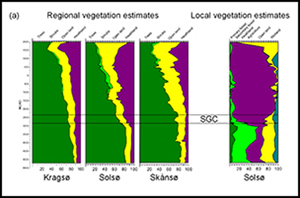
In western Jutland, a similar trajectory gave rise to anthropogenic heathlands. Odgaard et al. (Reference Odgaard, Ejrnæs, Näsman, Rasmussen, Møller, Ejrnæs, Höll, Krogh and Madsen2002) have recorded increased proportions of pollen from herbaceous species on sandy, well-drained soils in western Jutland during the third millennium BC, suggesting these soils particularly afforded heathland openings. In the fourth millennium BC, an increase in disturbance-indicator species such as Plantago lanceolata suggests ongoing small-scale clearances for husbandry and/or agriculture (Odgaard Reference Odgaard1994). Regional pollen trends suggest that the steady expansion of heathland began c. 3000 BC (Figure 3a), though recent work demonstrates that some localised growth could be rapid and radical (Figure 3a; Haak et al. Reference Haak, Kristiansen, Kroonen and Willerslev2023). Pollen preserved beneath barrows suggests that early heather-dominated areas were patchy and that SGC barrows were preferentially associated with these areas (Andersen Reference Andersen1998; Figures 3b & 4). The moraine, for example at Lake Solsø, accommodated larger stretches of heathlands while the sandy soils close to the Weichselian boundary, such as at Skånsø, supported more mixed vegetation (Odgaard Reference Odgaard1994). In contrast, towards the eastern boundary of the meltwater plains (e.g. at Skærskovgård), there would have been little heathland before the Late Bronze Age. Across western Jutland, the Late Neolithic saw a period of relative stagnation in heathland expansion, though notably, heathlands were maintained with regular burning (Odgaard Reference Odgaard1994). Burning is required every 6–15 years to prevent succession to scrub and forest (Gimingham Reference Gimingham1992: 56–7). Clearance resumed in earnest during the Early Bronze Age in both northern (Kristiansen et al. Reference Kristiansen and Austvoll2021: fig. 20.2) and western Jutland (Figure 3). Within these new heathland landscapes, novel funerary structures emerged: low mounds covering single inhumation graves. Initially, the construction of these barrows focused on the sandy, heath-supporting soils (Hübner Reference Hübner2005). The mounds are typically multi-phased, with pioneer graves dug into the ground or beneath low barrows. Subsequent burials might be used to enlarge existing mounds or new barrows might be added to alignments of barrows (Glob Reference Glob1944).
Comparison of regional and local vegetation trends in western Jutland, showing (a) regional and local estimations of land cover composition at three lake sites (redrawn from Odgaard Reference Odgaard1994: figs 48, 71 & 90; Haak et al. Reference Haak, Kristiansen, Kroonen and Willerslev2023) and (b) the local composition of landscape immediately preceding barrow construction during earlier periods of the Neolithic (grey) and the SGC period (black) (adapted from Andersen Reference Andersen1998: fig. 2 and annotated with data from figs 4–7) (figure prepared by M. Haughton).

Possible appearance of third millennium BC heathland in western Jutland, showing a mix of Calluna, herbaceous species and light open forest (New Forest, Hampshire, UK. Credit: soilnet.com).

The origin of these funerary traditions is still debated. The local impact of broader continental-scale migrations is difficult to assess because human remains are rarely preserved in Jutland, particularly in the core SGC expansion area. Archaeological and ancient DNA evidence, however, suggest migration was a factor (Egfjord et al. Reference Egfjord2021), and there were clear links in material culture and burial practices across Corded Ware-using communities in northern Europe (c. 2900–2000 BC). At the same time, local traditions remained important (Furholt Reference Furholt2014) and continuity of site locations and of funerary and depositional practices require explanation (Rostholm Reference Rostholm1982; Klassen Reference Klassen2005; Madsen Reference Madsen2020).
Hence, during the third millennium BC, a new kind of social and economic niche emerged, tied specifically to the sandy, nutrient-poor landscapes of western Jutland. This niche provided new affordances for seasonal grazing, with consequent demands for livestock and human mobility. Rather than merely providing a grazing ‘resource’, these heathlands were produced by social changes that allowed new possibilities to be discovered in the landscape. Moreover, the presence of the ancestors in these new landscapes was significant from the outset and novel burial forms seem to have responded to the growing openness of the landscape.
The emergence of ancestral commons
The co-occurrence of pastoral herding and new forms of burial in the emerging and expanding managed pastures of the third millennium BC suggests an important link between these practices. Rather than seeking an explanation which focuses on the pragmatics of subsistence in SGC communities, we recognise that worldviews emerge from embodied experience and interaction with the world. At every point, the entangled elements of this world emerged and gained significance in relation to one another. Instead of simply seeking pasture and then developing cultural and cosmological practices later, landscape and culture co-emerged; the emergence of heathlands was embedded in particular cultural (barrow-building) and economic (transhumant herding) practices and vice versa. This should not surprise us, for it has long been recognised that the division between ritual and profane is a product of modern worldviews (Brück Reference Brück1999; Bradley Reference Bradley2005). Instead, an entanglement blurred the boundaries between the heathland pasture, pastoral mobility and the ever-visible barrows for the dead. Living and acting in the presence of the ancestral dead fosters and strengthens associated practices (de Coppett Reference de Coppet, Barnes, de Coppet and Parkin1985).
Once emerged and entangled, heathlands created novel niches with new social affordances, which we call ‘ancestral commons’. As pastureland was intermittently visited and managed, heathlands must have been ‘held in common’—jointly owned and/or managed by social groups—and thus would have fostered a sense of community. At the same time, they were landscapes that recreated, confirmed and communicated a sense of common pasts. Via these two kinds of ‘commons’, heathlands became focal sites that orientated people and livestock around a shared cultural background, activated and reinforced by the nexus of practices pertaining to heathland maintenance, barrow-building and movement around the landscape that sustained them. These were all practices that required knowledge—both cosmological and practical. For instance, grazing and controlled burning require particular skills and reveal an orientation towards future outcomes (Noë Reference Noë2006; Dreyfus Reference Dreyfus2014). In this sense, all these practices would have acquired meaning within the spatial and temporal horizons of the heath pastures.
This form of ancestral commons has specific capacities in terms of persistence. Heathlands were caught in rejuvenation cycles (e.g. burning practices, transgression of the life/death of plants), reincarnation (e.g. funerary contexts, movement across threshold of human life/death), and return cycles (e.g. seasonality, the back-and-forth movement of people/animals). These cycles would have been linked to the ancestors through oral narratives as well as made tangible in the physical and visual qualities of funerary monuments. Moreover, the persistence of the heathlands would have constituted a stable landscape to which people could return, one distinct from other landscapes (Løvschal Reference Løvschal2022).
To elaborate these ideas, we trace the emerging relations between these elements beginning with the most archaeologically visible—barrows.
Barrows and heathland
The link between barrows and emergent heathland is well attested in the palaeoecological record (Odgaard Reference Odgaard1994; Andersen Reference Andersen1998; Hübner Reference Hübner2005). Burnt macrofossils of heather (Calluna vulgaris) have been recovered from SGC funerary mounds, for example at Malle and Rogenstrup (Figure 1). Investigation of a barrow in a linear cemetery at Malle identified a large amount of charred vegetation—almost exclusively Calluna with no arboreal species present—suggesting that the barrows were situated in an extensive area of managed heathland (Andreasen Reference Andreasen2009). Furthermore, the pollen record from SGC barrows frequently shows a succession from forest to heathland immediately pre-dating monument construction (e.g. Andersen Reference Andersen1998). The reverse situation—that is, a lack of both barrow-building and evidence for forest clearance/heathland expansion, as at Kragsø (Odgaard Reference Odgaard1994)—reinforces the link between heathland and funerary mounds. Finally, the use of heathland turves has been observed within the structural fabric of barrows in approximately 16 per cent of cases, though poor preservation conditions mean this may be an underestimate (Hübner Reference Hübner2005: 467–70). Harreskov provides another example: pollen diagrams show forest clearance and heathland expansion in association with a large rise in charcoal indicating deliberate burning in the years preceding barrow construction, and the final phase of the barrow preserved evidence for the structural use of turves (Odgaard & Rostholm Reference Odgaard and Rostholm1987).
Barrows can act as landscape markers only when they are widely visible; within forests, their low form (averaging 0.75–0.9m) would have been obscured (Hübner Reference Hübner2005: 473). Moreover, the linear arrangement of barrows, which could be easily recognised and followed, relied on open environments and visual prominence in the landscape; 85 per cent of known barrows in Jutland were positioned in locally prominent locations (Hübner Reference Hübner2005: 470–1). Cyclical burning further enhanced the visual prominence of barrows and prompted metaphorical associations. Burning transformed the pastoral landscape into an evocative conflagration, with the land covered by patchy flame and plumes of smoke, ultimately leaving it scorched and blackened for weeks or months, making barrows particularly prominent. The subsequent shoots of the recovering vegetation may have suggested metaphors of regeneration and persistence.
Heathlands and barrows thus had the potential to instantiate landscape history, tying together humans and their environments through repeated practices of burning, grazing, barrow-building and the reuse and enlargement of existing barrows. The ability of this system to compel action is attested by the palynological evidence for the continuous expansion of heathlands and sustained levels of microscopic charcoal (Odgaard Reference Odgaard1994; Figure 2).
Heathlands and mobility
While heathlands emerged on the sandy soils of western Jutland, grassland and shrub pastureland developed in deforested areas in eastern Jutland (Odgaard & Rasmussen Reference Odgaard and Rasmussen2000). Grass provides preferable grazing during the early part of the year for sheep and, in particular, cattle (Ferreira et al. Reference Ferreira2013). As heather maintains good nutritional value throughout the year, seasonal movement between these pastures and heathlands is likely. It is possible that transhumant herding covered distances of up to 90km (e.g. from Djursland in eastern Jutland to west of the Weichselian boundary), falling well within the range of historically attested pastoralism in northern Europe (Costello & Svensson Reference Costello, Svensson, Costello and Svensson2018). Repeated visits are also suggested by the careful maintenance of heathland. While birch burning at Vroue resulted in deformed pollen (Andersen Reference Andersen1998), heathland fires were actively managed to prevent destruction of the seed bank. Nevertheless, burning an area required pastoralists and herds to move on while the vegetation recovered. Thus, the rhythmic movement of humans and animals was integral to Neolithic heathland living.
The archaeological record also strongly suggests mobility. Examples of the two-aisled longhouse, which became the norm later in the SGC period (c. 2600–2350 BC), are scarce in western Jutland during the third millennium BC. Instead, at that time, the archaeological evidence—typically a few postholes and associated depressions—suggests that settlements were of an ephemeral nature. Similarly, finds are limited to small quantities of pottery sherds and worked flint with a few simple finished tools (Simonsen Reference Simonsen1987). Glob (Reference Glob1944: 245) recognised that SGC barrows frequently contained material derived from domestic activities and reasoned that settlements must have been located nearby. Limited evidence has been found, however, and no settlements are known from areas where the earliest burials occurred (Klassen Reference Klassen2005; Figure 5).
Comparison between SGC settlement sites and the phases of funerary activity (phases after Müller & Vandkilde Reference Müller, Vandkilde, Austvoll, Eriksen, Fredriksen, Melheim, Prøsch-Danielsen and Skogstrand2020: fig. 2.3; settlement data collected by K. Stæhr Gregersen) (figure by M. Haughton).

Some settlement sites may represent permanent or semi-permanent bases in later periods (see also Simonsen Reference Simonsen2017). This typically occurred beyond the core area of the initial SGC expansion, as at Vesterbæk where a series of two-aisled longhouses were situated close to SGC barrows and macrofossils of heather and charcoal were recovered (Møller Reference Møller2011). While the site is not well-dated, it may represent a more permanent base that operated in tandem with the seasonal mobility of some or all of the community into the heathland zone. The settlement at Rævind Hede may represent a similar base, located near SGC barrows at the northern extent of the heath-supporting soils, though its date is also uncertain (Terkildsen Reference Terkildsen2020).
In summary, rhythms of mobility were critical in the emergence and maintenance of heathland pasture. The requirement for repeated visits instantiated a particular relationship between humans and heathlands in which the landscape was repeatedly visited but only permanently inhabited by the ancestral dead.
Barrows and mobility
Linear arrangements of stone-marked graves were present in north-western Jutland as early as the late fourth millennium BC (Johannsen & Laursen Reference Johannsen and Laursen2010). SGC barrows were, subsequently, the first linear arrangements of mounded funerary monuments in Jutland. Müller (Reference Müller1904: fig. 15) recognised a 6km-long line of barrows at Dommerby (Figure 6). Another, more than 5km in length, is known from Trehuse, running along the Weichselian boundary (Hübner Reference Hübner2005). These arrangements created directionality in the landscape, working as ‘way points’ along which people could have moved (Løvschal & Fontijn Reference Løvschal and Fontijn2019). Typically following ridges and naturally dry routes, they seem to direct rather than restrict movement. Thus, barrows began to outline a landscape infrastructure that emerged alongside open landscapes and the mobility of people and herds across Jutland.
Alignment of Neolithic barrows parallel to a historical road at Dommerby Hede, northern Jutland (Müller Reference Müller1904: fig. 15) (figure by S. Müller).

The initial SGC expansion (2850–2650 BC) was marked by a particularly active phase of barrow building. Indeed, the majority (59%) of SGC barrows were constructed during the first two centuries of the period (Hübner Reference Hübner2005). During that time, Hübner (Reference Hübner2005: 468) estimates that five out of every six burials resulted in the construction of a new, low barrow. This large-scale barrow-building activity had important and long-lasting structuring effects on the landscape. By marking areas of newly opened pasture, barrows motivated people's return to these areas—as a result of both cosmological draw and for acts of commemoration and subsequent barrow building. This landscape structure and ways of moving through it were reinforced by each subsequent mound, in the same way as has been argued for the subsequent Early Bronze Age (Johansen et al. Reference Johansen, Laursen and Holst2004). As time went on, burials were more likely to be inserted into existing monuments (only every fourth burial now received a new barrow, Hübner Reference Hübner2005), presumably in connection with now-established seasonal patterns of movement partly marked out by barrow constructions. Thus, barrows instantiated and maintained rhythms of mobility.
The artefacts accompanying the dead also referenced distance and mobility. At Refshøjgård, excavation of an early SGC barrow recovered a beaker whose form blends local traditions and exotic influences; the excavator has suggested that the potter had seen beakers from central Germany (Klassen Reference Klassen2005). Later in the period, ‘A-horizon’ SGC artefacts suggest links with the wider Corded Ware world (Furholt Reference Furholt2014).
Human and animal remains are rarely preserved in the sandy soils of western Jutland and mobility within Jutland cannot currently be detected using standard isotopic techniques due to the low variation in radiogenic signals (Frei et al. Reference Frei, Frei and Jessen2020). Nevertheless, at Møgelvang, in northern Jutland, an individual dated to 2901–2586 BC had a non-local strontium isotopic signature, indicating an origin outside of modern Denmark (van der Sluis et al. Reference Van der Sluis, Daly, Frei and Reimer2020). These remains were derived from a disturbed Early Neolithic tomb, which had been subsequently reused multiple times in antiquity. Additionally, one of seven individuals buried in a SGC cist at Gjerrild, in eastern Jutland, had a non-local isotopic signature (Frei et al. Reference Frei2019). The genomes of three of these individuals also indicate significant Steppe ancestry (Egfjord et al. Reference Egfjord2021), providing further evidence that the SGC phenomenon was associated with long-distance mobility, at least at its outset. None of these examples, however, comes from a typical SGC barrow.
Hence, barrows emphasised connectivity and movement. They monumentalised mobility, for example, through the deposition of objects that reflected the connections formed by that movement and—through the use of heathland turves in their construction—links with the very land that motivated and enabled mobility.
Discussion
Ancestral commons in the Middle Neolithic
More than simply change in vegetation or subsistence basis, the emerging ancestral commons represented entangled cultural, cosmological and landscape practices. As concepts of space are culturally mediated, landscapes can shape understandings of time, cosmology and life/death. Here, we consider how the emerging ancestral commons might have shaped the communities which, in turn, shaped them.
The association between ancestral commons and mobility is firmly established in relation to the physical world, but there are also metaphorical implications. The rhythms of movement must have included both the living and the dead, the latter taken for burial in the barrows and becoming part of a physical infrastructure for travel. Hence, the mobility of the living and the dead were intimately entangled in this landscape—barrows (and by extension the bodies of the dead) became the infrastructure used to orientate and direct long-distance travel for the living and, potentially, also directed onward passage for the dead. To journey through this landscape, then, was to travel with the dead (Løvschal Reference Løvschal, Fontijn, Louwen, van der Vaart and Wentink2013) and, in a literal sense, to be guided by them.
The heathland itself was also ripe with metaphorical associations. The landscape compels return through the cycle of disturbance and rejuvenation. Each return would see renewal written onto the landscape in new life that emerged under the watch of the ancestral barrows. At the same time, barrows that would have appeared conspicuous when newly constructed would gradually become incorporated into the landscape as vegetation covered their surfaces. In this way, we suggest metaphors of rejuvenation and incorporation could have led to a reciprocal cosmological transfer between the barrows and the heathland itself. In this context, the co-operation and trust required to maintain these landscapes were mediated both by the landscape and its demands and by the dead, and theirs (cf. de Coppet Reference de Coppet, Barnes, de Coppet and Parkin1985).
These landscapes did not afford obvious means of enclosure or control of the commons. Neither are there prominent points from which to observe pastureland—and herds—nor settlements placed to exploit the commons directly. In addition, the need to move animals to access grazing opportunities elsewhere would have taken people tens of kilometres away into eastern or northern Jutland for parts of the year. Thus, it is unlikely that these commons were managed by physical control. Instead, they might have been grounded in a system of enabling and securing access and grazing rights (Moritz Reference Moritz2016), reinforced by the cosmological force of the ancestral commons.
The ancestral commons did not remain unchanged through time, however. For example, barrow building was more popular during the early SGC period, when rhythms of return were established. In the later Neolithic, the heathland was maintained as a place for return but far fewer barrows were built. A subsequent boom in barrow-building in the Early Bronze Age perpetuated the landscape's underlying cosmological rationale: during this period, people returned to old SGC barrows and built new barrows (though of different forms) in similar locations.
Long-term ramifications of ancestral commons
We suggest that the ancestral commons established by Neolithic pastoral regimes in Jutland provided the building block on which the Nordic Bronze Age world developed. It is well-established that mobility was important in the Bronze Age world, underpinning not only the sourcing of raw materials for bronze that were dispersed throughout Europe, but also the acquisition of other goods such as wool, amber and gold. This interconnection is so marked that it is regularly argued to represent a new horizon in exchange and interdependence (e.g. Vandkilde Reference Vandkilde2016). Such a system must have been built upon expectations of reciprocity, common understandings and the ability to travel unimpeded. We argue that such a system did not simply emerge because communities desired bronze. Instead, we have demonstrated how a system of mobility and shared expectations of other groups developed as a specific result of the landscape affordances and interactions with the world during the preceding millennium.
It is a curious feature of Danish prehistory that two intensive phases of barrow building, in the SGC and Early Bronze Age, are separated by a period of relatively limited mound creation (Holst et al. Reference Holst, Rasmussen, Kristiansen and Bech2013). Nevertheless, the palaeoenvironmental record clearly demonstrates that heathlands were actively maintained during the intervening period. The reduction in barrow-building coincides with the arrival of Beaker pottery and of early metallurgy to western Jutland. We suggest there followed a period of acculturation, during which new ideas and practices were adapted to the landscape, reinforced by the familiar ancestral commons. These ancestral commons were then primed for re-activation in the Early Bronze Age, when travelling alongside the ancestral dead gained a new importance in the context of long-distance trade.
Pastoral mobility generated a network of social connections and its instantiation in the ancestral commons provided the cosmological and social force necessary to hold together the wider complex through the changes at the onset of the Nordic Bronze Age. Allowing people to move freely in the landscape was a prerequisite that must have been tied into previously established grazing rights and landscape maintenance obligations. Thus, we argue pre-existing social ties established in a SGC pastoral context across western Jutland, and presumably maintained by transhumance and heathland management in the following centuries, were primed and ready to be mobilised in the Bronze Age. This social and economic niche was the result of interspecies and intercommunity collaboration that stretches beyond any pioneering intent to bring about particular worlds (cf. Kristiansen et al. Reference Kristiansen2017) and instead reveals the deep-time ramifications of the entanglement of people, herds, landscape and cosmology.
Conclusion
This article has summarised a story of the complex co-emergence of social, economic and cosmological concerns in the context of the late prehistoric heathlands of western Jutland. The changes of the third millennium BC—in particular, the opening up of the landscape and formation of heathlands, mobile pastoralism and barrow-building—were not distinct developments, but rather were entangled from the start. This landscape-based entanglement, which we have argued constituted a kind of ancestral commons, had specific qualities related to its emergence that contributed to its enduring success.
Ultimately, this is a story of the deep roots of the landscape and cultural world of the Nordic Bronze Age. The expansive connectivity of the latter must have had multiple origins but, we argue, it was the interdependence of the third millennium BC communities of practice, powered by the heathland landscape and the ancestral dead, which permitted the emergence of trust and mutual understanding between the communities of Jutland and far beyond.
Acknowledgements
The authors thank the ANTHEA project team for discussion of these ideas, particularly Kirstine Stæhr Gregersen for help with references, and the two anonymous reviewers for their thoughtful comments.
Funding statement
The project received funding from the European Research Council (ERC) under the European Union's Horizon 2020 research and innovation programme (grant agreement number 853356).


 Open access

