

This year marks the fiftieth anniversary of Lawrence C. Goodwyn’s Democratic Promise: The Populist Moment in America, published by Oxford University Press in 1976. Goodwyn’s magisterial work appeared at a time when the so-called New Social History had reoriented the way American historians looked at the nation’s past. Rejecting a great-man approach to studying the past, that generation of historians had discovered the common man and woman, concluding that the stories of ordinary folk—and indeed even marginalized and oppressed people—had at least as much to teach us about our past as did presidents, generals, or captains of industry. Social and political movements that failed were as important to understand as those that succeeded.
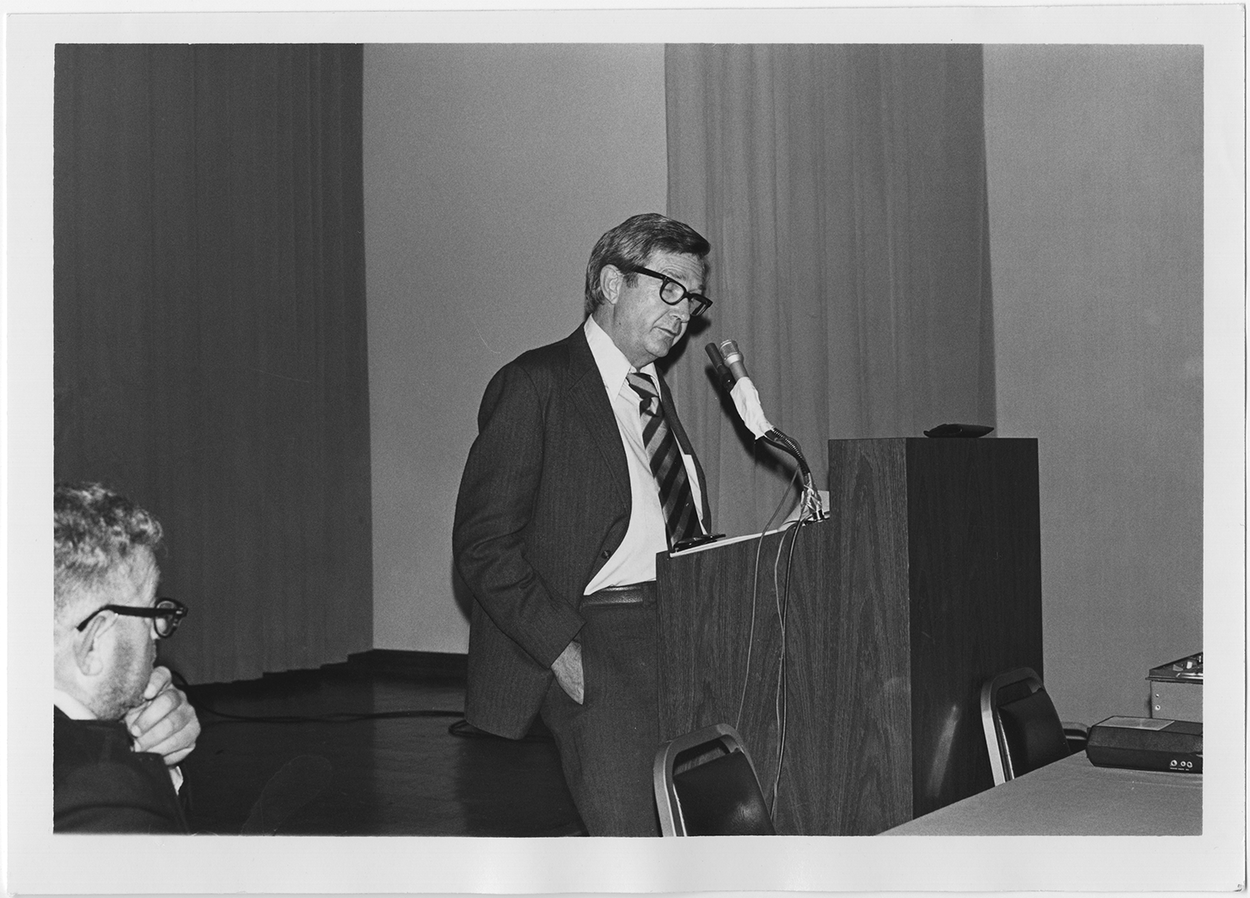
Lawrence C. Goodwyn, author of Democratic Promise: The Populist Moment in America (1976), speaking in 1978. Courtesy Special Collections, University of North Texas Libraries, Denton, Texas.

Lawrence Corbett Goodwyn (1928–2013) graduated from Texas A&M University and served in the Army during the Korean War. Then he earned a PhD from the University of Texas at Austin in 1971. Goodwyn came to the study of history fresh from a career in journalism, having extensively documented the Civil Rights Movement in the Deep South as well as then editing the organ of Texas liberals, The Texas Observer. Among Goodwyn’s most important influences was the British historian E. P. Thompson, whose 1963 book, The Making of the English Working Class, had been influenced by Marxism but emphasized the unique development of grassroots, working-class consciousness, mutualism, and solidarity in England. Goodwyn saw many parallels between Thompson’s English workers and downtrodden American farmers and laborers, not least among them being the ways both sets of workers created their own movement cultures and radical responses to industrial capitalism.
Goodwyn was not alone among American historians seeking to rehabilitate the reputation of Populists from the harsh judgments of Richard Hofstadter and others, who, writing in the shadow of McCarthyism, had accused the Populists of narrow-minded bigotry, anti-Semitism, and demagoguery. C. Vann Woodward, Norman Pollack, and Walter T. K. Nugent, among others, had preceded Goodwyn in disputing the notion that Populists were some species of protofascists. But Goodwyn brought to the task his formidable skills as a writer and his fervent conviction that American Populism had radical roots, and those roots of Populism sprang from the Texas-based Farmers’ Alliance, not from some liberal midwestern opposition tradition. Populism, in his telling of the story, was a movement in opposition to American liberalism and capitalism—a movement that, while ultimately unsuccessful, briefly offered a more democratic, cooperative alternative to the course the nation had pursued and would continue to pursue. The Populist Moment, as he termed it, was a tragic tale of lost opportunity.
At the heart of Goodwyn’s thesis in Democratic Promise was the idea that the Alliance cooperative experience created a profoundly democratic and grassroots “movement culture” (xiii) based on cooperation rather than on capitalistic competition. This movement culture had something of an analogue in the Knights of Labor. When the existing power structure destroyed the cooperative self-help programs of the Alliance and the Knights, these organizations’ members created the People’s Party, where they hoped to use political power to create a “cooperative commonwealth” (xx) by radically restructuring the nation’s financial system. The centerpiece of their program was the abolition of the national banking system and the adoption of a greenback-based currency issued by the federal government, a goal to be realized largely through the enactment of Charles W. Macune’s proposed Subtreasury Plan, an ambitious program of affordable government loans to farmers. But in Goodwyn’s telling, the Populists’ plans were stymied by the existence of a “shadow movement” (xiv), a sort of fake Populism not informed by the cooperative experience and thus lacking the dedication to principle required for Populist success. In 1896, according to Democratic Promise, the shadow movement sold its soul for the effervescent promise of Democratic fusion candidate William Jennings Bryan and silver coinage, a betrayal of genuine Populist principles that spelled doom to the People’s Party, the movement it had represented, and the democratic future for America that it had promised.
I first met Larry Goodwyn in 1986, when the late Robert A. Calvert (who was one of Goodwyn’s University of Texas classmates and a mentor of mine at Texas A&M) accompanied me on a research trip to North Carolina. Bob and I were houseguests of Larry and Nell Goodwyn in Durham for a week, and during that time, Larry regaled us with stories about his current research into the rise of the Solidarity movement in Poland, yet another story of working-class movement formation and political radicalism. The fires of Populism still burned brightly in Larry, who spent several late nights that week sharing his thoughts about my own research into Populism and race in Texas. A year later, on a return trip to North Carolina to finish my dissertation research, I dropped by Larry’s house to give him an update on my progress. I had forgotten about this return visit with him until the summer of 2025, when I retired from teaching and was cleaning out my office at TCU. I came across a long-forgotten diary I had kept of that trip, some thirty-eight years earlier. My entry for that day reminded me of Larry’s passion for Populism, research, activism, and the life of the mind. “Larry asked me if I would come by his house at 10:30 a.m.,” I wrote. “I expected a conversation of an hour at the most—5 hours later, I left his house.” At the end of that day’s diary entry, I noted that “I was exhausted after 5 hrs. with Goodwyn. That’s like 5 hours with the Inquisition.”
Like many true believers, Larry had little patience with those who did not see the world his way. It took me years to conclude that he was wrong about key aspects of Populism, and part of me was secretly relieved that he did not live to see my excessively long history of Texas Populism, The People’s Revolt: Texas Populists and the Roots of American Liberalism (2020), which reached conclusions that he would have viewed as heresy. I have often said that Larry never let the facts stand in the way of a good story, a verdict I arrived at only reluctantly when I was unable to find evidence for many of his claims about Texas Populism. But to say that Lawrence Goodwyn cast a long shadow over my own work, and over the study of Populism, would be an understatement.
The contributors to this roundtable have collectively written, by my count, ten books on Populism or related topics. They were given free rein to share their own thoughts about the significance of Goodwyn and Democratic Promise, as well as the abridged version of the book published by Oxford University Press in 1978: The Populist Moment: A Short History of the Agrarian Revolt in America. In particular, Democratic Promise, with its dramatic prose and riveting tale of the path not taken by American politics, is a work that greatly influenced all of the participants in this roundtable. Historians of Populism are still coming to terms with it. We would all be so lucky if that could be said of our own works half a century after their publication.
When I was invited to take part in a roundtable commemorating the fiftieth anniversary of the publication of Lawrence Goodwyn’s Democratic Promise, my first reaction was “fifty years???” But I soon owned up to that timetable and agreed to participate.
I met Larry Goodwyn around 1970, when he was turning his University of Texas dissertation into the book that would become Democratic Promise and I was returning to the University of North Carolina at Chapel Hill after an interruption of my graduate studies for what we called—with little humor—a “McNamara fellowship” (i.e., military service in Vietnam). Despite our differences on some details of populist historiography, Larry and I were on the same page in what, at the time, was the great divide between scholars of American Populism who viewed the Farmers’ Alliance and People’s Party as a reincarnation of McCarthyism or, as both of us firmly believed, a new vision of democratic promise in America.
When Larry and I met, he was collecting material in Chapel Hill to flesh out his big book and I was churning out chapters of a dissertation on southern Populism at UNC. The academic job market was beginning to tank, but Goodwyn, a seasoned journalist and historian who never lacked confidence in his own powers of persuasion, seemed undaunted. He somehow arranged an audience with the president of Duke University, and one afternoon he drove from Chapel Hill over to Durham for the meeting. Larry’s calling card, so to speak, was an excellent article-length manuscript titled “Populist Dreams and Negro Rights: East Texas as a Case Study,” which eventually became a well-known article published in the American Historical Review (appearing in the December 1971 issue). In a sign of how much things have changed in academia in the past half-century, Goodwyn came away from that meeting with a job offer in hand and subsequently served on the Duke history faculty for his entire academic career, directing Duke’s oral history program and mentoring a significant number of graduate students.
Like many historians of that era, Larry was enamored with the work of C. Vann Woodward. When I asked what led him to that conviction, he had a ready answer: Goodwyn—like Woodward—believed that a successful historian must not only master his or her research subject but also take care of the way in which his or her material was presented to the public. Both believed that the writing could carry their argument even if the data were less than compelling. Not all reviewers at the time, nor all of my fellow panelists in this roundtable, would agree.
Goodwyn divided historical writing about Populism in the South and Great Plains into two groups: those which had strong grassroots movements—many of them launched by organizers from Texas—and others, which he famously dubbed a shadow movement, which did not. Prior to Democratic Promise, much of what had been written about Populism had been written by participants in the movement and began to appear in print almost immediately after the events they described. Matt Hild, Charles Postel, and others in this roundtable will discuss early historians of Populism, such as John D. Hicks and Chester McArthur Destler, but Goodwyn inspired a new spate of books testing his theories in individual states; several of these are mentioned by my colleagues below. Other historians explicitly took issue with significant aspects of his interpretation, particularly what they saw as his overemphasis on the Texas experience in explaining the so-called movement culture of Populism. These included Robert W. Cherny (“Lawrence Goodwyn and Nebraska Populism: A Review Essay,” Great Plains Quarterly, 1981) and Stanley Parsons, et al. (“The Role of Cooperatives in the Development of the Movement Culture of Populism,” The Journal of American History, 1983).
Goodwyn did not always take kindly to those who might point out errors in his work. During the interregnum between my first encounter with him and the publication of his book, I shared with the aforementioned Robert Cherny an instance in writing where Goodwyn did not follow his own rule for what he considered to be the necessary order of events in the formation of cooperatives. I later apologized to Larry for not giving him a heads-up, but we did not speak for a long time afterward.
Subsequent treatments of Populism have taken issue with Goodwyn’s Texas-centric, Greenbacker-influenced emphasis on the formation of the movement culture of Populism. My own early work, especially Populist Vanguard: A History of the Southern Farmers’ Alliance (1976), published the same year as Democratic Promise, emphasized the role of producerism and evangelicalism in Populism. Since then, books such as Joe Creech’s Righteous Indignation: Religion and the Populist Revolution (2006) have expanded on the theme of religion, while Charles Postel’s influential The Populist Vision (2007) placed American Populism more squarely in the context of modern capitalist development, suggesting “that modern society is not a given but is shaped by men and women who pursue alternative visions of what the modern world should be” (viii).
It is safe to say that the last word has not been written on American Populism. But all of these scholars, and many more, owe much to the originality and power of Larry Goodwyn’s work.
The 1976 publication of Lawrence Goodwyn’s Democratic Promise played a pivotal role in the paradigm shift in Populist historiography that discredited Richard Hofstadter’s dismissal of the late nineteenth-century agrarian uprising as little more than an example of status anxiety and the complaints of men out of step with the progress of history. Focusing on the Texas Farmers’ Alliance and subsequent People’s Party, Goodwyn famously argued that the agrarian movement represented the “largest democratic mass movement in American history” (Populist Moment vii). Democracy was not the musings and actions of great men, Goodwyn contended, but rather the collective movement of the people. For Goodwyn the failure to understand the Populists arose from a national misunderstanding of the nature of mass democratic movements, the language used to describe such movements, and the presumptions about the role of different classes of people in history. In framing his argument, he engaged in a larger analysis of the nature of democracy. Goodwyn concluded, “In an age of progress and forward motion, they [Populists] had come to suspect Horatio Alger was not real…. Heretics in a land of true believers and recent converts, they saw the coming society and they did not like it” (Democratic Promise 552–553). What they saw was the corporate state and they organized in an attempt to bring it under democratic control.
The appearance of Democratic Promise during the celebration of the nation’s bicentennial raises interesting historical parallels. In 1976 the United States was in the throes of a decade of economic chaos that would witness the transition from the prosperity of the so-called New Deal Order to an economic reality sometimes labeled neoliberalism, a free-market ideology that sustained a global economy of outsourced production, information technology, and new financial instruments. The economically pivotal decade of the 1970s followed a successful, decade-long people’s movement to secure civil and political rights for Black citizens. The overthrow of Jim Crow represented both a transformational moment in Black history and a renewed public debate over the nature of democracy. Like many historians of the era, Lawrence Goodwyn, a lifelong activist, was a participant in the Civil Rights Movement and knew firsthand the ebb and flow of mass movements. He could not have been surprised that the next iteration of democracy and capitalism would further limit people’s power while promising prosperity.
For the Populists, participatory democracy required citizen input from the selection of candidates to popular election of U.S. senators. A humane capitalism challenged the “money power” that Tennessee’s 1890 Alliance governor dismissed as “a mushroom growth of ‘booms’ and wild speculation … in which a few are enriched to the detriment of the many.”Footnote 1 Real progress rested on government regulation to level the playing field, create a flexible currency, and make a more open political system. In the 1960s and 1970s, American activists looked for social and economic programs that would foster avenues to assure individual economic stability, opportunities for education, healthcare, home ownership, and time for leisure and creativity. Goodwyn fought for the rights of the poor and disenfranchised, but his research into the Populist era convinced him that entrenched power made small concessions but did not engage in fundamental change that favored the people.
As Bob McMath notes above, Goodwyn’s first career as a journalist was an important factor in his scholarship. His journalism background is evident in his use of language to both narrate the story of agrarian insurgency and probe the intricacies of their evolving position. Like any good journalist, he incorporated individual voices into his narrative whenever possible, knowing that contemporary men and women could present their views in hard-hitting, everyday language that still resonated more thoroughly than scholarly explanations and political theories. Texas politician Jim Hightower, who, like Goodwyn, once edited the Texas Observer, has called Goodwyn a “maverick” and “an independent thinker” who sought out and listened to the voices of marginalized people. Hightower described Goodwyn as “an honest digger of history’s real stories.”Footnote 2 This trait led to another aspect of Goodwyn’s legacy: the creation of Duke’s oral history program.
One of Goodwyn’s students at Duke, Charles Bolton, related his experience in Goodwyn’s oral history seminar to emphasize the importance of collecting stories of marginalized people. Bolton was embarrassed when a fellow student, from California, disparaged his South Mississippi roots. In a later conversation, Goodwyn assured his student that humble origins were an asset in oral history. “Bolton,” he said, “you’ve come from the bottom of the mud hole; it’s very hard for you to condescend to other folks. And that is one of your strengths. Not just as a person, but as a historian.”Footnote 3 Bolton went on to write about poor whites and direct the Center for Oral History and Cultural Heritage at the University of Southern Mississippi. Like Bolton, a number of other Goodwyn students became directors of oral history and documentary centers, demonstrating that it is not only the books that we write but also the students we mentor that shape a historian’s legacy.
I did not know Lawrence Goodwyn personally; my one encounter with him came at a conference session in which he was a panelist. That one experience confirmed much of what I had been told about him. It was a particularly memorable event. The session was a roundtable discussion on new works on Populism and its influence in the Progressive Era. Anyone who has read his book knows that Goodwyn viewed the 1896 election as the highwater mark of publicly engaged democracy. As he phrased it, the defeat of Populism in 1896 banished the financial question and established patterns for the twentieth century: rapid acceleration of the industrial merger movement, decline of public participation in the democratic process, and corporate domination of mass communication. It was expected that the panelists would engage in a lively discussion, and they did not disappoint. But Goodwyn engaged the audience in unexpected ways. Soon everyone in the packed room was excitedly contributing to the discussion in a way I can only describe as akin to a graduate student debate over beer and pizza, with all the enthusiasm and intensity those conversations entail. Everyone was so engaged that no one noticed the time until we were reminded that our time was up and we needed to vacate the room. We all moved to the hallway and continued to defend our positions until moderators from other panels came out to encourage us to speak quietly or else find another place to debate Populist history. Since it was near lunchtime, we broke into smaller groups and left. I cannot speak for others, but my group continued to discuss the morning’s insights through lunch and into the afternoon. Goodwyn’s reputation for provoking discussion was on full display. It energized the panel and audience to reconsider or defend their positions, and at least one audience member was challenged to reconsider some assumptions about the Populist movement and go back to the evidence.
Democratic Promise launched a generation of new scholarship on Populism. Goodwyn’s focus on Texas Populism encouraged others, myself included, to analyze the Populist Moment in other states, sometimes challenging Goodwyn’s insights and, at other times, confirming his work. The role of Black Populists and their relation to the twentieth-century Garvey Moment reshaped earlier interpretations that had marginalized Black Alliance members and Populists. Cultural histories, women’s histories, and intellectual histories of Populism all questioned Goodwyn’s interpretation while solidifying his position in the pantheon of great historians. Fifty years later, we are once again at a crossroads of democracy and capitalism, not only nationally but globally, but this time we have insights from the Populist Moment, which Goodwyn encouraged us to explore.
Lawrence Goodwyn’s Democratic Promise was different. My first encounter with the book was twenty years after its publication when I started reading about Populism in earnest during my first year in graduate school. Other historians had written compelling and excellent histories. What set Goodwyn’s work apart was the sense that he wrote about the Populists as an insider, exploring their collective thoughts, probing the interior of their movement. A gifted journalist, Goodwyn unfolded the story of Populism by conveying a sense of being there on the ground with what seemed like direct knowledge of the historical actors. I was unsure about some of the analytical framing. Was Goodwyn’s formula for the “sequential process of democratic movement-building” (Populist Moment xviii) universally applicable to social movements? Did it even fit the Populist movement? I had questions. Nonetheless, the story was alive. I greatly appreciated a history that recognized the capacity of ordinary working people to think, to imagine, and to build a social movement striving for an alternative to the corporate status quo. Moreover—and this may have been the key thing that caught my attention—Goodwyn seemed unburdened by the heavy condescension that has so often weighed down the histories written of rural people. He presented his Populist heroes as human beings fully equipped with intellectual, emotional, and creative powers. He had written a book that invited the reader into the Populists’ world, and in doing so his work was an inspiration.
Goodwyn’s work was also full of surprises. I had started reading about Populism in my search for the origins of the New Deal and mid-twentieth-century farmer-labor politics. Goodwyn, however, unlike John Hicks and other historians, saw rupture rather than continuity when it came to Populism and the New Deal. Influenced by the New Left concerns of his day, he saw the New Deal and its farmer-labor complement as part of the bureaucratic and corporate order that triumphed in the twentieth century. His search was for an alternative democratic culture. And he found that alternative culture in the Farmers’ Alliance born of the central Texas plains. Part of this culture, Goodwyn told us, was rooted in the cooperative movement, which made sense to me given that enthusiasm for cooperative economics fit well with New Left sentiments about economic and participatory democracy. The New Left romanticized how cooperative enterprises functioned, and Goodwyn did, too. He ignored, for example, the highly centralized and bureaucratic mechanisms that would be required to control the entire Texas cotton crop, as the Farmers’ Alliance sought to do. Nonetheless, cooperative enterprise had its logic. But I was genuinely surprised by the other element of what Goodwyn viewed as Populism’s democratic culture: Greenback monetary theory. His history made the greenback apostles to be the true and pure champions of Populist democracy, the messengers of the unique solution to the problems facing the nation’s working people. On first reading, it did not seem plausible that a late twentieth-century historian would embrace the notion that the monetary question was the key to human liberation. Goodwyn, however, had not only explored Populist thinking; he had made parts of it his own. As David Montgomery so pointedly remarked, “Goodwyn is not simply a historian who understands Greenback doctrine…. He is a Greenbacker.”Footnote 4
Adopting the Greenback theory was surely quirky, but lots of historians have their quirks. The problem, it seemed to me, was that as a greenback apostle himself, Goodwyn had failed to treat Greenbackism as one among several intertwined branches of Populist culture, and in so doing lopped off multiple limbs of the movement. I had read Democratic Promise alongside Chester McArthur Destler’s American Radicalism, 1865–1901, a 1946 collection of essays about post-Civil War farmer and labor movements. Destler’s essay on the influence of Edward Kellogg and his theories about credit and fiat currency helped me understand Goodwyn’s focus on the monetary question. But for Destler, the Farmers’ Alliances, with their soft-money doctrines, were just one part of what became the Populist coalition, and other essays in his volume explored the multisided negotiations among downstate farmers, Debsian railway workers, Knights of Labor organizers, trade unionists, Single Taxers, prohibitionists, and socialists in the forging of the People’s Party in Illinois. Writing in the shadow of the New Deal, Destler examined the messy business of coalition building in farmer-labor and social-democratic politics. Goodwyn’s favored Texas faction was skeptical about such messy business, and his history left me wondering about the other currents of thought among the workers and farmers who made up the industrial organizations that founded the People’s Party. What of the syndicalist Populists who looked to the unification of labor as the path to emancipation? What of the socialist Populists, of the revolutionary and evolutionary variety, who held that the public ownership of the means of production was necessary to end exploitation? What of the Single Tax Populists, including among the Black landless poor, who held that land monopoly lay at the foundation of society’s ills? These other Populists appeared on the margins of Goodwyn’s history, although too often they did so in the role of pretenders and villains.
Goodwyn’s book was also different because it was such a bracing read, a well-told story of true-hearted heroes doing battle with imposters lurking in what he called the shadow movement. In the climax of this high drama, the bravest of the heroes were the middle-of-the-road Populists, who stuck to their radical principles and refused to make political alliances with either the Republicans or the Democrats. The worst of the villains, he told us, were the fusionists, mere opportunists who sought electoral agreements with one or the other of the main political parties. This morality tale, although compelling, left me with more questions than answers. Prior to the Civil War, had not the abolitionists made skillful use of fusion politics to advance their radical cause? And after the war, had not farmer-labor parties, including the Greenbackers, regularly engaged in fusion in pursuit of their political goals? And had not this fusionism included radical labor Populists and some of the most radical of the Populist editors? Perhaps this was a question of specific contingencies and political calculi, and Goodwyn was generalizing from the Texas experience, where most Populists saw little to gain from an electoral agreement with the Texas Republicans and looked at fusion with their Democratic enemies as political suicide. In any event, the notion that fusion was the bane of farmer-labor politics is a key lesson that a reader might draw from reading Goodwyn. Significantly, the old guard of the Republican and Democratic parties drew the opposite lesson, and in the wake of the Populist revolt enacted anti-fusion laws across most of Populist country with the aim of inhibiting third parties and electoral agreements that might threaten their grip on power.
The first thing I noticed about Goodwyn’s Democratic Promise was that—unlike anything else written on the topic, and unlike most historical monographs—it was a big, sprawling book, coming in at more than 700 pages. As Connie Lester has already noted above, this format enabled Goodwyn to unleash his vibrant prose in all its expansive glory and to follow his sources into remote corners, providing provocative detail that may or may not have fit the core narrative. The abridged version, The Populist Moment (1978), is half as long and more accessible to most readers; it is also more tightly focused, pruning Goodwyn’s prose and further narrowing the Populist story. In the original, for example, Goodwyn provides clues about the remarkable racial dynamics of Populist-Republican fusion in North Carolina, “a wondrous blend of ‘practical politics,’ Populist racism, fear of Democratic racism, and—occasionally—a genuine effort to build an interracial political coalition on a cornerstone of election reform to protect the freedom of the ballot” (Democratic Promise 342). The result was the unmatched protection of voting rights for both the Black and white poor, and the partial realization of multiracial democracy. In the abridged version, pieces of the racial paradox drop out, and one of the most critical episodes in the fight for racial equality in the post-Reconstruction South might easily be missed.
It would be nice to see Democratic Promise back in print. Populism was a vast, multiregional, and multidimensional social and political movement, and the vast expanse of the original Democratic Promise provides invaluable clues for its exploration.
Like Charles Postel, I first read Democratic Promise two decades after its publication. I had already read three monographs on American Populism, Robert C. McMath Jr.’s Populist Vanguard: A History of the Southern Farmers’ Alliance (1975) and American Populism: A Social History, 1877–1898 (1993), as well as Barton C. Shaw’s The Wool-Hat Boys: Georgia’s Populist Party (1984). Free of any academic burdens that summer as I traveled up and down the eastern seaboard, I resolved to read in their entirety Goodwyn’s lengthy tome plus the even more daunting The Emergence of the New South, 1913–1945 (1967) by George B. Tindall. (At a conference that I attended at Kennesaw State University in 2001, Professor Tindall declared that he had never read his own magnum opus because “it’s too darn long,” or something to that effect. I could not tell whether or not he was joking.)
Having already read the books by McMath and Shaw, I undoubtedly read Democratic Promise from a different perspective than those who read it upon its publication. But like my fellow panelists in this roundtable, I was struck not just by its length but by its breadth, the depth of Goodwyn’s research, and the passion with which he wrote about Populism. My impression upon finally completing it was that I had read a book as important and magisterial as Tindall’s aforementioned Emergence of the New South and C. Vann Woodward’s Origins of the New South, 1877–1913 (1951), a book that had reframed the understanding of its subject.
Given that I had been and would continue writing about the Knights of Labor in the South at the time I read Democratic Promise, the chapter that most influenced my thinking about Populism was the sixth, “Toward the Sub-Treasury System and a National Farmer-Labor Coalition.” Along with the books by McMath, this chapter of Democratic Promise suggested that it would be possible for me to write a publishable doctoral dissertation about farmer and labor movements in the late nineteenth-century South, in which the Knights of Labor, the Southern Farmers’ Alliance, the Colored Farmers’ Alliance, and the Populist Party would play central roles. Older books about the Knights of Labor, such as Norman J. Ware’s The Labor Movement in the United States, 1860–1895: A Study in Democracy (1929), relegated the Farmers’ Alliances and the Populist Party to a minor role associated with the decline of the Knights. Similarly, older works on the Farmers’ Alliances and Populism, such as John D. Hicks’s The Populist Revolt: A History of the Farmers’ Alliance and the People’s Party (1931), paid only scant attention to the Knights.
Goodwyn, on the other hand, devoted a considerable amount of narrative and analysis to the Knights of Labor and the possibility of a farmer-labor coalition. Democratic Promise made a significant contribution to the historiography of the somewhat misnamed Southwest Strike of 1886 in which the Knights, with support from some members of the Texas Alliance, unsuccessfully challenged the railroad magnate Jay Gould. Goodwyn argued that the strike sparked the radicalism of future Texas Populists such as William R. Lamb.
Yet Goodwyn also emphasized what he saw as the fatal obstacle to a farmer-labor coalition rallying around the new People’s Party that would be established during 1891–1892. “As of 1892,” Goodwyn wrote, “neither the Knights of Labor nor any other American working-class institution had been able to create in its own ranks the culture of a people’s movement that had animated the Farmers[’] Alliance since 1886” (Democratic Promise 309). This conclusion would have been reasonable based upon any of the books about the Knights of Labor that existed when Goodwyn wrote his own volume, although Goodwyn had perhaps done enough research about the Knights of Labor (in Texas, at least) to draw his own conclusions. But books would be published during the next twenty years that would suggest that Goodwyn had underestimated or even misunderstood the movement culture of the Knights and its political impact during the Gilded Age. One of the most notable of these studies was Leon Fink’s Workingmen’s Democracy: The Knights of Labor and American Politics (1983). Subsequent works by Bruce Laurie and Robert Weir also made compelling arguments for the Knights having built a tangible and important movement culture. My own book, Arkansas’s Gilded Age: The Rise, Decline, and Legacy of Populism and Working-Class Protest (2018), demonstrated that organized labor, especially the Knights, played a significant role in the Populist Moment in that state, which occurred during the period of 1888 to 1890, under the guise of the Union Labor Party, before being crushed by election fraud and violence perpetrated by Democrats.
The books by Fink, Laurie, and Weir focused on the United States more broadly than did Democratic Promise. As Charles Postel notes above, Goodwyn’s book focused more on the South than on the United States as a whole, and more on Texas than on the South as a whole, which may have kept the book from being as balanced as, for example, Hicks’s The Populist Revolt (1931) or later books by McMath and Postel. Texas Populism, as important as it was, did not necessarily represent American Populism—or even southern Populism—very well.
Two important books about Georgia Populism that were published less than a decade after Democratic Promise illustrated this point well and constituted significant challenges to Goodwyn’s emphasis on the Alliance cooperative movement, Alliance radicalism, and the politics of the Subtreasury Plan. In The Roots of Southern Populism: Yeoman Farmers and the Transformation of the Georgia Upcountry, 1850–1890 (1983), Steven Hahn traced the origins of Populism in Georgia to the arrival of commercial agriculture and market capitalism during the 1870s and 1880s, which drew farmers into “the vortex of the cotton economy” (135). To Hahn, the Farmers’ Alliance itself was rife with “class divisions” (275).
Arriving on the heels of Hahn’s book, Barton Shaw’s The Wool-Hat Boys (1984) downplayed the significance of Populism in the upcountry of North Georgia and instead emphasized Tom Watson’s part of the state, the east central Georgia Cotton Belt, as a Populist stronghold. Shaw argued that a long history of political dissent in that particular region, dating back to the era of Jacksonian Democrats and Whigs, had turned Watson’s Tenth Congressional District into a veritable political school that made voters well prepared to embrace Populism as the latest vehicle for opposition to the Democratic Party. “The Farmers’ Alliance,” Shaw contended, “undoubtedly helped prepare the way for Populism, but it was not decisive” (163). Samuel L. Webb, in Two-Party Politics in the One-Party South: Alabama’s Hill Country, 1874–1920 (1997), reached similar conclusions about Populism in Alabama.
None of these disagreements with Goodwyn’s book, however, undermines its significance. Goodwyn played a major role in reviving American Populism as a field of historical study; all of the works on the subject in the last fifty years have had to reckon with his findings and arguments, in much the same way that historians of racial segregation and the struggle for Black equality had to address Woodward’s The Strange Career of Jim Crow (first published in 1955), even if they disagreed with many of its contentions. Goodwyn also helped restore the reputation of the Populists among American historians after Richard Hofstadter, in his influential The Age of Reform (1955), had portrayed the Populist movement and its adherents with something approaching opprobrium. Goodwyn instead insisted that Populism represented what his book’s title suggested: the promise of democracy, and the potential that it represents in the face of many obstacles that have stood in the way of its fulfillment. That promise resonated with the Populists; it resonated with the 1950s–1960s civil rights activists whose ranks included Goodwyn, and it still resonates with many Americans today. “Remembering history at a time when others distort or seek to forget it,” wrote Eric Foner in 2025, “can itself be a form of resistance.”Footnote 5 In that sense, the value of Democratic Promise still transcends whatever questions subsequent historians have raised about parts of its consequential narrative and interpretation.
Like my fellow roundtable essayists, I have been grappling with Lawrence Goodwyn’s Democratic Promise for a long time. And like some other members of this roundtable, I did not read it closely until I was in my thirties. I have a distinct memory of finishing the book while sitting in my sunny backyard on a warm summer’s day. The last chapter, titled “The Irony of Populism,” made powerful claims about the relevance of the Populist story. It seized my imagination. I had never before been so moved by a scholar’s passionate claim to their subject’s germaneness.
If I had paid closer attention, I would have noticed that passion in the book’s first sentence: “This book is about the decline of freedom in America” (Democratic Promise vii). On that same page, Goodwyn went on to critique our culture’s problematic and often blind faith in progress. That persistent presumption, he argued, meant that there is much that we do not see when we reconstruct the past.
Even today, there is much that readers of Democratic Promise do not see. It is consistently characterized as a book about Populism. It is consistently evaluated in relation to other significant texts exploring the history of the same. But Democratic Promise is about much more than the People’s Party or the Populist movement. This book is about the rich—if stilted and uneven and always aspirational—American democratic tradition itself.
Be assured that I do not believe that Democratic Promise belongs on a pedestal. As a historian of the Midwest and West, I strongly disagree with its staunch characterization of Populists in those regions as a shadow movement. As a feminist scholar, I am pained by the absence of women and gender. As someone who knows about Goodwyn’s civil rights work, I am unsettled by its failure to fully understand how the rich and resilient Black organizing tradition transcended the white supremacy in the People’s Party rather than being crushed by it.
Nonetheless, Goodwyn’s book stands out because it not only explored the history of Populism but also claimed the Populists as but one expression of a broader and deeper history of popular democracy in the United States. Importantly, the book’s reclamation of that wider tradition’s significance influenced scholars and organizers in the years after its publication. The book’s afterlife reveals an oft-forgotten story that deserves much more attention from historians.
Published in 1976, as many who came of age in the 1960s sorted through their simultaneously exhilarating and painful movement experiences, Democratic Promise offered a new way forward. Some believed that securing equity and equality required rejecting the excesses of the final years of the New Left. They began to embrace the promise and aspirations of a fully inclusive we-the-people politics. Inspired by the Black Freedom Movement and guided by elders with experiences in the short-lived Popular Front of the 1930s, a small, loosely organized group of influential thinkers and doers saw Goodwyn’s book as a novel way to think about the nation’s future.
To be sure, most reviews of Democratic Promise focused, predictably and appropriately, on the details. In the Journal of American Studies, December 1977, Melvyn Stokes noted that the book sported “the best discussion of the sub-treasury scheme that has so far appeared in print” (431). Evaluating the book for the American Historical Review in June 1977, Robert McMath commented on the “Greenbacker thread that runs through” Goodwyn’s “agrarian crusade” (754).
Others saw more. In The Journal of American History, September 1977, reviewer Walter Nugent noted that the book “is a statement about modern American society” (465). In the February 7, 1977, issue of The New Yorker, Robert Coles suggested that Democratic Promise offered “a potential boost toward collective self-examination at a time when we need just that” (118). In the New York Times, on January 4, 1977, Alden Whitman proclaimed that “we rightly cherish what Walt Whitman called our ‘democratic vistas,’” and Goodwyn’s Populists “surely offered one such vista.” As the nation celebrated its bicentennial and reflected on the state of its democracy, Democratic Promise captured, expressed, and embodied deep concerns as well as new hope.
Given its timing, the fact that Oxford University Press issued a shorter, more accessible version of the massive tome in 1978, The Populist Moment, came as no surprise. The abridged edition’s new-to-readers epigraph was also no surprise: “The people need to ‘see themselves’ experimenting in democratic forms” (xxix). In fact, the short version of the book proved especially striking in its articulation of purpose. It began: “This book is about the flowering of the largest democratic mass movement in American history. It is also necessarily a book about democracy itself. Finally, it is about why Americans have far less democracy than they like to think and what would have to happen to alter that situation” (Populist Moment vii). As authors often do only after publication, Goodwyn seemed more fully able to put a fine point on Democratic Promise’s broader project.
Democratic Promise, along with The Populist Moment, made Goodwyn a major player in an emerging community of people trying to change the narrative about making change. His larger-than-life personality and personal commitments turned his perch at Duke University into a place that drew in others. Beyond graduate students, Goodwyn’s book galvanized like-minded academics, Black Freedom Movement veterans, and Saul Alinsky-influenced organizers.
They seized on Goodwyn’s claims about both the need for co-created democracy and Americans’ problematic belief in inevitable progress. Their mostly neglected journal, Democracy: A Journal of Political Renewal and Radical Change, became an important intellectual manifestation of their coalescence. Funded by progressive philanthropist Max Palevsky and launched in January 1981, that journal promised to create a home for thinking about the practical matter of renewing and sustaining people-driven movements like those venerated in Democratic Promise.
Democracy’s editor, Princeton University political philosopher Sheldon Wolin, used the first issue to declare that “memory is a subversive weapon.” Besides alluding to Democratic Promise’s animating purpose, he marshaled essays from thinkers concerned with the state of democratic culture in the United States. Drifting from Marxism into a stance that rejected the liberal-conservative spectrum altogether, Christopher Lasch explored a “crisis of confidence” illustrated by the recent presidential election.Footnote 6 Elsewhere in the first issue of Democracy, Walter LaFeber reflected on a shift in public discourse regarding the Vietnam War, one that blamed the debacle on the grassroots movement that protested American involvement. Joyce Appleby, meanwhile, thoughtfully reviewed new books by Theda Skocpol and Barrington Moore Jr.
Goodwyn also contributed a piece to Democracy’s first issue. His essay, “Organizing Democracy: The Limits of Theory and Practice,” brought historical thinking to bear on the present and future. It simultaneously critiqued capitalism and Marxism, called on Americans to develop “democratic terminology and modes of discourse,” and offered a brief history of “mass democratic movement building” that connected the Populists to Shays’s Rebellion and the CIO-led sit-down strikes of the 1930s.Footnote 7
Heady stuff.
For three years, Democracy published a wide range of commentators and critics, including Alan Wolfe, Shuichi Kato, Frances Fox Piven, Michael Paul Rogin, Robert Reich, William Appleman Williams, Ann M. Lane, and Ivan Illich. It also became a space for new voices. A young Black Freedom Movement veteran named Harry Boyte, long mentored by Southern Christian Leadership Conference education director Dorothy Cotton, contributed a piece to the April 1981 issue. It called for a new citizen politics that challenged assumptions on the left while fomenting resistance to a resurgent right. Along with his partner, feminist and historian Sara Evans, Boyte lived in the Research Triangle in North Carolina in the early and mid-1970s, where Goodwyn had become a friend and direct influence on both.
Evans and Boyte, individually and collectively, did much to extend the insights of Democratic Promise (and the community briefly created by the journal Democracy) through their own work. In Personal Politics: The Roots of Women’s Liberation in the Civil Rights Movement and the New Left (1979), Evans used oral histories to explicate the everyday experiences of movement makers transforming definitions of democracy. Boyte’s books, The Backyard Revolution (1980) and Community Is Possible (1984), focused on contemporary localized citizen movements that, as Studs Terkel suggested in 1981, “the six o’clock news does not, in the slightest degree, cover.”Footnote 8 The long reach of Democratic Promise—well beyond historiographic debates on Populism—includes these renewed grassroots movements of the early 1980s, whose history remains to be told.
Goodwyn’s insights also proved foundational to three now-classic books on American democracy published in the 1980s and early 1990s. First, Free Spaces: The Sources of Democratic Change in America (1986), co-authored by Sara Evans and Harry Boyte, introduced a concept that remains prominent in democratic theorizing. Free spaces are the locations in which people find each other to work together across differences to identify and solve shared problems.
Second, Citizen Action and The New American Populism (1986), by Harry Boyte, Heather Booth, and Steve Max, focused on the “experiences and stories” of “people in recent years who fought for their communities.” Chronicling citizen organizing, it insisted on “the promise of America.”Footnote 9 The book theorized the experiences that Goodwyn hoped, a decade before, to renew and extend.
Finally, Christopher Lasch’s The True and Only Heaven: Progress and Its Critics (1991) rejected assumptions regarding progress (as Democratic Promise had) and settled on Populism as the most productive American political tradition. Reviled for his critiques of liberal feminism and seen, even today, as someone who drifted from the New Left to the New Right, Lasch—depending heavily on Goodwyn’s book—rejected both. He connected the Populist story to the visions of Martin Luther King Jr. and demarcated a broader anti-consumerist and anti-capitalist tradition critical to democracy’s survival. Lasch saw populism (in a general sense) as the only way to preserve a truly democratic future.
In the 1990s and 2000s, the organizing and scholarship encouraged by Democratic Promise and the work that followed it flowered into a range of initiatives focusing on what many now call civic agency. Today, philanthropies such as the Lumina and Teagle Foundations, universities such as Tufts and Ball State, initiatives such as Third Way Civics and the interdisciplinary journal The Good Society, and social scientists Francesca Polletta, Melvin Rogers, Laura Grattan, and Peter Levine all continue to deepen and widen and complicate our understanding of and prospects for everyday politics. More historians should—like Goodwyn’s students, friends, and colleagues in People Power: History, Organizing, and Larry Goodwyn’s Democratic Vision in the Twenty-First Century (2021)—follow their lead.
Occasionally, commentators note that the tradition of democratic movement-making lionized in Democratic Promise offers a way out. The brilliant Tressie McMillan Cottom suggested as much in an October 1, 2025, New York Times column, titled “Mourn, Or Else.” Faced with a resurgent and illiberal authoritarianism, Cottom argued that “we will have to become far less complacent and far less scared. We also will have to organize. Because no citizen who simply settles for being a consumer of democracy should expect to have a real democracy ever again.”
Lawrence Goodwyn could not have put it any more plainly.

 Open access

