




1. Introduction
Grammatical gender is a feature found in many of the world’s languages, where nouns are classified into categories such as masculine, feminine, or neuter (Corbett Reference Corbett1991). What makes grammatical gender (hereafter referred to as gender) particularly intriguing is the significant variability in gender systems across languages. Some languages, like Danish, differentiate between two gender values, such as common and neuter, while others, such as German and Polish, have three genders: masculine, feminine, and neuter. In contrast, languages like Modern English do not use grammatical gender at all. What is even more intriguing is the presence of multiple, and potentially different, gender systems in one mind, as in the case of bilingual speakers.
Recent research has extensively explored how gender is represented in the bilingual mental lexicon (e.g., Costa et al. Reference Costa, Kovacic, Franck and Caramazza2003, Salamoura & Williams Reference Salamoura and Williams2007, Paolieri et al. Reference Paolieri, Cubelli, Macizo, Bajo, Lotto and Job2010, Klassen Reference Klassen2016a, Morales et al. Reference Morales, Paolieri, Dussias, Valdés Kroff, Gerfen and Bajo2016, Sá-Leite et al. Reference Sá-Leite, Flores, Eira, Haro and Comesaña2023). Evidence predominantly supports the notion that L1 and L2 gender systems interact during L2 processing, with automatic activation of L1 gender values affecting L2 comprehension and production (e.g., Sá-Leite et al. Reference Sá-Leite, Luna, Fraga and Comesaña2020 for an overview). This has led to the development of the gender-integrated representation hypothesis, which suggests that L1 and L2 gender systems are interconnected, either through shared gender nodes (Salamoura & Williams Reference Salamoura and Williams2007, Klassen Reference Klassen2016a) or through linked lexical representations (Paolieri et al. Reference Paolieri, Cubelli, Macizo, Bajo, Lotto and Job2010). Conversely, the gender-autonomous representation hypothesis posits that L1 and L2 gender systems remain distinct and independent (Costa et al. Reference Costa, Kovacic, Franck and Caramazza2003).
While previous studies have examined either symmetric gender systems with the same type and number of gender values, such as Spanish and Italian (e.g., Paolieri et al. Reference Paolieri, Cubelli, Macizo, Bajo, Lotto and Job2010, Morales et al. Reference Morales, Paolieri, Dussias, Valdés Kroff, Gerfen and Bajo2016, Casado et al. Reference Casado, Ferré and Paolieri2023), or asymmetric systems with differing numbers of gender values, such as German and Spanish (e.g., Klassen Reference Klassen2016a), less is known about the interaction between asymmetric and dissimilar gender systems. This study addresses this gap by using a timed gender decision task with late unbalanced Polish–Danish bilinguals, who possess asymmetric and dissimilar gender systems, and a baseline group of Polish–German bilinguals, who have symmetric and similar gender systems. In line with previous research, we define asymmetric gender systems as those characterized by differing numbers of gender values (e.g., Manolescu & Jarema Reference Manolescu and Jarema2015, Klassen Reference Klassen2016a, Reference Klassen, de la Fuente, Valenzuela and Martínez Sanz2016b). Additionally, we introduce the concept of dissimilarity between gender systems to emphasize that the Danish gender system is not only asymmetric relative to the Polish gender system but also (partly) lacks a direct correspondence with the gender categories in Polish. This distinguishes our study from previous studies on asymmetric gender systems, which focused on systems where both L1 and L2 include masculine and feminine genders, but one language lacks neuter gender (Manolescu & Jarema Reference Manolescu and Jarema2015, Klassen Reference Klassen2016a, Reference Klassen, de la Fuente, Valenzuela and Martínez Sanz2016b).
Comparing Polish–Danish and Polish–German bilinguals offers a novel opportunity to explore how asymmetric and dissimilar gender systems interact, a topic that has not received attention in previous research. By investigating how the masculine and feminine genders in L1 Polish influence gender assignment to common-gender nouns in L2 Danish compared to masculine and feminine nouns in L2 German, we aim to clarify the status of the common gender in the bilingual lexicon – whether it is represented as a distinct category or integrated within the asymmetric system. Regarding neuter gender, which is present in all three languages, gender assignment in L2 Danish and German may be similarly affected by L1 Polish. Weaker L1 effects for neuter nouns in L2 Danish than in L2 German would suggest that neuter gender holds a different role within the asymmetric gender system for Polish–Danish bilinguals. Additionally, we examine bilinguals across varying levels of L2 proficiency, from intermediate to advanced, to understand how L2 proficiency influences gender representation in the bilingual lexicon, an aspect that has only recently been considered in studies of this nature (Sá-Leite et al. Reference Sá-Leite, Flores, Eira, Haro and Comesaña2023).
The article is structured as follows: Section 2 provides the relevant background for the study, and section 3 presents our research questions. In section 4, which focuses on Experiment 1, we describe the method, materials, participants (Polish–Danish bilinguals), and procedure, as well as present the results. We follow the same structure in section 5 for Experiment 2, in which Polish–German bilinguals participated. Section 6 summarizes and discusses our key findings and concludes the article.
2. Background
2.1. Grammatical gender in the bilingual lexicon
When mastering a gendered language, learners must assign gender to each lexical item in the mental lexicon. In Danish, for example, they must learn that nat (‘night’) is common and hus (‘house’) is neuter, with the choice being virtually always arbitrary (Haberland Reference Haberland, König and van der Auwera1994). This makes gender an invariable lexical property of the noun, conceptualized either as an integral part of the lexical item (e.g., Carroll Reference Carroll1989) or as a gender node to which all nouns of a particular gender are linked (e.g., Schriefers & Jescheniak Reference Schriefers and Jescheniak1999). Elements such as determiners or adjectives receive gender via agreement with the noun.
Most evidence for the interactions between L1 and L2 gender systems comes from production studies, which consistently show faster response times to nouns that share gender between L1 and L2 than to nouns with different genders in L1 and L2. This facilitation for gender-congruent nouns has been documented in tasks such as picture naming (Bordag Reference Bordag, Foster-Cohen, Smith, Sorace and Ota2004, Bordag & Pechmann Reference Bordag and Pechmann2007, Paolieri et al. Reference Paolieri, Cubelli, Macizo, Bajo, Lotto and Job2010, Manolescu & Jarema Reference Manolescu and Jarema2015, Klassen Reference Klassen2016a, Morales et al. Reference Morales, Paolieri, Dussias, Valdés Kroff, Gerfen and Bajo2016, Peristeri et al. Reference Peristeri, Tsimpli, Sorace and Tsapkini2018) and translation (Salamoura & Williams Reference Salamoura and Williams2007, Manolescu & Jarema Reference Manolescu and Jarema2015, Paolieri et al. Reference Paolieri, Cubelli, Macizo, Bajo, Lotto and Job2010, 2019). For instance, Paolieri and colleagues (Reference Paolieri, Cubelli, Macizo, Bajo, Lotto and Job2010) examined gender congruency effects in intermediate to high-proficient Italian–Spanish bilinguals using a forward translation task. Both Italian and Spanish have a two-way gender system with masculine and feminine. Participants were asked to translate nouns from L1 Italian to L2 Spanish by producing either a bare noun or a noun phrase (definite article + noun). Both bare nouns and nominal phrases were translated faster when the nouns matched in gender between the languages than when they did not.
In contrast, research on L1–L2 gender system interactions in bilingual comprehension has been relatively scarce. Studies using primed lexical decision tasks (Lemhöfer et al. Reference Lemhöfer, Spalek and Schriefers2008), translation recognition (Paolieri et al. Reference Paolieri, Demestre, Guasch, Bajo and Ferré2020), and visual-world eye tracking (Weber & Paris Reference Weber, Paris, Forbus, Grentner and Regier2004, Morales et al. Reference Morales, Paolieri, Dussias, Valdés Kroff, Gerfen and Bajo2016, Lemmerth & Hopp Reference Lemmerth and Hopp2018) suggest that L1 gender information is co-activated during L2 comprehension (but see Johannessen et al. Reference Johannessen, Lundquist, Rodina, Tengesdal, Kaldhol, Türker and Fyndanis2024 for different results). However, further research is needed to fully understand these interactions.
The degree of interaction between L1 and L2 gender systems varies depending on the overall transparency of the language, which refers to how easily a noun’s gender can be inferred from its morphophonological properties (see Sá-Leite et al. Reference Sá-Leite, Luna, Fraga and Comesaña2020 for discussion). Specifically, gender congruency effects are more easily observed in languages with transparent gender systems, where morphophonological cues to gender are present. As Sá-Leite and colleagues (Reference Sá-Leite, Luna, Fraga and Comesaña2020:684) explain, the availability of gender cues enhances the activation of gender information. The higher this activation, the greater the competition between L2 and L1 translation equivalents, resulting in stronger gender congruency effects. In turn, in languages with non-transparent gender systems, the level of gender activation is inherently low, leading to weaker and more elusive gender congruency effects.
The influence of L1 is not the only factor shaping bilinguals’ gender systems. A significant body of research shows that late bilinguals often resort to using a default gender, typically overgeneralizing masculine forms in many languages (White et al. Reference White, Valenzuela, Kozlowska-Macgregor and Ingrid Leung2004, Montrul et al. Reference Montrul, Foote and Perpiñán2008). Sabourin and colleagues (Reference Sabourin, Stowe and de Haan2006) attribute this defaulting behavior to the frequency distribution of gender values. For example, in Dutch, where approximately two-thirds of nouns are of common gender, learners tend to overgeneralize this gender value when uncertain about a noun’s gender. Learners of German, a language in which the default gender is not clearly established (e.g., Kupisch et al. Reference Kupisch, Geiss, Mitrofanova and Westergaard2022), appear to be sensitive to the frequency of gender values. They tend to struggle with gender assignment to neuter nouns, which are the least frequent (e.g., Spinner & Juffs Reference Spinner and Juffs2008, Ecke Reference Ecke and Ayoun2022).
White and colleagues (Reference White, Valenzuela, Kozlowska-Macgregor and Ingrid Leung2004) suggest that defaulting arises from performance issues, particularly the challenge of accessing gender information during real-time processing. More generally, late bilinguals are thought to develop weaker connections between nouns and their associated gender nodes, resulting in less stable gender representations (Grüter et al. Reference Grüter, Lew-Williams and Fernald2012). This leads to slower access to gender information and an increased likelihood of gender assignment errors.
This raises the question: Can the default gender override L1 effects? Klassen (Reference Klassen, de la Fuente, Valenzuela and Martínez Sanz2016b) explored this issue in a study with intermediate Spanish–German bilinguals using a picture naming task. The study manipulated gender congruency between Spanish and German, focusing on two key comparisons: masculine in Spanish/feminine in German and feminine in Spanish/neuter in German. In the first case, nontarget masculine use could result from both L1 influence and the treatment of masculine as a default, while in the second case, nontarget masculine use could only be explained by defaulting to masculine. Klassen (Reference Klassen, de la Fuente, Valenzuela and Martínez Sanz2016b) observed that masculine gender was used as a default in both cases, suggesting that the default strategy, rather than L1 influence, shaped participants’ performance. This interpretation was further supported by response time data, which showed no significant differences in errors involving masculine gender across the conditions. The study concluded that the tendency to default to masculine gender outweighed any L1 Spanish influence.
In a timed gender decision task conducted with Polish learners of Swedish, Długosz (Reference Długosz2023a) observed a gender congruency effect for neuter gender nouns in accuracy scores, though this effect did not extend to response times. Interestingly, the overgeneralization of common gender was evident in both accuracy scores and response times. When the time constraint was eliminated, the gender congruency effect remained significant, but the overgeneralization of common gender disappeared (Długosz Reference Długosz2023b). These findings indicate that, in real-time language processing, the use of default gender may indeed take precedence over gender congruency effects.
To summarize, mounting evidence suggests that L1 and L2 gender systems interact during language processing. This interaction is typically measured as a gender congruency effect, where processing is facilitated for nouns that share gender in L1 and L2 compared to those that differ in gender in L1 and L2. Most research in this area has concentrated on production by employing picture naming and translation tasks. However, gender congruency effects in comprehension remain underexplored, presenting a valuable opportunity for further investigation. Additionally, evidence exists to suggest that in bilingual language processing, the use of a default gender may have a more significant influence than the L1 gender system.
2.2. Asymmetric gender systems in the bilingual lexicon
Most previous research has focused on examining gender representation in the mental lexicon of bilinguals with symmetric gender systems (e.g., Sá-Leite et al. Reference Sá-Leite, Luna, Fraga and Comesaña2020 for an overview). While gender congruency effects are more readily observed between languages with the same type and number of gender values, asymmetry in bilinguals’ gender systems does not preclude interaction between them. Studies investigating gender congruency effects between asymmetric gender systems often do not explicitly address the issue of asymmetry, frequently overlooking the gender value absent in one of the bilinguals’ languages (Costa et al. Reference Costa, Kovacic, Franck and Caramazza2003, Paris & Weber Reference Weber, Paris, Forbus, Grentner and Regier2004). The nature of asymmetric gender systems was specifically examined in two studies regarding L2 production.
Klassen (Reference Klassen2016a) tested intermediate Spanish–German bilinguals using a picture naming task that manipulated the gender of the depicted objects (congruent, incongruent, and neuter). While Spanish has two genders – masculine and feminine – German has a three-way gender system with masculine, feminine, and neuter. The results showed that participants responded faster to gender-congruent nouns than to incongruent nouns. Notably, responses were less inhibited (response times were shorter) when nouns were masculine or feminine in L1 Spanish but neuter in L2 German, compared to noun pairs mismatched for masculine or feminine gender. Klassen (Reference Klassen2016a) interpreted this finding in terms of a unique representation of the gender value absent in L1 which produces less interference with the response than when the incongruency involves gender values present in both languages.
In a similar study, Manolescu & Jarema (Reference Manolescu and Jarema2015) examined picture naming and translation performance in high-proficiency Romanian–French bilinguals. Romanian distinguishes between masculine, feminine, and neuter genders, while French has only masculine and feminine. The study was particularly interested in the representation of the Romanian neuter gender. The findings showed that participants took less time to respond to gender-congruent than to gender-incongruent stimuli. Importantly, the level of inhibition was consistent across mismatch types, indicating that the Romanian neuter gender, which is absent in French, did not cause additional interference.
Finally, although not explicitly focused on the asymmetric gender systems, Długosz (Reference Długosz2023a) investigated gender assignment in Polish learners of Swedish, a language with a gender system similar to Danish. The study investigated gender congruency, though it only considered gender mismatches involving neuter nouns. Participants were more accurate in assigning gender to neuter nouns when their Polish translation equivalents were also neuter, compared to when they were not. However, no L1 Polish effect was observed in response times. Since Długosz’s (Reference Długosz2023a) study did not include conditions involving gender matches and mismatches for common- gender nouns, it remains unclear how common gender is represented within an asymmetric and dissimilar gender system.
In summary, Klassen’s (Reference Klassen, de la Fuente, Valenzuela and Martínez Sanz2016b) study suggests varying degrees of inhibition for an L2 gender value that is absent in L1. Manolescu & Jarema (Reference Manolescu and Jarema2015) do not observe differences in the magnitude of inhibition in L2 depending on the type of gender mismatch with L1. Finally, Długosz (Reference Długosz2023a) indicates that the gender congruency effect between asymmetric and different gender systems might be weaker, as it appears in accuracy rates but not in response times. Therefore, the question of how the asymmetry between gender systems, especially involving dissimilar gender values, constrains the gender congruency effect is far from understood.
2.3. Proficiency effects on gender in the bilingual lexicon
Although L2 proficiency is widely acknowledged to play a significant role in modulating language co-activation in bilinguals (e.g., Van Hell & Tanner Reference van Hell and Tanner2012, Schwartz Reference Schwartz and Schwieter2015), its influence on cross-language gender effects has been largely neglected. Current research suggests that the effect of L1 on the L2 gender system is more pronounced at lower L2 proficiency (Costa et al. Reference Costa, Kovacic, Franck and Caramazza2003, Bordag & Pechmann Reference Bordag and Pechmann2007, Paolieri et al. Reference Paolieri, Cubelli, Macizo, Bajo, Lotto and Job2010). For example, Bordag & Pechmann (Reference Bordag and Pechmann2007) observed weaker gender congruency effects in a picture naming task among “upper-intermediate to advanced” participants compared to “intermediate to advanced” participants, attributing this difference to L2 proficiency.
Costa and colleagues (Reference Costa, Kovacic, Franck and Caramazza2003) reported no L1 effects in a series of picture naming experiments, but their study has been criticized for various confounds that may have contributed to this null result. Among others, participants were early bilinguals with a high degree of language balance, making it difficult to interpret the findings as evidence for independent gender systems. Instead, the results should be considered in light of L2 proficiency and the age of the onset of bilingualism. Supporting this view, Sá-Leite and colleagues (Reference Sá-Leite, Flores, Eira, Haro and Comesaña2023) demonstrated that the extent of L1 effects on the L2 gender system may depend on language balance. In forward and backward translation tasks with early and late unbalanced Portuguese–German bilinguals, they observed a stronger gender congruency effect in L1 Portuguese when there was greater imbalance between participants’ proficiency in L2 German and L1 Portuguese.
More broadly, research on bilingual language co-activation beyond gender has consistently linked greater L1 effects to lower L2 proficiency (Schwartz Reference Schwartz and Schwieter2015:345). This aligns with predictions from most models of bilingual lexical processing and acquisition (e.g., Kroll & Stewart Reference Kroll and Stewart1994, Grainger et al. Reference Grainger, Midgley, Holcomb, Kail and Hickmann2010, Ecke Reference Ecke2015, Dijkstra et al. Reference Dijkstra, Wahl, Buytenhuijs, van Halem, Al-Jibouri, de Korte and Rekké2019).
For example, the Parasitic Model of Vocabulary Acquisition assumes that learners unconsciously identify and exploit similarities between new and already known word forms. As Ecke (Reference Ecke and Ayoun2022:234) explains:
Once learners detect a new word’s similarity in (phonological or orthographic) form and/or meaning with an already known item, they will (by default) assume equivalence and create connections between the two forms using the stable one as a host representation to anchor the new form in the lexicon.
This process, which involves adopting the syntactic frame of the host language – including gender information – leads to greater cross-linguistic influence at earlier stages of L2 learning. As proficiency increases, these parasitic connections weaken, which may explain the reduced gender congruency effects observed among more advanced learners. Similarly, the Revised Hierarchical Model (Kroll & Stewart Reference Kroll and Stewart1994, Kroll et al. Reference Kroll, van Hell, Tokowicz and Green2010) suggests that with increased L2 proficiency, direct L2-to-concept links strengthen, reducing reliance on L1.
In sum, preliminary evidence points to a negative relationship between gender congruency effects and L2 proficiency, with the influence of L1 being stronger at lower levels of L2 proficiency.
2.4. The gender systems in Danish, German, and Polish
Danish distinguishes between two genders: common (utrum) and neuter (neutrum). Approximately 75 percent of Danish nouns belong to the common gender (Hansen & Heltoft Reference Hansen and Heltoft2011:453). Haberland (Reference Haberland, König and van der Auwera1994:323) describes the semantic content of the Danish gender as “vague,” noting that “[t]he relationship of standard Danish grammatical gender categories to biological sex is mostly historical and remote.” Both genders include nouns referring to humans, physical objects, and abstract concepts, making it difficult to establish clear rules for gender assignment (Christensen & Christensen Reference Christensen and Zola Christensen2019:71, Haberland Reference Haberland, König and van der Auwera1994:323). Where rules do exist, they tend to be vague and come with numerous exceptions (Lundskær-Nielsen & Holmes Reference Lundskær-Nielsen and Holmes2010:1ff.). Additionally, formal gender marking in Danish is considered covert, appearing only in the noun’s (in)definite singular form (not the stem as such) and through agreement in adjectives (Haberland Reference Haberland, König and van der Auwera1994:324).
Research on the acquisition of grammatical gender in Danish is relatively limited compared to that in Swedish and Norwegian. Existing studies indicate that both early and late bilinguals learning L2 Danish tend to overgeneralize the common gender (Kappelgaard & Hjorth Reference Kappelgaard and Bruun Hjorth2017, Søby & Kristensen Reference Søby and Burholt Kristensen2019, Gregersen et al. Reference Gregersen, Cornips and Boeg Thomsen2021). Notably, bilinguals with gendered L1s often overuse the common gender, whereas those with ungendered L1s typically default to the neuter gender (Kappelgaard & Hjorth Reference Kappelgaard and Bruun Hjorth2017).
German, by contrast, has a three-way gender system with masculine, feminine, and neuter. Approximately 50 percent of German nouns are masculine, 30 percent are feminine, and 20 percent are neuter (Bauch Reference Bauch1971). As in Danish, gender assignment is largely arbitrary, although some semantic and morphophonological regularities apply, particularly to monosyllabic nouns (e.g., Köpcke & Zubin Reference Köpcke, Zubin, Lang and Zifonun1996). These regularities are mostly probabilistic, with only a few deterministic patterns, such as those related to noun suffixes (Hohlfeld Reference Hohlfeld2006:129).
Polish also has three genders: masculine, feminine, and neuter. However, standard grammar forms tend to split the masculine gender into three classes depending on gender agreement in the accusative case (e.g., Grzegorczykowa et al. Reference Grzegorczykowa, Laskowski and Wróbel1999). Masculine nouns constitute roughly 50 percent of Polish nouns, followed by feminine (40 percent), and neuter (10 percent) (Stefańczyk Reference Stefańczyk2007:48). Gender assignment is highly predictable based on the morphological shape of the noun in the nominative singular. Nouns ending in a consonant are typically masculine, those ending in -a and -(o)ść are feminine, and nouns ending in -o, -e/-ę, and -um are neuter.
It is important to note that, in addition to being symmetric and similar, the Polish and German gender systems provide semantic grounding for masculine and feminine genders. Specifically, the masculine category includes nouns referring to male referents, while the feminine category comprises nouns referring to female referents. This semantic grounding is absent in Danish. As noted by an anonymous reviewer, this similarity between Polish and German makes the masculine and feminine genders less arbitrary, facilitating bilinguals’ ability to map the different gender values between their two languages.
To assess gender congruency between Polish and Danish on the one hand, and between Polish and German on the other, we used the vocabulary lists compiled specifically for stimulus selection (see “Materials” in sections 4.1 and 5.1). When translated from German into Polish, 62.4 percent of masculine nouns, 62.0 percent of feminine nouns, and 22.3 percent of neuter nouns retained their gender in Polish. For common-gender nouns translated from Danish, the Polish equivalents were masculine in 40.2 percent of cases, feminine in 47.6 percent, and neuter in 12.2 percent. Comparably, for neuter nouns in Danish, 78.7 percent were masculine or feminine in Polish, while only 21.3 percent retained the neuter gender in translation. A more detailed summary of these calculations is available in the OSF repository.
In summary, Polish and German share symmetric gender systems, each comprising masculine, feminine, and neuter genders, whereas Polish and Danish represent an asymmetric pairing with (partly) different gender values. Despite these differences, all three languages share a common feature: The neuter gender is the least frequent category. Additionally, compared to Polish, both Danish and German lack reliable noun-internal cues for gender assignment, although German appears to be somewhat more transparent in this regard (e.g., Kupisch et al. Reference Kupisch, Geiss, Mitrofanova and Westergaard2022). In terms of gender congruency, the majority of masculine and feminine nouns in German share their gender with their translation equivalents in Polish. Most common-gender nouns in Danish translate into Polish as either masculine or feminine. Finally, the vast majority of neuter nouns in both Danish and German are incongruent in gender with their Polish translation equivalents.
3. Research questions
The primary objective of this study is to examine the influence of L1 on the L2 gender system when the two languages differ in both the type and number of gender values. Specifically, we investigate late unbalanced Polish–Danish bilinguals and compare them to a baseline group of Polish–German bilinguals, whose languages exhibit no such gender asymmetries. Additionally, we aim to explore the role of L2 proficiency in modulating L1 influence. We evaluate the influence of L1 on the L2 gender system by examining the gender congruency effect, primarily measured through response times. Faster response times are interpreted as evidence of facilitated language processing driven by the co-activation of congruent gender values. Conversely, slower response times are seen as indicative of inhibitory processes resulting from competition between incongruent gender values (e.g., Sá-Leite et al. Reference Sá-Leite, Luna, Fraga and Comesaña2020). The key research questions are as follows:
RQ1. Does L1 Polish exert the same influence on the gender systems of L2 Danish and L2 German?
RQ2. Does this influence, if present, vary with L2 proficiency?
We predict that L1 Polish will exert a differential influence on the gender systems of L2 Danish and L2 German. Specifically, due to the asymmetry and dissimilarity between these gender systems, Polish–Danish bilinguals are expected to display weaker or less consistent gender congruency effects compared to Polish–German bilinguals (e.g., Klassen Reference Klassen2016a, Długosz Reference Długosz2023a). In line with previous research and the Parasitic Model of Vocabulary Acquisition (Ecke Reference Ecke2015, Reference Ecke and Ayoun2022), we also predict stronger gender congruency effects at lower levels of L2 proficiency.
Given the unequal distribution of gender values in Danish and German, with neuter gender being the least frequent, we consider the possibility that both bilingual groups will underuse the neuter gender. This leads us to the following research question:
RQ3. Do Polish–Danish and Polish–German bilinguals face greater challenges with gender assignment for neuter nouns than for other genders?
We predict that participants’ performance with neuter nouns will be poorer than with nouns of other genders. Specifically, we expect Polish–Danish bilinguals to overgeneralize common gender (Długosz Reference Długosz2023a), while Polish–German bilinguals may, in principle, default to either the masculine or feminine gender.
4. Experiment 1: Polish–Danish bilinguals
4.1. Method
Participants
We recruited 37 Polish native speakers majoring in Danish at a Polish university, including five males (M age = 22.1 years, SD = 2.4). Participants began learning Danish at university (M age of onset = 19.4 years, SD = 1.7), as Danish is not taught in Polish schools. To ensure a broad range of Danish proficiency, we recruited both undergraduate and graduate students at different stages of their studies. Based on the university curriculum, participants’ proficiency in Danish ranged from intermediate to advanced levels. Informed consent was obtained from all participants, and they were compensated with bookstore gift cards for their participation in the study.
Proficiency in Danish
Proficiency in Danish was assessed via the Dialang placement test (Alderson Reference Alderson2005). We chose the Dialang test because it is, to our knowledge, the only language placement test available in both Danish and German. The test consists of 50 real words and 25 pseudo-words that are presented as a list, which participants must classify as either existing or nonexisting words. We used an adaptation in which the items are displayed on the screen one at a time (see Di Pisa et al. Reference Di Pisa, Kubota, Rothman and Marinis2022). The test was hosted on PsyToolkit – a web-based software for programming and running reaction-time experiments (Stoet Reference Stoet2010, Reference Stoet2017). Participants were asked to press the key “J” (= ja ‘yes’) if they thought the word existed in Danish or “N” (= nej ‘no’) if they thought the word did not exist in Danish. The test score was calculated as the sum of all correct answers. The maximum possible score was thus 75. The scores of Polish–Danish bilinguals ranged from 43 to 66, with a mean of 54.14 (SD = 5.60).
Materials
To begin stimulus selection, we compiled a list of approximately 900 nouns drawn from students’ course books and vocabulary lists aligned with CEFR levels A1–B2. We avoided (i) polysemic nouns, (ii) nouns with multiple Polish translations, (iii) compound nouns, (iv) pluralia-tantum nouns, and (v) nouns referring to humans. Next, we translated the selected nouns into Polish and coded their gender in both Danish and Polish to assess gender congruency between the two languages.
This list formed the basis for selecting the final stimuli. Instead of simply creating gender-congruent and gender-incongruent conditions, we factored in both gender and congruency, resulting in four conditions: common congruent, common incongruent, neuter congruent, and neuter incongruent, each comprising 18 items. In the common-congruent condition, the Polish translation equivalents were either masculine (n = 9) or feminine (n = 9). In the common-incongruent condition, they were consistently neuter. This allowed us to explore whether gender assignment to common-gender nouns in Danish is influenced by masculine and feminine gender in Polish. In the neuter-congruent condition, the Polish translation equivalents were always neuter. Finally, the neuter-incongruent condition involved items whose Polish translation equivalents were either masculine (n = 9) or feminine (n = 9).
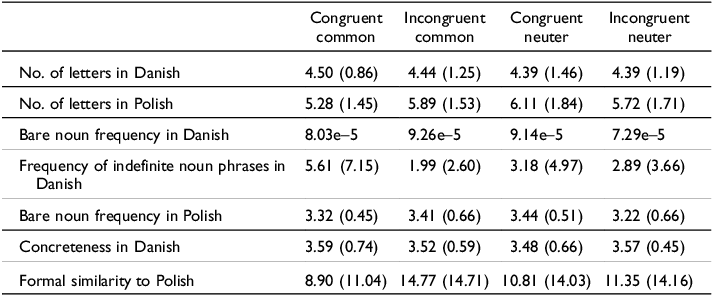
The items in the four conditions were controlled for variables known to affect lexical processing (see table 1). These variables included word length (in letters) in both Danish and Polish, frequency in Danish (Society for Danish Language and Literature 2024), frequency in Polish according to SUBTLEX-PL (Mandera et al. Reference Mandera, Keuleers, Wodniecka and Brysbaert2015), concreteness in Danish (Thompson & Lupyan Reference Thompson, Lupyan, Rogers, Rau, Zhu and Kalish2018), and formal similarity to Polish, calculated as a percentage using the AWSM tool (https://awsm-tools.com/levenshtein-distance ). Kruskal-Wallis tests showed no significant differences between the conditions (ps > .300). A few items (n = 6) had gender-predictable endings (-de, -ed, -er, -ør), with no more than two such items per condition. A complete list of the items can be found in the OSF repository.
Characteristics of the Danish items

As pointed out by an anonymous reviewer, the frequency with which a noun co-occurs with overt gender markers, such as articles, may be more predictive of learners’ difficulties with acquiring gender than bare noun frequency. To address this, we accounted for the frequency of indefinite noun phrases (e.g., en have ‘a garden’) in Danish across the four conditions. We excluded definite noun phrases because their forms might overlap with supine verb forms. This analysis was conducted using the Danish Web 2020 (daTenTen20) corpus (Jakubíček et al. Reference Jakubíček, Kilgarriff, Kovář, Rychlý, Suchomel, Hardie and Love2013) in the Sketch Engine (Kilgarriff et al. Reference Kilgarriff, Baisa, Bušta, Jakubíček, Kovář, Michelfeit, Rychlý and Suchomel2014), with frequency measured in hits per million tokens. The four conditions were matched for this variable (p = .256, Kruskal-Wallis test).
Procedure
The testing session consisted of a background questionnaire, the gender decision task, and the Dialang test, administered in that order. In the gender decision task, each trial began with a fixation cross displayed for 500 ms. Just after the fixation cross, a Danish noun was presented for 3,000 ms or until a key press response was registered. To minimize confusion with letter signs, participants used the “9” key for “en-words” (common gender) and the “0” key for “et-words” (neuter gender) on a standard keyboard. Printed key labels (“en” and “et”) were provided to assist with task completion.
The stimuli were displayed in white uppercase Arial font against a black background at the center of a computer screen, using the PsyToolkit platform (Stoet Reference Stoet2010, Reference Stoet2017). The order of stimulus presentation was randomized for each participant. Prior to the task, participants received instructions in Danish and completed a separate practice block featuring unrelated items, after which they had the opportunity to ask questions regarding the procedures. Participants were instructed to respond using their dominant hand.
Data analysis
The statistical analyses were performed using the statistical R software (R Core Team 2024) employing the lmerTest (Kuznetsova et al. Reference Kuznetsova, Brockhoff and Christensen2017) and lme4 (Bates et al. Reference Bates, Mächler, Bolker and Walker2015) packages. The complete dataset and analyses scripts are available in the OSF repository (https://osf.io/ujp9y/). Response accuracy was analyzed using generalized linear mixed-effects models with a binomial distribution and logit link function, fitted by maximum likelihood (Laplace Approximation). Response times (RTs) were log-transformed and analyzed using linear mixed-effects models fitted by REML. Congruency and Gender were coded using sum contrast coding (−0.5 for the first level and +0.5 for the second level), while proficiency scores were transformed into z-scores. Estimated marginal means were calculated using the emmeans package (Lenth et al. Reference Lenth, Banfai, Bauerkner, Giné-Vásquez, Herve, Jung, Love, Miguez, Piaskowski, Riebl and Singmann2024), and standardized coefficients were obtained using the effectsize package (Ben-Shachar et al. Reference Ben-Shachar, Lüdecke and Makowski2020). Plots were generated with the sjPlot package (Lüdecke Reference Lüdecke2023).
As fixed effects, the models included congruency, gender, proficiency, and their double interactions (congruency × gender, congruency × proficiency, and gender × proficiency), and, finally, the triple interaction of congruency × gender × proficiency. Initially, we created models with a maximal random-effects structure justified by the design, that is with by-participant random slopes for congruency and gender and by-item random slopes for proficiency. In cases of failed convergence or singular fit, we refitted the models by removing the necessary random-effects terms to achieve a nonsingular fit.
4.2. Results
Response accuracy
Responses that fell outside the 3,000 ms response window were removed (2.18 percent), as were responses below 300 ms (0.04 percent), since these cannot have resulted from genuine word recognition processes (Jiang Reference Jiang2013:30). Table 2 presents the model output.
Model output for accuracy in DanishFootnote 1

For accuracy, there was a significant effect of gender and proficiency. Participants performed better with common-gender (89.6 percent, SE = 2.0) compared to neuter-gender items (75.4 percent, SE = 3.7). Additionally, participants performed better as their proficiency in Danish increased. The effect of congruency was not significant, nor were any of the interactions. Figure 1 illustrates the predicted probabilities of accuracy, taking into account congruency, gender, and proficiency.
Plot of interaction between congruency, gender, and proficiency for accuracy in Danish.

Response times (RTs)
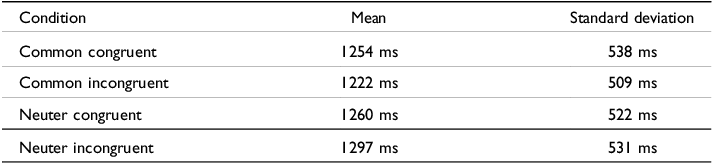
First, we removed the RTs for incorrect responses (22.92 percent). For the remaining data, we removed the RTs that exceeded 2.5 SD of each participant’s mean (1.99 percent). Table 3 presents the descriptive results, and table 4 shows the model output.
Descriptive RTs in Danish

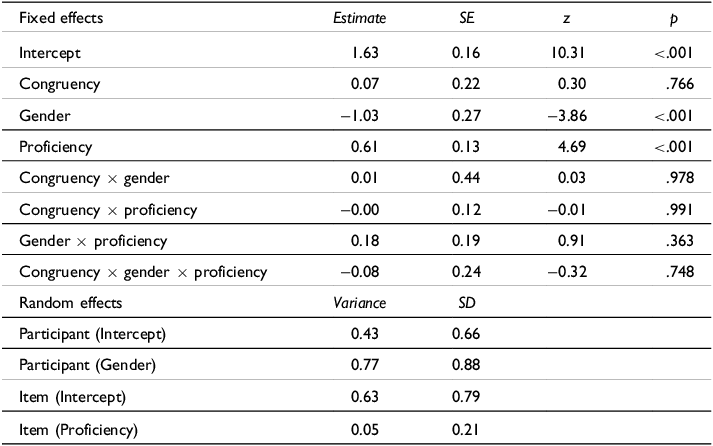
Model output for RTs in DanishFootnote 2

For RTs, there was a significant effect of gender and proficiency. Participants responded faster to common gender items compared to neuter gender items. Also, participants’ RTs were shorter as their proficiency in Danish increased. The effect of congruency was not significant, nor were any of the interactions. Figure 2 illustrates the predicted values of logarithmic RTs taking into account congruency, gender, and proficiency.
Plot of interaction between congruency, gender, and proficiency for RTs in Danish.

To summarize, we found no evidence for the influence of L1 Polish on participants’ gender decisions in L2 Danish. Neither accuracy nor response times were affected by gender congruency, regardless of participants’ proficiency in Danish. However, a significant effect of gender was observed, with participants experiencing greater difficulty assigning gender to neuter nouns. This was evident in both lower accuracy rates and longer response times for neuter nouns compared to common-gender nouns. Finally, overall performance improved as participants’ proficiency in L2 Danish increased.
5. Experiment 2: Polish–German bilinguals
5.1. Method
Participants
We recruited 38 Polish native speakers majoring in German at a Polish university, including five males (M age = 21.0 years, SD = 3.5). All participants began learning German after age 6 in school settings (M age of onset = 12.2 years, SD = 3.5). As with the Polish–Danish bilingual group, we recruited both undergraduate and graduate students at various stages of their studies to ensure a broad range of German proficiency. According to the university curriculum, participants’ proficiency in German ranged from intermediate to advanced levels. Informed consent was obtained from all participants, and they were compensated with bookstore gift cards for their participation in the study.
Proficiency in German
Proficiency in German was assessed using the Dialang placement test (Alderson Reference Alderson2005). The procedure used in Experiment 2 was identical to that in Experiment 1, with the only change being the language transition from Danish (Experiment 1) to German (Experiment 2). The scores of Polish–German bilinguals ranged from 36 to 71, with a mean of 50.84 (SD = 7.50).
Materials
The procedures for stimulus selection mirrored those used for the Danish task. After compiling a list of German nouns, we created experimental conditions that replicated the manipulation of gender congruency in Danish. Specifically, we treated masculine and feminine gender collectively and crossed the factors of gender (masculine/feminine, neuter) and congruency (congruent, incongruent). This resulted in four conditions: masculine/feminine congruent, masculine/feminine incongruent, neuter congruent, and neuter incongruent. Each condition consisted of 18 German noncognate nouns, ranging from three to nine letters in length. In the two masculine/feminine conditions, half of the nouns were masculine, while the other half were feminine. To ensure comparability with the Danish results, we aimed to include as many German translations of the Danish items as possible, achieving an overlap of 55.6 percent (40 out of 72 items shared across both languages).
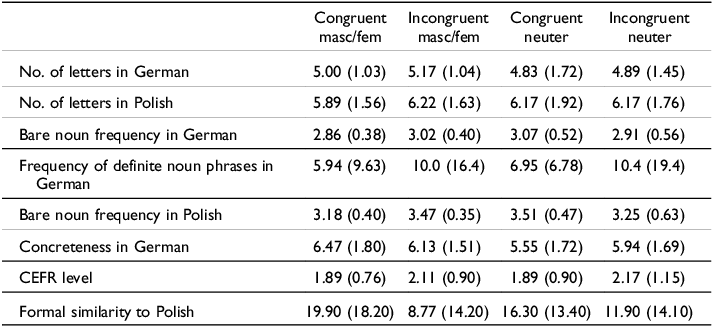
The items in the four conditions were again controlled for relevant lexical variables (see table 5), including word length (in letters) in both German and Polish, frequency in German according to SUBTLEX-DE (Brysbaert et al. Reference Brysbaert, Buchmeier, Conrad, Jacobs, Bölte and Böhl2011), frequency in Polish according to SUBTLEX-PL (Mandera et al. Reference Mandera, Keuleers, Wodniecka and Brysbaert2015), concreteness in German (Köper & Schulte im Walde Reference Köper, im Walde, Calzolari, Choukri, Declerck, Goggi, Grobelnik, Maegaard, Mariani, Mazo, Moreno, Odijk and Piperidis2016), and formal similarity to Polish calculated as a percentage using the AWSM tool (https://awsm-tools.com/levenshtein-distance). In addition, we controlled for word difficulty measured using CEFR levels (A1 = easiest, C1 = most difficult). This was not possible for Danish due to the lack of reliable resources that could unambiguously assign nouns to CEFR levels. Kruskal-Wallis tests showed no significant differences between the conditions (ps > .080). We also accounted for the number of items with gender-predictive endings: each of the neuter-gender conditions contained two such items, while each masculine/feminine-gender condition included twelve. A complete list of the items is available in the OSF repository.
Characteristics of the German itemsFootnote 3

As with the Danish task, we accounted for the frequency of definite noun phrases (e.g., das Bett ‘the bed’) in German across the four conditions. We excluded indefinite noun phrases because the article ein does not disambiguate between masculine and neuter genders. This analysis was conducted using the German Web 2000 (deTenTen20) corpus (Jakubíček et al. Reference Jakubíček, Kilgarriff, Kovář, Rychlý, Suchomel, Hardie and Love2013) in the Sketch Engine (Kilgarriff et al. Reference Kilgarriff, Baisa, Bušta, Jakubíček, Kovář, Michelfeit, Rychlý and Suchomel2014), with frequency measured in hits per million tokens. For the masculine gender, the frequencies of the nominative singular article der and the accusative singular article den were combined. This approach was necessary because, for the other two gender values – feminine and neuter – the nominative and accusative singular forms overlap, which artificially inflates their frequencies. The four conditions were matched for this variable (p = .564, Kruskal-Wallis test).
Procedure
The procedure used in Experiment 2 was identical to that of Experiment 1, except for the change in language from Danish (Experiment 1) to German (Experiment 2). Participants used the keys “1” (der), “2” (die), and “3” (das) to avoid confusion with letter signs. This key order – masculine, feminine, and neuter – reflects the conventional sequence typically used by German learners and teachers. Printed key labels (der, die, and das) were provided to assist with task completion.
Data analysis
The procedures for data analysis mirrored those used for the Danish task.
5.2. Results
Response accuracy
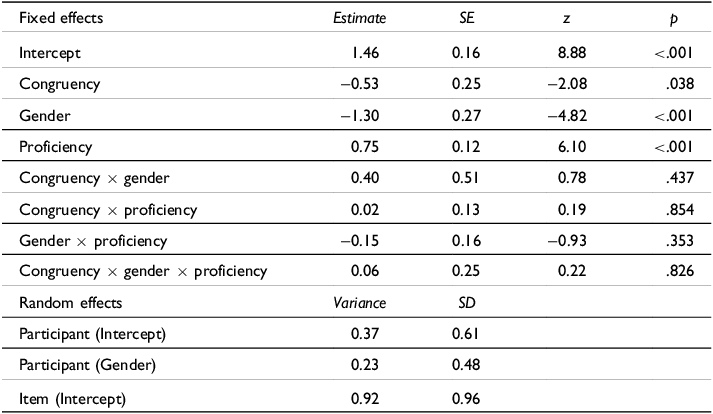
Responses that fell outside the 3,000 ms response window were removed (0.66 percent), as were responses below 300 ms (0.04 percent). Table 6 presents the model output.
Model output for accuracy in GermanFootnote 4

For accuracy, there was a significant main effect of congruency, gender, and proficiency. Participants demonstrated higher accuracy with gender-congruent items (84.9 percent, SE = 2.7) compared to gender-incongruent items (76.8 percent, SE = 3.6). Additionally, they performed better with items of masculine/feminine gender (89.2 percent, SE = 2.1) than with items of neuter gender (69.1 percent, SE = 4.2). Most of the errors involving neuter gender were due to the overgeneralization of masculine gender (87.8 percent). Finally, participants’ accuracy improved with increasing proficiency in German. The interactions were not statistically significant. Figure 3 illustrates the predicted probabilities of accuracy, taking into account congruency, gender, and proficiency.
Plot of interaction between congruency, gender, and proficiency for accuracy in German.

Response times (RTs)
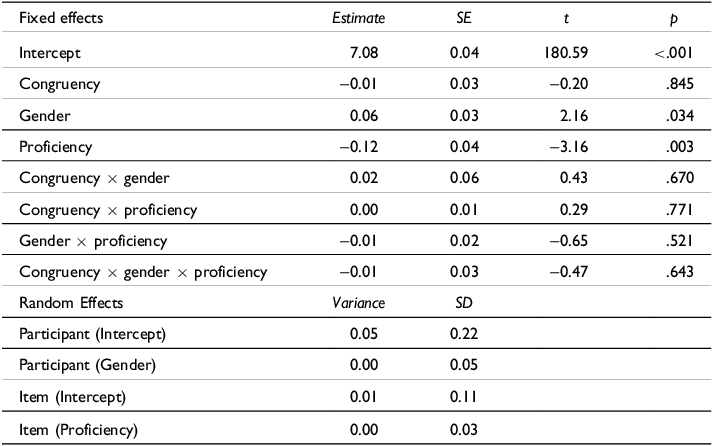
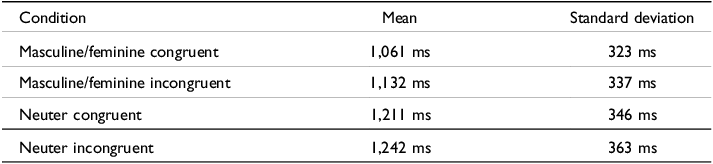
We removed the RTs for incorrect responses (26.54 percent). For the remaining data, we removed the RTs that exceeded 2.5 SD of each participant’s mean (2.75 percent). Table 7 presents the descriptive results, and table 8 shows the model output.
Descriptive RTs in German

Model output for RTs in GermanFootnote 5

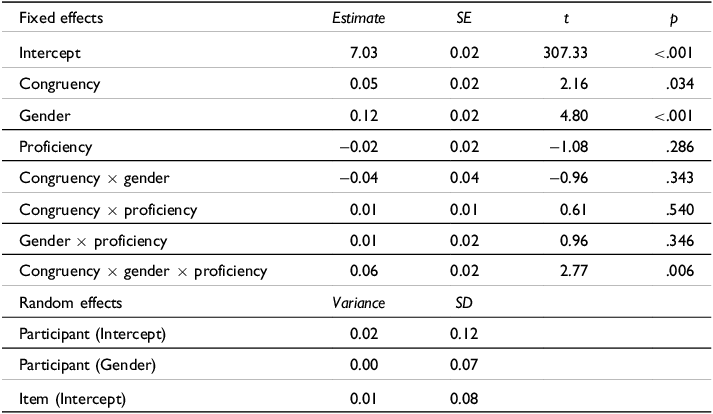
For RTs, there was a significant main effect of congruency and gender. Participants responded faster to gender-congruent items than to gender-incongruent items. Additionally, RTs were shorter for masculine/feminine gender items than for neuter gender items. The size of the gender effect (Std. Coef. = 0.42; 95 percent CI [0.25, 0.59]) was larger than the size of the congruency effect (Std. Coef. = 0.17; 95 percent CI [0.02, 0.32]). The effect of proficiency was not significant. The interaction of congruency × gender × proficiency was significant, whereas the interactions of congruency × gender and gender × proficiency were not. Figure 4 illustrates the predicted logarithmic RTs, taking into account congruency, gender, and proficiency.
Plot of interaction between congruency, gender, and proficiency for RTs in German.

The pairwise contrasts for the interaction of congruency × gender × proficiency (with proficiency at three levels: mean −2 SD, mean, mean +2 SD) revealed that proficiency modulated the effect of congruency for both masculine/feminine and neuter genders.
For masculine/feminine nouns, the difference between congruent and incongruent nouns was significant, at the proficiency level of 2 SD below the mean, estimate = −0.11, SE = 0.04, t = −2.70, p = .007. The difference between congruent and incongruent nouns was also significant, at the mean proficiency level, estimate = −0.06, SE = 0.03, t = −2.17, p = .034, but this effect disappeared at the proficiency level of 2 SD above the mean, estimate = −0.02, SE = 0.04, t = −0.43, p = .670. These results indicate that the gender congruency effect for masculine/feminine nouns decreased with increasing proficiency.
For neuter nouns, the difference between congruent and incongruent nouns was not significant, at the proficiency level of 2 SD below the mean, estimate = 0.04, SE = 0.05, t = 0.94, p = .251, and at the mean proficiency level, estimate = −0.03, SE = 0.03, t = −0.98, p = .333. The difference between congruent and incongruent nouns emerged at the proficiency level of 2 SD above the mean, estimate = −0.10, SE = 0.04, t = −2.35, p = .020. This indicates that the gender congruency effect for neuter nouns only arose at higher proficiency.
To summarize, the results suggest that participants’ performance in L2 German was influenced by their L1 Polish, resulting in higher accuracy rates and faster response times for gender-congruent items compared to gender-incongruent ones. A closer examination revealed that the gender congruency effect in response times varied depending on proficiency in L2 German. For masculine/feminine nouns, L1 Polish seemed to exert a stronger influence at lower L2 German proficiency levels, whereas for neuter nouns, congruency effects appeared to emerge only at higher proficiency levels. A significant effect of gender was also observed, as participants experienced more difficulty with gender assignment for neuter nouns, as reflected in lower accuracy and longer response times compared to masculine/feminine nouns. This was evident in both lower accuracy rates and longer response times for neuter nouns compared to masculine/feminine nouns. Lastly, accuracy improved with increased L2 German proficiency, although response times did not show the same benefit.Footnote 6
6. Discussion
This study was designed to investigate how asymmetric and dissimilar gender systems are represented in the bilingual mental lexicon. We employed a gender decision task to assess late unbalanced Polish–Danish bilinguals across various L2 proficiency levels and compared them to Polish–German bilinguals, who possess symmetric and similar gender systems. We collected accuracy and response time data under conditions of gender-match and mismatch with L1. The baseline group of Polish–German bilinguals demonstrated clear gender congruency effects, validating the effectiveness of our method. We first discuss results for Polish–Danish bilinguals, which are the primary focus of this study.
Our analysis revealed that Polish–Danish bilinguals’ performance in L2 Danish was not influenced by their L1 Polish. Participants achieved comparable accuracy levels and response times, regardless of whether the gender of Danish nouns was congruent with Polish. The Danish common gender did not activate the Polish masculine or feminine gender, nor did it interact with the Polish neuter gender. Surprisingly, even the neuter gender, which exists in both languages, did not produce any gender congruency effect. This suggests that the L2 Danish gender system operates independently of the L1 Polish gender system, even in a metalinguistic task requiring explicit access to gender information. These findings imply that asymmetric and dissimilar gender systems are represented separately in the bilingual lexicon, at least in bilinguals with typologically distant language pairs.
The lack of a gender congruency effect for the neuter gender is more puzzling. Despite the neuter gender being present in both languages, there was no observed cross-language interaction. This may be explained by the fact that the neuter gender is less frequent in Danish, covering only about 25 percent of nouns. As a result, learners may default to the common gender (e.g., Długosz Reference Długosz2023a), which was evident in our study through participants’ lower accuracy and longer response time for neuter nouns. This tendency to default to common gender may have overshadowed the gender congruency effect. Nonetheless, difficulties with the neuter gender diminished with increased L2 proficiency, though this did not lead to a noticeable gender congruency effect. Thus, the default gender alone cannot fully explain the absence of L1 influence.
The absence of a gender congruency effect in Polish–Danish bilinguals may be explained by the low transparency of the Danish gender system, which is positioned at the nontransparent end of the transparency spectrum, even less transparent than the German system (Kupisch et al. Reference Kupisch, Geiss, Mitrofanova and Westergaard2022). Without reliable noun-internal cues to gender, the level of gender activation may have been too low for a gender congruency effect to manifest.
Our results suggest that the gender systems of Polish–Danish bilinguals are represented independently in the mental lexicon. The asymmetry and dissimilarity between these systems likely inhibit cross-language interactions, even for neuter gender, which is present in both languages. The typological distance between Polish and Danish may have further contributed to the lack of a gender congruency effect. Although Polish and German also belong to different language families, the combination of gender asymmetry, dissimilarity, and typological distance likely accounts for the null effect observed in Polish–Danish bilinguals.
In contrast, the baseline group of Polish–German bilinguals showed clear gender congruency effects, indicating that symmetric and similar gender systems are interconnected in the bilingual lexicon. However, the extent of this interaction varied with L2 proficiency. For masculine and feminine nouns, which constitute the majority of German vocabulary (Bauch Reference Bauch1971), the gender congruency effect diminished at higher L2 proficiency levels, suggesting a stronger influence of the L1 gender system among less proficient learners. This finding corroborates previous research indicating a negative relationship between the gender congruency effect and L2 proficiency (Bordag & Pechmann Reference Bordag and Pechmann2007, Paolieri et al. Reference Paolieri, Cubelli, Macizo, Bajo, Lotto and Job2010), and is consistent with most models of bilingual lexical processing and acquisition (e.g., Kroll & Stewart, Reference Kroll and Stewart1994, Grainger et al. Reference Grainger, Midgley, Holcomb, Kail and Hickmann2010, Ecke Reference Ecke2015, Dijkstra et al. Reference Dijkstra, Wahl, Buytenhuijs, van Halem, Al-Jibouri, de Korte and Rekké2019). Specifically, our findings can be explained by the Parasitic Model of Vocabulary Acquisition (e.g., Ecke Reference Ecke2015, Reference Ecke and Ayoun2022), which posits that weaker gender congruency effects at higher L2 proficiency reflect a reduction in parasitic connections between new lexical items in L2 and the established L1 hosts. Our findings are also consistent with the study by Sá-Leite and colleagues (Reference Sá-Leite, Flores, Eira, Haro and Comesaña2023) and provide further evidence that greater L2 proficiency is associated with reduced cross-language activation effects (e.g., Schwartz Reference Schwartz and Schwieter2015).
For neuter nouns, however, we found an opposite pattern: The effect of L1 only emerged at higher L2 proficiency levels. Our results show that Polish–German bilinguals struggled with assigning gender to neuter nouns, which are relatively infrequent in German. This was evident from lower accuracy rates and longer response times for neuter nouns compared to masculine/feminine nouns. We interpret these findings to suggest that the difficulty associated with neuter gender had a dominant effect on participants’ performance. This interpretation is further supported by the response time analysis, where the effect size for gender was larger than for congruency. Notably, even though our analysis of response times included only correct responses – those where the gender of neuter nouns was accurately assigned – performance at lower L2 proficiency was still below chance (see figure 3), indicating that correct responses were rare. We propose that even when neuter gender was correctly identified, the cognitive load of inhibiting the more frequent masculine gender led to slower response times. As L2 proficiency increased, this difficulty with neuter gender attenuated, allowing the gender congruency effect to emerge. In conclusion, our findings suggest that the challenges of processing the neuter gender overshadowed the gender congruency effect at lower L2 proficiency (e.g., Klassen Reference Klassen2016a).
In summary, our study suggests that while symmetric and similar gender systems interact, asymmetric and dissimilar gender systems do not. Our findings, based on gender decision data from Polish–Danish bilinguals, indicate that the Danish common gender does not activate the Polish masculine and feminine gender. Additionally, even the neuter gender, present in both languages, does not appear to be subject to cross-language effects. For Polish–German bilinguals, we observed a gender congruency effect that was differently affected by L2 proficiency. Specifically, for masculine and feminine nouns, the effect was more pronounced at lower L2 proficiency levels, aligning with previous research and the predictions of the Parasitic Model of Vocabulary Acquisition (Ecke Reference Ecke2015, Reference Ecke and Ayoun2022). Conversely, for neuter nouns, the effect was greater at higher L2 proficiency levels, which we attribute to the difficulty with neuter gender due to its infrequent occurrence in German.
Our study has important implications for psycholinguistic research on bilingualism, particularly regarding how similarities and differences between a bilingual’s two languages shape their representation in the mental lexicon. Even if two languages have the same gender value, their representation in the mental lexicon might not be shared if their gender systems differ in the type and number of gender values. The finding that the neuter gender is most likely shared in the lexicon of Polish–German but not Polish–Danish bilinguals indicates that not all bilinguals leverage lexical similarities between L1 and L2 to the same extent. Moreover, our findings support the Parasitic Model of Vocabulary Acquisition (e.g., Ecke Reference Ecke2015, Reference Ecke and Ayoun2022). However, by demonstrating that difficulties with the neuter gender can override the influence of L1, our findings advocate for a more nuanced understanding of parasitic connections between new L2 items and their L1 hosts. Since lexical items specify various types of information, these parasitic connections are inherently shaped by factors associated with that information.
In the present study, we used a gender decision task that is metalinguistic in nature, requiring participants to consciously access the gender of nouns in order to respond. This approach enhances the visibility of gender effects; however, it does not provide insight into implicit gender processing during language comprehension and production. By employing a gender decision task, our goal was to determine whether asymmetric and dissimilar gender systems interact under conditions that facilitate the observation of gender effects. Our future work will address these questions through additional methods, including picture naming, translation, and visual-world eye tracking.
As suggested by an anonymous reviewer, the present study could benefit from including control groups of L2 Danish and L2 German learners with a genderless L1. This would enable us to confirm whether the gender congruency effect observed in Polish–German bilinguals is indeed attributable to the influence of L1 Polish. While we agree that such a methodological approach could potentially lend more credibility to our findings, we do not see any other explanation beyond gender congruency for the effect found in our study, given the extent of experimental control over the items. To our knowledge, no study on the gender congruency effect has included L2 control groups with a genderless L1. Furthermore, the vast majority of previous studies on gender congruency effects did not include monolingual controls. Among those that did, at least four reported a gender congruency effect in bilinguals but not in monolinguals (Bordag Reference Bordag, Foster-Cohen, Smith, Sorace and Ota2004, Manolescu & Jarema Reference Manolescu and Jarema2015, Paolieri et al. Reference Paolieri, Cubelli, Macizo, Bajo, Lotto and Job2010, Morales et al. Reference Morales, Paolieri, Dussias, Valdés Kroff, Gerfen and Bajo2016). However, one of the earliest studies in this domain, Costa et al. (Reference Costa, Kovacic, Franck and Caramazza2003), did find a gender congruency effect in both bilinguals and monolinguals using a picture naming task. This study, however, received considerable criticism due to various issues, including poor control of item-related variables such as gender transparency and cognate status, as well as a small participant pool per experiment. Last but not least, our previous research supports similar conclusions regarding gender congruency effects in Polish–German bilinguals, showing a significant effect for feminine nouns, which diminishes with higher L2 German proficiency (Długosz & Olszewska Reference Długosz and Olszewska2024).
Additionally, we cannot rule out the typological distance between Polish and Danish as a potential factor contributing to the null results. Although previous research observed gender congruency effects in typologically distant language pairs, such as Spanish–German (Klassen Reference Klassen2016a) or Greek–German (Salamoura & Williams Reference Salamoura and Williams2007), these studies did not investigate highly dissimilar gender systems. Our future work will focus on cognates to determine whether an increase in lexical similarity between Polish and Danish can elicit gender congruency effects.





 Open access

