





Introduction
Although much has been written about the representation of two languages in the bilingual’s mind (Bialystok et al., Reference Bialystok, Craik, Green and Gollan2009; Kroll et al., Reference Kroll, Bobb and Hoshino2014), more is needed about how bilinguals engage with the linguistic and non-linguistic cues in the environment. In an interactional context, the environment has interlocutors with varying proficiencies in L1 and L2. For ease of communication, bilinguals select the language in which they perceive the interlocutor is proficient. For example, if a high-L2 proficient bilingual must interact with a low-L2 proficient interlocutor, there is a requirement for the high-L2 proficient bilingual to inhibit one language over the other. In this case, the high-L2 proficient bilingual would limit their use of L2 – otherwise, they would not. Inhibiting one of the proficient/dominant languages would require active language control. The shift in language plans and language use accounts for linguistic adaptation. The Adaptive Control Hypothesis - ACH (Green & Abutalebi, Reference Green and Abutalebi2013) attempts to explain this aspect of control in the bilingual language system. According to the hypothesis, bilinguals employ specific cognitive control depending on the linguistic context. In a single language context, the bilinguals use only one language over the other, and employ more control to maintain their goal, also resolving conflict arising from non-target language. In a dual language context, the bilinguals use and shift between two languages. This demands higher cognitive control to maintain goals, reduce language interference, inhibit non-target language, and be vigilant about the salient cues in their environment. To adapt effectively, they must facilitate or inhibit either of the languages. During the dense code-switching context, the bilinguals switch between languages in a sentence; language control is higher here while there is opportunistic planning. In this context, bilinguals do not necessarily inhibit or facilitate the languages. Although the ACH extensively explains the mechanisms of cognitive control in different language contexts, it does not account for how bilinguals formulate language plans that would lead to language production.
A recent account on bilingual language production by Blanco-Elorrieta and Caramazza (Reference Blanco-Elorrieta and Caramazza2021) postulates that bilinguals do not necessarily employ language control but instead select the language with higher activation. This activation is modulated by various factors such as frequency of occurrence of the element in different languages, proficiency of the speaker, the temporal effect that is the recency of use of the word in languages, meaning of the sentence/ word and communicative context. Importantly, in a communicative context, language activation is determined by the interlocutors' language profile. Suppose an interlocutor knows only one language; their language activation/selection solely depends on their known language. If the interlocutor understands both languages, in that case, both languages have equal activation. The language activation/selection will be influenced by other aspects such as the frequency of the word, what language was previously spoken (recency effect) and the contextual semantics. These aspects are crucial in understanding how interlocutors with varied proficiencies activate and select languages in an interactional context. Though many studies have shown that language dominance and proficiency (Gollan et al., Reference Gollan, Kleinman and Wierenga2014) contribute to language activation and selection, we suspect that there might be an active interaction between the perceived proficiency of the interlocutors and language dominance/proficiencies of the bilinguals. Kapiley and Mishra (Reference Kapiley and Mishra2019) found that unbalanced high-L2 proficient bilinguals make associations to a language that they perceive the interlocutor is dominant/proficient. They accordingly plan and choose their language while speaking. In their experiments, participants were familiarized with high-L2 and low-L2 proficient cartoons. Based on the cartoon's L2 proficiency, the participants could associate L2 to high-L2 proficient cartoon and L1 to low-L2 proficient cartoon. During the main experiments, the participants chose L2 to respond to high-L2 proficiency and L1 to low-L2 proficiency. Quick adaption to interlocutors' language proficiency indicates linguistic flexibility of bilingual mind.
Recent papers have investigated the neural and behavioural consequences enriching the theoretical speculations how information about interlocutors could influence language switching at the lexical level (Feldman et al., Reference Feldman, Srinivasan, Fernandes and Shaikh2021; Kaan et al., Reference Kaan, Kheder, Kreidler, Tomić and Valdes Kroff2020; Tomić & Kaan, Reference Tomić and Kaan2022; Vaughan-Evans, Reference Vaughan-Evans2022). Kaan et al. (Reference Kaan, Kheder, Kreidler, Tomić and Valdes Kroff2020) examined if bilinguals’ comprehension of language switching is affected by the language awareness of interlocutors. Spanish–English bilinguals listened to either code-switched or non-switched sentences in Spanish and English. Importantly, they did this when there was either a Spanish–English bilingual companion or a monolingual. ERPs recorded showed that the positive frontocentral component was smaller in the presence of a bilingual than a monolingual. This suggests that bilinguals consider their interlocutors’ language profile even if they were just companions during comprehension task. De Bruin and Martin (Reference De Bruin and Martin2022) examined the effect of external primes on free choices during voluntary object-naming. For the task, the participants were asked to name pictures in the language of their choice in the presence of linguistic and non-linguistic primes. Linguistic primes were short sentences in Spanish or Basque; the non-linguistic primes were Spanish/Basque flags. The results indicate that participants’ language choice was significantly influenced by the primes presented in the trials. Moreover, faster responses were found when the participants' language preference and language indicated by the primes were congruent. It should be noted that the primes used in this study were not introduced earlier. Therefore, the authors observe that personal preference and external primes influence language choice.
More recently, Vaughan-Evans (Reference Vaughan-Evans2022) has expanded the work of Bhatia et al. (Reference Bhatia, Prasad, Sake and Mishra2017), exploring the influence of external cues (non-linguistic cues) on language selection and production. Bhatia et al. (Reference Bhatia, Prasad, Sake and Mishra2017) found that bilinguals' language choices were influenced by cues (that denote Hindi and English) used by a cartoon figure. Vaughan-Evans (Reference Vaughan-Evans2022) used lanyards and posters, which were non-linguistic cues to trigger language choices in highly proficient Welsh–English bilinguals. During the task, participants were asked to indicate their preferred language in the presence of lanyards/posters. They found that participants chose Welsh upon seeing an Iaith Gwaith logo. Further, responses during the cue trials were faster than no cue trials. Different kinds of external cues influence bilingual speakers' free choice. Studies demonstrate that their social awareness of such primes and their meaning also cascade down to lexical selection and control. We are not sure if this happens consciously or unconsciously, but the finding certainly shows the sensitivity and adaptiveness of the bilingual mind towards environmental cues.
Current study
We speculated if similar cognitive and language control mechanisms are in play for language production in different dynamic monitoring contexts induced by interlocutors. To test this, we used a voluntary object-naming task. During this task, bilinguals simultaneously activate two different lexical systems and must select one of the two languages to name the object. Across trials, bilinguals can freely shift from one language to another. This enables the bilinguals to operate under “top-down” control, unlike in cued naming, in which participants are instructed to name the objects in the language denoted by a cue (“bottom-up”). Responses during voluntary object-naming tasks also provide insight into the language's magnitude/degree of lexical representation, often determined by language proficiency/ dominance (Gollan & Ferreira, Reference Gollan and Ferreira2009). For instance, high-L2 dominant/proficient bilinguals name and switch to their L2 more often than L1. The task also facilitates studying the interaction between the external influences that affect the internal language plan. In this case, the external influence refers to the interlocutors' presence and how they affect language production. In the current study, we investigated if unbalanced bilinguals (high and low-L2 proficient) modulate their choice and language control depending on their interlocutors' L2 proficiency. The bilinguals did the object-naming task in the presence of interlocutors. In Experiment 1, the language context was created by manipulating the presentation of high and low proficient interlocutors' percentages to create a “High-L2 proficient interlocutor dominant block” (further referred to as block 1), “Low-L2 proficient interlocutor dominant block” (block 2) and “mixed block” (block 3).” This would reveal how high and low-L2 proficient participants monitor their language choice while naming in dynamic contexts. We instructed the participants to voluntarily name the objects in the presence of an interlocutor with whom they were previously familiar. Experiment 2 was performed to investigate if an interlocutor (high/low-L2 proficient) in a non-dynamic context modulates the frequency of language choice and naming in bilinguals. High and low-L2 proficient participants did a voluntary object-naming task in the presence of interlocutors. Unlike in experiment 1, only one type of interlocutor, a high-L2 proficient interlocutor or a low-L2 proficient interlocutor, was presented in each block. In block 1, a high-L2 proficient interlocutor was presented; in block 2, a low-L2 proficient interlocutor was presented; in block 3, there was no interlocutor – (this was a control). It must to be noted that these bilinguals in both experiments were asked to name the objects in the language that came to mind. We did not instruct the participants to maintain a balance between languages. Based on the evidence that bilinguals tag languages to the interlocutors' language proficiency (Kapiley & Mishra, Reference Kapiley and Mishra2019; Molnar et al., Reference Molnar, Ibáñez-Molina and Carreiras2015), one can assume that bilinguals would choose and switch to the language in which the interlocutor is proficient. However, the mechanisms as to how high and low-L2 proficient participants employ language control might differ.
Previous research findings on language control were based on unbalanced high-L2 proficient participants; very little is known about how low-L2 proficient participants would associate languages with interlocutors and adapt the same way. Though the research on language processing in low-L2 proficient bilinguals in a context is limited, Molnar et al. (Reference Molnar, Ibáñez-Molina and Carreiras2015) found that early and late Basque–Spanish bilinguals could establish language associations between interlocutors and their language profiles (monolingual or bilingual). In their experiment, bilingual participants did an audio-visual lexical decision task in the presence of monolingual and bilingual interlocutors. The language of the spoken word was either congruent or incongruent with the interlocutor's language profile. In the trials in which monolingual interlocutors were presented – in a single language context – early bilinguals responded faster during congruent trials than late bilinguals. In the trials in which bilingual interlocutors were presented – in a dual-language context – early bilinguals responded to Basque and Spanish words with a similar response time. The authors reasoned that the early bilinguals efficiently adapted linguistically to the interlocutors by predicting and activating the context-appropriate language. The early bilinguals can afford to co-activate in a bilingual context. The late bilinguals responded faster while responding to Spanish words, as their activation in Spanish was higher.
The following paragraphs predict the possible outcomes for language choice, naming latencies, and switch costs across the monitoring blocks in experiment 1.
In block 1, the high-L2 proficient interlocutor would be presented more times than the low-L2 proficient interlocutor and the participants would predict higher occurrence of high-L2 proficient interlocutors in this block. Due to this, there would be higher activation of English. We predicted that high-L2 proficient participants would choose English more often than Telugu. The naming latencies would be faster in English, and the switching cost would be higher when switching to English from Telugu. There would be active interference from English while naming in Telugu, leading to slower naming latencies. The switch cost in Telugu would be lower than the English switch cost. If low-L2 proficient participants attempt to adapt to the interlocutors (Molnar et al., Reference Molnar, Ibáñez-Molina and Carreiras2015), they should demonstrate a similar language choice and switch rate as that of high-L2 proficient participants. The delayed latencies would be obtained while naming in English (compared to high-L2 proficient participants), which would incur symmetric switch costs as English is their non-dominant language.
In block 2, low-L2 proficient interlocutor would be presented a higher number of times than the high-L2 proficient interlocutor and the participants might predict that the occurrence of low-L2 proficient interlocutor would be higher – for which we expect higher activation of Telugu. High and low-L2 proficient participants would name the objects faster while choosing Telugu. Low-L2 proficient participants would incur higher switching costs in Telugu, as it's their dominant language. On the other hand, high-L2 proficient participants might incur symmetric switch costs as Telugu is the non-dominant language and previous studies demonstrated that unbalanced bilinguals incur symmetric switch costs in non-dominant language block (Timmer et al., Reference Timmer, Christoffels and Costa2019).
In block 3, unlike other blocks, the presentation of a particular interlocutor type would be less predictable (high and low-L2 proficient interlocutors were presented equally). Therefore, performance in this block would require more language control. The high-L2 proficient participants would choose and switch to either of the languages an equal number of times. The naming latencies between Telugu and English would be similar. They would also incur symmetric switch costs as they co-activate both languages (Kapiley & Mishra, Reference Kapiley and Mishra2019). Low-L2 proficient participants would choose Telugu more often than English, with faster naming and higher switch costs in Telugu, considering that they are more proficient in Telugu only.
In Experiment 2, we predicted that in block 1, high-L2 proficient participants would choose English more often with faster naming latencies and incur higher switching costs in English. Low-L2 proficient participants would choose English more often than Telugu while attempting to adapt to high-L2 proficient interlocutors and incur symmetric switch costs. Another possibility is that since low-L2 proficient participants have limited vocabulary and lexical access to English they might not switch to English. Based on the account of bilingual language production by Blanco-Elorrieta and Caramazza (Reference Blanco-Elorrieta and Caramazza2021), low L2 proficient participants might choose and switch to English only if there is higher activation of English for that item. In block 2, low-L2 proficient participants would choose Telugu more often or might select only Telugu over English. If they plan to switch between languages, they would incur higher switch costs in Telugu. High-L2 proficient participants would choose Telugu more often than English and would incur symmetric switch costs. In block 3, high-L2 proficient participants would choose English more often and be faster with higher switch costs in English. It would be the reverse for low-L2 proficient participants.
Experiment 1
Experiment 1 aimed to test if the presence of interlocutors with varied L2 proficiencies in dynamic contexts modulated language choice and control in high and low-L2 proficient bilinguals.
Methods
Participants
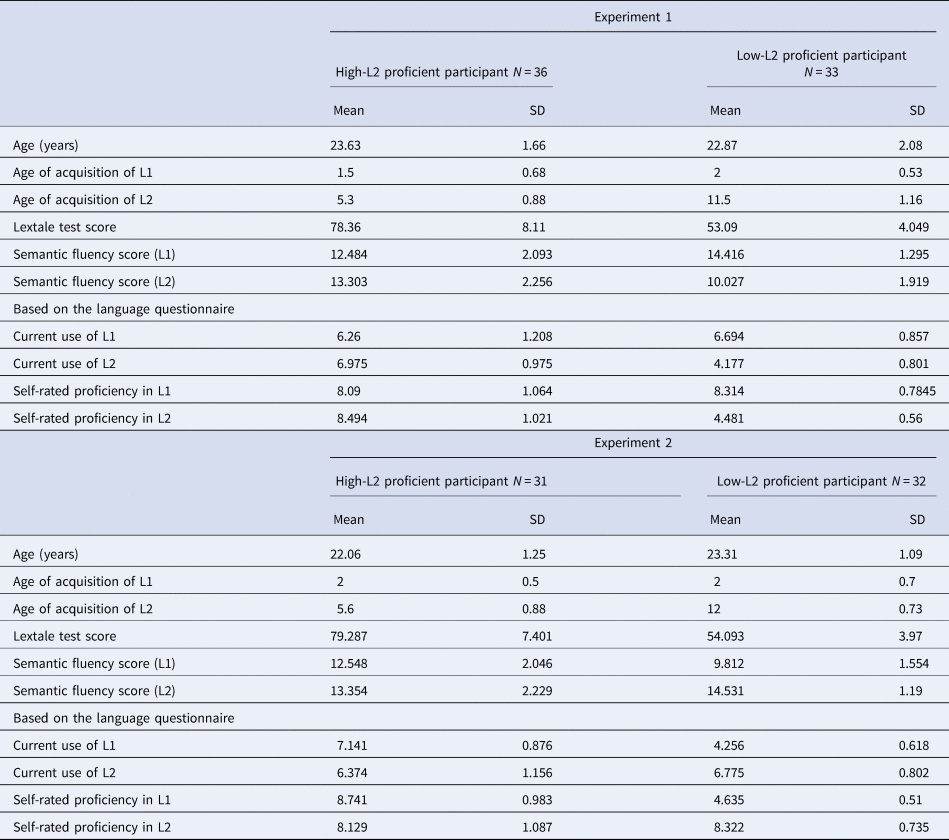
Thirty-three low-L2 proficient bilinguals (17 male, 16 female, mean-age = 22.87 years, SD = 2.08 years) and thirty-six high-L2 proficient bilinguals (16 male, 20 female, mean-age = 23.63 years, SD = 1.66 years) from the University of Hyderabad voluntarily participated in the experiment and gave their written consent. The study had clearance from the institutional ethics committee (IEC) at the University of Hyderabad. The initial categorization of high and low-L2 proficient participants was based on the interactions with one of the authors (Telugu–English bilingual). During the interaction low-L2 proficient participants reported that their medium of instruction during schooling and college was in Telugu. English was introduced as a subject only during their high school, and their current medium of education is in Telugu. Therefore, use and exposure of English is low. The high-L2 proficient participants reported that they acquired English during their childhood. English was the medium of instruction in school and college. They use Telugu and English extensively in their daily life. To account for the participants language profile both subjective and objective measures were used.
Language Control tasks
The Lextale test (Lemhöfer & Broersma, Reference Lemhöfer and Broersma2012), a virtual vocabulary test, was used to calculate English proficiency: it consists of 60 trials with pseudo-word and existing words in English. The participant is asked to identify existing words through a button press. Participants did a semantic fluency task to measure their Telugu and English proficiency. The participants had to generate words in Telugu for the categories “vegetables” and “birds” and in English for “fruits” and “animals.” Categories were counterbalanced between languages. The average number of words per minute for each category accounted for Telugu and English proficiency. A language questionnaire acquired demographic details and related language (L1 and L2) data. Questions about language proficiency, use, exposure, and age of acquisition of L1 and L2 were included. Based on the questionnaire data, the cumulative score of self-rated language proficiency and current use in Telugu and English were calculated. The results from language control measures and questionnaire data were that the low-L2 proficient participants rated themselves to be less proficient in English compared to high-L2 proficient participants (Means & SD - Table 1; t test - Supplementary file Table 1).
Characteristics of the participants – Experiment 1 and 2
Stimuli
One hundred black and white line drawings, each measuring 300 x 300 pixels, were picked from Snodgrass and Vanderwart (Reference Snodgrass and Vanderwart1980) and Google Images (Appendix 1). Objects with phonological cohorts or multiple names were not included. The audio-visual stimuli by Kapiley and Mishra (Reference Kapiley and Mishra2019) were used.
Procedure
Participants watched videos of the cartoon interlocutor “speaking” in Telugu and English for the familiarization phase. Then, they were given a questionnaire to rate the perceived language proficiency of each cartoon-interlocutor in Telugu and English on a scale of 1-10 (1-low proficient, 10-high proficient). The high-L2 proficient interlocutors (M = 8.61, SD = 0.64) were rated to be more proficient in English than low-L2 proficient interlocutors (M = 4.05, SD = 0.60), t(1,68) = 36.84, p < 0.001). Telugu ratings did not vary high-L2 proficient (M = 4.05, SD = 0.60) and low-L2 proficient interlocutors (M = 4.05, SD = 0.60), t(1,68) = 36.84, p < 0.001). 85% of the participants reported that speech samples of low-L2 proficient interlocutors had language errors, delayed speech, repeated words, and mispronounced words in English.
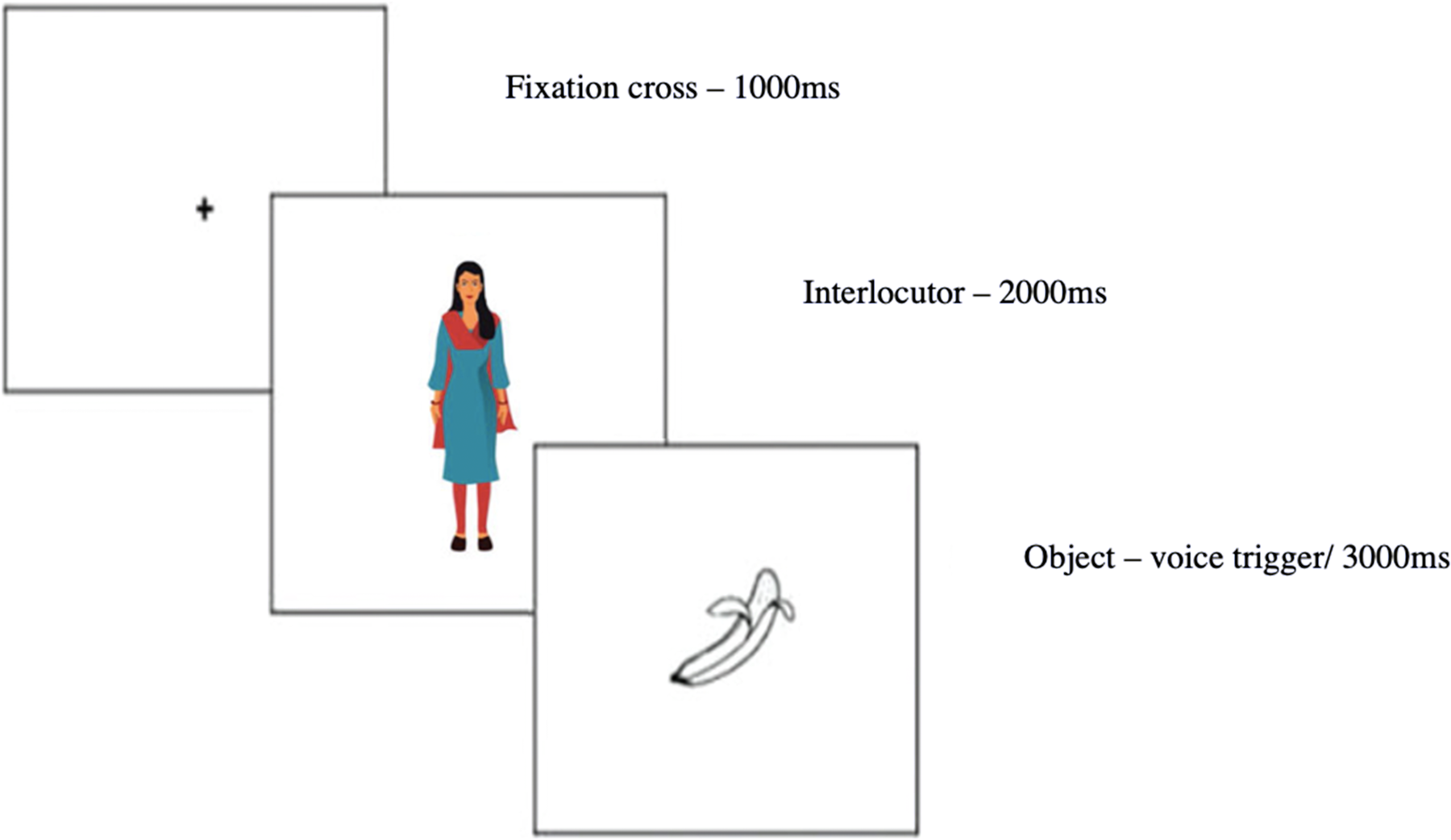
J.C. Forster's DMDX software developed at the University of Arizona (Forster & Forster, Reference Forster and Forster2003), version 5.1.1.3 with DirectX 9.0 on a 19" DELL square monitor with 1280 x1024 pixel resolution and 60 Hz refresh rate, was used to dispense the stimuli. Candidates were seated on a chair at 75 cm from the monitor. Through a button press and voice trigger using an iball M-27 table microphone, DMDX recorded manual and verbal responses. Every trial started with a fixation cross at the centre of the screen for 1000 ms, followed by an image (Appendix 1) of the interlocutor for 2000 ms. Then, a screen with an object at its centre was presented for 3000 ms or until the voice was triggered (Figure 1). Participants were asked to name the object as accurately as possible in the language that came to their minds. We did not ask the participants to maintain any linguistic balance. The verbal responses were noted using Audacity 2.0 in a noise-free lab setting. Before the main experiment, twenty practice trials were administered, and in the main experiment, the stimuli pictures in the practice trials were not reiterated. Leisure breaks between the sessions were given to the participants.
Schematic representation of the trial sequence.
Design
The experiment comprised 300 trials, with 100 trials for each monitoring block. Block 1 consisted of 100 trials in which the high-L2 proficient interlocutor was presented 75%, and 25% was the low-L2 proficient interlocutor. In Block 2, the low-L2 proficient interlocutor presentation percentage was 75% and the high-L2 proficiency was 25%. In Block 3, the percentage of high and low-L2 proficient interlocutors was 50% each. The administration of the blocks was counterbalanced across participants.
Data analysis
Seven participants' data were discarded as they did not complete all the three blocks (2/3 blocks) in the experiment. Trials with naming latencies less than 150 ms and/above 3000 ms, non-verbal responses, and auto triggering of voice-key were discarded (9.51%). 1.81% of the trials were excluded due to object-naming errors. The latencies above and below “2 S.D” were discarded (0.5%). The following analysis was performed on the extracted data.
Language choice
The percentage of language choices was calculated by dividing the total number of language choices for a particular language by the total number of trials in the block. The switch rate for a language in each block was calculated as the total number of switch trials of a language divided by the total number of trials. Repeated measures ANOVA was performed separately on the percentage of language choices and switch rate as a dependent measure. Block type (1, 2 & 3) and language (English, Telugu) were treated as within-subject factors, and group (high-L2 proficient, low-L2 proficient participants) as between-subject factors.
Naming
Naming latencies were calculated from the onset of the object stimulus to the voice trigger due to the verbal response. For trial type, the trials in which the participant's response language was the same as the previous trial was considered “stay trial.” The trials in which participants switched their responses to another language from the previous trial was considered “switch trial.” Naming latencies were treated as dependent measures, and block type (1, 2 & 3), language (English, Telugu), and trial type (stay, switch) were treated as within-subject factors, and group (high-L2 proficient, low-L2 proficient participants) as between-subject factor. Separate repeated-measures ANOVA was performed for switch costs if the 4-way interaction was significant. The values obtained on the “stay” trials minus the “switch” trials of English and Telugu accounted for switch costs. The independent factors were the same as for naming latencies.
Results
Language choice
The percentage of choices in Telugu (M = 45.41, SE = 0.55) were significantly higher than choices in English (M = 42.94, SE = 0.64); F(1,30) = 459.07, p < 0.001, h2 = 0.16. Interaction between block type and language was significant F(1,30) = 529.98, p < 0.001, η2 = 0.94. In block 1, participants chose English (M = 64.40, SE = 1.42) more often than Telugu (M = 24.87, SE = 1.34, p < 0.001); in block 2, Telugu (M = 66.87, SE = 0.97) was chosen more often than English (M = 20.48, SE = 0.53, p < 0.001). In block 3, participants chose English (M = 43.93, SE = 1.03) and Telugu (M = 44.51, SE = 0.95) an equal number of times.
Group and language interaction was significant F(1,30) = 37.20, p < 0.001, η2 = 0.55. High-L2 proficient participants chose English (M = 48.32, SE = 0.66) a higher number of times than Telugu (M = 39.89, SE = 0.73, p < 0.001). Whereas low-L2 proficient participants chose to name the objects in Telugu (M = 45.98, SE = 0.93) a greater number of times than in English (M = 42.51, SE = 0.91, p < 0.001). The three-way interaction between group, block type and language was significant F(1,30) = 4.96, p = 0.01, η2 = 0.14. In block 2 and block 3, low-L2 proficient participants chose Telugu (block 2 - M = 68.83, SE= 1.21; block 3 - M = 49.64, SE = 1.65) more often to name the objects than high-L2 participants (block 2 - M = 64.90, SE = 1.55, p = 0.002; block 3 - M = 39.38, SE = 1.14, p < 0.001). In block 1, both low and high-L2 proficient participants chose English more often (high-L2 proficient participants M = 65.87, SE = 2.14; low-L2 proficient participants M= 62.93, SE= 1.72, p = 0.27). The main effect of block type, group and the interaction between them was not significant (F < 1)
Switch rate
The participants switched more often in block 3 (M = 17.26, SE = 0.51) than block 1 (M = 14.28, SE = 0.58, p = 0.001) and block 2 (M = 9.08, SE = 0.34, p < 0.001). F(1,30) = 81.06, p < 0.001, η2 = 0.73. There was a significant interaction between block type and language F(1,30) = 4.73, p = 0.01, η2 = 0.13. In block 1, switches to English (M = 14.56, SE = 0.63) were significantly higher than the switches to Telugu (M = 14, SE = 0.54, p = 0.04). Switches to either of the languages did not differ significantly in other blocks.
Interaction between group and block type was significant F(1,30) = 18.34, p < 0.001, η2 = 0.37. In block 2, the switch rate incurred by low-L2 proficient participants (M = 11, SE = 0.65) was significantly higher than high-L2 proficient participants (M = 6.19, SE = 0.32, p < 0.001). Whereas in block 3, high-L2 proficient participants (M = 18.53, SE = 0.62) switched more often than the low-L2 proficient participants (M = 16, SE = 0.73, p = 0.008). In block 1, there was no difference between the switch rate incurred by high and low-L2 proficient participants (p = 0.91). Two-way interaction between group and language was significant F(1,30) = 4.17, p = 0.05, η2 = 0.12. Low-L2 proficient participants (M = 14.19, SE = 0.46) switched to Telugu more often than high-L2 proficient participants across blocks (M = 12.86, SE = 0.43, p = 0.06). The main effect of language and group was not significant. The three-way interaction between group, block type, and language was not significant (F< 1).
Naming latencies
The high-L2 proficient participants (M = 1043.28 ms, SE = 25.37) were faster in naming the objects (low-L2 proficient participants - M = 1194.09 ms, SE = 25.05) F1(1,30) = 16.65, p < 0.001, η2 = 0.35; F2(1,299) = 148.40, p < 0.001, η2 = 0.33. The naming latencies in Telugu (M = 1107.98 ms, SE = 18.50) were significantly faster than in English (M = 1129.40 ms, SE = 16.76) F1(1,30) = 6.58, p = 0.01, η2 = 0.18; F2(1,299) = 148.40, p < 0.001, η2 = 0.33. The stay trials (M = 1107.47 ms, SE = 17.50) were significantly faster than switch trials (M = 1129.90 ms, SE = 17.93) F1(1,30) = 6.36, p = 0.01, η2 = 0.17; F2(1,299) = 3.73, p = 0.05, η2 = 0.01.
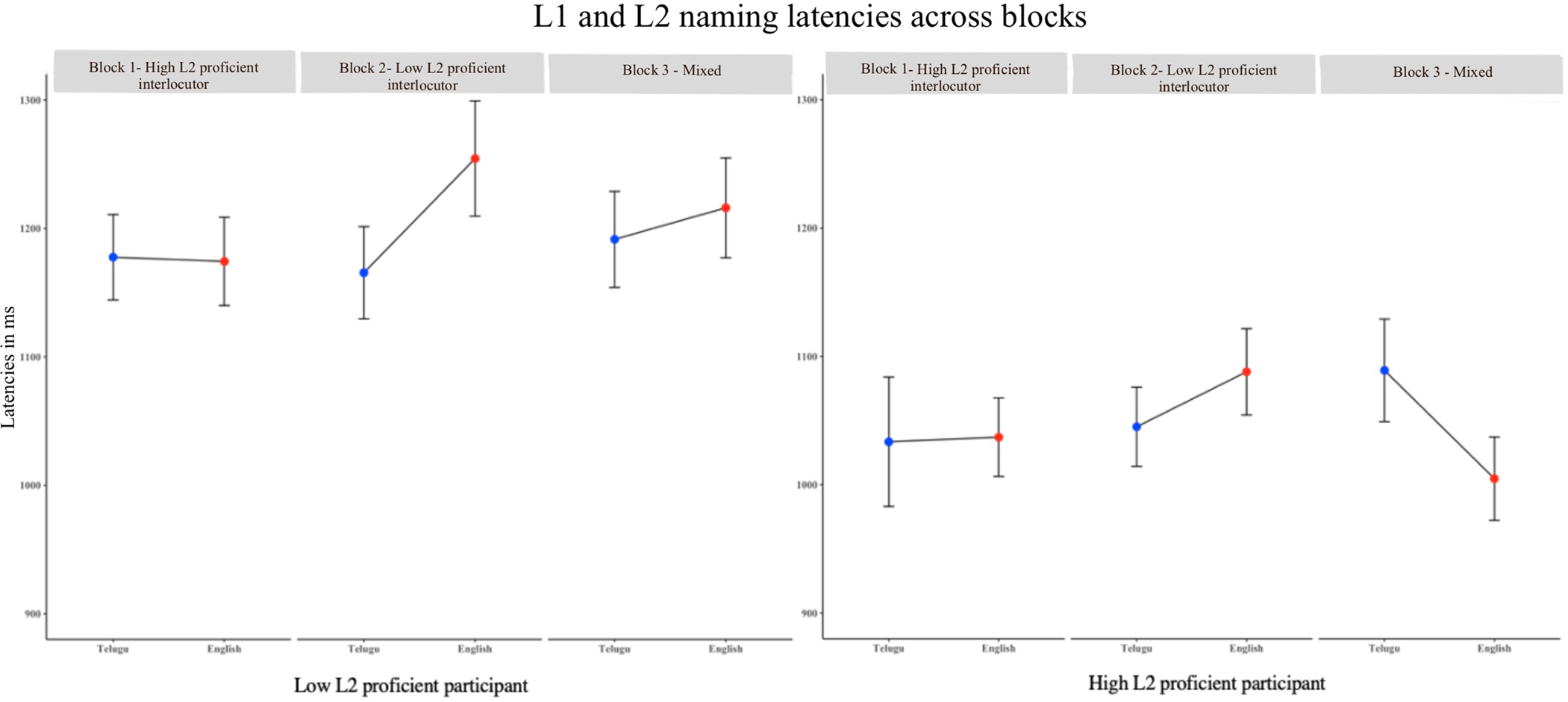
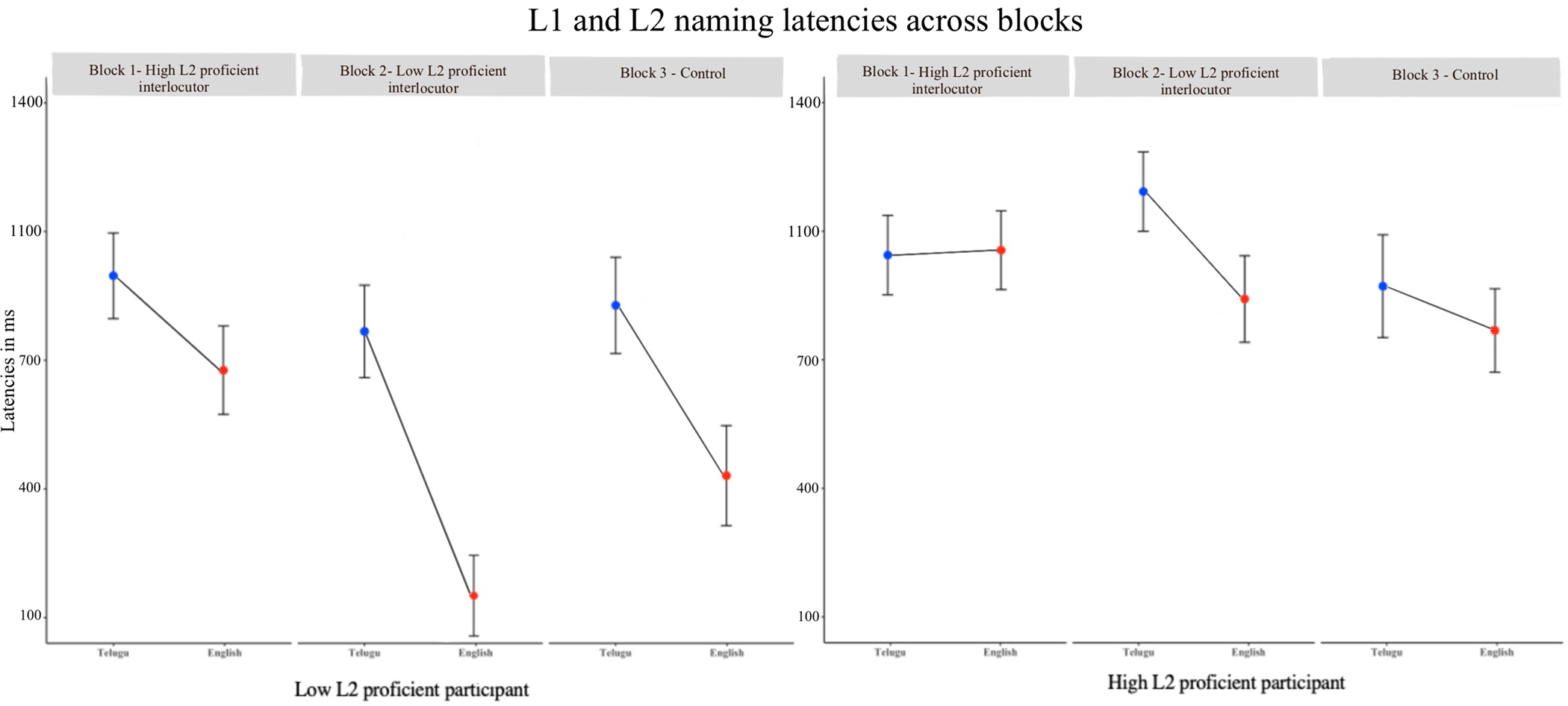
Block type and language interacted significantly F1(1,30) = 13.73, p < 0.001, η2 = 0.31; F2(1,299) = 20.26, p < 0.001, η2 = 0.06. Participants were significantly faster while naming in Telugu (M = 1090.42, SE = 25.55) than in English (M = 1164.66, SE = 30.59, p < 0.001) in blocks 2 and 3. The participants were faster while naming in English (M = 1115.23, SE = 24.77) than in Telugu (M = 1141.60, SE = 27.36, p = 0.03) in block 1 (Table 2).
Means and standard errors (in parentheses) of naming latencies and switch cost (in milliseconds) in English and Telugu across blocks in Experiment 1

The three-way interaction between the group, language and block type was significant F1(1,30) = 5.71, p = 0.004, η2 = 0.08; F2(1,299) = 1.02, p = 0.36, η2 = 0.002. Low-L2 proficient participants were significantly slower while naming the objects in English in blocks 1(M = 1183.64 ms, SE = 34.55), 2 (M = 1236.08 ms, SE =41.39) and 3 (M = 1222.03 ms, SE = 35.75) compared to high-L2 proficient participants (block 1 - M = 1032.98 ms, SE = 34.55, p = 0.003; block 2 - M = 1093.23 ms, SE = 41.39, p = 0.01; block 3 - M = 1008.42ms, SE = 35.75, p < 0.001). In block 3, the Telugu naming latencies did not significantly differ between high (M = 1093.09 ms, SE = 38.16) and low-L2 proficient participants (M =1190.10, SE = 38.16, p = 0.07) (Table 2 and Figure 2).
High-L2 proficient participants were significantly faster while naming in English and Telugu across blocks.
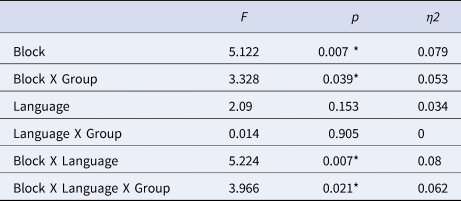
The four-way interaction between block type, group, language and trial type was significant F1(1,30) = 4.46, p = 0.01, η2 = 0.13; F2(1,299) = 6.83, p = 0.001, η2 = 0.02. Switch cost analysis was performed to simplify these interactions further (Table 3).
By subject and by item analysis on naming latencies – Experiment 1
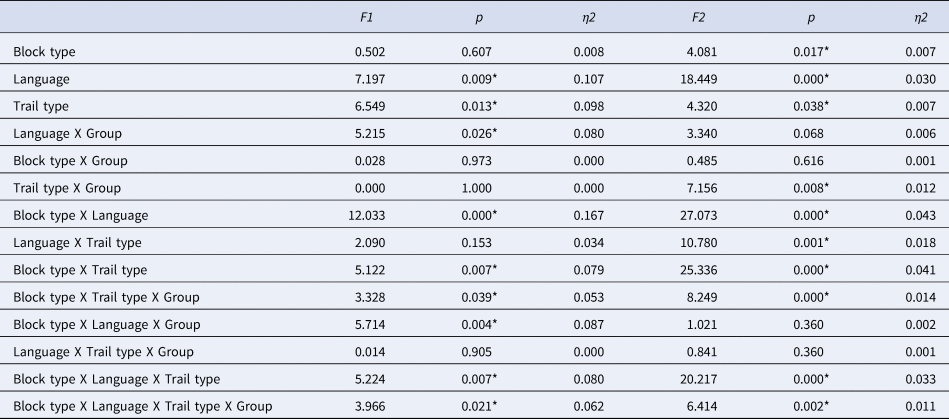
*p < 0.05, ***p < 0.001
Switch cost analysis: Main effects and their interaction – Experiment 1
*p < 0.05, ***p < 0.001
Switch cost
The switch cost was significantly higher in block 1 (M = 57.58 ms, SE = 17.17) compared to block 2 (M = 2.86 ms, SE = 15.85, p = 0.02) and block 3 (M = 6.84 ms, SE = 10.17, p = 0.02) F(1,30) = 4.50, p = 0.01, η2 = 0.13. The overall switch cost obtained in block 2 and block 3 did not differ significantly (p = 0.81). Significant interaction between block type and language was present F(1,30) = 4.69, p = 0.01, η2 = 0.13. Participants incurred higher switch cost in Telugu (M = 97.74, SE = 23.53) than in English (M = 17.42, SE = 18.06, p < 0.001) only in block 1 (Table 3.1).
Group and block type interaction was significant F(1,30) = 3.85, p = 0.02, η2 = 0.11. The low-L2 proficient participants incurred significantly lower switch costs (M = -13.88 ms, SE = 13.96) compared to high-L2 proficient participants (M = 27.56 ms, SE = 12.19, p = 0.01) only in block 3. In block 1 and block 2, there was no significant difference between the switch costs obtained by high and low-L2 proficient participants (p = 0.68; p = 0.08).
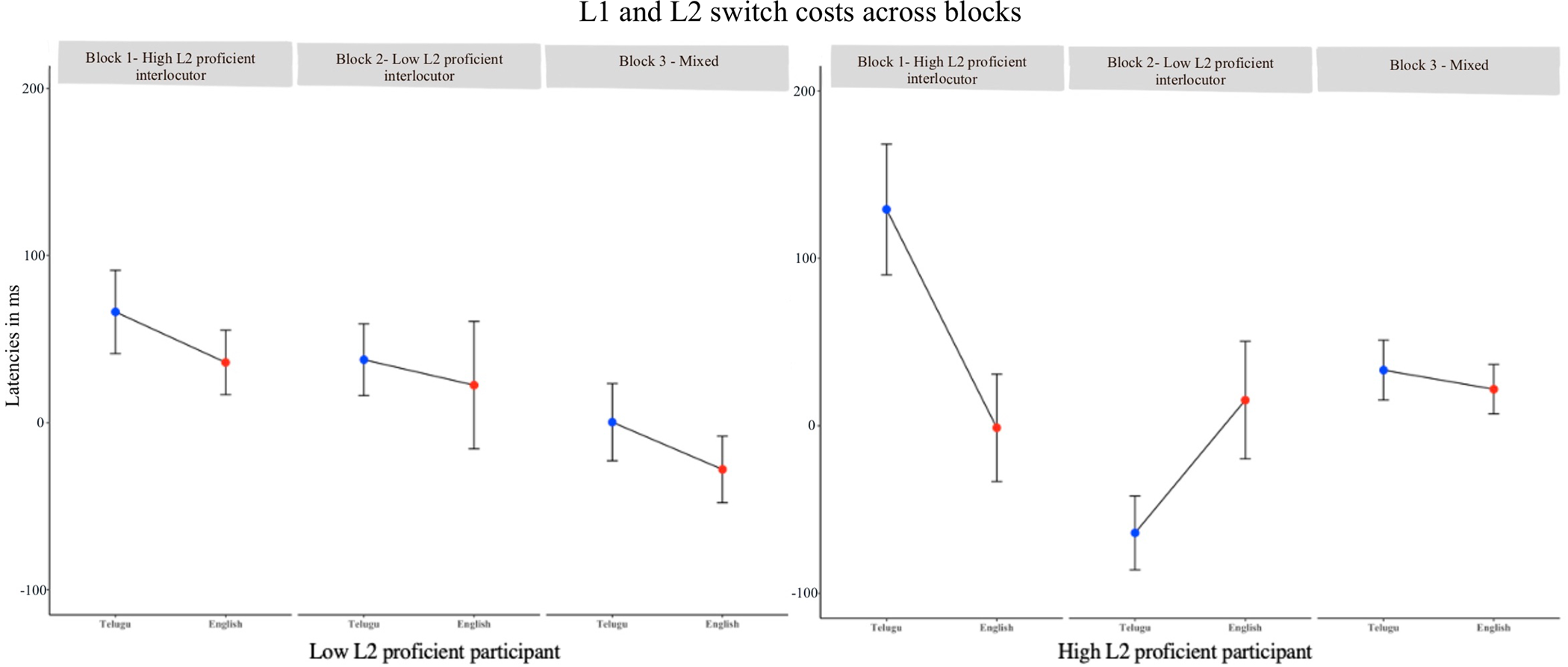
The three-way interaction between group, block type and language was significant F(1,30) = 4.46, p = 0.01, η2 = 0.13. Pairwise comparisons of the group across blocks indicate that, in block 2, low-L2 proficient participants (M = 37.65 ms, SE = 21.51) incurred higher costs in Telugu compared to high-L2 proficient participants (M = -63.97 ms, SE = 22.03, p = 0.005). Whereas in block 3, high-L2 proficient participants (M = 21.86 ms, SE = 14.72) incurred higher costs in English than low-L2 proficient participants (M = -28.01 ms, SE = 19.89, p = 0.04) (Table 2 and Figure 3). Pairwise comparisons of the language across blocks indicate that high-L2 proficient participants incurred more switch benefit in English (M = -1.17 ms, SE = 26.47) than in Telugu (M = 129.22 ms, SE = 32.77, p = 0.001) in block 1. In block 2, high-L2 proficient participants incurred a marginal switch benefit in Telugu (M = -63.97 ms, SE = 21.77) than English (M = 15.34 ms, SE = 36.64, p = 0.07).
Low-L2 proficient participants incurred higher costs in Telugu than high-L2 proficient participants.
Low-L2 proficient participants chose English significantly fewer number of times and were faster while naming in English. However, high-L2 proficient participants chose English significantly higher number of times with faster naming latencies in English.
The main effect of group and language was not significant. Interaction between group and language was not significant (F < 1)
Discussion
High and low-L2 proficient participants did a voluntary object-naming task in the presence of interlocutors in three monitoring blocks that involved dynamic presentation of high and low-L2 proficient interlocutors at different frequencies. Two groups of participants chose English and were faster while naming the objects when the occurrence of a high-L2 proficiency interlocutor was higher than a low-L2 proficient interlocutor in block 1. In block 2, when the frequency of occurrence of low-L2 proficient interlocutors was high, the two groups of participants named the objects in Telugu a higher number of times and were faster. In block 3, the interlocutors were presented an equal number of times and the participants' percentage of choice and naming latencies in English and Telugu did not differ significantly. The dynamic presentation of the interlocutors with varied L2 proficiencies modulated switch costs, as high-L2 proficient participants incurred switch benefits in English in block 1, and marginal switch benefits in Telugu in block 2.
How high and low proficient participants perform during non-dynamic interlocutor blocks is unclear. Would there be language switches? If so, would the switches occur as a function of interlocutors' proficiency or participants' language dominance? For example, if the participants' language dominance is in play, then the percentage of choice would be only in one language, irrespective of interlocutor proficiency. On the other hand, if interlocutors’ language proficiency influences the language choice of the participants, then there would be a higher number of language choices and faster naming in the language appropriate to the interlocutor. For example, participants would choose only L1 for low-L2 proficient interlocutor block and L2 for high-L2 proficient interlocutors; experiment 2 explores this effect.
Experiment 2
In Experiment 2, we asked high and low-L2 proficient participants to voluntarily name objects in the presence and absence of the interlocutors. The high and low-L2 proficient interlocutors were presented in separate non-dynamic blocks.
Participants
Thirty-one high-L2 proficient bilinguals (13 male, 18 female, mean-age = 22.06 years, SD = 1.25 years) and thirty-two low-L2 proficient bilinguals (15 male, 17 female, mean-age = 23.31 years, SD = 1.09 years) participated in the experiment. The participants were categorized based on the procedure used in experiment 1 (Means and SD - Table 1; t test - Supplementary file Table 1).
Procedure
The procedure was similar to Experiment 1. The Participants rated the high-L2 proficient interlocutors (M = 8.53, SD = 0.75) significantly higher in English than low-L2 proficient interlocutor (M = 3.69, SD = 0.84), t(1,62) = 43.60, p < 0.001). The ratings for Telugu proficiency did not differ for high-L2 proficient interlocutor (M = 8.04, SD = 0.69) and low-L2 proficient interlocutor (M = 8.21, SD = 0.72), t(1,62) = - 1.48, p = 0.14). Ninety percent of the participants reported that low-L2 proficient interlocutors made language-related errors with delayed speech.
Design
The experiment comprised 300 trials, with 100 trials in each block. Block 1 consisted of 100 trials with a high-L2 proficient interlocutor. In Block 2, low-L2 proficient interlocutor and in Block 3, no interlocutor was presented. The administration of the blocks was counterbalanced.
Data analysis
Three participants' data was discarded as they did not complete the experiment. Trials with no response, trials with latencies less than 150 ms, and/or above 3000 ms were discarded (10.27 %). 0.9 % of object-naming errors were filtered out. Latencies +/- 2 S.D were discarded (0.68%). Repeated measures ANOVA was performed on the dependent measures and factors explained in Experiment 1.
Results
Language choice
The percentage of choices in Telugu (M = 67.84, SE = 0.24) were significantly higher than in English (M = 32.15, SE = 0.24) F(1,29) = 5376.09, p < 0.001, η2 = 0.98. Group and language interaction was significant F(1,29) = 14664.87, p < 0.001, η2 = 0.99. High-L2 proficient participants chose English more often (M = 61.62, SE = 0.34) than Telugu (M = 38.37, SE = 0.34, p < 0.001). Low-L2 proficient participants chose Telugu more often (M = 97.31, SE = 0.34) than English (M = 2.68, SE = 0.34, p < 0.001). Interaction between block type and language was significant F(1,29) = 1814.63, p < 0.001, η2 = 0.96. Participants chose Telugu (block 1 - M = 54.64, SE = 0.69; block 2 - M = 94, SE = 0.37; block 3 - M = 54.87, SE = 0.35) more often than English (block 1 - M = 45.35, SE = 0.69, p < 0.001; block 2 - M = 5.99, SE = 0.37, p < 0.001; block 3 - M = 45.12, SE = 0.35, p < 0.001). However, In block 2, the percentage of choices in Telugu (M = 94, SE = 0.37) were the highest compared to block 1 (M = 54.64, SE = 0.69, p < 0.001) and block 3 (M = 54.87, SE = 0.35, p < 0.001).
The group, block type and language interaction were significant F(1,29) = 1552.47, p < 0.001, η2 = 0.96. Low-L2 proficient participants chose Telugu more often than English (block 1 -Telugu - M = 92.78, SE = 0.98; English - M = 7.21, SE = 0.98, p < 0.001; block 2 - Telugu - M = 99.57, SE = 0.52; English - M = 0.42, SE = 0.52, p < 0.001; block 3 - Telugu - M = 0.42, SE = 0.50; English - M = 99.57, SE = 0.50, p < 0.001). High-L2 proficient participants chose English more often than Telugu in blocks 1 (Telugu - M = 16.51, SE = 0.98; English - M = 83.49, SE = 0.98, p < 0.001) and 3 (Telugu - M = 10.16, SE = 0.50; English - M = 89.83, SE = 0.50, p < 0.001). In block 2, high-L2 proficient participants chose Telugu (M = 88.44, SE = 0.52) more often than English (M = 11.55, SE = 0.52). The main effect of block type, group and their interaction was not significant (F < 1)
Switch rate
The high-L2 proficient participants (M = 50, SE = 1.43) switched more often than low-L2 proficient participants (M = 39.44, SE = 1.43), F(1,29) = 26.91, p < 0.001, η2 = 0.10. The participants switched more often in block 1 (M = 49.16, SE = 0.83) compared to block 2 (M = 40, SE = 2.27, p = 0.001) and block 3 (M = 45, SE = 1.85, p = 0.05) F(1,29) = 6.78, p = 0.002, η2 = 0.10. A significant interaction between block type and group F(1,29) = 6.78, p = 0.002, η2 = 0.10 indicated that, in block 1, the switch rate incurred by both groups did not differ significantly (high-L2 proficient interlocutor - M = 50, SE = 1.17; low-L2 proficient interlocutor - M = 48.33, SE = 1.17, p = 0.32). In blocks 2 and 3, the switch rates incurred by high-L2 proficient participants (block 2 - M = 50, SE = 3.21, block 3 - M = 50, SE = 2.62) were significantly higher than low-L2 proficient participants (block 2 - M = 30, SE = 3.21, p < 0.001; block 3- M = 40, SE = 2.62, p = 0.009).
Two-way interaction between group and language was significant F(1,29) = 8.46, p = 0.005, η2 = 0.12. Low-L2 proficient participants’ switch rate in English (M = 35.47, SE = 1.76) was lower than in Telugu (M = 43.41, SE = 2.29, p = 0.008). The three-way interaction between group, block type, and language was significant F(1,29) = 4.86 p = 0.009, η2 = 0.07, low-L2 proficient participants incurred lower switch rate in English (M = 18.89, SE = 4.09) compared to Telugu (M = 41.11, SE = 5.66, p = 0.004) only in block 2. The switch rates obtained between languages by participants (high and low-L2 proficient) were similar across blocks. The main effect of language and group was absent (F < 1).
Naming latencies
Low-L2 proficient participants (M = 647.11 ms, SE = 26.78) responded faster compared to high-L2 proficient participants (M = 1030.29 ms, SE = 26.78) F1(1,29) = 102.31, p < 0.001, η2 = 0.63; F2(1,299) = 360.82, p < 0.001, η2 = 0.37. Participants took significantly longer time to name the objects in block 1 (M = 952.00 ms, SE = 26.90) compared to block 2 (M = 784.30 ms, SE = 33.77) and block 3 (M = 779.80 ms, SE = 37.42) F1(1,29) = 8.80, p < 0.001, η2 = 0.13; F2(1,299) = 7.81, p < 0.001, η2 = 0.01. No significant difference existed between the naming latencies obtained in blocks 2 and 3 (p = 0.92). The naming latencies in English (M = 692.95 ms, SE = 21.44) were significantly faster than in Telugu (M = 984.45 ms, SE = 22.88) F1(1,29) = 159.65, p < 0.001, η2 = 0.73; F2(1,299) = 155.17, p < 0.001, η2 = 0.20. The switch trials (M = 903.71 ms, SE = 25.08) were significantly slower than stay trials (M = 773.69 ms, SE = 21.26) F1(1,29) = 23.23, p < 0.001, η2 = 0.28; F2(1,299) = 31.29, p < 0.001, η2 = 0.05
Block type and language interacted significantly F1(1,29) = 12.17, p < 0.001, η2 = 0.17; F2(1,299) = 35.77, p < 0.001, η2 = 0.05. In block 1, participants were faster while naming in English in block 2 (M = 551.08 ms, SE = 45.65) compared to block 1 (M = 885.43 ms, SE = 27.26, p < 0.001) and 3 (M = 642.35 ms, SE = 40.05, p = 0.004). Naming latencies in Telugu were faster in block 3 (M = 917.26 ms, SE = 50.10) compared to block 1 (M = 1018.56 ms, SE = 38.05, p = 0.004) and 2 (M = 1017.52 ms, SE = 35.15, p = 0.004).
Interaction between Block type and group was significant F1(1,29) = 10.03, p < 0.001, η2 = 0.14; F2(1,299) = 3.44, p = 0.03, η2 = 0.006. Low-L2 proficient participants (block 1 - M = 824.45 ms, SE = 38.05; block 2 - M = 471.80 ms, SE = 47.76; block 3 M = 645.07 ms, SE = 52.92) were faster while naming the objects than high-L2 proficient participants (M = 1079.55 ms, SE = 38.05, p < 0.001; M = 1096.80 ms, SE = 47.76, p < 0.001; M = 914.54 ms, SE = 52.92, p < 0.001) across the blocks.
Language and group interacted significantly F1(1,29) = 43.62, p < 0.001, η2 = 0.42; F2(1, 299) = 153.17, p < 0.001, η2 = 0.20 (Figure 4). Low-L2 proficient participants were faster while naming the objects (Telugu - M = 869.04, SE = 32.37; English - M = 425.18, SE = 30.32) compared to high-L2 proficient participants (Telugu - M = 1099.86, SE = 32.36, p < 0.001; English - M = 960.73, SE = 30.32, p < 0.001) (Table 4).
Means and standard errors (in parentheses) of naming latencies and switch cost (in milliseconds) in English and Telugu across blocks in Experiment 2

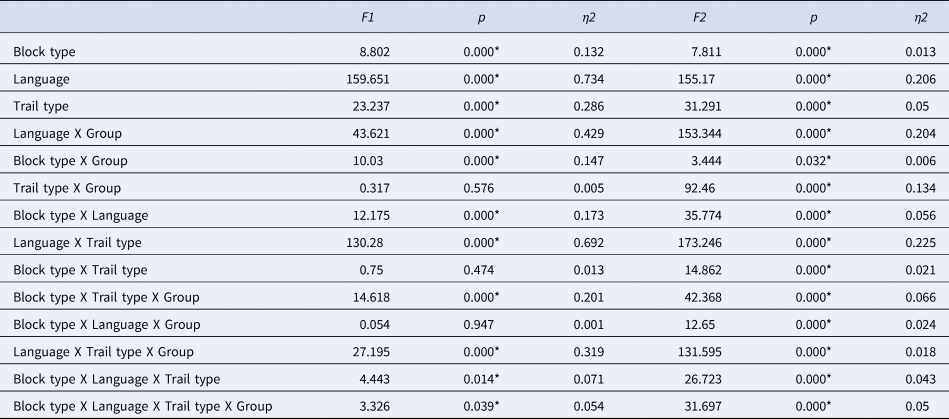
The four-way interaction between group, block type, language and trial type was significant F1(1,29) = 4.46, p = 0.01, η2 = 0.13; F2(1, 299) = 31.69, p < 0.001, η2 = 0.05 (Table 5). Switch cost analysis was performed to simplify these interactions further.
By subject and by item analysis on naming latencies – Experiment 2
*p < 0.05, ***p < 0.001
Switch cost
Participants incurred higher switch cost in English (M = 384.80, SE = 31.67) than in Telugu (M = -109.16, SE = 34.75), F(1,29) = 156.78, p < 0.001, η2 = 0.40. Significant interaction between block type and language was present F(1,29) = 4.47, p = 0.01, η2 = 0.07. In block 2 (M = -194.61, SE = 53.20), participants incurred the least switch cost in Telugu compared to block 1 (M = -7.45, SE = 50.52, p < 0.001) and 3 (M = -125.43, SE = 90.91, p < 0.001). Whereas the participants incurred high switch cost in English in block 2 (M = 515.46, SE = 79.64) compared to block 1 (M = 311.31, SE = 54.56, p < 0.001) and 3 (M = 327.64, SE = 56.13, p < 0.001) (Table 5.1).
Switch cost analysis: Main effects and their interaction – Experiment 2

*p < 0.05, ***p < 0.001
Group and block type interaction was significant F(1,29) = 14.14, p < 0.001, η2 = 0.19. The low-L2 proficient participants incurred significantly lower switch costs (M = -13.88 ms, SE = 13.96) compared to high-L2 proficient participants (M = 27.56 ms, SE = 12.19, p = 0.01) only in block 3. In block 1 and block 2, there was no significant difference between the switch cost obtained by high and low-L2 proficient participants (p = 0.68; p = 0.08). The interaction between group and language was significant F(1,29) = 39.65, p < 0.001, η2 = 0.40. Low-L2 proficient participants incurred switch benefit in Telugu (M = -226.01 ms, SE = 49.15) compared to English (M = 516.39 ms, SE = 44.79, p < 0.001). High-L2 proficient participants incurred higher switch costs in English (M = 253.22 ms, SE = 44.79) than in Telugu (M = 7.68 ms, SE = 49.15, p < 0.001).
The three-way interaction between group, block type and language was significant F(1,29) = 3.98, p = 0.021, η2 = 0.06. Low-L2 proficient participants incurred switch benefits in Telugu in all the blocks. The high-L2 proficient participants incurred symmetric switch costs in blocks 1 and 3; however, they incurred high switch costs in English block 2 (Table 4 and Figure 5).
Low-L2 proficient participants incurred switch benefit in Telugu irrespective of block type.

Discussion
High and low-L2 proficient participants voluntarily named the objects in three different blocks; in block 1, participants saw only one interlocutor that was a high-L2 proficient interlocutor; in block 2, low-L2 proficient interlocutor and in block 3, there was no interlocutor. Unlike results from Experiment 1, the participants' language proficiency significantly influenced language choice while naming the objects, especially when the presentation of the interlocutor type was blocked. Low-L2 proficient participants chose Telugu more often than English, irrespective of the block type. High-L2 proficient participants chose English more often in blocks 1 and 3, and chose Telugu more often in block 2. The results from the switch rate analysis also indicates that the overall switch rate incurred by high-L2 proficient participants was significantly higher than low-L2 proficient participants. This can imply that high-L2 proficient participants linguistically adapt to the interlocutors' language proficiencies. The values obtained on English naming latencies by low-L2 proficient participants were significantly lower than Telugu – however, the low-L2 proficient participants chose English less than two percent of the time. Interestingly, they also demonstrated switch benefits in Telugu irrespective of block type. In contrast, the high-L2 proficient participants were faster while naming in English with more number language choices in English (blocks 1 and 3). In block 2, though high-L2 proficient participants were slower while naming in Telugu, the percentage of choices was significantly higher in Telugu in the presence of a low-L2 proficient interlocutor.
General discussion
In two experiments, we investigated if high and low-L2-proficient bilingual speakers monitor their language choice and control in the presence of familiarized bilingual interlocutors with high or low-L2 proficiency. The main idea was, building on our previous work, Kapiley and Mishra (Reference Kapiley and Mishra2019), to examine if bilingual speakers adapt to dynamically evolving contexts of interlocutors with varied L2 proficiencies. Notably, our experimental manipulation for experiment 1 involved presenting different types of interlocutors in specific frequencies to create differential monitoring conditions. In experiment 2, the high and low-L2 proficient interlocutors were presented in separate blocks and a block with no interlocutor. Results from experiment 1 indicate that irrespective of participants' L2 proficiency; they chose to name the objects in English in block 1 as they saw a higher frequency of interlocutors judged as high-L2 proficiency. For block 2, both high and low-L2 proficient participants' language choice in Telugu was higher when the low-L2 proficient interlocutor was presented at a higher frequency. In block 3, the participants chose and switched to English when they saw high-L2 proficient interlocutors and chose/switched to Telugu when they saw low-L2 proficient interlocutors; therefore, the percentage of choice and the switch rate of English and Telugu did not differ significantly. These results extend earlier findings by Kapiley and Mishra (Reference Kapiley and Mishra2019). On the contrary, results from experiment 2 show that the language proficiency of participants determined the language choice, switch rate, naming latencies and switch costs. The overall switch rate and percentage of choices by low-L2 proficient participants was significantly low compared to high-L2 proficient participants. Only low-L2 proficient participants named the objects in Telugu, irrespective of the interlocutors' varied L2 proficiency. This can be attributed to Telugu being the participants' dominant language, and both interlocutors (proficient speakers of Telugu) lead to higher activation of Telugu. Therefore, it was easier for the participants to choose Telugu as they had no requirement to adapt to the interlocutors linguistically. However, high-L2 proficient participants chose and switched to English a higher number of times in the presence of a high-L2 proficient interlocutor and Telugu in the presence of a low-L2 proficient interlocutor.
The interlocutors' effect on naming latencies was significant in both experiments. The presence of the interlocutors significantly modulated high and low-L2 proficient participants' language activation. The presence of the interlocutor/face activates the language associated with the interlocutor/face (Kapiley & Mishra, Reference Kapiley and Mishra2018, Reference Kapiley and Mishra2019; Li et al., Reference Li, Yang, Scherf and Li2013; Woumans et al., Reference Woumans, Martin, Vanden Bulcke, Van Assche, Costa, Hartsuiker and Duyck2015). In block 1, since the occurrence of a high-L2 proficient interlocutor was higher, the presence of an interlocutor led to active facilitation of English responses. High L2 proficient participants were significantly faster while naming in English than low L2 proficient participants. Since the occurrence of low L2 proficient interlocutors was higher in block 2, high L2 proficient bilinguals obtained faster naming latencies in Telugu as there was active facilitation of Telugu in the presence of the interlocutor. On the other hand, low-L2 proficient participants suffered active interference of Telugu during object naming in English. In Block 3, interlocutors were presented an equal number of times. Previous research on bilingual proficiency and executive function indicates that high-L2 proficient participants can efficiently co-activate both languages, enabling them to employ higher executive control in high monitoring conditions than low-L2 proficient participants (Rafeekh & Mishra, Reference Rafeekh and Mishra2021). The lexical representation in English and Telugu is higher in high-L2 proficient participants, so they can anticipate using any language during dynamic contexts such as mixed block. Therefore, the naming latencies between English and Telugu did not significantly differ. We speculate that due to limited access to L2 lexical representation in low-L2 proficient bilinguals, they often rely on the L1 lexical representations to process L2 lexical representations. Hence, we observed delayed naming in English by low-L2 proficient participants in the mixed block.
However, in Experiment 2, low-L2 proficient participants responded faster in English than in Telugu in all the blocks. This could be due to a lower percentage of English language choice and switch rate (< 2%). Low-L2 proficient participants' naming latency in Telugu was significantly lower in block 2 compared to blocks 1 and 3. The presence of a low-L2 proficient interlocutor facilitated higher activation of Telugu, leading to faster naming. On the other hand, high-L2 proficient participants were faster when naming in English in all the blocks as they are dominant in English. However, in block 2, the active interference of English might have led to significantly slower naming in English.
We found an interesting pattern of switch costs by high and low-L2 proficient participants in experiments 1 and 2. In Experiment 1, low-L2 proficient participants incurred symmetric switch costs in all the blocks. High-L2 proficient participants incurred switching benefits in block 1 while switching to English (which means that the stay trials in English were significantly slower than the switch trials) and a marginal switching benefit in Telugu in block 2. In block 3, the cost associated with English and Telugu switches did not differ significantly. We speculate that the interlocutors' presentation frequency might have modulated the switch costs differently in high and low-L2 proficient participants. The high-L2 proficient participants might have anticipated the interlocutor presentation's frequency better than the low-L2 proficient participants. When the high-L2 proficient participants were frequently presented with high-L2 proficient interlocutors, they might have expected that the particular block was dominant with high-L2 proficient interlocutor presentation. This might have led to higher English activation; therefore, participants switched to English when a high-L2 proficient interlocutor was presented. A similar mechanism might have been in play for block 2 as we observed the switching benefit in Telugu. These findings support Gollan and Silverberg's (Reference Gollan and Silverberg2001) notion of performance benefit: bilinguals switch languages when it is easier for them to switch. In block 3, high-L2 proficient participants incurred symmetric switch costs. In this block, the participants might have anticipated that the presentation of high and low-L2 proficient interlocutors is unpredictable. Therefore, they might have activated both the languages and switched to the languages that were associated to the interlocutor. Previous findings suggest that high-L2 proficient bilinguals are better at monitoring and anticipation (Bhandari et al., Reference Bhandari, Prasad and Mishra2020). We observed that low-L2 proficient participants incurred symmetric switch costs as they did not anticipate the interlocutors' frequency and activated both languages irrespective of block type.
In experiment 2, low-L2 proficient participants incurred switch benefits in Telugu in blocks 1 and 2, indicating that there was active facilitation of Telugu in the presence of the interlocutors. Interestingly, switch benefit was also found in block 3 (absence of interlocutor). This could be due to fewer English switches and few participants not switching to English in block 3. High-L2 proficient participants incurred symmetric switch costs in blocks 1 and 3, contrary to the predictions that high-L2 proficient participants would incur higher switch costs in L2. In block 1, the high-L2 proficient interlocutor might have facilitated switches to English, leading to faster latencies on English switch trials. In block 3, we speculate that switches to English or Telugu could result from ease of lexical access (Blanco-Elorrieta & Caramazza, Reference Blanco-Elorrieta and Caramazza2021), leading to symmetric switch costs. High-L2 proficient participants incurred higher switch costs in English in block 2 as the presence of low-L2 proficient interlocutors facilitated higher activation in Telugu, leading to faster switch trials in Telugu. This also might have led to active interference of Telugu during English switch trials.
These results suggest that high and low-L2 proficient bilinguals linguistically adapt to the interlocutors' L2 proficiency. However, the degree of language control differs significantly. High-L2 proficient bilinguals are better at monitoring and anticipating the language cues in a context. High-L2 proficient bilinguals are more sensitive to the cues in their environment (Bhatia et al., Reference Bhatia, Prasad, Sake and Mishra2017), and they make fair use to facilitate their adaptive processes concerning others.
Conclusion and implications
Our findings have greater relevance for the sociolinguistic contexts of India than in other places. It is becoming very clear from many recent datasets that bilinguals' performance is highly culture-specific, and a range of ethnic, educational, cognitive, social and cognitive variables affect their language and cognitive control, including the influence of literacy (Knoeferle et al., Reference Knoeferle, Mishra and Peña2022). Indian university structure presents a highly English-specific but unbalanced discourse setup where high and low English proficiency is decisive as a marker of both linguistics and cognitive competence (Sailaja, Reference Sailaja2012). The social lingua franca is English. This situation forces bilinguals to select English for interlocutors judged as better at English, an ideal example of adaption (Green & Abutalebi, Reference Green and Abutalebi2013). We created different contexts by presenting interlocutors at specific frequencies, and the results indicate that it affected the bilingual speakers' language choices and switch rates. Based on previous findings (Kapiley & Mishra, Reference Kapiley and Mishra2019) and this study, we can say that high-L2 proficient speakers use English with other high-L2 proficient speakers. Low-L2 proficient speakers adapt to high-L2 proficient bilinguals using their limited English vocabulary. Furthermore, low-L2 proficient speakers use their native language to communicate with other low-L2 proficient speakers. These findings align with the schematic model of bilingual empirical connections by Rafeekh and Mishra (Reference Rafeekh and Mishra2021).
Acknowledgements
Sangeeth for animation of cartoons
Supplementary Material
For supplementary material accompanying this paper, visit http://doi.org/10.1017/S1366728923000962


 Open access

