

INTRODUCTION
There are few issues on which comparative politics theories offer more sharply contrasting predictions than on the link between resource rents and government welfare provision. Some authors, especially those in the tradition of “rentier state theory,” expect oil-rich rulers to engage in mass co-optation, politically pacifying their population with expansive welfare policies (Beblawi and Luciani Reference Beblawi and Luciani1987; Karl Reference Karl1997). Others, especially those proposing formal models of politics in oil-rich states, expect rentier rulers to neglect their population. As rents are siphoned off by a small ruling elite that does not need a domestic economic basis for their self-enrichment, welfare provision is minimal and misery spreads (Acemoglu, Robinson, and Verdier Reference Acemoglu, Robinson and Verdier2004; Mesquita and Smith Reference Mesquita and Smith2009).
There are empirical examples for both trajectories. Oman and Equatorial Guinea have broadly comparable levels of natural resource rents per capita—slightly above 8,000 USD per capita in the 1995 to 2014 period (Ross Reference Ross2013). Both have been ruled by the same autocrats since the 1970s, when both countries were desperately poor. Under Sultan Qaboos, Omani public services have expanded at a rapid pace, leading to one of the world’s fastest declines in child mortality, from 159 per one thousand live births in 1971 to 9 by 2010, far below the Middle East average of 32. In Teodoro Obiang’s Equatorial Guinea, the state outside of the security services remains embryonic, the vast majority of the population continues to live in abject poverty, and infant mortality has declined painfully slowly: from 263 in 1971 to 109 in 2010, remaining above the (high) sub-Saharan average of 89. Access to rentier wealth is monopolized by the president’s small entourage (Wood Reference Wood2004).
The present paper addresses the above puzzle: what makes some, but not all oil-rich ruling elites provide generous welfare? Building on a case study of Oman, we propose that elites in oil-rich states offer broad-based welfare if they face political threats in the shape of mass-based anti-systemic movements that seek regime change at the country’s political center. These threats, which we also call “subversion” in this paper, motivate rulers to use welfare provision as a tool of mass co-optation to reduce popular support for such movements.Footnote 1 Importantly, not all types of threats to elites have this effect. Given the highly militarized nature of counter-insurgency against separatism and the difficulty of buying off nationalist sentiments, separatist subversive threats are not expected to entail long-term enhancements of social welfare.
To be sure, welfare provision is a potentially useful tool of co-optation for both oil-rich and oil-poor ruling elites. But mass co-optation by welfare provision is an easier option in resource-rich states due to weaker fiscal constraints that make the “guns versus butter” trade-off between security and welfare spending less steep, giving resource-rich rulers not only the motivation but also, critically, the means for mass co-optation policies. In resource-poor countries, the incentive to provide welfare is countered by fiscal constraints and, potentially, augmented security costs in the face of subversion.
Theoretically, our paper addresses a fundamental, unresolved tension in the literature on resource-rich states. Formal models predict that ruling elites provide less welfare because they benefit less from non-oil economic development and fear that public goods provision can enable social mobilization (Acemoglu and Robinson Reference Acemoglu and Robinson2006; Hong Reference Hong2017; Mesquita and Smith Reference Mesquita and Smith2009; Soysa and Gizelis Reference Soysa and Gizelis2013). Rentier state theory, by contrast, describes generous welfare provision as default tool of mass co-optation in oil-rich states (Beblawi and Luciani Reference Beblawi and Luciani1987; Karl Reference Karl1997). There is surprisingly little empirical research on the effect of oil rents on welfare, and it usually estimates global average effects rather than investigating the conditions under which oil leads to welfare provision (Gylfason Reference Gylfason2001; Gylfason and Zoega Reference Gylfason and Zoega2002; Hong Reference Hong2017).
To the best of our knowledge, our paper is the first to provide a clear theoretical account of the incentive structures that can make elites in resource-rich states provide generous welfare—existing theories only explain why they should not do so. We reconcile the predictions of formal models of resource kleptocracy with rentier state theory by stipulating conditions under which welfare is provided. We locate our theory and findings in broader discussions of state and regime formation, arguing that the outcome we identify—a generous welfare state but without high state capacity—constitutes a distinct type of regime that is different both from developmental states and kleptocratic states.
Our empirical tests combine the strengths of qualitative inquiry using rich archival data with new quantitative techniques for causal inference and provide corroboration of a conditional effect of oil on long-term welfare outcomes. We find evidence of large substantive effects. In our core model, oil-rich countries facing subversive threats significantly reduce healthcare and education inequality and display higher school enrollment in the 15 years after onset of the threat compared to oil states facing no such threat. While evidence for primary enrollment is mixed, secondary enrollment is 15 percentage points higher. Our paper also recovers the concept of subversion from existing literature—which has often used it implicitly—and makes it empirically tractable.
The paper first reviews existing theoretical and empirical literature on welfare in rentier states. It then presents our own argument, followed by the Oman case study motivating it. The next section provides the global quantitative test of our argument, followed by a discussion of the limitation of our research and of its wider significance.
LITERATURE AND THEORY
The wide empirical divergence in welfare outcomes among resource-rich countries is mirrored in contrasting theoretical expectations regarding welfare provision in such countries. Formal theories of elite behavior identify two reasons for why rulers with access to rents provide fewer public goods. First, the indirect economic benefits of such provision are relatively smaller. Public goods such as health and education are key contributors to economic growth, which generates tax revenues. Ruling elites who can capture external rents have weaker incentives to make these investments (Hong Reference Hong2017; Soysa and Gizelis Reference Soysa and Gizelis2013). Second, human development can create political challenges from better resourced and educated citizens (Bourguignon and Verdier Reference Bourguignon and Verdier2000). Rentier elites invest less in public goods to reduce such challenges (Acemoglu and Robinson Reference Acemoglu and Robinson2006; Mesquita and Smith Reference Mesquita and Smith2009).
Rentier state theory, largely inspired by Middle Eastern regimes, makes the opposite prediction. Oil regimes use public riches to co-opt and pacify the population. Broad-based welfare provision is described as quasi-automatic outcome of oil rents in authoritarian MENA countries (Beblawi and Luciani Reference Beblawi and Luciani1987), but also in democracies like pre-Chavez Venezuela (Karl Reference Karl1997). Rentier state theory stipulates that welfare provision leads to the political acquiescence of populations (Beblawi and Luciani Reference Beblawi and Luciani1987; Karl Reference Karl1997). The pacifying effect of mass education in particular might be a counter-intuitive assumption, but recent empirical work has shown that schooling can be used to instill, if not loyalty, then at least political compliance (Paglayan Reference Paglayan2017). However, rentier theories do not specify the elite calculus leading to such rentier generosity in any detail, and the historical decisions leading to the expansion of welfare systems in MENA rentier states are not well documented.
Existing statistical literature on resource rents and welfare similarly is of little help in explaining disparate outcomes. Most papers estimate average effects rather than investigating the conditions that lead to kleptocracy or rent-financed welfare. The majority of cross-sectional and panel studies find negative effects of resource rents, covering outcome variables like spending on health (Hong Reference Hong2017), spending on education (Gylfason Reference Gylfason2001; Hong Reference Hong2017), under-5 child mortality (Wigley Reference Wigley2017), spread of HIV (Soysa and Gizelis Reference Soysa and Gizelis2013), secondary enrollment (Gylfason Reference Gylfason2001; Gylfason and Zoega Reference Gylfason and Zoega2002), and compound measures of education and health outcomes (Carmignani and Avom Reference Carmignani and Avom2010).
These findings are not undisputed. One issue is that most of the cited papers include GDP per capita as a control variable, which introduces a post-treatment measurement bias as GDP figures in rentier countries are driven up—sometimes drastically—by a booming resource sector. Given that GDP is a robust predictor of education and health outcomes, this effectively leads to a statistical comparison of artificially rich resource-rich states with wealthy resource-poor states that makes rentier outcomes look artificially worse (Herb Reference Herb2005; Paine Reference Paine2016). A more appropriate, but empirically unavailable comparison group would be a counterfactual version of the same states without resource riches, which likely would have lower GDP figures. A small number of studies try to control for such biases by using only pre-treatment control variables and find a positive effect of resources on human development (e.g., Cotet and Tsui Reference Cotet and Tsui2013; Pineda and Rodríguez Reference Pineda and Rodríguez2010). Even these, however, do not address potential causal heterogeneity.
This is surprising given that the broader resource curse literature has moved toward the investigation of conditional effects of rents (Herb Reference Herb2017; Smith Reference Smith2007). We are aware of only one theoretical statement on the conditionality of public goods provision in resource-rich states, by Sarr and Wick (Reference Sarr and Wick2010). They propose that ruling elites will produce more public goods if they are relatively less effective at capturing the natural resources in a potentially violent contest with the population. They test this proposition with a cross-sectional regression in which a ruler’s strength is proxied with the number of soldiers per capita. Their empirical model includes no measure of the relative strength of oppositional challenges, however, which introduces potential biases as such challenges might themselves drive militarization.
There is one empirical paper that addresses the impact of oppositional mobilization on public goods provision in oil-rich states. Mazaheri (Reference Mazaheri2017) analyzes annual variation of welfare provision since 1990 in a sample of developing countries and detects a positive effect of oil in the presence of non-violent protests and a negative effect in the presence of violent protests. The paper usefully highlights the incentive environment of rulers, yet it focuses on short-term effects, not the long-term divergence of welfare provision and outcomes that interests us. Mazaheri’s intuition that oppositional challenges can trigger welfare provision is nonetheless plausible. It aligns with recent literature showing that threats from the left motivated elites to step up welfare policies in pre-WWII and Cold War Europe (Paster Reference Paster2013; Rasmussen and Knutsen Reference Rasmussen and Knutsen2019).
That said, we cannot assume that oppositional challenges automatically lead to co-optation through welfare. Especially when opposition has anti-system objectives, ruling elites always have the option to repress. Moreover, repression itself has resource implications as it compels rulers to spend more on security, be it to increase the capacity of security forces or safeguard their loyalty. Security spending in turn can crowd out welfare spending, creating a trade-off between “butter and guns” (Sexton, Wellhausen, and Findley Reference Sexton, Wellhausen and Findley2019), even when rulers have a political incentive to distribute welfare. Moreover, subversive challenges to incumbents can disrupt the infrastructure and security required to deliver public goods (Chamarbagwala and Morán Reference Chamarbagwala and Morán2011). As a result, stronger elite incentives to provide welfare will not necessarily be reflected in actual welfare delivery in the short run. Finally, it is likely that the type of oppositional challenge matters. Extant literature has highlighted important differences in the way regimes fight anti-systemic movements aiming to take over central government as opposed to those aiming to split off from the national territory (Slater Reference Slater2020), with important implications for the viability of welfare provision as a political tool.
Our Argument
Building on the foregoing discussion, we now propose our own argument to resolve the tension between models of resource kleptocracy and rentier state theories. It is informed inductively by the case study in this paper and deductively by literature about how oppositional threats can motivate elites to change welfare policies. We concur with formal models of politics in resource-rich countries that ruling elites seek to ensure survival in power. Public policies are subject to this overarching goal and reflect elites’ assessment of threats to their rule. Within these constraints, elites will seek to maximize their personal rents from resource revenues.
We also agree with existing literature that the relative economic pay-off of welfare provision is lower in resource-based regimes, while its potential modernization effects are politically undesired (Acemoglu and Robinson Reference Acemoglu and Robinson2006; Mesquita and Smith Reference Mesquita and Smith2009). All else being equal, we therefore expect oil-rich regimes to establish narrow kleptocratic coalitions with limited welfare provision and rampant elite self-enrichment.
This changes whenever elites face serious threats to their survival in power which they assess to be dissolvable through large-scale material distribution in the form of welfare—a process known as “mass co-optation” (Gerschewski Reference Gerschewski2013). Elites will prefer welfare distribution over other forms of defusing such threats—for example, political liberalization and representative institutions—because oil wealth allows them to hand out welfare with relatively limited impact on their own rent streams, while retaining general control over the policy process (Gandhi and Przeworski Reference Gandhi and Przeworski2006).
We posit that such a change in elite incentives is specifically induced by organized anti-systemic threats that elites perceive as credible and which hold the potential of or have successfully led to broader social mobilization threatening their survival in power. As a shorthand for such threats, we use “subversion,” which can be defined as an “act of trying to destroy or damage an established system or government” (Cambridge Dictionary 2021). For our purposes, subversion involves movements with a permanent organizational structure that allows them to recruit, learn over time, and choose targets strategically (Dahlum, Knutsen, and Wig Reference Dahlum, Knutsen and Wig2019). Ephemeral protest events and unrest by themselves are unlikely to evoke a systematic, lasting elite response compared to organized groups mounting an ongoing threat. Our concept is therefore more specific than broader notions such as “contentious politics,” which can include strikes, riots, and demonstrations with no clear, organized anti-systemic agenda of regime change.Footnote 2 Similarly, intra-elite conflicts are also unlikely to have broader welfare effects as these can be addressed through targeted, elite-level sharing of rents. Organized challenges need to incorporate a mass, bottom-up element to make mass co-optation through welfare a viable counter-strategy. Finally, though they may involve episodes of armed conflict, anti-systemic subversive threats do not necessarily entail violence and are thus distinct from civil wars.Footnote 3
Organized anti-systemic threats that affect only specific territories should also not motivate increased country-wide welfare provision. Separatist or secessionist anti-systemic movements contest a state’s authority in particular areas in order to break away from the political center. They are routinely underpinned by ethnic or sectarian nationalist ideologies to mobilize against the state. Extant research has shown that such ethnic conflicts typically revolve around questions of self-rule, rather than being driven by socioeconomic inequalities (Cederman and Wucherpfennig Reference Cederman and Wucherpfennig2017). They therefore cannot easily be bought off through general improvement of public goods provision. If anything, the most common economic strategy to address separatism is the purposeful withdrawal of public goods as punishment (Woertz Reference Woertz and Muro2017), and separatist subversions are routinely dealt with as a purely military matter (Slater Reference Slater2020).Footnote 4 We therefore expect only center-seeking subversion to push elites into broad, nation-wide welfare provision. Center-seeking subversion implies a contest over central government resources, thereby putting pressure on ruling elites to demonstrate that they can deploy government to popular benefit.
But why not simply repress center-seeking subversions? Repression and welfare distribution both involve costs. Repression runs the risk of failure through defections from the security apparatus or escalating conflict, which can lead to exit from power. Mass co-optation is likely to reduce popular support for subversion, but it is fiscally costly, potentially diverting resources from other uses, including elite rent-seeking. Even in regimes with limited rent-seeking, the ability to make a substantive difference in welfare through extra spending can be limited by debt and deficit constraints and the high political costs of taxation. Critically, however, such opportunity costs of welfare provision are lower for elites with access to natural resource rents. Discretionary control over rents makes it easier for elites to invest in security while also dedicating resources to welfare and social development, potentially defanging subversive movements—without needing to tax or expropriate elites. While subversion can still disrupt public service provision in the short run, guns versus butter trade-offs are less acute for rulers with access to rents.
While the opportunity costs of welfare provision are generally lower in oil-rich states, in politically calm times this might well be offset by the lower economic pay-offs and undesired political modernization effects attributed to welfare provision. However, when welfare provision becomes a tool of political survival rather than economic development, its political pay-offs increase, making the lower opportunity costs of welfare policy salient. Rentier rulers then become more likely to engage in mass co-optation policies than their peers in non-oil states, who are more likely to choose repression over mass co-optation, which will have either no effect on welfare provision or a negative one because repression can itself be fiscally costly and logistically disruptive.
For rentier elites, it is easier to give up some slices of a larger pie if the alternative potentially is losing it all. Building on historical institutionalist literature on social coalitions and regime formation (Haggard and Kaufman Reference Haggard and Kaufman2008; Slater Reference Slater2010; Smith Reference Smith2007), we expect the distributional effects of political contestation to be long-lasting. Welfare regimes, in particular, are often self-perpetuating once created due to lock-in effects and the risk that reversing welfare programs creates focal points for opposition (Knutsen and Rasmussen Reference Knutsen and Rasmussen2018). We therefore anticipate that while the welfare effects of subversion might not be immediately visible due to short-term disruptions, they will become salient in the medium to long-term.
Table 1 outlines the predicted effects of political subversion on welfare provision for center-seeking and separatist subversion in resource-rich and resource-poor countries. The predictions follow from the combination of (loose or tight) fiscal constraints, and different motivations to provide welfare that follow from the type of oppositional threat. The key prediction is that resource-rich countries with center-seeking subversion are likely to see longer-term increases in welfare provision; the other case categories serve mostly as theoretical and empirical contrast cases. The expectations for the two mixed cases (resource-poor with center-seeking subversion and resource-rich with separatist subversion) are indeterminate, while we would, if anything, expect negative welfare outcomes for resource-poor countries facing separatist subversion. These are only subsidiary hypotheses, however—the core prediction is that welfare provision in resource-rich countries with center-seeking subversions will increase consistently. For this to be the case, we merely need to show that—unlike in resource-rich countries with center-seeking subversion—there is no consistent improvement in welfare in the contrast cases.
Predicted Welfare Effect of Subversion in Resource-Poor and Resource-Rich Countries

Note: Core hypothesis in bold.
The above account is abstract and stylized. In practice, elite decisions can be subject to many case-specific idiosyncratic factors, making our theory merely probabilistic. There could also be systematic context factors shared across cases that affect elite decisions on welfare provision, some potentially attenuating, some reinforcing the above causal mechanisms. Such potential factors include the historical and ideological context of different world regions, diffusion processes in which regimes might adopt policies they have observed in neighboring regimes facing similar challenges, the specific ideological orientation of center-seeking subversive movements, and whether subversion happens around critical junctures, such as regime formation. One prominent context factor that plays at least an auxiliary role in our Oman case study is that of foreign influence over political elites. This influence could run two ways. On the one hand, like in Oman, foreign powers could push national elites to provide welfare in order to promote political stability (and support them logistically in doing so). On the other hand, foreign support could substitute for domestic coalition-building, allowing regimes to eschew mass co-optation policies and instead opt for repression (Yom Reference Yom2016). While this paper primarily focuses on the core mechanisms outlined in the above theory section, it also tentatively explores such context factors.
EMPIRICAL ANALYSIS
We motivate our causal hypotheses through a case study of oil-rich Oman in the 1960s–70s, which served as the original inspiration for our theoretical framework (Rohlfing Reference Rohlfing2008). The case study builds on secondary literature in English and Arabic, as well as primary sources from the United Kingdom’s Foreign Office and India Office, which consist of communication and minutes of meetings with Gulf rulers written by U.K. representatives based in Muscat and the British headquarters in Bahrain.Footnote 5 These unusually detailed records allow us to process-trace elite decisions and the perceptions driving them (Gerring Reference Gerring2007). Oman is a case of high per capita rents, which makes it more likely that the causal processes involving oil rents are visible (Seawright Reference Seawright2016). At the same time, being relatively thinly settled, mountainous, and ethnically diverse, Oman also provides a rather difficult environment for rapid welfare expansion.
Yet the historical context of the Oman case study is rather specific and its theoretical function for our paper is heuristic. We therefore use two quantitative methods, the generalized synthetic control (GSC) method (Xu Reference Xu2017) and a difference-in-difference (DID) research design, to test the generalizability of our argument in a global sample of countries. The GSC approach is useful for approximating a quasi-experimental research design in which treated cases, that is, oil- or non-oil countries facing subversive threats, are compared to a synthetic control group that is assembled from a global “donor pool” of untreated cases. GSC allows for a tight pre-treatment match and through its estimation of factors and factor loadings helps to control for time-variant unobserved trends. The DID approach, while less tightly matched, allows us to assess the impact of oil rents as a continuous variable and to investigate more complex interactions of oil and subversion with context factors, while controlling for the legacy of time-invariant structural factors affecting welfare. We measure welfare provision in terms of longitudinal changes in education and health outcomes. Following the Oman case study, we first present our core quantitative models with assorted diagnostics and robustness tests, followed by an investigation of the potential impact of various context factors on our findings.
Case Study: Oman
When oil was discovered in the mid-1960s, Oman was one of the poorest countries in the region, largely illiterate, with almost no infrastructure, and ruled by a Sultan routinely described as stingy misanthrope (Peterson Reference Peterson1978, 78, 85). Sultan Said, obsessed with remaining debt-free, refused to share the newfound wealth with his population. He typically stalled the few health and education projects he had started, much to the chagrin of his British advisers (Foreign Office 1961; see also Foreign Office 1969a; Takriti Reference Takriti2013a, 43, 45, 89, 160, 161).
The 1950s and 1960s were a period of political turmoil in the Arab world, with monarchies falling in nationalist-leftist coups. By the mid-1960s, radical republican thought started to spread rapidly in Oman. In 1965, the Dhofar Liberation Front, a leftist-nationalist insurgency, emerged in the southern region of Dhofar, inspired and aided by radical leftist movements in other parts of the Arab and wider developing world (Maky Reference Maky and Barut2012; Takriti Reference Takriti2013a). In 1968, it became the openly Marxist Popular Front for the Liberation of the Occupied Arabian Gulf (PFLOAG), which aimed for the liberation of the whole country and other sheikhdoms on the Arabian Peninsula, converting what started as a regional rebellion to a center-seeking one (Foreign Office, 2000; see also Takriti Reference Takriti2013a; 85, 86, 103).
The rebels’ key grievance was Oman’s underdevelopment in the face of growing oil riches and rising living standards in neighboring Gulf countries. Alongside liberation from Anglo-American colonialism and the establishment of republican regimes, a 1966 national charter jointly drafted by Omani liberation groups and the Bahrain National Liberation Front called for “the establishment of social justice that would enable the people to benefit from its own material resources” (Takriti Reference Takriti2013a, 90f.). Among the movement’s rank and file, the experience of hunger and oppression and the promise of progress by the rebels were more important motivations than Marxist ideology (112).
The Sultan was unmoved—if anything, like formal theories of kleptocratic rule predict, he thought that social development, education in particular, would accelerate subversion: “This is why you lost India, you educated the people” he told British diplomats (154f.). The Sultan’s austere views were not universally shared within the regime. Minister of Interior Sayid Ahmed Ibrahim told British diplomats in August 1968 that the country was in need of much faster development (Foreign Office 1968); Sultan Said’s son Qaboos also complained in private that his father was cut off from the people and did not react to their demands (Foreign Office 1966b). Despite growing oil revenues, the Sultanate’s 1968 budget still allocated 75% of spending to defense, compared to 1.3% for health and 0.8% for education (Peterson Reference Peterson1978, 90).
By the late 1960s, the insurgency threatened to spill from Dhofar into mainland Oman (Maky Reference Maky and Barut2012, 479). Not only did PFLOAG, while rooted in Dhofar, seek national liberation. In addition, the more urban, Ba’athist-inspired National Democratic Front for the Liberation of Oman and the Arabian Gulf (NDFLOAG) emerged in 1969 to organize discontented young Omanis across the whole country (Peterson Reference Peterson1978, 189). The December 1969 annual review of the British Consul General was skeptical that the ruler could survive beyond 1971, deploring his refusal to provide hospitals and schools that could improve his standing with young Omanis (Foreign Office 1969a). During the first half of 1970, the Dhofari rebels seemed to be gaining the upper hand militarily (Foreign Office 1970b). At the same time, critically, the fledgling NDFLOAG campaign in the mainland escalated the center-seeking subversive threat, organizing incursions into mainland cities and creating fears of an imminent takeover among British diplomats and local elites (Foreign Office 1969b; 1970c; 1970d). This convinced the Sultan’s son Qaboos and his British backers to depose the old Sultan in July of that year. When NDFLOAG targeted armed forces in mainland Oman, it triggered the palace coup (Foreign Office 1970b).
Both Qaboos and the British shared the perception that development was needed to forestall revolution (Foreign Office 1963; 1966a; 1969c). In his “succession statement, the new Sultan expressed his growing anger and dismay at the inability of his father to use the country’s new-found wealth for the needs of the people” (Foreign Office 1970b). Under Qaboos’ leadership, Oman quickly built a national administration and public services. Provision of schools, health facilities, and water distribution were among the new Sultan’s first decisions days after the coup (Foreign Office 1970f). Figure 1a illustrates the remarkable shift of spending trends around the critical juncture of 1970–71. By 1971, total spending more than doubled from 20.6 to 46 million Rials, while still representing only 92% of total revenue thanks to growing oil income. In 1972, spending increased by another 70%; development expenditure on infrastructure, including schools and hospitals, rose to more than 40% of total spending (Foreign Office 1970f; 1974; see Figure 1b). In 1971, the relative share of social spending—mainly current expenditure on education and health—had risen 2.5-fold compared to 1963. Welfare investments yielded quick results. The school population in all of Oman increased from 750 in June 1970 to 10,000 by the end of the year (Foreign Office 1970b). The total number of schools increased from 3 in 1970 to 68 in 1973; the number of clinics grew from 13 to 29 (Peterson Reference Peterson1978, 206). At the same time, security spending continued to grow in absolute terms under Qaboos, leading to improvements in military capacity (Foreign Office 1970e). Oil rents mitigated any trade-off between guns and butter.
Public Spending Trends in Oman, 1963–73
Note: Functional spending data are not available for 1969 and 1970; no development spending data available for 1968. Data taken from various budget reports by U.K. consulate and embassy, Muscat.

Oman ended its protectorate treaty with Britain in 1971. British influence through high-level advisers remained critical—yet Sultan Qaboos himself repeatedly pushed for and requested development projects (Foreign Office 1970a). Archival documents note that in personal conversations, the Sultan “fully realized the importance to the stability of the Sultanate of developing the country as rapidly as could reasonably be done” (Foreign Office 1971). These documents might well be biased and not fully reflect the Sultan’s motivations. Yet, there is no reason for confidential diplomatic reports to play up the Sultan’s contribution to Omani welfare policies. Had he been reluctant to develop the country, British diplomats would likely have decried this just as they did in his father’s case.
Similarly, it is unlikely that the military assistance that Iran provided to Oman from late 1972 onward (Foreign Office 1972) made a critical difference for domestic welfare policies. Iran intervened only after key welfare policy decisions had already been taken and it provided purely military support. While the Iranian presence arguably alleviated some military spending pressures from 1973 onward, Qaboos would have been able to substantially step up welfare spending in any case given that continued rapid growth of oil income allowed him to expand total expenditure from less than 80m Rial in 1973 to more than 500m in 1975, of which he still devoted a very substantial 45% to defense and security (Foreign Office 1975a).
The archival record suggests that the Sultan’s counter-revolutionary development strategy worked. As early as 1970, a British diplomatic dispatch reported that “the beginnings of effective civilian Government have begun to bring Dhofaris back to loyalty to the Sultan,” creating splits among the rebels (Foreign Office 1970b). In February 1975, the British ambassador reported that the “Sultan’s generous and open-handed policy toward those who undergo a change of heart amounts to a continuous and ongoing political settlement” (Foreign Office 1975b). Counter-revolutionary welfare was accompanied by continued investment in the security and military apparatus, which by the mid-1970s was large and efficient (Peterson Reference Peterson1978, 96, 191). By 1976, the revolutionaries in Dhofar were militarily defeated and the subversive networks in mainland Oman suppressed.
The Omani case study shows that: (1) post-1964 oil revenue as such did not lead to significant welfare provision; (2) once a center-seeking subversive movement emerged, Sultan Qaboos saw oil-financed welfare provision as a key way to counter subversion; (3) Qaboos faced no acute guns versus butter trade-off due to rents. Yet, despite clear within-case evidence of threat perceptions and elite motivations, the findings may not generalize. While the archival records show that Qaboos initiated development as much as his British patrons did, especially after the British protectorate ended, the strong hand of British advisers makes Oman a special case (Takriti Reference Takriti2013b). Secondly, intra-family rivalry was an important part of the Omani story and might have affected Qaboos’ welfare strategies. To partially address these concerns, we provide qualitative evidence from other Arabian oil monarchies (see Section A.7 of the Supplementary Material) which shows that, there too, waves of post-WWII subversion motivated rulers to rapidly expand welfare, including in cases without colonial presence and palace coups. This suggests that the pattern may be generalizable.
Quantitative Tests
Methods and Identification Strategy
Despite strong evidence, our case study material faces the challenge that the ideological and geopolitical context of Arab nationalist subversion may have been unique. Given that all Arabian oil states were sooner or later exposed to such subversions there is, moreover, no obvious opportunity for matched comparisons with negative cases as a control group to the Omani case. We use the GSC method (Xu Reference Xu2017) to address these limitation and test our argument in a global sample. Our theory considers the onset of significant subversive activities as a critical historical juncture with potentially long-term consequences. GSC allows us to estimate the effect of such a “treatment” with longitudinal observational data. Specifically, we assess the impact of two types of subversion (center-seeking and separatist) on welfare outcomes in both oil-rich and oil-poor countries.
GSC requires less stringent assumptions than common panel data techniques as it is robust to a general class of unobserved unit and time heterogeneity. It combines advantages of traditional DID research designs, such as matching on pre-treatment trends, with the ability to construct a hypothetical control group from a larger range of untreated cases. Unlike conventional synthetic control groups, it can integrate many treatment cases with varying timing of treatment in the same model and allows the modeling of unobserved time-varying confounders, reducing the risk of omitted variable bias and improving pre-treatment matching, thereby mitigating endogeneity risks (Xu Reference Xu2022). The data generation process assumed by GSC is as follows:
 $$ \begin{array}{rl}{Y}_{it}={\delta}_{it}\hskip0.3em {T}_{it}+{x}_{it}^{\prime}\hskip0.3em \beta +{\lambda}_i^{\prime}\hskip0.3em {f}_t+{\varepsilon}_{it}.& \end{array} $$
The treatment indicator $ {T}_{it} $
is 1 if unit i has been exposed to the treatment after time t and is 0 otherwise.
$ {T}_{it} $
is 1 if unit i has been exposed to the treatment after time t and is 0 otherwise. $ {\delta}_{it} $
is the heterogeneous treatment effect on unit i at time t;
$ {\delta}_{it} $
is the heterogeneous treatment effect on unit i at time t; $ {x}_{it} $
is a
$ {x}_{it} $
is a $ \left(k\times 1\right) $
vector of observed covariates,
$ \left(k\times 1\right) $
vector of observed covariates, $ \beta ={\left[{\beta}_1,\dots, {\beta}_k\right]}^{\prime } $
is a
$ \beta ={\left[{\beta}_1,\dots, {\beta}_k\right]}^{\prime } $
is a $ \left(k\times 1\right) $
vector of unknown parameters,
$ \left(k\times 1\right) $
vector of unknown parameters, $ {f}_t={\left[{f}_{1t},\dots, {f}_{rt}\right]}^{\prime } $
is an
$ {f}_t={\left[{f}_{1t},\dots, {f}_{rt}\right]}^{\prime } $
is an $ \left(r\times 1\right) $
vector of unobserved common factors,
$ \left(r\times 1\right) $
vector of unobserved common factors, $ \lambda {}_i={\left[{\lambda}_{i1}\dots, {\lambda}_{ir}\right]}^{\prime } $
is an
$ \lambda {}_i={\left[{\lambda}_{i1}\dots, {\lambda}_{ir}\right]}^{\prime } $
is an $ \left(r\times 1\right) $
vector of unknown factor loadings (or unit-specific intercepts), while
$ \left(r\times 1\right) $
vector of unknown factor loadings (or unit-specific intercepts), while $ {\varepsilon}_{it} $
represents unobserved idiosyncratic shocks for unit i at time t. The main innovations over conventional panel or DID models lie in the heterogeneous treatment effects and the combination of factors and factor loadings.
$ {\varepsilon}_{it} $
represents unobserved idiosyncratic shocks for unit i at time t. The main innovations over conventional panel or DID models lie in the heterogeneous treatment effects and the combination of factors and factor loadings.
To model the above process, GSC estimates an interactive fixed effects model using only control group data, obtaining latent, time-varying factors shared across the units ( $ {f}_t $
in the above equation). It then estimates unit-specific factor loadings for each treated unit
$ {f}_t $
in the above equation). It then estimates unit-specific factor loadings for each treated unit $ (\lambda {}_i) $
using pre-treatment outcomes so as to establish parallel trends (see Bai Reference Bai2009, for an introduction to interactive fixed effects). This is followed by the imputation of post-treatment counterfactual observations for the treated units using factors and loadings together. GSC uses a bootstrapping procedure to provide confidence intervals to evaluate the statistical significance of the estimated effects.
$ (\lambda {}_i) $
using pre-treatment outcomes so as to establish parallel trends (see Bai Reference Bai2009, for an introduction to interactive fixed effects). This is followed by the imputation of post-treatment counterfactual observations for the treated units using factors and loadings together. GSC uses a bootstrapping procedure to provide confidence intervals to evaluate the statistical significance of the estimated effects.
While GSC can account for unobserved variables shared across cases, the method does not guarantee that treatment assignment is exogenous. There is therefore a possibility that post-treatment covariates used to construct the synthetic control group are themselves affected by the treatment, which could create biased estimates. To address this risk, we also estimate models with factors and intercepts only. These models do not use any post-treatment information from the treated cases, even if producing somewhat less tight pre-treatment matches.
As a general robustness test, we also estimate staggered DID models for our subversion treatments. This allows us to mitigate some of the drawbacks of GSC, specifically allowing us: (1) to interact our treatment variable with a continuous measure of oil rents to estimate treatment effects, without relying on a sub-sample strategy, and (2) to interact our treatments with other conditioning factors. While less suited for dealing with trends in unobservables and unit heterogeneity (Gobillon and Magnac Reference Gobillon and Magnac2016; Liu, Wang, and Xu Reference Liu, Wang and Yiqing2022), the inclusion of region-specific time trends allows us to account for regional heterogeneity in welfare outcomes over time. Unit fixed effects control for any unobservable time-invariant differences across countries, while year fixed effects capture common period shocks. To avoid controlling for contemporaneous covariates that could be endogenous to the outcome or treatment, we only control for time-invariant structural factors, sufficiently removed in time from the treatment to be considered exogenous. We interact these factors with a time trend in order to ascertain that time-varying legacy effects of these factors are not driving our results. In turn, we compensate for the lack of contemporaneous controls by employing entropy matching to improve pre-treatment balance (Hainmueller Reference Hainmueller2012).Footnote 6 The DID model specification is as follows:
 $$ \begin{array}{c}{Y}_{it}=\alpha \hskip0.3em {T}_{i,t}+\hskip0.3em \beta \hskip0.3em Oil\hskip0.3em rent{s}_{i,t}+\delta \hskip0.3em ({T}_{i,t}\times Oil\hskip0.3em rent{s}_{i,t})\\ {}\hskip-3.2em +\gamma \hskip0.2em ({x}_i^{\prime}\times Year)\hskip0.3em +{\theta}_i+{\eta}_t+{\varepsilon}_{i,t}.& \end{array} $$ $ {T}_{it} $
denotes the treatment indicator,
$ {T}_{it} $
denotes the treatment indicator, $ ({x}_i^{\prime}\times Year) $
is the interaction between a vector of country-level characteristics (including region dummies) with a year time trend, and
$ ({x}_i^{\prime}\times Year) $
is the interaction between a vector of country-level characteristics (including region dummies) with a year time trend, and $ {\theta}_i $
and
$ {\theta}_i $
and $ {\eta}_t $
are country and year fixed effects, respectively.
$ {\eta}_t $
are country and year fixed effects, respectively. $ {\varepsilon}_{i,t} $
denotes the error term. The heterogeneous effect of treatment conditioned by oil is captured by
$ {\varepsilon}_{i,t} $
denotes the error term. The heterogeneous effect of treatment conditioned by oil is captured by $ ({T}_{i,t}\times Oil\hskip0.3em rent{s}_{i,t}). $
One of the main identifying assumptions of DID are parallel trends between treatment and control group. We corroborate this assumption in the analysis below.
$ ({T}_{i,t}\times Oil\hskip0.3em rent{s}_{i,t}). $
One of the main identifying assumptions of DID are parallel trends between treatment and control group. We corroborate this assumption in the analysis below.
Data and Variables
We construct our treatment variables from a measure in the Varieties of Democracy dataset (Coppedge et al. 2019b) that documents the country-level presence of “anti-system movements.” V-Dem defines such movements as wanting to change the polity in fundamental ways; having a mass base; and being separate from normal electoral competition (Coppedge et al. 2019a, 182). This reflects our own concept of subversion well. The variable is categorical, ranging from 0 (no or minimal activity) to 4 (very high level of activity). We code subversion as present in years with a value of at least 3, reflecting “a high level of anti-system movement activity, posing a substantial threat to the regime.” V-Dem also provides information on the character of anti-system movements. We consider movements described as separatist or autonomist separatist subversions; and those described as either leftist, rightist, or religious center-seeking subversions.Footnote 7 Once treated, a case remains treated for the entire time period under observation.Footnote 8 Our analysis includes all subversions of the twentieth and twenty-first centuries.
To derive our dependent variables, we rely on education and health outcome indicators. While there are other channels of mass co-optation, such as subsidies and public employment, education and health outcomes are by far the best documented across countries and time; play a salient role in the popular perception of government performance (Ratigan Reference Ratigan2022; Rothstein Reference Rothstein2009); and have been commonly used in existing research on natural resources and welfare. Outcome indicators are one step removed from elite decisions to improve welfare. Yet, a wide range of literature shows the strong impact of government efforts on human development outcomes (Bütikofer, Løken, and Salvanes Reference Bütikofer, Løken and Salvanes2019; Easterlin Reference Easterlin1999). Ceteris paribus, elite decisions to improve welfare provision are highly likely to impact these variables over time. We run our models on four main variables.
Educational inequality and health inequality, based on V-Dem (Coppedge et al. 2019b), which capture the extent to which access to high-quality basic education and health care is guaranteed. The variables are measured on a scale from 0 to 4. Zero means that 75% of all children (education) or citizens (health) are denied access; and 4 means that less than 5% are excluded.
We also use primary enrollment and secondary enrollment rates based on Barro and Lee (Reference Barro and Lee2013), which we interpolated using splines as the raw data come in 5-year intervals. For countries with missing secondary enrollment data, we used the World Development Indicators (2017) database and historical U.N. yearbooks to extend the time series backwards. The yearbook data contain 5-year moving averages which we level adjusted so that they meet the Barro and Lee time series at the same level. If the time series do not meet, the gap is interpolated using a spline. Between the two indicators, we think secondary enrollment represents a much stronger test for our theory as expanding secondary participation requires a higher fiscal commitment to welfare and international donor support for secondary enrollment has been patchy. The variable also covers substantially more treated cases.Footnote 9 Finally, different from secondary enrollment, primary enrollment approaches 100% early on for many cases in our dataset, creating an upper bound problem that makes comparison of change rates across countries with different enrollment starting points less reliable.
For our GSC models, we choose control variables that potentially affect human development outcomes and are therefore likely to improve the GSC matching of treatment and control groups. We include: (1) GDP per capita (logged) in 2011 prices; (2) urbanization; (3) oil rents per capita (logged) in 2011 prices; (4) dummies for civil war and interstate war, respectively; (5) a continuous measure of electoral democracy (Coppedge et al. 2019b); (6) a continuous measure of the prevalence of physical violence (Coppedge et al. 2019b) as proxy for levels repression; and (7) a leftist ideology dummy constructed from V-Dem (Coppedge et al. 2019b). Section B.1 of the Dataverse Appendix contains detail on the sources and theoretical justification for each of these variables. A number of variables are only available from 1950, which therefore becomes the start date for our models. This still allows us to cover the vast majority of oil-rich cases that have experienced subversion, as most of them are countries in the Global South that gained independence only after 1950.
In our DID models, we use the above control variables only for the entropy matching algorithm (Hainmueller Reference Hainmueller2012) and not for the estimation in order to avoid potential endogeneity issues. We complement these with further time-invariant matching parameters, specifically ethnic fractionalization, state antiquity by 1900, slave exports (log), the evangelized population by 1900, and whether a country was colonized (data sources are provided in Section B.1 of the Dataverse Appendix).Footnote 10 This selection is both driven by theoretical concerns, aiming to cover major human development determinants highlighted in the literature, and questions of data availability and coverage to avoid attrition. Section B.4 of the Dataverse Appendix provides descriptive statistics for the matched and unmatched sample. To reduce endogeneity risks, the DID models themselves are estimated only with time-invariant, plausibly exogenous control variables interacted with a time trend. Our baseline model includes ethnic fractionalization, slave exports (log), and state antiquity by 1900, as well as two geographic features that have been associated with worse public goods provision (ruggedness and land area [log]). Further control variables are added in robustness tests (see Sections B.24–B.27 of the Dataverse Appendix).
GSC Models and Results
To compare the effect of subversion in oil-rich and oil-poor countries, we estimate the GSC model on two separate samples: the oil-rich sample—our key group of countries—which we define in line with Andersen and Ross (Reference Andersen and Ross2014) as having consistently received at least 500 USD of per capita oil rents, with oil production onset prior to 2000; and oil-poor countries below this threshold.Footnote 11 Given the nature of GSC method, where isolating the net effect of a conditioning variable such as oil is not possible, this sub-sample strategy is the best way to assess the effect of subversion in oil and non-oil countries. In each sample, we estimate the treatment effect of center-seeking and separatist subversion separately, yielding 2×2 models for each outcome indicator. In models with oil-rich cases, we allow subversion treatments to occur up to 5 years before the onset of oil rents.Footnote 12 Earlier subversion incidents are coded as untreated because we assume that such episodes are unlikely to affect how oil rents are used later in time. In models with non-oil cases, we code countries as treated from the moment they first face anti-system subversion. Control groups are constructed from all untreated oil and non-oil cases. We only include treatment cases for which we have data for at least 10 years before treatment to allow the construction of an appropriately weighted control group and to mitigate the incidental parameters problem.Footnote 13
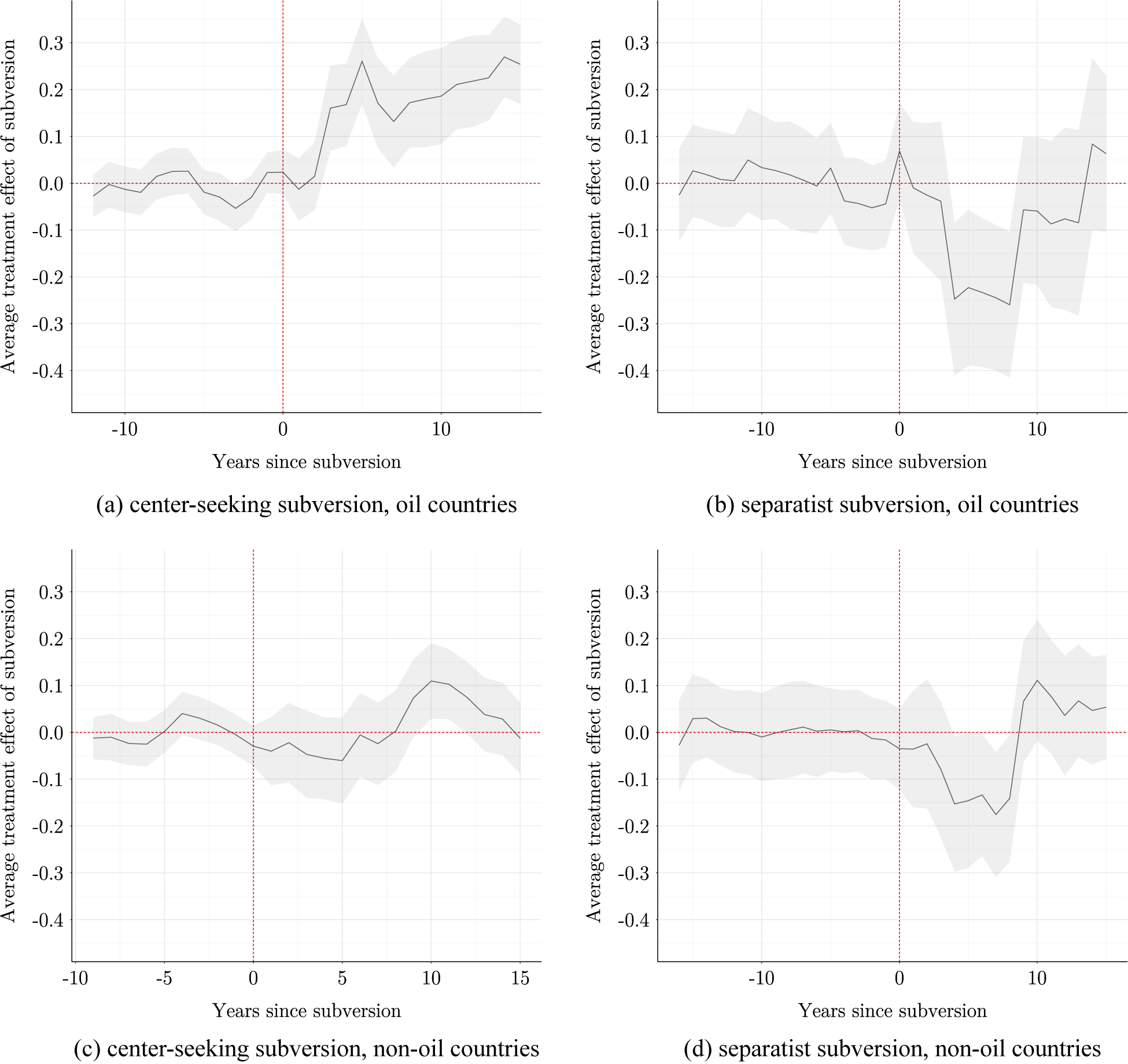
We first estimate the effect of center-seeking subversion in oil-rich cases, which we then compare with the effects of: (1) separatist subversion in oil cases; (2) center-seeking subversion in non-oil cases; and (3) separatist subversion in non-oil cases. The objective is to investigate whether the impact of subversion on public goods provision is general or specific to oil-rich countries (as our theory suggests) and whether it applies in all kinds of subversion or is limited to center-seeking anti-system activity (as per our theory). Our results are summarized in Tables 2 and 3 and graphically displayed in Figures 2–5. The figures show the estimated average treatment effects over a post-treatment period of 15 years for our four dependent variables, broken down by the above-mentioned country groups and treatment types. The pre-treatment effect estimates are not entirely smooth in all cases; they clearly cluster around a null effect, however, suggesting that our models are correctly specified.Footnote 14
ATTs of Center-Seeking Subversion (GSC Model)

Note: Standard errors are based on parametric bootstraps of one thousand times. All models contain country fixed effects and time-varying covariates. See Quantitative Tests section for a full list of all included covariates. * $ p<0.1 $
; **
$ p<0.1 $
; ** $ p<0.05 $
; ***
$ p<0.05 $
; *** $ p<0.01 $
.
$ p<0.01 $
.
ATTs of Separatist Subversion (GSC Model)

Note: Standard errors are based on parametric bootstraps of one thousand times. All models contain country fixed effects and time-varying covariates. See Quantitative Tests section for a full list of all included covariates. * $ p<0.1 $
; **
$ p<0.1 $
; ** $ p<0.05 $
; ***
$ p<0.05 $
; *** $ p<0.01 $
.
$ p<0.01 $
.
Effect of Subversion on Health Equality
Note: Gray areas show 95% confidence intervals.
Effect of Subversion on Education Equality
Note: Gray areas show 95% confidence intervals.

Effect of Subversion on Primary Enrollment
Note: Gray areas show 95% confidence intervals.

Effect of Subversion on Secondary Enrollment
Note: Gray areas show 95% confidence intervals.

The general pattern aligns with our hypotheses. Center-seeking subversion in oil cases leads to the most systematic improvements in outcomes. There are no systematic positive outcomes for any of the other treatments or case categories. The effect usually becomes significant a few years after treatment onset, deepening subsequently. The only exception is education equality where results set in slightly later. As subversion not only creates security costs but also potentially disrupts government operations, a positive effect on public goods outcomes is particularly impressive. It suggests that elites in oil-rich countries facing center-seeking anti-systemic movements do indeed prioritize welfare provision.Footnote 15 For the mixed case categories—non-oil countries facing center-seeking subversion and oil countries facing separatist subversion—there are mixed results that do not suggest a systematic overall effect. This aligns with our expectation that such cases either lack incentives or resources to distribute welfare, leading to unclear net effects.
In line with our theory, separatist subversion in non-oil countries worsens welfare outcomes in all indicators, with the exception of primary enrollment. We are less confident in the primary enrollment models for three reasons. First, our dataset contains the fewest observations for this variable.Footnote 16 Second, even poor countries have found it easy to reach full enrollment, giving the variable a hard upper bound and, problematically, different starting points across cases, while secondary education is much harder to expand (Doner and Schneider Reference Doner and Schneider2016). Third, the primary education models fare worst in our equivalence tests for pre-treatment parallel trends (see Section B.11 of the Dataverse Appendix). In sum, our models reflect the order of effects predicted in Table 1.
DID Models and Results
As discussed above, we deploy a separate set of DID models to provide a robustness test for our core results and overcome some of the limitations of GSC. These models allow us to include oil rents as a continuous variable and to interact our treatment variables with further conditioning factors. The results of our core models are summarized in Table 4. Since our model estimates the treatment effect conditioned by oil rents, the results are best illustrated using marginal effects plots (Figures 6 and 7). One of the core identifying assumptions of DID are parallel pre-treatment trends, which we test in Section B.22 of the Dataverse Appendix, and which show no significant diversion of treated cases prior to treatment.
Effect of Subversion Conditioned by Oil (DID Model)

Note: Standard errors are clustered at the country level. All regressions apply entropy matching using time-varying and time-invariant variables to balance treatment and control group in the pre-period. See Quantitative Tests section for a full list of matching variables.
* $ p<0.1 $
; **
$ p<0.1 $
; ** $ p<0.05 $
; ***
$ p<0.05 $
; *** $ p<0.01 $
.
$ p<0.01 $
.
Center-Seeking Subversion
Note: Gray areas show 95% confidence intervals.

Separatist Subversion
Note: Gray areas show 95% confidence intervals.

The results of the DID models broadly align with those from the GSC models. As we would expect, Figure 6 shows that the effect of center-seeking subversion on health equality, education equality, and secondary enrollment is positive only for countries with higher oil rents. The pattern for primary enrollment, already the weakest outcome variable in the GSC models, is unclear. Figure 7 demonstrates that oil plays no systematic conditioning role for the impact of separatist subversion, with the potential exception of a positive, marginally significant joint effect on secondary enrollment. The negative intercepts of the regression lines suggest, moreover, that non-oil cases facing separatism experience negative welfare outcomes. As only two intercepts (for education equality and secondary enrollment) are significant at 0.90, this last finding remains tentative. Reassuringly, the core finding of the GSC models—that only center-seeking subversion in oil-rich countries has a systematic positive impact on welfare outcomes—is confirmed in our DID models. And although the findings on other types of subversion and on oil-poor countries vary in a few instances from those of the GSC models, the shared overall pattern is that there is no systematic positive effect.
Robustness Tests
GSC relies more heavily on modeling assumptions than other methods, which makes it important to test different model specifications. We therefore run the above GSC models with a range of modifications regarding the fixed effects specification, pre-treatment period length, and definitions of treatments and case categories, We also estimate the model without any covariates, based purely on factors and factor loadings, so as to avoid the use of potentially endogenous covariates in constructing counterfactuals. We also conduct placebo tests shifting our treatment backward in time by 2 years following standard practice for the GSC (Liu, Wang, and Xu Reference Liu, Wang and Yiqing2022). All these tests are described in detail in Sections B.5 and B.10 of the Dataverse Appendix.
We conduct several further robustness tests that are applicable to both GSC and DID models, including stricter case inclusion rules, omitting MENA cases, and including only “first movers” in every world region—that is, the first historical case of each type of subversion in our sample—to deal with the fact that our general results could be driven by policy diffusion and learning effects among neighboring countries (see Sections B.11– B.21 of the Dataverse Appendix).
Finally, we run DID models with a range of additional time-invariant control variables (interacted with time) that have been shown to affect human development in the long run (see Sections B.24–B.27 of the Dataverse Appendix),Footnote 17 and conduct a test for omitted variable bias (see Section B.23 of the Dataverse Appendix). The results are very similar to the ones included above. Direction and significance of our core findings remain substantially unchanged with the only exception of education equality, which is significant in most but not all model specifications. Different from our core GSC models, the impact of separatism in non-oil cases—the case category with the fewest observations—is also not as uniformly negative, although it never produces systematic positive outcomes.
Mechanisms and Conditionalities
We would ideally want to observe government welfare policy efforts more directly, notably in terms of deployment of personnel or finances. Unfortunately, historical data on these variables are very patchy. In Section A.6 of the Supplementary Material, we nonetheless present fiscal data on a subset of cases that is consistent with our hypothesis. We show that oil-rich rulers facing center-seeking subversion devote the most resources to welfare and face the least trade-off between guns and butter. We also show that physical repression increases in all types of cases after all types of subversion, suggesting that oil-rich rulers tend to use guns and butter as complementary tools (see Section A.5 of the Supplementary Material).
We mentioned above that the logic of our theory could be boosted or attenuated by many context factors. The relatively limited number of observations in our country-level dataset and the probabilistic nature of our theory make it difficult to establish the role of such factors reliably. That said, in Sections A.1 and A.2 of the Supplementary Material and Sections B.28–B.31 of the Dataverse Appendix, we present a range of GSC and DID models which suggest tentatively that our core results: (1) also hold when regimes do not rely on foreign support; (2) apply both to subversions happening during periods of regime formation and outside of such periods; and (3) do not apply if oil rents are substituted by mineral rents and aid payments in our models (which are much smaller, however, making clear identification difficult).
We also distinguish center-seeking subversions of a leftist nature from other (religious or fascist) center-seeking subversions (see Sections A.3 and A.4 of the Supplementary Material). Our core results apply to leftist movements—the dominant form of center-seeking movement in our dataset—but not to the residual category of other center-seeking subversions. As case numbers are low and model fits weak for this mixed category, we hesitate to draw firm conclusions, but it is plausible that only leftist subversions make clear redistributive demands which regimes in turn try to assuage with mass co-optation policies. Further, case study work should investigate the nature of non-leftist subversions and regime reactions to them.
Finally, we investigate whether welfare provision is just a proxy for the building of a stronger administrative apparatus, a pattern suggested by Slater (Reference Slater2010) and Smith (Reference Smith2007), who find that regimes faced with broad-based opposition in their formative period build stronger states (see Section B.32 of the Dataverse Appendix). Contrary to this hypothesis, we do not find that either type of subversion leads to a systematic increase in state capacity, potentially because dealing with subversion—and, where applicable, engaging in mass co-optation—ties up scarce administrative resources that cannot be used for other state tasks like resource extraction or regulation. The empirical result, while tentative, is broadly in line with other recent work (Thies Reference Thies2010) showing that domestic conflict in the Global South does not necessarily have the state-building effects that Tilly (Reference Tilly, Evans, Rueschemeyer and Skocpol1985) ascribes to historical wars in Europe. It also rings true against the background of state-building in Gulf oil monarchies, which have been quite successful at mass co-optation and basic public goods provision, but less so in regulation or extracting information from their societies (Hertog Reference Hertog2010).
Limitations
Our analysis faces a number of potential limitations. For starters, we have so far taken the incidence of subversion as an exogenous treatment. Subversion, however, is endogenous to the social and political circumstances of a country. It could, for example, be a function of different levels or change rates of public good provision, as formal models reviewed above suggest. We do not believe that this fundamentally impugns our research design. First, the inclusion of a range of control variables and time-varying factors in the GSC algorithm reduces the risk that treated units are systematically different from the counterfactual untreated ones. Pre-treatment parallel outcome trends as corroborated through equivalence tests (Section B.11 of the Dataverse Appendix) mitigate the issue of reverse causality (Xu Reference Xu2022), as do the successfully passed placebo tests for our core model.Footnote 18 Second, our primary aim is not to predict absolute levels of welfare outcomes, but to investigate the relative impact of different types of subversion in oil-rich and oil-poor countries. These relative effects should apply independently of what caused the initial subversive activity. Third, if worse welfare provision creates subversion, then for any improvement in welfare to show up in our models, these would have to arguably overcome a pre-treatment negative trend, creating a conservative bias.
It could also be that subversion is to some extent endogenous to the presence of oil resources, as both the Oman case study and Mesquita and Smith (Reference Mesquita and Smith2009) suggest. This could potentially change the nature of subversion—notably, subversion in oil-rich cases may involve stronger demands for welfare provision. While we do not know of any empirical evidence to suggest this, we believe that this would be a complementary rather than rival causal mechanism. The loosened fiscal trade-offs our theory identifies will still make it easier to assuage welfare demands. We have, moreover, found that leftist center-seeking subversion is the most likely to trigger welfare provision, and leftist movements are likely to raise distributive and welfare demands in all contexts, whether oil-poor or oil-rich (Haggard and Kaufman Reference Haggard and Kaufman2008; Huber and Stephens Reference Huber and Stephens2012).
Finally, we have not tested whether ruling elites in oil-rich countries that are not threatened by subversion deliver less welfare than elites in non-oil states, as formal models of kleptocracy suggest. Establishing such effects is not possible with our research design. Future research might investigate such outcomes by using panel methods or by using oil discoveries as an instrument for rent flows.
CONCLUSION
Our case study and quantitative models align to show that generous oil-financed welfare provision is not an automatic outcome of rents. Instead, rulers step up welfare policies when political threats provide them with an incentive to do so. Welfare provision is not a useful counter-strategy for all types of threats, however, as improving national-level welfare outcomes does not typically help in dealing with separatist threats. Instead, it is anti-systemic center-seeking subversion, especially by left-wing movements, that pushes rulers to turn rents into welfare. In the face of such threats, the relaxed fiscal constraints that oil elites operate under allow them to step up welfare provision with limited political opportunity costs, neither requiring them to tax elites nor cut into security spending.
The welfare effects we find are long-term, as demonstrated by both case study and quantitative models. This confirms the general insight that welfare states and the political coalitions underlying them are very “sticky” once created (Haggard and Kaufman Reference Haggard and Kaufman2008). In our case study of Oman, leftist movements virtually disappeared by the late 1970s, yet the government has continued to provide generous public goods to its citizens to the present day.
We also show that anti-systemic subversion has lower or no effects on welfare provision in non-oil cases. We believe that this is due to tighter fiscal constraints, the likely costs of dealing with subversion, the fact that successful repression—though initially risky—reduces the political need to provide longer-term welfare and, at least in some cases, the disruption that subversion itself can cause to welfare provision.
We document increased repression levels in all our case categories after subversion, suggesting that oil-rich ruling elites use repression and mass co-optation as complementary tools of rule rather than as substitutes (a pattern that aligns with our Oman case study). We also show that welfare provision in our core cases does not seem to be accompanied by a general increase in state capacity. This suggests that center-seeking subversion in resource-rich countries leads to the creation of a particular type of state, able to provide generous welfare but otherwise endowed with limited infrastructural power—a conceptual counterpart to the better-documented developmental state in East Asia, where internal and external political threats have combined with resource scarcity to generate a type of state able to both regulate and, in the long run, provide welfare (Doner, Ritchie, and Slater Reference Doner, Ritchie and Slater2005).
Finally, our finding that elites in oil-rich states used education as part of their mass co-optation strategies is compatible with findings by Paglayan (Reference Paglayan2017) that education can serve as tool of political control as much as act as ferment for opposition. At a minimum, the perceived need to win “hearts and minds” when facing acute subversive threats seems to outweigh the aversion to public goods provision that formal models of political elites in resource-rich countries stipulate. In sum, political subversion might be the best antidote to oil-induced kleptocracy.
SUPPLEMENTARY MATERIAL
The supplementary material for this article can be found at https://doi.org/10.1017/S0003055423000977.
DATA AVAILABILITY STATEMENT
Research documentation and data that support the findings of this study, including a longer appendix with additional robustness tests (Sections B.1–B.34), are openly available at the APSR Dataverse: https://doi.org/10.7910/DVN/YYTXOB.
ACKNOWLEDGMENTS
The authors are listed in alphabetical order; each contributed equally. The research was presented at workshops and seminars at the London School of Economics, King’s College London, and the 2017 conference of the Middle East Studies Association. We thank Ishac Diwan, Adeel Malik, Neil Ketchley, and Marco Giani for their comments and constructive criticism, as well as Rodrigo Torres and Anita King for their excellent research assistance. We would also like to thank five anonymous reviewers for their insightful comments and critiques.
FUNDING STATEMENT
This research was funded by the Kuwait Programme at the London School of Economics and Political Science (Grant No. KPRG201501).
CONFLICT OF INTEREST
The authors declare no ethical issues or conflicts of interest in this research.
ETHICAL STANDARDS
The authors affirm this research did not involve human subjects.


 Open access


Comments
No Comments have been published for this article.