
 ζ
ζ





1. Introduction
Most homotopical models of higher categories are formalized as certain presheaves on a fixed category of shapes, which encode composition and associativity rules. The most common choices for these shapes include simplices, cubes, globes, and related structures. Opetopes, introduced by Baez and Dolan, fit within this framework but are distinguished by the fact that they were explicitly designed for this purpose from the outset – unlike other shape categories, which often emerged from more classical considerations (a similar approach is found in Joyal’s theta category).
Initially defined using operads to address homotopical aspects of higher categories, opetopes were later redefined by several authors and linked to the theory of computads and rewriting, establishing their role in a more computational branch of higher category theory.
In this work, we focus on positive opetopes introduced by Zawadowski and later redefined by Leclerc. Two main achievements of this theory motivate our study:
Theorem 1.1 (Zawadowski (Reference Zawadowski2023), Corollary 13.5).
The category of presheaves over the category of positive opetopes $\textsf{pOpe}$
is equivalent to the category of many-to-one computads.
$\textsf{pOpe}$
is equivalent to the category of many-to-one computads.
Theorem 1.2 (Zawadowski (Reference Zawadowski2017), Theorem 4.15).
The category $\textsf{pOpe}_\iota$
of positive opetopes with
$\textsf{pOpe}_\iota$
of positive opetopes with $\iota$
-contractions forms a test category.
$\iota$
-contractions forms a test category.
The first theorem indicates that the combinatorics of positive opetopes aligns closely with the theory of strict higher categories: higher categories can be thought of as generated by computads. The second theorem tells us that there exists a cofibrantly generated model structure on $\widehat{\textsf{pOpe}_\iota}$
representing the homotopy theory of
$\widehat{\textsf{pOpe}_\iota}$
representing the homotopy theory of $(\infty ,0)$
-categories. Our goal is to go beyond the mere existence of this model structure and construct a different one: with an explicit presentation via Cisinski–Olschok theory, and Quillen equivalent to the Kan–Quillen model structure on
$(\infty ,0)$
-categories. Our goal is to go beyond the mere existence of this model structure and construct a different one: with an explicit presentation via Cisinski–Olschok theory, and Quillen equivalent to the Kan–Quillen model structure on $\textsf{sSet}$
. However, the combinatorial complexity of the category of positive opetopes – most importantly, the fact that it is not an Eilenberg–Zilber category – poses a significant obstacle to achieving this goal directly. While Cisinski–Olschok theory does not itself require the Eilenberg–Zilber condition on the base category, the failure of opetopic sets to satisfy the Eilenberg–Zilber lemma gives rise to difficulties of two kinds. First, it is heuristically unappealing: two distinct nondegenerate cells degenerating to the same cell, or a cell degenerating to another in two distinct ways, do not correspond to any meaningful property of identities of higher morphisms, and allowing such phenomena would likely force homotopical workarounds for the resulting pathologies. Second, it leads to significant technical obstacles, most notably the lack of a convenient generating set of cofibrations in the form of boundary inclusions, which is needed for standard constructions such as filtration by skeleta.
$\textsf{sSet}$
. However, the combinatorial complexity of the category of positive opetopes – most importantly, the fact that it is not an Eilenberg–Zilber category – poses a significant obstacle to achieving this goal directly. While Cisinski–Olschok theory does not itself require the Eilenberg–Zilber condition on the base category, the failure of opetopic sets to satisfy the Eilenberg–Zilber lemma gives rise to difficulties of two kinds. First, it is heuristically unappealing: two distinct nondegenerate cells degenerating to the same cell, or a cell degenerating to another in two distinct ways, do not correspond to any meaningful property of identities of higher morphisms, and allowing such phenomena would likely force homotopical workarounds for the resulting pathologies. Second, it leads to significant technical obstacles, most notably the lack of a convenient generating set of cofibrations in the form of boundary inclusions, which is needed for standard constructions such as filtration by skeleta.
In principle, one could try restricting the class of $\iota$
-contractions in such a way that the resulting category would satisfy the Eilenberg–Zilber condition, similarly to Chanavat and Hadzihasanovic (Reference Chanavat and Hadzihasanovic2026). We illustrate our reason for not pursuing that route with the following example: in that case, there would be no degeneracy morphism
$\iota$
-contractions in such a way that the resulting category would satisfy the Eilenberg–Zilber condition, similarly to Chanavat and Hadzihasanovic (Reference Chanavat and Hadzihasanovic2026). We illustrate our reason for not pursuing that route with the following example: in that case, there would be no degeneracy morphism $\sigma$
from a triangular opetope to a
$\sigma$
from a triangular opetope to a $1$
-dimensional globular opetope; since the latter cannot be included in the former as a face,
$1$
-dimensional globular opetope; since the latter cannot be included in the former as a face, $\sigma$
cannot have a section. Yet in an
$\sigma$
cannot have a section. Yet in an $(\infty ,0)$
-category one would clearly like to have the possibility of inserting an identity on either endpoint of the domain edge of a globular diagram, obtaining a triangular diagram. If such a possibility is not built into the combinatorics of the exponent category, one is again forced to implement some homotopical mitigations, which are likely to obscure the presentation of generators of a model structure.
$(\infty ,0)$
-category one would clearly like to have the possibility of inserting an identity on either endpoint of the domain edge of a globular diagram, obtaining a triangular diagram. If such a possibility is not built into the combinatorics of the exponent category, one is again forced to implement some homotopical mitigations, which are likely to obscure the presentation of generators of a model structure.
Therefore, we restrict our attention to a certain full subcategory of well-behaved opetopic sets, called Eilenberg–Zilber opetopic sets ( $\widehat{\textsf{pOpe}_\iota}_{EZ}$
). In a sense, this continues the study of ideas introduced by Bergner and Rezk (Reference Bergner and Rezk2013) and Berger and Moerdijk (Reference Berger and Moerdijk2011), who imposed additional assumptions on the exponent category, making the corresponding presheaves well-behaved. In our approach, we give a different meaning to this idea, formulating similar demands as conditions on presheaves, which select a certain well-behaved subcategory. The decisive argument in favor of this approach is that a certain functor
$\widehat{\textsf{pOpe}_\iota}_{EZ}$
). In a sense, this continues the study of ideas introduced by Bergner and Rezk (Reference Bergner and Rezk2013) and Berger and Moerdijk (Reference Berger and Moerdijk2011), who imposed additional assumptions on the exponent category, making the corresponding presheaves well-behaved. In our approach, we give a different meaning to this idea, formulating similar demands as conditions on presheaves, which select a certain well-behaved subcategory. The decisive argument in favor of this approach is that a certain functor $\zeta$
does not preserve monomorphisms between general opetopic sets. However, it does preserve monomorphisms between Eilenberg–Zilber opetopic sets, justifying our restriction to this subclass.
$\zeta$
does not preserve monomorphisms between general opetopic sets. However, it does preserve monomorphisms between Eilenberg–Zilber opetopic sets, justifying our restriction to this subclass.
The functor $\zeta$
is derived from the nerve functor, which maps each representable to the nerve of the poset of faces ordered by inclusion. The nerve functor alone cannot be used for the comparison with the Kan–Quillen structure: the image of its right adjoint is not contained within
$\zeta$
is derived from the nerve functor, which maps each representable to the nerve of the poset of faces ordered by inclusion. The nerve functor alone cannot be used for the comparison with the Kan–Quillen structure: the image of its right adjoint is not contained within $\widehat{\textsf{pOpe}_\iota}_{EZ}$
, and furthermore it completely forgets the crucial property of non-invertibility of morphisms (unlike
$\widehat{\textsf{pOpe}_\iota}_{EZ}$
, and furthermore it completely forgets the crucial property of non-invertibility of morphisms (unlike $\zeta$
, it destroys completely the information about the direction of edges). The functor
$\zeta$
, it destroys completely the information about the direction of edges). The functor $\zeta$
addresses these issues by exploiting the rewriting-theoretic nature of opetopes; we refer to Chapter 3 for its precise definition.
$\zeta$
addresses these issues by exploiting the rewriting-theoretic nature of opetopes; we refer to Chapter 3 for its precise definition.
Although the category of Eilenberg–Zilber opetopic sets is not a topos, we have successfully generalized the Cisinski–Olschok theory in a way that still applies in this setting. The main results of this article are:
-
• Corollary5.18 and Definition5.24: The construction of a combinatorial model structure on $\widehat{\textsf{pOpe}_\iota}_{EZ}$
for
$(\infty ,0)$
-categories.
$\widehat{\textsf{pOpe}_\iota}_{EZ}$
for
$(\infty ,0)$
-categories. -
• Theorem5.33: The proof that this model structure is Quillen equivalent to the Kan–Quillen model structure on simplicial sets.


These results establish $\widehat{\textsf{pOpe}_\iota}_{EZ}$
as a valid opetopic model for spaces, while the underlying combinatorial framework provides a foundation for future development of directed models.
$\widehat{\textsf{pOpe}_\iota}_{EZ}$
as a valid opetopic model for spaces, while the underlying combinatorial framework provides a foundation for future development of directed models.
1.1 Outline
The first chapter introduces the necessary definitions and foundational results concerning positive opetopes.
In the second chapter, we study Eilenberg–Zilber presheaves and the class of cellular monomorphisms. We introduce the notion of a tidy Reedy category (of which $\textsf{pOpe}_\iota$
is a principal example), which is an abstract framework for developing our theory of Eilenberg–Zilber presheaves.
$\textsf{pOpe}_\iota$
is a principal example), which is an abstract framework for developing our theory of Eilenberg–Zilber presheaves.
The third chapter develops the connection between positive opetopes and simplicial sets through the lens of rewriting theory, including the definition of the functor $\zeta$
. It also presents related notions of ideals on positive opetopes and opetopic associahedra. In the final chapter, we construct a model category structure on Eilenberg–Zilber opetopic sets and prove that it is Quillen-equivalent to the Kan–Quillen model structure on simplicial sets.
$\zeta$
. It also presents related notions of ideals on positive opetopes and opetopic associahedra. In the final chapter, we construct a model category structure on Eilenberg–Zilber opetopic sets and prove that it is Quillen-equivalent to the Kan–Quillen model structure on simplicial sets.
2. Positive Opetopes and Contraction Morphisms
2.1 Positive-to-one posets and dendritic face complexes
The category $\textsf{pOpe}$
of positive opetopes was introduced by Zawadowski in Zawadowski (Reference Zawadowski2007a) as part of his study of the connection between computads and categories of presheaves, inspired by earlier works by Harnik and Makkai. Positive opetopes are higher-dimensional combinatorial structures used to model composition in higher categories. Later, alternative descriptions of
$\textsf{pOpe}$
of positive opetopes was introduced by Zawadowski in Zawadowski (Reference Zawadowski2007a) as part of his study of the connection between computads and categories of presheaves, inspired by earlier works by Harnik and Makkai. Positive opetopes are higher-dimensional combinatorial structures used to model composition in higher categories. Later, alternative descriptions of $\textsf{pOpe}$
were proposed by other authors, including a simpler axiomatization based on dendritic face complexes due to Leclerc Leclerc (Reference Leclerc2024).
$\textsf{pOpe}$
were proposed by other authors, including a simpler axiomatization based on dendritic face complexes due to Leclerc Leclerc (Reference Leclerc2024).
Below, we present both definitions, starting with Leclerc’s formulation, which is more accessible to those new to the subject. Along the way, we introduce several key notions, such as $\iota$
-contractions, which are essential for our goal of fitting opetopes into the framework of model categories. This chapter serves as a foundation for subsequent work, where certain presheaves on the category
$\iota$
-contractions, which are essential for our goal of fitting opetopes into the framework of model categories. This chapter serves as a foundation for subsequent work, where certain presheaves on the category $\textsf{pOpe}_\iota$
will become models of weak higher categories. No original results are presented here; instead, our goal is to provide a clear and comprehensive introduction to the topic.
$\textsf{pOpe}_\iota$
will become models of weak higher categories. No original results are presented here; instead, our goal is to provide a clear and comprehensive introduction to the topic.
Definition 2.1.
A
positive-to-one poset
is a quadruple $P:= (|P|, \dim , \prec ^+, \prec ^{-})$
, where
$P:= (|P|, \dim , \prec ^+, \prec ^{-})$
, where
-
•
$|P|$
is a finite set,
-
•
$\dim : |P| \to \mathbb{N}$
is a function
-
•
$\prec ^+$
and
$\prec ^-$
are binary relations on
$|P|$
.


This data is subject to the following conditions:
-
•
$x \prec ^+ y$
or
$x \prec ^- y$
$\implies$
$\dim (x) + 1 = \dim (y)$
, -
•
$\prec ^+ \cap \prec ^- = \emptyset$
, -
•
$\dim (x) \geq 1 \implies \exists !\ y, y \prec ^+ x \land \exists \ z, z \prec ^- x$
, -
•
$\dim (x) = 1 \implies \exists !\ y, y \prec ^- x$
.






The transitive-reflexive closure of $\prec := \prec ^+ \cup \prec ^-$
endows
$\prec := \prec ^+ \cup \prec ^-$
endows $|P|$
with the structure of a poset, for which
$|P|$
with the structure of a poset, for which $\dim$
becomes an order-preserving map.
$\dim$
becomes an order-preserving map.
Definition 2.2.
The boundary $\partial (x)$
of
$\partial (x)$
of $x$
is the set
$x$
is the set ${y \in |P| \mid y \prec x})$
. Note that
${y \in |P| \mid y \prec x})$
. Note that $\partial (x)$
is not closed under taking faces of its elements; in particular, it is not a positive-to-one poset.
$\partial (x)$
is not closed under taking faces of its elements; in particular, it is not a positive-to-one poset.
The codomain $\gamma (x)$
of
$\gamma (x)$
of $x$
is the unique element
$x$
is the unique element $y$
such that
$y$
such that $y \prec ^+ x$
(sometimes identified with the singleton containing that element, by abuse of notation).
$y \prec ^+ x$
(sometimes identified with the singleton containing that element, by abuse of notation).
The boundary $\partial (x)$
of
$\partial (x)$
of $x$
is the set
$x$
is the set $\{y \in |P| \mid y \prec x\}$
. Note that
$\{y \in |P| \mid y \prec x\}$
. Note that $\partial (x)$
is not closed under the operation of taking the face of a cell in
$\partial (x)$
is not closed under the operation of taking the face of a cell in $\partial (x)$
, in particular, it is not a positive-to-one poset.
$\partial (x)$
, in particular, it is not a positive-to-one poset.
Finally, we set $P_k = \dim ^{-1}(k)$
and
$P_k = \dim ^{-1}(k)$
and $P_{\leq k} = \dim ^{-1}(\{0,\ldots ,k\})$
.
$P_{\leq k} = \dim ^{-1}(\{0,\ldots ,k\})$
.
It follows that $\gamma$
is a function
$\gamma$
is a function $P_{\ge 1} \to |P|$
of the degree
$P_{\ge 1} \to |P|$
of the degree $-1$
, where
$-1$
, where $P_{\ge 1} = \dim ^{-1}(\{1,2,3,\ldots \})$
.
$P_{\ge 1} = \dim ^{-1}(\{1,2,3,\ldots \})$
.
Repeated application of $\gamma$
resulting in an element of dimension
$\gamma$
resulting in an element of dimension $k$
is denoted by
$k$
is denoted by $\gamma ^{(k)}$
, that is
$\gamma ^{(k)}$
, that is $\gamma ^{(k)}(x) = \gamma ^{\dim (x) - k}(x)$
.
$\gamma ^{(k)}(x) = \gamma ^{\dim (x) - k}(x)$
.
We interpret elements of $|P|$
as generalized higher-dimensional morphisms.
$|P|$
as generalized higher-dimensional morphisms.
Additionally, we can interpret $\dim$
topologically. Given a positive-to-one poset, we can associate with it a regular
$\dim$
topologically. Given a positive-to-one poset, we can associate with it a regular $CW$
-complex. Cells in this complex correspond to the elements of the positive-to-one poset. For more details, see Hadzihasanovic (Reference Hadzihasanovic2024).
$CW$
-complex. Cells in this complex correspond to the elements of the positive-to-one poset. For more details, see Hadzihasanovic (Reference Hadzihasanovic2024).
Definition 2.3.
A
dendritic face complex
is a positive-to-one poset $(|P|, \dim , \prec ^+, \prec ^{-})$
satisfying the following additional conditions:
$(|P|, \dim , \prec ^+, \prec ^{-})$
satisfying the following additional conditions:
-
• (Greatest element) : there exists a greatest element in the partial order generated by
$\prec$
-
• (Oriented Thinness) : for any triple
$x \prec ^\alpha y \prec ^\beta z$
(where
$\alpha , \beta \in \{+,-\}$
), there exists a unique
$y' \neq y$
such that
$x \prec ^{\alpha '} y' \prec ^{\beta '} z$
for some
$\alpha ', \beta ' \in \{+,-\}$
. Furthermore, the equality
$\alpha \beta = -\alpha '\beta '$
holds
-
• (Acyclicity) : if
$\dim (x) \gt 1$
, and we have
$y_1, \ldots , y_n \prec ^- x$
and
$z_1, \ldots , z_{n-1}$
satisfying
$z_i \prec ^- y_i$
and
$z_i \prec ^+ y_{i+1}$
, then
$y_1 \neq y_n$








Definition 2.4.
Morphism of positive-to-one posets $f:P\to Q$
is a map between underlying sets
$f:P\to Q$
is a map between underlying sets $f:|P|\to |Q|$
such that
$f:|P|\to |Q|$
such that
-
•
$f({\dim}\, (x))=\dim (f(x))$
, that is
$f$
preserves the dimension
-
• if
$x,y\in |P|$
satisfy
$x\prec ^\alpha y$
, then
$f(x)\prec ^\alpha f(y)$
for
$\alpha \in \{+,-\}$
-
• for every
$x\in |P|$
,
$f$
induces a bijection between
$\delta (x)$
and
$\delta (f(x))$
.



Notation 2.5.
Let $ P$
be a positive-to-one-poset. We introduce the following notation:
$ P$
be a positive-to-one-poset. We introduce the following notation:
-
• we write
$ |P|$
for the set of all cells of
$ P$
, to emphasize the process of forgetting the poset structure and distinguish it from
$ P$
when viewed as an object in the category of positive-to-one-posets. Formally,
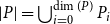
$ |P| = \bigcup _{i=0}^{\dim (P)} P_i$
, where
$\dim (P)$
is a maximum of a
$\dim$
function
-
• if
$ x \in |P|$
, then
$ \langle x \rangle$
denotes the smallest subobject of
$ P$
generated by
$ x$
; that is, the smallest subobject of
$ P$
containing
$ x$
and closed under the operations
$ \delta$
and
$ \gamma$
-
• if
$ P$
is a dendritic face complex,
$ \alpha _P$
denotes the
top cell
of
$ P$
, that is the cell of maximal dimension




In particular, $ \langle \alpha _P \rangle = P$
.
$ \langle \alpha _P \rangle = P$
.
Example 2.6.
On the picture below, we show example figures of some positive opetopes. Each element of dimension $ n$
is represented by an
$ n$
is represented by an $ n$
-fold arrow, indicating a mapping from the domain to the codomain.
$ n$
-fold arrow, indicating a mapping from the domain to the codomain.
Note that in the case of the last (4-dimensional) opetope, we have repeated some edges in order to account for the complexity of the combinatorics involved. To clarify the meaning of the diagram, consider the cell labeled $\alpha$
in the rightmost opetope: the domain of that arrow consists of the two gray
$\alpha$
in the rightmost opetope: the domain of that arrow consists of the two gray $3$
-fold cells and their boundaries. This serves as an illustration of how the domain and codomain structures are encoded in the diagram.
$3$
-fold cells and their boundaries. This serves as an illustration of how the domain and codomain structures are encoded in the diagram.

Definition 2.7.
A
contraction morphism
of positive-to-one posets $ f : P \to Q$
is a map between underlying sets
$ f : P \to Q$
is a map between underlying sets $ f : |P| \to |Q|$
such that:
$ f : |P| \to |Q|$
such that:
-
(1) Monotonicity of the dimension:
\begin{equation*} \dim (f(p)) \leq \dim (p),\ { i.e., }\ f\ { does\ not\ increase\ the\ dimension}. \end{equation*}
-
(2) Preservation of codomains:
\begin{equation*} f(\gamma ^{k}(p)) = \gamma ^{k}(f(p)), \quad {for }\ k \geq 0 \ { and }\ p \in P_{k+1}. \end{equation*}
The kernel of
$ f$
is defined as:
\begin{equation*} \ker (f) = \{p \in |P| \mid \dim (p) \gt \dim (f(p))\}. \end{equation*}
-
(3) Preservation of domains:
-
• If
$ \dim (f(p)) = \dim (p)$
, then
$ f$
restricts to a bijection:
\begin{equation*} \delta (p) \setminus \ker (f) \to \delta (f(p)) \end{equation*}
-
• If
$ \dim (f(p)) = \dim (p) - 1$
, then
$ f$
restricts to a bijection:
\begin{equation*} \delta (p) \setminus \ker (f) \to f(p) \end{equation*}
-
• If
$ \dim (f(p)) \lt \dim (p) - 1$
, then:
\begin{equation*} \delta (p) \subseteq \ker (f) \end{equation*}
-











Definition 2.8.
The category $\textsf{DFC}$
is a category with dendritic face complexes as objects, where morphisms are morphisms of positive-to-one-posets.
$\textsf{DFC}$
is a category with dendritic face complexes as objects, where morphisms are morphisms of positive-to-one-posets.
The category $\textsf{DFC}_\iota$
has the same objects, but its morphisms are contraction morphisms as described above.
$\textsf{DFC}_\iota$
has the same objects, but its morphisms are contraction morphisms as described above.
When viewed as morphisms between computads, contractions are exactly those maps that send generators either to generators or to (possibly iterated) identities on generators of smaller dimensions, Zawadowski (Reference Zawadowski2017) Thm 2.13.
The main result of Leclerc (Reference Leclerc2024) states that the category of dendritic face complexes is equivalent to the original category $\textsf{pOpe}$
of positive opetopes introduced by Zawadowski. The category
$\textsf{pOpe}$
of positive opetopes introduced by Zawadowski. The category $\textsf{pHg}$
of positive hypergraphs of Zawadowski is equivalent to the category of positive-to-one-posets (with the morphisms described above).
$\textsf{pHg}$
of positive hypergraphs of Zawadowski is equivalent to the category of positive-to-one-posets (with the morphisms described above).
The definition of contraction morphisms is taken from Zawadowski (Reference Zawadowski2017) and applied to the formalism of positive-to-one-posets without any change.
The category $\textsf{DFC}_\iota$
can be endowed with a structure of a Reedy category.
$\textsf{DFC}_\iota$
can be endowed with a structure of a Reedy category.
Definition 2.9.
Let $\mathcal{A}$
be a small category, equipped with a degree function
$\mathcal{A}$
be a small category, equipped with a degree function $d: \operatorname {obj}(\mathcal{A}) \rightarrow \Lambda$
on objects, where
$d: \operatorname {obj}(\mathcal{A}) \rightarrow \Lambda$
on objects, where $(\Lambda , \lt )$
is a well-ordered set, and suppose that
$(\Lambda , \lt )$
is a well-ordered set, and suppose that ${\mathcal{A}}_+$
and
${\mathcal{A}}_+$
and ${\mathcal{A}}_-$
are subcategories of
${\mathcal{A}}_-$
are subcategories of $\mathcal{A}$
which contain all of its objects. Then we say that
$\mathcal{A}$
which contain all of its objects. Then we say that $(\mathcal{A}, {\mathcal{A}}_+, {\mathcal{A}}_-)$
is a
Reedy category
if and only if these structures satisfy:
$(\mathcal{A}, {\mathcal{A}}_+, {\mathcal{A}}_-)$
is a
Reedy category
if and only if these structures satisfy:
-
• if
$\alpha : x \rightarrow y$
is a non-identity arrow in
${\mathcal{A}}_+$
(respectively,
${\mathcal{A}}_-$
) then
$d(x) \lt d(y)$
(respectively,
$d(x) \gt d(y)$
), and
-
• every arrow
$\alpha$
of
$\mathcal{A}$
has a unique factorization
$\alpha = \overrightarrow {\alpha } \circ \overleftarrow {\alpha }$
where
$\overrightarrow {\alpha } \in {\mathcal{A}}_+$
and
$\overleftarrow {\alpha } \in {\mathcal{A}}_-$
.


We call the morphisms of $\mathcal{A}_-$
codegeneracy maps
and the morphisms of
$\mathcal{A}_-$
codegeneracy maps
and the morphisms of $\mathcal{A}_+$
coface maps
.
$\mathcal{A}_+$
coface maps
.
For more exhaustive treatment of the theory of Reedy categories, we refer the reader to Riehl and Verity (Reference Riehl and Verity2014). To ground these notions, consider $\mathcal{A} = \Delta$
, the simplex category, where
$\mathcal{A} = \Delta$
, the simplex category, where $d$
corresponds to the dimension of simplices.
$d$
corresponds to the dimension of simplices.
Definition 2.10.
We define the degree function $d:\textrm {Ob}(\textsf{DFC})\to \mathbb{N}$
by the formula
$d:\textrm {Ob}(\textsf{DFC})\to \mathbb{N}$
by the formula $P\mapsto \#|P|$
.
$P\mapsto \#|P|$
.
The category $(\textsf{DFC}_\iota)_+$
is equal to
$(\textsf{DFC}_\iota)_+$
is equal to $\textsf{DFC}$
, while the category
$\textsf{DFC}$
, while the category $(\textsf{DFC}_\iota)_-$
is a category with morphisms being those contraction maps
$(\textsf{DFC}_\iota)_-$
is a category with morphisms being those contraction maps $f: P\to Q$
for which the underlying function is surjective.
$f: P\to Q$
for which the underlying function is surjective.
One can endow dendritic face complexes with a significantly different degree function, taking values in the set of eventually zero sequences of natural numbers, endowed with a colexicographic order:
 \begin{equation*}\textrm {Ob}(\textsf{DFC})\ni P\mapsto (\#|P_0|,\#|P_1|,\ldots )\in \mathbb{N}^{\mathbb{N}}\end{equation*}
While the first degree function is certainly easier to introduce and understand, often the second turns out to be better suited for inductive arguments. In this example, the codomain is no longer equal to the set of natural numbers, in particular it does not satisfy the definition of a Reedy category stated in Riehl and Verity (Reference Riehl and Verity2014). However, the theory resulting from replacing $\mathbb{N}$
with an arbitrary well-ordered set is a straightforward generalization of the most common case and also covered in the literature (see Hovey (Reference Hovey1999), Definition 5.2.1)
$\mathbb{N}$
with an arbitrary well-ordered set is a straightforward generalization of the most common case and also covered in the literature (see Hovey (Reference Hovey1999), Definition 5.2.1)
On the other hand, one cannot use the dimension of the greatest cell as a degree function for the above choice of ${\textsf{DFC}_\iota}_-$
. This is evident from the examples presented below.
${\textsf{DFC}_\iota}_-$
. This is evident from the examples presented below.
Example 2.11.
The only (isomorphism class of) dendritic face complex $P$
with the greatest cell of the dimension
$P$
with the greatest cell of the dimension $0$
, is a point. It has a single
$0$
, is a point. It has a single $0$
-cell and no cells of higher dimensions.
$0$
-cell and no cells of higher dimensions.
The only (isomorphism class of) dendritic face complex with the greatest cell of the dimension $1$
, is an edge. It has two distinct
$1$
, is an edge. It has two distinct $0$
-cells, a single
$0$
-cells, a single $1$
-cell, and no cells of higher dimension.
$1$
-cell, and no cells of higher dimension.
There exists an infinite countable set of pairwise non-isomorphic dendritic face complexes with the greatest cell of the dimension $2$
.
$2$
.
More precisely, let $n\in \mathbb{N}_{\ge 1}$ $P^{n}_0=\{0,\ldots ,n\}$
,
$P^{n}_0=\{0,\ldots ,n\}$
, $P^{n}_1=\{(i,i+1)\mid i\in \{0,\ldots ,n-1\}\}\sqcup \{a\}$
and
$P^{n}_1=\{(i,i+1)\mid i\in \{0,\ldots ,n-1\}\}\sqcup \{a\}$
and $P^{n}_2=\{b\}$
.
$P^{n}_2=\{b\}$
.
Set $\delta ((i,i+1))=\{i\}$
,
$\delta ((i,i+1))=\{i\}$
, $\gamma ((i,i+1))=\{i+1\}$
,
$\gamma ((i,i+1))=\{i+1\}$
, $\delta (a)=\{0\}$
,
$\delta (a)=\{0\}$
, $\gamma (a)=\{n\}$
,
$\gamma (a)=\{n\}$
, $\delta (b)=\{(i,i+1)\mid i\in \{0,\ldots ,n-1\}\}$
,
$\delta (b)=\{(i,i+1)\mid i\in \{0,\ldots ,n-1\}\}$
, $\gamma (b)=\{a\}$
.
$\gamma (b)=\{a\}$
.
This endows $P^{n}$
with a structure of a dendritic face complex with
$P^{n}$
with a structure of a dendritic face complex with $2n+3$
distinct cells.
$2n+3$
distinct cells.
There are exactly two surjective contractions morphisms $P^{2}\to P^{1}$
, one with kernel equal
$P^{2}\to P^{1}$
, one with kernel equal $\{(0,1)\}$
and the second with kernel given by
$\{(0,1)\}$
and the second with kernel given by $\{(1,2)\}$
Definition 2.12.
We say that a dendritic cell complex is
unary
, if $\#\delta (\alpha _P)=1$
.
$\#\delta (\alpha _P)=1$
.
Example 2.13.
An edge and $P_{1}$
are both unary dendritic cell complexes.
$P_{1}$
are both unary dendritic cell complexes.
2.2 Positive hypergraphs and positive opetopes
In this section, we present the original definition of the category of positive opetopes due to Zawadowski Zawadowski (Reference Zawadowski2007a).
Definition 2.14.
A
positive hypergraph
is a triple $S:=(\{S_k\}_{k\in \mathbb{N}}, \{\delta _k\}_{k\in \mathbb{N}}, \{\gamma _k\}_{k\in \mathbb{N}})$
, where each
$S:=(\{S_k\}_{k\in \mathbb{N}}, \{\delta _k\}_{k\in \mathbb{N}}, \{\gamma _k\}_{k\in \mathbb{N}})$
, where each $S_k$
is a finite set,
$S_k$
is a finite set, $\delta _k:S_{k+1}\to S_k$
is a total relation and
$\delta _k:S_{k+1}\to S_k$
is a total relation and $\gamma _k:S_{k+1}\to S_k$
is a function.
$\gamma _k:S_{k+1}\to S_k$
is a function.
Furthermore, we assume that only finitely many sets $S_k$
are nonempty and that the relation
$S_k$
are nonempty and that the relation $\delta _0:S_1\to S_0$
is a function.
$\delta _0:S_1\to S_0$
is a function.
A
morphism of positive hypergraphs $f : S \to T$
is a family of functions
$f : S \to T$
is a family of functions $f_k : S_k \to T_k$
, for
$f_k : S_k \to T_k$
, for $k \in \mathbb{N}$
, such that, for
$k \in \mathbb{N}$
, such that, for $k \gt 0$
and
$k \gt 0$
and $a \in S_k$
, we have
$a \in S_k$
, we have $\gamma (f(a)) = f(\gamma (a))$
and
$\gamma (f(a)) = f(\gamma (a))$
and $f_{k-1}$
restricts to a bijection
$f_{k-1}$
restricts to a bijection $f_a : \delta (a) \to \delta (f(a))$
.
$f_a : \delta (a) \to \delta (f(a))$
.
The
category of positive hypergraphs
is denoted by $\textsf{pHg}$
.
$\textsf{pHg}$
.
Set $S_k$
is called a set of
$S_k$
is called a set of $k$
-cells of
$k$
-cells of $S$
. We identify
$S$
. We identify $\gamma (x)$
with
$\gamma (x)$
with $\{\gamma (x)\}$
(as we did in the case of dendritic face complexes) and as a consequence, we introduce the following notation:
$\{\gamma (x)\}$
(as we did in the case of dendritic face complexes) and as a consequence, we introduce the following notation: $\delta \delta (x) =\bigcup _{y\in \delta (x)}\delta (y),\ \gamma \delta (x) = \{\gamma (y)\ \mid \ y\in \delta (x)\}$
.
$\delta \delta (x) =\bigcup _{y\in \delta (x)}\delta (y),\ \gamma \delta (x) = \{\gamma (y)\ \mid \ y\in \delta (x)\}$
.
Definition 2.15.
We define a binary relation of
lower order $\lt ^{S_k ,-}$
on for
$\lt ^{S_k ,-}$
on for $S_k$
for
$S_k$
for $k \gt 0$
as the transitive closure of the relation
$k \gt 0$
as the transitive closure of the relation $\triangleleft ^{S_k ,-}$
on
$\triangleleft ^{S_k ,-}$
on $S_k$
such that, for
$S_k$
such that, for $a, b \in S_k$
,
$a, b \in S_k$
, $a \triangleleft ^{S_k ,-} b$
iff
$a \triangleleft ^{S_k ,-} b$
iff $\gamma (a) \in \delta (b)$
.
$\gamma (a) \in \delta (b)$
.
On $S_k$
, we write
$S_k$
, we write $a \lt ^- b$
instead of
$a \lt ^- b$
instead of $a\lt ^{S_k ,-} b$
, and similarly for
$a\lt ^{S_k ,-} b$
, and similarly for $\leq ^-, \bowtie ^-$
.
$\leq ^-, \bowtie ^-$
.
We write $a\bowtie ^- b$
iff either
$a\bowtie ^- b$
iff either $a \lt ^- b$
or
$a \lt ^- b$
or $b \lt ^- a$
, and we write
$b \lt ^- a$
, and we write $a \leq ^- b$
iff either
$a \leq ^- b$
iff either $a = b$
or
$a = b$
or $a \lt ^- b$
.
$a \lt ^- b$
.
Definition 2.16.
We also define a binary relation of
upper order $\lt ^{S_k,+}$
on
$\lt ^{S_k,+}$
on $S_k$
for
$S_k$
for $k \geq 0$
as the transitive closure of the relation
$k \geq 0$
as the transitive closure of the relation $\triangleleft ^{S_k,+}$
on
$\triangleleft ^{S_k,+}$
on $S_k$
such that, for
$S_k$
such that, for $a, b \in S_k$
,
$a, b \in S_k$
, $a \triangleleft ^{S_k ,+} b$
iff there is
$a \triangleleft ^{S_k ,+} b$
iff there is $\alpha \in S_{k+1}$
such that
$\alpha \in S_{k+1}$
such that $a \in \delta (\alpha )$
and
$a \in \delta (\alpha )$
and $\gamma (\alpha ) = b$
.
$\gamma (\alpha ) = b$
.
We write $a \bowtie ^+ b$
iff either
$a \bowtie ^+ b$
iff either $a \lt ^+ b$
or
$a \lt ^+ b$
or $b \lt ^+ a$
, and we write
$b \lt ^+ a$
, and we write $a \leq ^+ b$
iff either
$a \leq ^+ b$
iff either $a = b$
or
$a = b$
or $a \lt ^+ b$
.
$a \lt ^+ b$
.
Definition 2.17.
A positive hypergraph $S$
is a
positive opetopic cardinal
if it is non-empty, that is
$S$
is a
positive opetopic cardinal
if it is non-empty, that is $S_0 \neq \emptyset$
, and it satisfies the following four conditions:
$S_0 \neq \emptyset$
, and it satisfies the following four conditions:
-
(1) (Globularity) : For
$a \in S_{\geq 2}$
:
\begin{equation*} \gamma \gamma (a) = \gamma \delta (a) \setminus \delta \delta (a), \quad \delta \gamma (a) = \delta \delta (a) \setminus \gamma \delta (a); \end{equation*}
-
(2) (Strictness) : For
$k \in \mathbb{N}$
, the relation
$\lt ^{S_k,+}$
is a strict order;
$\lt ^{S_0,+}$
is linear;
-
(3) (Disjointness) : For
$k \gt 0$
,
\begin{equation*} \bowtie ^{S_k,-} \cap \bowtie ^{S_k,+} = \emptyset ; \end{equation*}
-
(4) (Pencil linearity) : For any
$k \gt 0$
and
$x \in S_{k-1}$
, the sets
are linearly ordered by
\begin{equation*} \{a \in S_k \mid x = \gamma (a)\} \quad {and} \quad \{a \in S_k \mid x \in \delta (a)\} \end{equation*}
$\lt ^{S_k,+}$
.


Definition 2.18.
We define
the size
of a positive opetopic cardinal $S$
to be the sequence of natural numbers
$S$
to be the sequence of natural numbers $\textrm {size}(S) = {\#\big (S_n\setminus \delta (S_{n+1})\big )}_{n\in \mathbb{N}}$
, with almost all being equal to
$\textrm {size}(S) = {\#\big (S_n\setminus \delta (S_{n+1})\big )}_{n\in \mathbb{N}}$
, with almost all being equal to $0$
.
$0$
.
We say that $S$
is a
positive opetope
iff
$S$
is a
positive opetope
iff $\textrm {size}(S)_l = 1$
, for
$\textrm {size}(S)_l = 1$
, for $l \in \mathbb{N}$
.
$l \in \mathbb{N}$
.
The
category of positive opetopes $\textsf{pOpe}$
is the full subcategory of
$\textsf{pOpe}$
is the full subcategory of $\textsf{pHg}$
on positive opetopes.
$\textsf{pHg}$
on positive opetopes.
For a given positive opetope $P$
, we set
$P$
, we set $|P|:=\bigcup _{n\in \mathbb{N}}P_n$
. Moreover, for a given cell
$|P|:=\bigcup _{n\in \mathbb{N}}P_n$
. Moreover, for a given cell $x$
of
$x$
of $P$
, we denote by
$P$
, we denote by $\dim (x)$
the unique
$\dim (x)$
the unique $k\in \mathbb{N}$
such that
$k\in \mathbb{N}$
such that $x\in P_k$
.
$x\in P_k$
.
Finally, we set $\gamma ^{(n)}(x)=\gamma ^{\dim (x)-n}(x)$
if
$\gamma ^{(n)}(x)=\gamma ^{\dim (x)-n}(x)$
if $n\geq \dim (x)$
and
$n\geq \dim (x)$
and $\gamma ^{(n)}(x)=x$
otherwise.
$\gamma ^{(n)}(x)=x$
otherwise.
Theorem 2.19 (Leclerc (Reference Leclerc2024)).
The categories $\textsf{DFC}$
and
$\textsf{DFC}$
and $\textsf{pOpe}$
are equivalent.
$\textsf{pOpe}$
are equivalent.
On objects, the pair of functors exhibiting that equivalence is given as follows:
-
• given a positive-to-one poset
we assign to it a positive hypergraph
\begin{equation*}(P, \dim , \prec ^+, \prec ^{-})\end{equation*}
with
\begin{equation*}(\{P_k\}_{k\in \mathbb{N}},\{\delta _k\}_{k\in \mathbb{N}}, \{\gamma _k\}_{k\in \mathbb{N}})\end{equation*}
$P_k=\dim ^{-1}(k)$
,
$\gamma _k(x)=\gamma (x)$
and
$\delta _k(x)=\delta (x)$
-
• given a positive hypergraph
we assign to it a positive-to-one poset
\begin{equation*}(\{P_k\}_{k\in \mathbb{N}},\{\delta _k\}_{k\in \mathbb{N}}, \{\gamma _k\}_{k\in \mathbb{N}})\end{equation*}
with
\begin{equation*}(\coprod _{k\in \mathbb{N}}P_k,\dim ,\prec ^+, \prec ^{-})\end{equation*}
$\dim$
on each summand of the coproduct being equal to the index of that summand,
$(x\prec ^+ y) \Leftrightarrow (x=\gamma _{\dim (y)+1}(y))$
and
$(x\prec ^- y) \Leftrightarrow (x\in \delta _{\dim (y)+1}(y))$







Via this equivalence, contraction morphisms for positive opetopes are defined as those morphisms that correspond under the equivalence to contraction morphisms of dendritic face complexes (Definition3.7). Hence, we do not repeat the definition here.
Example 2.20.
In the picture below, on the left we have depicted an example of a $\delta$
-contraction (in fact, an epimorphic one). On the right, kernel of this epimorphism is marked with blue color.
$\delta$
-contraction (in fact, an epimorphic one). On the right, kernel of this epimorphism is marked with blue color.
To clarify the meaning of this transformation, note that the cells on the left diagram are marked with their images under the morphism. For instance, the cell labeled $ a$
is mapped to the corresponding cell
$ a$
is mapped to the corresponding cell $ a$
on the right, while the
$ a$
on the right, while the $1$
-cell labeled
$1$
-cell labeled $\mathbf{1}_2$
is mapped to the
$\mathbf{1}_2$
is mapped to the $0$
-cell labeled
$0$
-cell labeled $2$
. This illustrates how individual components are preserved or collapsed under the contraction.
$2$
. This illustrates how individual components are preserved or collapsed under the contraction.

3. Eilenberg–Zilber Presheaves
We begin this chapter by revisiting basic definitions and properties concerning presheaves over Reedy categories (as introduced in Section 1.3 of Cisinski (Reference Cisinski2019)), presenting them in a form more conducive to the development of the theory that follows.
After recalling the basic theory of Reedy categories, we introduce two key distinctions: first, between general presheaves and EZ-presheaves (the latter being those satisfying a certain double uniqueness condition on nondegenerate cells), and second, between cellular monomorphisms (those built inductively via the Reedy structure) and general monomorphisms. In the usual setting, where $\mathcal{A}$
is an elegant Reedy category, these distinctions become irrelevant. However, this is not the case for many categories of interest, such as the category
$\mathcal{A}$
is an elegant Reedy category, these distinctions become irrelevant. However, this is not the case for many categories of interest, such as the category $\textsf{pOpe}_\iota$
(consult Cavallo and Sattler (Reference Cavallo and Sattler2022) for a different example). We introduce the degeneracy-forking condition on the Reedy category – monomorphisms between EZ-presheaves over such category to a large extent behave as monomorphisms in
$\textsf{pOpe}_\iota$
(consult Cavallo and Sattler (Reference Cavallo and Sattler2022) for a different example). We introduce the degeneracy-forking condition on the Reedy category – monomorphisms between EZ-presheaves over such category to a large extent behave as monomorphisms in $\textsf{sSet}$
(for instance, we have well-behaved constructions analogous to skeleta in
$\textsf{sSet}$
(for instance, we have well-behaved constructions analogous to skeleta in $\textsf{sSet}$
), ruling out many pathologies occurring in a general case.
$\textsf{sSet}$
), ruling out many pathologies occurring in a general case.
In the second section, we introduce the notion of a tidy Reedy category – a Reedy category over which EZ-presheaves form a category that shares with $\textsf{sSet}$
even more desired properties from the homotopical point of view, such as local presentability. The majority of this chapter serves the purpose of establishing these properties.
$\textsf{sSet}$
even more desired properties from the homotopical point of view, such as local presentability. The majority of this chapter serves the purpose of establishing these properties.
3.1 Basic theory of EZ-presheaves
In this section, we fix a Reedy category $\mathcal{A}$
with degree function
$\mathcal{A}$
with degree function $d: \operatorname {ob}(\mathcal{A}) \to \Lambda$
, where
$d: \operatorname {ob}(\mathcal{A}) \to \Lambda$
, where $\Lambda$
is an arbitrary well-ordered set. For a presheaf
$\Lambda$
is an arbitrary well-ordered set. For a presheaf $X \in \widehat {\mathcal{A}}$
, we extend
$X \in \widehat {\mathcal{A}}$
, we extend $d$
to sections by setting
$d$
to sections by setting $d(e) := d(P)$
whenever
$d(e) := d(P)$
whenever $e \in X_P$
(i.e.,
$e \in X_P$
(i.e., $e$
is a section over
$e$
is a section over $P$
). To emphasize the topological interpretation, sections of a presheaf are called cells.
$P$
). To emphasize the topological interpretation, sections of a presheaf are called cells.
Definition 3.1.
Let $X \in \widehat {\mathcal{A}}$
be a presheaf and
$X \in \widehat {\mathcal{A}}$
be a presheaf and $\alpha \in X_P$
for some
$\alpha \in X_P$
for some $P \in \mathcal{A}$
. We say that the cell
$P \in \mathcal{A}$
. We say that the cell $\alpha$
is
degenerate
if
$\alpha$
is
degenerate
if $\alpha = \sigma ^* \beta$
for some non-identity
$\alpha = \sigma ^* \beta$
for some non-identity $\sigma \in \mathrm{Mor}(\mathcal{A}_-)$
and some
$\sigma \in \mathrm{Mor}(\mathcal{A}_-)$
and some $\beta \in X_Q$
. Otherwise, we say that
$\beta \in X_Q$
. Otherwise, we say that $\alpha$
is
nondegenerate
. The set of nondegenerate cells of
$\alpha$
is
nondegenerate
. The set of nondegenerate cells of $X$
is denoted by
$X$
is denoted by $X^{nd}$
.
$X^{nd}$
.
For a pair of cells $a', a \in X$
, if there exists a non-identity morphism
$a', a \in X$
, if there exists a non-identity morphism $\sigma \in \mathrm{Mor}(\mathcal{A}_-)$
such that
$\sigma \in \mathrm{Mor}(\mathcal{A}_-)$
such that $a = \sigma ^* a'$
, then we say that
$a = \sigma ^* a'$
, then we say that $a'$
degenerates to
$a'$
degenerates to $a$
. Moreover, if
$a$
. Moreover, if $a'\in X^{nd}$
, we call
$a'\in X^{nd}$
, we call $a'$
a
predegenerate cell
of
$a'$
a
predegenerate cell
of $a$
.
$a$
.
Definition 3.2.
The $\alpha$
-skeleton
$\alpha$
-skeleton $\operatorname {Sk}_\alpha (X)$
is the largest subpresheaf of
$\operatorname {Sk}_\alpha (X)$
is the largest subpresheaf of $X$
such that every nondegenerate section
$X$
such that every nondegenerate section $e$
of
$e$
of $\operatorname {Sk}_\alpha (X)$
satisfies
$\operatorname {Sk}_\alpha (X)$
satisfies $d(e) \le \alpha$
.
$d(e) \le \alpha$
.
Definition 3.3.
We define
the boundary $\partial {\unicode{x3088}_P}$
of a representable presheaf
$\partial {\unicode{x3088}_P}$
of a representable presheaf $ {\unicode{x3088}_P}$
as the presheaf given by the formula
$ {\unicode{x3088}_P}$
as the presheaf given by the formula $\partial {\unicode{x3088}_P} = \textrm {colim}_{\beta \lt d(P)} {Sk_{\beta}} {\unicode{x3088}_P}$
.
$\partial {\unicode{x3088}_P} = \textrm {colim}_{\beta \lt d(P)} {Sk_{\beta}} {\unicode{x3088}_P}$
.
Definition 3.4.
A presheaf $X \in \widehat {\mathcal{A}}$
is called an
EZ-presheaf
(Eilenberg–Zilber presheaf) if every section of
$X \in \widehat {\mathcal{A}}$
is called an
EZ-presheaf
(Eilenberg–Zilber presheaf) if every section of $X$
is the image of a unique nondegenerate section under a unique degeneracy map.
$X$
is the image of a unique nondegenerate section under a unique degeneracy map.
Remark 3.5. If every $X \in \widehat {\mathcal{A}}$
is an Eilenberg–Zilber presheaf, then
$X \in \widehat {\mathcal{A}}$
is an Eilenberg–Zilber presheaf, then $\mathcal{A}$
is by definition an elegant Reedy category Bergner and Rezk (Reference Bergner and Rezk2013).
$\mathcal{A}$
is by definition an elegant Reedy category Bergner and Rezk (Reference Bergner and Rezk2013).
Example 3.6.
If $X$
is a presheaf on
$X$
is a presheaf on $\Delta$
(or more generally, over any Eilenberg–Zilber category), then it is an EZ-presheaf. This is the statement of the Eilenberg–Zilber Lemma (Cisinski (Reference Cisinski2019), Lemma 1.3.6).
$\Delta$
(or more generally, over any Eilenberg–Zilber category), then it is an EZ-presheaf. This is the statement of the Eilenberg–Zilber Lemma (Cisinski (Reference Cisinski2019), Lemma 1.3.6).
A presheaf $X$
can fail to satisfy the Eilenberg–Zilber condition for two different reasons:
$X$
can fail to satisfy the Eilenberg–Zilber condition for two different reasons:
-
(1) There exists a nondegenerate
$\alpha \in X$
and two distinct codegeneracy maps
$\sigma _1, \sigma _2$
acting on
$\alpha$
such that
$\sigma _1^* \alpha = \sigma _2^* \alpha$
. -
(2) There exist a pair of distinct nondegenerate cells
$\alpha , \beta \in X$
and a pair of codegeneracy maps
$\sigma _1, \sigma _2$
acting on them such that
$\sigma _1^* \alpha = \sigma _2^* \beta$
.


Definition 3.7.
Let $i: \mathcal{A}_- \hookrightarrow \mathcal{A}$
be the inclusion functor and let
$i: \mathcal{A}_- \hookrightarrow \mathcal{A}$
be the inclusion functor and let $X \in \widehat {\mathcal{A}}$
be a presheaf. The
category of cells
of
$X \in \widehat {\mathcal{A}}$
be a presheaf. The
category of cells
of $X$
, denoted by
$X$
, denoted by $\oint _{\mathcal{A}} X$
, is the category of elements of the restricted presheaf
$\oint _{\mathcal{A}} X$
, is the category of elements of the restricted presheaf $i^* X$
on
$i^* X$
on $\mathcal{A}_-$
. In symbols,
$\mathcal{A}_-$
. In symbols, $\oint _{\mathcal{A}} X := \int _{\mathcal{A}_-} i^* X$
.
$\oint _{\mathcal{A}} X := \int _{\mathcal{A}_-} i^* X$
.
More explicitly, $\oint _{\mathcal{A}} X$
has the same objects as
$\oint _{\mathcal{A}} X$
has the same objects as $\int _{\mathcal{A}} X$
(i.e., pairs
$\int _{\mathcal{A}} X$
(i.e., pairs $(P, x)$
with
$(P, x)$
with $P \in \mathcal{A}$
and
$P \in \mathcal{A}$
and $x \in X_P$
), but a morphism
$x \in X_P$
), but a morphism $(f, \alpha ): (P, x) \to (Q, y)$
in
$(f, \alpha ): (P, x) \to (Q, y)$
in $\oint _{\mathcal{A}} X$
is a morphism in
$\oint _{\mathcal{A}} X$
is a morphism in $\int _{\mathcal{A}} X$
such that the underlying arrow
$\int _{\mathcal{A}} X$
such that the underlying arrow $f: P \to Q$
belongs to the subcategory
$f: P \to Q$
belongs to the subcategory $\mathcal{A}_-$
.
$\mathcal{A}_-$
.
By abuse of notation, we identify the sets $\bigsqcup _{P \in \mathcal{A}} X_P \cong \mathrm{Ob}(\int _{\mathcal{A}} X) = \mathrm{Ob}(\oint _{\mathcal{A}} X)$
.
$\bigsqcup _{P \in \mathcal{A}} X_P \cong \mathrm{Ob}(\int _{\mathcal{A}} X) = \mathrm{Ob}(\oint _{\mathcal{A}} X)$
.
Lemma 3.8.
A presheaf $X\in \widehat {\mathcal{A}}$
is an
$X\in \widehat {\mathcal{A}}$
is an $EZ$
-presheaf if and only if every connected component of its category of cells has a terminal object.
$EZ$
-presheaf if and only if every connected component of its category of cells has a terminal object.
Proof.
The category $\oint _{\mathcal{A}}X$
is isomorphic to the coproduct of its maximal connected subcategories:
$\oint _{\mathcal{A}}X$
is isomorphic to the coproduct of its maximal connected subcategories:
 \begin{equation*}\oint _{\mathcal{A}}X\cong \coprod _{s\in \mathcal{S}}\mathcal{C}_s\end{equation*}
Note that the uniqueness of the predegenerate cell of $a\in X_P$
in the definition of an EZ-presheaf corresponds to the existence of a weakly terminal object in the category
$a\in X_P$
in the definition of an EZ-presheaf corresponds to the existence of a weakly terminal object in the category $\mathcal{C}_s$
containing
$\mathcal{C}_s$
containing $a$
. The uniqueness of the degenerating map means precisely that this weakly final object is, in fact, terminal in a strict sense.
$a$
. The uniqueness of the degenerating map means precisely that this weakly final object is, in fact, terminal in a strict sense.
Observation 3.9.
A skeleton of an EZ-presheaf is an EZ-presheaf itself. More generally, if $X$
is an EZ-presheaf and
$X$
is an EZ-presheaf and $U$
is some set of cells of
$U$
is some set of cells of $X$
which satisfies the following condition:
$X$
which satisfies the following condition:
-
• if
$x\in U$
and
$y\in X_P$
is a predegenerate cell of
$x$
, then
$y\in U$


then the presheaf $Y$
obtained from
$Y$
obtained from $X$
by deleting images by codegeneracy maps of cells contained in
$X$
by deleting images by codegeneracy maps of cells contained in $U$
is also an EZ-presheaf.
$U$
is also an EZ-presheaf.
Definition 3.10.
Inclusion morphisms $\partial {\unicode{x3088}_P}\overset {\partial _P}{\hookrightarrow } {\unicode{x3088}_P}$
are called
boundary inclusions
. The class of transfinite compositions of pushouts of boundary inclusions is called the class of
cellular monomorphisms
.
$\partial {\unicode{x3088}_P}\overset {\partial _P}{\hookrightarrow } {\unicode{x3088}_P}$
are called
boundary inclusions
. The class of transfinite compositions of pushouts of boundary inclusions is called the class of
cellular monomorphisms
.
Definition 3.11.
If $\mathcal{A}$
is a Reedy category such that for every codegeneracy map
$\mathcal{A}$
is a Reedy category such that for every codegeneracy map $\sigma : P\to Q$
there exist a pair of distinct codegeneracy maps
$\sigma : P\to Q$
there exist a pair of distinct codegeneracy maps $\sigma ', \sigma '':R\to P$
such that
$\sigma ', \sigma '':R\to P$
such that $\sigma \circ \sigma '=\sigma \circ \sigma ''$
, then we say that
$\sigma \circ \sigma '=\sigma \circ \sigma ''$
, then we say that $\mathcal{A}$
is a
degeneracy-forking
Reedy category.
$\mathcal{A}$
is a
degeneracy-forking
Reedy category.
The idea behind that notion can be motivated as follows – if $f: X\to Y$
is a monomorphism of simplicial sets, then it both reflects (which is easy to prove) and preserves (which is somewhat harder) nondegenerate cells, that is,
$f: X\to Y$
is a monomorphism of simplicial sets, then it both reflects (which is easy to prove) and preserves (which is somewhat harder) nondegenerate cells, that is, $\alpha$
is a nondegenerate cell of
$\alpha$
is a nondegenerate cell of $X$
if and only if
$X$
if and only if $f(\alpha )$
is a nondegenerate cell of
$f(\alpha )$
is a nondegenerate cell of $Y$
. This is very tightly related to the fact that
$Y$
. This is very tightly related to the fact that $Y$
can be obtained from
$Y$
can be obtained from $X$
by attaching some new nondegenerate cells, one by one, expressing
$X$
by attaching some new nondegenerate cells, one by one, expressing $f$
as a transfinite composition of pushouts of boundary inclusions.
$f$
as a transfinite composition of pushouts of boundary inclusions.
Usually, this is proved by the Eilenberg–Zilber lemma, in particular relying on the fact that every degeneracy has a section (some face map).
More precisely, if $f(\alpha )\in Y_n$
is degenerate, then it is a degeneracy of some of its faces:
$f(\alpha )\in Y_n$
is degenerate, then it is a degeneracy of some of its faces: $f(\alpha )=\sigma ^*\delta ^*f(\alpha )$
(
$f(\alpha )=\sigma ^*\delta ^*f(\alpha )$
( $\delta$
is a section of the degeneracy
$\delta$
is a section of the degeneracy $\sigma$
by which the cell
$\sigma$
by which the cell $\alpha$
was degenerate), so by functoriality,
$\alpha$
was degenerate), so by functoriality, $\alpha =\sigma ^*\delta ^*\alpha$
, meaning that
$\alpha =\sigma ^*\delta ^*\alpha$
, meaning that $\alpha$
must be a degeneracy of some of its faces as well.
$\alpha$
must be a degeneracy of some of its faces as well.
Unfortunately, this argument does not apply to many categories of interest, most notably $\widehat{\textsf{pOpe}_\iota}_{EZ}$
, because not every degeneracy has a section. The concept of a degeneracy-forking Reedy category allows us to derive the same conclusion as above, but from different premises.
$\widehat{\textsf{pOpe}_\iota}_{EZ}$
, because not every degeneracy has a section. The concept of a degeneracy-forking Reedy category allows us to derive the same conclusion as above, but from different premises.
Specifically, if $f(\alpha ) = \sigma ^*\beta$
, then
$f(\alpha ) = \sigma ^*\beta$
, then $\sigma _1^* f(\alpha ) = \sigma _2^* f(\alpha )$
, and also
$\sigma _1^* f(\alpha ) = \sigma _2^* f(\alpha )$
, and also $\sigma _1^* \alpha = \sigma _2^* \alpha$
because
$\sigma _1^* \alpha = \sigma _2^* \alpha$
because $f$
is mono. If
$f$
is mono. If $X$
is an EZ-presheaf,
$X$
is an EZ-presheaf, $\alpha$
must be degenerate in this case (i.e., some cell is a degeneracy of
$\alpha$
must be degenerate in this case (i.e., some cell is a degeneracy of $\alpha$
in two distinct ways).
$\alpha$
in two distinct ways).
In summary, in informal terms, this condition ensures that a cell of an EZ-presheaf that “appears” degenerate is indeed degenerate.
Lemma 3.12.
If $ {\unicode{x3088}_P}$
is a representable presheaf,
$ {\unicode{x3088}_P}$
is a representable presheaf, $a\in {\unicode{x3088}_P}\setminus \partial {\unicode{x3088}_P}$
, then
$a\in {\unicode{x3088}_P}\setminus \partial {\unicode{x3088}_P}$
, then $a$
is a degeneracy of the top cell (i.e., the cell corresponding via the Yoneda embedding to the identity map of
$a$
is a degeneracy of the top cell (i.e., the cell corresponding via the Yoneda embedding to the identity map of $P$
).
$P$
).
Proof.
Take the morphism $R\xrightarrow {\mu } P$
corresponding to the cell
$R\xrightarrow {\mu } P$
corresponding to the cell $a$
via Yoneda embedding. Using the assumption that
$a$
via Yoneda embedding. Using the assumption that $\mathcal{A}$
is a Reedy category, we factor it as
$\mathcal{A}$
is a Reedy category, we factor it as $R\to Q\xrightarrow {\phi } P$
, where
$R\to Q\xrightarrow {\phi } P$
, where $\phi$
is a coface map. Since
$\phi$
is a coface map. Since $a$
is not in
$a$
is not in $\partial {\unicode{x3088}_P}$
,
$\partial {\unicode{x3088}_P}$
, $\phi =1_P$
and hence
$\phi =1_P$
and hence $\mu$
must be a codegeneracy map.
$\mu$
must be a codegeneracy map.
Lemma 3.13. Every representable presheaf is an EZ-presheaf.
Proof.
Let $ {\unicode{x3088}_P}$
be a representable presheaf and
$ {\unicode{x3088}_P}$
be a representable presheaf and $x\in ( {\unicode{x3088}_P})_Q$
. By the Yoneda lemma, we can equivalently view
$x\in ( {\unicode{x3088}_P})_Q$
. By the Yoneda lemma, we can equivalently view $x$
as a morphism
$x$
as a morphism $x: Q\to P$
. We can factor
$x: Q\to P$
. We can factor $x=\delta \circ \sigma$
uniquely, where
$x=\delta \circ \sigma$
uniquely, where $\delta$
is a coface map and
$\delta$
is a coface map and $\sigma$
is a codegeneracy map. The cell of
$\sigma$
is a codegeneracy map. The cell of $ {\unicode{x3088}_P}$
corresponding to the morphism
$ {\unicode{x3088}_P}$
corresponding to the morphism $\delta$
is the only nondegenerate cell with
$\delta$
is the only nondegenerate cell with $x$
as its image by some degeneracy map. This degeneracy map can only be
$x$
as its image by some degeneracy map. This degeneracy map can only be $\sigma ^*$
.
$\sigma ^*$
.
Theorem 3.14.
Let $X$
be an EZ-presheaf and
$X$
be an EZ-presheaf and $\phi \in Hom(\partial {\unicode{x3088}_P}, X)$
. Then the pushout displayed on the diagram below is also an EZ-presheaf.
$\phi \in Hom(\partial {\unicode{x3088}_P}, X)$
. Then the pushout displayed on the diagram below is also an EZ-presheaf.

Proof.
Since colimits are pointwise in presheaves, for every $Q$
, each cell in
$Q$
, each cell in $\widetilde {X}_Q\setminus X_Q$
is a unique degeneracy of the image of the main cell in
$\widetilde {X}_Q\setminus X_Q$
is a unique degeneracy of the image of the main cell in $ {\unicode{x3088}_P}$
via
$ {\unicode{x3088}_P}$
via $\hat {\phi }$
and conversely, if some cell
$\hat {\phi }$
and conversely, if some cell $a\in \widetilde {X}_Q$
is a degeneracy of the image of the main cell in
$a\in \widetilde {X}_Q$
is a degeneracy of the image of the main cell in $ {\unicode{x3088}_P}$
, then
$ {\unicode{x3088}_P}$
, then $a\in \widetilde {X}_Q\setminus X_Q$
.
$a\in \widetilde {X}_Q\setminus X_Q$
.
Let $a\in \widetilde {X}_Q$
for some
$a\in \widetilde {X}_Q$
for some $Q$
. If
$Q$
. If $a\in X_Q$
, then there is a unique cell
$a\in X_Q$
, then there is a unique cell $a'\in X_Q^{nd}$
which degenerates to
$a'\in X_Q^{nd}$
which degenerates to $a$
, since
$a$
, since $X$
is an EZ-presheaf. By what was written above, it follows that
$X$
is an EZ-presheaf. By what was written above, it follows that $a'$
is also nondegenerate in
$a'$
is also nondegenerate in $\widetilde {X}$
and no other nondegenerate cell of
$\widetilde {X}$
and no other nondegenerate cell of $\widetilde {X}$
degenerates to
$\widetilde {X}$
degenerates to $a$
.
$a$
.
Similarly, if $a\in \widetilde {X}\setminus X$
, then
$a\in \widetilde {X}\setminus X$
, then $a$
is a degeneracy of
$a$
is a degeneracy of $\hat {\phi }$
. By the same reasoning as in Lemma3.13,
$\hat {\phi }$
. By the same reasoning as in Lemma3.13, $a$
is not a degeneracy of any nondegenerate cell distinct from
$a$
is not a degeneracy of any nondegenerate cell distinct from $\hat {\phi }$
.
$\hat {\phi }$
.
More compactly, we have shown that $\oint _{\mathcal{A}}\widetilde {X}$
is obtained from
$\oint _{\mathcal{A}}\widetilde {X}$
is obtained from $\oint _{\mathcal{A}} X$
just by adding one new connected component, corresponding to degeneracies of the cell
$\oint _{\mathcal{A}} X$
just by adding one new connected component, corresponding to degeneracies of the cell $\hat {\phi }$
.
$\hat {\phi }$
.
Lemma 3.15.
Let $Z\overset {g}{\hookrightarrow }W$
be a monomorphism of presheaves on a degeneracy-forking Reedy category. Then the following are equivalent:
$Z\overset {g}{\hookrightarrow }W$
be a monomorphism of presheaves on a degeneracy-forking Reedy category. Then the following are equivalent:
-
• morphism
$g$
satisfies the following conditions:
-
(1) for every nondegenerate cell
$e\in W_P\setminus Z_P$
and for every pair
$\sigma _1,\sigma _2$
of distinct degeneracy operators acting on
$e$
, the following holds:
$\sigma _1^*e\neq \sigma _2^*e$
. -
(2) for every pair of cells
$e\in W_P,e'\in W_Q$
such that
$e'$
is a degeneracy of
$e$
,
$e'\in Z_Q$
implies
$e\in Z_P$
-
(3) for all pairs of distinct nondegenerate cells
$e\in W_P$
,
$e'\in W_Q\setminus Z_Q$
and all pairs of degeneracy operators
$\sigma _1,\sigma _2$
such that
$\sigma _1$
acts on
$e$
and
$\sigma _2$
acts on
$e'$
,
$\sigma _1^*e\neq \sigma _2^* e'$
-
-
•
$g$
is a cellular monomorphism.





Proof.
We will only show that the three conditions listed above imply that $g$
is a cellular monomorphism (the other implication, not using the degeneracy-forking condition, is left to the reader).
$g$
is a cellular monomorphism (the other implication, not using the degeneracy-forking condition, is left to the reader).
Using transfinite induction, it suffices to show that if $\alpha$
is a nondegenerate cell in
$\alpha$
is a nondegenerate cell in $W_P\setminus Z_P$
with boundary contained in
$W_P\setminus Z_P$
with boundary contained in $Z$
, then the map
$Z$
, then the map $g'$
shown on the diagram is a monomorphism that satisfies the same conditions
$g'$
shown on the diagram is a monomorphism that satisfies the same conditions $\textit {(1)-(3)}$
as the map
$\textit {(1)-(3)}$
as the map $g$
.
$g$
.

First, we will show that $g'$
is a monomorphism.
$g'$
is a monomorphism.
Suppose that there are two distinct cells $e, e'\in \big (Z\amalg _{\partial {{\unicode{x3088}_P}}} {{\unicode{x3088}_P}}\big )_Q$
such that
$e, e'\in \big (Z\amalg _{\partial {{\unicode{x3088}_P}}} {{\unicode{x3088}_P}}\big )_Q$
such that $g'(e)=g'(e')$
. Without loss of generality,
$g'(e)=g'(e')$
. Without loss of generality, $e\not \in Z_Q$
, so the previous lemma implies that it must be a degeneracy of a top cell of
$e\not \in Z_Q$
, so the previous lemma implies that it must be a degeneracy of a top cell of $ {\unicode{x3088}_P}$
.
$ {\unicode{x3088}_P}$
.
If $e'\not \in Z_Q$
, then
$e'\not \in Z_Q$
, then $e'$
is also a degeneracy of a top cell of
$e'$
is also a degeneracy of a top cell of $ {\unicode{x3088}_P}$
. The top cell of
$ {\unicode{x3088}_P}$
. The top cell of $ {\unicode{x3088}_P}$
is sent to
$ {\unicode{x3088}_P}$
is sent to $\alpha$
, which is assumed to be nondegenerate in
$\alpha$
, which is assumed to be nondegenerate in $W$
, hence by
$W$
, hence by $\textit {(1)}$
distinct degeneracy operators acting on
$\textit {(1)}$
distinct degeneracy operators acting on $\alpha$
give different cells, so
$\alpha$
give different cells, so $e$
and
$e$
and $e'$
must be mapped by
$e'$
must be mapped by $g$
to different degeneracies of
$g$
to different degeneracies of $\alpha$
.
$\alpha$
.
If $e'\in Z_Q$
, then the pair of cells
$e'\in Z_Q$
, then the pair of cells $e',\alpha$
violates the condition
$e',\alpha$
violates the condition $it{(2)}$
.
$it{(2)}$
.
Conditions $\textit {(1)}$
and
$\textit {(1)}$
and $\textit {(3)}$
for
$\textit {(3)}$
for $g'$
are obvious, since the image of
$g'$
are obvious, since the image of $g'$
contains the image of
$g'$
contains the image of $g$
.
$g$
.
To verify the condition $\textit {(2)}$
, we use the assumption that
$\textit {(2)}$
, we use the assumption that $\mathcal{A}$
is degeneracy-forking. Suppose that there exists
$\mathcal{A}$
is degeneracy-forking. Suppose that there exists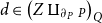 $d\in \big (Z\amalg _{\partial {{\unicode{x3088}_P}}} {{\unicode{x3088}_P}}\big )_Q$
such that one can find
$d\in \big (Z\amalg _{\partial {{\unicode{x3088}_P}}} {{\unicode{x3088}_P}}\big )_Q$
such that one can find $e\in \big (W\setminus Z\amalg _{\partial {{\unicode{x3088}_P}}} {{\unicode{x3088}_P}}\big )_R$
which degenerates to
$e\in \big (W\setminus Z\amalg _{\partial {{\unicode{x3088}_P}}} {{\unicode{x3088}_P}}\big )_R$
which degenerates to $d$
. Since the condition
$d$
. Since the condition $\textit {(2)}$
was satisfied for
$\textit {(2)}$
was satisfied for $g$
, we note that
$g$
, we note that $d$
must be a degeneracy of a top cell of
$d$
must be a degeneracy of a top cell of $ {\unicode{x3088}_P}$
.
$ {\unicode{x3088}_P}$
.
We can assume that $e$
is nondegenerate in
$e$
is nondegenerate in $W$
and that
$W$
and that $d$
is nondegenerate in
$d$
is nondegenerate in $Z\amalg _{\partial {\unicode{x3088}_P}} {\unicode{x3088}_P}$
. Explicitly, let
$Z\amalg _{\partial {\unicode{x3088}_P}} {\unicode{x3088}_P}$
. Explicitly, let $e'$
be the predegenerate cell of
$e'$
be the predegenerate cell of $e$
(unique by condition
$e$
(unique by condition $\textit {(3)}$
) in a presheaf
$\textit {(3)}$
) in a presheaf $W$
and let
$W$
and let $d'$
be some predegenerate cell of
$d'$
be some predegenerate cell of $d$
in a presheaf
$d$
in a presheaf $Z$
(obviously
$Z$
(obviously $e'$
is not an image of any cell in
$e'$
is not an image of any cell in $Z$
, since otherwise,
$Z$
, since otherwise, $e$
would be an image of a cell in
$e$
would be an image of a cell in $Z$
). We note that
$Z$
). We note that $e'$
degenerates to
$e'$
degenerates to $e$
which degenerates to
$e$
which degenerates to $d$
and also
$d$
and also $d'$
degenerates to
$d'$
degenerates to $d$
. Let
$d$
. Let $d''$
be the predegenerate cell of
$d''$
be the predegenerate cell of $d''$
in
$d''$
in $Y$
. Both
$Y$
. Both $e', d''$
are nondegenerate cells of an EZ-presheaf
$e', d''$
are nondegenerate cells of an EZ-presheaf $W$
which degenerate to the same cell
$W$
which degenerate to the same cell $d$
, and since
$d$
, and since $e'\not \in Z_Q$
, they must be equal by
$e'\not \in Z_Q$
, they must be equal by $\textit {(3)}$
. In particular, we can assume that
$\textit {(3)}$
. In particular, we can assume that $d$
is a top cell of
$d$
is a top cell of $P$
.
$P$
.
Let $\sigma : R\to Q\in \textrm {Mor}(\mathcal{A})$
be the codegeneracy map corresponding to the degeneracy operator sending
$\sigma : R\to Q\in \textrm {Mor}(\mathcal{A})$
be the codegeneracy map corresponding to the degeneracy operator sending $e$
to
$e$
to $d$
. Let the pair
$d$
. Let the pair $\sigma ',\sigma '':S\to R$
of distinct codegeneracy morphisms satisfy
$\sigma ',\sigma '':S\to R$
of distinct codegeneracy morphisms satisfy $\sigma \circ \sigma '=\sigma \circ \sigma ''$
. Then
$\sigma \circ \sigma '=\sigma \circ \sigma ''$
. Then $\sigma '^*(d)\neq \sigma ''^*(d)$
since there are no identifications between degeneracies of the top cell of
$\sigma '^*(d)\neq \sigma ''^*(d)$
since there are no identifications between degeneracies of the top cell of $P$
in the pushout
$P$
in the pushout $Z\amalg _{\partial {\unicode{x3088}_P}} {\unicode{x3088}_P}$
. On the other hand, they must be equal, since
$Z\amalg _{\partial {\unicode{x3088}_P}} {\unicode{x3088}_P}$
. On the other hand, they must be equal, since $d=\sigma ^*(e)$
. A contradiction.
$d=\sigma ^*(e)$
. A contradiction.
Observation 3.16.
One can think of cellular monomorphisms $X\hookrightarrow Y$
as those monomomorphisms, which correspond to morphisms
$X\hookrightarrow Y$
as those monomomorphisms, which correspond to morphisms $\oint _{\mathcal{A}}X\hookrightarrow \oint _{\mathcal{A}}Y$
which only add new connected components, each of which has a terminal object.
$\oint _{\mathcal{A}}X\hookrightarrow \oint _{\mathcal{A}}Y$
which only add new connected components, each of which has a terminal object.
Lemma 3.17.
If $\mathcal{A}$
is a degeneracy-forking Reedy category, then every monomorphism between EZ-presheaves is a cellular monomorphism.
$\mathcal{A}$
is a degeneracy-forking Reedy category, then every monomorphism between EZ-presheaves is a cellular monomorphism.
Proof.
Suppose $X\overset {f}{\hookrightarrow }Y$
is a monomorphism between EZ-presheaves, which is not cellular. This means that some cell
$X\overset {f}{\hookrightarrow }Y$
is a monomorphism between EZ-presheaves, which is not cellular. This means that some cell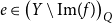 $e\in \big (Y\setminus \textrm {Im}(f)\big )_Q$
has a degeneracy (by the operator
$e\in \big (Y\setminus \textrm {Im}(f)\big )_Q$
has a degeneracy (by the operator $\sigma ^*$
) which is an image of a cell
$\sigma ^*$
) which is an image of a cell $d\in X_R$
(this is the negation of the condition
$d\in X_R$
(this is the negation of the condition $\textit {(2)}$
from the previous lemma, conditions
$\textit {(2)}$
from the previous lemma, conditions $\textit {(1)}$
and
$\textit {(1)}$
and $\textit {(3)}$
are trivially satisfied, since
$\textit {(3)}$
are trivially satisfied, since $X$
and
$X$
and $Y$
are EZ-presheaves).
$Y$
are EZ-presheaves).
Since $X$
and
$X$
and $Y$
are EZ-presheaves, we can assume that
$Y$
are EZ-presheaves, we can assume that $e$
is nondegenerate in
$e$
is nondegenerate in $Y$
and
$Y$
and $d$
is nondegenerate in
$d$
is nondegenerate in $X$
. Explicitly, let
$X$
. Explicitly, let $e'$
be the predegenerate cell of
$e'$
be the predegenerate cell of $e$
in a presheaf
$e$
in a presheaf $Y$
and let
$Y$
and let $d'$
be the unique predegenerate cell of
$d'$
be the unique predegenerate cell of $d$
in a presheaf
$d$
in a presheaf $X$
(obviously
$X$
(obviously $e'$
is not an image of any cell in
$e'$
is not an image of any cell in $X$
, since otherwise,
$X$
, since otherwise, $e$
would be an image of a cell in
$e$
would be an image of a cell in $X$
). It suffices to observe that
$X$
). It suffices to observe that $e'$
degenerates to
$e'$
degenerates to $f(d')$
. Indeed,
$f(d')$
. Indeed, $e'$
degenerates to
$e'$
degenerates to $e$
which degenerates to
$e$
which degenerates to $f(d)$
and also
$f(d)$
and also $f(d')$
degenerates to
$f(d')$
degenerates to $f(d)$
. Let
$f(d)$
. Let $d'$
be the predegenerate cell of
$d'$
be the predegenerate cell of $f(d')$
in
$f(d')$
in $Y$
. Both
$Y$
. Both $e', d'$
are nondegenerate cells of an EZ-presheaf
$e', d'$
are nondegenerate cells of an EZ-presheaf $Y$
which degenerate to the same cell
$Y$
which degenerate to the same cell $f(d)$
, hence they must be equal. In other words,
$f(d)$
, hence they must be equal. In other words, $e'$
is a predegenerate cell of
$e'$
is a predegenerate cell of $f(d')$
in a presheaf
$f(d')$
in a presheaf $Y$
.
$Y$
.
Let $\sigma : R\to Q\in \textrm {Mor}(\mathcal{A})$
be the codegeneracy map corresponding to the degeneracy operator sending
$\sigma : R\to Q\in \textrm {Mor}(\mathcal{A})$
be the codegeneracy map corresponding to the degeneracy operator sending $e$
to
$e$
to $f(d)$
. Let the pair
$f(d)$
. Let the pair $\sigma ',\sigma '':l\to R$
of distinct codegeneracy morphisms satisfy
$\sigma ',\sigma '':l\to R$
of distinct codegeneracy morphisms satisfy $\sigma \circ \sigma '=\sigma \circ \sigma ''$
. Then
$\sigma \circ \sigma '=\sigma \circ \sigma ''$
. Then $\sigma '^*(f(d))\neq \sigma ''^*(f(d))$
since
$\sigma '^*(f(d))\neq \sigma ''^*(f(d))$
since $d$
is a nondegenerate cell in EZ-presheaf and
$d$
is a nondegenerate cell in EZ-presheaf and $f$
is a monomorphism. On the other hand, they need to be equal, since
$f$
is a monomorphism. On the other hand, they need to be equal, since $f(d)=\sigma ^*(e)$
. A contradiction.
$f(d)=\sigma ^*(e)$
. A contradiction.
Corollary 3.18.
If $\mathcal{A}$
is a degeneracy-forking Reedy category and
$\mathcal{A}$
is a degeneracy-forking Reedy category and $X$
is an EZ-presheaf, then
$X$
is an EZ-presheaf, then $\emptyset \to X$
is a cellular monomorphism.
$\emptyset \to X$
is a cellular monomorphism.
Proof.
Initial presheaf is both an EZ-presheaf and a monomorphism $\emptyset \to \emptyset$
is cellular. Since
$\emptyset \to \emptyset$
is cellular. Since $\emptyset \hookrightarrow X$
is mono, the previous result implies that it is a cellular monomorphism. As a result,
$\emptyset \hookrightarrow X$
is mono, the previous result implies that it is a cellular monomorphism. As a result, $\emptyset \to X$
is a cellular monomorphism.
$\emptyset \to X$
is a cellular monomorphism.
Lemma 3.19.
If $\mathcal{A}$
is a degeneracy-forking Reedy category, then cellular monomorphisms are stable under taking retracts.
$\mathcal{A}$
is a degeneracy-forking Reedy category, then cellular monomorphisms are stable under taking retracts.
Proof.
Let $X\xrightarrow {f}Y$
be a cellular monomorphism and consider the following diagram in which compositions in both rows are identity morphisms:
$X\xrightarrow {f}Y$
be a cellular monomorphism and consider the following diagram in which compositions in both rows are identity morphisms:

Morphism $g$
is a monomorphism, being a retract of a monomorphism. Suppose that
$g$
is a monomorphism, being a retract of a monomorphism. Suppose that $g$
is not a cellular monomorphism, so at least one of the conditions specified in Lemma3.15 does not hold. We show that each of those possibilities leads to a contradiction:
$g$
is not a cellular monomorphism, so at least one of the conditions specified in Lemma3.15 does not hold. We show that each of those possibilities leads to a contradiction:
-
(1) there is a nondegenerate cell
$e\in W_P\setminus Z_P$
such that
$\sigma ^*(e)=\sigma '^*(e)$
for some pair of distinct codegeneracy maps
$\sigma , \sigma '$
. Since this is not the case for
$X$
and
$Y$
, this means that
$i'(e)\in Y$
is degenerate. We pick its predegenerate cell
$e'$
(we note that it is of a different shape than
$e$
). Then
$r'(e')$
is a predegenerate cell of
$e$
in
$W$
, a contradiction (more generally, this reasoning shows that the image of a nondegenerate cell in
$W$
is nondegenerate in
$Y$
, which we will use again in the point
$(3)$
). -
(2) there is a pair of cells
$e\in W_P, e'\in W_Q$
such that
$e$
degenerates to
$e'$
and
$e'\in Z_Q$
,
$e\not \in Z_P$
. Since
$f$
is a cellular monomorphism,
$i'(e)\in X_P$
(otherwise
$f$
would violate a condition
$(2)$
). Then
$e=r'\circ i'(e)=r'\circ f\circ i'(e)=g\circ r\circ i'(e)\in Z$
, a contradiction. -
(3) There are distinct nondegenerate cells
$e\in W_P, e'\in W_Q\setminus Z_Q$
which degenerate to the same cell. The cell
$i'(e')$
is not in the image of
$f$
: if
$f(d)=i'(e')$
, then
$g(r(d))=r'(f(d))=r'(i'(e'))=e'$
. It follows that
$i'(e)$
and
$i'(e')$
violate condition
$(2)$
for the cellular monomorphism
$f$
.












Notation 3.20.
If $M$
is a class of morphisms in a fixed category
$M$
is a class of morphisms in a fixed category $\mathcal{C}$
, then
$\mathcal{C}$
, then $\mathrm{l}(M)$
(
$\mathrm{l}(M)$
( $\mathrm{r}(M)$
) denotes the
left orthogonal complement
of the class
$\mathrm{r}(M)$
) denotes the
left orthogonal complement
of the class $M$
(
right orthogonal complement
, respectively), (see Riehl (Reference Riehl2014), p. 134, where those notions are introduced as
$M$
(
right orthogonal complement
, respectively), (see Riehl (Reference Riehl2014), p. 134, where those notions are introduced as
 and
and
 , respectively).
Corollary 3.21.
Let $\mathcal{A}$
be a degeneracy-forking category. The class of cellular monomorphisms is equal to the class
$\mathcal{A}$
be a degeneracy-forking category. The class of cellular monomorphisms is equal to the class $\mathrm{l}(\mathrm{r}(\{\partial _P\}_{P\in \mathcal{A}}))$
.
$\mathrm{l}(\mathrm{r}(\{\partial _P\}_{P\in \mathcal{A}}))$
.
If $\emptyset \to X$
is a cellular monomorphism, then
$\emptyset \to X$
is a cellular monomorphism, then $X$
is an EZ-presheaf. More generally, the class of presheaves
$X$
is an EZ-presheaf. More generally, the class of presheaves $X$
such that
$X$
such that $\emptyset \to X$
is cellular, is equal to the class of EZ-presheaves.
$\emptyset \to X$
is cellular, is equal to the class of EZ-presheaves.
Proof. The first claim follows from the small object argument, see Riehl (Reference Riehl2014).
For the second one, note that if $X$
is a colimit of a sequence of monomorphisms between EZ-presheaves, then
$X$
is a colimit of a sequence of monomorphisms between EZ-presheaves, then $X$
is an EZ-presheaf itself. Combine that observation with the Theorem3.14 and the fact that
$X$
is an EZ-presheaf itself. Combine that observation with the Theorem3.14 and the fact that $\emptyset$
is an EZ-presheaf.
$\emptyset$
is an EZ-presheaf.
The last is a combination of the second claim with Corollary3.18.
Corollary 3.22. A retract of an EZ-presheaf over a degeneracy-forking category is also an EZ-presheaf.


3.2 Tidy Reedy categories
Now we impose further conditions on $\mathcal{A}$
(which so far was assumed only to be a degeneracy-forking Reedy category) which will ensure that the notion of EZ-presheaf is compatible with the formation of limits. The assumptions posed here will allow us to prove that the full subcategory of EZ-presheaves is a reflective and locally presentable subcategory of the category of presheaves.
$\mathcal{A}$
(which so far was assumed only to be a degeneracy-forking Reedy category) which will ensure that the notion of EZ-presheaf is compatible with the formation of limits. The assumptions posed here will allow us to prove that the full subcategory of EZ-presheaves is a reflective and locally presentable subcategory of the category of presheaves.
Definition 3.23.
A
tidy Reedy category
is a Reedy category $\mathcal{A}$
satisfying the following conditions:
$\mathcal{A}$
satisfying the following conditions:
-
• it is degeneracy-forking
-
• the category
$\mathcal{A}_-$
has binary pushouts

Remark 3.24. The category satisfying only the second condition above is called a pre-elegant Reedy category. This notion was introduced by Cavallo and Sattler in Cavallo and Sattler (Reference Cavallo and Sattler2022).
Lemma 3.25. In a pre-elegant Reedy category, every codegeneracy map is an epimorphism.
Proof. Cavallo and Sattler (Reference Cavallo and Sattler2022), Lemma5.29.
One can show that the assumption about the existence of pushouts is sufficient to prove that $EZ$
-presheaves are closed under taking products, while to ensure the closedness under forming equalizers, one also needs the assumption about epimorphisms. Both of those results are easy consequences of the Corollary3.32, but we decided to include the independent proof of the first of them below. The degeneracy-forking condition is not connected to the question of completeness of the category of Eilenberg–Zilber presheaves; it is assumed because of the results presented earlier. From now on, we will always assume that
$EZ$
-presheaves are closed under taking products, while to ensure the closedness under forming equalizers, one also needs the assumption about epimorphisms. Both of those results are easy consequences of the Corollary3.32, but we decided to include the independent proof of the first of them below. The degeneracy-forking condition is not connected to the question of completeness of the category of Eilenberg–Zilber presheaves; it is assumed because of the results presented earlier. From now on, we will always assume that $\mathcal{A}$
is a tidy Reedy category.
$\mathcal{A}$
is a tidy Reedy category.
Example 3.26.
Category $\Delta$
is both a tidy Reedy category and an Eilenberg–Zilber category.
$\Delta$
is both a tidy Reedy category and an Eilenberg–Zilber category.
Category $\textsf{pOpe}_\iota$
is a tidy Reedy category, in which not every codegeneracy map is a split epimorphism. In Section 4.2
of the Chapter 4, we will give a detailed proof of that fact.
$\textsf{pOpe}_\iota$
is a tidy Reedy category, in which not every codegeneracy map is a split epimorphism. In Section 4.2
of the Chapter 4, we will give a detailed proof of that fact.
A subcategory $\Delta '$
of the category
$\Delta '$
of the category $\Delta$
, with the same set of objects, but morphisms being only those order-preserving maps which have a subsegment of the codomain as an image, is a tidy Reedy category, in which also not every codegeneracy map is a split epimorphism.
$\Delta$
, with the same set of objects, but morphisms being only those order-preserving maps which have a subsegment of the codomain as an image, is a tidy Reedy category, in which also not every codegeneracy map is a split epimorphism.
The full subcategory of $\Delta$
spanned by the objects
$\Delta$
spanned by the objects $[0], [1], [2]$
is elegant (even an Eilenberg–Zilber category), but not tidy (there are no nonidentity surjections with the codomain
$[0], [1], [2]$
is elegant (even an Eilenberg–Zilber category), but not tidy (there are no nonidentity surjections with the codomain $[2]$
)
$[2]$
)
Theorem 3.27.
Suppose that $X, Y$
are EZ-presheaves. Then
$X, Y$
are EZ-presheaves. Then $X\times Y$
is also an EZ-presheaf.
$X\times Y$
is also an EZ-presheaf.
Proof.
Let $(a,b)\in \big (X\times Y\big )_P$
and
$(a,b)\in \big (X\times Y\big )_P$
and $(a',b')\in \big (X\times Y\big )_Q, (a'',b'')\in \big (X\times Y\big )_R$
be two nondegenerate cells of
$(a',b')\in \big (X\times Y\big )_Q, (a'',b'')\in \big (X\times Y\big )_R$
be two nondegenerate cells of $X\times Y$
which degenerate to
$X\times Y$
which degenerate to $(a,b)$
:
$(a,b)$
:
 \begin{equation*}\mu ^*(a',b')=(a,b)=\rho ^*(a'',b'')\end{equation*}
Both cells $a'$
and
$a'$
and $ a''$
degenerate to
$ a''$
degenerate to $a$
. Since
$a$
. Since $X$
is an EZ-presheaf, there is
$X$
is an EZ-presheaf, there is $a'''\in X_S$
which degenerates to
$a'''\in X_S$
which degenerates to $a'$
and also to
$a'$
and also to $a''$
. This must factor through the cell which has the shape of the pushout of
$a''$
. This must factor through the cell which has the shape of the pushout of $\rho$
and
$\rho$
and $\mu$
, call it
$\mu$
, call it $\hat {a}\in X_{Q\amalg _P R}$
. Cell
$\hat {a}\in X_{Q\amalg _P R}$
. Cell $\hat {a}$
degenerates to
$\hat {a}$
degenerates to $a$
via an induced pushout map, which we denote by
$a$
via an induced pushout map, which we denote by $\eta$
.
$\eta$
.
Similarly, we obtain $\hat {b}\in Y_{Q\amalg _P R}$
which degenerates to
$\hat {b}\in Y_{Q\amalg _P R}$
which degenerates to $b$
via
$b$
via $\eta$
. But then
$\eta$
. But then $(\hat {a},\hat {b})\in \big (X\times Y\big )_{Q\amalg _P R}$
degenerates to both
$(\hat {a},\hat {b})\in \big (X\times Y\big )_{Q\amalg _P R}$
degenerates to both $(a',b')$
and
$(a',b')$
and $(a,b)$
and since those are nondegenerate, must be equal to both of them.
$(a,b)$
and since those are nondegenerate, must be equal to both of them.
Now suppose that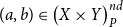 $(a,b)\in \big (X\times Y\big )_P^{nd}$
and
$(a,b)\in \big (X\times Y\big )_P^{nd}$
and $\mu , \rho$
are codegeneracy maps s. t.
$\mu , \rho$
are codegeneracy maps s. t. $\mu ^*(a,b)=\rho ^*(a,b)=(a',b')\in \big (X\times Y\big )_Q$
. It follows that
$\mu ^*(a,b)=\rho ^*(a,b)=(a',b')\in \big (X\times Y\big )_Q$
. It follows that $\mu ^*a=\rho ^*a=a'$
and since
$\mu ^*a=\rho ^*a=a'$
and since $X$
is an EZ-presheaf,
$X$
is an EZ-presheaf, $a$
must be a degeneracy of some cell
$a$
must be a degeneracy of some cell $a''$
via
$a''$
via $\kappa$
s. t.
$\kappa$
s. t. $\mu \circ \kappa =\rho \circ \mu$
. Cell
$\mu \circ \kappa =\rho \circ \mu$
. Cell $a''$
must degenerate to some cell
$a''$
must degenerate to some cell $\hat {a}\in X_S$
, where
$\hat {a}\in X_S$
, where $S$
is a pushout of
$S$
is a pushout of $\mu$
and
$\mu$
and $\rho$
. It degenerates to
$\rho$
. It degenerates to $a$
via the canonical pushout morphism
$a$
via the canonical pushout morphism $\eta$
. Note that
$\eta$
. Note that $\hat {a}$
must be distinct from
$\hat {a}$
must be distinct from $a$
since the pushout of two distinct morphisms is not an identity map (hence it is a proper codegeneracy map and therefore domain is not equal to the codomain).
$a$
since the pushout of two distinct morphisms is not an identity map (hence it is a proper codegeneracy map and therefore domain is not equal to the codomain).
Similarly, we obtain a cell $\hat {b}\in Y_S$
which degenerates to
$\hat {b}\in Y_S$
which degenerates to $b$
via
$b$
via $\eta$
, but then
$\eta$
, but then $\eta ^*(\hat {a},\hat {b})=(a,b)$
. Since
$\eta ^*(\hat {a},\hat {b})=(a,b)$
. Since $(a,b)$
is a nondegenerate cell, it follows that
$(a,b)$
is a nondegenerate cell, it follows that $(\hat {a},\hat {b})=(a,b)$
and
$(\hat {a},\hat {b})=(a,b)$
and $\eta =\mathrm{Id}_S$
. Since the pushout of two degeneracy maps is an identity only if those maps are equal (since otherwise it would be a morphism strictly lowering the degree), it follows that
$\eta =\mathrm{Id}_S$
. Since the pushout of two degeneracy maps is an identity only if those maps are equal (since otherwise it would be a morphism strictly lowering the degree), it follows that $\mu =\rho$
.
$\mu =\rho$
.
Observation 3.28. Similar reasoning shows that arbitrary products of EZ-presheaves are EZ-presheaves.
Lemma 3.29.
Let $X$
be an EZ-presheaf,
$X$
be an EZ-presheaf, $a,b\in X$
satisfy
$a,b\in X$
satisfy $\sigma ^*a=\sigma ^*b$
for some degeneracy operator
$\sigma ^*a=\sigma ^*b$
for some degeneracy operator $\sigma$
. Then
$\sigma$
. Then $a=b$
.
$a=b$
.
Proof.
Let $c$
be the unique nondegenerate cell of
$c$
be the unique nondegenerate cell of $X$
which degenerates to
$X$
which degenerates to $a$
and
$a$
and $b$
, that is
$b$
, that is $\sigma _a^* c=a$
,
$\sigma _a^* c=a$
, $\sigma _b^*c=b$
. Then
$\sigma _b^*c=b$
. Then $\sigma ^*\sigma _a^*c=\sigma ^*\sigma _b^*c$
, so by the uniqueness of degeneracy operator
$\sigma ^*\sigma _a^*c=\sigma ^*\sigma _b^*c$
, so by the uniqueness of degeneracy operator $\sigma _a\circ \sigma =\sigma _b\circ \sigma$
. Since
$\sigma _a\circ \sigma =\sigma _b\circ \sigma$
. Since $\sigma$
is epi,
$\sigma$
is epi, $\sigma _a=\sigma _b$
and consequently
$\sigma _a=\sigma _b$
and consequently $a=\sigma _a^*c=\sigma _b^*c=b$
.
$a=\sigma _a^*c=\sigma _b^*c=b$
.
Definition 3.30.
Let $P\xrightarrow {\sigma }Q$
,
$P\xrightarrow {\sigma }Q$
, $P\xrightarrow {\tau }R$
be a pair of maps in
$P\xrightarrow {\tau }R$
be a pair of maps in $\mathcal{A}_-$
and let
$\mathcal{A}_-$
and let $S=Q\amalg _P R$
. We will call the canonical map
$S=Q\amalg _P R$
. We will call the canonical map $ {\unicode{x3088}_Q}\amalg _{ {\unicode{x3088}_P}} {\unicode{x3088}_R}\to {\unicode{x3088}_S}$
a
comparing map
.
$ {\unicode{x3088}_Q}\amalg _{ {\unicode{x3088}_P}} {\unicode{x3088}_R}\to {\unicode{x3088}_S}$
a
comparing map
.
Theorem 3.31.
Let $X\in \widehat {\mathcal{A}}$
. Then
$X\in \widehat {\mathcal{A}}$
. Then $X\in \widehat {\mathcal{A}}_{EZ}\iff X$
is orthogonal to all comparing maps.
$X\in \widehat {\mathcal{A}}_{EZ}\iff X$
is orthogonal to all comparing maps.
Proof. $(\implies )$
Fix a comparing map
$(\implies )$
Fix a comparing map $g: {\unicode{x3088}_Q}\amalg _{ {\unicode{x3088}_P}} {\unicode{x3088}_R}\to {\unicode{x3088}_S}$
.
$g: {\unicode{x3088}_Q}\amalg _{ {\unicode{x3088}_P}} {\unicode{x3088}_R}\to {\unicode{x3088}_S}$
.

First, we will show the existence of a dashed arrow. Let $c\in X_T$
be a common predegenerate cell of
$c\in X_T$
be a common predegenerate cell of $f(\alpha _Q)$
and
$f(\alpha _Q)$
and $f(\alpha _R)$
. By the universal property of a pushout, there exists a unique codegeneracy map
$f(\alpha _R)$
. By the universal property of a pushout, there exists a unique codegeneracy map $\kappa : S\to T$
. Then
$\kappa : S\to T$
. Then $\kappa ^*c: {\unicode{x3088}_S} \to X$
is the desired map.
$\kappa ^*c: {\unicode{x3088}_S} \to X$
is the desired map.
It remains to justify the uniqueness of such a map. Let $\sigma ': R\to S$
be a pushout of
$\sigma ': R\to S$
be a pushout of $\sigma$
along
$\sigma$
along $\tau$
and suppose that
$\tau$
and suppose that $f_1, f_2: {\unicode{x3088}_S}\to X$
satisfy
$f_1, f_2: {\unicode{x3088}_S}\to X$
satisfy $f=f_1\circ g=f_2\circ g$
. Then
$f=f_1\circ g=f_2\circ g$
. Then $\sigma '^* f_1=f(\alpha _r)=\sigma '^* f_2$
. Now it suffices to apply Lemma3.29.
$\sigma '^* f_1=f(\alpha _r)=\sigma '^* f_2$
. Now it suffices to apply Lemma3.29. $({\impliedby})$
Suppose that
$({\impliedby})$
Suppose that $X\not \in \widehat {\mathcal{A}}_{EZ}$
. This means that at least one of the following conditions holds:
$X\not \in \widehat {\mathcal{A}}_{EZ}$
. This means that at least one of the following conditions holds:
-
(1) there exists a pair of distinct cells
$a\in X_Q^{nd}$
,
$b\in X_R^{nd}$
and a pair of codegeneracy maps
$\sigma ,\tau$
such that
$\sigma ^*a=\tau ^*b\in X_P$
-
(2) there exists a cell
$a\in X_Q^{nd}$
and a pair of distinct codegeneracy maps
$\sigma ,\tau$
such that
$\sigma ^*a=$
$\tau ^*b\in X_P$





In the first of those cases, $X$
is not orthogonal to a comparing map
$X$
is not orthogonal to a comparing map $ {\unicode{x3088}_Q}\amalg _{ {\unicode{x3088}_P}} {\unicode{x3088}_R}\to {\unicode{x3088}_S}$
: if it was, then the image of
$ {\unicode{x3088}_Q}\amalg _{ {\unicode{x3088}_P}} {\unicode{x3088}_R}\to {\unicode{x3088}_S}$
: if it was, then the image of $\alpha _S$
in
$\alpha _S$
in $X$
would be a common predegenerate cell of
$X$
would be a common predegenerate cell of $a$
and
$a$
and $b$
(which does not exist for a pair of distinct nondegenerate cells).
$b$
(which does not exist for a pair of distinct nondegenerate cells).
In the second case, we reason as follows: since $\sigma$
and
$\sigma$
and $\tau$
are distinct, their pushouts are not identities, in particular
$\tau$
are distinct, their pushouts are not identities, in particular $d(S)\lt d(Q)$
. If
$d(S)\lt d(Q)$
. If $X$
is orthogonal to a comparing map
$X$
is orthogonal to a comparing map $ {\unicode{x3088}_Q}\amalg _{ {\unicode{x3088}_P}} {\unicode{x3088}_Q}\to {\unicode{x3088}_S}$
, then the image of
$ {\unicode{x3088}_Q}\amalg _{ {\unicode{x3088}_P}} {\unicode{x3088}_Q}\to {\unicode{x3088}_S}$
, then the image of $\alpha _S$
in
$\alpha _S$
in $X$
is a predegenerate cell of
$X$
is a predegenerate cell of $a$
which has a strictly smaller dimension than
$a$
which has a strictly smaller dimension than $a$
, contradicting the fact that
$a$
, contradicting the fact that $a$
is a nondegenerate cell.
$a$
is a nondegenerate cell.
Recall that a category $\mathcal{C}$
is called a locally presentable category, if it satisfies the following conditions:
$\mathcal{C}$
is called a locally presentable category, if it satisfies the following conditions:
-
•
$\mathcal{C}$
is locally small -
•
$\mathcal{C}$
is cocomplete -
• there exists a small set
$S$
of
$\kappa$
-compact objects in
$\mathcal{C}$
such that every object in
$\mathcal{C}$
is a
$\kappa$
-filtered colimit of a diagram consisting only of objects in
$S$
for some regular cardinal
$\kappa$
.


Corollary 3.32.
The category $\widehat {\mathcal{A}}_{EZ}$
is a reflective and locally presentable subcategory of
$\widehat {\mathcal{A}}_{EZ}$
is a reflective and locally presentable subcategory of $\widehat {\mathcal{A}}$
. In particular, it is bicomplete, and limits in
$\widehat {\mathcal{A}}$
. In particular, it is bicomplete, and limits in $\widehat {\mathcal{A}}_{EZ}$
can be computed pointwise.
$\widehat {\mathcal{A}}_{EZ}$
can be computed pointwise.
Proof. Adámek and Rosický (Reference Adámek and Rosický1994), Theorem 1.39.
Remark 3.33. Local presentability of $\widehat {\mathcal{A}}_{EZ}$
can be also proved differently: by Cavallo and Sattler (Reference Cavallo and Sattler2022), Theorem 5.32, EZ-presheaves are characterized as those presheaves, which send pushouts of degeneracy maps to pullbacks of sets. In particular, the category
$\widehat {\mathcal{A}}_{EZ}$
can be also proved differently: by Cavallo and Sattler (Reference Cavallo and Sattler2022), Theorem 5.32, EZ-presheaves are characterized as those presheaves, which send pushouts of degeneracy maps to pullbacks of sets. In particular, the category $\widehat {\mathcal{A}}_{EZ}$
is a category of models of limit sketches, thus by Adámek and Rosický (Reference Adámek and Rosický1994) Corollary 1.52 it is locally presentable.
$\widehat {\mathcal{A}}_{EZ}$
is a category of models of limit sketches, thus by Adámek and Rosický (Reference Adámek and Rosický1994) Corollary 1.52 it is locally presentable.
Some colimits of EZ-presheaves can also be computed in the category of all presheaves.
Lemma 3.34.
Let $f: X\hookrightarrow Y$
,
$f: X\hookrightarrow Y$
, $g: X\to Z$
be a pair of morphisms between EZ-presheaves such that the first one is a monomorphism. Then the pushout
$g: X\to Z$
be a pair of morphisms between EZ-presheaves such that the first one is a monomorphism. Then the pushout $Y\amalg _X Z$
is an EZ-presheaf.
$Y\amalg _X Z$
is an EZ-presheaf.
Proof.
The morphism $f$
is a cellular monomorphism, being a monomorphism between EZ-presheaves. Since cellular monomorphisms are closed under taking pushouts,
$f$
is a cellular monomorphism, being a monomorphism between EZ-presheaves. Since cellular monomorphisms are closed under taking pushouts, $\tilde {f}: Z\hookrightarrow Y\amalg _X Z$
is also a cellular monomorphism. Since
$\tilde {f}: Z\hookrightarrow Y\amalg _X Z$
is also a cellular monomorphism. Since $Z$
is an EZ-presheaf,
$Z$
is an EZ-presheaf, $\emptyset \hookrightarrow Z$
is a cellular monomorphism. It follows that
$\emptyset \hookrightarrow Z$
is a cellular monomorphism. It follows that $\emptyset \hookrightarrow Y\amalg _X Z$
is cellular, so
$\emptyset \hookrightarrow Y\amalg _X Z$
is cellular, so $Y\amalg _X Z$
is an EZ-presheaf.
$Y\amalg _X Z$
is an EZ-presheaf.
Lemma 3.35. The coproduct of a family of EZ-presheaves is an EZ-presheaf.
Proof. Direct check.
Theorem 3.36.
A filtered colimit of EZ-presheaves (taken in $\widehat {\mathcal{A}}$
) is an EZ-presheaf, that is it is also a colimit in the category
$\widehat {\mathcal{A}}$
) is an EZ-presheaf, that is it is also a colimit in the category $\widehat {\mathcal{A}}_{EZ}$
.
$\widehat {\mathcal{A}}_{EZ}$
.
Proof. This follows from Adámek and Rosický (Reference Adámek and Rosický1994), p. 31, and the Theorem3.31 by observing that both domains and codomains of comparing maps are finitely presentable.
One can also characterize epimorphisms in the category of EZ-presheaves.
Lemma 3.37.
Let $f: X\to Y$
be a morphism of EZ-presheaves. Then it is an epimorphism if and only if the induced functor
$f: X\to Y$
be a morphism of EZ-presheaves. Then it is an epimorphism if and only if the induced functor $\oint _{\mathcal{A}}f:\oint _{\mathcal{A}}X\to \oint _{\mathcal{A}}Y$
gives a surjection between sets of connected components of the categories involved.
$\oint _{\mathcal{A}}f:\oint _{\mathcal{A}}X\to \oint _{\mathcal{A}}Y$
gives a surjection between sets of connected components of the categories involved.
Proof.
Suppose that $\pi _0\circ \oint _{\mathcal{A}}f:\pi _0\circ \oint _{\mathcal{A}}X\to \pi _0\circ \oint _{\mathcal{A}}Y$
is not a surjection.
$\pi _0\circ \oint _{\mathcal{A}}f:\pi _0\circ \oint _{\mathcal{A}}X\to \pi _0\circ \oint _{\mathcal{A}}Y$
is not a surjection.
The functor $\pi _0\circ \oint _{\mathcal{A}}$
is a left adjoint (being a composition of three left adjoints), in particular, it preserves epimorphisms. It follows that
$\pi _0\circ \oint _{\mathcal{A}}$
is a left adjoint (being a composition of three left adjoints), in particular, it preserves epimorphisms. It follows that $f$
is not an epimorphism.
$f$
is not an epimorphism.
Conversely, assume that $\pi _0\circ \oint _{\mathcal{A}}f:\pi _0\circ \oint _{\mathcal{A}}X\to \pi _0\circ \oint _{\mathcal{A}}Y$
is a surjection and let
$\pi _0\circ \oint _{\mathcal{A}}f:\pi _0\circ \oint _{\mathcal{A}}X\to \pi _0\circ \oint _{\mathcal{A}}Y$
is a surjection and let $k,h:Y\to Z$
be a pair of morphisms between EZ-presheaves such that
$k,h:Y\to Z$
be a pair of morphisms between EZ-presheaves such that $k\circ f=h\circ f$
.
$k\circ f=h\circ f$
.
It is enough to check that $k$
and
$k$
and $h$
agree on each cell of
$h$
agree on each cell of $Y$
. Fix
$Y$
. Fix $\alpha \in Y$
. By the assumption, there exists a codegeneracy map
$\alpha \in Y$
. By the assumption, there exists a codegeneracy map $\sigma$
and a cell
$\sigma$
and a cell $\beta \in X$
such that
$\beta \in X$
such that $f(\beta )=\sigma ^*\alpha$
, so
$f(\beta )=\sigma ^*\alpha$
, so $\sigma ^*k(\alpha )=k\circ f(\beta )=h\circ f(\beta )=\sigma ^*h(\alpha )$
. Applying Lemma3.29, we finish the proof.
$\sigma ^*k(\alpha )=k\circ f(\beta )=h\circ f(\beta )=\sigma ^*h(\alpha )$
. Applying Lemma3.29, we finish the proof.
It is also true that if $X\xrightarrow {f}Y$
is a monomorphism (isomorphism), then
$X\xrightarrow {f}Y$
is a monomorphism (isomorphism), then $\pi _0\circ \oint _{\mathcal{A}}f:\pi _0\circ \oint _{\mathcal{A}}X\to \pi _0\circ \oint _{\mathcal{A}}Y$
is injective (bijective). The converse implications are not true in general.
$\pi _0\circ \oint _{\mathcal{A}}f:\pi _0\circ \oint _{\mathcal{A}}X\to \pi _0\circ \oint _{\mathcal{A}}Y$
is injective (bijective). The converse implications are not true in general.
Lemma 3.38.
If $f:X\to Y$
is a morphism of
$f:X\to Y$
is a morphism of $EZ$
-presheaves, which is both a monomorphism and an epimorphism, then it is an isomorphism. That is, the category of Eilenberg–Zilber presheaves is balanced.
$EZ$
-presheaves, which is both a monomorphism and an epimorphism, then it is an isomorphism. That is, the category of Eilenberg–Zilber presheaves is balanced.
Proof.
From the assumptions follows that $f$
is a cellular monomorphism such that for every nondegenerate
$f$
is a cellular monomorphism such that for every nondegenerate $\alpha \in Y$
there exists
$\alpha \in Y$
there exists $\beta \in X$
and a codegeneracy map
$\beta \in X$
and a codegeneracy map $\sigma$
such that
$\sigma$
such that $f(\beta )=\sigma ^*\alpha$
.
$f(\beta )=\sigma ^*\alpha$
.
It is enough to check that every nondegenerate cell of $Y$
is an image of some cell of
$Y$
is an image of some cell of $X$
by
$X$
by $f$
, so suppose that
$f$
, so suppose that $\alpha \in Y_P\setminus X_P$
. This contradicts the point
$\alpha \in Y_P\setminus X_P$
. This contradicts the point $(3)$
of the Lemma3.15.
$(3)$
of the Lemma3.15.
Let $F:\widehat {\mathcal{A}}\to \mathcal{D}$
be a left adjoint functor. We formulate a sufficient condition for
$F:\widehat {\mathcal{A}}\to \mathcal{D}$
be a left adjoint functor. We formulate a sufficient condition for $F|_{\widehat {\mathcal{A}}_{EZ}}\to \mathcal{D}$
to be a left adjoint.
$F|_{\widehat {\mathcal{A}}_{EZ}}\to \mathcal{D}$
to be a left adjoint.
Theorem 3.39.
Suppose that $F\big |_{\mathcal{A}_-}$
preserves pushouts. Then the image of the right adjoint
$F\big |_{\mathcal{A}_-}$
preserves pushouts. Then the image of the right adjoint $R$
is contained in
$R$
is contained in $\widehat {\mathcal{A}}_{EZ}$
. In particular,
$\widehat {\mathcal{A}}_{EZ}$
. In particular, $F\big |_{\widehat {\mathcal{A}}_{EZ}}$
and
$F\big |_{\widehat {\mathcal{A}}_{EZ}}$
and $R$
constitute a pair of adjoint functors.
$R$
constitute a pair of adjoint functors.
Proof. The diagram

where the morphism on the left is a generic comparing map, expressing the fact that $R(X)$
is an EZ-presheaf.
$R(X)$
is an EZ-presheaf.
By the standard correspondence of lifting problems under adjunction, the existence of the unique filler in this diagram is equivalent to

which is true by the assumption on $F$
(the arrow on the left is an isomorphism).
$F$
(the arrow on the left is an isomorphism).
4. Functor
$\zeta$
and Ideals on Opetopes

This chapter has two main objectives. The first is to introduce functors that facilitate comparisons between opetopic and simplicial sets and to systematically study their key properties. The second is to prove that the category $\textsf{pOpe}_\iota$
is a tidy Reedy category. Although these two goals may appear unrelated at first glance, they are deeply connected through the concept of ideals in opetopes – a combinatorial analog of the kernel of a map between
$\textsf{pOpe}_\iota$
is a tidy Reedy category. Although these two goals may appear unrelated at first glance, they are deeply connected through the concept of ideals in opetopes – a combinatorial analog of the kernel of a map between $\omega$
-categories. This notion plays a central technical role and is developed in detail in the middle section of the chapter.
$\omega$
-categories. This notion plays a central technical role and is developed in detail in the middle section of the chapter.
4.1 Adjunction
$\zeta \dashv \rho$

In this section, we define the functor $\zeta \colon \widehat{\textsf{pOpe}_\iota} \to \textsf{sSet}$
, which will serve as a key tool for comparing the opetopic model structure with the Kan–Quillen model structure on
$\zeta \colon \widehat{\textsf{pOpe}_\iota} \to \textsf{sSet}$
, which will serve as a key tool for comparing the opetopic model structure with the Kan–Quillen model structure on $\textsf{sSet}$
. This functor is closely related to the usual nerve functor
$\textsf{sSet}$
. This functor is closely related to the usual nerve functor $\mathcal{N}$
, but unlike
$\mathcal{N}$
, but unlike $\mathcal{N}$
,
$\mathcal{N}$
, $\zeta$
retains information about the orientations of edges. This feature makes
$\zeta$
retains information about the orientations of edges. This feature makes $\zeta$
particularly well-suited for comparing models of non-invertible higher categories.
$\zeta$
particularly well-suited for comparing models of non-invertible higher categories.
To construct $\zeta$
, we begin with the nerve functor
$\zeta$
, we begin with the nerve functor $\mathcal{N}$
and apply identifications arising from an abstract rewriting system structure. These identifications align naturally with the rewriting-theoretic properties of positive opetopes, ensuring that
$\mathcal{N}$
and apply identifications arising from an abstract rewriting system structure. These identifications align naturally with the rewriting-theoretic properties of positive opetopes, ensuring that $\zeta$
captures the desired combinatorial data. For example, on subcategories of graphs inside
$\zeta$
captures the desired combinatorial data. For example, on subcategories of graphs inside $\widehat{\textsf{pOpe}_\iota}$
and
$\widehat{\textsf{pOpe}_\iota}$
and $\textsf{sSet}$
,
$\textsf{sSet}$
, $\zeta$
restricts to an isomorphism, while
$\zeta$
restricts to an isomorphism, while $\mathcal{N}$
maps each edge to a pair of edges with a common codomain.
$\mathcal{N}$
maps each edge to a pair of edges with a common codomain.
Definition 4.1.
We define the
opetopic nerve functor $\mathcal{N}_{\textsf{pOpe}_\iota} \colon \textsf{pOpe}_\iota \to \textsf{sSet}$
as follows:
$\mathcal{N}_{\textsf{pOpe}_\iota} \colon \textsf{pOpe}_\iota \to \textsf{sSet}$
as follows: $\mathcal{N}_{\textsf{pOpe}_\iota}(P)$
is the set of all non-empty finite ascending sequences
$\mathcal{N}_{\textsf{pOpe}_\iota}(P)$
is the set of all non-empty finite ascending sequences $(x_0, \ldots , x_n)$
of cells in the opetope
$(x_0, \ldots , x_n)$
of cells in the opetope $P$
, where an ascending sequence satisfies
$P$
, where an ascending sequence satisfies $x_i \preceq x_j$
for all
$x_i \preceq x_j$
for all $i \leq j$
. Face operators act on those sequences by deleting cells, while degeneracy operators insert copies of existing cells. This construction is functorial because morphisms in
$i \leq j$
. Face operators act on those sequences by deleting cells, while degeneracy operators insert copies of existing cells. This construction is functorial because morphisms in $\textsf{pOpe}_\iota$
preserve the inclusion order on cells.
$\textsf{pOpe}_\iota$
preserve the inclusion order on cells.
A $(P,n)$
-chain
is the
$(P,n)$
-chain
is the $n$
-simplex in
$n$
-simplex in $\mathcal{N}_{\textsf{pOpe}_\iota}(P)$
. In other words, it is a sequence
$\mathcal{N}_{\textsf{pOpe}_\iota}(P)$
. In other words, it is a sequence $(x_0,\ldots ,x_n)$
of cells of
$(x_0,\ldots ,x_n)$
of cells of $P$
such that for every
$P$
such that for every $i\in \{0,\ldots ,n-1\}$
cell
$i\in \{0,\ldots ,n-1\}$
cell $x_i$
is a (not necessarily proper) face of
$x_i$
is a (not necessarily proper) face of $x_{i+1}$
.
$x_{i+1}$
.
Remark 4.2. $\mathcal{N}_{\textsf{pOpe}_\iota}$
can equivalently be described as the composition
$\mathcal{N}_{\textsf{pOpe}_\iota}$
can equivalently be described as the composition $\mathcal{N} \circ \mathcal{P} \colon \textsf{pOpe}_\iota \to \textsf{sSet}$
, where
$\mathcal{N} \circ \mathcal{P} \colon \textsf{pOpe}_\iota \to \textsf{sSet}$
, where $\mathcal{P} \colon \textsf{pOpe}_\iota \to \textsf{Poset}$
assigns to an opetope
$\mathcal{P} \colon \textsf{pOpe}_\iota \to \textsf{Poset}$
assigns to an opetope $P$
its poset of faces ordered by the relation
$P$
its poset of faces ordered by the relation $\preceq$
, and
$\preceq$
, and $\mathcal{N} \colon \textsf{Poset} \to \textsf{sSet}$
is the standard nerve functor.
$\mathcal{N} \colon \textsf{Poset} \to \textsf{sSet}$
is the standard nerve functor.
Definition 4.3.
Let $\leadsto$
be the binary relation on
$\leadsto$
be the binary relation on $\mathcal{N}_{\textsf{pOpe}_\iota}(P)$
consisting of pairs of the form:
$\mathcal{N}_{\textsf{pOpe}_\iota}(P)$
consisting of pairs of the form:
 \begin{equation*} \Big ((x_0, \ldots , x_{i-1}, x_i, x_{i+1}, \ldots , x_n),\ (x_0, \ldots , x_{i-1}, \gamma ^k (x_i), x_{i+1}, \ldots , x_n)\Big ), \end{equation*}
where $k \in \mathbb{N}_{\gt 0}$
and
$k \in \mathbb{N}_{\gt 0}$
and $x_{i-1} \preceq \gamma ^k (x_i)$
.
$x_{i-1} \preceq \gamma ^k (x_i)$
.
Observation 4.4.
The reflexive closure $\leadsto _{ref}$
of
$\leadsto _{ref}$
of $\leadsto$
is closed under simplicial operators: if
$\leadsto$
is closed under simplicial operators: if $\tau$
is a simplicial operator and
$\tau$
is a simplicial operator and
 \begin{equation*}(x_0, \ldots , x_n) \leadsto _{ref} (x_0, \ldots , \gamma ^k (x_i), \ldots , x_n)\end{equation*}
then
 \begin{equation*}\tau (x_0, \ldots , x_n) \leadsto _{ref} \tau (x_0, \ldots , \gamma ^k (x_i), \ldots , x_n)\end{equation*}
Definition 4.5.
An
abstract rewriting system
(abbreviated ARS) is a pair $(X, R)$
, where
$(X, R)$
, where $X$
is a set and
$X$
is a set and $R\subset X\times X$
is a binary relation.
$R\subset X\times X$
is a binary relation.
Remark 4.6. Elements of $X$
are usually some expressions, with
$X$
are usually some expressions, with $(x_1,x_2)\in R$
meaning that
$(x_1,x_2)\in R$
meaning that $x_2$
is a reduced (simplified) form of
$x_2$
is a reduced (simplified) form of $x_2$
.
$x_2$
.
This simple idea can be encoded in many ways, for example in Ara et al. (Reference Ara, Burroni, Guiraud, Malbos, Métayer and Mimram2025) abstract rewriting systems are described as $1$
-polygraphs, that is graphs.
$1$
-polygraphs, that is graphs.
Definition 4.7.
An ARS is called
terminating
if there is no infinite sequence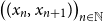 $\big ((x_{n},x_{n+1})\big )_{n\in \mathbb{N}}$
of pairs belonging to
$\big ((x_{n},x_{n+1})\big )_{n\in \mathbb{N}}$
of pairs belonging to $R$
.
$R$
.
Let
 \begin{equation*}R^\infty :=\bigcup _{n\in \mathbb{N}_{\gt 0}}\overbrace {R\circ \ldots \circ R}^{\text{n-fold composition}}\end{equation*}
An ARS is called
locally confluent
if for every $(x,y_1), (x,y_2)\in R$
there exists
$(x,y_1), (x,y_2)\in R$
there exists $z\in X$
such that
$z\in X$
such that $(y_1,z),(y_2,z)\in R^\infty$
.
$(y_1,z),(y_2,z)\in R^\infty$
.
An ARS is called
confluent
if for every $(x,y_1), (x,y_2)\in R^\infty$
there exists
$(x,y_1), (x,y_2)\in R^\infty$
there exists $z\in X$
such that
$z\in X$
such that $(y_1,z),(y_2,z)\in R^\infty$
.
$(y_1,z),(y_2,z)\in R^\infty$
.
An ARS is said to have
unique normal form property
if every equivalence class of the equivalence relation generated by $R$
contains exactly one normal form.
$R$
contains exactly one normal form.
Lemma 4.8. Every confluent ARS has a unique normal form property.
Proof. Ara et al. (Reference Ara, Burroni, Guiraud, Malbos, Métayer and Mimram2025), Lemma 1.3.19.
Lemma 4.9 (Newman’s lemma).
A terminating ARS is confluent if and only if it is locally confluent.
Proof. Ara et al. (Reference Ara, Burroni, Guiraud, Malbos, Métayer and Mimram2025), Lemma 1.3.21.
Lemma 4.10.
The pair $(\mathcal{N}_{\textsf{pOpe}_\iota}(P), \leadsto )$
forms a confluent abstract rewriting system.
$(\mathcal{N}_{\textsf{pOpe}_\iota}(P), \leadsto )$
forms a confluent abstract rewriting system.
Proof. We will use Newman’s lemma.
Step 1: Reduce the number of generating reductions.
We observe that every relation in $\leadsto$
decomposes into elementary steps:
$\leadsto$
decomposes into elementary steps:
 \begin{equation*} (x_0, \ldots , x_{i-1}, x_i, \ldots , x_n) \simeq (x_0, \ldots , x_{i-1}, \gamma (x_i), \ldots , x_n), \end{equation*}
where $x_{i-1} \preceq \gamma (x_i)$
.
$x_{i-1} \preceq \gamma (x_i)$
.
Step 2: Termination.
This system terminates because reductions strictly decrease the sum of cell dimensions in a sequence.
Step 3: Local confluence.
Consider sequences with reductions at positions $i$
and
$i$
and $j$
. If
$j$
. If $x_{i-1} \preceq \gamma (x_i)$
and
$x_{i-1} \preceq \gamma (x_i)$
and $x_{j-1} \preceq \gamma (x_j)$
, then the sequence
$x_{j-1} \preceq \gamma (x_j)$
, then the sequence $(x_0', x_1',\ldots , x_{n-1}', x_n')$
with
$(x_0', x_1',\ldots , x_{n-1}', x_n')$
with $x_l'=x_l$
for
$x_l'=x_l$
for $l\neq i,j$
,
$l\neq i,j$
, $x_i'=\gamma (x_i)$
,
$x_i'=\gamma (x_i)$
, $x_j'=\gamma (x_j)$
remains valid in
$x_j'=\gamma (x_j)$
remains valid in $\mathcal{N}_{\textsf{pOpe}_\iota}(P)_n$
.
$\mathcal{N}_{\textsf{pOpe}_\iota}(P)_n$
.
For the sake of transparency, we spell out explicitly the only non-obvious case $j=i+1$
:
$j=i+1$
:
 \begin{align*} &(x_0, \ldots , x_{i-1}, x_i, x_{i+1}, \ldots , x_n) \simeq (x_0, \ldots , x_{i-1}, \gamma (x_i), x_{i+1}, \ldots , x_n), \\ &(x_0, \ldots , x_i, x_{i+1}, x_{i+2}, \ldots , x_n) \simeq (x_0, \ldots , x_i, \gamma (x_{i+1}), x_{i+2}, \ldots , x_n). \end{align*}
We need to show that $(x_0,\ldots , x_{i-1}, \gamma (x_{i}), \gamma (x_{i+1}),x_{i+2},\ldots , x_n)$
is an element of
$(x_0,\ldots , x_{i-1}, \gamma (x_{i}), \gamma (x_{i+1}),x_{i+2},\ldots , x_n)$
is an element of $\mathcal{N}_{\textsf{pOpe}_\iota}(P)_n$
. For this, we note that
$\mathcal{N}_{\textsf{pOpe}_\iota}(P)_n$
. For this, we note that $x_{i}\preceq \gamma (x_{i+1})$
implies
$x_{i}\preceq \gamma (x_{i+1})$
implies $\gamma (x_{i})\preceq \gamma (x_{i+1})$
Remark 4.11. Note that our initial ARS can be expressed as a disjoint union of finite abstract rewriting systems indexed by $\mathbb{N}$
, since reduction does not change the dimension of a simplex:
$\mathbb{N}$
, since reduction does not change the dimension of a simplex:
 \begin{equation*} (\mathcal{N}_{\textsf{pOpe}_\iota}(P), \leadsto ) = \bigcup _{n \in \mathbb{N}} \Big (\mathcal{N}_{\textsf{pOpe}_\iota}(P)_n,\ \leadsto \cap \big (\mathcal{N}_{\textsf{pOpe}_\iota}(P)_n \times \mathcal{N}_{\textsf{pOpe}_\iota}(P)_n\big )\Big ) \end{equation*}
Definition 4.12.
Define $\zeta _{\textsf{pOpe}_\iota}(P)$
as the quotient
$\zeta _{\textsf{pOpe}_\iota}(P)$
as the quotient $\mathcal{N}_{\textsf{pOpe}_\iota}(P)/\leadsto$
. The simplicial structure on
$\mathcal{N}_{\textsf{pOpe}_\iota}(P)/\leadsto$
. The simplicial structure on $\mathcal{N}_{\textsf{pOpe}_\iota}(P)$
descends to
$\mathcal{N}_{\textsf{pOpe}_\iota}(P)$
descends to $\zeta _{\textsf{pOpe}_\iota}(P)$
, and morphisms in
$\zeta _{\textsf{pOpe}_\iota}(P)$
, and morphisms in $\textsf{pOpe}_\iota$
induce well-defined maps between quotients. Thus,
$\textsf{pOpe}_\iota$
induce well-defined maps between quotients. Thus, $\zeta _{\textsf{pOpe}_\iota}$
is a functor.
$\zeta _{\textsf{pOpe}_\iota}$
is a functor.
Definition 4.13.
Let $\zeta = \mathrm{Lan}_{ \unicode{x3088}} \zeta _{\textsf{pOpe}_\iota} \colon \widehat{\textsf{pOpe}_\iota} \to \textsf{sSet}$
be the left Kan extension of
$\zeta = \mathrm{Lan}_{ \unicode{x3088}} \zeta _{\textsf{pOpe}_\iota} \colon \widehat{\textsf{pOpe}_\iota} \to \textsf{sSet}$
be the left Kan extension of $\zeta _{\textsf{pOpe}_\iota}$
along the Yoneda embedding
$\zeta _{\textsf{pOpe}_\iota}$
along the Yoneda embedding $ \unicode{x3088}\colon \textsf{pOpe}_\iota\to \widehat{\textsf{pOpe}_\iota}$
.
$ \unicode{x3088}\colon \textsf{pOpe}_\iota\to \widehat{\textsf{pOpe}_\iota}$
.
Let $\mathfrak{Y} = \mathrm{Lan}_{ \unicode{x3088}} \mathcal{N}_{\textsf{pOpe}_\iota} \colon \widehat{\textsf{pOpe}_\iota} \to \textsf{sSet}$
be the left Kan extension of
$\mathfrak{Y} = \mathrm{Lan}_{ \unicode{x3088}} \mathcal{N}_{\textsf{pOpe}_\iota} \colon \widehat{\textsf{pOpe}_\iota} \to \textsf{sSet}$
be the left Kan extension of $\mathcal{N}_{\textsf{pOpe}_\iota}$
along the Yoneda embedding
$\mathcal{N}_{\textsf{pOpe}_\iota}$
along the Yoneda embedding $ \unicode{x3088}\colon \textsf{pOpe}_\iota\to \widehat{\textsf{pOpe}_\iota}$
.
$ \unicode{x3088}\colon \textsf{pOpe}_\iota\to \widehat{\textsf{pOpe}_\iota}$
.
Remark 4.14. The quotient map
 \begin{equation*}\pi \colon \mathcal{N}_{\textsf{pOpe}_\iota} \twoheadrightarrow \zeta _{\textsf{pOpe}_\iota}\end{equation*}
is a natural transformation of functors $\textsf{pOpe}_\iota\to sSet$
. This quotient map can be thought of as an analog of the natural transformation
$\textsf{pOpe}_\iota\to sSet$
. This quotient map can be thought of as an analog of the natural transformation
 \begin{equation*}Sd\twoheadrightarrow Id_{\textsf{sSet}}\end{equation*}
of functors $\Delta \to \textsf{sSet}$
.
$\Delta \to \textsf{sSet}$
.
There is an obvious natural transformation $\pi :\mathfrak{Y}\twoheadrightarrow \zeta$
induced by
$\pi :\mathfrak{Y}\twoheadrightarrow \zeta$
induced by $\pi \colon \mathcal{N}_{\textsf{pOpe}_\iota} \twoheadrightarrow \zeta _{\textsf{pOpe}_\iota}$
.
$\pi \colon \mathcal{N}_{\textsf{pOpe}_\iota} \twoheadrightarrow \zeta _{\textsf{pOpe}_\iota}$
.
Example 4.15.
In the picture below, we illustrate both functors $\mathcal{N}_{\textsf{pOpe}_\iota}$
and
$\mathcal{N}_{\textsf{pOpe}_\iota}$
and $\zeta _{\textsf{pOpe}_\iota}$
. Degenerate edges of simplicial sets are marked with white dots.
$\zeta _{\textsf{pOpe}_\iota}$
. Degenerate edges of simplicial sets are marked with white dots.

Observation 4.16.
The functor $\zeta$
defined above is a left adjoint (in particular, it preserves colimits), being the left Kan extension along the Yoneda embedding.
$\zeta$
defined above is a left adjoint (in particular, it preserves colimits), being the left Kan extension along the Yoneda embedding.
Theorem 4.17. $\zeta \colon \widehat{\textsf{pOpe}_\iota} \to \textsf{sSet}$
preserves cellular monomorphisms.
$\zeta \colon \widehat{\textsf{pOpe}_\iota} \to \textsf{sSet}$
preserves cellular monomorphisms.
Proof. Step 1: Reduction to generators.
By Observation4.16 it suffices to check this for generators, that is monomorphisms of the form $\partial _P:\partial {\unicode{x3088}_P}\to {\unicode{x3088}_P}$
.
$\partial _P:\partial {\unicode{x3088}_P}\to {\unicode{x3088}_P}$
.
Step 2: Reduction to $\mathbf{Set}$
.
$\mathbf{Set}$
.
In $\textsf{sSet}$
every monomorphism is cellular, so it is enough to show that
$\textsf{sSet}$
every monomorphism is cellular, so it is enough to show that $\zeta (\partial _P)$
is a monomorphism. Furthermore, since monomorphisms in
$\zeta (\partial _P)$
is a monomorphism. Furthermore, since monomorphisms in $\textsf{sSet}$
are pointwise, we only need to show that
$\textsf{sSet}$
are pointwise, we only need to show that $\zeta (\partial _P)_n$
is a monomorphism in
$\zeta (\partial _P)_n$
is a monomorphism in $\mathbf{Set}$
for every
$\mathbf{Set}$
for every $n\in \mathbb{N}$
.
$n\in \mathbb{N}$
.
Step 3: Exploitation of the confluence property.
Let us fix a pair $[x_0,\ldots , x_n], [y_0,\ldots , y_n]\in \zeta (\partial {\unicode{x3088}_P})$
of simplices, which are mapped to the same simplex in
$[x_0,\ldots , x_n], [y_0,\ldots , y_n]\in \zeta (\partial {\unicode{x3088}_P})$
of simplices, which are mapped to the same simplex in $\zeta ( {\unicode{x3088}_P})$
. We can assume that
$\zeta ( {\unicode{x3088}_P})$
. We can assume that $(x_0,\ldots , x_n)$
is in a normal form (when considered as an element of
$(x_0,\ldots , x_n)$
is in a normal form (when considered as an element of $ \unicode{x3088}_{\langle x_n\rangle }$
and similarly for
$ \unicode{x3088}_{\langle x_n\rangle }$
and similarly for $(y_0,\ldots , y_n)$
.
$(y_0,\ldots , y_n)$
.
Then $\mathfrak{Y}(\partial _P)(x_0,\ldots , x_n)$
and
$\mathfrak{Y}(\partial _P)(x_0,\ldots , x_n)$
and $\mathfrak{Y}(\partial _P)(y_0,\ldots , y_n)$
have a common reduction. On the other hand, if a chain
$\mathfrak{Y}(\partial _P)(y_0,\ldots , y_n)$
have a common reduction. On the other hand, if a chain $(x_0,\ldots , x_n)$
is reduced in
$(x_0,\ldots , x_n)$
is reduced in $\langle x_n\rangle$
, then it must be also reduced in
$\langle x_n\rangle$
, then it must be also reduced in $P$
, hence
$P$
, hence $(x_0,\ldots , x_n)=(y_0,\ldots , y_n)$
.
$(x_0,\ldots , x_n)=(y_0,\ldots , y_n)$
.
Example 4.18.
It is not true that $\zeta$
preserves arbitrary monomorphisms.
$\zeta$
preserves arbitrary monomorphisms.
Let $G$
be the triangle and
$G$
be the triangle and $P$
the unique
$P$
the unique $1$
-dimensional globular opetope. Let
$1$
-dimensional globular opetope. Let $\sigma _1,\sigma _2:P\to G$
be two distinct codegeneracy maps. Consider the following pushout:
$\sigma _1,\sigma _2:P\to G$
be two distinct codegeneracy maps. Consider the following pushout:

One can check that $X$
is an opetopic set with a nondegenerate edge, satisfying
$X$
is an opetopic set with a nondegenerate edge, satisfying $\zeta (X)\cong \{\bullet \}$
. In particular,
$\zeta (X)\cong \{\bullet \}$
. In particular, $\zeta ( \unicode{x3088}_\to \overset {}{\hookrightarrow } X)$
is not a monomorphism. Necessarily,
$\zeta ( \unicode{x3088}_\to \overset {}{\hookrightarrow } X)$
is not a monomorphism. Necessarily, $X$
is not an EZ-presheaf.
$X$
is not an EZ-presheaf.
Theorem 4.19.
For $P \in \textsf{pOpe}_\iota$
, the following diagram is a pushout:
$P \in \textsf{pOpe}_\iota$
, the following diagram is a pushout:

where the left map is given by the formula
 \begin{equation*}\big ([x_0, \ldots , x_j]\ast (\bullet )\big ) \mapsto [x_0, \ldots , x_j,\gamma ^2(\alpha _P)]\end{equation*}
and the right map is specified as
 \begin{equation*}\big ([x_0, \ldots , x_j]\ast (\bullet )\big ) \mapsto [x_0, \ldots , x_j, \alpha _P]\end{equation*}
Proof. Verification that formulas given in the statement yield well-defined morphisms of simplicial sets is straightforward.
Colimits in presheaves are computed pointwise, so it suffices to verify the pushout property in $\mathbf{Set}$
after evaluating on a representable. Given a cone:
$\mathbf{Set}$
after evaluating on a representable. Given a cone:

we construct a unique $f \colon \zeta (P)_n \to X$
. For a reduced chain
$f \colon \zeta (P)_n \to X$
. For a reduced chain $(x_0, \ldots , x_n)$
:
$(x_0, \ldots , x_n)$
:
Case 1: $[(x_0, \ldots , x_n)] \in \zeta (\langle \gamma ^2 \alpha _P\rangle )$
.
$[(x_0, \ldots , x_n)] \in \zeta (\langle \gamma ^2 \alpha _P\rangle )$
.
If $[(x_0,\ldots ,x_n)] \in \zeta (\langle \gamma ^2 \alpha _P\rangle )$
, then
$[(x_0,\ldots ,x_n)] \in \zeta (\langle \gamma ^2 \alpha _P\rangle )$
, then $f(x_0,\ldots ,x_n)$
is forced to agree with the inclusion map
$f(x_0,\ldots ,x_n)$
is forced to agree with the inclusion map $\zeta (\langle \gamma ^2 \alpha _P\rangle ) \overset {}{\hookrightarrow } X$
.
$\zeta (\langle \gamma ^2 \alpha _P\rangle ) \overset {}{\hookrightarrow } X$
.
Furthermore, suppose there exists an element $[(y_0,\ldots ,y_k) \ast (\bullet ,\ldots ,\bullet )]$
in
$[(y_0,\ldots ,y_k) \ast (\bullet ,\ldots ,\bullet )]$
in $\zeta (\delta P) \ast \{\bullet \}$
(where
$\zeta (\delta P) \ast \{\bullet \}$
(where $(y_0,\ldots ,y_k)$
is reduced in
$(y_0,\ldots ,y_k)$
is reduced in $y_k$
) that maps to
$y_k$
) that maps to $[(x_0,\ldots ,x_n)] \in \zeta (P)$
. By confluence,
$[(x_0,\ldots ,x_n)] \in \zeta (P)$
. By confluence, $(y_0,\ldots ,y_k) = (x_0,\ldots ,x_k)$
. Consequently,
$(y_0,\ldots ,y_k) = (x_0,\ldots ,x_k)$
. Consequently, $[(y_0,\ldots ,y_k) \ast (\bullet ,\ldots ,\bullet )]$
lies in
$[(y_0,\ldots ,y_k) \ast (\bullet ,\ldots ,\bullet )]$
lies in $\zeta (\langle \gamma ^2 \alpha _P\rangle ) \ast \{\bullet \}$
, thus verifying that
$\zeta (\langle \gamma ^2 \alpha _P\rangle ) \ast \{\bullet \}$
, thus verifying that $f$
defines a map of cones.
$f$
defines a map of cones.
Case 2: $[(x_0, \ldots , x_n)] \in \zeta (\delta P) \setminus \zeta (\langle \gamma ^2 \alpha _P\rangle )$
.
$[(x_0, \ldots , x_n)] \in \zeta (\delta P) \setminus \zeta (\langle \gamma ^2 \alpha _P\rangle )$
.
If $[(x_0,\ldots ,x_n)] \in \zeta (\delta P) \setminus \zeta (\langle \gamma ^2 \alpha _P\rangle )$
, then
$[(x_0,\ldots ,x_n)] \in \zeta (\delta P) \setminus \zeta (\langle \gamma ^2 \alpha _P\rangle )$
, then $f(x_0,\ldots ,x_n)$
is forced to agree with the composite inclusion
$f(x_0,\ldots ,x_n)$
is forced to agree with the composite inclusion $\zeta (\delta P) \hookrightarrow {} \zeta (\delta P) \ast \{\bullet \} \hookrightarrow {} X$
.
$\zeta (\delta P) \hookrightarrow {} \zeta (\delta P) \ast \{\bullet \} \hookrightarrow {} X$
.
Assume there exists an element $[(y_0,\ldots ,y_k) \ast (\bullet ,\ldots ,\bullet )]$
in
$[(y_0,\ldots ,y_k) \ast (\bullet ,\ldots ,\bullet )]$
in $\zeta (\delta P) \ast \{\bullet \} \setminus \zeta (\delta P)$
(again with
$\zeta (\delta P) \ast \{\bullet \} \setminus \zeta (\delta P)$
(again with $(y_0,\ldots ,y_k)$
reduced in
$(y_0,\ldots ,y_k)$
reduced in $y_k$
) that maps to
$y_k$
) that maps to $[(x_0,\ldots ,x_n)] \in \zeta (P)$
. By confluence,
$[(x_0,\ldots ,x_n)] \in \zeta (P)$
. By confluence, $(y_0,\ldots ,y_k) = (x_0,\ldots ,x_k)$
, and all subsequent terms
$(y_0,\ldots ,y_k) = (x_0,\ldots ,x_k)$
, and all subsequent terms $x_{k+1},\ldots ,x_n$
must equal
$x_{k+1},\ldots ,x_n$
must equal $\gamma (\alpha _P)$
or
$\gamma (\alpha _P)$
or $P$
. However, since
$P$
. However, since $[(x_0,\ldots ,x_n)] \in \zeta (\delta P) \setminus \zeta (\langle \gamma ^2 \alpha _P\rangle )$
, the term
$[(x_0,\ldots ,x_n)] \in \zeta (\delta P) \setminus \zeta (\langle \gamma ^2 \alpha _P\rangle )$
, the term $x_{k+1}$
cannot be reduced to
$x_{k+1}$
cannot be reduced to $\gamma ^2 (\alpha _P)$
, which yields a contradiction with
$\gamma ^2 (\alpha _P)$
, which yields a contradiction with $x_{k+1}\in |\delta P|$
.
$x_{k+1}\in |\delta P|$
.
Case 3: $[(x_0, \ldots , x_n)] \in \zeta (P) \setminus \zeta (\delta P)$
.
$[(x_0, \ldots , x_n)] \in \zeta (P) \setminus \zeta (\delta P)$
.
Chain $(x_0,\ldots ,x_n)$
contains a face
$(x_0,\ldots ,x_n)$
contains a face $x_i \in \delta P \setminus \gamma ^2 (\alpha _P)$
, and the smallest subsequent term
$x_i \in \delta P \setminus \gamma ^2 (\alpha _P)$
, and the smallest subsequent term $x_j$
(with
$x_j$
(with $i \lt j$
) equals
$i \lt j$
) equals $\gamma (\alpha _P)$
or
$\gamma (\alpha _P)$
or $P$
. We define
$P$
. We define $f(x_0,\ldots ,x_n)$
to coincide with the value of the inclusion
$f(x_0,\ldots ,x_n)$
to coincide with the value of the inclusion $\zeta (\delta P) \ast \{\bullet \} \hookrightarrow {} X$
applied to
$\zeta (\delta P) \ast \{\bullet \} \hookrightarrow {} X$
applied to $(x_0,\ldots ,x_{j-1},\bullet ,\ldots ,\bullet )$
. An argument analogous to the previous case demonstrates that there is exactly one element in
$(x_0,\ldots ,x_{j-1},\bullet ,\ldots ,\bullet )$
. An argument analogous to the previous case demonstrates that there is exactly one element in $\zeta (\delta P) \ast \{\bullet \}$
mapping to
$\zeta (\delta P) \ast \{\bullet \}$
mapping to $(x_0,\ldots ,x_n)$
, ensuring uniqueness.
$(x_0,\ldots ,x_n)$
, ensuring uniqueness.
4.2 Ideals in opetopes
In this section, we address the issue of showing that $\textsf{pOpe}_\iota$
is a tidy Reedy category. Our results rely heavily on the combinatorial properties of positive opetopic cardinals,
$\textsf{pOpe}_\iota$
is a tidy Reedy category. Our results rely heavily on the combinatorial properties of positive opetopic cardinals, $\iota$
-contractions, and ideals. Therefore, we cite numerous important results from Zawadowski (Reference Zawadowski2007a), where Zawadowski introduced positive opetopes.
$\iota$
-contractions, and ideals. Therefore, we cite numerous important results from Zawadowski (Reference Zawadowski2007a), where Zawadowski introduced positive opetopes.
The core of this chapter consists of computational tools for explicitly constructing connected colimits in the category $(\textsf{pOpe}_\iota)_-$
. However, we use these tools only to demonstrate the existence of binary pushouts in that category.
$(\textsf{pOpe}_\iota)_-$
. However, we use these tools only to demonstrate the existence of binary pushouts in that category.
Definition 4.20 (Zawadowski (Reference Zawadowski2007a)).
Let $P$
and
$P$
and $Q$
be positive opetopic cardinals,
$Q$
be positive opetopic cardinals, $f : P^* \rightarrow Q^*$
an
$f : P^* \rightarrow Q^*$
an $ \omega$
-functor between
$ \omega$
-functor between $ \omega$
-categories generated by them. The
kernel
of
$ \omega$
-categories generated by them. The
kernel
of $ f$
is the set of faces of
$ f$
is the set of faces of $ P$
sent by
$ P$
sent by $ f$
to identities on cells of
$ f$
to identities on cells of $ Q^{\ast }$
of lower dimension.
$ Q^{\ast }$
of lower dimension. $ \ker (f)$
denotes the kernel of
$ \ker (f)$
denotes the kernel of $ f$
.
$ f$
.
Remark 4.21. As shown by Zawadowski, this definition is equivalent to Definition 2.7, which follows from Lemma 4.23 below. Consequently, there is no need to work with $\omega$
-categories, allowing the content of this chapter to remain purely combinatorial. Furthermore, all notions introduced in Definition 2.7 – originally stated for positive opetopes – naturally extend to positive opetopic cardinals and are also equivalent to those in Definition 4.20.
$\omega$
-categories, allowing the content of this chapter to remain purely combinatorial. Furthermore, all notions introduced in Definition 2.7 – originally stated for positive opetopes – naturally extend to positive opetopic cardinals and are also equivalent to those in Definition 4.20.
Definition 4.22 (Zawadowski (Reference Zawadowski2007a)).
We say that a set $\mathfrak{C}$
of faces of
$\mathfrak{C}$
of faces of $ P_{\gt 0}$
is an
ideal
in
$ P_{\gt 0}$
is an
ideal
in $ P$
iff for any
$ P$
iff for any $ b \in P_{\gt 1}$
:
$ b \in P_{\gt 1}$
:
-
$1_i.$
if
$ \gamma (b) \in \mathfrak{C}$
, then
$ b \in \mathfrak{C}$
;
-
$2_i.$
if
$ \delta (b) \subseteq \mathfrak{C}$
, then
$ b \in \mathfrak{C}$
;
-
$3_i.$
if
$ b \in \mathfrak{C}$
, then
$ |\delta (b) \setminus \mathfrak{C}| = |\gamma (b) \setminus \mathfrak{C}|$
.



Lemma 4.23 (Zawadowski (Reference Zawadowski2007a), Lemma 10.4, Theorem 10.8).
Let $ f : P^{\ast } \rightarrow Q^{\ast }$
be an
$ f : P^{\ast } \rightarrow Q^{\ast }$
be an $ \omega$
-functor between
$ \omega$
-functor between $ \omega$
-categories generated by positive opetopic cardinals. Then
$ \omega$
-categories generated by positive opetopic cardinals. Then $ \ker (f)$
is an ideal. Conversely, any ideal is a kernel of an
$ \ker (f)$
is an ideal. Conversely, any ideal is a kernel of an $\omega$
-functor corresponding to the
$\omega$
-functor corresponding to the $\iota$
-contraction epimorphism.
$\iota$
-contraction epimorphism.
Definition 4.24 (Zawadowski (Reference Zawadowski2007a)).
A face $ u \in P_{\gt 0}$
is
unary
if
$ u \in P_{\gt 0}$
is
unary
if $ \delta (u)$
contains one element.
$ \delta (u)$
contains one element.
Definition 4.25 (Zawadowski (Reference Zawadowski2007a)).
Let $ U(P)$
be the set of unary faces in
$ U(P)$
be the set of unary faces in $ P$
,
$ P$
, $ \mathfrak{C} \subseteq P$
an ideal in
$ \mathfrak{C} \subseteq P$
an ideal in $ P$
, and
$ P$
, and $ \mathfrak{C} \neq \emptyset$
. The face
$ \mathfrak{C} \neq \emptyset$
. The face $ u \in P$
is called
safe
for
$ u \in P$
is called
safe
for $ P$
if
$ P$
if $ u \in U(P)\setminus \gamma (P)\setminus \delta (U(P))$
, that is
$ u \in U(P)\setminus \gamma (P)\setminus \delta (U(P))$
, that is $ u$
is a unary face in
$ u$
is a unary face in $ P$
that is not a codomain of any other face in
$ P$
that is not a codomain of any other face in $ P$
and it is not in the domain of a unary face in
$ P$
and it is not in the domain of a unary face in $ P$
.
$ P$
.
Lemma 4.26.
Let $P$
be a positive opetopic cardinal,
$P$
be a positive opetopic cardinal, $a\in P$
be a face which is a codomain of some other face, that is, there exists
$a\in P$
be a face which is a codomain of some other face, that is, there exists $b\in P$
such that
$b\in P$
such that $a=\gamma (b)$
. Then there exists
$a=\gamma (b)$
. Then there exists $c\in P$
such that
$c\in P$
such that $a=\gamma (c)$
and
$a=\gamma (c)$
and $c\in P\setminus \gamma (P)$
.
$c\in P\setminus \gamma (P)$
.
Proof.
Follows directly from the pencil-linearity applied to $a$
and the first globularity axiom (if
$a$
and the first globularity axiom (if $\gamma (d)=b$
, then the last face
$\gamma (d)=b$
, then the last face $e$
in the poset
$e$
in the poset $(\delta (b),\lt ^{-})$
satisfies
$(\delta (b),\lt ^{-})$
satisfies $\gamma (e)=\gamma (b)$
).
$\gamma (e)=\gamma (b)$
).
The following Lemma says that we can always divide any opetopic cardinal by its safe face.
Lemma 4.27 (Zawadowski (Reference Zawadowski2007a), Lemma 10.5).
Let $ P$
be an opetopic cardinal, and
$ P$
be an opetopic cardinal, and $ u$
a safe face for
$ u$
a safe face for $ P$
. Then we can divide
$ P$
. Then we can divide $ P$
by
$ P$
by $ u$
, that is we have a quotient
$ u$
, that is we have a quotient $ \omega$
-functor
$ \omega$
-functor $ q_u : P^{\ast } \rightarrow P^{\ast }/u$
whose kernel is
$ q_u : P^{\ast } \rightarrow P^{\ast }/u$
whose kernel is $\{u\}$
.
$\{u\}$
.
Lemma 4.28 (Zawadowski (Reference Zawadowski2007a), Lemma 10.7).
Let $ \mathfrak{C}$
be a non-empty ideal in
$ \mathfrak{C}$
be a non-empty ideal in $ P$
. There is always a face
$ P$
. There is always a face $ u \in \mathfrak{C}$
safe for
$ u \in \mathfrak{C}$
safe for $ P$
.
$ P$
.
Theorem 4.29 (Zawadowski (Reference Zawadowski2007a), Theorem 10.8).
If $ \mathfrak{C} \subseteq P_{\ge 1}$
is an ideal, then there is a
$ \mathfrak{C} \subseteq P_{\ge 1}$
is an ideal, then there is a $ \iota$
-epi map
$ \iota$
-epi map $ \pi _{\mathfrak{C}} : P \rightarrow P/\mathfrak{C}$
such that it has
$ \pi _{\mathfrak{C}} : P \rightarrow P/\mathfrak{C}$
such that it has $ \mathfrak{C}$
as its kernel. Moreover,
$ \mathfrak{C}$
as its kernel. Moreover, $ \pi _{\mathfrak{C}}$
is a universal map with this property, that is whenever there is an
$ \pi _{\mathfrak{C}}$
is a universal map with this property, that is whenever there is an $ \omega$
-functor
$ \omega$
-functor $ h: P^{\ast } \rightarrow Q^{\ast }$
such that
$ h: P^{\ast } \rightarrow Q^{\ast }$
such that $ \mathfrak{C} \subseteq \ker (f)$
, then there is a unique map
$ \mathfrak{C} \subseteq \ker (f)$
, then there is a unique map $ f' : (P/\mathfrak{C})^{\ast } \rightarrow Q$
such that
$ f' : (P/\mathfrak{C})^{\ast } \rightarrow Q$
such that $ f = f' \circ \pi _{\mathfrak{C}}$
.
$ f = f' \circ \pi _{\mathfrak{C}}$
.
Definition 4.30 (Zawadowski (Reference Zawadowski2007a)).
The relation $\lt ^-_l$
(denoted also simply by
$\lt ^-_l$
(denoted also simply by $\lt _l$
) on the set
$\lt _l$
) on the set $P_k$
for
$P_k$
for $0\leq l\lt k$
is defined as follows:
$0\leq l\lt k$
is defined as follows:
 \begin{equation*}\alpha \lt _l\beta \iff \gamma ^{(l)}\alpha \lt ^-\gamma ^{(l)}\beta \end{equation*}
Theorem 4.31 (Zawadowski (Reference Zawadowski2007a), Corollary 5.11, Corollary 5.12).
Let $\alpha ,\beta \in P_k$
,
$\alpha ,\beta \in P_k$
, $\alpha \neq \beta$
, then
$\alpha \neq \beta$
, then $\alpha$
and
$\alpha$
and $\beta$
are comparable in exactly one of the orders
$\beta$
are comparable in exactly one of the orders $\lt _0,\ldots ,\lt _k,\lt ^+$
. The union of all those relations (denoted simply by
$\lt _0,\ldots ,\lt _k,\lt ^+$
. The union of all those relations (denoted simply by $\lt$
) is a linear order on
$\lt$
) is a linear order on $P_k$
.
$P_k$
.
Notation 4.32.
We denote the operation of taking the successor by $succ$
(the linear order in which this is going to take place will be clear from the context).
$succ$
(the linear order in which this is going to take place will be clear from the context).
As we will see, the collection of linear orders $(P_0,\lt ),(P_1,\lt ),\ldots ,(P_n,\lt )$
induces a canonical filtration of
$(P_0,\lt ),(P_1,\lt ),\ldots ,(P_n,\lt )$
induces a canonical filtration of $P$
.
$P$
.
Construction 4.33.
We begin by defining $\mathcal{F}_{-1} = \emptyset$
and
$\mathcal{F}_{-1} = \emptyset$
and $\mathcal{F}_0 := \{x_0\}$
, where
$\mathcal{F}_0 := \{x_0\}$
, where $x_0$
is the initial element of
$x_0$
is the initial element of $P_0$
.
$P_0$
.
Assume inductively that the pair $\mathcal{F}_n, \alpha _n$
has been constructed, where
$\mathcal{F}_n, \alpha _n$
has been constructed, where $\mathcal{F}_n \subset \mathcal{P}(P)$
and
$\mathcal{F}_n \subset \mathcal{P}(P)$
and $x \in \mathcal{F}_n \setminus \mathcal{F}_{n-1}$
is a cell of minimal dimension. We then construct
$x \in \mathcal{F}_n \setminus \mathcal{F}_{n-1}$
is a cell of minimal dimension. We then construct $\mathcal{F}_{n+1}$
as follows:
$\mathcal{F}_{n+1}$
as follows:
-
1. If
$P_{\dim (x)} \subset \mathcal{F}_n$
, define
$\mathcal{F}_{n+1} := \mathcal{F}_n \cup \{\alpha , z\}$
, where:
-
•
$z$
is the initial element of
$(P_{\dim (x)+ 1} \setminus \mathcal{F}_n, \lt )$
, -
•
$\alpha$
is the
$\lt ^+$
-smallest cell of
$P$
satisfying
$\gamma (\alpha ) = z$
(guaranteed by the pencil-linearity axiom).
Note that
$\delta (\alpha ) \subset \mathcal{F}_n$
, because all elements of
$\delta (\alpha )$
are
$\lt ^+$
-smaller (and hence
$\lt$
-smaller) than
$z$
, so they must already belong to
$\mathcal{F}_n$
. -
-
2. If
$P_{\dim (x)} \not \subset \mathcal{F}_n$
, let
$z$
be the initial element of
$(P_{\dim (x)} \setminus \mathcal{F}_n, \lt )$
. There exists at least one cell
$\alpha$
connecting
$z$
to
$\mathcal{F}_n$
(i.e., satisfying
$\delta (\alpha ) \subset \mathcal{F}_n$
and
$\gamma (\alpha ) = z$
). Among all such cells, select the
$\lt ^+$
-minimal
$\alpha$
and define
$\mathcal{F}_{n+1} := \mathcal{F}_n \cup \{\alpha , z\}$
.










This procedure terminates after $\#|P|$
steps, with
$\#|P|$
steps, with $\mathcal{F}_{\#|P|}=P$
. It is straightforward to see that each
$\mathcal{F}_{\#|P|}=P$
. It is straightforward to see that each $\mathcal{F}_i$
for
$\mathcal{F}_i$
for $i\gt 0$
forms an opetopic cardinal. Note that with this construction the following holds: for every
$i\gt 0$
forms an opetopic cardinal. Note that with this construction the following holds: for every $y \in P$
and every index
$y \in P$
and every index $i$
, if
$i$
, if $\gamma (y) \in \mathcal{F}_i$
, then
$\gamma (y) \in \mathcal{F}_i$
, then $y \in \mathcal{F}_i$
.
$y \in \mathcal{F}_i$
.
Definition 4.34. The filtration constructed above is called the domain filtration .

Example 4.35.
In the picture above, we show the sequence of consecutive terms in the domain filtration of a certain opetope $P$
. Note that, in the left term of the last line, the new square-shaped cell is the lower one, not the upper one, as one might assume by simply observing the picture.
$P$
. Note that, in the left term of the last line, the new square-shaped cell is the lower one, not the upper one, as one might assume by simply observing the picture.
Key properties (either already proven or obvious) of the domain filtration are summarized in the following theorem:
Theorem 4.36.
In the domain filtration, the first term is equal to the singleton of the initial vertex of $P$
.
$P$
.
Every step $\mathcal{F}_{i+1}$
of this filtration is produced from the previous one by adding exactly two new cells
$\mathcal{F}_{i+1}$
of this filtration is produced from the previous one by adding exactly two new cells $\alpha , \gamma \alpha$
to
$\alpha , \gamma \alpha$
to $\mathcal{F}_i$
, where
$\mathcal{F}_i$
, where $\alpha$
has the property that
$\alpha$
has the property that $\delta \alpha \subseteq \mathcal{F}_i$
.
$\delta \alpha \subseteq \mathcal{F}_i$
.
For any $\kappa \in P$
, iff
$\kappa \in P$
, iff $\kappa \in \mathcal{F}_i$
, then
$\kappa \in \mathcal{F}_i$
, then $\kappa \in \mathcal{F}_i\setminus \gamma \mathcal{F}_i\iff \kappa \in \mathcal{F}_{i+1}\setminus \gamma \mathcal{F}_{i+1}$
.
$\kappa \in \mathcal{F}_i\setminus \gamma \mathcal{F}_i\iff \kappa \in \mathcal{F}_{i+1}\setminus \gamma \mathcal{F}_{i+1}$
.
Definition 4.37.
Following Zawadowski (Reference Zawadowski2017), we note that the notion of an $ \iota$
-map extends to arbitrary positive hypergraphs, not just positive opetopes or positive opetopic cardinals.
The category of positive hypergraphs with
$ \iota$
-map extends to arbitrary positive hypergraphs, not just positive opetopes or positive opetopic cardinals.
The category of positive hypergraphs with $ \iota$
-maps
is denoted
$ \iota$
-maps
is denoted $ \textsf{pHg}_\iota$
.
$ \textsf{pHg}_\iota$
.
Using the inclusion functor $ \textsf{pOpe}_\iota \hookrightarrow \textsf{pHg}_\iota$
, we obtain a functor
$ \textsf{pOpe}_\iota \hookrightarrow \textsf{pHg}_\iota$
, we obtain a functor
 \begin{equation*} \mathcal{H}_\iota \colon \textsf{pHg}_\iota \to \widehat{\textsf{pOpe}_\iota} \end{equation*}
defined by
 \begin{equation*} H \mapsto \left [ P \mapsto \textsf{pHg}_\iota (P, H) \right ]. \end{equation*}
This functor $ \mathcal{H}_\iota$
induces a bijection
$ \mathcal{H}_\iota$
induces a bijection
 \begin{equation*} \textsf{pHg}_\iota (P, H) \cong \widehat{\textsf{pOpe}_\iota}(P, H) \end{equation*}
when $ P$
is a positive opetope and
$ P$
is a positive opetope and $ H$
is a
positive opetopic hypergraph
(i.e., for each
$ H$
is a
positive opetopic hypergraph
(i.e., for each $ x \in |H|$
, the hypergraph
$ x \in |H|$
, the hypergraph $ \langle x \rangle$
is a positive opetope).
$ \langle x \rangle$
is a positive opetope).
Applying the functor $\mathcal{H}_\iota$
to the domain filtration of an opetopic cardinal, we can transfer this construction to the category
$\mathcal{H}_\iota$
to the domain filtration of an opetopic cardinal, we can transfer this construction to the category $\widehat{\textsf{pOpe}_\iota}$
.
$\widehat{\textsf{pOpe}_\iota}$
.
Lemma 4.38.
Let $P$
be a positive opetopic hypergraph. Let
$P$
be a positive opetopic hypergraph. Let $X$
be the quotient of
$X$
be the quotient of $\coprod _{c\in |P|} {\unicode{x3088}_{\langle c\rangle}}$
induced by the inclusions
$\coprod _{c\in |P|} {\unicode{x3088}_{\langle c\rangle}}$
induced by the inclusions $ \unicode{x3088}_{\langle c_1\rangle }\hookrightarrow {} \unicode{x3088}_{\langle c_2\rangle }$
for every pair
$ \unicode{x3088}_{\langle c_1\rangle }\hookrightarrow {} \unicode{x3088}_{\langle c_2\rangle }$
for every pair $c_1\preceq c_2$
. Then
$c_1\preceq c_2$
. Then $X\cong \mathcal{H}_\iota (P)$
. In particular,
$X\cong \mathcal{H}_\iota (P)$
. In particular,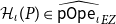 $\mathcal{H}_\iota (P)\in \widehat{\textsf{pOpe}_\iota}_{EZ}$
.
$\mathcal{H}_\iota (P)\in \widehat{\textsf{pOpe}_\iota}_{EZ}$
.
Proof. Immediate consequence of the Yoneda lemma.
Corollary 4.39.
Let $P$
be a positive opetopic cardinal. There exists a filtration
$P$
be a positive opetopic cardinal. There exists a filtration $\{U_k\}_{k=1,\ldots , m}$
of
$\{U_k\}_{k=1,\ldots , m}$
of $\mathcal{H}_\iota (P)$
in which the first term is equal to the initial vertex of
$\mathcal{H}_\iota (P)$
in which the first term is equal to the initial vertex of $P$
and each term of the filtration is obtained from the previous one by the following pushout
$P$
and each term of the filtration is obtained from the previous one by the following pushout

where $Q=\langle c\rangle$
for some
$Q=\langle c\rangle$
for some $c\in |P|$
.
$c\in |P|$
.
Proof.
Apply the functor $\mathcal{H}_\iota$
to the domain filtration of
$\mathcal{H}_\iota$
to the domain filtration of $P$
.
$P$
.
Theorem 4.40.
Let $f: P\to Q$
be a
$f: P\to Q$
be a $\iota$
-epi, that is a contraction morphism between opetopes. Then there exists an opetope
$\iota$
-epi, that is a contraction morphism between opetopes. Then there exists an opetope $P'$
and a pair of distinct morphisms
$P'$
and a pair of distinct morphisms $\sigma _1,\sigma _2:P'\to P$
such that
$\sigma _1,\sigma _2:P'\to P$
such that $f\circ \sigma _1=f\circ \sigma _2$
.
$f\circ \sigma _1=f\circ \sigma _2$
.
In other words, $\textsf{pOpe}_\iota$
is degeneracy-forking.
$\textsf{pOpe}_\iota$
is degeneracy-forking.
Proof.
Using Lemmas4.27 and 4.28, it suffices to show this for the contraction morphism $ f_u: P \to P''$
with
$ f_u: P \to P''$
with $ \ker (f_u) = \{u\}$
, where
$ \ker (f_u) = \{u\}$
, where $ u$
is a safe face of
$ u$
is a safe face of $ P$
contained in the kernel of
$ P$
contained in the kernel of $ f$
.
$ f$
.
Case 1: $ u$
is not the greatest element of
$ u$
is not the greatest element of $ P$
.
$ P$
.
The opetope $ P'$
is constructed from
$ P'$
is constructed from $ P$
by replacing
$ P$
by replacing $ u$
with two cells
$ u$
with two cells $ u', u''$
of the same shape as
$ u', u''$
of the same shape as $ u$
, subject to the relations:
$ u$
, subject to the relations:
 \begin{equation*} \delta (u') = \delta (u), \quad \gamma (u') = \delta (u''), \quad \gamma (u'') = \gamma (u). \end{equation*}
Furthermore, if an element $ a \in P$
satisfies
$ a \in P$
satisfies $ \delta (a) = \{u\} \sqcup D$
for some
$ \delta (a) = \{u\} \sqcup D$
for some $ D$
, then in
$ D$
, then in $ P'$
,
$ P'$
, $ a$
satisfies
$ a$
satisfies $ \delta (a) = \{u', u''\} \sqcup D$
.
$ \delta (a) = \{u', u''\} \sqcup D$
.
One may verify directly that $ P'$
satisfies all axioms of a dendritic face complex. Additionally, both
$ P'$
satisfies all axioms of a dendritic face complex. Additionally, both $ u'$
and
$ u'$
and $ u''$
are safe faces of
$ u''$
are safe faces of $ P'$
, with the corresponding contractions yielding
$ P'$
, with the corresponding contractions yielding $ \sigma _1$
and
$ \sigma _1$
and $ \sigma _2$
.
$ \sigma _2$
.
Case 2: $ u$
is the greatest element of
$ u$
is the greatest element of $ P$
.
$ P$
.
We construct $ P'$
by defining:
$ P'$
by defining:
 \begin{equation*} \delta (\alpha _{P'}) = \{u', u''\} \quad \text{and} \quad \gamma (\alpha _{P'}) = u''', \end{equation*}
where $ u', u'', u'''$
are cells isomorphic to
$ u', u'', u'''$
are cells isomorphic to $ u$
, with the relation
$ u$
, with the relation $ \gamma (u') = \delta (u'')$
. These conditions uniquely determine
$ \gamma (u') = \delta (u'')$
. These conditions uniquely determine $ P'$
as a dendritic face complex, and
$ P'$
as a dendritic face complex, and $ u'$
and
$ u'$
and $ u''$
are safe faces of
$ u''$
are safe faces of $ P'$
.
$ P'$
.
Quotienting $ P'$
by either
$ P'$
by either $ u'$
or
$ u'$
or $ u''$
results in a unary opetope where the image of
$ u''$
results in a unary opetope where the image of $ \alpha _{P'}$
becomes a safe face.
$ \alpha _{P'}$
becomes a safe face.
Finally, define the contractions:
 \begin{equation*} \sigma _1 := P \twoheadrightarrow (P/u')/[\alpha _{P'}], \quad \sigma _2 := P \twoheadrightarrow (P/u'')/[\alpha _{P'}]. \end{equation*}
Definition 4.41.
Let $P$
be a positive opetopic cardinal and
$P$
be a positive opetopic cardinal and $\mathfrak{C}\subset \mathcal{P}(P)$
. We say that
$\mathfrak{C}\subset \mathcal{P}(P)$
. We say that $\mathfrak{C}$
is a
pre-ideal in
$\mathfrak{C}$
is a
pre-ideal in $P$
iff whenever
$P$
iff whenever $b\in P_{\gt 0}\setminus \gamma (P)$
-
$1_{pi}.$
if
$\gamma (b)\in \mathfrak{C}$
, then
$b\in \mathfrak{C}$
and
$\delta (b)\subseteq \mathfrak{C}$
;
-
$2_{pi}.$
if
$b \in \mathfrak{C}$
, then
$|\delta (b)\setminus \mathfrak{C}|\leq 1$
.


Remark 4.42. We can think about pre-ideal as a set of faces that is weakly backward and upward closed.
It is not true that any set of faces of an opetopic cardinal $P$
is contained in the least ideal in
$P$
is contained in the least ideal in $P$
. If a set
$P$
. If a set $X=\{m_P\}$
contains just the main face
$X=\{m_P\}$
contains just the main face $m_P$
of a non-globular 2-opetope
$m_P$
of a non-globular 2-opetope $P$
, then there are at least two minimal ideals containing
$P$
, then there are at least two minimal ideals containing $X$
, they must contain all but one face in
$X$
, they must contain all but one face in $\delta (m_P)$
. However, if the set of faces
$\delta (m_P)$
. However, if the set of faces $X$
is a pre-ideal then there is a unique ideal
$X$
is a pre-ideal then there is a unique ideal $\mathfrak{C}$
containing
$\mathfrak{C}$
containing $X$
. This is shown below.
$X$
. This is shown below.
Definition 4.43.
We define two operations on the set of cells of an opetopic cardinal $P$
:
$P$
:
 \begin{equation*}Cl, Cl^\infty : \mathcal{P}(P) \to \mathcal{P}(P)\end{equation*}
called immediate closure and closure , respectively. We put
 \begin{equation*}Cl(\mathfrak{C}) = \mathfrak{C}\cup \{ \alpha , \gamma (\alpha )| \alpha \in P_{\gt 0}\setminus \gamma (P), \; \delta (\alpha )\subseteq \mathfrak{C} \}\end{equation*}
Let $Cl^{\infty }(\mathfrak{C})$
denote the least closure of the set
$Cl^{\infty }(\mathfrak{C})$
denote the least closure of the set $\mathfrak{C}$
under the (monotone) operation
$\mathfrak{C}$
under the (monotone) operation $Cl$
, that is,
$Cl$
, that is, $Cl^\infty (\mathfrak{C})=\cup _{n\in \mathbb{N}}Cl^n (\mathfrak{C})$
.
$Cl^\infty (\mathfrak{C})=\cup _{n\in \mathbb{N}}Cl^n (\mathfrak{C})$
.
If $Cl(\mathfrak{C})\subseteq \mathfrak{C}$
and
$Cl(\mathfrak{C})\subseteq \mathfrak{C}$
and $\mathfrak{C}$
is a pre-ideal, then we call
$\mathfrak{C}$
is a pre-ideal, then we call $\mathfrak{C}$
closed pre-ideal
.
$\mathfrak{C}$
closed pre-ideal
.
Lemma 4.44.
Any union of pre-ideals in opetopic cardinal $P$
is a pre-ideal.
$P$
is a pre-ideal.
Proof. Straightforward.
Lemma 4.45.
Let $\mathfrak{C}$
be a pre-ideal in opetope
$\mathfrak{C}$
be a pre-ideal in opetope $P$
. Assume
$P$
. Assume $\beta \in P\setminus \gamma (P)$
a face in
$\beta \in P\setminus \gamma (P)$
a face in $P$
such that
$P$
such that $\delta (\beta )\subseteq \mathfrak{C}$
but
$\delta (\beta )\subseteq \mathfrak{C}$
but $\gamma (\beta )\not \in \mathfrak{C}$
. Then the set
$\gamma (\beta )\not \in \mathfrak{C}$
. Then the set $\mathfrak{C}_1=\mathfrak{C} \cup \{\beta , \gamma (\beta ) \}$
is a pre-ideal in
$\mathfrak{C}_1=\mathfrak{C} \cup \{\beta , \gamma (\beta ) \}$
is a pre-ideal in $P$
.
$P$
.
Proof.
The only face $b$
in
$b$
in $P$
such that
$P$
such that $\gamma (b)\in \mathfrak{C}_1\setminus I$
is
$\gamma (b)\in \mathfrak{C}_1\setminus I$
is $\beta$
. For
$\beta$
. For $b=\beta$
and
$b=\beta$
and $\mathfrak{C}_1$
the condition
$\mathfrak{C}_1$
the condition $1_{pi}$
clearly holds. Thus the condition
$1_{pi}$
clearly holds. Thus the condition $1_{pi}$
holds for any face in
$1_{pi}$
holds for any face in $P$
and
$P$
and $\mathfrak{C}_1$
.
$\mathfrak{C}_1$
.
The face $\beta$
is also the only face in
$\beta$
is also the only face in $\mathfrak{C}_1\setminus \gamma (P)$
that does not belong to
$\mathfrak{C}_1\setminus \gamma (P)$
that does not belong to $\mathfrak{C}$
. As the condition
$\mathfrak{C}$
. As the condition $1_{pi}$
holds for
$1_{pi}$
holds for $b=\beta$
it holds for all the faces in
$b=\beta$
it holds for all the faces in $P\setminus \gamma (P)$
.
$P\setminus \gamma (P)$
.
Thus $\mathfrak{C}_1$
is indeed a pre-ideal.
$\mathfrak{C}_1$
is indeed a pre-ideal.
By iteration of the above Lemma, we get
Corollary 4.46.
Let $\mathfrak{C}$
be a pre-ideal in opetopic cardinal
$\mathfrak{C}$
be a pre-ideal in opetopic cardinal $P$
. Then
$P$
. Then $Cl(\mathfrak{C})$
is again a pre-ideal in
$Cl(\mathfrak{C})$
is again a pre-ideal in $P$
containing
$P$
containing $\mathfrak{C}$
.
$\mathfrak{C}$
.
The main fact of this section in the following
Theorem 4.47.
Let $\mathfrak{C}$
be a closed pre-ideal in an opetopic cardinal
$\mathfrak{C}$
be a closed pre-ideal in an opetopic cardinal $P$
. Then
$P$
. Then $\mathfrak{C}$
is an ideal.
$\mathfrak{C}$
is an ideal.
Before proving the theorem, we state the following:
Corollary 4.48.
Let $\mathfrak{C}$
be a closed pre-ideal in an opetopic cardinal
$\mathfrak{C}$
be a closed pre-ideal in an opetopic cardinal $P$
. Then
$P$
. Then $Cl^\infty (\mathfrak{C})$
is the least ideal containing
$Cl^\infty (\mathfrak{C})$
is the least ideal containing $\mathfrak{C}$
.
$\mathfrak{C}$
.
Proof.
Any ideal in an opetope $P$
must be closed under the operation
$P$
must be closed under the operation $Cl$
. Since the operation
$Cl$
. Since the operation $Cl$
is monotone, by 4.44 and 4.46, the sum
$Cl$
is monotone, by 4.44 and 4.46, the sum $Cl^\infty (\mathfrak{C})=\bigcup _{n\in \mathbb{N}} Cl^n(\mathfrak{C})$
is a closed pre-ideal. Thus, by 4.47,
$Cl^\infty (\mathfrak{C})=\bigcup _{n\in \mathbb{N}} Cl^n(\mathfrak{C})$
is a closed pre-ideal. Thus, by 4.47, $Cl^\infty (\mathfrak{C})$
is the least ideal containing
$Cl^\infty (\mathfrak{C})$
is the least ideal containing $\mathfrak{C}$
, as required.
$\mathfrak{C}$
, as required.
Proof of Theorem 4.47
. We proceed by induction on the cardinality of $|P|$
, where
$|P|$
, where $P$
is an arbitrary positive opetopic cardinal.
$P$
is an arbitrary positive opetopic cardinal.
Base case ( $|P|=1$
and
$|P|=1$
and $|P|=3$
):
$|P|=3$
):
Straightforward verification since $P$
is either a point or an edge.
$P$
is either a point or an edge.
Induction step:
Let $\mathcal{F} \subset P$
be the second-to-last term in the domain filtration of
$\mathcal{F} \subset P$
be the second-to-last term in the domain filtration of $P$
(see Theorem4.36), and let
$P$
(see Theorem4.36), and let $P \setminus \mathcal{F} = \{\alpha , \gamma \alpha \}$
.
$P \setminus \mathcal{F} = \{\alpha , \gamma \alpha \}$
.
By the inductive hypothesis and the last statement in Theorem4.36, $\mathfrak{C} \cap \mathcal{F}$
is a closed pre-ideal in
$\mathfrak{C} \cap \mathcal{F}$
is a closed pre-ideal in $\mathcal{F}$
and hence an ideal. Therefore, conditions
$\mathcal{F}$
and hence an ideal. Therefore, conditions $1_i$
,
$1_i$
, $2_i$
, and
$2_i$
, and $3_i$
hold for all
$3_i$
hold for all $b \in P \setminus \{\alpha , \gamma \alpha \}$
. We now verify these conditions for the remaining cells
$b \in P \setminus \{\alpha , \gamma \alpha \}$
. We now verify these conditions for the remaining cells $\alpha$
and
$\alpha$
and $\gamma \alpha$
.
$\gamma \alpha$
.
Case 1: Verifying conditions for $\alpha$ $\mathbf{1}_{\mathbf{i}}(\alpha )$
: Follows directly from
$\mathbf{1}_{\mathbf{i}}(\alpha )$
: Follows directly from $1_{pi}(\alpha )$
, since
$1_{pi}(\alpha )$
, since $\alpha \in P_{\geq 0} \setminus \gamma P$
.
$\alpha \in P_{\geq 0} \setminus \gamma P$
. $\mathbf{2}_{\mathbf{i}}(\alpha )$
: Immediate from the closedness of
$\mathbf{2}_{\mathbf{i}}(\alpha )$
: Immediate from the closedness of $\mathfrak{C}$
.
$\mathfrak{C}$
. $\mathbf{3}_{\mathbf{i}}(\alpha )$
: By
$\mathbf{3}_{\mathbf{i}}(\alpha )$
: By $2_{pi}(\alpha )$
,
$2_{pi}(\alpha )$
, $|\delta (\alpha )| = 0$
or
$|\delta (\alpha )| = 0$
or $|\delta (\alpha )| = 1$
.
$|\delta (\alpha )| = 1$
.
If $|\delta (\alpha )| = 0$
, closedness implies
$|\delta (\alpha )| = 0$
, closedness implies $\gamma (\alpha ) \in \mathfrak{C}$
, reducing
$\gamma (\alpha ) \in \mathfrak{C}$
, reducing $3_i$
to the trivial equality
$3_i$
to the trivial equality $0 = 0$
.
$0 = 0$
.
Conversely, if $\gamma (\alpha ) \in \mathfrak{C}$
, then
$\gamma (\alpha ) \in \mathfrak{C}$
, then $\delta (\alpha ) \subseteq \mathfrak{C}$
by
$\delta (\alpha ) \subseteq \mathfrak{C}$
by $1_{pi}(\alpha )$
, so if
$1_{pi}(\alpha )$
, so if $|\delta (\alpha )| = 1$
, then
$|\delta (\alpha )| = 1$
, then $\gamma (\alpha ) \not \in \mathfrak{C}$
, reducing
$\gamma (\alpha ) \not \in \mathfrak{C}$
, reducing $3_i$
to
$3_i$
to $1 = 1$
.
$1 = 1$
.
Case 2: Verifying conditions for $\gamma \alpha$ $\mathbf{1}_{\mathbf{i}}(\gamma \alpha )$
: Observe that
$\mathbf{1}_{\mathbf{i}}(\gamma \alpha )$
: Observe that $\gamma ^2\alpha$
is terminal in the poset
$\gamma ^2\alpha$
is terminal in the poset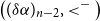 $\big ((\delta \alpha )_{n-2}, \lt ^-\big )$
(where
$\big ((\delta \alpha )_{n-2}, \lt ^-\big )$
(where $n = \dim (\alpha )$
). By
$n = \dim (\alpha )$
). By $1_i$
and
$1_i$
and $3_i$
, if a cell
$3_i$
, if a cell $x \in \mathcal{F}$
lies in
$x \in \mathcal{F}$
lies in $\mathfrak{C}$
, its entire lower set is contained in
$\mathfrak{C}$
, its entire lower set is contained in $\mathfrak{C}$
– by induction it is enough to show that for direct predecessors of
$\mathfrak{C}$
– by induction it is enough to show that for direct predecessors of $x$
, that is for
$x$
, that is for $y$
such that there exists
$y$
such that there exists $z\in P$
with
$z\in P$
with $y\in \delta z$
and
$y\in \delta z$
and $\gamma (z)=x$
. Since
$\gamma (z)=x$
. Since $\gamma (z)\in \mathfrak{C}$
,
$\gamma (z)\in \mathfrak{C}$
, $\delta (z)\subset \mathfrak{C}$
. When
$\delta (z)\subset \mathfrak{C}$
. When $x$
is the final element of
$x$
is the final element of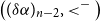 $\big ((\delta \alpha )_{n-2}, \lt ^-\big )$
, its lower set is equal to the whole poset itself, in particular
$\big ((\delta \alpha )_{n-2}, \lt ^-\big )$
, its lower set is equal to the whole poset itself, in particular $\delta \gamma \alpha \subseteq \mathfrak{C}$
.
$\delta \gamma \alpha \subseteq \mathfrak{C}$
. $\mathbf{2}_{\mathbf{i}}(\gamma \alpha )$
: A dual argument applies. By a combination of
$\mathbf{2}_{\mathbf{i}}(\gamma \alpha )$
: A dual argument applies. By a combination of $2_i$
and
$2_i$
and $3_i$
, if all predecessors of a given element are in
$3_i$
, if all predecessors of a given element are in $\mathfrak{C}$
, then so is the element itself. Assume that
$\mathfrak{C}$
, then so is the element itself. Assume that $\delta \gamma \alpha \subseteq \mathfrak{C}$
. From the globularity formula for
$\delta \gamma \alpha \subseteq \mathfrak{C}$
. From the globularity formula for $\delta \gamma (\alpha )=\delta \delta (\alpha )\setminus \gamma \delta (\alpha )$
follows that all minimal elements the poset of
$\delta \gamma (\alpha )=\delta \delta (\alpha )\setminus \gamma \delta (\alpha )$
follows that all minimal elements the poset of $(n-2)$
-cells of
$(n-2)$
-cells of $(\delta \alpha ,\lt ^{-})$
are in
$(\delta \alpha ,\lt ^{-})$
are in $\mathfrak{C}$
(recall that minimal elements of
$\mathfrak{C}$
(recall that minimal elements of $(Q, \lt ^{-})$
are exactly those which are not in
$(Q, \lt ^{-})$
are exactly those which are not in $\gamma (Q)$
), hence the whole poset itself, in particular the final
$\gamma (Q)$
), hence the whole poset itself, in particular the final $\gamma ^2\alpha$
.
$\gamma ^2\alpha$
. $\mathbf{3}_{\mathbf{i}}(\gamma \alpha )$
: If
$\mathbf{3}_{\mathbf{i}}(\gamma \alpha )$
: If $\gamma \alpha \in \mathfrak{C}$
, then
$\gamma \alpha \in \mathfrak{C}$
, then $\delta \alpha \subseteq \mathfrak{C}$
by
$\delta \alpha \subseteq \mathfrak{C}$
by $3_i(\alpha )$
(since
$3_i(\alpha )$
(since $\alpha \in \mathfrak{C}$
by
$\alpha \in \mathfrak{C}$
by $1_i(\alpha )$
). As
$1_i(\alpha )$
). As $\mathfrak{C}\cap {\delta \alpha }$
is an ideal in
$\mathfrak{C}\cap {\delta \alpha }$
is an ideal in $\delta \alpha$
, applying
$\delta \alpha$
, applying $3_i$
to
$3_i$
to $(n-1)$
-cells in
$(n-1)$
-cells in $\delta \alpha$
(we just proved that all of them are in
$\delta \alpha$
(we just proved that all of them are in $\mathfrak{C}$
) shows that for every
$\mathfrak{C}$
) shows that for every $\kappa \in \big ((\delta \alpha )_{n-2}, \lt ^-\big )$
exactly one of the following two possibilities is true:
$\kappa \in \big ((\delta \alpha )_{n-2}, \lt ^-\big )$
exactly one of the following two possibilities is true:
-
1.
$\kappa \in \mathfrak{C}$
with all direct predecessors in
$\mathfrak{C}$
, or -
2.
$\kappa \not \in \mathfrak{C}$
with exactly one direct predecessor not in
$\mathfrak{C}$
.


 $\mathbf{2}_{\mathbf{i}}(\gamma \alpha )$
: Starting from the final element and labeling predecessors of each cell according to those two rules, we see that at most one of the minimal elements is not in
$\mathbf{2}_{\mathbf{i}}(\gamma \alpha )$
: Starting from the final element and labeling predecessors of each cell according to those two rules, we see that at most one of the minimal elements is not in $\mathfrak{C}$
(and this happens exactly when the final element
$\mathfrak{C}$
(and this happens exactly when the final element $\gamma ^2\alpha$
is not in
$\gamma ^2\alpha$
is not in $\mathfrak{C}$
, so the equality
$\mathfrak{C}$
, so the equality $3_i$
reduces either to
$3_i$
reduces either to $0=0$
or
$0=0$
or $1=1$
).
$1=1$
).
Theorem 4.49.
Pushout of any pair of $\iota$
-epis between opetopes in
$\iota$
-epis between opetopes in $\textsf{pOpe}_\iota$
and
$\textsf{pOpe}_\iota$
and $(\textsf{pOpe}_\iota)_-$
exist and the embedding
$(\textsf{pOpe}_\iota)_-$
exist and the embedding $(\textsf{pOpe}_\iota)_-\to \textsf{pOpe}_\iota$
preserves them.
$(\textsf{pOpe}_\iota)_-\to \textsf{pOpe}_\iota$
preserves them.
Proof.
Let $\sigma _1:P\to P_1$
and
$\sigma _1:P\to P_1$
and $\sigma _2:P\to P_2$
be a pair of
$\sigma _2:P\to P_2$
be a pair of $\iota$
-epis between opetopes. Let
$\iota$
-epis between opetopes. Let $\mathfrak{C}_1$
and
$\mathfrak{C}_1$
and $\mathfrak{C}_2$
be their respective kernels. Then, by Lemma4.44, the set
$\mathfrak{C}_2$
be their respective kernels. Then, by Lemma4.44, the set $\mathfrak{C}_1\cup \mathfrak{C}_2$
is a pre-ideal. Then, by Corollary4.48,
$\mathfrak{C}_1\cup \mathfrak{C}_2$
is a pre-ideal. Then, by Corollary4.48, $\mathfrak{C}=Cl^\infty (\mathfrak{C}_1\cup \mathfrak{C}_2)$
is the least ideal containing
$\mathfrak{C}=Cl^\infty (\mathfrak{C}_1\cup \mathfrak{C}_2)$
is the least ideal containing $\mathfrak{C}_1\cup \mathfrak{C}_2$
. Then the square
$\mathfrak{C}_1\cup \mathfrak{C}_2$
. Then the square

is a pushout both in $\textsf{pOpe}_\iota$
and
$\textsf{pOpe}_\iota$
and $(\textsf{pOpe}_\iota)_-$
by Theorem4.29.
$(\textsf{pOpe}_\iota)_-$
by Theorem4.29.
Remark 4.50. The author conjectures that $\textsf{pOpe}_\iota$
is a residuation structure in the sense of Ara et al. (Reference Ara, Burroni, Guiraud, Malbos, Métayer and Mimram2025), 4.6.1., with
$\textsf{pOpe}_\iota$
is a residuation structure in the sense of Ara et al. (Reference Ara, Burroni, Guiraud, Malbos, Métayer and Mimram2025), 4.6.1., with $\sigma _1/\sigma _2$
given as
$\sigma _1/\sigma _2$
given as $\pi _{\overline {\sigma _1(\ker (\sigma _2))}}\circ \sigma _1$
.
$\pi _{\overline {\sigma _1(\ker (\sigma _2))}}\circ \sigma _1$
.
4.3
$\zeta$
preserves pushouts of codegeneracy maps

The functor $\zeta : \widehat{\textsf{pOpe}_\iota} \to \textsf{sSet}$
has a right adjoint
$\zeta : \widehat{\textsf{pOpe}_\iota} \to \textsf{sSet}$
has a right adjoint $\rho : \textsf{sSet} \to \widehat{\textsf{pOpe}_\iota}$
, given by
$\rho : \textsf{sSet} \to \widehat{\textsf{pOpe}_\iota}$
, given by
 \begin{equation*} X \mapsto \big (P \mapsto \rho (X)_P = \textsf{sSet}(\zeta (P), X)\big ), \end{equation*}
since it is the left Kan extension along the Yoneda embedding.
However, it is far from clear whether $\zeta \big |{\widehat{\textsf{pOpe}_\iota}_{EZ}}$
has a right adjoint. To show that
$\zeta \big |{\widehat{\textsf{pOpe}_\iota}_{EZ}}$
has a right adjoint. To show that $\rho$
can also be regarded as a right adjoint of
$\rho$
can also be regarded as a right adjoint of $\zeta \big |{\widehat{\textsf{pOpe}_\iota}_{EZ}}$
, we will use the criterion formulated in Theorem3.39. The applicability of this theorem to the adjunction
$\zeta \big |{\widehat{\textsf{pOpe}_\iota}_{EZ}}$
, we will use the criterion formulated in Theorem3.39. The applicability of this theorem to the adjunction $\zeta \dashv \rho$
is precisely the content of Corollary4.62, which we prove in the following. The recipe for the kernel of the pushout of two morphisms in
$\zeta \dashv \rho$
is precisely the content of Corollary4.62, which we prove in the following. The recipe for the kernel of the pushout of two morphisms in $(\textsf{pOpe}_\iota)_-$
, described implicitly in the proofs of results of the previous section, is used extensively.
$(\textsf{pOpe}_\iota)_-$
, described implicitly in the proofs of results of the previous section, is used extensively.
From now up to the end of this section, we assume that $P$
is an opetopic cardinal, not necessarily an opetope, unless it is explicitly stated otherwise.
$P$
is an opetopic cardinal, not necessarily an opetope, unless it is explicitly stated otherwise.
Definition 4.51.
If $P$
is an opetope and two
$P$
is an opetope and two $(P,n)$
-chains have the same image under the map
$(P,n)$
-chains have the same image under the map $\mathcal{N}_{\textsf{pOpe}_\iota}(P)\twoheadrightarrow \zeta (P)$
, we call them
$\mathcal{N}_{\textsf{pOpe}_\iota}(P)\twoheadrightarrow \zeta (P)$
, we call them $\zeta$
-equivalent
.
$\zeta$
-equivalent
.
Definition 4.52.
Let $\mathfrak{C}$
be an ideal of
$\mathfrak{C}$
be an ideal of $P$
and
$P$
and $\pi _{\mathfrak{C}}:P\to P/\mathfrak{C}$
be a quotient map. We say that two
$\pi _{\mathfrak{C}}:P\to P/\mathfrak{C}$
be a quotient map. We say that two $(P,n)$
-chains
$(P,n)$
-chains $(x_0,\ldots ,x_n)$
and
$(x_0,\ldots ,x_n)$
and $(y_0,\ldots ,y_n)$
are
$(y_0,\ldots ,y_n)$
are $\mathfrak{C}$
-equivalent
, if for every
$\mathfrak{C}$
-equivalent
, if for every $i\in \{0,\ldots ,n\}$ $\pi _{\mathfrak{C}}(x_i)=\pi _{\mathfrak{C}}(y_i)$
.
$\pi _{\mathfrak{C}}(x_i)=\pi _{\mathfrak{C}}(y_i)$
.
Lemma 4.53.
If $\mathfrak{C}$
is an ideal of
$\mathfrak{C}$
is an ideal of $P$
and
$P$
and $x, y$
are cells of
$x, y$
are cells of $P$
such that
$P$
such that $\pi _{\mathfrak{C}}(x)=\pi _{\mathfrak{C}}(y)$
, then there exists a sequence
$\pi _{\mathfrak{C}}(x)=\pi _{\mathfrak{C}}(y)$
, then there exists a sequence $a_0=x\preceq u_1\succeq a_1\preceq u_2\succeq a_2\preceq \ldots \succeq a_m=y$
of cells of
$a_0=x\preceq u_1\succeq a_1\preceq u_2\succeq a_2\preceq \ldots \succeq a_m=y$
of cells of $P$
such that for every
$P$
such that for every $k$
$k$ $\pi _{\mathfrak{C}}(a_k)=\pi _{\mathfrak{C}}(u_k)=\pi _{\mathfrak{C}}(a_{k-1})$
.
$\pi _{\mathfrak{C}}(a_k)=\pi _{\mathfrak{C}}(u_k)=\pi _{\mathfrak{C}}(a_{k-1})$
.
Proof.
If $\pi _{\mathfrak{C}}(x)=\pi _{\mathfrak{C}}(\gamma x)$
, we set
$\pi _{\mathfrak{C}}(x)=\pi _{\mathfrak{C}}(\gamma x)$
, we set $u_1=x$
,
$u_1=x$
, $a_1=\gamma x$
. Similarly, if
$a_1=\gamma x$
. Similarly, if $\pi _{\mathfrak{C}}(\gamma ^2 x)=\pi _{\mathfrak{C}}(\gamma x)$
, we set
$\pi _{\mathfrak{C}}(\gamma ^2 x)=\pi _{\mathfrak{C}}(\gamma x)$
, we set $u_2=\gamma x$
,
$u_2=\gamma x$
, $a_2=\gamma ^2 x$
. Proceeding in this way, we build a sequence as in the statement of the lemma, but connecting
$a_2=\gamma ^2 x$
. Proceeding in this way, we build a sequence as in the statement of the lemma, but connecting $x$
with
$x$
with $\gamma ^k x$
for
$\gamma ^k x$
for $k$
such that
$k$
such that $\gamma ^k x\not \in \mathfrak{C}$
. By symmetry, we can connect
$\gamma ^k x\not \in \mathfrak{C}$
. By symmetry, we can connect $y$
with
$y$
with $\gamma ^l y$
such that
$\gamma ^l y$
such that $\gamma ^l y\not \in \mathfrak{C}$
.
$\gamma ^l y\not \in \mathfrak{C}$
.
Note that in this case $\dim (\gamma ^k x)=\dim (\gamma ^l y)$
, so
$\dim (\gamma ^k x)=\dim (\gamma ^l y)$
, so $\gamma ^k x, \gamma ^l y$
can be a connected by a sequence of
$\gamma ^k x, \gamma ^l y$
can be a connected by a sequence of $\dim (\gamma ^k x)$
-cells in
$\dim (\gamma ^k x)$
-cells in $\mathfrak{C}$
(Zawadowski (Reference Zawadowski2017), Corollary 2.9). Concatenating all three sequences, we get the claim.
$\mathfrak{C}$
(Zawadowski (Reference Zawadowski2017), Corollary 2.9). Concatenating all three sequences, we get the claim.
Definition 4.54.
A pair of $(P,n)$
-chains
$(P,n)$
-chains $(x_0,\ldots ,x_n)$
and
$(x_0,\ldots ,x_n)$
and $(y_0,\ldots ,y_n)$
is
elementarily equivalent
if there exists an index
$(y_0,\ldots ,y_n)$
is
elementarily equivalent
if there exists an index $i$
such that
$i$
such that $j\neq i\implies x_j=y_j$
and there is a cell
$j\neq i\implies x_j=y_j$
and there is a cell $z_i$
of
$z_i$
of $P$
s. t.
$P$
s. t. $x_i\preceq z_i\succeq y_i$
,
$x_i\preceq z_i\succeq y_i$
, $\pi _{\mathfrak{C}}(x_i)=\pi _{\mathfrak{C}}(z_i)=\pi _{\mathfrak{C}}(y_i)$
and
$\pi _{\mathfrak{C}}(x_i)=\pi _{\mathfrak{C}}(z_i)=\pi _{\mathfrak{C}}(y_i)$
and $z_i\preceq x_{i+1}$
. In that case, we say that this pair is
elementarily equivalent
by
$z_i\preceq x_{i+1}$
. In that case, we say that this pair is
elementarily equivalent
by $z_i$
. The index
$z_i$
. The index $i$
is called the
change index
of an elementary equivalence.
$i$
is called the
change index
of an elementary equivalence.
Definition 4.55.
Let $(x_0,\ldots ,x_n)$
and
$(x_0,\ldots ,x_n)$
and $(y_0,\ldots ,y_n)$
be a
$(y_0,\ldots ,y_n)$
be a $\mathfrak{C}$
-equivalent pair of
$\mathfrak{C}$
-equivalent pair of $(P,n)$
-chains. Let
$(P,n)$
-chains. Let $k$
be the largest index such that
$k$
be the largest index such that $x_k\neq y_k$
.
$x_k\neq y_k$
.
Then the
distance
between $(x_0,\ldots ,x_n)$
and
$(x_0,\ldots ,x_n)$
and $(y_0,\ldots ,y_n)$
is a sequence of
$(y_0,\ldots ,y_n)$
is a sequence of $n+1$
natural numbers
$n+1$
natural numbers
 \begin{equation*}(m_0,\ldots ,m_k,0,\ldots ,0)\end{equation*}
where $m_k$
is the smallest natural number
$m_k$
is the smallest natural number $m$
which satisfies the statement of the Lemma
4.53
applied to
$m$
which satisfies the statement of the Lemma
4.53
applied to $P:=\langle x_{k+1}\rangle ,\ x:=x_k,\ y:=y_k$
and
$P:=\langle x_{k+1}\rangle ,\ x:=x_k,\ y:=y_k$
and $m_i$
for
$m_i$
for $i\lt k$
is the smallest natural number
$i\lt k$
is the smallest natural number $m$
which satisfies the statement of the Lemma
4.53
applied to
$m$
which satisfies the statement of the Lemma
4.53
applied to $P:=\langle x_{k+1}\rangle , x:=x_i,\ y:=y_i$
.
$P:=\langle x_{k+1}\rangle , x:=x_i,\ y:=y_i$
.
Observation 4.56.
Distances of $\mathfrak{C}$
-equivalent pairs of
$\mathfrak{C}$
-equivalent pairs of $(P,n)$
-chains are well-ordered by the colexicographic order.
$(P,n)$
-chains are well-ordered by the colexicographic order.
Lemma 4.57.
If $\mathfrak{C}$
is an ideal and
$\mathfrak{C}$
is an ideal and $(P,n)$
-chains
$(P,n)$
-chains $(x_0,\ldots ,x_n),(y_0,\ldots ,y_n)$
are
$(x_0,\ldots ,x_n),(y_0,\ldots ,y_n)$
are $\mathfrak{C}$
-equivalent, then there exists a sequence
$\mathfrak{C}$
-equivalent, then there exists a sequence $\vec {x}_0,\ldots ,\vec {x}_m$
of
$\vec {x}_0,\ldots ,\vec {x}_m$
of $(P,n)$
-chains such that
$(P,n)$
-chains such that $\vec {x}_0=(x_0,\ldots ,x_n), \vec {x}_m=(y_0,\ldots ,y_n)$
and every pair of consecutive terms in this sequence is elementarily equivalent.
$\vec {x}_0=(x_0,\ldots ,x_n), \vec {x}_m=(y_0,\ldots ,y_n)$
and every pair of consecutive terms in this sequence is elementarily equivalent.
Moreover, if $i$
is the largest index such that
$i$
is the largest index such that $x_i\neq y_i$
, we can pick this sequence in such a way that every term (and every elementary equivalence between two consecutive terms) is of the form
$x_i\neq y_i$
, we can pick this sequence in such a way that every term (and every elementary equivalence between two consecutive terms) is of the form $(v_0,\ldots ,v_{i},x_{i+1},\ldots ,x_n)$
.
$(v_0,\ldots ,v_{i},x_{i+1},\ldots ,x_n)$
.
Proof.
We proceed by induction on the distance tuple $(m_0,\ldots ,m_n)$
between pairs of
$(m_0,\ldots ,m_n)$
between pairs of $(P,n)$
-chains, by assuming that all pairs of
$(P,n)$
-chains, by assuming that all pairs of $\mathfrak{C}$
-equivalent
$\mathfrak{C}$
-equivalent $(P,n)$
-chains with distance less than
$(P,n)$
-chains with distance less than $(m_0,\ldots ,m_n)$
(in the lexicographical order) are elementarily equivalent.
$(m_0,\ldots ,m_n)$
(in the lexicographical order) are elementarily equivalent.
Base case: If two chains $(x_0,\ldots ,x_n)$
and
$(x_0,\ldots ,x_n)$
and $(y_0,\ldots ,y_n)$
have distance
$(y_0,\ldots ,y_n)$
have distance $(1,0,\ldots ,0)$
, they are elementarily equivalent by definition. This establishes the base case.
$(1,0,\ldots ,0)$
, they are elementarily equivalent by definition. This establishes the base case.
Inductive step: Let $(x_0,\ldots ,x_n)$
and
$(x_0,\ldots ,x_n)$
and $(y_0,\ldots ,y_n)$
be
$(y_0,\ldots ,y_n)$
be $\mathfrak{C}$
-equivalent chains with distance
$\mathfrak{C}$
-equivalent chains with distance $(m_0,\ldots ,m_n)$
. Let
$(m_0,\ldots ,m_n)$
. Let $i$
be the maximal index where
$i$
be the maximal index where $x_i \neq y_i$
. By the distance definition, there exists a connecting sequence in
$x_i \neq y_i$
. By the distance definition, there exists a connecting sequence in $x_{i+1}$
:
$x_{i+1}$
:
 \begin{equation*} a_0^i = x_i \preceq u_1^i \succeq a_1^i \preceq u_2^i \succeq \cdots \preceq u_{m_i}^i \succeq a_{m_i}^i = y_i \end{equation*}
where $\pi _{\mathfrak{C}}(a_k^i) = \pi _{\mathfrak{C}}(u_k^i)$
for all
$\pi _{\mathfrak{C}}(a_k^i) = \pi _{\mathfrak{C}}(u_k^i)$
for all $k$
, and
$k$
, and $m_j = 0$
for
$m_j = 0$
for $j \gt i$
.
$j \gt i$
.
Case 1: If $x_{i-1} \preceq a_1^i$
, construct the modified chain:
$x_{i-1} \preceq a_1^i$
, construct the modified chain:
 \begin{equation*} (x_0,\ldots ,x_{i-1}, a_1^i, x_{i+1},\ldots ,x_n). \end{equation*}
This chain is elementarily equivalent to $(x_0,\ldots ,x_n)$
because
$(x_0,\ldots ,x_n)$
because $\pi _{\mathfrak{C}}(a_1^i) = \pi _{\mathfrak{C}}(u_1^i)$
and
$\pi _{\mathfrak{C}}(a_1^i) = \pi _{\mathfrak{C}}(u_1^i)$
and $u_1^i$
contains both
$u_1^i$
contains both $x_i$
and
$x_i$
and $a_1^i$
. The new pair:
$a_1^i$
. The new pair:
 \begin{equation*} \left ((x_0,\ldots ,x_{i-1},a_1^i,\ldots ,x_n),\ (y_0,\ldots ,y_n)\right ) \end{equation*}
has a smaller distance. By the inductive hypothesis, they are elementarily equivalent.
Case 2: If $x_{i-1} \not \preceq a_1^i$
, then
$x_{i-1} \not \preceq a_1^i$
, then $\pi _{\mathfrak{C}}(x_{i-1})$
coincides with
$\pi _{\mathfrak{C}}(x_{i-1})$
coincides with $\pi _{\mathfrak{C}}(x_{i-1}')$
for some cell
$\pi _{\mathfrak{C}}(x_{i-1}')$
for some cell $x_{i-1}'$
in
$x_{i-1}'$
in $a_1^i$
. This gives a connecting sequence in
$a_1^i$
. This gives a connecting sequence in $u_1^i$
:
$u_1^i$
:
 \begin{equation*} a_0^{i-1} = x_{i-1} \preceq u_1^{i-1} \succeq a_1^{i-1} \preceq \cdots \preceq u_{m'}^{i-1} \succeq a_{m'}^{i-1} = x_{i-1}' \end{equation*}
with $\pi _{\mathfrak{C}}(a_k^{i-1}) = \pi _{\mathfrak{C}}(u_k^{i-1})$
for all
$\pi _{\mathfrak{C}}(a_k^{i-1}) = \pi _{\mathfrak{C}}(u_k^{i-1})$
for all $k$
.
$k$
.
Subcase 2.1: If $x_{i-2} \preceq a_1^{i-1}$
, we perform substitutions:
$x_{i-2} \preceq a_1^{i-1}$
, we perform substitutions:
 \begin{equation*} \begin{aligned} &(\ldots ,x_{i-2},x_{i-1},x_i,\ldots ) \simeq (\ldots ,x_{i-2},x_{i-1},u_1^i,\ldots ) \\ &\simeq (\ldots ,x_{i-2},u_1^{i-1},u_1^i,\ldots ) \simeq (\ldots ,x_{i-2},a_1^{i-1},u_1^i,\ldots )\\ &\simeq (\ldots ,x_{i-2},u_1^{i-1},u_1^i,\ldots ) \end{aligned} \end{equation*}
The resulting chain $(\ldots ,x_{i-2},u_1^{i-1},u_1^i,\ldots )$
has a smaller distance to
$(\ldots ,x_{i-2},u_1^{i-1},u_1^i,\ldots )$
has a smaller distance to $(y_0,\ldots ,y_n)$
, allowing us to apply the inductive hypothesis.
$(y_0,\ldots ,y_n)$
, allowing us to apply the inductive hypothesis.
Subcase 2.2: If $x_{i-2} \not \preceq a_1^{i-1}$
, repeat the procedure recursively. At each step, the index decreases by 1. When reaching index 0, replace
$x_{i-2} \not \preceq a_1^{i-1}$
, repeat the procedure recursively. At each step, the index decreases by 1. When reaching index 0, replace $x_0$
with
$x_0$
with $a_1^0$
directly (no further predecessors exist), which reduces the distance.
$a_1^0$
directly (no further predecessors exist), which reduces the distance.
This process terminates because each iteration either reduces the index $i$
or decreases the distance.
$i$
or decreases the distance.
Definition 4.58.
Let $\mathfrak{C}$
be a pre-ideal of the opetope
$\mathfrak{C}$
be a pre-ideal of the opetope $P$
. We say that two
$P$
. We say that two $(P,n)$
-chains
$(P,n)$
-chains $(x_0,\ldots ,x_n)$
and
$(x_0,\ldots ,x_n)$
and $(y_0,\ldots ,y_n)$
are
primitively equivalent
, if there exists an index
$(y_0,\ldots ,y_n)$
are
primitively equivalent
, if there exists an index $i$
such that
$i$
such that $x_j=y_j$
for
$x_j=y_j$
for $j\neq i$
,
$j\neq i$
, $y_i\in \mathfrak{C}$
and
$y_i\in \mathfrak{C}$
and $\dim \ (x_i) +1=\dim (y_i)$
,
$\dim \ (x_i) +1=\dim (y_i)$
, $\delta y_i\setminus \{x_i\}\subset \mathfrak{C}$
. The index
$\delta y_i\setminus \{x_i\}\subset \mathfrak{C}$
. The index $i$
is called the
change index
of a primitive equivalence.
$i$
is called the
change index
of a primitive equivalence.
Lemma 4.59.
If $\mathfrak{C}$
is an ideal, then every elementary equivalence
$\mathfrak{C}$
is an ideal, then every elementary equivalence
 \begin{equation*}(x_0,\ldots , x_{i-1},x_i,x_{i+1}\ldots ,x_n)\sim (x_0,\ldots , x_{i-1},y_i,x_{i+1}\ldots ,x_n)\end{equation*}
can be represented as a composition of primitive-form equivalences, each of them having the same change index as the original elementary equivalence.
Proof.
Assume that the pair of chains given in the statement is elementarily equivalent via $ z_i$
. There exists a sequence
$ z_i$
. There exists a sequence $ x_i = c_1 \prec c_2 \prec \ldots \prec c_m = z_i$
such that for every
$ x_i = c_1 \prec c_2 \prec \ldots \prec c_m = z_i$
such that for every $ j$
,
$ j$
, $ \dim (c_j) + 1 = \dim (c_{j+1})$
and
$ \dim (c_j) + 1 = \dim (c_{j+1})$
and $ c_j \in \langle z_i \rangle$
.
$ c_j \in \langle z_i \rangle$
.
We note that the chains $ (x_0, \ldots , x_{i-1}, c_j, x_{i+1}, \ldots , x_n)$
and
$ (x_0, \ldots , x_{i-1}, c_j, x_{i+1}, \ldots , x_n)$
and $ (x_0, \ldots , x_{i-1}, c_{j+1}, x_{i+1}, \ldots , x_n)$
are primitively equivalent. Thus, we produce a sequence of primitive-form equivalences joining
$ (x_0, \ldots , x_{i-1}, c_{j+1}, x_{i+1}, \ldots , x_n)$
are primitively equivalent. Thus, we produce a sequence of primitive-form equivalences joining
 \begin{equation*} (x_0, \ldots , x_{i-1}, x_i, x_{i+1}, \ldots , x_n) \quad \text{with} \quad (x_0, \ldots , x_{i-1}, z_i, x_{i+1}, \ldots , x_n). \end{equation*}
Using the same method, we connect
 \begin{equation*} (x_0, \ldots , x_{i-1}, y_i, x_{i+1}, \ldots , x_n) \quad \text{with} \quad (x_0, \ldots , x_{i-1}, z_i, x_{i+1}, \ldots , x_n) \end{equation*}
via a sequence of primitive-form equivalences. Combining these sequences, we establish the claim.
Theorem 4.60.
Let $f:\zeta (P)\to X$
be a morphism of simplicial sets and let
$f:\zeta (P)\to X$
be a morphism of simplicial sets and let $\mathfrak{C}$
be a pre-ideal of
$\mathfrak{C}$
be a pre-ideal of $P$
. Suppose that the following holds: for every pair of primitively equivalent
$P$
. Suppose that the following holds: for every pair of primitively equivalent $(P,n)$
-chains, the corresponding pair of simplices in
$(P,n)$
-chains, the corresponding pair of simplices in $\zeta (P)$
represented by those chains is identified by
$\zeta (P)$
represented by those chains is identified by $f$
. Then
$f$
. Then $f$
also identifies every pair of simplices represented by
$f$
also identifies every pair of simplices represented by $\overline {\mathfrak{C}}$
-equivalent
$\overline {\mathfrak{C}}$
-equivalent $(P,n)$
-chains.
$(P,n)$
-chains.
Remark 4.61. The proof establishes a stronger technical statement: If $P$
is an opetope,
$P$
is an opetope, $\mathfrak{C}$
is a pre-ideal and
$\mathfrak{C}$
is a pre-ideal and $\vec {x}=(x_0, x_1,\ldots , x_n), \vec {y}=(y_0, y_1,\ldots , y_n)$
form a pair of
$\vec {x}=(x_0, x_1,\ldots , x_n), \vec {y}=(y_0, y_1,\ldots , y_n)$
form a pair of $\overline {\mathfrak{C}}$
-equivalent
$\overline {\mathfrak{C}}$
-equivalent $(P,n)$
-chains, then there exists a sequence
$(P,n)$
-chains, then there exists a sequence $\vec {x}=\vec {a}_1,\ldots ,\vec {a}_m=\vec {y}$
of
$\vec {x}=\vec {a}_1,\ldots ,\vec {a}_m=\vec {y}$
of $(P,n)$
-chains in which every two consecutive terms are either
$(P,n)$
-chains in which every two consecutive terms are either
-
•
$\mathfrak{C}$
-primitevely equivalent, or -
•
$\zeta$
-equivalent


Moreover, the change index of each $\mathfrak{C}$
-primitive equivalence is bounded by the last index where
$\mathfrak{C}$
-primitive equivalence is bounded by the last index where $\vec {x},\vec {y}$
differ.
$\vec {x},\vec {y}$
differ.
Proof.
It suffices to show that simplices represented by $\overline {\mathfrak{C}}$
-elementarily equivalent chains are identified. By Lemma4.59, we need only consider
$\overline {\mathfrak{C}}$
-elementarily equivalent chains are identified. By Lemma4.59, we need only consider $\overline {\mathfrak{C}}$
-primitively equivalent chains.
$\overline {\mathfrak{C}}$
-primitively equivalent chains.
From the definition of the immediate closure operator, $\overline {\mathfrak{C}}$
is obtained from
$\overline {\mathfrak{C}}$
is obtained from $\mathfrak{C}$
through finitely many extensions: Whenever
$\mathfrak{C}$
through finitely many extensions: Whenever $\alpha \in (P\setminus \gamma P)\setminus \mathfrak{C}$
satisfies
$\alpha \in (P\setminus \gamma P)\setminus \mathfrak{C}$
satisfies $\delta \alpha \subset \mathfrak{C}$
, we set
$\delta \alpha \subset \mathfrak{C}$
, we set $\mathfrak{D}=\mathfrak{C}\cup \{\alpha ,\gamma \alpha \}$
, choosing
$\mathfrak{D}=\mathfrak{C}\cup \{\alpha ,\gamma \alpha \}$
, choosing $\alpha$
of minimal dimension at each stage.
$\alpha$
of minimal dimension at each stage.
We proceed by induction: Assume $f$
identifies all
$f$
identifies all $\mathfrak{C}$
-equivalent chains. We must show it identifies
$\mathfrak{C}$
-equivalent chains. We must show it identifies $\mathfrak{D}$
-equivalent ones. New primitive equivalences in
$\mathfrak{D}$
-equivalent ones. New primitive equivalences in $\mathfrak{D}$
must involve
$\mathfrak{D}$
must involve $\alpha$
or
$\alpha$
or $\gamma \alpha$
. By induction hypothesis, assume
$\gamma \alpha$
. By induction hypothesis, assume $f$
identifies chains differing below index
$f$
identifies chains differing below index $i$
; we prove the statement for index
$i$
; we prove the statement for index $i$
.
$i$
.
Base case (Index 0): Consider chains
 \begin{equation*}(x_0, x_1,\ldots ,x_n)\quad \text{and}\quad (x_0',x_1,\ldots ,x_n)\end{equation*}
which are $\zeta$
-equivalent to
$\zeta$
-equivalent to
 \begin{equation*}(\gamma ^{(0)}x_0, x_1,\ldots ,x_n)\quad \text{and}\quad (\gamma ^{(0)}x_0',x_1,\ldots ,x_n)\end{equation*}
respectively. Since $\pi _{\overline {\mathfrak{C}}}(x_0)=\pi _{\overline {\mathfrak{C}}}(x_0')$
, we have
$\pi _{\overline {\mathfrak{C}}}(x_0)=\pi _{\overline {\mathfrak{C}}}(x_0')$
, we have $\pi _{\overline {\mathfrak{C}}}(\gamma ^{(0)}x_0)=\pi _{\overline {\mathfrak{C}}}(\gamma ^{(0)}x_0')$
. The 0-cells identified by
$\pi _{\overline {\mathfrak{C}}}(\gamma ^{(0)}x_0)=\pi _{\overline {\mathfrak{C}}}(\gamma ^{(0)}x_0')$
. The 0-cells identified by $\pi _{\overline {\mathfrak{C}}}$
are connected through
$\pi _{\overline {\mathfrak{C}}}$
are connected through $\overline {\mathfrak{C}}\cap \mathcal{F}_l$
, where
$\overline {\mathfrak{C}}\cap \mathcal{F}_l$
, where $\mathcal{F}_l$
is the largest one-dimensional term in domain filtration of
$\mathcal{F}_l$
is the largest one-dimensional term in domain filtration of $P$
. Crucially,
$P$
. Crucially, $\overline {\mathfrak{C}}\cap \mathcal{F}_l = \mathfrak{C}\cap \mathcal{F}_l$
because immediate closure cannot add new cells to
$\overline {\mathfrak{C}}\cap \mathcal{F}_l = \mathfrak{C}\cap \mathcal{F}_l$
because immediate closure cannot add new cells to $\mathcal{F}_l$
(all edges present here are
$\mathcal{F}_l$
(all edges present here are $\lt ^-$
-minimal). Thus the chains connect via
$\lt ^-$
-minimal). Thus the chains connect via $\mathfrak{C}$
-elementary equivalences, which establishes the base case.
$\mathfrak{C}$
-elementary equivalences, which establishes the base case.
Induction step (Index $\gt 0$
):
$\gt 0$
):
Case 1 (Primitive equivalence through $\gamma \alpha$
): Consider
$\gamma \alpha$
): Consider
 \begin{equation*}(x_0,\ldots , x_{j-1}, x_j, x_{j+1},\ldots ,x_n)\sim (x_0,\ldots , x_{j-1}, \gamma \alpha , x_{j+1},\ldots ,x_n)\end{equation*}
where $x_j\in \delta \gamma \alpha$
(otherwise those chains are
$x_j\in \delta \gamma \alpha$
(otherwise those chains are $\zeta$
-equivalent). Construct a chain
$\zeta$
-equivalent). Construct a chain
 \begin{equation*}(z_0,\ldots , z_{j-1}, \gamma ^2\alpha , x_{j+1},\ldots ,x_n)\end{equation*} $\overline {\mathfrak{C}}$
-equivalent to
$\overline {\mathfrak{C}}$
-equivalent to $(x_0,\ldots , x_{j-1}, x_j, x_{j+1},\ldots ,x_n)$
by:
$(x_0,\ldots , x_{j-1}, x_j, x_{j+1},\ldots ,x_n)$
by:
-
• Taking
$z_{j-1}$
as a face of
$\gamma ^2\alpha$
with
$\pi (z_{j-1})=\pi (x_{j-1})$
-
• Taking
$z_{j-2}$
as a face of
$z_{j-1}$
with
$\pi (z_{j-2})=\pi (x_{j-2})$
-
• Continuing this face selection process recursively






This equivalence occurs entirely within $\delta \alpha$
(i.e., it can be viewed as an equivalence of
$\delta \alpha$
(i.e., it can be viewed as an equivalence of $(\delta \alpha , j)$
-chains when we truncate the chains from the right). By minimality of
$(\delta \alpha , j)$
-chains when we truncate the chains from the right). By minimality of $\alpha$
,
$\alpha$
, $\overline {\mathfrak{C}}\cap \delta \alpha \subset \mathfrak{C}$
, making this a
$\overline {\mathfrak{C}}\cap \delta \alpha \subset \mathfrak{C}$
, making this a $\mathfrak{C}$
-equivalence.
$\mathfrak{C}$
-equivalence.
Similarly, the chain through $\gamma \alpha$
connects to
$\gamma \alpha$
connects to
 \begin{equation*}(y_0,\ldots , y_{j-1}, \gamma \alpha , x_{j+1},\ldots ,x_n)\end{equation*}
with $y_{j-1}\preceq \gamma ^2\alpha$
, via
$y_{j-1}\preceq \gamma ^2\alpha$
, via $\overline {\mathfrak{C}}$
-equivalences in
$\overline {\mathfrak{C}}$
-equivalences in $\gamma ^2\alpha$
(since
$\gamma ^2\alpha$
(since $\gamma \alpha \in \overline {\mathfrak{C}}$
implies
$\gamma \alpha \in \overline {\mathfrak{C}}$
implies $\pi _{\overline {\mathfrak{C}}}(\gamma \alpha )=\pi _{\overline {\mathfrak{C}}}(\gamma ^2\alpha )$
). These equivalences are again expressible through
$\pi _{\overline {\mathfrak{C}}}(\gamma \alpha )=\pi _{\overline {\mathfrak{C}}}(\gamma ^2\alpha )$
). These equivalences are again expressible through $\mathfrak{C}$
-primitive equivalences. By induction,
$\mathfrak{C}$
-primitive equivalences. By induction,
 \begin{equation*}(y_0,\ldots ,\gamma ^2\alpha ,\ldots ,x_n)\quad \text{and}\quad (z_0,\ldots ,\gamma ^2\alpha ,\ldots ,x_n)\end{equation*}
are identified, completing the argument through three connecting sequences.
Case 2 (Primitive equivalence through $\alpha$
): The reasoning mirrors Case 1 precisely. For
$\alpha$
): The reasoning mirrors Case 1 precisely. For
 \begin{equation*}(x_0,\ldots ,x_{j-1},x_j,\ldots ,x_n)\sim (x_0,\ldots ,x_{j-1},\alpha ,\ldots ,x_n)\end{equation*}
with $x_j\in \delta \alpha$
, construct through recursive face selections in
$x_j\in \delta \alpha$
, construct through recursive face selections in $\delta \alpha$
 \begin{equation*}(z_0,\ldots ,z_{j-1},\gamma ^2\alpha ,\ldots ,x_n)\end{equation*}
which is $\overline {\mathfrak{C}}$
-equivalent to
$\overline {\mathfrak{C}}$
-equivalent to $(x_0,\ldots , x_{j-1}, x_j, x_{j+1},\ldots ,x_n)$
.
$(x_0,\ldots , x_{j-1}, x_j, x_{j+1},\ldots ,x_n)$
.
The chain
 \begin{equation*}(x_0,\ldots ,x_{j-1},\alpha ,\ldots ,x_n)\end{equation*}
similarly connects to
 \begin{equation*}(y_0,\ldots ,y_{j-1},\alpha ,\ldots ,x_n)\end{equation*}
via $\mathfrak{C}$
-equivalences in
$\mathfrak{C}$
-equivalences in $\gamma ^2\alpha$
. Induction again bridges the final identification and concatenation of three sequences gives the desired result.
$\gamma ^2\alpha$
. Induction again bridges the final identification and concatenation of three sequences gives the desired result.
Corollary 4.62. Let

be a pushout of codegeneracy maps between opetopes.
Then the square

is also a pushout.
Proof.
We will use Theorem4.60 several times, taking $\mathfrak{C}=\ker (\sigma _1)\cup \ker (\sigma _2)$
.
$\mathfrak{C}=\ker (\sigma _1)\cup \ker (\sigma _2)$
.
We need to show that the canonical map $\theta : \big (\zeta ( \unicode{x3088}_{Q_1}) \amalg _{\zeta ( {\unicode{x3088}_P})} \zeta ( \unicode{x3088}_{Q_2}) \to \zeta ( {\unicode{x3088}_R})\big )$
is an isomorphism.
$\theta : \big (\zeta ( \unicode{x3088}_{Q_1}) \amalg _{\zeta ( {\unicode{x3088}_P})} \zeta ( \unicode{x3088}_{Q_2}) \to \zeta ( {\unicode{x3088}_R})\big )$
is an isomorphism.
Claim 1: $\zeta : \textsf{pOpe}_\iota\to \textsf{sSet}$
preserves epimorphisms.
$\zeta : \textsf{pOpe}_\iota\to \textsf{sSet}$
preserves epimorphisms.
Let $P\to Q$
be a
$P\to Q$
be a $\iota$
-epimorphism. For every
$\iota$
-epimorphism. For every $(Q, n)$
-chain, its
$(Q, n)$
-chain, its $\zeta (\sigma _i)$
-preimage is constructed pointwise starting from the rightmost coordinate, analogous to the construction of the chain
$\zeta (\sigma _i)$
-preimage is constructed pointwise starting from the rightmost coordinate, analogous to the construction of the chain $(z_0, \ldots , z_{j-1}, \gamma ^2\alpha , x_{j+1}, \ldots , x_n)$
in the proof of Theorem4.60.
$(z_0, \ldots , z_{j-1}, \gamma ^2\alpha , x_{j+1}, \ldots , x_n)$
in the proof of Theorem4.60.
Claim 2: $\theta$
is an epimorphism.
$\theta$
is an epimorphism.
The canonical map $\mu : \zeta ( {\unicode{x3088}_P}) \to \zeta ( \unicode{x3088}_{Q_1}) \amalg _{\zeta ( {\unicode{x3088}_P})} \zeta ( \unicode{x3088}_{Q_2})$
is an epimorphism, being a composition of epimorphism and a pushout of an epimorphism.
$\mu : \zeta ( {\unicode{x3088}_P}) \to \zeta ( \unicode{x3088}_{Q_1}) \amalg _{\zeta ( {\unicode{x3088}_P})} \zeta ( \unicode{x3088}_{Q_2})$
is an epimorphism, being a composition of epimorphism and a pushout of an epimorphism.
The map $\zeta ( \unicode{x3088}_{Q_1}) \amalg _{\zeta ( {\unicode{x3088}_P})} \zeta ( \unicode{x3088}_{Q_2}) \to \zeta ( {\unicode{x3088}_R})$
is an epimorphism by the cancellation law for epimorphisms, applied to:
$\zeta ( \unicode{x3088}_{Q_1}) \amalg _{\zeta ( {\unicode{x3088}_P})} \zeta ( \unicode{x3088}_{Q_2}) \to \zeta ( {\unicode{x3088}_R})$
is an epimorphism by the cancellation law for epimorphisms, applied to:
 \begin{equation*}\big (\zeta ( {\unicode{x3088}_P}) \to \zeta ( {\unicode{x3088}_R})\big ) =\big (\zeta ( \unicode{x3088}_{Q_1}) \amalg _{\zeta ( {\unicode{x3088}_P})} \zeta ( \unicode{x3088}_{Q_2}) \to \zeta ( {\unicode{x3088}_R})\big ) \circ \big (\zeta ( {\unicode{x3088}_P}) \to \zeta ( \unicode{x3088}_{Q_1}) \amalg _{\zeta ( {\unicode{x3088}_P})} \zeta ( \unicode{x3088}_{Q_2})\big )\end{equation*}
Claim 3: $\mu$
identifies simplices represented by
$\mu$
identifies simplices represented by $\mathfrak{C}$
-primitively equivalent chains.
$\mathfrak{C}$
-primitively equivalent chains.
Note that by Theorem4.60, the map $\zeta ( {\unicode{x3088}_P}) \to \zeta ( {\unicode{x3088}_R})$
is precisely the quotient map induced by these identifications.
$\zeta ( {\unicode{x3088}_P}) \to \zeta ( {\unicode{x3088}_R})$
is precisely the quotient map induced by these identifications.
Consider a primitively equivalent pair:
 \begin{equation*}(x_0, \ldots , x_{i-1}, x_i, x_{i+1}, \ldots , x_n) \sim (x_0, \ldots , x_{i-1}, y_i, x_{i+1}, \ldots , x_n).\end{equation*}
Without loss of generality, assume $y_i \in \ker (\sigma _1)$
. If
$y_i \in \ker (\sigma _1)$
. If $x_i = \gamma y_i$
, the chains are
$x_i = \gamma y_i$
, the chains are $\zeta$
-equivalent and thus identified by
$\zeta$
-equivalent and thus identified by $\zeta$
regardless of any considerations concerning ideals, so assume
$\zeta$
regardless of any considerations concerning ideals, so assume $x_i \in \delta y_i$
. Furthermore, if
$x_i \in \delta y_i$
. Furthermore, if $x_i \notin \ker (\sigma _1)$
, the chains are identified by
$x_i \notin \ker (\sigma _1)$
, the chains are identified by $\zeta (\sigma _1)$
; hence we assume
$\zeta (\sigma _1)$
; hence we assume $x_i \in \ker (\sigma _1)$
(which excludes the case where
$x_i \in \ker (\sigma _1)$
(which excludes the case where $x_i$
is a point).
$x_i$
is a point).
We inductively show each such pair is identified by $\mu$
, with the base case
$\mu$
, with the base case $i = -1$
being vacuously true (as chains are equal by assumption).
$i = -1$
being vacuously true (as chains are equal by assumption).
Almost all cells of $\delta y_i$
(meaning all except at most one) lie in
$\delta y_i$
(meaning all except at most one) lie in $\ker (\sigma _1)$
, and
$\ker (\sigma _1)$
, and $x_i$
is identified by
$x_i$
is identified by $\sigma _1$
with some
$\sigma _1$
with some $x_i' \in \partial \gamma y_i$
. If
$x_i' \in \partial \gamma y_i$
. If $\delta y_i \subset \ker (\sigma _1)$
, then
$\delta y_i \subset \ker (\sigma _1)$
, then $\sigma _1(x_i) = \sigma _1(y_i)$
, so the chains are identified. This also holds if
$\sigma _1(x_i) = \sigma _1(y_i)$
, so the chains are identified. This also holds if $\delta y_i \not \subset \ker (\sigma _1)$
: the unique face
$\delta y_i \not \subset \ker (\sigma _1)$
: the unique face $z$
satisfying
$z$
satisfying $z \in \delta y_i \setminus \ker (\sigma _1)$
must lie in
$z \in \delta y_i \setminus \ker (\sigma _1)$
must lie in $\ker (\sigma _2)$
, since
$\ker (\sigma _2)$
, since $\delta y_i \setminus \{x_i\} \subset \mathfrak{C}$
.
$\delta y_i \setminus \{x_i\} \subset \mathfrak{C}$
.
Let
 \begin{equation*}\gamma (x_i) = u^0_i \triangleleft ^+ u^1_i \triangleleft ^+ \ldots \triangleleft ^+ u^m_i = \gamma ^2(y_i)\end{equation*}
with $v_j$
(for
$v_j$
(for $j = 1, \ldots , m$
) satisfying
$j = 1, \ldots , m$
) satisfying $u^{j-1}_i \in \delta (v_j)$
,
$u^{j-1}_i \in \delta (v_j)$
, $\gamma (v_j) = u^j_i$
, and
$\gamma (v_j) = u^j_i$
, and $v_j \in \delta (y_i)$
.
$v_j \in \delta (y_i)$
.
Since $x_i \in \ker (\sigma _1)$
, there exists a chain
$x_i \in \ker (\sigma _1)$
, there exists a chain
 \begin{equation*}(u_0^0, \ldots , u_{i-1}^0, u_i^0, x_{i+1}, \ldots , x_n)\end{equation*}
identified by $\zeta (\sigma _1)$
with
$\zeta (\sigma _1)$
with
 \begin{equation*}(x_0, \ldots , x_{i-1}, x_i, x_{i+1}, \ldots , x_n)\end{equation*}
Assume inductively we have constructed
 \begin{equation*}(u_0^s, \ldots , u_{i-1}^s, u_i^s, x_{i+1}, \ldots , x_n)\end{equation*}
which is identified with
 \begin{equation*}(u_0^{s-1}, \ldots , u_{i-1}^{s-1}, u_i^{s-1}, x_{i+1}, \ldots , x_n)\end{equation*}
via $\zeta (\sigma _1)$
or
$\zeta (\sigma _1)$
or $\zeta (\sigma _2)$
for all
$\zeta (\sigma _2)$
for all $s \lt k$
(
$s \lt k$
( $1 \leq s \leq m$
).
$1 \leq s \leq m$
).
The next term
 \begin{equation*}(u_0^{s+1}, \ldots , u_{i-1}^{s+1}, u_i^{s+1}, x_{i+1}, \ldots , x_n)\end{equation*}
exists because $v_{s+1}$
lies in either
$v_{s+1}$
lies in either $\ker (\sigma _1)$
or
$\ker (\sigma _1)$
or $\ker (\sigma _2)$
(the latter when
$\ker (\sigma _2)$
(the latter when $v_{s+1} = z$
).
$v_{s+1} = z$
).
Consequently, the pair
 \begin{equation*}(x_0, \ldots , x_{i-1}, x_i, x_{i+1}, \ldots , x_n), (u_0^m, \ldots , u_{i-1}^m, \gamma ^2 y_i, x_{i+1}, \ldots , x_n)\end{equation*}
is identified by $\mu$
and the latter chain is
$\mu$
and the latter chain is $\zeta$
-equivalent to
$\zeta$
-equivalent to
 \begin{equation*}(u_0^m, \ldots , u_{i-1}^m, y_i, x_{i+1}, \ldots , x_n)\end{equation*}
The chains
 \begin{equation*}(u_0^m, \ldots , y_i, \ldots , x_n),(x_0, \ldots , y_i, \ldots , x_n)\end{equation*}
are $\overline {\ker (\sigma _1) \cup \ker (\sigma _2)}$
-equivalent, so there is a sequence of
$\overline {\ker (\sigma _1) \cup \ker (\sigma _2)}$
-equivalent, so there is a sequence of $\ker (\sigma _1)$
- and
$\ker (\sigma _1)$
- and $\ker (\sigma _2)$
-primitive-form equivalences connecting them (Remark4.61), with change indices
$\ker (\sigma _2)$
-primitive-form equivalences connecting them (Remark4.61), with change indices $\leq i-1$
, hence
$\leq i-1$
, hence $\mu$
identifies them by induction.
$\mu$
identifies them by induction.
Thus, $\mathfrak{C} = \ker (\sigma _1) \cup \ker (\sigma _2)$
identifies
$\mathfrak{C} = \ker (\sigma _1) \cup \ker (\sigma _2)$
identifies $\mathfrak{C}$
-primitively equivalent chains, allowing us to apply Theorem4.53.
$\mathfrak{C}$
-primitively equivalent chains, allowing us to apply Theorem4.53.
Claim 4: $\theta$
is a monomorphism.
$\theta$
is a monomorphism.
It remains to show that if simplices
 \begin{equation*}[x_0, \ldots , x_n], [y_0, \ldots , y_n]\end{equation*}
(where $[\cdot ]$
denotes
$[\cdot ]$
denotes $\zeta$
-equivalence classes) are identified by
$\zeta$
-equivalence classes) are identified by $\zeta (\sigma ): \zeta ( {\unicode{x3088}_P}) \to \zeta ( {\unicode{x3088}_R})$
, then they are also identified by
$\zeta (\sigma ): \zeta ( {\unicode{x3088}_P}) \to \zeta ( {\unicode{x3088}_R})$
, then they are also identified by $\mu$
(note that every simplex in
$\mu$
(note that every simplex in $\zeta ( \unicode{x3088}_{Q_1}) \amalg _{\zeta ( {\unicode{x3088}_P})} \zeta ( \unicode{x3088}_{Q_2})$
is an image of some simplex in
$\zeta ( \unicode{x3088}_{Q_1}) \amalg _{\zeta ( {\unicode{x3088}_P})} \zeta ( \unicode{x3088}_{Q_2})$
is an image of some simplex in $\zeta ( {\unicode{x3088}_P})$
).
$\zeta ( {\unicode{x3088}_P})$
).
By Lemma4.10, their images under $\sigma$
share the same
$\sigma$
share the same $\gamma$
-reduction. We can assume that both chains are in reduced form, with common reduction
$\gamma$
-reduction. We can assume that both chains are in reduced form, with common reduction $(z_0, \ldots , z_n)$
. If
$(z_0, \ldots , z_n)$
. If $\sigma (x_i) = z_i = \sigma (y_i)$
for all
$\sigma (x_i) = z_i = \sigma (y_i)$
for all $i$
, the chains are
$i$
, the chains are $\mathfrak{C}$
-equivalent and thus
$\mathfrak{C}$
-equivalent and thus $\mu$
identifies them by Theorem4.60.
$\mu$
identifies them by Theorem4.60.
Otherwise, let $k$
be the minimal index where
$k$
be the minimal index where $\sigma (x_k) \neq z_k$
(by symmetry between
$\sigma (x_k) \neq z_k$
(by symmetry between $(x_0, \ldots , x_n)$
and
$(x_0, \ldots , x_n)$
and $(y_0, \ldots , y_n)$
, we assume that this happens for
$(y_0, \ldots , y_n)$
, we assume that this happens for $x_k$
). Then
$x_k$
). Then $\sigma (x_{k-1}) \in \gamma ^t \sigma (x_k)$
for maximal
$\sigma (x_{k-1}) \in \gamma ^t \sigma (x_k)$
for maximal $t \gt 0$
(vacuously true if
$t \gt 0$
(vacuously true if $k = 0$
).
$k = 0$
).
There exists an ascending sequence of cells $x'_0, \ldots , x'_{k-1}$
with
$x'_0, \ldots , x'_{k-1}$
with $\sigma (x_i) = \sigma (x'_i)$
and
$\sigma (x_i) = \sigma (x'_i)$
and $x'_{k-1} \in \gamma ^t x_k$
. Chain
$x'_{k-1} \in \gamma ^t x_k$
. Chain
 \begin{equation*}\vec {x}_1=(x'_0,\ldots ,x_{k-1}',\gamma ^t x_k,x_{k+1}\ldots ,x_n)\end{equation*}
is $\zeta$
-equivalent to
$\zeta$
-equivalent to
 \begin{equation*}(x'_0,\ldots ,x_{k-1}',x_k,x_{k+1}\ldots ,x_n)\end{equation*}
which is $\overline {\mathfrak{C}}$
-equivalent with
$\overline {\mathfrak{C}}$
-equivalent with
 \begin{equation*}(x_0,\ldots ,x_n)\end{equation*}
Given $\vec {x}_j$
, applying the same operation we get
$\vec {x}_j$
, applying the same operation we get $\vec {x}_{j+1}$
, leading to a sequence of chains in which every two consecutive terms are either
$\vec {x}_{j+1}$
, leading to a sequence of chains in which every two consecutive terms are either $\zeta$
-equivalent or
$\zeta$
-equivalent or $\overline {\mathfrak{C}}$
-equivalent. The first term of that sequence is
$\overline {\mathfrak{C}}$
-equivalent. The first term of that sequence is $(x_0,\ldots ,x_n)$
and the last one
$(x_0,\ldots ,x_n)$
and the last one $(\tilde {x_0},\ldots ,\tilde {x_n})$
satisfies
$(\tilde {x_0},\ldots ,\tilde {x_n})$
satisfies $\sigma (\tilde {x_j})=z_j$
. We proceed similarly with the chain
$\sigma (\tilde {x_j})=z_j$
. We proceed similarly with the chain $(y_0,\ldots ,y_n)$
.
$(y_0,\ldots ,y_n)$
.
Chains $(\tilde {x_0},\ldots ,\tilde {x_n})$
and
$(\tilde {x_0},\ldots ,\tilde {x_n})$
and $(\tilde {y_0},\ldots ,\tilde {y_n})$
are identified by
$(\tilde {y_0},\ldots ,\tilde {y_n})$
are identified by $\zeta ( {\unicode{x3088}_P})\to \zeta ( \unicode{x3088}_{Q_1})\coprod _{\zeta ( {\unicode{x3088}_P})}\zeta ( \unicode{x3088}_{Q_2})$
by the Theorem4.60, because they are
$\zeta ( {\unicode{x3088}_P})\to \zeta ( \unicode{x3088}_{Q_1})\coprod _{\zeta ( {\unicode{x3088}_P})}\zeta ( \unicode{x3088}_{Q_2})$
by the Theorem4.60, because they are $\mathfrak{C}$
-equivalent. Furthermore, every two consecutive terms of sequences mentioned above are identified (because they are either
$\mathfrak{C}$
-equivalent. Furthermore, every two consecutive terms of sequences mentioned above are identified (because they are either $\mathfrak{C}$
-equivalent or
$\mathfrak{C}$
-equivalent or $\zeta$
-equivalent).
$\zeta$
-equivalent).
Claim 5: $\theta$
is an isomorphism.
$\theta$
is an isomorphism.
Since $\textsf{sSet}$
is a topos of presheaves, it is enough to prove that
$\textsf{sSet}$
is a topos of presheaves, it is enough to prove that $\theta$
is both a monomorphism and an epimorphism, so this follows from Claims 2 and 4.
$\theta$
is both a monomorphism and an epimorphism, so this follows from Claims 2 and 4.
4.4 Opetopic associahedron
Definition 4.63.
We define the
opetopic $n$
-associahedron
as
$n$
-associahedron
as $\rho (\Delta ^n)$
, the image of the
$\rho (\Delta ^n)$
, the image of the $n$
-simplex under
$n$
-simplex under $\rho$
.
$\rho$
.
Example 4.64.
First three associahedra $\rho (\Delta ^0), \rho (\Delta ^1)$
and
$\rho (\Delta ^0), \rho (\Delta ^1)$
and $ \rho (\Delta ^2)$
are simply representables, that is
$ \rho (\Delta ^2)$
are simply representables, that is $ \unicode{x3088}_\bullet , \unicode{x3088}_\to$
and
$ \unicode{x3088}_\bullet , \unicode{x3088}_\to$
and $ \unicode{x3088}_\Delta$
. In the picture below we illustrated (nondegenerate cells of)
$ \unicode{x3088}_\Delta$
. In the picture below we illustrated (nondegenerate cells of) $\rho (\Delta ^3)$
and
$\rho (\Delta ^3)$
and $\rho (\Delta ^4)$
(note that some cells are repeated in order to allow us to incorporate all relations between them).
$\rho (\Delta ^4)$
(note that some cells are repeated in order to allow us to incorporate all relations between them).

Remark 4.65. Corollary 5.25 implies that opetopic associahedra are EZ-presheaves.
Lemma 4.66.
For every $P \in \textsf{pOpe}_\iota$
, the set
$P \in \textsf{pOpe}_\iota$
, the set $\zeta (P)_0$
is linearly ordered by the edges of
$\zeta (P)_0$
is linearly ordered by the edges of $\zeta (P)$
. Moreover, there exists a canonical isomorphism of linear orders
$\zeta (P)$
. Moreover, there exists a canonical isomorphism of linear orders $P_0 \cong \zeta (P)_0$
given by
$P_0 \cong \zeta (P)_0$
given by $v \mapsto [(v)]$
, where both sides carry vertex orders induced by their connecting edges.
$v \mapsto [(v)]$
, where both sides carry vertex orders induced by their connecting edges.
Proof.
The stated map is first a bijection of sets: normal forms of $(P,0)$
-chains demonstrate this. As
$(P,0)$
-chains demonstrate this. As $\zeta$
is a left adjoint, the partial order on
$\zeta$
is a left adjoint, the partial order on $\zeta (P)$
contains the linear order on
$\zeta (P)$
contains the linear order on $P_0$
(i.e., the map is a preorder morphism). To conclude the equality of orders, we verify that for every edge
$P_0$
(i.e., the map is a preorder morphism). To conclude the equality of orders, we verify that for every edge $[(a,b)] \in \zeta (P)_1$
, we have
$[(a,b)] \in \zeta (P)_1$
, we have $\gamma ^{(0)}a \leq \gamma ^{(0)}b$
. Here,
$\gamma ^{(0)}a \leq \gamma ^{(0)}b$
. Here, $\gamma ^{(0)}b$
is the last vertex of cell
$\gamma ^{(0)}b$
is the last vertex of cell $b$
, which by definition exceeds all other vertices of
$b$
, which by definition exceeds all other vertices of $b$
, including
$b$
, including $\gamma ^{(0)}a$
.
$\gamma ^{(0)}a$
.
Corollary 4.67.
For every opetope $P$
, the isomorphism
$P$
, the isomorphism
 \begin{equation*} \rho (\Delta ^n)_P \cong \textsf{Poset}(P_0, [n]) \end{equation*}
holds. In particular, $\rho (\Delta ^n)$
contains a linear graph
$\rho (\Delta ^n)$
contains a linear graph $Sp[n]$
with vertices canonically ordered.
$Sp[n]$
with vertices canonically ordered.
Proof.
By the Yoneda lemma and the $\zeta \dashv \rho$
adjunction:
$\zeta \dashv \rho$
adjunction:
 \begin{equation*} \rho (\Delta ^n)_P \cong \mathbf{Hom}( {\unicode{x3088}_P}, \rho (\Delta ^n)) \cong \mathbf{Hom}(\zeta (P), \Delta ^n). \end{equation*}
Since $\zeta (P)_0$
is linearly ordered, we further obtain:
$\zeta (P)_0$
is linearly ordered, we further obtain:
 \begin{equation*} \mathbf{Hom}(\zeta (P), \Delta ^n) \cong \mathbf{Hom}(\zeta (P)_0, \Delta ^n) \cong \textsf{Poset}(\zeta (P)_0, [n]). \end{equation*}
Applying Lemma4.66 yields $\textsf{Poset}(\zeta (P)_0, [n]) \cong \textsf{Poset}(P_0, [n])$
.
$\textsf{Poset}(\zeta (P)_0, [n]) \cong \textsf{Poset}(P_0, [n])$
.
In Zawadowski (Reference Zawadowski2017), Zawadowski characterized the product $ {\unicode{x3088}_P} \times \unicode{x3088}_\to$
using flags and
$ {\unicode{x3088}_P} \times \unicode{x3088}_\to$
using flags and $p$
-flags (corresponding to codimension 0 and 1 cells, respectively). A straightforward adaptation of his method yields an inductive description of
$p$
-flags (corresponding to codimension 0 and 1 cells, respectively). A straightforward adaptation of his method yields an inductive description of $\zeta (\Delta ^n)$
as a subobject of
$\zeta (\Delta ^n)$
as a subobject of $\zeta (\Delta ^{n-1}) \times \unicode{x3088}_\to$
, which is essential for proving the contractibility of
$\zeta (\Delta ^{n-1}) \times \unicode{x3088}_\to$
, which is essential for proving the contractibility of $\zeta (\Delta ^n)$
.
$\zeta (\Delta ^n)$
.
Definition 4.68.
Define a functor $A \colon \textsf{sSet} \to \widehat{\textsf{pOpe}_\iota}$
as the left Kan extension of
$A \colon \textsf{sSet} \to \widehat{\textsf{pOpe}_\iota}$
as the left Kan extension of $\rho |_{\textsf{pOpe}_\iota} \colon \textsf{pOpe}_\iota \to \textsf{sSet}$
along the Yoneda embedding. Denote its right adjoint by
$\rho |_{\textsf{pOpe}_\iota} \colon \textsf{pOpe}_\iota \to \textsf{sSet}$
along the Yoneda embedding. Denote its right adjoint by $S$
.
$S$
.
Remark 4.69. By a standard result (Cisinski (Reference Cisinski2019), Proposition 3.1.13), $A$
preserves monomorphisms.
$A$
preserves monomorphisms.
Lemma 4.70.
The functor $A$
takes values in
$A$
takes values in $\widehat{\textsf{pOpe}_\iota}_{EZ}$
.
$\widehat{\textsf{pOpe}_\iota}_{EZ}$
.
Proof.
By Corollary3.21, it suffices to show that $A$
sends the inclusions
$A$
sends the inclusions $\partial \Delta ^n \hookrightarrow {} \Delta ^n$
to cellular monomorphisms. By the preceding remark and Lemma3.17, this reduces to verifying that both
$\partial \Delta ^n \hookrightarrow {} \Delta ^n$
to cellular monomorphisms. By the preceding remark and Lemma3.17, this reduces to verifying that both $A(\partial \Delta ^n)$
and
$A(\partial \Delta ^n)$
and $A(\Delta ^n)$
are EZ-presheaves.
$A(\Delta ^n)$
are EZ-presheaves.
For $A(\Delta ^n)$
, this follows directly from its construction. For
$A(\Delta ^n)$
, this follows directly from its construction. For $A(\partial \Delta ^n)$
, observe that
$A(\partial \Delta ^n)$
, observe that $\partial \Delta ^n$
can be expressed as a pushout of representables along inclusions of common faces. Since
$\partial \Delta ^n$
can be expressed as a pushout of representables along inclusions of common faces. Since $A$
is cocontinuous and Lemma3.34 ensures cellularity is preserved under pushouts, the claim follows.
$A$
is cocontinuous and Lemma3.34 ensures cellularity is preserved under pushouts, the claim follows.
Lemma 4.71.
The functor $A$
preserves finite products.
$A$
preserves finite products.
Proof. It suffices to verify the claim for binary products of representables. Consider the sequence:
 \begin{equation*} \big (A(\Delta ^n) \times A(\Delta ^m)\big )_P \cong \big (A(\Delta ^n)\big )_P \times \big (A(\Delta ^m)\big )_P \cong \textsf{Poset}(P_0, [n]) \times \textsf{Poset}(P_0, [m]) \end{equation*}
 \begin{equation*} \cong \textsf{Poset}(P_0, [n] \times [m]) \end{equation*}
This final expression motivates defining a functor $A' \colon \textsf{Poset}_{\mathrm{fin}} \to \widehat{\textsf{pOpe}_\iota}$
by:
$A' \colon \textsf{Poset}_{\mathrm{fin}} \to \widehat{\textsf{pOpe}_\iota}$
by:
 \begin{equation*} A'(\mathcal{H}) := \big (P \mapsto \textsf{Poset}(P_0, \mathcal{H})\big ) \end{equation*}
for finite posets $\mathcal{H}$
. Each component functor
$\mathcal{H}$
. Each component functor $\big (A'(-)\big )_P$
preserves products because it is a
$\big (A'(-)\big )_P$
preserves products because it is a $\mathrm{Hom}$
-functor in the first argument. As limits in
$\mathrm{Hom}$
-functor in the first argument. As limits in $\widehat{\textsf{pOpe}_\iota}$
are computed pointwise,
$\widehat{\textsf{pOpe}_\iota}$
are computed pointwise, $A'$
preserves all products.
$A'$
preserves all products.
The chain of isomorphisms shows $A$
and
$A$
and $A'$
agree on posets
$A'$
agree on posets $[n] \times [m]$
, which correspond via the nerve functor to binary products
$[n] \times [m]$
, which correspond via the nerve functor to binary products $\Delta ^n \times \Delta ^m$
in
$\Delta ^n \times \Delta ^m$
in $\textsf{sSet}$
. Thus, we obtain:
$\textsf{sSet}$
. Thus, we obtain:
 \begin{equation*} A(\Delta ^n \times \Delta ^m) \cong A(\Delta ^n) \times A(\Delta ^m). \end{equation*}
Lemma 4.72.
If $X$
is an EZ-presheaf and
$X$
is an EZ-presheaf and $\mathcal{G} \hookrightarrow \mathrm{Aut}(X)$
is a subgroup, then
$\mathcal{G} \hookrightarrow \mathrm{Aut}(X)$
is a subgroup, then $X/\mathcal{G}$
remains an EZ-presheaf.
$X/\mathcal{G}$
remains an EZ-presheaf.
Proof. Quotient under the action of automorphisms identifies nondegenerate cells only with nondegenerate cells since isomorphisms preserve and reflect nondegenerate cells.
Furthermore, if nondegenerate $a, b\in X_P$
satisfy
$a, b\in X_P$
satisfy $g(a)=b$
and
$g(a)=b$
and $g(\sigma _1^* a)=\sigma _2^* b$
for some codegeneracy maps
$g(\sigma _1^* a)=\sigma _2^* b$
for some codegeneracy maps $\sigma _1, \sigma _2$
and
$\sigma _1, \sigma _2$
and $g\in \mathcal{G}$
, then
$g\in \mathcal{G}$
, then $\sigma _1=\sigma _2$
, so this quotient also cannot identify distinct degeneracies of a given cell.
$\sigma _1=\sigma _2$
, so this quotient also cannot identify distinct degeneracies of a given cell.
Corollary 4.73. $A(\Delta ^n)\cong \unicode{x3088}_\to ^n/\Sigma _n$
, where the action of the symmetric group
$A(\Delta ^n)\cong \unicode{x3088}_\to ^n/\Sigma _n$
, where the action of the symmetric group $\Sigma _n$
is given by permutation of coordinates.
$\Sigma _n$
is given by permutation of coordinates.
Proof.
In the category $\textsf{sSet}$
, we have
$\textsf{sSet}$
, we have $(\Delta ^1)^n/\Sigma _n \cong \Delta ^n$
. To see this, first observe that the vertices of
$(\Delta ^1)^n/\Sigma _n \cong \Delta ^n$
. To see this, first observe that the vertices of $(\Delta ^1)^n$
admit a canonical bijection
$(\Delta ^1)^n$
admit a canonical bijection
 \begin{equation*} \big ((\Delta ^1)^n\big )_0 \ni v \longmapsto \phi _v \in \textsf{Set}\big (\{1,\ldots ,n\},\{0,1\}\big ), \end{equation*}
where $\phi _v(i)$
records the
$\phi _v(i)$
records the $i$
-th coordinate of
$i$
-th coordinate of $v$
. Two vertices
$v$
. Two vertices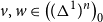 $v,w \in \big ((\Delta ^1)^n\big )_0$
lie in the same
$v,w \in \big ((\Delta ^1)^n\big )_0$
lie in the same $\Sigma _n$
-orbit if and only if
$\Sigma _n$
-orbit if and only if $\sum _{i=1}^n \phi _v(i) = \sum _{i=1}^n \phi _w(i)$
.
$\sum _{i=1}^n \phi _v(i) = \sum _{i=1}^n \phi _w(i)$
.
Next, note that every nondegenerate cell of $(\Delta ^1)^n$
is uniquely determined by its vertices. It follows that
$(\Delta ^1)^n$
is uniquely determined by its vertices. It follows that $(\Delta ^1)^n/\Sigma _n$
is isomorphic to the largest subobject of
$(\Delta ^1)^n/\Sigma _n$
is isomorphic to the largest subobject of $(\Delta ^1)^n$
whose vertices are
$(\Delta ^1)^n$
whose vertices are
 \begin{equation*} (0,\ldots ,0,0),\, (0,\ldots ,0,1),\, (0,\ldots ,1,1),\, \ldots ,\, (0,1,\ldots ,1),\, (1,\ldots ,1). \end{equation*}
This subobject is evidently isomorphic to $\Delta ^n$
, as it corresponds to the standard
$\Delta ^n$
, as it corresponds to the standard $n$
-simplex with vertices ordered by increasing numbers of
$n$
-simplex with vertices ordered by increasing numbers of $1$
s.
$1$
s.
Since $A$
preserves the interval, finite products, and quotients, we conclude:
$A$
preserves the interval, finite products, and quotients, we conclude:
 \begin{equation*} A(\Delta ^n) \cong A\left ((\Delta ^1)^n/\Sigma _n\right ) \cong A(\Delta ^1)^n/\Sigma _n \cong \unicode{x3088}_I^n/\Sigma _n. \end{equation*}
Definition 4.74.
The
cylinder $ \text{Cyl}(P)$
of an opetope
$ \text{Cyl}(P)$
of an opetope $ P$
is a special hypergraph introduced by Zawadowski Zawadowski (Reference Zawadowski2017). Before recalling the definition of
$ P$
is a special hypergraph introduced by Zawadowski Zawadowski (Reference Zawadowski2017). Before recalling the definition of $ \text{Cyl}(P)$
, we introduce preliminary notions (here, we work with a fixed opetope
$ \text{Cyl}(P)$
, we introduce preliminary notions (here, we work with a fixed opetope $ P$
of dimension
$ P$
of dimension $ n$
).
$ n$
).
A
flag
is a sequence $ \vec {x} = [x_m, x_{m-1}, \ldots , x_0]$
of cells in
$ \vec {x} = [x_m, x_{m-1}, \ldots , x_0]$
of cells in $ P$
such that
$ P$
such that $ x_i \in \partial x_{i+1}$
and
$ x_i \in \partial x_{i+1}$
and $ x_i \in P_i$
for all
$ x_i \in P_i$
for all $ i$
. A flag is
maximal
if
$ i$
. A flag is
maximal
if $ m = n$
.
$ m = n$
.
For a flag $\vec {x} = [x_k, x_{k-1}, \ldots , x_0]$
that is neither
$\vec {x} = [x_k, x_{k-1}, \ldots , x_0]$
that is neither $[x_n, \gamma (x_n), \ldots , \gamma ^{(1)}(x_n), \gamma ^{(0)}(x_n)]$
nor $[x_n, \gamma (x_n), \ldots , \gamma ^{(1)}(x_n), \delta \gamma ^{(1)}(x_n)]$
, and where
$[x_n, \gamma (x_n), \ldots , \gamma ^{(1)}(x_n), \delta \gamma ^{(1)}(x_n)]$
, and where $k \gt 1$
, the
low level
of
$k \gt 1$
, the
low level
of $\vec {x}$
is defined as
$\vec {x}$
is defined as
 \begin{equation*} \mathrm{ll}(\vec {x}) = \max \{i \lt k-1 \mid x_{i+1} \in \delta (x_{i+2})\}. \end{equation*}
A
punctured flag
(or
p-flag
) in $ P$
is a sequence
$ P$
is a sequence $ \vec {z} = \vec {x}(i)$
, where
$ \vec {z} = \vec {x}(i)$
, where $ i = k - 1$
or
$ i = k - 1$
or $ i = \text{ll}(\vec {x})$
for some flag
$ i = \text{ll}(\vec {x})$
for some flag $ \vec {x}$
. If
$ \vec {x}$
. If $ i = k - 1$
,
$ i = k - 1$
, $ \vec {z}$
is a
high p-flag
; otherwise, it is a
low p-flag
.
$ \vec {z}$
is a
high p-flag
; otherwise, it is a
low p-flag
.
The faces of $ \text{Cyl}(P)$
are of three types:
$ \text{Cyl}(P)$
are of three types:
-
1. Flat faces :
$ \{- \} \times P \cup \{+ \} \times P$
(denoted
$ -P$
and
$ +P$
);
-
2. Flags : All flags of all faces of
$ P$
; -
3. P-flags : All p-flags of all faces of
$ P$
.



The dimension of a face $ -p$
or
$ -p$
or $ +p$
equals the dimension of
$ +p$
equals the dimension of $ p$
. The dimension of a flag or p-flag is the number of non-zero faces.
$ p$
. The dimension of a flag or p-flag is the number of non-zero faces.
The complete description hypergraph $ \textrm {Cyl}(P)$
is long and technical. Here we include only those parts, which are critical for our reasoning.
$ \textrm {Cyl}(P)$
is long and technical. Here we include only those parts, which are critical for our reasoning.
Lemma 4.75.
For a maximal flag $ \vec {x}$
in
$ \vec {x}$
in $ \textrm {Cyl}(P)$
(i.e., a cell of maximal dimension), the set of vertices of
$ \textrm {Cyl}(P)$
(i.e., a cell of maximal dimension), the set of vertices of $ \vec {x}$
is given by:
$ \vec {x}$
is given by:
 \begin{equation*} \langle \vec {x} \rangle _0 = \{-p \mid p \in P_0,\, p \leq ^+ x_0\} \cup \{+p \mid p \in P_0,\, x_0 \leq ^+ p\}. \end{equation*}
Theorem 4.76.
The product $ {\unicode{x3088}_P}\times \unicode{x3088}_\to$
has the following properties:
$ {\unicode{x3088}_P}\times \unicode{x3088}_\to$
has the following properties:
-
• it is an image of
$Cyl(P)$
under the functor
$\textsf{pHg}_\iota \hookrightarrow {}\widehat{\textsf{pOpe}_\iota}$
-
• every nondegenerate cell of
$ {\unicode{x3088}_P}\times \unicode{x3088}_\to$
is contained in a nondegenerate cell of a dimension
$dim\ P+1$
-
• nondegenerate cells of a maximal dimension are in a bijective correspondence with flags on
$P$
-
• nondegenerate cells of a maximal dimension containing the vertex
$(\gamma ^{(0)}P,0)$
are in a bijective correspondence with flags of the form
$[\alpha _P,\ldots ,\gamma ^{(0)}P]$
-
• there is a linear order
$\lt$
on the set of maximal flags, called
flag order
, such that every two consecutive flags in this order share exactly one face of codimension
$1$
. Moreover,
$\textrm {Cyl}(P)$
is obtained from maximal flags exactly by those identifications.

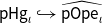


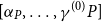


Definition 4.77.
The hypergraph-cone $\textrm {Cone}_H(P)$
over an opetope
$\textrm {Cone}_H(P)$
over an opetope $P$
is a subobject of
$P$
is a subobject of $\textrm {Cyl}(P)$
generated by the flags of the form
$\textrm {Cyl}(P)$
generated by the flags of the form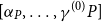 $[\alpha _P,\ldots ,\gamma ^{(0)}P]$
. The cone
$[\alpha _P,\ldots ,\gamma ^{(0)}P]$
. The cone $\textrm {Cone}(P)$
over an opetope
$\textrm {Cone}(P)$
over an opetope $P$
is the image of
$P$
is the image of $\textrm {Cone}_H(P)$
under the embedding
$\textrm {Cone}_H(P)$
under the embedding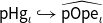 $\textsf{pHg}_\iota \hookrightarrow {}\widehat{\textsf{pOpe}_\iota}$
.
$\textsf{pHg}_\iota \hookrightarrow {}\widehat{\textsf{pOpe}_\iota}$
.
Remark 4.78. There is a canonical inclusion $P\cong P\times \{0\}\stackrel {i_0}{\hookrightarrow } \textrm {Cone}(P)$
.
$P\cong P\times \{0\}\stackrel {i_0}{\hookrightarrow } \textrm {Cone}(P)$
.
If $\delta :Q\to P$
is a coface map s. t.
$\delta :Q\to P$
is a coface map s. t. $\gamma ^{(0)}Q=\gamma ^{(0)}P$
, then there is an induced inclusion
$\gamma ^{(0)}Q=\gamma ^{(0)}P$
, then there is an induced inclusion $\textrm {Cone}(\delta ):\textrm {Cone}(Q)\hookrightarrow {}\textrm {Cone}(P)$
. If
$\textrm {Cone}(\delta ):\textrm {Cone}(Q)\hookrightarrow {}\textrm {Cone}(P)$
. If $\gamma ^{(0)}Q\neq \gamma ^{(0)}P$
, we define
$\gamma ^{(0)}Q\neq \gamma ^{(0)}P$
, we define $\textrm {Cone}(\delta )$
to be the inclusion
$\textrm {Cone}(\delta )$
to be the inclusion $Q\times \{0\}\hookrightarrow {}\textrm {Cone}(P)$
Next, we extend the definition of a cone to a larger class of opetopic sets.
Definition 4.79.
Let $X\in \widehat{\textsf{pOpe}_\iota}_{EZ}$
be a free opetopic set, that is, an opetopic set with the property that for each nondegenerate cell
$X\in \widehat{\textsf{pOpe}_\iota}_{EZ}$
be a free opetopic set, that is, an opetopic set with the property that for each nondegenerate cell $\alpha$
of
$\alpha$
of $X$
, the subobject of
$X$
, the subobject of $X$
generated by
$X$
generated by $\alpha$
is isomorphic with representable (counterpart of the notion of positive opetopic hypergraph on the level of presheaves). Furthermore, we assume that
$\alpha$
is isomorphic with representable (counterpart of the notion of positive opetopic hypergraph on the level of presheaves). Furthermore, we assume that $X$
has a distinguished vertex
$X$
has a distinguished vertex $x$
, which is the last vertex in
$x$
, which is the last vertex in $X$
with respect to the order induced by the edges of
$X$
with respect to the order induced by the edges of $X$
.
$X$
.
The cone $\textrm {Cone}(X,x)$
over
$\textrm {Cone}(X,x)$
over $X$
with respect to
$X$
with respect to $x$
is defined as
$x$
is defined as
 \begin{equation*}\textrm {colim}_{\alpha \in \mathcal{C}_{nd}(X)} \textrm {Cone}(\alpha ,x)\end{equation*}
where $\mathcal{C}_{nd}(X)$
is a category with objects being nondegenerate cells of
$\mathcal{C}_{nd}(X)$
is a category with objects being nondegenerate cells of $X$
and morphisms being inclusions of faces, and
$X$
and morphisms being inclusions of faces, and $\textrm {Cone}(\alpha ,x)$
is equal to
$\textrm {Cone}(\alpha ,x)$
is equal to $\textrm {Cone}(\alpha )$
if
$\textrm {Cone}(\alpha )$
if $\gamma ^{(0)}\alpha =x$
and equal to
$\gamma ^{(0)}\alpha =x$
and equal to $\alpha$
otherwise.
$\alpha$
otherwise.
Definition 4.80.
We define a sequence of opetopic sets $\{\widetilde {A}(n)\}_{n\in \mathbb{N}}$
inductively by the formula
$\{\widetilde {A}(n)\}_{n\in \mathbb{N}}$
inductively by the formula
 \begin{equation*}\widetilde {A}(0)=\{\bullet \},\ \widetilde {A}(n+1)=\textrm {Cone}(\widetilde {A}(n),v_n)\end{equation*}
where $v_n$
is the unique vertex of
$v_n$
is the unique vertex of $\widetilde {A}(n)$
which is not contained in the base of a cone, that is,
$\widetilde {A}(n)$
which is not contained in the base of a cone, that is, $v_n\not \in \mathcal{C}^0(\widetilde {A}(n-1))$
.
$v_n\not \in \mathcal{C}^0(\widetilde {A}(n-1))$
.
Theorem 4.81. $\widetilde {A}(n)\cong \unicode{x3088}_I^n/\Sigma _n$
.
$\widetilde {A}(n)\cong \unicode{x3088}_I^n/\Sigma _n$
.
Proof.
First we show that $\widetilde {A}(n)\cong V_n$
, where
$\widetilde {A}(n)\cong V_n$
, where $V_n$
is the largest subobject of
$V_n$
is the largest subobject of $I^n$
with the set of vertices given by
$I^n$
with the set of vertices given by $\{(0,0,\ldots ,0,0), (0,0,\ldots ,0,1), (0,0,\ldots ,1,1), \ldots , (0,1,\ldots ,1,1),(1,1,\ldots ,1,1)=:v_n\}$
For $n=0, 1$
it is obvious. For general
$n=0, 1$
it is obvious. For general $n$
, we proceed by induction.
$n$
, we proceed by induction.
Note that every (not necessarily nondegenerate) cell of $I^n$
is uniquely determined by its shape and ordered list of vertices: it is obviously true for
$I^n$
is uniquely determined by its shape and ordered list of vertices: it is obviously true for $ \unicode{x3088}_I^0, \unicode{x3088}_I^1$
, and the general case is shown by the induction using the canonical isomorphism
$ \unicode{x3088}_I^0, \unicode{x3088}_I^1$
, and the general case is shown by the induction using the canonical isomorphism $( \unicode{x3088}_I^n)_P\cong ( \unicode{x3088}_I^{n-1})_P\times ({ \unicode{x3088}_I})_P$
.
$( \unicode{x3088}_I^n)_P\cong ( \unicode{x3088}_I^{n-1})_P\times ({ \unicode{x3088}_I})_P$
.
By the inductive assumption and construction of a cone, it follows that $\widetilde {A}(n)$
contains vertices
$\widetilde {A}(n)$
contains vertices $(0,0,\ldots ,0,0), (0,\ldots ,0,1,0), (0,\ldots ,1,1,0), \ldots , (1,\ldots ,1,1,0)$
(those are exactly the vertices from the base of a cone). An apex of a cone is equal to a vertex
$(0,0,\ldots ,0,0), (0,\ldots ,0,1,0), (0,\ldots ,1,1,0), \ldots , (1,\ldots ,1,1,0)$
(those are exactly the vertices from the base of a cone). An apex of a cone is equal to a vertex $(1,1,\ldots ,1,1)$
. Now from the Theorem4.76 follows that
$(1,1,\ldots ,1,1)$
. Now from the Theorem4.76 follows that $\widetilde {A}(n)$
contains all nondegenerate cells on those vertices: cells of the maximal dimension in
$\widetilde {A}(n)$
contains all nondegenerate cells on those vertices: cells of the maximal dimension in $Cone(V_{n-1},v_{n-1})$
are exactly those maximal cells of
$Cone(V_{n-1},v_{n-1})$
are exactly those maximal cells of $V_{n-1}\times \unicode{x3088}_I$
which contain both vertices
$V_{n-1}\times \unicode{x3088}_I$
which contain both vertices $(v_{n-1},0)$
and
$(v_{n-1},0)$
and $(v_{n-1},1)$
, as we can see from the description of the set
$(v_{n-1},1)$
, as we can see from the description of the set $\langle \vec {x}\rangle _0$
given in the Lemma4.75.
$\langle \vec {x}\rangle _0$
given in the Lemma4.75.
To show that $V_n\cong \unicode{x3088}_I^n/\Sigma _n$
we employ reasoning similar to the one given in the proof of the Corollary4.73.
$V_n\cong \unicode{x3088}_I^n/\Sigma _n$
we employ reasoning similar to the one given in the proof of the Corollary4.73.
So the argument given in the proof of the Corollary4.73 indeed applies also here.
Corollary 4.82. $A(\Delta ^n)\cong \textrm {Cone}(A(\Delta ^{n-1}),v_{n-1})$
.
$A(\Delta ^n)\cong \textrm {Cone}(A(\Delta ^{n-1}),v_{n-1})$
.
5. The Homotopy Theory of Opetopic Sets
5.1 Olschok-Cisinski theory for Eilenberg–Zilber presheaves
In this chapter, we briefly discuss the basic results of Cisinski’s theory. Some parts of that theory were developed in the context of Grothendieck topoi; however, they are mostly used for categories of presheaves.
Olschok formulated a generalized version of that theory, which deals with locally presentable cartesian closed categories.
Our modification of his theory doesn’t assume cartesian closedness of the underlying category.
We begin by recalling several notions from Olschok’s work.
Definition 3.1. Let $\mathcal{A}$
be a category with pushouts. Given a natural transformation
$\mathcal{A}$
be a category with pushouts. Given a natural transformation $\alpha : F \xrightarrow {\cdot } F': \mathcal{X} \rightarrow \mathcal{A}$
and a map
$\alpha : F \xrightarrow {\cdot } F': \mathcal{X} \rightarrow \mathcal{A}$
and a map $f: X \rightarrow Y$
let
$f: X \rightarrow Y$
let $f \star \alpha$
be the connecting map in the diagram below:
$f \star \alpha$
be the connecting map in the diagram below:

For a class $J$
of maps, we write
$J$
of maps, we write $J \star \alpha$
for
$J \star \alpha$
for $\{f \star \alpha \mid f \in J\}$
.
$\{f \star \alpha \mid f \in J\}$
.
Definition 5.1.
We say that a weak factorization system $(L, R)$
is
cofibrantly generated
if
$(L, R)$
is
cofibrantly generated
if $L = \mathrm{l}(\mathrm{r}(S))$
for some subset
$L = \mathrm{l}(\mathrm{r}(S))$
for some subset $S\subset L$
. It is a functorial, if there exists a functor
$S\subset L$
. It is a functorial, if there exists a functor $F: \mathcal{C}^{\to }\to \mathcal{C}$
together with a pair of natural transformations
$F: \mathcal{C}^{\to }\to \mathcal{C}$
together with a pair of natural transformations $\lambda : \textrm {dom}\to F$
,
$\lambda : \textrm {dom}\to F$
, $\rho : F\to \textrm {cod}$
such that
$\rho : F\to \textrm {cod}$
such that $\lambda _f\in L$
and
$\lambda _f\in L$
and $\rho _f\in R$
for every
$\rho _f\in R$
for every $f\in \mathcal{C}^\to$
, and
$f\in \mathcal{C}^\to$
, and $f = \rho _f \circ \lambda _f$
.
$f = \rho _f \circ \lambda _f$
.

A weak factorization system is called
cofibrant
if, for every object $X$
, the morphism
$X$
, the morphism $\emptyset \to X$
belongs to
$\emptyset \to X$
belongs to $L$
.
$L$
.
Observation 5.2.
For every weak factorization system on the category $\mathcal{C}$
, there exists a trivial model structure on
$\mathcal{C}$
, there exists a trivial model structure on $\mathcal{C}$
, with
$\mathcal{C}$
, with $\textrm {W}:=\textrm {Mor}(\mathcal{C})$
,
$\textrm {W}:=\textrm {Mor}(\mathcal{C})$
, $\textrm {Cof}=L$
,
$\textrm {Cof}=L$
, $\textrm {Fib}=R$
.
$\textrm {Fib}=R$
.
Definition 5.3.
For the model category $\mathcal{C}$
, a
functorial cylinder
is a functor
$\mathcal{C}$
, a
functorial cylinder
is a functor $I\otimes -:\mathcal{C}\to \mathcal{C}$
, endowed with a pair of natural transformations
$I\otimes -:\mathcal{C}\to \mathcal{C}$
, endowed with a pair of natural transformations

in which the first one is a cofibration and the second one is a weak equivalence.
If $\mathcal{C}$
is just a category endowed with a weak factorization system, a functorial cylinder is understood as a functorial cylinder with respect to the trivial model structure.
$\mathcal{C}$
is just a category endowed with a weak factorization system, a functorial cylinder is understood as a functorial cylinder with respect to the trivial model structure.
Definition 5.4.
Given a functorial cylinder $I\otimes -$
, two maps
$I\otimes -$
, two maps $f, g:X\to Y$
are called homotopic, if the map
$f, g:X\to Y$
are called homotopic, if the map $f\amalg g: X\amalg X\to Y$
factors through
$f\amalg g: X\amalg X\to Y$
factors through $\partial _X: X\amalg X\to I\otimes X$

The map $H: I\otimes X\to Y$
is called a homotopy between
$H: I\otimes X\to Y$
is called a homotopy between $f$
and
$f$
and $g$
.
$g$
.
Remark 5.5. The relation of being homotopic on the set $Hom(X, Y)$
is reflexive and symmetric, but not transitive in general. We denote its transitive closure by
$Hom(X, Y)$
is reflexive and symmetric, but not transitive in general. We denote its transitive closure by $\simeq$
.
$\simeq$
.
Definition 5.6.
Given a cofibrantly generated weak factorization system $(L, R)$
with generating set
$(L, R)$
with generating set $M$
, a functorial cylinder
$M$
, a functorial cylinder $I\otimes -$
and the set
$I\otimes -$
and the set $S\subset \mathrm{l}(\mathrm{r}(L))$
we define sets:
$S\subset \mathrm{l}(\mathrm{r}(L))$
we define sets:
 \begin{equation} \Lambda _I^0(S, L) = S \cup \{ I \otimes X \cup \{\varepsilon \} \otimes Y \to I \otimes Y \mid X \to Y \in M,\ \varepsilon = 0, 1 \}. \end{equation}
For $ n \geq 0$
, we put
$ n \geq 0$
, we put
 \begin{equation} \Lambda _I^{n+1}(S, L) = \{ I \otimes X \cup \partial I \otimes Y \to I \otimes Y \mid X \to Y \in \Lambda _I^n(S, L) \}, \end{equation}
and finally:
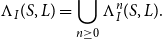 \begin{equation} \Lambda _I(S, L) = \bigcup _{n \geq 0} \Lambda _I^n(S, L). \end{equation}
Morphisms belonging to the class $\mathrm{l}(\mathrm{r}(\Lambda _I(S, L)))$
are called
anodyne extensions
.
$\mathrm{l}(\mathrm{r}(\Lambda _I(S, L)))$
are called
anodyne extensions
.
Definition 5.7.
Morphisms having the right lifting property with respect to the class of anodyne extensions are called
naive fibrations
. If an object $X\in \mathcal{C}$
has the property that
$X\in \mathcal{C}$
has the property that $X\to \{\bullet \}$
is a naive fibration, we say that
$X\to \{\bullet \}$
is a naive fibration, we say that $X$
is
fibrant
.
$X$
is
fibrant
.
Definition 5.8.
A morphism $f:X\to Y$
is called a
weak equivalence
it the induced map
$f:X\to Y$
is called a
weak equivalence
it the induced map
 \begin{equation*}\big (\textrm {Hom}(Y,W)/\simeq \big )\to \big (\textrm {Hom}(X,W)/\simeq \big )\end{equation*}
is bijective for every fibrant object $W$
.
$W$
.
We denote the class of weak equivalences by $W(I\otimes -, S, M)$
.
$W(I\otimes -, S, M)$
.
Definition 5.9.
Let $(L, R)$
be a weak factorization system in a category
$(L, R)$
be a weak factorization system in a category $\mathcal{C}$
. A functorial cylinder
$\mathcal{C}$
. A functorial cylinder $(I, \partial , \sigma )$
is
cartesian
if:
$(I, \partial , \sigma )$
is
cartesian
if:
-
• the cylinder functor
$I\otimes -: \mathcal{C} \to \mathcal{C}$
is a left adjoint.
-
• morphisms
$I \otimes X \cup \{\varepsilon \} \otimes Y \to I \otimes Y$
and
$I \otimes X \cup \partial I \otimes Y \to I \otimes Y$
are in
$L$
for
$(X\to Y)\in L$
and
$\varepsilon =0,1$
.





Theorem 5.10.
Let $\mathcal{K}$
be a locally presentable category and
$\mathcal{K}$
be a locally presentable category and $(L, R)$
a cofibrant weak factorization system generated by a set
$(L, R)$
a cofibrant weak factorization system generated by a set $M \subseteq L$
. Let
$M \subseteq L$
. Let $(I\otimes -, \partial , \sigma )$
be a cartesian cylinder, and
$(I\otimes -, \partial , \sigma )$
be a cartesian cylinder, and $S \subseteq L$
an arbitrary subset. Then, setting
$S \subseteq L$
an arbitrary subset. Then, setting
 \begin{equation*}C := L, \quad W := W(I\otimes -, S, M), \quad F := \mathrm{r}(C \cap W)\end{equation*}
gives a cofibrantly generated model structure $(C, W, F)$
on
$(C, W, F)$
on $\mathcal{K}$
. Moreover,
$\mathcal{K}$
. Moreover, $(I\otimes -, \partial , \sigma )$
is also a cylinder for this model structure.
$(I\otimes -, \partial , \sigma )$
is also a cylinder for this model structure.
Remark 5.11. In our work, we explain how, under certain additional assumptions, the assumption that $I\otimes -$
is left adjoint can be dropped.
$I\otimes -$
is left adjoint can be dropped.
Cisinski’s theory, as described in Cisinski (Reference Cisinski2019), has become a standard tool for constructing cofibrantly generated model structures on categories of presheaves – and more generally, on Grothendieck toposes (see Cisinski (Reference Cisinski2006)). This framework was further generalized by Olschok Olschok (Reference Olschok2011) to a broader class of locally presentable categories under certain conditions, including cartesian closedness.
Unfortunately, these tools cannot be directly applied in our setting, as the cartesian closedness of the category $\widehat{\textsf{pOpe}_\iota}_{EZ}$
remains an open question. Nevertheless, we were able to circumvent this issue by reproving several key lemmas from Olschok (Reference Olschok2011) without relying on the assumption of cartesian closedness. Instead, we employ alternative assumptions that are more readily verifiable within the context of our work. This section is devoted to detailing these modifications.
$\widehat{\textsf{pOpe}_\iota}_{EZ}$
remains an open question. Nevertheless, we were able to circumvent this issue by reproving several key lemmas from Olschok (Reference Olschok2011) without relying on the assumption of cartesian closedness. Instead, we employ alternative assumptions that are more readily verifiable within the context of our work. This section is devoted to detailing these modifications.
Definition 5.12.
Let $\mathcal{A}$
be a tidy Reedy category.
$\mathcal{A}$
be a tidy Reedy category.
We say that $\widehat {\mathcal{A}}$
is
category with proper point
if for every
$\widehat {\mathcal{A}}$
is
category with proper point
if for every $X\in \textrm {Ob}(\widehat {\mathcal{A}})\setminus \{\emptyset \}$
there exists at least one morphism
$X\in \textrm {Ob}(\widehat {\mathcal{A}})\setminus \{\emptyset \}$
there exists at least one morphism $\bullet \to X$
(which is necessarily a monomorphism), where
$\bullet \to X$
(which is necessarily a monomorphism), where $\bullet$
is the final object.
$\bullet$
is the final object.
In this section, we work with a fixed tidy Reedy category $\mathcal{A}$
such that
$\mathcal{A}$
such that $\widehat {\mathcal{A}}$
is a category with a proper point.
$\widehat {\mathcal{A}}$
is a category with a proper point.
In the Theorem 3.16 in Olschok (Reference Olschok2011), it is assumed that the cylinder functor is a left adjoint, but proof of the Theorem relies only on consequences of that fact, namely the Corollary 3.3 and the fact that cylinder preserves the initial object.
In the context of the category of EZ-presheaves, we don’t know if it is true that the product-functor $ \unicode{x3088}_I\times (-)$
is a left adjoint (even though certainly it is when regarded as an endofunctor on the category of presheaves). Nevertheless, it preserves the initial object, and the appropriate analog of Corollary 3.3 (namely our Corollary5.17) holds.
$ \unicode{x3088}_I\times (-)$
is a left adjoint (even though certainly it is when regarded as an endofunctor on the category of presheaves). Nevertheless, it preserves the initial object, and the appropriate analog of Corollary 3.3 (namely our Corollary5.17) holds.
Definition 5.13.
Let $J$
be a class of morphisms in the category
$J$
be a class of morphisms in the category $\widehat {\mathcal{A}}_{EZ}$
.
$\widehat {\mathcal{A}}_{EZ}$
.
Then $\mathrm{l}_{\widehat {\mathcal{A}}}(J)$
(
$\mathrm{l}_{\widehat {\mathcal{A}}}(J)$
( $\mathrm{r}_{\widehat {\mathcal{A}}}(J)$
) denotes the class of all morphisms in
$\mathrm{r}_{\widehat {\mathcal{A}}}(J)$
) denotes the class of all morphisms in $\widehat {\mathcal{A}}$
having the left lifting property (right lifting property, respectively) with respect to the class
$\widehat {\mathcal{A}}$
having the left lifting property (right lifting property, respectively) with respect to the class $J$
, while
$J$
, while $\mathrm{l}_{{\widehat {\mathcal{A}}_{EZ}}}(J)$
(
$\mathrm{l}_{{\widehat {\mathcal{A}}_{EZ}}}(J)$
( $\mathrm{r}_{\widehat {\mathcal{A}}}(J)$
) denotes the class of all morphisms in
$\mathrm{r}_{\widehat {\mathcal{A}}}(J)$
) denotes the class of all morphisms in $\widehat {\mathcal{A}}_{EZ}$
having the left lifting property (the right lifting property, respectively) with respect to the class
$\widehat {\mathcal{A}}_{EZ}$
having the left lifting property (the right lifting property, respectively) with respect to the class $J$
.
$J$
.
Lemma 5.14.
Let $J$
be any class of cellular monomorphisms in
$J$
be any class of cellular monomorphisms in $\widehat {\mathcal{A}}_{EZ}$
. Let
$\widehat {\mathcal{A}}_{EZ}$
. Let $\mathrm{l}_{\widehat {\mathcal{A}}}(\mathrm{r}_{\widehat {\mathcal{A}}}(J))$
be the saturated class generated by
$\mathrm{l}_{\widehat {\mathcal{A}}}(\mathrm{r}_{\widehat {\mathcal{A}}}(J))$
be the saturated class generated by $J$
in the category of all presheaves and
$J$
in the category of all presheaves and $\mathrm{l}_{\widehat {\mathcal{A}}_{EZ}}(\mathrm{r}_{\widehat {\mathcal{A}}_{EZ}}(J))$
be the saturated class generated by
$\mathrm{l}_{\widehat {\mathcal{A}}_{EZ}}(\mathrm{r}_{\widehat {\mathcal{A}}_{EZ}}(J))$
be the saturated class generated by $J$
in
$J$
in $\widehat {\mathcal{A}}_{EZ}$
. Then
$\widehat {\mathcal{A}}_{EZ}$
. Then $\mathrm{l}_{\widehat {\mathcal{A}}}(\mathrm{r}_{\widehat {\mathcal{A}}}(J))\cap \textrm {Mor}(\widehat {\mathcal{A}}_{EZ})=\mathrm{l}_{\widehat {\mathcal{A}}_{EZ}}(\mathrm{r}_{\widehat {\mathcal{A}}_{EZ}}(J))$
.
$\mathrm{l}_{\widehat {\mathcal{A}}}(\mathrm{r}_{\widehat {\mathcal{A}}}(J))\cap \textrm {Mor}(\widehat {\mathcal{A}}_{EZ})=\mathrm{l}_{\widehat {\mathcal{A}}_{EZ}}(\mathrm{r}_{\widehat {\mathcal{A}}_{EZ}}(J))$
.
Proof.
By the small object argument, both classes are given by retracts of morphisms obtained by transfinite composition of pushouts of elements in $J$
(in respective categories).
$J$
(in respective categories).
Suppose that $f\in \mathrm{l}_{\widehat {\mathcal{A}}}(\mathrm{r}_{\widehat {\mathcal{A}}}(J))\cap \textrm {Mor}(\widehat {\mathcal{A}}_{EZ})\setminus \mathrm{l}_{\widehat {\mathcal{A}}_{EZ}}(\mathrm{r}_{\widehat {\mathcal{A}}_{EZ}}(J))$
. This means that
$f\in \mathrm{l}_{\widehat {\mathcal{A}}}(\mathrm{r}_{\widehat {\mathcal{A}}}(J))\cap \textrm {Mor}(\widehat {\mathcal{A}}_{EZ})\setminus \mathrm{l}_{\widehat {\mathcal{A}}_{EZ}}(\mathrm{r}_{\widehat {\mathcal{A}}_{EZ}}(J))$
. This means that $f$
is a retract of some
$f$
is a retract of some $g$
, which is a transfinite composition of pushouts of morphisms in
$g$
, which is a transfinite composition of pushouts of morphisms in $J$
and the domain of
$J$
and the domain of $g$
is not an EZ-presheaf.
$g$
is not an EZ-presheaf.

Forming the pushout as on the diagram above, we see that $f$
is also a retract of
$f$
is also a retract of $\overline {g}$
. The domain of
$\overline {g}$
. The domain of $\overline {g}$
is an EZ-presheaf. Since pushouts commute with transfinite compositions, it follows that
$\overline {g}$
is an EZ-presheaf. Since pushouts commute with transfinite compositions, it follows that $\overline {g}$
is transfinite composition of pushouts of the same morphisms in
$\overline {g}$
is transfinite composition of pushouts of the same morphisms in $J$
in terms of which
$J$
in terms of which $g$
was expressed, but in the case of
$g$
was expressed, but in the case of $\overline {g}$
pushouts are taken along the morphisms of
$\overline {g}$
pushouts are taken along the morphisms of $EZ$
-presheaves, hence
$EZ$
-presheaves, hence $\overline {g}\in \mathrm{l}_{\widehat {\mathcal{A}}_{EZ}}(\mathrm{r}_{\widehat {\mathcal{A}}_{EZ}}(J))$
. Since this class is closed under retracts, we also have
$\overline {g}\in \mathrm{l}_{\widehat {\mathcal{A}}_{EZ}}(\mathrm{r}_{\widehat {\mathcal{A}}_{EZ}}(J))$
. Since this class is closed under retracts, we also have $f\in \mathrm{l}_{\widehat {\mathcal{A}}_{EZ}}(\mathrm{r}_{\widehat {\mathcal{A}}_{EZ}}(J))$
, a contradiction.
$f\in \mathrm{l}_{\widehat {\mathcal{A}}_{EZ}}(\mathrm{r}_{\widehat {\mathcal{A}}_{EZ}}(J))$
, a contradiction.
Lemma 5.15.
If a product $\prod _{t\in T}X_t$
of nonempty objects in
$\prod _{t\in T}X_t$
of nonempty objects in $\widehat {\mathcal{A}}$
, where
$\widehat {\mathcal{A}}$
, where $\mathcal{A}$
is a category with a proper point, is an EZ-presheaf, then every presheaf
$\mathcal{A}$
is a category with a proper point, is an EZ-presheaf, then every presheaf $X_t$
is an EZ-presheaf.
$X_t$
is an EZ-presheaf.
Proof.
Suppose that $X_{t_0}$
is not an EZ-presheaf for some
$X_{t_0}$
is not an EZ-presheaf for some $t_0$
. For every
$t_0$
. For every $t\in T\setminus \{t_0\}$
we fix a vertex
$t\in T\setminus \{t_0\}$
we fix a vertex $x_t\in X_t$
, that is, a subobject of
$x_t\in X_t$
, that is, a subobject of $X_t$
isomorphic with
$X_t$
isomorphic with $\bullet$
.
$\bullet$
.
Next, we consider a subobject of the product given by $\prod _{t\in T\setminus \{t_0\}}\{x_t\}\times X_{t_0}\cong X_{t_0}$
.
$\prod _{t\in T\setminus \{t_0\}}\{x_t\}\times X_{t_0}\cong X_{t_0}$
.
This subobject is a retract of $\prod _{t\in T}X_t$
by the projection map
$\prod _{t\in T}X_t$
by the projection map $\pi _{t_0}$
. This gives a contradiction with the Corollary3.22.
$\pi _{t_0}$
. This gives a contradiction with the Corollary3.22.
Lemma 5.16.
Let $\xi$
be any of the functorial inclusions
$\xi$
be any of the functorial inclusions $\{0\}\times (-)\hookrightarrow {} \unicode{x3088}_I\times (-)$
,
$\{0\}\times (-)\hookrightarrow {} \unicode{x3088}_I\times (-)$
, $\{1\}\times (-)\hookrightarrow {} \unicode{x3088}_I\times (-)$
,
$\{1\}\times (-)\hookrightarrow {} \unicode{x3088}_I\times (-)$
, $\partial \unicode{x3088}_I\times (-)\hookrightarrow {} \unicode{x3088}_I\times (-)$
and
$\partial \unicode{x3088}_I\times (-)\hookrightarrow {} \unicode{x3088}_I\times (-)$
and $J$
be a class of cellular monomorphisms between EZ-presheaves over
$J$
be a class of cellular monomorphisms between EZ-presheaves over $\textsf{pOpe}_\iota$
. Then the following holds:
$\textsf{pOpe}_\iota$
. Then the following holds:
 \begin{equation*}\big (\mathrm{l}_{\widehat {\mathcal{A}}}(\mathrm{r}_{\widehat {\mathcal{A}}}(J))\star \xi \big )\cap \textrm {Mor}(\widehat {\mathcal{A}}_{EZ})=\mathrm{l}_{\widehat {\mathcal{A}}_{EZ}}(\mathrm{r}_{\widehat {\mathcal{A}}_{EZ}}(J))\star \xi \end{equation*}
Proof.
Let us fix a morphism $f: X\to Y$
from
$f: X\to Y$
from $\mathrm{l}_{\widehat {\mathcal{A}}}(\mathrm{r}_{\widehat {\mathcal{A}}}(J))$
, where
$\mathrm{l}_{\widehat {\mathcal{A}}}(\mathrm{r}_{\widehat {\mathcal{A}}}(J))$
, where $Y\neq \emptyset$
(we leave it to the reader to handle this trivial case separately).
$Y\neq \emptyset$
(we leave it to the reader to handle this trivial case separately).
Claim 1: $Y\in \widehat {\mathcal{A}}_{EZ}\implies f\in \mathrm{l}_{\widehat {\mathcal{A}}_{EZ}}(\mathrm{r}_{\widehat {\mathcal{A}}_{EZ}}(J))$
Since $f$
is cellular, it is enough to show: that for a cellular monomorphism having an EZ-presheaf as a codomain implies having an EZ-presheaf as a domain (the reverse implication also holds, as we already showed).
$f$
is cellular, it is enough to show: that for a cellular monomorphism having an EZ-presheaf as a codomain implies having an EZ-presheaf as a domain (the reverse implication also holds, as we already showed).
Claim 1.1: $f\in \mathrm{l}(\mathrm{r}(\{\partial _P\}_{P\in \mathcal{A}})) \land Y\in \widehat {\mathcal{A}}_{EZ}\implies X\in \widehat {\mathcal{A}}_{EZ}$
By Observation3.16 $\oint Y\setminus \oint X$
is well defined and a coproduct of connected categories (since it is a sum of connected components in
$\oint Y\setminus \oint X$
is well defined and a coproduct of connected categories (since it is a sum of connected components in $Y$
), each of which has a terminal object. Since all connected components of
$Y$
), each of which has a terminal object. Since all connected components of $\oint Y$
have terminal objects (by virtue of
$\oint Y$
have terminal objects (by virtue of $Y$
being an EZ-presheaf), the same must hold for
$Y$
being an EZ-presheaf), the same must hold for $\oint X$
, showing that
$\oint X$
, showing that $X$
is also an EZ-presheaf. The application of Lemma5.14 finishes the proof of the claim.
$X$
is also an EZ-presheaf. The application of Lemma5.14 finishes the proof of the claim.
Claim 2: $f\star \xi \in \textrm {Mor}(\widehat {\mathcal{A}}_{EZ})\implies Y\in \widehat {\mathcal{A}}_{EZ}$
Suppose that $f\star \xi$
is a morphism of EZ-presheaves, in particular
$f\star \xi$
is a morphism of EZ-presheaves, in particular $\text{cod}(f\star \xi )$
is an EZ-presheaf. Lemma5.15 and isomorphism
$\text{cod}(f\star \xi )$
is an EZ-presheaf. Lemma5.15 and isomorphism $\text{cod}(f)\times I\cong \text{cod}(f\star \xi )$
imply that
$\text{cod}(f)\times I\cong \text{cod}(f\star \xi )$
imply that $\text{cod}(f)=Y$
is indeed an EZ-presheaf, that is both the premise and the conclusion of the Claim
$\text{cod}(f)=Y$
is indeed an EZ-presheaf, that is both the premise and the conclusion of the Claim $1$
hold.
$1$
hold.
Corollary 5.17 (Eilenberg–Zilber version of the Corollary 3.3 from Olschok (Reference Olschok2011)).
Let $J_1$
and
$J_1$
and $J_2$
be two classes of cellular monomorphisms in
$J_2$
be two classes of cellular monomorphisms in $\widehat{\textsf{pOpe}_\iota}_{EZ}$
. Then the following implication holds:
$\widehat{\textsf{pOpe}_\iota}_{EZ}$
. Then the following implication holds:
 \begin{equation*}J_1\star \xi \subseteq J_2\implies \mathrm{l}_{\widehat {\mathcal{A}}_{EZ}}(\mathrm{r}_{\widehat {\mathcal{A}}_{EZ}}(J_1))\star \xi \subseteq \mathrm{l}_{\widehat {\mathcal{A}}_{EZ}}(\mathrm{r}_{\widehat {\mathcal{A}}_{EZ}}(J_2))\end{equation*}
Proof.
Inclusion $\mathrm{l}_{\widehat {\mathcal{A}}}(\mathrm{r}_{\widehat {\mathcal{A}}}(J_1))\star \xi \subseteq \mathrm{l}_{\widehat {\mathcal{A}}}(\mathrm{r}_{\widehat {\mathcal{A}}}(J_2))$
follows from Olschok (Reference Olschok2011), Corollary 3.3. Now it suffices to intersect both sides with
$\mathrm{l}_{\widehat {\mathcal{A}}}(\mathrm{r}_{\widehat {\mathcal{A}}}(J_1))\star \xi \subseteq \mathrm{l}_{\widehat {\mathcal{A}}}(\mathrm{r}_{\widehat {\mathcal{A}}}(J_2))$
follows from Olschok (Reference Olschok2011), Corollary 3.3. Now it suffices to intersect both sides with $\textrm {Mor}(\widehat {\mathcal{A}}_{EZ})$
and apply Lemma5.14 and Lemma5.16.
$\textrm {Mor}(\widehat {\mathcal{A}}_{EZ})$
and apply Lemma5.14 and Lemma5.16.
Corollary 5.18 (Eilenberg–Zilber version of the Theorem 3.16 from Olschok (Reference Olschok2011)).
Let $\mathcal{A}$
be a tidy Reedy category such that
$\mathcal{A}$
be a tidy Reedy category such that $\widehat {\mathcal{A}}_{EZ}$
is a category with a proper point. Let
$\widehat {\mathcal{A}}_{EZ}$
is a category with a proper point. Let $(L, R)$
be a cofibrant weak factorization system in
$(L, R)$
be a cofibrant weak factorization system in $\widehat {\mathcal{A}}_{EZ}$
generated by a set
$\widehat {\mathcal{A}}_{EZ}$
generated by a set $L\subseteq \{\partial _P\}_{P\in \mathcal{A}}$
. Let
$L\subseteq \{\partial _P\}_{P\in \mathcal{A}}$
. Let $I$
be a functorial cylinder and
$I$
be a functorial cylinder and $S \subseteq L$
an arbitrary subset. Then, setting
$S \subseteq L$
an arbitrary subset. Then, setting
 \begin{equation*} \textrm {Cof} := L \quad \textrm {W} := \mathcal{W}(I, S, \{\partial _P\}_{P\in \mathcal{A}}) \quad \textrm {Fib} := \mathrm{r}(L \cap \mathcal{W}) \end{equation*}
gives a cofibrant model structure $(\textrm {Cof}, \textrm {W}, \textrm {Fib})$
on
$(\textrm {Cof}, \textrm {W}, \textrm {Fib})$
on $\widehat {\mathcal{A}}_{EZ}$
, with
$\widehat {\mathcal{A}}_{EZ}$
, with $I\otimes X$
being a cylinder over
$I\otimes X$
being a cylinder over $X$
for every
$X$
for every $X\in \widehat {\mathcal{A}}_{EZ}$
.
$X\in \widehat {\mathcal{A}}_{EZ}$
.
Definition 5.19. The model structure obtained either from the original Cisinski–Olschok theory or from the modification described above is called a generalized Cisinski model structure .
Remark 5.20. Proof of the Olschok theorem is based on the highly nontrivial theorem of Jeff Smith (and simultaneously generalizes the result of Cisinski, which has more elementary proof).
One can slightly modify the reasoning given by Cisinski to obtain the existence of the opetopic $(\infty ,0)$
-model structure above without direct reliance on the Jeff Smith theorem.
$(\infty ,0)$
-model structure above without direct reliance on the Jeff Smith theorem.
In the following, we formulate a useful criterion for checking if a given functor with domain in a generalized Cisinski model structure is a left Quillen functor.
Lemma 5.21.
Let $\mathcal{C}$
be a category equipped with a generalized Cisinski model structure, generated by the cylinder functor
$\mathcal{C}$
be a category equipped with a generalized Cisinski model structure, generated by the cylinder functor $I \otimes -: \mathcal{C} \to \mathcal{C}$
and a set
$I \otimes -: \mathcal{C} \to \mathcal{C}$
and a set $S$
of generating anodyne extensions.
$S$
of generating anodyne extensions.
Let $\mathcal{D}$
be a model category and
$\mathcal{D}$
be a model category and $F: \mathcal{C} \to \mathcal{D}$
a left adjoint such that the following conditions hold:
$F: \mathcal{C} \to \mathcal{D}$
a left adjoint such that the following conditions hold:
-
•
$F$
preserves cofibrations,
-
• for every
$c \in \mathcal{C}$
,
$F(I \otimes c)$
is a cylinder object for
$F(c)$
in
$\mathcal{D}$
-
• for every
$f \in S$
,
$F(f)$
is an acyclic cofibration in
$\mathcal{D}$


Then $F$
is a left Quillen functor.
$F$
is a left Quillen functor.
Proof.
To prove $F$
is left Quillen, it suffices to show
$F$
is left Quillen, it suffices to show $F$
preserves acyclic cofibrations. Let
$F$
preserves acyclic cofibrations. Let $\textsf{Cof}_{\mathcal{D}}$
and
$\textsf{Cof}_{\mathcal{D}}$
and $\textsf{W}_{\mathcal{D}}$
denote the cofibrations and weak equivalences in
$\textsf{W}_{\mathcal{D}}$
denote the cofibrations and weak equivalences in $\mathcal{D}$
, respectively.
$\mathcal{D}$
, respectively.
Step 1: Reduction to anodyne extensions
Let $f: K \to L$
be an acyclic cofibration in
$f: K \to L$
be an acyclic cofibration in $\mathcal{C}$
. Let
$\mathcal{C}$
. Let $\kappa : Id_{\mathcal{C}}\to \mathfrak{P}$
be a functorial fibrant replacement obtained from the application small object argument to the set of generators of the class of anodyne extensions (in particular, it is a pointwise anodyne extension). Consider the following diagram:
$\kappa : Id_{\mathcal{C}}\to \mathfrak{P}$
be a functorial fibrant replacement obtained from the application small object argument to the set of generators of the class of anodyne extensions (in particular, it is a pointwise anodyne extension). Consider the following diagram:

Since $\mathfrak{P}(f)$
is an acyclic cofibration between fibrant objects, it is an anodyne extension. It follows that
$\mathfrak{P}(f)$
is an acyclic cofibration between fibrant objects, it is an anodyne extension. It follows that $F(\kappa _K)$
,
$F(\kappa _K)$
, $F(\kappa _L)$
,
$F(\kappa _L)$
, $F(\mathfrak{P}(f)) \in \textsf{W}_{\mathcal{D}}$
, the 2-out-of-3 property implies
$F(\mathfrak{P}(f)) \in \textsf{W}_{\mathcal{D}}$
, the 2-out-of-3 property implies $F(f) \in \textsf{W}_{\mathcal{D}}$
. As
$F(f) \in \textsf{W}_{\mathcal{D}}$
. As $F$
preserves cofibrations,
$F$
preserves cofibrations, $F(f) \in \textsf{Cof}_{\mathcal{D}} \cap \textsf{W}_{\mathcal{D}}$
.
$F(f) \in \textsf{Cof}_{\mathcal{D}} \cap \textsf{W}_{\mathcal{D}}$
.
Step 2: Reduction to generating anodyne extensions.
Recall that the class of generating anodyne extension for the generalized Cisinski model structure is defined inductively through:
 \begin{align*} \Lambda _0^I(S, M) &= S \cup \left \{ I \otimes K \cup \{\epsilon \} \otimes L \to I \otimes L \,|\, K \hookrightarrow L \in M,\, \epsilon \in \{0,1\} \right \} \\ \Lambda _{n+1}^I(S, M) &= \left \{ I \otimes K \cup \partial I \otimes L \to I \otimes L \,|\, K \hookrightarrow L \in \Lambda _n^I(S, M) \right \} \\ \Lambda ^I(S, M) &= \bigcup _{n \geq 0} \Lambda _n^I(S, M) \end{align*}
Base Case ( $n=0$
): Consider the following diagram:
$n=0$
): Consider the following diagram:

The left vertical arrow and the right upper arrow are acyclic cofibrations which are preserved by $F$
by the assumption on
$F$
by the assumption on $I$
. Thus the right vertical arrow is also an acyclic cofibration preserved by
$I$
. Thus the right vertical arrow is also an acyclic cofibration preserved by $F$
, being a pushout of one. Finally, the diagonal arrow on the right is a weak equivalence by
$F$
, being a pushout of one. Finally, the diagonal arrow on the right is a weak equivalence by $2$
-out-of-
$2$
-out-of- $3$
.
$3$
.
Inductive step:
For $K \hookrightarrow L \in \Lambda _n^I(S, M)$
such that
$K \hookrightarrow L \in \Lambda _n^I(S, M)$
such that $F(K \hookrightarrow L)\in \textrm {Cof}_{\mathcal{D}}\cap W_{\mathcal{D}}$
:
$F(K \hookrightarrow L)\in \textrm {Cof}_{\mathcal{D}}\cap W_{\mathcal{D}}$
:

The left vertical arrow is isomorphic with $K\amalg K\hookrightarrow {}L\amalg L$
, hence it is in
$K\amalg K\hookrightarrow {}L\amalg L$
, hence it is in $\textrm {Cof}_{\mathcal{D}}\cap W_{\mathcal{D}}$
, hence so is its pushout, the second vertical arrow. Maps
$\textrm {Cof}_{\mathcal{D}}\cap W_{\mathcal{D}}$
, hence so is its pushout, the second vertical arrow. Maps $K\hookrightarrow {}I\otimes K$
and
$K\hookrightarrow {}I\otimes K$
and $L\hookrightarrow {}I\otimes L$
are in
$L\hookrightarrow {}I\otimes L$
are in $\textrm {Cof}_{\mathcal{D}}\cap W_{\mathcal{D}}$
by the assumption on the cylinder. By
$\textrm {Cof}_{\mathcal{D}}\cap W_{\mathcal{D}}$
by the assumption on the cylinder. By $2$
-out-of-
$2$
-out-of- $3$
applied to the pentagon on the right, we see that
$3$
applied to the pentagon on the right, we see that $I\otimes K\cup \partial I\otimes L\to I\otimes L$
is in
$I\otimes K\cup \partial I\otimes L\to I\otimes L$
is in $\textrm {Cof}_{\mathcal{D}}\cap W_{\mathcal{D}}$
.
$\textrm {Cof}_{\mathcal{D}}\cap W_{\mathcal{D}}$
.
5.2 Opetopic
$(\infty , 0)$
-structure

In this section, we apply the tools developed in the previous section to construct a particular model structure on the category $\widehat{\textsf{pOpe}_\iota}_{EZ}$
, referred to as the
$\widehat{\textsf{pOpe}_\iota}_{EZ}$
, referred to as the $(\infty ,0)$
-model structure. Moreover, we demonstrate that the functors introduced in the preceding chapter give rise to two Quillen adjunctions between this model structure and the classical Kan–Quillen model structure on
$(\infty ,0)$
-model structure. Moreover, we demonstrate that the functors introduced in the preceding chapter give rise to two Quillen adjunctions between this model structure and the classical Kan–Quillen model structure on $\textsf{sSet}$
.
$\textsf{sSet}$
.
Definition 5.22.
Let $P$
be a positive opetope. Let
$P$
be a positive opetope. Let $e$
be a cell of
$e$
be a cell of $P$
of the codimension
$P$
of the codimension $1$
. We define
$1$
. We define $e$
-horn on
$e$
-horn on $P$
$P$ $\Lambda ^e P$
to be the biggest subobject of
$\Lambda ^e P$
to be the biggest subobject of $ {\unicode{x3088}_P}$
in the category of
$ {\unicode{x3088}_P}$
in the category of $\widehat{\textsf{pOpe}_\iota}_{EZ}$
which does not contain cells corresponding to morphisms
$\widehat{\textsf{pOpe}_\iota}_{EZ}$
which does not contain cells corresponding to morphisms $\langle e\rangle \hookrightarrow {}P$
and
$\langle e\rangle \hookrightarrow {}P$
and $Id_P$
.
$Id_P$
.
Remark 5.23. Equivalently, $\Lambda ^e P$
can be described as a subobject of
$\Lambda ^e P$
can be described as a subobject of $ {\unicode{x3088}_P}$
(in either of categories
$ {\unicode{x3088}_P}$
(in either of categories $\widehat{\textsf{pOpe}_\iota}$
or
$\widehat{\textsf{pOpe}_\iota}$
or $\widehat{\textsf{pOpe}_\iota}_{EZ}$
) generated by cells corresponding to morphisms
$\widehat{\textsf{pOpe}_\iota}_{EZ}$
) generated by cells corresponding to morphisms $\langle c\rangle \hookrightarrow {}P$
for
$\langle c\rangle \hookrightarrow {}P$
for $c\in |P|\setminus \{e,\alpha _P\}$
. In particular, for
$c\in |P|\setminus \{e,\alpha _P\}$
. In particular, for $e=\gamma \alpha _P$
, we have
$e=\gamma \alpha _P$
, we have $\Lambda ^e P\cong \mathcal{H}_\iota (\delta P)$
.
$\Lambda ^e P\cong \mathcal{H}_\iota (\delta P)$
.
Definition 5.24.
The opetopic $(\infty , 0)$
-structure
is a model structure on the category
$(\infty , 0)$
-structure
is a model structure on the category $\widehat{\textsf{pOpe}_\iota}_{EZ}$
obtained from the application of the Corollary
5.18
to the class
$\widehat{\textsf{pOpe}_\iota}_{EZ}$
obtained from the application of the Corollary
5.18
to the class
 \begin{equation*}S:=\{\Lambda ^e P\hookrightarrow {} {\unicode{x3088}_P}\}_{P\in \textsf{pOpe}_\iota, e\in P_{\dim (P)-1}}\end{equation*}
and the functorial cylinder
 \begin{equation*}I\otimes -= \unicode{x3088}_\to \times -.\end{equation*}
Theorem 5.25.
Functor $\rho :\textsf{sSet}\to \widehat{\textsf{pOpe}_\iota}$
takes values in a category
$\rho :\textsf{sSet}\to \widehat{\textsf{pOpe}_\iota}$
takes values in a category $\widehat{\textsf{pOpe}_\iota}_{EZ}$
. In particular,
$\widehat{\textsf{pOpe}_\iota}_{EZ}$
. In particular, $\zeta$
and
$\zeta$
and $\rho$
restrict to a pair of adjoint functors between
$\rho$
restrict to a pair of adjoint functors between $\textsf{sSet}$
and
$\textsf{sSet}$
and $\widehat{\textsf{pOpe}_\iota}_{EZ}$
.
$\widehat{\textsf{pOpe}_\iota}_{EZ}$
.
Corollary 5.26.
For every $P\in \textsf{pOpe}_\iota$
, the simplicial set
$P\in \textsf{pOpe}_\iota$
, the simplicial set $\zeta ( {\unicode{x3088}_P})$
is contractible in the Kan–Quillen model structure on
$\zeta ( {\unicode{x3088}_P})$
is contractible in the Kan–Quillen model structure on $\textsf{sSet}$
.
$\textsf{sSet}$
.
Proof.
We proceed by induction on the dimension of $ P$
.
$ P$
.
Base cases (dimension 0 or 1):
For $P$
being a point or an edge
$P$
being a point or an edge $\zeta ( {\unicode{x3088}_P})$
is also a point or an edge, hence contractible in
$\zeta ( {\unicode{x3088}_P})$
is also a point or an edge, hence contractible in $\textsf{sSet}$
.
$\textsf{sSet}$
.
Inductive step:
Consider the diagram from the Theorem4.19. The top horizontal morphism is an acyclic cofibration, being a monomorphism between contractible objects; hence,a the bottom arrow is also an acyclic cofibration, being its pushout. By the inductive hypothesis, $ \zeta (\gamma (\alpha _P))$
is contractible, as
$ \zeta (\gamma (\alpha _P))$
is contractible, as $ \langle \gamma (\alpha _P)\rangle$
has lower dimension than
$ \langle \gamma (\alpha _P)\rangle$
has lower dimension than $ P$
.
$ P$
.
A weak equivalence from a contractible object ensures its codomain is contractible. Thus, $ \zeta ( {\unicode{x3088}_P})$
, being the codomain of the bottom arrow, is contractible.
$ \zeta ( {\unicode{x3088}_P})$
, being the codomain of the bottom arrow, is contractible.
Lemma 5.27.
If $P$
is an opetopic cardinal, then
$P$
is an opetopic cardinal, then $\delta P$
is contractible.
$\delta P$
is contractible.
Proof.
We will show that each term $\mathcal{F}_i$
in the domain filtration of
$\mathcal{F}_i$
in the domain filtration of $P$
(see Theorem4.36) with
$P$
(see Theorem4.36) with $i\geq 0$
is contractible, by induction on
$i\geq 0$
is contractible, by induction on $i$
and the cardinality of
$i$
and the cardinality of $|P|$
.
$|P|$
.
Base case: $\mathcal{F}_0$
is clearly contractible, being simply a point.
$\mathcal{F}_0$
is clearly contractible, being simply a point.
Inductive step:
Assume that $\mathcal{F}_j(Q)$
is contractible for
$\mathcal{F}_j(Q)$
is contractible for $\#|Q|\lt \#|P|$
and every
$\#|Q|\lt \#|P|$
and every $j\geq 0$
.
$j\geq 0$
.
 \begin{equation*}\mathcal{F}_{n}(P)=\mathcal{F}_{n-1}\amalg _{\delta \alpha }\langle \alpha \rangle \end{equation*}
If $\langle \alpha \rangle =\mathcal{F}_n(P)$
, then Corollary5.26 implies that
$\langle \alpha \rangle =\mathcal{F}_n(P)$
, then Corollary5.26 implies that $\mathcal{F}_n(P)$
is contractible.
$\mathcal{F}_n(P)$
is contractible.
Otherwise, $\#|\langle \alpha \rangle |\lt \#|P|$
, hence
$\#|\langle \alpha \rangle |\lt \#|P|$
, hence $\delta \alpha$
is contractible by inductive hypothesis, being the second-to-last term in the domain filtration of
$\delta \alpha$
is contractible by inductive hypothesis, being the second-to-last term in the domain filtration of $\langle \alpha \rangle$
. Inclusion
$\langle \alpha \rangle$
. Inclusion $\delta \alpha \hookrightarrow {}\langle \alpha \rangle$
is a cofibration, hence
$\delta \alpha \hookrightarrow {}\langle \alpha \rangle$
is a cofibration, hence $\mathcal{F}_n(P)$
is contractible, being homotopy pushout of three contractible objects.
$\mathcal{F}_n(P)$
is contractible, being homotopy pushout of three contractible objects.
Corollary 5.28.
For every horn $\Lambda ^\alpha P$
, the morphism
$\Lambda ^\alpha P$
, the morphism $\zeta ({\Lambda ^\alpha P\hookrightarrow {} {\unicode{x3088}_P}})$
is an acyclic cofibration of the Kan–Quillen model structure on
$\zeta ({\Lambda ^\alpha P\hookrightarrow {} {\unicode{x3088}_P}})$
is an acyclic cofibration of the Kan–Quillen model structure on $\textsf{sSet}$
.
$\textsf{sSet}$
.
Proof.
By induction on the number of faces in $\delta P$
.
$\delta P$
.
Base case.
If $\delta P$
has one face of maximal dimension (i.e.,
$\delta P$
has one face of maximal dimension (i.e., $\delta P$
is representable), the claim follows because
$\delta P$
is representable), the claim follows because $\zeta ({\Lambda ^\alpha P\hookrightarrow {}P})$
is a morphism between contractible objects.
$\zeta ({\Lambda ^\alpha P\hookrightarrow {}P})$
is a morphism between contractible objects.
If $\delta P$
has two faces of maximal dimension, denote the first face in
$\delta P$
has two faces of maximal dimension, denote the first face in $\delta P$
by
$\delta P$
by $\delta _f P$
and the last face in
$\delta _f P$
and the last face in $\delta P$
by
$\delta P$
by $\delta _l P$
. There are three cases:
$\delta _l P$
. There are three cases:
-
•
$\delta _f P$
is not in
$\Lambda ^{\alpha }P$
. Then
$\Lambda ^\alpha P$
is isomorphic to
$\langle \delta _l \alpha _P\rangle \coprod _{\langle \gamma ^2 (\alpha _P)\rangle } \langle \gamma (\alpha _P)\rangle$
, hence contractible. -
•
$\gamma P$
is not in
$\Lambda ^{\alpha }P$
. Then
$\Lambda ^\alpha P$
is isomorphic to
$\delta _f P\coprod _{\gamma \delta _f P} \delta _l P$
, hence contractible. -
•
$\delta _l P$
is not in
$\Lambda ^{\alpha }P$
. Then
$\Lambda ^\alpha P$
is isomorphic to
$\delta _f P\coprod _{\delta \delta _f P} \gamma \alpha _P$
, hence contractible.





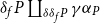
Inductive step.
Assume the claim holds for all $P$
such that
$P$
such that $\delta P$
has at most
$\delta P$
has at most $n$
cells of maximal dimension. By the previous lemma, we may assume
$n$
cells of maximal dimension. By the previous lemma, we may assume $\alpha \neq \gamma P$
.
$\alpha \neq \gamma P$
.
Choose a cell $\beta$
of maximal dimension in
$\beta$
of maximal dimension in $\delta P$
, adjacent to the cells in
$\delta P$
, adjacent to the cells in $\delta P \setminus \Lambda ^\alpha P$
. Observe that
$\delta P \setminus \Lambda ^\alpha P$
. Observe that $\Lambda ^\alpha P \setminus \{\beta \}$
is a horn of an opetope
$\Lambda ^\alpha P \setminus \{\beta \}$
is a horn of an opetope $P'$
, obtained from
$P'$
, obtained from $P$
by merging
$P$
by merging $\alpha$
and
$\alpha$
and $\beta$
into a single cell
$\beta$
into a single cell $\kappa$
.
$\kappa$
.
Let $Q$
be an opetope with domain spanned by
$Q$
be an opetope with domain spanned by $\alpha$
and
$\alpha$
and $\beta$
and codomain
$\beta$
and codomain $\kappa$
. Then
$\kappa$
. Then $Q \coprod _{\kappa } P'$
is an inner horn of an opetope with codomain
$Q \coprod _{\kappa } P'$
is an inner horn of an opetope with codomain $P$
. This horn is constructed from
$P$
. This horn is constructed from $\Lambda ^\alpha P$
via two anodyne extensions, making it weakly equivalent to
$\Lambda ^\alpha P$
via two anodyne extensions, making it weakly equivalent to $\Lambda ^\alpha P$
. By the inductive assumption,
$\Lambda ^\alpha P$
. By the inductive assumption, $Q \coprod _{\kappa } P'$
is a binary horn and thus contractible. Since weak equivalences preserve contractibility,
$Q \coprod _{\kappa } P'$
is a binary horn and thus contractible. Since weak equivalences preserve contractibility, $\zeta ({\Lambda ^\alpha P\hookrightarrow {}P})$
is an acyclic cofibration.
$\zeta ({\Lambda ^\alpha P\hookrightarrow {}P})$
is an acyclic cofibration.
Lemma 5.29.
For every $X\in \widehat{\textsf{pOpe}_\iota}_{EZ}$
,
$X\in \widehat{\textsf{pOpe}_\iota}_{EZ}$
, $\zeta (X\times \unicode{x3088}_\to )$
is a cylinder over
$\zeta (X\times \unicode{x3088}_\to )$
is a cylinder over $\zeta (X)$
.
$\zeta (X)$
.
Proof.
Using induction by the skeleton, we reduce to the case of $X= {\unicode{x3088}_P}$
for
$X= {\unicode{x3088}_P}$
for $P\in \textsf{pOpe}_\iota$
.
$P\in \textsf{pOpe}_\iota$
.
In Zawadowski (Reference Zawadowski2017), the map $ {\unicode{x3088}_P}\times \{0\}\hookrightarrow {} {\unicode{x3088}_P}\times \unicode{x3088}_\to$
was explicitly described as a composition of pushouts of opetopic horn inclusions, thus the result follows from the previous Corollary.
$ {\unicode{x3088}_P}\times \{0\}\hookrightarrow {} {\unicode{x3088}_P}\times \unicode{x3088}_\to$
was explicitly described as a composition of pushouts of opetopic horn inclusions, thus the result follows from the previous Corollary.
Theorem 5.30.
An adjunction $\zeta \dashv \rho$
is a Quillen adjunction between the Kan–Quillen structure on the category
$\zeta \dashv \rho$
is a Quillen adjunction between the Kan–Quillen structure on the category $\textsf{sSet}$
and the
$\textsf{sSet}$
and the $(\infty ,0)$
-structure on the category
$(\infty ,0)$
-structure on the category $\widehat{\textsf{pOpe}_\iota}_{EZ}$
.
$\widehat{\textsf{pOpe}_\iota}_{EZ}$
.
Proof. This follows the Theorem4.17, the Corollary5.28, and the Lemma5.29 by using the criterion formulated in the Lemma5.21.
With the aid of Corollary4.82, we can prove the following:
Theorem 5.31. $A(\Delta ^n)$
is contractible in opetopic
$A(\Delta ^n)$
is contractible in opetopic $(\infty ,0)$
-structure.
$(\infty ,0)$
-structure.
Proof.
First, we fix an opetope $P$
and show that
$P$
and show that $\textrm {Cone}(P)$
is contractible, mirroring the reasoning given in Zawadowski (Reference Zawadowski2017) Theorem 3.23 and preceding results.
$\textrm {Cone}(P)$
is contractible, mirroring the reasoning given in Zawadowski (Reference Zawadowski2017) Theorem 3.23 and preceding results.
Claim 1: $\textrm {Cone}(P)$
is contractible.
$\textrm {Cone}(P)$
is contractible. $\textrm {Cone}_H(P)$
is a subobject of
$\textrm {Cone}_H(P)$
is a subobject of $\textrm {Cyl}(P)$
spanned by some initial (with respect to the flag order) segment of maximal flags. From Zawadowski (Reference Zawadowski2017) Proposition 3.21, it follows that
$\textrm {Cyl}(P)$
spanned by some initial (with respect to the flag order) segment of maximal flags. From Zawadowski (Reference Zawadowski2017) Proposition 3.21, it follows that $\textrm {Cone}_H(P)$
can be expressed in terms of the filtration
$\textrm {Cone}_H(P)$
can be expressed in terms of the filtration
 \begin{equation*}\langle x_0\rangle = C^{\vec {x_0}}\hookrightarrow {}C^{\vec {x_1}}\hookrightarrow {}\ldots \hookrightarrow {} C^{\vec {x_l}}=\textrm {Cone}(P) \end{equation*}
where the first term is an opetope spanned by the initial flag of $P$
and each term is obtained from the previous one by gluing the next (with respect to the flag order) maximal cell of
$P$
and each term is obtained from the previous one by gluing the next (with respect to the flag order) maximal cell of $\textrm {Cone}(P)$
to its predecessor along the unique common face of codimension
$\textrm {Cone}(P)$
to its predecessor along the unique common face of codimension $1$
.
$1$
.
When we apply to this filtration the functor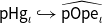 $\textsf{pHg}_\iota \hookrightarrow {}\widehat{\textsf{pOpe}_\iota}$
, we get a finite sequence in which the first term is contractible (being representable) and every other term is obtained from the previous one as a pushout of two inclusions between contractible cofibrant objects. From this, we see that every term in that sequence (in particular the last one) is contractible.
$\textsf{pHg}_\iota \hookrightarrow {}\widehat{\textsf{pOpe}_\iota}$
, we get a finite sequence in which the first term is contractible (being representable) and every other term is obtained from the previous one as a pushout of two inclusions between contractible cofibrant objects. From this, we see that every term in that sequence (in particular the last one) is contractible.
For more details, see proofs of Zawadowski (Reference Zawadowski2017), Propositions 3.21, 3.22, and Theorem 3.22 (to simplify the comparison, we used analogous notation).
Claim 2: $A(\Delta ^n)$
is contractible (induction on
$A(\Delta ^n)$
is contractible (induction on $n$
).
$n$
).
Base case ( $n=0$
):
$n=0$
):
The claim is obviously true for $n=0$
, which establishes the inductive step.
$n=0$
, which establishes the inductive step.
Induction step:
Both
 \begin{equation*}\textrm {colim}_{\alpha \in \mathcal{C}_{nd}(A(\Delta ^{n-1}))} \textrm {Cone}(\alpha ,v_{n-1})\cong A(\Delta ^n)\end{equation*}
and
 \begin{equation*}\textrm {colim}_{\alpha \in \mathcal{C}_{nd}(A(\Delta ^{n-1}))} { \unicode{x3088}_{\langle \alpha \rangle }}\cong A(\Delta ^{n-1})\end{equation*}
represent the homotopy colimit of the same diagram (see Radulescu-Banu (Reference Radulescu-Banu2009), p. 101), and the second one is contractible by the inductive assumption, so the first one is also contractible.
Corollary 5.32.
The adjunction $A\dashv S$
is a Quillen adjunction between the Kan–Quillen structure on the category
$A\dashv S$
is a Quillen adjunction between the Kan–Quillen structure on the category $sSet$
and opetopic
$sSet$
and opetopic $(\infty ,0)$
-structure on
$(\infty ,0)$
-structure on $\widehat{\textsf{pOpe}_\iota}_{EZ}$
Proof.
By Remark4.69, $A$
preserves cofibrations.
$A$
preserves cofibrations.
It suffices to show that $A$
maps generating acyclic cofibrations
$A$
maps generating acyclic cofibrations $\Lambda ^n_k\hookrightarrow {}\Delta ^n$
to acyclic cofibrations, hence it is enough to show that both domain and codomain are mapped to contractible objects. For the codomain, this is precisely the corollary above, while for the domain, we use the standard description of
$\Lambda ^n_k\hookrightarrow {}\Delta ^n$
to acyclic cofibrations, hence it is enough to show that both domain and codomain are mapped to contractible objects. For the codomain, this is precisely the corollary above, while for the domain, we use the standard description of $\Lambda ^n_k$
as a pushout of representables and cocontinuity of
$\Lambda ^n_k$
as a pushout of representables and cocontinuity of $A$
.
$A$
.
5.3 Quillen equivalence
The goal of this section is to prove that opetopic $(\infty , 0)$
-model structure is Quillen-equivalent with the Kan–Quillen model structure on
$(\infty , 0)$
-model structure is Quillen-equivalent with the Kan–Quillen model structure on $\textsf{sSet}$
.
$\textsf{sSet}$
.
Theorem 5.33. Both adjunctions

and

induce Quillen equivalences between the opetopic $(\infty , 0)$
-model structure on
$(\infty , 0)$
-model structure on $\widehat{\textsf{pOpe}_\iota}_{EZ}$
and the Kan–Quillen model structure on
$\widehat{\textsf{pOpe}_\iota}_{EZ}$
and the Kan–Quillen model structure on $\textsf{sSet}$
.
$\textsf{sSet}$
.
Proof.
To establish that the adjunctions $(\zeta ,\rho )$
and
$(\zeta ,\rho )$
and $(A, S)$
form Quillen equivalences, it suffices to demonstrate that both composite functors
$(A, S)$
form Quillen equivalences, it suffices to demonstrate that both composite functors $\zeta \circ A$
and
$\zeta \circ A$
and $A \circ \zeta$
induce equivalences on the respective homotopy categories
$A \circ \zeta$
induce equivalences on the respective homotopy categories $\mathrm{Ho}(\textsf{sSet})$
and
$\mathrm{Ho}(\textsf{sSet})$
and $\mathrm{Ho}(\widehat{\textsf{pOpe}_\iota}_{EZ})$
. We analyze each composition systematically.
$\mathrm{Ho}(\widehat{\textsf{pOpe}_\iota}_{EZ})$
. We analyze each composition systematically.
Claim 1: The composition $\zeta \circ A$
induces an equivalence on
$\zeta \circ A$
induces an equivalence on $\mathrm{Ho}(\textsf{sSet})$
.
$\mathrm{Ho}(\textsf{sSet})$
.
Step 1: Natural transformation construction.
By definition, the restrictions of $A$
and
$A$
and $\rho$
(the right adjoint to
$\rho$
(the right adjoint to $A$
) to representable objects in
$A$
) to representable objects in $\textsf{sSet}$
(i.e., their compositions with the Yoneda embedding
$\textsf{sSet}$
(i.e., their compositions with the Yoneda embedding $ \unicode{x3088}: \Delta \to \textsf{sSet}$
) coincide. This identification allows us to reinterpret the counit transformation
$ \unicode{x3088}: \Delta \to \textsf{sSet}$
) coincide. This identification allows us to reinterpret the counit transformation
 \begin{equation*} \epsilon : \zeta \circ \rho |_\Delta \to \unicode{x3088}_\Delta \end{equation*}
as a natural transformation between restricted functors:
 \begin{equation*} \epsilon ': \zeta \circ A|_\Delta \to \unicode{x3088}_\Delta . \end{equation*}
Since both $\zeta$
and
$\zeta$
and $A$
are left adjoints, they preserve colimits. We may therefore extend
$A$
are left adjoints, they preserve colimits. We may therefore extend $\varepsilon$
canonically along colimits over
$\varepsilon$
canonically along colimits over $\Delta$
to obtain a global natural transformation:
$\Delta$
to obtain a global natural transformation:
 \begin{equation*} \mathcal{E}: \zeta \circ A \to \mathrm{Id}_{\textsf{sSet}}. \end{equation*}
Step 2: Proving $\mathcal{E}$
is a pointwise weak equivalence.
$\mathcal{E}$
is a pointwise weak equivalence.
We verify that $\mathcal{E}_X$
is a weak equivalence for all
$\mathcal{E}_X$
is a weak equivalence for all $X \in \textsf{sSet}$
via skeletal induction:
$X \in \textsf{sSet}$
via skeletal induction:
Base case – representables:
For $X = \Delta ^n$
(the standard
$X = \Delta ^n$
(the standard $n$
-simplex), both
$n$
-simplex), both $\zeta \circ A(\Delta ^n)$
and
$\zeta \circ A(\Delta ^n)$
and $\mathrm{Id}_{\textsf{sSet}}(\Delta ^n) = \Delta ^n$
are contractible simplicial sets by Theorem5.31 and
$\mathrm{Id}_{\textsf{sSet}}(\Delta ^n) = \Delta ^n$
are contractible simplicial sets by Theorem5.31 and $\zeta$
being a left Quillen functor. The map
$\zeta$
being a left Quillen functor. The map $\mathcal{E}_{\Delta ^n}$
between contractible objects is necessarily a weak equivalence.
$\mathcal{E}_{\Delta ^n}$
between contractible objects is necessarily a weak equivalence.
Inductive step – arbitrary simplicial sets:
For general $X$
, by Cisinski (Reference Cisinski2019) Corollaries 1.3.10, 2.3.19, and 2.3.29, the component
$X$
, by Cisinski (Reference Cisinski2019) Corollaries 1.3.10, 2.3.19, and 2.3.29, the component $\mathcal{E}_X$
is shown to be a weak equivalence using induction by a skeleton.
$\mathcal{E}_X$
is shown to be a weak equivalence using induction by a skeleton.
Thus $\mathcal{E}$
is a natural weak equivalence, making
$\mathcal{E}$
is a natural weak equivalence, making $\zeta \circ A$
homotopy equivalent to the identity on
$\zeta \circ A$
homotopy equivalent to the identity on $\textsf{sSet}$
. This induces an equivalence
$\textsf{sSet}$
. This induces an equivalence $\mathrm{Ho}(\zeta \circ A) \simeq \mathrm{Id}_{\mathrm{Ho}(\textsf{sSet})}$
.
$\mathrm{Ho}(\zeta \circ A) \simeq \mathrm{Id}_{\mathrm{Ho}(\textsf{sSet})}$
.
Claim 2: The composition $A \circ \zeta$
induces an equivalence on
$A \circ \zeta$
induces an equivalence on $\mathrm{Ho}(\widehat{\textsf{pOpe}_\iota}_{EZ})$
.
$\mathrm{Ho}(\widehat{\textsf{pOpe}_\iota}_{EZ})$
.
Step 1: Terminal object and reedy cofibrancy.
Let $\bullet$
denote the terminal object in the category of coopetopic diagrams (functors
$\bullet$
denote the terminal object in the category of coopetopic diagrams (functors $\textsf{pOpe}_\iota \to \widehat{\textsf{pOpe}_\iota}_{EZ}$
). Consider the unique morphisms:
$\textsf{pOpe}_\iota \to \widehat{\textsf{pOpe}_\iota}_{EZ}$
). Consider the unique morphisms:
 \begin{equation*} \phi : A \circ \zeta |_{\textsf{pOpe}_\iota} \to \bullet \quad \text{and} \quad \psi : \mathrm{Id}_{\widehat{\textsf{pOpe}_\iota}_{EZ}}|_{\textsf{pOpe}_\iota} \to \bullet . \end{equation*}
Equip this diagram category with the Reedy model structure. Since $A$
,
$A$
, $\zeta$
, and
$\zeta$
, and $\mathrm{Id}_{\widehat{\textsf{pOpe}_\iota}_{EZ}}$
preserve cellular monomorphisms and are left adjoint, the diagrams
$\mathrm{Id}_{\widehat{\textsf{pOpe}_\iota}_{EZ}}$
preserve cellular monomorphisms and are left adjoint, the diagrams $A \circ \zeta |_{\textsf{pOpe}_\iota}$
and
$A \circ \zeta |_{\textsf{pOpe}_\iota}$
and $\mathrm{Id}_{\widehat{\textsf{pOpe}_\iota}_{EZ}}|_{\textsf{pOpe}_\iota}$
are Reedy cofibrant. Specifically, their latching maps are either
$\mathrm{Id}_{\widehat{\textsf{pOpe}_\iota}_{EZ}}|_{\textsf{pOpe}_\iota}$
are Reedy cofibrant. Specifically, their latching maps are either $A \circ \zeta (\partial {\unicode{x3088}_P}) \hookrightarrow A \circ \zeta ( {\unicode{x3088}_P})$
or
$A \circ \zeta (\partial {\unicode{x3088}_P}) \hookrightarrow A \circ \zeta ( {\unicode{x3088}_P})$
or $\partial {\unicode{x3088}_P} \hookrightarrow {\unicode{x3088}_P}$
. Hence, their coproduct
$\partial {\unicode{x3088}_P} \hookrightarrow {\unicode{x3088}_P}$
. Hence, their coproduct $A \circ \zeta |_{\textsf{pOpe}_\iota} \amalg \mathrm{Id}_{\widehat{\textsf{pOpe}_\iota}_{EZ}}|_{\textsf{pOpe}_\iota}$
is also Reedy cofibrant.
$A \circ \zeta |_{\textsf{pOpe}_\iota} \amalg \mathrm{Id}_{\widehat{\textsf{pOpe}_\iota}_{EZ}}|_{\textsf{pOpe}_\iota}$
is also Reedy cofibrant.
Step 2: Weak equivalences to the terminal object.
All representable presheaves in $\widehat{\textsf{pOpe}_\iota}_{EZ}$
are cofibrant and contractible. Since
$\widehat{\textsf{pOpe}_\iota}_{EZ}$
are cofibrant and contractible. Since $A$
and
$A$
and $\zeta$
preserve cofibrant contractible objects (as left Quillen functors), both
$\zeta$
preserve cofibrant contractible objects (as left Quillen functors), both $\phi$
and
$\phi$
and $\psi$
are weak equivalences between cofibrant objects.
$\psi$
are weak equivalences between cofibrant objects.
Step 3: Factorization and cofibrant replacement.
Factor the universal morphism $[\phi , \psi ]: A \circ \zeta |_{\textsf{pOpe}_\iota} \amalg \mathrm{Id}_{\widehat{\textsf{pOpe}_\iota}_{EZ}}|_{\textsf{pOpe}_\iota} \to \bullet$
as:
$[\phi , \psi ]: A \circ \zeta |_{\textsf{pOpe}_\iota} \amalg \mathrm{Id}_{\widehat{\textsf{pOpe}_\iota}_{EZ}}|_{\textsf{pOpe}_\iota} \to \bullet$
as:

where $[\phi ', \psi ']$
is a cofibration and
$[\phi ', \psi ']$
is a cofibration and $U \to \bullet$
is an acyclic fibration. Since the domain is Reedy cofibrant,
$U \to \bullet$
is an acyclic fibration. Since the domain is Reedy cofibrant, $U$
inherits Reedy cofibrancy.
$U$
inherits Reedy cofibrancy.
By the 2-out-of-3 property applied to the inclusions $i_{A \circ \zeta |_{\textsf{pOpe}_\iota}}$
and
$i_{A \circ \zeta |_{\textsf{pOpe}_\iota}}$
and $i_{\mathrm{Id}_{\widehat{\textsf{pOpe}_\iota}_{EZ}}|_{\textsf{pOpe}_\iota}}$
, the induced maps
$i_{\mathrm{Id}_{\widehat{\textsf{pOpe}_\iota}_{EZ}}|_{\textsf{pOpe}_\iota}}$
, the induced maps $\phi '$
and
$\phi '$
and $\psi '$
are weak equivalences between Reedy cofibrant diagrams.
$\psi '$
are weak equivalences between Reedy cofibrant diagrams.
Step 4: Left Kan extension and restricting to $\widehat{\textsf{pOpe}_\iota}_{EZ}$
.
$\widehat{\textsf{pOpe}_\iota}_{EZ}$
.
The left Kan extension $Lan_{ \unicode{x3088}}U$
along the Yoneda embedding
$Lan_{ \unicode{x3088}}U$
along the Yoneda embedding $ \unicode{x3088}: \textsf{pOpe}_\iota \to \widehat{\textsf{pOpe}_\iota}_{EZ}$
preserves cellular monomorphisms because
$ \unicode{x3088}: \textsf{pOpe}_\iota \to \widehat{\textsf{pOpe}_\iota}_{EZ}$
preserves cellular monomorphisms because $U$
is Reedy cofibrant. Crucially,
$U$
is Reedy cofibrant. Crucially, $Lan_{ \unicode{x3088}}U$
preserves EZ-presheaves, allowing us to regard it as an endofunctor on
$Lan_{ \unicode{x3088}}U$
preserves EZ-presheaves, allowing us to regard it as an endofunctor on $\widehat{\textsf{pOpe}_\iota}_{EZ}$
.
$\widehat{\textsf{pOpe}_\iota}_{EZ}$
.
Furthermore, $U$
being a cofibrant replacement of
$U$
being a cofibrant replacement of $\bullet$
ensures that each
$\bullet$
ensures that each $Lan_{ \unicode{x3088}}U( {\unicode{x3088}_P})$
is contractible for
$Lan_{ \unicode{x3088}}U( {\unicode{x3088}_P})$
is contractible for $P \in \textsf{pOpe}_\iota$
.
$P \in \textsf{pOpe}_\iota$
.
Step 5: Connecting to the identity functor.
The natural transformations $Lan_{ \unicode{x3088}}\phi ': A \circ \zeta \to U$
and
$Lan_{ \unicode{x3088}}\phi ': A \circ \zeta \to U$
and $Lan_{ \unicode{x3088}}\psi ': \mathrm{Id}_{\widehat{\textsf{pOpe}_\iota}_{EZ}} \to U$
are pointwise weak equivalences (again by Cisinski (Reference Cisinski2019), Corollaries 1.3.10, 2.3.19, and 2.3.29). Thus
$Lan_{ \unicode{x3088}}\psi ': \mathrm{Id}_{\widehat{\textsf{pOpe}_\iota}_{EZ}} \to U$
are pointwise weak equivalences (again by Cisinski (Reference Cisinski2019), Corollaries 1.3.10, 2.3.19, and 2.3.29). Thus $A \circ \zeta$
and
$A \circ \zeta$
and $\mathrm{Id}_{\widehat{\textsf{pOpe}_\iota}_{EZ}}$
are connected through
$\mathrm{Id}_{\widehat{\textsf{pOpe}_\iota}_{EZ}}$
are connected through $U$
by a zigzag of weak equivalences in the Reedy model structure, yielding:
$U$
by a zigzag of weak equivalences in the Reedy model structure, yielding:
 \begin{equation*} \mathrm{Ho}(A \circ \zeta ) \cong \mathrm{Ho}(\mathrm{Id}_{\widehat{\textsf{pOpe}_\iota}_{EZ}}) = \mathrm{Id}_{\mathrm{Ho}(\widehat{\textsf{pOpe}_\iota}_{EZ})}. \end{equation*}
Therefore, $A \circ \zeta$
induces an equivalence on
$A \circ \zeta$
induces an equivalence on $\mathrm{Ho}(\widehat{\textsf{pOpe}_\iota}_{EZ})$
.
$\mathrm{Ho}(\widehat{\textsf{pOpe}_\iota}_{EZ})$
.
Competing interests
The author declares none.


 Open access

