

A key advantage that incumbents in the U.S. Congress hold over electoral challengers is the ability to bring home tangible benefits to constituents. Members of Congress (MCs) use the power of the purse to secure distributive benefits in their districts, and they claim credit for such projects in order to build a personal vote and ensure reelection (Cain, Ferejohn, and Fiorina Reference Cain, Ferejohn and Fiorina1987; Fiorina Reference Fiorina1981; Mayhew Reference Mayhew1974). Critics negatively refer to this practice to as pork barrel spending, but distributive politics provides a venue for productive and meaningful representation and can be used to facilitate congressional lawmaking (Evans Reference Evans2004; Frisch and Kelly Reference Frisch and Kelly2015; Lazarus Reference Lazarus2009).
When it comes to bringing home spending projects, congresswomen substantially outperform congressmen. A U.S. congressional district stands to receive more federal funding when represented by a woman (Anzia and Berry Reference Anzia and Berry2011; Lazarus and Steigerwalt Reference Lazarus and Steigerwalt2018). However, voters are unlikely to attribute new spending in their community to the right public official, so credit claiming for spending projects is necessary for MCs to turn legislative output into electoral capital (Grimmer, Messing, and Westwood Reference Grimmer, Messing and Westwood2012). Gender stereotypes influence how voters interpret new information about politicians (Ditonto Reference Ditonto2017; Dittmar Reference Dittmar2015), and women in politics must navigate a complex campaign messaging environment due to these stereotypes (Bauer and Santia Reference Bauer and Santia2022, Reference Bauer and Santia2023). An important question, therefore, is whether congresswomen face a gendered challenge in claiming credit for the distributive benefits that they bring home to their constituencies.
This article explores the role of legislator gender in credit claiming for distributive benefits. I theorize that congresswomen face a gender bias when claiming credit for federal projects through two mechanisms. Congresswomen’s credit claims are potentially less effective at boosting support than those of congressmen because of gender stereotypes, and congresswomen may be especially vulnerable to attacks that paint the spending as fiscally irresponsible. I use an online survey experiment to test these expectations. The survey experiment features a newspaper excerpt about a fictitious member of Congress. The legislator’s gender and the excerpt content are randomly assigned. The content treatments include a nonconsequential announcement (control group), a credit claim, and a credit claim with a critique of the spending as wasteful. After reading the assigned newspaper except, respondents evaluated the fictitious legislator on a number of characteristics in a post-treatment survey.
Similar to previous research on credit claiming (Grimmer, Westwood, and Messing Reference Grimmer, Westwood and Messing2015), I find that claiming credit for a federal spending project increases public support for legislators. However, contrary to expectations, I find no evidence that legislator gender plays a substantial role in the credit-claiming process. Credit claiming had an equally positive effect for the woman and man legislator on respondent ratings of general support and effectiveness in Congress. Additionally, a critique of the spending project as wasteful did neutralize the positive effects of credit claiming, but I find no legislator gender-based difference in this effect. The woman legislator and man legislator were rated equally on fiscal responsibility across treatment groups. In sum, I replicate previous findings that credit claiming for spending projects meaningfully influences support for legislators, and I do not find evidence that congresswomen face a tougher credit-claiming environment than congressmen.
Facing gendered vulnerability in congressional elections, congresswomen tend to outperform their male colleagues on representational tasks, including distributive politics (Lazarus and Steigerwalt Reference Lazarus and Steigerwalt2018). This article advances the literature on gender and politics by investigating whether a gender bias in credit claiming prevents congresswomen from using their representational advantage to boost their chances of reelection. I find no evidence that legislator gender influences the public’s reaction to congressional credit claims, indicating that congresswomen can effectively use a distributive politics strategy to counter gendered vulnerability in the U.S. Congress.
Gender, Distributive Politics, and Congressional Elections
Women continue to be substantially underrepresented in the U.S. Congress (CAWP 2023), but the specific role of gender stereotypes and bias in congressional elections is complex. On one hand, women candidates tend to win elections at the same rate as men candidates and appear to be less hampered by gender stereotypes than previously thought (Dolan Reference Dolan2014; Hayes and Lawless Reference Hayes and Lawless2015; Schwarz and Coppock Reference Schwarz and Coppock2022; Seltzer, Newman, and Leighton Reference Seltzer, Newman and Leighton1997). On the other hand, women remain less likely to be recruited for office than men (Sanbonmatsu Reference Sanbonmatsu2006), are more likely to face electoral challenges (Lawless and Pearson Reference Lawless and Pearson2008), and must work harder for campaign donations (Jenkins Reference Jenkins2007). Therefore, women are less likely to run for office than men (Lawless and Fox Reference Lawless and Fox2010), and women who do run tend to have more political experience and qualifications than men who run (Fulton Reference Fulton2012; Pearson and McGhee Reference Pearson and McGhee2013). Findings of gender neutrality in congressional elections, therefore, mask an underlying gender bias, as women win at the same rate as men even though they come from a higher quality candidate pool (Fulton Reference Fulton2012).
The gender gap in candidate quality appears to lead to a similar gap in legislative performance (Anzia and Berry Reference Anzia and Berry2011; Lazarus and Steigerwalt Reference Lazarus and Steigerwalt2018; Volden, Wiseman, and Wittmer Reference Volden, Wiseman and Wittmer2013). Particularly relevant to this research, congresswomen secure more federal funding in their congressional districts than congressmen. Anzia and Berry (Reference Anzia and Berry2011) find that congresswomen secure around 9% more discretionary district spending than congressmen. In a study on specific spending programs, Lazarus and Steigerwalt (Reference Lazarus and Steigerwalt2018) find that congresswomen secured more congressional earmarks and 2009 American Recovery and Reinvestment Act dollars than congressmen. These findings relate to the literature on congressional representation and elections, as district funding is theorized to play a pivotal role in congressional elections by offering incumbents an opportunity to build support among constituents.
Foundational accounts of congressional behavior place the geographic distribution of public resources at the center of legislator reelection strategy (Fenno Reference Fenno1978; Mayhew Reference Mayhew1974). Legislators pursue federal funding for projects in their district to build a personal vote and display their influence in Congress to constituents (Cain, Ferejohn, and Fiorina Reference Cain, Ferejohn and Fiorina1987; Fiorina Reference Fiorina1981). Electorally vulnerable MCs, who have the most to gain from building a personal vote, are particularly keen on securing federal spending in their districts (Ashworth and Bueno de Mesquita Reference Ashworth and de Mesquita2006; Lazarus Reference Lazarus2010). Additionally, states receive more federal funding when they have a senator up for reelection (Shepsle et al. Reference Shepsle, Van Houweling, Abrams and Hanson2009).
Women legislators’ advantage on district spending plausibly stems, in part, from the gender-based electoral challenges. Lazarus and Steigerwalt (Reference Lazarus and Steigerwalt2018) compellingly argue that women legislators face gendered vulnerability in elections, causing them to outperform men legislators on a number of constituent-oriented activities. Therefore, securing additional district funding is a strategy that women legislators employ to overcome gendered vulnerability in congressional elections.
However, voters are generally unable to recognize federal spending for projects in their community and attribute credit for such funding to the correct congressional representative (Stein and Bickers Reference Stein and Bickers1994). Consequentially, legislators must use messaging tactics, such as press releases and ribbon-cutting ceremonies, to forge connections in constituents’ minds between legislative actions and spending projects. Credit claiming for spending projects is necessary for MCs to turn legislative output into electoral capital (Arnold Reference Arnold1990; Grimmer, Messing, and Westwood Reference Grimmer, Messing and Westwood2012; Grimmer, Westwood, and Messing Reference Grimmer, Westwood and Messing2015; Mayhew Reference Mayhew1974). A legislator stands to electorally benefit from securing distributive benefits only if constituents attribute such benefits to the legislator’s work in Congress.
The central question underlying this research is whether a gender bias influences credit attribution for spending projects, thereby precluding congresswomen’s advantage at securing federal funds from resulting in an electoral boost. Do women legislators who secure additional district spending to overcome gendered vulnerability in congressional elections face a gender-based barrier in claiming credit for the funding they secure?
Theory
Credit claiming is an essential component of a distributive politics-based reelection strategy, and I theorize that women legislators face a gender bias in how people react to credit claiming and attribute credit for distributive benefits. I posit two mechanisms through which a credit-claiming gender bias might function.
First, credit attribution potentially occurs through a gendered lens, with women legislators facing a more severe challenge in claiming credit for federal projects than men legislators. Credit-claiming efforts generally aim to generate the impression that the legislator is influential in Washington and uses such influence to positively impact constituents’ lives. Gender stereotypes impact the ways in which voters interpret new information about candidates (Ditonto Reference Ditonto2017). Women politicians are stereotyped as having less competence and leadership than men politicians (Dittmar Reference Dittmar2015; Meeks Reference Meeks2012; Schneider and Bos Reference Schneider and Bos2014), which plausibly harms congresswomen’s ability to claim credit for spending projects.
Gender stereotypes play a particularly meaningful role in candidate messaging and communication strategies. Stereotypes around gender lead voters to inherently associate masculine traits with political leadership (Bauer Reference Bauer2020). Women politicians can emphasize masculine traits to mitigate gender stereotypes on expertise, competence, and leadership, but doing so risks a likability backlash (Bauer Reference Bauer2017; Wang, Merolla, and Manganiello Reference Wang, Merolla and Manganiello2023). Therefore, female candidates must vary their messaging strategies to balance masculine and feminine stereotypes (Carpinella and Bauer Reference Carpinella and Bauer2021; Bauer and Santia Reference Bauer and Santia2022, Reference Bauer and Santia2023).
Legislators employ credit claiming as a strategy to enhance perceptions of their competence, leadership, and conviction in the eyes of constituents (Grimmer, Westwood, and Messing Reference Grimmer, Westwood and Messing2015; Mayhew Reference Mayhew1974). Credit claiming tends to include language on how the legislator “fought to secure federal funding” (Gomez Reference Gomez2022) and “pushed hard to protect critical programs” (Peltola Reference Peltola2023). As such, credit claiming intersects with the gender stereotypes discussed earlier. Dolan and Kropf (Reference Dolan and Kropf2004) find that congresswomen credit claim more than congressmen, suggesting that congresswomen use credit claiming as a strategy dispel gender stereotypes. However, a key component of credit claiming is the credibility of claims in the eyes of constituents (Mayhew Reference Mayhew1974). I argue that the stereotypes congresswomen aim to dispel through credit claiming plausibly reduce the impact of their credit claims. Women potentially face a credit-claiming bind in which gender stereotypes limit the effectiveness of messages designed in part to counter such stereotypes.
Constituents potentially attribute credit for federal funding to congressmen at a higher rate than congresswomen because of gender stereotypes, preventing women in Congress from capitalizing on their district funding advantage. This proposed mechanism results in my first hypothesis.
H1: The public attributes less credit to congresswomen compared to congressmen for the same federal spending projects.
Second, the potential downside of claiming credit for federal spending projects might be more severe for congresswomen than congressmen. Credit claiming can become a political liability when the spending is framed as irresponsible or wasteful (Barron and McLaughlin Reference Barron and McLaughlin2023; Grimmer, Westwood, and Messing Reference Grimmer, Westwood and Messing2015), and congresswomen may be more vulnerable to such attacks than congressmen. Attacks on congressional spending are common, particularly since the return of earmarks in 2021 (see Appendix in the Supplementary Material for examples of attacks on federal spending). Women politicians are perceived as being more liberal than men politicians (Dolan Reference Dolan2004; Koch Reference Koch2002; McDermott Reference McDermott1997), and wasteful spending critiques of congresswomen’s credit claims may tap into this stereotype.
Additionally, women candidates are particularly vulnerable to stereotype-based attacks on the campaign trail (Bauer Reference Bauer2015; Cassese and Holman Reference Cassese and Holman2018), meaning that wasteful spending attacks may be especially harmful to congresswomen’s electorally motivated credit claims. A gendered backlash against credit claiming would be critical from a congressional elections standpoint. Swing-district MCs, representing politically heterogeneous districts, tend to use a credit-claiming-focused homestyle more than MCs in safe districts (Ashworth and Bueno de Mesquita Reference Ashworth and de Mesquita2006; Grimmer Reference Grimmer2013). If women claiming credit makes them seem more liberal than men claiming credit, then credit claiming fails to achieve its strategic purpose for congresswomen in swing districts. Therefore, credit claiming potentially carries more downside risk for congresswomen than for congressmen.
H2: Congresswomen’s credit claims are more vulnerable to attacks on the spending as fiscally irresponsible than congressmen’s credit claims.
In sum, I ask whether congresswomen face a tougher challenge gleaning the benefits from federal spending projects than congressmen, and I posit two mechanisms through which a gender bias might influence the public’s reaction to congressional credit claiming. First, people may attribute less credit to congresswomen compared to congressmen for the same spending projects. Second, congresswomen’s credit claims may be particularly vulnerable to attacks on spending as wasteful and fiscally irresponsible. Both proposed mechanisms would hurt women legislators’ ability to counter gendered vulnerability with a distributive politics-based reelection strategy.
Research Design
I test the theory outlined earlier through an online survey. Grimmer, Westwood, and Messing (Reference Grimmer, Westwood and Messing2015) lay the foundation for testing the effects of credit claiming with multiple experimental designs.Footnote 1 The general theme of such designs is to randomly assign respondents to a either credit-claiming treatment, in which a legislator emphasizes their role in bringing home a beneficial project, or a non-credit-claiming control treatment. Additionally, various aspects of the credit claim can be randomly assigned, such as the amount of funding claimed, the type of project claimed, or whether the credit claim is adjoined by a critique of the spending as wasteful. Following treatment, respondents are asked to evaluate the legislator on general characteristics as well as characteristics specifically related to credit claiming.
After fielding an online survey sample of roughly 2,000 respondents through the Lucid Theorem sampling platform, I build on the experimental design outlined earlier.Footnote 2 My experimental treatment features a newspaper excerpt about a fictitious member of Congress. The length and structure of the excerpt remains constant across treatment conditions, but I randomly assign respondents to one of three content treatments: a standard advertising message (control), a credit-claiming message for a spending project in a recently passed bill, and a credit-claiming message adjoined by a critique of the bill as wasteful by the nonpartisan Committee for a Responsible Federal Budget. Critically, I add a gender dimension to the design by randomly varying the gender of the legislator making the credit claim. This is accomplished using stereotypical male and female names—Matthew Anderson and Madeline Anderson—and varying the gender pronouns used in the newspaper except.Footnote 3 Randomly varying legislator gender allows for an examination of whether gender conditions the effects of credit-claiming messages.Footnote 4 Additionally, I randomize the party of the legislator, as party likely shapes how people interpret credit claims and party stereotypes may now limit the effects of gender stereotypes (Dolan and Lynch Reference Dolan and Lynch2014; Hayes Reference Hayes2011).
After reading the newspaper excerpt, respondents were asked to answer a number of questions aimed at measuring the effects of the experimental treatments on legislator evaluations. First, respondents gave their general evaluation of the legislator by answering the following question: “How pleased would you be if {MC NAME} was your representative in Congress?” Responses were given on 7-point Likert scale, ranging from “very displeased” to “very pleased.” Second, respondents evaluated the legislator’s ability to pass legislation that helps their community, offering a measure of perceived effectiveness in Congress. Third, respondents rated the legislator’s level of fiscal responsibility, highlighting a potential downside of credit claiming. These questions were asked with a similar 7-point Likert scale structure as the general evaluation. Together, these measures clarify the various effects of congressional credit claiming.
Results
For an initial analysis of the general support measure, I plot mean support for the MC (measured on a 1–7 scale) with 95% confidence intervals across the six treatment conditions in Figure 1. Two things stand out in Figure 1. First, credit claiming for spending projects increases support for MCs, while framing the spending as wasteful eliminates the increase in MC support. These findings replicate the results of previous credit-claiming experiments (Grimmer, Westwood, and Messing Reference Grimmer, Westwood and Messing2015). Second, women MCs do not appear to underperform men MCs in any of the three substantive treatment conditions. If anything, women MCs appear to slightly outperform men MCs on the general support measure.
Mean MC support across treatment group.
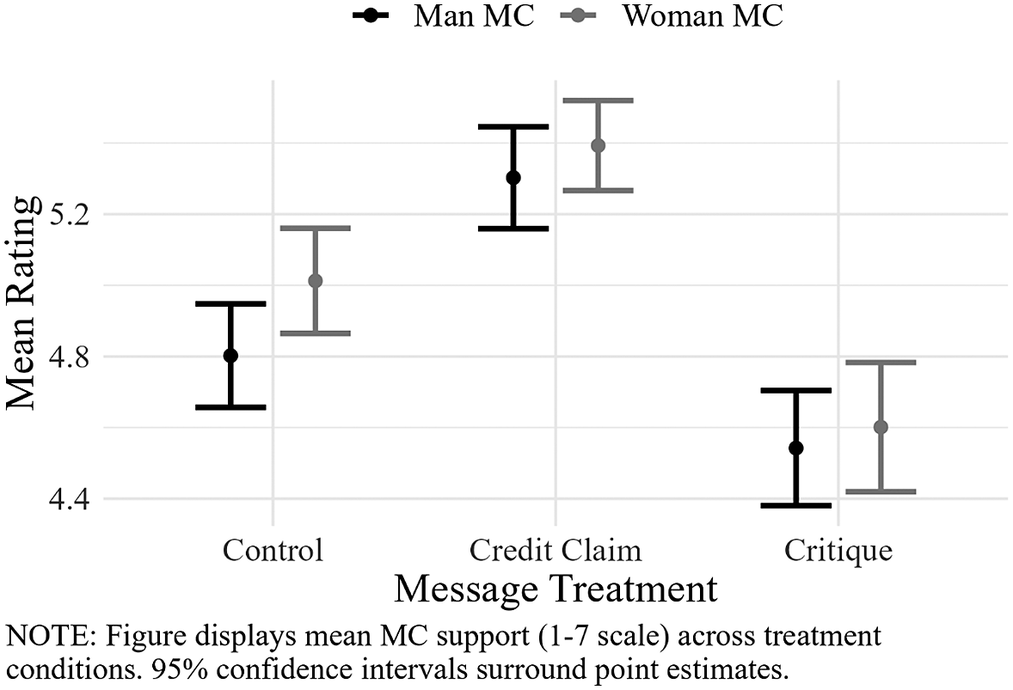
Statistical comparisons shed further light on the findings in Figure 1. Credit claiming increases MC support relative to the control message by an average of 0.38 points (7-point scale) for the woman MC and 0.50 points for the man MC. Conversely, credit claiming with a critique of the spending decreases MC support relative to the normal credit-claiming message by an average of 0.79 points for the woman MC and 0.76 points for the man MC. Using analysis of variance (ANOVA) comparisons with Tukey’s HSD (honest significant difference) corrections to adjust for multiple comparisons, all four of these effects reach statistical significance (p < .05; see Tables A5 and A6 in the Appendix).
However, the man MC condition does not outperform the woman MC condition within any of the substantive treatment conditions. The only difference based on gender appears to be a slight overperformance by women in the control message condition.Footnote 5 ANOVA comparisons with Tukey corrections reveal no statistically significant MC gender-based difference in general support in any of the three substantive conditions (see Table A7 in the Appendix). The substantive treatments have a substantial impact on MC support, but legislator gender does not play a meaningful role in respondents’ reactions to the newspaper except. This pattern of results holds across alternative measures of MC support—binary approve/disapprove and hypothetical vote intention (see Tables A24–A30 in the Appendix). Regardless of measure, I find no evidence of gender effects favoring men over women.
Next, I evaluate the measure of the MC’s perceived ability to pass legislation that helps their community. Credit claiming is designed to increase perceptions of MCs’ influence and effectiveness in Congress, so this measure represents a core element of credit-claiming success. Figure 2 displays the mean of this measure with 95% confidence intervals across gender and the two substantive treatment conditions relevant to H 1 —the control condition and the credit claim condition.
Mean MC effectiveness across treatment group.
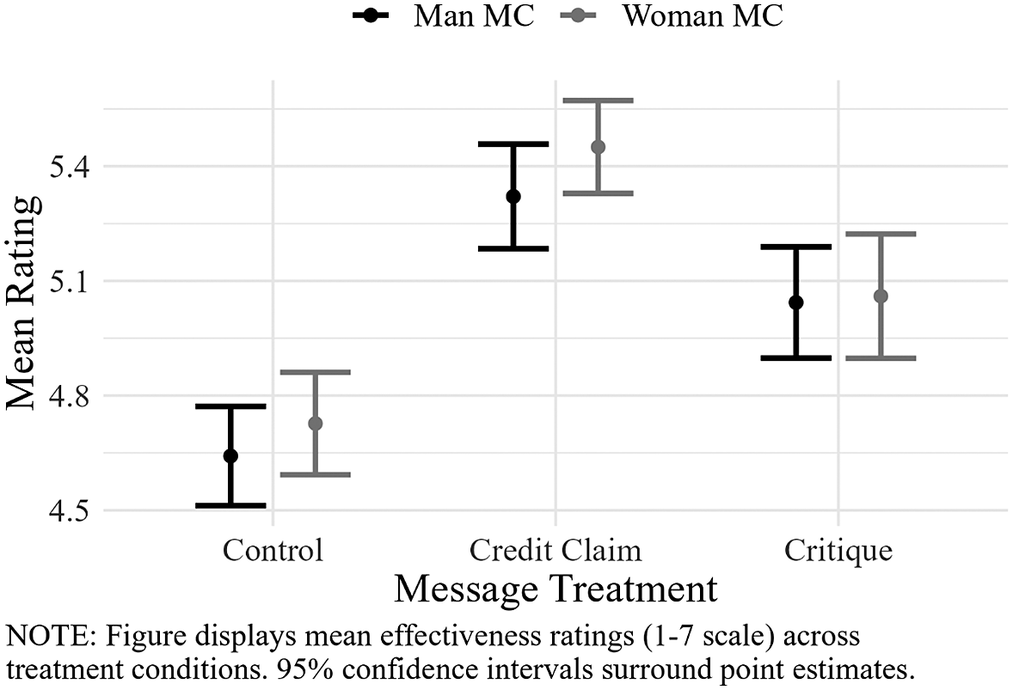
Figure 2 shows that credit claiming substantially boosts public perceptions of MC effectiveness at passing legislation that helps their community. The woman MC’s perceived effectiveness rating increases from an average of 4.73 (on a 1–7 scale) in the control condition to 5.45 in the credit claim condition. Similarly, the man MC’s perceived effectiveness rises from an average of 4.64 in the control condition to 5.32 in the credit claim condition. Thus, the credit claim boost is 0.72 points for the woman MC and 0.68 for the man MC (see Table A12 in the Appendix). Both of these differences are statistically significant (p < .01). However, legislator gender does not appear to play a meaningful role in the effects of credit claiming. The woman MC receives slightly higher effectiveness ratings, on average, than the man MC in both the control condition and the credit claim condition, though neither of these comparisons reaches statistical significance in a difference of means test (see Table A9 in the Appendix). Therefore, results stand in contrast to the expectations of H 1 .
I explore whether women legislators are particularly vulnerable to attacks on their distributive politics efforts as wasteful by analyzing respondents’ perceptions of the legislator’s fiscal responsibility. Figure 3 displays the mean ratings of MC fiscal responsibility across legislator gender for the credit claim condition and credit claim with a spending critique condition. The spending critique does decrease perceptions of MC fiscal responsibility. The woman MC’s average fiscal responsibility rating decreases from 5.17 in the credit claim condition to 4.51 in the credit claim with a critique condition. Similarly, the man MC’s average fiscal responsibility rating drops from 5.01 in the credit claim condition to 4.42 in the credit claim with a critique condition. Both of these comparisons reach statistical significance (p < .01) in an ANOVA analysis with Tukey corrections (see Table A17 in the Appendix). Spending critiques effectively dampen the benefits of credit claiming by portraying the credit-claiming MC as fiscally irresponsible.
Mean MC fiscal responsibility across treatment group.

However, contrary to H 2 , congresswomen do not appear to face a greater downside risk of credit claiming for spending projects compared to congressmen. The difference in mean fiscal responsibility ratings between the credit claim condition and the credit claim with a spending critique condition for the woman MC and the man MC—0.66 and 0.59, respectively—are very similar. Figure 3 indicates that there is not a substantively meaningful legislator gender-based difference in fiscal responsibility ratings within either the credit claim or credit claim with a spending critique condition. Further, difference of means tests confirm the lack of a statistically significant gender effect within each of the substantive conditions (see Table A14 in the Appendix). In both the credit claim and the credit claim with a spending critique conditions, respondents did not rate the woman MC and the man MC differently on fiscal responsibility.Footnote 6 Therefore, I report no support for H 2 .
Rather than indicate the rejection of H 1 and H 2 , the null results on MC gender could instead emerge through research design or implementation issues such as lack of power, problematic measurement of concepts, or respondent inattentiveness. However, I argue that the foregoing results do, in fact, indicate a rejection of the hypotheses. While I did not conduct a pre-experiment power analysis, there are enough observations per message group (approximately 700 per message group) to distinguish even a small gender difference through difference of means testing.Footnote 7 Further, the woman MC technically outperforms the man MC in every comparison shown here, making it unlikely that a lack of power is hiding gender differences favoring the man MC.
On the issue of concept measurement, the measures used to test H 1 and H 2 are established in the literature (Grimmer, Messing, and Westwood Reference Grimmer, Messing and Westwood2012; Grimmer, Westwood, and Messing Reference Grimmer, Westwood and Messing2015). Additionally, that I observe meaningful message treatment effects in the expected direction in all three figures helps validate the study from both a concept measurement and a respondent inattentiveness standpoint. Rather than observe null findings across the board, I replicate previous findings on message treatments. Therefore, I argue that the null findings on MC gender reflect a null relationship rather than a design or implementation issue. The message treatments lead to substantial variation in the dependent variables in the expected directions, while the gender treatment does not lead to variation in the dependent variables.
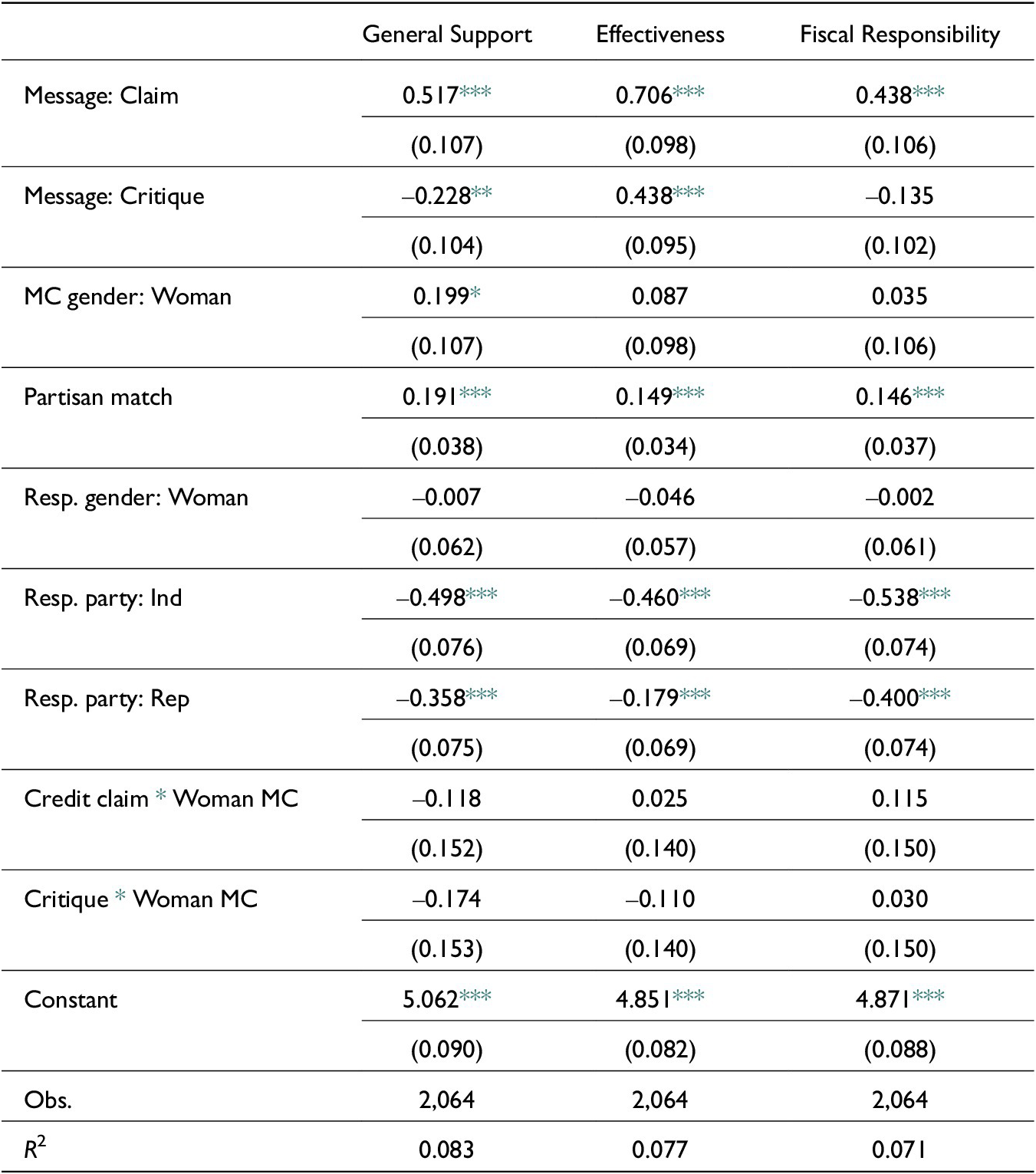
Next, I estimate ordinary least squares regressions with a Substantive Content Treatment * MC Gender Treatment interaction to provide a more direct test of the hypotheses. This modeling strategy tests whether substantive treatment effects are conditioned by legislator gender. In other words, the interaction examines whether the effects of the substantive treatments are different for the woman MC and the man MC. If legislator gender conditions how the public reacts to congressional credit claiming, I should observe a meaningful interaction effect.
Table 1 displays the results of this regression analysis for all three of the dependent variables discussed, with controls for respondent gender and partisan relationship to the MC.Footnote 8 In all three models, I find no evidence of an interaction effect between the substantive treatment and MC gender treatment. The interaction term coefficients are substantively small and do not come close to statistical significance. Credit claiming boosts general MC support and perceptions of the MC’s ability to pass legislation that helps their community, and it does so similarly for men and women legislators. A critique of the spending as wasteful reverses the general support effects of credit claiming and decreases perceptions of MC fiscal responsibility, and there is no gender-based difference in this effect.Footnote 9
Regression with MC gender and message treatment interaction
Notes: Ordinary least squares models. Dependent variable = MC ratings. Standard errors in parentheses.
* p < .1;
** p < .05;
*** p < .01.
Finally, I explore how partisanship impacts the experimental findings by subsetting the analysis by MC party (randomly assigned) and MC copartisan status with the respondent. Distributive politics are interpreted through a partisan lens (Sidman Reference Sidman2019), so subsetting the data by respondent and MC partisanship may yield additional insights. Figure 4 displays general support for the MC across treatment groups for each of the four possible partisan relationships: copartisan Republican MC, non-copartisan Republican MC, copartisan Democratic MC, and non-copartisan Democratic MC. Generally, subsetting by partisanship does not change the result. The message content treatment influences MC support, but MC gender does not. This is particularly true when the MC and respondent are copartisans—MC gender has no influence over copartisan MC support.
Mean MC support across treatment group and party affiliation.
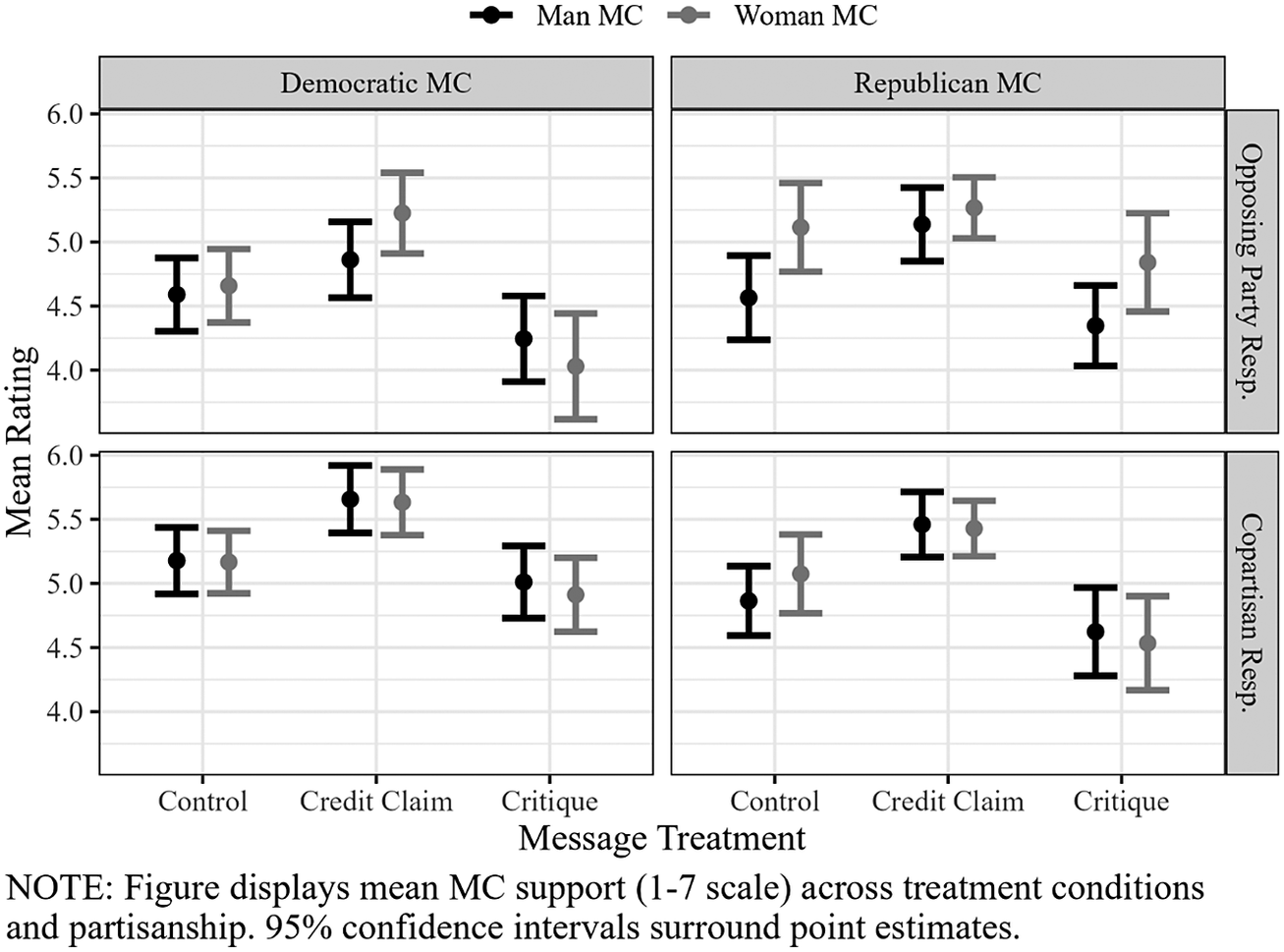
However, Figure 4 suggests a few additional findings. First, the general support advantage of women MCs in the control group observed in Figure 1 appears to stem from the upper-right quadrant of Figure 4. Among Democratic respondents who were assigned a Republican MC and the control message condition, the woman MC condition yielded substantially higher general support ratings than the man MC condition. Second, also in the upper-right quadrant, the woman MC condition yielded substantially higher general support ratings than the man MC condition for the credit claim with a critique message. Subsetting the data by partisanship is non-preregistered exploratory analysis, but these finding offer an interesting pathway for future research. In the messaging environment offered by this research design, Democrats appear to favor Republican congresswomen to Republican congressmen.
In sum, my findings are robust across analyses. The message content treatments influenced general support as well as perceptions of legislator effectiveness and fiscal responsibility, but the legislator gender treatment did not. These findings stand in contrast to the expectations of H 1 and H 2 . Congresswomen face unique challenges in retaining their offices, but their ability to claim credit for federal spending projects appears to equal that of congressmen.
Conclusion
This study advances the congressional representation and gender and politics literatures by clarifying the role of legislator gender in credit claiming for distributive benefits. I develop a theory for how legislator gender might influence public reactions to congressional credit claiming. I design and field a survey experiment to test this theory, and I find that legislator gender does not meaningfully impact the effectiveness of credit claiming for distributive benefits.
Facing gendered vulnerability in elections, women legislators tend to outperform their male colleagues on representational tasks, such as securing district funding projects (Lazarus and Steigerwalt Reference Lazarus and Steigerwalt2018). My findings suggest that women legislators can effectively use a distributive politics strategy for ameliorating gendered vulnerability in congressional elections. Women MCs can boost their public support through credit claiming at a similar rate as men MCs, and spending critiques do not have a particularly damaging effect on congresswomen. My findings comport with a recent study in a different political landscape. Using a conjoint experiment to study the effect of legislator gender in perceptions of member of Parliament (MP) productivity in Britain, Hargrave and Smith (Reference Hargrave and Smith2023) find that voters prefer productive MPs, but “unproductive men do not receive more positive evaluations than unproductive women, nor are productive men rewarded for their efforts any more than productive women.”Footnote 10 For voters in the United States and United Kingdom, the positive public opinion benefits of effective representation are not conditioned by legislator gender. Therefore, the findings of this study plausibly generalize to other countries: effective representation is a useful tool for both women and men legislators to build public support.
The rejection of both hypotheses was unexpected, though it does follow a recent trend in the literature. Individual experiments expecting to find gender differences favoring men have uncovered similar findings to those reported above (e.g., Teele, Kalla, and Rosenbluth Reference Teele, Kalla and Rosenbluth2018), and a meta-analysis of 67 conjoint and factorial candidate-choice experiments concludes that “the average effect of being a woman (vs. a man) is an approximately 2 percentage point increase in support” (Schwarz and Coppock Reference Schwarz and Coppock2022, 657). Gender stereotypes do harm women candidates on specific trait evaluations such as competence and leadership (Bauer Reference Bauer2020; Dittmar Reference Dittmar2015; Meeks Reference Meeks2012; Schneider and Bos Reference Schneider and Bos2014), but women candidates do not appear to face an overall gender bias in elections. This study fits into the literature by showing that legislative effectiveness, fiscal responsibility, and credit-claiming ability do not fall into the gender stereotype category of findings. Instead these results align more closely with the findings from candidate-choice experiments. Congresswomen’s credit claims are just as effective as those of congressmen and do not carry more downside risk of spending critics.
One explanation for these findings is that women legislators’ representational advantage has been internalized by the public. A recent study uses a field experiment to find constituents expect women legislators to do more work than men legislators (Butler, Naurin, and Öhberg Reference Butler, Naurin and Öhberg2022). Increased expectations for women legislators could result from or lead to women legislators’ overperformance on representational tasks. In either case, constituents appear to both expect and receive greater effective representation from women legislators. The high standard set for women legislators may counter gender stereotypes on trait evaluations, leading to the null findings displayed above. Further research might explore whether this is the case and, if so, the consequences of a higher representational standard for women legislators.
By exploring both the potential upside and downside of congressional credit claiming through the lens of legislator gender, this study sheds new light on the dynamics of gender, legislative representation, and elections. Extant research shows that congresswomen outperform congressmen on representational tasks (Anzia and Berry Reference Anzia and Berry2011; Lazarus and Steigerwalt Reference Lazarus and Steigerwalt2018; Volden, Wiseman, and Manganiello Reference Volden, Wiseman and Wittmer2013). Their overperformance on representational tasks leads to additional credit-claiming opportunities, and congresswomen do, in fact, claim credit more than congressmen (Dolan and Kropf Reference Dolan and Kropf2004). This study extends this line of research by showing that women legislators do not face gender stereotypes while credit claiming—the upside and downside of credit claiming is not conditioned by legislator gender. The implication of this study, therefore, is that congresswomen can turn their representational advantage into an electoral advantage. However, additional research is needed to further flesh out this claim. To clarify how these independent findings actually influence the ballot box, further research must explore how credit claiming aggregates over time to shape legislator evaluations and influence electoral outcomes.
This study advances the credit-claiming literature by adding a gender dimension to previous experimental designs, but it hold constant aspects of credit claiming that deserve further attention. For instance, the topic of the federal grant being claimed, transportation, is less likely to evoke stereotypes than more gendered policy issues like military bases. If the results obtained here hold regardless of the topic of spending, women may be able to mitigate gender stereotypes on certain policy issues through credit claiming. Alternatively, women may face a credit-claiming barrier when claiming credit for a more gendered type of spending. By varying the type of project being claimed, future research can test this question. Finally, an important limitation of this research is the use of only stereotypically white legislators’ names in the experimental vignettes. The role of race and ethnicity in credit claiming is an important venue for further research. Credit claiming for distributive benefits remains a core strategy that legislators use to build public support, and the ways in which this strategy interacts with identity deserve further investigation.
Supplementary material
The supplementary material for this article can be found at http://doi.org/10.1017/S1743923X23000582.
Acknowledgments
This research was made possible by a Carrie Chapman Catt Prize for Research on Women and Politics from the Carrie Chapman Catt Center for Women and Politics at Iowa State University. I thank Rachel Blum, Michael Crespin, Nathan Barron, and the anonymous reviewers for their helpful suggestions.
Competing interest
The author has no conflicts of interest to declare that are relevant to the content of this article.


 Open access

