





1 Introduction
Let S be a K3 surface, v a Mukai vector, and w an integer. The purpose of this paper is to introduce and study a category
 $$ \begin{align} \mathbb{T}=\mathbb{T}_S(v)_w^{\mathrm{{red}}} \end{align} $$
called (reduced) quasi-BPS category. When v is primitive, (1.1) is equivalent to the derived category of twisted sheaves over the moduli space M of stable objects on S with Mukai vector v, which is a holomorphic symplectic manifold. When v is not necessarily primitive, but w is coprime to v, we show that $\mathbb {T}$
is proper, smooth, and has trivial Serre functor étale locally on the good moduli space M of semistable objects with Mukai vector v, which is a singular symplectic variety. (Here we say that a functor is trivial if it is isomorphic to a shift functor). So we obtain a category
$\mathbb {T}$
is proper, smooth, and has trivial Serre functor étale locally on the good moduli space M of semistable objects with Mukai vector v, which is a singular symplectic variety. (Here we say that a functor is trivial if it is isomorphic to a shift functor). So we obtain a category $\mathbb {T}$
which we regard as a (twisted) categorical (étale locally) crepant resolution of singularities of M.
$\mathbb {T}$
which we regard as a (twisted) categorical (étale locally) crepant resolution of singularities of M.
The construction of the category (1.1) is motivated by enumerative geometry: quasi-BPS categories are a categorical replacement of BPS cohomologies [Reference Davison and MeinhardtDM20, Reference DavisonDava, Reference Kinjo and KosekiKK, Reference DavisonDHSMb, Reference Davison, Hennecart and Schlegel MejiaDHSMa], constructed from semiorthogonal decompositions of derived categories of moduli stacks of semistable sheaves which approximate the PBW theorem in cohomological Donaldson-Thomas (DT) theory studied in loc. cit. Below, we first mention our main results, and then explain how the construction of the category (1.1) is motivated by DT theory and the study of singular symplectic varieties.
1.1 Semiorthogonal decompositions into quasi-BPS categories
The main result of this paper is Theorem 1.2. Before stating it, we introduce quasi-BPS categories as building blocks of the derived category of coherent sheaves on the moduli of semistable sheaves on a K3 surface.
For a K3 surface S, let
 $$ \begin{align*}\mathrm{Stab}(S) \end{align*} $$
be the main connected component of the space of Bridgeland stability conditions [Reference BridgelandBri08] on $D^b(S)$
. Let
$D^b(S)$
. Let $\Gamma =\mathbb {Z} \oplus \mathrm {NS}(S) \oplus \mathbb {Z}$
be the Mukai lattice. For
$\Gamma =\mathbb {Z} \oplus \mathrm {NS}(S) \oplus \mathbb {Z}$
be the Mukai lattice. For $\sigma \in \mathrm {Stab}(S)$
and
$\sigma \in \mathrm {Stab}(S)$
and $v \in \Gamma $
, consider the moduli stacks
$v \in \Gamma $
, consider the moduli stacks
 $$ \begin{align*} \mathfrak{M}_S^{\sigma}(v) \hookleftarrow \mathcal{M}_S^{\sigma}(v) \to M_S^{\sigma}(v), \end{align*} $$
where $\mathfrak {M}_S^{\sigma }(v)$
is the derived moduli stack of
$\mathfrak {M}_S^{\sigma }(v)$
is the derived moduli stack of $\sigma $
-semistable objects in
$\sigma $
-semistable objects in $D^b(S)$
with Mukai vector v,
$D^b(S)$
with Mukai vector v, $\mathcal {M}_S^{\sigma }(v)$
is its classical truncation, and
$\mathcal {M}_S^{\sigma }(v)$
is its classical truncation, and $M_S^{\sigma }(v)$
is its good moduli space. Below we write
$M_S^{\sigma }(v)$
is its good moduli space. Below we write $v=dv_0$
for
$v=dv_0$
for $d \in \mathbb {Z}_{{\geqslant } 1}$
and
$d \in \mathbb {Z}_{{\geqslant } 1}$
and $v_0$
a primitive Mukai vector with
$v_0$
a primitive Mukai vector with $\langle v_0, v_0\rangle =2g-2$
. We say
$\langle v_0, v_0\rangle =2g-2$
. We say $w\in \mathbb {Z}$
is coprime with v if
$w\in \mathbb {Z}$
is coprime with v if $\gcd (w,d)=1$
. We use the following structures on the derived category of
$\gcd (w,d)=1$
. We use the following structures on the derived category of $\mathfrak {M}_S^{\sigma }(v)$
:
$\mathfrak {M}_S^{\sigma }(v)$
:
(The weight decomposition): every point in $\mathfrak {M}_S^{\sigma }(v)$
admits scalar automorphisms
$\mathfrak {M}_S^{\sigma }(v)$
admits scalar automorphisms $\mathbb {C}^{\ast }$
, and thus there is an orthogonal decomposition of
$\mathbb {C}^{\ast }$
, and thus there is an orthogonal decomposition of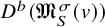 $D^b(\mathfrak {M}_S^{\sigma }(v))$
into
$D^b(\mathfrak {M}_S^{\sigma }(v))$
into $\mathbb {C}^{\ast }$
-weight categories
$\mathbb {C}^{\ast }$
-weight categories
 $$ \begin{align*} D^b(\mathfrak{M}_S^{\sigma}(v))=\bigoplus_{w\in \mathbb{Z}} D^b(\mathfrak{M}_S^{\sigma}(v))_w. \end{align*} $$
(The categorical Hall product): for a decomposition $d=d_1+\cdots +d_k$
, the stack of filtrations of
$d=d_1+\cdots +d_k$
, the stack of filtrations of $\sigma $
-semistable objects induces the categorical Hall product defined by Porta-Sala [Reference Porta and SalaPS23]:
$\sigma $
-semistable objects induces the categorical Hall product defined by Porta-Sala [Reference Porta and SalaPS23]:
 $$ \begin{align} \boxtimes_{i=1}^k D^b(\mathfrak{M}_S^{\sigma}(d_i v_0)) \to D^b(\mathfrak{M}_S^{\sigma}(v)). \end{align} $$
Quasi-BPS categories are defined using certain weight conditions. They can be alternatively defined inductively using the following theorem (Theorem 1.1), which is a categorical analogue of a theorem of Davison–Hennecart–Schlegel Mejia [Reference DavisonDHSMb, Theorem 1.5], who proved that the cohomological Hall algebra of a K3 surface is generated by its BPS cohomology.
Theorem 1.1. (Theorem 5.1)
Let $\sigma \in \mathrm {Stab}(S)$
be a generic stability condition. Then there exists a subcategory (called quasi-BPS category)
$\sigma \in \mathrm {Stab}(S)$
be a generic stability condition. Then there exists a subcategory (called quasi-BPS category)
 $$ \begin{align} \mathbb{T}_S^{\sigma}(v)_w \subset D^b\left(\mathfrak{M}_S^{\sigma}(v)\right)_w \end{align} $$
with the following properties. First, if v is primitive, then $\mathbb {T}_S^{\sigma }(v)_w= D^b\left (\mathfrak {M}_S^{\sigma }(v)\right )_w$
. Second, for general v, there is a semiorthogonal decomposition
$\mathbb {T}_S^{\sigma }(v)_w= D^b\left (\mathfrak {M}_S^{\sigma }(v)\right )_w$
. Second, for general v, there is a semiorthogonal decomposition
 $$ \begin{align} D^b\left(\mathfrak{M}_S^{\sigma}(v)\right) =\left\langle \boxtimes_{i=1}^k \mathbb{T}_{S}^{\sigma}(d_i v_0)_{w_i+(g-1)d_i(\sum_{i>j}d_j-\sum_{i<j}d_j)} \right\rangle. \end{align} $$
The right-hand side is after all partitions $(d_i)_{i=1}^k$
of d and all weights
$(d_i)_{i=1}^k$
of d and all weights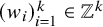 $(w_i)_{i=1}^k\in \mathbb {Z}^k$
such that
$(w_i)_{i=1}^k\in \mathbb {Z}^k$
such that
 $$\begin{align*}\frac{w_1}{d_1}<\cdots<\frac{w_k}{d_k},\end{align*}$$
and each fully faithful functor in (1.4) is given by the categorical Hall product (1.2).
The summands in the semiorthogonal decomposition (1.4) are in bijection with convex paths of lattice points between the origin and $(w,d)$
. The order of the summands in the semiorthogonal decomposition is the same as the natural partial order on such convex paths, see Remark 3.5.
$(w,d)$
. The order of the summands in the semiorthogonal decomposition is the same as the natural partial order on such convex paths, see Remark 3.5.
The category $\mathbb {T}_S^{\sigma }(v)_w$
is uniquely determined by the semiorthogonal decomposition (1.4). Locally on
$\mathbb {T}_S^{\sigma }(v)_w$
is uniquely determined by the semiorthogonal decomposition (1.4). Locally on $M_S^{\sigma }(v)$
, the category
$M_S^{\sigma }(v)$
, the category $\mathbb {T}_S^{\sigma }(v)_w$
is defined to be the subcategory of objects which are Koszul dual to matrix factorizations with some weight conditions for the maximal torus of the stabilizer groups. Such a subcategory was first considered by Špenko–Van den Bergh [Reference Špenko and Van den BerghŠVdB17] to construct noncommutative crepant resolutions of quotients of quasi-symmetric representations by reductive groups. It was later used in [Reference Halpern-Leistner and SamHLS20] to prove the “magic window theorem” for GIT quotient stacks, and in [Reference PădurariuPăda] to give PBW type decompositions for categorical (and K-theoretic) Hall algebras of symmetric quivers with potential.
$\mathbb {T}_S^{\sigma }(v)_w$
is defined to be the subcategory of objects which are Koszul dual to matrix factorizations with some weight conditions for the maximal torus of the stabilizer groups. Such a subcategory was first considered by Špenko–Van den Bergh [Reference Špenko and Van den BerghŠVdB17] to construct noncommutative crepant resolutions of quotients of quasi-symmetric representations by reductive groups. It was later used in [Reference Halpern-Leistner and SamHLS20] to prove the “magic window theorem” for GIT quotient stacks, and in [Reference PădurariuPăda] to give PBW type decompositions for categorical (and K-theoretic) Hall algebras of symmetric quivers with potential.
We regard the subcategory (1.3) as a global version of these categories in the case of moduli stacks of semistable objects on K3 surfaces. The main tool in investigating the category (1.3) is its local description via categories of matrix factorizations on the moduli stacks of representations of Ext-quivers of $\sigma $
-polystable objects. We study quasi-BPS categories in this local context in [Reference PădurariuPTc].
$\sigma $
-polystable objects. We study quasi-BPS categories in this local context in [Reference PădurariuPTc].
1.2 Quasi-BPS categories for reduced stacks
The derived stack $\mathfrak {M}_S^{\sigma }(v)$
is never classical because of the existence of the trace map
$\mathfrak {M}_S^{\sigma }(v)$
is never classical because of the existence of the trace map $\operatorname {Ext}^2(E, E) \twoheadrightarrow \mathbb {C}$
for any nonzero object
$\operatorname {Ext}^2(E, E) \twoheadrightarrow \mathbb {C}$
for any nonzero object $E \in D^b(S)$
. Let
$E \in D^b(S)$
. Let
 $$ \begin{align*} \mathfrak{M}_S^{\sigma}(v)^{\mathrm{{red}}} \hookrightarrow \mathfrak{M}_S^{\sigma}(v) \end{align*} $$
be the reduced derived stack, which roughly speaking is obtained by taking the traceless part of its obstruction theory. By [Reference Kaledin, Lehn and SorgerKLS06], it is known that the reduced derived stack is classical when $g{\geqslant } 2$
. We also have a reduced version of the quasi-BPS category
$g{\geqslant } 2$
. We also have a reduced version of the quasi-BPS category
 $$ \begin{align} \mathbb{T}_S^{\sigma}(v)^{\mathrm{{red}}}_w \subset D^b\left(\mathfrak{M}_S^{\sigma}(v)^{\mathrm{{red}}}\right)_w \end{align} $$
and a reduced version of the semiorthogonal decomposition (1.4), see Theorem 5.2. When v is primitive, we have
 $$ \begin{align} \mathbb{T}_S^{\sigma}(v)^{\mathrm{{red}}}_w=D^b\left(M_S^{\sigma}(v), \alpha^w\right), \end{align} $$
where $\alpha $
is the Brauer class which represents the obstruction to the existence of a universal object, and
$\alpha $
is the Brauer class which represents the obstruction to the existence of a universal object, and $M_S^{\sigma }(v)$
is a projective holomorphic symplectic manifold [Reference MukaiMuk87, Reference Bayer and MacrìBM14]. From the above description, we have the following properties of the category (1.5) when v is primitive: (i) the category
$M_S^{\sigma }(v)$
is a projective holomorphic symplectic manifold [Reference MukaiMuk87, Reference Bayer and MacrìBM14]. From the above description, we have the following properties of the category (1.5) when v is primitive: (i) the category $\mathbb {T}_S^{\sigma }(v)^{\mathrm {{red}}}_w$
is smooth and proper; (ii) the Serre functor
$\mathbb {T}_S^{\sigma }(v)^{\mathrm {{red}}}_w$
is smooth and proper; (ii) the Serre functor $S_{\mathbb {T}}$
of
$S_{\mathbb {T}}$
of $\mathbb {T}_S^{\sigma }(v)^{\mathrm {{red}}}_w$
is isomorphic to the shift functor
$\mathbb {T}_S^{\sigma }(v)^{\mathrm {{red}}}_w$
is isomorphic to the shift functor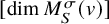 $[\dim M_S^{\sigma }(v)]$
; and (iii) by Halpern-Leistner [Reference Halpern-LeistnerHLa], the category
$[\dim M_S^{\sigma }(v)]$
; and (iii) by Halpern-Leistner [Reference Halpern-LeistnerHLa], the category $\mathbb {T}_S^{\sigma }(v)^{\mathrm {{red}}}_w$
is independent of
$\mathbb {T}_S^{\sigma }(v)^{\mathrm {{red}}}_w$
is independent of $\sigma $
up to equivalence. The proof of the above properties relies on the description (1.6) for primitive v, and a priori there is no reason that these properties hold for nonprimitive v. Nevertheless, we have the following:
$\sigma $
up to equivalence. The proof of the above properties relies on the description (1.6) for primitive v, and a priori there is no reason that these properties hold for nonprimitive v. Nevertheless, we have the following:
Theorem 1.2. (Corollary 6.8, Theorem 7.4, Theorem 4.8)
Suppose that $g{\geqslant } 2$
,
$g{\geqslant } 2$
, $\sigma , \sigma '\in \mathrm {Stab}(S)$
are generic stability conditions, and w is coprime to v. Then:
$\sigma , \sigma '\in \mathrm {Stab}(S)$
are generic stability conditions, and w is coprime to v. Then:
(i) (smooth and properness): the category $\mathbb {T}_S^{\sigma }(v)_w^{\mathrm {{red}}}$
is smooth and proper;
$\mathbb {T}_S^{\sigma }(v)_w^{\mathrm {{red}}}$
is smooth and proper;
(ii) (étale locally trivial Serre functor): the Serre functor $S_{\mathbb {T}}$
of
$S_{\mathbb {T}}$
of $\mathbb {T}_S^{\sigma }(v)^{\mathrm {{red}}}_w$
is trivial étale locally on
$\mathbb {T}_S^{\sigma }(v)^{\mathrm {{red}}}_w$
is trivial étale locally on $M_S^{\sigma }(v)$
;
$M_S^{\sigma }(v)$
;
(iii) (wall-crossing equivalence): there is an equivalence $\mathbb {T}_S^{\sigma }(v)_w^{\mathrm {{red}}} \simeq \mathbb {T}_S^{\sigma '}(v)_w^{\mathrm {{red}}}$
. Hence we may write the quasi-BPS category as
$\mathbb {T}_S^{\sigma }(v)_w^{\mathrm {{red}}} \simeq \mathbb {T}_S^{\sigma '}(v)_w^{\mathrm {{red}}}$
. Hence we may write the quasi-BPS category as $\mathbb {T}_S(v)_w^{\mathrm {{red}}}$
.
$\mathbb {T}_S(v)_w^{\mathrm {{red}}}$
.
The key point in the proof of (i) above is Lemma 6.6 (the categorical support lemma), which says that any object in $\mathbb {T}_S(v)_w^{\mathrm {{red}}}$
has a nilpotent singular support if w is coprime to v. By combining with the strong generation, we conclude that
$\mathbb {T}_S(v)_w^{\mathrm {{red}}}$
has a nilpotent singular support if w is coprime to v. By combining with the strong generation, we conclude that $\mathbb {T}_S(v)_w^{\mathrm {{red}}}$
is smooth and proper if w is coprime to v. In particular, it admits a Serre functor
$\mathbb {T}_S(v)_w^{\mathrm {{red}}}$
is smooth and proper if w is coprime to v. In particular, it admits a Serre functor $S_{\mathbb {T}}$
. We expect that
$S_{\mathbb {T}}$
. We expect that $S_{\mathbb {T}}$
is globally isomorphic to
$S_{\mathbb {T}}$
is globally isomorphic to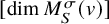 $[\dim M_S^{\sigma }(v)]$
. However, currently there is a technical subtlety of proving this, and we only prove it is trivial étale locally in (ii). Globally, we prove an isomorphism
$[\dim M_S^{\sigma }(v)]$
. However, currently there is a technical subtlety of proving this, and we only prove it is trivial étale locally in (ii). Globally, we prove an isomorphism $S_{\mathbb {T}}\cong [\dim M_S^{\sigma }(v)]$
on the level of cohomologies, see Corollary 7.12, and also for perfect complexes, see Corollary 7.13. In view of parts (i) and (ii) of Theorem 1.2, we view
$S_{\mathbb {T}}\cong [\dim M_S^{\sigma }(v)]$
on the level of cohomologies, see Corollary 7.12, and also for perfect complexes, see Corollary 7.13. In view of parts (i) and (ii) of Theorem 1.2, we view $\mathbb {T}_S(v)^{\mathrm {red}}_w$
as a categorical version of a crepant resolution of
$\mathbb {T}_S(v)^{\mathrm {red}}_w$
as a categorical version of a crepant resolution of $M^\sigma _S(v).$
It is an interesting question to see the relation between (reduced) quasi-BPS categories and categorical crepant resolutions in the sense of Kuznetsov [Reference KuznetsovKuz14] or noncommutative crepant resolutions in the sense of Van den Bergh [Reference Van den BerghVdB]. We plan to investigate this relation in future work.
The main tool in proving Theorem 1.2 is its local version for stacks of representations of preprojective algebras constructed from Ext-quivers of $\sigma $
-polystable objects, see [Reference PădurariuPTc]. Along the way, we obtain generation statements for singular support quotient categories of more general quasi-smooth stacks that may be of independent interest, see Theorem 6.11.
$\sigma $
-polystable objects, see [Reference PădurariuPTc]. Along the way, we obtain generation statements for singular support quotient categories of more general quasi-smooth stacks that may be of independent interest, see Theorem 6.11.
1.3 Topological K-theory of quasi-BPS categories
We finally relate topological K-theory of quasi-BPS category with the cohomology of the BPS sheaf $\mathcal {BPS}_v$
on
$\mathcal {BPS}_v$
on $M_S^{\sigma }(v)$
studied in [Reference DavisonDHSMb] (i.e., with BPS cohomology). Note that
$M_S^{\sigma }(v)$
studied in [Reference DavisonDHSMb] (i.e., with BPS cohomology). Note that $\mathcal {BPS}_v=\mathrm {IC}_{M_S^{\sigma }(v)}=\mathbb {Q}_{M_S^{\sigma }(v)}[\dim M_S^{\sigma }(v)]$
if v is a primitive Mukai vector and
$\mathcal {BPS}_v=\mathrm {IC}_{M_S^{\sigma }(v)}=\mathbb {Q}_{M_S^{\sigma }(v)}[\dim M_S^{\sigma }(v)]$
if v is a primitive Mukai vector and $\sigma $
is generic, and in general it is a semisimple perverse sheaf which contains
$\sigma $
is generic, and in general it is a semisimple perverse sheaf which contains $\mathrm {IC}_{M_S^{\sigma }(v)}$
as a proper direct summand. Here
$\mathrm {IC}_{M_S^{\sigma }(v)}$
as a proper direct summand. Here $\mathrm {IC}_{M_S^{\sigma }(v)}$
is the intersection complex of
$\mathrm {IC}_{M_S^{\sigma }(v)}$
is the intersection complex of $M_S^{\sigma }(v)$
.
$M_S^{\sigma }(v)$
.
For a dg-category $\mathcal {D}$
and
$\mathcal {D}$
and $i\in \mathbb {Z}$
, we denote by
$i\in \mathbb {Z}$
, we denote by $K_i^{\mathrm {{top}}}(\mathcal {D})$
the topological K-theory of
$K_i^{\mathrm {{top}}}(\mathcal {D})$
the topological K-theory of $\mathcal {D}$
defined by Blanc [Reference BlancBla16]. We prove the following:
$\mathcal {D}$
defined by Blanc [Reference BlancBla16]. We prove the following:
Theorem 1.3. (Theorem 8.1)
Suppose that $\sigma $
is a generic Gieseker stability condition,
$\sigma $
is a generic Gieseker stability condition, $g{\geqslant } 2$
, and w is coprime to v. For
$g{\geqslant } 2$
, and w is coprime to v. For $i\in \mathbb {Z}$
, we have the identity:
$i\in \mathbb {Z}$
, we have the identity:
 $$ \begin{align*} &\dim K_{i}^{\mathrm{{top}}}(\mathbb{T}_S^{\sigma}(v)_w) = \sum_{j\in \mathbb{Z}}\dim H^{i+2j}(M_S^{\sigma}(v), \mathcal{BPS}_v). \end{align*} $$
The above result is motivated by categorification of BPS invariants in Donaldson-Thomas theory, which will be explained in the next subsection. We regard Theorem 1.3 as a weight-independence phenomenon reminiscent of the (numerical and cohomological) $\chi $
-independence phenomenon [Reference Maulik and TodaMT18b, Reference TodaTod23b, Reference Maulik and ShenMS23, Reference Kinjo and KosekiKK]. It is an interesting problem to define a primitive part
$\chi $
-independence phenomenon [Reference Maulik and TodaMT18b, Reference TodaTod23b, Reference Maulik and ShenMS23, Reference Kinjo and KosekiKK]. It is an interesting problem to define a primitive part $\mathrm {P}K^{\mathrm {top}}_i(\mathbb {T}_S^{\sigma }(v)_w)\subset K^{\mathrm {top}}_i(\mathbb {T}_S^{\sigma }(v)_w)$
whose dimension is independent for all weights
$\mathrm {P}K^{\mathrm {top}}_i(\mathbb {T}_S^{\sigma }(v)_w)\subset K^{\mathrm {top}}_i(\mathbb {T}_S^{\sigma }(v)_w)$
whose dimension is independent for all weights $w\in \mathbb {Z}$
.
$w\in \mathbb {Z}$
.
Theorem 1.3 can be seen as part of the more general problem of categorifying perverse sheaves of interest [Reference PădurariuPTe, Reference PădurariuPădb]. Such a problem is the first step in categorifying instances of the BBDG decomposition theorem [Reference Beilinson, Bernstein and DeligneBBD82]. In the context of good moduli space maps for objects in certain Calabi-Yau $2$
-categories, a BBDG-type decomposition theorem was proved by Davison [Reference DavisonDavc]. Theorem 1.1 can be seen as a partial categorification of the decomposition theorem for the good moduli space map
$2$
-categories, a BBDG-type decomposition theorem was proved by Davison [Reference DavisonDavc]. Theorem 1.1 can be seen as a partial categorification of the decomposition theorem for the good moduli space map $\mathcal {M}^\sigma _S(v) \to M^\sigma _S(v)$
.
$\mathcal {M}^\sigma _S(v) \to M^\sigma _S(v)$
.
1.4 Motivation from Donaldson-Thomas theory
We now explain how the study of quasi-BPS categories is motivated by DT theory. Let X be a smooth Calabi-Yau 3-fold. For a given numerical class v and a stability condition $\sigma $
on
$\sigma $
on $D^b(X)$
, the DT invariant is defined to be a rational number
$D^b(X)$
, the DT invariant is defined to be a rational number
 $$ \begin{align} \mathrm{DT}^{\sigma}(v) \in \mathbb{Q} \end{align} $$
which virtually counts $\sigma $
-semistable (compactly supported) objects with numerical class v, see [Reference ThomasTho00, Reference Joyce and SongJS12, Reference Piyaratne and TodaPT19]. It is defined via the moduli stack
$\sigma $
-semistable (compactly supported) objects with numerical class v, see [Reference ThomasTho00, Reference Joyce and SongJS12, Reference Piyaratne and TodaPT19]. It is defined via the moduli stack $\mathcal {M}_X^{\sigma }(v)$
of
$\mathcal {M}_X^{\sigma }(v)$
of $\sigma $
-semistable objects with numerical class v or its good moduli space
$\sigma $
-semistable objects with numerical class v or its good moduli space
 $$\begin{align*}\mathcal{M}_X^{\sigma}(v) \to M_X^{\sigma}(v).\end{align*}$$
When $\sigma $
-semistable objects coincide with
$\sigma $
-semistable objects coincide with $\sigma $
-stable objects (e.g., v is primitive and
$\sigma $
-stable objects (e.g., v is primitive and $\sigma $
is generic), then the DT invariant is an integer and can be also computed as
$\sigma $
is generic), then the DT invariant is an integer and can be also computed as
 $$ \begin{align*} \mathrm{DT}^{\sigma}(v)=\int_{[M_X^{\sigma}(v)]^{\mathrm{{vir}}}}1 = \int_{M_X^{\sigma}(v)} \chi_B \ de \in \mathbb{Z}, \end{align*} $$
where $\chi _B$
is the Behrend constructible function [Reference BehrendBeh09]. Otherwise, (1.7) is defined as the weighted Euler characteristic with respect to the Behrend function of the ‘log’ of
$\chi _B$
is the Behrend constructible function [Reference BehrendBeh09]. Otherwise, (1.7) is defined as the weighted Euler characteristic with respect to the Behrend function of the ‘log’ of $\mathcal {M}_X^{\sigma }(v)$
in the motivic Hall algebra, see [Reference Joyce and SongJS12].
$\mathcal {M}_X^{\sigma }(v)$
in the motivic Hall algebra, see [Reference Joyce and SongJS12].
For a generic $\sigma $
, the BPS invariant
$\sigma $
, the BPS invariant $\Omega ^{\sigma }(v)$
is inductively defined by the multiple cover formula
$\Omega ^{\sigma }(v)$
is inductively defined by the multiple cover formula
 $$ \begin{align*} \mathrm{DT}^{\sigma}(v)=\sum_{k{\geqslant} 1, k|v}\frac{1}{k^2} \Omega^{\sigma}(v/k). \end{align*} $$
Although (1.7) is a rational number in general, the BPS number $\Omega ^{\sigma }(v)$
is an integer. The integrality of
$\Omega ^{\sigma }(v)$
is an integer. The integrality of $\Omega ^{\sigma }(v)$
is conjectured in [Reference Kontsevich and SoibelmanKS, Conjecture 6], [Reference Joyce and SongJS12, Conjecture 6.12] and proved in [Reference Davison and MeinhardtDM20] combined with [Reference TodaTod13]. We address the following categorification problem of BPS invariants:
$\Omega ^{\sigma }(v)$
is conjectured in [Reference Kontsevich and SoibelmanKS, Conjecture 6], [Reference Joyce and SongJS12, Conjecture 6.12] and proved in [Reference Davison and MeinhardtDM20] combined with [Reference TodaTod13]. We address the following categorification problem of BPS invariants:
Problem 1.1. Is there a dg-category $\mathbb {T}^{\sigma }(v)$
which recovers
$\mathbb {T}^{\sigma }(v)$
which recovers $\Omega ^{\sigma }(v)$
by taking the Euler characteristic of an additive invariant, for example,
$\Omega ^{\sigma }(v)$
by taking the Euler characteristic of an additive invariant, for example,
 $$\begin{align*}\chi(K^{\mathrm{{top}}}(\mathbb{T}^{\sigma}(v))):=\dim_{\mathbb{Q}} K_0^{\mathrm{{top}}}(\mathbb{T}^{\sigma}(v))_{\mathbb{Q}}-\dim_{\mathbb{Q}} K_1^{\mathrm{{top}}}(\mathbb{T}^{\sigma}(v))_{\mathbb{Q}}= -\Omega^{\sigma}(v)?\end{align*}$$
The above problem is open even if v is primitive, and in this case it is related to the gluing problem of matrix factorizations, see [Reference TodaTod24a] for the case of local surfaces and [Reference Hennion, Holstein and RobaloHHR] for work in progress addressing the general case.
Now, for a K3 surface S, we consider the local K3 surface
 $$ \begin{align} X=\mathrm{Tot}_S(K_S)=S \times \mathbb{A}^1_{\mathbb{C}}. \end{align} $$
The ( $\mathbb {C}^{\ast }$
-equivariant) DT category for the moduli stack
$\mathbb {C}^{\ast }$
-equivariant) DT category for the moduli stack $\mathcal {M}_X^{\sigma }(v)$
is defined in [Reference TodaTod24a] via categorical dimensional reduction
$\mathcal {M}_X^{\sigma }(v)$
is defined in [Reference TodaTod24a] via categorical dimensional reduction
 $$ \begin{align*} \mathcal{DT}(\mathcal{M}_X^{\sigma}(v)):=D^b(\mathfrak{M}_S^{\sigma}(v)). \end{align*} $$
We regard the subcategory $\mathbb {T}_S^{\sigma }(v)_w \subset \mathcal {DT}(\mathcal {M}_X^{\sigma }(v))$
as a categorification of the BPS invariant for local K3 surface when
$\mathbb {T}_S^{\sigma }(v)_w \subset \mathcal {DT}(\mathcal {M}_X^{\sigma }(v))$
as a categorification of the BPS invariant for local K3 surface when $(v, w)$
is coprime. Indeed, Theorem 1.3 implies that
$(v, w)$
is coprime. Indeed, Theorem 1.3 implies that
 $$ \begin{align} \chi(K^{\mathrm{{top}}}(\mathbb{T}_S^{\sigma}(v)_w))=-\Omega^{\sigma}(v), \end{align} $$
where the right-hand side is explicitly computed in terms of Hilbert schemes of points, see the next subsection. Thus the category $\mathbb {T}_S^{\sigma }(v)_w$
gives a solution to Problem 1.1 for the local K3 surface (1.8).
$\mathbb {T}_S^{\sigma }(v)_w$
gives a solution to Problem 1.1 for the local K3 surface (1.8).
1.5 Motivation from hyperkähler geometry
Let S be a K3 surface, and consider the local K3 surface (1.8). The BPS invariant in this case is completely known:
 $$ \begin{align} \Omega^{\sigma}(v)=-\chi(S^{[\langle v, v \rangle/2+1]}), \end{align} $$
where, for a positive integer n, we denote by $S^{[n]}$
the Hilbert scheme of n points on S. The above identity is conjectured by the second named author [Reference TodaTod12b] and proved by Maulik–Thomas [Reference Maulik and ThomasMT18a, Corollary 6.10]. The identity (1.10) is an instance of the
$S^{[n]}$
the Hilbert scheme of n points on S. The above identity is conjectured by the second named author [Reference TodaTod12b] and proved by Maulik–Thomas [Reference Maulik and ThomasMT18a, Corollary 6.10]. The identity (1.10) is an instance of the $\chi $
-independence phenomena (e.g., when
$\chi $
-independence phenomena (e.g., when $v=(0, \beta , \chi )$
, the right-hand side of (1.10) is independent of
$v=(0, \beta , \chi )$
, the right-hand side of (1.10) is independent of $\chi $
), see [Reference TodaTod12a, Conjecture 6.3], [Reference TodaTod23b, Conjecture 2.15] and [Reference Maulik and ShenMS23, Reference Kinjo and KosekiKK] for the recent development of
$\chi $
), see [Reference TodaTod12a, Conjecture 6.3], [Reference TodaTod23b, Conjecture 2.15] and [Reference Maulik and ShenMS23, Reference Kinjo and KosekiKK] for the recent development of $\chi $
-independence phenomena.
$\chi $
-independence phenomena.
When v is primitive, the identity (1.10) holds since $M_S^{\sigma }(v)$
is a holomorphic symplectic manifold [Reference MukaiMuk87] deformation equivalent to
$M_S^{\sigma }(v)$
is a holomorphic symplectic manifold [Reference MukaiMuk87] deformation equivalent to $S^{[\langle v, v\rangle /2+1]}$
. However, it is much less obvious and mysterious when v is not primitive. For nonprimitive v, the good moduli space
$S^{[\langle v, v\rangle /2+1]}$
. However, it is much less obvious and mysterious when v is not primitive. For nonprimitive v, the good moduli space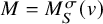 $M=M_S^{\sigma }(v)$
is a singular symplectic variety. O’Grady [Reference O’GradyO’G99] constructed a symplectic resolution of singularities
$M=M_S^{\sigma }(v)$
is a singular symplectic variety. O’Grady [Reference O’GradyO’G99] constructed a symplectic resolution of singularities
 $$ \begin{align} \widetilde{M} \to M \end{align} $$
when $v=2v_0$
for a primitive
$v=2v_0$
for a primitive $v_0$
with
$v_0$
with $\langle v_0, v_0 \rangle =2$
. But this turned out to be the only exceptional case: Kaledin–Lehn–Sorger [Reference Kaledin, Lehn and SorgerKLS06] proved that M does not admit a symplectic resolution in all other cases with
$\langle v_0, v_0 \rangle =2$
. But this turned out to be the only exceptional case: Kaledin–Lehn–Sorger [Reference Kaledin, Lehn and SorgerKLS06] proved that M does not admit a symplectic resolution in all other cases with $\langle v, v\rangle {\geqslant } 2$
. By [Reference FuFu03, Proposition 1.1], the existence of a symplectic resolution (1.11) is equivalent to the existence of a crepant resolution of M, so M does not admit a crepant resolution except in the example studied by O’Grady. Instead of a usual (geometric) crepant resolution, it is interesting to investigate if M admits a crepant resolution of singularities in a categorical sense:
$\langle v, v\rangle {\geqslant } 2$
. By [Reference FuFu03, Proposition 1.1], the existence of a symplectic resolution (1.11) is equivalent to the existence of a crepant resolution of M, so M does not admit a crepant resolution except in the example studied by O’Grady. Instead of a usual (geometric) crepant resolution, it is interesting to investigate if M admits a crepant resolution of singularities in a categorical sense:
Problem 1.2. Is there a categorical version of a crepant resolution of $M_S^{\sigma }(v)$
?
$M_S^{\sigma }(v)$
?
Inspired by Theorem 1.2, we regard the category $\mathbb {T}_S(v)_w^{\mathrm {{red}}}$
as a categorical version of a (twisted, étale local) crepant resolution of
$\mathbb {T}_S(v)_w^{\mathrm {{red}}}$
as a categorical version of a (twisted, étale local) crepant resolution of $M_S^{\sigma }(v)$
. Note that, even in the situation of the O’Grady resolution (1.11) (that is, if
$M_S^{\sigma }(v)$
. Note that, even in the situation of the O’Grady resolution (1.11) (that is, if $d=2$
and
$d=2$
and $\langle v_0, v_0\rangle =2$
), the category
$\langle v_0, v_0\rangle =2$
), the category $\mathbb {T}_S(2)_1^{\mathrm {red}}$
is different from
$\mathbb {T}_S(2)_1^{\mathrm {red}}$
is different from $D^b(\widetilde {M})$
because its topological K-theory is a proper direct summand of the topological K-theory of
$D^b(\widetilde {M})$
because its topological K-theory is a proper direct summand of the topological K-theory of $\widetilde {M}$
, see by Theorem 1.3 and [Reference de Cataldo, Rapagnetta and SaccàdCRS21].
$\widetilde {M}$
, see by Theorem 1.3 and [Reference de Cataldo, Rapagnetta and SaccàdCRS21].
In view of (1.9) and (1.10), we further expect $\mathbb {T}_S(v)_w^{\mathrm {{red}}}$
to be a “noncommutative hyperkähler variety” deformation equivalent to
$\mathbb {T}_S(v)_w^{\mathrm {{red}}}$
to be a “noncommutative hyperkähler variety” deformation equivalent to $S^{[\langle v, v\rangle /2+1]}$
. In particular, it is natural to investigate how
$S^{[\langle v, v\rangle /2+1]}$
. In particular, it is natural to investigate how $\mathbb {T}_S(v)_w^{\mathrm {{red}}}$
is analogous to
$\mathbb {T}_S(v)_w^{\mathrm {{red}}}$
is analogous to $D^b(M)$
for a smooth projective hyperkähler variety of
$D^b(M)$
for a smooth projective hyperkähler variety of $K3^{[\langle v, v\rangle /2+1]}$
-type. More precisely, we may expect the following, which we regard as a categorical
$K3^{[\langle v, v\rangle /2+1]}$
-type. More precisely, we may expect the following, which we regard as a categorical $\chi $
-independence phenomenon:
$\chi $
-independence phenomenon:
Conjecture 1.4. (Conjecture 4.13)
For any $g{\geqslant } 0$
and any
$g{\geqslant } 0$
and any $w\in \mathbb {Z}$
coprime with v, the category
$w\in \mathbb {Z}$
coprime with v, the category $\mathbb {T}_S(v)_{w}^{\mathrm {{red}}}$
is deformation equivalent to
$\mathbb {T}_S(v)_{w}^{\mathrm {{red}}}$
is deformation equivalent to $D^b\left (S^{[\langle v, v\rangle /2+1]}\right )$
.
$D^b\left (S^{[\langle v, v\rangle /2+1]}\right )$
.
Recall that $\langle v_0, v_0\rangle =2g-2$
. The above conjecture is easy to check for
$\langle v_0, v_0\rangle =2g-2$
. The above conjecture is easy to check for $g=0$
, see Proposition 4.17. For
$g=0$
, see Proposition 4.17. For $g=1$
, we conjecture that the category
$g=1$
, we conjecture that the category $\mathbb {T}_S(v)_w^{\mathrm {{red}}}$
is equivalent to the derived category of a K3 surface (possibly twisted and not necessarily isomorphic to S), and we show this follows from an explicit computation of the quasi-BPS categories of
$\mathbb {T}_S(v)_w^{\mathrm {{red}}}$
is equivalent to the derived category of a K3 surface (possibly twisted and not necessarily isomorphic to S), and we show this follows from an explicit computation of the quasi-BPS categories of $\mathbb {C}^3$
studied in [Reference PădurariuPT24, Reference Pădurariu and TodaPT23], see Conjectures 4.18, 4.19 and Proposition 4.20. In the forthcoming paper [Reference Cautis, Pădurariu and TodaCPT], we prove Conjecture 4.19, which implies Conjecture 1.4. More precisely, there is an equivalence
$\mathbb {C}^3$
studied in [Reference PădurariuPT24, Reference Pădurariu and TodaPT23], see Conjectures 4.18, 4.19 and Proposition 4.20. In the forthcoming paper [Reference Cautis, Pădurariu and TodaCPT], we prove Conjecture 4.19, which implies Conjecture 1.4. More precisely, there is an equivalence $D^b(S', \alpha ^w) \stackrel {\sim }{\to } \mathbb {T}_S(v)_w^{\mathrm {{red}}}$
for another K3 surface
$D^b(S', \alpha ^w) \stackrel {\sim }{\to } \mathbb {T}_S(v)_w^{\mathrm {{red}}}$
for another K3 surface $S'$
and a Brauer class
$S'$
and a Brauer class $\alpha $
.
$\alpha $
.
1.6 Updates and future directions
Here we discuss several related works and developments that appeared after this paper was posted on arXiv, as well as possible future directions.
(i) Categorical $\chi $
-independence. In Conjecture 1.4, we discussed categorical
$\chi $
-independence. In Conjecture 1.4, we discussed categorical $\chi $
-independence in terms of deformation equivalence. In [Reference PădurariuPTb, Reference PădurariuPTd], in the case of Higgs bundles, we conjectured a symmetry between BPS categories that exchanges
$\chi $
-independence in terms of deformation equivalence. In [Reference PădurariuPTb, Reference PădurariuPTd], in the case of Higgs bundles, we conjectured a symmetry between BPS categories that exchanges $\chi $
and the weight w, giving an equivalence of categories. This can be regarded as a categorical version of the Hausel–Thaddeus mirror symmetry conjecture [Reference Hausel and ThaddeusHT03], and it provides a categorical
$\chi $
and the weight w, giving an equivalence of categories. This can be regarded as a categorical version of the Hausel–Thaddeus mirror symmetry conjecture [Reference Hausel and ThaddeusHT03], and it provides a categorical $\chi $
-independence in the stronger sense of equivalence of categories (rather than deformation equivalence).
$\chi $
-independence in the stronger sense of equivalence of categories (rather than deformation equivalence).
We expect a similar phenomenon for K3 surfaces, which would imply that certain BPS categories are equivalent to the derived categories of (possibly twisted) holomorphic symplectic manifolds of $K3^{[n]}$
-type. If true, it would also establish the global triviality of the Serre functor, and the existence of t-structures for these BPS categories. We plan to formulate this expectation precisely in a future work.
$K3^{[n]}$
-type. If true, it would also establish the global triviality of the Serre functor, and the existence of t-structures for these BPS categories. We plan to formulate this expectation precisely in a future work.
(ii) Langlands duality for K3 surfaces. In [Reference PădurariuPT25], we introduced the notion of limit categories for quasi-smooth derived stacks with symmetric tangent complexes. In the case of Higgs bundles over a curve, such limit categories may be regarded as the classical limit of the categories of D-modules on the moduli stack of bundles. Then we formulated a precise version of the Dolbeault geometric Langlands conjecture by Donagi–Pantev [Reference Donagi and PantevDP12] via limit categories.
It would be interesting to pursue an analogue of this story for K3 surfaces. Namely, if we denote by $\mathfrak {M}_S$
the derived moduli stack of one-dimensional sheaves on S and by
$\mathfrak {M}_S$
the derived moduli stack of one-dimensional sheaves on S and by $\mathfrak {M}_S^{\mathrm {{ss}}}\subset \mathfrak {M}_S$
its open substack of semistable sheaves, we expect an equivalence
$\mathfrak {M}_S^{\mathrm {{ss}}}\subset \mathfrak {M}_S$
its open substack of semistable sheaves, we expect an equivalence
 $$ \begin{align} D^b(\mathfrak{M}_S^{\mathrm{{ss}}}) \simeq \mathrm{L}(\mathfrak{M}_S), \end{align} $$
where the right-hand side is the limit category for $\mathfrak {M}_S$
defined in [Reference PădurariuPT25]. Note that each component of
$\mathfrak {M}_S$
defined in [Reference PădurariuPT25]. Note that each component of $\mathfrak {M}_S$
is not quasi-compact. Moreover, the right-hand side is expected to admit a semiorthogonal decomposition into products of quasi-BPS categories, which may be regarded as a Langlands dual to the semiorthogonal decomposition in Theorem 1.1.
$\mathfrak {M}_S$
is not quasi-compact. Moreover, the right-hand side is expected to admit a semiorthogonal decomposition into products of quasi-BPS categories, which may be regarded as a Langlands dual to the semiorthogonal decomposition in Theorem 1.1.
Inspired by the geometric Langlands equivalence, it is also interesting to study deformation quantizations of BPS and limit categories, and an analogue of the equivalence (1.12) in this situation. Further, we expect the equivalence (1.12) to be compatible with parabolic induction, the action of Wilson/ Hecke operators, and satisfy a version of Whittaker normalization. These conditions specify it uniquely, and it is interesting to compare the equivalence obtained with recently constructed equivalences for moduli of sheaves on K3 surfaces from [Reference Maulik, Shen, Yin and ZhangMSYZ25]. We will pursue these directions of research in future work.
(iii) Semiorthogonal decompositions of categorical PT theory. In [Reference TodaTod21], the second author proved a categorical Kawai–Yoshioka formula, which gives a semiorthogonal decomposition of the derived category of the relative Hilbert scheme of points over the linear system on S with irreducible curve class. In this case, it is isomorphic to the moduli space of Pandharipande–Thomas stable pairs [Reference Pandharipande and ThomasPT09] on S.
For nonirreducible curve classes, we expect a semiorthogonal decomposition of categorical PT theory. For $X=S\times \mathbb {A}^1$
,
$X=S\times \mathbb {A}^1$
, $\beta \in H_2(S, \mathbb {Z})$
and
$\beta \in H_2(S, \mathbb {Z})$
and $n\in \mathbb {Z}$
, the second author [Reference TodaTod24a] constructed the
$n\in \mathbb {Z}$
, the second author [Reference TodaTod24a] constructed the $\mathbb {C}^*$
-equivariant PT category
$\mathbb {C}^*$
-equivariant PT category
 $$ \begin{align} \mathcal{DT}^{\mathbb{C}^{*}}(P_n(X, \beta)) \end{align} $$
as a certain Verdier quotient of $D^b(\mathfrak {M}_S)$
. Here
$D^b(\mathfrak {M}_S)$
. Here $P_n(X, \beta )$
is the moduli space of PT stable pairs on X. We expect that, via categorical wall-crossing, the dg-category (1.13) admits a semiorthogonal decomposition into products of quasi-BPS categories as studied in this paper. This would provide a categorical version of the Katz–Klemm–Vafa formula for PT invariants proved in [Reference TodaTod12b], that is, a categorification of Borcherds’ infinite product. A similar categorical wall-crossing phenomenon was established in [Reference Pădurariu and TodaPTa] in the case of the DT/PT correspondence.
$P_n(X, \beta )$
is the moduli space of PT stable pairs on X. We expect that, via categorical wall-crossing, the dg-category (1.13) admits a semiorthogonal decomposition into products of quasi-BPS categories as studied in this paper. This would provide a categorical version of the Katz–Klemm–Vafa formula for PT invariants proved in [Reference TodaTod12b], that is, a categorification of Borcherds’ infinite product. A similar categorical wall-crossing phenomenon was established in [Reference Pădurariu and TodaPTa] in the case of the DT/PT correspondence.
We motivated the introduction of quasi-BPS categories by the study of Hall algebras. However, we do not pursue further the connection between quasi-BPS categories and Lie theory in this paper. We note that the precise relation between quasi-BPS categories and categorifications of Lie algebras is not yet understood even in the local case of the preprojective algebra of a quiver. Further, we expect the study of deformation quantizations of quasi-BPS categories (mentioned in (ii) above) to be worth pursuing also in the local case of the preprojective algebra of a quiver in relation to [Reference Braden, Licata, Proudfoot and WebsterBLPW16]. We hope to study these relations to Lie theory in future work.
2 Preliminaries
In this section, we introduce notations and review definitions related to stacks, matrix factorizations, and window categories. We also include a table with the most important notation we use later in the paper.
Notation used in the paper

2.1 Notations for (derived) stacks
All the spaces $\mathscr {X}$
considered are quasi-smooth (derived) stacks over
$\mathscr {X}$
considered are quasi-smooth (derived) stacks over $\mathbb {C}$
, see [Reference TodaTod24a, Subsection 3.1] for references. The classical truncation of
$\mathbb {C}$
, see [Reference TodaTod24a, Subsection 3.1] for references. The classical truncation of $\mathscr {X}$
is denoted by
$\mathscr {X}$
is denoted by $\mathscr {X}^{\mathrm {{cl}}}$
. We denote by
$\mathscr {X}^{\mathrm {{cl}}}$
. We denote by $\mathbb {L}_{\mathscr {X}}$
the cotangent complex of
$\mathbb {L}_{\mathscr {X}}$
the cotangent complex of $\mathscr {X}$
.
$\mathscr {X}$
.
For G an algebraic group and X a dg-scheme with an action of G, denote by $X/G$
the corresponding quotient stack. When X is affine, we denote by
$X/G$
the corresponding quotient stack. When X is affine, we denote by $X/\!\!/ G$
the quotient dg-scheme with dg-ring of regular functions
$X/\!\!/ G$
the quotient dg-scheme with dg-ring of regular functions $\mathcal {O}_X^G$
. For a morphism
$\mathcal {O}_X^G$
. For a morphism $f \colon X\to Y$
and for a closed point
$f \colon X\to Y$
and for a closed point $y \in Y$
, we denote by
$y \in Y$
, we denote by $\widehat {X}_y$
the following base change
$\widehat {X}_y$
the following base change
 $$ \begin{align*} \widehat{X}_y := X \times_{Y} \operatorname{Spec} \left(\widehat{\mathcal{O}}_{Y, y}\right). \end{align*} $$
We call $\widehat {X}_y$
the formal fiber, though it is a scheme over a complete local ring rather than a formal scheme. When X is a G-representation,
$\widehat {X}_y$
the formal fiber, though it is a scheme over a complete local ring rather than a formal scheme. When X is a G-representation, $f\colon X\to Y:=X/\!\!/ G$
, and
$f\colon X\to Y:=X/\!\!/ G$
, and $y=0$
, we omit the subscript y from the above notation.
$y=0$
, we omit the subscript y from the above notation.
We use the terminology of good moduli spaces of Alper, see [Reference AlperAlp13, Section 8] for examples of stacks with good moduli spaces.
2.2 DG-categories
For $\mathscr {X}$
a quasi-smooth stack, we denote by
$\mathscr {X}$
a quasi-smooth stack, we denote by $D^b(\mathscr {X})$
the bounded derived category of coherent sheaves on
$D^b(\mathscr {X})$
the bounded derived category of coherent sheaves on $\mathscr {X}$
and by
$\mathscr {X}$
and by $\mathrm {Perf}(\mathscr {X})$
the subcategory of perfect complexes on
$\mathrm {Perf}(\mathscr {X})$
the subcategory of perfect complexes on $\mathscr {X}$
, see Subsection 2.6 for more details and for more categories of (quasi)coherent sheaves.
$\mathscr {X}$
, see Subsection 2.6 for more details and for more categories of (quasi)coherent sheaves.
2.2.1 Generation of dg-categories
Any dg-category considered is a $\mathbb {C}$
-linear pretriangulated dg-category, in particular its homotopy category is a triangulated category. For a pretriangulated dg-category
$\mathbb {C}$
-linear pretriangulated dg-category, in particular its homotopy category is a triangulated category. For a pretriangulated dg-category $\mathcal {D}$
and a full subcategory
$\mathcal {D}$
and a full subcategory $\mathcal {C} \subset \mathcal {D}$
, we say that
$\mathcal {C} \subset \mathcal {D}$
, we say that $\mathcal {C}$
classically generates
$\mathcal {C}$
classically generates $\mathcal {D}$
if
$\mathcal {D}$
if $\mathcal {D}$
coincides with the smallest thick pretriangulated subcategory of
$\mathcal {D}$
coincides with the smallest thick pretriangulated subcategory of $\mathcal {D}$
which contains
$\mathcal {D}$
which contains $\mathcal {C}$
. In what follows, when we say subcategory, it always means full subcategory. If
$\mathcal {C}$
. In what follows, when we say subcategory, it always means full subcategory. If $\mathcal {D}$
is furthermore cocomplete, then we say that
$\mathcal {D}$
is furthermore cocomplete, then we say that $\mathcal {C}$
generates
$\mathcal {C}$
generates $\mathcal {D}$
if
$\mathcal {D}$
if $\mathcal {D}$
coincides with the smallest thick pretriangulated subcategory of
$\mathcal {D}$
coincides with the smallest thick pretriangulated subcategory of $\mathcal {C}$
which contains
$\mathcal {C}$
which contains $\mathcal {C}$
and is closed under taking colimits.
$\mathcal {C}$
and is closed under taking colimits.
We also recall some terminology related to strong generation. For a set of objects $\mathcal {S} \subset \mathcal {D}$
, we denote by
$\mathcal {S} \subset \mathcal {D}$
, we denote by $\langle \mathcal {S} \rangle $
the smallest subcategory which contains S and is closed under shifts, finite direct sums, and direct summands. If
$\langle \mathcal {S} \rangle $
the smallest subcategory which contains S and is closed under shifts, finite direct sums, and direct summands. If $\mathcal {D}$
is cocomplete, we denote by
$\mathcal {D}$
is cocomplete, we denote by $\langle \! \langle S \rangle \! \rangle $
the smallest subcategory which contains S and is closed under shifts, arbitrary direct sums, and direct summands. For subcategories
$\langle \! \langle S \rangle \! \rangle $
the smallest subcategory which contains S and is closed under shifts, arbitrary direct sums, and direct summands. For subcategories $\mathcal {C}_1, \mathcal {C}_2 \subset \mathcal {D}$
, we denote by
$\mathcal {C}_1, \mathcal {C}_2 \subset \mathcal {D}$
, we denote by $\mathcal {C}_1 \star \mathcal {C}_2 \subset \mathcal {D}$
the smallest subcategory which contains objects E which fit into distinguished triangles
$\mathcal {C}_1 \star \mathcal {C}_2 \subset \mathcal {D}$
the smallest subcategory which contains objects E which fit into distinguished triangles $A_1 \to E \to A_2\to A_1[1]$
with
$A_1 \to E \to A_2\to A_1[1]$
with $A_i \in \mathcal {C}_i$
for
$A_i \in \mathcal {C}_i$
for $i\in \{1,2\}$
, and is closed under shifts, finite direct sums, and direct summands. We say that
$i\in \{1,2\}$
, and is closed under shifts, finite direct sums, and direct summands. We say that $\mathcal {D}$
is strongly generated by
$\mathcal {D}$
is strongly generated by $C \in \mathcal {D}$
if
$C \in \mathcal {D}$
if $\mathcal {D}=\langle C \rangle ^{\star n}$
for some
$\mathcal {D}=\langle C \rangle ^{\star n}$
for some $n{\geqslant } 1$
. This is equivalent to
$n{\geqslant } 1$
. This is equivalent to $\operatorname {Ind} \mathcal {D}=\langle \! \langle C \rangle \! \rangle ^{\star n}$
for some
$\operatorname {Ind} \mathcal {D}=\langle \! \langle C \rangle \! \rangle ^{\star n}$
for some $n{\geqslant } 1$
, see [Reference NeemanNee21, Proposition 1.9]. A dg-category
$n{\geqslant } 1$
, see [Reference NeemanNee21, Proposition 1.9]. A dg-category $\mathcal {D}$
is called regular if it has a strong generator. A dg-category
$\mathcal {D}$
is called regular if it has a strong generator. A dg-category $\mathcal {D}$
is called smooth if the diagonal dg-module of
$\mathcal {D}$
is called smooth if the diagonal dg-module of $\mathcal {D}$
is perfect. It is proved in [Reference LuntsLun10, Lemma 3.5, 3.6] that if
$\mathcal {D}$
is perfect. It is proved in [Reference LuntsLun10, Lemma 3.5, 3.6] that if $\mathcal {D}$
is smooth, then
$\mathcal {D}$
is smooth, then $\mathcal {D}$
is regular.
$\mathcal {D}$
is regular.
2.2.2 Semiorthogonal decompositions
Let R be a partially ordered countable set with binary relation ${\leqslant }$
. Let
${\leqslant }$
. Let $\mathbb {T}$
be a pretriangulated dg-category. We will construct semiorthogonal decompositions
$\mathbb {T}$
be a pretriangulated dg-category. We will construct semiorthogonal decompositions
 $$ \begin{align} \mathbb{T}=\langle \mathbb{A}_i \mid i \in R \rangle \end{align} $$
with summands pretriangulated subcategories $\mathbb {A}_i$
indexed by
$\mathbb {A}_i$
indexed by $i\in R$
such that, if
$i\in R$
such that, if $i,j\in R$
and there exist objects
$i,j\in R$
and there exist objects $\mathcal {A}_i\in \mathbb {A}_i$
,
$\mathcal {A}_i\in \mathbb {A}_i$
, $\mathcal {A}_j\in \mathbb {A}_j$
with
$\mathcal {A}_j\in \mathbb {A}_j$
with $\operatorname {Hom}_{\mathbb {T}}(\mathcal {A}_i,\mathcal {A}_j)\neq 0$
, then
$\operatorname {Hom}_{\mathbb {T}}(\mathcal {A}_i,\mathcal {A}_j)\neq 0$
, then $i{\leqslant } j$
.
$i{\leqslant } j$
.
Let $\pi \colon \mathscr {X}\to S$
be a morphism from a quasi-smooth stack to a scheme S and assume
$\pi \colon \mathscr {X}\to S$
be a morphism from a quasi-smooth stack to a scheme S and assume $\mathbb {T}$
is a subcategory of
$\mathbb {T}$
is a subcategory of $D^b(\mathscr {X})$
. We say the decomposition (2.1) is S-linear if
$D^b(\mathscr {X})$
. We say the decomposition (2.1) is S-linear if $\mathbb {A}_i\otimes \pi ^*\mathrm {Perf}(S)\subset \mathbb {A}_i$
.
$\mathbb {A}_i\otimes \pi ^*\mathrm {Perf}(S)\subset \mathbb {A}_i$
.
2.3 Graded matrix factorizations
References for this subsection are [Reference TodaTod24b, Section 2.2], [Reference TodaTod24a, Section 2.2], [Reference Ballard, Favero and KatzarkovBFK19, Section 2.3], [Reference Polishchuk and VaintrobPV11, Section 1]. Let G be an algebraic group and let Y be a smooth affine scheme with an action of G. Let $\mathscr {Y}=Y/G$
be the corresponding quotient stack and let f be a regular function
$\mathscr {Y}=Y/G$
be the corresponding quotient stack and let f be a regular function
 $$\begin{align*}f \colon \mathscr{Y}\to \mathbb{C}.\end{align*}$$
Assume that there exists an extra action of $\mathbb {C}^{\ast }$
on Y which commutes with the action of G on Y, trivial on
$\mathbb {C}^{\ast }$
on Y which commutes with the action of G on Y, trivial on $\mathbb {Z}/2 \subset \mathbb {C}^{\ast }$
, and f is weight two with respect to the above
$\mathbb {Z}/2 \subset \mathbb {C}^{\ast }$
, and f is weight two with respect to the above $\mathbb {C}^{\ast }$
-action.
$\mathbb {C}^{\ast }$
-action.
Consider the category of graded matrix factorizations
 $$ \begin{align*}\mathrm{MF}^{\mathrm{gr}}(\mathscr{Y}, f). \end{align*} $$
Its objects are pairs $(P, d_P)$
with P a
$(P, d_P)$
with P a $G\times \mathbb {C}^*$
-equivariant coherent sheaf on Y and
$G\times \mathbb {C}^*$
-equivariant coherent sheaf on Y and $d_P \colon P\to P(1)$
a
$d_P \colon P\to P(1)$
a $G\times \mathbb {C}^*$
-equivariant morphism satisfying
$G\times \mathbb {C}^*$
-equivariant morphism satisfying $d_P^2=f$
. Here
$d_P^2=f$
. Here $(1)$
is the twist by the character
$(1)$
is the twist by the character $\mathrm {pr}_2 \colon G \times \mathbb {C}^{\ast } \to \mathbb {C}^{\ast }$
. Note that as the
$\mathrm {pr}_2 \colon G \times \mathbb {C}^{\ast } \to \mathbb {C}^{\ast }$
. Note that as the $\mathbb {C}^{\ast }$
-action is trivial on
$\mathbb {C}^{\ast }$
-action is trivial on $\mathbb {Z}/2$
, we have the induced action of
$\mathbb {Z}/2$
, we have the induced action of $\mathbb {C}^{\star }=\mathbb {C}^{\ast }/(\mathbb {Z}/2)$
on Y and f is weight one with respect to the above
$\mathbb {C}^{\star }=\mathbb {C}^{\ast }/(\mathbb {Z}/2)$
on Y and f is weight one with respect to the above $\mathbb {C}^{\star }$
-action. The objects of
$\mathbb {C}^{\star }$
-action. The objects of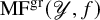 $\mathrm {MF}^{\mathrm {gr}}(\mathscr {Y}, f)$
can be alternatively described as tuples
$\mathrm {MF}^{\mathrm {gr}}(\mathscr {Y}, f)$
can be alternatively described as tuples
 $$ \begin{align} (E, F, \alpha \colon E\to F(1)', \beta \colon F\to E), \end{align} $$
where E and F are $G\times \mathbb {C}^{\star }$
-equivariant coherent sheaves on Y,
$G\times \mathbb {C}^{\star }$
-equivariant coherent sheaves on Y, $(1)'$
is the twist by the character
$(1)'$
is the twist by the character $G \times \mathbb {C}^{\star } \to \mathbb {C}^{\star }$
, and
$G \times \mathbb {C}^{\star } \to \mathbb {C}^{\star }$
, and $\alpha $
and
$\alpha $
and $\beta $
are
$\beta $
are $\mathbb {C}^{\star }$
-equivariant morphisms such that
$\mathbb {C}^{\star }$
-equivariant morphisms such that $\alpha \circ \beta $
and
$\alpha \circ \beta $
and $\beta \circ \alpha $
are multiplication by f.
$\beta \circ \alpha $
are multiplication by f.
For a pretriangulated subcategory $\mathbb {M}$
of
$\mathbb {M}$
of $D^b(\mathscr {Y})$
, define
$D^b(\mathscr {Y})$
, define $\mathrm {MF}^{\mathrm {{gr}}}(\mathbb {M}, f)$
as the full subcategory of
$\mathrm {MF}^{\mathrm {{gr}}}(\mathbb {M}, f)$
as the full subcategory of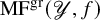 $\mathrm {MF}^{\mathrm {{gr}}}(\mathscr {Y}, f)$
with objects totalizations of pairs
$\mathrm {MF}^{\mathrm {{gr}}}(\mathscr {Y}, f)$
with objects totalizations of pairs $(P, d_{P})$
with
$(P, d_{P})$
with $P \in \mathbb {M}$
equipped with
$P \in \mathbb {M}$
equipped with $\mathbb {C}^{\ast }$
-equivariant structure, see [Reference PădurariuPT24, Subsection 2.6.2]. If
$\mathbb {C}^{\ast }$
-equivariant structure, see [Reference PădurariuPT24, Subsection 2.6.2]. If $\mathbb {M}$
is generated by a set of vector bundles
$\mathbb {M}$
is generated by a set of vector bundles $\{\mathscr {V}_i\}_{i\in I}$
on
$\{\mathscr {V}_i\}_{i\in I}$
on $\mathscr {Y}$
, then
$\mathscr {Y}$
, then $\mathrm {MF}^{\mathrm {{gr}}}(\mathbb {M}, f)$
is generated by matrix factorizations whose factors are direct sums of vector bundles from
$\mathrm {MF}^{\mathrm {{gr}}}(\mathbb {M}, f)$
is generated by matrix factorizations whose factors are direct sums of vector bundles from $\{\mathscr {V}_i\}_{i\in I}$
, see [Reference PădurariuPT24, Lemma 2.3].
$\{\mathscr {V}_i\}_{i\in I}$
, see [Reference PădurariuPT24, Lemma 2.3].
Functoriality of categories of graded matrix factorizations for pullback and proper pushforward is discussed in [Reference Polishchuk and VaintrobPV11]. In Subsection 7.2, we will also consider the category $D^{\mathrm {{gr}}}(Y)$
for a possibly singular affine variety Y with a
$D^{\mathrm {{gr}}}(Y)$
for a possibly singular affine variety Y with a $\mathbb {C}^{\ast }$
-action as above. It consists of objects (2.2) with
$\mathbb {C}^{\ast }$
-action as above. It consists of objects (2.2) with $f=0$
, so its definition is the same as
$f=0$
, so its definition is the same as $\mathrm {MF}^{\mathrm {{gr}}}(Y, 0)$
, but when Y is singular an object (2.2) may not be isomorphic to the one such that
$\mathrm {MF}^{\mathrm {{gr}}}(Y, 0)$
, but when Y is singular an object (2.2) may not be isomorphic to the one such that $E, F$
are locally free of finite rank. See [Reference Efimov and PositselskiEP15] for factorization categories over possibly singular varieties. Note that if the
$E, F$
are locally free of finite rank. See [Reference Efimov and PositselskiEP15] for factorization categories over possibly singular varieties. Note that if the $\mathbb {C}^{\ast }$
-action on Y is trivial, then
$\mathbb {C}^{\ast }$
-action on Y is trivial, then $D^{\mathrm {{gr}}}(Y)=D^b(Y)$
.
$D^{\mathrm {{gr}}}(Y)=D^b(Y)$
.
2.4 The Koszul equivalence
Let Y be a smooth affine scheme with an action of an algebraic group G, let $\mathscr {Y}=Y/G$
, and let V be a G-equivariant vector bundle on Y. We always assume that Y is either of finite type over
$\mathscr {Y}=Y/G$
, and let V be a G-equivariant vector bundle on Y. We always assume that Y is either of finite type over $\mathbb {C}$
or is a formal fiber of a map
$\mathbb {C}$
or is a formal fiber of a map $X \to X/\!\!/ H$
for a finite type affine scheme X and an algebraic group H as in Subsection 2.1. Let
$X \to X/\!\!/ H$
for a finite type affine scheme X and an algebraic group H as in Subsection 2.1. Let $\mathbb {C}^*$
act on the fibers of V with weight
$\mathbb {C}^*$
act on the fibers of V with weight $2$
and consider a section
$2$
and consider a section $s\in \Gamma (Y, V)$
. It induces a map
$s\in \Gamma (Y, V)$
. It induces a map $\partial :=s^{\vee } \colon V^{\vee } \to \mathcal {O}_Y$
. Let
$\partial :=s^{\vee } \colon V^{\vee } \to \mathcal {O}_Y$
. Let $s^{-1}(0)$
be the derived zero locus of s with dg-algebra of regular functions
$s^{-1}(0)$
be the derived zero locus of s with dg-algebra of regular functions
 $$ \begin{align} \mathcal{O}_{s^{-1}(0)}:=(\cdots \to \wedge^2 V^{\vee} \stackrel{\partial}{\to} V \stackrel{\partial}{\to} \mathcal{O}_Y) \end{align} $$
where the right-hand side is the Koszul complex associated with s. Consider the quotient (quasi-smooth) stack
 $$ \begin{align} \mathscr{P}:=s^{-1}(0)/G. \end{align} $$
We call $\mathscr {P}$
the Koszul stack associated with
$\mathscr {P}$
the Koszul stack associated with $(Y, V, s, G)$
. There is a natural inclusion
$(Y, V, s, G)$
. There is a natural inclusion
 $$\begin{align*}j\colon \mathscr{P}\hookrightarrow\mathscr{Y}.\end{align*}$$
The section s also induces the regular function
 $$ \begin{align} f\colon \mathscr{V}^{\vee}:=\text{Tot}_Y\left(V^{\vee}\right)/G\to\mathbb{C} \end{align} $$
defined by $f(y,v)=\langle s(y), v \rangle $
for
$f(y,v)=\langle s(y), v \rangle $
for $y\in Y(\mathbb {C})$
and
$y\in Y(\mathbb {C})$
and $v\in V^{\vee }|_y$
. Consider the category of graded matrix factorizations
$v\in V^{\vee }|_y$
. Consider the category of graded matrix factorizations $\text {MF}^{\text {gr}}\left (\mathscr {V}^{\vee }, f\right )$
with respect to the
$\text {MF}^{\text {gr}}\left (\mathscr {V}^{\vee }, f\right )$
with respect to the $\mathbb {C}^*$
-action mentioned above. The Koszul equivalence, also called dimensional reduction in the literature, says the following:
$\mathbb {C}^*$
-action mentioned above. The Koszul equivalence, also called dimensional reduction in the literature, says the following:
Theorem 2.1. [Reference IsikIsi13, Reference HiranoHir17, Reference TodaTod24a]
There is an equivalence
 $$ \begin{align} \Theta \colon D^b(\mathscr{P}) \stackrel{\sim}{\to} \mathrm{MF}^{\mathrm{gr}}(\mathscr{V}^{\vee}, f) \end{align} $$
given by $\Theta (-)=\mathcal {K}\otimes _{\mathcal {O}_{\mathscr {P}}}(-)$
, where
$\Theta (-)=\mathcal {K}\otimes _{\mathcal {O}_{\mathscr {P}}}(-)$
, where $\mathcal {K}$
is the Koszul factorization, see [Reference TodaTod24a, Theorem 2.3.3].
$\mathcal {K}$
is the Koszul factorization, see [Reference TodaTod24a, Theorem 2.3.3].
We will use the following lemma:
Lemma 2.2. [Reference PădurariuPTc, Lemma 2.6]
Let $\{V_a\}_{a\in A}$
be a set of G-representations and let
$\{V_a\}_{a\in A}$
be a set of G-representations and let $\mathbb {S} \subset \mathrm {MF}^{\mathrm {{gr}}}(\mathscr {V}^{\vee }, f)$
be the subcategory generated by matrix factorizations whose factors are direct sums of vector bundles
$\mathbb {S} \subset \mathrm {MF}^{\mathrm {{gr}}}(\mathscr {V}^{\vee }, f)$
be the subcategory generated by matrix factorizations whose factors are direct sums of vector bundles $\mathcal {O}_{\mathscr {V}^{\vee }} \otimes V_a$
. Then an object
$\mathcal {O}_{\mathscr {V}^{\vee }} \otimes V_a$
. Then an object $\mathcal {E} \in D^b(\mathscr {P})$
satisfies
$\mathcal {E} \in D^b(\mathscr {P})$
satisfies $\Theta (\mathcal {E}) \in \mathbb {S}$
if and only if
$\Theta (\mathcal {E}) \in \mathbb {S}$
if and only if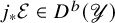 $j_{\ast }\mathcal {E} \in D^b(\mathscr {Y})$
is generated by
$j_{\ast }\mathcal {E} \in D^b(\mathscr {Y})$
is generated by $\mathcal {O}_{\mathscr {Y}} \otimes V_a$
for
$\mathcal {O}_{\mathscr {Y}} \otimes V_a$
for $a\in A$
.
$a\in A$
.
2.5 Window categories
2.5.1 Attracting stacks
Let Y be an affine variety with an action of a reductive group G. Let $\lambda $
be a cocharacter of G. Let
$\lambda $
be a cocharacter of G. Let $G^\lambda $
and
$G^\lambda $
and $G^{\lambda {\geqslant } 0}$
be the Levi and parabolic groups associated to
$G^{\lambda {\geqslant } 0}$
be the Levi and parabolic groups associated to $\lambda $
. Let
$\lambda $
. Let $Y^\lambda \subset Y$
be the closed subvariety of
$Y^\lambda \subset Y$
be the closed subvariety of $\lambda $
-fixed points. Consider the attracting variety
$\lambda $
-fixed points. Consider the attracting variety
 $$\begin{align*}Y^{\lambda{\geqslant} 0}:=\{y\in Y|\,\lim_{t\to 0}\lambda(t)\cdot y\in Y^\lambda\}\subset Y.\end{align*}$$
Consider the attracting and fixed stacks
 $$ \begin{align} \mathscr{Z}:=Y^\lambda/G^\lambda \xleftarrow{q}\mathscr{S}:=Y^{\lambda{\geqslant} 0}/G^{\lambda{\geqslant} 0}\xrightarrow{p}\mathscr{Y}:=Y/G. \end{align} $$
The map p is proper. Kempf-Ness strata are connected components of certain attracting stacks $\mathscr {S}$
, and the map p restricted to a Kempf-Ness stratum is a closed immersion, see [Reference Halpern-LeistnerHL15, Section 2.1]. The attracting stacks also appear in the definition of Hall algebras [Reference PădurariuPăd23] (for Y an affine space), where the Hall product is induced by the functor
$\mathscr {S}$
, and the map p restricted to a Kempf-Ness stratum is a closed immersion, see [Reference Halpern-LeistnerHL15, Section 2.1]. The attracting stacks also appear in the definition of Hall algebras [Reference PădurariuPăd23] (for Y an affine space), where the Hall product is induced by the functor
 $$ \begin{align} \ast:=p_*q^*\colon D^b(\mathscr{Z})\to D^b(\mathscr{Y}). \end{align} $$
In this case, the map p may not be a closed immersion.
Let $T \subset G$
be a maximal torus and let
$T \subset G$
be a maximal torus and let $\lambda $
be a cocharacter
$\lambda $
be a cocharacter $\lambda \colon \mathbb {C}^{\ast } \to T$
. For a G-representation Y, the attracting variety
$\lambda \colon \mathbb {C}^{\ast } \to T$
. For a G-representation Y, the attracting variety $Y^{\lambda {\geqslant } 0} \subset Y$
coincides with the sub T-representation generated by weights which pair non-negatively with
$Y^{\lambda {\geqslant } 0} \subset Y$
coincides with the sub T-representation generated by weights which pair non-negatively with $\lambda $
. We may abuse notation and denote by
$\lambda $
. We may abuse notation and denote by $\langle \lambda , Y^{\lambda {\geqslant } 0} \rangle := \langle \lambda , \det Y^{\lambda {\geqslant } 0} \rangle $
, where
$\langle \lambda , Y^{\lambda {\geqslant } 0} \rangle := \langle \lambda , \det Y^{\lambda {\geqslant } 0} \rangle $
, where $\det Y^{\lambda {\geqslant } 0}$
is the sum of T-weights of
$\det Y^{\lambda {\geqslant } 0}$
is the sum of T-weights of $Y^{\lambda {\geqslant } 0}$
.
$Y^{\lambda {\geqslant } 0}$
.
2.5.2 The definition of window categories
Let Y be an affine variety with an action of a reductive group G and a linearization $\ell $
. Consider the stacks
$\ell $
. Consider the stacks
 $$\begin{align*}j\colon\mathscr{Y}^{\ell\text{-ss}}:=Y^{\ell\text{-ss}}/G\hookrightarrow\mathscr{Y}.\end{align*}$$
We review the construction of window categories of $D^b(\mathscr {Y})$
which are equivalent to
$D^b(\mathscr {Y})$
which are equivalent to $D^b(\mathscr {Y}^{\ell \text {-ss}})$
via the restriction map, due to Segal [Reference SegalSeg11], Halpern-Leistner [Reference Halpern-LeistnerHL15], and Ballard–Favero–Katzarkov [Reference Ballard, Favero and KatzarkovBFK19]. We follow the presentation from [Reference Halpern-LeistnerHL15].
$D^b(\mathscr {Y}^{\ell \text {-ss}})$
via the restriction map, due to Segal [Reference SegalSeg11], Halpern-Leistner [Reference Halpern-LeistnerHL15], and Ballard–Favero–Katzarkov [Reference Ballard, Favero and KatzarkovBFK19]. We follow the presentation from [Reference Halpern-LeistnerHL15].
By also fixing a Weyl-invariant norm on the cocharacter lattice, the unstable locus $\mathscr {Y}\setminus \mathscr {Y}^{\ell \text {-ss}}$
has a stratification in Kempf-Ness strata
$\mathscr {Y}\setminus \mathscr {Y}^{\ell \text {-ss}}$
has a stratification in Kempf-Ness strata $\mathscr {S}_i$
for
$\mathscr {S}_i$
for $i\in I$
a finite ordered set:
$i\in I$
a finite ordered set:
 $$\begin{align*}\mathscr{Y}\setminus \mathscr{Y}^{\ell\text{-ss}}=\bigsqcup_{i\in I}\mathscr{S}_i.\end{align*}$$
A Kempf-Ness stratum $\mathscr {S}_i$
is the attracting stack in
$\mathscr {S}_i$
is the attracting stack in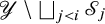 $\mathscr {Y} \setminus \bigsqcup _{j<i}\mathscr {S}_j$
for a cocharacter
$\mathscr {Y} \setminus \bigsqcup _{j<i}\mathscr {S}_j$
for a cocharacter $\lambda _i$
, with the fixed stack
$\lambda _i$
, with the fixed stack $\mathscr {Z}_i:=\mathscr {S}_i^{\lambda _i}$
. Let
$\mathscr {Z}_i:=\mathscr {S}_i^{\lambda _i}$
. Let $N_{\mathscr {S}_i/\mathscr {Y}}$
be the normal bundle of
$N_{\mathscr {S}_i/\mathscr {Y}}$
be the normal bundle of $\mathscr {S}_i$
in
$\mathscr {S}_i$
in $\mathscr {Y}$
. Define the width of the window categories
$\mathscr {Y}$
. Define the width of the window categories
 $$\begin{align*}\eta_i:=\left\langle \lambda_i, \det\left(N^{\vee}_{\mathscr{S}_i/\mathscr{Y}}|_{\mathscr{Z}_i}\right) \right\rangle.\end{align*}$$
For a choice of real numbers $m_{\bullet }=(m_i)_{i\in I}\in \mathbb {R}^I$
, define the category
$m_{\bullet }=(m_i)_{i\in I}\in \mathbb {R}^I$
, define the category
 $$ \begin{align} \mathbb{G}^\ell_{m_{\bullet}}:=\{\mathcal{F}\in D^b(\mathscr{Y})\text{ such that } \mathrm{wt}_{\lambda_i}(\mathcal{F}|_{\mathscr{Z}_i})\subset [ m_i, m_i+\eta_i) \text{ for all }i\in I\}. \end{align} $$
In the above, $\mathrm {wt}_{\lambda _i}(\mathcal {F}|_{\mathscr {Z}_i})$
is the set of
$\mathrm {wt}_{\lambda _i}(\mathcal {F}|_{\mathscr {Z}_i})$
is the set of $\lambda _i$
-weights on
$\lambda _i$
-weights on $\mathcal {F}|_{\mathscr {Z}_i}$
. Then [Reference Halpern-LeistnerHL15, Theorem 2.10] says that the restriction functor
$\mathcal {F}|_{\mathscr {Z}_i}$
. Then [Reference Halpern-LeistnerHL15, Theorem 2.10] says that the restriction functor $j^*$
induces an equivalence of categories:
$j^*$
induces an equivalence of categories:
 $$ \begin{align} j^*\colon \mathbb{G}^\ell_{m_{\bullet}}\xrightarrow{\sim} D^b\big(\mathscr{Y}^{\ell\text{-ss}}\big) \end{align} $$
for any choice of real numbers $m_{\bullet }=(m_i)_{i\in I}\in \mathbb {R}^I$
.
$m_{\bullet }=(m_i)_{i\in I}\in \mathbb {R}^I$
.
2.6 Quasi-smooth derived stacks
2.6.1 Derived categories of (quasi-)coherent sheaves
Let $\mathfrak {M}$
be a derived Artin stack over
$\mathfrak {M}$
be a derived Artin stack over $\mathbb {C}$
and let
$\mathbb {C}$
and let $\mathcal {M}$
be its classical truncation. Let
$\mathcal {M}$
be its classical truncation. Let $\mathbb {L}_{\mathfrak {M}}$
be the cotangent complex of
$\mathbb {L}_{\mathfrak {M}}$
be the cotangent complex of $\mathfrak {M}$
. The stack
$\mathfrak {M}$
. The stack $\mathfrak {M}$
is called quasi-smooth if for all closed points
$\mathfrak {M}$
is called quasi-smooth if for all closed points $x\to \mathcal {M}$
, the restriction
$x\to \mathcal {M}$
, the restriction $\mathbb {L}_{\mathfrak {M}}|_x$
has cohomological amplitude in
$\mathbb {L}_{\mathfrak {M}}|_x$
has cohomological amplitude in $[-1, 1]$
. By [Reference Ben-Bassat, Brav, Bussi and JoyceBBBBJ15, Theorem 2.8], the stack
$[-1, 1]$
. By [Reference Ben-Bassat, Brav, Bussi and JoyceBBBBJ15, Theorem 2.8], the stack $\mathfrak {M}$
is quasi-smooth if and only if it is a
$\mathfrak {M}$
is quasi-smooth if and only if it is a $1$
-stack and any point of
$1$
-stack and any point of $\mathfrak {M}$
lies in the image of a
$\mathfrak {M}$
lies in the image of a $0$
-representable smooth morphism
$0$
-representable smooth morphism
 $$ \begin{align} \alpha \colon \mathscr{U}\to\mathfrak{M} \end{align} $$
for a Koszul scheme $\mathscr {U}$
as in (2.3). Let
$\mathscr {U}$
as in (2.3). Let $D_{\mathrm {{qc}}}(\mathscr {U})$
be the derived category of dg-modules over
$D_{\mathrm {{qc}}}(\mathscr {U})$
be the derived category of dg-modules over $\mathcal {O}_{\mathscr {U}}$
and let
$\mathcal {O}_{\mathscr {U}}$
and let $D^b(\mathscr {U}) \subset D_{\mathrm {{qc}}}(\mathscr {U})$
be the subcategory of objects with bounded coherent cohomologies. Further, let
$D^b(\mathscr {U}) \subset D_{\mathrm {{qc}}}(\mathscr {U})$
be the subcategory of objects with bounded coherent cohomologies. Further, let $\operatorname {Ind} D^b(\mathscr {U})$
be the ind-completion of
$\operatorname {Ind} D^b(\mathscr {U})$
be the ind-completion of $D^b(\mathscr {U})$
[Reference GaitsgoryGai13]. For a quasi-smooth stack
$D^b(\mathscr {U})$
[Reference GaitsgoryGai13]. For a quasi-smooth stack $\mathfrak {M}$
, the dg-categories
$\mathfrak {M}$
, the dg-categories $D_{\mathrm {{qc}}}(\mathfrak {M})$
,
$D_{\mathrm {{qc}}}(\mathfrak {M})$
, $D^b(\mathfrak {M})$
, and
$D^b(\mathfrak {M})$
, and $\operatorname {Ind} D^b(\mathfrak {M})$
are defined to be limits in the
$\operatorname {Ind} D^b(\mathfrak {M})$
are defined to be limits in the $\infty $
-category of smooth morphisms (2.11), see [Reference TodaTod24a, Subsection 3.1.1], [Reference GaitsgoryGai13]:
$\infty $
-category of smooth morphisms (2.11), see [Reference TodaTod24a, Subsection 3.1.1], [Reference GaitsgoryGai13]:
 $$ \begin{align*} D_{\mathrm{{qc}}}(\mathfrak{M})=\lim_{\mathscr{U} \to \mathfrak{M}} D_{\mathrm{{qc}}}(\mathscr{U}), \ D^b(\mathfrak{M})=\lim_{\mathscr{U} \to \mathfrak{M}} D^b(\mathscr{U}), \ \operatorname{Ind} D^b(\mathfrak{M})=\lim_{\mathscr{U} \to \mathfrak{M}} \operatorname{Ind} D^b(\mathscr{U}). \end{align*} $$
The category $\operatorname {Ind} D^b(\mathfrak {M})$
is a module over
$\operatorname {Ind} D^b(\mathfrak {M})$
is a module over $D_{\mathrm {{qc}}}(\mathfrak {M})$
via the tensor product. For
$D_{\mathrm {{qc}}}(\mathfrak {M})$
via the tensor product. For $\mathcal {E}_1, \mathcal {E}_2 \in \operatorname {Ind} D^b(\mathfrak {M})$
, there exists an internal homomorphism, see [Reference Drinfeld and GaitsgoryDG13, Remark 3.4.5]
$\mathcal {E}_1, \mathcal {E}_2 \in \operatorname {Ind} D^b(\mathfrak {M})$
, there exists an internal homomorphism, see [Reference Drinfeld and GaitsgoryDG13, Remark 3.4.5]
 $$ \begin{align*} \mathcal{H}om(\mathcal{E}_1, \mathcal{E}_2) \in D_{\mathrm{{qc}}}(\mathfrak{M}), \end{align*} $$
such that for any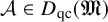 $\mathcal {A} \in D_{\mathrm {{qc}}}(\mathfrak {M})$
we have
$\mathcal {A} \in D_{\mathrm {{qc}}}(\mathfrak {M})$
we have
 $$ \begin{align*} \operatorname{Hom}_{D_{\mathrm{{qc}}}(\mathfrak{M})}(\mathcal{A}, \mathcal{H}om(\mathcal{E}_1, \mathcal{E}_2)) \cong \operatorname{Hom}_{\operatorname{Ind} D^b(\mathfrak{M})}(\mathcal{A} \otimes \mathcal{E}_1, \mathcal{E}_2). \end{align*} $$
If $\mathfrak {M}$
is QCA (quasi-compact and with affine automorphism groups) [Reference Drinfeld and GaitsgoryDG13, Definition 1.1.8], then
$\mathfrak {M}$
is QCA (quasi-compact and with affine automorphism groups) [Reference Drinfeld and GaitsgoryDG13, Definition 1.1.8], then $\operatorname {Ind} D^b(\mathfrak {M})$
is compactly generated with compact objects
$\operatorname {Ind} D^b(\mathfrak {M})$
is compactly generated with compact objects $D^b(\mathfrak {M})$
, see [Reference Drinfeld and GaitsgoryDG13, Theorem 3.3.5].
$D^b(\mathfrak {M})$
, see [Reference Drinfeld and GaitsgoryDG13, Theorem 3.3.5].
2.6.2 Étale and formal local structures along good moduli spaces
Let $\mathfrak {M}$
be a quasi-smooth stack over
$\mathfrak {M}$
be a quasi-smooth stack over $\mathbb {C}$
and let
$\mathbb {C}$
and let $\mathcal {M}$
be its classical truncation. Suppose that
$\mathcal {M}$
be its classical truncation. Suppose that $\mathcal {M}$
admits a good moduli space map
$\mathcal {M}$
admits a good moduli space map
 $$\begin{align*}\pi\colon \mathcal{M} \to M,\end{align*}$$
see [Reference AlperAlp13] for the notion of a good moduli space. In particular, M is an algebraic space and $\pi $
is a quasi-compact morphism. For each point in M, there are an étale neighborhood
$\pi $
is a quasi-compact morphism. For each point in M, there are an étale neighborhood $U \to M$
and Cartesian squares:
$U \to M$
and Cartesian squares:

where each vertical arrow is étale and $\mathfrak {M}_U$
is equivalent to a Koszul stack
$\mathfrak {M}_U$
is equivalent to a Koszul stack $\mathscr {P}=s^{-1}(0)/G$
as in (2.4), see [Reference TodaTod24a, Subsection 3.1.4], [Reference Halpern-LeistnerHLa, Theorem 4.2.3], [Reference Alper, Hall and DavidAHD20]. Similarly, for each closed point
$\mathscr {P}=s^{-1}(0)/G$
as in (2.4), see [Reference TodaTod24a, Subsection 3.1.4], [Reference Halpern-LeistnerHLa, Theorem 4.2.3], [Reference Alper, Hall and DavidAHD20]. Similarly, for each closed point $y \in M$
, there exist Cartesian squares, see [Reference TodaTod24a, Subsection 3.1.4]:
$y \in M$
, there exist Cartesian squares, see [Reference TodaTod24a, Subsection 3.1.4]:

2.6.3 $(-1)$
-shifted cotangent stacks
$(-1)$
-shifted cotangent stacks

Let $\mathfrak {M}$
be a quasi-smooth stack. Let
$\mathfrak {M}$
be a quasi-smooth stack. Let $\mathbb {T}_{\mathfrak {M}}$
be the tangent complex of
$\mathbb {T}_{\mathfrak {M}}$
be the tangent complex of $\mathfrak {M}$
, which is the dual complex to the cotangent complex
$\mathfrak {M}$
, which is the dual complex to the cotangent complex $\mathbb {L}_{\mathfrak {M}}$
. We denote by
$\mathbb {L}_{\mathfrak {M}}$
. We denote by $\Omega _{\mathfrak {M}}[-1]$
the (-1)-shifted cotangent stack of
$\Omega _{\mathfrak {M}}[-1]$
the (-1)-shifted cotangent stack of $\mathfrak {M}$
:
$\mathfrak {M}$
:
 $$ \begin{align*} \Omega_{\mathfrak{M}}[-1]:=\mathrm{Spec}_{\mathfrak{M}}\left(\mathrm{Sym}(\mathbb{T}_{\mathfrak{M}}[1])\right). \end{align*} $$
Consider the projection map
 $$ \begin{align} p_0\colon \mathcal{N}:=\Omega_{\mathfrak{M}}[-1]^{\mathrm{{cl}}}\to \mathfrak{M}. \end{align} $$
For a Koszul stack $\mathscr {P}$
as in (2.4), recall the function f from (2.5) and consider the critical locus
$\mathscr {P}$
as in (2.4), recall the function f from (2.5) and consider the critical locus $\mathrm {Crit}(f)\subset \mathscr {V}^{\vee }$
. In this case, the map
$\mathrm {Crit}(f)\subset \mathscr {V}^{\vee }$
. In this case, the map $p_0$
is the natural projection
$p_0$
is the natural projection
 $$ \begin{align} p_0\colon \mathrm{Crit}(f)=\Omega_{\mathscr{P}}[-1]^{\mathrm{{cl}}}\to \mathscr{P}. \end{align} $$
For an object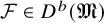 $\mathcal {F} \in D^b(\mathfrak {M})$
, Arinkin–Gaitsgory [Reference Arinkin and GaitsgoryAG15] defined the notion of singular support denoted by
$\mathcal {F} \in D^b(\mathfrak {M})$
, Arinkin–Gaitsgory [Reference Arinkin and GaitsgoryAG15] defined the notion of singular support denoted by
 $$ \begin{align*} \mathrm{Supp}^{\mathrm{{sg}}}(\mathcal{F}) \subset \mathcal{N}. \end{align*} $$
The definition is compatible with maps $\alpha $
as in (2.11), see [Reference Arinkin and GaitsgoryAG15, Section 7]. Consider the group
$\alpha $
as in (2.11), see [Reference Arinkin and GaitsgoryAG15, Section 7]. Consider the group $\mathbb {C}^*$
scaling the fibers of the map
$\mathbb {C}^*$
scaling the fibers of the map $p_0$
. A closed substack
$p_0$
. A closed substack $\mathscr {Z}$
of
$\mathscr {Z}$
of $\mathcal {N}$
is called conical if it is closed under the action of
$\mathcal {N}$
is called conical if it is closed under the action of $\mathbb {C}^*$
. The singular support
$\mathbb {C}^*$
. The singular support $\mathrm {Supp}^{\mathrm {{sg}}}(\mathcal {F})$
of
$\mathrm {Supp}^{\mathrm {{sg}}}(\mathcal {F})$
of $\mathcal {F}$
is a conical subset
$\mathcal {F}$
is a conical subset $\mathscr {Z}$
of
$\mathscr {Z}$
of $\mathcal {N}$
. For a given conical closed substack
$\mathcal {N}$
. For a given conical closed substack $\mathscr {Z} \subset \mathcal {N}$
, we denote by
$\mathscr {Z} \subset \mathcal {N}$
, we denote by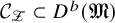 $\mathcal {C}_{\mathscr {Z}} \subset D^b(\mathfrak {M})$
the subcategory of objects whose singular supports are contained in
$\mathcal {C}_{\mathscr {Z}} \subset D^b(\mathfrak {M})$
the subcategory of objects whose singular supports are contained in $\mathscr {Z}$
.
$\mathscr {Z}$
.
Consider a Koszul stack $\mathscr {P}$
as in (2.4) and recall the Koszul equivalence
$\mathscr {P}$
as in (2.4) and recall the Koszul equivalence $\Theta $
from (2.6). Under
$\Theta $
from (2.6). Under $\Theta $
, the singular support of
$\Theta $
, the singular support of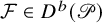 $\mathcal {F}\in D^b(\mathscr {P})$
corresponds to the support
$\mathcal {F}\in D^b(\mathscr {P})$
corresponds to the support $\mathscr {Z}$
of the matrix factorization
$\mathscr {Z}$
of the matrix factorization $\Theta (\mathcal {F})$
, namely the maximal closed substack
$\Theta (\mathcal {F})$
, namely the maximal closed substack $\mathscr {Z}\subset \mathrm {Crit}(f)$
such that
$\mathscr {Z}\subset \mathrm {Crit}(f)$
such that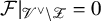 $\mathcal {F}|_{\mathscr {V}^{\vee }\setminus \mathscr {Z}}=0$
in
$\mathcal {F}|_{\mathscr {V}^{\vee }\setminus \mathscr {Z}}=0$
in $\mathrm {MF}^{\mathrm {gr}}(\mathscr {V}^{\vee }\setminus \mathscr {Z}, f)$
, see [Reference TodaTod24a, Subsection 2.3.9].
$\mathrm {MF}^{\mathrm {gr}}(\mathscr {V}^{\vee }\setminus \mathscr {Z}, f)$
, see [Reference TodaTod24a, Subsection 2.3.9].
2.7 The window theorem for quasi-smooth stacks
We review the theory of window categories for singular support quotients of quasi-smooth stacks [Reference TodaTod24a, Chapter 5], which itself is inspired by Halpern-Leistner’s theory of window categories for $0$
-shifted symplectic derived stacks [Reference Halpern-LeistnerHLa]. We continue with the notation from the previous subsection.
$0$
-shifted symplectic derived stacks [Reference Halpern-LeistnerHLa]. We continue with the notation from the previous subsection.
Let $\mathfrak {M}$
be a quasi-smooth stack and assume throughout this subsection that its classical truncation
$\mathfrak {M}$
be a quasi-smooth stack and assume throughout this subsection that its classical truncation $\mathcal {M}$
admits a good moduli space
$\mathcal {M}$
admits a good moduli space $\mathcal {M} \to M.$
Let
$\mathcal {M} \to M.$
Let $\ell $
be a line bundle on
$\ell $
be a line bundle on $\mathcal {M}$
and let
$\mathcal {M}$
and let $b \in H^4(\mathcal {M}, \mathbb {Q})$
be a positive definite class, see [Reference Halpern-LeistnerHLb, Definition 3.7.6]. We also use the same symbols
$b \in H^4(\mathcal {M}, \mathbb {Q})$
be a positive definite class, see [Reference Halpern-LeistnerHLb, Definition 3.7.6]. We also use the same symbols $(\ell , b)$
for
$(\ell , b)$
for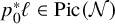 $p_0^{\ast }\ell \in \mathrm {Pic}(\mathcal {N})$
and
$p_0^{\ast }\ell \in \mathrm {Pic}(\mathcal {N})$
and $p_0^{\ast }b \in H^4(\mathcal {N}, \mathbb {Q})$
. Then there is a
$p_0^{\ast }b \in H^4(\mathcal {N}, \mathbb {Q})$
. Then there is a $\Theta $
-stratification with respect to
$\Theta $
-stratification with respect to $(\ell , b)$
:
$(\ell , b)$
:
 $$ \begin{align} \mathcal{N}=\mathscr{S}_1 \sqcup \cdots \sqcup \mathscr{S}_N\sqcup \mathcal{N}^{\ell\text{-ss}} \end{align} $$
with centers $\mathscr {Z}_i\subset \mathscr {S}_i$
, see [Reference Halpern-LeistnerHLb, Theorem 5.2.3, Proposition 5.3.3]. In the above situation, an analogue of the window theorem is proved in [Reference TodaTod, Theorem 1.1], [Reference TodaTod24a, Theorem 5.3.13] (which generalizes [Reference Halpern-LeistnerHLa, Theorem 3.3.1] in the case that
$\mathscr {Z}_i\subset \mathscr {S}_i$
, see [Reference Halpern-LeistnerHLb, Theorem 5.2.3, Proposition 5.3.3]. In the above situation, an analogue of the window theorem is proved in [Reference TodaTod, Theorem 1.1], [Reference TodaTod24a, Theorem 5.3.13] (which generalizes [Reference Halpern-LeistnerHLa, Theorem 3.3.1] in the case that $\mathfrak {M}$
is
$\mathfrak {M}$
is $0$
-shifted symplectic):
$0$
-shifted symplectic):
Theorem 2.3. [Reference TodaTod24a, Reference TodaTod]
In addition to the above, suppose that $\mathcal {M} \to M$
satisfies the formal neighborhood theorem, see below. Then for each
$\mathcal {M} \to M$
satisfies the formal neighborhood theorem, see below. Then for each $m_{\bullet }=(m_i)_{i=1}^N\in \mathbb {R}^N$
, there is a subcategory
$m_{\bullet }=(m_i)_{i=1}^N\in \mathbb {R}^N$
, there is a subcategory $\mathbb {W}(\mathfrak {M})^\ell _{m_{\bullet }} \subset D^b(\mathfrak {M})$
such that the composition
$\mathbb {W}(\mathfrak {M})^\ell _{m_{\bullet }} \subset D^b(\mathfrak {M})$
such that the composition
 $$ \begin{align*} \mathbb{W}(\mathfrak{M})^\ell_{m_{\bullet}} \subset D^b(\mathfrak{M}) \twoheadrightarrow D^b(\mathfrak{M})/\mathcal{C}_{\mathscr{Z}} \end{align*} $$
is an equivalence, where $\mathscr {Z}:=\mathcal {N} \setminus \mathcal {N}^{\ell \text {-ss}}$
.
$\mathscr {Z}:=\mathcal {N} \setminus \mathcal {N}^{\ell \text {-ss}}$
.
Remark 2.4. When $\mathcal {N}$
is a (global) quotient stack
$\mathcal {N}$
is a (global) quotient stack $\mathcal {N}=Y/G$
for a reductive algebraic group G, a
$\mathcal {N}=Y/G$
for a reductive algebraic group G, a $\Theta $
-stratification (2.16) is the same as a Kempf-Ness stratification [Reference Halpern-LeistnerHLb, Example 0.0.5]. The class b is then constructed as the pull-back of the class in
$\Theta $
-stratification (2.16) is the same as a Kempf-Ness stratification [Reference Halpern-LeistnerHLb, Example 0.0.5]. The class b is then constructed as the pull-back of the class in $H^4(BG, \mathbb {Q})$
corresponding to the chosen positive definite form [Reference Halpern-LeistnerHLb, Example 5.3.4].
$H^4(BG, \mathbb {Q})$
corresponding to the chosen positive definite form [Reference Halpern-LeistnerHLb, Example 5.3.4].
Remark 2.5. Suppose that $\mathbb {L}_{\mathfrak {M}}$
is self-dual, for example,
$\mathbb {L}_{\mathfrak {M}}$
is self-dual, for example, $\mathfrak {M}$
is 0-shifted symplectic. In this case, we have
$\mathfrak {M}$
is 0-shifted symplectic. In this case, we have $\mathcal {N}^{\ell \text {-ss}}=\Omega _{\mathfrak {M}^{\ell \text {-ss}}}[-1]^{\mathrm {{cl}}}$
, which easily follows from [Reference Halpern-LeistnerHLa, Lemma 4.3.22]. Then we have the equivalence, see [Reference TodaTod24a, Lemma 3.2.9]:
$\mathcal {N}^{\ell \text {-ss}}=\Omega _{\mathfrak {M}^{\ell \text {-ss}}}[-1]^{\mathrm {{cl}}}$
, which easily follows from [Reference Halpern-LeistnerHLa, Lemma 4.3.22]. Then we have the equivalence, see [Reference TodaTod24a, Lemma 3.2.9]:
 $$ \begin{align*} D^b(\mathfrak{M})/\mathcal{C}_{\mathscr{Z}} \stackrel{\sim}{\to} D^b(\mathfrak{M}^{\ell\text{-ss}}). \end{align*} $$
We now explain the meaning of “the formal neighborhood theorem” in the statement of Theorem 2.3, see [Reference TodaTod24a, Definition 5.2.3]. For a closed point $y \in M$
, denote also by
$y \in M$
, denote also by $y \in \mathcal {M}$
the unique closed point in the fiber of
$y \in \mathcal {M}$
the unique closed point in the fiber of $\mathcal {M} \to M$
at y. Set
$\mathcal {M} \to M$
at y. Set $G_y:=\mathrm {Aut}(y)$
, which is a reductive algebraic group. Let
$G_y:=\mathrm {Aut}(y)$
, which is a reductive algebraic group. Let $\widehat {\mathcal {M}}_y$
be the formal fiber along with
$\widehat {\mathcal {M}}_y$
be the formal fiber along with $\mathcal {M} \to M$
at y. Let
$\mathcal {M} \to M$
at y. Let $\widehat {\mathcal {H}}^0(\mathbb {T}_{\mathcal {M}}|_{y})$
be the formal fiber of
$\widehat {\mathcal {H}}^0(\mathbb {T}_{\mathcal {M}}|_{y})$
be the formal fiber of  at the origin, and define $\widehat {\mathcal {H}}^0(\mathbb {T}_{\mathfrak {M}}|_{y})$
similarly, see also the convention from Subsection 2.1. Then the formal neighborhood theorem says that there is a
$\widehat {\mathcal {H}}^0(\mathbb {T}_{\mathfrak {M}}|_{y})$
similarly, see also the convention from Subsection 2.1. Then the formal neighborhood theorem says that there is a $G_y$
-equivariant morphism
$G_y$
-equivariant morphism
 $$ \begin{align*} \kappa_y \colon \widehat{\mathcal{H}}^0(\mathbb{T}_{\mathcal{M}}|_{y}) \to \mathcal{H}^1(\mathbb{T}_{\mathcal{M}}|_{y}) \end{align*} $$
such that, by setting $\mathcal {U}_y$
to be the classical zero locus of
$\mathcal {U}_y$
to be the classical zero locus of $\kappa _y$
, there is an isomorphism
$\kappa _y$
, there is an isomorphism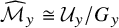 $\widehat {\mathcal {M}}_y \cong \mathcal {U}_y/G_y$
. Let
$\widehat {\mathcal {M}}_y \cong \mathcal {U}_y/G_y$
. Let $\mathfrak {U}_y$
be the derived zero locus of
$\mathfrak {U}_y$
be the derived zero locus of $\kappa _y$
. Then, by replacing
$\kappa _y$
. Then, by replacing $\kappa _y$
if necessary,
$\kappa _y$
if necessary, $\widehat {\mathfrak {M}}_y$
is equivalent to
$\widehat {\mathfrak {M}}_y$
is equivalent to $\mathfrak {U}_y/G$
, see [Reference TodaTod24a, Lemma 5.2.5].
$\mathfrak {U}_y/G$
, see [Reference TodaTod24a, Lemma 5.2.5].
Below we give a formal local description of $\mathbb {W}(\mathfrak {M})_{m_{\bullet }}^\ell $
. Consider the pair of a smooth stack and a regular function
$\mathbb {W}(\mathfrak {M})_{m_{\bullet }}^\ell $
. Consider the pair of a smooth stack and a regular function $(\mathscr {X}_y, f_y)$
:
$(\mathscr {X}_y, f_y)$
:
 $$ \begin{align*} \mathscr{X}_y:=\left(\widehat{\mathcal{H}}^0(\mathbb{T}_{\mathfrak{M}}|_{y}) \times \mathcal{H}^1(\mathbb{T}_{\mathfrak{M}}|_{y})^{\vee}\right)/G_y \stackrel{f_y}{\to} \mathbb{C}, \end{align*} $$
where $f_y(u, v)=\langle \kappa _y(u), v \rangle $
. From (2.15), the critical locus of
$f_y(u, v)=\langle \kappa _y(u), v \rangle $
. From (2.15), the critical locus of $f_y$
is isomorphic to the classical truncation of the
$f_y$
is isomorphic to the classical truncation of the $(-1)$
-shifted cotangent stack over
$(-1)$
-shifted cotangent stack over $\widehat {\mathfrak {M}}_y$
, so it is isomorphic to the formal fiber
$\widehat {\mathfrak {M}}_y$
, so it is isomorphic to the formal fiber $\widehat {\mathcal {N}}_y$
of
$\widehat {\mathcal {N}}_y$
of $\mathcal {N} \to \mathcal {M} \to M$
at y. The pull-back of the
$\mathcal {N} \to \mathcal {M} \to M$
at y. The pull-back of the $\Theta $
-stratification (2.16) to
$\Theta $
-stratification (2.16) to $\widehat {\mathcal {N}}_y$
gives a Kempf-Ness stratification
$\widehat {\mathcal {N}}_y$
gives a Kempf-Ness stratification
 $$ \begin{align*} \widehat{\mathcal{N}}_y=\widehat{\mathscr{S}}_{1, y} \sqcup \cdots \sqcup \widehat{\mathscr{S}}_{N, y} \sqcup \widehat{\mathcal{N}}_y^{\ell\text{-ss}} \end{align*} $$
with centers $\widehat {\mathscr {Z}}_{i, y}\subset \widehat {\mathscr {S}}_{i, y}$
and one parameter subgroups
$\widehat {\mathscr {Z}}_{i, y}\subset \widehat {\mathscr {S}}_{i, y}$
and one parameter subgroups $\lambda _i \colon \mathbb {C}^{\ast } \to G_y$
. By the Koszul equivalence, see Theorem 2.1, there is an equivalence:
$\lambda _i \colon \mathbb {C}^{\ast } \to G_y$
. By the Koszul equivalence, see Theorem 2.1, there is an equivalence:
 $$ \begin{align*} \Theta_y \colon D^b(\widehat{\mathfrak{M}}_y) \stackrel{\sim}{\to} \mathrm{MF}^{\text{gr}}(\mathscr{X}_y, f_y). \end{align*} $$
Then the subcategory $\mathbb {W}(\mathfrak {M})_{m_{\bullet }}^\ell $
in Theorem 2.3 is characterized as follows: an object
$\mathbb {W}(\mathfrak {M})_{m_{\bullet }}^\ell $
in Theorem 2.3 is characterized as follows: an object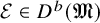 $\mathcal {E} \in D^b(\mathfrak {M})$
is an object of
$\mathcal {E} \in D^b(\mathfrak {M})$
is an object of $\mathbb {W}(\mathfrak {M})^\ell _{m_{\bullet }}$
if and only if, for any closed point
$\mathbb {W}(\mathfrak {M})^\ell _{m_{\bullet }}$
if and only if, for any closed point $y \in M$
, we have
$y \in M$
, we have
 $$ \begin{align} \Theta_{y}(\mathcal{E}|_{\widehat{\mathfrak{M}}_y}) \in \mathrm{MF}^{\text{gr}}(\mathbb{G}^\ell_{m_{\bullet}'}, f_y), \ m_i'=m_i-\left\langle \lambda_i, \det\left(\mathcal{H}^1(\mathbb{T}_{\mathfrak{M}}|_{y})^{\lambda_i>0}\right) \right\rangle. \end{align} $$
The category $\mathbb {G}^{\ell }_{m^{\prime }_{\bullet }}$
is the window category (2.9) for the weights
$\mathbb {G}^{\ell }_{m^{\prime }_{\bullet }}$
is the window category (2.9) for the weights $(m^{\prime }_i)_{i=1}^N$
and the line bundle
$(m^{\prime }_i)_{i=1}^N$
and the line bundle $\ell $
. The difference between
$\ell $
. The difference between $m_i$
and
$m_i$
and $m_i'$
is due to the discrepancy of categorical Hall products on
$m_i'$
is due to the discrepancy of categorical Hall products on $\mathfrak {M}_y$
and
$\mathfrak {M}_y$
and $\mathscr {X}_y$
, see [Reference PădurariuPăd23, Proposition 3.1].
$\mathscr {X}_y$
, see [Reference PădurariuPăd23, Proposition 3.1].
2.8 Intrinsic window subcategory
We continue to consider a quasi-smooth derived stack $\mathfrak {M}$
whose classical truncation
$\mathfrak {M}$
whose classical truncation $\mathcal {M}$
admits a good moduli space
$\mathcal {M}$
admits a good moduli space $\mathcal {M} \to M$
. We say that
$\mathcal {M} \to M$
. We say that $\mathfrak {M}$
is symmetric if for any closed point
$\mathfrak {M}$
is symmetric if for any closed point $y \in \mathfrak {M}$
, the
$y \in \mathfrak {M}$
, the $G_y:=\mathrm {Aut}(y)$
-representation
$G_y:=\mathrm {Aut}(y)$
-representation
 $$ \begin{align*} \mathcal{H}^0(\mathbb{T}_{\mathfrak{M}}|_{y}) \oplus \mathcal{H}^1(\mathbb{T}_{\mathfrak{M}}|_{y})^{\vee} \end{align*} $$
is a self-dual $G_y$
-representation. In this subsection, we assume that
$G_y$
-representation. In this subsection, we assume that $\mathfrak {M}$
is symmetric. Let
$\mathfrak {M}$
is symmetric. Let $\delta \in \mathrm {Pic}(\mathfrak {M})_{\mathbb {R}}$
. We now define a different kind of window categories, called intrinsic window subcategories
$\delta \in \mathrm {Pic}(\mathfrak {M})_{\mathbb {R}}$
. We now define a different kind of window categories, called intrinsic window subcategories $\mathbb {W}(\mathfrak {M})_{\delta }^{\mathrm {{int}}} \subset D^b(\mathfrak {M})$
, see [Reference TodaTod24a, Definition 5.2.12, 5.3.12]. These categories are the quasi-smooth version of “magic window categories” from [Reference Špenko and Van den BerghŠVdB17, Reference Halpern-Leistner and SamHLS20].
$\mathbb {W}(\mathfrak {M})_{\delta }^{\mathrm {{int}}} \subset D^b(\mathfrak {M})$
, see [Reference TodaTod24a, Definition 5.2.12, 5.3.12]. These categories are the quasi-smooth version of “magic window categories” from [Reference Špenko and Van den BerghŠVdB17, Reference Halpern-Leistner and SamHLS20].
First, assume that $\mathfrak {M}$
is a Koszul stack associated with
$\mathfrak {M}$
is a Koszul stack associated with $(Y, V, s, G)$
as in (2.4)
$(Y, V, s, G)$
as in (2.4)
 $$ \begin{align} \mathfrak{M}=s^{-1}(0)/G. \end{align} $$
Consider the quotient stack $\mathscr {Y}=Y/G$
, the closed immersion
$\mathscr {Y}=Y/G$
, the closed immersion $j \colon \mathfrak {M} \hookrightarrow \mathscr {Y}$
, and let
$j \colon \mathfrak {M} \hookrightarrow \mathscr {Y}$
, and let $\mathscr {V} \to \mathscr {Y}$
be the total space of
$\mathscr {V} \to \mathscr {Y}$
be the total space of $V/G \to Y/G$
. In this case, we define
$V/G \to Y/G$
. In this case, we define $\mathbb {W}(\mathfrak {M})_{\delta }^{\mathrm {{int}}} \subset D^b(\mathfrak {M})$
to be consisting of
$\mathbb {W}(\mathfrak {M})_{\delta }^{\mathrm {{int}}} \subset D^b(\mathfrak {M})$
to be consisting of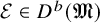 $\mathcal {E} \in D^b(\mathfrak {M})$
such that for any map
$\mathcal {E} \in D^b(\mathfrak {M})$
such that for any map $\nu \colon B\mathbb {C}^{\ast } \to \mathfrak {M}$
we have
$\nu \colon B\mathbb {C}^{\ast } \to \mathfrak {M}$
we have
 $$ \begin{align*} \mathrm{wt}(\nu^{\ast}j^{\ast}j_{\ast}\mathcal{E}) \subset \left[\frac{1}{2}\mathrm{wt}\left(\det \nu^{\ast}(\mathbb{L}_{\mathscr{V}}|_{\mathscr{Y}})^{\nu<0} \right), \frac{1}{2}\mathrm{wt}\left(\det \nu^{\ast}(\mathbb{L}_{\mathscr{V}}|_{\mathscr{Y}})^{\nu>0}\right) \right] +\mathrm{wt}(\nu^{\ast}\delta). \end{align*} $$
The above subcategory $\mathbb {W}(\mathfrak {M})_{\delta }^{\mathrm {{int}}}$
is intrinsic to
$\mathbb {W}(\mathfrak {M})_{\delta }^{\mathrm {{int}}}$
is intrinsic to $\mathfrak {M}$
, that is, independent of a choice of a presentation
$\mathfrak {M}$
, that is, independent of a choice of a presentation $\mathfrak {M}$
as (2.18) for
$\mathfrak {M}$
as (2.18) for $(Y, V, s, G)$
, see [Reference TodaTod24a, Lemma 5.3.14].
$(Y, V, s, G)$
, see [Reference TodaTod24a, Lemma 5.3.14].
In general, the intrinsic window subcategory is defined as follows (which generalizes the magic window category in [Reference Halpern-LeistnerHLa, Definition 4.3.5] considered when $\mathbb {L}_{\mathfrak {M}}$
is self-dual):
$\mathbb {L}_{\mathfrak {M}}$
is self-dual):
Definition 2.6. [Reference TodaTod24a, Definition 5.3.12]
We define the subcategory
 $$ \begin{align*} \mathbb{W}(\mathfrak{M})_{\delta}^{\mathrm{{int}}} \subset D^b(\mathfrak{M}) \end{align*} $$
to be consisting of objects $\mathcal {E}$
such that, for any étale morphism
$\mathcal {E}$
such that, for any étale morphism $\iota _U\colon U \to M$
such that
$\iota _U\colon U \to M$
such that $\mathfrak {M}_U$
is of the form
$\mathfrak {M}_U$
is of the form $s^{-1}(0)/G$
as in (2.18) and
$s^{-1}(0)/G$
as in (2.18) and $\iota _U$
induces an étale morphism
$\iota _U$
induces an étale morphism $\iota _U \colon \mathfrak {M}_U \to \mathfrak {M}$
, we have
$\iota _U \colon \mathfrak {M}_U \to \mathfrak {M}$
, we have $\iota _U^{\ast }\mathcal {E} \in \mathbb {W}(\mathfrak {M}_U)_{\iota _U^{\ast }\delta }^{\mathrm {{int}}} \subset D^b(\mathfrak {M}_U)$
.
$\iota _U^{\ast }\mathcal {E} \in \mathbb {W}(\mathfrak {M}_U)_{\iota _U^{\ast }\delta }^{\mathrm {{int}}} \subset D^b(\mathfrak {M}_U)$
.
3 Quasi-BPS categories for doubled quivers
In this section, we review the results in [Reference PădurariuPTc] about quasi-BPS categories of doubled quivers, focusing on the example of doubled quivers of g-loop quivers for $g{\geqslant } 1$
. These results are the local analogues of Theorems 1.1 and 1.2. We also discuss similar results for formal fibers along good moduli space morphisms.
$g{\geqslant } 1$
. These results are the local analogues of Theorems 1.1 and 1.2. We also discuss similar results for formal fibers along good moduli space morphisms.
3.1 Moduli stacks of representations of quivers
3.1.1 Moduli stacks
Let $Q=(I, E)$
be a quiver, where I is the set of vertices and E is the set of edges. For a dimension vector
$Q=(I, E)$
be a quiver, where I is the set of vertices and E is the set of edges. For a dimension vector $\boldsymbol {d}=(d^{(a)})_{a \in I} \in \mathbb {N}^{I}\subset \mathbb {Z}^I$
, we denote by
$\boldsymbol {d}=(d^{(a)})_{a \in I} \in \mathbb {N}^{I}\subset \mathbb {Z}^I$
, we denote by
 $$ \begin{align} \mathscr{X}(\boldsymbol{d})=R_Q(\boldsymbol{d})/G(\boldsymbol{d}) \end{align} $$
the moduli stack of Q-representations of dimension $\boldsymbol {d}$
. Here, the affine space
$\boldsymbol {d}$
. Here, the affine space $R_Q(\boldsymbol {d})$
and the reductive group
$R_Q(\boldsymbol {d})$
and the reductive group $G(\boldsymbol {d})$
are defined by
$G(\boldsymbol {d})$
are defined by
 $$ \begin{align*} R_Q(\boldsymbol{d})=\bigoplus_{(a \to b) \in E} \operatorname{Hom}(V^{(a)}, V^{(b)}), \ G(\boldsymbol{d})=\prod_{a \in I}GL(V^{(a)}), \end{align*} $$
where $V^{(a)}$
is a
$V^{(a)}$
is a $\mathbb {C}$
-vector space of dimension
$\mathbb {C}$
-vector space of dimension $d^{(a)}$
. We denote by
$d^{(a)}$
. We denote by $\mathfrak {g}(\boldsymbol {d})$
the Lie algebra of
$\mathfrak {g}(\boldsymbol {d})$
the Lie algebra of $G(\boldsymbol {d})$
.
$G(\boldsymbol {d})$
.
3.1.2 Doubled quivers
Let $Q^{\circ }=(I, E^{\circ })$
be a quiver. Let
$Q^{\circ }=(I, E^{\circ })$
be a quiver. Let $E^{\circ \ast }$
be the set of edges
$E^{\circ \ast }$
be the set of edges $e^{\ast }=(b \to a)$
for each
$e^{\ast }=(b \to a)$
for each $e=(a \to b)$
in
$e=(a \to b)$
in $E^{\circ }$
. Consider the doubled quiver of
$E^{\circ }$
. Consider the doubled quiver of $Q^\circ $
:
$Q^\circ $
:
 $$ \begin{align*} Q^{\circ, d}=(I, E^{\circ, d}), \ E^{\circ, d}=E^{\circ} \sqcup E^{\circ \ast}. \end{align*} $$
Let $\mathscr {I}$
be the quadratic relation
$\mathscr {I}$
be the quadratic relation $\sum _{e \in E^{\circ }} [e, e^{\ast }]\in \mathbb {C}[Q^{\circ , d}]$
. For a dimension vector
$\sum _{e \in E^{\circ }} [e, e^{\ast }]\in \mathbb {C}[Q^{\circ , d}]$
. For a dimension vector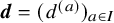 $\boldsymbol {d}=(d^{(a)})_{a \in I}$
, the relation
$\boldsymbol {d}=(d^{(a)})_{a \in I}$
, the relation $\mathscr {I}$
induces a moment map:
$\mathscr {I}$
induces a moment map:
 $$ \begin{align} \mu \colon R_{Q^{\circ, d}}(\boldsymbol{d})=T^*R_{Q^\circ}(\boldsymbol{d}) \to \mathfrak{g}(\boldsymbol{d}). \end{align} $$
The derived zero locus
 $$ \begin{align} \mathscr{P}(\boldsymbol{d}):=\mu^{-1}(0)/G(\boldsymbol{d}) \stackrel{j}{\hookrightarrow} \mathscr{Y}(\boldsymbol{d}):=R_{Q^{\circ, d}}(\boldsymbol{d})/G(\boldsymbol{d}) \end{align} $$
is the derived moduli stack of $(Q^{\circ , d}, \mathscr {I})$
-representations of dimension vector
$(Q^{\circ , d}, \mathscr {I})$
-representations of dimension vector $\boldsymbol {d}$
. Note that a
$\boldsymbol {d}$
. Note that a $(Q^{\circ , d}, \mathscr {I})$
-representation is the same as a representation of the preprojective algebra
$(Q^{\circ , d}, \mathscr {I})$
-representation is the same as a representation of the preprojective algebra $\Pi _{Q^\circ }:=\mathbb {C}[Q^{\circ , d}]/(\mathscr {I})$
of
$\Pi _{Q^\circ }:=\mathbb {C}[Q^{\circ , d}]/(\mathscr {I})$
of $Q^\circ $
, and we will use these two names interchangeably.
$Q^\circ $
, and we will use these two names interchangeably.
3.1.3 Tripled quivers
Consider a quiver $Q^{\circ }=(I, E^{\circ })$
. For
$Q^{\circ }=(I, E^{\circ })$
. For $a\in I$
, let
$a\in I$
, let $\omega _a$
be a loop at a. The tripled quiver of
$\omega _a$
be a loop at a. The tripled quiver of $Q^\circ $
is:
$Q^\circ $
is:
 $$ \begin{align*} Q=(I, E), \ E=E^{\circ, d}\sqcup \{\omega_a\}_{a \in I}. \end{align*} $$
The tripled potential W of Q is:
 $$ \begin{align*} W=\left(\sum_{a \in I}\omega_a \right) \left( \sum_{e \in E^{\circ}}[e, e^{\ast}] \right). \end{align*} $$
Consider the stack (3.1) of representations of dimension $\boldsymbol {d}$
for the tripled quiver Q:
$\boldsymbol {d}$
for the tripled quiver Q:
 $$\begin{align*}\mathscr{X}(\boldsymbol{d}):=R_{Q}(\boldsymbol{d})/G(\boldsymbol{d}):=R_{Q^{\circ, d}}(\boldsymbol{d}) \oplus \mathfrak{g}(\boldsymbol{d})/G(\boldsymbol{d}).\end{align*}$$
The potential W induces the regular function:
 $$ \begin{align} \mathrm{Tr} W\colon \mathscr{X}(\boldsymbol{d})=R_{Q}(\boldsymbol{d})/G(\boldsymbol{d}) \to \mathbb{C}. \end{align} $$
We have the Koszul duality equivalence, see Theorem 2.1:
 $$ \begin{align} \Theta \colon D^b(\mathscr{P}(\boldsymbol{d})) \stackrel{\sim}{\to} \mathrm{MF}^{\mathrm{{gr}}}(\mathscr{X}(\boldsymbol{d}), \mathrm{Tr} W). \end{align} $$
3.2 The weight lattice
Let $Q=(I, E)$
be a quiver. For a dimension vector
$Q=(I, E)$
be a quiver. For a dimension vector $\boldsymbol {d} \in \mathbb {N}^I$
, let
$\boldsymbol {d} \in \mathbb {N}^I$
, let $T(\boldsymbol {d}) \subset G(\boldsymbol {d})$
be the standard maximal torus and let
$T(\boldsymbol {d}) \subset G(\boldsymbol {d})$
be the standard maximal torus and let $M(\boldsymbol {d})$
be the character lattice for
$M(\boldsymbol {d})$
be the character lattice for $T(\boldsymbol {d})$
:
$T(\boldsymbol {d})$
:
 $$ \begin{align*} M(\boldsymbol{d})=\bigoplus_{a\in I} \bigoplus_{1{\leqslant} i{\leqslant} d^{(a)}} \mathbb{Z} \beta_i^{(a)}. \end{align*} $$
Here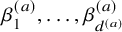 $\beta _1^{(a)}, \ldots , \beta _{d^{(a)}}^{(a)}$
are the weights of the standard representation of
$\beta _1^{(a)}, \ldots , \beta _{d^{(a)}}^{(a)}$
are the weights of the standard representation of $GL(V^{(a)})$
for
$GL(V^{(a)})$
for $a\in I$
. In the case that I consists of one element, we omit the superscript
$a\in I$
. In the case that I consists of one element, we omit the superscript $(a)$
. We denote by
$(a)$
. We denote by $\rho \in M(\boldsymbol {d})_{\mathbb {Q}}$
half of the sum of the positive roots of
$\rho \in M(\boldsymbol {d})_{\mathbb {Q}}$
half of the sum of the positive roots of $\mathfrak {g}(\boldsymbol {d})$
. Let W be the Weyl group of
$\mathfrak {g}(\boldsymbol {d})$
. Let W be the Weyl group of $G(\boldsymbol {d})$
and let
$G(\boldsymbol {d})$
and let $M(\boldsymbol {d})_{\mathbb {R}}^W \subset M(\boldsymbol {d})_{\mathbb {R}}$
be the Weyl-invariant subspace. There is a decomposition:
$M(\boldsymbol {d})_{\mathbb {R}}^W \subset M(\boldsymbol {d})_{\mathbb {R}}$
be the Weyl-invariant subspace. There is a decomposition:
 $$\begin{align*}M(\boldsymbol{d})_{\mathbb{R}}^W=\bigoplus_{a \in I} \mathbb{R}\sigma^{(a)},\end{align*}$$
where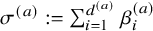 $\sigma ^{(a)}:=\sum _{i=1}^{d^{(a)}}\beta _i^{(a)}$
. There is a natural pairing:
$\sigma ^{(a)}:=\sum _{i=1}^{d^{(a)}}\beta _i^{(a)}$
. There is a natural pairing:
 $$ \begin{align*} \langle -, -\rangle \colon M(\boldsymbol{d})_{\mathbb{R}}^W \times \mathbb{R}^I \to \mathbb{R}, \ \langle \sigma^{(a)}, e^{(b)} \rangle=\delta^{ab}. \end{align*} $$
Here $\{e^{(b)}\}_{b\in I}$
is the standard basis of
$\{e^{(b)}\}_{b\in I}$
is the standard basis of $\mathbb {R}^I$
. We denote by
$\mathbb {R}^I$
. We denote by $\iota \colon M(\boldsymbol {d})_{\mathbb {R}} \to \mathbb {R}$
the linear map sending
$\iota \colon M(\boldsymbol {d})_{\mathbb {R}} \to \mathbb {R}$
the linear map sending $\beta _i^{(a)}$
to
$\beta _i^{(a)}$
to $1$
, and its kernel by
$1$
, and its kernel by $M(\boldsymbol {d})_{0, \mathbb {R}}$
. An element
$M(\boldsymbol {d})_{0, \mathbb {R}}$
. An element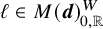 $\ell \in M(\boldsymbol {d})_{0, \mathbb {R}}^W$
is written as
$\ell \in M(\boldsymbol {d})_{0, \mathbb {R}}^W$
is written as
 $$ \begin{align*} \ell=\sum_{a\in I}\ell^{(a)}\sigma^{(a)}, \ \langle \ell, \boldsymbol{d} \rangle= \sum_{a}\ell^{(a)}d^{(a)}=0 \end{align*} $$
that is, $\ell $
is an
$\ell $
is an $\mathbb {R}$
-character of
$\mathbb {R}$
-character of $G(\boldsymbol {d})$
which is trivial on the diagonal torus
$G(\boldsymbol {d})$
which is trivial on the diagonal torus $\mathbb {C}^{\ast } \subset G(\boldsymbol {d})$
. Denote by
$\mathbb {C}^{\ast } \subset G(\boldsymbol {d})$
. Denote by $\underline {\boldsymbol {d}}:=\sum _{a\in I}d^{(a)}$
the total dimension. Define the following Weyl-invariant weight:
$\underline {\boldsymbol {d}}:=\sum _{a\in I}d^{(a)}$
the total dimension. Define the following Weyl-invariant weight:
 $$ \begin{align*} \tau_{\boldsymbol{d}} :=\frac{1}{\underline{\boldsymbol{d}}} \cdot \sum_{a\in I, 1{\leqslant} i{\leqslant} d^{(a)}}\beta_i^{(a)}. \end{align*} $$
Define the polytope:
 $$ \begin{align} \textbf{W}(\boldsymbol{d}):=\frac{1}{2}\mathrm{sum}[0, \beta]\subset M(\boldsymbol{d})_{\mathbb{R}}, \end{align} $$
where the Minkowski sum is after all $T(\boldsymbol {d})$
-weights
$T(\boldsymbol {d})$
-weights $\beta $
of
$\beta $
of $R(\boldsymbol {d})$
.
$R(\boldsymbol {d})$
.
Definition 3.1. A weight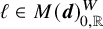 $\ell \in M(\boldsymbol {d})_{0, \mathbb {R}}^W$
is generic if the following conditions hold:
$\ell \in M(\boldsymbol {d})_{0, \mathbb {R}}^W$
is generic if the following conditions hold:
-
• if
$H \subset M(\boldsymbol {d})_{0, \mathbb {R}}$
is a hyperplane parallel to a face in
$\mathbf {W}(\boldsymbol {d})$
which contains
$\ell $
, then
$M(\boldsymbol {d})_{0, \mathbb {R}}^W \subset H$
, -
• for any decomposition
$\boldsymbol {d}=\boldsymbol {d}_1+\boldsymbol {d}_2$
such that
$\boldsymbol {d}_1, \boldsymbol {d}_2 \in \mathbb {N}^I$
are not proportional to
$\boldsymbol {d}$
, we have that
$\langle \ell , \boldsymbol {d}_i\rangle \neq 0$
for
$i\in \{1,2\}$
.



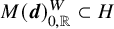


Note that the set of generic weights is a dense open subset in $M(\boldsymbol {d})^W_{0,\mathbb {R}}$
.
$M(\boldsymbol {d})^W_{0,\mathbb {R}}$
.
3.3 Quasi-BPS categories for stacks of representations of preprojective algebras
Let $Q^{\circ }=(I, E^{\circ })$
be a quiver and let
$Q^{\circ }=(I, E^{\circ })$
be a quiver and let $\mathscr {P}(\boldsymbol {d})$
be the derived moduli stack of representations of its preprojective algebra (3.3). For
$\mathscr {P}(\boldsymbol {d})$
be the derived moduli stack of representations of its preprojective algebra (3.3). For $\delta \in M(\boldsymbol {d})_{\mathbb {R}}^W$
, define the quasi-BPS category to be the intrinsic window subcategory in Definition 2.6:
$\delta \in M(\boldsymbol {d})_{\mathbb {R}}^W$
, define the quasi-BPS category to be the intrinsic window subcategory in Definition 2.6:
 $$ \begin{align} \mathbb{T}(\boldsymbol{d})_\delta:=\mathbb{W}(\mathscr{P}(\boldsymbol{d}))_{\delta}^{\mathrm{{int}}} \subset D^b(\mathscr{P}(\boldsymbol{d})), \ \mathbb{T}(\boldsymbol{d})_w :=\mathbb{T}(\boldsymbol{d})_{\delta=w \tau_{\boldsymbol{d}}}. \end{align} $$
An alternative description is as follows, where recall the map $j\colon \mathscr {P}(\boldsymbol {d})\hookrightarrow \mathscr {Y}(\boldsymbol {d})$
and choose a dominant chamber
$j\colon \mathscr {P}(\boldsymbol {d})\hookrightarrow \mathscr {Y}(\boldsymbol {d})$
and choose a dominant chamber $M(\boldsymbol {d})^+\subset M(\boldsymbol {d})$
, for example, the one in [Reference PădurariuPTc, Subsection 2.2.2]:
$M(\boldsymbol {d})^+\subset M(\boldsymbol {d})$
, for example, the one in [Reference PădurariuPTc, Subsection 2.2.2]:
Lemma 3.2. [Reference PădurariuPTc, Corollary 3.20]
The subcategory $\mathbb {T}(\boldsymbol {d})_{\delta }$
in (3.7) consists of objects
$\mathbb {T}(\boldsymbol {d})_{\delta }$
in (3.7) consists of objects $\mathcal {E} \in D^b(\mathscr {P}(\boldsymbol {d}))$
such that
$\mathcal {E} \in D^b(\mathscr {P}(\boldsymbol {d}))$
such that $j_{\ast }\mathcal {E}$
is classically generated by the vector bundle
$j_{\ast }\mathcal {E}$
is classically generated by the vector bundle $\mathcal {O}_{\mathscr {Y}(d)} \otimes \Gamma _{G(\boldsymbol {d})}(\chi )$
, where
$\mathcal {O}_{\mathscr {Y}(d)} \otimes \Gamma _{G(\boldsymbol {d})}(\chi )$
, where $\chi $
is a dominant weight such that
$\chi $
is a dominant weight such that
 $$ \begin{align} \chi+\rho-\delta \in \mathbf{W}(\boldsymbol{d}). \end{align} $$
Here, $\Gamma _{G(\boldsymbol {d})}(\chi )$
is the irreducible representation of
$\Gamma _{G(\boldsymbol {d})}(\chi )$
is the irreducible representation of $G(\boldsymbol {d})$
with highest weight
$G(\boldsymbol {d})$
with highest weight $\chi $
, and
$\chi $
, and $\mathbf {W}(\boldsymbol {d})$
is the polytope (3.6) for the tripled quiver Q of
$\mathbf {W}(\boldsymbol {d})$
is the polytope (3.6) for the tripled quiver Q of $Q^\circ $
.
$Q^\circ $
.
For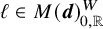 $\ell \in M(\boldsymbol {d})_{0, \mathbb {R}}^W$
, let
$\ell \in M(\boldsymbol {d})_{0, \mathbb {R}}^W$
, let $\mathscr {P}(\boldsymbol {d})^{\ell \text {-ss}} \subset \mathscr {P}(\boldsymbol {d})$
be the open substack of
$\mathscr {P}(\boldsymbol {d})^{\ell \text {-ss}} \subset \mathscr {P}(\boldsymbol {d})$
be the open substack of $\ell $
-semistable locus. The quasi-BPS category for
$\ell $
-semistable locus. The quasi-BPS category for $\ell $
-semistable locus is defined to be
$\ell $
-semistable locus is defined to be
 $$ \begin{align*} \mathbb{T}^{\ell}(\boldsymbol{d})_\delta :=\mathbb{W}(\mathscr{P}(\boldsymbol{d})^{\ell\text{-ss}})_{\delta}^{\mathrm{{int}}} \subset D^b(\mathscr{P}(\boldsymbol{d})^{\ell\text{-ss}}), \ \mathbb{T}^\ell(\boldsymbol{d})_{w} :=\mathbb{T}^\ell(\boldsymbol{d})_{\delta=w\tau_{\boldsymbol d}}. \end{align*} $$
Consider the restriction functor
 $$ \begin{align} \mathrm{res} \colon D^b(\mathscr{P}(\boldsymbol{d})) \twoheadrightarrow D^b(\mathscr{P}(\boldsymbol{d})^{\ell\text{-ss}}). \end{align} $$
We recall a wall-crossing equivalence proved in [Reference PădurariuPTc]:
Theorem 3.3. [Reference PădurariuPTc, Corollary 3.19, Remark 3.12]
For generic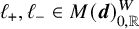 $\ell _+, \ell _- \in M(\boldsymbol {d})_{0, \mathbb {R}}^W$
, let
$\ell _+, \ell _- \in M(\boldsymbol {d})_{0, \mathbb {R}}^W$
, let $\delta '=\varepsilon _{+} \cdot \ell _{+} +\varepsilon _{-} \cdot \ell _{-}$
for general
$\delta '=\varepsilon _{+} \cdot \ell _{+} +\varepsilon _{-} \cdot \ell _{-}$
for general $0<\varepsilon _{\pm } \ll 1$
. Let
$0<\varepsilon _{\pm } \ll 1$
. Let $\delta \in M(\boldsymbol {d})^W_{\mathbb {R}}$
and let
$\delta \in M(\boldsymbol {d})^W_{\mathbb {R}}$
and let $\delta "=\delta +\delta '$
. Then the restriction functor (3.9) induces equivalences:
$\delta "=\delta +\delta '$
. Then the restriction functor (3.9) induces equivalences:
 $$ \begin{align*} \mathbb{T}(\boldsymbol{d})_{\delta"} \stackrel{\sim}{\to} \mathbb{T}^{\ell_{\pm}}(\boldsymbol{d})_{ \delta"}. \end{align*} $$
In particular, there is an equivalence $\mathbb {T}^{\ell _{+}}(\boldsymbol {d})_{\delta "} \simeq \mathbb {T}^{\ell _{-}}(\boldsymbol {d})_{ \delta "}$
.
$\mathbb {T}^{\ell _{+}}(\boldsymbol {d})_{\delta "} \simeq \mathbb {T}^{\ell _{-}}(\boldsymbol {d})_{ \delta "}$
.
3.4 Semiorthogonal decompositions for preprojective algebras of quivers with one vertex
In the remaining of this section, we focus on the case of the g-loop quiver $Q^{\circ }=Q_g$
with loops
$Q^{\circ }=Q_g$
with loops $X_1, \ldots , X_g$
. In this case, we write the dimension vector by
$X_1, \ldots , X_g$
. In this case, we write the dimension vector by $\boldsymbol {d}=d \in \mathbb {N}$
. The doubled quiver is
$\boldsymbol {d}=d \in \mathbb {N}$
. The doubled quiver is $Q^{\circ , d}=Q_{2g}$
with loops
$Q^{\circ , d}=Q_{2g}$
with loops $X_1, \ldots , X_g, Y_1, \ldots , Y_g$
and the relation
$X_1, \ldots , X_g, Y_1, \ldots , Y_g$
and the relation $\mathscr {I}$
is given by
$\mathscr {I}$
is given by $\sum _{i=1}^g[X_i, Y_i]\in \mathbb {C}[Q_{2g}]$
. The map (3.2) in this case is
$\sum _{i=1}^g[X_i, Y_i]\in \mathbb {C}[Q_{2g}]$
. The map (3.2) in this case is
 $$ \begin{align*} \mu \colon \mathfrak{gl}(d)^{\oplus 2g} \to \mathfrak{gl}(d), \ (x_1, \ldots, x_g, y_1, \ldots, y_g) \mapsto \sum_{i=1}^g [x_i, y_i]. \end{align*} $$
Then the derived stack in (3.3) is
 $$ \begin{align*}\mathscr{P}(d)=\mu^{-1}(0)/GL(d) \hookrightarrow \mathscr{Y}(d)=\mathfrak{gl}(d)^{\oplus 2g}/GL(d). \end{align*} $$
For a partition $d=d_1+\cdots +d_k$
, let
$d=d_1+\cdots +d_k$
, let $\mathscr {P}(d_1, \ldots , d_k)$
be the derived moduli stack of filtrations
$\mathscr {P}(d_1, \ldots , d_k)$
be the derived moduli stack of filtrations
 $$ \begin{align*} 0=R_0\subset R_1 \subset \cdots \subset R_k \end{align*} $$
of $(Q^{\circ , d}, \mathscr {I})$
-representations such that
$(Q^{\circ , d}, \mathscr {I})$
-representations such that $R_i/R_{i-1}$
has dimension
$R_i/R_{i-1}$
has dimension $d_i$
. Explicitly, let
$d_i$
. Explicitly, let $\lambda \colon \mathbb {C}^{\ast } \to T(d)$
be an antidominant cocharacter corresponding to the decomposition
$\lambda \colon \mathbb {C}^{\ast } \to T(d)$
be an antidominant cocharacter corresponding to the decomposition $d=d_1+\cdots +d_k$
and set
$d=d_1+\cdots +d_k$
and set
 $$ \begin{align*} \mu^{{\geqslant} 0} \colon \left(\mathfrak{gl}(d)^{\oplus 2g}\right)^{\lambda {\geqslant} 0} \to \mathfrak{gl}(d)^{\lambda {\geqslant} 0} \end{align*} $$
to be the restriction of $\mu $
. Then
$\mu $
. Then
 $$ \begin{align*} \mathscr{P}(d_1, \ldots, d_k)=\left(\mu^{{\geqslant} 0}\right)^{-1}(0)/GL(d)^{\lambda {\geqslant} 0}. \end{align*} $$
Consider the evaluation morphisms
 $$ \begin{align*} \times_{i=1}^k \mathscr{P}(d_i) \stackrel{q}{\leftarrow} \mathscr{P}(d_1, \ldots, d_k) \stackrel{p}{\to} \mathscr{P}(d). \end{align*} $$
The map q is quasi-smooth and the map p is proper. Consider the categorical Hall product for the preprojective algebra of $Q^\circ $
[Reference Porta and SalaPS23, Reference Varagnolo and VasserotVV22]:
$Q^\circ $
[Reference Porta and SalaPS23, Reference Varagnolo and VasserotVV22]:
 $$ \begin{align} p_{\ast}q^{\ast} \colon \boxtimes_{i=1}^k D^b(\mathscr{P}(d_i)) \to D^b(\mathscr{P}(d)). \end{align} $$
We recall a result from [Reference PădurariuPTc]:
Theorem 3.4. [Reference PădurariuPTc, Theorem 4.20, Example 4.21]
There is a semiorthogonal decomposition
 $$ \begin{align} D^b(\mathscr{P}(d))= \left\langle \boxtimes_{i=1}^k \mathbb{T}(d_i)_{w_i+(g-1)d_i(\sum_{i>j}d_j-\sum_{i<j}d_j)}\right\rangle \end{align} $$
where the right-hand side is after all partitions $(d_i)_{i=1}^k$
of d and weights
$(d_i)_{i=1}^k$
of d and weights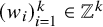 $(w_i)_{i=1}^k \in \mathbb {Z}^k$
such that
$(w_i)_{i=1}^k \in \mathbb {Z}^k$
such that
 $$ \begin{align} \frac{w_1}{d_1}<\cdots<\frac{w_k}{d_k}. \end{align} $$
The fully faithful functor
 $$ \begin{align*} \boxtimes_{i=1}^k \mathbb{T}(d_i)_{w_i+(g-1)d_i(\sum_{i>j}d_j-\sum_{i<j}d_j)} \to D^b(\mathscr{P}(d)) \end{align*} $$
is given by the categorical Hall product (3.10). The order is as in [Reference PădurariuPT24, Subsection 3.5], [Reference PădurariuPTc, Subsection 4.6].
Remark 3.5. The semiorthogonal decomposition (3.11) is obtained from that of $(2g+1)$
-loop quiver and applying Koszul equivalence. The order of summands in (3.11) is the same one for the
$(2g+1)$
-loop quiver and applying Koszul equivalence. The order of summands in (3.11) is the same one for the $(2g+1)$
-loop quiver from [Reference PădurariuPTc, Subsection 4.6], see also [Reference PădurariuPT24, Subsection 3.5] for the case
$(2g+1)$
-loop quiver from [Reference PădurariuPTc, Subsection 4.6], see also [Reference PădurariuPT24, Subsection 3.5] for the case $g=1$
, where it was described by (repeatedly) comparing certain ratios associated to a weight in
$g=1$
, where it was described by (repeatedly) comparing certain ratios associated to a weight in $M(d)$
. We now state an equivalent combinatorial formulation, which is not difficult to be compared with the one from loc. cit, but we postpone writing full details to future work, which will discuss similar semiorthogonal decompositions for arbitrary reductive groups G (not necessarily of type A).
$M(d)$
. We now state an equivalent combinatorial formulation, which is not difficult to be compared with the one from loc. cit, but we postpone writing full details to future work, which will discuss similar semiorthogonal decompositions for arbitrary reductive groups G (not necessarily of type A).
Let R be the set of convex lattice paths from the origin to $(w,d)$
. The set R is in bijection with the summands with the semiorthogonal decomposition (3.11). For example, to such a summand, we associate the convex path
$(w,d)$
. The set R is in bijection with the summands with the semiorthogonal decomposition (3.11). For example, to such a summand, we associate the convex path
 $$\begin{align*}p: (0,0), (w_1,d_1), (w_1+w_2,d_1+d_2),(w_1+w_2+w_3,d_1+d_2+d_3),\ldots, (w,d).\end{align*}$$
We define the following partial order on R. For p and $p'$
convex paths in R, we have that
$p'$
convex paths in R, we have that $p'{\leqslant } p$
if and only if
$p'{\leqslant } p$
if and only if $p'$
“lies below” p. More explicitly, the second coordinates of
$p'$
“lies below” p. More explicitly, the second coordinates of $p'$
and p are functions
$p'$
and p are functions $\gamma ', \gamma : [0,w]\to \mathbb {R}$
, and
$\gamma ', \gamma : [0,w]\to \mathbb {R}$
, and $p'$
“lies below” p means that
$p'$
“lies below” p means that $\gamma '(x){\leqslant } \gamma (x)$
for all
$\gamma '(x){\leqslant } \gamma (x)$
for all $x\in [0,w]$
.
$x\in [0,w]$
.
3.5 Semiorthogonal decompositions on formal fibers
We have the following diagram:

Here, the vertical arrows are good moduli space morphisms and horizontal arrows are closed immersions. Consider a closed point $p\in P(d)$
which corresponds to a semisimple
$p\in P(d)$
which corresponds to a semisimple $(Q^{\circ , d}, \mathscr {I})$
-representation
$(Q^{\circ , d}, \mathscr {I})$
-representation
 $$ \begin{align} R_p=\bigoplus_{i=1}^m W^{(i)} \otimes R^{(i)}, \end{align} $$
where $R^{(i)}$
is a simple
$R^{(i)}$
is a simple $(Q^{\circ , d}, \mathscr {I})$
-representation of dimension
$(Q^{\circ , d}, \mathscr {I})$
-representation of dimension $r^{(i)}$
and
$r^{(i)}$
and $W^{(i)}$
is a finite-dimensional
$W^{(i)}$
is a finite-dimensional $\mathbb {C}$
-vector space. We denote by
$\mathbb {C}$
-vector space. We denote by $\widehat {\mathscr {Y}}(d)_p$
the formal fiber of the right vertical arrow in (3.13) at p. By the étale slice theorem, we have
$\widehat {\mathscr {Y}}(d)_p$
the formal fiber of the right vertical arrow in (3.13) at p. By the étale slice theorem, we have
 $$ \begin{align*} \widehat{\mathscr{Y}}(d)_p=\widehat{\operatorname{Ext}}_{Q^{\circ, d}}^1(F_p, F_p)/G_p, \end{align*} $$
where $G_p=\mathrm {Aut}(R_p)=\prod _{i=1}^m GL(W^{(i)})$
, and see Subsection 2.1 for the notation. We denote by
$G_p=\mathrm {Aut}(R_p)=\prod _{i=1}^m GL(W^{(i)})$
, and see Subsection 2.1 for the notation. We denote by
 $$ \begin{align} j_p \colon \widehat{\mathscr{P}}(d)_p \hookrightarrow \widehat{\mathscr{Y}}(d)_p \end{align} $$
the natural inclusion of the derived zero locus of $\mu $
restricted to
$\mu $
restricted to $\widehat {\mathscr {Y}}(d)_p$
.
$\widehat {\mathscr {Y}}(d)_p$
.
Remark 3.6. Let $\kappa $
be the morphism
$\kappa $
be the morphism
 $$ \begin{align*} \kappa \colon \operatorname{Ext}^1_{(Q^{\circ, d}, \mathscr{I})}(R_p, R_p) \to \operatorname{Ext}^2_{(Q^{\circ, d}, \mathscr{I})}(R_p, R_p) \end{align*} $$
given by $x \mapsto [x, x]$
. By the formality of polystable objects in CY2 category, see [Reference DavisonDavc, Corollary 4.9], the derived stack
$x \mapsto [x, x]$
. By the formality of polystable objects in CY2 category, see [Reference DavisonDavc, Corollary 4.9], the derived stack $\widehat {\mathscr {P}}(d)_p$
is equivalent to the formal fiber of
$\widehat {\mathscr {P}}(d)_p$
is equivalent to the formal fiber of $\kappa ^{-1}(0)/G_p$
at
$\kappa ^{-1}(0)/G_p$
at $0 \in \kappa ^{-1}(0)^{\mathrm {cl}}/\!\!/ G_p$
.
$0 \in \kappa ^{-1}(0)^{\mathrm {cl}}/\!\!/ G_p$
.
We define
 $$ \begin{align} \mathbb{T}_p(d)_w :=\mathbb{W}(\widehat{\mathscr{P}}(d)_p)_{w\tau_d}^{\mathrm{{int}}} \subset D^b(\widehat{\mathscr{P}}(d)_p). \end{align} $$
There is a description of $\mathbb {T}_p(d)_w$
similar to Lemma 3.2, see Subsection 5.4. Consider a partition
$\mathbb {T}_p(d)_w$
similar to Lemma 3.2, see Subsection 5.4. Consider a partition $d=d_1+\cdots +d_k$
. We have the commutative diagram:
$d=d_1+\cdots +d_k$
. We have the commutative diagram:

where $\times _{i=1}^k \pi _{P,d_i}$
and
$\times _{i=1}^k \pi _{P,d_i}$
and $\pi _{P,d}$
are good moduli space maps. The base change of the categorical Hall product gives the functor
$\pi _{P,d}$
are good moduli space maps. The base change of the categorical Hall product gives the functor
 $$ \begin{align} \bigoplus_{p_1+\cdots+p_k=p} \boxtimes_{i=1}^k D^b(\widehat{\mathscr{P}}(d_i)_{p_i}) \to D^b(\widehat{\mathscr{P}}(d)_{p}), \end{align} $$
where the sum on the left-hand side consists of the fiber of the bottom horizontal arrow $\oplus $
in (3.17), which is a finite map. Also see [Reference TodaTod, (6.12), Lemma 6.4] for the existence of base change diagram of (3.17) extended to derived stacks.
$\oplus $
in (3.17), which is a finite map. Also see [Reference TodaTod, (6.12), Lemma 6.4] for the existence of base change diagram of (3.17) extended to derived stacks.
The following proposition is a formal fiber version of Theorem 3.4. The proof is technical and will be postponed to Subsection 5.4.
Proposition 3.7. There is a semiorthogonal decomposition
 $$ \begin{align*} D^b(\widehat{\mathscr{P}}(d)_p) =\left\langle \bigoplus_{p_1+\cdots+p_k=p} \boxtimes_{i=1}^k \mathbb{T}_{p_i}(d_i)_{w_i+(g-1)d_i(\sum_{i>j}d_j-\sum_{i<j}d_j)} \right\rangle. \end{align*} $$
The right-hand side is after all partitions $(d_i)_{i=1}^k$
of d, all points
$(d_i)_{i=1}^k$
of d, all points $(p_1,\ldots , p_k)$
in the fiber over p of the addition map
$(p_1,\ldots , p_k)$
in the fiber over p of the addition map $\oplus \colon \times _{i=1}^k P(d_i)\to P(d)$
, and all weights
$\oplus \colon \times _{i=1}^k P(d_i)\to P(d)$
, and all weights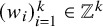 $(w_i)_{i=1}^k\in \mathbb {Z}^k$
such that
$(w_i)_{i=1}^k\in \mathbb {Z}^k$
such that
 $$\begin{align*}\frac{w_1}{d_1}<\cdots<\frac{w_k}{d_k}.\end{align*}$$
The order of the semiorthogonal decomposition is the same as the order of (3.11). The fully faithful functor
 $$ \begin{align*} \bigoplus_{p_1+\cdots+p_k=p} \boxtimes_{i=1}^k \mathbb{T}_{p_i}(d_i)_{w_i+(g-1)d_i(\sum_{i>j}d_j-\sum_{i<j}d_j)} \to D^b(\widehat{\mathscr{P}}(d)_p) \end{align*} $$
is given by the base change of the categorical Hall product (3.18).
During the proof of Proposition 3.7, we will also obtain the following:
Corollary 3.8. The map $\iota _p \colon \widehat {\mathscr {P}}(d)_p \to \mathscr {P}(d)$
induces the functor
$\iota _p \colon \widehat {\mathscr {P}}(d)_p \to \mathscr {P}(d)$
induces the functor
 $$ \begin{align*} \iota_p^{\ast} \colon \mathbb{T}(d)_w \to \mathbb{T}_p(d)_w \end{align*} $$
and its image classically generates $\mathbb {T}_p(d)_w$
.
$\mathbb {T}_p(d)_w$
.
3.6 Reduced quasi-BPS categories
We continue the discussion from the previous subsection. Let $\mathfrak {gl}(d)_0 \subset \mathfrak {gl}(d)$
be the traceless Lie subalgebra, and let
$\mathfrak {gl}(d)_0 \subset \mathfrak {gl}(d)$
be the traceless Lie subalgebra, and let $\mu _0$
be the map
$\mu _0$
be the map
 $$ \begin{align} \mu_0 \colon \mathfrak{gl}(d)^{\oplus 2g} \to \mathfrak{gl}(d)_0, \ (x_1, \ldots, x_g, y_1, \ldots, y_g) \mapsto \sum_{i=1}^g [x_i, y_i]. \end{align} $$
Define the reduced stack:
 $$ \begin{align*} \mathscr{P}(d)^{\mathrm{{red}}} :=\mu_0^{-1}(0)/GL(d). \end{align*} $$
We define the reduced quasi-BPS category to be
 $$ \begin{align} \mathbb{T}(d)_w^{\mathrm{{red}}}:=\mathbb{W}(\mathscr{P}(d)^{\mathrm{{red}}})^{\mathrm{{int}}}_{w\tau_d} \subset D^b(\mathscr{P}(d)^{\mathrm{{red}}}). \end{align} $$
There is a description similar to Lemma 3.2 using the embedding $\mathscr {P}(d)^{\mathrm {{red}}} \hookrightarrow \mathscr {Y}(d)$
. Denote by
$\mathscr {P}(d)^{\mathrm {{red}}} \hookrightarrow \mathscr {Y}(d)$
. Denote by $\mathfrak {gl}(d)_{\mathrm {{nil}}} \subset \mathfrak {gl}(d)_0$
the subset of nilpotent elements. The categorical support lemma in [Reference PădurariuPTc] is the following:
$\mathfrak {gl}(d)_{\mathrm {{nil}}} \subset \mathfrak {gl}(d)_0$
the subset of nilpotent elements. The categorical support lemma in [Reference PădurariuPTc] is the following:
Lemma 3.9. [Reference PădurariuPTc, Corollary 5.5]
For coprime $(d, w)\in \mathbb {N}\times \mathbb {Z}$
, any object
$(d, w)\in \mathbb {N}\times \mathbb {Z}$
, any object $\mathcal {E} \in \mathbb {T}(d)_w^{\mathrm {{red}}}$
satisfies:
$\mathcal {E} \in \mathbb {T}(d)_w^{\mathrm {{red}}}$
satisfies:
 $$ \begin{align*} \mathrm{Supp}^{\mathrm{{sg}}}(\mathcal{E}) \subset (\mathfrak{gl}(d)^{\oplus 2g} \oplus \mathfrak{gl}(d)_{\mathrm{{nil}}})/GL(d). \end{align*} $$
For $g{\geqslant } 2$
, the derived stack
$g{\geqslant } 2$
, the derived stack $\mathscr {P}(d)^{\mathrm {{red}}}$
is classical by [Reference Kaledin, Lehn and SorgerKLS06, Proposition 3.6], in particular there is a good moduli space morphism
$\mathscr {P}(d)^{\mathrm {{red}}}$
is classical by [Reference Kaledin, Lehn and SorgerKLS06, Proposition 3.6], in particular there is a good moduli space morphism
 $$ \begin{align*} \pi_P \colon \mathscr{P}(d)^{\mathrm{{red}}}\to P(d)=\mu^{-1}(0)^{\mathrm{red}}/\!\!/ G(d). \end{align*} $$
It follows that the Hom-space between any two objects in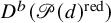 $D^b(\mathscr {P}(d)^{\mathrm {{red}}})$
is a module over
$D^b(\mathscr {P}(d)^{\mathrm {{red}}})$
is a module over $\mathcal {O}_{P(d)}$
. The categorical support lemma is the main ingredient in the proof of the following:
$\mathcal {O}_{P(d)}$
. The categorical support lemma is the main ingredient in the proof of the following:
Proposition 3.10. [Reference PădurariuPTc, Proposition 5.9]
For coprime $(d, w)\in \mathbb {N}\times \mathbb {Z}$
and objects
$(d, w)\in \mathbb {N}\times \mathbb {Z}$
and objects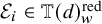 $\mathcal {E}_i \in \mathbb {T}(d)_w^{\mathrm {{red}}}$
for
$\mathcal {E}_i \in \mathbb {T}(d)_w^{\mathrm {{red}}}$
for $i=1, 2$
, the
$i=1, 2$
, the $\mathcal {O}_{P(d)}$
-module
$\mathcal {O}_{P(d)}$
-module
 $$\begin{align*}\bigoplus_{i\in \mathbb{Z}}\operatorname{Hom}^i_{\mathscr{P}(d)^{\mathrm{red}}}(\mathcal{E}_1, \mathcal{E}_2)\end{align*}$$
is finitely generated. In particular, we have $\operatorname {Hom}^i_{\mathscr {P}(d)^{\mathrm {red}}}(\mathcal {E}_1, \mathcal {E}_2)=0$
for
$\operatorname {Hom}^i_{\mathscr {P}(d)^{\mathrm {red}}}(\mathcal {E}_1, \mathcal {E}_2)=0$
for $\lvert i \rvert \gg 0$
.
$\lvert i \rvert \gg 0$
.
3.7 Relative Serre functor on reduced quasi-BPS categories
We continue the discussion from the previous subsection. We have that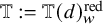 $\mathbb {T}:=\mathbb {T}(d)^{\mathrm {{red}}}_w$
is a subcategory of
$\mathbb {T}:=\mathbb {T}(d)^{\mathrm {{red}}}_w$
is a subcategory of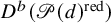 $D^b(\mathscr {P}(d)^{\mathrm {red}})$
, which is a module over
$D^b(\mathscr {P}(d)^{\mathrm {red}})$
, which is a module over $\mathrm {Perf}(\mathscr {P}(d)^{\mathrm {{red}}})$
. Thus there is an associated internal homomorphism, see Subsection 2.6:
$\mathrm {Perf}(\mathscr {P}(d)^{\mathrm {{red}}})$
. Thus there is an associated internal homomorphism, see Subsection 2.6:
 $$ \begin{align*} \mathcal{H}om_{\mathbb{T}}(\mathcal{E}_1, \mathcal{E}_2) \in D_{\mathrm{{qc}}}(\mathscr{P}(d)^{\mathrm{{red}}}) \end{align*} $$
for $\mathcal {E}_1, \mathcal {E}_2 \in \mathbb {T}$
. Proposition 3.10 implies that
$\mathcal {E}_1, \mathcal {E}_2 \in \mathbb {T}$
. Proposition 3.10 implies that $\pi _{\ast } \mathcal {H}om_{\mathbb {T}}(\mathcal {E}_1, \mathcal {E}_2)$
is an object of
$\pi _{\ast } \mathcal {H}om_{\mathbb {T}}(\mathcal {E}_1, \mathcal {E}_2)$
is an object of $D^b(P(d))$
.
$D^b(P(d))$
.
Theorem 3.11. [Reference PădurariuPTc, Theorem 5.10]
For coprime $(d, w)\in \mathbb {N}\times \mathbb {Z}$
and
$(d, w)\in \mathbb {N}\times \mathbb {Z}$
and $\mathcal {E}_1, \mathcal {E}_2 \in \mathbb {T}$
, there is an isomorphism:
$\mathcal {E}_1, \mathcal {E}_2 \in \mathbb {T}$
, there is an isomorphism:
 $$ \begin{align} \operatorname{Hom}_{P(d)}(\pi_{\ast}\mathcal{H}om_{\mathbb{T}}(\mathcal{E}_1, \mathcal{E}_2), \mathcal{O}_{P(d)}) \cong \operatorname{Hom}_{\mathbb{T}}(\mathcal{E}_2, \mathcal{E}_1). \end{align} $$
For $\mathcal {E}_1=\mathcal {E}_2=\mathcal {E}$
, the identity
$\mathcal {E}_1=\mathcal {E}_2=\mathcal {E}$
, the identity $\operatorname {id} \colon \mathcal {E} \to \mathcal {E}$
corresponds, under (3.21), to the morphism
$\operatorname {id} \colon \mathcal {E} \to \mathcal {E}$
corresponds, under (3.21), to the morphism
 $$ \begin{align*} \mathrm{tr}_{\mathcal{E}} \colon \pi_{\ast}\mathcal{H}om(\mathcal{E}, \mathcal{E}) \to \mathcal{O}_{P(d)}. \end{align*} $$
From the construction in [Reference PădurariuPTc], the above morphism coincides with the trace map determined by $(GL(d), \mathfrak {gl}(d)^{\oplus 2g}, \mathfrak {gl}(d)_0, \mu _0)$
, see Subsection 7.2 for the construction of the trace map, especially (7.7).
$(GL(d), \mathfrak {gl}(d)^{\oplus 2g}, \mathfrak {gl}(d)_0, \mu _0)$
, see Subsection 7.2 for the construction of the trace map, especially (7.7).
4 Quasi-BPS categories for K3 surfaces
In this section, we introduce (nonreduced and reduced) quasi-BPS categories for K3 surfaces. In Theorem 4.8, we prove the wall-crossing equivalence for quasi-BPS categories. We state a categorical version of the $\chi $
-independence phenomenon, see Conjecture 4.13, which we prove for
$\chi $
-independence phenomenon, see Conjecture 4.13, which we prove for $g=0$
and for
$g=0$
and for $g=1$
and
$g=1$
and $(d,w)=(2,1)$
.
$(d,w)=(2,1)$
.
4.1 Generalities on K3 surfaces
Let S be a smooth projective K3 surface, that is, $K_S$
is trivial and
$K_S$
is trivial and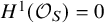 $H^1(\mathcal {O}_S)=0$
. Let
$H^1(\mathcal {O}_S)=0$
. Let $K(S)$
be the Grothendieck group of S. Denote by
$K(S)$
be the Grothendieck group of S. Denote by $\chi (-, -)$
the Euler pairing
$\chi (-, -)$
the Euler pairing
 $$ \begin{align*} \chi(E, F)=\sum_{j}(-1)^j \mathrm{ext}^j(E, F). \end{align*} $$
Let $N(S)$
be the numerical Grothendieck group:
$N(S)$
be the numerical Grothendieck group:
 $$ \begin{align*} N(S):=K(S)/\equiv, \end{align*} $$
where $E_1 \equiv E_2$
in
$E_1 \equiv E_2$
in $K(S)$
if
$K(S)$
if $\chi (E_1, F)=\chi (E_2, F)$
for any
$\chi (E_1, F)=\chi (E_2, F)$
for any $F \in K(S)$
. Below for
$F \in K(S)$
. Below for $F\in D^b(S)$
, we denote by
$F\in D^b(S)$
, we denote by $[F] \in N(S)$
its numerical class in
$[F] \in N(S)$
its numerical class in $N(S)$
. There is an isomorphism by taking the Mukai vector:
$N(S)$
. There is an isomorphism by taking the Mukai vector:
 $$ \begin{align} v(-)=\operatorname{ch}(-)\sqrt{\mathrm{td}}_S \colon N(S) \stackrel{\cong}{\to} \mathbb{Z} \oplus \mathrm{NS}(S) \oplus \mathbb{Z}. \end{align} $$
Write a vector $v\in N(S)$
as
$v\in N(S)$
as $v=(r, \beta , \chi )\in \mathbb {Z}\oplus \mathrm {NS}(S)\oplus \mathbb {Z}$
via the above isomorphism. There is a symmetric bilinear pairing on
$v=(r, \beta , \chi )\in \mathbb {Z}\oplus \mathrm {NS}(S)\oplus \mathbb {Z}$
via the above isomorphism. There is a symmetric bilinear pairing on $N(S)$
defined by
$N(S)$
defined by $\langle E_1, E_2 \rangle =-\chi (E_1, E_2)$
. Under the isomorphism (4.1), we have
$\langle E_1, E_2 \rangle =-\chi (E_1, E_2)$
. Under the isomorphism (4.1), we have
 $$ \begin{align*} \langle E_1, E_2 \rangle=\beta_1 \beta_2-r_1 \chi_2-r_2 \chi_1, \end{align*} $$
where $v(E_i)=(r_i, \beta _i, \chi _i)$
.
$v(E_i)=(r_i, \beta _i, \chi _i)$
.
We say $v\in N(S)$
is primitive if it cannot be written as
$v\in N(S)$
is primitive if it cannot be written as $v=dv_0$
for an integer
$v=dv_0$
for an integer $d{\geqslant } 2$
and
$d{\geqslant } 2$
and $v_0\in N(S)$
. Let
$v_0\in N(S)$
. Let $v\in N(S)$
and
$v\in N(S)$
and $w\in \mathbb {Z}$
. Write
$w\in \mathbb {Z}$
. Write $v=dv_0$
for
$v=dv_0$
for $d\in \mathbb {Z}$
and
$d\in \mathbb {Z}$
and $v_0$
primitive. We define
$v_0$
primitive. We define $\gcd (v, w):=\gcd (d,w)$
. Below we identify
$\gcd (v, w):=\gcd (d,w)$
. Below we identify $N(S)$
with
$N(S)$
with $\mathbb {Z} \oplus \mathrm {NS}(S) \oplus \mathbb {Z}$
via the isomorphism (4.1), and write an element
$\mathbb {Z} \oplus \mathrm {NS}(S) \oplus \mathbb {Z}$
via the isomorphism (4.1), and write an element $v \in N(S)$
as
$v \in N(S)$
as $v=(r, \beta , \chi )$
.
$v=(r, \beta , \chi )$
.
4.2 Bridgeland stability conditions on K3 surfaces
For a K3 surface S, we denote by
 $$ \begin{align*} \mathrm{Stab}(S) \end{align*} $$
(the main connected component of) the space of Bridgeland stability conditions [Reference BridgelandBri07, Reference BridgelandBri08] on $D^b(S)$
. A point
$D^b(S)$
. A point $\sigma \in \mathrm {Stab}(S)$
consists of a pair
$\sigma \in \mathrm {Stab}(S)$
consists of a pair
 $$ \begin{align*} \sigma=(Z, \mathcal{A}), \ Z \colon N(S) \to \mathbb{C}, \ \mathcal{A} \subset D^b(S), \end{align*} $$
where Z is a group homomorphism (called central charge) and $\mathcal {A}$
is the heart of a bounded t-structure satisfying some axioms, see [Reference BridgelandBri07]. One of the axioms is the following positivity property
$\mathcal {A}$
is the heart of a bounded t-structure satisfying some axioms, see [Reference BridgelandBri07]. One of the axioms is the following positivity property
 $$ \begin{align*} Z(E) \in \{ z \in \mathbb{C} : \mathrm{Im}(z)>0 \mbox{ or } z \in \mathbb{R}_{<0}\} \end{align*} $$
for any $0\neq E \in \mathcal {A}$
. An object
$0\neq E \in \mathcal {A}$
. An object $E \in \mathcal {A}$
is called Z-(semi)stable if for any subobject
$E \in \mathcal {A}$
is called Z-(semi)stable if for any subobject $0\neq F \subsetneq E$
we have
$0\neq F \subsetneq E$
we have $\arg Z(F)<({\leqslant }) \arg Z(E)$
in
$\arg Z(F)<({\leqslant }) \arg Z(E)$
in $(0, \pi ]$
. An object
$(0, \pi ]$
. An object $E \in D^b(X)$
is called
$E \in D^b(X)$
is called $\sigma $
-(semi)stable if
$\sigma $
-(semi)stable if $E[a] \in \mathcal {A}$
is Z-semistable for some
$E[a] \in \mathcal {A}$
is Z-semistable for some $a \in \mathbb {Z}$
.
$a \in \mathbb {Z}$
.
For each $B+iH \in \mathrm {NS}(S)_{\mathbb {C}}$
such that H is ample with
$B+iH \in \mathrm {NS}(S)_{\mathbb {C}}$
such that H is ample with $H^2>2$
, there is an associated stability condition
$H^2>2$
, there is an associated stability condition
 $$ \begin{align*} \sigma_{B, H}=(Z_{B, H}, \mathcal{A}_{B, H}) \in \mathrm{Stab}(S), \end{align*} $$
where $\mathcal {A}_{B, H} \subset D^b(S)$
is the heart of a bounded t-structure obtained by a tilting of
$\mathcal {A}_{B, H} \subset D^b(S)$
is the heart of a bounded t-structure obtained by a tilting of $\mathrm {Coh}(S)$
and
$\mathrm {Coh}(S)$
and $Z_{B, H}$
is given by
$Z_{B, H}$
is given by
 $$ \begin{align*} Z_{B, H}(E)=-\int_S e^{-B-iH} v(E) \in \mathbb{C}. \end{align*} $$
We refer to [Reference BridgelandBri08, Section 6] for the construction of the above stability conditions. A stability condition $\sigma _{B, mH}$
for
$\sigma _{B, mH}$
for $m\gg 0$
is said to be in a neighborhood of the large volume limit. Recall the following proposition about semistable objects at the large volume limit:
$m\gg 0$
is said to be in a neighborhood of the large volume limit. Recall the following proposition about semistable objects at the large volume limit:
Proposition 4.1. [Reference BridgelandBri09, Proposition 14.2], [Reference TodaTod08, Proposition 6.4, Lemma 6.5]
If $v=(r, \beta , \chi )$
such that
$v=(r, \beta , \chi )$
such that $r{\geqslant } 0$
and
$r{\geqslant } 0$
and $H \cdot \beta>0$
, or
$H \cdot \beta>0$
, or $r=H \cdot \beta =0$
and
$r=H \cdot \beta =0$
and $\chi>0$
, then an object
$\chi>0$
, then an object $E\in D^b(S)$
of Mukai vector v is
$E\in D^b(S)$
of Mukai vector v is $\sigma _{0, mH}$
-semistable for
$\sigma _{0, mH}$
-semistable for $m\gg 0$
if and only if
$m\gg 0$
if and only if $E[2a]$
is an H-Gieseker semistable sheaf for some
$E[2a]$
is an H-Gieseker semistable sheaf for some $a\in \mathbb {Z}$
.
$a\in \mathbb {Z}$
.
4.3 Moduli stacks of semistable objects on K3 surfaces
For each $\sigma =(Z, \mathcal {A}) \in \mathrm {Stab}(S)$
and
$\sigma =(Z, \mathcal {A}) \in \mathrm {Stab}(S)$
and $v \in N(S)$
, we denote by
$v \in N(S)$
, we denote by
 $$ \begin{align*} \mathfrak{M}_S^{\sigma}(v) \end{align*} $$
the derived moduli stack of $\sigma $
-semistable objects
$\sigma $
-semistable objects $F \in \mathcal {A} \cup \mathcal {A}[1]$
with numerical class v. We denote by
$F \in \mathcal {A} \cup \mathcal {A}[1]$
with numerical class v. We denote by $\mathbb {F}$
the universal object
$\mathbb {F}$
the universal object
 $$ \begin{align*} \mathbb{F} \in D^b(S \times \mathfrak{M}_S^{\sigma}(v)). \end{align*} $$
We also consider the reduced version of the stack $\mathfrak {M}_S^{\sigma }(v)$
. Let
$\mathfrak {M}_S^{\sigma }(v)$
. Let $v=(r, \beta , \chi )$
. Let
$v=(r, \beta , \chi )$
. Let $\mathcal {P}ic^{\beta }(S)$
be the derived moduli stack of line bundles on S with first Chern class
$\mathcal {P}ic^{\beta }(S)$
be the derived moduli stack of line bundles on S with first Chern class $\beta $
. Then
$\beta $
. Then $\mathcal {P}ic^{\beta }(S)=\operatorname {Spec}\mathbb {C}[\varepsilon ]/\mathbb {C}^{\ast }$
, where
$\mathcal {P}ic^{\beta }(S)=\operatorname {Spec}\mathbb {C}[\varepsilon ]/\mathbb {C}^{\ast }$
, where $\varepsilon $
is of degree
$\varepsilon $
is of degree $-1$
. We consider the determinant morphism
$-1$
. We consider the determinant morphism
 $$ \begin{align*} \det \colon \mathfrak{M}_S^{\sigma}(v) \to \mathcal{P}ic^{\beta}(S)=\operatorname{Spec}\mathbb{C}[\varepsilon]/\mathbb{C}^{\ast}. \end{align*} $$
Define the reduced stack:
 $$ \begin{align} \mathfrak{M}_S^{\sigma}(v)^{\mathrm{{red}}}:= \mathfrak{M}_S^{\sigma}(v) \times_{\mathcal{P}ic^{\beta}(S)} B\mathbb{C}^{\ast}. \end{align} $$
The obstruction space of the reduced stack $\mathfrak {M}_S^{\sigma }(v)^{\mathrm {{red}}}$
at
$\mathfrak {M}_S^{\sigma }(v)^{\mathrm {{red}}}$
at $F\in \mathcal {A}\cup \mathcal {A}[1]$
is the kernel of the trace map:
$F\in \mathcal {A}\cup \mathcal {A}[1]$
is the kernel of the trace map:
 $$ \begin{align*} \operatorname{Ext}_S^2(F, F)_0:=\operatorname{Ker}\left(\operatorname{Ext}_S^2(F, F) \stackrel{\mathrm{tr}}{\twoheadrightarrow} H^2(\mathcal{O}_S)=\mathbb{C} \right). \end{align*} $$
Note that $\mathfrak {M}^\sigma _S(v)^{\mathrm {red}}$
may still not be a classical stack. There are decompositions:
$\mathfrak {M}^\sigma _S(v)^{\mathrm {red}}$
may still not be a classical stack. There are decompositions:
 $$ \begin{align*} D^b(\mathfrak{M}_S^{\sigma}(v))=\bigoplus_{w \in \mathbb{Z}}D^b(\mathfrak{M}_S^{\sigma}(v))_w, \ D^b(\mathfrak{M}_S^{\sigma}(v)^{\mathrm{{red}}})=\bigoplus_{w \in \mathbb{Z}}D^b(\mathfrak{M}_S^{\sigma}(v)^{\mathrm{{red}}})_w, \end{align*} $$
where each summand contains complexes F of weight w with respect to the scaling automorphisms $\mathbb {C}^{\ast } \subset \mathrm {Aut}(F)$
, see [Reference TodaTod24a, Subsection 3.2.4].
$\mathbb {C}^{\ast } \subset \mathrm {Aut}(F)$
, see [Reference TodaTod24a, Subsection 3.2.4].
We denote by $\mathcal {M}_S^{\sigma }(v)$
the classical truncation of
$\mathcal {M}_S^{\sigma }(v)$
the classical truncation of $\mathfrak {M}_S^{\sigma }(v)$
. It admits a good moduli space (cf. [Reference AlperAlp13], [Reference Alper, Halpern-Leistner and HeinlothAHLH, Example 7.26]):
$\mathfrak {M}_S^{\sigma }(v)$
. It admits a good moduli space (cf. [Reference AlperAlp13], [Reference Alper, Halpern-Leistner and HeinlothAHLH, Example 7.26]):
 $$ \begin{align} \pi \colon \mathcal{M}_S^{\sigma}(v) \to M_S^{\sigma}(v), \end{align} $$
where $M_S^{\sigma }(v)$
is a proper algebraic space. A closed point
$M_S^{\sigma }(v)$
is a proper algebraic space. A closed point $y \in M_S^{\sigma }(v)$
corresponds to a
$y \in M_S^{\sigma }(v)$
corresponds to a $\sigma $
-polystable object
$\sigma $
-polystable object
 $$ \begin{align} F=\bigoplus_{i=1}^m V^{(i)} \otimes F^{(i)}, \end{align} $$
where $F^{(1)}, \ldots , F^{(m)}$
are mutually nonisomorphic
$F^{(1)}, \ldots , F^{(m)}$
are mutually nonisomorphic $\sigma $
-stable objects such that
$\sigma $
-stable objects such that $\arg Z(F^{(i)})=\arg Z(F)$
, and
$\arg Z(F^{(i)})=\arg Z(F)$
, and $V^{(i)}$
is a finite-dimensional vector space with dimension
$V^{(i)}$
is a finite-dimensional vector space with dimension $d^{(i)}$
for
$d^{(i)}$
for $1{\leqslant } i{\leqslant } m$
.
$1{\leqslant } i{\leqslant } m$
.
Let $G_y:=\mathrm {Aut}(F)=\prod _{i=1}^m GL(V^{(i)})$
and let
$G_y:=\mathrm {Aut}(F)=\prod _{i=1}^m GL(V^{(i)})$
and let $\widehat {\operatorname {Ext}}_S^1(F, F)$
be the formal fiber at the origin of the morphism
$\widehat {\operatorname {Ext}}_S^1(F, F)$
be the formal fiber at the origin of the morphism
 $$ \begin{align*} \operatorname{Ext}_S^1(F, F) \to \operatorname{Ext}_S^1(F, F)/\!\!/ G_y. \end{align*} $$
By the formality of the dg-algebra $\mathrm {RHom}(F, F)$
, see [Reference DavisonDavc, Corollary 4.9], there are equivalences
$\mathrm {RHom}(F, F)$
, see [Reference DavisonDavc, Corollary 4.9], there are equivalences
 $$ \begin{align} \widehat{\mathfrak{M}}_S^{\sigma}(v)_y \simeq \widehat{\kappa}^{-1}(0)/G_y, \ \widehat{\mathfrak{M}}_S^{\sigma}(v)_y^{\mathrm{{red}}} \simeq \widehat{\kappa}_0^{-1}(0)/G_y, \end{align} $$
where $\kappa $
,
$\kappa $
, $\kappa _0$
are the maps
$\kappa _0$
are the maps
 $$ \begin{align*} \kappa\colon \operatorname{Ext}_S^1(F, F) \to \operatorname{Ext}_S^2(F, F), \ \kappa_0 \colon \operatorname{Ext}_S^1(F, F) \to \operatorname{Ext}_S^2(F, F)_0 \end{align*} $$
given by $x \mapsto [x, x]$
, and
$x \mapsto [x, x]$
, and $\widehat {\kappa }$
,
$\widehat {\kappa }$
, $\widehat {\kappa }_0$
are their restrictions to
$\widehat {\kappa }_0$
are their restrictions to $\widehat {\operatorname {Ext}}_S^1(F, F)$
.
$\widehat {\operatorname {Ext}}_S^1(F, F)$
.
Remark 4.2. The stack $\kappa ^{-1}(0)/G_y$
is described in terms of the Ext-quiver of F as follows. Let
$\kappa ^{-1}(0)/G_y$
is described in terms of the Ext-quiver of F as follows. Let $Q^{\circ , d}_y$
be the quiver with vertices
$Q^{\circ , d}_y$
be the quiver with vertices $\{1, \ldots , m\}$
and the number of edges from i to j is
$\{1, \ldots , m\}$
and the number of edges from i to j is $\dim \operatorname {Ext}_{S}^1(F^{(i)}, F^{(j)})$
for any
$\dim \operatorname {Ext}_{S}^1(F^{(i)}, F^{(j)})$
for any $1{\leqslant } i, j{\leqslant } m$
. By Serre duality,
$1{\leqslant } i, j{\leqslant } m$
. By Serre duality, $Q^{\circ , d}_y$
is symmetric. Moreover the number of loops at each vertex is even, so
$Q^{\circ , d}_y$
is symmetric. Moreover the number of loops at each vertex is even, so $Q^{\circ , d}_y$
is the doubled quiver of some quiver
$Q^{\circ , d}_y$
is the doubled quiver of some quiver $Q_y^{\circ }$
. The derived stack
$Q_y^{\circ }$
. The derived stack $\kappa ^{-1}(0)/G_y$
is identified with the derived moduli stack of representations of the preprojective algebra of
$\kappa ^{-1}(0)/G_y$
is identified with the derived moduli stack of representations of the preprojective algebra of $Q^\circ _y$
(alternatively, of
$Q^\circ _y$
(alternatively, of $Q^{\circ , d}_y$
-representations with quadratic relation
$Q^{\circ , d}_y$
-representations with quadratic relation $\mathscr {I}_y$
) as in Subsection 3.3, and dimension vector
$\mathscr {I}_y$
) as in Subsection 3.3, and dimension vector $(d^{(i)})_{i=1}^m$
where
$(d^{(i)})_{i=1}^m$
where $d^{(i)}=\dim V^{(i)}$
.
$d^{(i)}=\dim V^{(i)}$
.
There is a wall-chamber structure on $\mathrm {Stab}(S)$
such that
$\mathrm {Stab}(S)$
such that $\mathcal {M}_S^{\sigma }(v)$
is constant if
$\mathcal {M}_S^{\sigma }(v)$
is constant if $\sigma $
lies in a chamber, but may change when
$\sigma $
lies in a chamber, but may change when $\sigma $
crosses a wall. Locally, a wall is defined by the equation
$\sigma $
crosses a wall. Locally, a wall is defined by the equation
 $$ \begin{align*} \frac{Z(v_1)}{Z(v_2)} \in \mathbb{R}_{>0}, \ v=v_1+v_2 \end{align*} $$
such that $v_1$
and
$v_1$
and $v_2$
are not proportional, see [Reference BridgelandBri08, Proposition 9.3].
$v_2$
are not proportional, see [Reference BridgelandBri08, Proposition 9.3].
A stability condition $\sigma \in \mathrm {Stab}(S)$
is generic if
$\sigma \in \mathrm {Stab}(S)$
is generic if $\sigma $
is not on a wall. If
$\sigma $
is not on a wall. If $\sigma $
is generic, then for a polystable object (4.4) each numerical class
$\sigma $
is generic, then for a polystable object (4.4) each numerical class $[F^{(i)}]$
of
$[F^{(i)}]$
of $F^{(i)}$
is proportional to v. Let
$F^{(i)}$
is proportional to v. Let $v=dv_0$
for a primitive
$v=dv_0$
for a primitive $v_0$
. Then we have
$v_0$
. Then we have
 $$ \begin{align*}[F^{(i)}]=r^{(i)}v_0, \ d^{(1)}r^{(1)}+\cdots+d^{(m)}r^{(m)}=d. \end{align*} $$
The good moduli space $M_S^{\sigma }(v)$
has a stratification indexed by data
$M_S^{\sigma }(v)$
has a stratification indexed by data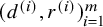 $(d^{(i)}, r^{(i)})_{i=1}^m$
, and the deepest stratum corresponds to
$(d^{(i)}, r^{(i)})_{i=1}^m$
, and the deepest stratum corresponds to $m=1$
,
$m=1$
, $\dim V^{(1)}=d$
and
$\dim V^{(1)}=d$
and $d^{(1)}=1$
.
$d^{(1)}=1$
.
Let $v=dv_0$
for a primitive
$v=dv_0$
for a primitive $v_0$
with
$v_0$
with $\langle v_0, v_0\rangle =2g-2$
, and
$\langle v_0, v_0\rangle =2g-2$
, and $Q^{\circ , d}=Q_{2g}$
be the quiver with one vertex and
$Q^{\circ , d}=Q_{2g}$
be the quiver with one vertex and $2g$
-loops with relation
$2g$
-loops with relation $\mathscr {I}$
as in Subsection 3.3. Recall the stacks:
$\mathscr {I}$
as in Subsection 3.3. Recall the stacks:
 $$ \begin{align*} \mathscr{P}(d)=\mu^{-1}(0)/GL(d), \ \mathscr{P}(d)^{\mathrm{{red}}}=\mu_0^{-1}(0)/GL(d) \end{align*} $$
where $\mu \colon \mathfrak {gl}(d)^{\oplus 2g} \to \mathfrak {gl}(d)$
and
$\mu \colon \mathfrak {gl}(d)^{\oplus 2g} \to \mathfrak {gl}(d)$
and $\mu _0 \colon \mathfrak {gl}(d)^{\oplus 2g} \to \mathfrak {gl}(d)_0$
are moment maps.
$\mu _0 \colon \mathfrak {gl}(d)^{\oplus 2g} \to \mathfrak {gl}(d)_0$
are moment maps.
Lemma 4.3. For any closed point $y \in M_S^{\sigma }(v)$
, there is a point
$y \in M_S^{\sigma }(v)$
, there is a point $p \in P(d)$
which is sufficiently close to
$p \in P(d)$
which is sufficiently close to $0\in P(d)$
such that we have equivalences
$0\in P(d)$
such that we have equivalences
 $$ \begin{align} \widehat{\mathfrak{M}}_S^{\sigma}(v)_y \simeq \widehat{\mathscr{P}}(d)_p, \ \widehat{\mathfrak{M}}_S^{\sigma}(v)_y^{\mathrm{{red}}} \simeq \widehat{\mathscr{P}}(d)_p^{\mathrm{{red}}}. \end{align} $$
If y lies in the deepest stratum, we can take $p=0$
.
$p=0$
.
Proof. Let y correspond to a direct sum (4.4) such that $[F^{(i)}]=r^{(i)} v_0$
, and let
$[F^{(i)}]=r^{(i)} v_0$
, and let $R^{(i)}$
be a simple
$R^{(i)}$
be a simple $(Q^{\circ , d}, \mathscr {I})$
-representation with dimension
$(Q^{\circ , d}, \mathscr {I})$
-representation with dimension $r^{(i)}$
. Such
$r^{(i)}$
. Such $R^{(i)}$
exists by a straightforward dimension count argument, for example see the proof of [Reference PădurariuPTc, Lemma 5.7 (i)]. Let
$R^{(i)}$
exists by a straightforward dimension count argument, for example see the proof of [Reference PădurariuPTc, Lemma 5.7 (i)]. Let
 $$ \begin{align*} R=\bigoplus_{i=1}^m V^{(i)} \otimes R^{(i)} \end{align*} $$
be a semisimple $(Q^{\circ , d}, \mathscr {I})$
-representation and let
$(Q^{\circ , d}, \mathscr {I})$
-representation and let $p\in P(d)$
be the corresponding point. Note that
$p\in P(d)$
be the corresponding point. Note that
 $$ \begin{align*} \chi(R^{(i)}, R^{(j)})=\chi(F^{(i)}, F^{(j)})=r^{(i)}r^{(j)}(2-2g). \end{align*} $$
By the CY2 property of $(Q^{\circ , d}, \mathscr {I})$
-representations (cf. see [Reference KellerKel11], [Reference DavisonDavc, Proposition 7.1]), and the fact that
$(Q^{\circ , d}, \mathscr {I})$
-representations (cf. see [Reference KellerKel11], [Reference DavisonDavc, Proposition 7.1]), and the fact that $\hom (R^{(i)}, R^{(j)})=\hom (F^{(i)}, F^{(j)})=\delta _{ij}$
, we have an isomorphism
$\hom (R^{(i)}, R^{(j)})=\hom (F^{(i)}, F^{(j)})=\delta _{ij}$
, we have an isomorphism
 $$ \begin{align*} \operatorname{Ext}^{\ast}(R^{(i)}, R^{(j)})\cong \operatorname{Ext}^{\ast}(F^{(i)}, F^{(j)}). \end{align*} $$
Then by the formality of polystable objects CY2 categories [Reference DavisonDavc, Corollary 4.9], there is an isomorphism of dg-algebras $\mathrm {RHom}(R, R) \cong \mathrm {RHom}(F, F)$
. Therefore we have equivalences (4.6), see Remark 3.6.
$\mathrm {RHom}(R, R) \cong \mathrm {RHom}(F, F)$
. Therefore we have equivalences (4.6), see Remark 3.6.
There is an action of $\mathbb {C}^{\ast }$
on the moduli of
$\mathbb {C}^{\ast }$
on the moduli of $Q^{\circ , d}$
-representations which scales the linear maps corresponding to each edge of
$Q^{\circ , d}$
-representations which scales the linear maps corresponding to each edge of $Q^{\circ , d}$
, which induces an action on
$Q^{\circ , d}$
, which induces an action on $P(d)$
. The above
$P(d)$
. The above $\mathbb {C}^{\ast }$
-action preserves the type of the semisimplification, and any point
$\mathbb {C}^{\ast }$
-action preserves the type of the semisimplification, and any point $p \in P(d)$
satisfies
$p \in P(d)$
satisfies $\lim _{t\to 0} (t \cdot p)=0$
. Therefore we can take p to be sufficiently close to
$\lim _{t\to 0} (t \cdot p)=0$
. Therefore we can take p to be sufficiently close to $0$
. By the above construction, we can take
$0$
. By the above construction, we can take $p=0$
if y lies in the deepest stratum.
$p=0$
if y lies in the deepest stratum.
Combining Lemma 4.3 with [Reference Kaledin, Lehn and SorgerKLS06], we have the following:
Lemma 4.4. Suppose that $g{\geqslant } 2$
. Then for a generic
$g{\geqslant } 2$
. Then for a generic $\sigma $
, the derived stack
$\sigma $
, the derived stack $\mathfrak {M}_S^{\sigma }(v)^{\mathrm {{red}}}$
is classical, that is, the natural morphism
$\mathfrak {M}_S^{\sigma }(v)^{\mathrm {{red}}}$
is classical, that is, the natural morphism $\mathcal {M}_S^{\sigma }(v) \to \mathfrak {M}_S^{\sigma }(v)^{\mathrm {{red}}}$
is an equivalence.
$\mathcal {M}_S^{\sigma }(v) \to \mathfrak {M}_S^{\sigma }(v)^{\mathrm {{red}}}$
is an equivalence.
Proof. For $g{\geqslant } 2$
, the derived stack
$g{\geqslant } 2$
, the derived stack $\mathscr {P}(d)^{\mathrm {{red}}}$
is classical by [Reference Kaledin, Lehn and SorgerKLS06, Proposition 3.6]. Therefore the conclusion holds by Lemma 4.3.
$\mathscr {P}(d)^{\mathrm {{red}}}$
is classical by [Reference Kaledin, Lehn and SorgerKLS06, Proposition 3.6]. Therefore the conclusion holds by Lemma 4.3.
4.4 Quasi-BPS categories for K3 surfaces
Let $v\in N(S)$
and
$v\in N(S)$
and $w\in \mathbb {Z}$
. Take
$w\in \mathbb {Z}$
. Take $a \in K(S)_{\mathbb {R}}$
such that
$a \in K(S)_{\mathbb {R}}$
such that $\chi (a\otimes v)=w \in \mathbb {Z}$
. We define the
$\chi (a\otimes v)=w \in \mathbb {Z}$
. We define the $\mathbb {R}$
-line bundle
$\mathbb {R}$
-line bundle $\delta $
on
$\delta $
on $\mathfrak {M}_S^{\sigma }(v)$
to be
$\mathfrak {M}_S^{\sigma }(v)$
to be
 $$ \begin{align} \delta=\det p_{\mathfrak{M}_{\ast}}(a \boxtimes \mathbb{F}), \end{align} $$
where $p_{\mathfrak {M}} \colon S \times \mathfrak {M}_S^{\sigma }(v) \to \mathfrak {M}_S^{\sigma }(v)$
,
$p_{\mathfrak {M}} \colon S \times \mathfrak {M}_S^{\sigma }(v) \to \mathfrak {M}_S^{\sigma }(v)$
, $p_{S} \colon S \times \mathfrak {M}_S^{\sigma }(v) \to S$
are the projections, and
$p_{S} \colon S \times \mathfrak {M}_S^{\sigma }(v) \to S$
are the projections, and $a\boxtimes \mathbb {F}:=p_S^* a\otimes \mathbb {F}$
. Note that the object
$a\boxtimes \mathbb {F}:=p_S^* a\otimes \mathbb {F}$
. Note that the object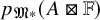 $p_{\mathfrak {M}\ast }(A \boxtimes \mathbb {F})$
is a perfect complex on
$p_{\mathfrak {M}\ast }(A \boxtimes \mathbb {F})$
is a perfect complex on $\mathfrak {M}_S^{\sigma }(v)$
for any
$\mathfrak {M}_S^{\sigma }(v)$
for any $A \in D^b(S)$
, so the
$A \in D^b(S)$
, so the $\mathbb {R}$
-line bundle (4.7) is well-defined. The pull-back of
$\mathbb {R}$
-line bundle (4.7) is well-defined. The pull-back of $\delta $
to
$\delta $
to $\mathfrak {M}_S^{\sigma }(v)^{\mathrm {{red}}}$
is also denoted by
$\mathfrak {M}_S^{\sigma }(v)^{\mathrm {{red}}}$
is also denoted by $\delta $
. We define the (nonreduced or reduced) quasi-BPS categories to be the following intrinsic window categories from Definition 2.6:
$\delta $
. We define the (nonreduced or reduced) quasi-BPS categories to be the following intrinsic window categories from Definition 2.6:
 $$ \begin{align} &\mathbb{T}_S^{\sigma}(v)_ \delta:=\mathbb{W}(\mathfrak{M}_S^{\sigma}(v))^{\mathrm{{int}}}_{\delta}\subset D^b(\mathfrak{M}_S^{\sigma}(v))_w, \\ \notag &\mathbb{T}_S^{\sigma}(v)_ \delta^{\mathrm{{red}}}:=\mathbb{W}(\mathfrak{M}_S^{\sigma}(v)^{\mathrm{{red}}})^{\mathrm{{int}}}_{\delta}\subset D^b(\mathfrak{M}_S^{\sigma}(v)^{\mathrm{{red}}})_w. \end{align} $$
Remark 4.5. For each $y\in M_S^{\sigma }(v)$
, let
$y\in M_S^{\sigma }(v)$
, let $\widehat {\mathfrak {M}}_S^{\sigma }(v)_y$
be the formal fiber at y and
$\widehat {\mathfrak {M}}_S^{\sigma }(v)_y$
be the formal fiber at y and $\delta _y$
the pull-back of
$\delta _y$
the pull-back of $\delta $
to it. The quasi-BPS category for the formal fiber is defined in a similar way:
$\delta $
to it. The quasi-BPS category for the formal fiber is defined in a similar way:
 $$ \begin{align*}\mathbb{T}^{\sigma}_{S, y}(v)_{\delta_y} :=\mathbb{W}(\widehat{\mathfrak{M}}_S^{\sigma}(v)_y)_{\delta_y}^{\mathrm{{int}}} \subset D^b(\widehat{\mathfrak{M}}_S^{\sigma}(v)_y). \end{align*} $$
By the definition of $\mathbb {T}_S^{\sigma }(v)_{\delta }$
, an object
$\mathbb {T}_S^{\sigma }(v)_{\delta }$
, an object $\mathcal {E} \in D^b(\mathfrak {M}_S^{\sigma }(v))$
is an object in
$\mathcal {E} \in D^b(\mathfrak {M}_S^{\sigma }(v))$
is an object in $\mathbb {T}_S^{\sigma }(v)_{\delta }$
if and only if its restriction to any formal fiber is an object in
$\mathbb {T}_S^{\sigma }(v)_{\delta }$
if and only if its restriction to any formal fiber is an object in $\mathbb {T}_{S, y}^{\sigma }(v)_{\delta _y}$
. There is an analogous statement for the reduced version.
$\mathbb {T}_{S, y}^{\sigma }(v)_{\delta _y}$
. There is an analogous statement for the reduced version.
Lemma 4.6. If $\sigma \in \mathrm {Stab}(S)$
is generic, then
$\sigma \in \mathrm {Stab}(S)$
is generic, then $\mathbb {T}_S^{\sigma }(v)_{\delta }$
and
$\mathbb {T}_S^{\sigma }(v)_{\delta }$
and $\mathbb {T}_S^{\sigma }(v)_{\delta }^{\mathrm {{red}}}$
are independent of
$\mathbb {T}_S^{\sigma }(v)_{\delta }^{\mathrm {{red}}}$
are independent of $a\in K(S)_{\mathbb {R}}$
satisfying
$a\in K(S)_{\mathbb {R}}$
satisfying $\chi (a \otimes v)=w$
.
$\chi (a \otimes v)=w$
.
Proof. Let $b \in K(S)_{\mathbb {R}}$
such that
$b \in K(S)_{\mathbb {R}}$
such that $\chi (b \otimes v)=0$
and set
$\chi (b \otimes v)=0$
and set $a'=a+b$
. Let
$a'=a+b$
. Let $\delta '$
be the
$\delta '$
be the $\mathbb {R}$
-line bundle defined as in (4.7) for
$\mathbb {R}$
-line bundle defined as in (4.7) for $a'$
. By Remark 4.5, it is enough to show that
$a'$
. By Remark 4.5, it is enough to show that $\delta _y=\delta ^{\prime }_y$
for any closed point
$\delta _y=\delta ^{\prime }_y$
for any closed point $y \in M_S^{\sigma }(v)$
. Let y be a point which corresponds to the polystable object F as in (4.4). By the decomposition (4.4), we have
$y \in M_S^{\sigma }(v)$
. Let y be a point which corresponds to the polystable object F as in (4.4). By the decomposition (4.4), we have $\mathrm {Aut}(F)=\prod _{i=1}^m GL(V^{(i)})$
and
$\mathrm {Aut}(F)=\prod _{i=1}^m GL(V^{(i)})$
and $\delta _y$
is the character of
$\delta _y$
is the character of $\mathrm {Aut}(F)$
given by
$\mathrm {Aut}(F)$
given by
 $$ \begin{align} \delta_y= \det\left(\sum_{i=1}^m V^{(i)} \otimes \chi(a \otimes F^{(i)})\right) =\bigotimes_{i=1}^m (\det V^{(i)})^{\chi(a\otimes F^{(i)})}. \end{align} $$
As $\sigma $
is generic, the numerical class of
$\sigma $
is generic, the numerical class of $F^{(i)}$
is proportional to v. Therefore
$F^{(i)}$
is proportional to v. Therefore $\chi (b \otimes v)=0$
implies
$\chi (b \otimes v)=0$
implies $\chi (b \otimes F^{(i)})=0$
for
$\chi (b \otimes F^{(i)})=0$
for $1{\leqslant } i{\leqslant } m$
, hence
$1{\leqslant } i{\leqslant } m$
, hence $\delta _y=\delta ^{\prime }_y$
.
$\delta _y=\delta ^{\prime }_y$
.
By the above lemma, the following definition makes sense.
Definition 4.7. For $v \in N(S)$
, let
$v \in N(S)$
, let $\sigma \in \mathrm {Stab}(S)$
be generic. For
$\sigma \in \mathrm {Stab}(S)$
be generic. For $w \in \mathbb {Z}$
, define
$w \in \mathbb {Z}$
, define
 $$ \begin{align*} \mathbb{T}_S^{\sigma}(v)_{w} := \mathbb{T}_S^{\sigma}(v)_\delta, \ \mathbb{T}_S^{\sigma}(v)_{w}^{\mathrm{{red}}} := \mathbb{T}_S^{\sigma}(v)_\delta^{\mathrm{{red}}}. \end{align*} $$
Here $\delta $
is defined as in (4.7) for any
$\delta $
is defined as in (4.7) for any $a \in K(S)_{\mathbb {R}}$
such that
$a \in K(S)_{\mathbb {R}}$
such that $\chi (a \otimes v)=w$
.
$\chi (a \otimes v)=w$
.
The first main result of this section is the following wall-crossing equivalence of quasi-BPS categories.
Theorem 4.8. Let $\sigma _1, \sigma _2 \in \mathrm {Stab}(S)$
be generic stability conditions. Then there exist equivalences
$\sigma _1, \sigma _2 \in \mathrm {Stab}(S)$
be generic stability conditions. Then there exist equivalences
 $$ \begin{align} \mathbb{T}_S^{\sigma_1}(v)_{w} \stackrel{\sim}{\to} \mathbb{T}_S^{\sigma_2}(v)_{w}, \ \mathbb{T}_S^{\sigma_1}(v)_{w}^{\mathrm{{red}}}\stackrel{\sim}{\to} \mathbb{T}_S^{\sigma_2}(v)_{w}^{\mathrm{{red}}}. \end{align} $$
Proof. We only prove the first equivalence, the second one follows by the same argument. We reduce the proof of the equivalence to a local statement as in Theorem 3.3.
Consider a stability $\sigma =(Z, \mathcal {A}) \in \mathrm {Stab}(S)$
lying on a wall and consider stability conditions
$\sigma =(Z, \mathcal {A}) \in \mathrm {Stab}(S)$
lying on a wall and consider stability conditions $\sigma _{\pm }=(Z_{\pm }, \mathcal {A}_{\pm }) \in \mathrm {Stab}(S)$
lying in adjacent chambers. Let
$\sigma _{\pm }=(Z_{\pm }, \mathcal {A}_{\pm }) \in \mathrm {Stab}(S)$
lying in adjacent chambers. Let $b \in K(S)_{\mathbb {R}}$
be an element satisfying
$b \in K(S)_{\mathbb {R}}$
be an element satisfying $\chi (b \otimes v)=0$
and let
$\chi (b \otimes v)=0$
and let $\delta ' \in \mathrm {Pic}(\mathfrak {M}_S^{\sigma }(v))_{\mathbb {R}}$
be defined as in (4.7) using b. Let
$\delta ' \in \mathrm {Pic}(\mathfrak {M}_S^{\sigma }(v))_{\mathbb {R}}$
be defined as in (4.7) using b. Let $\delta \in \mathrm {Pic}(\mathfrak {M}_S^{\sigma }(v))_{\mathbb {R}}$
be as in Definition 4.7, and set
$\delta \in \mathrm {Pic}(\mathfrak {M}_S^{\sigma }(v))_{\mathbb {R}}$
be as in Definition 4.7, and set $\delta "=\delta +\delta '$
. It is enough to show that there exists b as above such that the restriction functors for the open immersions
$\delta "=\delta +\delta '$
. It is enough to show that there exists b as above such that the restriction functors for the open immersions $ \mathfrak {M}^{\sigma _{\pm }}_S(v) \subset \mathfrak {M}^{\sigma }_S(v)$
restrict to the equivalence
$ \mathfrak {M}^{\sigma _{\pm }}_S(v) \subset \mathfrak {M}^{\sigma }_S(v)$
restrict to the equivalence
 $$ \begin{align} \mathbb{T}_S^{\sigma}(v)_{\delta"} \stackrel{\sim}{\to} \mathbb{T}_S^{\sigma_{\pm}}(v)_{\delta"}. \end{align} $$
The open substacks $\mathfrak {M}_S^{\sigma _{\pm }}(v) \subset \mathfrak {M}_S^{\sigma }(v)$
are semistable loci with respect to line bundle
$\mathfrak {M}_S^{\sigma _{\pm }}(v) \subset \mathfrak {M}_S^{\sigma }(v)$
are semistable loci with respect to line bundle $\ell _{\pm }$
on
$\ell _{\pm }$
on $\mathfrak {M}_S^{\sigma }(v)$
and they are parts of
$\mathfrak {M}_S^{\sigma }(v)$
and they are parts of $\Theta $
-stratifications, see [Reference Halpern-LeistnerHLa, Proposition 4.4.5]. The line bundles
$\Theta $
-stratifications, see [Reference Halpern-LeistnerHLa, Proposition 4.4.5]. The line bundles $\ell _{\pm }$
are constructed as follows. We may assume that
$\ell _{\pm }$
are constructed as follows. We may assume that $Z(v)=Z_{\pm }(v)=\sqrt {-1}$
, and write
$Z(v)=Z_{\pm }(v)=\sqrt {-1}$
, and write $Z_{\pm }(-)=\chi (\omega _{\pm }\otimes -)$
for
$Z_{\pm }(-)=\chi (\omega _{\pm }\otimes -)$
for $\omega _{\pm } \in K(S)_{\mathbb {C}}$
. Then set
$\omega _{\pm } \in K(S)_{\mathbb {C}}$
. Then set $b_{\pm } \in K(S)_{\mathbb {R}}$
to be the real parts of
$b_{\pm } \in K(S)_{\mathbb {R}}$
to be the real parts of $\omega _{\pm }$
, which satisfy
$\omega _{\pm }$
, which satisfy $\chi (b_{\pm } \otimes v)=0$
. The line bundles
$\chi (b_{\pm } \otimes v)=0$
. The line bundles $\ell _{\pm }$
are defined by
$\ell _{\pm }$
are defined by $\ell _{\pm }=\det p_{\mathfrak {M}\ast }(b_{\pm } \boxtimes \mathbb {F})$
, see [Reference Halpern-LeistnerHLb, Theorem 6.4.11]. Then we set
$\ell _{\pm }=\det p_{\mathfrak {M}\ast }(b_{\pm } \boxtimes \mathbb {F})$
, see [Reference Halpern-LeistnerHLb, Theorem 6.4.11]. Then we set $b=\varepsilon _{+} b_{+} +\varepsilon _{-} b_{-}$
for general elements
$b=\varepsilon _{+} b_{+} +\varepsilon _{-} b_{-}$
for general elements $0< \varepsilon _{\pm } \ll 1$
.
$0< \varepsilon _{\pm } \ll 1$
.
Since $\mathfrak {M}_S^{\sigma }(v)$
is 0-shifted symplectic, from Theorem 2.3 and Remark 2.5 (see also [Reference Halpern-LeistnerHLa, Theorem 3.3.1]), there exist subcategories
$\mathfrak {M}_S^{\sigma }(v)$
is 0-shifted symplectic, from Theorem 2.3 and Remark 2.5 (see also [Reference Halpern-LeistnerHLa, Theorem 3.3.1]), there exist subcategories $\mathbb {W}(\mathfrak {M}_S^{\sigma }(v))^{\ell _{\pm }}_{m_{\bullet \pm }} \subset D^b(\mathfrak {M}_S^{\sigma }(v))$
which induce equivalences:
$\mathbb {W}(\mathfrak {M}_S^{\sigma }(v))^{\ell _{\pm }}_{m_{\bullet \pm }} \subset D^b(\mathfrak {M}_S^{\sigma }(v))$
which induce equivalences:
 $$ \begin{align} \mathbb{W}(\mathfrak{M}_S^{\sigma}(v))^{\ell_{\pm}}_{m_{\bullet\pm}} \stackrel{\sim}{\to} D^b(\mathfrak{M}_S^{\sigma_{\pm}}(v)). \end{align} $$
Moreover, there exist choices of $m_{\bullet \pm }$
such that
$m_{\bullet \pm }$
such that $\mathbb {T}_S^{\sigma }(v)_{\delta "} \subset \mathbb {W}(\mathfrak {M}_S^{\sigma }(v))^{\ell _{\pm }}_{m_{\bullet \pm }}$
, see [Reference Halpern-LeistnerHLa, Lemma 4.3.10] or [Reference TodaTod, Proposition 6.15] for a choice of
$\mathbb {T}_S^{\sigma }(v)_{\delta "} \subset \mathbb {W}(\mathfrak {M}_S^{\sigma }(v))^{\ell _{\pm }}_{m_{\bullet \pm }}$
, see [Reference Halpern-LeistnerHLa, Lemma 4.3.10] or [Reference TodaTod, Proposition 6.15] for a choice of $m_{\bullet }$
. Therefore, by Remark 4.5, it is enough to show that, for each closed point
$m_{\bullet }$
. Therefore, by Remark 4.5, it is enough to show that, for each closed point $y\in M_S^{\sigma }(v)$
, we have the equivalences
$y\in M_S^{\sigma }(v)$
, we have the equivalences
 $$ \begin{align} \mathbb{T}_{S, y}^{\sigma}(v)_{\delta_y"} \stackrel{\sim}{\to} \mathbb{T}_{S, y}^{\sigma_{\pm}}(v)_{\delta_y"}. \end{align} $$
Here, on the right-hand side we consider the intrinsic window subcategories for the formal fibers of the morphisms $\mathcal {M}_S^{\sigma _{\pm }}(v) \subset \mathcal {M}_S^{\sigma }(v) \to M_S^{\sigma }(v)$
at y.
$\mathcal {M}_S^{\sigma _{\pm }}(v) \subset \mathcal {M}_S^{\sigma }(v) \to M_S^{\sigma }(v)$
at y.
Let y correspond to the polystable object (4.4) and set $\boldsymbol {d}=(\dim V^{(i)})_{i=1}^m$
. Let
$\boldsymbol {d}=(\dim V^{(i)})_{i=1}^m$
. Let $(Q^{\circ , d}_y, \mathscr {I}_y)$
be the Ext-quiver at y with relation
$(Q^{\circ , d}_y, \mathscr {I}_y)$
be the Ext-quiver at y with relation $\mathscr {I}_y$
, see Remark 4.2. The quiver with relation
$\mathscr {I}_y$
, see Remark 4.2. The quiver with relation $(Q^{\circ , d}_y, \mathscr {I}_y)$
is the double of some quiver
$(Q^{\circ , d}_y, \mathscr {I}_y)$
is the double of some quiver $Q_y^{\circ }$
. Let
$Q_y^{\circ }$
. Let $\mathscr {P}_y(\boldsymbol {d})$
be the derived stack of
$\mathscr {P}_y(\boldsymbol {d})$
be the derived stack of $(Q^{\circ , d}_y, \mathscr {I}_y)$
-representations with dimension vector
$(Q^{\circ , d}_y, \mathscr {I}_y)$
-representations with dimension vector $\boldsymbol {d}$
, see (3.3), and
$\boldsymbol {d}$
, see (3.3), and $P_y(\boldsymbol {d})$
the good moduli space of its classical truncation. By the equivalence (4.5), there is an equivalence
$P_y(\boldsymbol {d})$
the good moduli space of its classical truncation. By the equivalence (4.5), there is an equivalence
 $$ \begin{align} \widehat{\mathfrak{M}}_S^{\sigma}(v)_y \simeq \widehat{\mathscr{P}}_y(\boldsymbol{d}). \end{align} $$
Here the right-hand side is the formal fiber of $\mathscr {P}(\boldsymbol {d})$
at
$\mathscr {P}(\boldsymbol {d})$
at $0 \in P(\boldsymbol {d})$
. The line bundles
$0 \in P(\boldsymbol {d})$
. The line bundles $\ell _{\pm }$
restricted to
$\ell _{\pm }$
restricted to $\widehat {\mathfrak {M}}_S^{\sigma }(v)$
correspond to generic elements
$\widehat {\mathfrak {M}}_S^{\sigma }(v)$
correspond to generic elements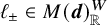 $\ell _{\pm } \in M(\boldsymbol {d})_{\mathbb {R}}^W$
, where
$\ell _{\pm } \in M(\boldsymbol {d})_{\mathbb {R}}^W$
, where $M(\boldsymbol {d})_{\mathbb {R}}$
is the character lattice of the maximal torus of
$M(\boldsymbol {d})_{\mathbb {R}}$
is the character lattice of the maximal torus of $G_y:=\mathrm {Aut}(y)=\prod _{i=1}^m GL(V^{(i)})$
. Moreover the
$G_y:=\mathrm {Aut}(y)=\prod _{i=1}^m GL(V^{(i)})$
. Moreover the $\sigma _{\pm }$
-semistable loci in the left-hand side of (4.14) correspond to
$\sigma _{\pm }$
-semistable loci in the left-hand side of (4.14) correspond to $\ell _{\pm }$
-semistable
$\ell _{\pm }$
-semistable $(Q^{\circ , d}_y, \mathscr {I}_y)$
-representations. Therefore the equivalences (4.13) follow from the formal fiber version of the equivalences
$(Q^{\circ , d}_y, \mathscr {I}_y)$
-representations. Therefore the equivalences (4.13) follow from the formal fiber version of the equivalences
 $$\begin{align*}\mathbb{T}(\boldsymbol{d})_{\delta_y"} \stackrel{\sim}{\to} \mathbb{T}^{l_{\pm}}(\boldsymbol{d})_{\delta_y"}\end{align*}$$
in Theorem 3.3, whose proof is identical to loc. cit.
By Lemma 4.6 and Theorem 4.8, the following definition makes sense:
Definition 4.9. For $v \in N(S)$
and
$v \in N(S)$
and $w \in \mathbb {Z}$
, define
$w \in \mathbb {Z}$
, define
 $$ \begin{align*} \mathbb{T}_S(v)_{w}:= \mathbb{T}_S^{\sigma}(v)_{w}, \ \mathbb{T}_S(v)_{w}^{\mathrm{{red}}}:= \mathbb{T}_S^{\sigma}(v)_{w}^{\mathrm{{red}}}, \end{align*} $$
where $\sigma \in \mathrm {Stab}(S)$
is a generic stability condition.
$\sigma \in \mathrm {Stab}(S)$
is a generic stability condition.
Remark 4.10. The category $\mathbb {T}_S(v)_w$
is defined as an abstract pretriangulated dg-category. If we take a generic
$\mathbb {T}_S(v)_w$
is defined as an abstract pretriangulated dg-category. If we take a generic $\sigma \in \mathrm {Stab}(S)$
, it is realized as a subcategory of
$\sigma \in \mathrm {Stab}(S)$
, it is realized as a subcategory of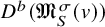 $D^b(\mathfrak {M}_S^{\sigma }(v))$
by the identification
$D^b(\mathfrak {M}_S^{\sigma }(v))$
by the identification $\mathbb {T}_S(v)_w=\mathbb {T}_S^{\sigma }(v)_w \subset D^b(\mathfrak {M}_S^{\sigma }(v))$
.
$\mathbb {T}_S(v)_w=\mathbb {T}_S^{\sigma }(v)_w \subset D^b(\mathfrak {M}_S^{\sigma }(v))$
.
Remark 4.11. Suppose that $g{\geqslant } 2$
and take a generic
$g{\geqslant } 2$
and take a generic $\sigma \in \mathrm {Stab}(S)$
. Then we have
$\sigma \in \mathrm {Stab}(S)$
. Then we have $\mathfrak {M}_S^{\sigma }(v)^{\mathrm {{red}}}=\mathcal {M}_S^{\sigma }(v)$
. Let
$\mathfrak {M}_S^{\sigma }(v)^{\mathrm {{red}}}=\mathcal {M}_S^{\sigma }(v)$
. Let $\mathcal {M}_S^{\sigma \text {-st}}(v) \subset \mathcal {M}_S^{\sigma }(v)$
be the open substack of
$\mathcal {M}_S^{\sigma \text {-st}}(v) \subset \mathcal {M}_S^{\sigma }(v)$
be the open substack of $\sigma $
-stable objects. Then the good moduli space morphism
$\sigma $
-stable objects. Then the good moduli space morphism $\mathcal {M}_S^{\sigma \text {-st}}(v) \to M_S^{\sigma \text {-st}}(v)$
is a
$\mathcal {M}_S^{\sigma \text {-st}}(v) \to M_S^{\sigma \text {-st}}(v)$
is a $\mathbb {C}^{\ast }$
-gerbe classified by
$\mathbb {C}^{\ast }$
-gerbe classified by $\alpha \in \mathrm {Br}(M_S^{\sigma \text {-st}}(v))$
which gives the obstruction of the existence of a universal object in
$\alpha \in \mathrm {Br}(M_S^{\sigma \text {-st}}(v))$
which gives the obstruction of the existence of a universal object in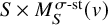 $S \times M_S^{\sigma \text {-st}}(v)$
. We then have that
$S \times M_S^{\sigma \text {-st}}(v)$
. We then have that
 $$ \begin{align} \mathbb{T}_S(v)_w^{\mathrm{{red}}}|_{M_S^{\sigma\text{-st}}(v)}=D^b(M_S^{\sigma}(v), \alpha^w), \end{align} $$
where the right hand is the derived category of $\alpha ^w$
-twisted coherent sheaves on
$\alpha ^w$
-twisted coherent sheaves on $M_S^{\sigma \text {-st}}(v)$
, see [Reference CăldăraruCăl00, Reference LieblichLie07], and the left-hand side is the subcategory of
$M_S^{\sigma \text {-st}}(v)$
, see [Reference CăldăraruCăl00, Reference LieblichLie07], and the left-hand side is the subcategory of $D^b(\mathcal {M}^{\sigma \text {-st}}(v))$
classically generated by the restriction of objects in
$D^b(\mathcal {M}^{\sigma \text {-st}}(v))$
classically generated by the restriction of objects in $\mathbb {T}_S(v)_w^{\mathrm {{red}}}$
.
$\mathbb {T}_S(v)_w^{\mathrm {{red}}}$
.
If v is primitive, then $M_S^{\sigma \text {-st}}(v)=M_S^{\sigma }(v)$
and it is a nonsingular holomorphic symplectic variety deformation equivalent to the Hilbert scheme of points
$M_S^{\sigma \text {-st}}(v)=M_S^{\sigma }(v)$
and it is a nonsingular holomorphic symplectic variety deformation equivalent to the Hilbert scheme of points $S^{[n]}$
, where
$S^{[n]}$
, where $n=\langle v, v\rangle /2+1$
. By (4.15), we have
$n=\langle v, v\rangle /2+1$
. By (4.15), we have
 $$ \begin{align} \mathbb{T}_S(v)_w^{\mathrm{{red}}}=D^b(M_S^{\sigma}(v), \alpha^w). \end{align} $$
Remark 4.12. We can also define quasi-BPS categories for other Calabi-Yau surfaces, that is, abelian surfaces, similarly to Definition 4.9. When S is an abelian surface, the derived Picard stack is $\mathcal {P}ic^{\beta }(S)=\widehat {S} \times \operatorname {Spec} \mathbb {C}[\varepsilon ]/\mathbb {C}^{\ast }$
, where
$\mathcal {P}ic^{\beta }(S)=\widehat {S} \times \operatorname {Spec} \mathbb {C}[\varepsilon ]/\mathbb {C}^{\ast }$
, where $\widehat {S}$
is the dual abelian surface, and we define the reduced stack (4.2) by
$\widehat {S}$
is the dual abelian surface, and we define the reduced stack (4.2) by $\mathfrak {M}_S^{\sigma }(v) \times _{\mathcal {P}ic^{\beta }(S)}\mathcal {P}ic^{\beta }(S)^{\mathrm {{cl}}}$
. The results in this paper also hold for abelian surfaces.
$\mathfrak {M}_S^{\sigma }(v) \times _{\mathcal {P}ic^{\beta }(S)}\mathcal {P}ic^{\beta }(S)^{\mathrm {{cl}}}$
. The results in this paper also hold for abelian surfaces.
Let $v=dv_0$
for a primitive
$v=dv_0$
for a primitive $v_0$
. We expect that, if
$v_0$
. We expect that, if $\gcd (d, w)=1$
, the category
$\gcd (d, w)=1$
, the category $\mathbb {T}_S(v)_w^{\mathrm {{red}}}$
is a “noncommutative hyperkähler manifold”, so that it shares several properties with
$\mathbb {T}_S(v)_w^{\mathrm {{red}}}$
is a “noncommutative hyperkähler manifold”, so that it shares several properties with $D^b(M)$
for a smooth projective hyperkähler variety of
$D^b(M)$
for a smooth projective hyperkähler variety of $K3^{[n]}$
-type for
$K3^{[n]}$
-type for $n=\langle v, v \rangle /2+1$
. More precisely, we may expect the following, which we view as a categorical
$n=\langle v, v \rangle /2+1$
. More precisely, we may expect the following, which we view as a categorical $\chi $
-independence phenomenon.
$\chi $
-independence phenomenon.
Conjecture 4.13. Let $v=dv_0$
for
$v=dv_0$
for $d{\geqslant } 1$
and
$d{\geqslant } 1$
and $v_0$
a primitive vector with
$v_0$
a primitive vector with $\langle v_0, v_0\rangle =2g-2$
. Suppose that
$\langle v_0, v_0\rangle =2g-2$
. Suppose that $g{\geqslant } 0$
. For
$g{\geqslant } 0$
. For $\gcd (d, w)=1$
, the category
$\gcd (d, w)=1$
, the category $\mathbb {T}_S(v)_{w}^{\mathrm {{red}}}$
is deformation equivalent to
$\mathbb {T}_S(v)_{w}^{\mathrm {{red}}}$
is deformation equivalent to $D^b(S^{[n]})$
for
$D^b(S^{[n]})$
for $n=\langle v, v\rangle /2+1$
.
$n=\langle v, v\rangle /2+1$
.
4.5 Quasi-BPS categories for Gieseker semistable sheaves
In Definition 4.9, we defined quasi-BPS categories for Bridgeland semistable objects. By applying the categorical wall-crossing equivalence in Theorem 4.8, we can relate the categories in Definition 4.9 with those under Hodge isometries, and with those for moduli stacks of Gieseker semistable sheaves.
Let G be the group of Hodge isometries of the Mukai lattice $H^{\ast }(S, \mathbb {Z})$
, preserving the orientation of the positive definite four-dimensional plane of
$H^{\ast }(S, \mathbb {Z})$
, preserving the orientation of the positive definite four-dimensional plane of $H^{\ast }(S, \mathbb {R})$
. Note that it acts on the algebraic part
$H^{\ast }(S, \mathbb {R})$
. Note that it acts on the algebraic part $\mathbb {Z} \oplus \mathrm {NS}(S) \oplus \mathbb {Z}$
. The following is a categorical analogue of derived invariance property of counting invariants for K3 surfaces [Reference TodaTod08, Reference TodaTod12b].
$\mathbb {Z} \oplus \mathrm {NS}(S) \oplus \mathbb {Z}$
. The following is a categorical analogue of derived invariance property of counting invariants for K3 surfaces [Reference TodaTod08, Reference TodaTod12b].
Corollary 4.14. For any $\gamma \in G$
, there is an equivalence
$\gamma \in G$
, there is an equivalence
 $$ \begin{align*} \mathbb{T}_S(v)_w \simeq \mathbb{T}_S(\gamma v)_w. \end{align*} $$
Proof. Let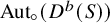 $\mathrm {Aut}_{\circ }(D^b(S))$
be the group of autoequivalences
$\mathrm {Aut}_{\circ }(D^b(S))$
be the group of autoequivalences $\Phi $
of
$\Phi $
of $D^b(S)$
whose action
$D^b(S)$
whose action $\Phi _{\ast }$
on the space of stability conditions preserves the component
$\Phi _{\ast }$
on the space of stability conditions preserves the component $\mathrm {Stab}(S)$
. It also acts on
$\mathrm {Stab}(S)$
. It also acts on $H^{\ast }(S, \mathbb {Z})$
, and denote the action by
$H^{\ast }(S, \mathbb {Z})$
, and denote the action by $\Phi _{\ast } \colon H^{\ast }(S, \mathbb {Z}) \to H^{\ast }(S, \mathbb {Z})$
. Then we have the surjective group homomorphism, see [Reference HartmannHar12, Proposition 7.9], [Reference Huybrechts, Macri and StellariHMS09, Corollary 4.10]:
$\Phi _{\ast } \colon H^{\ast }(S, \mathbb {Z}) \to H^{\ast }(S, \mathbb {Z})$
. Then we have the surjective group homomorphism, see [Reference HartmannHar12, Proposition 7.9], [Reference Huybrechts, Macri and StellariHMS09, Corollary 4.10]:
 $$ \begin{align} \mathrm{Aut}_{\circ}(D^b(S)) \to G, \ \Phi \mapsto \Phi_{\ast} \end{align} $$
For $\Phi \in \mathrm {Aut}_{\circ }(D^b(S))$
, there is an equivalence of derived stacks
$\Phi \in \mathrm {Aut}_{\circ }(D^b(S))$
, there is an equivalence of derived stacks $\phi \colon \mathfrak {M}_S^{\sigma }(v) \simeq \mathfrak {M}_S^{\Phi _{\ast }\sigma }(\Phi _{\ast }\sigma )$
given by
$\phi \colon \mathfrak {M}_S^{\sigma }(v) \simeq \mathfrak {M}_S^{\Phi _{\ast }\sigma }(\Phi _{\ast }\sigma )$
given by $F \mapsto \Phi (F)$
. The above equivalence induces an equivalence
$F \mapsto \Phi (F)$
. The above equivalence induces an equivalence
 $$ \begin{align*} \phi_{\ast} \colon \mathbb{T}_S^{\sigma}(v)_{\delta} \simeq \mathbb{T}_S^{\Phi_{\ast}\sigma}(\Phi_{\ast}v)_{\delta'} \end{align*} $$
where $\delta '$
is determined by
$\delta '$
is determined by $a'=\Phi _{\ast }^{-1}a \in K(S)_{\mathbb {R}}$
which satisfies
$a'=\Phi _{\ast }^{-1}a \in K(S)_{\mathbb {R}}$
which satisfies $\chi (a'\otimes v')=w$
for
$\chi (a'\otimes v')=w$
for $v'=\Phi _{\ast }v$
. By Theorem 4.8 and the surjectivity of (4.17), we obtain the corollary.
$v'=\Phi _{\ast }v$
. By Theorem 4.8 and the surjectivity of (4.17), we obtain the corollary.
Let H be an ample divisor on S. We denote by $\mathfrak {M}_S^H(v)$
the derived moduli stack of H-Gieseker semistable sheaves on S with Mukai vector v, and by
$\mathfrak {M}_S^H(v)$
the derived moduli stack of H-Gieseker semistable sheaves on S with Mukai vector v, and by $\mathfrak {M}_S^H(v)^{\mathrm {{red}}}$
its reduced stack. For
$\mathfrak {M}_S^H(v)^{\mathrm {{red}}}$
its reduced stack. For $a \in K(S)_{\mathbb {R}}$
, we define the
$a \in K(S)_{\mathbb {R}}$
, we define the $\mathbb {R}$
-line bundle
$\mathbb {R}$
-line bundle $\delta $
on
$\delta $
on $\mathfrak {M}_S^H(v)$
,
$\mathfrak {M}_S^H(v)$
, $\mathfrak {M}_S^H(v)^{\mathrm {{red}}}$
similarly to (4.7). Then we define
$\mathfrak {M}_S^H(v)^{\mathrm {{red}}}$
similarly to (4.7). Then we define
 $$ \begin{align*} &\mathbb{T}_S^H(v)_{\delta}:=\mathbb{W}(\mathfrak{M}_S^H(v))_{\delta}^{\mathrm{{int}}} \subset D^b(\mathfrak{M}_S^H(v)), \\ &\mathbb{T}_S^H(v)_{\delta}^{\mathrm{{red}}}:=\mathbb{W}(\mathfrak{M}_S^H(v)^{\mathrm{{red}}})_{\delta}^{\mathrm{{int}}} \subset D^b(\mathfrak{M}_S^H(v)^{\mathrm{{red}}}). \end{align*} $$
Below we consider H generic with respect to v, so that all Jordan-Hölder factors of objects in $\mathfrak {M}_S^H(v)$
have numerical class proportional to v. The following is a corollary of the wall-crossing equivalence in Theorem 4.8.
$\mathfrak {M}_S^H(v)$
have numerical class proportional to v. The following is a corollary of the wall-crossing equivalence in Theorem 4.8.
Corollary 4.15. For $v \in N(S)_{\mathbb {R}}$
and generic
$v \in N(S)_{\mathbb {R}}$
and generic $\sigma \in \mathrm {Stab}(S)$
, there is
$\sigma \in \mathrm {Stab}(S)$
, there is $\varepsilon \in \{0, 1\}$
and
$\varepsilon \in \{0, 1\}$
and $m\gg 0$
such that, by setting
$m\gg 0$
such that, by setting $v'=(-1)^{\varepsilon }v(mH)$
we have equivalences
$v'=(-1)^{\varepsilon }v(mH)$
we have equivalences
 $$ \begin{align*} \mathbb{T}_S(v)_{\delta} \simeq \mathbb{T}_S^H(v')_{\delta'}, \ \mathbb{T}_S(v)_{\delta}^{\mathrm{{red}}} \simeq \mathbb{T}_S^H(v')_{\delta'}^{\mathrm{{red}}}. \end{align*} $$
Here, $\delta '$
is a line bundle on
$\delta '$
is a line bundle on $\mathfrak {M}_S^H(v)$
determined by
$\mathfrak {M}_S^H(v)$
determined by $a'=(-1)^{\varepsilon }a(-mH) \in K(S)_{\mathbb {R}}$
with
$a'=(-1)^{\varepsilon }a(-mH) \in K(S)_{\mathbb {R}}$
with $\chi (a \otimes v)=\chi (a' \otimes v')=w$
. Then:
$\chi (a \otimes v)=\chi (a' \otimes v')=w$
. Then:
 $$ \begin{align*} \mathbb{T}_S(v)_{w} \simeq \mathbb{T}_S^H(v')_{w}, \ \mathbb{T}_S(v)_{w}^{\mathrm{{red}}} \simeq \mathbb{T}_S^H(v')_{w}^{\mathrm{{red}}}. \end{align*} $$
Proof. We take the autoequivalence $\Phi $
of
$\Phi $
of $D^b(S)$
to be either
$D^b(S)$
to be either $\Phi =\otimes \mathcal {O}(mH)$
or
$\Phi =\otimes \mathcal {O}(mH)$
or $\otimes \mathcal {O}(mH)[1]$
for
$\otimes \mathcal {O}(mH)[1]$
for $m\gg 0$
, such that the vector
$m\gg 0$
, such that the vector $\Phi _{\ast }v=(r, \beta , \chi )$
either has
$\Phi _{\ast }v=(r, \beta , \chi )$
either has $r {\geqslant } 0$
and
$r {\geqslant } 0$
and $H \cdot \beta>0$
, or
$H \cdot \beta>0$
, or $r=H \cdot \beta =0$
,
$r=H \cdot \beta =0$
, $\chi>0$
. Then applying Corollary 4.14, Theorem 4.8, and Proposition 4.1 we obtain the conclusion.
$\chi>0$
. Then applying Corollary 4.14, Theorem 4.8, and Proposition 4.1 we obtain the conclusion.
We next mention the natural periodicity and symmetry of quasi-BPS categories:
Lemma 4.16. Let $m:=\gcd \{\chi (a \otimes v) : a \in K(S)\}$
. We have equivalences
$m:=\gcd \{\chi (a \otimes v) : a \in K(S)\}$
. We have equivalences
 $$ \begin{align*} \mathbb{T}_S(v)_w \simeq \mathbb{T}_S(v)_{w+m}, \ \mathbb{T}_S(v)_w \simeq \mathbb{T}_S(v)_{-w}^{\mathrm{{op}}}. \end{align*} $$
The similar equivalences also hold for $\mathbb {T}_S(v)_w^{\mathrm {{red}}}$
.
$\mathbb {T}_S(v)_w^{\mathrm {{red}}}$
.
Proof. For $a \in K(S)$
, let
$a \in K(S)$
, let $\delta $
be the line bundle (4.7). Then tensoring by
$\delta $
be the line bundle (4.7). Then tensoring by $\delta $
induces equivalences:
$\delta $
induces equivalences:
 $$ \begin{align*} \mathbb{T}_S^{\sigma}(v)_w \simeq \mathbb{T}^{\sigma}_S(v)_{w+\chi(a\otimes v)}, \ \mathbb{T}^{\sigma}_S(v)_w^{\mathrm{{red}}} \simeq \mathbb{T}^{\sigma}_S(v)_{w+\chi(a\otimes v)}^{\mathrm{{red}}}. \end{align*} $$
Therefore we obtain the first equivalence. The second equivalence is given by the restriction of $\mathcal {H}om(-, \mathcal {O}_{\mathfrak {M}_S^{\sigma }(v)})$
to
$\mathcal {H}om(-, \mathcal {O}_{\mathfrak {M}_S^{\sigma }(v)})$
to $\mathbb {T}_S^{\sigma }(v)$
.
$\mathbb {T}_S^{\sigma }(v)$
.
4.6 Conjecture 4.13 for
$g=0,1$

Write the Mukai vector as $v=dv_0$
, where
$v=dv_0$
, where $d\in \mathbb {Z}_{{\geqslant } 1}$
and for
$d\in \mathbb {Z}_{{\geqslant } 1}$
and for $v_0$
a primitive Mukai vector with
$v_0$
a primitive Mukai vector with $\langle v_0, v_0 \rangle =2g-2$
and
$\langle v_0, v_0 \rangle =2g-2$
and $g{\geqslant } 0$
.
$g{\geqslant } 0$
.
The following proposition proves Conjecture 4.13 when $g=0$
.
$g=0$
.
Proposition 4.17. Suppose that $g=0$
and
$g=0$
and $\gcd (d, w)=1$
. Then we have
$\gcd (d, w)=1$
. Then we have
 $$ \begin{align*} \mathbb{T}_S(dv_0)_w^{\mathrm{{red}}}=\begin{cases} D^b(\operatorname{Spec} \mathbb{C}), & d=1, \\ 0, & d>1. \end{cases} \end{align*} $$
Proof. By Corollary 4.15, we can assume that $\mathbb {T}_S(v)_w=\mathbb {T}_S^H(v)_{\delta }$
in
$\mathbb {T}_S(v)_w=\mathbb {T}_S^H(v)_{\delta }$
in $D^b(\mathfrak {M}_S^H(v))$
for H an ample divisor on S. It is well known that
$D^b(\mathfrak {M}_S^H(v))$
for H an ample divisor on S. It is well known that $\mathfrak {M}_S^H(v)$
consists of a single point
$\mathfrak {M}_S^H(v)$
consists of a single point $F^{\oplus d}$
for a spherical stable sheaf F, so we have
$F^{\oplus d}$
for a spherical stable sheaf F, so we have
 $$ \begin{align*} \mathfrak{M}_S^H(v)^{\mathrm{{red}}}= \operatorname{Spec} \mathbb{C}[\mathfrak{gl}(d)_0^{\vee}[1]]/GL(d). \end{align*} $$
By the definition of $\mathbb {T}_S(v)_w^{\mathrm {{red}}}$
, it consists of objects such that for the inclusion
$\mathbb {T}_S(v)_w^{\mathrm {{red}}}$
, it consists of objects such that for the inclusion
 $$\begin{align*}j \colon \mathfrak{M}_S^H(v)^{\mathrm{{red}}} \hookrightarrow BGL(d),\end{align*}$$
the object $j_{\ast }\mathcal {E}$
is generated by
$j_{\ast }\mathcal {E}$
is generated by $\Gamma _{GL(d)}(\chi )$
for a dominant weight
$\Gamma _{GL(d)}(\chi )$
for a dominant weight $\chi $
such that
$\chi $
such that
 $$ \begin{align*} \chi+\rho \in \frac{1}{2} \mathrm{sum}[0, \beta_i-\beta_j]+\frac{w}{d}\sum_{i=1}^d \beta_i, \end{align*} $$
where the Minkowski sum is after all $1{\leqslant } i, j{\leqslant } d$
. By [Reference TodaTod23a, Lemma 3.2], such a weight exists if and only if
$1{\leqslant } i, j{\leqslant } d$
. By [Reference TodaTod23a, Lemma 3.2], such a weight exists if and only if $d|w$
, and thus only if
$d|w$
, and thus only if $d=1$
because
$d=1$
because $\gcd (d,w)=1$
. Therefore, together with (4.16) in the primitive case, the proposition follows.
$\gcd (d,w)=1$
. Therefore, together with (4.16) in the primitive case, the proposition follows.
We next discuss the case of $g=1$
. Then
$g=1$
. Then $v=dv_0$
, where
$v=dv_0$
, where $v_0$
is primitive with
$v_0$
is primitive with $\langle v_0, v_0 \rangle =0$
. For a generic
$\langle v_0, v_0 \rangle =0$
. For a generic $\sigma $
, set
$\sigma $
, set
 $$ \begin{align*}S':=M_S^{\sigma}(v_0) \end{align*} $$
which is well known to be a K3 surface [Reference MukaiMuk87, Reference Bayer and MacrìBM14]. We have the good moduli space morphism $\mathcal {M}_S^{\sigma }(v_0) \to S'$
which is a
$\mathcal {M}_S^{\sigma }(v_0) \to S'$
which is a $\mathbb {C}^{\ast }$
-gerbe classified by some
$\mathbb {C}^{\ast }$
-gerbe classified by some $\alpha \in \mathrm {Br}(S')$
. There is an equivalence
$\alpha \in \mathrm {Br}(S')$
. There is an equivalence
 $$ \begin{align} D^b(S', \alpha) \stackrel{\sim}{\to} D^b(S) \end{align} $$
given by the Fourier-Mukai transform with kernel the universal $(1\boxtimes \alpha )$
-twisted sheaf on
$(1\boxtimes \alpha )$
-twisted sheaf on $S \times S'$
, see [Reference CăldăraruC02]. There is also an isomorphism given by the direct sum map
$S \times S'$
, see [Reference CăldăraruC02]. There is also an isomorphism given by the direct sum map
 $$ \begin{align} \mathrm{Sym}^d(S') \stackrel{\cong}{\to} M_S^{\sigma}(dv_0). \end{align} $$
Let $\mathcal {M}_S^{\sigma }(v_0, \ldots , v_0)$
be the classical moduli stack of filtrations of semistable objects on S:
$\mathcal {M}_S^{\sigma }(v_0, \ldots , v_0)$
be the classical moduli stack of filtrations of semistable objects on S:
 $$ \begin{align*} 0=F_0 \subset F_1 \subset \cdots \subset F_d \end{align*} $$
such that $F_i/F_{i-1}$
is a
$F_i/F_{i-1}$
is a $\sigma $
-semistable object with numerical class
$\sigma $
-semistable object with numerical class $v_0$
. We define
$v_0$
. We define $\mathscr {Z}_S$
and
$\mathscr {Z}_S$
and $\widetilde {\mathcal {M}}_S^{\sigma }(v_0)$
by the following diagram, where the two squares are Cartesian in the classical sense:
$\widetilde {\mathcal {M}}_S^{\sigma }(v_0)$
by the following diagram, where the two squares are Cartesian in the classical sense:

Let $T(d)=(\mathbb {C}^{\ast })^{\times d}$
. The map
$T(d)=(\mathbb {C}^{\ast })^{\times d}$
. The map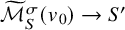 $\widetilde {\mathcal {M}}_S^{\sigma }(v_0) \to S'$
is a
$\widetilde {\mathcal {M}}_S^{\sigma }(v_0) \to S'$
is a $T(d)$
-gerbe, so we have the decomposition into
$T(d)$
-gerbe, so we have the decomposition into $T(d)$
-weights
$T(d)$
-weights
 $$ \begin{align} D^b(\widetilde{\mathcal{M}}_S^{\sigma}(v_0)) =\bigoplus_{(w_1, \ldots, w_d)\in \mathbb{Z}^d} D^b(\widetilde{\mathcal{M}}_S^{\sigma}(v_0))_{(w_1, \ldots, w_d)} \end{align} $$
where the summand corresponding to $(w_1, \ldots , w_d)$
is equivalent to
$(w_1, \ldots , w_d)$
is equivalent to $D^b(S', \alpha ^{w_1+\cdots +w_d})$
. For
$D^b(S', \alpha ^{w_1+\cdots +w_d})$
. For $1{\leqslant } i{\leqslant } d$
, define
$1{\leqslant } i{\leqslant } d$
, define $m_i$
by the formula
$m_i$
by the formula
 $$ \begin{align} m_i :=\left\lceil \frac{wi}{d} \right\rceil -\left\lceil \frac{w(i-1)}{d} \right\rceil +\delta_{id} -\delta_{i1} \in \mathbb{Z}. \end{align} $$
Define the functor
 $$ \begin{align*} \Phi_{d,w}\colon D^b(S', \alpha^w)\to D^b(\mathfrak{M}_{S}^{\sigma}(v)^{\mathrm{{red}}})_{w},\ \mathcal{F}\mapsto p_{S*}\left(q_S^{\ast}\circ i_{(m_1, \ldots, m_d)}\mathcal{F}\right), \end{align*} $$
where $i_{(m_1, \ldots , m_d)}$
is the inclusion of
$i_{(m_1, \ldots , m_d)}$
is the inclusion of $D^b(S', \alpha ^w)$
into the weight
$D^b(S', \alpha ^w)$
into the weight $(m_1, \ldots , m_d)$
-part of (4.21). When
$(m_1, \ldots , m_d)$
-part of (4.21). When $v_0=[\mathcal {O}_x]$
for a point
$v_0=[\mathcal {O}_x]$
for a point $x \in S$
, it is proved in [Reference Pădurariu and TodaPTa, Proposition 4.7] that the image of the functor
$x \in S$
, it is proved in [Reference Pădurariu and TodaPTa, Proposition 4.7] that the image of the functor $\Phi _{d, w}$
lies in
$\Phi _{d, w}$
lies in $\mathbb {T}_S^{\sigma }(v)_w$
. We now state a stronger form of Conjecture 4.13 for
$\mathbb {T}_S^{\sigma }(v)_w$
. We now state a stronger form of Conjecture 4.13 for $g=1$
.
$g=1$
.
Conjecture 4.18. Let $v=d v_0$
such that
$v=d v_0$
such that $d \in \mathbb {Z}_{{\geqslant } 1}$
and
$d \in \mathbb {Z}_{{\geqslant } 1}$
and $v_0$
is primitive with
$v_0$
is primitive with $\langle v_0, v_0 \rangle =0$
. If
$\langle v_0, v_0 \rangle =0$
. If $\gcd (d, w)=1$
, then the functor
$\gcd (d, w)=1$
, then the functor $\Phi _{d, w}$
restricts to the equivalence
$\Phi _{d, w}$
restricts to the equivalence
 $$ \begin{align} \Phi_{d, w} \colon D^b(S', \alpha^w) \stackrel{\sim}{\to} \mathbb{T}_S^{\sigma}(dv_0)_{w}^{\mathrm{{red}}}. \end{align} $$
In particular for $w=1$
, the category
$w=1$
, the category $\mathbb {T}_S^{\sigma }(dv_0)_1$
is equivalent to
$\mathbb {T}_S^{\sigma }(dv_0)_1$
is equivalent to $D^b(S)$
.
$D^b(S)$
.
In [Reference PădurariuPT24, Reference Pădurariu and TodaPT23], we addressed a similar conjecture for $\mathbb {C}^2$
which we recall here. Let
$\mathbb {C}^2$
which we recall here. Let $\mathscr {C}(d)^{\mathrm {{red}}}$
be the reduced derived moduli stack of zero-dimensional sheaves on
$\mathscr {C}(d)^{\mathrm {{red}}}$
be the reduced derived moduli stack of zero-dimensional sheaves on $\mathbb {C}^2$
with length d. It is the quotient stack
$\mathbb {C}^2$
with length d. It is the quotient stack
 $$ \begin{align*} \mathscr{C}(d)^{\mathrm{{red}}}=\mu_0^{-1}(0)/GL(d), \end{align*} $$
where $\mu _0 \colon \mathfrak {gl}(d)^{\oplus 2} \to \mathfrak {gl}(d)_0$
is the commuting map, so the map (3.19) for
$\mu _0 \colon \mathfrak {gl}(d)^{\oplus 2} \to \mathfrak {gl}(d)_0$
is the commuting map, so the map (3.19) for $g=1$
. Let
$g=1$
. Let $\mathscr {C}(1, \ldots , 1)$
be the classical moduli stack of filtrations of zero-dimensional sheaves on
$\mathscr {C}(1, \ldots , 1)$
be the classical moduli stack of filtrations of zero-dimensional sheaves on $\mathbb {C}^2$
:
$\mathbb {C}^2$
:
 $$ \begin{align*} 0=Q_0 \subset Q_1 \subset \cdots \subset Q_d\end{align*} $$
such that $Q_i/Q_{i-1}$
is isomorphic to
$Q_i/Q_{i-1}$
is isomorphic to $\mathcal {O}_{x_i}$
for some
$\mathcal {O}_{x_i}$
for some $x_i \in \mathbb {C}^2$
. Similarly to (4.20), we have the following diagram
$x_i \in \mathbb {C}^2$
. Similarly to (4.20), we have the following diagram

The functor
 $$ \begin{align} \Phi_{d, w}^{\mathbb{C}^2} \colon D^b(\mathbb{C}^2) \to D^b(\mathscr{C}(d)^{\mathrm{{red}}}) \end{align} $$
is defined similarly to (4.23).
Conjecture 4.19. [Reference PădurariuPT24, Reference Pădurariu and TodaPT23]
If $\gcd (d, w)=1$
, the functor (4.25) restricts to the equivalence
$\gcd (d, w)=1$
, the functor (4.25) restricts to the equivalence
 $$ \begin{align} \Phi_{d, w}^{\mathbb{C}^2} \colon D^b(\mathbb{C}^2) \stackrel{\sim}{\to} \mathbb{T}(d)_w^{\mathrm{{red}}}. \end{align} $$
Here the right-hand side is defined in (3.20) for $g=1$
.
$g=1$
.
We have the following proposition:
Proof. Consider the composition
 $$ \begin{align} D^b(\mathfrak{M}_S^{\sigma}(dv_0)^{\mathrm{{red}}}) \stackrel{p_S^{!}}{\to}\operatorname{Ind} D^b(\mathscr{Z}_S) \stackrel{q_{S\ast}}{\to}\operatorname{Ind} D^b(\widetilde{\mathcal{M}}_S^{\sigma}(v_0)) \stackrel{\mathrm{pr}}{\to}\operatorname{Ind} D^b(S', \alpha^w), \end{align} $$
where $\mathrm {pr}$
is the projection onto the weight
$\mathrm {pr}$
is the projection onto the weight $(m_1, \ldots , m_d)$
-component. We claim that, assuming Conjecture 4.19, the above functor restricts to the functor
$(m_1, \ldots , m_d)$
-component. We claim that, assuming Conjecture 4.19, the above functor restricts to the functor
 $$ \begin{align} \Phi_{d, w}^{R} \colon \mathbb{T}^\sigma_S(dv_0)_w^{\mathrm{{red}}} \to D^b(S', \alpha^w), \end{align} $$
which is a right adjoint of $\Phi _{d, w}$
. Let
$\Phi _{d, w}$
. Let
 $$ \begin{align*}\mathcal{M}_S^{\sigma}(dv_0) \to M_S^{\sigma}(dv_0) \stackrel{\cong}{\leftarrow} \mathrm{Sym}^d(S') \end{align*} $$
be the good moduli space morphism, see (4.19).
For a point $p \in S'$
, the diagram (4.20) pulled back over the formal completion
$p \in S'$
, the diagram (4.20) pulled back over the formal completion $\operatorname {Spec} \widehat {\mathcal {O}}_{\mathrm {Sym}^d(S'), d[p]} \to \mathrm {Sym}^d(S')$
is isomorphic to the diagram (4.24) pulled back via
$\operatorname {Spec} \widehat {\mathcal {O}}_{\mathrm {Sym}^d(S'), d[p]} \to \mathrm {Sym}^d(S')$
is isomorphic to the diagram (4.24) pulled back via $\operatorname {Spec} \widehat {\mathcal {O}}_{\mathrm {Sym}^d(\mathbb {C}^2), d[0]} \to \mathrm {Sym}^d(\mathbb {C}^2)$
. The ind-completion of the equivalence (4.26) gives an equivalence
$\operatorname {Spec} \widehat {\mathcal {O}}_{\mathrm {Sym}^d(\mathbb {C}^2), d[0]} \to \mathrm {Sym}^d(\mathbb {C}^2)$
. The ind-completion of the equivalence (4.26) gives an equivalence
 $$\begin{align*}\operatorname{Ind} D^b(\mathbb{C}^2) \stackrel{\sim}{\to} \operatorname{Ind} \mathbb{T}(d)_w^{\mathrm{{red}}},\end{align*}$$
whose inverse is
 $$ \begin{align} \mathrm{pr} \circ q_{\mathbb{C}^2 \ast} p_{\mathbb{C}^2}^! \colon \operatorname{Ind}\mathbb{T}(d)_w^{\mathrm{{red}}} \to \operatorname{Ind} D^b(\mathbb{C}^2). \end{align} $$
In the above, $\mathrm {pr}$
is again the projection functor onto the weight
$\mathrm {pr}$
is again the projection functor onto the weight $(m_1,\ldots , m_d)$
-component. By the equivalence (4.26), the functor (4.29) restricts to the functor
$(m_1,\ldots , m_d)$
-component. By the equivalence (4.26), the functor (4.29) restricts to the functor $\mathbb {T}(d)_w^{\mathrm {{red}}}\to D^b(\mathbb {C}^2)$
. Therefore the functor (4.27) restricts to the functor (4.28), giving a right adjoint of
$\mathbb {T}(d)_w^{\mathrm {{red}}}\to D^b(\mathbb {C}^2)$
. Therefore the functor (4.27) restricts to the functor (4.28), giving a right adjoint of $\Phi _{d, w}$
.
$\Phi _{d, w}$
.
We have the natural transformations $\operatorname {id} \to \Phi _{d, w}^R \circ \Phi _{d, w}$
,
$\operatorname {id} \to \Phi _{d, w}^R \circ \Phi _{d, w}$
, $\Phi _{d, w}\circ \Phi _{d, w}^R \to \operatorname {id}$
by adjunction, which are isomorphisms formally locally on
$\Phi _{d, w}\circ \Phi _{d, w}^R \to \operatorname {id}$
by adjunction, which are isomorphisms formally locally on $\mathrm {Sym}^d(S')$
. Hence they are isomorphisms and thus
$\mathrm {Sym}^d(S')$
. Hence they are isomorphisms and thus $\Phi _{d, w}$
is an equivalence.
$\Phi _{d, w}$
is an equivalence.
Remark 4.21. In [Reference Cautis, Pădurariu and TodaCPT], we prove Conjecture 4.19. By Proposition 4.20, it implies that Conjecture 4.18 is true.
5 Semiorthogonal decompositions into quasi-BPS categories
In this section, we prove a categorical version of the PBW theorem for cohomological Hall algebras of K3 surfaces [Reference DavisonDHSMb], see Theorem 5.1. We first prove Theorem 5.1 assuming Proposition 3.7, which states that there is a semiorthogonal decomposition formally locally on the good moduli space. We then prove Proposition 3.7.
5.1 Semiorthogonal decomposition
Let S be a K3 surface. We take $v \in N(S)$
and write
$v \in N(S)$
and write $v=dv_0$
for
$v=dv_0$
for $d \in \mathbb {Z}_{{\geqslant } 1}$
and primitive
$d \in \mathbb {Z}_{{\geqslant } 1}$
and primitive $v_0$
. For a partition
$v_0$
. For a partition $d=d_1+\cdots +d_k$
, let
$d=d_1+\cdots +d_k$
, let $\mathfrak {M}_S^{\sigma }(d_1 v_0, \ldots , d_k v_0)$
be the derived moduli stack of filtrations
$\mathfrak {M}_S^{\sigma }(d_1 v_0, \ldots , d_k v_0)$
be the derived moduli stack of filtrations
 $$ \begin{align*} 0=F_0 \subset F_1 \subset \cdots \subset F_k \end{align*} $$
such that $F_i/F_{i-1}$
is
$F_i/F_{i-1}$
is $\sigma $
-semistable with numerical class
$\sigma $
-semistable with numerical class $d_i v_0$
. Consider the natural morphisms
$d_i v_0$
. Consider the natural morphisms
 $$ \begin{align} \times_{i=1}^k \mathfrak{M}_S^{\sigma}(d_i v_0) \stackrel{q}{\leftarrow} \mathfrak{M}_S^{\sigma}(d_1 v_0, \ldots, d_k v_0) \stackrel{p}{\to} \mathfrak{M}_S^{\sigma}(d v_0), \end{align} $$
where q is quasi-smooth and p is proper. The above morphisms induce the categorical Hall product, see [Reference Porta and SalaPS23]:
 $$ \begin{align} p_{\ast}q^{\ast} \colon \boxtimes_{i=1}^k D^b(\mathfrak{M}_S^{\sigma}(d_i v_0)) \to D^b(\mathfrak{M}_S^{\sigma}(d v_0)). \end{align} $$
We next discuss a semiorthogonal decomposition of $D^b(\mathfrak {M}_S^{\sigma }(v))$
using categorical Hall products of quasi-BPS categories, which we view as a categorical version of the PBW theorem for cohomological Hall algebras [Reference Davison and MeinhardtDM20, Theorem C], [Reference DavisonDHSMb, Corollary 1.6]. When
$D^b(\mathfrak {M}_S^{\sigma }(v))$
using categorical Hall products of quasi-BPS categories, which we view as a categorical version of the PBW theorem for cohomological Hall algebras [Reference Davison and MeinhardtDM20, Theorem C], [Reference DavisonDHSMb, Corollary 1.6]. When $v_0$
is the class of a point, the statement was proved in [Reference PădurariuPăd23].
$v_0$
is the class of a point, the statement was proved in [Reference PădurariuPăd23].
Theorem 5.1. Assume $v=dv_0$
for
$v=dv_0$
for $d\in \mathbb {Z}_{{\geqslant } 1}$
and for a primitive Mukai vector
$d\in \mathbb {Z}_{{\geqslant } 1}$
and for a primitive Mukai vector $v_0$
. For a generic stability condition
$v_0$
. For a generic stability condition $\sigma $
, there is a semiorthogonal decomposition
$\sigma $
, there is a semiorthogonal decomposition
 $$ \begin{align} D^b(\mathfrak{M}_S^{\sigma}(v)) =\left\langle \boxtimes_{i=1}^k \mathbb{T}_{S}^{\sigma}(d_i v_0)_{w_i+(g-1)d_i(\sum_{i>j}d_j-\sum_{i<j}d_j)} \right\rangle. \end{align} $$
The right-hand side is after all partitions $(d_i)_{i=1}^k$
of d and all weights
$(d_i)_{i=1}^k$
of d and all weights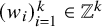 $(w_i)_{i=1}^k\in \mathbb {Z}^k$
such that
$(w_i)_{i=1}^k\in \mathbb {Z}^k$
such that
 $$\begin{align*}\frac{w_1}{d_1}<\cdots<\frac{w_k}{d_k}.\end{align*}$$
Each semiorthogonal summand is given by the restriction of the categorical Hall product (5.2), and the order of the semiorthogonal decomposition is the same as that of (3.11).
Proof. We first explain that the semiorthogonal decomposition (5.3) holds formally locally over the good moduli space $M^\sigma _S(v)$
. For each
$M^\sigma _S(v)$
. For each $y \in M_S^{\sigma }(v)$
, recall the equivalence
$y \in M_S^{\sigma }(v)$
, recall the equivalence
 $$ \begin{align} \widehat{\mathfrak{M}}_S^{\sigma}(v)_y \simeq \widehat{\mathscr{P}}(d)_p\end{align} $$
from Lemma 4.3. For an $\mathbb {R}$
-line bundle
$\mathbb {R}$
-line bundle $\delta $
on
$\delta $
on $\mathfrak {M}_S^{\sigma }(v)$
as in (4.7), its restriction
$\mathfrak {M}_S^{\sigma }(v)$
as in (4.7), its restriction $\delta _y$
to
$\delta _y$
to $\widehat {\mathfrak {M}}_S^{\sigma }(v)_y$
corresponds to
$\widehat {\mathfrak {M}}_S^{\sigma }(v)_y$
corresponds to $w\tau _d$
under the above equivalence by the computation (4.9). Therefore, the category
$w\tau _d$
under the above equivalence by the computation (4.9). Therefore, the category $\mathbb {T}_{S, y}^{\sigma }(v)_{\delta _y}$
from Remark 4.5 is equivalent to the category
$\mathbb {T}_{S, y}^{\sigma }(v)_{\delta _y}$
from Remark 4.5 is equivalent to the category $\mathbb {T}_p(d)_w$
from (3.16) under the equivalence (5.4), as both of them are intrinsic window subcategories of equivalent derived stacks. Therefore the statement holds formally locally at any point
$\mathbb {T}_p(d)_w$
from (3.16) under the equivalence (5.4), as both of them are intrinsic window subcategories of equivalent derived stacks. Therefore the statement holds formally locally at any point $y \in M_S^{\sigma }(v)$
by Proposition 3.7. We set
$y \in M_S^{\sigma }(v)$
by Proposition 3.7. We set
 $$ \begin{align} A=(d_i, w_i')_{i=1}^k, \ w_i':=w_i+(g-1)d_i\left(\sum_{i>j}d_j-\sum_{i<j}d_j\right). \end{align} $$
Every functor
 $$ \begin{align} \Upsilon_{A} \colon \boxtimes_{i=1}^k \mathbb{T}_{S}^{\sigma}(d_i v_0)_{w_i'} \to D^b(\mathfrak{M}_S^{\sigma}(v)) \end{align} $$
is globally defined via categorical Hall product, hence a standard argument reduces the existence of the desired SOD to the formal local statement as in [Reference PădurariuPăd23, Section 4.2], also see [Reference Pădurariu and TodaPTa, Reference TodaTod24a, Reference TodaTod, Reference TodaTod24b] for the similar arguments on reduction to formal fibers.
We give more details on the proof. We prove the semiorthogonal decomposition (5.3) by induction on d. The case of $d=1$
is obvious, so we assume that
$d=1$
is obvious, so we assume that $d{\geqslant } 2$
. We first show that, for
$d{\geqslant } 2$
. We first show that, for $w_1/d_1<\cdots <w_k/d_k$
, the functor (5.6) is fully faithful. By the induction hypothesis, the inclusion
$w_1/d_1<\cdots <w_k/d_k$
, the functor (5.6) is fully faithful. By the induction hypothesis, the inclusion
 $$ \begin{align*} \boxtimes_{i=1}^k \mathbb{T}_S^{\sigma}(d_i v_0)_{w_i'} \hookrightarrow \boxtimes_{i=1}^k D^b(\mathfrak{M}_S^{\sigma}(d_i v_0))_{w_i'} \end{align*} $$
admits a right adjoint. The categorical Hall product restricted to the fixed $(\mathbb {C}^{\ast })^k$
-weights
$(\mathbb {C}^{\ast })^k$
-weights $(w_i)_{i=1}^k$
:
$(w_i)_{i=1}^k$
:
 $$ \begin{align*} \boxtimes_{i=1}^k D^b(\mathfrak{M}_S^{\sigma}(d_i v_0))_{w_i'} \to D^b(\mathfrak{M}_S^{\sigma}(v)) \end{align*} $$
also admits a right adjoint, see the proof of [Reference TodaTod, Lemma 6.7] or [Reference PădurariuPăd23, Theorem 1.1]. Therefore the functor (5.6) admits a right adjoint $\Upsilon _A^R$
. To show that (5.6) is fully faithful, it is enough to show that the natural transform
$\Upsilon _A^R$
. To show that (5.6) is fully faithful, it is enough to show that the natural transform
 $$ \begin{align} \operatorname{id} \to \Upsilon_A^R \circ \Upsilon_A \end{align} $$
is an isomorphism. This is a local question for $M_S^{\sigma }(v)$
, that is, it is enough to show that (5.7) is an isomorphism after restricting to
$M_S^{\sigma }(v)$
, that is, it is enough to show that (5.7) is an isomorphism after restricting to $\widehat {\mathfrak {M}}_S^{\sigma }(v)_y$
for any
$\widehat {\mathfrak {M}}_S^{\sigma }(v)_y$
for any $y\in M_S^{\sigma }(v)$
. Since
$y\in M_S^{\sigma }(v)$
. Since $\Upsilon _A$
and
$\Upsilon _A$
and $\Upsilon _A^R$
are compatible with pull-backs to
$\Upsilon _A^R$
are compatible with pull-backs to $\widehat {\mathfrak {M}}_S^{\sigma }(v)_y$
, the isomorphism (5.7) on
$\widehat {\mathfrak {M}}_S^{\sigma }(v)_y$
, the isomorphism (5.7) on $\widehat {\mathfrak {M}}_S^{\sigma }(v)_y$
follows from Lemma 4.3 and Proposition 3.7.
$\widehat {\mathfrak {M}}_S^{\sigma }(v)_y$
follows from Lemma 4.3 and Proposition 3.7.
We next show that there is a semiorthogonal decomposition of the form
 $$ \begin{align} D^b(\mathfrak{M}_S^{\sigma}(v))_w=\langle \{\mathrm{Im}\Upsilon_A\}_{A \in \Gamma}, \mathbb{W} \rangle, \end{align} $$
where $\Gamma $
is the set of partitions
$\Gamma $
is the set of partitions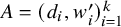 $A=(d_i, w^{\prime }_i)_{i=1}^k$
of
$A=(d_i, w^{\prime }_i)_{i=1}^k$
of $(d, w)$
as in (5.5) such that
$(d, w)$
as in (5.5) such that $k{\geqslant } 2$
and
$k{\geqslant } 2$
and $w_1/d_1<\cdots <w_k/d_k$
. For
$w_1/d_1<\cdots <w_k/d_k$
. For $A>B$
, we have
$A>B$
, we have $\operatorname {Hom}(\mathrm {Im}\Upsilon _A, \mathrm {Im}\Upsilon _B)=0$
. Indeed it is enough to show that
$\operatorname {Hom}(\mathrm {Im}\Upsilon _A, \mathrm {Im}\Upsilon _B)=0$
. Indeed it is enough to show that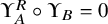 $\Upsilon _A^R \circ \Upsilon _B=0$
, which is a property local on
$\Upsilon _A^R \circ \Upsilon _B=0$
, which is a property local on $M_S^{\sigma }(v)$
. Hence similarly to showing (5.7) is an isomorphism, the desired vanishing follows from Proposition 3.7. We next show that the functor (5.6) admits a left adjoint
$M_S^{\sigma }(v)$
. Hence similarly to showing (5.7) is an isomorphism, the desired vanishing follows from Proposition 3.7. We next show that the functor (5.6) admits a left adjoint $\Upsilon _A^L$
. Let
$\Upsilon _A^L$
. Let $\mathbb {D}_{\mathfrak {M}}$
be the dualizing functor
$\mathbb {D}_{\mathfrak {M}}$
be the dualizing functor
 $$ \begin{align*} \mathbb{D}_{\mathfrak{M}} \colon D^b(\mathfrak{M}_S^{\sigma}(v)) \stackrel{\sim}{\to} D^b(\mathfrak{M}_S^{\sigma}(v))^{\mathrm{{op}}}. \end{align*} $$
The above functor restricts to the equivalence $\mathbb {D}_{\mathbb {T}(d)} \colon \mathbb {T}_S^{\sigma }(v)_{\delta } \stackrel {\sim }{\to } \mathbb {T}_S^{\sigma }(v)_{-\delta }^{\mathrm {{op}}}$
. For a partition A in (5.5), we set
$\mathbb {D}_{\mathbb {T}(d)} \colon \mathbb {T}_S^{\sigma }(v)_{\delta } \stackrel {\sim }{\to } \mathbb {T}_S^{\sigma }(v)_{-\delta }^{\mathrm {{op}}}$
. For a partition A in (5.5), we set $A^{\vee }=(d_i, -w_i')_{i=1}^k$
. Then the functor
$A^{\vee }=(d_i, -w_i')_{i=1}^k$
. Then the functor
 $$ \begin{align*} \Upsilon_A^L:= \left(\boxtimes_{i=1}^k \mathbb{D}_{\mathbb{T}(d_i)}\right) \circ (\Upsilon_{A^{\vee}}^R)^{\mathrm{{op}}} \circ \mathbb{D}_{\mathfrak{M}} \colon D^b(\mathfrak{M}_S^{\sigma}(v)) \to \boxtimes_{i=1}^k \mathbb{T}_S^{\sigma}(d_i v_0)_{w_i'} \end{align*} $$
gives a left adjoint of $\Upsilon _A$
. Therefore we obtain the semiorthogonal decomposition of the form (5.8).
$\Upsilon _A$
. Therefore we obtain the semiorthogonal decomposition of the form (5.8).
It is enough to show that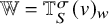 $\mathbb {W}=\mathbb {T}_S^{\sigma }(v)_w$
in the semiorthogonal decomposition (5.8). The inclusion
$\mathbb {W}=\mathbb {T}_S^{\sigma }(v)_w$
in the semiorthogonal decomposition (5.8). The inclusion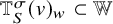 $\mathbb {T}_S^{\sigma }(v)_w \subset \mathbb {W}$
follows from a formal local argument as above. It thus suffices to show that
$\mathbb {T}_S^{\sigma }(v)_w \subset \mathbb {W}$
follows from a formal local argument as above. It thus suffices to show that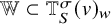 $\mathbb {W} \subset \mathbb {T}_S^{\sigma }(v)_w$
. The subcategory
$\mathbb {W} \subset \mathbb {T}_S^{\sigma }(v)_w$
. The subcategory $\mathbb {W}$
consists of
$\mathbb {W}$
consists of $\mathcal {E} \in D^b(\mathfrak {M}_S^{\sigma }(v))_w$
such that
$\mathcal {E} \in D^b(\mathfrak {M}_S^{\sigma }(v))_w$
such that $\Upsilon _A^L(\mathcal {E})=0$
for all
$\Upsilon _A^L(\mathcal {E})=0$
for all $A \in \Gamma $
. This is a local property on
$A \in \Gamma $
. This is a local property on $M_S^{\sigma }(v)$
. The functor
$M_S^{\sigma }(v)$
. The functor $\Upsilon _A^L$
is compatible with pull-back to
$\Upsilon _A^L$
is compatible with pull-back to $\widehat {\mathfrak {M}}_S^{\sigma }(v)_y$
. Thus, for any
$\widehat {\mathfrak {M}}_S^{\sigma }(v)_y$
. Thus, for any $\mathcal {E} \in \mathbb {W}$
, we have
$\mathcal {E} \in \mathbb {W}$
, we have $\mathcal {E}|_{\widehat {\mathfrak {M}}^{\sigma }_S(v)_y} \in \mathbb {T}_{S, y}^{\sigma }(v)_{\delta _y}$
by Lemma 4.3 and Proposition 3.7. Therefore, from Remark 4.5, we conclude that
$\mathcal {E}|_{\widehat {\mathfrak {M}}^{\sigma }_S(v)_y} \in \mathbb {T}_{S, y}^{\sigma }(v)_{\delta _y}$
by Lemma 4.3 and Proposition 3.7. Therefore, from Remark 4.5, we conclude that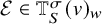 $\mathcal {E} \in \mathbb {T}_S^{\sigma }(v)_w$
.
$\mathcal {E} \in \mathbb {T}_S^{\sigma }(v)_w$
.
The reduced version of the semiorthogonal decomposition is as follows:
Theorem 5.2. Assume $v=dv_0$
for
$v=dv_0$
for $d\in \mathbb {Z}_{{\geqslant } 1}$
and for a primitive Mukai vector
$d\in \mathbb {Z}_{{\geqslant } 1}$
and for a primitive Mukai vector $v_0$
. For a generic stability condition
$v_0$
. For a generic stability condition $\sigma $
, there is a semiorthogonal decomposition
$\sigma $
, there is a semiorthogonal decomposition
 $$ \begin{align*} &D^b(\mathfrak{M}_S^{\sigma}(v)^{\mathrm{{red}}}) =\\ &\left\langle \boxtimes_{i=1}^{k-1} \mathbb{T}_{S}^{\sigma}(d_i v_0)_{w_i+(g-1)d_i(\sum_{i>j}d_j-\sum_{i<j}d_j)} \boxtimes \mathbb{T}_S^{\sigma}(d_k v_0)_{w_k+(g-1)d_k(\sum_{k>j}d_j)}^{\mathrm{{red}}} \right\rangle. \end{align*} $$
The right-hand side is after $d_1+\cdots +d_k=d$
such that
$d_1+\cdots +d_k=d$
such that $w_1/d_1<\cdots <w_k/d_k$
.
$w_1/d_1<\cdots <w_k/d_k$
.
Proof. Let $v_0=(r, \beta , \chi )$
. We have the commutative diagram
$v_0=(r, \beta , \chi )$
. We have the commutative diagram

where the middle horizontal arrow is $(L_1, \ldots , L_k) \mapsto L_1 \otimes \cdots \otimes L_k$
. By base change, the categorical Hall product induces the functor
$(L_1, \ldots , L_k) \mapsto L_1 \otimes \cdots \otimes L_k$
. By base change, the categorical Hall product induces the functor
 $$ \begin{align*} \boxtimes_{i=1}^{k-1}D^b(\mathfrak{M}_S^{\sigma}(d_i v_0)) \boxtimes D^b(\mathfrak{M}_S^{\sigma}(d_k v_0)^{\mathrm{{red}}}) \to D^b(\mathfrak{M}_S^{\sigma}(dv_0)^{\mathrm{{red}}}). \end{align*} $$
The rest of the argument is the same as in Theorem 5.1.
5.2 Generation from ambient spaces
The rest of this section is devoted to the proof of Proposition 3.7. In this subsection, we prove technical preliminary results about generation of dg-categories from ambient spaces and the restriction of semiorthogonal decompositions to formal fibers.
Let $\mathcal {U}$
be a reduced
$\mathcal {U}$
be a reduced $\mathbb {C}$
-scheme of finite type with an action of a reductive algebraic group G. Let
$\mathbb {C}$
-scheme of finite type with an action of a reductive algebraic group G. Let $\mathcal {U}/G \to T$
be a morphism to an affine scheme T of finite type. For a closed point
$\mathcal {U}/G \to T$
be a morphism to an affine scheme T of finite type. For a closed point $y \in T$
, we denote by
$y \in T$
, we denote by $\widehat {\mathcal {U}}_y/G$
the formal fiber at y. We denote by
$\widehat {\mathcal {U}}_y/G$
the formal fiber at y. We denote by $\iota _y$
the induced map
$\iota _y$
the induced map $\iota _y \colon \widehat {\mathcal {U}}_y/G \to \mathcal {U}/G$
. Recall the definition of classical generation from Subsection 2.2.1.
$\iota _y \colon \widehat {\mathcal {U}}_y/G \to \mathcal {U}/G$
. Recall the definition of classical generation from Subsection 2.2.1.
Lemma 5.3. The image of the pull-back functor
 $$ \begin{align} \iota_y^{\ast} \colon D^b(\mathcal{U}/G) \to D^b(\widehat{\mathcal{U}}_y/G) \end{align} $$
classically generates $D^b(\widehat {\mathcal {U}}_y/G)$
.
$D^b(\widehat {\mathcal {U}}_y/G)$
.
Proof. It is enough to show that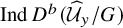 $\operatorname {Ind} D^b(\widehat {\mathcal {U}}_y/G)$
is generated by the image of
$\operatorname {Ind} D^b(\widehat {\mathcal {U}}_y/G)$
is generated by the image of
 $$ \begin{align} \iota_y^{\ast} \colon \operatorname{Ind} D^b(\mathcal{U}/G) \to \operatorname{Ind} D^b(\widehat{\mathcal{U}}_y/G). \end{align} $$
Indeed, suppose that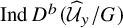 $\operatorname {Ind} D^b(\widehat {\mathcal {U}}_y/G)$
is generated by the image of (5.10). Let
$\operatorname {Ind} D^b(\widehat {\mathcal {U}}_y/G)$
is generated by the image of (5.10). Let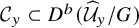 $\mathcal {C}_y \subset D^b(\widehat {\mathcal {U}}_y/G)$
be the subcategory classically generated by the image of (5.9). Then we have
$\mathcal {C}_y \subset D^b(\widehat {\mathcal {U}}_y/G)$
be the subcategory classically generated by the image of (5.9). Then we have $\operatorname {Ind} \mathcal {C}_y \stackrel {\sim }{\to } \operatorname {Ind} D^b(\widehat {\mathcal {U}}_y/G)$
, hence
$\operatorname {Ind} \mathcal {C}_y \stackrel {\sim }{\to } \operatorname {Ind} D^b(\widehat {\mathcal {U}}_y/G)$
, hence $\mathcal {C}_y=D^b(\widehat {\mathcal {U}}_y/G)$
as both of them are the subcategories of compact objects in
$\mathcal {C}_y=D^b(\widehat {\mathcal {U}}_y/G)$
as both of them are the subcategories of compact objects in $\operatorname {Ind} \mathcal {C}_y$
and
$\operatorname {Ind} \mathcal {C}_y$
and $\operatorname {Ind} D^b(\widehat {\mathcal {U}}_y/G)$
, respectively.
$\operatorname {Ind} D^b(\widehat {\mathcal {U}}_y/G)$
, respectively.
Let $\mathscr {Z} \subset \mathcal {U}$
be a G-invariant closed subset, and define
$\mathscr {Z} \subset \mathcal {U}$
be a G-invariant closed subset, and define $\mathcal {U}^{\circ }=\mathcal {U} \setminus \mathscr {Z}$
. Let
$\mathcal {U}^{\circ }=\mathcal {U} \setminus \mathscr {Z}$
. Let $i \colon \mathscr {Z} \hookrightarrow \mathcal {U}$
be the closed immersion and
$i \colon \mathscr {Z} \hookrightarrow \mathcal {U}$
be the closed immersion and $j \colon \mathcal {U}^{\circ } \hookrightarrow \mathcal {U}$
be the open immersion. For any
$j \colon \mathcal {U}^{\circ } \hookrightarrow \mathcal {U}$
be the open immersion. For any $\mathcal {E} \in \operatorname {Ind} D^b(\mathcal {U}/G)$
, we have the distinguished triangle
$\mathcal {E} \in \operatorname {Ind} D^b(\mathcal {U}/G)$
, we have the distinguished triangle
 $$ \begin{align*} R\Gamma_{\mathscr{Z}}(\mathcal{E}) \to \mathcal{E} \to j_{\ast}j^{\ast}\mathcal{E}\to R\Gamma_{\mathscr{Z}}(\mathcal{E})[1], \end{align*} $$
where $R\Gamma _{\mathscr {Z}}(\mathcal {E})$
is an object in
$R\Gamma _{\mathscr {Z}}(\mathcal {E})$
is an object in
 $$ \begin{align*} \operatorname{Ind} D^b_{\mathscr{Z}}(\mathcal{U}/G)= \mathrm{Ker}\left(j^{\ast} \colon \operatorname{Ind} D^b(\mathcal{U}/G) \to \operatorname{Ind} D^b(\mathcal{U}^{\circ}/G) \right) \end{align*} $$
and $j_{\ast }j^{\ast }\mathcal {E}$
is an object in
$j_{\ast }j^{\ast }\mathcal {E}$
is an object in $j_{\ast }\operatorname {Ind} D^b(\mathcal {U}^{\circ }/G)$
. Note that by [Reference Gaitsgory and RozenblyumGR17, Proposition 6.1.3], the category
$j_{\ast }\operatorname {Ind} D^b(\mathcal {U}^{\circ }/G)$
. Note that by [Reference Gaitsgory and RozenblyumGR17, Proposition 6.1.3], the category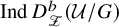 $\operatorname {Ind} D_{\mathscr {Z}}^b(\mathcal {U}/G)$
is generated by the image of
$\operatorname {Ind} D_{\mathscr {Z}}^b(\mathcal {U}/G)$
is generated by the image of
 $$ \begin{align*} i_{\ast} \colon \operatorname{Ind} D^b(\mathscr{Z}/G) \to \operatorname{Ind} D^b_{\mathscr{Z}}(\mathcal{U}/G). \end{align*} $$
We have the Cartesian diagrams

There are base change isomorphisms, see [Reference Drinfeld and GaitsgoryDG13, Corollary 3.7.14]:
 $$ \begin{align*} \iota_y^{\ast}j_{\ast} \cong \widehat{j}_{\ast}\iota_y^{\circ \ast}&\colon \operatorname{Ind} D^b(\mathcal{U}^{\circ}/G) \to \operatorname{Ind} D^b(\widehat{\mathcal{U}}_y/G), \\ \iota_y^{\ast}i_{\ast} \cong \widehat{i}_{\ast}\overline{\iota}_y^{\ast}&\colon \operatorname{Ind} D^b(\mathscr{Z}/G) \to \operatorname{Ind} D^b(\widehat{\mathcal{U}}_y/G), \end{align*} $$
we can replace $\mathcal {U}$
with
$\mathcal {U}$
with $\mathcal {U}^{\circ } \sqcup \mathscr {Z}$
. Then, by taking a stratification of
$\mathcal {U}^{\circ } \sqcup \mathscr {Z}$
. Then, by taking a stratification of $\mathcal {U}$
and repeating the above argument, we can assume that
$\mathcal {U}$
and repeating the above argument, we can assume that $\mathcal {U}$
is smooth. Then
$\mathcal {U}$
is smooth. Then
 $$ \begin{align*} \operatorname{Ind} D^b(\mathcal{U}/G)=D_{\mathrm{{qc}}}(\mathcal{U}/G)=\operatorname{Ind} \mathrm{Perf}(\mathcal{U}/G) \end{align*} $$
and it is a standard fact that the image of $\mathrm {Perf}(\mathcal {U}/G) \to \mathrm {Perf}(\widehat {\mathcal {U}}_y/G)$
classically generates
$\mathrm {Perf}(\mathcal {U}/G) \to \mathrm {Perf}(\widehat {\mathcal {U}}_y/G)$
classically generates $\mathrm {Perf}(\widehat {\mathcal {U}}_y/G)$
(see the argument of [Reference KuznetsovKuz11, Lemma 5.2]).
$\mathrm {Perf}(\widehat {\mathcal {U}}_y/G)$
(see the argument of [Reference KuznetsovKuz11, Lemma 5.2]).
Let Y be a smooth affine variety with an action of a reductive algebraic group G. Let $V \to Y$
be a G-equivariant vector bundle with a G-invariant section s. We set
$V \to Y$
be a G-equivariant vector bundle with a G-invariant section s. We set $\mathfrak {U}$
to be the derived zero locus of s, and
$\mathfrak {U}$
to be the derived zero locus of s, and $\mathcal {U} \hookrightarrow \mathfrak {U}$
its classical truncation. We have the following diagram
$\mathcal {U} \hookrightarrow \mathfrak {U}$
its classical truncation. We have the following diagram

For $y \in \mathcal {U}/\!\!/ G$
, we denote by
$y \in \mathcal {U}/\!\!/ G$
, we denote by $\widehat {Y}_y$
the formal fiber of
$\widehat {Y}_y$
the formal fiber of $Y \to Y/\!\!/ G$
at y, and by
$Y \to Y/\!\!/ G$
at y, and by $\widehat {\mathfrak {U}}_y \hookrightarrow \widehat {Y}_y$
the derived zero locus of s restricted to
$\widehat {\mathfrak {U}}_y \hookrightarrow \widehat {Y}_y$
the derived zero locus of s restricted to $\widehat {Y}_y$
. Let
$\widehat {Y}_y$
. Let $\iota _y \colon \widehat {\mathfrak {U}}_y/G \to \mathfrak {U}/G$
be the induced map.
$\iota _y \colon \widehat {\mathfrak {U}}_y/G \to \mathfrak {U}/G$
be the induced map.
Lemma 5.4. The image of the pull-back functor
 $$ \begin{align*} \iota_y^{\ast} \colon D^b(\mathfrak{U}/G) \to D^b(\widehat{\mathfrak{U}}_y/G) \end{align*} $$
classically generates $D^b(\widehat {\mathfrak {U}}_y/G)$
.
$D^b(\widehat {\mathfrak {U}}_y/G)$
.
Proof. Since $D^b(\widehat {\mathfrak {U}}_y/G)$
is classically generated by the image of
$D^b(\widehat {\mathfrak {U}}_y/G)$
is classically generated by the image of
 $$ \begin{align*} D^b(\widehat{\mathcal{U}}_y/G) \to D^b(\widehat{\mathfrak{U}}_y/G) \end{align*} $$
the claim follows from Lemma 5.3.
Lemma 5.5. Let $D^b(\mathfrak {U}/G)=\langle \mathbb {T}_i \mid i \in I \rangle $
be a
$D^b(\mathfrak {U}/G)=\langle \mathbb {T}_i \mid i \in I \rangle $
be a $Y/\!\!/ G$
-linear semiorthogonal decomposition. Let
$Y/\!\!/ G$
-linear semiorthogonal decomposition. Let $\widehat {\mathbb {T}}_{i, y} \subset D^b(\widehat {\mathfrak {U}}_y/G)$
be the subcategory classically generated by the image of
$\widehat {\mathbb {T}}_{i, y} \subset D^b(\widehat {\mathfrak {U}}_y/G)$
be the subcategory classically generated by the image of $\iota _y^{\ast } \colon \mathbb {T}_i \to D^b(\widehat {\mathfrak {U}}_y/G)$
. Then there is a semiorthogonal decomposition
$\iota _y^{\ast } \colon \mathbb {T}_i \to D^b(\widehat {\mathfrak {U}}_y/G)$
. Then there is a semiorthogonal decomposition
 $$ \begin{align}D^b(\widehat{\mathfrak{U}}_y/G)=\langle \widehat{\mathbb{T}}_{i, y} \mid i \in I\rangle.\end{align} $$
Proof. The subcategories $\widehat {\mathbb {T}}_{i, y}$
classically generate
$\widehat {\mathbb {T}}_{i, y}$
classically generate $D^b(\widehat {\mathfrak {U}}_y/G)$
by Lemma 5.4. It is enough to show the semiorthogonality of the right-hand side in (5.11). Indeed in this case, any object in
$D^b(\widehat {\mathfrak {U}}_y/G)$
by Lemma 5.4. It is enough to show the semiorthogonality of the right-hand side in (5.11). Indeed in this case, any object in $D^b(\widehat {\mathfrak {U}}_y/G)$
can be generated by objects in
$D^b(\widehat {\mathfrak {U}}_y/G)$
can be generated by objects in $\widehat {\mathbb {T}}_{i, y}$
for
$\widehat {\mathbb {T}}_{i, y}$
for $i\in I$
with the same order as the semiorthogonal decomposition
$i\in I$
with the same order as the semiorthogonal decomposition $D^b(\mathfrak {U}/G)=\langle \mathbb {T}_i \mid i \in I \rangle $
, and the projection functors
$D^b(\mathfrak {U}/G)=\langle \mathbb {T}_i \mid i \in I \rangle $
, and the projection functors $D^b(\widehat {\mathfrak {U}}_y/G)\to \widehat {\mathbb {T}}_{i, y}$
are induced by those for
$D^b(\widehat {\mathfrak {U}}_y/G)\to \widehat {\mathbb {T}}_{i, y}$
are induced by those for $D^b(\mathfrak {U}/G)\to \mathbb {T}_i$
.
$D^b(\mathfrak {U}/G)\to \mathbb {T}_i$
.
As for the semiorthogonality, take $i, j \in I$
such that
$i, j \in I$
such that $\operatorname {Hom}(\mathbb {T}_i, \mathbb {T}_j)=0$
. Then for
$\operatorname {Hom}(\mathbb {T}_i, \mathbb {T}_j)=0$
. Then for $A \in \mathbb {T}_i$
and
$A \in \mathbb {T}_i$
and $B \in \mathbb {T}_j$
, we have
$B \in \mathbb {T}_j$
, we have
 $$ \begin{align} \operatorname{Hom}(\iota_y^{\ast}A, \iota_y^{\ast}B) =\operatorname{Hom}(A, B \otimes \iota_{y\ast}\mathcal{O}_{\widehat{\mathfrak{U}}_y/G}) =\operatorname{Hom}(A, B \otimes f^{\ast}\widehat{\mathcal{O}}_{Y/\!\!/ G, y}). \end{align} $$
The sheaf $\widehat {\mathcal {O}}_{Y/\!\!/ G, y}$
is an object of
$\widehat {\mathcal {O}}_{Y/\!\!/ G, y}$
is an object of $D_{\mathrm {{qc}}}(Y/\!\!/ G)=\operatorname {Ind}\mathrm {Perf}(Y/\!\!/ G)$
, hence
$D_{\mathrm {{qc}}}(Y/\!\!/ G)=\operatorname {Ind}\mathrm {Perf}(Y/\!\!/ G)$
, hence $f^{\ast }\widehat {\mathcal {O}}_{Y/\!\!/ G, y} \in D_{\mathrm {{qc}}}(\mathfrak {U}/G)$
, and
$f^{\ast }\widehat {\mathcal {O}}_{Y/\!\!/ G, y} \in D_{\mathrm {{qc}}}(\mathfrak {U}/G)$
, and $\otimes $
is the action of
$\otimes $
is the action of $D_{\mathrm {{qc}}}(\mathfrak {U}/G)$
on
$D_{\mathrm {{qc}}}(\mathfrak {U}/G)$
on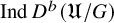 $\operatorname {Ind} D^b(\mathfrak {U}/G)$
, which recall is continuous (i.e., it preserves small coproducts). Then
$\operatorname {Ind} D^b(\mathfrak {U}/G)$
, which recall is continuous (i.e., it preserves small coproducts). Then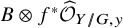 $B \otimes f^{\ast }\widehat {\mathcal {O}}_{Y/\!\!/ G, y}$
is an object of
$B \otimes f^{\ast }\widehat {\mathcal {O}}_{Y/\!\!/ G, y}$
is an object of $\operatorname {Ind} \mathbb {T}_{j}$
, and by writing it as
$\operatorname {Ind} \mathbb {T}_{j}$
, and by writing it as $\mathrm {colim}_{k \in K} B_k$
for
$\mathrm {colim}_{k \in K} B_k$
for $B_k \in \mathbb {T}_j$
, we have
$B_k \in \mathbb {T}_j$
, we have
 $$ \begin{align*} \operatorname{Hom}(A, \mathrm{colim}_{k\in K}B_k)= \mathrm{colim}_{k\in K}\operatorname{Hom}(A, B_k)=0, \end{align*} $$
where the first identity follows as A is compact, and the second vanishing holds from $\operatorname {Hom}(\mathbb {T}_{i}, \mathbb {T}_j)=0$
.
$\operatorname {Hom}(\mathbb {T}_{i}, \mathbb {T}_j)=0$
.
5.3 Descriptions of quasi-BPS categories for doubled quivers
In this subsection, we give an alternative description of quasi-BPS categories for doubled quivers, which will be used in the proof of Proposition 3.7. Below we keep the notation in Subsection 3.5.
Let $Q^{\circ }$
be a g-loop quiver. For
$Q^{\circ }$
be a g-loop quiver. For $d \in \mathbb {N}$
, let
$d \in \mathbb {N}$
, let $\mathscr {X}(d)$
be the moduli stack of d-dimensional representations of the tripled quiver of
$\mathscr {X}(d)$
be the moduli stack of d-dimensional representations of the tripled quiver of $Q^{\circ }$
:
$Q^{\circ }$
:
 $$\begin{align*}\mathscr{X}(d)=\mathfrak{gl}(d)^{\oplus 2g+1}/GL(d).\end{align*}$$
Consider the regular function induced by the tripled potential:
 $$ \begin{align} \mathrm{Tr} W(x_1, \ldots, x_g, y_1, \ldots, y_g, z) = \mathrm{Tr} \sum_{i=1}^g z[x_i, y_i] \colon \mathscr{X}(d) \to \mathbb{C}. \end{align} $$
Let $\mathbb {C}^{\ast }$
act on z with weight two. We define the subcategory
$\mathbb {C}^{\ast }$
act on z with weight two. We define the subcategory
 $$ \begin{align} \mathbb{S}^{\mathrm{{gr}}}(d)_w \subset \mathrm{MF}^{\mathrm{{gr}}}(\mathscr{X}(d), \mathrm{Tr} W) \end{align} $$
to be classically generated by matrix factorizations whose factors are direct sums of $\mathcal {O}_{\mathscr {X}(d)} \otimes \Gamma _{GL(d)}(\chi )$
such that
$\mathcal {O}_{\mathscr {X}(d)} \otimes \Gamma _{GL(d)}(\chi )$
such that
 $$ \begin{align*} \chi+\rho \in \mathbf{W}(d)_w=\frac{1}{2} \mathrm{sum}[0, \beta]+w\tau_d=\left(\frac{2g+1}{2}\mathrm{sum}_{1{\leqslant} i,j{\leqslant} d}[0, \beta_i-\beta_j]\right)+w\tau_d \end{align*} $$
where the Minkowski sums above are after all the $T(d)$
-weights of
$T(d)$
-weights of $R_{Q}(d)=\mathfrak {gl}(d)^{\oplus 2g+1}$
. Alternatively, by [Reference Halpern-Leistner and SamHLS20, Lemma 2.9], the subcategory (5.14) consists of matrix factorizations with factors
$R_{Q}(d)=\mathfrak {gl}(d)^{\oplus 2g+1}$
. Alternatively, by [Reference Halpern-Leistner and SamHLS20, Lemma 2.9], the subcategory (5.14) consists of matrix factorizations with factors $\mathcal {O}_{\mathscr {X}(d)} \otimes \Gamma $
for a
$\mathcal {O}_{\mathscr {X}(d)} \otimes \Gamma $
for a $GL(d)$
-representation
$GL(d)$
-representation $\Gamma $
whose
$\Gamma $
whose $T(d)$
-weights are contained in
$T(d)$
-weights are contained in
 $$ \begin{align*} \nabla(d)_w =\left\{\chi \in M(d)_{\mathbb{R}} : -\frac{1}{2}n_{\lambda} {\leqslant} \langle \lambda, \chi \rangle {\leqslant} \frac{1}{2}n_{\lambda} \mbox{ for all } \lambda \colon \mathbb{C}^{\ast} \to T(d)\right\}+w\tau_d. \end{align*} $$
Here, the width $n_{\lambda }$
is defined by
$n_{\lambda }$
is defined by
 $$ \begin{align*} n_{\lambda}:=\left\langle \lambda, \det \left((R_Q(d)^{\vee})^{\lambda>0}\right)-\det \left((\mathfrak{gl}(d)^{\vee})^{\lambda>0}\right) \right\rangle=2g \left\langle \lambda, \det \left(\mathfrak{gl}(d)^{\lambda>0}\right)\right\rangle. \end{align*} $$
The equivalence (3.5) restricts to the equivalence, see Lemma 2.2:
 $$ \begin{align} \Theta \colon \mathbb{T}(d)_w \stackrel{\sim}{\to} \mathbb{S}^{\mathrm{{gr}}}(d)_w. \end{align} $$
We next give another description of the subcategory (3.16) based on Lemma 3.2. As in Subsections 3.4, 3.5, let $\mathscr {P}(d)$
be the derived moduli stack of d-dimensional representations of the quiver
$\mathscr {P}(d)$
be the derived moduli stack of d-dimensional representations of the quiver $Q^{\circ ,d}$
with relation
$Q^{\circ ,d}$
with relation $\mathscr {I}$
. There is a good moduli space map
$\mathscr {I}$
. There is a good moduli space map
 $$\begin{align*}\pi_{P,d}\colon \mathscr{P}(d)^{\mathrm{{cl}}} \to P(d).\end{align*}$$
Let $p \in P(d)$
be a closed point corresponding to the semisimple
$p \in P(d)$
be a closed point corresponding to the semisimple $(Q^{\circ ,d}, \mathscr {I})$
-representation
$(Q^{\circ ,d}, \mathscr {I})$
-representation $R_p$
as in (3.14):
$R_p$
as in (3.14):
 $$ \begin{align} R_p=\bigoplus_{i=1}^m W^{(i)} \otimes R^{(i)}, \end{align} $$
where $R^{(i)}$
is a simple representation of dimension
$R^{(i)}$
is a simple representation of dimension $r^{(i)}$
and
$r^{(i)}$
and $W^{(i)}$
is a finite-dimensional
$W^{(i)}$
is a finite-dimensional $\mathbb {C}$
-vector space. Recall that
$\mathbb {C}$
-vector space. Recall that $G_p=\prod _{i=1}^m GL(W^{(i)})$
and let
$G_p=\prod _{i=1}^m GL(W^{(i)})$
and let $T_p \subset G_p$
be a maximal torus. Note that we have an isomorphism of
$T_p \subset G_p$
be a maximal torus. Note that we have an isomorphism of $G_p$
-representations:
$G_p$
-representations:
 $$ \begin{align} \operatorname{Ext}_{Q^{\circ, d}}^1(R_p, R_p) \oplus \mathfrak{gl}(d)^{\vee} =\bigoplus_{i, j}\operatorname{Hom}(W^{(i)}, W^{(j)})^{\oplus (\delta_{ij}+2g r^{(i)} r^{(j)})}. \end{align} $$
Let $M_p$
be the character lattice of
$M_p$
be the character lattice of $T_p$
and let
$T_p$
and let $\tau _{d, p} \in (M_p)_{\mathbb {R}}$
be the restriction of
$\tau _{d, p} \in (M_p)_{\mathbb {R}}$
be the restriction of $\tau _d$
to
$\tau _d$
to $G_p \subset GL(d)$
. For
$G_p \subset GL(d)$
. For $w \in \mathbb {Z}$
, we set
$w \in \mathbb {Z}$
, we set
 $$ \begin{align} \mathbf{W}_p(d)_{w}=\frac{1}{2}\mathrm{sum}[0, \beta] +w \tau_{d, p} \subset (M_p)_{\mathbb{R}}, \end{align} $$
where the Minkowski sum is after all $T_p$
-weights
$T_p$
-weights $\beta $
in the representation (5.17). Let
$\beta $
in the representation (5.17). Let $\beta _i^{(j)}$
for
$\beta _i^{(j)}$
for $1{\leqslant } i {\leqslant } \dim W^{(j)}$
be the weights of the standard representation of
$1{\leqslant } i {\leqslant } \dim W^{(j)}$
be the weights of the standard representation of $GL(W^{(j)})$
. Then a weight
$GL(W^{(j)})$
. Then a weight $\chi $
in
$\chi $
in $\textbf {W}_p(d)_w$
is written as
$\textbf {W}_p(d)_w$
is written as
 $$ \begin{align} \chi=\sum_{i, j, a, b}c_{ij}^{(ab)}(\beta_i^{(a)}-\beta_j^{(b)}) +\frac{w}{d}\sum_{i, a}r^{(a)}\beta_i^{(a)}, \end{align} $$
where the sum above is after all $1{\leqslant } a, b{\leqslant } m$
,
$1{\leqslant } a, b{\leqslant } m$
, $1{\leqslant } i{\leqslant } \dim W^{(a)}$
,
$1{\leqslant } i{\leqslant } \dim W^{(a)}$
, $1{\leqslant } j{\leqslant } \dim W^{(b)}$
, and where
$1{\leqslant } j{\leqslant } \dim W^{(b)}$
, and where $\lvert c_{ij}^{(ab)} \rvert {\leqslant } \delta _{ab}/2+gr^{(a)}r^{(b)}$
for all such
$\lvert c_{ij}^{(ab)} \rvert {\leqslant } \delta _{ab}/2+gr^{(a)}r^{(b)}$
for all such $a,b,i,j$
.
$a,b,i,j$
.
Lemma 5.6. Recall the map $j_p \colon \widehat {\mathscr {P}}(d)_p \hookrightarrow \widehat {\mathscr {Y}}(d)_p$
from (3.15). The subcategory introduced in (3.16):
$j_p \colon \widehat {\mathscr {P}}(d)_p \hookrightarrow \widehat {\mathscr {Y}}(d)_p$
from (3.15). The subcategory introduced in (3.16):
 $$ \begin{align} \mathbb{T}_p(d)_{w} \subset D^b(\widehat{\mathscr{P}}(d)_p) \end{align} $$
coincides with the subcategory of objects $\mathcal {E}$
such that
$\mathcal {E}$
such that $j_{p\ast }\mathcal {E}$
is generated by the vector bundles
$j_{p\ast }\mathcal {E}$
is generated by the vector bundles $\Gamma _{G_p}(\chi ) \otimes \mathcal {O}_{\widehat {\mathscr {Y}}(d)_p}$
, where
$\Gamma _{G_p}(\chi ) \otimes \mathcal {O}_{\widehat {\mathscr {Y}}(d)_p}$
, where $\chi $
is a dominant
$\chi $
is a dominant $T_p$
-weight satisfying
$T_p$
-weight satisfying
 $$ \begin{align*}\chi+\rho_p \in \mathbf{W}_p(d)_{w}, \end{align*} $$
where $\rho _p$
is half the sum of positive roots of
$\rho _p$
is half the sum of positive roots of $G_p$
.
$G_p$
.
Proof. The lemma follows similarly to Lemma 3.2, using the Koszul equivalence and [Reference PădurariuPTc, Corollary 3.14].
Remark 5.7. Alternatively, by Lemma 5.6 and [Reference Halpern-Leistner and SamHLS20, Lemma 2.9], the subcategory (5.20) consists of objects $\mathcal {E}$
such that
$\mathcal {E}$
such that $j_{p\ast }\mathcal {E}$
is generated by vector bundles
$j_{p\ast }\mathcal {E}$
is generated by vector bundles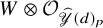 $W \otimes \mathcal {O}_{\widehat {\mathscr {Y}}(d)_p}$
for W a
$W \otimes \mathcal {O}_{\widehat {\mathscr {Y}}(d)_p}$
for W a $G_p$
-representation whose
$G_p$
-representation whose $T_p$
-weights are contained in the set
$T_p$
-weights are contained in the set
 $$ \begin{align} \left\{\chi \in (M_{p})_{\mathbb{R}} : -\frac{1}{2}n_{\lambda, p} {\leqslant} \langle \lambda, \chi \rangle {\leqslant} \frac{1}{2} n_{\lambda, p}\text{ for all }\lambda \colon \mathbb{C}^{\ast} \to T_p \right\}+w\tau_{d, p}. \end{align} $$
Here, the width $n_{\lambda , p}$
is defined by
$n_{\lambda , p}$
is defined by
 $$ \begin{align*} n_{\lambda, p}=\Big\langle \lambda, \det\left(\operatorname{Ext}_{Q^{\circ, d}}^1(R_p, R_p)^{\vee}\oplus \mathfrak{gl}(d)\right)^{\lambda>0}\Big\rangle-\Big\langle \lambda, \det\left((\mathfrak{g}_p^{\vee})^{\lambda>0}\right) \Big\rangle, \end{align*} $$
where $\mathfrak {g}_p$
is the Lie algebra of
$\mathfrak {g}_p$
is the Lie algebra of $G_p$
. From (5.17), one can easily check that
$G_p$
. From (5.17), one can easily check that
 $$ \begin{align} n_{\lambda, p}=2g \Big\langle \lambda, \det\left(\mathfrak{gl}(d)^{\lambda>0}\right) \Big\rangle =n_{\lambda} \end{align} $$
for any cocharacter $\lambda \colon \mathbb {C}^{\ast } \to T_p \subset T(d)$
.
$\lambda \colon \mathbb {C}^{\ast } \to T_p \subset T(d)$
.
5.4 Proof of Proposition 3.7
In this subsection, we prove Proposition 3.7 and Corollary 3.8, and thus finish the proof of Theorem 5.1.
Proof of Proposition 3.7 and Corollary 3.8
Let $\iota _p \colon \widehat {\mathscr {P}}(d)_p \to \mathscr {P}(d)$
be the natural induced map and define
$\iota _p \colon \widehat {\mathscr {P}}(d)_p \to \mathscr {P}(d)$
be the natural induced map and define $\widehat {\mathbb {T}}_p(d)_w$
to be the subcategory of
$\widehat {\mathbb {T}}_p(d)_w$
to be the subcategory of $D^b(\widehat {\mathscr {P}}(d)_p)$
classically generated by the image of
$D^b(\widehat {\mathscr {P}}(d)_p)$
classically generated by the image of
 $$ \begin{align*} \iota_p^{\ast} \colon \mathbb{T}(d)_w \to D^b(\widehat{\mathscr{P}}(d)_p). \end{align*} $$
By Theorem 3.4 and Lemma 5.5, we have the semiorthogonal decomposition
 $$ \begin{align} D^b(\widehat{\mathscr{P}}(d)_p) =\left\langle \bigoplus_{p_1+\cdots+p_k=p} \boxtimes_{i=1}^k \widehat{\mathbb{T}}_{p_i}(d_i)_{w_i+(g-1)d_i(\sum_{i>j}d_j-\sum_{i<j}d_j)} \right\rangle. \end{align} $$
Therefore it is enough to show that
 $$ \begin{align} \widehat{\mathbb{T}}_p(d)_w=\mathbb{T}_p(d)_w, \end{align} $$
which is the claim of Corollary 3.8.
Let $\widehat {\mathscr {X}}(d)_p$
be the formal fiber at p of the composition
$\widehat {\mathscr {X}}(d)_p$
be the formal fiber at p of the composition
 $$ \begin{align*}\mathscr{X}(d) \to \mathscr{Y}(d) \to Y(d)=\mathfrak{gl}(d)^{\oplus 2g}/\!\!/ GL(d), \end{align*} $$
where the first morphism is the natural projection. It is given by
 $$ \begin{align*} \widehat{\mathscr{X}}(d)_p=(\widehat{\operatorname{Ext}}^1_{Q^{\circ, d}}(R_p, R_p)\times \mathfrak{gl}(d)^{\vee})/G_p. \end{align*} $$
We have the Koszul duality equivalence, see Theorem 2.1
 $$ \begin{align} \Theta_p \colon D^b(\widehat{\mathscr{P}}(d)_p) \stackrel{\sim}{\to} \mathrm{MF}^{\mathrm{{gr}}}(\widehat{\mathscr{X}}(d)_p, \mathrm{Tr} W). \end{align} $$
We next define categories Koszul equivalent to the two categories in (5.24):
 $$ \begin{align*} \widehat{\mathbb{S}}^{\mathrm{{gr}}}_p(d)_w \subset \mathrm{MF}^{\mathrm{{gr}}}(\widehat{\mathscr{X}}(d)_p, \mathrm{Tr} W), \ \mathbb{S}^{\mathrm{{gr}}}_p(d)_w \subset \mathrm{MF}^{\mathrm{{gr}}}(\widehat{\mathscr{X}}(d)_p, \mathrm{Tr} W). \end{align*} $$
We define the subcategory $\widehat {\mathbb {S}}^{\mathrm {{gr}}}_p(d)_w$
to be classically generated by the image of
$\widehat {\mathbb {S}}^{\mathrm {{gr}}}_p(d)_w$
to be classically generated by the image of
 $$ \begin{align*} \mathbb{S}^{\mathrm{{gr}}}(d)_w \subset \mathrm{MF}^{\mathrm{{gr}}}(\mathscr{X}(d), \mathrm{Tr} W) \to \mathrm{MF}^{\mathrm{{gr}}}(\widehat{\mathscr{X}}(d)_p, \mathrm{Tr} W). \end{align*} $$
We define the subcategory $\mathbb {S}^{\mathrm {{gr}}}_p(d)_w$
to be consisting of matrix factorizations whose factors are of the form
$\mathbb {S}^{\mathrm {{gr}}}_p(d)_w$
to be consisting of matrix factorizations whose factors are of the form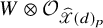 $W \otimes \mathcal {O}_{\widehat {\mathscr {X}}(d)_p}$
, where W is a
$W \otimes \mathcal {O}_{\widehat {\mathscr {X}}(d)_p}$
, where W is a $G_p$
-representation whose
$G_p$
-representation whose $T_p$
-weights are contained in (5.21). By the equivalence (5.15) and using Lemma 2.2 and Remark 5.7, the equivalence
$T_p$
-weights are contained in (5.21). By the equivalence (5.15) and using Lemma 2.2 and Remark 5.7, the equivalence $\Theta _p$
restricts to equivalences
$\Theta _p$
restricts to equivalences
 $$ \begin{align*} \Theta_p \colon \widehat{\mathbb{T}}_p(d)_w \stackrel{\sim}{\to} \widehat{\mathbb{S}}^{\mathrm{{gr}}}_p(d)_w, \ \mathbb{T}_p(d)_w \stackrel{\sim}{\to} \mathbb{S}^{\mathrm{{gr}}}_p(d)_w. \end{align*} $$
It is enough to show that $\widehat {\mathbb {S}}^{\mathrm {{gr}}}_p(d)_w=\mathbb {S}^{\mathrm {{gr}}}_p(d)_w$
. By Remark 5.7, it is obvious that
$\widehat {\mathbb {S}}^{\mathrm {{gr}}}_p(d)_w=\mathbb {S}^{\mathrm {{gr}}}_p(d)_w$
. By Remark 5.7, it is obvious that $\widehat {\mathbb {T}}_p(d)_w \subset \mathbb {T}_p(d)_w$
, hence
$\widehat {\mathbb {T}}_p(d)_w \subset \mathbb {T}_p(d)_w$
, hence $\widehat {\mathbb {S}}^{\mathrm {{gr}}}_p(d)_w \subset \mathbb {S}^{\mathrm {{gr}}}_p(d)_w$
.
$\widehat {\mathbb {S}}^{\mathrm {{gr}}}_p(d)_w \subset \mathbb {S}^{\mathrm {{gr}}}_p(d)_w$
.
By the semiorthogonal decomposition (5.23) together with the equivalence (5.25), we have the semiorthogonal decomposition
 $$ \begin{align} \mathrm{MF}^{\mathrm{{gr}}}(\widehat{\mathscr{X}}(d)_p, \mathrm{Tr} W) =\left\langle \bigoplus_{p_1+\cdots+p_k=p} \boxtimes_{i=1}^k \widehat{\mathbb{S}}^{\mathrm{{gr}}}_{p_i}(d_i)_{w_i+g d_i(\sum_{i>j}d_j-\sum_{i<j}d_j)} \right\rangle \end{align} $$
for $w_1/d_1<\cdots <w_k/d_k$
, and each summand is given by the categorical Hall product, see [Reference PădurariuPăd23, Proposition 3.1] or [Reference TodaTod24a, Lemma 2.4.4, 2.4.7] for the compatibility of the categorical Hall products under Koszul duality. In Lemma 5.8 below, we show that the semiorthogonal summands in (5.26) except
$w_1/d_1<\cdots <w_k/d_k$
, and each summand is given by the categorical Hall product, see [Reference PădurariuPăd23, Proposition 3.1] or [Reference TodaTod24a, Lemma 2.4.4, 2.4.7] for the compatibility of the categorical Hall products under Koszul duality. In Lemma 5.8 below, we show that the semiorthogonal summands in (5.26) except $\widehat {\mathbb {S}}^{\mathrm {{gr}}}_p(d)_w$
are right orthogonal to
$\widehat {\mathbb {S}}^{\mathrm {{gr}}}_p(d)_w$
are right orthogonal to $\mathbb {S}^{\mathrm {{gr}}}_p(d)_w$
. Then by (5.26) we have
$\mathbb {S}^{\mathrm {{gr}}}_p(d)_w$
. Then by (5.26) we have $\mathbb {S}^{\mathrm {{gr}}}_p(d)_w \subset \widehat {\mathbb {S}}^{\mathrm {{gr}}}_p(d)_w$
, hence that
$\mathbb {S}^{\mathrm {{gr}}}_p(d)_w \subset \widehat {\mathbb {S}}^{\mathrm {{gr}}}_p(d)_w$
, hence that $\widehat {\mathbb {S}}^{\mathrm {{gr}}}_p(d)_w=\mathbb {S}^{\mathrm {{gr}}}_p(d)_w$
.
$\widehat {\mathbb {S}}^{\mathrm {{gr}}}_p(d)_w=\mathbb {S}^{\mathrm {{gr}}}_p(d)_w$
.
Lemma 5.8. The semiorthogonal summands in (5.26) with $k{\geqslant } 2$
are right orthogonal to
$k{\geqslant } 2$
are right orthogonal to $\mathbb {S}^{\mathrm {{gr}}}_p(d)_w$
.
$\mathbb {S}^{\mathrm {{gr}}}_p(d)_w$
.
Proof. The proof is analogous to that of [Reference Pădurariu and TodaPT23, Lemma 3.6]. The inclusion $T_p \subset T(d)$
induces a surjection
$T_p \subset T(d)$
induces a surjection $M(d) \twoheadrightarrow M_p$
. We will regard
$M(d) \twoheadrightarrow M_p$
. We will regard $T(d)$
-weights as
$T(d)$
-weights as $T_p$
-weights by the above surjection. Let
$T_p$
-weights by the above surjection. Let $\widehat {\textbf {W}}_p(d)_w$
be the image of
$\widehat {\textbf {W}}_p(d)_w$
be the image of $\textbf {W}(d)_w \subset M(d)_{\mathbb {R}} \twoheadrightarrow (M_{p})_{\mathbb {R}}$
. Recall the decomposition (5.16) and the weights
$\textbf {W}(d)_w \subset M(d)_{\mathbb {R}} \twoheadrightarrow (M_{p})_{\mathbb {R}}$
. Recall the decomposition (5.16) and the weights $\beta ^{(a)}_i$
for
$\beta ^{(a)}_i$
for $1{\leqslant } a{\leqslant } m$
and
$1{\leqslant } a{\leqslant } m$
and $1{\leqslant } i{\leqslant }\dim W^{(a)}$
. Then a weight
$1{\leqslant } i{\leqslant }\dim W^{(a)}$
. Then a weight $\chi $
in
$\chi $
in $\widehat {\textbf {W}}_p(d)_w$
is written as
$\widehat {\textbf {W}}_p(d)_w$
is written as
 $$ \begin{align} \chi=\sum_{i, j, a, b}\alpha_{ij}^{(ab)}(\beta_i^{(a)}-\beta_j^{(b)}) +\frac{w}{d}\sum_{i, a}r^{(a)}\beta_i^{(a)}, \end{align} $$
where the sum above is after all $1{\leqslant } a, b{\leqslant } m$
,
$1{\leqslant } a, b{\leqslant } m$
, $1{\leqslant } i{\leqslant } \dim W^{(a)}$
,
$1{\leqslant } i{\leqslant } \dim W^{(a)}$
, $1{\leqslant } j{\leqslant } \dim W^{(b)}$
, and we have that
$1{\leqslant } j{\leqslant } \dim W^{(b)}$
, and we have that $\lvert \alpha _{ij}^{(ab)} \rvert {\leqslant } r^{(a)}r^{(b)}(g+1/2)$
. We also note that a choice of
$\lvert \alpha _{ij}^{(ab)} \rvert {\leqslant } r^{(a)}r^{(b)}(g+1/2)$
. We also note that a choice of $(p_1, \ldots , p_k)$
corresponds to decompositions for all
$(p_1, \ldots , p_k)$
corresponds to decompositions for all $1{\leqslant } j{\leqslant } m$
:
$1{\leqslant } j{\leqslant } m$
:
 $$ \begin{align*} W^{(j)}=W_1^{(j)} \oplus \cdots \oplus W_k^{(j)} \end{align*} $$
such that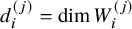 $d_i^{(j)}=\dim W_i^{(j)}$
satisfies
$d_i^{(j)}=\dim W_i^{(j)}$
satisfies $d_i=d_i^{(1)}+\cdots +d_i^{(m)}$
.
$d_i=d_i^{(1)}+\cdots +d_i^{(m)}$
.
Let $\lambda $
be the antidominant cocharacter of
$\lambda $
be the antidominant cocharacter of $T_p$
which acts on the space
$T_p$
which acts on the space $W_i^{(j)}$
by weight
$W_i^{(j)}$
by weight $(k+1-i)$
for
$(k+1-i)$
for $1{\leqslant } j{\leqslant } m$
and
$1{\leqslant } j{\leqslant } m$
and $1{\leqslant } i{\leqslant } k$
, and write it as
$1{\leqslant } i{\leqslant } k$
, and write it as $\lambda =(\lambda ^{(j)})_{1{\leqslant } j{\leqslant } m}$
, where
$\lambda =(\lambda ^{(j)})_{1{\leqslant } j{\leqslant } m}$
, where $\lambda ^{(j)}$
is a cocharacter of the maximal torus of
$\lambda ^{(j)}$
is a cocharacter of the maximal torus of $GL(W^{(j)})$
. We set
$GL(W^{(j)})$
. We set $\mathfrak {g}^{(j)}=\mathrm {End}(W^{(j)})$
. Consider the diagram of attracting loci
$\mathfrak {g}^{(j)}=\mathrm {End}(W^{(j)})$
. Consider the diagram of attracting loci
 $$ \begin{align*} \widehat{\mathscr{X}}(d)_p^{\lambda}=\times_{i=1}^k \widehat{\mathscr{X}}(d_i)_{p_i} \stackrel{q}{\leftarrow} \widehat{\mathscr{X}}(d)_p^{\lambda {\geqslant} 0} \stackrel{p}{\to} \widehat{\mathscr{X}}(d)_p. \end{align*} $$
Let $A=\Gamma _{GL(d)}(\chi ) \otimes \mathcal {O}_{\widehat {\mathscr {X}}(d)_p}$
and
$A=\Gamma _{GL(d)}(\chi ) \otimes \mathcal {O}_{\widehat {\mathscr {X}}(d)_p}$
and $B=\Gamma _{GL(d)^{\lambda }}(\chi ') \otimes \mathcal {O}_{\mathscr {X}(d)_p^{\lambda }}$
such that
$B=\Gamma _{GL(d)^{\lambda }}(\chi ') \otimes \mathcal {O}_{\mathscr {X}(d)_p^{\lambda }}$
such that
 $$ \begin{align} \chi+\rho_p \in \textbf{W}_p(d)_w, \ \chi'+\sum_{i=1}^k \rho_{p_i} \in \bigoplus_{i=1}^k \widehat{\textbf{W}}_{p_i}(d_i)_{w_i'}\subset \bigoplus_{i=1}^k M(d_i)_{\mathbb{R}}=M(d)_{\mathbb{R}}, \end{align} $$
where $w=w_1+\cdots +w_k$
,
$w=w_1+\cdots +w_k$
, $w_1/d_1<\cdots <w_k/d_k$
and
$w_1/d_1<\cdots <w_k/d_k$
and $w_i'=w_i+gd_i(\sum _{i>j}d_j-\sum _{j>i}d_j)$
. We write
$w_i'=w_i+gd_i(\sum _{i>j}d_j-\sum _{j>i}d_j)$
. We write
 $$ \begin{align} \chi'=\sum_{i=1}^k (\psi_i+w^{\prime}_i\tau_{d_i}),\, \psi_i\in \widehat{\textbf{W}}_{p_i}(d_i)_0. \end{align} $$
By the adjunction, we have
 $$ \begin{align} \operatorname{Hom}(A, p_{\ast}q^{\ast}B)=\operatorname{Hom}(p^{\ast}A, q^{\ast}B). \end{align} $$
Let $\chi "$
be a weight of
$\chi "$
be a weight of $\Gamma _{GL(d)}(\chi )$
. Below we show that
$\Gamma _{GL(d)}(\chi )$
. Below we show that
 $$ \begin{align} \langle \lambda, \chi" \rangle> \langle \lambda, \chi'\rangle. \end{align} $$
Then (5.30) vanishes by [Reference PădurariuPăda, Proposition 4.2] and thus the lemma holds. Let $\mu $
be the weight:
$\mu $
be the weight:
 $$ \begin{align} \mu=-\frac{1}{2} \mathfrak{gl}(d)^{\lambda>0}+\frac{1}{2}\sum_{a=1}^m(\mathfrak{g}^{(a)})^{\lambda^{(a)}>0}= \sum_{i, j, a<b}\gamma_{ij}^{(ab)}(\beta_i^{(a)}-\beta_j^{(b)}) \end{align} $$
where $1{\leqslant } a<b{\leqslant } m$
,
$1{\leqslant } a<b{\leqslant } m$
, $1{\leqslant } i{\leqslant } \dim W^{(a)}$
,
$1{\leqslant } i{\leqslant } \dim W^{(a)}$
, $1{\leqslant } j{\leqslant } \dim W^{(b)}$
, and such that
$1{\leqslant } j{\leqslant } \dim W^{(b)}$
, and such that $\lvert \gamma _{ij}^{(ab)}\rvert =r^{(a)}r^{(b)}/2$
. To show (5.31), it is enough to show that
$\lvert \gamma _{ij}^{(ab)}\rvert =r^{(a)}r^{(b)}/2$
. To show (5.31), it is enough to show that
 $$ \begin{align} \langle \lambda, \chi"+\rho_p+\mu-w\tau_d\rangle>\langle \lambda, \chi'+\rho_p+\mu-w\tau_d \rangle. \end{align} $$
By (5.29), we write
 $$ \begin{align*} \chi'+\rho_p+\mu-w\tau_d =\sum_{i=1}^k \psi_i+\sum_{i=1}^k w_i \tau_{d_i} -\frac{2g+1}{2} \mathfrak{gl}(d)^{\lambda>0}-w\tau_d, \end{align*} $$
where $\psi _i \in \widehat {\textbf {W}}_{p_i}(d_i)_{0}$
for
$\psi _i \in \widehat {\textbf {W}}_{p_i}(d_i)_{0}$
for $1{\leqslant } i{\leqslant } k$
. In what follows, we write
$1{\leqslant } i{\leqslant } k$
. In what follows, we write $\mathfrak {gl}(d)^{\lambda>0}$
instead of
$\mathfrak {gl}(d)^{\lambda>0}$
instead of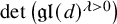 $\det \left (\mathfrak {gl}(d)^{\lambda>0}\right )$
to simplify notation. We compute
$\det \left (\mathfrak {gl}(d)^{\lambda>0}\right )$
to simplify notation. We compute
 $$ \begin{align*} \left\langle \lambda, \chi'+\rho_p+\mu-w\tau_d \right\rangle &=\left\langle \lambda, \sum_{i=1}^k \psi_i+\sum_{i=1}^k w_i \tau_{d_i}-\frac{2g+1}{2} \mathfrak{gl}(d)^{\lambda>0} -w \tau_d \right\rangle \\ &=\sum_{i=1}^k (k+1-i)d_i\left(\frac{w_i}{d_i}-\frac{w}{d}\right) -\left\langle \lambda, \frac{2g+1}{2}\mathfrak{gl}(d)^{\lambda>0} \right\rangle. \end{align*} $$
For $1{\leqslant } i{\leqslant } k$
, define
$1{\leqslant } i{\leqslant } k$
, define
 $$\begin{align*}\tilde{w}_i:=d_i\left(\frac{w_i}{d_i}-\frac{w}{d}\right).\end{align*}$$
Then $\tilde {w}_1+\cdots +\tilde {w}_k=0$
and
$\tilde {w}_1+\cdots +\tilde {w}_k=0$
and $\tilde {w}_1+\cdots +\tilde {w}_l<0$
for
$\tilde {w}_1+\cdots +\tilde {w}_l<0$
for $1{\leqslant } l<k$
. Therefore
$1{\leqslant } l<k$
. Therefore
 $$ \begin{align*} \sum_{i=1}^k (k+1-i)d_i\left(\frac{w_i}{d_i}-\frac{w}{d}\right) =\sum_{l=1}^k \left(\sum_{i=1}^l \tilde{w}_i \right)<0. \end{align*} $$
It follows that
 $$ \begin{align} \left\langle \lambda, \chi'+\rho_p+\mu-w\tau_d \right\rangle <-\left\langle \lambda, \frac{2g+1}{2}\mathfrak{gl}(d)^{\lambda>0} \right\rangle. \end{align} $$
On the other hand, by (5.28) and [Reference Halpern-Leistner and SamHLS20, Lemma 2.9], we have
 $$ \begin{align*} \langle \lambda, \chi" -w\tau_d \rangle {\geqslant} -\frac{1}{2}n_{\lambda, p}=-g \langle \lambda, \mathfrak{gl}(d)^{\lambda>0} \rangle. \end{align*} $$
Then
 $$ \begin{align*} \langle \lambda, \chi"+\rho_p+\mu-w\tau_d \rangle {\geqslant} -g \langle \lambda, \mathfrak{gl}(d)^{\lambda>0}\rangle+\langle \lambda, \rho_p+\mu \rangle=-\left\langle \lambda, \frac{2g+1}{2}\mathfrak{gl}(d)^{\lambda>0} \right\rangle. \end{align*} $$
Therefore we have the inequality (5.33).
6 Smooth and properness of reduced quasi-BPS categories
In this section, we show that the reduced version of quasi-BPS category is smooth and proper, which gives evidence towards Conjecture 4.13. We first prove the strong generation of quasi-BPS categories. It relies on the strong generations of singular support quotients, which itself is of independent interest and is proved in Subsection 6.3.
6.1 Strong generation of quasi-BPS categories
In this subsection, we prove the strong generation of the quasi-BPS category $\mathbb {T}_S(v)_{w}$
, see Subsection 2.1 for the terminology of strong generation. The strategy is to show that
$\mathbb {T}_S(v)_{w}$
, see Subsection 2.1 for the terminology of strong generation. The strategy is to show that $\mathbb {T}_S(v)_{w}$
is admissible in a singular support quotient category constructed from Joyce-Song pairs on the local Calabi-Yau threefold
$\mathbb {T}_S(v)_{w}$
is admissible in a singular support quotient category constructed from Joyce-Song pairs on the local Calabi-Yau threefold $X:=S\times \mathbb {C}$
, which has a strong generator by Theorem 6.11.
$X:=S\times \mathbb {C}$
, which has a strong generator by Theorem 6.11.
Let S be a smooth projective K3 surface, let H be an ample divisor on S, and set $\mathcal {O}(n)=\mathcal {O}_S(nH)$
. For
$\mathcal {O}(n)=\mathcal {O}_S(nH)$
. For $v \in N(S)$
, let
$v \in N(S)$
, let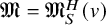 $\mathfrak {M}=\mathfrak {M}_S^H(v)$
be the derived moduli stack of H-Gieseker semistable sheaves F on S with numerical class v. We take H generic with respect to v. Let
$\mathfrak {M}=\mathfrak {M}_S^H(v)$
be the derived moduli stack of H-Gieseker semistable sheaves F on S with numerical class v. We take H generic with respect to v. Let $n \gg 0$
be such that
$n \gg 0$
be such that $H^i(F(n))=0$
for all
$H^i(F(n))=0$
for all $i>0$
and all H-Gieseker semistable sheaves F with numerical class v. Let
$i>0$
and all H-Gieseker semistable sheaves F with numerical class v. Let $\mathbb {F} \in D^b(S \times \mathfrak {M})$
be the universal sheaf, and consider the following derived stack
$\mathbb {F} \in D^b(S \times \mathfrak {M})$
be the universal sheaf, and consider the following derived stack
 $$ \begin{align*} \mathfrak{M}^{\dagger}:= \operatorname{Spec}_{\mathfrak{M}} \mathrm{Sym} (p_{\mathfrak{M}\ast}(\mathbb{F}\boxtimes \mathcal{O}(n))^{\vee}), \end{align*} $$
where $p_{\mathfrak {M}} \colon S \times \mathfrak {M} \to \mathfrak {M}$
is the projection. The stack
$p_{\mathfrak {M}} \colon S \times \mathfrak {M} \to \mathfrak {M}$
is the projection. The stack $\mathfrak {M}^{\dagger }$
is the derived moduli stack of pairs
$\mathfrak {M}^{\dagger }$
is the derived moduli stack of pairs $(F, s)$
, where F is an H-Gieseker semistable sheaf on S with numerical class v and
$(F, s)$
, where F is an H-Gieseker semistable sheaf on S with numerical class v and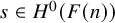 $s \in H^0(F(n))$
.
$s \in H^0(F(n))$
.
We consider its $(-1)$
-shifted cotangent space
$(-1)$
-shifted cotangent space
 $$ \begin{align*} \Omega_{\mathfrak{M}^{\dagger}}[-1]=\operatorname{Spec}_{\mathfrak{M}^{\dagger}} \mathrm{Sym}(\mathbb{T}_{\mathfrak{M}^{\dagger}}[1]). \end{align*} $$
Since the projection $\mathfrak {M}^{\dagger } \to \mathfrak {M}$
is smooth, we have the isomorphism, see [Reference TodaTod24a, Lemma 3.1.2]:
$\mathfrak {M}^{\dagger } \to \mathfrak {M}$
is smooth, we have the isomorphism, see [Reference TodaTod24a, Lemma 3.1.2]:
 $$ \begin{align*} (\Omega_{\mathfrak{M}}[-1]\times_{\mathfrak{M}} \mathfrak{M}^{\dagger})^{\mathrm{{cl}}} \stackrel{\cong}{\to} \Omega_{\mathfrak{M}^{\dagger}}[-1]^{\mathrm{{cl}}}. \end{align*} $$
Therefore, $\Omega _{\mathfrak {M}^{\dagger }}[-1]$
is the derived moduli stack of pairs
$\Omega _{\mathfrak {M}^{\dagger }}[-1]$
is the derived moduli stack of pairs $(E, s)$
, where E is a compactly supported coherent sheaf on the local K3 surface
$(E, s)$
, where E is a compactly supported coherent sheaf on the local K3 surface
 $$ \begin{align*} X:=\mathrm{Tot}(\omega_S)=S \times \mathbb{C} \stackrel{r}{\to} S \end{align*} $$
such that $r_{\ast }E$
has numerical class v, and
$r_{\ast }E$
has numerical class v, and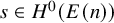 $s \in H^0(E(n))$
. Here the pull-back of
$s \in H^0(E(n))$
. Here the pull-back of $\mathcal {O}(n)$
on S to X is also denoted by
$\mathcal {O}(n)$
on S to X is also denoted by $\mathcal {O}(n)$
. We recall the definition of Joyce-Song (JS) stable pairs on X:
$\mathcal {O}(n)$
. We recall the definition of Joyce-Song (JS) stable pairs on X:
Definition 6.1. [Reference Joyce and SongJS12, Definition 5.20]
A pair $(E, s)$
on
$(E, s)$
on $X=S \times \mathbb {C}$
is JS-stable if E is a compactly supported H-Gieseker semistable sheaf on X and
$X=S \times \mathbb {C}$
is JS-stable if E is a compactly supported H-Gieseker semistable sheaf on X and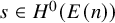 $s \in H^0(E(n))$
is a section such that there is no nontrivial exact sequence of framed sheaves
$s \in H^0(E(n))$
is a section such that there is no nontrivial exact sequence of framed sheaves
 $$ \begin{align} 0 \to (\mathcal{O}_X \to E'(n)) \to (\mathcal{O}_X \stackrel{s}{\to} E(n)) \to (0 \to E"(n)) \to 0, \end{align} $$
where $E'$
,
$E'$
, $E"$
are H-Gieseker semistable sheaves with the same reduced Hilbert polynomials.
$E"$
are H-Gieseker semistable sheaves with the same reduced Hilbert polynomials.
We denote by
 $$ \begin{align*} \Omega_{\mathfrak{M}^{\dagger}}^{\mathrm{{JS}}}[-1] \subset \Omega_{\mathfrak{M}^{\dagger}}[-1] \end{align*} $$
the open substack consisting of JS-stable pairs, and we denote by $\mathscr {Z}^{\mathrm {{JS}}}$
its complement. It is well known that
$\mathscr {Z}^{\mathrm {{JS}}}$
its complement. It is well known that $\Omega _{\mathfrak {M}^{\dagger }}^{\mathrm {{JS}}}[-1]^{\mathrm {{cl}}}$
is a quasi-projective scheme, which easily follows from [Reference Joyce and SongJS12, Theorem 5.22] by taking a compactification of X. We set
$\Omega _{\mathfrak {M}^{\dagger }}^{\mathrm {{JS}}}[-1]^{\mathrm {{cl}}}$
is a quasi-projective scheme, which easily follows from [Reference Joyce and SongJS12, Theorem 5.22] by taking a compactification of X. We set
 $$ \begin{align*} \ell :=\det p_{\mathfrak{M}\ast}(\mathbb{F}\boxtimes \mathcal{O}(n)) \in \mathrm{Pic}(\mathfrak{M}). \end{align*} $$
Its pull-back to $\Omega _{\mathfrak {M}^{\dagger }}[-1]$
is also denoted by
$\Omega _{\mathfrak {M}^{\dagger }}[-1]$
is also denoted by $\ell $
. We denote by
$\ell $
. We denote by $\Omega ^{\ell \text {-ss}}_{\mathfrak {M}^{\dagger }}[-1]$
the stack of
$\Omega ^{\ell \text {-ss}}_{\mathfrak {M}^{\dagger }}[-1]$
the stack of $\ell $
-semistable points in
$\ell $
-semistable points in $\Omega _{\mathfrak {M}^{\dagger }}[-1]^{\mathrm {cl}}$
.
$\Omega _{\mathfrak {M}^{\dagger }}[-1]^{\mathrm {cl}}$
.
Lemma 6.2. We have $\Omega ^{\mathrm {{JS}}}_{\mathfrak {M}^{\dagger }}[-1]= \Omega ^{\ell \mathrm {-ss}}_{\mathfrak {M}^{\dagger }}[-1]$
.
$\Omega ^{\mathrm {{JS}}}_{\mathfrak {M}^{\dagger }}[-1]= \Omega ^{\ell \mathrm {-ss}}_{\mathfrak {M}^{\dagger }}[-1]$
.
Proof. Let $\mathfrak {M}^{\mathrm {{cl}}} \to M$
be a good moduli space. It is enough to prove the identity on each fiber at a closed point
$\mathfrak {M}^{\mathrm {{cl}}} \to M$
be a good moduli space. It is enough to prove the identity on each fiber at a closed point $y \in M$
for the composition of the projections
$y \in M$
for the composition of the projections
 $$ \begin{align} \gamma \colon \Omega_{\mathfrak{M}^{\dagger}}[-1]^{\mathrm{{cl}}} \to \mathfrak{M}^{\dagger, \mathrm{cl}} \to \mathfrak{M}^{\mathrm{{cl}}} \to M. \end{align} $$
A point y corresponds to a polystable sheaf $\bigoplus _{i=1}^m V^{(i)} \otimes F^{(i)}$
. Let
$\bigoplus _{i=1}^m V^{(i)} \otimes F^{(i)}$
. Let $(Q^{\circ , d}_y, \mathscr {I}_y)$
be the Ext-quiver of
$(Q^{\circ , d}_y, \mathscr {I}_y)$
be the Ext-quiver of $(F^{(1)}, \ldots , F^{(m)})$
with relation
$(F^{(1)}, \ldots , F^{(m)})$
with relation $\mathscr {I}_y$
. The quiver
$\mathscr {I}_y$
. The quiver $Q^{\circ , d}_y$
is the double of some quiver
$Q^{\circ , d}_y$
is the double of some quiver $Q_y^{\circ }$
, see Remark 4.2. Let
$Q_y^{\circ }$
, see Remark 4.2. Let $(Q_y, W)$
be the tripled quiver with potential of
$(Q_y, W)$
be the tripled quiver with potential of $Q_y^{\circ }$
, see Subsection 3.1.3. Let
$Q_y^{\circ }$
, see Subsection 3.1.3. Let $c^{(i)}:=h^0(F^{(i)}(n))>0$
and let
$c^{(i)}:=h^0(F^{(i)}(n))>0$
and let $Q_y^{\dagger }$
be the quiver obtained by adding a vertex
$Q_y^{\dagger }$
be the quiver obtained by adding a vertex $\{0\}$
to
$\{0\}$
to $Q_y$
and
$Q_y$
and $c^{(i)}$
-arrows from
$c^{(i)}$
-arrows from $0$
to i for
$0$
to i for $1{\leqslant } i{\leqslant } m$
. Then a fiber of (6.2) at y corresponds to nilpotent
$1{\leqslant } i{\leqslant } m$
. Then a fiber of (6.2) at y corresponds to nilpotent $Q_y^{\dagger }$
-representations with dimension vector
$Q_y^{\dagger }$
-representations with dimension vector $(1, \boldsymbol {d})$
where
$(1, \boldsymbol {d})$
where $\boldsymbol {d}=(\dim V^{(i)})_{i=1}^m$
and
$\boldsymbol {d}=(\dim V^{(i)})_{i=1}^m$
and $1$
is the dimension at the vertex
$1$
is the dimension at the vertex $\{0\}$
:
$\{0\}$
:
 $$ \begin{align} \gamma^{-1}(y) \cong R^{\mathrm{{nil}}}_{Q_y^{\dagger}}(1, \boldsymbol{d})/G(\boldsymbol{d}). \end{align} $$
Also the line bundle $\ell $
restricted to
$\ell $
restricted to $\gamma ^{-1}(y)$
corresponds to the character
$\gamma ^{-1}(y)$
corresponds to the character
 $$ \begin{align*} \ell_y \colon G(\boldsymbol{d})=\prod_{i=1}^m GL(V^{(i)}) \to \mathbb{C}^{\ast}, \ (g_i)_{i=1}^m \mapsto \prod_{i=1}^m (\det g_i)^{c^{(i)}}. \end{align*} $$
By [Reference TodaTod24a, Lemma 5.1.9, 5.1.19], the $\ell _y$
-semistable
$\ell _y$
-semistable $Q_y^{\dagger }$
-representations are those generated by the images from the arrows
$Q_y^{\dagger }$
-representations are those generated by the images from the arrows $0 \to i$
with
$0 \to i$
with $1{\leqslant } i {\leqslant } m$
. The above
$1{\leqslant } i {\leqslant } m$
. The above $\ell _y$
-semistable locus in the right-hand side of (6.3) corresponds to pairs
$\ell _y$
-semistable locus in the right-hand side of (6.3) corresponds to pairs $(E, s)$
on X in
$(E, s)$
on X in $\gamma ^{-1}(y)$
such that
$\gamma ^{-1}(y)$
such that $r_{\ast }E$
is S-equivalent to
$r_{\ast }E$
is S-equivalent to $\bigoplus _{i=1}^m V^{(i)} \otimes F^{(i)}$
and there is no exact sequence of the form (6.1), that is, it is a JS pair. Therefore we obtain the desired identity on
$\bigoplus _{i=1}^m V^{(i)} \otimes F^{(i)}$
and there is no exact sequence of the form (6.1), that is, it is a JS pair. Therefore we obtain the desired identity on $\gamma ^{-1}(y)$
.
$\gamma ^{-1}(y)$
.
We set
 $$ \begin{align*} b:=\operatorname{ch}_2(p_{\mathfrak{M}\ast}(\mathbb{F} \boxtimes \mathcal{O}(n))) \in H^4(\mathfrak{M}, \mathbb{Q}). \end{align*} $$
Its pull-back to $\Omega _{\mathfrak {M}^{\dagger }}[-1]$
is also denoted by b. Consider the
$\Omega _{\mathfrak {M}^{\dagger }}[-1]$
is also denoted by b. Consider the $\Theta $
-stratification with respect to
$\Theta $
-stratification with respect to $(\ell , b)$
, see [Reference Halpern-LeistnerHLa, Theorem 4.1.3]:
$(\ell , b)$
, see [Reference Halpern-LeistnerHLa, Theorem 4.1.3]:
 $$ \begin{align*} \Omega_{\mathfrak{M}^{\dagger}}[-1]= \mathscr{S}_1 \sqcup \cdots \sqcup \mathscr{S}_N \sqcup \Omega^{\ell\text{-ss}}_{\mathfrak{M}^{\dagger}}[-1]. \end{align*} $$
By Theorem 2.3, for each choice of $m_\bullet =(m_i)_{i=1}^N \in \mathbb {R}^N$
, there is a subcategory
$m_\bullet =(m_i)_{i=1}^N \in \mathbb {R}^N$
, there is a subcategory $\mathbb {W}(\mathfrak {M}^{\dagger })_{m_{\bullet }}^\ell \subset D^b(\mathfrak {M}^{\dagger })$
such that the composition
$\mathbb {W}(\mathfrak {M}^{\dagger })_{m_{\bullet }}^\ell \subset D^b(\mathfrak {M}^{\dagger })$
such that the composition
 $$ \begin{align} \Phi \colon \mathbb{W}(\mathfrak{M}^{\dagger})_{m_{\bullet}}^\ell \subset D^b(\mathfrak{M}^{\dagger}) \twoheadrightarrow D^b(\mathfrak{M}^{\dagger})/\mathcal{C}_{\mathscr{Z}^{\mathrm{{JS}}}} \end{align} $$
is an equivalence. Let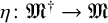 $\eta \colon \mathfrak {M}^{\dagger } \to \mathfrak {M}$
be the projection. We have the following lemma:
$\eta \colon \mathfrak {M}^{\dagger } \to \mathfrak {M}$
be the projection. We have the following lemma:
Lemma 6.3. Let $\delta \in \mathrm {Pic}(\mathfrak {M}^H_S(v))_{\mathbb {R}}$
. There exists a choice
$\delta \in \mathrm {Pic}(\mathfrak {M}^H_S(v))_{\mathbb {R}}$
. There exists a choice $m_\bullet $
such that the functor
$m_\bullet $
such that the functor $\eta ^{\ast } \colon D^b(\mathfrak {M}) \to D^b(\mathfrak {M}^{\dagger })$
restricts to a functor
$\eta ^{\ast } \colon D^b(\mathfrak {M}) \to D^b(\mathfrak {M}^{\dagger })$
restricts to a functor $\eta ^{\ast } \colon \mathbb {T}_S^H(v)_\delta \to \mathbb {W}(\mathfrak {M}^{\dagger })_{m_{\bullet }}^\ell $
.
$\eta ^{\ast } \colon \mathbb {T}_S^H(v)_\delta \to \mathbb {W}(\mathfrak {M}^{\dagger })_{m_{\bullet }}^\ell $
.
Proof. We use the notation in the proof of Lemma 6.2. For $y\in M$
, let
$y\in M$
, let $\mathscr {X}_y(\boldsymbol {d})$
be the moduli stack of
$\mathscr {X}_y(\boldsymbol {d})$
be the moduli stack of $Q_y$
-representations with dimension vector
$Q_y$
-representations with dimension vector $\boldsymbol {d}$
and let
$\boldsymbol {d}$
and let $\mathscr {X}_y^{\dagger }(\boldsymbol {d})$
be the moduli stack of
$\mathscr {X}_y^{\dagger }(\boldsymbol {d})$
be the moduli stack of $Q_y^{\dagger }$
-representations with dimension vector
$Q_y^{\dagger }$
-representations with dimension vector $(1, \boldsymbol {d})$
. Let
$(1, \boldsymbol {d})$
. Let $\widehat {\mathscr {X}}_y^{\dagger }(\boldsymbol {d})$
be the formal fiber of the composition
$\widehat {\mathscr {X}}_y^{\dagger }(\boldsymbol {d})$
be the formal fiber of the composition
 $$ \begin{align*} \mathscr{X}^{\dagger}_y(\boldsymbol{d}) \to \mathscr{X}_y(\boldsymbol{d}) \to X_y(\boldsymbol{d}) \end{align*} $$
at the origin, where the last map is the good moduli space morphism. Let
 $$ \begin{align*} \widehat{\mathscr{X}}^{\dagger}_y(\boldsymbol{d})= \widehat{\mathscr{S}}_1 \sqcup \cdots \sqcup \widehat{\mathscr{S}}_N \sqcup \widehat{\mathscr{X}}^{\dagger}_y(\boldsymbol{d})^{\ell_y\text{-ss}} \end{align*} $$
be the Kempf-Ness stratification with respect to $(\ell _y, b_y)$
. For
$(\ell _y, b_y)$
. For $1{\leqslant } i{\leqslant } N$
, consider the center
$1{\leqslant } i{\leqslant } N$
, consider the center $\widehat {\mathscr {Z}}_i$
of
$\widehat {\mathscr {Z}}_i$
of $\widehat {\mathscr {S}}_i$
and its corresponding one parameter subgroup
$\widehat {\mathscr {S}}_i$
and its corresponding one parameter subgroup $\lambda _i$
for the maximal torus of
$\lambda _i$
for the maximal torus of $G(\boldsymbol {d})$
. Let
$G(\boldsymbol {d})$
. Let $\widehat {\mathfrak {M}}_y^{\dagger }$
,
$\widehat {\mathfrak {M}}_y^{\dagger }$
, $\widehat {\mathfrak {M}}_y$
be the formal fibers along
$\widehat {\mathfrak {M}}_y$
be the formal fibers along $\mathfrak {M}^{\dagger } \to M$
,
$\mathfrak {M}^{\dagger } \to M$
, $\mathfrak {M}\to M$
at y respectively. We have the commutative diagram
$\mathfrak {M}\to M$
at y respectively. We have the commutative diagram

Here the horizontal arrows are Koszul duality equivalences in Theorem 2.1, and the vertical arrows are pull-backs along the natural projections.
By [Reference TodaTod, Proposition 6.1], there exists a choice $m_\bullet =(m_i)_{i=1}^N \in \mathbb {R}^N$
such that an object
$m_\bullet =(m_i)_{i=1}^N \in \mathbb {R}^N$
such that an object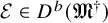 $\mathcal {E} \in D^b(\mathfrak {M}^{\dagger })$
lies in
$\mathcal {E} \in D^b(\mathfrak {M}^{\dagger })$
lies in $\mathbb {W}(\mathfrak {M}^{\dagger })_{m_{\bullet }}^\ell $
if and only if, for any y as above, we have
$\mathbb {W}(\mathfrak {M}^{\dagger })_{m_{\bullet }}^\ell $
if and only if, for any y as above, we have
 $$ \begin{align*} \mathrm{wt}_{\lambda_i} \Theta_y^{\dagger}(\mathcal{E}|_{\widehat{\mathfrak{M}}_y^{\dagger}})|_{\widehat{\mathscr{Z}}_i} \subset \left[ -\frac{1}{2}n_i^{\dagger}, \frac{1}{2}n_i^{\dagger}\right)+\langle \lambda_i, \delta_y\rangle. \end{align*} $$
Here, the width $n_i^{\dagger }$
is defined by
$n_i^{\dagger }$
is defined by
 $$ \begin{align*} n_i^{\dagger}:=\left\langle \lambda_i, \det\Big(\mathbb{L}^{\lambda_i>0}_{\mathscr{X}_y^{\dagger}(\boldsymbol{d})}\Big|_{0}\big)\right\rangle =n_i+\sum_{j=1}^m c^{(j)} \left\langle \lambda_i, \det\big((V_j^{\vee})^{\lambda_i>0}\big) \right\rangle \end{align*} $$
and $n_i:=\big \langle \lambda _i, \det \big (\mathbb {L}^{\lambda _i>0}_{\mathscr {X}_y(\boldsymbol {d})}|_{0}\big )\big \rangle $
. On the other hand, by the definition of
$n_i:=\big \langle \lambda _i, \det \big (\mathbb {L}^{\lambda _i>0}_{\mathscr {X}_y(\boldsymbol {d})}|_{0}\big )\big \rangle $
. On the other hand, by the definition of $\mathbb {T}_S^H(v)_\delta $
, for an object
$\mathbb {T}_S^H(v)_\delta $
, for an object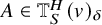 $A \in \mathbb {T}_S^H(v)_\delta $
, the
$A \in \mathbb {T}_S^H(v)_\delta $
, the $\lambda _i$
-weights of
$\lambda _i$
-weights of $\Theta _y(A|_{\widehat {\mathfrak {M}}_y})|_{\widehat {\mathscr {X}}_y(\boldsymbol {d})^{\lambda _i}}$
lie in
$\Theta _y(A|_{\widehat {\mathfrak {M}}_y})|_{\widehat {\mathscr {X}}_y(\boldsymbol {d})^{\lambda _i}}$
lie in $[-n_i/2, n_i/2]+\langle \lambda _i, \delta _y\rangle $
for all
$[-n_i/2, n_i/2]+\langle \lambda _i, \delta _y\rangle $
for all $1{\leqslant } i{\leqslant } N$
. As in [Reference TodaTod24a, Lemma 5.1.9], each
$1{\leqslant } i{\leqslant } N$
. As in [Reference TodaTod24a, Lemma 5.1.9], each $\lambda _i$
has only nonpositive weights in each
$\lambda _i$
has only nonpositive weights in each $V^{(j)}$
for
$V^{(j)}$
for $1{\leqslant } j{\leqslant } m$
, hence we have
$1{\leqslant } j{\leqslant } m$
, hence we have $n_i^{\dagger }>n_i$
. From the diagram (6.5), we have
$n_i^{\dagger }>n_i$
. From the diagram (6.5), we have
 $$\begin{align*}\Theta_y^{\dagger}((\eta^{\ast}A)|_{\widehat{\mathfrak{M}}_y^{\dagger}}) \cong \eta^{\prime\ast}\Theta_y(A|_{\mathfrak{M}_y}),\end{align*}$$
hence its restriction to $\widehat {\mathscr {Z}}_i$
has
$\widehat {\mathscr {Z}}_i$
has $\lambda _i$
-weights in
$\lambda _i$
-weights in $[-n_i^{\dagger }/2, n_i^{\dagger }/2)+\langle \lambda _i, \delta _y\rangle $
. Therefore we have
$[-n_i^{\dagger }/2, n_i^{\dagger }/2)+\langle \lambda _i, \delta _y\rangle $
. Therefore we have $\eta ^{\ast }A \in \mathbb {W}(\mathfrak {M}^{\dagger })_{m_{\bullet }}^\ell $
.
$\eta ^{\ast }A \in \mathbb {W}(\mathfrak {M}^{\dagger })_{m_{\bullet }}^\ell $
.
We prove the following theorem, using the strong generation of singular support quotients in Theorem 6.11 which will be proved in Subsection 6.3:
Theorem 6.4. The quasi-BPS category $\mathbb {T}_S(v)_w$
is regular.
$\mathbb {T}_S(v)_w$
is regular.
Proof. By Corollary 4.15, it is enough to show that $\mathbb {T}_S^H(v)_{w} \subset D^b(\mathfrak {M}_S^H(v))$
is regular. We consider the following composition
$\mathbb {T}_S^H(v)_{w} \subset D^b(\mathfrak {M}_S^H(v))$
is regular. We consider the following composition
 $$ \begin{align*} F \colon \mathbb{T}_S^H(v)_w \stackrel{i}{\hookrightarrow} D^b(\mathfrak{M})_w \stackrel{\eta^{\ast}}{\to} D^b(\mathfrak{M}^{\dagger}) \stackrel{p}{\twoheadrightarrow} D^b(\mathfrak{M}^{\dagger}) /\mathcal{C}_{\mathscr{Z}^{\mathrm{{JS}}}}. \end{align*} $$
Let $\Phi $
be the window equivalence (6.4) as in Lemma 6.3, and let
$\Phi $
be the window equivalence (6.4) as in Lemma 6.3, and let $\Phi ^{-1}$
be its inverse. Let
$\Phi ^{-1}$
be its inverse. Let $\Psi \colon D^b(\mathfrak {M})_w \twoheadrightarrow \mathbb {T}_S^H(v)_w$
be the projection with respect to the semiorthogonal decomposition in Theorem 5.1. We also define the following functor
$\Psi \colon D^b(\mathfrak {M})_w \twoheadrightarrow \mathbb {T}_S^H(v)_w$
be the projection with respect to the semiorthogonal decomposition in Theorem 5.1. We also define the following functor
 $$ \begin{align*} G \colon D^b(\mathfrak{M}^{\dagger})/\mathcal{C}_{\mathscr{Z}^{\mathrm{{JS}}}} \stackrel{\Phi^{-1}}{\to} \mathbb{W}(\mathfrak{M}^{\dagger})_{m_{\bullet}}^\ell \stackrel{j}{\hookrightarrow} D^b(\mathfrak{M}^{\dagger}) \stackrel{(\eta_{\ast})_w}{\twoheadrightarrow} D^b(\mathfrak{M})_w \stackrel{\Psi}{\twoheadrightarrow} \mathbb{T}_S^H(v)_{w}. \end{align*} $$
Here, $(\eta _{\ast })_w(-)$
is the weight w-part of
$(\eta _{\ast })_w(-)$
is the weight w-part of $\eta _{\ast }(-)$
, which is the projection onto
$\eta _{\ast }(-)$
, which is the projection onto $D^b(\mathfrak {M})_w$
with respect to the semiorthogonal decomposition
$D^b(\mathfrak {M})_w$
with respect to the semiorthogonal decomposition
 $$ \begin{align} D^b(\mathfrak{M}^{\dagger}) =\langle \ldots, D^b(\mathfrak{M})_{-1}, D^b(\mathfrak{M})_0, D^b(\mathfrak{M})_1, \ldots \rangle. \end{align} $$
Every fully faithful functor in (6.6) is given by the restriction of $\eta ^{\ast }$
to
$\eta ^{\ast }$
to $D^b(\mathfrak {M})_w$
. The above semiorthogonal decomposition exists since
$D^b(\mathfrak {M})_w$
. The above semiorthogonal decomposition exists since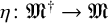 $\eta \colon \mathfrak {M}^{\dagger } \to \mathfrak {M}$
is an affine space bundle such that the cone of
$\eta \colon \mathfrak {M}^{\dagger } \to \mathfrak {M}$
is an affine space bundle such that the cone of $\mathcal {O}_{\mathfrak {M}} \to \eta _{\ast }\mathcal {O}_{\mathfrak {M}^{\dagger }}$
has strictly negative
$\mathcal {O}_{\mathfrak {M}} \to \eta _{\ast }\mathcal {O}_{\mathfrak {M}^{\dagger }}$
has strictly negative $\mathbb {C}^{\ast }$
-weights, see [Reference Halpern-LeistnerHL15, Amplification 3.18].
$\mathbb {C}^{\ast }$
-weights, see [Reference Halpern-LeistnerHL15, Amplification 3.18].
Then $G \circ F \cong \operatorname {id}$
. Indeed, we have
$G \circ F \cong \operatorname {id}$
. Indeed, we have
 $$ \begin{align*} \Psi \circ (\eta_{\ast})_w \circ \Phi^{-1} \circ p \circ\eta^{\ast} \circ i \cong \Psi \circ (\eta_{\ast})_w \circ \eta^{\ast} \circ i \cong \Psi \circ i \cong \operatorname{id}. \end{align*} $$
For the first isomorphism, the image of $\eta ^{\ast } \circ i$
lies in
$\eta ^{\ast } \circ i$
lies in $\mathbb {W}(\mathfrak {M}^{\dagger })_{m_{\bullet }}^\ell $
by Lemma 6.3 and then
$\mathbb {W}(\mathfrak {M}^{\dagger })_{m_{\bullet }}^\ell $
by Lemma 6.3 and then $\Phi ^{-1}\circ p$
is the identity on
$\Phi ^{-1}\circ p$
is the identity on $\mathbb {W}(\mathfrak {M}^{\dagger })_{m_{\bullet }}^\ell $
by the definition of
$\mathbb {W}(\mathfrak {M}^{\dagger })_{m_{\bullet }}^\ell $
by the definition of $\Phi $
. The second isomorphism follows since
$\Phi $
. The second isomorphism follows since $(\eta _{\ast })_w \circ \eta ^{\ast }\cong \operatorname {id}$
. The last isomorphism also holds by the definition of
$(\eta _{\ast })_w \circ \eta ^{\ast }\cong \operatorname {id}$
. The last isomorphism also holds by the definition of $\Psi $
. By Theorem 6.11 together with the fact that
$\Psi $
. By Theorem 6.11 together with the fact that $\Omega ^{\mathrm {{JS}}}_{\mathfrak {M}^{\dagger }}[-1]$
is a quasi-projective scheme, the category
$\Omega ^{\mathrm {{JS}}}_{\mathfrak {M}^{\dagger }}[-1]$
is a quasi-projective scheme, the category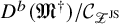 $D^b(\mathfrak {M}^{\dagger })/\mathcal {C}_{\mathscr {Z}^{\mathrm {{JS}}}}$
is regular, so it is
$D^b(\mathfrak {M}^{\dagger })/\mathcal {C}_{\mathscr {Z}^{\mathrm {{JS}}}}$
is regular, so it is $\langle \mathcal {E} \rangle ^{\star n}$
for some
$\langle \mathcal {E} \rangle ^{\star n}$
for some $\mathcal {E} \in D^b(\mathfrak {M}^{\dagger })/\mathcal {C}_{\mathscr {Z}^{\mathrm {{JS}}}}$
and
$\mathcal {E} \in D^b(\mathfrak {M}^{\dagger })/\mathcal {C}_{\mathscr {Z}^{\mathrm {{JS}}}}$
and $n{\geqslant } 1$
. Then as
$n{\geqslant } 1$
. Then as $\mathrm {Im}(F) \subset \langle \mathcal {E} \rangle ^{\star n}$
and
$\mathrm {Im}(F) \subset \langle \mathcal {E} \rangle ^{\star n}$
and $G \circ F \cong \operatorname {id}$
, we conclude that
$G \circ F \cong \operatorname {id}$
, we conclude that $\mathbb {T}_S^H(v)_{w}=\langle G(\mathcal {E}) \rangle ^{\star n}$
, hence
$\mathbb {T}_S^H(v)_{w}=\langle G(\mathcal {E}) \rangle ^{\star n}$
, hence $\mathbb {T}_S^H(v)_{w}$
is regular.
$\mathbb {T}_S^H(v)_{w}$
is regular.
By an analogous argument using window categories of the reduced stack $\mathfrak {M}^{\dagger , \mathrm {red}}$
, we obtain:
$\mathfrak {M}^{\dagger , \mathrm {red}}$
, we obtain:
Theorem 6.5. The reduced quasi-BPS category $\mathbb {T}_S(v)_w^{\mathrm {red}}$
is regular.
$\mathbb {T}_S(v)_w^{\mathrm {red}}$
is regular.
6.2 Properness of reduced quasi-BPS categories
Recall that we write $v=dv_0$
for
$v=dv_0$
for $d\in \mathbb {Z}_{{\geqslant } 1}$
and for
$d\in \mathbb {Z}_{{\geqslant } 1}$
and for $v_0$
primitive with
$v_0$
primitive with $\langle v_0, v_0 \rangle =2g-2$
. Let
$\langle v_0, v_0 \rangle =2g-2$
. Let $\mathfrak {M}^{\mathrm {{red}}}=\mathfrak {M}_S^{\sigma }(v)^{\mathrm {{red}}}$
for a generic
$\mathfrak {M}^{\mathrm {{red}}}=\mathfrak {M}_S^{\sigma }(v)^{\mathrm {{red}}}$
for a generic $\sigma \in \mathrm {Stab}(S)$
. We consider its
$\sigma \in \mathrm {Stab}(S)$
. We consider its $(-1)$
-shifted cotangent space:
$(-1)$
-shifted cotangent space:
 $$ \begin{align*} \Omega_{\mathfrak{M}^{\mathrm{{red}}}}[-1] \to \mathfrak{M}^{\mathrm{{red}}}. \end{align*} $$
Its classical truncation is identified with the moduli stack of pairs
 $$ \begin{align} (F, \theta), \ F \in \mathcal{M}_S^{\sigma}(v), \ \theta \colon F \to F \end{align} $$
such that $\mathrm {tr}(\theta )=0$
, see [Reference TodaTod24a, Lemma 3.4.1] for the nonreduced case and the proof for the reduced case is similar. Let
$\mathrm {tr}(\theta )=0$
, see [Reference TodaTod24a, Lemma 3.4.1] for the nonreduced case and the proof for the reduced case is similar. Let
 $$ \begin{align*} \mathcal{N}_{\mathrm{{nil}}} \subset \Omega_{\mathfrak{M}^{\mathrm{{red}}}}[-1] \end{align*} $$
be the closed substack consisting of pairs (6.7) such that $\theta $
is nilpotent. The following is the global version of the categorical support lemma.
$\theta $
is nilpotent. The following is the global version of the categorical support lemma.
Theorem 6.6. Let $w\in \mathbb {Z}$
be coprime with d and let
$w\in \mathbb {Z}$
be coprime with d and let $\mathcal {E} \in \mathbb {T}_S^{\sigma }(v)_w^{\mathrm {{red}}} \subset D^b(\mathfrak {M}_S^{\sigma }(v)^{\mathrm {{red}}})$
. Then
$\mathcal {E} \in \mathbb {T}_S^{\sigma }(v)_w^{\mathrm {{red}}} \subset D^b(\mathfrak {M}_S^{\sigma }(v)^{\mathrm {{red}}})$
. Then $\mathrm {Supp}^{\mathrm {{sg}}}(\mathcal {E}) \subset \mathcal {N}_{\mathrm {{nil}}}$
.
$\mathrm {Supp}^{\mathrm {{sg}}}(\mathcal {E}) \subset \mathcal {N}_{\mathrm {{nil}}}$
.
Proof. It is enough to prove the inclusion $\mathrm {Supp}^{\mathrm {{sg}}}(\mathcal {E}) \subset \mathcal {N}_{\mathrm {{nil}}}$
over any point
$\mathrm {Supp}^{\mathrm {{sg}}}(\mathcal {E}) \subset \mathcal {N}_{\mathrm {{nil}}}$
over any point $y \in M_S^{\sigma }(v)$
. For simplicity, we write
$y \in M_S^{\sigma }(v)$
. For simplicity, we write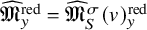 $\widehat {\mathfrak {M}}^{\mathrm {{red}}}_y=\widehat {\mathfrak {M}}_S^{\sigma }(v)_y^{\mathrm {{red}}}$
. The equivalence in Lemma 4.3 induces the isomorphism of classical truncations of
$\widehat {\mathfrak {M}}^{\mathrm {{red}}}_y=\widehat {\mathfrak {M}}_S^{\sigma }(v)_y^{\mathrm {{red}}}$
. The equivalence in Lemma 4.3 induces the isomorphism of classical truncations of $(-1)$
-shifted cotangents,
$(-1)$
-shifted cotangents,
 $$ \begin{align} \Omega_{\widehat{\mathfrak{M}}^{\mathrm{{red}}}_y}[-1]^{\mathrm{{cl}}} \stackrel{\cong}{\to} \Omega_{\widehat{\mathscr{P}}(d)_p^{\mathrm{{red}}}}[-1]^{\mathrm{{cl}}}. \end{align} $$
The right-hand side is the critical locus of the function
 $$ \begin{align*} \mathrm{Tr} W \colon \widehat{\mathfrak{gl}}(d)^{\oplus 2g}_p \times \mathfrak{gl}(d)_0 \to \mathbb{C} \end{align*} $$
where $\mathrm {Tr} W$
is the function (5.13) associated with the tripled quiver of the g-loop quiver, see Subsection 2.6.3. Then the isomorphism (6.8) restricts to the isomorphism
$\mathrm {Tr} W$
is the function (5.13) associated with the tripled quiver of the g-loop quiver, see Subsection 2.6.3. Then the isomorphism (6.8) restricts to the isomorphism
 $$ \begin{align*} \mathcal{N}_{\mathrm{{nil}}} \times_{\mathfrak{M}^{\mathrm{{red}}}} \widehat{\mathfrak{M}}^{\mathrm{{red}}}_y \stackrel{\cong}{\to} \mathrm{Crit}(\mathrm{Tr} W) \cap (\widehat{\mathfrak{gl}}(d)^{\oplus 2g}_p \times \mathfrak{gl}(d)_{\mathrm{{nil}}}). \end{align*} $$
Therefore the theorem follows from Lemma 3.9.
Recall that a pretriangulated category $\mathcal {D}$
over
$\mathcal {D}$
over $\mathbb {C}$
is called proper if for any
$\mathbb {C}$
is called proper if for any $\mathcal {E}_1, \mathcal {E}_2 \in \mathcal {D}$
, the vector space
$\mathcal {E}_1, \mathcal {E}_2 \in \mathcal {D}$
, the vector space $\bigoplus _{i\in \mathbb {Z}} \operatorname {Hom}^{\ast }(\mathcal {E}_1, \mathcal {E}_2)$
is finite dimensional. We also have the following global analogue of Proposition 3.10:
$\bigoplus _{i\in \mathbb {Z}} \operatorname {Hom}^{\ast }(\mathcal {E}_1, \mathcal {E}_2)$
is finite dimensional. We also have the following global analogue of Proposition 3.10:
Theorem 6.7. If $(d, w)\in \mathbb {N}\times \mathbb {Z}$
are coprime and
$(d, w)\in \mathbb {N}\times \mathbb {Z}$
are coprime and $g{\geqslant } 2$
, the category
$g{\geqslant } 2$
, the category $\mathbb {T}_S(v)_w^{\mathrm {{red}}}$
is proper.
$\mathbb {T}_S(v)_w^{\mathrm {{red}}}$
is proper.
Proof. We regard $\mathbb {T}_S(v)_w^{\mathrm {{red}}}$
as a subcategory of
$\mathbb {T}_S(v)_w^{\mathrm {{red}}}$
as a subcategory of $D^b(\mathfrak {M}_S^{\sigma }(v)^{\mathrm {{red}}})$
for a generic
$D^b(\mathfrak {M}_S^{\sigma }(v)^{\mathrm {{red}}})$
for a generic $\sigma \in \mathrm {Stab}(S)$
via
$\sigma \in \mathrm {Stab}(S)$
via $\mathbb {T}_S(v)_w^{\mathrm {{red}}}=\mathbb {T}_S^{\sigma }(v)_{w}^{\mathrm {{red}}}$
. For
$\mathbb {T}_S(v)_w^{\mathrm {{red}}}=\mathbb {T}_S^{\sigma }(v)_{w}^{\mathrm {{red}}}$
. For $\mathcal {E}_1, \mathcal {E}_2 \in \mathbb {T}_S^{\sigma }(v)_w^{\mathrm {{red}}}$
, let
$\mathcal {E}_1, \mathcal {E}_2 \in \mathbb {T}_S^{\sigma }(v)_w^{\mathrm {{red}}}$
, let
 $$ \begin{align*}\mathcal{H} om(\mathcal{E}_1, \mathcal{E}_2) \in D_{\mathrm{{qc}}}(\mathfrak{M}_S^{\sigma}(v)^{\mathrm{{red}}}) \end{align*} $$
be the internal homomorphism, see Subsection 2.6. Recall that $\mathfrak {M}_S^{\sigma }(v)^{\mathrm {{red}}}=\mathcal {M}_S^{\sigma }(v)$
by Lemma 4.4. Let
$\mathfrak {M}_S^{\sigma }(v)^{\mathrm {{red}}}=\mathcal {M}_S^{\sigma }(v)$
by Lemma 4.4. Let $\pi $
be the good moduli space morphism from (4.3). Then we have
$\pi $
be the good moduli space morphism from (4.3). Then we have
 $$ \begin{align} \pi_{\ast}\mathcal{H}om(\mathcal{E}_1, \mathcal{E}_2) \in D^b(M_S^{\sigma}(v)). \end{align} $$
Indeed, the statement (6.9) is local on $M_S^{\sigma }(v)$
, hence it follows from Proposition 3.10 and Lemma 4.3. Then the theorem holds as
$M_S^{\sigma }(v)$
, hence it follows from Proposition 3.10 and Lemma 4.3. Then the theorem holds as
 $$ \begin{align*} \mathrm{Hom}^{\ast}(\mathcal{E}_1, \mathcal{E}_2) =R^{\ast}\Gamma(\pi_{\ast}\mathcal{H}om(\mathcal{E}_1, \mathcal{E}_2)) \end{align*} $$
and $M_S^{\sigma }(v)$
is a proper algebraic space.
$M_S^{\sigma }(v)$
is a proper algebraic space.
Corollary 6.8. If $(d, w)\in \mathbb {N}\times \mathbb {Z}$
are coprime and
$(d, w)\in \mathbb {N}\times \mathbb {Z}$
are coprime and $g{\geqslant } 2$
, then
$g{\geqslant } 2$
, then $\mathbb {T}_S(v)_w^{\mathrm {{red}}}$
is proper and smooth.
$\mathbb {T}_S(v)_w^{\mathrm {{red}}}$
is proper and smooth.
Proof. By Theorem 6.7 and Theorem 6.5, the category $\mathbb {T}_S(v)_w^{\mathrm {{red}}}$
is proper and regular if
$\mathbb {T}_S(v)_w^{\mathrm {{red}}}$
is proper and regular if $\gcd (d, w)=1$
. Then it is also proper and smooth by [Reference OrlovOrl16, Theorem 3.18].
$\gcd (d, w)=1$
. Then it is also proper and smooth by [Reference OrlovOrl16, Theorem 3.18].
6.3 Strong generation of singular support quotients
In this subsection, we prove Theorem 6.11 on strong generation of singular support quotients, which was used in the proof of Theorem 6.4.
Let $\mathfrak {M}$
be a quasi-smooth derived stack of finite type over
$\mathfrak {M}$
be a quasi-smooth derived stack of finite type over $\mathbb {C}$
such that its classical truncation
$\mathbb {C}$
such that its classical truncation $\mathcal {M}=\mathfrak {M}^{\mathrm {{cl}}}$
admits a good moduli space
$\mathcal {M}=\mathfrak {M}^{\mathrm {{cl}}}$
admits a good moduli space $\mathcal {M} \to M$
which is quasi-separated. Note that M is quasi-compact by the assumption on
$\mathcal {M} \to M$
which is quasi-separated. Note that M is quasi-compact by the assumption on $\mathfrak {M}$
.
$\mathfrak {M}$
.
We denote by $\mathrm {Et}/M$
the category whose objects are
$\mathrm {Et}/M$
the category whose objects are $(U, \eta )$
, where U is a
$(U, \eta )$
, where U is a $\mathbb {C}$
-scheme and
$\mathbb {C}$
-scheme and $\eta \colon U \to M$
is an étale morphism. The set of morphisms
$\eta \colon U \to M$
is an étale morphism. The set of morphisms $(U', \eta ') \to (U, \eta )$
consists of étale morphisms
$(U', \eta ') \to (U, \eta )$
consists of étale morphisms $U' \to U$
commuting with
$U' \to U$
commuting with $\eta $
and
$\eta $
and $\eta '$
.
$\eta '$
.
For a closed subscheme $Z \subset U$
, an étale morphism
$Z \subset U$
, an étale morphism $f \colon U' \to U$
is called an étale neighborhood of Z if
$f \colon U' \to U$
is called an étale neighborhood of Z if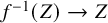 $f^{-1}(Z) \to Z$
is an isomorphism.
$f^{-1}(Z) \to Z$
is an isomorphism.
We will use the following result in the proof of Theorem 6.4:
Theorem 6.9. [Reference RydhRyd11, Theorem D]
Let $\mathbf {D} \subset \mathrm {Et}/M$
be the subcategory satisfying the following conditions:
$\mathbf {D} \subset \mathrm {Et}/M$
be the subcategory satisfying the following conditions:
-
(i) If
$(U\to M) \in \mathbf {D}$
and
$(U' \to U)$
is a morphism in
$\mathrm {Et}/M$
, then
$(U' \to M) \in \mathbf {D}$
. -
(ii) If
$(U' \to M) \in \mathbf {D}$
and
$(U' \to U)$
is a morphism in
$\mathrm {Et}/M$
which is finite and surjective, then
$(U \to M) \in \mathbf {D}$
. -
(iii) If
$(j \colon U^{\circ } \to U)$
and
$(f \colon W \to U)$
are morphisms in
$\mathrm {Et}/M$
such that j is an open immersion and f is an étale neighborhood of
$U\setminus U^{\circ }$
, and
$(U^{\circ } \to M) \in \mathbf {D}$
and
$(W \to M) \in \mathbf {D}$
, then
$(U \to M) \in \mathbf {D}$
.











Then if there is $(g \colon M' \to M) \in \mathbf {D}$
such that g is surjective, then
$(g \colon M' \to M) \in \mathbf {D}$
such that g is surjective, then $(\operatorname {id} \colon M \to M) \in \mathbf {D}$
.
$(\operatorname {id} \colon M \to M) \in \mathbf {D}$
.
For each object $(U \to M) \in \mathrm {Et}/M$
, let
$(U \to M) \in \mathrm {Et}/M$
, let $\mathcal {M}_U \to U$
be the pull-back of
$\mathcal {M}_U \to U$
be the pull-back of $\mathcal {M} \to M$
by
$\mathcal {M} \to M$
by $U \to M$
. There is a derived stack
$U \to M$
. There is a derived stack $\mathfrak {M}_U$
, unique up to equivalence, such that for each morphism
$\mathfrak {M}_U$
, unique up to equivalence, such that for each morphism $\rho \colon U' \to U$
in
$\rho \colon U' \to U$
in $\mathrm {Et}/M$
there is an induced diagram, see Subsection 2.6
$\mathrm {Et}/M$
there is an induced diagram, see Subsection 2.6

For each $y\in M$
, there is
$y\in M$
, there is $\eta \colon U \to M$
in
$\eta \colon U \to M$
in $\mathrm {Et}/M$
whose image contains y such that
$\mathrm {Et}/M$
whose image contains y such that $\mathfrak {M}_U$
is equivalent to a Koszul stack
$\mathfrak {M}_U$
is equivalent to a Koszul stack
 $$ \begin{align} \mathfrak{M}_U \simeq s^{-1}(0)/G \end{align} $$
for some $(Y, V, s, G)$
, where Y is a smooth scheme with an action of a reductive algebraic group G,
$(Y, V, s, G)$
, where Y is a smooth scheme with an action of a reductive algebraic group G, $V\to Y$
is a G-equivariant vector bundle with a G-invariant section s and
$V\to Y$
is a G-equivariant vector bundle with a G-invariant section s and $s^{-1}(0)$
is the derived zero locus of s, see Subsection 2.6.
$s^{-1}(0)$
is the derived zero locus of s, see Subsection 2.6.
For $\ell \in \mathrm {Pic}(\mathfrak {M})_{\mathbb {R}}$
and
$\ell \in \mathrm {Pic}(\mathfrak {M})_{\mathbb {R}}$
and $(U\to M)\in \mathrm {Et}/M$
, consider the
$(U\to M)\in \mathrm {Et}/M$
, consider the $\ell $
-semistable locus
$\ell $
-semistable locus
 $$ \begin{align} \Omega_{\mathfrak{M}_U}^{\ell\text{-ss}}[-1]^{\mathrm{{cl}}} \subset \Omega_{\mathfrak{M}_U}[-1]^{\mathrm{{cl}}}. \end{align} $$
We denote by $\mathscr {Z}_U$
the complement of the open immersion (6.12), which is a conical closed substack. Let
$\mathscr {Z}_U$
the complement of the open immersion (6.12), which is a conical closed substack. Let $\mathcal {C}_{\mathscr {Z}_U} \subset D^b(\mathfrak {M}_U)$
be the subcategory of objects with singular supports contained in
$\mathcal {C}_{\mathscr {Z}_U} \subset D^b(\mathfrak {M}_U)$
be the subcategory of objects with singular supports contained in $\mathscr {Z}_U$
.
$\mathscr {Z}_U$
.
Lemma 6.10. Suppose that the open substack (6.12) is an algebraic space. Then for a Koszul stack as in (6.11), the category $D^b(\mathfrak {M}_U)/\mathcal {C}_{\mathscr {Z}_{U}}$
is regular. In particular, there is a compact generator
$D^b(\mathfrak {M}_U)/\mathcal {C}_{\mathscr {Z}_{U}}$
is regular. In particular, there is a compact generator $\mathcal {E}_U \in D^b(\mathfrak {M}_U)/\mathcal {C}_{\mathscr {Z}_U}$
.
$\mathcal {E}_U \in D^b(\mathfrak {M}_U)/\mathcal {C}_{\mathscr {Z}_U}$
.
Proof. By the Koszul duality equivalence in Theorem 2.1, we have the equivalence
 $$ \begin{align} D^b(\mathfrak{M}_U) \stackrel{\sim}{\to} \mathrm{MF}^{\mathrm{{gr}}}(V^{\vee}/G, f). \end{align} $$
The above equivalence descends to an equivalence, see [Reference TodaTod24a, Proposition 2.3.9]
 $$ \begin{align*} D^b(\mathfrak{M}_U)/\mathcal{C}_{\mathscr{Z}_U} \stackrel{\sim}{\to} \mathrm{MF}^{\mathrm{{gr}}}((V^{\vee}/G) \setminus \mathscr{Z}_U, f). \end{align*} $$
Note that we have
 $$ \begin{align} (\Omega_{\mathfrak{M}}[-1]^{\mathrm{{cl}}}\setminus \mathscr{Z})\times_{\mathcal{M}}U =(\mathrm{Crit}(w)/G) \setminus \mathscr{Z}_U, \end{align} $$
hence the right-hand side is an algebraic space by the assumption. Let $(V^{\vee })^{\mathrm {{free}}} \subset (V^{\vee })^{\ell \text {-ss}}$
be the
$(V^{\vee })^{\mathrm {{free}}} \subset (V^{\vee })^{\ell \text {-ss}}$
be the $(G\times \mathbb {C}^{\ast })$
-invariant open subspace of
$(G\times \mathbb {C}^{\ast })$
-invariant open subspace of $\ell $
-semistable points with free closed G-orbits. Then (6.14) is a closed substack of
$\ell $
-semistable points with free closed G-orbits. Then (6.14) is a closed substack of $Y:=(V^{\vee })^{\mathrm {{free}}}/G$
. Since the category of matrix factorizations depends only on an open neighborhood of the critical locus, there is an equivalence
$Y:=(V^{\vee })^{\mathrm {{free}}}/G$
. Since the category of matrix factorizations depends only on an open neighborhood of the critical locus, there is an equivalence
 $$ \begin{align*} \mathrm{MF}^{\mathrm{{gr}}}((V^{\vee}/G) \setminus \mathscr{Z}_U, f) \stackrel{\sim}{\to} \mathrm{MF}^{\mathrm{{gr}}}(Y, f). \end{align*} $$
Note that Y is quasi-projective since it is an open subset of the quasi-projective good moduli space $(V^{\vee })^{\ell \text {-ss}}/\!\!/ G$
. The category
$(V^{\vee })^{\ell \text {-ss}}/\!\!/ G$
. The category $\mathrm {MF}^{\mathrm {{gr}}}(Y, f)$
is proven to be smooth in [Reference Favero and KellyFK18, Lemma 2.11, Remark 2.12], hence it is regular.
$\mathrm {MF}^{\mathrm {{gr}}}(Y, f)$
is proven to be smooth in [Reference Favero and KellyFK18, Lemma 2.11, Remark 2.12], hence it is regular.
The main result of this subsection is the following strong generation of singular support quotient:
Theorem 6.11. Let $\mathfrak {M}$
be a quasi-smooth derived stack of finite type over
$\mathfrak {M}$
be a quasi-smooth derived stack of finite type over $\mathbb {C}$
with a good moduli space
$\mathbb {C}$
with a good moduli space
 $$\begin{align*}\mathfrak{M}^{\mathrm{{cl}}} \to M,\end{align*}$$
where M is a quasi-separated algebraic space. For $\ell \in \mathrm {Pic}(\mathfrak {M})_{\mathbb {R}}$
, suppose that
$\ell \in \mathrm {Pic}(\mathfrak {M})_{\mathbb {R}}$
, suppose that $\Omega _{\mathfrak {M}}^{\ell \text {-ss}}[-1]^{\mathrm {{cl}}}$
is an algebraic space. Let
$\Omega _{\mathfrak {M}}^{\ell \text {-ss}}[-1]^{\mathrm {{cl}}}$
is an algebraic space. Let $\mathscr {Z} = \Omega _{\mathfrak {M}}[-1]^{\mathrm {{cl}}} \setminus \Omega _{\mathfrak {M}}^{\ell \text {-ss}}[-1]^{\mathrm {{cl}}}$
. Then the quotient category
$\mathscr {Z} = \Omega _{\mathfrak {M}}[-1]^{\mathrm {{cl}}} \setminus \Omega _{\mathfrak {M}}^{\ell \text {-ss}}[-1]^{\mathrm {{cl}}}$
. Then the quotient category $D^b(\mathfrak {M})/\mathcal {C}_{\mathscr {Z}}$
is regular.
$D^b(\mathfrak {M})/\mathcal {C}_{\mathscr {Z}}$
is regular.
Proof. For $(U \to M) \in \mathrm {Et}/M$
, we define
$(U \to M) \in \mathrm {Et}/M$
, we define
 $$ \begin{align} \mathcal{T}_U:=D^b(\mathfrak{M}_U)/\mathcal{C}_{\mathscr{Z}_U}, \ \underline{\operatorname{Ind}}\mathcal{T}_U:=\operatorname{Ind} D^b(\mathfrak{M}_U)/ \operatorname{Ind} \mathcal{C}_{\mathscr{Z}_U}. \end{align} $$
By the diagram (6.10), there is an adjoint pair:

Then $U \mapsto \underline {\operatorname {Ind}}\mathcal {T}_{U}$
is an
$U \mapsto \underline {\operatorname {Ind}}\mathcal {T}_{U}$
is an $\mathrm {Et}/M$
-pretriangulated categories with adjoints, see [Reference Hall and RydhHR17, Section 5].
$\mathrm {Et}/M$
-pretriangulated categories with adjoints, see [Reference Hall and RydhHR17, Section 5].
Let $\mathbf {D}^{\mathrm {{st}}} \subset \mathrm {Et}/M$
be the full subcategory of
$\mathbf {D}^{\mathrm {{st}}} \subset \mathrm {Et}/M$
be the full subcategory of $(U \to M)$
such that
$(U \to M)$
such that $\mathcal {T}_U$
is regular. The condition
$\mathcal {T}_U$
is regular. The condition $(U \to M) \in \mathbf {D}^{\mathrm {{st}}}$
is equivalent to
$(U \to M) \in \mathbf {D}^{\mathrm {{st}}}$
is equivalent to $\mathcal {T}_U=\langle \mathcal {E}_U \rangle ^{\star n}$
for some
$\mathcal {T}_U=\langle \mathcal {E}_U \rangle ^{\star n}$
for some $\mathcal {E}_U \in \mathcal {T}_U$
and
$\mathcal {E}_U \in \mathcal {T}_U$
and $n{\geqslant } 1$
. On the other hand, it is proved in [Reference TodaTod24a, Proposition 3.2.7, Section 7.2] that
$n{\geqslant } 1$
. On the other hand, it is proved in [Reference TodaTod24a, Proposition 3.2.7, Section 7.2] that $\underline {\operatorname {Ind}} \mathcal {T}_U=\operatorname {Ind}(\mathcal {T}_U)$
with compact objects the idempotent closure of
$\underline {\operatorname {Ind}} \mathcal {T}_U=\operatorname {Ind}(\mathcal {T}_U)$
with compact objects the idempotent closure of $\mathcal {T}_U$
. Therefore by [Reference NeemanNee21, Proposition 1.9], the condition
$\mathcal {T}_U$
. Therefore by [Reference NeemanNee21, Proposition 1.9], the condition $\mathcal {T}_U=\langle \mathcal {E}_U \rangle ^{\star n}$
is equivalent to
$\mathcal {T}_U=\langle \mathcal {E}_U \rangle ^{\star n}$
is equivalent to $\underline {\operatorname {Ind}} \mathcal {T}_U= \langle \! \langle \mathcal {E}_U \rangle \! \rangle ^{\star n}$
for some
$\underline {\operatorname {Ind}} \mathcal {T}_U= \langle \! \langle \mathcal {E}_U \rangle \! \rangle ^{\star n}$
for some $n{\geqslant } 1$
. By Lemma 6.10, there exists
$n{\geqslant } 1$
. By Lemma 6.10, there exists $(M' \to M) \in \mathbf {D}^{\mathrm {{st}}}$
which is surjective. By Theorem 6.9, it is enough to check the conditions (i), (ii), and (iii) for the subcategory
$(M' \to M) \in \mathbf {D}^{\mathrm {{st}}}$
which is surjective. By Theorem 6.9, it is enough to check the conditions (i), (ii), and (iii) for the subcategory $\mathbf {D}^{\mathrm {{st}}} \subset \mathrm {Et}/M$
.
$\mathbf {D}^{\mathrm {{st}}} \subset \mathrm {Et}/M$
.
To show condition (i), consider a morphism $(\rho \colon U' \to U)$
in
$(\rho \colon U' \to U)$
in $\mathrm {Et}/M$
. Suppose that
$\mathrm {Et}/M$
. Suppose that $\underline {\operatorname {Ind}} \mathcal {T}_U=\langle \! \langle \mathcal {E}_U \rangle \! \rangle ^{\star n}$
. For each
$\underline {\operatorname {Ind}} \mathcal {T}_U=\langle \! \langle \mathcal {E}_U \rangle \! \rangle ^{\star n}$
. For each $A \in \underline {\operatorname {Ind}} \mathcal {T}_{U'}$
, there is a natural morphism
$A \in \underline {\operatorname {Ind}} \mathcal {T}_{U'}$
, there is a natural morphism $\rho ^{\ast }\rho _{\ast }A \to A$
and
$\rho ^{\ast }\rho _{\ast }A \to A$
and $\rho _{\ast }A \in \langle \! \langle \mathcal {E}_U \rangle \! \rangle ^{\star n}$
by the assumption. Since
$\rho _{\ast }A \in \langle \! \langle \mathcal {E}_U \rangle \! \rangle ^{\star n}$
by the assumption. Since $U' \times _U U' \to U'$
admits a section given by the diagonal, we have a decomposition into open and closed subsets
$U' \times _U U' \to U'$
admits a section given by the diagonal, we have a decomposition into open and closed subsets
 $$\begin{align*}U' \times_U U'=U' \sqcup U".\end{align*}$$
Then, by the base change for $U' \to U \leftarrow U'$
, the morphism
$U' \to U \leftarrow U'$
, the morphism $\rho ^{\ast }\rho _{\ast }A \to A$
splits, hence
$\rho ^{\ast }\rho _{\ast }A \to A$
splits, hence $A \in \langle \! \langle \rho ^{\ast }\mathcal {E}_U \rangle \! \rangle ^{\star n}$
. Therefore
$A \in \langle \! \langle \rho ^{\ast }\mathcal {E}_U \rangle \! \rangle ^{\star n}$
. Therefore $\underline {\operatorname {Ind}} \mathcal {T}_{U'}=\langle \! \langle \mathcal {E}_{U'}\rangle \! \rangle ^{\star n}$
for
$\underline {\operatorname {Ind}} \mathcal {T}_{U'}=\langle \! \langle \mathcal {E}_{U'}\rangle \! \rangle ^{\star n}$
for $\mathcal {E}_{U'}=\rho ^{\ast }\mathcal {E}_U$
and
$\mathcal {E}_{U'}=\rho ^{\ast }\mathcal {E}_U$
and $(U' \to M) \in \mathbf {D}^{\mathrm {{st}}}$
holds.
$(U' \to M) \in \mathbf {D}^{\mathrm {{st}}}$
holds.
To show condition (ii), let $(\rho \colon U' \to U)$
be a morphism in
$(\rho \colon U' \to U)$
be a morphism in $\mathrm {Et}/M$
such that
$\mathrm {Et}/M$
such that $\rho $
is finite surjective. Assume that
$\rho $
is finite surjective. Assume that $(U' \to M) \in \mathbf {D}^{\mathrm {{st}}}$
, so
$(U' \to M) \in \mathbf {D}^{\mathrm {{st}}}$
, so $\underline {\operatorname {Ind}} \mathcal {T}_{U'}=\langle \! \langle \mathcal {E}_{U'} \rangle \! \rangle ^{\star n}$
for some
$\underline {\operatorname {Ind}} \mathcal {T}_{U'}=\langle \! \langle \mathcal {E}_{U'} \rangle \! \rangle ^{\star n}$
for some $\mathcal {E}_{U'} \in \mathcal {T}_{U'}$
and
$\mathcal {E}_{U'} \in \mathcal {T}_{U'}$
and $n{\geqslant } 1$
. For
$n{\geqslant } 1$
. For $A \in \underline {\operatorname {Ind}} \mathcal {T}_U$
, let
$A \in \underline {\operatorname {Ind}} \mathcal {T}_U$
, let $A \to \rho _{\ast }\rho ^{\ast }A=A \otimes \rho _{\ast }\mathcal {O}_{\mathfrak {M}_U}$
be the natural morphism. The induced map
$A \to \rho _{\ast }\rho ^{\ast }A=A \otimes \rho _{\ast }\mathcal {O}_{\mathfrak {M}_U}$
be the natural morphism. The induced map $\rho \colon \mathfrak {M}_{U'} \to \mathfrak {M}_U$
is also finite and surjective, and
$\rho \colon \mathfrak {M}_{U'} \to \mathfrak {M}_U$
is also finite and surjective, and $\mathcal {O}_{\mathfrak {M}_U} \to \rho _{\ast }\mathcal {O}_{\mathfrak {M}_{U'}}$
splits. In fact, we have
$\mathcal {O}_{\mathfrak {M}_U} \to \rho _{\ast }\mathcal {O}_{\mathfrak {M}_{U'}}$
splits. In fact, we have $\rho _{\ast }=\rho _{!}$
as
$\rho _{\ast }=\rho _{!}$
as $\rho $
is finite étale, and the natural map
$\rho $
is finite étale, and the natural map $\rho _{!}\mathcal {O}_{\mathfrak {M}_{U'}} \to \mathcal {O}_{\mathfrak {M}_U}$
gives a splitting. Therefore A is a direct summand of
$\rho _{!}\mathcal {O}_{\mathfrak {M}_{U'}} \to \mathcal {O}_{\mathfrak {M}_U}$
gives a splitting. Therefore A is a direct summand of $\rho _{\ast }\rho ^{\ast }A$
. As
$\rho _{\ast }\rho ^{\ast }A$
. As $\rho ^{\ast }A \in \langle \! \langle \mathcal {E}_{U'} \rangle \! \rangle ^{\star n}$
, we have
$\rho ^{\ast }A \in \langle \! \langle \mathcal {E}_{U'} \rangle \! \rangle ^{\star n}$
, we have $A \in \langle \! \langle \rho _{\ast }\mathcal {E}_{U'} \rangle \! \rangle ^{\star n}$
. Since
$A \in \langle \! \langle \rho _{\ast }\mathcal {E}_{U'} \rangle \! \rangle ^{\star n}$
. Since $\rho $
is finite, we have
$\rho $
is finite, we have $\rho _{\ast }\mathcal {E}_{U'} \in \mathcal {T}_U$
. Then by setting
$\rho _{\ast }\mathcal {E}_{U'} \in \mathcal {T}_U$
. Then by setting $\mathcal {E}_U=\rho _{\ast }\mathcal {E}_{U'}$
, we have
$\mathcal {E}_U=\rho _{\ast }\mathcal {E}_{U'}$
, we have $A \in \langle \! \langle \mathcal {E}_{U} \rangle \! \rangle ^{\star n}$
, hence
$A \in \langle \! \langle \mathcal {E}_{U} \rangle \! \rangle ^{\star n}$
, hence $\underline {\operatorname {Ind}} \mathcal {T}_U= \langle \! \langle \mathcal {E}_{U} \rangle \! \rangle ^{\star n}$
and
$\underline {\operatorname {Ind}} \mathcal {T}_U= \langle \! \langle \mathcal {E}_{U} \rangle \! \rangle ^{\star n}$
and $(U \to M) \in \mathbf {D}^{\mathrm {{st}}}$
holds.
$(U \to M) \in \mathbf {D}^{\mathrm {{st}}}$
holds.
To show condition (iii), let $(j \colon U_{\circ } \to U)$
and
$(j \colon U_{\circ } \to U)$
and $(f \colon W \to U)$
be morphisms in
$(f \colon W \to U)$
be morphisms in $\mathrm {Et}/M$
such that j is an open immersion and f is an étale neighborhood of
$\mathrm {Et}/M$
such that j is an open immersion and f is an étale neighborhood of $U \setminus U_{\circ }$
. Suppose that
$U \setminus U_{\circ }$
. Suppose that $\underline {\operatorname {Ind}} \mathcal {T}_{U_{\circ }}=\langle \! \langle \mathcal {E}_{U_{\circ }} \rangle \! \rangle ^{\star n}$
and
$\underline {\operatorname {Ind}} \mathcal {T}_{U_{\circ }}=\langle \! \langle \mathcal {E}_{U_{\circ }} \rangle \! \rangle ^{\star n}$
and $\underline {\operatorname {Ind}} \mathcal {T}_{W}=\langle \! \langle \mathcal {E}_W \rangle \! \rangle ^{\star n}$
for some
$\underline {\operatorname {Ind}} \mathcal {T}_{W}=\langle \! \langle \mathcal {E}_W \rangle \! \rangle ^{\star n}$
for some $n {\geqslant } 1$
and
$n {\geqslant } 1$
and $\mathcal {E}_W \in \mathcal {T}_W$
,
$\mathcal {E}_W \in \mathcal {T}_W$
, $\mathcal {E}_{U_{\circ }} \in \mathcal {T}_{U_{\circ }}$
. For an object
$\mathcal {E}_{U_{\circ }} \in \mathcal {T}_{U_{\circ }}$
. For an object $A \in \underline {\operatorname {Ind}} \mathcal {T}_U$
, there is a distinguished triangle in
$A \in \underline {\operatorname {Ind}} \mathcal {T}_U$
, there is a distinguished triangle in $\underline {\operatorname {Ind}} \mathcal {T}_U$
, see [Reference Hall and RydhHR17, Lemma 5.9]:
$\underline {\operatorname {Ind}} \mathcal {T}_U$
, see [Reference Hall and RydhHR17, Lemma 5.9]:
 $$ \begin{align} A \to j_{\ast}j^{\ast}A \oplus f_{\ast}f^{\ast}A \to f_{\ast}f^{\ast}j_{\ast}j^{\ast}A \to A[1]. \end{align} $$
We have $j_{\ast }j^{\ast }A \in \langle \! \langle j_{\ast }\mathcal {E}_{U_{\circ }}\rangle \! \rangle ^{\star n}$
,
$j_{\ast }j^{\ast }A \in \langle \! \langle j_{\ast }\mathcal {E}_{U_{\circ }}\rangle \! \rangle ^{\star n}$
, $f_{\ast }f^{\ast }A \in \langle \! \langle f_{\ast }\mathcal {E}_W \rangle \! \rangle ^{\star n}$
and
$f_{\ast }f^{\ast }A \in \langle \! \langle f_{\ast }\mathcal {E}_W \rangle \! \rangle ^{\star n}$
and $f_{\ast }f^{\ast }j_{\ast }j^{\ast }A \in \langle \! \langle f_{\ast }\mathcal {E}_W\rangle \! \rangle ^{\star n}$
. By Lemma 6.12, there exists
$f_{\ast }f^{\ast }j_{\ast }j^{\ast }A \in \langle \! \langle f_{\ast }\mathcal {E}_W\rangle \! \rangle ^{\star n}$
. By Lemma 6.12, there exists $\mathcal {E}_U \in \mathcal {T}_U$
such that
$\mathcal {E}_U \in \mathcal {T}_U$
such that $j_{\ast }\mathcal {E}_{U_{\circ }}$
and
$j_{\ast }\mathcal {E}_{U_{\circ }}$
and $f_{\ast }\mathcal {E}_W$
are objects in
$f_{\ast }\mathcal {E}_W$
are objects in $\langle \! \langle \mathcal {E}_U \rangle \! \rangle ^{\star m}$
for some
$\langle \! \langle \mathcal {E}_U \rangle \! \rangle ^{\star m}$
for some $m{\geqslant } 1$
. Then we have
$m{\geqslant } 1$
. Then we have $j_{\ast }j^{\ast }A \in \langle \! \langle \mathcal {E}_U \rangle \! \rangle ^{\star nm}$
,
$j_{\ast }j^{\ast }A \in \langle \! \langle \mathcal {E}_U \rangle \! \rangle ^{\star nm}$
, $f_{\ast }f^{\ast }A \in \langle \! \langle \mathcal {E}_U \rangle \! \rangle ^{\star nm}$
and
$f_{\ast }f^{\ast }A \in \langle \! \langle \mathcal {E}_U \rangle \! \rangle ^{\star nm}$
and $f_{\ast }f^{\ast }j_{\ast }j^{\ast }A \in \langle \! \langle \mathcal {E}_U\rangle \! \rangle ^{\star nm}$
. From the triangle (6.16), we conclude that
$f_{\ast }f^{\ast }j_{\ast }j^{\ast }A \in \langle \! \langle \mathcal {E}_U\rangle \! \rangle ^{\star nm}$
. From the triangle (6.16), we conclude that $\underline {\operatorname {Ind}} \mathcal {T}_U=\langle \! \langle \mathcal {E}_U \rangle \! \rangle ^{\star nm+1}$
, therefore
$\underline {\operatorname {Ind}} \mathcal {T}_U=\langle \! \langle \mathcal {E}_U \rangle \! \rangle ^{\star nm+1}$
, therefore $(U \to M) \in \mathbf {D}^{\mathrm {{st}}}$
.
$(U \to M) \in \mathbf {D}^{\mathrm {{st}}}$
.
We have used the following lemma:
Lemma 6.12. Let $f \colon U' \to U$
be a morphism in
$f \colon U' \to U$
be a morphism in $\mathrm {Et}/M$
. Then for any object
$\mathrm {Et}/M$
. Then for any object $P \in D^b(\mathfrak {M}_{U'})$
, there is
$P \in D^b(\mathfrak {M}_{U'})$
, there is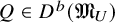 $Q \in D^b(\mathfrak {M}_{U})$
and
$Q \in D^b(\mathfrak {M}_{U})$
and $m {\geqslant } 1$
such that
$m {\geqslant } 1$
such that $f_{\ast } P \in \langle \! \langle Q \rangle \! \rangle ^{\star m}$
in
$f_{\ast } P \in \langle \! \langle Q \rangle \! \rangle ^{\star m}$
in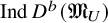 $\operatorname {Ind} D^b(\mathfrak {M}_U)$
.
$\operatorname {Ind} D^b(\mathfrak {M}_U)$
.
Proof. Since P is a finite extension of objects from the image of the pushforward functor $D^b(\mathcal {M}_{U'}) \to D^b(\mathfrak {M}_{U'})$
, we may assume that
$D^b(\mathcal {M}_{U'}) \to D^b(\mathfrak {M}_{U'})$
, we may assume that $P\in D^b(\mathcal {M}_{U'})$
. It suffices to find
$P\in D^b(\mathcal {M}_{U'})$
. It suffices to find $Q\in D^b(\mathcal {M}_U)$
and
$Q\in D^b(\mathcal {M}_U)$
and $m{\geqslant } 1$
such that
$m{\geqslant } 1$
such that $f_*P\in \langle \! \langle Q \rangle \! \rangle ^{\star m}$
in
$f_*P\in \langle \! \langle Q \rangle \! \rangle ^{\star m}$
in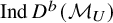 $\operatorname {Ind} D^b(\mathcal {M}_U)$
. By Nagata compactification, there is a factorization
$\operatorname {Ind} D^b(\mathcal {M}_U)$
. By Nagata compactification, there is a factorization
 $$\begin{align*}f \colon U' \stackrel{j}{\hookrightarrow} \overline{U} \stackrel{g}{\to} U,\end{align*}$$
where j is an open immersion and g is proper. There is an object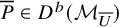 $\overline {P} \in D^b(\mathcal {M}_{\overline {U}})$
such that
$\overline {P} \in D^b(\mathcal {M}_{\overline {U}})$
such that $j^{\ast }\overline {P}\cong P$
. Then
$j^{\ast }\overline {P}\cong P$
. Then $j_{\ast }P \cong \overline {P} \otimes _{\mathcal {O}_{\overline {U}}} j_{\ast }\mathcal {O}_{U'}$
, where
$j_{\ast }P \cong \overline {P} \otimes _{\mathcal {O}_{\overline {U}}} j_{\ast }\mathcal {O}_{U'}$
, where $j_{\ast }\mathcal {O}_{U'} \in D_{\mathrm {{qc}}}(\overline {U})$
and the tensor product is given by the action of
$j_{\ast }\mathcal {O}_{U'} \in D_{\mathrm {{qc}}}(\overline {U})$
and the tensor product is given by the action of $D_{\mathrm {{qc}}}(\overline {U})$
on
$D_{\mathrm {{qc}}}(\overline {U})$
on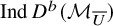 $\operatorname {Ind} D^b(\mathcal {M}_{\overline {U}})$
. By [Reference NeemanNee21, Theorem 6.2], there is
$\operatorname {Ind} D^b(\mathcal {M}_{\overline {U}})$
. By [Reference NeemanNee21, Theorem 6.2], there is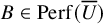 $B \in \mathrm {Perf}(\overline {U})$
such that
$B \in \mathrm {Perf}(\overline {U})$
such that $j_{\ast }\mathcal {O}_{U'} \in \langle \! \langle B \rangle \! \rangle ^{\star m}$
for some
$j_{\ast }\mathcal {O}_{U'} \in \langle \! \langle B \rangle \! \rangle ^{\star m}$
for some $m{\geqslant } 1$
in
$m{\geqslant } 1$
in $D_{\mathrm {{qc}}}(\overline {U})$
. Then
$D_{\mathrm {{qc}}}(\overline {U})$
. Then $j_{\ast }P \in \langle \! \langle \overline {P} \otimes _{\mathcal {O}_{\overline {U}}}B\rangle \! \rangle ^{\star m}$
, hence
$j_{\ast }P \in \langle \! \langle \overline {P} \otimes _{\mathcal {O}_{\overline {U}}}B\rangle \! \rangle ^{\star m}$
, hence $f_{\ast }P \in \langle \! \langle Q \rangle \! \rangle ^{\star m}$
for
$f_{\ast }P \in \langle \! \langle Q \rangle \! \rangle ^{\star m}$
for $Q=g_{\ast }(\overline {P}\otimes _{\mathcal {O}_{\overline {U}}}B) \in D^b(\mathcal {M}_U)$
.
$Q=g_{\ast }(\overline {P}\otimes _{\mathcal {O}_{\overline {U}}}B) \in D^b(\mathcal {M}_U)$
.
7 Serre functor for reduced quasi-BPS categories
In this section, we show that the reduced quasi-BPS categories have étale locally trivial Serre functor, which gives further evidence towards Conjecture 4.13.
7.1 Serre functor
Recall that we write $v=dv_0$
for
$v=dv_0$
for $d\in \mathbb {Z}_{{\geqslant } 1}$
and a primitive Mukai vector
$d\in \mathbb {Z}_{{\geqslant } 1}$
and a primitive Mukai vector $v_0$
with
$v_0$
with $\langle v_0, v_0 \rangle =2g-2$
. We assume
$\langle v_0, v_0 \rangle =2g-2$
. We assume $g{\geqslant } 2$
. Consider a generic stability
$g{\geqslant } 2$
. Consider a generic stability $\sigma \in \mathrm {Stab}(S)$
. Recall that the derived stack
$\sigma \in \mathrm {Stab}(S)$
. Recall that the derived stack $\mathfrak {M}_S^{\sigma }(v)^{\mathrm {{red}}}$
is equivalent to its classical truncation
$\mathfrak {M}_S^{\sigma }(v)^{\mathrm {{red}}}$
is equivalent to its classical truncation $\mathcal {M}=\mathcal {M}^\sigma _S(v)$
by Lemma 4.4. Let
$\mathcal {M}=\mathcal {M}^\sigma _S(v)$
by Lemma 4.4. Let $w \in \mathbb {Z}$
such that
$w \in \mathbb {Z}$
such that $\gcd (d, w)=1$
, and consider the quasi-BPS category
$\gcd (d, w)=1$
, and consider the quasi-BPS category
 $$\begin{align*}\mathbb{T}=\mathbb{T}_S^{\sigma}(v)_w^{\mathrm{{red}}}\subset D^b(\mathcal{M}).\end{align*}$$
We recall some terminology from [Reference Bondal and Van den BerghBVdB03]. Let $\mathcal {T}$
be a
$\mathcal {T}$
be a $\mathbb {C}$
-linear pretriangulated category. A contravariant functor
$\mathbb {C}$
-linear pretriangulated category. A contravariant functor $F\colon \mathcal {T}\to \mathrm {Vect}(\mathbb {C})$
is called of finite type if
$F\colon \mathcal {T}\to \mathrm {Vect}(\mathbb {C})$
is called of finite type if $\oplus _{i\in \mathbb {Z}}F(A[i])$
is finite dimensional for all objects A of
$\oplus _{i\in \mathbb {Z}}F(A[i])$
is finite dimensional for all objects A of $\mathcal {T}$
. The category
$\mathcal {T}$
. The category $\mathcal {T}$
is called saturated if every contravariant functor
$\mathcal {T}$
is called saturated if every contravariant functor $H\colon \mathcal {T}\to \mathrm {Vect}(\mathbb {C})$
of finite type is representable.
$H\colon \mathcal {T}\to \mathrm {Vect}(\mathbb {C})$
of finite type is representable.
By Corollary 6.8 and [Reference Bondal and Van den BerghBVdB03, Theorem 1.3], the category $\mathbb {T}$
is saturated, and thus it admits a Serre functor
$\mathbb {T}$
is saturated, and thus it admits a Serre functor
 $$ \begin{align*}S_{\mathbb{T}} \colon \mathbb{T} \to \mathbb{T} \end{align*} $$
that is, a functor such that there are functorial isomorphisms for $\mathcal {E}_1, \mathcal {E}_2 \in \mathbb {T}$
:
$\mathcal {E}_1, \mathcal {E}_2 \in \mathbb {T}$
:
 $$ \begin{align*} \operatorname{Hom}(\mathcal{E}_1, \mathcal{E}_2) \cong \operatorname{Hom}(\mathcal{E}_2, S_{\mathbb{T}}(\mathcal{E}_1))^{\vee}. \end{align*} $$
There is also a version of the Serre functor relative to the good moduli space $\pi \colon \mathcal {M} \to M$
. For
$\pi \colon \mathcal {M} \to M$
. For $\mathcal {E}_1, \mathcal {E}_2 \in \mathbb {T}$
, let
$\mathcal {E}_1, \mathcal {E}_2 \in \mathbb {T}$
, let $\mathcal {H}om_{\mathbb {T}}(\mathcal {E}_1, \mathcal {E}_2) \in D_{\mathrm {{qc}}}(\mathcal {M})$
be its internal homomorphism. Then a functor
$\mathcal {H}om_{\mathbb {T}}(\mathcal {E}_1, \mathcal {E}_2) \in D_{\mathrm {{qc}}}(\mathcal {M})$
be its internal homomorphism. Then a functor $S_{\mathbb {T}/M}\colon \mathbb {T} \to \mathbb {T}$
is called a relative Serre functor if there are functorial isomorphisms in
$S_{\mathbb {T}/M}\colon \mathbb {T} \to \mathbb {T}$
is called a relative Serre functor if there are functorial isomorphisms in $D^b(M)$
:
$D^b(M)$
:
 $$ \begin{align} \mathcal{H}om_M(\pi_{\ast}\mathcal{H}om_{\mathbb{T}}(\mathcal{E}_1, \mathcal{E}_2), \mathcal{O}_M) \cong \pi_{\ast}\mathcal{H}om_{\mathbb{T}}(\mathcal{E}_2, S_{\mathbb{T}/M}(\mathcal{E}_1)). \end{align} $$
Remark 7.1. We note that M has at worst Gorenstein singularities. The result is most probably well known, but we did not find a reference. The statement follows from Lemma 4.3 and [Reference PădurariuPTc, Lemma 5.7]. Thus $\mathcal {H}om(-, \mathcal {O}_M)$
is an equivalence
$\mathcal {H}om(-, \mathcal {O}_M)$
is an equivalence
 $$ \begin{align*} \mathcal{H}om(-, \mathcal{O}_M) \colon D^b(M) \stackrel{\sim}{\to} D^b(M)^{\mathrm{{op}}}. \end{align*} $$
Moreover, the dualizing complex is $\omega _M=\mathcal {O}_M[\dim M]$
, since the singular locus of M is at least codimension two and there is a holomorphic symplectic form on the smooth part.
$\omega _M=\mathcal {O}_M[\dim M]$
, since the singular locus of M is at least codimension two and there is a holomorphic symplectic form on the smooth part.
Remark 7.2. The category $\mathbb {T}$
is proper over M, that is,
$\mathbb {T}$
is proper over M, that is, $\pi _{\ast }\mathcal {H}om_{\mathbb {T}}(\mathcal {E}_1, \mathcal {E}_2) \in D^b(M)$
, and it is strongly generated. Thus the relative Serre functor also exists, and is constructed as follows. Let
$\pi _{\ast }\mathcal {H}om_{\mathbb {T}}(\mathcal {E}_1, \mathcal {E}_2) \in D^b(M)$
, and it is strongly generated. Thus the relative Serre functor also exists, and is constructed as follows. Let $\mathcal {E} \in \mathbb {T}$
be a strong generator and consider the sheaf of dg-algebras on M:
$\mathcal {E} \in \mathbb {T}$
be a strong generator and consider the sheaf of dg-algebras on M:
 $$\begin{align*}\mathcal{A}=\pi_{\ast}\mathcal{H}om_{\mathbb{T}}(\mathcal{E}, \mathcal{E}).\end{align*}$$
Then $\mathbb {T}$
is equivalent to the derived category of coherent right dg-
$\mathbb {T}$
is equivalent to the derived category of coherent right dg- $\mathcal {A}$
-modules. Under the above equivalence, the relative Serre functor is given by the
$\mathcal {A}$
-modules. Under the above equivalence, the relative Serre functor is given by the $\mathcal {A}^{\mathrm {{op}}}\otimes _{\mathcal {O}_M} \mathcal {A}$
-module
$\mathcal {A}^{\mathrm {{op}}}\otimes _{\mathcal {O}_M} \mathcal {A}$
-module $\mathcal {H}om_{M}(\mathcal {A}, \mathcal {O}_M)$
.
$\mathcal {H}om_{M}(\mathcal {A}, \mathcal {O}_M)$
.
The absolute and the relative Serre functors are related as follows:
Lemma 7.3. We have $S_{\mathbb {T}}=S_{\mathbb {T}/M}[\dim M]$
.
$S_{\mathbb {T}}=S_{\mathbb {T}/M}[\dim M]$
.
Proof. By taking the global sections of (7.1), we obtain
 $$ \begin{align*} \operatorname{Hom}_M(\pi_{\ast}\mathcal{H}om_{\mathbb{T}}(\mathcal{E}_1, \mathcal{E}_2), \mathcal{O}_M) \cong \operatorname{Hom}(\mathcal{E}_2, S_{\mathbb{T}/M}(\mathcal{E}_1)). \end{align*} $$
By the Serre duality for M and using that $\omega _M=\mathcal {O}_M[\dim M]$
from Remark 7.1, the left-hand side is isomorphic to
$\omega _M=\mathcal {O}_M[\dim M]$
from Remark 7.1, the left-hand side is isomorphic to
 $$ \begin{align*} \operatorname{Hom}_M(\mathcal{O}_M, \pi_{\ast}\mathcal{H}om_{\mathbb{T}}(\mathcal{E}_1, \mathcal{E}_2)[\dim M])^{\vee} =\operatorname{Hom}(\mathcal{E}_1, \mathcal{E}_2[\dim M])^{\vee}. \end{align*} $$
Then the lemma holds by the uniqueness of $S_{\mathbb {T}}$
.
$S_{\mathbb {T}}$
.
We believe that $S_{\mathbb {T}}$
is isomorphic to the shift functor
$S_{\mathbb {T}}$
is isomorphic to the shift functor $[\dim M]$
, see the discussion in Subsection 1.2, which reinforces the analogy between reduced quasi-BPS categories and hyperkähler varieties, see Conjecture 4.13. The main result in this section is the following weaker form of this expectation, which we prove in Subsection 7.4:
$[\dim M]$
, see the discussion in Subsection 1.2, which reinforces the analogy between reduced quasi-BPS categories and hyperkähler varieties, see Conjecture 4.13. The main result in this section is the following weaker form of this expectation, which we prove in Subsection 7.4:
Theorem 7.4. The Serre functor $S_{\mathbb {T}}$
is isomorphic to the shift functor
$S_{\mathbb {T}}$
is isomorphic to the shift functor $[\dim M]$
étale locally on M, that is, there is an étale cover
$[\dim M]$
étale locally on M, that is, there is an étale cover $U \to M$
such that for each
$U \to M$
such that for each $\mathcal {E} \in \mathbb {T}$
we have
$\mathcal {E} \in \mathbb {T}$
we have $S_{\mathbb {T}}(\mathcal {E})|_U \cong \mathcal {E}|_U[\dim M]$
.
$S_{\mathbb {T}}(\mathcal {E})|_U \cong \mathcal {E}|_U[\dim M]$
.
7.2 Construction of the trace map
In this subsection, we construct a trace map for objects with nilpotent singular supports in a general setting. The construction here is used in the proof of Theorem 7.4.
Let G be a reductive algebraic group which acts on a smooth affine variety Y. We assume that there is a one-dimensional subtorus $\mathbb {C}^{\ast } \subset G$
which acts on Y trivially, so the G-action on Y factors through the action of
$\mathbb {C}^{\ast } \subset G$
which acts on Y trivially, so the G-action on Y factors through the action of $\mathbb {P}(G):=G/\mathbb {C}^{\ast }$
. We say that Y is unimodular if
$\mathbb {P}(G):=G/\mathbb {C}^{\ast }$
. We say that Y is unimodular if $\det \Omega _Y$
is trivial as a G-equivariant line bundle. We also say that the action of
$\det \Omega _Y$
is trivial as a G-equivariant line bundle. We also say that the action of $\mathbb {P}(G)$
on Y is generic if the subset
$\mathbb {P}(G)$
on Y is generic if the subset $Y^s \subset Y$
of points with closed
$Y^s \subset Y$
of points with closed $\mathbb {P}(G)$
-orbit and trivial stabilizer is nonempty and
$\mathbb {P}(G)$
-orbit and trivial stabilizer is nonempty and $\mathrm {codim}(Y\setminus Y^s) {\geqslant } 2$
.
$\mathrm {codim}(Y\setminus Y^s) {\geqslant } 2$
.
Lemma 7.5. [Reference KnopKno89, Korollary 2]
If Y is unimodular and generic, then $Y/\!\!/ G$
has only Gorenstein singularities and its canonical module is trivial.
$Y/\!\!/ G$
has only Gorenstein singularities and its canonical module is trivial.
Let Y be unimodular and generic. By Lemma 7.5, the quotient $Y/\!\!/ G$
is Gorenstein and its dualizing complex is
$Y/\!\!/ G$
is Gorenstein and its dualizing complex is
 $$ \begin{align}\omega_{Y/\!\!/ G}=\mathcal{O}_{Y/\!\!/ G}[\dim Y/\!\!/ G]. \end{align} $$
Let $V \to Y$
be a G-equivariant vector bundle with a G-invariant regular section s such that V is also unimodular and generic. We refer to such choices of G, Y, V, and s as a good data
$V \to Y$
be a G-equivariant vector bundle with a G-invariant regular section s such that V is also unimodular and generic. We refer to such choices of G, Y, V, and s as a good data $(G, Y, V, s)$
.
$(G, Y, V, s)$
.
Let $\mathcal {U}:=s^{-1}(0)$
be the zero locus of s, which is equivalent to the derived zero locus as we assumed that s is regular. We have the following diagram
$\mathcal {U}:=s^{-1}(0)$
be the zero locus of s, which is equivalent to the derived zero locus as we assumed that s is regular. We have the following diagram

Here $0 \colon Y/G \to V^{\vee }/G$
is the zero section,
$0 \colon Y/G \to V^{\vee }/G$
is the zero section, $\eta $
is the projection, and the bottom horizontal arrows are induced maps on good moduli spaces.
$\eta $
is the projection, and the bottom horizontal arrows are induced maps on good moduli spaces.
Recall the Koszul duality equivalence in Theorem 2.1
 $$ \begin{align*} \Theta \colon D^b(\mathcal{U}/G) \stackrel{\sim}{\to} \mathrm{MF}^{\mathrm{{gr}}}(V^{\vee}/G, f). \end{align*} $$
For $\mathcal {E} \in D^b(\mathcal {U}/G)$
, let
$\mathcal {E} \in D^b(\mathcal {U}/G)$
, let $\mathcal {P}=\Theta (\mathcal {E})$
. Then we have the following isomorphism in
$\mathcal {P}=\Theta (\mathcal {E})$
. Then we have the following isomorphism in $D_{\mathrm {{qc}}}(Y/G)$
, see [Reference PădurariuPTc, Lemma 2.7]:
$D_{\mathrm {{qc}}}(Y/G)$
, see [Reference PădurariuPTc, Lemma 2.7]:
 $$ \begin{align*} j_{\ast}\mathcal{H}om_{\mathcal{U}/G}(\mathcal{E}, \mathcal{E}) \stackrel{\cong}{\to} \eta_{\ast} \mathcal{H} om_{V^{\vee}/G}(\mathcal{P}, \mathcal{P}). \end{align*} $$
Here $\mathcal {H}om_{V^{\vee }/G}(\mathcal {P}, \mathcal {P})$
is the internal homomorphism of matrix factorizations, which is an object in
$\mathcal {H}om_{V^{\vee }/G}(\mathcal {P}, \mathcal {P})$
is the internal homomorphism of matrix factorizations, which is an object in $\mathrm {MF}^{\mathrm {{gr}}}(V^{\vee }/G, 0)$
. As
$\mathrm {MF}^{\mathrm {{gr}}}(V^{\vee }/G, 0)$
. As $V^{\vee }/G$
is smooth, by taking a resolution of
$V^{\vee }/G$
is smooth, by taking a resolution of $\mathcal {P}$
by vector bundles, we obtain the natural trace map in
$\mathcal {P}$
by vector bundles, we obtain the natural trace map in $\mathrm {MF}^{\mathrm {{gr}}}(V^{\vee }/G, 0)$
:
$\mathrm {MF}^{\mathrm {{gr}}}(V^{\vee }/G, 0)$
:
 $$ \begin{align*} \mathrm{tr} \colon \mathcal{H}om_{V^{\vee}/G}(\mathcal{P}, \mathcal{P}) \to \mathcal{O}_{V^{\vee}/G}. \end{align*} $$
By taking $\pi _{V^{\vee }\ast }$
, we obtain the morphism in
$\pi _{V^{\vee }\ast }$
, we obtain the morphism in $D^{\mathrm {{gr}}}(V^{\vee }/\!\!/ G)$
:
$D^{\mathrm {{gr}}}(V^{\vee }/\!\!/ G)$
:
 $$ \begin{align} \pi_{V^{\vee}\ast}\mathrm{tr} \colon \pi_{\ast}\mathcal{H}om_{V^{\vee}/G}(\mathcal{P}, \mathcal{P}) \to \mathcal{O}_{V^{\vee}/\!\!/ G} \end{align} $$
Here the grading on $V^{\vee }/\!\!/ G$
is induced by the fiberwise weight two
$V^{\vee }/\!\!/ G$
is induced by the fiberwise weight two $\mathbb {C}^{\ast }$
-action on
$\mathbb {C}^{\ast }$
-action on $V^{\vee }/G \to Y/G$
, see Subsection 2.3 for the graded category
$V^{\vee }/G \to Y/G$
, see Subsection 2.3 for the graded category $D^{\mathrm {{gr}}}(V^{\vee }/\!\!/ G)$
.
$D^{\mathrm {{gr}}}(V^{\vee }/\!\!/ G)$
.
We say that $\mathcal {P}$
has nilpotent support if:
$\mathcal {P}$
has nilpotent support if:
 $$ \begin{align*}\mathrm{Supp}(\mathcal{P}) \subset \pi_{V^{\vee}}^{-1}(\mathrm{Im}(\overline{0})). \end{align*} $$
We say $\mathcal {E}$
has nilpotent singular support with respect to
$\mathcal {E}$
has nilpotent singular support with respect to $(G, Y, V, s)$
if
$(G, Y, V, s)$
if $\mathcal {P}$
has nilpotent support.
$\mathcal {P}$
has nilpotent support.
Assume that $\mathcal {P}$
has nilpotent support. Then the object
$\mathcal {P}$
has nilpotent support. Then the object $\pi _{V^{\vee }\ast }\mathcal {H}om_{V^{\vee }/G}(\mathcal {P}, \mathcal {P})$
in
$\pi _{V^{\vee }\ast }\mathcal {H}om_{V^{\vee }/G}(\mathcal {P}, \mathcal {P})$
in $D^{\mathrm {{gr}}}(V^{\vee }/\!\!/ G)$
has proper support over
$D^{\mathrm {{gr}}}(V^{\vee }/\!\!/ G)$
has proper support over $Y/\!\!/ G$
. Moreover, we have
$Y/\!\!/ G$
. Moreover, we have
 $$ \begin{align} \omega_{V^{\vee}/\!\!/ G}= \mathcal{O}_{V^{\vee}/\!\!/ G}[\dim V^{\vee}/\!\!/ G](-2 \operatorname{rank} V)= \mathcal{O}_{V^{\vee}/\!\!/ G}[\dim Y/\!\!/ G-\operatorname{rank} V] \end{align} $$
in $D^{\mathrm {{gr}}}(V^{\vee }/\!\!/ G)$
, where
$D^{\mathrm {{gr}}}(V^{\vee }/\!\!/ G)$
, where $(1)$
is the grade shift functor of
$(1)$
is the grade shift functor of $D^{\mathrm {{gr}}}(V^{\vee }/\!\!/ G)$
which is isomorphic to the cohomological shift functor
$D^{\mathrm {{gr}}}(V^{\vee }/\!\!/ G)$
which is isomorphic to the cohomological shift functor $[1]$
. Then by Lemma 7.6 below, the morphism (7.4) induces the morphism in
$[1]$
. Then by Lemma 7.6 below, the morphism (7.4) induces the morphism in $D^b(Y/\!\!/ G)$
:
$D^b(Y/\!\!/ G)$
:
 $$ \begin{align} a_{\mathcal{P}} \colon \eta_{\ast}\pi_{V^{\vee}\ast}\mathcal{H}om_{V^{\vee}/G}(\mathcal{P}, \mathcal{P}) \to \mathcal{O}_{Y/\!\!/ G} [\operatorname{rank} V]. \end{align} $$
Suppose that $\mathcal {U}/\!\!/ G$
is Gorenstein with trivial canonical module and has dimension
$\mathcal {U}/\!\!/ G$
is Gorenstein with trivial canonical module and has dimension $\dim Y/\!\!/ G -\operatorname {rank} V$
. Then
$\dim Y/\!\!/ G -\operatorname {rank} V$
. Then $\overline {j}^! \mathcal {O}_{Y/\!\!/ G}= \mathcal {O}_{\mathcal {U}/\!\!/ G}[-\operatorname {rank} V]$
. Since there are isomorphisms:
$\overline {j}^! \mathcal {O}_{Y/\!\!/ G}= \mathcal {O}_{\mathcal {U}/\!\!/ G}[-\operatorname {rank} V]$
. Since there are isomorphisms:
 $$ \begin{align*} \overline{\eta}_{\ast}\pi_{V^{\vee}\ast}\mathcal{H}om_{V^{\vee}/G}(\mathcal{P}, \mathcal{P}) &=\pi_{Y\ast}\eta_{\ast}\mathcal{H}om_{V^{\vee}/G}(\mathcal{P}, \mathcal{P}) \\ &\stackrel{\cong}{\to} \pi_{Y\ast}j_{\ast}\mathcal{H}om_{\mathcal{U}/G}(\mathcal{E}, \mathcal{E}) \\ &=\overline{j}_{\ast}\pi_{\mathcal{U}\ast}\mathcal{H}om_{\mathcal{U}/G}(\mathcal{E}, \mathcal{E}), \end{align*} $$
the morphism (7.6) induces the trace morphism in $D^b(\mathcal {U}/\!\!/ G)$
:
$D^b(\mathcal {U}/\!\!/ G)$
:
 $$ \begin{align} \mathrm{tr}_{\mathcal{E}} \colon \pi_{\mathcal{U}\ast}\mathcal{H}om_{\mathcal{U}/G}(\mathcal{E}, \mathcal{E}) \to \overline{j}^{!}\mathcal{O}_{Y/\!\!/ G}[\operatorname{rank} V] =\mathcal{O}_{\mathcal{U}/\!\!/ G}. \end{align} $$
We have used the following lemma in the above construction:
Lemma 7.6. Let $X, Y$
be Noetherian
$X, Y$
be Noetherian $\mathbb {C}$
-schemes with
$\mathbb {C}$
-schemes with $\mathbb {C}^{\ast }$
-actions, and let
$\mathbb {C}^{\ast }$
-actions, and let $f \colon X \to Y$
be a
$f \colon X \to Y$
be a $\mathbb {C}^{\ast }$
-equivariant morphism. Let
$\mathbb {C}^{\ast }$
-equivariant morphism. Let $\omega _X$
be a dualizing complex for X. If
$\omega _X$
be a dualizing complex for X. If $\mathcal {E} \in D^{\mathrm {{gr}}}(X)$
has proper support over Y, then there is a natural isomorphism
$\mathcal {E} \in D^{\mathrm {{gr}}}(X)$
has proper support over Y, then there is a natural isomorphism
 $$\begin{align*}\phi_f \colon \operatorname{Hom}_X(\mathcal{E}, \omega_X) \stackrel{\cong}{\to} \operatorname{Hom}_Y(f_{\ast}\mathcal{E}, \omega_Y).\end{align*}$$
Moreover, let $g \colon Y \to Z$
be another
$g \colon Y \to Z$
be another $\mathbb {C}^{\ast }$
-equivariant morphism and assume the support of
$\mathbb {C}^{\ast }$
-equivariant morphism and assume the support of $\mathcal {E}$
is proper over Z. Let
$\mathcal {E}$
is proper over Z. Let $h=g \circ f \colon X \to Z$
. Then we have
$h=g \circ f \colon X \to Z$
. Then we have
 $$ \begin{align*} \phi_h=\phi_g \circ \phi_f \colon \operatorname{Hom}_X(\mathcal{E}, \omega_X) \stackrel{\phi_f}{\to} \operatorname{Hom}_Y(f_{\ast}\mathcal{E}, \omega_Y) \stackrel{\phi_g}{\to} \operatorname{Hom}_Z(h_{\ast}\mathcal{E}, \omega_Z). \end{align*} $$
Proof. The lemma is obvious if f and g are proper since $\omega _X=f^{!}\omega _Y$
,
$\omega _X=f^{!}\omega _Y$
, $\omega _Y=g^{!}\omega _Z$
and
$\omega _Y=g^{!}\omega _Z$
and $f^!$
and
$f^!$
and $g^!$
are right adjoints to
$g^!$
are right adjoints to $f_{\ast }$
,
$f_{\ast }$
, $g_{\ast }$
. In general, let
$g_{\ast }$
. In general, let $i \colon T \hookrightarrow X$
be a
$i \colon T \hookrightarrow X$
be a $\mathbb {C}^{\ast }$
-invariant closed subscheme such that
$\mathbb {C}^{\ast }$
-invariant closed subscheme such that $f|_{T}$
,
$f|_{T}$
, $g|_{f(T)}$
are proper. By a standard dévissage argument, it suffices to check the statement for
$g|_{f(T)}$
are proper. By a standard dévissage argument, it suffices to check the statement for $\mathcal {E}=i_{\ast }\mathcal {F}$
for some
$\mathcal {E}=i_{\ast }\mathcal {F}$
for some $\mathcal {F} \in D^{\mathrm {gr}}(T)$
. Then
$\mathcal {F} \in D^{\mathrm {gr}}(T)$
. Then $\operatorname {Hom}_X(\mathcal {E}, \omega _X)=\operatorname {Hom}_T(\mathcal {F}, \omega _T)$
as
$\operatorname {Hom}_X(\mathcal {E}, \omega _X)=\operatorname {Hom}_T(\mathcal {F}, \omega _T)$
as $\omega _T=i^{!}\omega _X$
. Then the lemma holds from the case of f, g proper.
$\omega _T=i^{!}\omega _X$
. Then the lemma holds from the case of f, g proper.
Definition 7.7. Let $(G, Y, V, s)$
be a good data. Suppose that
$(G, Y, V, s)$
be a good data. Suppose that $\mathcal {U}/\!\!/ G$
is Gorenstein with trivial canonical module and of dimension
$\mathcal {U}/\!\!/ G$
is Gorenstein with trivial canonical module and of dimension $\dim Y/\!\!/ G-\mathrm {rank}\,V$
. For
$\dim Y/\!\!/ G-\mathrm {rank}\,V$
. For $\mathcal {E} \in D^b(\mathcal {U}/G)$
with nilpotent singular support with respect to this data, the morphism
$\mathcal {E} \in D^b(\mathcal {U}/G)$
with nilpotent singular support with respect to this data, the morphism
 $$ \begin{align*} \mathrm{tr}_{\mathcal{E}} \colon \pi_{\mathcal{U}\ast}\mathcal{H}om_{\mathcal{U}/G}(\mathcal{E}, \mathcal{E}) \to \mathcal{O}_{\mathcal{U}/\!\!/ G} \end{align*} $$
constructed in (7.7) is called the trace map determined by $(G, Y, V, s)$
.
$(G, Y, V, s)$
.
The following lemma is immediate from the construction of the trace map:
Lemma 7.8. For another good data $(G', Y', V', s')$
, suppose that there is a commutative diagram of stacks
$(G', Y', V', s')$
, suppose that there is a commutative diagram of stacks

where the horizontal arrows are isomorphisms. Let $\mathcal {U}'=(s')^{-1}(0)$
and consider the induced equivalence
$\mathcal {U}'=(s')^{-1}(0)$
and consider the induced equivalence $\phi \colon \mathcal {U}/G \stackrel {\cong }{\to } \mathcal {U}'/G'$
. For
$\phi \colon \mathcal {U}/G \stackrel {\cong }{\to } \mathcal {U}'/G'$
. For $\mathcal {E} \in D^b(\mathcal {U}/G)$
with nilpotent singular support for
$\mathcal {E} \in D^b(\mathcal {U}/G)$
with nilpotent singular support for $(G, Y, V, s)$
, the object
$(G, Y, V, s)$
, the object $\phi _*\mathcal {E}$
has nilpotent singular support with respect to
$\phi _*\mathcal {E}$
has nilpotent singular support with respect to $(G', Y', V', s')$
. Further, the trace map
$(G', Y', V', s')$
. Further, the trace map $\mathrm {tr}_{\mathcal {E}}$
determined by
$\mathrm {tr}_{\mathcal {E}}$
determined by $(G, Y, V, s)$
is identified with that of
$(G, Y, V, s)$
is identified with that of $\mathrm {tr}_{\phi _{\ast }\mathcal {E}}$
determined by
$\mathrm {tr}_{\phi _{\ast }\mathcal {E}}$
determined by $(G', Y', V', s')$
, that is, the following diagram commutes
$(G', Y', V', s')$
, that is, the following diagram commutes

where the vertical arrows are natural isomorphisms induced by $\phi $
.
$\phi $
.
Suppose that $\mathcal {E} \in D^b(\mathcal {U}/G)$
is a perfect complex. In this case, there is a canonical trace map
$\mathcal {E} \in D^b(\mathcal {U}/G)$
is a perfect complex. In this case, there is a canonical trace map $\mathcal {H}om_{\mathcal {U}/G}(\mathcal {E}, \mathcal {E}) \to \mathcal {O}_{\mathcal {U}/G}$
. By taking the push-forward to
$\mathcal {H}om_{\mathcal {U}/G}(\mathcal {E}, \mathcal {E}) \to \mathcal {O}_{\mathcal {U}/G}$
. By taking the push-forward to $\mathcal {U}/\!\!/ G$
, we obtain the map
$\mathcal {U}/\!\!/ G$
, we obtain the map
 $$ \begin{align} \pi_{\mathcal{U}\ast}\mathcal{H}om_{\mathcal{U}/G}(\mathcal{E}, \mathcal{E}) \to \mathcal{O}_{\mathcal{U}/\!\!/ G}. \end{align} $$
Note that the above construction is independent of a choice of $(G, Y, V, s)$
. The following lemma is straightforward to check, and we omit the details.
$(G, Y, V, s)$
. The following lemma is straightforward to check, and we omit the details.
Lemma 7.9. If $\mathcal {E}$
is a perfect complex, then
$\mathcal {E}$
is a perfect complex, then $\mathrm {tr}_{\mathcal {E}}$
is the same as the map (7.8).
$\mathrm {tr}_{\mathcal {E}}$
is the same as the map (7.8).
7.3 Comparison of the trace maps
In this subsection, we compare the trace map constructed in the previous subsection under a change of the presentations of quasi-smooth affine derived schemes.
Suppose that $(G, Y, V, s)$
is a good data and let W be another G-representation such that
$(G, Y, V, s)$
is a good data and let W be another G-representation such that $\det W$
is a trivial G-character. Let
$\det W$
is a trivial G-character. Let $i \colon Y/G \hookrightarrow (Y\oplus W)/G$
be the embedding given by
$i \colon Y/G \hookrightarrow (Y\oplus W)/G$
be the embedding given by $y\mapsto (y, 0)$
. We have the section
$y\mapsto (y, 0)$
. We have the section $s'$
of the vector bundle
$s'$
of the vector bundle $V \oplus W \oplus W \to Y \oplus W$
given by
$V \oplus W \oplus W \to Y \oplus W$
given by $(y, w) \mapsto (s(y), w, w)$
, whose zero locus is
$(y, w) \mapsto (s(y), w, w)$
, whose zero locus is $\mathcal {U} \subset Y$
. Then
$\mathcal {U} \subset Y$
. Then $(G, Y\oplus W, V\oplus W\oplus W, s')$
is a good data. Let
$(G, Y\oplus W, V\oplus W\oplus W, s')$
is a good data. Let $\mathcal {E}\in D^b(\mathcal {U}/G)$
be a complex with nilpotent singular support with respect to
$\mathcal {E}\in D^b(\mathcal {U}/G)$
be a complex with nilpotent singular support with respect to $(G, Y, V, s)$
. Then
$(G, Y, V, s)$
. Then $\mathcal {E}$
also has nilpotent singular support with respect to
$\mathcal {E}$
also has nilpotent singular support with respect to $(G, Y\oplus W, V\oplus W\oplus W, s')$
and we can consider the trace determined by the good data
$(G, Y\oplus W, V\oplus W\oplus W, s')$
and we can consider the trace determined by the good data $(G, Y\oplus W, V\oplus W\oplus W, s')$
:
$(G, Y\oplus W, V\oplus W\oplus W, s')$
:
 $$ \begin{align*} \mathrm{tr}_{\mathcal{E}}' \colon \mathcal{H}om_{\mathcal{U}/G}(\mathcal{E}, \mathcal{E}) \to \mathcal{O}_{\mathcal{U}/\!\!/ G}. \end{align*} $$
Lemma 7.10. Let $\mathcal {E}\in D^b(\mathcal {U}/G)$
have nilpotent singular support with respect to the good data
$\mathcal {E}\in D^b(\mathcal {U}/G)$
have nilpotent singular support with respect to the good data $(G, Y, V, s)$
. Then
$(G, Y, V, s)$
. Then $\mathcal {E}$
also has nilpotent singular support with respect to the good data
$\mathcal {E}$
also has nilpotent singular support with respect to the good data $(G, Y\oplus W, V\oplus W\oplus W, s')$
. Further, we have that
$(G, Y\oplus W, V\oplus W\oplus W, s')$
. Further, we have that $\mathrm {tr}_{\mathcal {E}}=\mathrm {tr}_{\mathcal {E}}'$
.
$\mathrm {tr}_{\mathcal {E}}=\mathrm {tr}_{\mathcal {E}}'$
.
Proof. We have the following diagram

Let $q \colon W \oplus W^{\vee } \to \mathbb {C}$
be the natural nondegenerate pairing. From the construction of the Koszul equivalences, there is a commutative diagram:
$q \colon W \oplus W^{\vee } \to \mathbb {C}$
be the natural nondegenerate pairing. From the construction of the Koszul equivalences, there is a commutative diagram:

Here, the horizontal arrows are the Koszul equivalences from Theorem 2.1, and $\Phi $
is the Knörrer periodicity equivalence, given by
$\Phi $
is the Knörrer periodicity equivalence, given by $\Phi (-)=(-)\otimes _{\mathbb {C}} \mathcal {K}$
. The Koszul factorization
$\Phi (-)=(-)\otimes _{\mathbb {C}} \mathcal {K}$
. The Koszul factorization $\mathcal {K}$
of q has the form
$\mathcal {K}$
of q has the form
 $$ \begin{align*} \mathcal{K}=\left(\bigwedge^{\mathrm{{even}}} W \otimes {\mathcal{O}_{W \oplus W^{\vee}}} \rightleftarrows \bigwedge^{\mathrm{{odd}}}W \otimes \mathcal{O}_{W \oplus W^{\vee}} \right) \in \mathrm{MF}^{\mathrm{{gr}}}((W \oplus W^{\vee})/G, q) \end{align*} $$
and is isomorphic to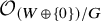 $\mathcal {O}_{(W \oplus \{0\})/G}$
, see [Reference Ballard, Favero and KatzarkovBFK19, Proposition 3.20]. In the above, the grading is given by the
$\mathcal {O}_{(W \oplus \{0\})/G}$
, see [Reference Ballard, Favero and KatzarkovBFK19, Proposition 3.20]. In the above, the grading is given by the $\mathbb {C}^{\ast }$
-action on
$\mathbb {C}^{\ast }$
-action on $W \oplus W^{\vee }$
of weight
$W \oplus W^{\vee }$
of weight $(0, 2)$
. By a diagram chasing, we see that
$(0, 2)$
. By a diagram chasing, we see that
 $$\begin{align*}\mathcal{Q}:=\Theta'(\mathcal{E})=\Phi(\mathcal{P})\end{align*}$$
has support in $\mathrm {Im}(\overline {0})$
, where
$\mathrm {Im}(\overline {0})$
, where $\overline {0}\colon (Y\oplus W)/\!\!/ G\to (Y\oplus W\oplus W^\vee )/\!\!/ G$
. Then
$\overline {0}\colon (Y\oplus W)/\!\!/ G\to (Y\oplus W\oplus W^\vee )/\!\!/ G$
. Then $\mathcal {E}$
has nilpotent singular support with respect to
$\mathcal {E}$
has nilpotent singular support with respect to $(G, Y\oplus W, V\oplus W\oplus W, s')$
.
$(G, Y\oplus W, V\oplus W\oplus W, s')$
.
Let $i_0 \colon BG \hookrightarrow (W \oplus W^{\vee })/G$
be the inclusion of the origin. We have the Koszul equivalence
$i_0 \colon BG \hookrightarrow (W \oplus W^{\vee })/G$
be the inclusion of the origin. We have the Koszul equivalence
 $$ \begin{align*} D^b(BG) \stackrel{\sim}{\to} \mathrm{MF}^{\mathrm{{gr}}}((W\oplus W^{\vee})/G, q) \end{align*} $$
which sends $\mathcal {O}_{BG}$
to
$\mathcal {O}_{BG}$
to $\mathcal {K}$
. Then
$\mathcal {K}$
. Then $\mathcal {H}om(\mathcal {K}, \mathcal {K})=i_{0\ast }\mathcal {O}_{BG}$
, hence we have the isomorphism
$\mathcal {H}om(\mathcal {K}, \mathcal {K})=i_{0\ast }\mathcal {O}_{BG}$
, hence we have the isomorphism $i_{V^{\vee }\ast }\mathcal {H}om(\mathcal {P}, \mathcal {P}) \stackrel {\cong }{\to } \mathcal {H}om(\mathcal {Q}, \mathcal {Q})$
. We have the commutative diagram:
$i_{V^{\vee }\ast }\mathcal {H}om(\mathcal {P}, \mathcal {P}) \stackrel {\cong }{\to } \mathcal {H}om(\mathcal {Q}, \mathcal {Q})$
. We have the commutative diagram:

where the bottom arrow is the morphism obtained by adjunction and using the isomorphism in $D^b(V^{\vee }/G)$
:
$D^b(V^{\vee }/G)$
:
 $$ \begin{align*} i^{!}_{V^{\vee}}\mathcal{O}_{(V^{\vee} \oplus W \oplus W^{\vee})/G} \cong \det W \otimes \det (W^{\vee}(2))[-2\dim W] =\mathcal{O}_{V^{\vee}/G}. \end{align*} $$
Applying $\pi _{V^{\vee } \oplus W \oplus W^{\vee }\ast }$
to the sheaves in the diagram (7.10), we obtain the commutative diagram:
$\pi _{V^{\vee } \oplus W \oplus W^{\vee }\ast }$
to the sheaves in the diagram (7.10), we obtain the commutative diagram:

Then by Lemma 7.6 applied for the map p together with the commutative diagram (7.9), we have the commutative diagram in $D^b((Y\oplus W)/\!\!/ G)$

The bottom arrow is the natural morphism by $\overline {i}_{Y}^{!}\mathcal {O}_{(Y\oplus W)/\!\!/ G}[\dim W]=\mathcal {O}_{Y/\!\!/ G}$
, see (7.2). The lemma follows from the above commutative diagram together with the constructions of
$\overline {i}_{Y}^{!}\mathcal {O}_{(Y\oplus W)/\!\!/ G}[\dim W]=\mathcal {O}_{Y/\!\!/ G}$
, see (7.2). The lemma follows from the above commutative diagram together with the constructions of $\mathrm {tr}_{\mathcal {E}}$
and
$\mathrm {tr}_{\mathcal {E}}$
and $\mathrm {tr}_{\mathcal {E}}'$
.
$\mathrm {tr}_{\mathcal {E}}'$
.
7.4 Local triviality of the Serre functor
In this section, we prove Theorem 7.4 using the trace map to reduce to the local case discussed in Theorem 3.11.
We first explain that objects of $\mathbb {T}$
have nilpotent singular support in the sense of Subsection 7.2. This result is a version of Lemma 3.9 and Theorem 6.6. To show it follows from Lemma 3.9, we need to mention a stronger form of the étale local description of M from Subsection 2.6. For each
$\mathbb {T}$
have nilpotent singular support in the sense of Subsection 7.2. This result is a version of Lemma 3.9 and Theorem 6.6. To show it follows from Lemma 3.9, we need to mention a stronger form of the étale local description of M from Subsection 2.6. For each $y\in M$
, recall from Remark 4.2 the polystable sheaf F, the corresponding doubled quiver
$y\in M$
, recall from Remark 4.2 the polystable sheaf F, the corresponding doubled quiver $Q^{\circ , d}_y$
, dimension vector
$Q^{\circ , d}_y$
, dimension vector $\boldsymbol {d}$
, and good moduli spaces of the reduced stacks of representations of the doubled quiver and of the preprojective algebra of
$\boldsymbol {d}$
, and good moduli spaces of the reduced stacks of representations of the doubled quiver and of the preprojective algebra of $Q^\circ _y$
, respectively:
$Q^\circ _y$
, respectively:
 $$\begin{align*}\pi_Y\colon \mathscr{Y}(\boldsymbol{d})\to Y(\boldsymbol{d}),\, \pi_P\colon \mathcal{P}(\boldsymbol{d})\to P(\boldsymbol{d}).\end{align*}$$
Then there exists a smooth affine scheme A with an action of the reductive group $G:=G(\boldsymbol {d})$
, a section s of the vector bundle
$G:=G(\boldsymbol {d})$
, a section s of the vector bundle $V:=\mathcal {O}_A\otimes \mathfrak {g}(\boldsymbol {d})^\vee $
with zero locus
$V:=\mathcal {O}_A\otimes \mathfrak {g}(\boldsymbol {d})^\vee $
with zero locus
 $$\begin{align*}\mathcal{Z}:=s^{-1}(0)/G\subset \mathscr{A}:=A/G,\end{align*}$$
and étale maps $e"\colon A/\!\!/ G\to Y(\boldsymbol {d})$
and
$e"\colon A/\!\!/ G\to Y(\boldsymbol {d})$
and $M\xleftarrow {e} Z:=s^{-1}(0)/\!\!/ G\xrightarrow {e'}P(\boldsymbol {d})$
such that the following diagram is Cartesian, the horizontal maps are étale, and the vertical maps are good moduli space maps:
$M\xleftarrow {e} Z:=s^{-1}(0)/\!\!/ G\xrightarrow {e'}P(\boldsymbol {d})$
such that the following diagram is Cartesian, the horizontal maps are étale, and the vertical maps are good moduli space maps:

and such that both squares in the following diagram are Cartesian, the horizontal maps are étale, and the vertical maps are good moduli space maps:

See [Reference DavisonDavc, Theorem 5.11] for a proof of the second diagram. To also obtain the first diagram, one can prove a stronger statement accounting for the derived structure of $\mathfrak {M}$
and
$\mathfrak {M}$
and $\mathscr {P}(\boldsymbol {d})$
as in [Reference Halpern-LeistnerHLa, Theorem 4.2.3], because A (R in loc.cit.) can be chosen étale over
$\mathscr {P}(\boldsymbol {d})$
as in [Reference Halpern-LeistnerHLa, Theorem 4.2.3], because A (R in loc.cit.) can be chosen étale over $ \mathrm {Ext}^1_S(F, F)=R_{Q^{\circ ,d}}(\boldsymbol {d})$
, see the proof of loc.cit. Then (7.11) and the right square of (7.12) commute, and the left square of (7.12) commutes by [Reference Halpern-LeistnerHLa, Theorem 4.2.3]. For such
$ \mathrm {Ext}^1_S(F, F)=R_{Q^{\circ ,d}}(\boldsymbol {d})$
, see the proof of loc.cit. Then (7.11) and the right square of (7.12) commute, and the left square of (7.12) commutes by [Reference Halpern-LeistnerHLa, Theorem 4.2.3]. For such $e\colon Z\to M$
and for
$e\colon Z\to M$
and for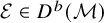 $\mathcal {E}\in D^b(\mathcal {M})$
, we denote by
$\mathcal {E}\in D^b(\mathcal {M})$
, we denote by $\mathcal {E}|_Z=e^*(\mathcal {E})\in D^b(\mathcal {Z})$
.
$\mathcal {E}|_Z=e^*(\mathcal {E})\in D^b(\mathcal {Z})$
.
The upshot of the discussion above is that $y\in M$
is in the image of
$y\in M$
is in the image of $e\colon Z\to M$
for a good data
$e\colon Z\to M$
for a good data $(G, A, V, s)$
.
$(G, A, V, s)$
.
Proposition 7.11. Let $\mathcal {E} \in \mathbb {T}$
. Then
$\mathcal {E} \in \mathbb {T}$
. Then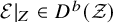 $\mathcal {E}|_Z\in D^b(\mathcal {Z})$
has nilpotent singular support with respect to
$\mathcal {E}|_Z\in D^b(\mathcal {Z})$
has nilpotent singular support with respect to $(G, A, V, s)$
.
$(G, A, V, s)$
.
Proof. The object $\mathcal {E}|_Z$
is in the subcategory of
$\mathcal {E}|_Z$
is in the subcategory of $D^b(\mathcal {Z})$
classically generated by the image of
$D^b(\mathcal {Z})$
classically generated by the image of $e"\colon D^b(\mathcal {P}(\boldsymbol {d}))\to D^b(\mathcal {Z})$
, see [Reference PădurariuPTe, Subsection 2.11, Subsection 9.2]. Then the claim follows from [Reference PădurariuPTc, Lemma 5.4, Corollary 5.5].
$e"\colon D^b(\mathcal {P}(\boldsymbol {d}))\to D^b(\mathcal {Z})$
, see [Reference PădurariuPTe, Subsection 2.11, Subsection 9.2]. Then the claim follows from [Reference PădurariuPTc, Lemma 5.4, Corollary 5.5].
Proof of Theorem 7.4
By Proposition 7.11, the object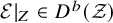 $\mathcal {E}|_Z \in D^b(\mathcal {Z})$
admits a trace map determined by
$\mathcal {E}|_Z \in D^b(\mathcal {Z})$
admits a trace map determined by $(G, A, V, s)$
, see the construction of Subsection 7.2 and Definition 7.7:
$(G, A, V, s)$
, see the construction of Subsection 7.2 and Definition 7.7:
 $$ \begin{align} \mathrm{tr}_Z \colon \pi_{\ast}\mathcal{H}om(\mathcal{E}|_{Z}, \mathcal{E}|_{Z}) \to \mathcal{O}_Z. \end{align} $$
By the definition of the relative Serre functor, it corresponds to a morphism
 $$ \begin{align} \phi_Z \colon \mathcal{E}|_{Z} \to S_{\mathbb{T}/M}(\mathcal{E})|_{Z}. \end{align} $$
By Lemma 7.3, it is enough to show that the above morphism is an isomorphism.
Set $\mathscr {A}=A/G$
and
$\mathscr {A}=A/G$
and $\mathcal {V}=V/G$
. For each point
$\mathcal {V}=V/G$
. For each point $u \in Z \hookrightarrow A/\!\!/ G$
, let
$u \in Z \hookrightarrow A/\!\!/ G$
, let $\widehat {\mathscr {A}}_u$
be the formal fiber of
$\widehat {\mathscr {A}}_u$
be the formal fiber of $\mathscr {A} \to A/\!\!/ G$
at u, and (by abuse of notation) denote by
$\mathscr {A} \to A/\!\!/ G$
at u, and (by abuse of notation) denote by $u \in \mathscr {A}$
the unique closed point in the fiber of
$u \in \mathscr {A}$
the unique closed point in the fiber of $\mathscr {A} \to A/\!\!/ G$
at u. Let
$\mathscr {A} \to A/\!\!/ G$
at u. Let $G_u=\mathrm {Aut}(u) \subset G$
. By the étale slice theorem, there is an isomorphism
$G_u=\mathrm {Aut}(u) \subset G$
. By the étale slice theorem, there is an isomorphism
 $$ \begin{align} \widehat{\mathscr{A}}_u \cong \widehat{\mathcal{H}}^{0}(\mathbb{T}_{\mathscr{A}}|_{u})/G_u. \end{align} $$
From the triangle $\mathbb {T}_{\mathcal {Z}} \to \mathbb {T}_{\mathscr {A}}|_{\mathcal {Z}} \to \mathcal {V}|_{\mathcal {Z}}\to \mathbb {T}_{\mathcal {Z}}[1]$
, there is an exact sequence of
$\mathbb {T}_{\mathcal {Z}} \to \mathbb {T}_{\mathscr {A}}|_{\mathcal {Z}} \to \mathcal {V}|_{\mathcal {Z}}\to \mathbb {T}_{\mathcal {Z}}[1]$
, there is an exact sequence of $G_u$
-representations
$G_u$
-representations
 $$ \begin{align*} 0 \to \mathcal{H}^0(\mathbb{T}_{\mathcal{Z}|_{u})} \to \mathcal{H}^0(\mathbb{T}_{\mathscr{A}}|_{u}) \stackrel{ds|_{u}}{\to} \mathcal{V}|_{u} \to \mathcal{H}^1(\mathbb{T}_{\mathcal{Z}}|_{u}) \to 0. \end{align*} $$
Hence there exist isomorphisms of $G_u$
-representations
$G_u$
-representations
 $$ \begin{align} \mathcal{H}^0(\mathbb{T}_{\mathscr{A}}|_{u}) \cong \mathcal{H}^0(\mathbb{T}_{\mathcal{Z}}|_{u}) \oplus W, \ \mathcal{V}|_u \cong \mathcal{H}^1(\mathbb{T}_{\mathcal{Z}}|_{u}) \oplus W \end{align} $$
for some $G_u$
-representation W such that
$G_u$
-representation W such that $ds|_{u}=(0, \operatorname {id}_W)$
.
$ds|_{u}=(0, \operatorname {id}_W)$
.
First assume that u corresponds to a point in the deepest stratum, so that
 $$ \begin{align}\mathcal{H}^0(\mathbb{T}_{\mathcal{Z}}|_{u})=\mathfrak{gl}(d)^{\oplus 2g}, \ \mathcal{H}^1(\mathbb{T}_{\mathcal{Z}}|_{u}) =\mathfrak{gl}(d)_0, \text{ and } G_u=GL(d).\end{align} $$
Let $\mu _0 \colon \mathfrak {gl}(d)^{\oplus 2g} \to \mathfrak {gl}(d)_0$
be the moment map (3.19). Note that the zero locus of
$\mu _0 \colon \mathfrak {gl}(d)^{\oplus 2g} \to \mathfrak {gl}(d)_0$
be the moment map (3.19). Note that the zero locus of $s|_{\widehat {\mathscr {A}}_u}$
is isomorphic to the formal fiber of
$s|_{\widehat {\mathscr {A}}_u}$
is isomorphic to the formal fiber of $\mu _0^{-1}(0)/GL(d) \to \mu _0^{-1}(0)/\!\!/ GL(d)$
at the origin, see Lemma 4.3. As both of s and
$\mu _0^{-1}(0)/GL(d) \to \mu _0^{-1}(0)/\!\!/ GL(d)$
at the origin, see Lemma 4.3. As both of s and $\mu _0$
are regular sections, by a formal coordinate change we may replace the isomorphism (7.15) and assume that
$\mu _0$
are regular sections, by a formal coordinate change we may replace the isomorphism (7.15) and assume that $s|_{\widehat {\mathscr {A}}_u}$
corresponds to the map
$s|_{\widehat {\mathscr {A}}_u}$
corresponds to the map
 $$ \begin{align*} (\mu_0, \operatorname{id}_W) \colon \mathfrak{gl}(d)^{\oplus 2g} \oplus W \to \mathfrak{gl}(d)_0 \oplus W \end{align*} $$
under the decompositions (7.16) and isomorphisms (7.17). By Lemmas 7.8 and 7.10, the trace map (7.13) pulled back via $\widehat {Z}_u:=\operatorname {Spec} \widehat {\mathcal {O}}_{Z, u} \to Z$
coincides with the trace map determined by the good data
$\widehat {Z}_u:=\operatorname {Spec} \widehat {\mathcal {O}}_{Z, u} \to Z$
coincides with the trace map determined by the good data $(GL(d), \mathfrak {gl}(d)^{\oplus 2g}, \mathfrak {gl}(d)_0, \mu _0)$
. Then from Theorem 3.11, the map (7.14) is an isomorphism at
$(GL(d), \mathfrak {gl}(d)^{\oplus 2g}, \mathfrak {gl}(d)_0, \mu _0)$
. Then from Theorem 3.11, the map (7.14) is an isomorphism at $\widehat {Z}_u$
.
$\widehat {Z}_u$
.
In general, let $p \in \mathfrak {gl}(d)^{\oplus 2g}/\!\!/ GL(d)$
be a point corresponding to u as in Lemma 4.3, that is, there is an equivalence
$p \in \mathfrak {gl}(d)^{\oplus 2g}/\!\!/ GL(d)$
be a point corresponding to u as in Lemma 4.3, that is, there is an equivalence
 $$ \begin{align} \widehat{\mathcal{Z}}_{u} \simeq \widehat{\mathscr{P}}(d)_p \end{align} $$
for the g-loop quiver $Q^{\circ }$
. Let
$Q^{\circ }$
. Let $\mathscr {Y}(d)=\mathfrak {gl}(d)^{\oplus 2g}/GL(d)$
be the moduli stack of representations of the doubled quiver of
$\mathscr {Y}(d)=\mathfrak {gl}(d)^{\oplus 2g}/GL(d)$
be the moduli stack of representations of the doubled quiver of $Q^\circ $
. We also denote by
$Q^\circ $
. We also denote by $p \in \mathscr {Y}(d)$
the unique closed point in the fiber of
$p \in \mathscr {Y}(d)$
the unique closed point in the fiber of $\mathscr {Y}(d) \to \mathfrak {gl}(d)^{\oplus 2g}/\!\!/ GL(d)$
at p. Then we have decompositions
$\mathscr {Y}(d) \to \mathfrak {gl}(d)^{\oplus 2g}/\!\!/ GL(d)$
at p. Then we have decompositions
 $$ \begin{align} \mathcal{H}^0(\mathbb{T}_{\mathscr{Y}(d)}|_{p})=\mathcal{H}^0(\mathbb{T}_{\mathcal{Z}}|_{u}) \oplus W', \ \mathfrak{gl}(d)_0=\mathcal{H}^1(\mathbb{T}_{\mathcal{Z}}|_{u}) \oplus W' \end{align} $$
for some $G_u$
-representation
$G_u$
-representation $W'$
.
$W'$
.
By Lemma 7.8 and the isomorphism (7.15), the trace map (7.13) at $\widehat {Z}_u$
equals the trace map determined by
$\widehat {Z}_u$
equals the trace map determined by $(G_u, \mathcal {H}^0(\mathbb {T}_{\mathscr {A}}|_{u}), \mathscr {V}|_{u}, s|_{\widehat {\mathscr {A}}_u})$
. Then by the decomposition (7.16) and Lemma 7.10, it also equals the trace map determined by the good data
$(G_u, \mathcal {H}^0(\mathbb {T}_{\mathscr {A}}|_{u}), \mathscr {V}|_{u}, s|_{\widehat {\mathscr {A}}_u})$
. Then by the decomposition (7.16) and Lemma 7.10, it also equals the trace map determined by the good data $(G_u, \mathcal {H}^0(\mathbb {T}_{\mathcal {Z}}|_{u}), \mathcal {H}^1(\mathbb {T}_{\mathcal {Z}}|_{u}), \kappa )$
. Then by (7.19) and Lemma 7.10, under the equivalence (7.18) the trace map (7.13) at
$(G_u, \mathcal {H}^0(\mathbb {T}_{\mathcal {Z}}|_{u}), \mathcal {H}^1(\mathbb {T}_{\mathcal {Z}}|_{u}), \kappa )$
. Then by (7.19) and Lemma 7.10, under the equivalence (7.18) the trace map (7.13) at $\widehat {Z}_u$
also equals the trace map determined by
$\widehat {Z}_u$
also equals the trace map determined by $(G_p, \mathcal {H}^0(\mathbb {T}_{\mathscr {Y}(d)}|_{p}), \mathfrak {gl}(d)_0, \mu _0)$
, which in turn equals the trace map determined by
$(G_p, \mathcal {H}^0(\mathbb {T}_{\mathscr {Y}(d)}|_{p}), \mathfrak {gl}(d)_0, \mu _0)$
, which in turn equals the trace map determined by $(GL(d), \mathfrak {gl}(d)^{\oplus 2g}, \mathfrak {gl}(d)_0, \mu _0)$
at p by Lemma 7.8. Again by Theorem 3.11, the map (7.14) is an isomorphism on
$(GL(d), \mathfrak {gl}(d)^{\oplus 2g}, \mathfrak {gl}(d)_0, \mu _0)$
at p by Lemma 7.8. Again by Theorem 3.11, the map (7.14) is an isomorphism on $\widehat {Z}_u$
. Therefore (7.14) is an isomorphism at any point
$\widehat {Z}_u$
. Therefore (7.14) is an isomorphism at any point $u\in Z$
, hence it is an isomorphism.
$u\in Z$
, hence it is an isomorphism.
The proof of Theorem 7.4 also implies the following:
Corollary 7.12. In the situation of Theorem 7.4, for each $\mathcal {E} \in \mathbb {T}$
there are isomorphisms:
$\mathcal {E} \in \mathbb {T}$
there are isomorphisms:
 $$\begin{align*}\mathcal{H}^i(S_{\mathbb{T}}(\mathcal{E})) \cong \mathcal{H}^i(\mathcal{E}[\dim M])\end{align*}$$
for all $i\in \mathbb {Z}$
. In particular, if there exists
$i\in \mathbb {Z}$
. In particular, if there exists $k\in \mathbb {Z}$
such that
$k\in \mathbb {Z}$
such that $\mathcal {E}$
is an object in
$\mathcal {E}$
is an object in $\mathbb {T} \cap \operatorname {Coh}(\mathcal {M})[k]$
, then
$\mathbb {T} \cap \operatorname {Coh}(\mathcal {M})[k]$
, then $S_{\mathbb {T}}(\mathcal {E}) \cong \mathcal {E}[\dim M]$
.
$S_{\mathbb {T}}(\mathcal {E}) \cong \mathcal {E}[\dim M]$
.
Proof. Let $\mathrm {tr}_Z$
be the morphism in (7.13). For another étale morphism
$\mathrm {tr}_Z$
be the morphism in (7.13). For another étale morphism $Z' \to M$
, the proof of Theorem 3.11 shows that the morphism
$Z' \to M$
, the proof of Theorem 3.11 shows that the morphism
 $$ \begin{align*} \mathrm{tr}_{Z}|_{Z \times_M Z'}- \mathrm{tr}_{Z'}|_{Z\times_M Z'} \colon \pi_{\ast}\mathcal{H}om(\mathcal{E}|_{Z\times_M Z'}, \mathcal{E}|_{Z\times_M Z'}) \to \mathcal{O}_{Z \times_M Z'} \end{align*} $$
is a zero map formally locally at any point in $Z\times _M Z'$
. Thus for the morphism
$Z\times _M Z'$
. Thus for the morphism $\phi _Z$
in (7.14), the morphism
$\phi _Z$
in (7.14), the morphism
 $$ \begin{align*} \phi_Z|_{Z\times_M Z'}-\phi_{Z'}|_{Z\times_M Z'} \colon \mathcal{E}|_{Z\times_M Z'} \to S_{\mathbb{T}/M}(\mathcal{E})|_{Z\times_M Z'} \end{align*} $$
is a zero map formally locally at each point in $Z\times _M Z'$
. Therefore for each
$Z\times _M Z'$
. Therefore for each $i \in \mathbb {Z}$
, the isomorphism
$i \in \mathbb {Z}$
, the isomorphism
 $$ \begin{align*} \mathcal{H}^i(\phi_Z) \colon \mathcal{H}^i(\mathcal{E}|_{Z}) \stackrel{\cong}{\to} \mathcal{H}^i(S_{\mathbb{T}/M}(\mathcal{E})|_{Z}) \end{align*} $$
glues to give an isomorphism $\mathcal {H}^i(\mathcal {E})\cong \mathcal {H}^i(S_{\mathbb {T}/M}(\mathcal {E}))$
. Then the corollary follows from Lemma 7.3.
$\mathcal {H}^i(\mathcal {E})\cong \mathcal {H}^i(S_{\mathbb {T}/M}(\mathcal {E}))$
. Then the corollary follows from Lemma 7.3.
We also have the following:
Corollary 7.13. In the situation of Theorem 3.11, for $\mathcal {E} \in \mathbb {T} \cap \mathrm {Perf}(\mathcal {M})$
, we have
$\mathcal {E} \in \mathbb {T} \cap \mathrm {Perf}(\mathcal {M})$
, we have $S_{\mathbb {T}}(\mathcal {E}) \cong \mathcal {E}[\dim M]$
.
$S_{\mathbb {T}}(\mathcal {E}) \cong \mathcal {E}[\dim M]$
.
Proof. As $\mathcal {E}$
is perfect, there is a trace map
$\mathcal {E}$
is perfect, there is a trace map $\mathcal {H}om_{\mathcal {M}}(\mathcal {E}, \mathcal {E}) \to \mathcal {O}_{\mathcal {M}}$
, thus its push-forward
$\mathcal {H}om_{\mathcal {M}}(\mathcal {E}, \mathcal {E}) \to \mathcal {O}_{\mathcal {M}}$
, thus its push-forward $\pi _{\ast }$
gives a morphism
$\pi _{\ast }$
gives a morphism
 $$ \begin{align*} \pi_{\ast}\mathcal{H}om_{\mathcal{M}}(\mathcal{E}, \mathcal{E}) \to \mathcal{O}_M. \end{align*} $$
The above morphism corresponds to $\phi \colon \mathcal {E} \to S_{\mathbb {T}/M}(\mathcal {E})$
. By Lemma 7.9, the above morphism coincides with (7.14) on each étale map
$\phi \colon \mathcal {E} \to S_{\mathbb {T}/M}(\mathcal {E})$
. By Lemma 7.9, the above morphism coincides with (7.14) on each étale map $Z \to M$
, thus
$Z \to M$
, thus $\phi $
is an isomorphism. Then the corollary follows from Lemma 7.3.
$\phi $
is an isomorphism. Then the corollary follows from Lemma 7.3.
8 Topological K-theory of quasi-BPS categories for K3 surfaces
8.1 Statement of the main result
In this section, we prove Theorem 1.3 using the computation of topological K-theory of quasi-BPS categories of preprojective algebras from [Reference PădurariuPTe]. We actually compute the topological K-theory of quasi-BPS categories for all weights $w\in \mathbb {Z}$
, not only in the case of w coprime with
$w\in \mathbb {Z}$
, not only in the case of w coprime with $v=dv_0$
, see Theorem 8.1.
$v=dv_0$
, see Theorem 8.1.
For a stack $\mathscr {X}$
, we denote by
$\mathscr {X}$
, we denote by $D_{\mathrm {{con}}}(\mathscr {X})$
the bounded derived category of constructible sheaves on
$D_{\mathrm {{con}}}(\mathscr {X})$
the bounded derived category of constructible sheaves on $\mathscr {X}$
and
$\mathscr {X}$
and $\mathrm {Perv}(\mathscr {X}) \subset D_{\mathrm {{con}}}(\mathscr {X})$
the subcategory of perverse sheaves [Reference Laszlo and OlssonLO09]. We denote by
$\mathrm {Perv}(\mathscr {X}) \subset D_{\mathrm {{con}}}(\mathscr {X})$
the subcategory of perverse sheaves [Reference Laszlo and OlssonLO09]. We denote by $D^+_{\mathrm {con}}(\mathscr {X})$
the category of locally bounded below complexes of constructible sheaves on
$D^+_{\mathrm {con}}(\mathscr {X})$
the category of locally bounded below complexes of constructible sheaves on $\mathscr {X}$
: if
$\mathscr {X}$
: if $\mathscr {X}$
is connected, then
$\mathscr {X}$
is connected, then $D^+_{\mathrm {con}}(\mathscr {X})$
is the limit of the diagram of categories
$D^+_{\mathrm {con}}(\mathscr {X})$
is the limit of the diagram of categories $D_n:=D^b_{\mathrm {con}}(\mathscr {X})$
for all
$D_n:=D^b_{\mathrm {con}}(\mathscr {X})$
for all $n\in \mathbb {N}$
and for the perverse truncation functors
$n\in \mathbb {N}$
and for the perverse truncation functors ${}^p\tau ^{{\leqslant } n'}\colon D_n\to D_{n'}$
; for general
${}^p\tau ^{{\leqslant } n'}\colon D_n\to D_{n'}$
; for general $\mathscr {X}$
, we have
$\mathscr {X}$
, we have $D^+_{\mathrm {con}}(\mathscr {X})=\prod _{\mathscr {X}'\in \pi _0(\mathscr {X})} D^+_{\mathrm {con}}(\mathscr {X}')$
.
$D^+_{\mathrm {con}}(\mathscr {X})=\prod _{\mathscr {X}'\in \pi _0(\mathscr {X})} D^+_{\mathrm {con}}(\mathscr {X}')$
.
In this section, we assume that $d{\geqslant } 2$
,
$d{\geqslant } 2$
, $g{\geqslant } 2$
, and that
$g{\geqslant } 2$
, and that $\sigma \in \mathrm {Stab}(S)$
corresponds to a Gieseker stability condition for an ample divisor H, see Proposition 4.1 and Corollary 4.15. The reason we restrict to Gieseker stability conditions is that, in this case,
$\sigma \in \mathrm {Stab}(S)$
corresponds to a Gieseker stability condition for an ample divisor H, see Proposition 4.1 and Corollary 4.15. The reason we restrict to Gieseker stability conditions is that, in this case, $\mathcal {M}$
is a global quotient stack and one can construct a cycle map as in [Reference PădurariuPTe, Section 3]. We fix
$\mathcal {M}$
is a global quotient stack and one can construct a cycle map as in [Reference PădurariuPTe, Section 3]. We fix $v=dv_0$
and
$v=dv_0$
and $w\in \mathbb {Z}$
.
$w\in \mathbb {Z}$
.
In Subsection 8.2.1, we recall the definition of the BPS sheaf
 $$\begin{align*}\mathcal{BPS}_v=\mathcal{BPS}^{\sigma}_S(v)\in \mathrm{Perv}\left(M^{\sigma}_S(v)\right).\end{align*}$$
For a partition $A=(d_i)_{i=1}^k$
of d, define the perverse sheaf
$A=(d_i)_{i=1}^k$
of d, define the perverse sheaf $\mathcal {BPS}_A$
on
$\mathcal {BPS}_A$
on $M_S^{\sigma }(v)$
to be
$M_S^{\sigma }(v)$
to be
 $$ \begin{align*} \mathcal{BPS}_A :=\left(\oplus_{\ast}\boxtimes_{i=1}^k \mathcal{BPS}_{d_i v_0}\right)^{\mathfrak{S}_A}, \end{align*} $$
where $\mathfrak {S}_A \subset \mathfrak {S}_k$
is the subgroup of permutations
$\mathfrak {S}_A \subset \mathfrak {S}_k$
is the subgroup of permutations $\sigma \in \mathfrak {S}_k$
such that
$\sigma \in \mathfrak {S}_k$
such that $d_i=d_{\sigma (i)}$
, and
$d_i=d_{\sigma (i)}$
, and $\oplus $
is the addition map
$\oplus $
is the addition map
 $$ \begin{align*} \oplus \colon M_S^{\sigma}(d_1 v_0) \times \cdots \times M_S^{\sigma}(d_k v_0) \to M_S^{\sigma}(d v_0). \end{align*} $$
For $w\in \mathbb {Z}$
, let
$w\in \mathbb {Z}$
, let $S^d_w$
be the set of partitions of d from [Reference PădurariuPTe, Subsection 6.1.2]. From [Reference PădurariuPTe, Proposition 8.8], it consists of partitions
$S^d_w$
be the set of partitions of d from [Reference PădurariuPTe, Subsection 6.1.2]. From [Reference PădurariuPTe, Proposition 8.8], it consists of partitions $A=(d_i)_{i=1}^k$
such that, for all
$A=(d_i)_{i=1}^k$
such that, for all $1{\leqslant } i{\leqslant } k$
,
$1{\leqslant } i{\leqslant } k$
, $w_i:= d_i w/d$
is an integer, thus
$w_i:= d_i w/d$
is an integer, thus $S^d_w$
is in bijection with the set of partitions of
$S^d_w$
is in bijection with the set of partitions of $\gcd (d,w)$
. We set
$\gcd (d,w)$
. We set
 $$\begin{align*}\mathcal{BPS}_{v,w}:=\bigoplus_{A\in S^d_v}\mathcal{BPS}_A.\end{align*}$$
For a dg-category $\mathscr {D}$
, we denote by
$\mathscr {D}$
, we denote by $K^{\mathrm {top}}(\mathscr {D})$
the topological K-theory spectrum as defined by Blanc [Reference BlancBla16]. We consider its (rational) homotopy groups:
$K^{\mathrm {top}}(\mathscr {D})$
the topological K-theory spectrum as defined by Blanc [Reference BlancBla16]. We consider its (rational) homotopy groups:
 $$\begin{align*}K^{\mathrm{top}}_i(\mathscr{D}):=\left(\pi_i K^{\mathrm{top}}(\mathscr{D})\right)\otimes_{\mathbb{Z}}\mathbb{Q}.\end{align*}$$
For a review of (and references on) topological K-theory, see [Reference PădurariuPTe, Subsection 2.4]. If $\mathcal {M}$
is a quotient stack, we denote by
$\mathcal {M}$
is a quotient stack, we denote by $G^{\mathrm {top}}(\mathcal {M})$
the (rational) K-homology of
$G^{\mathrm {top}}(\mathcal {M})$
the (rational) K-homology of $\mathcal {M}$
. Then, by [Reference Halpern-Leistner and PomerleanoHLP20], we have that
$\mathcal {M}$
. Then, by [Reference Halpern-Leistner and PomerleanoHLP20], we have that $G^{\mathrm {top}}(\mathcal {M})=K^{\mathrm {top}}(D^b(\mathcal {M}))$
.
$G^{\mathrm {top}}(\mathcal {M})=K^{\mathrm {top}}(D^b(\mathcal {M}))$
.
For a $\mathbb {Z}$
-graded vector space
$\mathbb {Z}$
-graded vector space $H^{\ast }$
and
$H^{\ast }$
and $i\in \mathbb {Z}$
, let
$i\in \mathbb {Z}$
, let $\widetilde {H}^{i}:=\prod _{j \in \mathbb {Z}}H^{i+2j}$
. In this section, we prove the following result, which implies Theorem 1.3 as a special case. Note that the second isomorphism is not canonical, see Theorem 8.9 for a statement involving canonical isomorphisms:
$\widetilde {H}^{i}:=\prod _{j \in \mathbb {Z}}H^{i+2j}$
. In this section, we prove the following result, which implies Theorem 1.3 as a special case. Note that the second isomorphism is not canonical, see Theorem 8.9 for a statement involving canonical isomorphisms:
Theorem 8.1. For $i\in \mathbb {Z}$
, there exist isomorphisms of
$i\in \mathbb {Z}$
, there exist isomorphisms of $\mathbb {Q}$
-vector spaces
$\mathbb {Q}$
-vector spaces
 $$ \begin{align} K_{i}^{\mathrm{{top}}}(\mathbb{T}_S^{\sigma}(v)_w^{\mathrm{{red}}}) \stackrel{\cong}{\to} K_{i}^{\mathrm{{top}}}(\mathbb{T}_S^{\sigma}(v)_w) \cong \widetilde{H}^{i}\left(M^{\sigma}_S(v), \mathcal{BPS}_{v,w}\right). \end{align} $$
8.2 BPS sheaves for K3 surfaces
As in the case of symmetric quivers with potential or preprojective algebras, the BPS cohomology for K3 surfaces is the “primitive” part of the Hall algebra of S for the chosen stability condition, and is computed as the cohomology of the BPS sheaf.
In this section, we recall the definition of BPS sheaves for K3 surfaces due to Davison–Hennecart–Schlegel Mejia [Reference DavisonDHSMb] and we compare these sheaves with BPS sheaves for preprojective algebras.
8.2.1 BPS sheaves via intersection complexes
Let $\mathbb {D}$
be the Verdier duality functor on
$\mathbb {D}$
be the Verdier duality functor on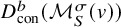 $D^b_{\mathrm {con}}(\mathcal {M}^{\sigma }_S(v))$
and let
$D^b_{\mathrm {con}}(\mathcal {M}^{\sigma }_S(v))$
and let $D_d:=\mathbb {D}\mathbb {Q}\in D^b_{\mathrm {con}}(\mathcal {M}^{\sigma }_S(v))$
be the dualizing complex on
$D_d:=\mathbb {D}\mathbb {Q}\in D^b_{\mathrm {con}}(\mathcal {M}^{\sigma }_S(v))$
be the dualizing complex on $\mathcal {M}^{\sigma }_S(v)=\mathcal {M}^{\sigma }_S(dv_0)$
. Recall the good moduli space map
$\mathcal {M}^{\sigma }_S(v)=\mathcal {M}^{\sigma }_S(dv_0)$
. Recall the good moduli space map
 $$\begin{align*}\pi_d:=\pi\colon\mathcal{M}\to M.\end{align*}$$
The BBDG decomposition theorem holds for $\pi _{d*} D_d\in D^+_{\mathrm {con}}(M^{\sigma }_S(v))$
, see [Reference DavisonDavb, Theorem C]. The BPS sheaf of
$\pi _{d*} D_d\in D^+_{\mathrm {con}}(M^{\sigma }_S(v))$
, see [Reference DavisonDavb, Theorem C]. The BPS sheaf of $M^{\sigma }_S(v)$
is a certain direct summand of the zeroth perverse truncation (which itself is a perverse sheaf on
$M^{\sigma }_S(v)$
is a certain direct summand of the zeroth perverse truncation (which itself is a perverse sheaf on $M^{\sigma }_S(v)$
, see loc. cit.):
$M^{\sigma }_S(v)$
, see loc. cit.):
 $$ \begin{align} {}^p\tau^{{\leqslant} 0}\pi_{d*}D_d\in \mathrm{Perv}(M_S^{\sigma}(v)). \end{align} $$
We now explain the definition of the BPS sheaf. The cohomological Hall product $m=p_*q^*$
for the maps
$m=p_*q^*$
for the maps $p,q$
in (5.1) induces an algebra structure on the
$p,q$
in (5.1) induces an algebra structure on the $\mathbb {N}$
-graded complex
$\mathbb {N}$
-graded complex
 $$\begin{align*}\mathscr{A}:=\bigoplus_{d\in\mathbb{N}} {}^p\tau^{{\leqslant} 0}\pi_{d*}D_d \in \bigoplus_{d\in \mathbb{N}} D^+_{\mathrm{con}}(M_S^{\sigma}(dv_0)) .\end{align*}$$
There is a natural map
 $$\begin{align*}\mathrm{IC}_{M^{\sigma}_S(v)}\to {}^p\tau^{{\leqslant} 0}\pi_{d*}D_d.\end{align*}$$
The main theorem of Davison–Hennecart–Schlegel Mejia [Reference DavisonDHSMb, Theorem C] says that the induced map from the free algebra generated by the intersection complexes is isomorphic to $\mathscr {A}$
:
$\mathscr {A}$
:
 $$ \begin{align*} \mathrm{Free}\left(\bigoplus_{d\in\mathbb{N}}\mathrm{IC}_{M^{\sigma}_S(dv_0)}\right)\xrightarrow{\sim} \mathscr{A}. \end{align*} $$
The BPS sheaves
 $$\begin{align*}\mathcal{BPS}^{\sigma}_S(v)=\mathcal{BPS}^{\sigma}_S(dv_0)\in \mathrm{Perv}\left(M^{\sigma}_S(v)\right)\end{align*}$$
are defined via the free Lie algebra on the intersection complexes
 $$ \begin{align} \mathrm{Free}_{\mathrm{Lie}}\left(\bigoplus_{d\in\mathbb{N}}\mathrm{IC}_{M^{\sigma}_S(v)}\right)=:\bigoplus_{d\in\mathbb{N}}\mathcal{BPS}^{\sigma}_S(dv_0). \end{align} $$
We obtain that:
 $$ \begin{align} \mathrm{Sym}\left(\bigoplus_{d\in\mathbb{N}}\mathcal{BPS}^{\sigma}_S(dv_0)\right)\xrightarrow{\sim}\mathscr{A}. \end{align} $$
A precise formulation for the heuristics that the BPS cohomology is the “primitive” part of the Hall algebra is the following: the relative Hall algebra of S for the multiples of the Mukai vector $v_0$
and stability condition
$v_0$
and stability condition $\sigma $
has a PBW decomposition in terms of BPS sheaves:
$\sigma $
has a PBW decomposition in terms of BPS sheaves:
 $$ \begin{align} \mathrm{Sym}\left(\bigoplus_{d\in\mathbb{N}}\mathcal{BPS}^{\sigma}_S(dv_0)\otimes H^\cdot(B\mathbb{C}^*)\right)\xrightarrow{\sim}\mathscr{H}:=\bigoplus_{d\in\mathbb{N}}\pi_{d*}D_{d}, \end{align} $$
see [Reference DavisonDHSMb, Theorem 1.5], and note that the above isomorphism is of constructible sheaves, not of relative algebras. There is also a version for the absolute Hall algebra [Reference DavisonDHSMb, Corollary 1.6]. The above PBW theorem is the analogue for K3 surfaces of the Davison–Meinhardt PBW theorem for cohomological Hall algebras of quivers with potential [Reference Davison and MeinhardtDM20]. The results in [Reference DavisonDHSMb] cited above hold by a computation of all the simple summands of $\pi _{d*}D_d$
, which satisfies a version of the BBDG/ Saito decomposition theorem due to Davison [Reference DavisonDavc].
$\pi _{d*}D_d$
, which satisfies a version of the BBDG/ Saito decomposition theorem due to Davison [Reference DavisonDavc].
8.2.2 The moduli stack of semistable sheaves on a K3 surface via preprojective algebras
One can describe the map $\pi _d \colon \mathcal {M}_S^{\sigma }(v) \to M_S^{\sigma }(v)$
étale, formally, or analytically locally on the target via preprojective algebras [Reference Arbarello and SaccàAS18], [Reference DavisonDavc, Sections 4 and 5], [Reference Halpern-LeistnerHLa, Theorem 4.3.2], [Reference TodaTod18], Subsections 2.6.2 and 7.4.
$\pi _d \colon \mathcal {M}_S^{\sigma }(v) \to M_S^{\sigma }(v)$
étale, formally, or analytically locally on the target via preprojective algebras [Reference Arbarello and SaccàAS18], [Reference DavisonDavc, Sections 4 and 5], [Reference Halpern-LeistnerHLa, Theorem 4.3.2], [Reference TodaTod18], Subsections 2.6.2 and 7.4.
We will use the setting of Subsection 7.4, see diagrams (7.11) and (7.12). We will continue with the notation from Subsection 7.4.
The quiver $Q^\circ _y$
is totally negative in the sense of [Reference DavisonDHSMb, Section 1.2.3], see [Reference Kaledin, Lehn and SorgerKLS06]. Thus the results in [Reference DavisonDHSMb] about construction of BPS sheaves via intersection complexes apply, so the BPS sheaves
$Q^\circ _y$
is totally negative in the sense of [Reference DavisonDHSMb, Section 1.2.3], see [Reference Kaledin, Lehn and SorgerKLS06]. Thus the results in [Reference DavisonDHSMb] about construction of BPS sheaves via intersection complexes apply, so the BPS sheaves $\mathcal {BPS}^p(\boldsymbol {d})$
of the preprojective algebras of the quiver
$\mathcal {BPS}^p(\boldsymbol {d})$
of the preprojective algebras of the quiver $Q^\circ _y$
have a similar description via intersection complexes (8.3). Then the maps e and
$Q^\circ _y$
have a similar description via intersection complexes (8.3). Then the maps e and $e'$
in the bottom arrows of the diagram (7.12) induce isomorphisms:
$e'$
in the bottom arrows of the diagram (7.12) induce isomorphisms:
 $$ \begin{align} e^*\left(\mathcal{BPS}^{\sigma}_S(v)\right)=e^{\prime*}\left(\mathcal{BPS}^p(\boldsymbol{d})\right). \end{align} $$
Remark 8.2. If we are interested in a local analytic description of $\mathcal {M}^{\sigma }_S(v)$
, then it is possible to choose Y an analytic open subset of
$\mathcal {M}^{\sigma }_S(v)$
, then it is possible to choose Y an analytic open subset of $P(\boldsymbol {d})$
and
$P(\boldsymbol {d})$
and $M^{\sigma }_S(v)$
, that is, we may assume that e and
$M^{\sigma }_S(v)$
, that is, we may assume that e and $e'$
are open inclusions of analytic sets. Thus, locally analytically near p, the preimage of the map
$e'$
are open inclusions of analytic sets. Thus, locally analytically near p, the preimage of the map $\pi _d$
is isomorphic to the preimage of the map
$\pi _d$
is isomorphic to the preimage of the map $\pi _P$
.
$\pi _P$
.
8.3 Topological K-theory and étale covers
We use the shorthand notations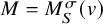 $M=M^{\sigma }_S(v)$
,
$M=M^{\sigma }_S(v)$
,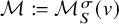 $\mathcal {M}:=\mathcal {M}^{\sigma }_S(v)$
,
$\mathcal {M}:=\mathcal {M}^{\sigma }_S(v)$
,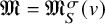 $\mathfrak {M}=\mathfrak {M}^{\sigma }_S(v)$
and
$\mathfrak {M}=\mathfrak {M}^{\sigma }_S(v)$
and
 $$\begin{align*}\mathbb{T}(M)^{\mathrm{red}}:=\mathbb{T}^{\sigma}_S(v)^{\mathrm{red}}_w, \ \mathbb{T}(M):=\mathbb{T}^{\sigma}_S(v)_w.\end{align*}$$
We write the semiorthogonal decomposition for $\mathcal {M}$
as:
$\mathcal {M}$
as:
 $$ \begin{align} D^b(\mathcal{M})=\langle \mathbb{A}(M)^{\mathrm{red}}, \mathbb{T}(M)^{\mathrm{red}}\rangle. \end{align} $$
By the following lemma, it suffices to prove Theorem 8.1 for $\mathbb {T}(M)^{\mathrm {red}}$
. The argument for
$\mathbb {T}(M)^{\mathrm {red}}$
. The argument for $\mathbb {T}(M)$
is the same, but we prefer working with the stack
$\mathbb {T}(M)$
is the same, but we prefer working with the stack $\mathcal {M}$
because the good moduli space map is defined from
$\mathcal {M}$
because the good moduli space map is defined from $\mathcal {M}$
.
$\mathcal {M}$
.
Lemma 8.3. The closed immersion $\iota \colon \mathcal {M} \hookrightarrow \mathfrak {M}$
induces the isomorphism
$\iota \colon \mathcal {M} \hookrightarrow \mathfrak {M}$
induces the isomorphism
 $$ \begin{align*} \iota_{\ast}\colon G^{\mathrm{top}}_\bullet(\mathbb{T}(M)^{\mathrm{red}})\xrightarrow{\sim} G^{\mathrm{top}}_\bullet(\mathbb{T}(M)). \end{align*} $$
Proof. We have the isomorphism
 $$ \begin{align*}\iota_{\ast}\colon G^{\mathrm{top}}_\bullet(\mathcal{M})\xrightarrow{\sim} G^{\mathrm{top}}_\bullet(\mathfrak{M}) \end{align*} $$
since both spaces have the same underlying topological space. Then the lemma holds since $\iota _{\ast }$
sends
$\iota _{\ast }$
sends $\mathbb {T}(M)^{\mathrm {red}}$
to
$\mathbb {T}(M)^{\mathrm {red}}$
to $\mathbb {T}(M)$
.
$\mathbb {T}(M)$
.
The semiorthogonal decomposition in Theorem 5.2 holds étale locally over M by [Reference PădurariuPTe, Section 9] and the diagram (7.12). Indeed, let $R\to M$
be an étale map which factors through
$R\to M$
be an étale map which factors through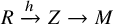 $R\xrightarrow {h} Z\to M$
as in (7.12). Let
$R\xrightarrow {h} Z\to M$
as in (7.12). Let $\mathcal {R}:=\mathcal {M}^\sigma _S(v)\times _{M^\sigma _S(v)} R$
. By [Reference PădurariuPTe, Section 9], there is a semiorthogonal decomposition:
$\mathcal {R}:=\mathcal {M}^\sigma _S(v)\times _{M^\sigma _S(v)} R$
. By [Reference PădurariuPTe, Section 9], there is a semiorthogonal decomposition:
 $$ \begin{align} D^b(\mathcal{R})=\langle \mathbb{A}(R)^{\mathrm{red}}, \mathbb{T}(R)^{\mathrm{red}}\rangle \end{align} $$
such that for an étale map $b\colon R'\to R$
, the pull-back
$b\colon R'\to R$
, the pull-back $b^{\ast }$
induce functors
$b^{\ast }$
induce functors
 $$ \begin{align*} b^{\ast} \colon \mathbb{A}(R)^{\mathrm{red}} \to \mathbb{A}(R')^{\mathrm{red}}, \ b^{\ast} \colon \mathbb{T}(R)^{\mathrm{red}} \to \mathbb{T}(R')^{\mathrm{red}}. \end{align*} $$
Consider étale covers
 $$\begin{align*}U=(Z\xrightarrow{e} M),\, \mathcal{U}=(\mathcal{Z}\xrightarrow{e}\mathcal{M}) \end{align*}$$
generated by the étale covers $Z\to M$
as in (7.12).
$Z\to M$
as in (7.12).
Consider the presheaves of spectra $\mathcal {K}$
,
$\mathcal {K}$
, $\mathcal {A}$
and
$\mathcal {A}$
and $\mathcal {T}$
on U defined as follows: for
$\mathcal {T}$
on U defined as follows: for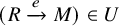 $(R\xrightarrow {e}M)\in U$
(and dropping e from the notation), we have:
$(R\xrightarrow {e}M)\in U$
(and dropping e from the notation), we have:
 $$\begin{align*}\mathcal{K}(R)=G^{\mathrm{top}}(\mathcal{R}),\, \mathcal{A}(R)=K^{\mathrm{top}}(\mathbb{A}(R)^{\mathrm{red}}),\, \mathcal{T}(R)=K^{\mathrm{top}}(\mathbb{T}(R)^{\mathrm{red}}).\end{align*}$$
By [Reference PădurariuPTe, Theorem 9.2], there is a direct sum of presheaves of spectra on U:
 $$ \begin{align} \mathcal{K}=\mathcal{A}\oplus\mathcal{T}. \end{align} $$
Let $\mathcal {F}$
be a presheaf of spectra and consider a cover
$\mathcal {F}$
be a presheaf of spectra and consider a cover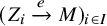 $(Z_i\xrightarrow {e} M)_{i\in I}$
as in the diagram (7.12) for a set I. Consider the cosimplicial sheaf of spectra:
$(Z_i\xrightarrow {e} M)_{i\in I}$
as in the diagram (7.12) for a set I. Consider the cosimplicial sheaf of spectra:

which can be used to compute the cohomology of the sheafification of $\mathcal {F}$
, and which can be also related to Čech cohomology
$\mathcal {F}$
, and which can be also related to Čech cohomology  , see [Reference ThomasonTho85, Definition 1.33, Remark 1.38]. There is a natural map

For a presheaf of spectra $\mathcal {F}$
and for
$\mathcal {F}$
and for $i\in \mathbb {Z}$
, denote by
$i\in \mathbb {Z}$
, denote by $\mathcal {F}_i=\pi _i\mathcal {F}$
the corresponding presheaf of abelian groups and by
$\mathcal {F}_i=\pi _i\mathcal {F}$
the corresponding presheaf of abelian groups and by $\mathcal {F}_i^s$
the sheafification of
$\mathcal {F}_i^s$
the sheafification of $\mathcal {F}_i$
.
$\mathcal {F}_i$
.
Proposition 8.4. The map (8.10) induces a weak equivalence of spectra:

Thus there is a spectral sequence

Proof. The above statement is proved for (rational) algebraic K-theory by Thomason in [Reference ThomasonTho85, theorem 2.15, Corollary 2.16, Corollary 2.17]. The proof in loc. cit. also applies to the easier case of (rational) topological K-theory. Indeed, pushforward maps along étale maps exist on topological K-theory, so topological K-theory satisfies the weak transfer property [Reference ThomasonTho85, Definition 2.12], thus topological K-theory has etale cohomological descent [Reference ThomasonTho85, Proposition 2.14], and then the statement of [Reference ThomasonTho85, Theorem 2.15] also holds for topological K-theory.
Alternatively, the analogous statement holds for singular cohomology [Reference MilneMil80, Chapter III, Theorem 2.17], then by a standard dévissage argument also for Borel-Moore homology, and then the statement for topological K-theory can be obtained using [Reference PădurariuPTe, Proposition 3.1].
Remark 8.5. Even more, the presheaf $\mathcal {K}$
is a sheaf of spectra. Indeed, let
$\mathcal {K}$
is a sheaf of spectra. Indeed, let $\mathcal {K}^s$
be the sheafification of
$\mathcal {K}^s$
be the sheafification of $\mathcal {K}$
. For any
$\mathcal {K}$
. For any $(E\to M)\in \mathrm {Et}(M)$
, we can compute the sections
$(E\to M)\in \mathrm {Et}(M)$
, we can compute the sections $\mathcal {K}^s(E)$
using Čech cohomology for a cover
$\mathcal {K}^s(E)$
using Čech cohomology for a cover $U_E$
of E:
$U_E$
of E:

By the same argument as in Proposition 8.4, we also have that  , thus $\mathcal {K}$
is indeed a sheaf.
$\mathcal {K}$
is indeed a sheaf.


Proof. The map $\eta _{\mathcal {K}}=\eta _{\mathcal {A}}\oplus \eta _{\mathcal {T}}$
is an isomorphism by Proposition 8.4, so
$\eta _{\mathcal {K}}=\eta _{\mathcal {A}}\oplus \eta _{\mathcal {T}}$
is an isomorphism by Proposition 8.4, so $\eta _{\mathcal {T}}$
is also an isomorphism.
$\eta _{\mathcal {T}}$
is also an isomorphism.
Let $\mathcal {H}_q$
be the presheaf of
$\mathcal {H}_q$
be the presheaf of $\mathbb {Q}$
-vector spaces such that, for
$\mathbb {Q}$
-vector spaces such that, for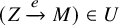 $(Z\xrightarrow {e}M)\in U$
, we have
$(Z\xrightarrow {e}M)\in U$
, we have
 $$\begin{align*}\mathcal{H}_q(Z)=H^{\mathrm{BM}}_q(\mathcal{Z}).\end{align*}$$
Then $\mathcal {H}_q=\pi _q\mathcal {H}$
, where
$\mathcal {H}_q=\pi _q\mathcal {H}$
, where $\mathcal {H}$
is the presheaf of Eilenberg-MacLane spectra. As for
$\mathcal {H}$
is the presheaf of Eilenberg-MacLane spectra. As for $\mathcal {K}$
, the presheaf
$\mathcal {K}$
, the presheaf $\mathcal {H}$
is actually a sheaf. There is a spectral sequence analogous to (8.11):
$\mathcal {H}$
is actually a sheaf. There is a spectral sequence analogous to (8.11):

see the proof of Proposition 8.4.
Proposition 8.7. We have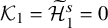 $\mathcal {K}_1=\widetilde {\mathcal {H}}^s_1=0$
. Thus the terms
$\mathcal {K}_1=\widetilde {\mathcal {H}}^s_1=0$
. Thus the terms $E_{p,q}$
from (8.11) and
$E_{p,q}$
from (8.11) and $E^{\prime }_{p,q}$
from (8.12) vanish for q odd.
$E^{\prime }_{p,q}$
from (8.12) vanish for q odd.
Proof. By [Reference PădurariuPTe, Proposition 3.1], it suffices to check that $\widetilde {\mathcal {H}}^s_{1}=0$
. It suffices to check that the stalks of
$\widetilde {\mathcal {H}}^s_{1}=0$
. It suffices to check that the stalks of $\widetilde {\mathcal {H}}^s_{1}$
over
$\widetilde {\mathcal {H}}^s_{1}$
over $y\in M$
are zero. We can define spectra
$y\in M$
are zero. We can define spectra $\mathcal {H}^{\mathrm {an}}$
in the analytic topology, and
$\mathcal {H}^{\mathrm {an}}$
in the analytic topology, and $\mathcal {H}^{\mathrm {an}}_y\cong \mathcal {H}_y$
for any
$\mathcal {H}^{\mathrm {an}}_y\cong \mathcal {H}_y$
for any $y\in M$
, which follows as in [Reference MilneMil80, Chapter III, Theorem 3.12]. It thus suffices to check that
$y\in M$
, which follows as in [Reference MilneMil80, Chapter III, Theorem 3.12]. It thus suffices to check that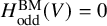 $H^{\mathrm {BM}}_{\mathrm {odd}}(V)=0$
for a system of open sets
$H^{\mathrm {BM}}_{\mathrm {odd}}(V)=0$
for a system of open sets $V\subset M$
. By the local description from Subsection 8.2.2, we may assume that
$V\subset M$
. By the local description from Subsection 8.2.2, we may assume that $V\subset P(\boldsymbol {d})$
is an open neighborhood of the origin, where
$V\subset P(\boldsymbol {d})$
is an open neighborhood of the origin, where $P(\boldsymbol {d})$
is the coarse space of dimension
$P(\boldsymbol {d})$
is the coarse space of dimension $\boldsymbol {d}$
representations of the preprojective algebra of the Ext-quiver
$\boldsymbol {d}$
representations of the preprojective algebra of the Ext-quiver $Q^\circ _y$
.
$Q^\circ _y$
.
Consider the action of $\mathbb {C}^*$
on spaces of representations of the double quiver of
$\mathbb {C}^*$
on spaces of representations of the double quiver of $Q^\circ _y$
, which acts with weight one. It induces a scaling action on
$Q^\circ _y$
, which acts with weight one. It induces a scaling action on $P(\boldsymbol {d})$
which contracts it onto
$P(\boldsymbol {d})$
which contracts it onto $0$
. We can choose a system of open sets
$0$
. We can choose a system of open sets $0\in V\subset P(\boldsymbol {d})$
such that V is homeomorphic to
$0\in V\subset P(\boldsymbol {d})$
such that V is homeomorphic to $P(\boldsymbol {d})$
and
$P(\boldsymbol {d})$
and $\pi _{P}^{-1}(V)$
is homeomorphic to
$\pi _{P}^{-1}(V)$
is homeomorphic to $\mathcal {P}(\boldsymbol {d})$
. It then suffices to check that
$\mathcal {P}(\boldsymbol {d})$
. It then suffices to check that $H^{\mathrm {BM}}_{\mathrm {odd}}(\mathcal {P}(\boldsymbol {d}))=0$
, which was proved by Davison in [Reference DavisonDavb, Theorem A].
$H^{\mathrm {BM}}_{\mathrm {odd}}(\mathcal {P}(\boldsymbol {d}))=0$
, which was proved by Davison in [Reference DavisonDavb, Theorem A].
Let $i\in \mathbb {Z}$
. Consider the Chern character for the quotient stack
$i\in \mathbb {Z}$
. Consider the Chern character for the quotient stack $\mathcal {M}$
:
$\mathcal {M}$
:
 $$\begin{align*}\mathrm{ch}\colon G^{\mathrm{top}}_i(\mathcal{M})\to \widetilde{H}^{\mathrm{BM}}_i(\mathcal{M}),\end{align*}$$
see [Reference PădurariuPTe, Subsection 3.1]. There are analogous such Chern characters for $\mathcal {Z}$
with
$\mathcal {Z}$
with $(e\colon \mathcal {Z}\to \mathcal {M})\in \mathcal {U}$
. By Proposition 8.7, there are compatible spectral sequences with terms for bidegrees:
$(e\colon \mathcal {Z}\to \mathcal {M})\in \mathcal {U}$
. By Proposition 8.7, there are compatible spectral sequences with terms for bidegrees:

Let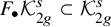 $F_{\bullet } \mathcal {K}_{2g}^s\subset \mathcal {K}_{2g}^s$
and
$F_{\bullet } \mathcal {K}_{2g}^s\subset \mathcal {K}_{2g}^s$
and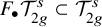 $F_{\bullet } \mathcal {T}_{2g}^s\subset \mathcal {T}_{2g}^s$
be the increasing filtrations defined by
$F_{\bullet } \mathcal {T}_{2g}^s\subset \mathcal {T}_{2g}^s$
be the increasing filtrations defined by
 $$ \begin{align*} F_j \mathcal{K}_{2q}^s =\operatorname{ch}^{-1}(\mathcal{H}_{{\leqslant} 2q+2j}^s), \ F_j \mathcal{T}_{2g}^s=\mathcal{T}_{2g}^s \cap F_j \mathcal{K}_{2q}^s. \end{align*} $$
We denote by $\mathrm {gr}_{\bullet }$
the associated grading with respect to the above filtrations. We obtain compatible spectral sequences:
$\mathrm {gr}_{\bullet }$
the associated grading with respect to the above filtrations. We obtain compatible spectral sequences:

where the cycle maps $\mathrm {c}$
are isomorphisms by [Reference PădurariuPTe, Proposition 3.1].
$\mathrm {c}$
are isomorphisms by [Reference PădurariuPTe, Proposition 3.1].
Proposition 8.8. The image of the map $d\mathrm {c}\alpha $
is
$d\mathrm {c}\alpha $
is $H^{-i-2j}(\mathcal {M}, \mathcal {BPS}_{v,w})$
.
$H^{-i-2j}(\mathcal {M}, \mathcal {BPS}_{v,w})$
.
Proof. By [Reference PădurariuPTe, Theorem 9.2], the image of $\mathrm {c}\alpha $
is the bi-graded complex with terms
$\mathrm {c}\alpha $
is the bi-graded complex with terms  . The restriction of d to $E^\circ _{p,q}$
corresponds to the Čech spectral sequence for
$E^\circ _{p,q}$
corresponds to the Čech spectral sequence for $\mathcal {BPS}_{v,w}$
:
$\mathcal {BPS}_{v,w}$
:
 $$\begin{align*}d\colon E^{\circ}_{p,q}\implies H^{-i-2j}(M, \mathcal{BPS}_{v,w}).\end{align*}$$
The conclusion then follows.
We obtain the following:
Theorem 8.9. For any $i\in \mathbb {Z}$
, there is an isomorphism
$i\in \mathbb {Z}$
, there is an isomorphism
 $$\begin{align*}\mathrm{c}\colon \mathrm{gr}_jK^{\mathrm{top}}_i(\mathbb{T}^{\sigma}_S(v)^{\mathrm{red}}_w)\xrightarrow{\sim} H^{-i-2j}\left(M^{\sigma}_S(v), \mathcal{BPS}_{v,w}\right).\end{align*}$$
Proof of Theorem 8.1
By Theorem 8.9 and Lemma 8.3, it suffices to check that there is a noncanonical isomorphism $K^{\mathrm {top}}_i(\mathbb {T}^{\sigma }_S(v)^{\mathrm {red}}_w)\cong \bigoplus _{j\in \mathbb {Z}}\mathrm {gr}_j K^{\mathrm {top}}_i(\mathbb {T}^{\sigma }_S(v)^{\mathrm {red}}_w)$
. It suffices to check that the Chern character
$K^{\mathrm {top}}_i(\mathbb {T}^{\sigma }_S(v)^{\mathrm {red}}_w)\cong \bigoplus _{j\in \mathbb {Z}}\mathrm {gr}_j K^{\mathrm {top}}_i(\mathbb {T}^{\sigma }_S(v)^{\mathrm {red}}_w)$
. It suffices to check that the Chern character
 $$\begin{align*}\mathrm{ch}\colon K^{\mathrm{top}}_i(\mathbb{T}^{\sigma}_S(v)^{\mathrm{red}}_w)\hookrightarrow G^{\mathrm{top}}_i(\mathcal{M}^\sigma_S(v))\to \widetilde{H}^{\mathrm{BM}}_i(\mathcal{M}^\sigma_S(v))\end{align*}$$
is injective. By the diagram (8.13), it suffices to check that the following Chern character is injective
 $$\begin{align*}\mathrm{ch}\colon K^{\mathrm{top}}_i(\mathbb{T}(R)^{\mathrm{red}})\hookrightarrow G^{\mathrm{top}}_i(\mathcal{R})\to \widetilde{H}^{\mathrm{BM}}_i(\mathcal{R}),\end{align*}$$
where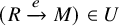 $(R\xrightarrow {e} M)\in U$
. This was proved in [Reference PădurariuPTe, Proposition 9.9].
$(R\xrightarrow {e} M)\in U$
. This was proved in [Reference PădurariuPTe, Proposition 9.9].
Acknowledgments
We thank Tasuki Kinjo, Davesh Maulik, Yalong Cao, Junliang Shen, Georg Oberdieck, and Jørgen Rennemo for discussions related to this work. The project of this paper started when Y. T. was visiting Columbia University in April 2023. Y. T. thanks Columbia University for their hospitality.
Competing interests
The authors have no competing interest to declare.
Financial support
T. P. is grateful to Columbia University in New York and to Max Planck Institute for Mathematics in Bonn for their hospitality and financial support during the writing of this paper. Y. T. is supported by World Premier International Research Center Initiative (WPI initiative), MEXT, Japan, and Inamori Research Institute for Science, and JSPS KAKENHI Grant Numbers JP19H01779, JP24H00180.


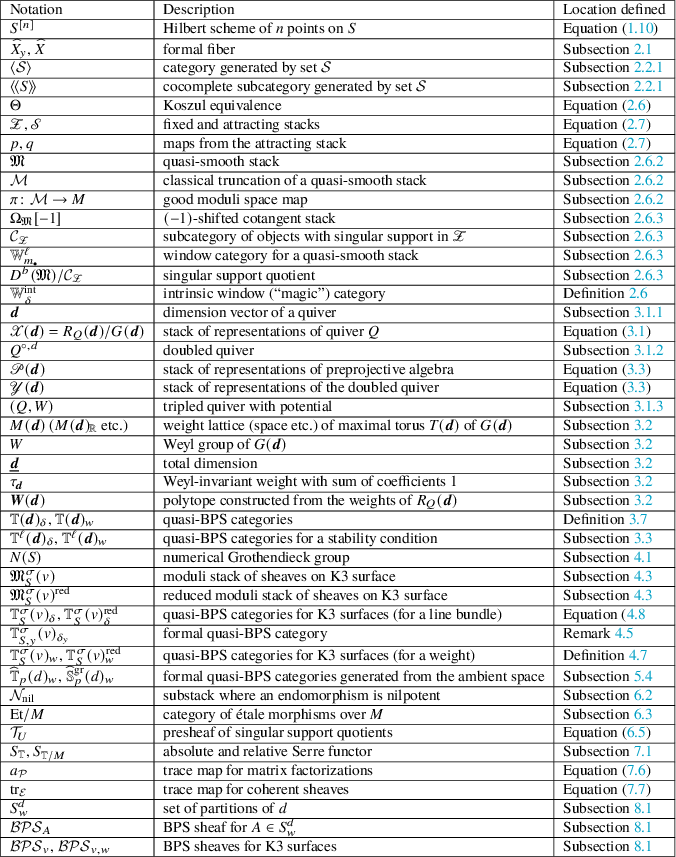

 Open access

