


Introduction
Fish of the genus Trichiurus (Scombriformes: Trichiuridae), commonly known as cutlassfish or hairtails, are benthopelagic species that play an important ecological role as regulators of lower trophic-level populations. Their diet includes fish, crustaceans, and cephalopods, positioning them as key predators within marine ecosystems and contributing to the balance and energy flow in food webs (Shin et al., Reference Shin, Park, Lee, Jeong, Lee, Kang and Park2022; Yan et al., Reference Yan, Hou, Chen, Lu and Jin2011). In addition to their ecological importance, cutlassfish hold substantial commercial value, particularly in East Asian countries such as China, India, Japan, and Korea, where they constitute a major component of global fisheries catches, supporting both local economies and food security (Ghosh et al., Reference Ghosh, Rohit, Muthurathinam, Rajesh, Koya, Anulekshmi, Nakhwa, Surya, Manas, Roul, Azeez and Kumar2024; Liao et al., Reference Liao, Karim and Zhang2021; Shin et al., Reference Shin, Kim, Kim, Kwon, Choi, Park and Lee2023; Watari et al., Reference Watari, Tokumitsu, Hirose, Ogawa and Makino2017). Trichiurus currently comprises 10 valid species (Froese and Pauly, Reference Froese and Pauly2024), with T. lepturus being the only circumtropical taxon. While Trichiurus nitens was historically synonymized with T. lepturus, recent studies recognize it as a distinct Eastern Pacific species (Burhanuddin and Parin, Reference Burhanuddin and Parin2008; Fricke et al., Reference Fricke, Eschmeyer and der Laan R2024; Yi et al., Reference Yi, Hsu, Gu, He, Luo, Lin and Yan2022), ranging from California to Peru.
The Gulf of California is one of the most biodiverse marine ecosystems globally and an essential fishing ground for Mexico. It is home to a wide range of species, including many endemics, and supports critical habitats like mangroves, coral reefs, and seagrass beds. However, the region faces significant environmental pressures, including overfishing, habitat loss, and the impacts of climate change (Arreguín-Sánchez et al., Reference Arreguín-Sánchez, del Monte-Luna, Zetina-Rejón and Albáñez-Lucero2017; Lluch-Cota et al., Reference Lluch-Cota, Aragón-Noriega, Arreguín-Sánchez, Aurioles-Gamboa, Bautista-Romero, Brusca, Cervantes-Duarte, Cortés-Altamirano, Del-Monte-Luna, Esquivel-Herrera and Fernández2007; Páez-Osuna et al., Reference Páez-Osuna, Sánchez-Cabeza, Ruiz-Fernández, Piñón-Gimate, Cardoso-Mohedano, Flores-Verdugo, Carballo, Cisneros-Mata and Álvarez-Borrego2016). Particularly, the eastern portion of the Gulf experiences high fishing effort (Moreno-Baez et al., Reference Moreno-Baez, Girón-Nava, Aburto-Oropeza, Johnson, Corominas, Erisman and Ezcurra2015). This situation represents a threat for both the biodiversity of the Gulf and the sustainability of its fisheries, which are vital for the local economy and food security.
Trichiurus nitens is a documented component of fish assemblages in the Gulf of California (Amezcua and Amezcua-Linares, Reference Amezcua and Amezcua-Linares2014). Despite its presence, the species has received little attention in scientific literature. Technical reports indicate that it is commonly caught in the Gulf’s fishing grounds (Vallarta-Zárate et al., Reference Vallarta-Zárate, Huidobro-Campos, Vásquez-Ortiz, Martínez-Magaña, Osuna-Soto, Pérez-Flores, Altamirano-López, Jacob-Cervantes, Hernández-Cruz and Rojas-González2023), yet its ecological relevance remains largely unexplored. This lack of research may be attributed to the fact that T. nitens holds no commercial value in the region, limiting its scientific attention. Nonetheless, it is known that environment pressures can change species abundances, potentially elevating previously overlooked species into more prominent ecological or economic roles (Link, Reference Link2007). Therefore, recognizing the ecological importance of underappreciated fish species is critical for tracking and maintaining the functional diversity of an ecosystem in a changing world (Link, Reference Link2007).
The ecology of a fish species can often be partially understood through the study of its parasites, as these organisms are intricately linked to various aspects of their host’s biology, including distribution patterns, habitat selection, and diet composition (Jacobson et al., Reference Jacobson, Marcogliese and MacKenzie2024; Timi and Poulin, Reference Timi and Poulin2020). For example, fish with broad dietary ranges tend to host more abundant, rich, and diverse communities of food-transmitted parasites compared to those with a restricted prey spectrum (Dallarés et al., Reference Dallarés, Moyà-Alcover, Padrós, Cartes, Solé, Castañeda and Carrassón2016; Knudsen et al., Reference Knudsen, Klemetsen and Staldvik1996). Likewise, shifts in parasite populations or community structures can serve as indicators of host population structure (George-Nascimento and Oliva, Reference George-Nascimento and Oliva2015; Lester and Moore, Reference Lester and Moore2015). In this context, the present study aimed to document the parasite fauna of T. nitens from four locations in the eastern Gulf of California, Mexico, providing clues to the species’ ecological characteristics, including its feeding habits and population connectivity.
Methods
Fish and parasites sampling
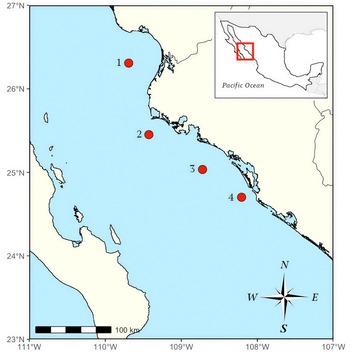
Fish samples were collected from fishing hauls conducted at four locations in the eastern Gulf of California during April–May 2024 (Figure 1 and Table 1). The hauls were performed as part of a research cruise aboard the R/V Dr. Jorge Carranza Fraser, operated by the Instituto Mexicano de Investigación en Pesca y Acuacultura Sustentables (IMIPAS). A midwater net with four equal panels (top and bottom footrope length: 48.17 m) was used, deployed at an average speed of 6.5 km/h for 45 minutes at a depth of 25–30 m, in water with an average temperature of approximately 23ºC. In total 165 fish identified as T. nitens were collected and frozen for later examination. Species identification was carried out onboard the vessel by ichthyologists from IMIPAS.
Study area with sampling locations across the eastern Gulf of California. 1: Yavaros; 2: Topolobampo; 3: Las Glorias; 4: El Tambor.

Sample characteristics of Trichiurus nitens collected from four locations in the eastern Gulf of California

n = sample size; TL = total length ± standard deviation; SST = sea surface temperature.
For parasitological examination, fish were thawed and measured for total length (TL, in cm). The external surfaces, gills, body cavities, and internal organs were then carefully examined under a stereomicroscope to detect metazoan parasites. All observed parasites were counted. Trematodes and monogeneans were processed using standard morphological identification techniques (Salgado-Maldonado, Reference Salgado-Maldonado2009; Vidal-Martínez et al., Reference Vidal-Martínez, Aguirre-Macedo, Scholz, González-Solís and Mendoza-Franco2001). Nematodes and some trematodes were fixed and preserved in 96% ethanol for subsequent molecular identification.
Molecular identification
DNA extraction and amplification were carried out following established protocols (Hernández-Mena et al., Reference Hernández-Mena, García-Varela and Pérez-Ponce de León2017; Shamsi et al., Reference Shamsi, Briand and Justine2017). For trematodes, the 28S rDNA region was amplified using primers 391 (5′-AGCGGAGGAAAAGAAACTAA-3′) and 536 (5′-CAGCTATCCTGAGGGAAAC-3′) (García-Varela and Nadler, Reference García-Varela and Nadler2005; Nadler and Hudspeth, Reference Nadler and Hudspeth1998). For nematodes, the ITS-1 region was targeted with primers SS1 (5′-GTTTCCGTAGGTGAACCTGCG-3′) and NC13R (5′-GCTGCGTTCTTCATCGAT-3′), while the ITS-2 region used SS2 (5′-TTGCAGACACATTGAGCACT-3′) and NC2 (5′-TTAGTTTCTTTTCCTCCGCT-3′) (Zhang et al., Reference Zhang, Hu, Shamsi, Beveridge, Li, Xu, Li, Cantacessi and Gasser2007; Zhu et al., Reference Zhu, Gasser, Podolska and Chilton1998). PCR products were sequenced on an ABI 3730xl Genetic Analyzer (Applied Biosystems, Foster City, CA, USA). The resulting sequences were analyzed, edited, and assembled using the software Geneious Pro 4.8.4 software (Biomatters Ltd., Auckland, New Zealand). Sequence similarities were determined via BLAST searches against the GenBank nucleotide database. All newly generated sequences have been deposited in GenBank (Table 2, Supplementary Table S1). For phylogenetic analyses, datasets were generated using Mesquite 3.62 (https://www.mesquiteproject.org/) with the newly obtained sequences in this study and sequences published in GenBank, including those selected in previous studies (Chan-Martin et al., Reference Chan-Martin, Castellanos-Martínez, Aguirre-Macedo and Martínez-Aquino2022; Mattiucci et al., Reference Mattiucci, Cipriani, Webb, Paoletti, Marcer, Bellisario, Gibson and Nascetti2014). A total of two data matrices were generated: one for trematodes with DNA sequences of the 28S marker and another for nematodes with the ITS-1 and ITS-2 markers. In the case of nematodes, the ITS-1 and ITS-2 regions were combined into a single analysis. The matrices were aligned using the default parameters (Pairwise Alignment: SLOW/ACCURATE) of ClustalW (Thompson et al., Reference Thompson, Higgins and Gibson1994) implemented on the website: https://www.genome.jp/tools-bin/clustalw. The nucleotide substitution model that best fit the aligned datasets was inferred with jModelTest v2 (Darriba et al., Reference Darriba, Taboada, Doallo and Posada2012). The method used to determine phylogenetic relationships was maximum likelihood (ML), which was implemented in RAxML v. 7.0.4 (Stamatakis, Reference Stamatakis2006). The reliability of the phylogenetic relationships was assessed via non-parametric bootstrap analysis with 1000 replicates.
Parasite infection parameters in Trichiurus nitens across four localities in the Gulf of California, Mexico

A = adult; L = larva; P% = prevalence; MI = median intensity.
Note: Values within parenthesis represent 95% confidence intervals.
a Sample too small to calculate the confidence limits for median intensity.
Parasitological metrics for population and community analysis
Parasite data were analyzed at both the population and infracommunity levels following Bush et al. (Reference Bush, Lafferty, Lotz and Shostak1997). At the population level, prevalence (percent of infected fish) and median intensity (median number of parasites per infected fish) were calculated for each parasite species at each location. At the infracommunity level, only the species richness and the total number of parasite individuals were measured, as most fish were either uninfected or hosted only a single parasite species. Similarity in parasite assemblages among individual fish hosting parasites was quantified using Bray–Curtis distances, calculated on square-root-transformed abundance data to reduce the dominance of highly abundant taxa in the analysis. Uninfected fish were excluded from these analyses. To visualize patterns related to sampling locations, non-metric multidimensional scaling (nMDS) was performed using the similarity matrix. To enhance visualization, distances between the centroids of each sample were plotted by bootstrap averaging the original dataset (75 iterations with replacement; rho coefficient = 0.99). Statistical differences among locations were evaluated using a one-way permutational multivariate analysis of variance (PERMANOVA), incorporating fish TL as a covariate and ‘location’ as a factor. A sequential sum of squares (Type I SS) approach was applied to account for the covariate. All analyses were conducted using PRIMER v7 and the PERMANOVA + for PRIMER package (Anderson et al., Reference Anderson, Gorley and Clarke2008; Clarke and Gorley, Reference Clarke and Gorley2015).
Results
Five parasite species were identified: the trematode Lecithochirium sinaloense, the monogenean Octoplectanocotyla travassosi, and three nematodes – Anisakis typica A, Skrjabinisakis brevispiculata, and Spinitectus sp. (Table 2). Identification was based on a combination of morphological and molecular data for the trematode, morphology alone for the monogenean and Spinitectus, and molecular data only for the two anisakids.
Anisakid larvae were initially separated into two morphotypes based on ventricular characteristics and body length: Anisakidae gen. sp. 1, approximately 1 mm in length, had a large ventricle relative to body size; Anisakidae gen. sp. 2, approximately 25 mm long, exhibited a small ventricle. This classification followed the ventricular size criterion proposed by Safonova et al. (Reference Safonova, Voronova and Vainutis2021). Molecular analysis (ITS-1 and ITS-2 regions) of three larvae from gen. sp. 1 and two from gen. sp. 2 confirmed that these morphotypes corresponded to distinct species: gen. sp. 1 showed 100% similarity to A. typica A and gen. sp. 2 to S. brevispiculata in BLAST, as supported by phylogenetic analysis (Figure 2, Supplementary Table S1).
Maximum-likelihood phylogenetic tree of concatenated ITS-1 and ITS-2 sequences from anisakid nematodes. Terminal labels show species names and GenBank accession numbers (sequences from this study in bold). Bootstrap support values are shown at nodes. The tree was rooted with Skrjabinisakis paggiae and Skrjabinisakis physeteris as outgroups. Scale bar indicates nucleotide substitutions per site.

For the trematode, 28S sequences were obtained from seven specimens. BLAST searches and phylogenetic analyses placed these specimens within the genus Lecithochirium, particularly as a sister species to L. synodi and L. microstomum (Figure 3, Supplementary Table S1). Morphologically, our specimens were identified as L. sinaloense by a combination of characters such as the presence of a presomatic pit glandular, the sucker ratio (1:2.9–3.9 × 1:2.7–3.5), shape of the vitelline masses, and egg size (21–23 × 13–15).
Maximum-likelihood phylogenetic tree of 28S sequences from hemiurids. Terminal labels show species names and GenBank accession numbers (sequences from this study in bold). Bootstrap support values are shown at nodes. Lecithaster gibbosus, Merlucciotrema praeclarum, and Bunocotyle progenetica were used as outgroup. Scale bar indicates nucleotide substitutions per site.

Among the five parasite species found in T. nitens, L. sinaloense was the only one occurring in all four sampling locations (Figure 4) and the most notable in terms of prevalence and infection intensity, followed by O. travassosi, while the nematodes were infrequently encountered (Table 2). Fish from three locations – Yavaros, Las Glorias, and El Tambor – were small, all measuring around 25 cm in length, and fish from Topolobampo were large, measuring an average of 75 cm (Table 1). In small fish, L. sinaloense reached a prevalence of 40% and median intensity of 1, whereas in large fish these values were 85% and 25, respectively. Likewise, in small fish, O. travassosi reached a prevalence of 11% and median intensity if 1, whereas in large fish these values were 60% and 4, respectively (Table 2).
Spatial variation in parasite community composition of Trichiurus nitens across sampling locations in the Gulf of California. Pie charts represent the relative abundance (%) of each parasite species, coded by colour: (1) Lecithochirium sinaloense (blue), (2) Octoplectanocotyla travassosi (green), (3) Anisakis typica (red), (4) Skrjabinisakis brevispiculata (yellow), and (5) Spinitectus sp. (pink). Size proportions reflect actual abundance ratios among species at each site.

The examined fish showed depauperate parasite infracommunities (Figure 5). About half of the small fish were free of parasites, while the rest were parasitized by one or two species, with an average of fewer than three individual parasites per fish (Figure 5). In contrast, 90% of the large fish were parasitized by one to three species, with an average of 42 individual parasites per fish.
Parasite infracommunities of Trichiurus nitens across four localities in the Gulf of California, Mexico. (A) Relative parasite species richness represented in greyscale: white = 0 parasite species, medium grey = 1 parasite species, light grey = 2 parasite species, dark grey = 3 parasite species. (B) Average number of parasite individuals (bars indicate standard error).

The analysis of infracommunity similarity across locations excluded Topolobampo, as fish sizes from this site were not comparable to those from the other three locations. The bootstrap-average-based nMDS ordination of infracommunities (Figure 6) did not reveal a clear separation among samples, with a low value of stress (0.03), indicating a good fit. This lack of differentiation was further supported by the PERMANOVA analysis (Table 3), which showed no significant differences among the parasite assemblages of fish from Yavaros, Las Glorias, and El Tambor.
Non-metric multi-dimensional scaling plot (nMDS) of bootstrap averages of parasite infracommunities in three samples of Trichiurus nitens from the Gulf of California, based on Bray–Curtis dissimilarity of square root-transformed data of abundance. Black full symbols represent the overall centroids across all repetitions. Blue circles: El Tambor; red triangles: Las Glorias; and green squares: Yavaros. Colours areas represent 95% confidence regions.

PERMANOVA results of square-root-transformed abundance of parasites of Trichiurus nitens in three samples from the Gulf of California, based on the Bray–Curtis dissimilarity measure with host length as covariable. P-values obtained after 9999 permutations

df = degrees freedom; SS = sum of squares; MS = mean square.
Discussion
Comments on the parasite fauna of T. nitens
Thus far, no parasitological studies have focused on T. nitens, limiting direct comparisons. Of the 11 species of Trichiurus, parasitological research has predominantly focused on T. lepturus, likely due its commercial importance. In fact, these studies often emphasize the identification of anisakid nematodes because of their zoonotic relevance (e.g., Cipriani et al., Reference Cipriani, Giulietti, Shayo, Storesund, Bao, Palomba, Mattiucci and Levsen2022; Kim et al., Reference Kim, Nam and Jeon2016).
The parasite species identified in this study have previously been reported in other fish host species and geographical regions. Anisakis typica (s.l.) is one of the most common anisakid nematodes in warm temperate and tropical waters, occurring as an adult in various dolphin species and as a larva in multiple fish species worldwide, including T. lepturus from Korea and the Southwest Indian Ocean (Cipriani et al., Reference Cipriani, Giulietti, Shayo, Storesund, Bao, Palomba, Mattiucci and Levsen2022; Lee et al., Reference Lee, Cheon and Choi2009; Mattiucci et al., Reference Mattiucci, Palomba, Cavallero, D’Amelio and Bruschi2022). Previous studies have reported A. typica (s.l.) in the fish Trachinotus rhodopus (Carangidae) from Puerto Ángel, Oaxaca, and in the dolphin Stenella longirostris (Delphinidae) from La Paz, Baja California Sur (Aguilar-Aguilar et al., Reference Aguilar-Aguilar, Moreno-Navarrete, Salgado-Maldonado and Villa-Ramírez2001; Martínez-Flores et al., Reference Martínez-Flores, García-Prieto, Bastida-Zavala and Oceguera-Figueroa2023). Thus, the present study further confirms the presence of A. typica (s.l.) in the Mexican Pacific, including the Gulf of California.
The phylogenetic analysis provides additional resolution for this taxon. Our sequences clustered within A. typica sp. A, as defined by Cipriani et al. (Reference Cipriani, Giulietti, Shayo, Storesund, Bao, Palomba, Mattiucci and Levsen2022), who also reported the occurrence of A. typica sp. B in sympatry with sp. A in T. lepturus. This placement indicates phylogenetic affinity with Indo-Pacific populations and suggests that A. typica sp. A has a broader distribution than previously documented, now including the Eastern Pacific. In our material, A. typica sp. B was not detected. The detection of A. typica sp. A in the Gulf of California expands both the known host range (now including T. nitens) and the geographic distribution of this lineage. Cipriani et al. (Reference Cipriani, Giulietti, Shayo, Storesund, Bao, Palomba, Mattiucci and Levsen2022) already emphasized that A. typica sp. A shows a worldwide distribution, and our findings are consistent with this interpretation. These results are relevant not only for clarifying the diversity and phylogeography of anisakid nematodes, but also for food safety considerations, since Anisakis larvae are zoonotic.
Skrjabinisakis brevispiculata is currently the valid name for Anisakis brevispiculata, which has been found in kogiid whales as definitive hosts and in several fish species as intermediate hosts across the Atlantic and Indo-Pacific regions (Cabrera-Gil et al., Reference Cabrera-Gil, Deshmukh, Cervera-Estevan, Fraija-Fernández, Fernández and Aznar2018; Cipriani et al., Reference Cipriani, Palomba, Giulietti, Aco-Alburqueque, Andolfi, Ten Doeschate, Brownlow, Davison and Mattiucci2024; Safonova et al., Reference Safonova, Voronova and Vainutis2021). In our phylogenetic reconstruction, the sequences obtained from T. nitens clustered with sequences of S. brevispiculata, supporting the identification of this species in the Gulf of California. To our knowledge, there are no previous records of S. brevispiculata in the Mexican Pacific. Its presence in T. nitens can be explained by the wide geographic distribution of at least two of its definitive hosts, Kogia breviceps and Physeter macrocephalus, as well as one of its intermediate hosts, Xiphias gladius, all of which extend into the Mexican Pacific. This study represents new host and geographical records for S. brevispiculata.
A single specimen of Spinitectus sp. was found in all fish examined. Molecular analysis was precluded by DNA degradation. Morphologically, the specimen was identified as Spinitectus sp. following Moravec et al. (Reference Moravec, Huffman, de Buron and González-Solís2023), based on its characteristic transverse rows of conical, pointed cuticular spines – a diagnostic feature distinguishing this genus from other nematodes. The low prevalence could suggest accidental acquisition through trophic interactions. This nematode has been reported in other marine fish from the Mexican Pacific, typically at very low prevalence; however, in some species, such as Euthynnus lineatus, prevalence can range from moderate to high (Miranda-Delgado et al., Reference Miranda-Delgado, Violante-González, Monks, Rojas-Herrera, García-Ibáñez, Flores-Rodríguez, Romero-Ramírez and Santos-Bustos2019; Santos-Bustos et al., Reference Santos-Bustos, Violante-González, Monks, Rojas-Herrera, García-Ibáñez, Flores-Rodríguez, Almazán-Núñez and Moreno-Díaz2018; Villalba-Vasquez et al., Reference Villalba-Vasquez, Violante-González, Pulido-Flores, Monks, Rojas-Herrera, Flores-Rodríguez, Cayetano, Rosas-Acevedo and Santos-Bustos2022). Despite its occurrence, Spinitectus has only been identified at the genus level. According to Moravec et al. (Reference Moravec, Huffman, de Buron and González-Solís2023), species-level identification of Spinitectus remains challenging due to the inadequacy of existing species descriptions.
Currently, three valid species of monogeneans belong to the genus Octoplectanocotyla: O. aphanopi, O. travassosi, and O. trichiuri. The morphology of the monogeneans found in T. nitens aligns with O. travassosi, originally described by Carvalho and Luque (Reference Carvalho and Luque2012) from specimens collected on T. lepturus in Brazil. According to these authors, O. travassosi differs from its congeners by possessing a third pair of small hooks between the outer and inner pairs, as well as six large and two small genital spines. These distinguishing structures were observed in specimens from T. nitens; however, further detailed morphological and molecular analyses are required to confirm the presence of O. travassosi in the Mexican Pacific.
Lecithochirium sinaloense was previously reported from Cynoponticus coniceps in the Mexican Pacific (Bravo-Hollis, Reference Bravo-Hollis1956), and to our knowledge, no additional records of this trematode exist. Our specimens resemble L. sinaloense, particularly based on a combination of characters: shape of the vitelline masses, presomatic pit glandular, sucker ratio and egg size. This species belongs to the ‘synodi’ group, which includes several very similar species. Bray (Reference Bray1991) mentions that the species in this group could well be synonyms. However, L. sinaloense (and therefore our specimens) can be distinguished from L. synodi by having larger eggs (20–23 in length vs. 12–16 in L. synodi) and by the average sucker ratio (1:3.1 in L. sinaloense vs. 1:1.3 in L. synodi) (Bravo-Hollis, Reference Bravo-Hollis1956; Bray, Reference Bray1991; Manter, Reference Manter1931). Additionally, Bray (Reference Bray1991) explicitly mentions that L. sinaloense may be a synonym of L. acutum; however, we differ since L. acutum generally has smaller eggs (e.g., 15 × 10 in Chauhan, Reference Chauhan1954; see Bray, Reference Bray1991 for further measurements). Genetically and phylogenetically, our specimens are also distinct from specimens that have been identified as L. synodi from Brazil. Clearly, resolving the taxonomic problem of the ‘synodi’ group requires a more thorough review of the species that comprise the group, supported by DNA sequences and phylogenetic analysis. However, we have decided to adopt a conservative position regarding the taxonomic validity of L. sinaloense, since there are underlying morphological differences, which are compatible with the specimens collected in this study.
The parasite community of T. nitens in our study area showed low richness (five taxa), consistent with patterns observed in other mesopelagic vertical migrators (Woodstock et al., Reference Woodstock, Blanar and Sutton2020). While T. lepturus populations may show variable parasite richness across regions, for instance, 6 taxa in Taiwan (Shih, Reference Shih2004) vs. 14 in Brazil (Carvalho and Luque, Reference Carvalho and Luque2011), our findings align with the typically depauperate communities reported for bathypelagic fishes. This pattern may reflect ecological constraints of the mesopelagic zone, including greater host spacing and lower nutrient availability that limit parasite transmission (Woodstock et al., Reference Woodstock, Blanar and Sutton2020). Consistent with the findings of the present study, a trematode (Lecithochirium microstomum) was the most abundant parasite reported in T. lepturus from Brazil. Notably, the Brazilian fish measured approximately 100 cm in length, whereas the Taiwanese specimens and most of those examined in this study measured approximately 25 cm. Such differences in fish size may explain the higher parasite species richness reported in Brazil. In fish populations, larger individuals typically harbour richer parasite communities because they have had more time to accumulate parasites, access a wider range of habitats, and consume a more diverse diet, all of which can increase exposure to a broader array of parasite species (Guégan and Hugueny, Reference Guégan and Hugueny1994; Pérez-del Olmo et al., Reference Pérez-del Olmo, Fernández, Raga, Kostadinova and Poulin2008; Poulin, Reference Poulin2007). Nonetheless, in the present study, the 20 larger fish (75 cm in length) did not exhibit higher parasite species richness, although they did harbour a greater number of parasite individuals. This observation supports the idea that the decay in similarity of parasite communities as a function of ontogenetic distances becomes more apparent when using abundance-based metrics rather than those based solely on presence/absence data (Timi et al., Reference Timi, Luque and Poulin2010). The absence of a clear correlation between parasite richness and host size has been documented in several studies (e.g., González and Poulin, Reference González and Poulin2005; Norton et al., Reference Norton, Lewis and Rollinson2003). While our data show a similar pattern, we emphasize that our sample lacked sufficient representation across size classes for robust statistical analysis.
Parasites of T. nitens as indicators of fish feeding ecology
The lack of obvious variation in parasite species across the size range studied (25–75 cm) suggests that T. nitens maintains a specialized feeding strategy throughout ontogeny. This aligns with a previous study which identified T. lepturus as a specialist feeder, with larger individuals narrowing to only three prey types: Clupeiformes, Mugiliformes, and Perciformes (Gomathy and Vivekanandan, Reference Gomathy and Vivekanandan2017). Another study also revealed that T. lepturus strongly prefers one of three selected fish species (Chiou et al., Reference Chiou, Chen, Wang and Chen2006). Broader evidence from other fish species supports the parasite-diet link. For instance, Knudsen et al. (Reference Knudsen, Klemetsen and Staldvik1996) demonstrated that infections by three food-transmitted parasite species reflected the specialization of Arctic charr on specific prey items. In contrast, Kleinertz et al. (Reference Kleinertz, Klimpel and Palm2012) found that the diversity of the parasite community mirrored the variety of prey items consumed by European sprat. Similarly, Dallarés et al. (Reference Dallarés, Moyà-Alcover, Padrós, Cartes, Solé, Castañeda and Carrassón2016) observed that the high abundance, richness, and diversity of parasites in greater forkbeard correlated with its broad dietary range. However, further targeted research is necessary to confirm the hypothesis of feeding specialization in T. nitens.
Based on our findings, it is also plausible to suggest that T. nitens primarily feeds in the pelagic zone, where intermediate host availability is limited compared to benthic zones (see Dallarés et al., Reference Dallarés, Constenla, Padrós, Cartes, Solé and Carrassón2014, and references therein). On the other hand, our results do not allow us to determine the specific prey consumed by T. nitens. Of the five parasite species found in T. nitens, four are food-transmitted (one trematode and three nematodes). Inferring how these parasites are transmitted to T. nitens is challenging, as they can use a variety of invertebrate and fish species as paratenic hosts through their indirect life cycles, which are not totally understood (Gibson and Bray, Reference Gibson and Bray1986; Mattiucci et al., Reference Mattiucci, Palomba, Cavallero, D’Amelio and Bruschi2022; Moravec et al., Reference Moravec, Huffman, de Buron and González-Solís2023).
Parasites of T. nitens as indicators of host population structure
The similarity in parasite assemblage structure across sampling locations could reflect connectivity among host populations, based on two established ecological patterns: first, some parasite species tend to occur only in specific host populations; second, the abundance of certain parasite species can vary among host populations where they are present (Poulin and Kamiya, Reference Poulin and Kamiya2015). In general, similarity among parasite communities in marine fish tends to decline with increasing geographical distance, due to oceanographic variability that can act as a barrier to the distribution of both fish and their parasites (Oliva and González, Reference Oliva and González2005; Vales et al., Reference Vales, García, Crespo and Timi2011). This decay in similarity depends, among other factors, on the spatial scale of the study, environmental constraints, and the dispersal abilities of the organisms (Poulin and Kamiya, Reference Poulin and Kamiya2015).
Our study area is characterized by pronounced environmental complexity (Marín-Enríquez et al., Reference Marín-Enríquez, Cruz-Escalona, Enríquez-García and Félix-Ortíz2024). Despite this heterogeneity, which might theoretically limit host movement, we observed homogeneous parasite assemblages across sites. This pattern could suggest sufficient host connectivity to maintain shared parasite faunas, or limitations of parasite tags to resolve subtle population structure in this system. Our study design did not include a geographically distinct reference population to test the method’s resolution. The maximum sampled distance (∼260 km between Yavaros and El Tambor) falls within ranges where parasite tags have detected structure elsewhere (Poulin and Kamiya, Reference Poulin and Kamiya2015), but conclusions remain provisional without complementary data (e.g., genetics, otolith chemistry). Future studies should integrate these approaches to validate potential connectivity.
Conclusion
To the best of our knowledge, this study represents the first parasitological investigation of T. nitens. The depauperate parasite community, comprising one monogenean species, one trematode, and three nematodes, suggests that T. nitens may exhibit a specialized feeding strategy. Moreover, the homogeneous parasite assemblages across our 260-km study area suggest potential connectivity among T. nitens populations, though we emphasize that this interpretation requires validation through complementary approaches (e.g., genetics, otolith chemistry). Although T. nitens remains underappreciated, our findings provide valuable insights into its ecology, which could inform future fisheries management. Additionally, these parasitological data serve as a useful baseline for ecosystem monitoring under future global change scenarios.
Supplementary material
The supplementary material for this article can be found at https://doi.org/10.1017/S0025315425100623.
Acknowledgements
Special thanks to IMIPAS for the facilities provided for collecting samples and to the crew of the ship Jorge Carranza for their support on the cruise. The Secretaría de Ciencia, Humanidades, Tecnología e Innovación (SECIHTI) provided postgraduate student scholarships to D.L.M. and J.M.O.C.
Author contributions
F.N.M.S.: ideas, methodology, resources, manuscript preparation, funding acquisition. D.L.M.: data generation, data analysis, visualization. J.M.O.C.: data generation, investigation. J.A.C.B.: resources, data generation, data analysis. D.I.H.M.: resources, data generation, data analysis. All authors read and approved the final manuscript.
Funding
This work was supported by the Programa de Apoyo a Proyectos de Investigación e Innovación Tecnológica (PAPIIT) of the Universidad Nacional Autónoma de México (UNAM), grant number IA200523.
Competing interests
The authors declare none.
Ethics statement
This study did not involve endangered or protected species. No living animals were captured specifically for this project. The specimens examined were collected during a research cruise. The fishing permit was issued by the National Commission for Aquaculture and Fisheries (PPF/DGOPA-090/23).
Data availability
Data will be made available on request.


 Open access

