


Strawberries are an important winter crop in Florida. They are cultivated on raised beds that are fumigated and covered with polyethylene mulch. Florida strawberry growers traditionally relied on methyl bromide for effective control soilborne pests including weeds. However, in 2005 the Montreal Protocol and the Clean Air Act banned the use of methyl bromide in the United States, except for exceptional quarantine situations, because it depletes ozone in the atmosphere (US EPA, 2017). Currently, weed control options in polyethylene-mulched strawberries are limited, and no single fumigant alternative adequately controls broadleaf and grass weeds as well as nutsedge species.
The use of polyethylene mulch (Cyperus spp.) in fruiting vegetable crops improves fumigant retention, improves yield, reduces nutrient leaching, and produces a cleaner harvested product (Díaz-Pérez Reference Díaz-Pérez2010; Lament Reference Lament1993; Moor et al. Reference Moor, Karp and Põldma2008). Drip irrigation in plasticulture creates a U-shaped wetting front in the soil profile, with vertical water movement predominating over lateral movement (Csinos et al. Reference Csinos, Laska and Childers2002). Fertilizers can be injected through drip tape in plasticulture systems to deliver water and fertilizer to the crop root zone (Lament Reference Lament1993).
Polyethylene mulch also gives excellent control of grass and broadleaf weeds, except where the plastic is punctured for transplant (Adcock et al. Reference Adcock, Foshee, Wehtje and Gilliam2008; Schonbeck Reference Schonbeck1999). Florida strawberry growers have increasingly reported that black medic (Medicago lupulina L.), cutleaf evening primrose (Oenothera laciniata Hill), Carolina geranium, and Florida pusley (Richardia scabra L.) are problematic and difficult to control (Boyd and Reed Reference Boyd and Reed2016). Moreover, purple (Cyperus rotundus L.) and yellow (Cyperus esculentus L.) nutsedges not only emerge from the planting hole but also pierce the polyethylene mulch (Adcock et al. Reference Adcock, Foshee, Wehtje and Gilliam2008; Johnson and Mullinix Reference Johnson and Mullinix2008; Monday et al. Reference Monday, Foshee, Blythe, Wehtje and Gilliam2015; Webster Reference Webster and Culpepper2005). A 2010 survey by the Southern Weed Science Society reported that purple and yellow nutsedges are the most common and troublesome weeds in fruiting vegetable crops in Florida (Webster Reference Webster2010). There are very few POST herbicides that are safe to use on strawberries (Manning and Fennimore Reference Manning and Fennimore2001), and in Florida, clopyralid, clethodim, and sethoxydim are the only POST herbicides registered (Anonymous 2015; Figueroa and Doohan Reference Figueroa and Doohan2006; Vallad et al. Reference Vallad, Freeman and Dittmar2014). Currently, there are no herbicides with activity on nutsedge registered for use in strawberry.
A variety of PRE herbicides are registered for grass and broadleaf weed control. Field experiments conducted in California found that oxyfluorfen reduced the densities of broadleaf weeds including California burclover (Medicago polymorpha L.), hairy nightshade (Solanum physalifolium Rusby), little mallow (Malva parviflora L.), shepherd’s-purse [Capsella bursa-pastoris (L.) Medik], and yellow sweetclover [Melilotus officinalis (L.) Lam.] by 70% to 100% compared with a nontreated control, with no reduction of strawberry yield (Daugovish et al. Reference Daugovish, Fennimore and Mochizuki2008). In Florida, Shall et al. (Reference Shall, Hochmuth, Gilreath and Crocker1995) reported that strawberry was tolerant to pretransplant applications of clopyralid, terbacil, napropamide, oxyfluorfen, pendimethalin, prodiamine, metolachlor, and simazine. Gilreath et al. (Reference Gilreath, Santos and Motis2003) reported that napropamide plus oxyfluorfen at 4.5+0.57 kg ha−1 resulted in the best grass and broadleaf weed control and also had greater berry numbers and weights than did either herbicide applied alone. Boyd and Reed (Reference Boyd and Reed2016) reported that EPTC at 458 g ha−1, fomesafen at 84 g ha−1, and halosulfuron at 10 g ha−1, as well as tank-mixes of EPTC plus S-metolachlor at 229+107 g ha−1, fomesafen plus S-metolachlor at 42+107 g ha−1, and napropamide plus oxyfluorfen at 448+56 g ha−1, applied to the bed top prior to laying the plastic mulch, did not injure strawberry or reduce yield.
Application of herbicides through drip irrigation offers several benefits over sprayed applications. These include improved movement of the herbicides to the weed root zone, increased applicator safety, timeliness, and reduced drift to nontarget vegetation (Thomas et al. Reference Thomas, Pennington, Schmidt and Pringle2003; Wang et al. Reference Wang, Reding, Locke, Leland, Derksen, Spongberg and Krause2009). Herbicide application through drip irrigation has been evaluated in vegetable crops (Dittmar et al. Reference Dittmar and Jennings2012; Monday et al. Reference Monday, Foshee, Blythe, Wehtje and Gilliam2015; Webster and Culpepper Reference Webster and Culpepper2005). In eggplant (Solanum melongena L.), Webster and Culpepper (Reference Webster and Culpepper2005) reported that halosulfuron applied through drip irrigation at 3 wk after transplant resulted in <7% reduction in fruit biomass and number. Dittmar et al. (Reference Dittmar and Jennings2012) also reported that tomato (Solanum lycopersicum L.) plants exhibited excellent tolerance to halosulfuron, imazosulfuron, and trifloxysulfuron applied through drip irrigation at 3 to 4 wk after transplanting.
Herbicides are typically applied on the bed top shortly after fumigation, which typically occurs 21 to 30 d prior to strawberry transplant. Applying herbicides through drip irrigation may allow strawberry growers to apply herbicides much closer to the transplant date (Boyd and Reed Reference Boyd and Reed2016) and thus improve weed control. The objectives of this research were to evaluate weed control with and strawberry tolerance to herbicides applied through the drip irrigation system.
Materials and Methods
Experiment Description
Field experiments were conducted in 2015 to 2016 (year 1) and 2016 to 2017 (year 2) at the Gulf Coast Research and Education Center (27°45′N, 82°13′W) in Balm, Florida, to evaluate weed control and strawberry tolerance to herbicides injected through the drip tape. Soil at the research center is classified as a Myakka fine sand (sandy, siliceous, hyperthermic Oxyaquic Alorthod) with a pH of 7.6 and 0.8% organic matter. The soil was tilled and raised beds were formed with bed-pressing equipment (Kennco Manufacturing, Ruskin, FL) on 1.2-m centerto-center spacing with a height of 30.5 cm and a bed-top width of 66 cm. A drip irrigation system was installed that consisted of a single drip tape with emitters spaced 30 cm apart and an emitter flow rate of 0.95 L min−1 per 30.5 m (Jain Irrigation Inc., Haines City, FL). The drip tape was installed in the center of the bed and beds were covered with virtually impermeable film (Berry Plastics, Evansville, IN). Plots were fumigated with 336 kg ha−1 of 63.4% 1,3-dichloropropene plus 34.7% chloropicrin (Telone C-35, Dow AgroSciences LLC, Indianapolis, IN) on August 27, 2015, and September 10, 2016. Fumigants were applied using a two-shank fumigation rig (Kennco) at a 20-cm depth.
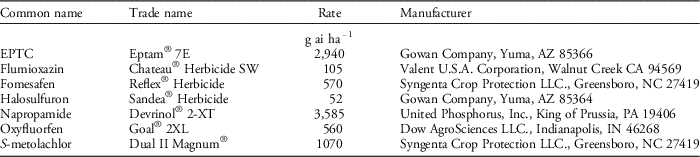
Experiments were arranged as a randomized complete block design in four blocks. Each plot was 4.5 m long with a 1.5-m buffer between plots. Treatments were arranged in a factorial design consisting of application timings of either 7 or 14 d prior to transplanting and seven herbicides. A nontreated check was included in each block. Herbicides evaluated included 2,940 g ai ha−1 EPTC, 105 g ai ha−1 flumioxazin, 570 g ai ha−1 fomesafen, 52 g ai ha−1 halosulfuron, 3,585 g ai ha−1 napropamide, 560 g ai ha−1 oxyfluorfen, and 1,070 g ai ha−1 S-metolachlor (Table 1). Herbicides were applied in 6,100 L ha−1 of water with CO2-pressurized canisters and a custom injection manifold. Herbicide injections were made on October 12, 2015, and October 6, 2016, at 7 d before transplanting, and October 5, 2015, and September 30, 2016, at 14 d before transplanting. Prior to injection, the drip tape was cut and the end of the drip tape was sealed to allow application to individual plots. Following each injection, the drip tape was flushed with water to remove all herbicide residues. Two rows of ‘Strawberry Festival’ strawberry transplants were planted per bed, with 38-cm spacing between plants. The plots were fertilized and irrigated throughout the season as per industry standards (Vallad et al. Reference Vallad, Freeman and Dittmar2014).
Herbicide treatments applied through drip irrigation under the plastic mulch following fumigation at the Gulf Coast Research and Education Center in Balm, FL, in 2015 and 2016.
Prior to herbicide injection, a flap of plastic mulch that measured 30 cm by 30 cm was cut from the bed center adjacent to the drip tape. Fifty yellow nutsedge tubers were buried in the top 5-cm soil profile. The flap of plastic mulch was then folded back and taped in place. Baskets measuring 10-cm depth with 50 cm2 surface area were made from screen. On the transplant date, two baskets were buried in each plot using the soil from the bed with approximately 1 cm extended above the soil surface after burial to identify the burial sites. Twenty-five seeds of black medic, Carolina geranium, and goosegrass [Eleusine indica (L.) Gaertn.] were mixed in the top 2 cm of each basket. Weed seeds used in these experiments were local biotypes collected near Balm, Florida.
Data Collection
Crop injury was visually evaluated on a scale ranging from 0% (no injury) to 100% (complete shoot death) at 2, 11, 35, and 46 DATP in year 1 and 7, 13, and 47 DATP in year 2, respectively. Berries were harvested twice per week from late December to early March, with harvest initiated when berries began to ripen and terminated when commercial growers in the regions stopped harvesting their fields.
Emerged nutsedge shoots in the burial area were counted every 2 wk until emergence ceased. Emerged weeds in the buried basket were identified, counted, and removed every 2 wk until emergence ceased.
Statistical Analysis
Data were subjected to analysis of variance in SAS (version 9.2, SAS Institute Inc., Cary, NC) using the PROC GLM procedure. Data were checked for normality and constant variance prior to analysis. Weed data were log-transformed before analysis. Nontransformed means for weed control are reported with statistical interpretation based on transformed data. Treatment means were separated using Fisher’s protected LSD test at P=0.05. Data collected on multiple dates, including strawberry injury and yield, were analyzed using the repeated statement. When the interaction between year and the main effects, timing and herbicide treatment, was not significant, data were pooled by timing, herbicide treatment, and timing by herbicide treatment. Where there was a significant interaction between years, the data are presented by year.
Results and Discussion
Strawberry Response
Year by herbicide treatment interaction was significant (P<0.0001) for strawberry injury and thus years are presented separately. In year 1, timing by herbicide interactions were detected for strawberry injury (P=0.0003) and thus results are presented across all combinations. Halosulfuron was the most injurious herbicide, causing 18% and 46% injury at 35 d after transplant when applied at 7 and 14 d prior to transplanting, respectively (Table 2). The greater injury when halosulfuron was applied at 14 d prior to transplanting than at 7 d cannot adequately be explained by the authors. Napropamide and S-metolachlor caused 7% and 5% strawberry injury on November 5, 2015, when applications were made 7 and 14 d prior to transplanting, respectively. However, the injury was temporary and plants quickly recovered. Strawberry injury from other herbicides was minimal (<5%) from both application timings throughout the experiment. In year 2, none of herbicides caused injury (data not shown).
Strawberry injury and total berry yield in 2015 to 2016 (year 1) and 2016 to 2017 (year 2) following herbicide injection through the drip tape 7 and 14 d prior to transplanting at the Gulf Coast Research and Education Center in Balm, FL.Footnote a
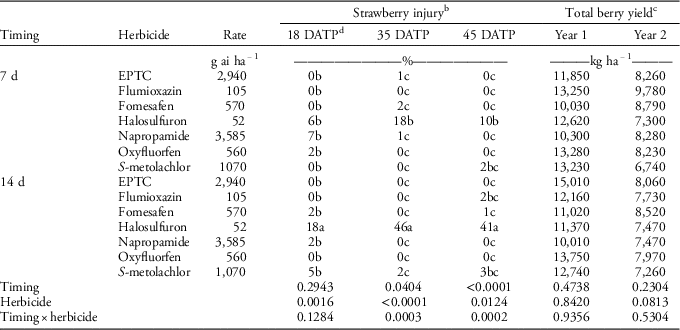
a Means followed by the same letter within a column are not significantly different according to Fisher’s protected LSD test at the 0.05 probability level.
b Year 1 (2 and 11 DATP) and year 2 injury data were not presented due to a lack of strawberry injury across herbicide treatments. Crop injury was evaluated on October 21, October 30, November 5, and December 3 in year 1, and on October 20, October 26, and December 13 in year 2.
c Nontreated total berry yield was 10,046 and 8,522 kg ha−1 in year 1 and 2, respectively.
d Abbreviation: DATP, days after transplanting.
Year effect was significant (P<0.0001) for total berry yield and thus years are presented separately. The harvest date by herbicide interaction was not significant in year 1 (P=0.3158) and year 2 (P=0.4638), and thus only total berry yields are presented (Table 2). None of the herbicides reduced total berry yield compared to the nontreated control in year 1 (P=0.8106) or year 2 (P=0.2181). Halosulfuron caused severe injury in year 1 but the total yield did not differ significantly from the nontreated control. In year 2, the unusual warm temperatures in October and November resulted in large plants that produced less fruit for the first half of the growing season (data not shown). This occurred industry-wide with low yields throughout the entire production region. Halosulfuron caused severe injury in year 1 but the total yield did not differ significantly from the nontreated control. We postulate that the high temperature and rapid growth in year 2 might explain the reduced strawberry injury but this hypothesis needs to be further verified. Overall, these results correspond with previous research indicating drip-applied EPTC, fomesafen, and napropamide plus oxyfluorfen are safe for weed control in polyethylene-mulched strawberry (Boyd and Reed Reference Boyd and Reed2016).
Results in this study showed that S-metolachlor at 1,070 g ha−1 applied through drip irrigation caused minimal strawberry injury in all ratings in both years. However, previous research indicated S-metolachlor at 214 g ha−1 applied to soil surface before transplanting was unsafe for annual strawberry production in Florida (Boyd and Reed Reference Boyd and Reed2016). The current oxyfluorfen label requires a minimal of 30 d treatment-to-planting interval (Anonymous 2013) but our results showed that oxyfluorfen at 560 g ha−1 applied through drip-irrigation 7 d before transplanting did not injure the strawberry. In previous research, Boyd and Reed (Reference Boyd and Reed2016) reported EPTC at 229 and 458 g ha−1, fomesafen at 42 and 84 g ha−1, and oxyfluorfen plus S-metolachlor at 56+448 g ha−1 applied through drip irrigation at 1, 7, 15, and 30 d prior to transplanting did not cause significant strawberry injury. Daugovish et al. (Reference Daugovish, Fennimore and Mochizuki2008) also found oxyfluorfen applications made 7 d prior to transplanting did not injure strawberry. Overall, these results suggest that the time interval between herbicide drip injection and transplant could be shortened when applying on the sandy soils typically found in the Florida plasticulture production system.
Weed Emergence
Year by timing interactions on weed seedling emergence were not significant for all species with the exception of goosegrass (P<0.0033). Thus, except for goosegrass, data from two years were combined and a single analysis was conducted. The main effects of herbicide and timing, as well as their interactions, were not significant with the exception of herbicide effect on goosegrass in year 1 (P=0.0035) (Table 3).
Weed control in 2015 to 2016 (year 1) and 2016 to 2017 (year 2) following herbicide injection through the drip tape 7 and 14 d prior to transplanting at the Gulf Coast Research and Education Center in Balm, FL.Footnote a
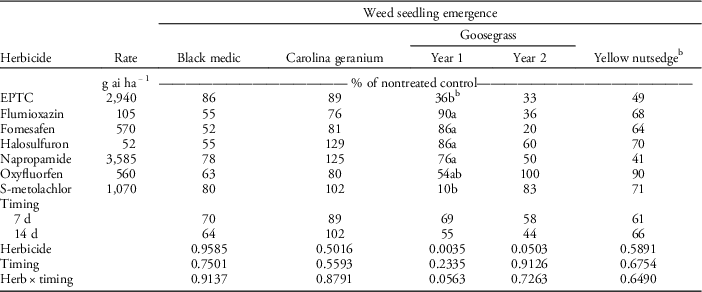
a Means followed by the same letter within a column are not significantly different according to Fisher’s protected LSD test at the 0.05 probability level.
b Yellow nutsedge data (year 2) were not presented due to a lack of weed emergence in the entire experimental site.
Averaged over application timings, the drip-applied flumioxazin, fomesafen, and halosulfuron suppressed 45%, 48%, and 45% black medic emergence to 55%, 52%, and 55% of the nontreated control, respectively (Table 3). In year 1, EPTC and S-metolachlor was generally more effective than other herbicides and controlled 64% and 90% goosegrass emergence, respectively, but this trend did not persist in year 2. The drip-applied EPTC, fomesafen, and napropamide reduced yellow nutsedge emergence to 49%, 64%, and 41% of the nontreated control, respectively. However, averaged over application timings and herbicides, Carolina geranium emergence was 95% relative to the nontreated control. This would indicate that the evaluated herbicides applied through drip application were ineffective in suppressing Carolina geranium seedling emergence.
Inconsistent weed control with the evaluated herbicides was reported previously. For example, previous research indicated that EPTC, halosulfuron, and S-metolachlor provided effective control of purple (Grichar et al. Reference Grichar, Besler and Brewer2003; Reed et al. Reference Reed, Boyd and Dittmar2016; Vencill et al. Reference Vencill, Richburg, Wilcut and Hawf1995; Wilfret and Burgis Reference Wilfret and Burgis1976) and yellow nutsedge (Dittmar et al. Reference Dittmar and Jennings2012; Gentner Reference Gentner1973; Grichar et al. Reference Grichar, Lemon, Brewer and Minton2001; Reed et al. Reference Reed, Boyd and Dittmar2016; Vencill et al. Reference Vencill, Richburg, Wilcut and Hawf1995; Wax et al. Reference Wax, Stoller, Slife and Andersen1972). In other research, Miller and Dittmar (Reference Miller and Dittmar2014) noted that PRE herbicides including fomesafen at 280 or 420 g ha−1, S-metolachlor at 710 or 1,070 g ha−1, and S-metolachlor plus fomesafen at 710+280 g ha−1 provided ≤60% control of a mixed stand of purple (40%) and yellow (60%) nutsedge species. Meyers and Shankle (Reference Meyers and Shankle2016) reported that halosulfuron at 13 g ha−1 fb S-metolachlor at 856 g ha−1 provided <55% control of yellow nutsedge. Reed et al. (Reference Reed, Boyd and Dittmar2016) noted that EPTC and fomesafen have demonstrated the ability to suppress short-term purple and yellow nutsedge growth. The authors noted that control efficacy increased when applications were made close to tuber sprouting. Wilfret and Burgis (Reference Wilfret and Burgis1976) noted that the activity of napropamide was increased in a moist soil, and reduced in a dry soil. The authors also noted that a single application of napropamide failed to control purple nutsedge but sequential applications effectively reduced purple nutsedge population. Boyd (Reference Boyd2015) also reported that EPTC, fomesafen, and S-metolachlor applied alone or as tank mixes reduced purple nutsedge density but control levels were inconsistent over time and space. To date, there are no herbicides registered for nutsedge control in strawberry and growers must rely on fumigation. Some herbicide treatments evaluated in this research appear be helpful as part of a weed management program to complement fumigants for PRE nutsedge control.
The herbicide treatments evaluated in our experiments provided relatively low and inconsistent suppression of broadleaves. This would suggest a POST herbicide is required for effective control. The lack of efficacy with the evaluated herbicides might be because we have evaluated species known to be difficult to control. Previous researchers documented that clopyralid is safe for use on strawberries when applied properly (Boyd and Dittmar Reference Boyd and Dittmar2015; Hunnicutt et al. Reference Hunnicutt, MacRae, Dittmar, Noling, Ferrell, Alves and Jacoby2013), and in Florida, clopyralid is the only POST registered (Anonymous 2015; Vallad et al. Reference Vallad, Freeman and Dittmar2014) with activity on broadleaf weeds (Anonymous 2015; Sharpe et al. Reference Sharpe, Boyd and Dittmar2015). Therefore, a POST application of clopyralid may be needed to effectively control broadleaf weeds that escaped control by PRE herbicides. As noted earlier, the evaluated herbicides were drip-applied with 6,100 L ha−1 of water. This is large amount of water compared with the broadcast application method requiring only about 200 L ha−1 water. Perhaps, the evaluated herbicides were overly diluted or moved too deep in the soil profile. Future research should evaluate the efficacy of these herbicides when drip-applied with different application volumes.
In summary, there was significant early-season injury from the drip application of halosulfuron in year 1, but strawberry growth recovered and berry yield was comparable to other herbicides and the nontreated control in both years. None of the other herbicides evaluated elicited significant crop injury or reduced berry yield. However, the evaluated herbicides provided relatively low and inconsistent weed suppression. We conclude that EPTC, flumioxazin, fomesafen, napropamide, oxyfluorfen, and S-metolachlor in polyethylene-mulched strawberry production can be safely drip-applied 7 and 14 d prior to transplanting with no significant strawberry injury. We also conclude that drip applied herbicides would be helpful as a component of weed control program, but additional actions, such as a POST herbicide, may be necessary for season-long weed control.
Acknowledgments
The authors thank the Florida Strawberry Research and Education Foundation for support of this research. The authors also thank the technical assistance of Michael Sweat.



