

Introduction
Successful or active ageing depends, to a large extent, on older people's autonomy and health. Health is a multi-dimensional construct that includes different indicators such as number of chronic conditions, functional status or disability (Santoni et al., Reference Santoni, Marengoni, Calderón-Larrañaga, Angleman, Rizzuto, Welmer, Mangialaschem, Orsini and Fratiglioni2017).
Perceived health status, defined as a global assessment that people carry out in order to ascertain whether they are healthy or not (Despot-Lucanin and Lucanin, Reference Despot-Lucanin and Lucanin2012), is another important health indicator that has proved to be useful in predicting older adults' morbidity, mortality and quality of life (Jylhä, Reference Jylhä2009; Cárdenas-Jiménez and López-Díaz, Reference Cárdenas-Jiménez and López-Díaz2011). Perceived health seems to be relevant in predicting conditions such as high blood pressure or heart conditions (Emmelin et al., Reference Emmelin, Weinehall, Stegmayr, Dahlgren, Stenlund and Wall2003). Furthermore, perceived health status is also important for older adults' wellbeing and life satisfaction (Liu et al., Reference Liu, Wei, Peng and Xue2020).
Perceived health status depends on biological, social and psychological factors such as previous experiences with health and illness, the existence of disability, age or personality (Jylhä, Reference Jylhä2009). In old age, perceived health status also depends on comparisons that individuals carry out with their peer group, and on attitudes towards ageing, ageism and how older people believe they are viewed by society (Idler et al., Reference Idler, Leventhal, McLaughlin and Leventhal2004; Moor et al., Reference Moor, Zimprich, Schmitt and Kliegel2006; Cheng et al., Reference Cheng, Fung and Chan2007; Fasel et al., Reference Fasel, Vauclair, Lima and Abrams2021).
Attitudes towards ageing refer to the expectancies about the ageing process (Levy et al., Reference Levy, Slade and Kasl2002) and constitute a stable appraisal that reflects people's feelings and thoughts about a specific situation or fact (Low et al., Reference Low, Molzahn and Schopflocher2013). The term ageism refers to the expression of these negative attitudes towards the ageing process as well as the prejudiced behaviour manifested as fear and worry about growing older, or about others growing older, and seem to affect older adults' health (World Health Organization, 2015; Fernández-Jiménez et al., Reference Fernández-Jiménez, Álvarez-Hernández, Salguero-García, Aguilar-Parra and Trigueros2020; Marques et al., Reference Marques, Mariano, Mendonça, De Tavernier, Hess, Naegele, Peixeiro and Martins2020). Finally, how older people believe they are viewed by society, or their meta-stereotypes, constitute an important element of age stereotypes and predict older people's wellbeing (Suh et al., Reference Suh, Choi, Lee, Cha and Jor2012; Fasel et al., Reference Fasel, Vauclair, Lima and Abrams2021). In the same line, it has been found that the beliefs that older people have regarding how others perceive old age affect their cognitive and physical performance (Vauclair et al., Reference Vauclair, Lima, Abrams, Swift and Bratt2016).
In addition, these beliefs are linked with the perception that older people have of their own ageing process, however, it has been suggested that variables such as the country or the culture people are imbedded in or the cohort they identify with can influence their self-perception and age-related stereotypes (Weiss, Reference Weiss2014; Weiss and Zhang, Reference Weiss and Zhang2020). Other variables, such as educational level or gender, were also found to affect older people's perception of the ageing process, e.g. women were found to be less satisfied with their ageing process than men (Kleinspehn-Ammerlahn et al., Reference Kleinspehn-Ammerlahn, Kotter-Grühn and Smith2008; Kotter-Grühn et al., Reference Kotter-Grühn, Kleinspehn-Ammerlahn, Gerstorf and Smith2009).
Attitudes towards ageing seem to have the same impact on older adults' subjective health as the one that they have on chronic physical illnesses or disability (Jylhä et al., Reference Jylhä, Guralnik, Balfour and Fried2001). Several studies show that attitudes towards ageing influence physical and mental health, as well as individuals' personal satisfaction and wellbeing (Levy, Reference Levy2009; Suh et al., Reference Suh, Choi, Lee, Cha and Jor2012; Low et al., Reference Low, Molzahn and Schopflocher2013; Bryant et al., Reference Bryant, Bei, Gilson, Komiti, Jackson and Judd2016; Sargent-Cox, Reference Sargent-Cox2017; Liu et al., Reference Liu, Wei, Peng and Xue2020). It has been found that, for example, positive attitudes towards ageing are linked to lower mortality risk (Levy and Myers, Reference Levy and Myers2005; Westerhof et al., Reference Westerhof, Miche, Brothers, Barrett, Diehl, Montepare, Wahl and Wurm2014) and to a better recovery from illnesses such as heart attack (Levy et al., Reference Levy, Slade, May and Caracciolo2006).
On the contrary, negative attitudes towards ageing are associated with worse physical and mental functioning. Ageist attitudes are linked to higher risk of developing cardiovascular conditions and Alzheimer's disease, and with a higher risk of hospitalisation (Levy et al., Reference Levy, Slade, May and Caracciolo2006, Reference Levy, Zonderman, Slade and Ferrucci2009, Reference Levy, Ferrucci, Zonderman, Slade, Troncoso and Resnick2016; Levy, Reference Levy2009). Likewise, these attitudes are associated with more pessimistic expectancies towards the ageing process, a lower level of motivation to adopt healthy behaviour and a higher level of loneliness (Sargent-Cox, Reference Sargent-Cox2017). Therefore, negative attitudes towards ageing constitute an important barrier for ageing actively (Swift et al., Reference Swift, Abrams, Lamont and Drury2017; Fernández-Ballesteros et al., Reference Fernández-Ballesteros, Olmos, Pérez-Ortiz and Sánchez-Izquierdo2020).
Given the importance that attitudes towards ageing have for older people's physical and mental status and for their likelihood of ageing actively, it is now important to gain a better understanding of the pathways and mechanisms of how views on ageing affect health and longevity (Wurm et al., Reference Wurm, Diehl, Kornadt, Westerhof and Wahl2017). According to Wurm et al. (Reference Wurm, Diehl, Kornadt, Westerhof and Wahl2017), understanding the associations between views on ageing and health outcomes is important for both research in human ageing and for intervention research and public health practices that aim at promoting health. Therefore, the present study focuses on understanding the indirect effect that attitudes towards ageing have on perceived health status and explores the role of cognitive functioning and physical activity as mediators. Understanding the relationship can be useful for developing psycho-educational strategies aimed at improving older adults' negative self-perception of ageing, and in this way increase their chances of ageing successfully (Diehl et al., Reference Diehl, Wahl, Barrett, Brothers, Miche, Montepare, Westerhof and Wurm2014).
The mediating role of cognitive functioning
Cognitive functioning is associated with older individuals' health and lifestyle choices. On the one hand, assessing cognitive functioning is important for determining older people's physical and mental health (Diamond, Reference Diamond2013; Stephan et al., Reference Stephan, Caudroit, Jaconelli and Terracciano2014). Previous research has shown that perceived health status predicts cognitive abilities (Schafer and Shippee, Reference Schafer and Shippee2010). Given the importance that older adults' cognitive functioning has, different studies have attempted to identify variables that can influence changes in older individuals' cognitive status. In this sense, the influence of physical, psychological and social variables such as walking speed, emotional functioning, social relations or physical activity is crucial for older adults' cognitive functioning (Clouston et al., Reference Clouston, Brewster, Kuh, Richards, Cooper, Hardy, Rubin and Hofer2013; Miceli et al., Reference Miceli, Maniscalco and Matranga2019).
Cognitive functioning is also influenced by negative attitudes towards ageing. Previous studies have found that ageism predicts lower performance levels on memory tests (Horton et al., Reference Horton, Baker, Pearce and Deakin2008; Stephan et al., Reference Stephan, Sutin, Caudroit and Terracciano2016; Molden and Maxfield, Reference Molden and Maxfield2017) and other cognitive abilities such as processing speed or verbal fluency (Lamont et al., Reference Lamont, Swift and Abrams2015; Robertson et al., Reference Robertson, King-Kallimanis and Kenny2016; Stephan et al., Reference Stephan, Sutin, Caudroit and Terracciano2016; Seidler and Wolff, Reference Seidler and Wolff2017). Horton et al. (Reference Horton, Baker, Pearce and Deakin2008) found that ageism predicted cognitive functioning both when these attitudes were experimentally induced and when they were not. Siebert et al. (Reference Siebert, Wahl and Schröder2018b) found that over 12 years, attitudes towards ageing predicted changes in fluid abilities such as perceptual speed, reasoning, spatial ability and working memory but not in crystallised intelligence abilities such as declarative knowledge.
Negative attitudes towards ageing are also a risk factor for the development of cognitive impairment. In a longitudinal study carried out with middle-aged people, Robertson et al. (Reference Robertson, King-Kallimanis and Kenny2016) found that negative attitudes towards ageing predicted cognitive decline. Siebert et al. (Reference Siebert, Wahl, Degen and Schröder2018a) found that attitudes towards ageing predicted cognitive impairment and the development of Alzheimer's disease. Using 20-year data from the Interdisciplinary Longitudinal Study of Adults Development, Siebert et al. (Reference Siebert, Braun and Wahl2020) also found that negative attitudes towards ageing predicted both the objective cognitive functioning and subjective memory complaints.
The mediating role of physical activity
Physical activity, which includes a wide range of activities, from domestic chores that are not structured activities to structured and planned physical exercise (Koeneman et al., Reference Koeneman, Verheijden, Chinapaw and Hopman-Rock2011), is essential for preventing cognitive and functional impairment, and a crucial factor for promoting successful or active ageing (Paterson and Warburton, Reference Paterson and Warburton2010). Often, old age is linked to health impairment and to the onset and progression of chronic conditions (Awang et al., Reference Awang, Mansor, Nai Peng and Nik Osman2018; Ruiz-Montero et al., Reference Ruiz-Montero, Rubio, Dumitrache and Chiva-Bartoll2021). People who practise moderate physical activity regularly have a more positive perceived health status, a lower risk of chronic illnesses as well as less likelihood of having an impaired functional status (Stessman et al., Reference Stessman, Hammerman-Rozenberg, Maaravi and Cohen2002; Brach et al., Reference Brach, FitzGerald, Newman, Kelsey, Kuller, VanSwearingen and Kriska2003; Paterson et al., Reference Paterson, Jones and Rice2007; Warburton et al., Reference Warburton, Katzmarzyk, Rhodes and Shephard2007; Persson and While, Reference Persson and While2011; Condello et al., Reference Condello, Capranica, Stager, Forte, Falbo, Di Baldassarre and Pesce2016; Morgan et al., Reference Morgan, Willmott, Ben-Shlomo, Haase and Campbell2019). Thus, an active lifestyle that includes regular physical activity constitutes an important protective factor for physical, cognitive and emotional health (Mura and Carta, Reference Mura and Carta2013; Prakash et al., Reference Prakash, Voss, Erickson and Kramer2015; Puvill et al., Reference Puvill, Lindenberg, Slaets, de Craen and Westendorp2017).
Despite all the benefits of physical activity, as we age the time we dedicate to it decreases (Milanović et al., Reference Milanović, Pantelić, Trajković, Sporiš, Kostić and James2013). Therefore, many studies have aimed to ascertain the reasons that explain why people tend to become more sedentary as they age (Päivi et al., Reference Päivi, Mirja and Terttu2010). In this sense, negative attitudes towards ageing is an important aspect that can influence the likelihood of practising physical activity. Positive perception and attitudes towards ageing are linked to a higher rate of physical activity (Wurm et al., Reference Wurm, Tomasik and Tesch-Römer2010; Emile et al., Reference Emile, Chalabaev, Stephan, Corrion and d'Arripe-Longueville2014; Clark et al., Reference Clark, Riebe, Blissmer, Lees and Greaney2016; Burton et al., Reference Burton, Clancy and Cowap2018; Lee et al., Reference Lee, Lee and An2020). On the contrary, negative perceptions and attitudes towards ageing are associated with a worse physical status, which entails a loss of abilities and independence, as well as less likelihood of health maintenance behaviours and with greater mortality risk (Sargent-Cox et al., Reference Sargent-Cox, Anstey and Luszcz2012; Stewart et al., Reference Stewart, Chipperfield, Perry and Weiner2012; Gale et al., Reference Gale, Čukić, Chastin, Dall, Dontje, Skelton and Deary2018).
According to Hausknecht et al. (Reference Hausknecht, Low, O'Loughlin, McNab and Clemson2020), because of the effect that attitudes towards ageing have on health status, cognitive functioning and physical activity, we believe it is important to understand the mechanisms that explain how they influence health. Since, to our knowledge, there are no studies that aim at clarifying how these variables are related, the aim of this study was to explore attitudes towards ageing and self-perceptions of ageing among Spanish middle-aged and older people and to identify possible mediators in the relationship between self-perceptions of ageing on perceived health status.
Methods
Participants
In this cross-sectional study, the Ageing in Spain Longitudinal Study database, Pilot Survey (ELES-PS) was used. The sample of this study included community-dwelling participants aged 50 or older who were living in Spain. Information regarding the design and procedure of the survey are provided by Rojo-Pérez et al. (Reference Rojo-Pérez, Fernández-Mayoralas, Rodríguez-Rodríguez, Forjaz, Rodríguez-Blázquez, Prieto-Flores, Rojo-Abuin and Martínez-Martin2012). The sample was randomly selected proportional to the population aged 50 or older, and households were selected randomly from a database of households with telephones by census tract.
The database of the ELES-PS project contains a total sample of 1,747 people (Teófilo et al., Reference Teófilo, González, Díaz-Veiga and Rodríguez2011). Data for the ELES-PS project were collected in three phases between December 2010 and September 2011. Some individuals refused to continue with the interview after phase 1 or phase 2 were completed. Therefore, in the present study only a sub-sample of 1,124 individuals with ages between 50 and 98 (mean = 64.84, standard deviation = 10.12) who completed all three phases were included. Descriptive characteristics of the participants are shown in Table 1.
Demographic characteristics of the participants

Procedure
Data collection took place in three phases: the first phase consisted of telephone interviews in which informed consent, sociodemographic data and household characteristics were collected; the second phase entailed a visit from community nurses in order to administer the Mini-Mental State Examination (MMSE; Folstein et al., Reference Folstein, Folstein and McHugh1975; Lobo et al., Reference Lobo, Saz and Marcos2002) and to collect biomedical data. If the MMSE reached preset thresholds of 24 points, the participants were provided with a self-administered questionnaire to complete. Additionally, for participants who scored below 24 on the MMSE it was suggested that a proxy responder be present for the subsequent home visit. Finally, the third phase consisted of a face-to-face interview carried out by an expert interviewer who administered the questionnaire using a computer. In this second home visit the self-administered questionnaire was retrieved and, if the participant had been unable to complete the questionnaire, the interviewer assisted in its completion at that moment. More information about the research procedure may be consulted in Teófilo et al. (Reference Teófilo, González, Díaz-Veiga and Rodríguez2011).
Instruments
The complete questionnaire developed for the ELES-PS project is available (in Spanish) on the ELES website (http://proyectoeles.es/) and a summary in English can be found online. It collected information about the following dimensions: demographic characteristics, living conditions and quality of life, psycho-social aspects and functioning, health, social network and social participation, and economic and environmental aspects (Teófilo et al., Reference Teófilo, González, Díaz-Veiga and Rodríguez2011). However, in this section only the instruments that have been analysed in this research are described.
Attitudes towards ageing
A total of four items were used in order to describe participants' attitudes towards ageing: (a) ‘What age do you think someone is an older person?’ (with six different answering options: 1 = after 60 years old, 2 = after 65 years old, 3 = after 70 years old, 4 = after 75 years old, 5 = after 80 years old, 6 = it does not depend on chronological age); (b) ‘To what extent are you worried about your own process of growing older?’ (with three different answering options: 1 = yes, 2 = no, 3 = I don't know); (c) ‘What are the first and the second reasons for you to be worried about growing older?’ (1 = physical impairment, 2 = cognitive impairment, 3 = retirement and becoming less active, 4 = functional impairment and disability, 5 = a decrease in income, 6 = losing social contacts and loneliness, 7 = other reason, please specify); and (d) ‘How does society treat older people?’ (1 = society treats them well, 2 = society treats them with indifference, 3 = society treats them badly).
Self-perceptions of ageing
A total of four items were used to assess participants' self-perceptions of ageing: (a) ‘Things are getting worse as I age’; (b) ‘I have as much energy as I had last year’; (c) ‘As you get older you are less useful’; and (d) I am as happy in this stage of my life as I used to be when I was younger’ (with two answering options: 1 = I agree, 0 = I disagree). As the first and third items reflect a negative view of ageing, the scores obtained by the participants in these two items were inverted (0 = I agree, 1 = I disagree) before obtaining the final score. Finally, the score for one item with three answer options was also included: (5) ‘As I get older things are: 1 = worse, 2 = equal, 3 = better’. The sum of the answers on these items was used as a mean for self-perceptions of ageing. Scores ranged from 1 to 7, and higher scores were interpreted as a more positive self-perception.
Perceived health status
Perceived health status was assessed using one item: ‘In general, do you rate your current state of health as very good, good, regular, bad or very bad?’ (rated on a five-point scale from 1 = very bad to 5 = very good).
Cognitive functioning
The Spanish version of the MMSE was used (Lobo et al., Reference Lobo, Saz and Marcos2002). The total score obtained provides an index of overall cognitive functioning. Scores can range between 0 and 30, with higher scores corresponding to better cognitive functioning.
Physical activity
In order to assess participants' level of physical activity, the Total Activity Summary Index taken from the Yale Physical Activity Survey (Dipietro et al., Reference Dipietro, Caspersen, Ostfeld and Nadel1993; De Abajo et al., Reference De Abajo, Larriba and Márquez2001) was used. The Yale Physical Activity Survey contains two sections, and allows three indexes to be calculated: Total Time Index, Total Energy Expenditure Index and Total Activity Summary Index. The first section includes questions to assess the amount of time spent in a typical week on work-related, yard-work, care taking, exercise and recreational activities. The second section of the questionnaire measures participation in physical activity (vigorous activity, leisurely walking, moving, standing and sitting) according to frequency and intensity. The sum of these five activities provides the Total Activity Summary Index, which was the index used in this work.
Data analysis
First, in order to determine participants' attitudes towards ageing, answering frequencies were calculated by gender and by age group (<65, 65–79, >80 years). Correlation analyses using a Spearman's correlation test were then performed in order to determine the associations between age, gender, educational level, physical activity, cognitive functioning, self-perceptions of ageing and perceived health status.
Finally, in order to determine if the effect that self-perceptions of ageing had on perceived health status was mediated by cognitive functioning and by physical activity, a multiple mediation analysis was performed using the bias-corrected and accelerated bootstrapping method (Preacher and Hayes, Reference Preacher and Hayes2008) (see Figure 1). Bootstrapping is a non-parametric resampling method used for estimating direct and indirect effects in multiple mediator models. It involves repeatedly extracting samples from the data by randomly sampling with replacement and estimating the indirect effect in each resampled dataset (Preacher and Hayes, Reference Preacher and Hayes2008). The bootstrapping method presents the advantage of analysing multiple mediators simultaneously (Hayes, Reference Hayes2009) which minimises the number of inferential tests which reduces the likelihood of Type I error (Preacher and Hayes, Reference Preacher and Hayes2008). To determine whether mediation occurs, the percentile boostrap confidence intervals (CIs) are examined; if zero is contained within the 95 per cent CIs, then the lack of significance is assumed (Shrout and Bolger, Reference Shrout and Bolger2002; Preacher and Hayes, Reference Preacher and Hayes2008).
Proposed model to be tested.

Results
Attitudes towards ageing
As Table 2 conveys, almost 70 per cent of the participants stated that old age begins at a specific chronological age and among them an important percentage stated that old age starts at 70 or after this age. Meanwhile nearly one-third of the participants considered that old age does not start at a specific chronological age. That percentage was slightly higher for women than for men and increased among the older groups of participants.
Attitudes towards ageing
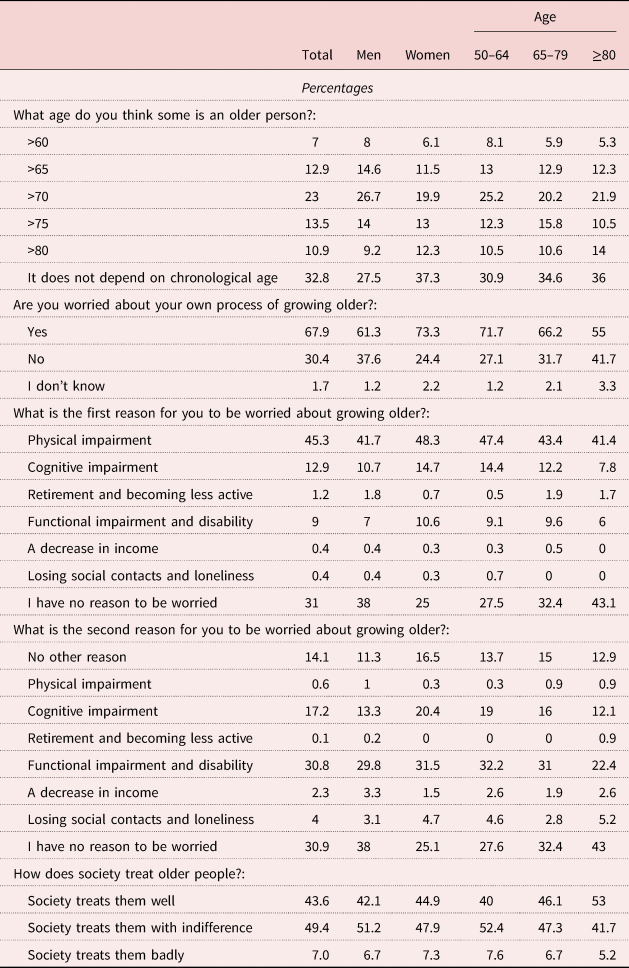
Notes: Men N = 513, women N = 611; age 50–64 N = 582, age 65–79 N = 426, age ≥80 N = 116.
In relation to the perception of how society behaves towards older people, half of the participants considered that society treats older people with indifference, and a slightly lower percentage indicated that society treats them well. Similar values were found for both men and women, and also in the group younger than 65. It is interesting that among the older group of participants, these values were inverted, so that among those over 80, half of them considered that society treats them well, and a slightly lower percentage that considered that society treats them with indifference.
Mediation analysis
Before the mediation analysis was performed, correlations between age, gender, educational level, physical activity, cognitive functioning, self-perceptions of ageing and perceived health status were performed. As shown in Table 3, age was negatively correlated with self-perceptions of ageing, physical activity, cognitive functioning and subjective health status; while subjective health status positively correlated with educational level, self-perceptions of ageing, physical activity and cognitive functioning, and negatively with age and gender (therefore, being female is associated with a poorer subjective health status).
Means, standard deviations (SD) and Spearman's correlations

Note: N = 1,124.
Significance levels: * p < 0.05, ** p < 0.01.
Results of the multiple mediation analysis showed a significant mediation effect, through cognitive functioning and physical activity, in the link between self-perceptions of ageing and perceived health status.
Specifically, using a 5,000 bootstrap and bias-corrected and accelerated 95 per cent CI multiple mediation analysis (Preacher and Hayes, Reference Preacher and Hayes2008), results revealed that, when controlling for gender (B = −0.0785, standard error (SE) = 0.0456, p > 0.05), age (B = −0.0009, SE = 0.0024, p > 0.05) and educational level (B = 0.0863, SE = 0.0167, p < 0.001), both paths from self-perceptions of ageing to cognitive functioning and to physical activity mediators, were significant and of positive value, as Table 4 conveys. In addition, the paths from the mediators to perceived health status were also significant and positive. Based on the coefficients, the mediating effect was nearly three times stronger for physical activity (B = 0.0110, SE = 0.0035, lower CI = 0.0060, upper CI = 0.0192) when compared to the mediating effect of cognitive functioning (B = 0.0032, SE = 0.0020, lower CI = 0.0001, upper CI = 0.0074).
Indirect effect of self-perceptions of ageing on perceived health status through cognitive functioning and physical activity

Notes: Based on 5,000 bootstrap samples. SE: standard error. BCa 95% CI: 95 per cent bias-corrected and accelerated confidence interval.
Significance levels: * p < 0.05, ** p < 0.01, *** p < 0.001.
The total effect of self-perceptions on perceived health status was significant (c; B = 0.1144, SE = 0.0147, p < 0.01). Moreover, the direct effect of self-perceptions (c’) was also significant and smaller than the total effect (B = 0.1002, SE = 0.0147, p < 0.01). The model explained 15.9 per cent of the variance in perceived health status.
Discussion
There are several studies that have investigated the relationship between self-perceptions of ageing and perceived health status, however, to our knowledge, there are no studies aimed at understanding how these variables are related. Therefore, the aim of this study was to explore attitudes towards ageing and self-perceptions of ageing among Spanish middle-aged and older people and to identify possible mediators in the relationship between self-perceptions of ageing on perceived health status. The proposed mediational model included cognitive functioning and physical activity as mediators between self-perceptions of ageing on perceived health status.
The findings of the present study suggest that in general participants situate the beginning of old age at 70 years or after that; also, participants considered that old age is worrying because of possible physical and cognitive impairment that might come with ageing and because ageing might entail functional limitations and receiving help from other people. Furthermore, it was found that cognitive functioning and physical activity mediated the association between attitudes towards ageing and perceived health status.
With regards to attitudes towards ageing, the majority of participants stated that old age begins at a specific chronological age and among them an important percentage stated that old age starts at 70 years or after this age, an age situated far beyond the mandatory retirement age in Spain. This finding is similar to results found by Liu et al. (Reference Liu, Yang and Feng2020) in their study with Chinese older adults who believed that old age begins at 70 years or after this age. Meanwhile, one-third of the participants in our study answered that old age does not depend on chronological age and the percentage of participants who have chosen this answering option increases within the older groups of participants. Finding that almost 70 per cent of the participants in this study considered that old age begins at a specific age might reflect the important role that chronological age might have in explaining perceptions of ageing, at least among Spanish older adults. However, it is also possible that the way the question was formulated might have conditioned participants to answer that old age begins at a specific age. A better way to have ascertained if the participants of this study considered that old age begins at a specific chronological age would have been to ask directly if they considered old age to begin at a specific chronological age or not.
Also, when asked about their perceptions on how society treats older adults, half of the participants indicated that society treats them with indifference. Meanwhile 40 per cent of them indicated that society treats them well. This percentage increased in the older group of participants, with 53 per cent of the participants who were 80 and older considering they were treated well by society. In the present study, the older group of older people have more positive perceptions about how society treats older people than younger older adults and have a more positive perception of the ageing process in general and are less worried about it.
Despite their positive attitudes towards ageing in general, the negative correlation we found between age and self-perceptions of ageing in this sample indicates that, when specifically asked about their own process of growing older, older participants of this study indicated that compared to other stages in their lifespan, old age entails having less energy and more difficulties, which might indicate that their perception of their own ageing process is less positive than their attitudes to ageing in general.
This discrepancy between older participants' attitudes towards ageing in general and their perception of their own process of ageing might be explained by a cohort effect (Weiss, Reference Weiss2014; Weiss and Zhang, Reference Weiss and Zhang2020). Traditionally, in Spain older people carried an important role in society and old age was associated with positive characteristics such wisdom and being an important support for other family members. Thus, despite the fact that these beliefs are changing among younger generations, it is possible that among older generations these positive views are enduring. As a result, older participants of this study might feel proud to be part of a generation that was able to support their family, overcome a very difficult social and economic situation that followed after the Spanish civil war and contribute to the progress of the Spanish society. Also, this older generation was taught to respect and cherish older people and old age, so when they are asked about old age in general, these beliefs might activate. However, when they are asked about their own ageing process, they focus on themselves as specific individuals and they might base their perception of their ageing process on comparisons of themselves in previous stages of life in terms of health status and other life domains that might change, as they grow older. Nevertheless, this is only speculative and data collected in this study do not allow us to understand why this discrepancy occurs.
When perceptions about the participants' own process of growing older was analysed by gender and by educational level, it was found that women had a more negative perception about their ageing process than men, while participants with a higher educational level had more positive perception when compared with participants with lower educational levels. Previous longitudinal studies had found similar results; age is linked with a decrease in satisfaction with ageing especially among older women who are less satisfied with their ageing process than older men (Kleinspehn-Ammerlahn et al., Reference Kleinspehn-Ammerlahn, Kotter-Grühn and Smith2008; Kotter-Grühn et al., Reference Kotter-Grühn, Kleinspehn-Ammerlahn, Gerstorf and Smith2009).
On the other hand, most of the participants were worried about the ageing process and when asked about the reasons for worrying, participants indicated that they were preoccupied by possible physical and cognitive impairment that might come with ageing and because ageing might entail functional limitations and receiving help from other people. According to Awang et al. (Reference Awang, Mansor, Nai Peng and Nik Osman2018), these are some of the main reasons people fear getting older. The first reason for the participants in this study to consider ageing worrying was physical impairment. This is understandable since in many cases old age is linked to health impairment and to the onset and progression of chronic conditions (Awang et al., Reference Awang, Mansor, Nai Peng and Nik Osman2018). Furthermore, physical and mental health deterioration can bring many detrimental consequences for older adults' quality of life and successful ageing (Puvill et al., Reference Puvill, Lindenberg, Slaets, de Craen and Westendorp2017). Finally, it is possible that the participants of the present study might be worried about physical impairment due to the fact that poor health in old age is one of the most prevalent age-related stereotypes (Ruiz-Montero et al., Reference Ruiz-Montero, Rubio, Dumitrache and Chiva-Bartoll2021).
The second reason for the participants in this study to consider ageing worrying was cognitive impairment. This result is in agreement with many other studies (e.g. Cutler, Reference Cutler2015; Awang et al., Reference Awang, Mansor, Nai Peng and Nik Osman2018; Ryu and Park, Reference Ryu and Park2019) that have identified worrying about dementia as one of the main concerns among adults when asked about the ageing process (Bowen et al., Reference Bowen, Kessler and Segler2019). Recent studies showed that worrying about dementia affects between 30 and 60 per cent of the participants (Bowen et al., Reference Bowen, Kessler and Segler2019). As pointed out by Cutler (Reference Cutler2015), this could be explained by the public awareness about dementia and the available knowledge about its progression and the lack of effective treatment to delay or stop its progression. At same time this concern could be seen as an expected outcome of negative ageing stereotypes that associate memory loss with the ageing process (Molden and Maxfield, Reference Molden and Maxfield2017). Previous studies (Robertson et al., Reference Robertson, King-Kallimanis and Kenny2016; Siebert et al., Reference Siebert, Wahl, Degen and Schröder2018a, Reference Siebert, Braun and Wahl2020) have found that attitudes towards ageing predict subjective memory complaints as well as cognitive impairment and the diagnosis of Alzheimer's disease.
Various studies point out that self-attitudes towards ageing influence older people's physical and mental health, as well as their life satisfaction and wellbeing (Suh et al., Reference Suh, Choi, Lee, Cha and Jor2012; Low et al., Reference Low, Molzahn and Schopflocher2013; Bryant et al., Reference Bryant, Bei, Gilson, Komiti, Jackson and Judd2016; Sargent-Cox, Reference Sargent-Cox2017; Liu et al., Reference Liu, Wei, Peng and Xue2020). Positive attitudes towards ageing are linked to lower mortality risk (Levy and Myers, Reference Levy and Myers2005; Westerhof et al., Reference Westerhof, Miche, Brothers, Barrett, Diehl, Montepare, Wahl and Wurm2014) and a better recovery from conditions such as heart attack (Levy et al., Reference Levy, Slade, May and Caracciolo2006). Meanwhile, negative attitudes towards ageing are associated with a poorer physical and mental status.
Negative ageing stereotypes and attitudes towards ageing can also have a major impact on older people's subjective health (Idler et al., Reference Idler, Leventhal, McLaughlin and Leventhal2004; Moor et al., Reference Moor, Zimprich, Schmitt and Kliegel2006; Cheng et al., Reference Cheng, Fung and Chan2007), and their influence can be as decisive as the presence of chronic illness and disability (Jylhä et al., Reference Jylhä, Guralnik, Balfour and Fried2001; Stewart et al., Reference Stewart, Chipperfield, Perry and Weiner2012). In this study, it was found that a high proportion of the participants had negative self-perceptions of ageing and a correlation with perceived health status was found. This result is similar to the findings from the study by Stewart et al. (Reference Stewart, Chipperfield, Perry and Weiner2012) in which participants who believed that the main cause of illness was old age informed more frequently of perceived health symptoms, engaged less in routine health maintenance behaviour, such as healthy diet, physical activity or regular check-ups, and had a greater likelihood of mortality two years later.
With regards to regular physical activity in older adults, openness to different experiences such as the practice of physical activity contributes to achieving more positive attitudes towards ageing (Emile et al., Reference Emile, Chalabaev, Stephan, Corrion and d'Arripe-Longueville2014). This could be explained by the effect that physical activity has on preventing cognitive and functional impairment that occur during the ageing process (Paterson and Warburton, Reference Paterson and Warburton2010). Moreover, the performance of physical activity is linked to better self-perception of ageing (Chalabaev et al., Reference Chalabaev, Emile, Corrion, Stephan, Clément-Guillotin, Pradier and d'Arripe-Longueville2013). On the other hand, as functional decline occurs in old age, a more negative perceived health status is linked to a decrease in healthy behaviours, e.g. regular physical activity (Beyer et al., Reference Beyer, Wolff, Warner, Schüz and Wurm2015). It is common that older adults who practise regular physical activity use less-negative self-directed stereotypes than those who do not practise any physical activity in their daily life (Burton et al., Reference Burton, Clancy and Cowap2018).
Furthermore, the link between self-perceptions of ageing and perceived health status was mediated by cognitive functioning and physical activity. Thus, participants' self-perceptions of ageing predicted their cognitive functioning and the weekly physical activity level, which in turn predicted their subjective health, although the effect was three times stronger in the case of physical activity. The findings of the present study indicate that the influence that self-perceptions of ageing have on subjective health can partially be explained, 15.9 per cent of its variance, by the participants' cognitive functioning and the weekly physical activity level. These are both behavioural pathways and reiterate the role of self-perceptions of ageing as an important variable that is linked to older adults' subjective health.
Although this study contributes to the literature on attitudes and perceptions towards ageing, there are several limitations to this investigation that are worth mentioning. The cross-sectional design does not allow for distinguishing between predictors and outcome variables. Therefore, the multiple mediation analysis we conducted only had descriptive purposes and results should be received with caution since no inferences can be made about the directionality between variables. It is possible for perceived health status to predict both cognitive functioning and the likelihood of practising physical activity and also to predict attitudes towards ageing. On the one hand, people's perceptions of their cognitive functioning predicts health (Diamond, Reference Diamond2013; Stephan et al., Reference Stephan, Caudroit, Jaconelli and Terracciano2014), yet other studies suggest that perceived health status predicts cognitive functioning (Schafer and Shippee, Reference Schafer and Shippee2010). In light of this, in order to clarify the causal relationships between attitudes towards ageing and perceived health status, future studies should test reciprocal models using longitudinal designs.
In the present study, we only focused on attitudes towards ageing, self-perceptions of ageing and on understanding the indirect effect that self-perceptions of ageing had on self-related health. However, in order to have a better understanding of the specific impact of age stereotypes, self-perceptions of ageing and subjective age on health-related outcomes, according to Wurm et al. (Reference Wurm, Diehl, Kornadt, Westerhof and Wahl2017) future studies should explore the joint impact of age stereotypes and subjective ageing on different health outcomes.
Despite these limitations, in this study we corroborated past evidence on the importance of perceptions and attitudes towards ageing for older adults' health and wellbeing. Findings of this study also contribute to a better understanding of the pathways and mechanisms explaining how views on ageing affect health. As posited by Wurm et al. (Reference Wurm, Diehl, Kornadt, Westerhof and Wahl2017), this is important for both research in human ageing and for intervention research and public health practices that aim to promote health among older adults.
Because there are still few interventions aimed at fostering positive views of ageing and at determining the effect these have on older people's health and wellbeing, more studies on this topic are needed (Hausknecht et al., Reference Hausknecht, Low, O'Loughlin, McNab and Clemson2020). Tackling negative self-perceptions of ageing and negative attitudes towards ageing can be particularly useful because negative attitudes towards ageing are associated with more pessimistic expectancies about the ageing process and a lower motivation to adopt healthy lifestyle habits (Sargent-Cox, Reference Sargent-Cox2017), thus negative attitudes towards ageing are an obstacle for active ageing (Swift et al., Reference Swift, Abrams, Lamont and Drury2017; Fernández-Ballesteros et al., Reference Fernández-Ballesteros, Olmos, Pérez-Ortiz and Sánchez-Izquierdo2020). As suggested by Diehl et al. (Reference Diehl, Wahl, Barrett, Brothers, Miche, Montepare, Westerhof and Wurm2014), psycho-educational and behavioural interventions targeting middle-aged and older adults' negative self-perceptions of ageing could constitute an important means to promote successful and active ageing and to delay health impairment.
Acknowledgments
Funding for open access charge: University of Granada.
Financial support
The ELES pilot study was carried out by the Research Group on Ageing (GIE-CSIC) and the Matia Instituto Gerontologico and was supported by the ‘Acciones Complementarias 2009’ Programme of the Spanish Ministry of Science and Innovation (CSO2009-06637-E/SOCI; CSO2009-06638-E/SOCI; CSO2009-08645-E/SOCI); the SAIOTEK 2009 Programme of the Basque Government; and the ‘Obra Social Caja Madrid’ Foundation.
Conflict of interest
The authors declared no potential conflicts of interest with respect to the research, authorship and/or publication of this article.
Ethical standards
The sample of the Ageing in Spain Longitudinal Study database, Pilot Survey (ELES-PS) was used. The ELES-PS was approved by the Bioethics Subcommittee of the Spanish National Research Council. Prior to the surveys, an informed consent form was granted and signed by each respondent, and anonymity was assured.


 Open access

