




1. Introduction
The focus of this paper is a special type of numeral classifier called repeater classifier or repeater for short (also called echo classifier, auto-classifier, or self-classifier). Repeaters emerge when in a classifier language a subset of nouns does not combine with the established classifier lexemes, but the syntactic configuration is such that it requires the classifier slot to be filled in overtly. This tension between the properties of individual nouns (i.e., unclassifiability) and the properties of certain syntactic structures that contain them (i.e., the need for a classifier) is resolved by repeating the noun in the classifier position.Footnote 1
As an illustration of this phenomenon, consider the following minimal pair from Thai. (1) is the baseline where the noun rôm ‘umbrella’ takes khan, the classifier for long, handled objects. In (2), on the other hand, prathêet ‘country’ and laam ‘pattern’ do not take an established classifier, so the classifier slot is filled by a copy of the noun.Footnote 2
(1)
rôm
sǎam khan
umbrella
three cl.handled.long
‘three umbrellas’ (Hundius & Kölver Reference Hundius and Kölver1983)
(2)
a.
prathêet
sǎam
prathêet
country
three
cl:country
‘three countries’ (Hundius & Kölver Reference Hundius and Kölver1983)
b.
laaj
sǎam
laaj
pattern
three
cl:pattern
‘three patterns’ (Jenks Reference Jenks2011: 93)
Thai
Crucially, ‘repeaters […] classify only themselves or compounds of which they are a constituent’ (Adams & Conklin Reference Adams and Conklin1975, cited in Placzek Reference Placzek1978, Gandour et al. Reference Gandour, Petty, Dardarananda, Dechongkit and Mukngoen1984). In other words, repeaters only occur with the form-identical noun (and compounds headed by the form-identical noun). They should be distinguished from garden variety classifiers that have grammaticalized from a noun and remain form-identical to their source, but that have become generalized classifiers and thus occur with a wide range of nouns, with the form-identical source noun being only one of these.
As a specific example, the Thai classifier khon has grammaticalized from the homophonous noun khon
$ {}_N $
 ‘person’ and has become a ‘general classifier for nouns denoting persons, except sacred or royal ones’ (Hundius & Kölver Reference Hundius and Kölver1983: 193). Thus while khon does indeed classify the form-identical noun khon
$ {}_N $
‘person’ and has become a ‘general classifier for nouns denoting persons, except sacred or royal ones’ (Hundius & Kölver Reference Hundius and Kölver1983: 193). Thus while khon does indeed classify the form-identical noun khon
$ {}_N $
 ‘person’ (3), it also combines with other nouns such as ‘child’, ‘student’ (Pornsiri Singhapreecha, p.c., (4)), ‘woman’, ‘teacher’ (Haas Reference Haas1942), or ‘film star’ (Hundius & Kölver Reference Hundius and Kölver1983).
(3)
khon
sǎam
khon
person
three
cl
‘three people’ (Pornsiri Singhapreecha, p.c.)
(4)
dek/nákrian
sǎam
khon
child/student
three
cl
‘three children/students’ (Pornsiri Singhapreecha, p.c.)
Thai
For this reason, khon in (3) is not a repeater but a garden variety classifier which, among other nouns, also classifies its source noun.
Repeaters can be found in certain East and Southeast Asian numeral classifier languages such as Thai, Lao, Burmese, Mal, Lisu, etc. (see Jones Reference Jones1970, Aikhenvald Reference Aikhenvald2000, Zhang Reference Zhang and Xing2012) as well as in a number of so-called multiple classifier languages of Lowland Amazonia (Aikhenvald Reference Aikhenvald2000: 222).Footnote 3 Most of the data in this paper comes from Thai, because it is a very well-documented language and I had the opportunity to check minimal pairs with Pornsiri Singhapreecha, a linguist native speaker of the language. At the appropriate points, however, I will make comparisons with other repeater languages.
The central problem I address in this paper is how repeaters should be modeled: specifically, which grammatical module produces them and by what exact mechanism. The analysis will be couched in mainstream Chomskyan generative grammar. In this framework, syntax is the only generative component of grammar: it forms both complex words and complex phrases. The Vocabulary (aka list of vocabulary items or Exponent List) is merely a list that provides phonological content to syntactic terminals at the end of the derivation; there are no ‘lexical operations’. The morphological component is post-syntactic and may perform small adjustments to the output of syntax. These adjustments are ‘limited to minor operations that manipulate nodes in a sharply constrained fashion’ (Embick & Noyer Reference Embick, Noyer, Ramchand and Reiss2007: 293). They apply to individual vocabulary items, and only when forced by idiosyncratic morpho(phonological) requirements thereof. The general perspective of this framework and its technical toolkit make it an excellent vehicle for analyzing the facts, however, the core of the analysis could also be easily recast in other frameworks.
While explicit discussion of repeaters in generative grammar is somewhat rare, all existing analyses agree that repeaters are to be derived from the corresponding nouns by a (semi)productive rule within the generative component of grammar (broadly speaking, syntax/morphosyntax). That is, the relationship between a repeater and the corresponding noun is dynamic; in somewhat older parlance we could say that repeaters are outputs of a transformation (see Simpson Reference Simpson, Cinque and Kayne2005, Piriyawiboon Reference Piriyawiboon2010: 83; Jenks Reference Jenks2011: 94; Simpson & Ngo Reference Simpson and Ngo2018).Footnote 4
This view is held because in Thai, for instance, repeaters are ‘very extensively applied in Standard usage’ (Hundius & Kölver Reference Hundius and Kölver1983: 190). In their seminal article on Thai classifiers, Hundius & Kölver (Reference Hundius and Kölver1983: 203) examined ‘a sample of about five hundred repeater nouns’, implying that the actual set of repeaters could be even larger. In Thai, there are about 40 sortal (aka unit) classifiers in daily use, and a further approximately 20 are used infrequently (Carpenter Reference Carpenter1991, though Singhapreecha Reference Singhapreecha, T’sou, Olivia and Tom2001 puts the total number at around 80). With this, Thai already possesses one of the most elaborate system of sortal classifiers (Carpenter Reference Carpenter1986). If repeater classifiers were lexicalized in the same way as other, ordinary classifiers (i.e., if all repeaters were listed in the vocabulary list one by one, as classifier listemes entirely disconnected from one another as well as from their associated nouns), they would considerably inflate the functional class of sortal classifiers, making it potentially open-ended (cf. Placzek Reference Placzek1978: 159; Carpenter Reference Carpenter1986, Jenks Reference Jenks2011: 94). This problem is even more pronounced in the royal linguistic register (ra:cha:sàp), in which many nouns that take regular classifiers in colloquial speech or Standard Thai take repeaters instead (Juntanamalaga Reference Juntanamalaga1988, Aikhenvald Reference Aikhenvald2021). Assuming around 600 different classifiers, about 500 of which are extremely specific in that they apply to just a single noun, one that happens to have the same phonological shape as the classifier, would beg the question if we are missing a generalization. As formulated in Jenks (Reference Jenks2011: 94), ‘the productivity of this construction indicates that its origin is grammatical rather than lexical’.Footnote 5
There are further productivity-related considerations, too, which make a lexicalized approach to repeaters uncompelling. New nouns are either paired with one of the established classifiers or are assigned a repeater (Singhapreecha Reference Singhapreecha, T’sou, Olivia and Tom2001, see also Beckwith Reference Beckwith2007: 102 on many loanwords being classified by repeaters). Of course, function words often grammaticalize from lexical classes, and established classifiers particularly often grammaticalize from nouns. However, grammaticalization requires a certain depth of time, and this is precisely what is lacking with new nouns. New nouns thus show particularly well that repeaters are linked to the corresponding nouns by a productive, immediately applicable process rather than lexicalization (i.e., being drawn from a pre-existing list of vocabulary items). That repeaters are created ‘online’, when the need arises, is also shown by the fact that when residents of rural areas do not know the ‘correct’ classifier, they often fall back on the repeater strategy (Placzek Reference Placzek1978: 48). Repeaters thus actively access the lexical entry of the corresponding noun and are not pre-listed as vocabulary items fully separate from these nouns. This is further supported by the fact that Carpenter (Reference Carpenter1986: 23) reports the overuse of repeaters as ‘the only really frequent stylistic reclassification’ strategy by speakers. Stylistic reclassification means that instead of combining a noun with one of its established, conventionalized classifiers, a speaker uses a classifier unusual for that noun, in order to achieve a stylistic effect (in this case, that of being ‘cute’). This is essentially misclassification on purpose, and it again shows that repeaters are not lexicalized but created from the corresponding nouns as needed.
In this paper‚ I will follow earlier generative work in treating repeaters as results of a rule application. However, I will challenge the assumption that this rule applies in narrow syntax. To anticipate the main idea, I hold that repeaters emerge in the post-syntactic component of grammar via a melody copying operation, which is a type of syntactic reduplication.
The article is structured as follows. In Section 2 I review and argue against a previous attempt to account for repeaters in terms of syntactic head movement. Section 3 lays out my analysis, while Section 4 presents cross-linguistic evidence for aspects of the proposal. Section 5 discusses the relation between repeaters and unclassified nouns. Section 6 rounds out the paper with the conclusions.
2. Previous approaches to repeaters
As shown in (1)–(4), the Thai NP features the word order ‘N Num Cl’. Since Cinque (Reference Cinque2005), there has been agreement in the generative literature that all noun modifiers are generated pre-nominally, and postnominal modifiers arise because the NP has moved across them to a higher structural position. This view has been widely adopted for Thai as well (see Visonyanggoon Reference Visonyanggoon2000, Singhapreecha Reference Singhapreecha, T’sou, Olivia and Tom2001, Simpson Reference Simpson, Cinque and Kayne2005, Piriyawiboon Reference Piriyawiboon2010, Jenks Reference Jenks2011, Chaiphet Reference Chaiphet2023, among others), and will be subscribed to here.
(5)
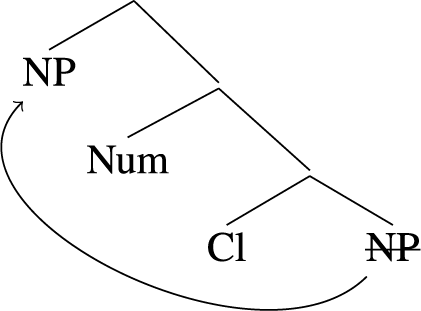
That this movement affects a phrasal projection of N rather than just the nominal head itself is supported by two arguments. First, if the noun were to move by head movement, it would have to move across the Cl position, where it would amalgamate with the ordinary classifier and only the resulting complex head could move on to a position above the numeral (‘no excorporation from complex heads’). Since this does not happen and the classifier is bypassed on the way, we must be looking at NP movement. Second, movement of the noun to the pre-numeral position pied-pipes adjectives such as ‘Thai’ or ‘small’ and complex modifiers like tua-lék ‘small-bodied’Footnote 6 as well as PPs such as nay esia ‘in Asia’. This clearly shows that the moving constituent is a whole phrase.
(6)
dèk
thay
tua-lék
sǎam
khon
child
Thai
body-small
three
cl
‘three small Thai children’ (Pornsiri Singhapreecha, p.c.)
(7)
prathêet
lék
nay
esia
sǎam
prathêet
country
small
in
Asia
three
cl:country
‘three small countries in Asia / three small Asian countries’ (Pornsiri Singhapreecha, p.c.) Thai
In the previous formal literature on classifiers, repeaters have received relatively little coverage. The main focus in Simpson (Reference Simpson, Cinque and Kayne2005) is on variation among classifier languages in Southeast Asia, but Simpson also briefly considers repeaters and outlines the contours of a movement-based account. He suggests that in the case of nouns that combine with ordinary classifiers, as in (8), the Cl position is filled by selecting a classifier from the lexicon.
(8)
rôm
sǎam
khan
umbrella
three
cl.handled.long
‘three umbrellas’ (Hundius & Kölver Reference Hundius and Kölver1983)
Thai
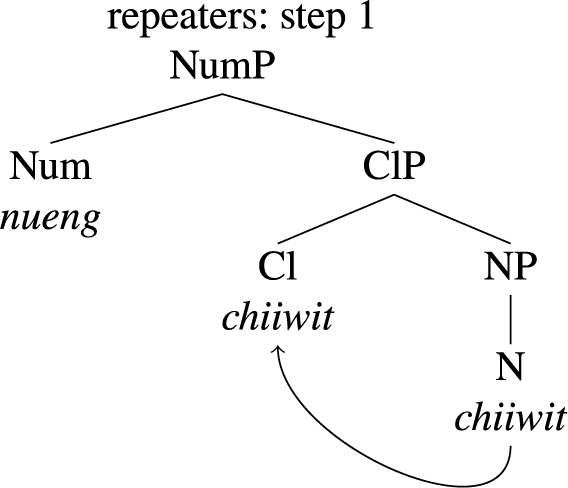
In the case of repeaters such as (9), on the other hand, N undergoes syntactic head movement to Cl. The lower copy of the head-chain is not deleted, thus at PF the same phonological material occurs twice, once in N and once in Cl. This is schematized in (10).
(9)
chiiwit
nueng
chiiwit
life
one
cl:life
‘one life’ (Piriyawiboon Reference Piriyawiboon2010: 83)
Thai
(10)
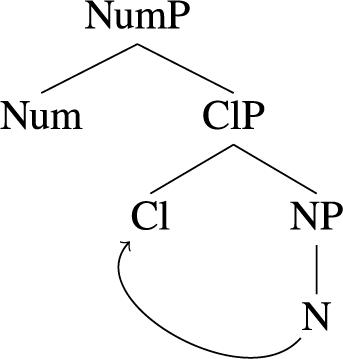
Taken together with the general NP movement in the Thai NP (also endorsed in Simpson Reference Simpson, Cinque and Kayne2005), this means that NPs with repeaters combine the head movement in (10) with the phrasal movement in (5), while in NPs with ordinary classifiers only NP movement occurs. This general idea, with slightly different syntactic labels, is also endorsed in Jenks (Reference Jenks2011).
(11)
(12)
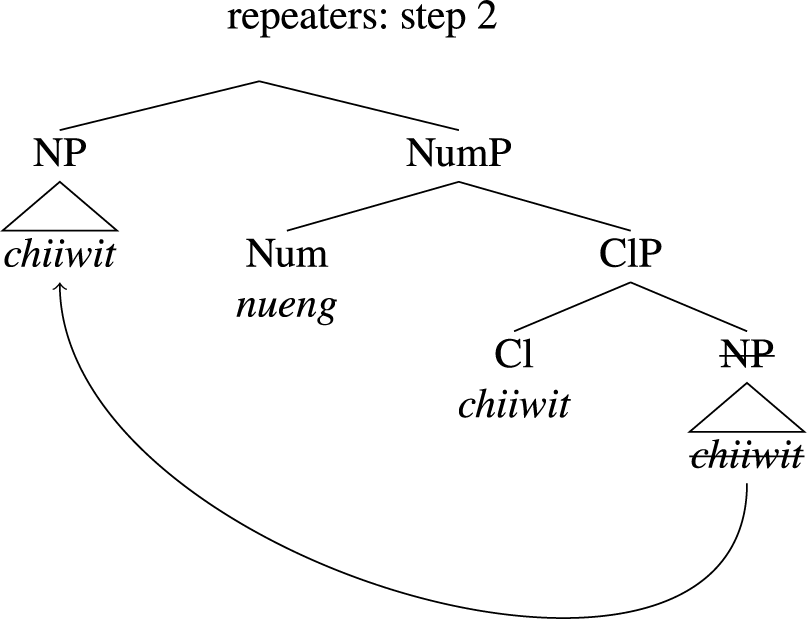
Even though there is some initial plausibility for the hypothesis and on some level Simpson clearly has the right intuition, there is quite a bit of evidence against the implementation of the proposal in terms of syntactic head movement. Firstly, whether a noun will take a repeater or not is an idiosyncratic property of the particular listeme; there is no morphosyntactic feature that characterizes all and only nouns that take repeaters (nor is there any semantic or phonological property unique to this class). Syntactic movement, on the other hand, is sensitive to morphosyntactic features and operates on morphosyntactic classes in a systematic manner. This means that movement cannot see the difference between ‘cat’ and ‘dog’ or rôm ‘umbrella’ and prathêet ‘country’. Simpson’s proposal would require head movement to operate on a listeme-by-listeme fashion, applying to a random subset of nouns in the language but not to others. This simply does not characterize syntactic movement. Consider the operation that preposes the noun (phrase) to the pre-numeral position, discussed above. This is a genuine instance of syntactic movement: it applies to all nouns, irrespective of whether that noun takes a repeater or not. That the operation that creates repeaters does not apply in this systematic fashion to all nouns but involves listeme-based idiosyncrasy points to a property of the post-syntactic component of the lexicon rather than narrow syntax.Footnote 7
Secondly, the movement account also makes the wrong prediction when it comes to compounds. Movement that indubitably takes place in narrow syntax, such as the preposing of the noun to the pre-numeral position, cannot tear compounds into two. As shown below, it is not possible to move the head of the compound away from the non-head part. (Note that Thai compounds are left-headed.)
(13)
k
$ \hat{\unicode{x025B}} $
 εw-nám
sǎam
bay
glass-water
three
cl
‘three glasses’ (Pornsiri Singhapreecha, p.c.)
(14)
*k
$ \hat{\unicode{x025B}} $
 εw
εwsǎam
bay
nám
glass
three
cl
water
‘three glasses’ (Pornsiri Singhapreecha, p.c.)
Thai
Consider now how compounds are classified when they are headed by an autoclassified noun. As shown in (15), only the head is repeated in the Cl position. This has been termed as the semi-repeater construction in the literature.
(15)
prathêet-samǔn
sǎam
prathêet
country-satellite
three
cl:country
‘three satellite countries’ (Hundius & Kölver Reference Hundius and Kölver1983)
Thai
Under Simpson’s analysis, this would involve the head of the compound moving away from the non-head part. We have just seen, however, that this is an illicit operation in Thai. Repetition of just the compound head is not unique to Thai but appears to characterize repeater languages more generally.Footnote 8
(16)
taiɁ-eiŋ
tə
eiŋ
brickbuilding-house
one
cl:house
‘one masonry house’ (Pe Reference Pe1965)
Burmese
(17)
kəŋ
khaak
pyəi
kəŋ
horn
two
cl:horn
‘two horns’ (Wajanarat Reference Wajanarat1979)
Mal
I conclude from the foregoing discussion that the repetition of the noun in the Cl position does not empirically exhibit the characteristics of narrow syntactic movement.
Simpson’s proposal also runs into theory-internal problems. To begin with, it falls foul of Kayne’s (Reference Kayne1994) Linear Correspondence Axiom (LCA). The LCA regulates how hierarchical structures are linearized. It rules out double exponence in movement chains because double exponence would violate irreflexivity and asymmetry, leading to conflicting (and ultimately irresolvable) linearization statements (Nunes Reference Nunes2004). The step in (11) creates precisely the offending configuration. One might argue that this is allowed because in a subsequent step, the NP moves out, and this repairs the problem. In (12), the N head is too deeply embedded in the landing site to c-command the instance of N that has moved to the Cl head (especially so if adjectives and PP modifiers preposed together with the noun are hosted in dedicated functional projections above NP). This reasoning raises at least two non-trivial questions, however. i) Why does (11) not cause the derivation to crash immediately (especially if the relative ordering of words is fixed at the end of each phase, as in Fox & Pesetsky Reference Fox and Pesetsky2005, and as argued in Simpson & Syed Reference Simpson and Syed2016, the projection that we here called NumP is a phase)? ii) What explains the difference in the spell out of head chains and phrasal chains? The assumption that in the case of the head chain (11) the lower copy must be spelled out, while in the case of the NP chain (12) the lower copy must be silenced remains a stipulation.Footnote 9
It should be noted that Nunes (Reference Nunes2004) discusses some cases of head chains where multiple, identical-looking copies are spelled out. He argues that this can happen when some mechanism makes one of the copies invisible for Chain Reduction. It is unclear what independently justifiable mechanism could be at work here to render either the head or the tail of the head movement chain invisible for reduction.Footnote 10 However, even if such a mechanism could be found, it would not solve all problems. Simpson (Reference Simpson, Cinque and Kayne2005) also discusses data such as (18), where only the classifier position is filled in overtly.
(18)
soong
pii
two
year
‘two years’ (Simpson Reference Simpson, Cinque and Kayne2005)
He suggests that these examples are also derived by head movement, but here chain reduction does take place (see also Simpson & Ngo Reference Simpson and Ngo2018: 222). Thus not only is the head movement operation itself listeme-based, but the spellout of multiple copies within the chain is also listeme-based, applying idiosyncratically within the set of nouns purportedly undergoing head movement. This is unoperationalizable in any theory of syntax.
Furthermore, the step in (11) also violates one of Cinque’s (Reference Cinque2005) constraints on NP-internal movement, which are essential in deriving only the cross-linguistically attested orders of Dem, Num, A and N. The relevant constraint posits that ‘Neither head movement nor movement of a phrase not containing the (overt) NP is possible’ (p. 321); ‘Allowing for movement of both N and NP […] would wrongly permit the derivation of most of the unattested orders’ (p. 324).
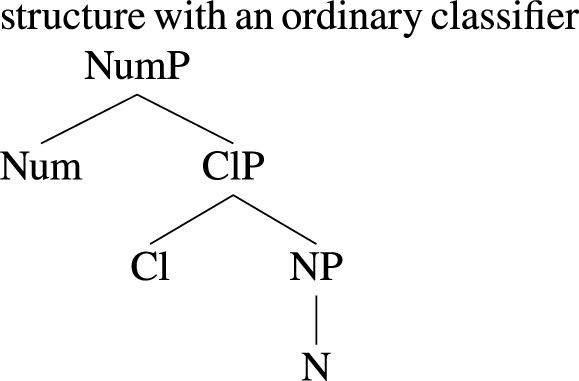
More than a decade later, Simpson & Ngo (Reference Simpson and Ngo2018) revisit Simpson’s original proposal. Recognizing the fundamental problem with applying syntactic movement idiosyncratically to particular nouns but not to others, they update the account in the following way. Repeater languages are suggested to have a phonologically null classifier, which selects for all and only nouns that take repeaters. The null classifier is suffixal, and hence in need of a morphological host. This triggers nouns that occur with the null classifier to undergo N-to-Cl movement, thereby providing support to the zero affix. Nouns that occur with the morphologically free overt classifiers do not have a similar trigger for movement and hence stay in situ. (The subsequent NP movement that takes the noun to the pre-numeral position again applies to both types of nouns.)
(19)
(20)
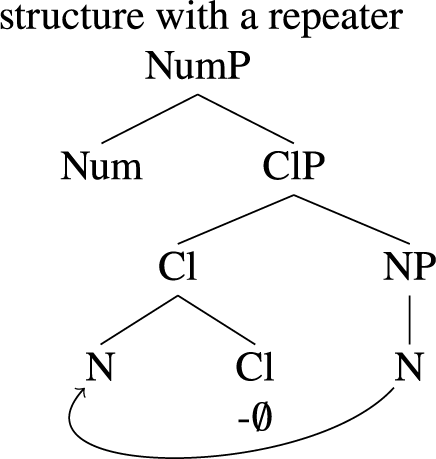
In this approach, the problem of which nouns will and will not move is ultimately reduced to the selectional restrictions between classifiers and nouns, a phenomenon that is independently known to have some idiosyncrasies (see esp. Haas Reference Haas1942).
There are several reasons why this proposal does not represent a successful attempt at eliminating the problems of the original account. Assuming silent elements with specific meaning contributions to the functional sequence has become fairly standard, cf. declarative main clause complementizers, present tense, or singular number in many languages, or Kayne-style silent nouns. Null classifiers, specifically, have been posited in a wide range of publications (including those of the present author), primarily on semantic grounds. When a noun has individual/atomic reference but no classifier is present, it is often assumed that a phonologically null classifier is responsible for the individual interpretation (Sharvy Reference Sharvy1978, Muromatsu Reference Muromatsu and Pica2003, Kobuchi-Philip Reference Kobuchi-Philip, Vogeleer and Tasmowski2006, Cinque Reference Cinque2006, Gebhardt Reference Gebhardt2009, Piriyawiboon Reference Piriyawiboon2010, Biswas Reference Biswas, Goto, Otaki, Sato and Takita2013, Zhang Reference Zhang2013, Her et al. Reference Her, Chen and Tsai2015, Dékány Reference Dékány2021, among others). The first problem with Simpson & Ngo’s (Reference Simpson and Ngo2018) account is that its success turns on the posited affixal nature of the silent classifier, an assumption that is not falsifiable.
The second problem is that Cl is a functional head, and thus it is subject to late insertion. This means that within narrow syntax, information about the morphologically free or bound nature of the to-be-inserted classifier exponent is not yet available, and so the relevant affix-supporting movement cannot be triggered.
A third and related problem is that syntactic movement in current Minimalism is triggered by feature-checking requirements rather than the morphophonological properties of affixes. The requirements of affixes are assumed to be taken care of in the post-syntactic component, and if there is indeed a null affixal classifier present, it is not clear why its need for a host is not achieved via Lowering onto N (aka Affix Hopping) or in situ cliticization leftward onto the numeral instead. In many languages, classifiers are indeed bound morphemes that lean onto the numeral for support. Cases in point include Bangla (Bhattacharya Reference Bhattacharya1999), Ch’ol (Mayan, Bale et al. Reference Bale, Coon and López2019), Munya (Sino-Tibetan, Bai Reference Bai, Aikhenvald and Mihas2019), or Kokborok (Sino-Tibetan, Baskaran Reference Baskaran2015), to mention just a few. There is no known language in which affixal classifiers are supported by (a copy of) the noun moving between the numeral and the classifier – in fact, one of the few absolute word order universals is that in numeral classifier languages (a copy of) the noun never intervenes between the numeral and the classifier, irrespective of whether the classifier is a free or bound morpheme. (Greenberg Reference Greenberg1972, generalization 20A; see also Cao & Her Reference Cao and Her2025). Moreover, the classifier forms a morphological and phonological word with the noun rather than the numeral only in Kegboid languages (‘Num Cl N’ word order), where numeral classifiers replaced an earlier noun class system marked on nouns (Aikhenvald Reference Aikhenvald2000: 110–111). Recruiting (a copy of) the noun to support an affixal classifier is thus highly unusual from a typological point of view as well.Footnote 11
Finally, Simpson & Ngo’s (Reference Simpson and Ngo2018) update of the movement analysis still suffers from three problems of the original account: it does not correctly predict the pattern of semi-repeaters and it still violates the LCA, as well as Cinque’s ban on head movement in the NP. Furthermore, it is still unexplained what causes the asymmetry between the spellout of head-chains (double spell out) and phrasal chains (single spell out).
To summarize, Simpson’s intuition that repeaters somehow use the lexical entry of the noun to fill the Cl position is correct on some level, but the execution in terms of syntactic head movement is not tenable. In the next section, I will outline an alternative analysis that involves access to the noun’s lexical entry without movement.
3. Repeaters as reduplication
3.1. Core proposal
I suggest that repeaters emerge post-syntactically, at the time of Vocabulary Insertion. Languages with repeaters have two ways to lexicalize (i.e., spell out or expone) the Cl node. The first method is to choose from the Exponent List a vocabulary item that is specified for insertion in the abstract Cl node and is permanently associated with a specific, invariable phonological form. This produces garden-variety classifiers and is available in all classifier languages.
(21)
a.
rôm
sǎam
khan
umbrella
three
Cl.handled.long
‘three umbrellas’
b.
mánaaw
sǎam
lûuk
lemon
three
cl.fruit
‘three lemons’ (Hundius & Kölver Reference Hundius and Kölver1983)
Thai
(22)
Cl
abstract node
(23)
List of Vocabulary Items that can be inserted to spell out the abstract Cl node
a.
Cl
$ \leftrightarrow $
 khan/{
 , etc.}__
b.
Cl
$ \leftrightarrow $
 lûuk/{
 , etc.}__
c.
…
(24)
Vocabulary Insertion into Cl
a.
Cl
$ \to $
 [Cl-khan]
b.
Cl
$ \to $
 [Cl-lûuk]
c.
…
As shown in (23), the Exponent List of a typical classifier language like Thai contains several vocabulary items that can spell out Cl. As is usual for such cases, ‘the winner is determined by a morpheme local to the morpheme undergoing insertion’ (Embick Reference Embick2015: 92). In other words, the vocabulary items for classifiers are supplied with contextual information that restricts their occurrence to the context of specific roots. Thus in the context of the root rôm ‘umbrella’, Cl is spelled out as khan, while in the context of the root mánaaw ‘lemon’, Cl is spelled out as lûuk. Footnote 12
The second method, available only in repeater languages, is to copy the phonological matrix of the noun and use this melody to spell out the Cl functional head. This operation affects only N’s phonological features/melody; its syntactico-semantic features remain unaffected. The insertion targets the Cl head directly, without a null affix being present. This is schematized below. The subscript ‘x’ after ‘melody’ is meant to indicate the identity of the two melodies.
(25)
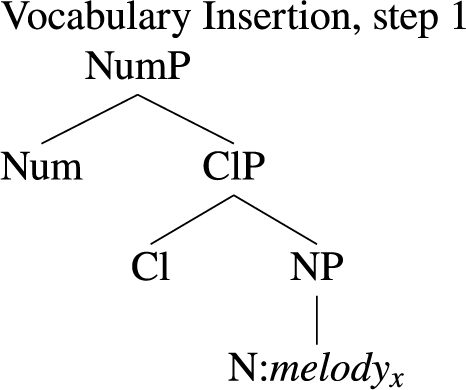
(26)
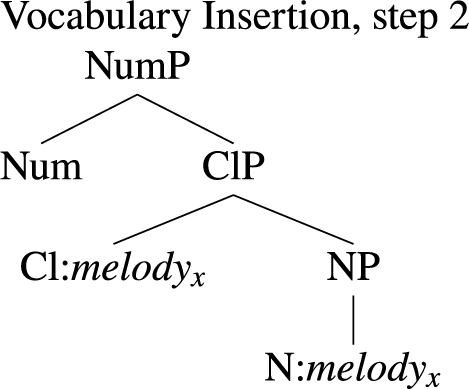
‘N’ is a shorthand for the root and its categorizer n. Whether roots are subject to late insertion is a matter of debate (see Alexiadou et al. Reference Alexiadou, Borer, Schäfer, Alexiadou, Borer and Schäfer2014) and it does not directly concern us here (though see the end of this section for some remarks). What is important is that Vocabulary Insertion proceeds bottom up (Bobaljik Reference Bobaljik2000), and so by the time Cl is vocabularized, N has already been associated with its own melody.
The copying of the phonological matrix of the noun is not a movement operation (whether syntactic or post-syntactic); it is a type of syntactic (i.e., non-affix creating) reduplication instead. Taking my cue from Travis (Reference Travis1999, Reference Travis, Kim and Strauss2001, Reference Travis and Somesfalean2003), I suggest to capture this via a special Vocabulary Item for Cl, one that is not permanently associated with a phonological matrix of its own but which is specified for reduplication in the list of vocabulary items (28).
(27)
a.
prathêet
sǎam
prathêet
country
three
cl:country
‘three countries’
b.
k

sǎam
k
island
three
cl:island
‘three islands’ (Hundius & Kölver Reference Hundius and Kölver1983)
Thai
(28)
Vocabulary Item, a member of the list in (23)

(29)
Vocabulary Insertion into Cl with (28)
a.
Cl
$ \to $
 [Cl-prathêet]
b.
Cl
$ \to $
 [Cl-k
[Cl-k
 ]
]
c.
…
This analysis echoes Burling’s (Reference Burling and Spiro1965: 250) view that repeaters are all ‘allomorphic variants of the same morpheme’, in the sense that they all go back to the same vocabulary item/listeme of the Exponent List, namely (28).Footnote 13
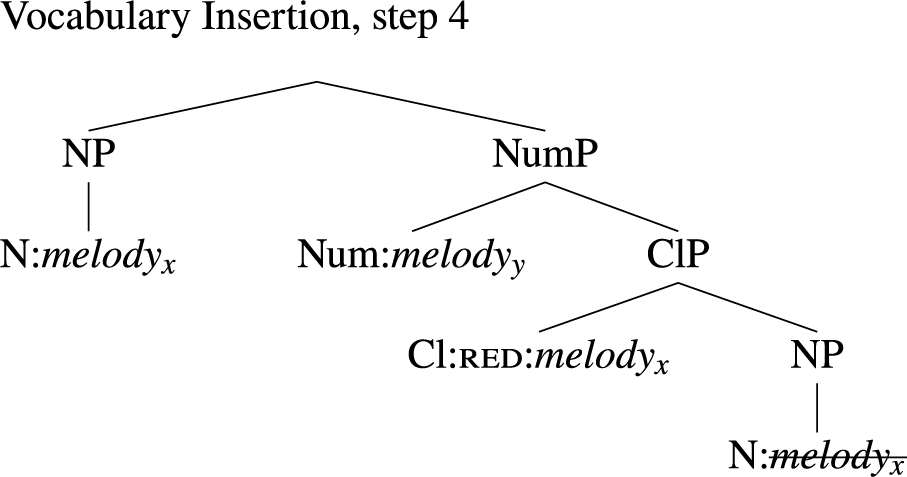
As mentioned above, on the standard approach Vocabulary Insertion operates bottom up, targeting the lower terminals before the higher ones (Bobaljik Reference Bobaljik2000). Thus after the melody of N is copied into Cl:red, Vocabulary Insertion continues upwards. It first reaches Num, and inserts the melody of the numeral (30). Next, Vocabulary Insertion reaches and expones the instance of the NP that has been placed into the pre-numeral position (see (5)/(12)). At the same time, the exponence mechanism also registers that this instance of the NP and the instance at the bottom of the structure, in the Cl-complement position, are fully identical: they involve the same listeme of the Exponent List and share all of their formal (morphosyntactic) features as well. They are therefore identified as being syntactic copies, which form a movement chain. This chain then undergoes the usual chain reduction, which suppresses the surface-exponence of the tail of the chain (31). (Note that Cl:red is not part of a movement chain, so its exponence is not affected.)
(30)
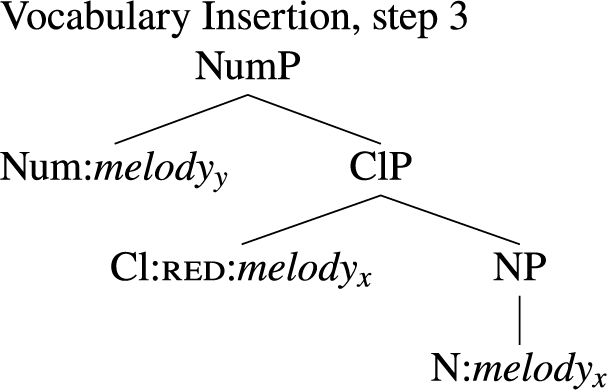
(31)
In (28) the reduplicative classifier is endowed with a contextual specification, similarly to ordinary classifiers (23). Alternatively, to capture Enfield’s (Reference Enfield2004: 120) intuition that ‘the repeater strategy is the closest thing to a residue option in the numeral classifier system’, we could drop the contextual information from the Vocabulary Item of Cl:red, and make it the default or elsewhere option, suitable whenever the given root is not listed in the contextual information of other, non-reduplicative classifier listemes.
(32)
Vocabulary Item, a member of the list in (23)
Cl
$ \leftrightarrow $
 RED
RED
In order to choose between (28) and (32), we need to consider the distribution of repeaters. In Ersu (Sino-Tibetan; Sichuan Province, China), for instance, repeaters are licit if and only if the quantified noun is not compatible with any of the regular classifiers (Zhang Reference Zhang2014). This also appears to be the case in Lao (Goddard Reference Goddard2005: 98). In these languages, the lexical entry of the reduplicative classifier can be left without contextual specification; (32) can be employed as a true last resort or rescue option whenever no other classifier is appropriate. This way, the derivation can meet the requirement that every syntactic terminal must be associated with a spellout, and Vocabulary Insertion can proceed further up in the tree.Footnote 14
In other repeater languages there is no full complementary distribution between repeaters and ordinary classifiers. In Thai, repeaters are generally not used when a garden variety classifier is available for the noun (33).
(33)
a.
dek
sǎam
khon/*dek
child
three
cl.person/cl:child
‘three children’
b.
pàakka
sǎam
dâam/*pàakka
pen
three
cl.long.handled/cl:pen
‘three pens’
c.
rôm
sǎam
khan/*rôm
umbrella
three
cl.handled.long/cl:umbrella
‘three umbrellas’ (Pornsiri Singhapreecha, p.c.)
Thai
Conversely, nouns that take a repeater are generally not compatible with the existing garden variety classifiers. In (34), substituting an (the general classifier for inanimates) for repeaters produces unacceptability.
(34)
a.
prathêet
sǎam
prathêet/*an
country
three
cl:country/cl.general
‘three countries’
b.
k
sǎam
k
/*an
island
three
cl:island/cl.general
‘three islands’ (Pornsiri Singhapreecha, p.c.)
Thai
For this reason, Jenks (Reference Jenks2011: 94) suggests that ‘the repeater construction seems to be a kind of last resort’.
With some nouns, however, either a repeater or a regular classifier is possible. Pornsiri Singhapreecha (p.c.) informs me that the alternants in (35) carry the same meaning.
(35)
a.
panhǎaa
sǎam
panhǎaa/rûan
problem
three
cl:problem/cl.story
‘three problems’ (Jenks Reference Jenks2011: 94)
b.
bâan
s
 ɔŋ
ɔŋbâan/lǎŋ
house
two
cl:house/cl.house
‘two houses’ (Placzek Reference Placzek1978: 43)
Thai
It thus seems to me that assuming a vocabulary item such as (32) as a general elsewhere-case is not fully appropriate for Thai: this would constrain repeaters to those nouns that cannot occur with ordinary classifiers, inappropriately ruling out alternations such as (35). I suggest that in a language like Thai, the nouns that take repeaters should be included in the entry of the reduplicative classifier in the form of a contextual specification, as in (23). Nouns that allow the alternation, such as those in (35), are simply listed as a contextual specification for both one of the regular classifiers and for the reduplicative classifier. Nouns in numeral classifier languages are often compatible with more than one ordinary classifier (e.g., in colloquial Thai pàakka ‘pen’ can take the general classifier an instead of dâam and cháaŋ ‘elephant’ can take tua ‘Cl.animal’ instead of the more formal ch
 ak ‘Cl.elephant’). Thus including a noun in the contextual specifications of two different classifiers is necessary independently of repeaters as well.Footnote 15
The reduplicative approach to repeaters avoids the problems raised by Simpson’s (Reference Simpson, Cinque and Kayne2005) and Simpson & Ngo’s (Reference Simpson and Ngo2018) accounts. It captures the item-specific nature of repeaters in the Vocabulary, which is the usual repository for certain idiosyncratic, unpredictable properties of listemes, and it does not violate the LCA. While they house the same melody, N and Cl remain clearly distinct in their morphosyntactic feature specification and so they are not involved in a movement chain. Therefore the issue of chain reduction (or lack thereof) is not relevant to them: both positions are spelled out by the same melody, as is usual in cases of reduplication. No typologically unattested order is derived and no unusual morphophonological constituency between Cl and N is assumed either.
This view also affords insights into the phenomenon of semi-repeaters. Recall that for compounds headed by an autoclassified noun, only the head of the compound is repeated in the Cl position.
(36)
prathêet-samǔn
sǎam
prathêet
country-satellite
three
cl:country
‘three satellite countries’ (Hundius & Kölver Reference Hundius and Kölver1983)
Thai
The reason for this, I suggest, is that the pattern in (36) is the optimal way to meet the requirement that Cl should receive an exponent. Targeting just the phonological material of the compound head keeps the melody copying mechanism minimal but at the same time allows Cl to be spelled out. In other words, this is the necessary and sufficient condition to allow Vocabulary Insertion to proceed beyond Cl. Semi-repeaters are parallel to cases of partial reduplication. These place a ‘cap’ on the amount of material to be repeated in such a way that the reduplicant may be smaller than the base, and the operation may affect material that would not be able to move independently.Footnote 16 No understanding of semi-repeaters is readily forthcoming from the head movement analysis, however.
To summarize, I suggest that repeaters involve the kind of copying found in reduplicative structures rather than the kind of copying that has been hypothesized to occur in movement structures. As discussed in Travis (Reference Travis, Kim and Strauss2001: 461), ‘the copying found in reduplication is very different from the copying mechanism used for movement (as in Copy and Delete). In syntactic reduplication, subdomains of the complement XP are being copied that would not be able to independently move. The result appears to be, then, that the copying of reduplication cannot be collapsed with the copying of movement’. Thai semi-repeaters provide one example for copying of a domain that would not be able to move on its own. A further example will be discussed in Section 4.
3.2. Repeaters as instantiations of a general classifier
As mentioned above, the proposed analysis ties in with Burling’s (Reference Burling and Spiro1965: 250) view that repeaters are all ‘allomorphic variants of the same morpheme’. In the present analysis, this morpheme is Cl:red. This single vocabulary item underlies all repeater classifiers, which are just different surface realizations of this morpheme. Theoretically, this is a more economical and streamlined model of the Thai list of vocabulary items than a potential lexicalist approach assuming 500+ different, highly specialized classifier entries, each of which is restricted to occur with the single noun that it is form-identical with. In addition to being preferable on the basis of Occam’s Razor, there is also empirical support for the present proposal over the lexicalist alternative.Footnote 17
Cl:red can be said to be a general classifier in the sense that it is desemanticized: it does not impose shape, size, or function-based restrictions on the wide variety of nouns it co-occurs with. From this perspective, we expect Cl:red and the ‘regular’ general classifier an to show some parallels. On the lexicalist view, on the other hand, repeaters are predicted to exhibit parallels with so-called unique classifiers. A unique classifier is a classifier whose use is restricted to a single – often culturally highly significant – noun (Grinevald Reference Grinevald and Wright2001). The single defining criterion of unique classifiers is their highly narrow range of application; they may have an entirely different phonological shape from the noun they classify. In Thai, ch
ak (lit. ‘rope’) is a good example: this classifier is uniquely applied to domestic elephants (Burusphat Reference Burusphat2007, Aikhenvald Reference Aikhenvald2021) but it is not form-identical to the noun it classifies (‘elephant’ is cháaŋ).Footnote 18 Similarly, the classifier law lit. ‘reed’ is applied only to the noun pìi ‘flute’ (Hundius & Kölver Reference Hundius and Kölver1983). On the lexicalist view, repeaters are a proper subset of unique classifiers (distinguished from the rest of the class only by their phonological identity to the classified noun), and so repeaters are expected to have similarities with unique classifiers such as chak rather than with the general classifier an. This prediction is not confirmed, however: repeaters show parallels to an rather than to unique classifiers, both during language acquisition and in language loss.
Starting with the differences between repeaters and other unique classifiers, Carpenter’s (Reference Carpenter1991) acquisition study found that the use of repeaters increased until age 5 (where they occurred in 18% of all responses), after which their use declined. By contrast, only one 9-year old child out of 204 (age range 1;8–11;3) used the unique classifier chak with cháaŋ ‘elephant’, in spite of the fact that this classifier-noun collocation is part of the input in the formal classroom setting. That repeaters and other highly specialized classifiers are not treated in the same way by children is also confirmed by Gandour et al.’s (Reference Gandour, Petty, Dardarananda, Dechongkit and Mukngoen1984) results. Gandour et al. (Reference Gandour, Petty, Dardarananda, Dechongkit and Mukngoen1984) found that children’s errors in NPs that in adult language feature muan, a classifier that is applied only to cigarettes and cigars, involved the substitution of a classifier used with a wider range of nouns. Thus while highly specialized classifiers are difficult for children, they overuse repeaters, which is the type of classifier that is the most specialized on the lexicalist account.Footnote 19, Footnote 20
Turning now to the similarities between repeaters and an, classic studies on the acquisition of classifiers such as Gandour et al. (Reference Gandour, Petty, Dardarananda, Dechongkit and Mukngoen1984) and Carpenter (Reference Carpenter1991) have shown that children overuse both the general classifier an and repeaters at the expense of what Grinevald (Reference Grinevald and Wright2001) calls specific classifiers, and this was the case for Gandour et al.’s (Reference Gandour, Buckingham and Dardarananda1985) conduction aphasic patient, too. Specific classifiers are classifiers which, unlike an, impose some shape, size, or function-based restrictions on the nouns they occur with, but which, unlike unique classifiers, are not restricted to use with a single noun (cf. khon for people and lêm for long and pointed or sharp-edged objects).
The overuse of an involves overgeneralization, while the overuse of repeaters amounts to overspecialization among classifiers. These are two seemingly opposite strategies, and thus their simultaneous use by the same speakers presents a puzzle. On the present account, this is not a mystery, however. Repeaters expone a general classifier whose only significant difference from an is that it is not associated to a piece of permanent, stable melody. The speakers in question therefore use a single strategy: both an and Cl:red are classifiers with a broad range of associated nouns, which substitute for more specialized classifiers.
In their discussion of the simultaneous application of overgeneralization and overspecialization, Gandour et al. (Reference Gandour, Petty, Dardarananda, Dechongkit and Mukngoen1984, Reference Gandour, Buckingham and Dardarananda1985) appeal to Conklin’s (Reference Conklin1981) theory of semantic load. Conklin suggests that due to their role in categorizing on the basis of inherent perceptible characteristics, specific classifiers add new information to the noun phrase, e.g., +human, long and thin, small and spherical, etc. This makes them semantically heavy. The general classifier, on the other hand, is semantically light, as it adds no semantic information to the NP beyond providing unit reference. For Conklin, repeaters are also semantically light: since they apply to singleton sets, they do not provide any semantic information beyond what is already present in the noun itself. To account for their data, Gandour et al. (Reference Gandour, Petty, Dardarananda, Dechongkit and Mukngoen1984, Reference Gandour, Buckingham and Dardarananda1985) suggest that semantically light classifiers are both acquired early in childhood and retained longer in language loss. This appeal to semantic complexity thus finds parallels between an and repeaters without taking the latter to be different phonological variants of a general classifier. At the same time, this type of explanation does not account for why the unique classifiers that are not form-identical to their associated nouns, such as chak, are difficult for children. Similarly to repeaters, chak-type classifiers also apply to singleton sets. They, too, eschew noun categorization on the basis of inherent perceptible characteristics, and so they should be semantically as light as repeaters. However, Carpenter’s (Reference Carpenter1991) findings do not confirm this: her results place an and repeaters on one pile, and unique classifiers such as ch
ak on another.
In overextending repeaters beyond the sphere of nouns they are usually used with, children and aphasics treat repeaters as a relatively productive category. Among Gandour et al.’s (Reference Gandour, Petty, Dardarananda, Dechongkit and Mukngoen1984) subjects, one 5-year-old used repeaters 100% of the time, while one 6-year-old used them in 76% of all responses. This was so in spite of the fact that none of the input nouns were classified by a full repeater in adult usage, and that only a few nouns allowed a partial repeater as one of several acceptable adult options. Gandour et al. (Reference Gandour, Petty, Dardarananda, Dechongkit and Mukngoen1984: 472) suggest that this overuse ‘may be attributed, in part, to syntactic relationships between classifiers and classified nouns’ (emphasis mine). The present proposal aligns with a non-lexical connection between repeaters and their associated nouns, and makes the repeater-producing rules alluded to in Gandour et al. (Reference Gandour, Petty, Dardarananda, Dechongkit and Mukngoen1984) fully explicit.
3.3. Consequences beyond repeater constructions
The analysis of repeaters as reduplication has consequences for the syntax of ellipsis. As shown below, the head noun can undergo ellipsis in NPs with both garden variety classifiers and repeaters.
(37)
a.
mii
thúrian
kìi
lûuk?
have
durian
how.many
cl
‘How many durians do you have?’
b.
cèt
lûuk
seven
cl
‘seven’ (Jenks Reference Jenks2011: 114)
Thai, ordinary Cl
(38)
sǎam
prathêet
three
cl:country
‘three (countries)’ (Pornsiri Singhapreecha, p.c.)
Thai, repeater
Ellipsis of the nominal head in repeater constructions is preferred (Juntanamalaga Reference Juntanamalaga1988, Beckwith Reference Beckwith2007: 101; Piriyawiboon Reference Piriyawiboon2010), presumably for reasons of economy. Recovery of the noun in repeater phrases is even more straightforward than in ordinary classifier constructions, as the former ‘fully describe the head N’ (Bradley Reference Bradley2005: 224), while the latter combine with a wider range of nouns. In order to derive examples such as (38), the order of operations must be 1) exponing N, 2) copying melody into Cl, 3) ellipsis of N. In other words, the melody of N must be present at an early stage of the derivation even in cases of NP ellipsis, in order to allow for melody copying from N to Cl to take place. This falls out naturally if unlike functional heads, roots are not subject to late insertion, but is also compatible with the late-insertion of roots as long as ellipsis is deletion at PF (Merchant Reference Merchant2001, Aelbrecht Reference Aelbrecht2010). However, ellipsis as radical lack of vocabulary insertion (Kornfeld & Saab Reference Kornfeld, Saab, Bok-Bennema, Hollebrandse, Kampers-Manhe and Sleeman2004) or as a null pro form in the ellipsis site (Lobeck Reference Lobeck1995) is ruled out.
Repeater constructions also weigh in on an old debate about the structure of classifier expressions. Whether the classifier forms a constituent with the noun or the numeral is an ongoing lively debate in the literature, with no consensus in sight for the time being. The proposal advanced here is only compatible with the [Num [Cl N]] constituency, and thus can be viewed as an argument corroborating this structure. This is because as argued in Travis (Reference Travis, Kim and Strauss2001: 461), a structural restriction on syntactic reduplication is that ‘subdomains of the complement XP are being copied’. Differently put, the base must be in the complement of the reduplicant, which holds only on the [Num [Cl N]] structure. Repeaters therefore provide a new, so far overlooked piece of argument in the debate on NP constituency as well.Footnote 21
4. Cross-linguistic parallels for melody copying from N
The account outlined above involves borrowing segmental information from N in order to expone a functional head already syntactically available in the extended NP. In this section, I show that this operation is attested in other languages as well. I first review Wang & Holmberg’s (Reference Wang and Holmberg2021) analysis of reduplication in Xining Chinese, which is suggested to involve copying of the root’s melody in order to expone the nominalizer n. I then turn to the facts of Murui, a multiple-classifier language of Columbia, and show that in this language melody is borrowed from the noun in order to fill the classifier slot in particular.
4.1. Reduplication into n
Wang & Holmberg (Reference Wang and Holmberg2021) observe that monosyllabic common nouns in Traditional Xining Chinese (Northwest China) are always reduplicated. Reduplication has no semantic effect, it is just a formal requirement on common nouns. (See also Wang & Holmberg Reference Wang and Holmberg2023 on similar data involving Mandarin Chinese given names.)
(39)
a.
xiōng
xiōng
countryside
red
‘countryside’
b.
mǒ
mó
steamed.bun
red
‘steamed bun’
c.
dō
dō
knife
red
‘knife’ (Wang & Holmberg Reference Wang and Holmberg2021)
Traditional Xining Chinese
Nouns do not come from the lexicon in a reduplicated form: reduplication is triggered in certain environments only. Thus in (39-a), where xiōng is an independent noun, reduplication is obligatory, but in (40), where it is the non-head of the compound xiōng-bóng, reduplication is not possible.Footnote 22
(40)
a.
xiǒng-bóng
countryside-person
‘country bumpkin’
b.
*xiōng
xiōng-bóng
countryside
countryside-person
Intended: ‘country bumpkin’ (Wang & Holmberg Reference Wang and Holmberg2021)
Traditional Xining Chinese
Wang & Holmberg (Reference Wang and Holmberg2021) suggest that this pattern is due to a requirement in Traditional Xining Chinese that a free noun must have at least two syllables. Chinese displays a close correspondence between syllable and morpheme, but there are some polysyllabic loanwords as well. As shown below, these do not undergo reduplication because the minimum syllable count is already met.
(41)
hǎdá
(*hǎdá)
hada
red
‘hǎdá’ (piece of silk used as a greeting gift among Tibetan and Mongolian people) (Wang & Holmberg Reference Wang and Holmberg2021) Traditional Xining Chinese
In order to formalize their findings, Wang & Holmberg (Reference Wang and Holmberg2021) propose that Traditional Xining Chinese has a language-specific output condition (or filter) that applies after Vocabulary Insertion.
(42)
*N if N is a free word and has less than two syllables.
In cases where (42) would not otherwise be met, the phonological features of the root are copied into the categorizer n. As the target of melody insertion is a sister null nominalizer, reduplication cannot take place when such a sister is absent. This rules out reduplication for the non-head of compounds (40-b) (which are not sisters to n), for pronouns (which are merged higher in the DP) and for adjectives and verbs (which employ a different categorizer).
Reviewing the full details of Traditional Xining Chinese reduplication would take me too afield; the interested reader is referred to Wang & Holmberg (Reference Wang and Holmberg2021) for a full explication of the facts and the analysis. What is important for our purposes is the parallels that this reduplication displays with repeater classifiers. In both cases, the phonological matrix of the bottommost element of the extended NP is copied into a syntactically independently generated head position along the functional spine. The two phenomena are also similar in that reduplication itself has no semantic import (such as plurality, iterativity, or intensification); it only serves to satisfy a formal criterion (bisyllabicity of free nouns in Traditional Xining Chinese and overt filling of the Cl position in repeater languages). They are also similar in that the copying process mainly or exclusively targets the heads of compounds.
Where the two processes differ is the element whose requirements are met by reduplication. In Traditional Xining Chinese, the trigger of reduplication is N/the base (it cannot be a free word with less than two syllables), while in repeater languages the trigger of reduplication is Cl/the reduplicant (this position must receive a spellout). In other words, while n in Traditional Xining Chinese can receive a phonologically zero spellout (as long as its complement is already bisyllabic), there is no phonologically zero spellout (i.e., null classifier) in repeater languages, and thus an overt spellout of Cl is forced.
4.2. Melody copying into Cl
In this section, I turn to repeaters in Murui (Witotoan). In order to provide the relevant background for the discussion, I will first introduce the phenomenon of ‘multiple classifier’ languages and survey the basic facts about the Murui NP.
In certain languages, the same set of classifiers can be used in more than one morphosyntactic environment. For instance, there are several languages in which the same set of classifiers occurs both with numerals and demonstratives (e.g., Mandarin Chinese), and sometimes classifiers occur with numerals, demonstratives as well as adjectives (Thai). In the case of Mandarin Chinese and Thai, researchers agree that one environment, namely that of numerals, is ‘primary’. This is because in the context of numerals classifiers are obligatory, while with demonstratives and adjectives they are not.Footnote 23 These languages are therefore classified as numeral classifier languages, similar to Ch’ol (Mayan), which allows classifiers only with numerals and the interrogative ‘how many’ (Bale et al. Reference Bale, Coon and López2019).
In other cases, however, there is no reason to think that one classifier environment is ‘primary’ and the others are ‘secondary’ (e.g., classifiers are obligatory with numerals as well as demonstratives and adjectives). In these cases we are talking about a ‘multiple classifier’ language (Aikhenvald Reference Aikhenvald2000). An example of this type of classifier language is Murui. Classifiers in Murui are mono- or disyllabic suffixes that categorize nouns based on physical properties (shape, size, consistency, functional properties), animacy, and other characteristics (Wojtylak Reference Wojtylak, Körtvélyessy, Štekauer and Valera2016). In the DP, they can occur on bare nouns and on nominal modifiers.
Murui nouns come in two types: bound noun roots, which must occur with a classifier to form an independent word (43), and free nouns, which optionally occur with classifiers (44).
(43)
de-fo
nose-cl.cavity
‘nose’ (Wojtylak Reference Wojtylak2017: 184)
bound noun
(44)
cheme,
cheme-ki
brain
brain-cl
‘brain (general), brain (specified for form)’ (Wojtylak Reference Wojtylak2017: 184)
free noun
Some nouns, for instance, ñeki
‘chambira palm’, are compatible with more than one classifier (45). There are also free nouns for which there is no classifier, e.g., nokae ‘canoe’, kuiada (a fish type), or jaziki
‘jungle’.
(45)
a.
ñeki-na
chambira-cl.tree
‘chambira palm tree’
b.
ñeki-ro
chambira-cl.string
‘a chambira string’
c.
ñeki-foro
chambira-cl.feather.like
‘a (feather-like) chambira leaf’
d.
ñeki-re
chambira-cl.plant.place
‘place where chambira grows’ (Wojtylak Reference Wojtylak, Körtvélyessy, Štekauer and Valera2016: 400)
Adjectives, numerals, interrogative words, demonstratives and other anaphorics in Murui are bound forms; they must combine with a classifier to form independent words.Footnote 24 In adnominal position, these modifiers take the general classifier -(j)e, irrespective of whether the head noun is classifiable, and if so, which specific classifier(s) it takes. For the sake of brevity, I illustrate this only with numerals and demonstratives, but the other modifiers mentioned above also exhibit this pattern.
(46)
da-je
ñeki-na,
da-je
anane-ko
one-cl.general
chambira-cl.tree
one-cl.general
maloca-cl.cover
‘one chambira tree, one maloca (traditional roundhouse)’ (Wojtylak Reference Wojtylak, Körtvélyessy, Štekauer and Valera2016, Reference Wojtylak2017)
Num with classified Ns
(47)
da-je
jiko-na,
da-je
jemi
one-cl.general
dog-top
one-cl.general
woolly.monkey
‘a dog, a woolly monkey’ (Wojtylak Reference Wojtylak2017)
Num with unclassified Ns
(48)
bai-e
ñeki-na-iai,
bai-e
anane-ko
that-cl.general
chambira-cl.tree.like-pl
that-cl.general
maloca-cl.cover
‘those chambira trees, that maloca’ (Wojtylak Reference Wojtylak2017)
Dem with classified Ns
(49)
bi-e
jiko,
bi-e
nokae,
bi-e
semana-mo
this-cl.general
dog
this-cl.general
canoe
this-cl.general
week.sp-loc
‘this dog, this canoe, this week’ (Wojtylak Reference Wojtylak2017)
Dem with unclassified Ns
Full NPs like those in (46)–(49) are rare, however. More frequently, the head noun is elided, and the modifier takes on the classifier that would be borne by the noun. (This aids recovering the reference of the ellipted noun; the semantic load of the general classifier is so weak that it would not be a useful anaphoric/reference-tracking device.)
(50)
da-na,
da-ko
one-cl.tree
one-cl.cover
‘one (tree), one (maloca)’ (Wojtylak Reference Wojtylak, Körtvélyessy, Štekauer and Valera2016, Reference Wojtylak2017)
Num with elided Ns
(51)
bi-ko,
bi-foro,
bi-do
this-cl.cover
this-cl.feather.like
this-cl.pointed
‘this (house), this (feather-shaped palm leaf), this (seed)’ (Wojtylak Reference Wojtylak, Körtvélyessy, Štekauer and Valera2016)
Dem with elided Ns
Crucial to us is what happens when the elided noun is such that there is no classifier for it. Filling the classifier slot is obligatory, and Murui meets this formal requirement by employing a repeater. In the default case, repeaters are partial copies of the corresponding noun: nouns with more than two syllables give rise to disyllabic repeaters (52), while nouns with two syllables give rise to monosyllabic repeaters (see -ko in (53-a)).Footnote 25 (52) and (53-b) show repeaters for Spanish loanwords, while (53-a) illustrates repeaters with native words.
(52)
da-mana,
da-misa
one-cl:rep:semana
one-cl:rep:camisa
‘one week, one shirt’ (Wojtylak Reference Wojtylak2017)
Num with repeater
(53)
a.
bi-ziki,
bi-kae-na,
bi-ko
this-cl:rep:jaziki
this-cl:rep:nokae-top
this-cl:rep:jiko
‘this jungle, this canoe, this dog’ (Wojtylak Reference Wojtylak, Körtvélyessy, Štekauer and Valera2016, Reference Wojtylak2017)
b.
bi-mana,
bi-dio
this-cl:rep:semana
this-cl:rep:radio
‘this week, this radio’ (Wojtylak Reference Wojtylak2017)
Dem with repeater
Repeaters have the same phonological features and prosodic status as garden variety classifiers (Wojtylak Reference Wojtylak2017: 200).Footnote 26
Classifiers in Murui clearly have a different distribution from the classifiers of East and Southeast Asian languages (‘multiple classifier’ language vs. numeral classifier languages), and I do not claim that the two systems can be collapsed. There are, however, some striking parallels between repeaters in Thai (Lao, etc.) and Murui. In both cases, there is a formal requirement to include a classifier in a certain syntactic slot. When the noun does not combine with the existing classifiers, (part of) the phonological matrix of the noun is borrowed to ‘fill in the blank’ (Wojtylak Reference Wojtylak, Körtvélyessy, Štekauer and Valera2016: 27), in an almost expletive-like manner. Repeaters form a residual class in both cases (in Murui, applying only to nouns that are not classifiable, and in Thai, mostly but not exclusively applying to otherwise unclassifiable nouns), and they fill a slot that is otherwise taken up by garden-variety classifiers.
Murui clearly shows that it is possible to access the noun’s lexical entry to fill a classifier position without involving syntactic movement. The partial repeaters in (52) and (53) are not eligible for movement on their own because they correspond to strings on the sub-morphemic level; they involve (partial) copying of the phonological matrix of the nominal root as a last resort. The Murui facts therefore provide strong independent evidence for a crucial ingredient of my analysis of repeaters in East and Southeast Asia.
5. Repeaters and unclassified nouns
Repeaters appear to be a way to avoid unclassified nouns when the linguistic structure mandates a classifier. The expletive-like filling of Cl contrasts with the situation in languages such as Nùng, Vietnamese, or Colloquial Khmer, where certain nouns do remain without an overt classifier in numeral phrases. Nùng (Tai, Kra–Dai) nouns fall into three groups: obligatorily classified, optionally classified, and unclassified nouns (Saul Reference Saul1965, Saul & Wilson Reference Saul and Wilson1980).
(54)
slám
pị
nang
three
cl
wife_of_older_bother
‘three sisters-in-law’ (Saul Reference Saul1965: 288)
(55)
slám
(pị)
sláo
three
cl
older_sister
‘three older sisters’ (Saul Reference Saul1965: 288)
(56)
slám
tị,
slám
vam
three
place
three
sentence
‘three places, three sentences’ (Saul Reference Saul1965: 290)
Nùng
A similar three-way split is also observed among nouns in Vietnamese (Emeneau Reference Emeneau1951, Nguyen Reference Nguyen1957, Thompson Reference Thompson1967, Simpson & Ngo Reference Simpson and Ngo2018). In Colloquial Khmer, nouns come in two types: optionally classified and unclassified (Jacob Reference Jacob1968).
(57)
koːn
bɤy
(nὲək)
child
three
cl.person
‘three children’ (Jacob Reference Jacob1968: 84)
(58)
chkae
bɤy
dog
three
‘three dogs’ (Jacob Reference Jacob1968: 84)
Colloquial Khmer
A detailed list of numeral classifier languages with unclassifiable nouns (in Southeast Asia and beyond) can be found in Dékány (Reference Dékány, Pratley, Bakay, Neu and Deal2022, Reference Dékány, Wągiel, Majdič and Dalento appear).
I suggest that unclassifiable nouns and repeaters are, in a way, two sides of the same coin: repeaters provide an alternative way of dealing with otherwise unclassifiable nouns (see also Denny Reference Denny, Freedman and Barkow1975, Goral Reference Goral1979, Kölver Reference Kölver, Seiler and Lehmann1982, Aikhenvald Reference Aikhenvald2000: 334). Similarly to most autoclassified nouns in repeater languages, the unclassified nouns in languages like Nùng, Vietnamese, or Colloquial Khmer are not compatible with the existing overt classifiers. Autoclassified nouns and unclassified nouns also share the property of being language-particular and unpredictable.
I propose that repeater languages and languages with unclassifiable nouns differ in their Exponent List. Repeater languages have no phonologically zero classifier in their Exponent List, nor do they have portmanteaus that could spell out N and Cl with one morpheme. The result is that the Cl node is always lexicalized overtly and separately from the noun. When there is no other option, they resort to copying the noun’s melody into the Cl position. Languages with unclassifiable nouns, on the other hand, have access either to a phonologically null classifier or N+Cl portmanteaus (something that needs to be investigated on a case-by-case basis), and thus can always expone the Cl position with a run-of-the-mill listeme from the Exponent List (see Dékány Reference Dékány, Pratley, Bakay, Neu and Deal2022). This means that they have no need for last-resort melody copying from N.
6. Conclusions
Taking a repeater classifier is an idiosyncratic property of a subset of Thai nouns. The place to deal with lexical idiosyncrasies is the Exponent List and the post-syntactic morphological component, not narrow syntax. This paper argued that repeater classifiers emerge post-syntactically, as a result of melody copying from N to Cl. I suggested that this melody copying is a kind of syntactic reduplication, and concurred with Travis (Reference Travis, Kim and Strauss2001: 461) that ‘the copying of reduplication cannot be collapsed with the copying of movement’. The analysis supports Wang & Holmberg’s (Reference Wang and Holmberg2021) position that not all cases of noun doubling result from movement, and shows that n is not the only functional head in the extended NP that can be exponed by phonological material borrowed from N.
Acknowledgments
I am profoundly indebted to Pornsiri Singhapreecha for her generous help with the Thai data. I have further benefited from the input of Andrew Simpson and two anonymous JL reviewers. The usual disclaimers apply.
Funding statement
This research was supported by the János Bolyai Research Scholarship of the Hungarian Academy of Sciences and the Hungarian National Research, Development, and Innovation Fund under grant NKFIH FK 145985.
 13 ‘sea’ and ni53Ɂɔ31 ‘cigarette’, are bisyllabic in such a way that neither syllable carries meaning on its own, and neither syllable appears as a component in compounds. With these nouns, only the last syllable undergoes copying. Since this is again a string on the submorphemic level, it cannot possibly undergo movement.
 13,
13,
 Open access

