





1 Introduction
The cyclically presented group $G_n(w)$
is the group defined by the cyclic presentation
$G_n(w)$
is the group defined by the cyclic presentation
 $$\begin{align*}\mathcal{G}_n(w) = \langle {x_0,\ldots, x_{n-1}}\ |\ {w,\theta(w),\ldots, \theta^{n-1}(w)} \rangle,\end{align*}$$
where $w(x_0,\ldots ,x_{n-1})$
is a word in the free group
$w(x_0,\ldots ,x_{n-1})$
is a word in the free group $F_n$
with generators
$F_n$
with generators $x_0,\ldots ,x_{n-1}$
and
$x_0,\ldots ,x_{n-1}$
and $\theta : F_n\rightarrow F_n$
is the shift automorphism of
$\theta : F_n\rightarrow F_n$
is the shift automorphism of $F_n$
given by
$F_n$
given by $\theta (x_i)=x_{i+1}$
for each
$\theta (x_i)=x_{i+1}$
for each $0\leq i<n$
(subscripts
$0\leq i<n$
(subscripts $\bmod ~n$
,
$\bmod ~n$
, $n>0$
). Cyclic presentations that are spines of 3-manifolds have been widely researched, with notable early studies by Dunwoody [Reference Dunwoody18], Sieradski [Reference Sieradski50], Helling, Kim, Mennicke [Reference Helling, Kim and Mennicke22], and Cavicchioli and Spaggiari [Reference Cavicchioli and Spaggiari16].
$n>0$
). Cyclic presentations that are spines of 3-manifolds have been widely researched, with notable early studies by Dunwoody [Reference Dunwoody18], Sieradski [Reference Sieradski50], Helling, Kim, Mennicke [Reference Helling, Kim and Mennicke22], and Cavicchioli and Spaggiari [Reference Cavicchioli and Spaggiari16].
A necessary condition for a presentation to be a spine of a closed 3-manifold is that its Whitehead graph is planar (see, for example, [Reference Hog-Angeloni, Metzler and Hog-Angeloni25, p. 33], [Reference Berge4, Documentation, Section 11]). The planar, reduced, Whitehead graphs of cyclic presentations were classified in [Reference Howie and Williams27], whose labeling (I.j),(II.j),(III.j) we now adopt. (Types (I.5) and (II.6) are precisely the graphs that correspond to positive or negative cyclic presentations.) In the overwhelming majority of studies of cyclic presentations as spines of 3-manifolds (for example [Reference Ankaralioglu and Aydin1, Reference Aydin, Gultekyn and Mulazzani2, Reference Cattabriga and Mulazzani7–Reference Cavicchioli, Hegenbarth and Kim13, Reference Cavicchioli, Ruini and Spaggiari15, Reference Dunwoody18, Reference Grasselli and Mulazzani20, Reference Grasselli and Mulazzani21, Reference Howie and Williams26, Reference Kim, Kim and Vesnin33–Reference Kim and Kim38, Reference McDermott42, Reference Mulazzani44, Reference Ruini, Spaggiari and Vesnin48, Reference Sieradski50–Reference Telloni53]) the reduced Whitehead graph is of one of the types (I.1), (I.3) or (I.5), which correspond to the graphs given by Dunwoody in [Reference Dunwoody18, Figure 1] and, as such, provide examples of so-called Dunwoody manifolds. By [Reference Cattabriga and Mulazzani8] and [Reference Grasselli and Mulazzani21] the class of Dunwoody manifolds is exactly the class of strongly-cyclic branched covers of $(1,1)$
-knots. Strictly speaking, the hypothesis
$(1,1)$
-knots. Strictly speaking, the hypothesis $ab\neq 0$
of [Reference Dunwoody18], which is removed in many later references (including [Reference Cattabriga and Mulazzani8, Reference Grasselli and Mulazzani21]), excludes Whitehead graphs of type (I.5) and for this reason no positive presentations appear in [Reference Dunwoody18, Table 1]. However, an explicit family of cyclic presentations that are spines of 3-manifolds and where the reduced Whitehead graph is of this type are given by the positive presentations of type
$ab\neq 0$
of [Reference Dunwoody18], which is removed in many later references (including [Reference Cattabriga and Mulazzani8, Reference Grasselli and Mulazzani21]), excludes Whitehead graphs of type (I.5) and for this reason no positive presentations appear in [Reference Dunwoody18, Table 1]. However, an explicit family of cyclic presentations that are spines of 3-manifolds and where the reduced Whitehead graph is of this type are given by the positive presentations of type $\mathfrak {Z}$
considered in [Reference McDermott42, Theorem 8] (that is, those with
$\mathfrak {Z}$
considered in [Reference McDermott42, Theorem 8] (that is, those with $s<0$
). Cyclic presentations that are spines of 3-manifolds where the reduced Whitehead graph is of a different type to (I.1), (I.3), (I.5) are few and far between. We are only aware of the following families of such presentations. The non-cyclically reduced cyclic presentation
$s<0$
). Cyclic presentations that are spines of 3-manifolds where the reduced Whitehead graph is of a different type to (I.1), (I.3), (I.5) are few and far between. We are only aware of the following families of such presentations. The non-cyclically reduced cyclic presentation $\mathcal {G}_n(x_0x_1x_1^{-1})$
is a spine of
$\mathcal {G}_n(x_0x_1x_1^{-1})$
is a spine of $S^3$
for all
$S^3$
for all $n\geq 1$
[Reference Howie and Williams26, Lemma 9]. Its Whitehead graph contains loops, but once these are removed the graph is of type (I.4). Helling, Kim, and Mennicke [Reference Helling, Kim and Mennicke22] and Cavicchioli and Spaggiari [Reference Cavicchioli and Spaggiari16, Theorem 3] showed that, for even n, the Fibonacci presentations
$n\geq 1$
[Reference Howie and Williams26, Lemma 9]. Its Whitehead graph contains loops, but once these are removed the graph is of type (I.4). Helling, Kim, and Mennicke [Reference Helling, Kim and Mennicke22] and Cavicchioli and Spaggiari [Reference Cavicchioli and Spaggiari16, Theorem 3] showed that, for even n, the Fibonacci presentations $\mathcal {F}(n)=\mathcal {G}_n(x_0x_1x_2^{-1})$
are spines of closed, oriented 3-manifolds; here (for
$\mathcal {F}(n)=\mathcal {G}_n(x_0x_1x_2^{-1})$
are spines of closed, oriented 3-manifolds; here (for $n\geq 4$
) the Whitehead graph is of type (II.11). A special case of [Reference Ruini and Spaggiari47, Theorem 6] gives that, for coprime integers
$n\geq 4$
) the Whitehead graph is of type (II.11). A special case of [Reference Ruini and Spaggiari47, Theorem 6] gives that, for coprime integers $k,l\geq 1$
and even n, the cyclic presentations
$k,l\geq 1$
and even n, the cyclic presentations $\mathcal {G}_n(x_0^lx_1^kx_2^{-l})$
are spines of closed, oriented 3-manifolds. These presentations are the Fractional Fibonacci presentations
$\mathcal {G}_n(x_0^lx_1^kx_2^{-l})$
are spines of closed, oriented 3-manifolds. These presentations are the Fractional Fibonacci presentations $\mathcal {F}^{k/l}(n)$
of [Reference Vesnin and Kim55, Reference Vesnin and Kim56] (or of [Reference Maclachlan and Duncan40, Reference Maclachlan and Reid41] in the case
$\mathcal {F}^{k/l}(n)$
of [Reference Vesnin and Kim55, Reference Vesnin and Kim56] (or of [Reference Maclachlan and Duncan40, Reference Maclachlan and Reid41] in the case $l=1$
) and if
$l=1$
) and if $(k,l)\neq (1,1)$
their reduced Whitehead graph is of type (II.7). Jeong and Wang [Reference Jeong28, Reference Jeong and Wang29] showed that, for
$(k,l)\neq (1,1)$
their reduced Whitehead graph is of type (II.7). Jeong and Wang [Reference Jeong28, Reference Jeong and Wang29] showed that, for $l\geq 2$
and even n the cyclic presentations
$l\geq 2$
and even n the cyclic presentations $\mathcal {G}_n(x_1(x_2^{-1}x_0)^l)$
are spines of closed, oriented 3-manifolds; here the reduced Whitehead graph is of type (II.14).
$\mathcal {G}_n(x_1(x_2^{-1}x_0)^l)$
are spines of closed, oriented 3-manifolds; here the reduced Whitehead graph is of type (II.14).
In Section 3, we present a family of cyclic presentations that are spines of closed 3-manifolds where the Whitehead graphs are of type (I.5) and show that the manifolds are cyclic branched covers of a lens space. This construction is essentially well known (see, for example [Reference Seifert and Threlfall49, p. 217], [Reference Minkus43, p. 4], or [Reference Kozlovskaya39, Section 3]), but the connection to the planar Whitehead graph classification of [Reference Howie and Williams27] has not previously been observed. In Section 4, we present a new family of cyclic presentations that are spines of closed 3-manifolds where the reduced Whitehead graphs are of type (II.7) (i.e., the same type as those of the Fractional Fibonacci presentations) and show that many, but not all, of the manifolds are hyperbolic. Experiments in Heegaard [Reference Berge4] were used in formulating these results.
2 Presentation complexes as spines of closed 3-manifolds
The presentation complex (or cellular model) $K=K_{\mathcal {P}}$
of a group presentation
$K=K_{\mathcal {P}}$
of a group presentation $\mathcal {P} = \langle {X}\ |\ {R} \rangle $
is the 2-complex with one 0-cell O, a loop at O for each generator
$\mathcal {P} = \langle {X}\ |\ {R} \rangle $
is the 2-complex with one 0-cell O, a loop at O for each generator $x \in X$
and a 2-cell for each relator (the boundary of that 2-cell spelling the relator). If N is a regular neighborhood of O then
$x \in X$
and a 2-cell for each relator (the boundary of that 2-cell spelling the relator). If N is a regular neighborhood of O then $K \cap \partial N$
is a 1-dimensional cell complex called the Whitehead graph or link graph of
$K \cap \partial N$
is a 1-dimensional cell complex called the Whitehead graph or link graph of $\mathcal {P}$
. Thus the Whitehead graph of
$\mathcal {P}$
. Thus the Whitehead graph of $\mathcal {P}$
is the graph with
$\mathcal {P}$
is the graph with $2|X|$
vertices
$2|X|$
vertices $v_x$
,
$v_x$
, $v_x'$
(
$v_x'$
( $x \in X$
) and an edge
$x \in X$
) and an edge $(v_x, v_y)$
(resp.
$(v_x, v_y)$
(resp. $(v_x', v_y')$
,
$(v_x', v_y')$
, $(v_x, v_y')$
) for each occurrence of a cyclic subword
$(v_x, v_y')$
) for each occurrence of a cyclic subword $xy^{-1}$
(resp.
$xy^{-1}$
(resp. $x^{-1}y$
,
$x^{-1}y$
, $(xy)^{\pm 1}$
) in a relator
$(xy)^{\pm 1}$
) in a relator $r \in R$
. The reduced Whitehead graph is the graph obtained from the Whitehead graph by replacing all multiedges between two vertices by a single edge. We say that a group presentation
$r \in R$
. The reduced Whitehead graph is the graph obtained from the Whitehead graph by replacing all multiedges between two vertices by a single edge. We say that a group presentation $\mathcal {P}$
is the spine of a closed 3-manifold M if there exists a 3-ball
$\mathcal {P}$
is the spine of a closed 3-manifold M if there exists a 3-ball $B^3\subset M$
such that
$B^3\subset M$
such that $M-\mathring {B}^3$
collapses onto
$M-\mathring {B}^3$
collapses onto $K_{\mathcal {P}}$
(where
$K_{\mathcal {P}}$
(where $\mathring {B}^3$
denotes the interior of
$\mathring {B}^3$
denotes the interior of $B^3$
). Since
$B^3$
). Since $K_{\mathcal {P}}$
is connected, the manifold M is necessarily connected.
$K_{\mathcal {P}}$
is connected, the manifold M is necessarily connected.
Suppose that a group presentation $\mathcal {P}=\langle {X}\ |\ {R} \rangle $
with an equal number of generators and relators is a spine of a closed, oriented 3-manifold. Then (see [Reference Seifert and Threlfall49, Chapter 9], [Reference Neuwirth45], [Reference Sieradski50, p. 125]) there is a
$\mathcal {P}=\langle {X}\ |\ {R} \rangle $
with an equal number of generators and relators is a spine of a closed, oriented 3-manifold. Then (see [Reference Seifert and Threlfall49, Chapter 9], [Reference Neuwirth45], [Reference Sieradski50, p. 125]) there is a $3$
-complex C whose set of faces consists of precisely one pair of oppositely oriented faces
$3$
-complex C whose set of faces consists of precisely one pair of oppositely oriented faces $F_r^+,F_r^-$
for each relator
$F_r^+,F_r^-$
for each relator $r\in R$
, whose boundaries spell r. Let
$r\in R$
, whose boundaries spell r. Let $M_0$
denote the 3-complex obtained from C by identifying the faces
$M_0$
denote the 3-complex obtained from C by identifying the faces $F_r^+,F_r^-$
(
$F_r^+,F_r^-$
( $r\in R$
). Then
$r\in R$
). Then $M_0$
is a closed, connected, oriented pseudo-manifold. The Seifert–Threlfall condition for
$M_0$
is a closed, connected, oriented pseudo-manifold. The Seifert–Threlfall condition for $M_0$
to be a manifold M is that its Euler characteristic is zero [Reference Seifert and Threlfall49, Theorem I, Section 60]. In this case the cell structure on
$M_0$
to be a manifold M is that its Euler characteristic is zero [Reference Seifert and Threlfall49, Theorem I, Section 60]. In this case the cell structure on $M=M_0$
has one vertex, one 3-cell, and 2-skeleton homeomorphic to the presentation complex
$M=M_0$
has one vertex, one 3-cell, and 2-skeleton homeomorphic to the presentation complex $K_{\mathcal {P}}$
of
$K_{\mathcal {P}}$
of $\mathcal {P}$
. The Whitehead graph
$\mathcal {P}$
. The Whitehead graph $\Gamma $
of
$\Gamma $
of $\mathcal {P}$
is the link of the single vertex of
$\mathcal {P}$
is the link of the single vertex of $K_{\mathcal {P}}$
, and so embeds in the link of the single vertex of M. The link of the vertex of M is the 2-sphere, and so
$K_{\mathcal {P}}$
, and so embeds in the link of the single vertex of M. The link of the vertex of M is the 2-sphere, and so $\Gamma $
has a planar embedding on this sphere. When
$\Gamma $
has a planar embedding on this sphere. When $\Gamma $
is connected the 3-complex C is a polyhedron
$\Gamma $
is connected the 3-complex C is a polyhedron $\pi $
bounding a 3-ball. Given a planar embedding of
$\pi $
bounding a 3-ball. Given a planar embedding of $\Gamma $
there is a one-to-one correspondence between the faces F of this embedding and the vertices
$\Gamma $
there is a one-to-one correspondence between the faces F of this embedding and the vertices $u_F$
of
$u_F$
of $\pi $
. This correspondence maps a face of degree d to a vertex of degree d of
$\pi $
. This correspondence maps a face of degree d to a vertex of degree d of $\pi $
. Moreover, if the vertices in the face read cyclically around the face are
$\pi $
. Moreover, if the vertices in the face read cyclically around the face are $w_1,\ldots ,w_d$
where
$w_1,\ldots ,w_d$
where $w_i\in \{v_x,v_x'\ (x\in X)\}$
then the arcs
$w_i\in \{v_x,v_x'\ (x\in X)\}$
then the arcs $e_1,\ldots ,e_d$
incident to
$e_1,\ldots ,e_d$
incident to $u_F$
, read cyclically, are directed toward
$u_F$
, read cyclically, are directed toward $u_F$
if
$u_F$
if $w_i=v_x$
and away from
$w_i=v_x$
and away from $u_F$
if
$u_F$
if $w_i=v_x'$
, and the arc
$w_i=v_x'$
, and the arc $e_j$
, corresponding to vertex
$e_j$
, corresponding to vertex $w_j=v_x$
or
$w_j=v_x$
or $v_x'$
, is labeled x.
$v_x'$
, is labeled x.
3 Cyclic presentations $\mathcal {H}(r,n)$
as spines of type (I.5)
$\mathcal {H}(r,n)$
as spines of type (I.5)

For $n>1,r \geq 1$
let
$n>1,r \geq 1$
let
 $$\begin{align*}\mathcal{H}(r,n)=\mathcal{G}_n(x_0x_1\ldots x_{r-1})\end{align*}$$
and let $H(r,n)$
be the group it defines. By [Reference Umar54, Theorems 2 and 3],
$H(r,n)$
be the group it defines. By [Reference Umar54, Theorems 2 and 3], $H(r,n)$
is finite if and only if
$H(r,n)$
is finite if and only if $(n,r)=1$
, in which case
$(n,r)=1$
, in which case $H(r,n) \cong \mathbb{Z}_r$
. The Whitehead graph of
$H(r,n) \cong \mathbb{Z}_r$
. The Whitehead graph of $\mathcal {H}(r,n)$
is connected if and only if
$\mathcal {H}(r,n)$
is connected if and only if $r>1$
and
$r>1$
and $(n,r)=1$
, and in this case it is of type (I.5), as shown in Figure 1, where (as also in Figure 5) the edge labels denote their multiplicities, a vertex label i denotes
$(n,r)=1$
, and in this case it is of type (I.5), as shown in Figure 1, where (as also in Figure 5) the edge labels denote their multiplicities, a vertex label i denotes $v_{x_i}$
, and a vertex label
$v_{x_i}$
, and a vertex label $\overline {i}$
denotes
$\overline {i}$
denotes $v_{x_i}'$
.
$v_{x_i}'$
.
Whitehead graph for $\mathcal {H}(r,n)$
(where
$\mathcal {H}(r,n)$
(where $(r,n)=1$
).
$(r,n)=1$
).

As a warm up to our main result, Theorem A, in this section we show that, when the Whitehead graph is connected (that is, if $n, r>1$
and
$n, r>1$
and $(n,r)=1$
), then
$(n,r)=1$
), then $\mathcal {H}(r,n)$
is a spine of a closed, oriented 3-manifold M. The positive presentations of type
$\mathcal {H}(r,n)$
is a spine of a closed, oriented 3-manifold M. The positive presentations of type $\mathfrak {Z}$
, considered in [Reference McDermott42], also have Whitehead graphs of type (I.5) and, subject to certain hypotheses, they are spines of closed, oriented manifolds N [Reference McDermott42, Theorem 8]. The manifolds M can often be distinguished from the manifolds N by comparing their fundamental groups
$\mathfrak {Z}$
, considered in [Reference McDermott42], also have Whitehead graphs of type (I.5) and, subject to certain hypotheses, they are spines of closed, oriented manifolds N [Reference McDermott42, Theorem 8]. The manifolds M can often be distinguished from the manifolds N by comparing their fundamental groups $\pi _1(M)=H(r,n)\cong \mathbb{Z}_r$
and
$\pi _1(M)=H(r,n)\cong \mathbb{Z}_r$
and $\pi _1(N)$
. For example, by [Reference McDermott42, Proposition 6],
$\pi _1(N)$
. For example, by [Reference McDermott42, Proposition 6], $\pi _1(N)$
is often infinite and [Reference McDermott42, Table 1] provides computational evidence that many of the finite groups
$\pi _1(N)$
is often infinite and [Reference McDermott42, Table 1] provides computational evidence that many of the finite groups $\pi _1(N)$
are non-cyclic.
$\pi _1(N)$
are non-cyclic.
Consider the polyhedron in Figure 2 with face pairing given by identifying the faces $F_i^+,F_i^-$
(
$F_i^+,F_i^-$
( $0\leq i<n)$
. We shall show that the identification of faces results in a 3-complex M whose 2-skeleton is the presentation complex of
$0\leq i<n)$
. We shall show that the identification of faces results in a 3-complex M whose 2-skeleton is the presentation complex of $\mathcal {H}(r,n)$
, so M has one 0-cell, n 1-cells, n 2-cells, and one 3-cell, so is a manifold by [Reference Seifert and Threlfall49, Theorem I, Section 60].
$\mathcal {H}(r,n)$
, so M has one 0-cell, n 1-cells, n 2-cells, and one 3-cell, so is a manifold by [Reference Seifert and Threlfall49, Theorem I, Section 60].
Face pairing polyhedron for $\mathcal {H}(r,n)$
.
$\mathcal {H}(r,n)$
.

Figure 2 Long description
At the top is the vertex labeled N, and at the bottom is S. Multiple curved and straight edges connect N to S, forming a symmetric, layered polyhedral structure. Along each layer, vertices are marked with labels such as w sub 0 super 3, w sub r super 3, w sub 2 r super 3, and so on, up to w sub n minus r super 3, with similar notation for w super r minus 2 and w super r minus 1. Between these layers, horizontal segments are labeled with F sub 0 super plus, F sub 1 super minus, F sub r super plus, F sub r super minus, F sub 2 r super plus, F sub 2 r super minus, and so forth, up to F sub n minus r super plus and F sub n minus r plus 1 super minus. Points along the horizontal axis are labeled x sub 0, x sub r, x sub 2 r, x sub 3 r, up to x sub n minus 2 r, x sub n minus r. The structure is symmetric about the central vertical axis, with ellipses indicating continuation of the pattern. Each edge is directed from N to S, and the face pairings are indicated by the F labels along the horizontal segments.
Let $[S,N]_i$
denote the arc of the face
$[S,N]_i$
denote the arc of the face $F_i^+$
with initial vertex S and terminal vertex N. All the arcs labeled
$F_i^+$
with initial vertex S and terminal vertex N. All the arcs labeled $x_0$
are contained in the following cycle (of length r):
$x_0$
are contained in the following cycle (of length r):
 $$ \begin{align*} [S,N]_0 &\stackrel{F_{n-(r-1)}}{\longrightarrow} [w_{n-(r-1)}^2,w_{n-(r-1)}^1] \stackrel{F_{n-(r-2)}}{\longrightarrow} [w_{n-(r-2)}^3,w_{n-(r-2)}^2]\\ & \stackrel{F_{n-(r-3)}}{\longrightarrow} [w_{n-(r-3)}^4,w_{n-(r-3)}^3] \stackrel{F_{n-(r-4)}}{\longrightarrow} \cdots \stackrel{F_{n-2}}{\longrightarrow} [w_{n-2}^{r-1},w_{n-2}^{r-2}]\\ & \stackrel{F_{n-1}}{\longrightarrow} [N,w_{n-1}^{r-1}] \stackrel{F_{0}}{\longrightarrow} [S,N]_0. \end{align*} $$
Heegaard diagram for the manifold $M(r,n)$
.
$M(r,n)$
.

Figure 3 Long description
From left to right, the top row contains circles labeled F sub negative 2 r plus 1, F sub negative r plus 1, F sub negative 1, and F sub r plus 1, with ellipses at both ends. The bottom row contains circles labeled F super plus sub n minus r, F super plus sub 0, F super plus sub r, and F super plus sub 2 r, also with ellipses at both ends. Each top circle is connected to the circle directly below it by multiple straight edges. The leftmost pair is connected by a single edge labeled 1 and another edge labeled r. The next pair is connected by three edges labeled 3, 2, and 1, and another edge labeled 2. The third pair is connected by three edges labeled 3, 2, and 1, and another edge labeled 2. The fourth pair is connected by three edges labeled 3, 2, and 1, and another edge labeled 2. The rightmost pair is connected by a single edge labeled 1 and another edge labeled r. Ellipses between pairs indicate continuation of the pattern.
Heegaard diagram for the manifold $M(r,n)/\rho $
.
$M(r,n)/\rho $
.

All the vertices that are a vertex (either initial or terminal) of an arc labeled $x_0$
are contained in the (induced) cycle of the initial vertices in the arcs above, so in the resulting complex M these vertices are identified. In particular, vertices
$x_0$
are contained in the (induced) cycle of the initial vertices in the arcs above, so in the resulting complex M these vertices are identified. In particular, vertices $N,S$
are identified, and (by comparing initial vertices) for
$N,S$
are identified, and (by comparing initial vertices) for $1< j < r$
vertices
$1< j < r$
vertices $w_{n-j}^{r-j+1}$
are identified with S. Therefore, for each
$w_{n-j}^{r-j+1}$
are identified with S. Therefore, for each $0\leq i<n$
,
$0\leq i<n$
, $1< j<r$
the vertex
$1< j<r$
the vertex $w_i^j=\theta ^{i+r-j+1}(w_{n-(r-j+1)}^j)$
is identified with S. Therefore all the vertices of the polyhedron are identified. Thus the quotient M has one 3-cell, n 2-cells, n 1-cells, and one
$w_i^j=\theta ^{i+r-j+1}(w_{n-(r-j+1)}^j)$
is identified with S. Therefore all the vertices of the polyhedron are identified. Thus the quotient M has one 3-cell, n 2-cells, n 1-cells, and one $0$
-cell, and since the boundaries of the
$0$
-cell, and since the boundaries of the $2$
-cells spell the relators of
$2$
-cells spell the relators of $\mathcal {H}(r,n)$
, it follows that M is a closed, oriented 3-manifold, and
$\mathcal {H}(r,n)$
, it follows that M is a closed, oriented 3-manifold, and $\mathcal {H}(r,n)$
is a spine of M.
$\mathcal {H}(r,n)$
is a spine of M.
As in (for example) [Reference Vesnin and Kozlovskaya57, proof of Proposition 2], a Heegaard diagram for M arising from the face pairing polyhedron is given in Figure 3. This diagram has a rotational symmetry $\rho $
of order n cyclically permuting the faces
$\rho $
of order n cyclically permuting the faces $F_i^+\rightarrow F_{i+r}^+$
and
$F_i^+\rightarrow F_{i+r}^+$
and $F_i^-\rightarrow F_{i+r}^-$
. The quotient of M by
$F_i^-\rightarrow F_{i+r}^-$
. The quotient of M by $\rho $
is a 3-orbifold in which the image of the rotation axis is a singular set. This yields the Heegaard diagram for
$\rho $
is a 3-orbifold in which the image of the rotation axis is a singular set. This yields the Heegaard diagram for $M/\rho $
in Figure 4, which is the canonical diagram of the lens space
$M/\rho $
in Figure 4, which is the canonical diagram of the lens space $L(r,1)$
. Hence the manifold M is an n-fold cyclic branched cover of
$L(r,1)$
. Hence the manifold M is an n-fold cyclic branched cover of $L(r,1)$
.
$L(r,1)$
.
Whitehead graph for $\mathcal {G}^{k/l}(n,f)$
(where
$\mathcal {G}^{k/l}(n,f)$
(where $\lambda = 2l+k-3$
, n even and
$\lambda = 2l+k-3$
, n even and $fk\equiv 0$
or
$fk\equiv 0$
or $2\bmod n$
).
$2\bmod n$
).

Figure 5 Long description
At the base are horizontal lines labeled f minus 4, f minus 2, f, f plus 2, f plus 4, spaced evenly from left to right. Above each, a vertical edge labeled lambda connects to a node in the middle row labeled f minus 3, f minus 1, f plus 1, f plus 3. Each middle node is also connected diagonally downward to two adjacent base nodes. The middle row nodes are connected by horizontal lines. Above the middle row, a third row contains integer labels from negative 4 to 4, each connected vertically to the corresponding middle node. All vertical edges between rows are labeled lambda, and all horizontal edges are labeled 1. The pattern repeats outward on both sides, indicated by ellipses at the left and right edges.
4 Cyclic presentations
$\mathcal {G}^{k/l}(n,f)$
as spines of type (II.7)

For $n\geq 2$
,
$n\geq 2$
, $k,l\geq 1$
,
$k,l\geq 1$
, $0\leq f<n$
, let
$0\leq f<n$
, let $\mathcal {G}^{k/l}(n,f)$
be the cyclic presentation
$\mathcal {G}^{k/l}(n,f)$
be the cyclic presentation
 $$\begin{align*}\mathcal{G}_n((y_0y_f\ldots y_{(l-1)f}) (y_{lf+1}y_{(l+1)f+1}\ldots y_{(l+(k-1))f+1}) (y_2y_{2+f}\ldots y_{2+(l-1)f})^{-1})\end{align*}$$
and let $G^{k/l}(n,f)$
be the group it defines. When
$G^{k/l}(n,f)$
be the group it defines. When $n\geq 4$
, the Whitehead graph of
$n\geq 4$
, the Whitehead graph of $\mathcal {G}^{k/l}(n,f)$
is planar if and only if n is even and either
$\mathcal {G}^{k/l}(n,f)$
is planar if and only if n is even and either $fk\equiv 0 \bmod n$
or
$fk\equiv 0 \bmod n$
or $fk\equiv 2 \bmod n$
, in which case it is of type (II.7) if
$fk\equiv 2 \bmod n$
, in which case it is of type (II.7) if $(k,l)\neq (1,1)$
and is of type (II.11) if
$(k,l)\neq (1,1)$
and is of type (II.11) if $k=l=1$
; see Figure 5. Our main result is the following.
$k=l=1$
; see Figure 5. Our main result is the following.
Theorem A Let $n\geq 4$
,
$n\geq 4$
, $fk\not \equiv 2 \bmod n$
, and
$fk\not \equiv 2 \bmod n$
, and $(k,l)\in \{(k,1),(1,l),(5,2),(2,5)\}$
. Then
$(k,l)\in \{(k,1),(1,l),(5,2),(2,5)\}$
. Then $\mathcal {G}^{k/l}(n,f)$
is a spine of a closed, oriented 3-manifold
$\mathcal {G}^{k/l}(n,f)$
is a spine of a closed, oriented 3-manifold $M^{k/l}(n,f)$
if and only if n and f are even and
$M^{k/l}(n,f)$
if and only if n and f are even and $fk\equiv 0 \bmod n$
.
$fk\equiv 0 \bmod n$
.
Our motivation for studying these presentations (and, in particular, under the condition $fk\equiv 0 \bmod n$
but not under the condition
$fk\equiv 0 \bmod n$
but not under the condition $fk\equiv 2 \bmod n$
) stems from the following connection to the Fractional Fibonacci groups. The presentations
$fk\equiv 2 \bmod n$
) stems from the following connection to the Fractional Fibonacci groups. The presentations $\mathcal {G}^{k/l}(n,0)$
are the Fractional Fibonacci group presentations
$\mathcal {G}^{k/l}(n,0)$
are the Fractional Fibonacci group presentations
 $$\begin{align*}\mathcal{F}^{k/l}(n)= \mathcal{G}_n(x_0^lx_1^kx_2^{-l})\end{align*}$$
introduced in [Reference Maclachlan and Duncan40, Reference Maclachlan and Reid41, Reference Vesnin and Kim55, Reference Vesnin and Kim56], generalizing the Fibonacci group presentations $\mathcal {F}^{1/1}(n)$
. For even n and coprime integers
$\mathcal {F}^{1/1}(n)$
. For even n and coprime integers $k,l\geq 1$
, the Fractional Fibonacci group
$k,l\geq 1$
, the Fractional Fibonacci group $F^{k/l}(n)$
is a 3-manifold group [Reference Maclachlan and Duncan40, Theorem 4.1], [Reference Maclachlan and Reid41, Section 4], [Reference Vesnin and Kim55, Section 2], [Reference Vesnin and Kim56, Section 2]. If
$F^{k/l}(n)$
is a 3-manifold group [Reference Maclachlan and Duncan40, Theorem 4.1], [Reference Maclachlan and Reid41, Section 4], [Reference Vesnin and Kim55, Section 2], [Reference Vesnin and Kim56, Section 2]. If $n\geq 2$
is even then
$n\geq 2$
is even then $\mathcal {F}^{1/1}(n)$
was shown to be a spine of a closed, oriented, 3-manifold in [Reference Cavicchioli and Spaggiari16],[Reference Helling, Kim and Mennicke22],[Reference Hilden, Lozano and Montesinos-Amilibia23],[Reference Hilden, Lozano and Montesinos-Amilibia24]. More generally, if
$\mathcal {F}^{1/1}(n)$
was shown to be a spine of a closed, oriented, 3-manifold in [Reference Cavicchioli and Spaggiari16],[Reference Helling, Kim and Mennicke22],[Reference Hilden, Lozano and Montesinos-Amilibia23],[Reference Hilden, Lozano and Montesinos-Amilibia24]. More generally, if $k,l\geq 1$
are coprime and n is even, then setting
$k,l\geq 1$
are coprime and n is even, then setting $s_i=q_i=l$
,
$s_i=q_i=l$
, $p_i=-r_i=k$
in [Reference Ruini and Spaggiari47, Theorem 6] gives that
$p_i=-r_i=k$
in [Reference Ruini and Spaggiari47, Theorem 6] gives that $\mathcal {F}^{k/l}(n)$
is a spine of a closed, oriented, 3-manifold. If n is odd then
$\mathcal {F}^{k/l}(n)$
is a spine of a closed, oriented, 3-manifold. If n is odd then $\mathcal {F}^{k/l}(n)$
is not a spine, since its Whitehead graph is non-planar. The question as to when, for odd n,
$\mathcal {F}^{k/l}(n)$
is not a spine, since its Whitehead graph is non-planar. The question as to when, for odd n, $F^{k/l}(n)$
is a 3-manifold group is considered in [Reference Howie and Williams26, Theorem 3] for the case
$F^{k/l}(n)$
is a 3-manifold group is considered in [Reference Howie and Williams26, Theorem 3] for the case $k=l=1$
, and in [Reference Chinyere and Williams17, Theorem 6.2] for the case
$k=l=1$
, and in [Reference Chinyere and Williams17, Theorem 6.2] for the case $l=1$
and the case
$l=1$
and the case $n=3$
. The abelianization
$n=3$
. The abelianization $F^{k/1}(n)^{\mathrm {ab}}$
is obtained in [Reference Maclachlan and Reid41, Lemma 1], [Reference Noferini and Williams46, Corollary 4.3].
$F^{k/1}(n)^{\mathrm {ab}}$
is obtained in [Reference Maclachlan and Reid41, Lemma 1], [Reference Noferini and Williams46, Corollary 4.3].
The shift extension $E^{k/l}(n)=F^{k/l}(n) \rtimes _\theta \mathbb{Z}_n$
of
$E^{k/l}(n)=F^{k/l}(n) \rtimes _\theta \mathbb{Z}_n$
of $F^{k/l}(n)$
by
$F^{k/l}(n)$
by $\mathbb{Z}_n=\langle {t}\ |\ {t^n} \rangle $
has the presentation
$\mathbb{Z}_n=\langle {t}\ |\ {t^n} \rangle $
has the presentation
 $$ \begin{align} E^{k/l}(n)=\langle {x,t}\ |\ {t^n, x^ltx^ktx^{-l}t^{-2}} \rangle, \end{align} $$
where the second relator is obtained by rewriting the relators of $F^{k/l}(n)$
in terms of the substitutions
$F^{k/l}(n)$
in terms of the substitutions $x_i=t^ixt^{-i}$
(see, for example, [Reference Johnson, Wamsley and Wright31, Theorem 4]). As set out in [Reference Bogley5, Section 2], for
$x_i=t^ixt^{-i}$
(see, for example, [Reference Johnson, Wamsley and Wright31, Theorem 4]). As set out in [Reference Bogley5, Section 2], for $0\leq f<n$
such that
$0\leq f<n$
such that $fk\equiv 0 \bmod n$
, there is a retraction
$fk\equiv 0 \bmod n$
, there is a retraction $\nu ^f:E^{k/l}(n) \rightarrow \mathbb{Z}_n=\langle {t}\ |\ {t^n} \rangle $
given by
$\nu ^f:E^{k/l}(n) \rightarrow \mathbb{Z}_n=\langle {t}\ |\ {t^n} \rangle $
given by $\nu ^f(t)=t$
,
$\nu ^f(t)=t$
, $\nu ^f(x)=t^f$
. The kernel,
$\nu ^f(x)=t^f$
. The kernel, $\mathrm {ker} (\nu ^f)$
, has a presentation with generators
$\mathrm {ker} (\nu ^f)$
, has a presentation with generators $y_i=t^ixt^{-(i+f)}$
(
$y_i=t^ixt^{-(i+f)}$
( $0\leq i<n$
) and relators that are rewrites of conjugates of the second relator of
$0\leq i<n$
) and relators that are rewrites of conjugates of the second relator of $E^{k/l}(n)$
by powers of t, and so has the cyclic presentation
$E^{k/l}(n)$
by powers of t, and so has the cyclic presentation $\mathcal {G}^{k/l}(n,f)$
. In particular (under the condition
$\mathcal {G}^{k/l}(n,f)$
. In particular (under the condition $fk\equiv 0 \bmod n$
),
$fk\equiv 0 \bmod n$
),
 $$ \begin{align*} \mathcal{G}^{k/1}(n,0) &= \mathcal{G}_n(y_0 y_1^{k} y_2^{-1})=\mathcal{F}^{k/1}(n),\\ \mathcal{G}^{1/l}(n,f) &=\mathcal{G}^{1/l}(n,0)=\mathcal{G}_n(y_0^l y_1 y_2^{-l})=\mathcal{F}^{1/l}(n),\\ \mathcal{G}^{5/2}(n,f) &= \mathcal{G}_n( (y_0y_f) (y_{2f+1}y_{3f+1}y_{4f+1}y_1y_{f+1}) (y_2y_{2+f})^{-1} ),\\ \mathcal{G}^{2/5}(n,f) &= \mathcal{G}_n((y_0y_fy_{0}y_{f}y_{0}) (y_{f+1}y_1) ( y_2y_{2+f}y_2y_{2+f}y_2)^{-1}). \end{align*} $$
The shift extension
 $$ \begin{align*} G^{k/l}(n,f) \rtimes_\theta \mathbb{Z}_n &= \langle {y,t}\ |\ {t^n, (yt^f)^lt(yt^f)^kt^{-fk+1}(yt^f)^{-l}t^{-2}} \rangle\\ &= \langle {x,t}\ |\ {t^n, x^ltx^kt^{-fk+1}x^{-l}t^{-2}} \rangle \end{align*} $$
(by setting $x=yt^f$
and eliminating y). In the case
$x=yt^f$
and eliminating y). In the case $fk\equiv 0 \bmod n$
, this coincides with
$fk\equiv 0 \bmod n$
, this coincides with $E^{k/l}(n)$
, which is independent of the value of f. This implies, for example, that the order of
$E^{k/l}(n)$
, which is independent of the value of f. This implies, for example, that the order of $G^{k/l}(n,f)$
is independent of f, the shift dynamics of
$G^{k/l}(n,f)$
is independent of f, the shift dynamics of $G^{k/l}(n,f)$
are identical for all values of f [Reference Bogley5, Lemma 2.2], and that
$G^{k/l}(n,f)$
are identical for all values of f [Reference Bogley5, Lemma 2.2], and that $G^{k/l}(n,f)$
is (non-elementary) word hyperbolic if and only if
$G^{k/l}(n,f)$
is (non-elementary) word hyperbolic if and only if $F^{k/l}(n)$
is (non-elementary) word hyperbolic. In Theorem 4.5 we similarly show that, for fixed
$F^{k/l}(n)$
is (non-elementary) word hyperbolic. In Theorem 4.5 we similarly show that, for fixed $k,l,n$
, if two groups
$k,l,n$
, if two groups $G^{k/l}(n,f_1),G^{k/l}(n,f_2)$
sharing a shift extension are fundamental groups of closed, connected, orientable 3-manifolds then either both manifolds are hyperbolic, or neither are. Observe that (under the hypothesis
$G^{k/l}(n,f_1),G^{k/l}(n,f_2)$
sharing a shift extension are fundamental groups of closed, connected, orientable 3-manifolds then either both manifolds are hyperbolic, or neither are. Observe that (under the hypothesis $fk\equiv 0\bmod n$
), as in Figure 5, the Whitehead graph of
$fk\equiv 0\bmod n$
), as in Figure 5, the Whitehead graph of $\mathcal {G}^{k/l}(n,f)$
has vertices
$\mathcal {G}^{k/l}(n,f)$
has vertices $v_{y_i},v_{y_i}'$
and edges
$v_{y_i},v_{y_i}'$
and edges $(v_{y_i},v_{y_{i+1}})$
,
$(v_{y_i},v_{y_{i+1}})$
, $(v_{y_i}',v_{y_{i+2}}')$
,
$(v_{y_i}',v_{y_{i+2}}')$
, $(v_{y_i},v_{y_{i+f}}')$
(of multiplicity
$(v_{y_i},v_{y_{i+f}}')$
(of multiplicity $2l+k-3$
), and so the Whitehead graph of
$2l+k-3$
), and so the Whitehead graph of $\mathcal {G}^{k/l}(n,f)$
is obtained from that of
$\mathcal {G}^{k/l}(n,f)$
is obtained from that of $\mathcal {F}^{k/l}(n)=\mathcal {G}^{k/l}(n,0)$
by replacing each edge
$\mathcal {F}^{k/l}(n)=\mathcal {G}^{k/l}(n,0)$
by replacing each edge $(v_{y_i},v_{y_{j}}')$
by the edge
$(v_{y_i},v_{y_{j}}')$
by the edge $(v_{y_i},v_{y_{j+f}}')$
.
$(v_{y_i},v_{y_{j+f}}')$
.
Remark 4.1 In the general setting of [Reference Bogley5], if $\nu ^f:\langle {x,t}\ |\ {t^n,W(x,t)} \rangle \rightarrow \langle {t}\ |\ {t^n} \rangle $
(
$\nu ^f:\langle {x,t}\ |\ {t^n,W(x,t)} \rangle \rightarrow \langle {t}\ |\ {t^n} \rangle $
( $n\geq 2$
) is a retraction given by
$n\geq 2$
) is a retraction given by $\nu ^{f}(t)=t$
and
$\nu ^{f}(t)=t$
and $\nu ^{f}(x)=t^{f}$
then
$\nu ^{f}(x)=t^{f}$
then $\mathrm {ker}(\nu ^f)$
has a cyclic presentation
$\mathrm {ker}(\nu ^f)$
has a cyclic presentation $\mathcal {G}_n(\rho ^f(W(x,t)))$
where
$\mathcal {G}_n(\rho ^f(W(x,t)))$
where $\rho ^f(W(x,t))$
is as defined in [Reference Bogley5, p. 159]. Analysis of the length two subwords
$\rho ^f(W(x,t))$
is as defined in [Reference Bogley5, p. 159]. Analysis of the length two subwords $x_{u(\iota )}^{\epsilon _\iota }x_{u(\iota +1)}^{\epsilon _{\iota +1}}$
of
$x_{u(\iota )}^{\epsilon _\iota }x_{u(\iota +1)}^{\epsilon _{\iota +1}}$
of $\rho ^f(W(x,t))$
(where
$\rho ^f(W(x,t))$
(where $\epsilon _\iota =\pm 1, \epsilon _{\iota +1}=\pm 1$
) provides a description of the edge set of the Whitehead graph of
$\epsilon _\iota =\pm 1, \epsilon _{\iota +1}=\pm 1$
) provides a description of the edge set of the Whitehead graph of $\mathcal {G}_n(\rho ^f(W(x,t)))$
. Given two such retractions
$\mathcal {G}_n(\rho ^f(W(x,t)))$
. Given two such retractions $\nu ^{f_1},\nu ^{f_2}$
this description yields that the Whitehead graph of
$\nu ^{f_1},\nu ^{f_2}$
this description yields that the Whitehead graph of $\mathcal {P}_2=\mathcal {G}_n(\rho ^{f_2}(W(x,t)))$
is obtained from that of
$\mathcal {P}_2=\mathcal {G}_n(\rho ^{f_2}(W(x,t)))$
is obtained from that of $\mathcal {P}_1=\mathcal {G}_n(\rho ^{f_1}(W(x,t)))$
by replacing each edge
$\mathcal {P}_1=\mathcal {G}_n(\rho ^{f_1}(W(x,t)))$
by replacing each edge $(v_{x_i},v_{x_j}')$
by the edge
$(v_{x_i},v_{x_j}')$
by the edge $(v_{x_i},v_{x_{j+(f_2-f_1)}}')$
, leaving all other edges unchanged. In particular, if the Whitehead graph of
$(v_{x_i},v_{x_{j+(f_2-f_1)}}')$
, leaving all other edges unchanged. In particular, if the Whitehead graph of $\mathcal {P}_1$
is one of the types in the planarity classification of [Reference Howie and Williams27] then the Whitehead graph of
$\mathcal {P}_1$
is one of the types in the planarity classification of [Reference Howie and Williams27] then the Whitehead graph of $\mathcal {P}_2$
is of the same type.
$\mathcal {P}_2$
is of the same type.
In contrast, for fixed $k,l,n$
, two groups
$k,l,n$
, two groups $G^{k/l}(n,f_1), G^{k/l}(n,f_2)$
sharing a shift extension will typically be non-isomorphic. We give examples of this in Example 4.2 and Lemma 4.3. Further, in the case
$G^{k/l}(n,f_1), G^{k/l}(n,f_2)$
sharing a shift extension will typically be non-isomorphic. We give examples of this in Example 4.2 and Lemma 4.3. Further, in the case $fk\equiv 0 \bmod n$
, we also have that the presentation
$fk\equiv 0 \bmod n$
, we also have that the presentation $\mathcal {G}^{k/l}(n,f)$
has a planar Whitehead graph. Since the group
$\mathcal {G}^{k/l}(n,f)$
has a planar Whitehead graph. Since the group $G^{k/l}(n,f)$
shares its shift extension with that of
$G^{k/l}(n,f)$
shares its shift extension with that of $F^{k/l}(n)$
, these properties combined suggest that the geometric properties of
$F^{k/l}(n)$
, these properties combined suggest that the geometric properties of $F^{k/l}(n)$
and
$F^{k/l}(n)$
and $\mathcal {F}^{k/l}(n)$
may be inherited by
$\mathcal {F}^{k/l}(n)$
may be inherited by $G^{k/l}(n,f)$
and
$G^{k/l}(n,f)$
and $\mathcal {G}^{k/l}(n,f)$
. However, while [Reference Ruini and Spaggiari47, Theorem 6] implies that
$\mathcal {G}^{k/l}(n,f)$
. However, while [Reference Ruini and Spaggiari47, Theorem 6] implies that $\mathcal {F}^{k/l}(n)$
is a spine for all coprime
$\mathcal {F}^{k/l}(n)$
is a spine for all coprime $k,l$
and even
$k,l$
and even $n\geq 2$
, Lemma 4.4 will show that, additionally, f must be even for
$n\geq 2$
, Lemma 4.4 will show that, additionally, f must be even for $\mathcal {G}^{k/l}(n,f)$
to be a spine of a closed, oriented, 3-manifold. This demonstrates that, generally, given two retractions
$\mathcal {G}^{k/l}(n,f)$
to be a spine of a closed, oriented, 3-manifold. This demonstrates that, generally, given two retractions $\nu ^{f_1},\nu ^{f_2}:\langle {x,t}\ |\ {t^n,W(x,t)} \rangle \rightarrow \langle {t}\ |\ {t^n} \rangle $
whose kernels have cyclic presentations
$\nu ^{f_1},\nu ^{f_2}:\langle {x,t}\ |\ {t^n,W(x,t)} \rangle \rightarrow \langle {t}\ |\ {t^n} \rangle $
whose kernels have cyclic presentations $\mathcal {P}_1,\mathcal {P}_2$
, as in Remark 4.1, it is not the case that
$\mathcal {P}_1,\mathcal {P}_2$
, as in Remark 4.1, it is not the case that $\mathcal {P}_1$
is a spine of a closed, oriented 3-manifold if and only if
$\mathcal {P}_1$
is a spine of a closed, oriented 3-manifold if and only if $\mathcal {P}_2$
is such a spine. In the other planar case,
$\mathcal {P}_2$
is such a spine. In the other planar case, $fk\equiv 2\bmod n$
, the groups
$fk\equiv 2\bmod n$
, the groups ${G}^{k/l}(n,f)$
do not share a shift extension with
${G}^{k/l}(n,f)$
do not share a shift extension with ${F}^{k/l}(n)$
, so there is no apriori reason to expect similar geometric properties to hold.
${F}^{k/l}(n)$
, so there is no apriori reason to expect similar geometric properties to hold.
Example 4.2 (Non-cyclic finite groups.)
The groups $G^{3/1}(3,0),G^{3/1}(3,1),$
are solvable of order 3528, and derived lengths 3, and 4, respectively ([Reference Johnson and Robertson30, p. 282], [Reference Maclachlan and Reid41, Remark 1]) and hence are non-isomorphic. The groups
$G^{3/1}(3,0),G^{3/1}(3,1),$
are solvable of order 3528, and derived lengths 3, and 4, respectively ([Reference Johnson and Robertson30, p. 282], [Reference Maclachlan and Reid41, Remark 1]) and hence are non-isomorphic. The groups $G^{3/2}(3,0),G^{3/2}(3,1),$
are solvable of order 504, and derived lengths 2 and 3, respectively (using [19]) and hence are non-isomorphic.
$G^{3/2}(3,0),G^{3/2}(3,1),$
are solvable of order 504, and derived lengths 2 and 3, respectively (using [19]) and hence are non-isomorphic.
In Lemma 4.3, we use the fact that the order of the abelianization $G^{k/l}(n,f)^{\mathrm {ab}}$
is given by
$G^{k/l}(n,f)^{\mathrm {ab}}$
is given by $|\mathrm {Res}(p_f(t),t^n-1)|$
, if this is non-zero, and is infinite otherwise, where
$|\mathrm {Res}(p_f(t),t^n-1)|$
, if this is non-zero, and is infinite otherwise, where
 $$\begin{align*}p_f(t)= (1-t^2)(1+t^f+\cdots +t^{(l-1)f}) + t^{lf+1}(1+t^f+\cdots + t^{(k-1)f})\end{align*}$$
is the representer polynomial of $G^{k/l}(n,f)$
, and
$G^{k/l}(n,f)$
, and $\mathrm {Res}(\cdot , \cdot )$
denotes the resultant [Reference Johnson32, p. 82]. As we will only be interested in the absolute values of resultants (and not the sign), to avoid repetitive use of modulus signs we will take
$\mathrm {Res}(\cdot , \cdot )$
denotes the resultant [Reference Johnson32, p. 82]. As we will only be interested in the absolute values of resultants (and not the sign), to avoid repetitive use of modulus signs we will take $\mathrm {Res}(\cdot , \cdot )$
to mean
$\mathrm {Res}(\cdot , \cdot )$
to mean $|\mathrm {Res}(\cdot , \cdot )|$
.
$|\mathrm {Res}(\cdot , \cdot )|$
.
Lemma 4.3 Let $n,k,l\geq 1$
where
$n,k,l\geq 1$
where $n,k$
are even and
$n,k$
are even and $\gcd (k,l)=1$
then
$\gcd (k,l)=1$
then $F^{k/l}(n)=G^{k/l}(n,0)\not \cong G^{k/l}(n,n/2)$
.
$F^{k/l}(n)=G^{k/l}(n,0)\not \cong G^{k/l}(n,n/2)$
.
Proof For any $0\leq f<n$
 $$ \begin{align} \mathrm{Res}(p_{f}(t),t^n-1) = \mathrm{Res}(p_{f}(t),t^{n/2}-1)\cdot \mathrm{Res}(p_f(t),t^{n/2}+1). \end{align} $$
The hypotheses imply that l is odd so we have
 $$ \begin{align*} \mathrm{Res}(p_{n/2}(t),t^{n/2}-1) &= \mathrm{Res}(l(1-t^2) + kt,t^{n/2}-1)\\ &= \mathrm{Res}(p_0(t),t^{n/2}-1), \end{align*} $$
and, setting $\alpha ,\bar {\alpha }=(k\pm \sqrt {k^2+4l^2})/(2l)$
,
$\alpha ,\bar {\alpha }=(k\pm \sqrt {k^2+4l^2})/(2l)$
,
 $$ \begin{align*} \mathrm{Res}(p_{0}(t),t^{n/2}+1) &=\mathrm{Res}\left( l(t-\alpha)(t-\bar{\alpha}), t^{n/2}+1\right)\\ &= l^{n/2} (\alpha^{n/2}+1)(\bar{\alpha}^{n/2}+1)\\ &= l^{n/2}\left((-1)^{n/2}+1+(\alpha^{n/2} + \bar{\alpha}^{n/2})\right). \end{align*} $$
On the other hand,
 $$ \begin{align*} \mathrm{Res}(p_{n/2}(t),t^{n/2}+1) &=\mathrm{Res}\left( l (1-t^2) + kt(1+t^{n/2})/2, t^{n/2}+1\right)\\ &=l^{n/2}\cdot 2(1+(-1)^{n/2}). \end{align*} $$
Therefore $\mathrm {Res}(p_0(t),t^{n/2}+1)\neq \mathrm {Res}(p_{n/2}(t),t^{n/2}+1)$
so, by equation (2),
$\mathrm {Res}(p_0(t),t^{n/2}+1)\neq \mathrm {Res}(p_{n/2}(t),t^{n/2}+1)$
so, by equation (2), $\mathrm {Res}(p_0(t), t^{n}-1)\neq \mathrm {Res}(p_{n/2}(t),t^{n}-1)$
. Hence
$\mathrm {Res}(p_0(t), t^{n}-1)\neq \mathrm {Res}(p_{n/2}(t),t^{n}-1)$
. Hence $|G^{k/l}(n,0)^{\mathrm {ab}}| \neq |G^{k/l}(n,n/2)^{\mathrm {ab}}|$
, and the result follows.
$|G^{k/l}(n,0)^{\mathrm {ab}}| \neq |G^{k/l}(n,n/2)^{\mathrm {ab}}|$
, and the result follows.
Lemma 4.4 Suppose $n\geq 4$
,
$n\geq 4$
, $k,l\geq 1$
,
$k,l\geq 1$
, $0\leq f<n$
where n is even,
$0\leq f<n$
where n is even, $fk\equiv 0\bmod n$
, and
$fk\equiv 0\bmod n$
, and $\gcd (k,l)=1$
. If f is odd then
$\gcd (k,l)=1$
. If f is odd then $\mathcal {G}^{k/l}(n,f)$
is not a spine of a closed, oriented 3-manifold.
$\mathcal {G}^{k/l}(n,f)$
is not a spine of a closed, oriented 3-manifold.
Proof First note that if f is odd, then the hypotheses imply that l is odd. The Whitehead graph of $\mathcal {G}^{k/l}(n,f)$
has a planar embedding, as shown in Figure 5. It has two
$\mathcal {G}^{k/l}(n,f)$
has a planar embedding, as shown in Figure 5. It has two $n/2$
-gons
$n/2$
-gons $v_{y_0}'-v_{y_2}'-\cdots -v_{y_{n-2}}'-v_{y_0}'$
and
$v_{y_0}'-v_{y_2}'-\cdots -v_{y_{n-2}}'-v_{y_0}'$
and $v_{y_1}'-v_{y_3}'-\cdots -v_{y_{n-1}}'-v_{y_1}'$
, n 3-gons
$v_{y_1}'-v_{y_3}'-\cdots -v_{y_{n-1}}'-v_{y_1}'$
, n 3-gons $v_{y_i}-v_{y_{i+1}}-v_{y_{i+f+1}}'-v_{y_i}$
, n 4-gons
$v_{y_i}-v_{y_{i+1}}-v_{y_{i+f+1}}'-v_{y_i}$
, n 4-gons $v_{y_i}-v_{y_{i+1}}-v_{y_{i+f+2}}'-v_{y_{i+f}}'-v_{y_i}$
, and
$v_{y_i}-v_{y_{i+1}}-v_{y_{i+f+2}}'-v_{y_{i+f}}'-v_{y_i}$
, and $\lambda n$
2-gons
$\lambda n$
2-gons $v_{y_i}-v_{y_{i+f+1}}'-v_{y_i}$
, where
$v_{y_i}-v_{y_{i+f+1}}'-v_{y_i}$
, where $\lambda = 2l+k-3$
. It follows that the reduced Whitehead graph is unique up to self homeomorphism of
$\lambda = 2l+k-3$
. It follows that the reduced Whitehead graph is unique up to self homeomorphism of $S^2$
.
$S^2$
.
Face pairing polyhedron for $\mathcal {G}^{k/1}(n,f)$
.
$\mathcal {G}^{k/1}(n,f)$
.

Figure 6 Long description
At the top center is node N. Directly below, a horizontal row of nodes u sub 0 to u sub 8 is connected by vertical and diagonal arrows to N and S at the bottom center. Each vertical segment between u sub i and u sub i plus 1 is labeled with faces F super plus sub f plus i and F super minus sub f plus i, with arrows indicating direction. The horizontal segments between these nodes are labeled with variables such as v super f plus i, w super f plus i, and y super f plus i. The outermost left and right nodes, u sub minus 1 and u sub 9, connect to the horizontal ellipsis, indicating continuation. The top and bottom layers contain faces F sub 0, F sub 2, F sub 4, F sub 6, F super plus sub 1, F super plus sub 3, F super plus sub 5, and F super plus sub 7, each connected by arrows to N and S. The structure forms a polyhedral network with directed edges, illustrating the face pairing for G super k forward slash 1 open parenthesis n comma f close parenthesis.
Face pairing polyhedron for $\mathcal {G}^{5/2}(n,f)$
.
$\mathcal {G}^{5/2}(n,f)$
.

Figure 7 Long description
At the horizontal center, a row of eight adjacent rectangles is labeled from left to right as F sub 2 f minus 1, F sub 2 f, F sub 2 f plus 1, F sub 2 f plus 2, F sub 2 f plus 3, F sub 2 f plus 4, F sub 2 f plus 5, and F sub 2 f plus 6. Each rectangle contains two stacked labels, with the lower label in each being F superscript plus with an increasing odd index from minus 1 to 7. Above and below this row, arrows connect each rectangle to a vertex at the top labeled N and a vertex at the bottom labeled S, forming two triangular regions. The upper triangles are labeled F sub 0, F sub 2, F sub 4, and F sub 6, while the lower triangles are labeled F superscript plus with odd indices from minus 1 to 7. Each arrow is labeled with variables such as s sub 0, s sub 2, s sub 4, s sub 6, s sub 8, and so on, or w superscript 1 with various indices. Additional vertical arrows connect the rectangles horizontally, labeled with variables like u sub 0, v sub 0, r sub 0, and so forth. Dotted lines extend beyond the leftmost and rightmost rectangles, indicating continuation. The overall structure forms a polyhedral network with directed edges and labeled faces, vertices, and edges.
Face pairing polyhedron for $\mathcal {G}^{1/l}(n,0)=\mathcal {F}^{1/l}(n)$
.
$\mathcal {G}^{1/l}(n,0)=\mathcal {F}^{1/l}(n)$
.

Figure 8 Long description
At the top is node N, from which eight solid arrows extend downward to nodes labeled u sub 0 super l, u sub 2 super l, up to u sub 8 super l. Dotted lines extend outward from N to additional nodes not fully shown. The next layer contains nodes F sub 0, F sub 2, F sub 4, F sub 6, each connected by arrows to the nodes above and to adjacent nodes by horizontal arrows labeled w sub 1, w sub 3, w sub 5, w sub 7. Below this, another layer of nodes includes v sub negative 3, v sub negative 1, v sub 1, v sub 3, v sub 5, v sub 7, with vertical arrows labeled t sub negative 1 super l, t sub 1 super l, t sub 3 super l, t sub 5 super l, t sub 7 super l. Dotted vertical lines indicate further continuation. The next layer downward contains nodes F sub negative 1, F sub negative 3, F sub 5, with horizontal arrows labeled w sub negative 1, w sub 1, w sub 3, w sub 5, w sub 7. Below this, nodes v sub negative 2, v sub 0, v sub 2, v sub 4, v sub 6, v sub 8 are connected by vertical arrows labeled t sub negative 2 super l, t sub 0 super l, t sub 2 super l, t sub 4 super l, t sub 6 super l, t sub 8 super l. The next layer contains nodes F sub negative 2, F sub 0, F sub 2, F sub 4, F sub 6, F sub 8, with horizontal arrows labeled w sub 0, w sub 2, w sub 4, w sub 6, w sub 8. The bottommost layer has nodes u sub negative 1 super l, u sub 1 super l, u sub 3 super l, u sub 5 super l, u sub 7 super l, u sub 9 super l, all connected by solid arrows converging downward to node S. Dotted lines extend outward from S to additional nodes not fully shown. Each face and edge is labeled with superscripts and subscripts, and the structure is symmetric about the vertical axis.
Face pairing polyhedron for $\mathcal {G}^{2/5}(n,f)$
.
$\mathcal {G}^{2/5}(n,f)$
.

Figure 9 Long description
At the top is vertex N, from which eight directed edges radiate downward, each labeled u sub 0 super 1 through u sub 8 super 1. These connect to a horizontal row of vertices, each marking the upper corners of four quadrilateral faces labeled F sub 0, F sub 2, F sub 4, and F sub 6. Each face is bounded by edges labeled u and w with varying indices and superscripts. Below this, a central horizontal band contains eight quadrilateral faces labeled F sub f minus 1, F sub f plus 1, F sub f plus 3, F sub f plus 5, F super plus sub f minus 2, F super plus sub f, F super plus sub f plus 2, and F super plus sub f plus 4, each with their own sets of labeled vertices and edges, including r, s, t, and v with various indices and superscripts. The bottom layer mirrors the top, with eight directed edges converging at vertex S, each labeled u sub negative 1 super 1 through u sub negative 8 super 1. Dotted lines on the left and right indicate continuation of the structure. All arrows are directed from N downward and from S upward, forming a symmetric polyhedral face-pairing scheme.
If $\mathcal {G}^{k/l}(n,f)$
is a spine of a closed, oriented, 3-manifold then in a putative corresponding face-pairing polyhedron, there are two degree
$\mathcal {G}^{k/l}(n,f)$
is a spine of a closed, oriented, 3-manifold then in a putative corresponding face-pairing polyhedron, there are two degree $n/2$
source vertices,
$n/2$
source vertices, $N,S$
, say, where N has outgoing arcs in cyclic order
$N,S$
, say, where N has outgoing arcs in cyclic order $y_0,y_2,y_4,\ldots , y_{n-2}$
and S has outgoing arcs in cyclic order
$y_0,y_2,y_4,\ldots , y_{n-2}$
and S has outgoing arcs in cyclic order $y_1,y_3,y_5,\ldots , y_{n-1}$
. The 2-cells incident to N are therefore, in cyclic order,
$y_1,y_3,y_5,\ldots , y_{n-1}$
. The 2-cells incident to N are therefore, in cyclic order, $F_0^-,F_2^-,F_4^-, \dots , F_{n-2}^-$
, where the boundary of
$F_0^-,F_2^-,F_4^-, \dots , F_{n-2}^-$
, where the boundary of $F_i^-$
reads, anticlockwise, the i’th relator of
$F_i^-$
reads, anticlockwise, the i’th relator of $\mathcal {G}^{k/l}(n,f)$
. The arc labeled
$\mathcal {G}^{k/l}(n,f)$
. The arc labeled $y_2$
, with initial vertex N, is the first of a path
$y_2$
, with initial vertex N, is the first of a path $y_2-y_{2+f}-\cdots -y_{2+(l-1)f}$
. Let v denote the terminal vertex of the last arc in this path. Then v has two incoming arcs labeled
$y_2-y_{2+f}-\cdots -y_{2+(l-1)f}$
. Let v denote the terminal vertex of the last arc in this path. Then v has two incoming arcs labeled $y_{(l-1)f+1},y_{(l-1)f+2}$
, and an outgoing arc labeled
$y_{(l-1)f+1},y_{(l-1)f+2}$
, and an outgoing arc labeled $y_{lf+3}$
. Therefore v is a degree 4 vertex, and its remaining arc is outgoing, and labeled
$y_{lf+3}$
. Therefore v is a degree 4 vertex, and its remaining arc is outgoing, and labeled $y_{lf+1}$
. The outgoing arcs
$y_{lf+1}$
. The outgoing arcs $y_{lf+1},y_{lf+3}$
then bound the
$y_{lf+1},y_{lf+3}$
then bound the $F_{lf+1}^-$
face. Since
$F_{lf+1}^-$
face. Since $l,f$
are odd,
$l,f$
are odd, $lf+1$
is even, so the face pairing contains two
$lf+1$
is even, so the face pairing contains two $F_{lf+1}^-$
faces, a contradiction.
$F_{lf+1}^-$
faces, a contradiction.
In Figures 6, 7, 8, and 9, we present face-pairing polyhedra with n pairs of faces $F_i^+,F_i^-$
(
$F_i^+,F_i^-$
( $0\leq i<n$
) of opposite orientation whose boundaries spell the defining relators of the relevant presentation
$0\leq i<n$
) of opposite orientation whose boundaries spell the defining relators of the relevant presentation $\mathcal {G}^{k/l}(n,f)$
. In the proof of Theorem A, we show that the identification of faces
$\mathcal {G}^{k/l}(n,f)$
. In the proof of Theorem A, we show that the identification of faces $F_i^+,F_i^-$
results in a 3-complex that satisfies the Seifert–Threlfall condition, and so is a manifold whose spine is the presentation complex of
$F_i^+,F_i^-$
results in a 3-complex that satisfies the Seifert–Threlfall condition, and so is a manifold whose spine is the presentation complex of $\mathcal {G}^{k/l}(n,f)$
. (Note that, in these figures, the condition that f is even is necessary for each relator to appear as the label of a pair of oppositely oriented faces.) The diagrams have different forms depending on whether
$\mathcal {G}^{k/l}(n,f)$
. (Note that, in these figures, the condition that f is even is necessary for each relator to appear as the label of a pair of oppositely oriented faces.) The diagrams have different forms depending on whether $l>k$
or
$l>k$
or $k>l$
. The figures should provide the enthusiastic reader with sufficient information to construct face-pairing polyhedra in the general cases. The values
$k>l$
. The figures should provide the enthusiastic reader with sufficient information to construct face-pairing polyhedra in the general cases. The values $\{k,l\}=\{2,5\}$
were selected so that
$\{k,l\}=\{2,5\}$
were selected so that $k,l,|k-l|$
are distinct, to make it straightforward to infer paths of lengths
$k,l,|k-l|$
are distinct, to make it straightforward to infer paths of lengths $k,l$
, and
$k,l$
, and $|k-l|$
. (For example, in Figure 7 the path from
$|k-l|$
. (For example, in Figure 7 the path from $v_{2f}$
to
$v_{2f}$
to $u_2$
has length
$u_2$
has length $3=k-l$
, and in Figure 9 the path from
$3=k-l$
, and in Figure 9 the path from $w_f$
to
$w_f$
to $v_{f-1}$
has length
$v_{f-1}$
has length $3=l-k$
.) We expect the Seifert–Threlfall condition to hold in the general case for coprime
$3=l-k$
.) We expect the Seifert–Threlfall condition to hold in the general case for coprime $k,l$
; however, the corresponding analysis to check this would be highly technical. Since our goal is to exhibit new cyclic presentations that arise as spines of closed 3-manifolds, whose Whitehead graphs are of type (II.7), rather than to be exhaustive, we have not sought to do this.
$k,l$
; however, the corresponding analysis to check this would be highly technical. Since our goal is to exhibit new cyclic presentations that arise as spines of closed 3-manifolds, whose Whitehead graphs are of type (II.7), rather than to be exhaustive, we have not sought to do this.
Proof of Theorem A
We may assume n is even and $fk\equiv 0$
, for otherwise the Whitehead graph of
$fk\equiv 0$
, for otherwise the Whitehead graph of $\mathcal {G}^{k/l}(n,f)$
is not planar [Reference Howie and Williams27] (noting that
$\mathcal {G}^{k/l}(n,f)$
is not planar [Reference Howie and Williams27] (noting that $fk\not \equiv 2 \bmod n$
, by hypothesis). Moreover, by Lemma 4.4 we may assume f is even.
$fk\not \equiv 2 \bmod n$
, by hypothesis). Moreover, by Lemma 4.4 we may assume f is even.
Case 1: $(k,l)=(k,1)$
. Consider the face pairing polyhedron depicted in Figure 6 (where the arc labels can be deduced from the position of the unique source in the boundary of each face) with face pairing given by identifying the faces
$(k,l)=(k,1)$
. Consider the face pairing polyhedron depicted in Figure 6 (where the arc labels can be deduced from the position of the unique source in the boundary of each face) with face pairing given by identifying the faces $F_i^+,F_i^-$
(
$F_i^+,F_i^-$
( $0\leq i<n)$
. We shall show that the identification of faces results in a 3-complex M whose
$0\leq i<n)$
. We shall show that the identification of faces results in a 3-complex M whose $2$
-skeleton is the presentation complex of
$2$
-skeleton is the presentation complex of $\mathcal {G}^{k/l}(n,f)$
, so M has one
$\mathcal {G}^{k/l}(n,f)$
, so M has one $0$
-cell, n 1-cells, n 2-cells, and one
$0$
-cell, n 1-cells, n 2-cells, and one $3$
-cell, so is a manifold by [Reference Seifert and Threlfall49, Theorem I, Section 60].
$3$
-cell, so is a manifold by [Reference Seifert and Threlfall49, Theorem I, Section 60].
All the arcs labeled $x_0$
are contained in the following cycle:
$x_0$
are contained in the following cycle:
 $$ \begin{align*} [N,u_0] &\stackrel{F_0}{\longrightarrow} [u_{1-f},v_0] \stackrel{F_{-1}}{\longrightarrow} [w_{f}^{k-2},u_1] \stackrel{F_{f-1}}{\longrightarrow} [w_{2f}^{k-3},w_{2f}^{k-2}]\\ &\stackrel{F_{2f-1}}{\longrightarrow} [w_{3f}^{k-4},w_{3f}^{k-3}] \stackrel{F_{3f-1}}{\longrightarrow} \cdots \stackrel{F_{(k-3)f-1}}{\longrightarrow} [w_{(k-2)f}^{1},w_{(k-2)f}^{2}]\\ &\stackrel{F_{(k-2)f-1}}{\longrightarrow} [v_{(k-1)f-2},w_{(k-1)f}^{1}] \stackrel{F_{(k-1)f-1}}{\longrightarrow} [v_{(k-1)f-3},w_{0}^1] \stackrel{F_{-2}}{\longrightarrow} [N,u_0]. \end{align*} $$
Therefore, in the resulting complex M all the arcs labeled $x_0$
are identified. Moreover, all the vertices that are a vertex (either initial or terminal) of an arc labeled
$x_0$
are identified. Moreover, all the vertices that are a vertex (either initial or terminal) of an arc labeled $x_0$
are contained in the (induced) cycle of the initial vertices in the arcs above, so these vertices are identified in M. By applying the shift
$x_0$
are contained in the (induced) cycle of the initial vertices in the arcs above, so these vertices are identified in M. By applying the shift $\theta ^{2j}$
(
$\theta ^{2j}$
( $0\leq j<n/2$
) to the above, all the arcs labeled
$0\leq j<n/2$
) to the above, all the arcs labeled $x_{2j}$
are identified and all the vertices of such arcs are identified. That is, the vertices
$x_{2j}$
are identified and all the vertices of such arcs are identified. That is, the vertices $N,u_{2j+(1-f)},w_{2j+f}^{k-2},w_{2j+2f}^{k-3},\dots , w_{2j+(k-2)f}^1, v_{2j+(k-1)f-2}$
are identified; equivalently, N,
$N,u_{2j+(1-f)},w_{2j+f}^{k-2},w_{2j+2f}^{k-3},\dots , w_{2j+(k-2)f}^1, v_{2j+(k-1)f-2}$
are identified; equivalently, N, $u_{2j+1}, w_{2j}^1,\dots w_{2j}^{k-2}, v_{2j}$
(
$u_{2j+1}, w_{2j}^1,\dots w_{2j}^{k-2}, v_{2j}$
( $0\leq j<n/2$
) are identified.
$0\leq j<n/2$
) are identified.
All the arcs labeled $x_1$
are contained in the following cycle:
$x_1$
are contained in the following cycle:
 $$ \begin{align*} [S,u_1] &\stackrel{F_1}{\longrightarrow} [u_{2-f},v_1] \stackrel{F_{0}}{\longrightarrow} [w_{f+1}^{k-2},u_2] \stackrel{F_{f}}{\longrightarrow} [w_{2f+1}^{k-3},w_{2f+1}^{k-2}]\\ &\stackrel{F_{2f}}{\longrightarrow} [w_{3f+1}^{k-4},w_{3f+1}^{k-3}] \stackrel{F_{3f}}{\longrightarrow} \cdots \stackrel{F_{(k-3)f}}{\longrightarrow} [w_{(k-2)f+1}^{1},w_{(k-2)f+1}^{2}]\\ &\stackrel{F_{(k-2)f}}{\longrightarrow} [v_{(k-1)f-1},w_{(k-1)f+1}^{1}] \stackrel{F_{(k-1)f}}{\longrightarrow} [v_{(k-1)f-2},w_{1}^1] \stackrel{F_{-2}}{\longrightarrow} [S,u_1]. \end{align*} $$
Therefore, in M all the arcs labeled $x_1$
are identified. Moreover, all the vertices that are a vertex (either initial or terminal) of an arc labeled
$x_1$
are identified. Moreover, all the vertices that are a vertex (either initial or terminal) of an arc labeled $x_1$
are contained in the (induced) cycle of the initial vertices in the arcs above, so these vertices are identified in M. By applying the shift
$x_1$
are contained in the (induced) cycle of the initial vertices in the arcs above, so these vertices are identified in M. By applying the shift $\theta ^{2j}$
(
$\theta ^{2j}$
( $0\leq j<n/2$
) to the above, all the arcs labeled
$0\leq j<n/2$
) to the above, all the arcs labeled $x_{2j+1}$
are identified and all the vertices of such arcs are identified. That is, the vertices
$x_{2j+1}$
are identified and all the vertices of such arcs are identified. That is, the vertices $S,u_{2j+(2-f)},w_{2j+f+1}^{k-2},w_{2j+2f+1}^{k-3},\dots , w_{2j+(k-2)f+1}^1, v_{2j+(k-1)f-1}$
are identified; that is S,
$S,u_{2j+(2-f)},w_{2j+f+1}^{k-2},w_{2j+2f+1}^{k-3},\dots , w_{2j+(k-2)f+1}^1, v_{2j+(k-1)f-1}$
are identified; that is S, $u_{2j}, w_{2j+1}^1,\dots w_{2j+1}^{k-2}, v_{2j+1}$
(
$u_{2j}, w_{2j+1}^1,\dots w_{2j+1}^{k-2}, v_{2j+1}$
( $0\leq j<n/2$
) are identified. Moreover, examining the terminal vertices of the first cycle above we see that
$0\leq j<n/2$
) are identified. Moreover, examining the terminal vertices of the first cycle above we see that $u_0$
and
$u_0$
and $u_1$
are identified. Therefore the vertices induced from the first cycle are identified with the vertices from the second cycle, so all vertices of the polyhedron are identified. Thus M has one 3-cell, n 2-cells, n 1-cells, and one 0-cell, and since the boundaries of the
$u_1$
are identified. Therefore the vertices induced from the first cycle are identified with the vertices from the second cycle, so all vertices of the polyhedron are identified. Thus M has one 3-cell, n 2-cells, n 1-cells, and one 0-cell, and since the boundaries of the $2$
-cells spell the relators of
$2$
-cells spell the relators of $\mathcal {G}^{1/l}(n,0)$
, it follows that
$\mathcal {G}^{1/l}(n,0)$
, it follows that $\mathcal {G}^{1/l}(n,0)$
is a spine of a closed 3-manifold, as required.
$\mathcal {G}^{1/l}(n,0)$
is a spine of a closed 3-manifold, as required.
Case 2: $(k,l)=(5,2)$
. Consider the face pairing polyhedron depicted in Figure 7 (where the arc labels can be deduced from the position of the unique source in the boundary of each face) with face pairing given by identifying the faces
$(k,l)=(5,2)$
. Consider the face pairing polyhedron depicted in Figure 7 (where the arc labels can be deduced from the position of the unique source in the boundary of each face) with face pairing given by identifying the faces $F_i^+,F_i^-$
(
$F_i^+,F_i^-$
( $0\leq i<n)$
. All the arcs labeled
$0\leq i<n)$
. All the arcs labeled $x_0$
are contained in the following cycle:
$x_0$
are contained in the following cycle:
 $$ \begin{align*} [N,s_0] &\stackrel{F_0}{\longrightarrow} [u_{1-2f},t_0] \stackrel{F_{-1}}{\longrightarrow} [w_{2f-1}^1,w_{2f-1}^2] \stackrel{F_{2f-1}}{\longrightarrow} [r_{2f-1},v_{4f-1}]\\ &\stackrel{F_{4f-2}}{\longrightarrow} [s_{4f},u_{4f}] \stackrel{F_{4f}}{\longrightarrow} [t_{4f},v_{4f}] \stackrel{F_{4f-1}}{\longrightarrow} [w_{f-1}^2,u_{-f+1}]\\ &\stackrel{F_{f-1}}{\longrightarrow} [v_{3f-1},w_{3f-1}^1] \stackrel{F_{3f-1}}{\longrightarrow} [u_{3f-1},r_{3f-1}] \stackrel{F_{-2}}{\longrightarrow} [N,s_0], \end{align*} $$
and all the arcs labeled $x_1$
are contained in the following cycle:
$x_1$
are contained in the following cycle:
 $$ \begin{align*} [S,s_1] &\stackrel{F_1}{\longrightarrow} [u_{2-2f},t_1] \stackrel{F_{0}}{\longrightarrow} [w_{2f}^1,w_{2f}^2] \stackrel{F_{2f}}{\longrightarrow} [r_{2f},v_{4f}]\\ & \stackrel{F_{4f-1}}{\longrightarrow} [s_{4f+1},u_{4f+1}] \stackrel{F_{4f+1}}{\longrightarrow} [t_{4f+1},v_{4f+1}] \stackrel{F_{4f}}{\longrightarrow} [w_{f}^2,u_{-f+2}]\\ & \stackrel{F_{f}}{\longrightarrow} [v_{3f},w_{3f}^1] \stackrel{F_{3f}}{\longrightarrow} [u_{3f},r_{3f}] \stackrel{F_{-1}}{\longrightarrow} [S,s_1]. \end{align*} $$
The proof then proceeds as in Case 1.
Case 3: $(k,l)=(1,l)$
. Consider the face pairing polyhedron depicted in Figure 8. All the arcs labeled
$(k,l)=(1,l)$
. Consider the face pairing polyhedron depicted in Figure 8. All the arcs labeled $x_0$
are contained in the following cycle:
$x_0$
are contained in the following cycle:
 $$ \begin{align*} [N,u_0^{1}] &\stackrel{F_0}{\longrightarrow} [w_0,t_0^1] \stackrel{F_{-2}}{\longrightarrow} [u_0^1,u_0^2] \stackrel{F_{0}}{\longrightarrow} [t_0^1,t_0^2] \stackrel{F_{-2}}{\longrightarrow} [u_0^2,u_0^3]\\ &\stackrel{F_{0}}{\longrightarrow} [t_0^2,t_0^3] \stackrel{}{\longrightarrow} \cdots \stackrel{F_{-2}}{\longrightarrow} [u_0^{l-2},u_0^{l-1}] \stackrel{F_{0}}{\longrightarrow} [t_0^{l-2},v_{-1}]\\ &\stackrel{F_{-2}}{\longrightarrow} [u_0^{l-1},w_{-1}] \stackrel{F_{0}}{\longrightarrow} [v_{-1},v_0] \stackrel{F_{-1}}{\longrightarrow} [w_{-2},w_0] \stackrel{F_{-2}}{\longrightarrow} [N,u_0^1], \end{align*} $$
and all the arcs labeled $x_1$
are contained in the following cycle:
$x_1$
are contained in the following cycle:
 $$ \begin{align*} [S,u_1^{1}] &\stackrel{F_1}{\longrightarrow} [w_1,t_1^1] \stackrel{F_{-1}}{\longrightarrow} [u_1^1,u_1^2] \stackrel{F_{1}}{\longrightarrow} [t_1^1,t_1^2] \stackrel{F_{-1}}{\longrightarrow} [u_1^2,u_1^3]\\ &\stackrel{F_{1}}{\longrightarrow} [t_1^2,t_1^3] \stackrel{}{\longrightarrow} \cdots \stackrel{F_{-1}}{\longrightarrow} [u_1^{l-2},u_1^{l-1}] \stackrel{F_{1}}{\longrightarrow} [t_1^{l-2},v_{0}]\\ &\stackrel{F_{-1}}{\longrightarrow} [u_1^{l-1},w_{0}] \stackrel{F_{1}}{\longrightarrow} [v_{0},v_1] \stackrel{F_{0}}{\longrightarrow} [w_{-1},w_1] \stackrel{F_{-1}}{\longrightarrow} [S,u_1^1]. \end{align*} $$
The proof then proceeds as in Case 1.
Case 4: $(k,l)=(2,5)$
. Consider the face pairing polyhedron depicted in Figure 9. All the arcs labeled
$(k,l)=(2,5)$
. Consider the face pairing polyhedron depicted in Figure 9. All the arcs labeled $x_0$
are contained in the following cycle:
$x_0$
are contained in the following cycle:
 $$ \begin{align*} [N,u_0^{1}] &\stackrel{F_0}{\longrightarrow} [w_0,t_0^1] \stackrel{F_{-2}}{\longrightarrow} [u_{0}^2,u_{0}^3] \stackrel{F_{0}}{\longrightarrow} [t_0^2,v_{-1}] \stackrel{F_{-2}}{\longrightarrow} [u_0^4,w_{f-1}]\\ &\stackrel{F_{0}}{\longrightarrow} [s_{-1},v_0] \stackrel{F_{-1}}{\longrightarrow} [r_{f-2},w_f] \stackrel{F_{f-2}}{\longrightarrow} [u_f^{1},u_{f}^2] \stackrel{F_{f}}{\longrightarrow} [t_f^{1},t_{f}^2]\\ & \stackrel{F_{f-2}}{\longrightarrow} [u_{f}^3,u_f^4] \stackrel{F_{f}}{\longrightarrow} [v_{f-1},s_{f-1}] \stackrel{F_{f-1}}{\longrightarrow} [w_{2f-2},r_{2f-2}] \stackrel{F_{2f-2}}{\longrightarrow} [N,u_{2f}^1], \end{align*} $$
and all the arcs labeled $x_1$
are contained in the following cycle:
$x_1$
are contained in the following cycle:
 $$ \begin{align*} [S,u_1^{1}] &\stackrel{F_1}{\longrightarrow} [w_1,t_1^1] \stackrel{F_{-1}}{\longrightarrow} [u_{1}^2,u_{1}^3] \stackrel{F_{1}}{\longrightarrow} [t_1^2,v_{0}] \stackrel{F_{-1}}{\longrightarrow} [u_1^4,w_{f}]\\ &\stackrel{F_{1}}{\longrightarrow} [s_{0},v_1] \stackrel{F_{0}}{\longrightarrow} [r_{f-1},w_{f+1}] \stackrel{F_{f-1}}{\longrightarrow} [u_{f+1}^{1},u_{f+1}^2] \stackrel{F_{f+1}}{\longrightarrow} [t_{f+1}^{1},t_{f+1}^2]\\ & \stackrel{F_{f-1}}{\longrightarrow} [u_{f+1}^3,u_{f+1}^4] \stackrel{F_{f+1}}{\longrightarrow} [v_{f},s_{f}] \stackrel{F_{f}}{\longrightarrow} [w_{2f-1},r_{2f-1}] \stackrel{F_{2f-1}}{\longrightarrow} [S,u_{2f+1}^1]. \end{align*} $$
The proof then proceeds as in Case 1.
We now consider the structures of the manifolds $M^{k/l}(n,f)$
of Theorem A.
$M^{k/l}(n,f)$
of Theorem A.
Theorem 4.5 Let $n\geq 2$
,
$n\geq 2$
, $k,l\geq 1$
,
$k,l\geq 1$
, $0\leq f<n$
, and
$0\leq f<n$
, and $fk\equiv 0\bmod n$
, where
$fk\equiv 0\bmod n$
, where $n,f$
are even, and suppose
$n,f$
are even, and suppose $(k,l)\in \{ (k,1), (1,l), (5,2),(2,5) \}$
. Then
$(k,l)\in \{ (k,1), (1,l), (5,2),(2,5) \}$
. Then $M^{k/l}(n,f)$
is hyperbolic if and only if
$M^{k/l}(n,f)$
is hyperbolic if and only if $M^{k/l}(n,0)$
is hyperbolic.
$M^{k/l}(n,0)$
is hyperbolic.
Proof By [Reference Chinyere and Williams17, Corollary 3.3] the shift $\theta _{G^{k/l}(n,0)}$
has order n, and hence the shift
$\theta _{G^{k/l}(n,0)}$
has order n, and hence the shift $\theta _{G^{k/l}(n,f)}$
also has order n. Suppose
$\theta _{G^{k/l}(n,f)}$
also has order n. Suppose $M^{k/l}(n,0)$
is hyperbolic. Then since, by Theorem A,
$M^{k/l}(n,0)$
is hyperbolic. Then since, by Theorem A, $M^{k/l}(n,0)$
is a closed, connected, orientable 3-manifold,
$M^{k/l}(n,0)$
is a closed, connected, orientable 3-manifold, $G^{k/l}(n,0)$
is a subgroup of
$G^{k/l}(n,0)$
is a subgroup of $\mathrm {Isom}^+(H^3)\cong PSL(2,\mathbb{C})$
. As in the proof of [Reference Maclachlan and Duncan40, Theorem 3.1] (see also [Reference Cavicchioli, Repovš and Spaggiari12, Theorem 3.1], [Reference Cavicchioli, Repovš and Spaggiari14, Theorem 3.1], [Reference Bardakov and Vesnin3, Theorem 3.1]) Mostow rigidity implies that
$\mathrm {Isom}^+(H^3)\cong PSL(2,\mathbb{C})$
. As in the proof of [Reference Maclachlan and Duncan40, Theorem 3.1] (see also [Reference Cavicchioli, Repovš and Spaggiari12, Theorem 3.1], [Reference Cavicchioli, Repovš and Spaggiari14, Theorem 3.1], [Reference Bardakov and Vesnin3, Theorem 3.1]) Mostow rigidity implies that $E^{k/l}(n)$
is a subgroup of
$E^{k/l}(n)$
is a subgroup of $PSL(2,\mathbb{C})$
. Hence
$PSL(2,\mathbb{C})$
. Hence $G^{k/l}(n,f)$
is a subgroup of
$G^{k/l}(n,f)$
is a subgroup of $PSL(2,\mathbb{C})$
, and so
$PSL(2,\mathbb{C})$
, and so $M^{k/l}(n,f)$
is hyperbolic. Repeating the argument with the roles of
$M^{k/l}(n,f)$
is hyperbolic. Repeating the argument with the roles of $G^{k/l}(n,0)$
and
$G^{k/l}(n,0)$
and $G^{k/l}(n,f)$
interchanged and the roles of
$G^{k/l}(n,f)$
interchanged and the roles of $M^{k/l}(n,0)$
and
$M^{k/l}(n,0)$
and $M^{k/l}(n,f)$
interchanged proves the converse.
$M^{k/l}(n,f)$
interchanged proves the converse.
Remark 4.6 The argument of the proof of Theorem 4.5 holds in the more general setting of [Reference Bogley5]. Namely, if $\nu ^{f_1},\nu ^{f_2}:\langle {x,t}\ |\ {t^n,W(x,t)} \rangle \rightarrow \langle {t}\ |\ {t^n} \rangle $
(
$\nu ^{f_1},\nu ^{f_2}:\langle {x,t}\ |\ {t^n,W(x,t)} \rangle \rightarrow \langle {t}\ |\ {t^n} \rangle $
( $n\geq 2$
) are retractions given by
$n\geq 2$
) are retractions given by $\nu ^{f_1}(t)=\nu ^{f_2}(t)=t$
and
$\nu ^{f_1}(t)=\nu ^{f_2}(t)=t$
and $\nu ^{f_1}(x)=t^{f_1}, \nu ^{f_2}(x)=t^{f_2}$
then
$\nu ^{f_1}(x)=t^{f_1}, \nu ^{f_2}(x)=t^{f_2}$
then $K_1=\mathrm {ker} (\nu ^{f_1})$
,
$K_1=\mathrm {ker} (\nu ^{f_1})$
, $K_2=\mathrm {ker} (\nu ^{f_2})$
have cyclic presentations
$K_2=\mathrm {ker} (\nu ^{f_2})$
have cyclic presentations $\mathcal {G}_n(\rho ^{f_1}(W(x,t))), \mathcal {G}_n(\rho ^{f_2}(W(x,t)))$
, respectively (as defined in [Reference Bogley5, p. 159]). Suppose that the shift automorphism has order n for either (and hence both) of these groups, and that
$\mathcal {G}_n(\rho ^{f_1}(W(x,t))), \mathcal {G}_n(\rho ^{f_2}(W(x,t)))$
, respectively (as defined in [Reference Bogley5, p. 159]). Suppose that the shift automorphism has order n for either (and hence both) of these groups, and that $K_1,K_2$
are fundamental groups of closed, connected, orientable
$K_1,K_2$
are fundamental groups of closed, connected, orientable $3$
-manifolds
$3$
-manifolds $M_1,M_2$
, respectively. Then
$M_1,M_2$
, respectively. Then $M_1$
is hyperbolic if and only if
$M_1$
is hyperbolic if and only if $M_2$
is hyperbolic. (Theorem 4.5 corresponds to the case
$M_2$
is hyperbolic. (Theorem 4.5 corresponds to the case $W(x,t)=x^ltx^ktx^{-l}t^{-2}$
, as in (1), where
$W(x,t)=x^ltx^ktx^{-l}t^{-2}$
, as in (1), where $(k,l)\in \{ (k,1),(1,l),(5,2),(2,5) \}$
.) We record that, since
$(k,l)\in \{ (k,1),(1,l),(5,2),(2,5) \}$
.) We record that, since $K_1$
is finite if and only if
$K_1$
is finite if and only if $K_2$
is finite, it is also the case that
$K_2$
is finite, it is also the case that $M_1$
is spherical if and only if
$M_1$
is spherical if and only if $M_2$
is spherical.
$M_2$
is spherical.
The significance of Theorem 4.5 is that the manifolds $M^{k/l}(n,0)$
are known to be hyperbolic in many cases, as we now describe. By [Reference Vesnin and Kim56, Corollary 2.1], if
$M^{k/l}(n,0)$
are known to be hyperbolic in many cases, as we now describe. By [Reference Vesnin and Kim56, Corollary 2.1], if $n\geq 6$
is even then
$n\geq 6$
is even then $M^{k/l}(n,0)$
is hyperbolic for all but finitely many pairs of coprime integers
$M^{k/l}(n,0)$
is hyperbolic for all but finitely many pairs of coprime integers $k,l$
, and it is conjectured [Reference Vesnin and Kim56, p. 658] that
$k,l$
, and it is conjectured [Reference Vesnin and Kim56, p. 658] that $n=6$
and
$n=6$
and $k=l=1$
is the only non-hyperbolic case (which is an affine Riemannian manifold by [Reference Helling, Kim and Mennicke22, Proposition 6]). Moreover,
$k=l=1$
is the only non-hyperbolic case (which is an affine Riemannian manifold by [Reference Helling, Kim and Mennicke22, Proposition 6]). Moreover, $M^{k/l}(n,0)$
is hyperbolic in each of the following cases:
$M^{k/l}(n,0)$
is hyperbolic in each of the following cases: $k\geq 2,l=1$
,
$k\geq 2,l=1$
, $n\geq 6$
and even [Reference Maclachlan and Reid41, Theorem 3];
$n\geq 6$
and even [Reference Maclachlan and Reid41, Theorem 3]; $k=1,l\geq 2$
,
$k=1,l\geq 2$
, $n\geq 6$
and even [Reference Vesnin and Kim56, Corollary 3.5];
$n\geq 6$
and even [Reference Vesnin and Kim56, Corollary 3.5]; $k=l=1$
,
$k=l=1$
, $n\geq 8$
and even [Reference Helling, Kim and Mennicke22, Theorem C]. If
$n\geq 8$
and even [Reference Helling, Kim and Mennicke22, Theorem C]. If $n=4$
and
$n=4$
and $k=1$
then
$k=1$
then $M^{k/l}(n,0)=M^{1/l}(4,0)$
is the lens space
$M^{k/l}(n,0)=M^{1/l}(4,0)$
is the lens space $L(4l^2+1,2l)$
and
$L(4l^2+1,2l)$
and $G^{1/l}(4,0)\cong \mathbb{Z}_{4l^2+1}$
by [Reference Vesnin and Kim56, Corollary 3.4]. For
$G^{1/l}(4,0)\cong \mathbb{Z}_{4l^2+1}$
by [Reference Vesnin and Kim56, Corollary 3.4]. For $k\geq 2$
the manifolds
$k\geq 2$
the manifolds $M^{k/1}(4,0)$
are not hyperbolic and are described in [Reference Maclachlan and Reid41, pp. 170–171]. In the next theorem we consider the manifolds
$M^{k/1}(4,0)$
are not hyperbolic and are described in [Reference Maclachlan and Reid41, pp. 170–171]. In the next theorem we consider the manifolds $M^{k/l}(4,f)$
where
$M^{k/l}(4,f)$
where $k\geq 2$
.
$k\geq 2$
.
Theorem 4.7 Let $k\geq 2, l\geq 1$
, where
$k\geq 2, l\geq 1$
, where $\gcd (k,l)=1$
and suppose
$\gcd (k,l)=1$
and suppose $fk\equiv 0 \bmod 4$
. Then
$fk\equiv 0 \bmod 4$
. Then $G^{k/l}(4,f)$
contains a
$G^{k/l}(4,f)$
contains a $\mathbb{Z}\oplus \mathbb{Z}$
subgroup and hence
$\mathbb{Z}\oplus \mathbb{Z}$
subgroup and hence $M^{k/l}(4,f)$
is not hyperbolic.
$M^{k/l}(4,f)$
is not hyperbolic.
Proof We show that the subgroup A of $E=E^{k/l}(4)$
generated by
$E=E^{k/l}(4)$
generated by $x^k, tx^kt^{-1}$
is free abelian of rank 2. Then, since
$x^k, tx^kt^{-1}$
is free abelian of rank 2. Then, since $\nu ^f(x^k)=1$
and
$\nu ^f(x^k)=1$
and $\nu ^f(tx^kt^{-1})=1$
,
$\nu ^f(tx^kt^{-1})=1$
, $A=\mathbb{Z}\oplus \mathbb{Z}$
is a subgroup of
$A=\mathbb{Z}\oplus \mathbb{Z}$
is a subgroup of $\mathrm {ker}(\nu ^f)=G^{k/l}(4,f)$
, and hence
$\mathrm {ker}(\nu ^f)=G^{k/l}(4,f)$
, and hence $M^{k/l}(4,f)$
is not hyperbolic by [Reference Callahan and Reid6, Theorem 3.3].
$M^{k/l}(4,f)$
is not hyperbolic by [Reference Callahan and Reid6, Theorem 3.3].
Let $G=\mathrm {ker}(\nu ^0)$
, so
$G=\mathrm {ker}(\nu ^0)$
, so $G=F^{k/l}(4)$
and is generated by
$G=F^{k/l}(4)$
and is generated by $x_i=t^ixt^{-i}$
, and let
$x_i=t^ixt^{-i}$
, and let $G_1=\langle {x_0,x_2}\ |\ {x_0^kx_2^k} \rangle $
,
$G_1=\langle {x_0,x_2}\ |\ {x_0^kx_2^k} \rangle $
, $G_2=\langle {x_1,x_3}\ |\ {x_1^kx_3^k} \rangle $
,
$G_2=\langle {x_1,x_3}\ |\ {x_1^kx_3^k} \rangle $
, $H=\langle {a,b}\ |\ {ab=ba} \rangle \cong \mathbb{Z}^2$
. Let
$H=\langle {a,b}\ |\ {ab=ba} \rangle \cong \mathbb{Z}^2$
. Let $\phi _1:H\rightarrow G_1$
,
$\phi _1:H\rightarrow G_1$
, $\phi _2:H\rightarrow G_2$
, be given by
$\phi _2:H\rightarrow G_2$
, be given by $\phi _1(a)=x_0^k$
,
$\phi _1(a)=x_0^k$
, $\phi _1(b)=x_0^{-l}x_2^l$
,
$\phi _1(b)=x_0^{-l}x_2^l$
, $\phi _2(a)=x_3^{-l}x_1^l$
,
$\phi _2(a)=x_3^{-l}x_1^l$
, $\phi _2(b)=x_1^k$
. We shall show that
$\phi _2(b)=x_1^k$
. We shall show that $\phi _1,\phi _2$
are injections. This implies that G can be expressed as an amalgamated free product
$\phi _1,\phi _2$
are injections. This implies that G can be expressed as an amalgamated free product $G=G_1*_H G_2$
, and
$G=G_1*_H G_2$
, and $\phi _1(a)=x_0^k,\phi _1(b)=x_0^{-l}x_2^l$
generate a free abelian subgroup of G (compare [Reference Maclachlan and Reid41, p. 171], which deals with the case
$\phi _1(a)=x_0^k,\phi _1(b)=x_0^{-l}x_2^l$
generate a free abelian subgroup of G (compare [Reference Maclachlan and Reid41, p. 171], which deals with the case $l=1$
). That is,
$l=1$
). That is, $x_0^k$
and
$x_0^k$
and $x_1^k$
generate a free abelian subgroup of G and so
$x_1^k$
generate a free abelian subgroup of G and so $x^k$
and
$x^k$
and $tx^kt^{-1}$
generate a free abelian subgroup of E, as required.
$tx^kt^{-1}$
generate a free abelian subgroup of E, as required.
We show that $\phi _1$
is an injection, the argument for
$\phi _1$
is an injection, the argument for $\phi _2$
being similar. Let
$\phi _2$
being similar. Let $\alpha : G_1\rightarrow \mathbb{Z}_k$
be given by
$\alpha : G_1\rightarrow \mathbb{Z}_k$
be given by $\alpha (x_0)=1,\alpha (x_2)=1\in \mathbb{Z}_k$
. Then
$\alpha (x_0)=1,\alpha (x_2)=1\in \mathbb{Z}_k$
. Then $K=\mathrm {ker}(\alpha )$
is generated by
$K=\mathrm {ker}(\alpha )$
is generated by $z=x_0^k$
,
$z=x_0^k$
, $g_i=x_0^ix_2x_0^{-(i+1)}$
(
$g_i=x_0^ix_2x_0^{-(i+1)}$
( $0\leq i\leq k-2$
),
$0\leq i\leq k-2$
), $g_{k-1}=x_0^{k-1}x_2$
, and has a presentation
$g_{k-1}=x_0^{k-1}x_2$
, and has a presentation
 $$\begin{align*}\langle {z,g_0,\ldots , g_{k-1}}\ |\ {zg_0g_1\ldots g_{k-2}g_{k-1}, zg_1g_2\ldots g_{k-1}g_{0}, \ldots , zg_{k-1}g_0\ldots g_{k-3}g_{k-2}} \rangle. \end{align*}$$
Now let $\theta :K\rightarrow \mathbb{Z}^k$
be an epimorphism given by
$\theta :K\rightarrow \mathbb{Z}^k$
be an epimorphism given by $\theta (g_0)=(1,0,\ldots ,0)$
,
$\theta (g_0)=(1,0,\ldots ,0)$
, $\theta (g_1)=(0,1,\ldots ,0), \ldots , \theta (g_{k-1})=(0,0,\ldots ,1)$
, and
$\theta (g_1)=(0,1,\ldots ,0), \ldots , \theta (g_{k-1})=(0,0,\ldots ,1)$
, and $\theta (z)=(-1,-1,\ldots , -1)$
. Let
$\theta (z)=(-1,-1,\ldots , -1)$
. Let $l=qk+r$
where
$l=qk+r$
where $q\geq 0$
,
$q\geq 0$
, $0\leq r<k$
and note that
$0\leq r<k$
and note that $r\neq 0$
, since
$r\neq 0$
, since $\gcd (k,l)=1$
. Then
$\gcd (k,l)=1$
. Then $x_0^{-l}x_2^l= (x_0^k)^{-q}x_0^{-r}(x_2^k)^qx_2^r=(x_0^k)^{-q}x_0^{-r}(x_0^{-k})^qx_2^r=z^{-2q-1} g_{k-r}g_{k-(r-1)}\ldots g_{k-1}$
and
$x_0^{-l}x_2^l= (x_0^k)^{-q}x_0^{-r}(x_2^k)^qx_2^r=(x_0^k)^{-q}x_0^{-r}(x_0^{-k})^qx_2^r=z^{-2q-1} g_{k-r}g_{k-(r-1)}\ldots g_{k-1}$
and $x_2^k=z$
. Therefore
$x_2^k=z$
. Therefore
 $$ \begin{align*} \theta (x_0^{-l}x_2^l)&=(2q+1)(1,1,\ldots ,1)+(0,\ldots ,0,1,\ldots ,1)\\ &=(2q+1,\ldots ,2q+1,2q+2,\ldots ,2q+2) \end{align*} $$
and $\theta (x_2^k)=(-1,-1,\ldots , -1)$
so
$\theta (x_2^k)=(-1,-1,\ldots , -1)$
so $\theta (x_0^{-l}x_2^l), \theta (x_2^k)$
generate a free abelian subgroup of rank 2 in
$\theta (x_0^{-l}x_2^l), \theta (x_2^k)$
generate a free abelian subgroup of rank 2 in $\mathbb{Z}^k$
. Moreover, in
$\mathbb{Z}^k$
. Moreover, in $G_1$
,
$G_1$
, $x_0^{-l}x_2^l$
and
$x_0^{-l}x_2^l$
and $x_2^k$
commute and so generate a free abelian subgroup of
$x_2^k$
commute and so generate a free abelian subgroup of $G_1$
, and hence
$G_1$
, and hence $\phi _1$
is injective.
$\phi _1$
is injective.
Acknowledgements
I thank Jim Howie for insightful comments on a draft of this article and Alessia Cattabriga for interesting discussions relating to this work, and for bringing pertinent results from [Reference Minkus43] and [Reference Ruini and Spaggiari47] to my attention. I thank the referee for pointing out that [Reference McDermott42, Theorem 8] provides a family of cyclic presentations that are 3-manifold spines where the Whitehead graph is of type (I.5), and for other valuable suggestions that improved the paper.


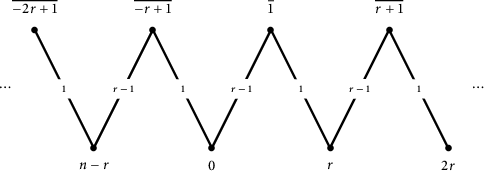


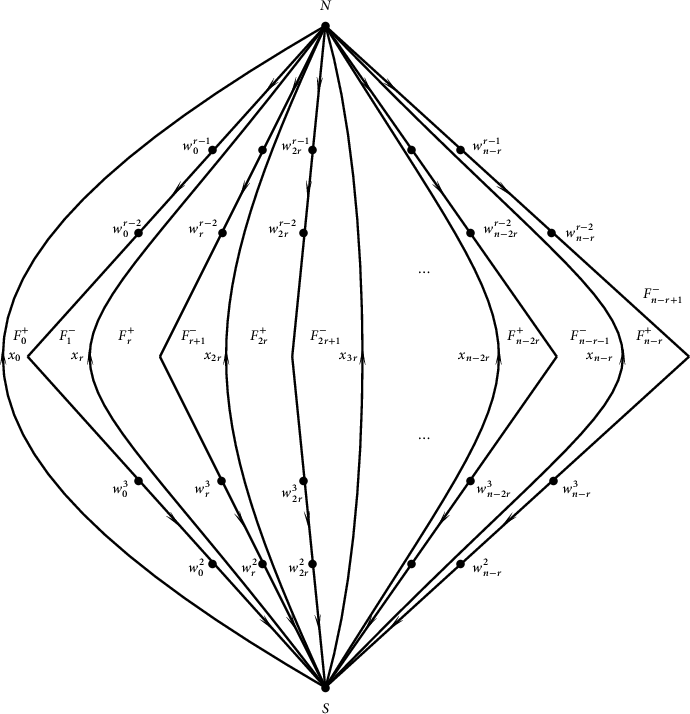

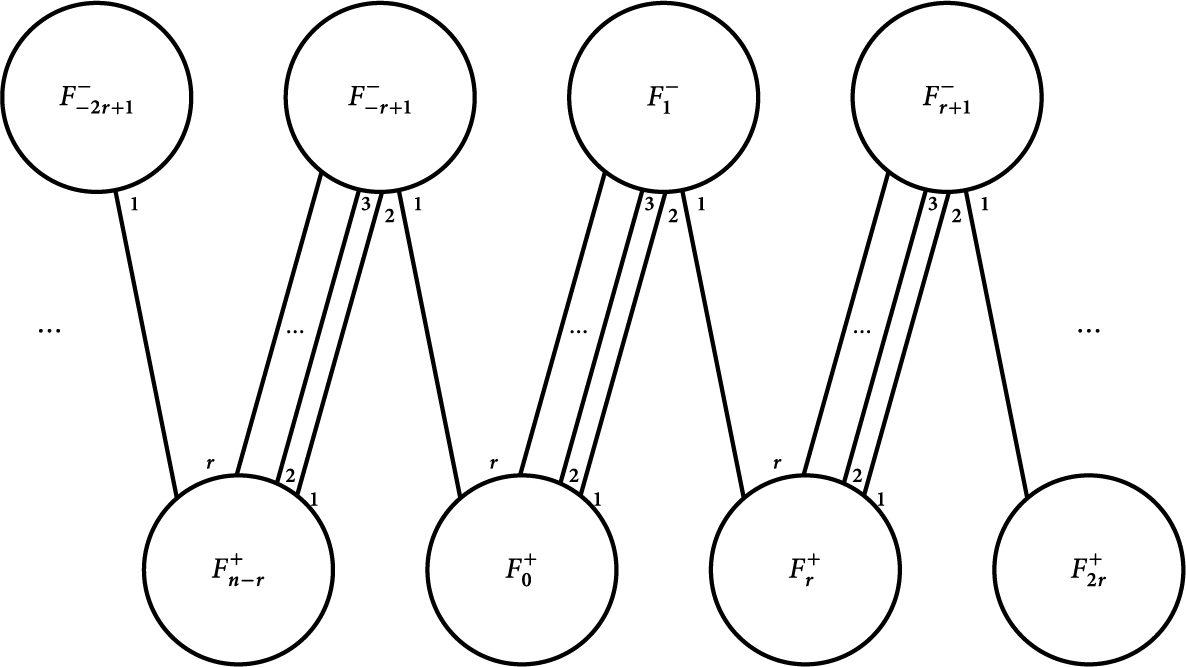

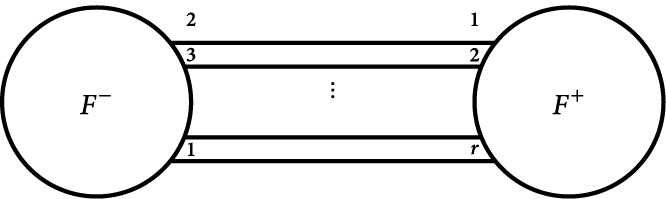

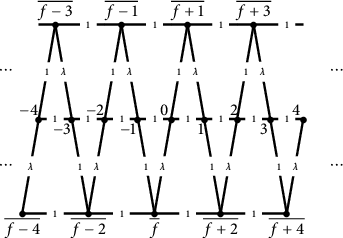


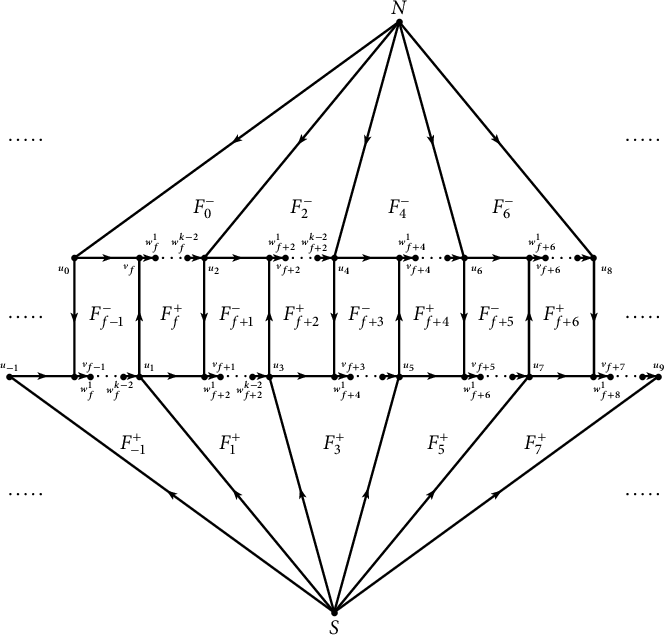

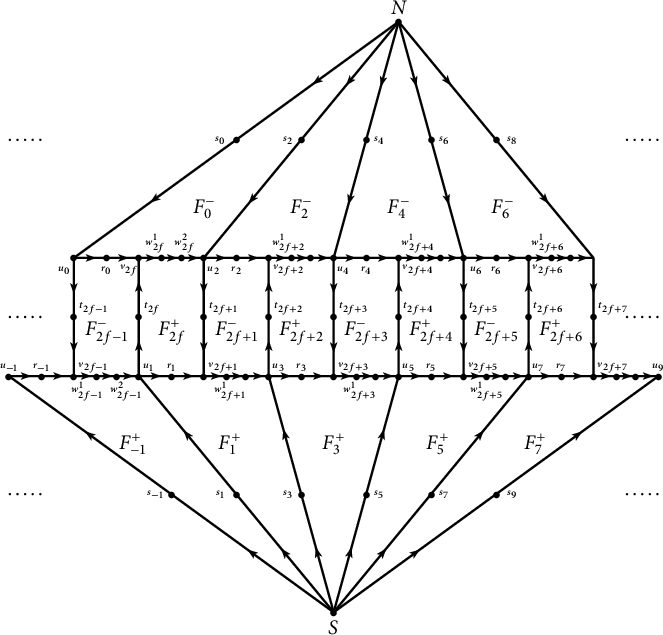

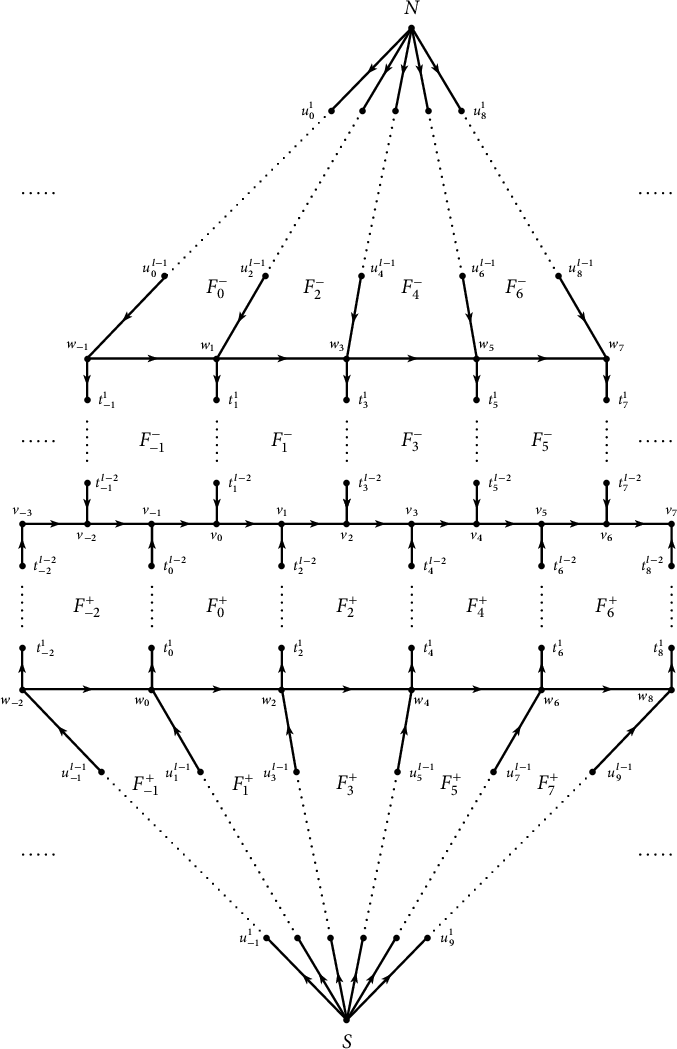

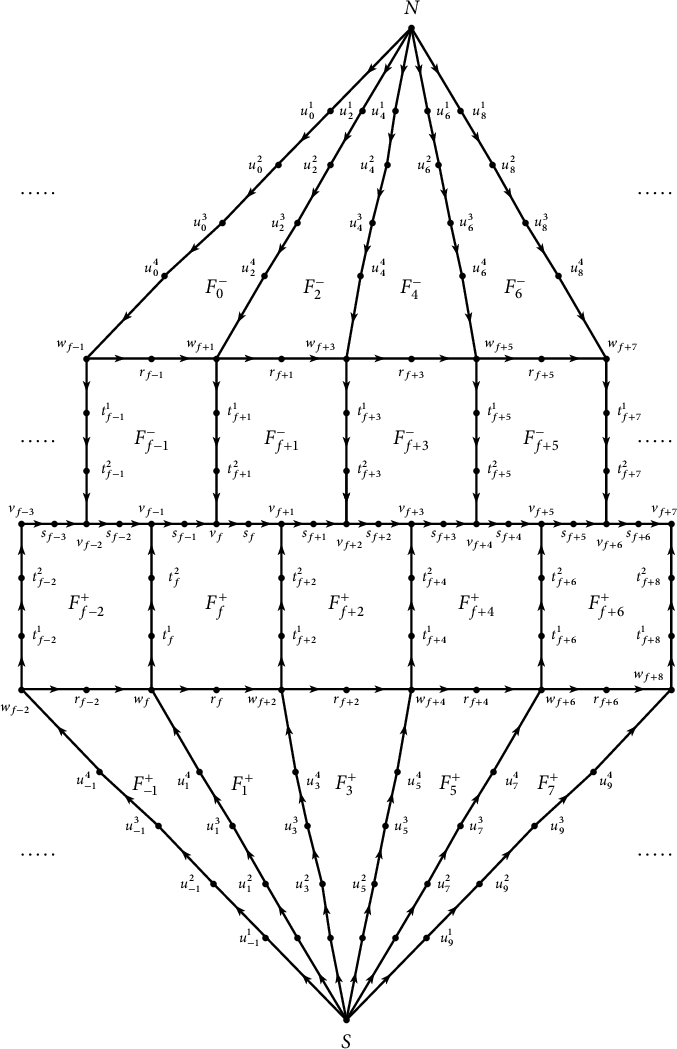


 Open access

