


Introduction
Data generated under cultural resource management (CRM) programmes (also known as development-led, preventative or salvage archaeology) represent a growing proportion of the archaeological record globally. This situation has prompted urgent calls to do more with these data, while acknowledging a need for data management that facilitates reuse (e.g. Kansa & Kansa Reference Kansa and Kansa2018). Projects aimed at making the most of CRM data tend to take these in the aggregate—as large digital datasets accessible through quantitative methods capable of extrapolating trends at a sufficient scale to overcome any inherent ‘messiness’ (e.g. Atici et al. Reference Atici2013; Cooper & Green Reference Cooper and Green2016).
A notable body of work has addressed the qualitative aspects of these records, including how recycled report templates replicate nationalist narratives (Plets et al. Reference Plets2021). Studies combining language-based analyses of reports and interviews with practitioners have further highlighted the need to consider CRM data within the characteristics of the professional sector (Börjesson Reference Börjesson2015; Börjesson & Huvila Reference Börjesson, Huvila and Huvila2018). These observations indicate a growing need to understand CRM data within a social process of converting information into knowledge.
We draw on insights from archival science to describe ‘project biography’ as a method for achieving this. This is not a modification of the object biography; we follow Riggs’s (Reference Riggs2017: 143) call for biographies that describe disciplinary practices of making knowledge through archival records. Our approach resonates with arguments to take seriously how these practices unfold within archives of fieldwork and post-field analyses (Baird & McFayden Reference Baird and McFayden2014). With some exceptions, contemporary CRM has not been seriously examined within this dynamic (Börjesson Reference Börjesson2015; Corwin & Helmer Reference Corwin and Helmer2024; cf. Faniel et al. Reference Faniel2018).
Archival science is attuned to 1) situations where information is unstable; 2) the social, temporal and technical processes whereby information is transmuted into facts (Nesmith Reference Nesmith2002: 32; Meehan Reference Meehan2009); and 3) the potentials for idiosyncrasies or information gaps to be meaningful (Harris Reference Harris and Hamilton2002). Our choice to adapt methods from this field responds to the long-lived, complex nature of many CRM projects and the potential for records to be fragmentary or incomplete (whether through the reporting itself or its curation).
We argue that our approach is a necessary complement to studies of CRM data in the aggregate, or as ‘big data’ (complex data sets that traditional data management systems cannot handle). These studies are often not designed to interrogate the nature of silences in datasets (cf. Huggett Reference Huggett2020a), nor are they attuned to features like decision-making about (for instance) changing approaches to mitigation during a project. We demonstrate how treating CRM records as archives allows us to describe null results that would not be detected through large-scale methods, and to examine the uncertainties, disagreements and omissions that emerge during mitigation. We thus respond to calls for more sustainable, nuanced use of archaeological data (Huggett Reference Huggett2020b; Hacıgüzeller et al. Reference Hacıgüzeller2021).
We describe the development and application of our method to the South African Heritage Resources Information System (SAHRIS; www.sahris.org.za), South Africa’s national digital repository of heritage data, as part of a multi-year project examining the archaeological impacts of development since the country’s democratic transition in 1994 (see Figure 1 for locations mentioned in the text). Like many national archives of CRM data, the contents of SAHRIS are idiosyncratic and shaped by a user base with variable documentation practices; our approach is therefore relevant to any database with these broad characteristics. Our work is—like most archival work—slow and fine-grained; however, it enables us to understand how data are produced in CRM contexts, which is essential to any endeavour to draw empirical conclusions from those data.
Map showing the locations of projects mentioned in the text (figure by authors).

Understanding the dataset
South Africa adopted a ‘polluter-pays’ approach to CRM after democratisation (Manetsi Reference Manetsi, Abungu and Ndoro2022). The National Heritage Resources Act (NHRA) of 1999 specifies protections for archaeology affected by development, stipulating the creation of a public repository of data preserved by record—namely SAHRIS. SAHRIS was established in 2014 under a Creative Commons Attribution (CC-BY) licence as the main digital hub for reports and permits related to scoping, impact assessment, mitigation and post-excavation analyses (among other research and commercial activities). The database is administered by the South African Heritage Resources Agency (SAHRA), the national heritage authority.
Cases are the basic unit of data in SAHRIS, and data are most often contained in associated PDF and .doc files. Cases can have a spatial component, but this is neither compulsory nor consistently included. Metadata primarily relate to: the regulatory and legal status of documents; the authors, clients and project titles; and case officers involved. It is possible to connect archaeological data with other projects through metadata but this is not always done. SAHRIS contains numerous ‘orphan’ records—reports with some metadata but not connected to any other cases. South Africa’s provincial heritage resource agencies (PHRAs) also have varying degrees of devolved authority over heritage management, which sometimes includes maintaining separate databases that are neither linked to SAHRIS nor CC-BY licensed. Fundamentally, then, the quality and character of SAHRIS data are contingent on users and their interface with relevant heritage authorities, which leads to fragmentation but also compels us to think more broadly about what these data are for.
Assembling project biographies
One of our entry points into SAHRIS was investigating the scale of burial disturbances caused by industrial development. Elsewhere, we discuss how burial relocations relate to South Africa’s economic development policies, and the experiences of these relocations for families (King et al. Reference Kingin press). Here, we describe how we reassembled project biographies through this subset of CRM records.
Identifying relevant records relied on knowing the legislative context to extract permits for burial-related work carried out under the pertinent section(s) of the NHRA. Finding orphan records involved manual searches using keywords to identify potentially relevant documents based on titles alone. Combined, these records formed a starting point for assembling more complete projects. Cases linked through metadata and/or spatial attributes were the clearest connections to make. Where this information was lacking, we established connections through records’ contents (e.g. notes in SAHRA comments and permits related to post-excavation work that could then be traced back to mitigation operations). We used external data to validate our connections: cross-referencing case information with cadastral data (comprehensive records of real estate and property of a region) held by the Surveyor General; information discussed in South Africa’s parliamentary monitoring group; public regulatory filings; and industrial operators’ public documentation like offering memoranda and annual reports.
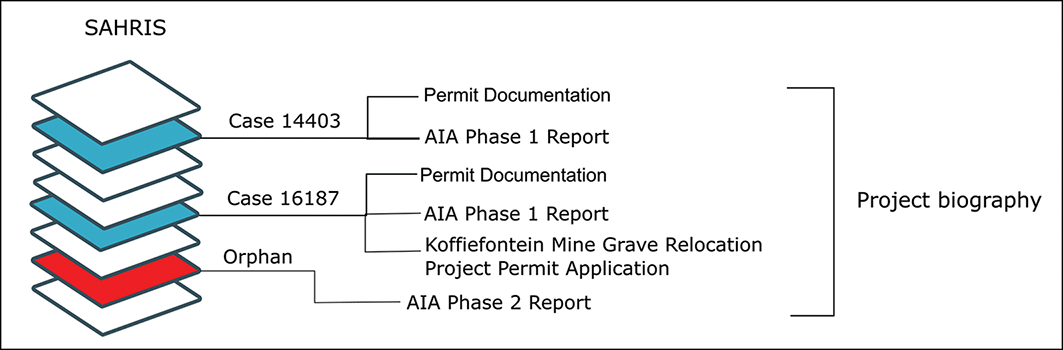
This produced archaeological project biographies with paperwork assembled in chronological order (sometimes with branching sub-projects), which we then read ‘against’ and ‘along the archival grain’ to understand how archaeologists made sense of their work at particular historical junctures (Stoler Reference Stoler and Hamilton2002). While the nature of SAHRIS means that while we could not produce all project records, we could capture moments as projects unfolded (Figure 2). This unfolding often took place on the order of years and decades. Mining activities are responsible for a large proportion of archaeological impacts, and mining leases change hands frequently. It is therefore common in areas with high densities of mining operations to see different stages of archaeological management carried out for different clients. Development projects also frequently expand and require more infrastructure: for example, wind farms require new transmission lines (Holland & Associates 2021), mines build power plants to independently produce energy (Celliers Reference Celliers2010) and so on.
Schematic showing a sample project biography (figure by authors).

The tempo and changeability of CRM work affect the way that information is gathered, which becomes clear once we examine how archaeologists’ decisions influence approaches to mitigation.
Reading along the grain for decision-making
Most obviously, decisions about how to manage the archaeological record are available in SAHRA officials’ guidance. These documents are insights into the regulator’s views on what constitutes appropriate strategies for addressing potential or actual impacts to heritage from development. While these decisions adhere to legislation and policy, as in all bureaucratic archives, there are subjectivities at work (Stoler Reference Stoler and Hamilton2002). The NHRA specifies types of developments that trigger heritage management interventions and stipulates national standards for site significance accompanied by mitigation actions; these latter range from conservation with/without declaration to mitigation before destruction to no mitigation needed. Sites older than 60 years, burials and declared sites are accorded the highest levels of protection. But there is room for interpretation of how mitigations should be implemented. We can see, for instance, where SAHRA refused a burial relocation permit because an impact assessment did not conduct a sufficiently robust community consultation (SAHRA 2020).
Some impact assessments use formulaic methods for assigning archaeological significance and mitigation, particularly where a project is large and requires a degree of consistency. One 2013 impact assessment for coal-mining activities assigned numerical values to assessment criteria, and then entered these into a formula to calculate unmitigated risk (PGS Heritage & Grave Relocation Consultants 2013: 17):
 $$\small{{\rm{Impact}}\;{\rm{risk}}\;{\rm{ = }} \;{{({\rm{significance}}\;{\rm{ + }}\;{\rm{spatial}}\;{\rm{scale}}\;{\rm{of}}\;{\rm{impact}}\;{\rm{ + }}\;{\rm{temporal}}\;{\rm{scale}}\;{\rm{of}}\;{\rm{impact}})} \over {\rm{3}}}\; \!\!\times \!\!\;{{{\rm{probability}}} \over {\rm{5}}}}$$
‘Significance’ here was defined using standards described by SAHRA and approved by the regional professional archaeological society. Under this system, high significance scores were given to burials and to well-preserved buildings older than 60 years that represented farming, mining and other activities within the life of the affected area (Figure 3). This is what one might expect given the specifications of the NHRA.
The remains of the Blesbokfontein School, probably the second school building built between 1915 and 1916 (following initial rental of a different building from the farmer). Graded as ‘medium’ significance’ (PGS Heritage & Grave Relocation Consultants 2013: fig. 20, licensed CC-BY).

By comparison, another consultancy used a different formula in a 2013 impact assessment for the Ivanplats Platreef coal mine. This approach cites the NHRA (Section 3 (3)) to establish a framework for significance rather than SAHRA’s standards, although both ultimately derive from the same legislation. Heritage value and importance were calculated by a formula that explicitly views “a heritage resource’s value [as] a direct indication of its sensitivity to change” (Digby Wells Environmental 2013: 11):
 $${\rm{Value}} = {\rm{Importance}} \times {\rm{Integrity}}$$
where
 $${\rm{Importance}} = {\rm{average}}\,{\rm{sum}}\;\left[ {sic} \right]\;{\rm{of}}\;{\rm{aesthetic}}\;{\rm{ + }}\;{\rm{historic}}\;{\rm{ + }}\;{\rm{scientific}}\;{\rm{ + }}\;{\rm{social}}\;{\rm{significance}}$$
Unmitigated impact (Digby Wells Environmental 2013: 12) was then calculated as:
 $${\rm{Magnitude}} = {\rm{Consequence}} \times {\rm{Probability}}$$
where
 $${\rm{Consequence}} = ({\rm{Spatial}}\;{\rm{scale}} + {\rm{Duration}} + {\rm{Intensity}}) \times {\rm{Heritage}}\;{\rm{Value}}$$
This formula yielded medium significance scores for burial grounds and Iron Age and historical sites in various stages of preservation, but not for sites from other periods showing poorer preservation (Figures 4 & 5).
Circular stone foundations identified within S.35-027 as part of the Ivanplats project. Graded as “9–<12 […] Medium significance” (Digby Wells Environmental 2013: fig. 7-21, licensed CC-BY).

Stone pathways within the S.35-027. Graded as “9–<12 […] Medium significance” (Digby Wells Environmental 2013: fig. 7-20, licensed CC-BY).

We describe these examples in detail to illustrate the (sometimes subtle) variation between methods for assessing significance and appropriate mitigation. These methods shape archaeological information recovered. Mitigation hierarchies may be stipulated by, for instance, funders or national regulators, but despite efforts at standardisation we can never assume that these are universally or consistently applied.
Once mitigation hierarchies and value assessments are established within project biographies, we can interrogate how decisions are made at different points in the project lifespan. For one, we can observe debates over the nature of risk and impact, which affects how archaeological documentation is prioritised (Rico Reference Rico, Lafrenz Samuels and Rico2015). Concerning a mine in the Waterberg region (see Figure 1), SAHRA requested in 2018 that the developer undertake a comprehensive suite of impact assessments to account for the project’s location in a biosphere with extensive Holocene archaeological occupation (SAHRA 2018). A 2020 integrated impact assessment then incorporated archaeological, palaeontological, environmental and social impacts, and evaluated these with respect to three potential layouts of the mine’s surface infrastructure. While accounting for visual impacts and impacts from blasting (particularly vibrations and dust), the final recommendation favoured a surface layout that prioritised minimal direct impact to archaeological sites (van Vollenhoven et al. Reference van Vollenhoven2020: app. C). However, in comments on the draft heritage management plan in 2023, rock art specialists argued that the impacts on rock art sites from blasting had been underestimated (Figure 6). In addition to degradation from dust particulates and vibration, they cited the effects of groundwater depletion caused by underground mining, which would exacerbate conditions in a dryland environment. The developer’s responses to the concerns offered ‘monitoring’ as the appropriate mitigation, citing environmental impact assessment data that indicated the effects of blasting would be less severe than the specialists proposed (Mgudlwa Reference Mgudlwa2023).
Rock art site on the Makgabeng Plateau, near an area affected by a forthcoming platinum mine (image copyright Rock Art Research Institute, South Africa, image courtesy of African Rock Art Digital Archive).

While the project just described has yet to proceed to monitoring (as far as we know), our approach allows us to interrogate precisely how methods such as ‘monitoring’—which takes a variety of forms in SAHRIS records—are implemented and adapted. This often includes protocols responding to archaeological features disturbed during building activities, particularly after documented removal of sensitive sites identified during impact assessment (e.g. Pelser Reference Pelser2012; PGS Heritage & Grave Relocation Consultants 2018). But monitoring has other meanings. In an impact assessment for diamond mining at Koffiefontein, for instance, consultants proposed protocols for mine employees to carry out archaeological monitoring activities akin to a ‘watching brief’ and then report this information to consultants on a regular basis (G&A Heritage 2018: 6, 11). This creates significant potential for silences to enter the archaeological record, which our method is designed to interrogate.
Identifying silences
Archival science takes silences as potentially meaningful. Even where these are the result of data management practices rather than the work of historical actors, we can still learn something about how knowledge is curated, validated or omitted. Some of the gaps in SAHRIS data speak to wider issues of governance, particularly concerning data held by PHRAs. Other gaps are technical in nature, related to the functionality of the server and the database architecture.
Through our project biographies, we identified null results, which are significant but not easily captured in aggregative analyses of quantitative data. For example, a 2013 impact assessment ahead of a grid connection for the Gibson Bay wind farm on the south-eastern coast noted minimal archaeological surface remains and no sub-surface deposits. The report qualified these conclusions with the observation that the sites in question were on sand dunes with low archaeological visibility, and in a landscape where a lack of pre-existing archaeological research presents a challenge in establishing the certainty of encountering particular deposits or artefact types (Nilssen Reference Nilssen2013).
We also identified instances where strategies that were negotiated with developers create the potential for gaps in the archaeological record. At a mine in KwaZulu-Natal Province, where archaeological impact assessment and mitigation have occurred during successive industrial expansions since at least 1995, the consultant requested a blanket permit for excavation and destruction in 2018. The reason given was a desire to prevent the mine from stopping work every time an archaeological site was encountered, and thus to enable mining to continue expeditiously (Tronox KZN Sands & Anderson Reference Anderson2018).
Particularly where reports contain information about consultation with affected parties, we can see commentary on the broader scope of heritage protections by descendant and stakeholder communities, including its omissions. This was evident in 2012 when the Gamtkwa KhoiSan Council opposed plans for a quartz mine that would damage their ancestral, spiritual and physical landscape. A consultation document noted that:
the SAHRA compliance system, just over a decade in place and in effect still in its infancy, and with initial focus centred on the fields of archaeology and palaeontology, leaves a void in system related [sic] support for sociocultural mitigation (van Ryneveld Reference van Ryneveld2012: 6).
Finally, we were able to establish categories of archaeological data that are frequently not recorded and to highlight where these silences represent emerging areas of concern. Our biographies have shown where (for instance) poorly preserved remnant dwellings associated with mineworkers from the mid-twentieth century have been graded as ‘low significance’ (Henderson Reference Henderson2001: 7). This is legal and complies with the NHRA’s protection for archaeology older than 60 years, but underscores what development-affected communities have long experienced: that heritage related to South Africans (and, indeed, Black workers from across the region) involved in these industries is not officially recognised or honoured (Esterhuysen et al. Reference Esterhuysen2018). On a procedural level, as the NHRA’s 60-year horizon continues to encompass an ever-greater share of the twentieth century, archaeologists will be compelled to document this aspect of industrial heritage in greater detail. This represents an area of evolving professional practice, as well as an aspect of the archaeological record that will soon expand rapidly.
Conclusions and ethical considerations
We have described a method for tracing—via CRM-generated records—the social and temporal processes through which archaeological information is converted into evidence. We argue that treating these records as archaeological archives—which demands attention to how knowledge emerges therein—offers an essential complement to quantitative or ‘big data’ approaches to data generated through mitigation activities. Knowledge-making is the work of individuals and collectives; critically evaluating how we produce archaeological data relies on our ability to trace this work. Where these actors disappear from the CRM-generated component of the archaeological record—whether as a result of aggregative large-scale analyses or because the industry itself sees work in terms of corporate rather than individual contributions—we lose some ability to understand how that record is formed.
Practically, our method addresses significant gaps in our knowledge of what CRM data can do. This includes foregrounding null results and establishing that where a spatial component is lacking we can still link records over time. We have not attempted to quantify the prevalence of specific archaeological practices (for instance, the non-recording of industrial archaeology features) but this could be done through sampling and used as a ‘health-check’ on professional practice.
There are also ethical concerns here. Tracing decision-making in public documents introduces an element of accountability for archaeologists that is different from work conducted within academic institutions: accountability to the public and affected communities, as well as to developers and authorities. This is why understanding conditions of work in the wider sector is essential: do archaeologists accept that this accountability is part of the job and part of the consequence of making records public? If so, how is this reflected in the terms of contracts with employers and guidance from regulators?
Our approach also has broader implications for how we consider the contribution of CRM activities to the archaeological record. Foremost, if we accept that ‘making the most’ of CRM data depends upon understanding the conditions under which those data are produced, then we need a more detailed understanding of how labour, pay, regulation, fieldwork and training constitute those conditions. This includes both the lived experiences of work (including how these are shaped by ableism, sexism and racism within the field) and historical processes that have defined archaeology’s contribution to development and planning systems. Methodologically, the corollary of this wider need is greater anthropological and historiographic attention to archaeology in development contexts.
Funding statement
Research supported by the Arts and Humanities Research Council (AH/W001381/1) and the Leverhulme Trust (RPG-2021-180).
Author contributions: CRediT categories
Rachel King: Conceptualization-Lead, Formal analysis-Lead, Funding acquisition-Lead, Investigation-Lead, Methodology-Lead, Project administration-Lead, Supervision-Lead, Validation-Lead, Writing - original draft-Lead, Writing - review & editing-Lead. Tessa Campbell: Data curation-Supporting, Investigation-Supporting. Giacomo Fontana: Data curation-Supporting, Investigation-Supporting.



 Open access

