

Introduction
Lysosomal storage disorders are a group of over 50 metabolic disorders caused by defects in lysosomal degradation pathways. Reference Al-Alawi, Harikrishna and Al-Thihli1 A deficiency of lysosomal hydrolases or a defect along the lysosomal pathways causes the intralysosomal accumulation of undegraded substrates composed of mucopolysaccharides and lipids, called mucolipidosis. Reference Al-Alawi, Harikrishna and Al-Thihli1,Reference Chen, Bach and Pagano2 In general, mucolipidosis can be classified into four types: I, II, III and IV. Reference Al-Alawi, Harikrishna and Al-Thihli1 Mucolipidosis type IV (MLIV: OMIM #252650) is an ultra-rare autosomal recessive progressive neurodegenerative disorder that appears during the first few years of life. Reference Tuysuz, Goldin, Metin, Korkmaz and Yalcinkaya3,Reference Misko, Wood and DeBono4 In addition to hypomyelinating leukodystrophy, Reference Misko, Wood, Kiselyov, Slaugenhaupt and Grishchuk5 the disease manifests as severe psychomotor difficulties, hypotonia that gradually develops into spasticity, bilateral pyramidal tract signs, strabismus, visual impairment due to progressive retinal degeneration, corneal clouding and achlorhydria. Reference Misko, Wood and DeBono4,Reference Saijo, Hayashi and Ezoe6,Reference Mirabelli-Badenier, Severino and Tappino7 Marked clinical heterogeneity has been observed, even among siblings, and the disease may present with nonspecific symptoms, which makes diagnosis challenging. Reference Al-Alawi, Harikrishna and Al-Thihli1,Reference Bassi, Manzoni, Monti, Pizzo, Ballabio and Borsani8 The clinical and paraclinical characteristics of MLIV patients may overlap with a variety of other diseases; for example, the deposition of iron in the basal ganglia observed in some MLIV patients bears resemblance to neurodegeneration with brain iron accumulation (NBIA) cases. Reference Misko, Wood and DeBono4 MLIV is caused by biallelic variants in the MCOLN1 gene (OMIM #605248), which encodes for transient receptor potential channel mucolipin-1 (TRPML1). Reference Hayashi, Hosono and Kubo9 MLIV is thought to result from abnormal sorting and/or transport of macromolecules along the late endocytic pathway, while other mucolipidosis disorders are caused by deficiency of a specific metabolic enzyme. Reference Wakabayashi, Gustafson, Sidransky and Goldin10,Reference Yamaguchi, Ban and Suzuki11 Ethnically, MLIV is more frequent among Ashkenazi Jews than other ethnic groups. Reference Misko, Wood and DeBono4,Reference AlBakheet, Qari, Colak, Rasheed, Kaya and Al-Sayed12 Here, for the first time, we present the clinical manifestations of four MLIV siblings who carried a novel MCOLN1 variant with prominent oromandibular dystonia and Parkinsonism.
Subjects and methods
Subjects
Four affected individuals of an Iranian family (Fig. 1A) who suffered from a progressive neurological disease were included. Although consanguinity was denied, the parents originated from nearby small villages, suggesting a common ancestry.
(A) Pedigree of the family in this study who carried a variant, c.362C > T:p. Thr121Met in the MCOLN1 gene. Genotypes of MCOLN1 are shown when individuals were assessed. The arrow denotes the proband. Dashed line shows the parents originated from nearby small villages, suggesting a common ancestry. Blank circles and squares: normal individuals; dark circles and squares: MLIV-affected individuals. (B) Sequence chromatograms of c.362C > T:p. Thr121Met variant in the MCOLN1 gene in the family members. MLIV = mucolipidosis type IV; M = mutated allele; N = normal (wild type) allele.

Patient II3
The proband (II3) was referred for genetic analysis at the age of 42 years. She was the result of an uneventful pregnancy with normal birth weight and normal psychomotor development up to the age of 6 years, when the first symptom, dysarthria, appeared followed by visual disturbance. She was unable to continue her schooling because of the progressive visual problem. She was initially diagnosed with retinitis pigmentosa (RP). The family has noticed progressive cognitive decline since the age of 12. In early adolescence, gait disturbance was added to her other problems due to the stiffness of her lower limbs (Table 1). She also has dysphagia, iron deficiency anemia (consumes iron supplements since ∼ 10 year) and high levels of serum gastrin, 712 pg/mL (reference intervals 13–115 pg/mL) (Table 2) which supports the diagnosis of achlorhydria. Over time, all movements were reduced, including facial mimicry, and abnormal movements developed in the face and limbs, including the inability to close her jaw (jaw opening dystonia) and abnormal dystonic postures in the limbs. However, no dysmorphic feature was observed in the proband as well as in her affected sisters (II6, II8 and II9). In terms of quality of life, she has severe movement problems and is not able to walk without aid. She relies on other family members for all of her daily activities, including going to the bathroom and eating. She has an irritable mood and is restless. On neurologic examination, she had anarthria (which she has been suffering since the age of ∼ 20 years) (based on her mother’s explanation, she had severe dysarthria from 6 years old) and was unable to follow commands and cooperate for a complete examination due to severe cognitive dysfunction. Positive findings included optic atrophy and RP, a masked face, severe jaw opening dystonia, dystonic postures of the hands and legs, hypokinesia, spasticity in the lower limbs, increased deep tendon reflexes and bilateral Babinski signs. Because of Parkinsonism, dystonia and spasticity, she was not able to walk unaided (Video 1). There was no evidence of myopathy or neuropathy based on the results of the electromyography/ nerve conduction study, so we did not perform muscle biopsy.
Detailed clinical features of patients with MCOLN1-related phenotypes in the published literature** NR = not reported; m = month; y = year; M = male; F = female; RP = retinitis pigmentosa; OMD = oromandibular dystonia; GD = generalized dystonia. # Synonymous variant “p. Gly568=” creates a novel donor splice site. ** Reference No. 4, which evaluated 26 cases of MLIV, was not included in the table due to its unavailability of the particular clinical information pertaining to these individuals.

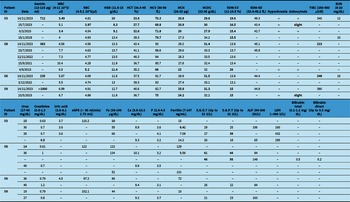
CBC and biochemical examinations of all affected individuals and their follow-ups in different times

CBC = complete blood count; WBC = white blood count; RBC = red blood count; HGB = hemoglobin; HCT = hematocrit; MCV = mean corpuscular volume; MCH = mean corpuscular hemoglobin; MCHC = mean corpuscular hemoglobin concentration; RDW = red cell distribution width; TIBC = total iron binding capacity; eGFR = estimated glomerular filtration rate; Fe = iron; Ca = calcium; P = phosphorus; SGOT = serum glutamic-oxaloacetic transaminase, SGPT = serum glutamic pyruvic transaminase; ALP = alkaline phosphatase; LDH = lactate dehydrogenase; BUN = blood urea nitrogen; “-” = Not checked. All abnormal amounts shown in bold.
All of the patients are taking iron supplements during tests.
Brain magnetic resonance imaging (MRI) revealed cerebellar atrophy, white matter hyperintensities on T2/FLAIR (fluid attenuated inversion recovery) and atrophy of the corpus callosum. Iron sensitive sequences (susceptibility weighted imaging or SWI) was normal (Fig. 2A, D, E).
Brain MRI of cases II3 (A, D, E), II8 (B, F) and II9 (C, G, H) shows thin corpus callosum on sagittal T2 sequences (A, B, C), white matter hyperintensity around the frontal horns on FLAIR sequences (D, H) and normal basal ganglia (no evidence of iron accumulation) (E, F, G).

Ophthalmologic consultation and fundus photos confirmed bilateral optic atrophy and RP (Fig. 3). Abdominal and heart MRIs to detect iron deposition (ferriscan) were done and revealed no pathologic iron deposition in the liver and heart (Supplementary file 1). Renal function tests such as blood urea nitrogen, creatinine and electrolytes were normal (Table 2). Her abdominal, including kidneys, ultrasound scan results were normal. Since there was no polysomnography study (PSG) for the proband, we could not say precisely whether there was any abnormal sleep pattern, but based on their healthy family members, there was no evidence of an abnormal sleep pattern such as nocturnal seizures, myoclonus or REM sleep behavior disorder.
Fundus photos of cases II3 (upper row) and II9 (lower row) showing optic atrophy and retinal degeneration of the right and left eyes.

Patient II6
The 35-year-old affected sister (II6) had normal psychomotor development in early childhood. The family noticed visual problems at the age of 6 years. She was unable to attend normal school due to her low intelligence quotient. Later, she developed dysarthria, dysphagia, slowness of movement and gait disturbance. She was not able to walk independently when she was 13 years old (Table 1). Similar to her sister, the patient had high levels of serum gastrin, 235 pg/mL and iron deficiency anemia (Table 2). She has been taking iron supplements since the age of 10 years. Her quality of life was similar that of to the proband. The examination was similar to the proband, including optic atrophy, RP, staring face, oromandibular dystonia, unintelligible speech, akinesia and rigidity, and spasticity of the lower limbs, dystonia of the limbs and trunk and spastic gait (Video 2). Like her sister, the renal function tests (Table 2) and abdominal ultrasound scan results were normal. Her sleep pattern was also similar to that of the proband. There was no evidence of myopathy or neuropathy. MRI showed mild cerebellar atrophy, atrophy of the corpus callosum and hyperintensity of the centrum semiovale and internal capsule.
Patient II8
The third affected sibling in this family (II8) was a 29-year-old female whose problems started at the age of 8, with cognitive decline, progressive visual disturbances and dysarthria. She had multiple episodes of generalized tonic–clonic seizures until she was 18 years old. Since she was seizure-free in recent years and does not receive any anti-epileptic medication at this point. Additional biochemical examinations revealed the high levels of serum gastrin, 383 pg/mL and iron deficiency anemia (consuming iron supplements since ∼ 9 years) (Table 2). Her quality of life was better than that of the proband and II6, and she could walk unaided; however, her vision problems have made it difficult for her to walk. Positive findings on neurologic examination were RP, optic atrophy, oromandibular dystonia, hypokinesia, increased muscle stretch reflexes and spastic gait. Plantar reflexes were extensor bilaterally (Table 1 and Video 3). There was no evidence of myopathy or neuropathy. Abnormal findings on brain MRI were mild cerebellar atrophy and atrophy of the corpus callosum (Fig. 2B,F). SWI sequences showed no evidence of pathologic iron deposition. The renal function tests (Table 2) and abdominal ultrasound scan results were normal. Her sleep pattern was also similar to that of the proband.
Patient II9
The fourth patient in this family (II9) was a 27-year-old female whose problems started at the age of 13, with symptoms developing in a similar fashion to her other affected siblings, comprising visual abnormalities, cognitive decline, speech and swallowing disturbances, gait difficulty, the high levels of serum gastrin, > 1000 pg/mL and iron deficiency anemia (Table 2). She has been taking iron supplements since the age of nine. Her quality of life was similar to that of II8. Neurologic examination revealed RP and optic atrophy, pyramidal abnormalities (spasticity of limbs, increased deep tendon reflexes and Babinski signs) and a movement disorder manifesting dystonia of the jaw and limbs, hypokinesia and rigidity (Table 1). Neither neuropathy nor myopathy was evident. Her brain MRI was similar to that of her sisters (Fig. 2C,G,H).
Fundus examination by an ophthalmologist revealed bilateral optic atrophy and RP (Fig. 3). Optic coherence tomography showed evidence of retinal thickness changes in the inner and outer sectors of the macula in both eyes (Fig. 4). The renal function tests (Table 2) and abdominal ultrasound scan results, as well as the sleep pattern, were normal.
Optic coherence tomography (OCT) of case II9 showing evidence of retinal thickness changes in the inner and outer sectors of the macula in right and left eyes.

Exome sequencing
Whole-exome sequencing (WES) was performed on the DNA of the proband. WES data was analyzed based on previously reported workflows. Reference Davarzani, Shahrokhi and Hashemi13 The candidate variant was PCR amplified and Sanger sequenced in the proband and her family members.
Results
A novel homozygous variant, c.362C > T:p. Thr121Met in MCOLN1 (NM_020533.3), was identified. The variant was co-segregated with the disease status in the family (Fig. 1B) and predicted as likely pathogenic based on the American College of Medical Genetics and Genomics (ACMG) classification (rules PM1, PM2 and PP1). The minor allele frequency of the variant was 0.000028, and 0.000016 in 1000 genomes, and GenomAD, respectively. It was not found in a homozygous state in both databases and was also not detected among the exome data of the 1000 unrelated Iranian individuals (Iranome database; http://www.iranome.com/ and 200 in-house exomes).
Discussion
While MLIV is mainly characterized by ophthalmological abnormalities, developmental delay and hypoplastic corpus callosum, Reference Yamaguchi, Ban and Suzuki11 the disease manifests variable expression. Reference AlBakheet, Qari, Colak, Rasheed, Kaya and Al-Sayed12,Reference Chaer, Harissi-Dagher, Soucy, Ellezam and Hamel14 The disease results from mutations in MCOLN1, which is a Ca2+/Fe2+ release channel in late endosomes and lysosomes. Reference Boudewyn and Walkley15 Thus, mutations in this gene can cause the accumulation of excessive amounts of iron, which results in defects in endosomal/lysosomal trafficking, autophagy, lysosomal exocytosis dysregulation, mTORC1/TFEB signaling axis aberrations and heavy metal dyshomeostasis with reactive oxygen species formation. Reference Boudewyn and Walkley15–Reference Fine and Li17 Defects along each of these steps may help explain the heterogeneous phenotype observed in MLIV patients. Reference Boudewyn and Walkley15 Although there are reports of iron accumulation in some cases, Reference Mirabelli-Badenier, Severino and Tappino7,Reference Jezela-Stanek, Ciara and Stepien18–Reference Metin, Korkmaz, Tuysuz, Yalcinkaya and E.20 our cases did not show evidence of iron accumulation on brain and other organs (Supplementary file 1).
Literature review also showed that MLIV cases share some relatively common features, including developmental delay, spasticity and impaired vision (4). As in our cases, there was the combination of cognitive disturbance, a movement disorder (dystonia, especially oromandibular dystonia, hypokinesia and rigidity), pyramidal signs (spasticity, increased deep tendon reflexes and Babinski signs) and RP (Table 1). However, there is variability in age at onset (AAO) and clinical heterogeneity in MLIV cases (Table 1). Based on these heterogeneities, Misko et al. have suggested that the natural history of MLIV consists of three stages: slow developmental gains in early life, plateauing with worsening hypertonicity and motor function and functional regression in early adolescence. Reference Misko, Wood and DeBono4 Also, they have mentioned that the majority of cases develop their symptoms at less than one year of age, ranging from 1.5 months to 8 years of age (mean age of 7.25 months) Reference Misko, Wood and DeBono4 (Table 1). In comparison, our cases also presented a three-stage history of MLIV, and like Misko’s study, they clearly displayed neurodegenerative elements in addition to a static neurodevelopmental condition, but the mean AAO in our cases (8.25 +/−2.86 years) was higher than the median of reported cases.
The observation that warrants attention is that in Misko’s investigation, a total of 18 out of 26 subjects displayed the presence of at least one c.406-2A > G allele, with 58% of them possessing Ashkenazi Jewish ancestry. Reference Misko, Wood and DeBono4 Maybe these issues make the spectrum of their symptoms more similar. Nevertheless, it is worth noting that a single patient (ID 1) with c.406-2A > G mutation exhibited a mild manifestation of the disease. Reference Misko, Wood and DeBono4 Also, our patients and other cases in Table 1, who carried different variants of MCOLN1, presented relatively similar features and disease history, despite the fact that a number of their symptoms have not been mentioned in detail.
Here, for the first time, we describe four Iranian MLIV siblings who carried a novel homozygous variant in the MCOLN1 gene. In late childhood, our patients developed a progressive visual problem, RP, which is a rare symptom of MLIV. Thereafter, they developed mental decline, difficulty with school performance, dysarthria, dystonia, lower limb spasticity and gait disturbances. Additionally, patient II8 had multiple episodes of generalized tonic–clonic seizures. MLIV typically results in a very thin corpus callosum, Reference Misko, Wood, Kiselyov, Slaugenhaupt and Grishchuk5 which is characteristic of our patients (Table 1). Overall, notwithstanding the fact that our patients exhibited a more advanced age of disease onset, the course of the disease appears to follow the same pattern as suggested by Misko et al. Reference Misko, Wood and DeBono4 Based on WES data, a novel variant of MCOLN1 was detected, and MLIV disease was confirmed in this family (Fig. 1B). A later AAO in our cases may relate to the nature of the variant.
As is increasingly recognized in the field of neurogenetic disorders, the presentation of MLIV may overlap with a variety of other diseases, and genetic analysis is an important strategy to clarify the diagnosis.
Supplementary material
The supplementary material for this article can be found at https://doi.org/10.1017/cjn.2024.47.
Acknowledgements
We thank the patients and their family members for participating in the study and acknowledge the Student Research Committee of the University of Social Welfare and Rehabilitation Sciences for funding the research (Grant number: 2957).
Author contributions
(1) Research project: A. Conception, B. Organization, C. Execution;
(2) Statistical Analysis: A. Design, B. Execution, C. Review and Critique;
(3) Manuscript: A. Writing of the first draft, B. Review and Critique.
Aida Ghasemi: 1C, 2B, 2C and 3A.
Mahdieh Eslami Ardakani: 1C and 3A.
Mansoureh Togha: 1C and 3A.
Narges Yazdi: 1C and 3A.
Anthony E Lang: 3B.
Elahe Amini: 1C, 3A.
Mohammad Rohani: 1A, 1C, 2C, 3A and 3B.
Afagh Alavi: 1A, 1B, 2A, 2C, 3A and 3B.
Funding statement
The Student Research Committee of the University of Social Welfare and Rehabilitation Sciences (USWR; grant number 2957).
Competing interests
None.
Ethical statement
The authors confirm that [the approval of an institutional review board] / [patient consent] was not required for this work. We confirm that we have read the Journal’s position on issues involved in ethical publication and affirm that this work is consistent with those guidelines. This study was conducted according to the declaration of Helsinki and approved by the ethics committee of the University of Social Welfare and Rehabilitation Sciences (IR.USWR.REC.1402.037) in Iran.