


Introduction
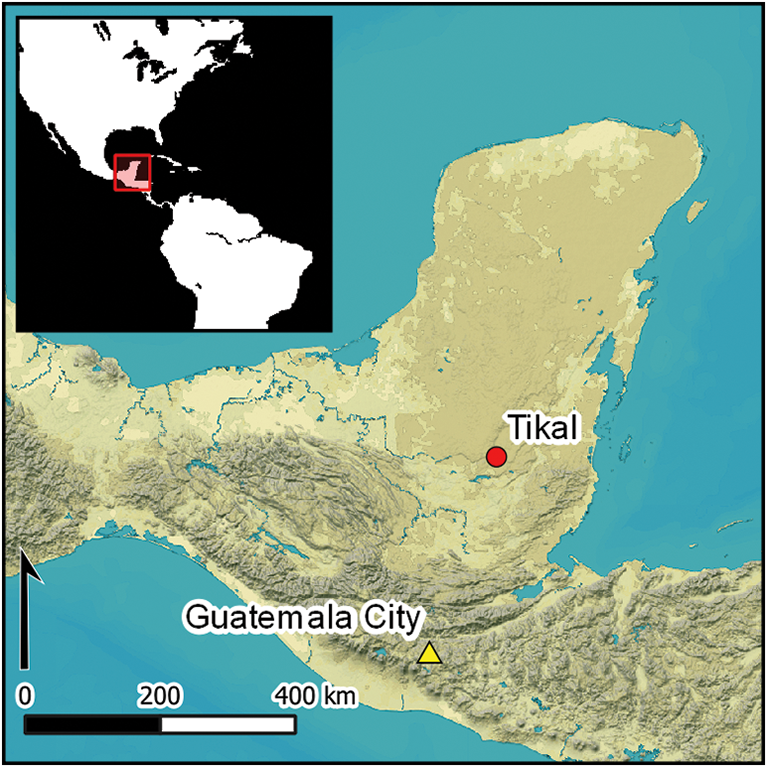
Several decades of fieldwork point to strong connections between the Maya dynastic seat of Tikal, in modern-day Guatemala, and the distant hegemonic metropolis of Teotihuacan in central Mexico. These connections touch on the nature of political ties between distant areas and systems of quasi-imperial control in Mesoamerica. At Tikal, prior evidence of that contact comes from, among other locations, royal burials in the North Acropolis, a deposit near that Acropolis and Group 6C-XVI, a buried complex of residential and ceremonial buildings (Figure 1; Coggins Reference Coggins1975: 171, 177; Iglesias Ponce de León Reference Iglesias Ponce de León1987; Culbert Reference Culbert1993: figs. 15, 17; Laporte & Fialko Reference Laporte and Fialko1995; Moholy-Nagy Reference Moholy-Nagy2021). Excavations in the 1980s within Group 6C-XVI, a buried complex of residential and ceremonial buildings (Figure 1), uncovered talud-tablero mouldings (a distinctive slope-and-panel feature linked to Teotihuacan) and the Tikal Marcador—a carving similar to the feathered standards at Teotihuacan but embellished with Maya hieroglyphs, perhaps as a depiction of an upright weapon and shield (Stuart Reference Stuart2024: 71–74). Found near an altar at the centre of a 6C-XVI patio, the Marcador mentions Teotihuacan elites and a probable conquest of Tikal in AD 378: an event labelled the Entrada, or ‘Arrival’, in Spanish (Proskouriakoff Reference Proskouriakoff1993; Stuart Reference Stuart, Carrasco, Jones and Sessions2000, Reference Stuart2024). Since then, signs of contact and conflict associated with this event have been noted at various sites across the Maya region (Estrada Belli et al. Reference Estrada-Belli2009). For example, the ruins of La Cuernavilla, on ridges to the north-west of Tikal and the citadels of Bastión and Fortín, in a hilly area south-west of the city, attest to large-scale fortifications in the region (Houston et al. Reference Houston, Garrison and Firpi2019; Román Ramírez & Piedrasanta Castellanos Reference Román Ramírez and Piedrasanta Castellanos2023). Most such defences date to the fourth and fifth centuries AD, which was a period of intensive interaction with Teotihuacan but also of increased population mobility more generally in the Maya region (Braswell Reference Braswell2003; Wright Reference Wright2012; Scherer & Wright Reference Scherer, Wright and Cucina2015).
Layout of relevant sector and architectural groups at Tikal, Guatemala (image by T.G. Garrison & H. Hurst).
New findings can now report further links between Teotihuacan and Tikal. In 2016, lidar of Tikal revealed a large plaza and pyramid close to Group 6C-XVI and south of the so-called Mundo Perdido and Seven Temples Plaza with their talud-tablero constructions and burnt human sacrifices tied to Teotihuacan (Chinchilla Mazariegos et al. Reference Chinchilla Mazariegos, Tiesler, Gómez and Price2015). Between this northern sector and Group 6C-XVI, a 2016 lidar survey revealed a large plaza and pyramid that had previously been treated as a natural hill (Houston et al. Reference Houston, Garrison and Firpi2019). Known today as Group 6D-III, this enclosed courtyard with a large temple on its eastern side offers a striking parallel in plan and orientation to the much larger Ciudadela (‘Citadel’) complex at Teotihuacan. The main, western-facing building, Structure 6D-105, resembles the layout and location of the Feathered Serpent Pyramid at Teotihuacan, as do the buildings and platforms defining its frontal square, and subsequent excavations by the Proyecto Arqueológico Sur de Tikal (PAST) identified talud-tableros mouldings embellishing different phases of the structure. These excavations confirmed the Early Classic date (c. AD 250–550) of the Group 6D-III Ciudadela (Román Ramírez & Méndez Lee Reference Román Ramírez and Lee2020) and also retrieved more than 5000 fragments of ‘theatre incense burners’—so-called because of their flamboyant decoration—that were locally produced but Teotihuacan in style, along with copious deposits of burned and shattered Spondylus shell. Almost all of the incense burners correspond to forms found in the Late Xolalpan period at Teotihuacan (AD 450–550). Close technological analysis by an expert in central Mexican lithics indicates that dart or atlatl points recovered during the excavations were probably crafted at Teotihuacan or by people trained at the metropolis (Joshua Kwoka, pers. comm. 2021; for comparable lithics see Carballo Reference Carballo2011: 70, 72). Radiocarbon dating returned a range of cal AD 250–410 (Beta-648278, 95.4% confidence) to cal AD 255–425 (Beta-648279, 95.4% confidence) for the construction of Structure 6D-105's platform, and cal AD 415–545 (Beta-648280, 95.4% confidence) for the deposit of incense burners and shells (for detail, see online supplementary material (OSM)). There is, therefore, a probability that Structure 6D-105 post-dated the Entrada of AD 378.
Like the Feathered Serpent Pyramid at Teotihuacan, the 6D-105 pyramid was fronted by an ‘adosado’, a building added to its facade, and it faced a plaza that could be filled with water (Gazzola Reference Gazzola and Robb2017: 45, fig. 4.8), its runoff flowing into the Madeira reservoir to the north (Figure 1). Excavation of the reservoir and its embankment uncovered a ritual deposit of water vessels, obsidian blades, shell and ash, all dating to the Manik 3A phase at Tikal (AD 380–480; for Manik 3A dating see Culbert & Kosakowsky Reference Culbert and Kosakowsky2019: tab. 7.1). Radiocarbon dates indicate that the reservoir was constructed between cal AD 230 and 390 (14C-8076, 95.4% confidence), possibly in two phases, and that the ritual deposit dated from cal AD 260–480 (14C-8077, 95.4% confidence, with higher probability of cal AD 340–480, 75.3% of 95.4% confidence). Construction across the south sector of Tikal thus concentrated in the later fourth to early fifth centuries AD. Occupation of Groups 6D-III and 6C-XVI coincided with the Entrada and its aftermath, followed within a century and a half by large-scale abandonment rituals at the Tikal Ciudadela and the burial of many buildings in the south sector. Pan-regional events probably played a role in these developments. The Entrada coincides with the shift from the Tlamimilolpa to the Xolalpan phase at Teotihuacan (Beramendi-Orosco et al. Reference Beramendi-Orosco2009: fig. 5), just post-dating the burning of the Feathered Serpent Pyramid and the subsequent emplacement of its own ‘adosado’ (Cowgill Reference Cowgill2015: 146). Similarly, the abandonment of the Ciudadela at Tikal took place at the same time as the burning and partial depopulation of Teotihuacan (Clayton Reference Clayton2020).
Three possibilities account for these findings: 1) a ‘soft’ borrowing at Tikal of Teotihuacan art and building styles, facilitated by trade and visitors; 2) a ‘hard’ intrusion of pan-regional antagonism, military campaigns and foreign influence; and 3) an oscillation between these forms of contact (Houston et al. Reference Houston2021: 1). This article reports on further evidence for a Teotihuacan presence at Tikal: a painted altar from Group 6D-XV, whose panels appear in layout, contents and execution to be close to those created for residential compounds at Teotihuacan itself.
Excavations at Group 6D-XV
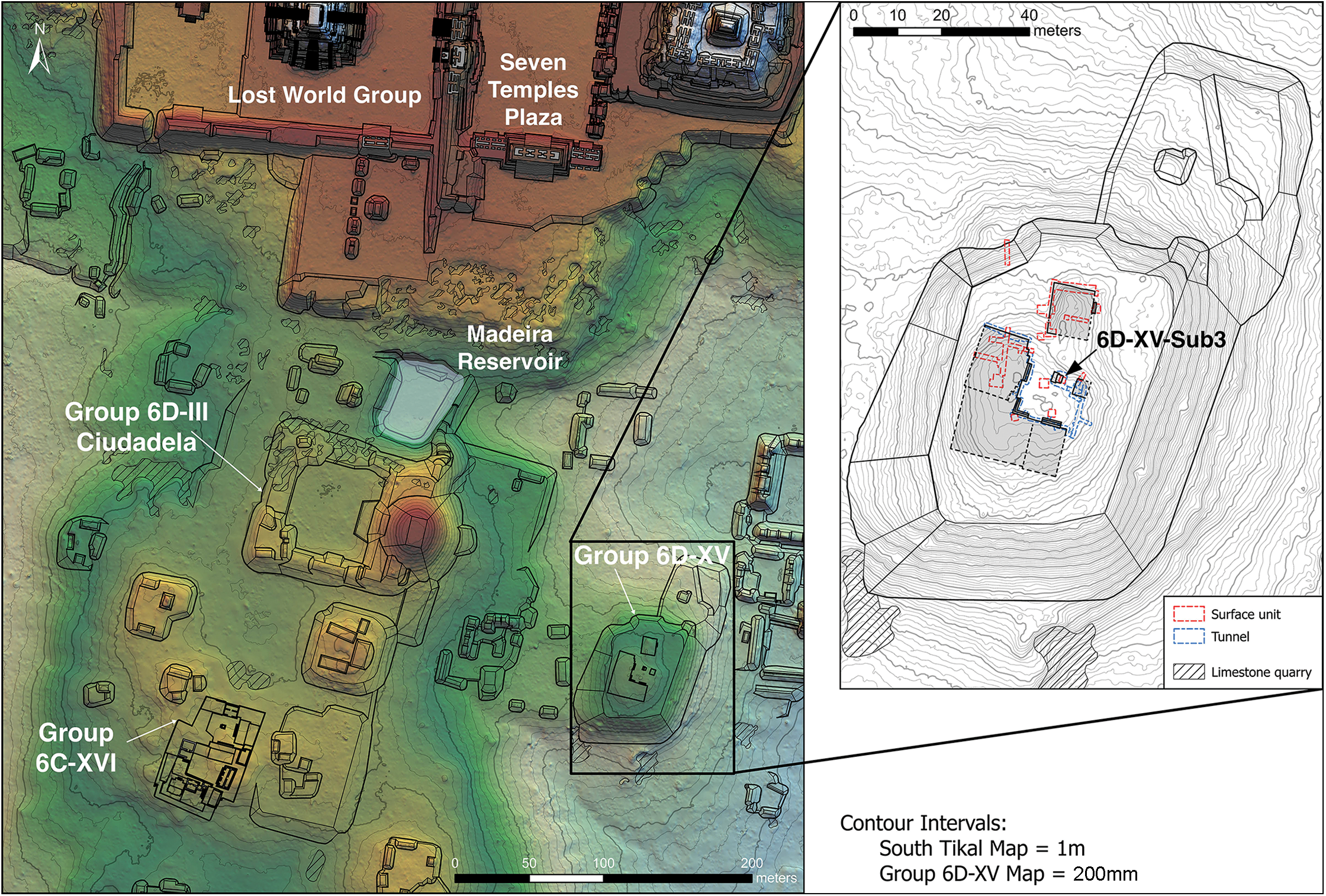
Beginning in 2019, prompted by fresh results from lidar, the excavations at Group 6D-XV ultimately revealed a painted altar (Structure 6D-XV-Sub3) at the centre of a patio marked by various construction episodes and associated burials or caches (PAST-Burials 7, 11, 10 and 15). Group 6D-XV lies atop a natural rise levelled to create a larger platform (Figure 2); located 125m east of the 6D-105 pyramid, this group shares an orientation with Group 6D-III, constructed parallel to its platform. Like the occupation and termination of Group 6C-XVI (Laporte Reference Laporte and de la Garza y Camino1987, Reference Laporte1989; Laporte & Fialko Reference Laporte and Fialko1995), Group 6D-XV revealed a residential patio compound that was buried as part of the termination of Tikal's southern sector.
Architectural group 6D-XV, tunnels correspond to the level of Structure 6D-XV-Sub3, showing the location (left) and a schematic representation (right) of the murals altar (image by T.G. Garrison, H. Hurst & L. Paiz).
The earliest phase of Group 6D-XV is represented by an ovoid arrangement of post holes on the eastern side of the mound, 11m beneath the current surface (Figures S15 & S17). Two atypical interments occur in association with what was probably a structure made from perishable material. PAST-Burial 10, a tomb with limestone walls, stuccoed floor and a thick ash stain above it, contained a supine skeleton of a probable male adult, arranged with hands crossed over the hips, head facing east (Figure 3, see also OSM). Among the grave goods was a stemmed biface of obsidian (Figure S13a) and a fragmentary biface of green obsidian, an object closely tied to Teotihuacan in both form and material, was in the fill directly above the burial (Figure S13b; cf. Haviland Reference Haviland2014: 415). Other funerary goods underscore the high status of the deceased, including a rich inventory of two shell needles, a shell earflare with a stone mosaic, 36 stuccoed Oliva shells, 54 shell beads, a grinding stone and several ceramic vessels. Two vessels were of local make but anomalous in shape, including a cream-coloured chalice resembling Late Tlamimlolpa goblet shapes and a slipped vessel with the image of a macaw (cf. Rattray Reference Rattray1992: pl. XIX).
PAST-Burial 10 and detail of artefacts found within the burial. The inset box shows an intaglio earspool covering with shell and jade inlays (42mm diameter) found 100mm above the cranium (figure by S. Levine, L. Paiz & A. Scherer).
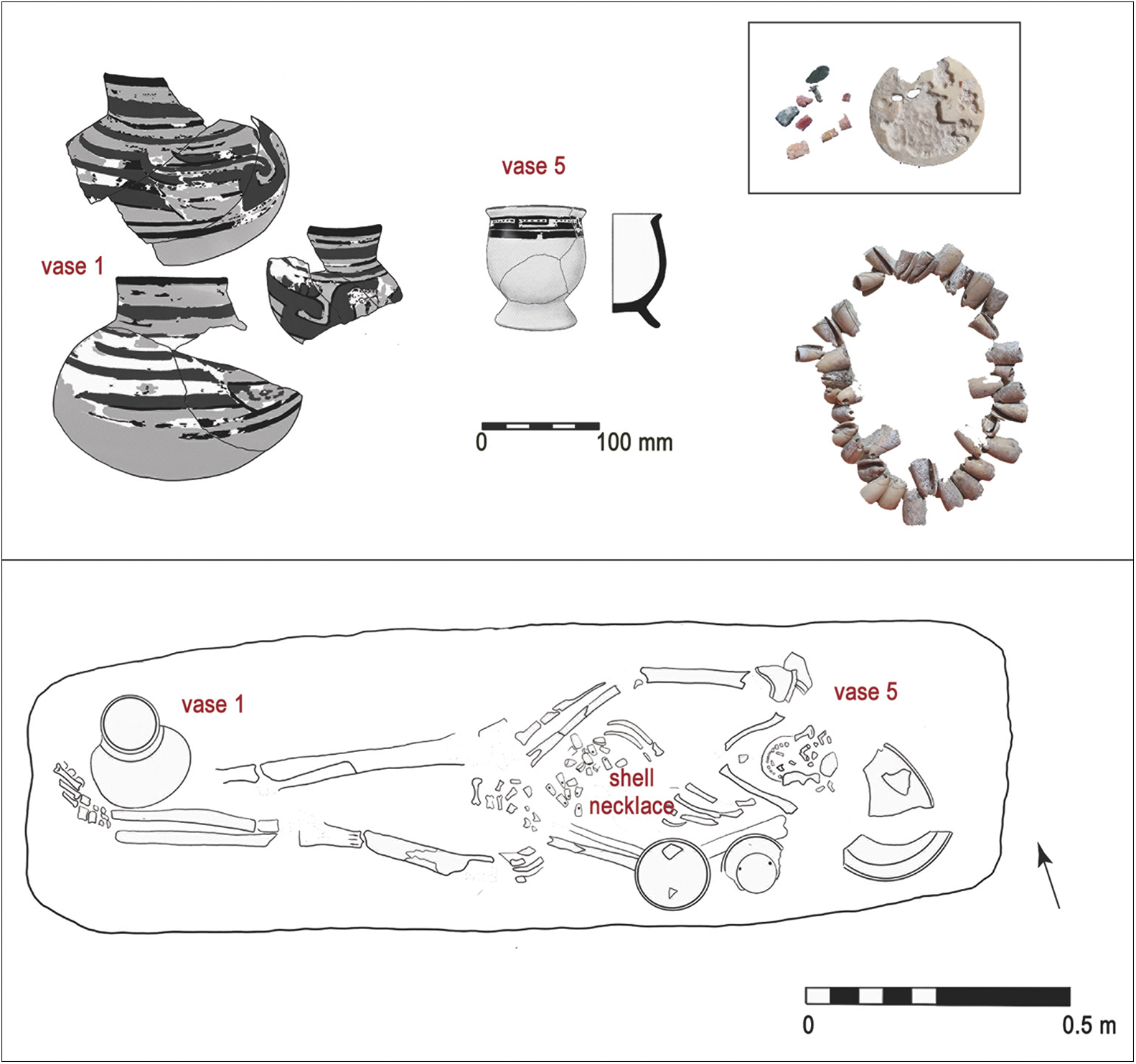
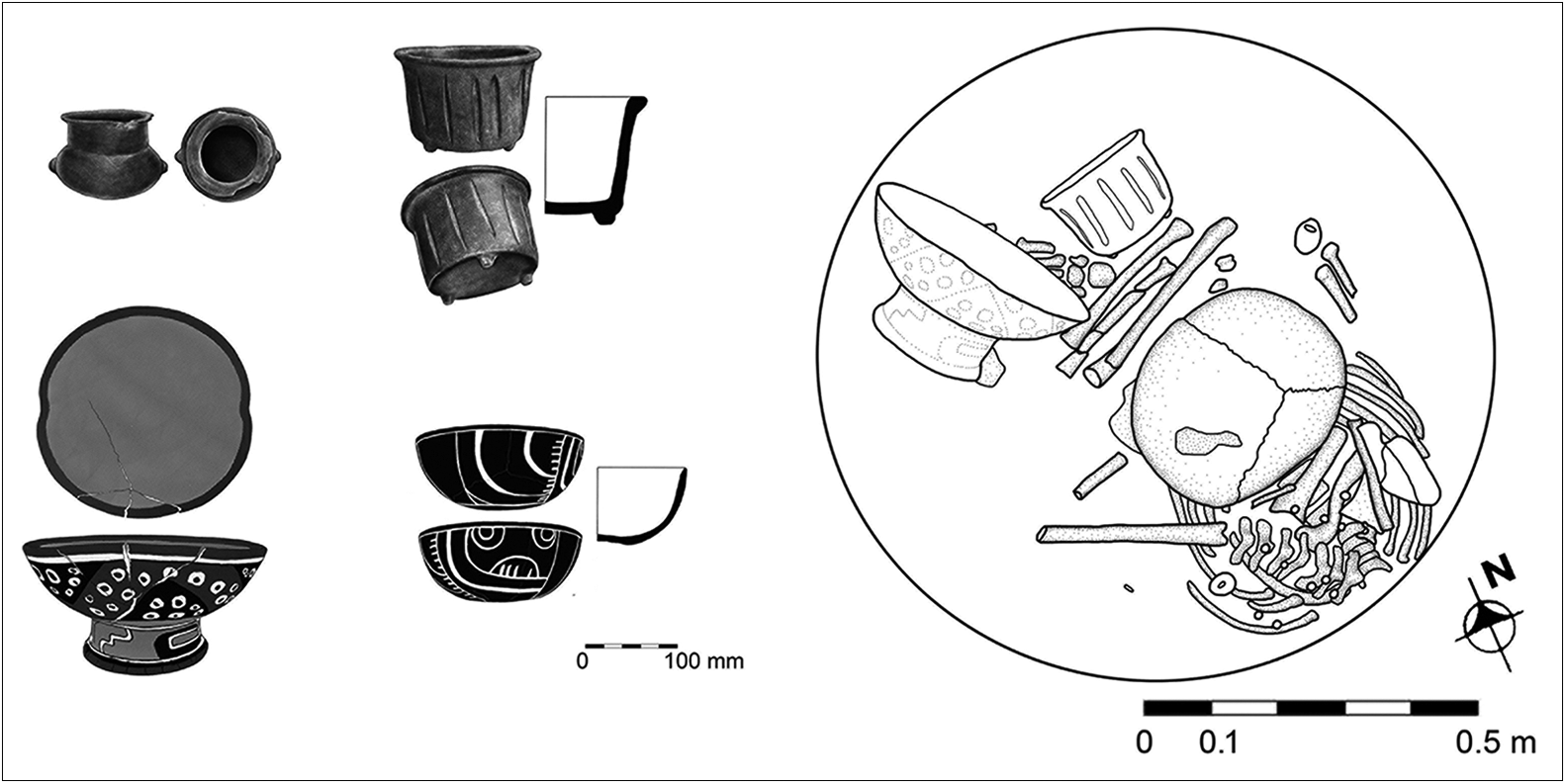
PAST-Burial 15 consists of a 2–4-year-old child placed in a seated position, knees drawn to the chest with arms flexed and hands set to the front of the body, inside a 1m-diameter circular pit (Figure 4); it post-dates PAST-Burial 10, intruding into the earlier phase of the building, and the bones show signs of fire damage. Found along with the child were a pierced dog tooth, 46 tubular shell beads, 39 circular shell beads, three greenstone beads, four burned jade beads, a red bead of uncertain material, and four ceramic vessels. The vessels, though clearly Maya in terms of their surface finish (Balanza Black, Lucha Incised, Paradero Fluted, Yaloche Cream), have forms that relate to Late Tlamimilolpa ceramics at Teotihuacan, including a pinched rim (probably simulating a dried gourd) and a flat-based fluted body and thick everted rim. The seated position and burning of PAST-Burial 15 are consistent with mortuary patterns at Teotihuacan during the Tlamimilolpa and Xolalpan phases (Sempowski & Spence Reference Sempowski and Spence1994: 181, 208–9). Two radiocarbon dates place the lower construction between cal AD 205 and 350 (Beta-670812, 95.4% confidence), and the fill above the burials extends from cal AD 380–540 (Beta-670815, 95.4% confidence).
Four ceramic vessels found in PAST-Burial 15 and a plan view of the burial (right). The upper-left and lower-right vessels were found beneath the pots illustrated on the plan (drawings by H. Hurst & S. Levine).
The fill over the burials and the early oval structure was topped by a single floor that supported four buildings. These structures delimited the sides of a patio with a central masonry altar (Figures 2 & S17). In layout, this arrangement corresponds to ‘Plaza Plan 4’, a pattern restricted to the southern sector of Tikal and “strongly influenced by cultural rules from Teotihuacan”, with burials and skull caches in central courtyard shrines (Becker Reference Becker, Manzanilla and Chapdelaine2009: 93, 96). A radiocarbon date of cal AD 360–540 (Beta-670814, 94.9% confidence) was obtained from the stairway construction fill of the building on the south side of the courtyard, and accompanying artefacts support a date in the fifth century AD.
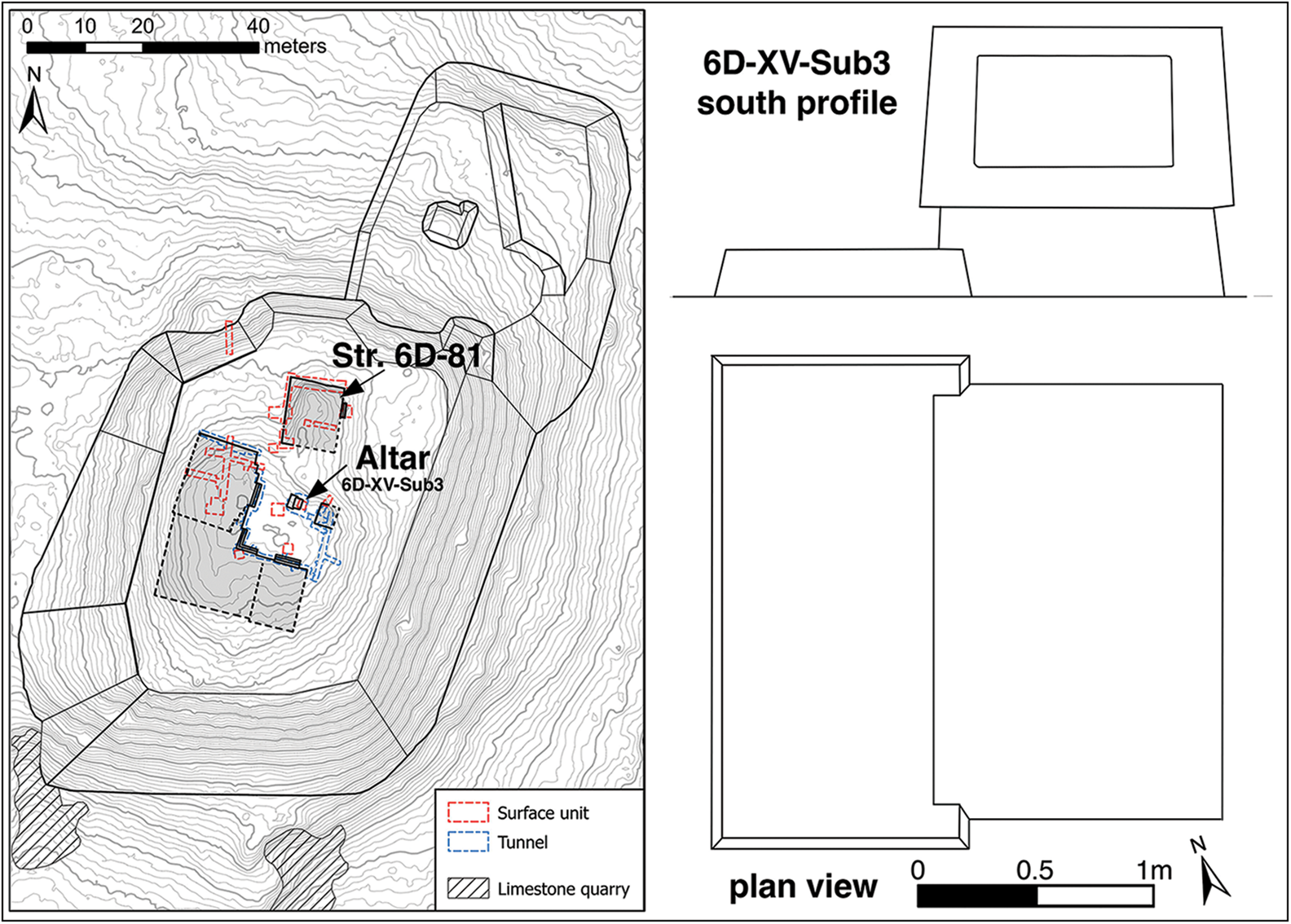
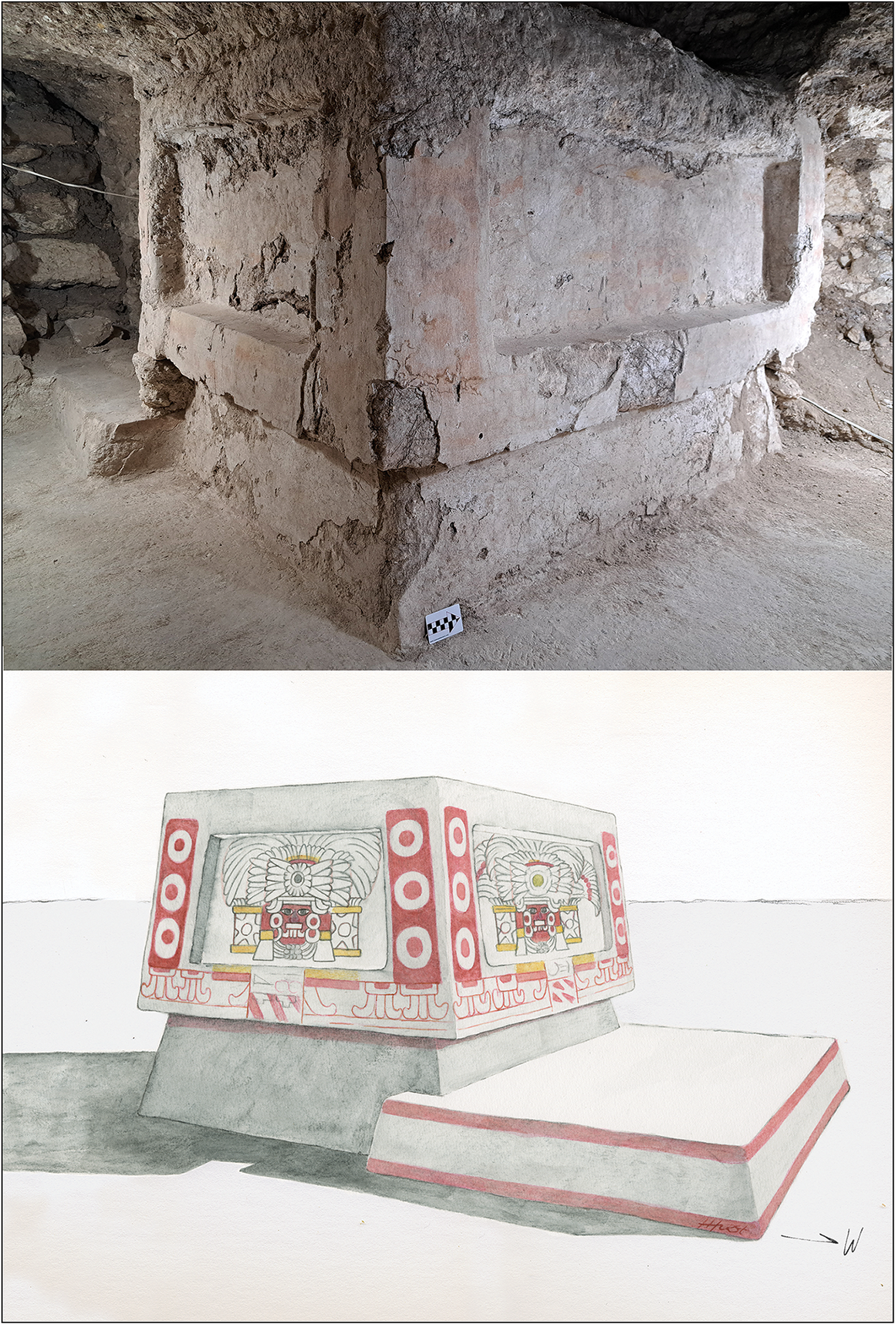
At the centre of the patio courtyard is Structure 6D-XV-Sub3, a small talud-tablero structure (1.1m tall) of rectangular footprint (1.8 × 1.33m), with its long facade facing west (Figure 5). Precarity of the murals means that it is not possible to excavate within the structure, and details of its construction are currently unknown. The principal approach to the altar is defined by a low outset platform extending 0.97m from the west facade; this platform, burned on its central axis, is painted with red bands and was laid out with a black line delineated on the floor (Figure S18). Four adjacent caches or burials occur with the altar (Figure S16). To the north-east, PAST-Burial 11 contained an infant, the bones were scattered in loose fill but had probably originally been placed atop the Balanza Black tripod plate found in the burial. A second interment to the north (PAST-Burial 7) was of a 6–12-month-old baby, and another infant was found on the frontal axis in 2024 (PAST-Burial 16). At the south-west corner of the altar was an offering without human remains, only a jar rim. To place the offerings, the underlying floor was broken and the holes were filled, following the deposition of the bodies and other artefacts, with crushed and compacted limestone. At Teotihuacan, such infant burials have been recovered from courtyard altars in the La Ventilla B compound and near residential rooms at the Tlamimilolpa complex (Rattray Reference Rattray1992: 12, 53).
Structure 6D-XV-Sub3, altar with murals photographed from the south-west (above) and rendered from the north-west (below) (photograph by E. Román; rendering by H. Hurst).
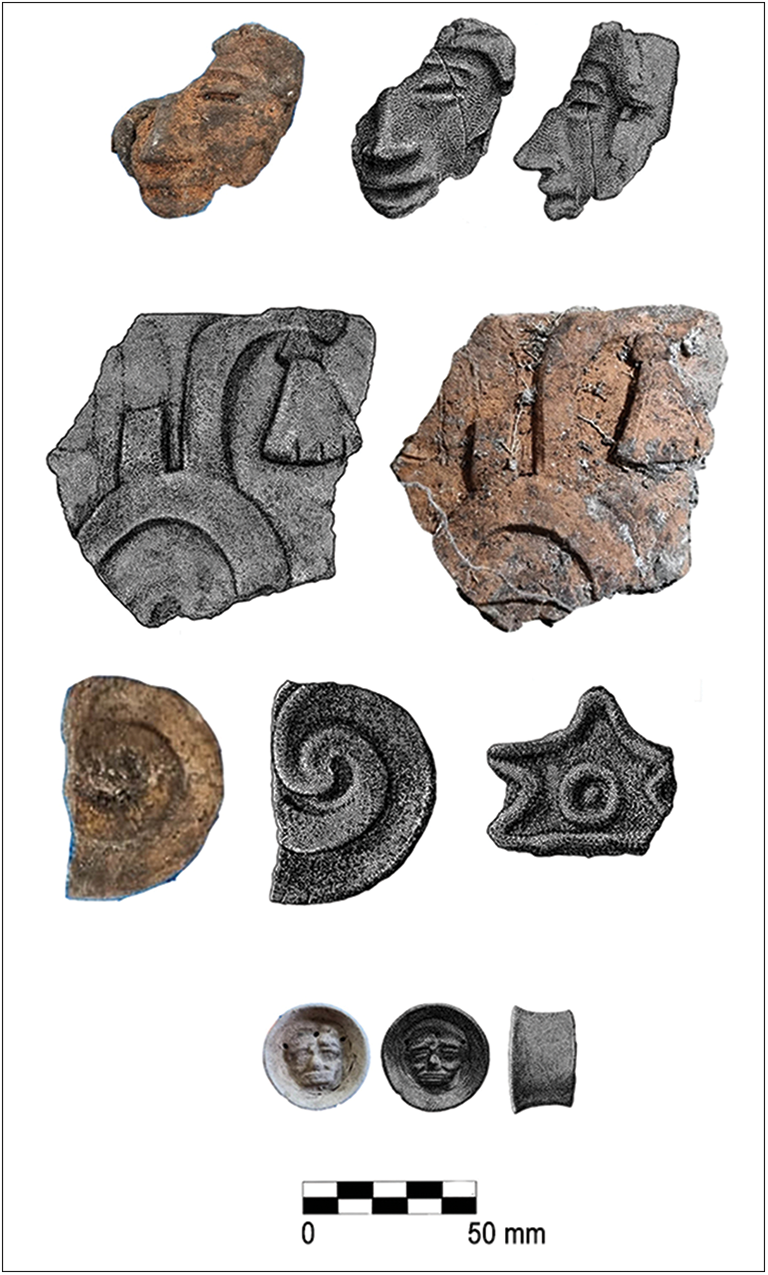
The 6D-XV patio compound and its courtyard altar were buried after a ceremony near the eastern part of the group that left burnt material spread over 3m; a radiocarbon date from this material indicates a range of cal AD 550–645 (Beta-670811, 95.4% probability), close to the rapid decline of Teotihuacan. Except for Structure 6D-81, the lone building still visible on the surface of the mound, the patio compound was intentionally covered by a non-uniform fill to create the impression of a natural hill. Several items were retrieved from the fill covering the altar (Figure 6), including a ceramic, drum-shaped earspool (Figure 6d). Unique in the Maya area, such ornaments are found at Mexican sites affiliated with Teotihuacan (Cabrera García Reference Cabrera García2016; Jimenez Betts Reference Jimenez Betts2018: 79–80, figs. 4.9, 4.17).
Teotihuacan-related objects found with the altar. Fragments of incense burners: a) PST-1C-25-11; b) PST-1C-25-11; c) PST-1C-25-11; and a ceramic earspool, d) PST-1C-25-10 (photographs by L. Paiz; drawings by S. Levine).
The altar paintings
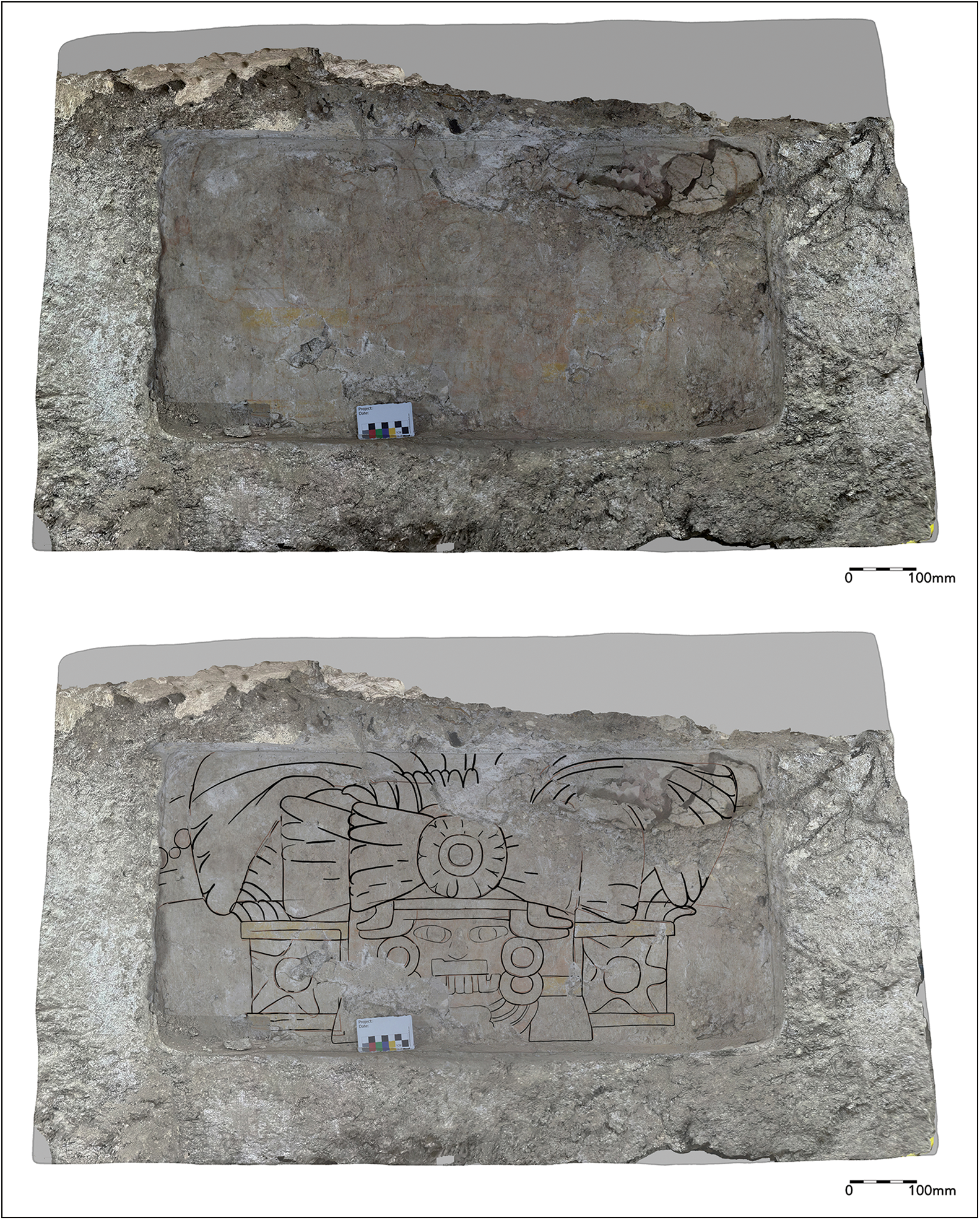
The courtyard altar (Structure 6D-XV-Sub3) employs masonry talud-tableros, covered by earthen and lime-based layers and finished with multiple coats of fine lime plaster (Figures 5, 7–10). The extended platform providing access on the west and the talud element of the altar were simply demarcated with thick red lines. The four tablero surfaces of the altar, including the frame and recessed panel of each side, were painted in red, orange, yellow and black hues (see OSM for details). Each recessed panel displays the frontal image of a person wearing a feathered headdress. Only the face and headdress are shown, and flanking elements may represent shields or other elements of regalia. Preservation of the plaster and the images is variable on each side, though overall the designs are faint and the plaster is friable. Application of photogrammetry, and processing of the high-resolution orthomosaic images with dStretch software, has aided the documentation and study of the painted panels. The dStretch digital imaging tool, initially designed for enhancing rock art, uses a decorrelation stretch algorithm to create various false colour images by increasing differences in hue (Harman Reference Harman2005). Red and yellow hues were detected in the Tikal altar paintings, which were then verified and incorporated into on-site drawings of the tableros, thereby confirming unclear details (Figure S11).
Altar of Structure 6D-XV-Sub3, west side, showing an orthomosaic photo (top image by H. Hurst, A. Bass, L. Paiz & E. Román) and illustration (lower image by H. Hurst).
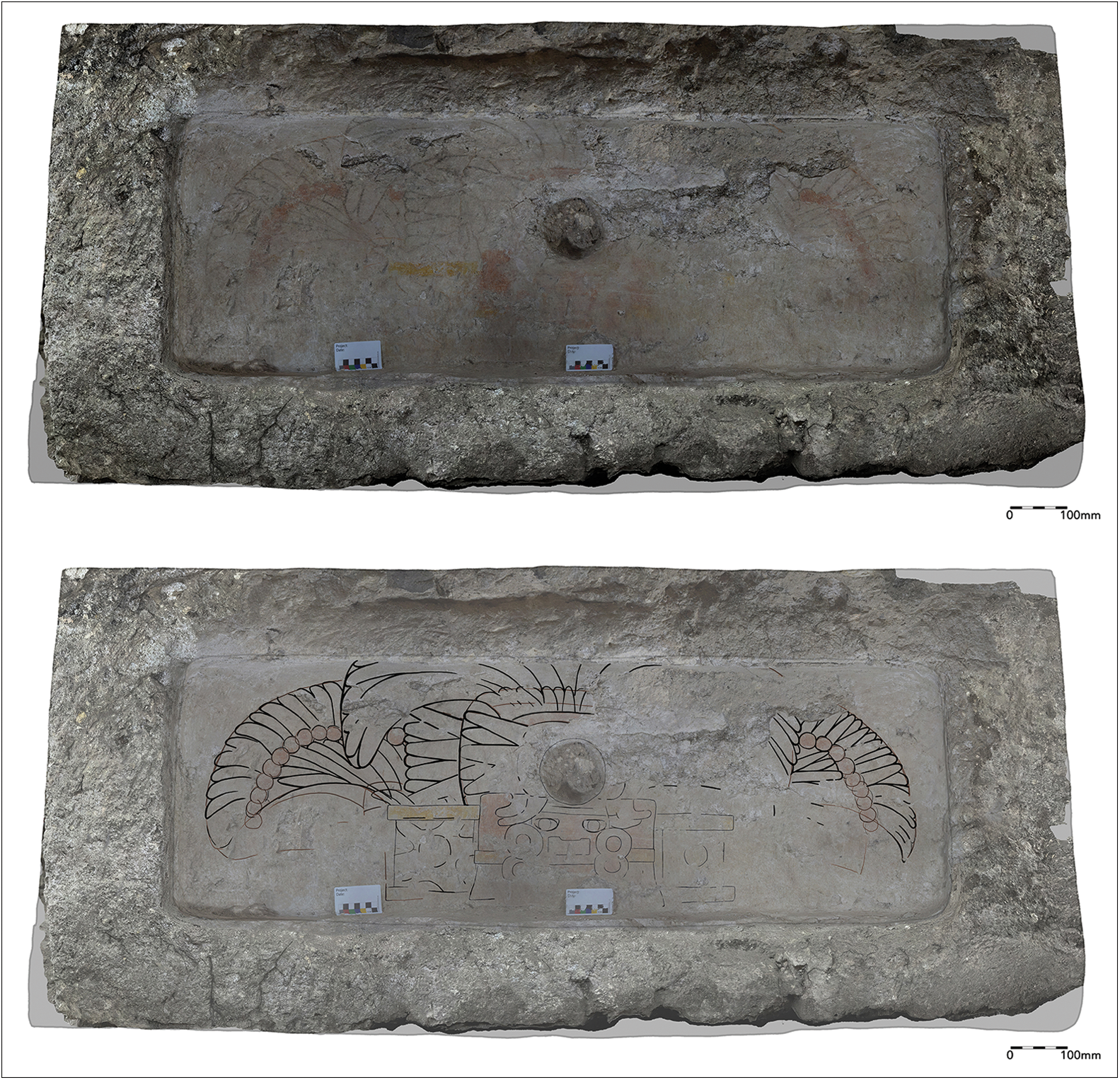
The paintings on the four sides of the altar are highly standardised. Each features a face framed by a broad headdress and flanking elements of regalia. The faces wear dual stacked earspools, three-strand necklaces and elaborate headdresses with white banding at the forehead and a circular diadem composed of three concentric sections. Behind the circular diadem are four tiers of short, stiff feathers and arching sprays of plumes. Symmetry and repetition dictate the altar design, with the face and diadem as primary elements. For example, the west and east panels are 0.46m wider than the north and south panels, yet the frontal figure maintains the same proportions on all sides. On the shorter north and south panels, the feathered headdress wraps around the outset of the tablero frame, completing the image without altering the scale (Figures 8 & 10).
Altar of Structure 6D-XV-Sub3, south side, showing an orthomosaic photo (top image by H. Hurst, A. Bass, L. Paiz & E. Román) and illustration (lower image by H. Hurst).
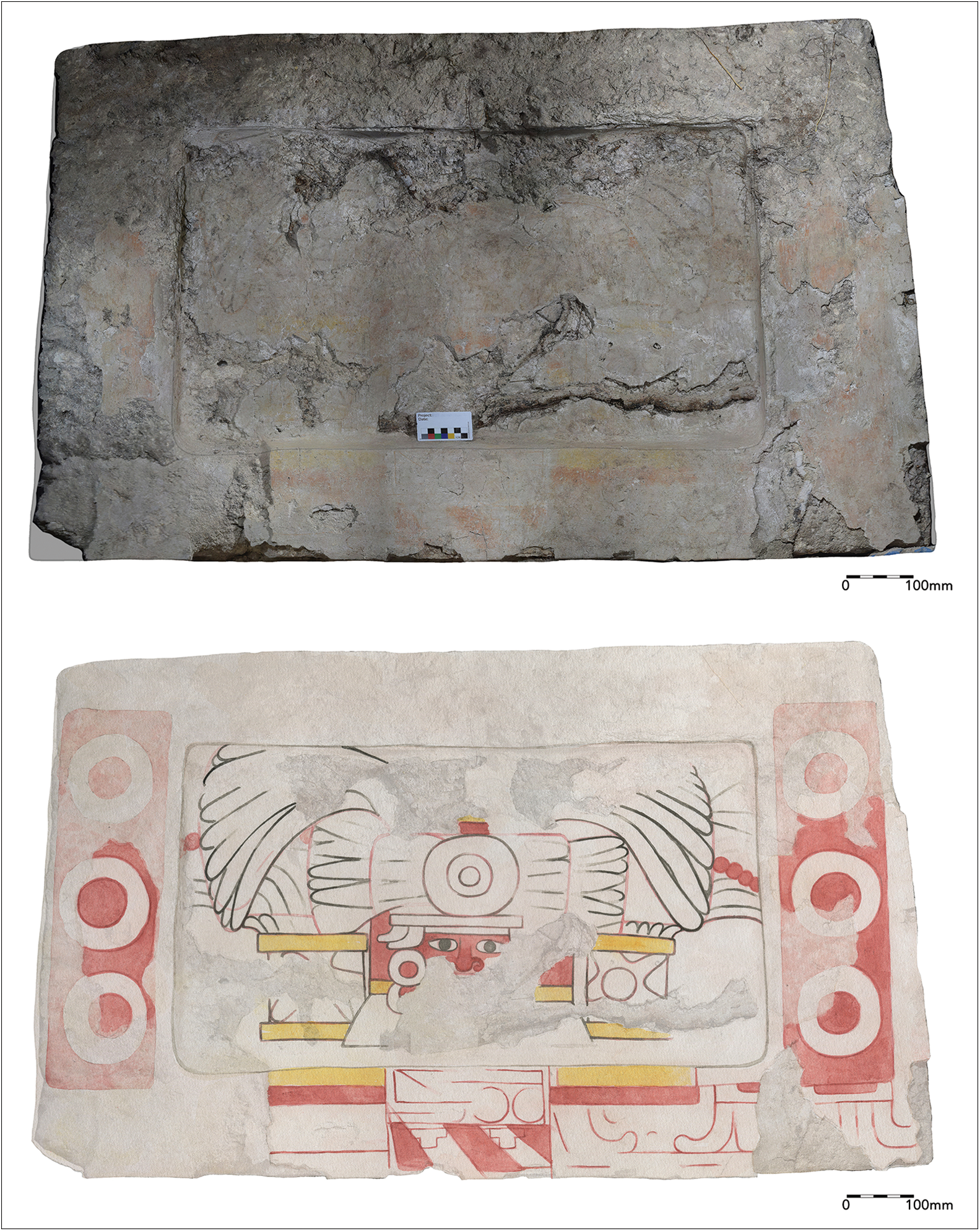
The decoration on the Tikal altar accords with Teotihuacan painting style and techniques. The use of frontality is typically associated with the representation of deities in Teotihuacan mural painting and sculpture (Kubler Reference Kubler1967: 7, Pasztory Reference Pasztory and Berlo1992: 293). The distinctive fanged or pronged mouthpiece of the figure on the Tikal altar suggests it relates to the ‘Storm God’ complex and, perhaps, to the ‘Great Goddess’, a divine entity whose existence is questioned by some specialists (e.g. Pasztory Reference Pasztory1973; Taube Reference Taube1983; Paulinyi Reference Paulinyi2006; Mandell Reference Mandell2015; Nielsen & Helmke Reference Nielsen, Helmke and Robb2017). The face has almond-shaped eyes and wears a nose-bar with fangs, consistent with depictions of several deities at Teotihuacan (see Robb Reference Robb and Robb2017a: fig. 22.5). The repeating mouthpiece motif, seen along the bottom border of the tablero frame (Figures 8 & 9), and the double earspool/feathered headdress combination are both also seen at Teotihuacan, at the Complex of the Superimposed Buildings and the Complex of the Sun, respectively (Cabrera Reference Cabrera and de la Fuente1995: fig. 3.6; de la Fuente Reference de la Fuente and de la Fuente1995: pl. 20). Yet, in a departure from commonly cited ‘Storm God’ characteristics (cf. Anderson & Helmke Reference Anderson and Helmke2013: 166), the Tikal altar figure lacks eye ‘goggles’. Hair frames the face, ending in a yellow bar and white triangular form, possibly representing paper or cotton. Although no additional body parts are visible, the figure is bordered by two identical shields; rectangular elements adorned with a star and feathers along the top edges (Miller Reference Miller1973: figs. 137, 197). The style is typical of Teotihuacan, where similar shields are depicted on a wall painting in the Zacuala residential compound (Kubler Reference Kubler1967: fig. 27), an incense burner lid from the Oztoyahualco compound (AD 350−550) and at least one figurine (Manzanilla Reference Manzanilla and Robb2017: 206; Robb Reference Robb and Robb2017b: 207). No hands are visible on the Tikal altar, yet the position of the shields, like their sculptural counterparts, suggests they are held by the figure itself.
Altar of Structure 6D-XV-Sub3, east side, showing an orthomosaic photo (top image by H. Hurst, A. Bass, L. Paiz & E. Román) and illustration (lower image by H. Hurst).
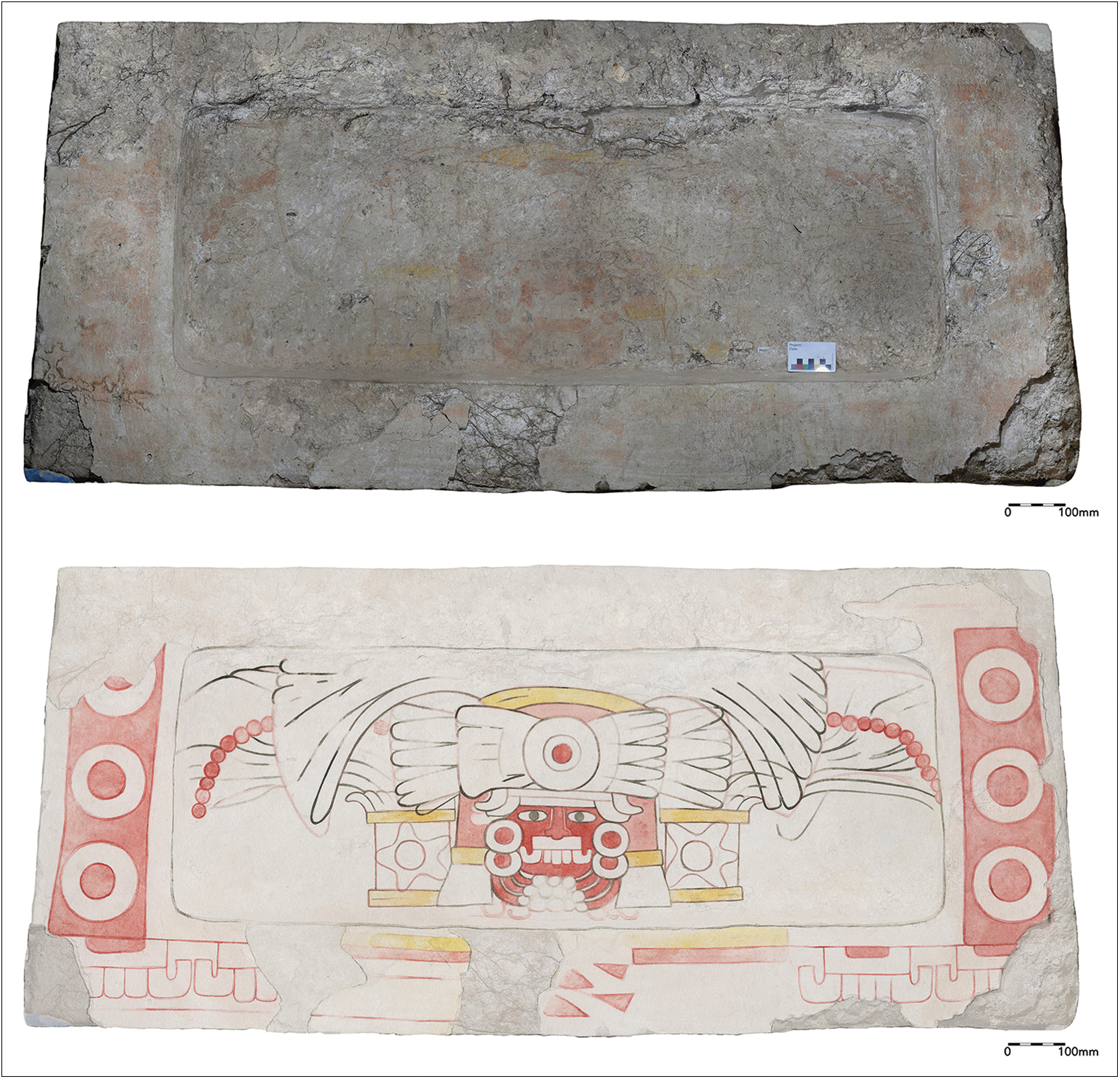
Some small variation is seen in the design on each side of the Tikal altar. The innermost circle of the headdress diadem differs in colour: black on the north panel, red on the east and grey (possibly a faded colourant) on the south. The west panel diadem has a circular socket (100mm wide, 50mm deep), and the imprint of a disc is still visible in the bordering plaster. The inset object, possibly a polished mirror, was not recovered during excavations and was likely removed before the altar was buried. The nose of the figure on the north panel is black in colour and does not protrude over the nose bar, perhaps depicting a skeletal cavity (cf. Figures 9 & 10). The north image is also unique in having feathers that ring the diadem. These variations suggest a quadripartite identity for the Tikal altar figures that may relate to the cardinal directions.
Altar of Structure 6D-XV-Sub3, north side, showing an orthomosaic photo (top image by H. Hurst, A. Bass, L. Paiz & E. Román) and illustration (lower image by H. Hurst).
Each tablero frame surrounding the recessed panel is also painted in polychrome, which situates or amplifies the iconography of the painted panel (Kubler Reference Kubler1967: 8; Lombardo de Ruiz Reference Lombardo De Ruiz, de la Fuente and Cicero2001: 21). The vertical sides of the tablero frames are adorned with red rectangular panels each containing three white rings; the chalchihuites, or ‘precious stone’, motif is associated with royal palaces in later Aztec imagery (Evans Reference Evans, Evans and Pillsbury2004: 8, fig. 1; Houston & Newman Reference Houston and Newman2021). At Teotihuacan, the motif is found on numerous architectural friezes, such as the Quetzalpapalotl Palace, and in tablero borders on the Temple of the Feathered Serpent and the Puma Mural from the Street of the Dead, among others (Miller Reference Miller1973: figs. 58–62, 86, 146; Robb Reference Robb and Robb2017a: figs. 22.1, 22.3). The bottom section of the Tikal altar frame has a central rectangle located directly below each frontal figure, flanked by repeated fanged mouthpieces. Poor preservation makes it unclear if this central element is the same on all sides or marks another point of variation. The treatment of the Tikal altar tablero frame in painted chalchihuites and isolated symbols drawn from the central figure conforms with imagery from the Late Tlamimilolpa-Early Xolalpan phase (AD 300–450) at Teotihuacan (Magaloni Reference Magaloni and de la Fuente1996: 219).
Close visual examination and separated colour data from the Tikal altar also disclose the layered brushstrokes of the fresco secco technique (see OSM for detail). The Tikal altar adheres closely to Teotihuacan mural painting style and technique in its use of a pale red underpainting sketch, flat colour fields and red contour lines on the figure, shields and frame (cf. Magaloni Reference Magaloni and de la Fuente1996, Reference Magaloni and Robb2017; Conides Reference Conides2018). The deliberate spacing in feather layout, the rendering of even contour lines and the final feathered-panel outline all depart from calligraphic lowland Maya painting of feathers (e.g. Bonampak, Structure 1, Room 1 headdresses), resembling more the plumage on the frontal figure of Tetitla Portico 11 (de la Fuente Reference de la Fuente and de la Fuente1995: pl. 45) and the Conjunto del Sol, among other Teotihuacan artworks. The mixture of red and black contour lines of the Tikal altar diverges from most Teotihuacan wall paintings, yet it is a technique evident on stuccoed vessels found at that city (Conides Reference Conides2018: 190). In addition to the imagery itself, these technical elements demonstrate that the altar murals were made by people well-versed in highly standardised Teotihuacan painting.
Discussion
The form and painted decoration of the Group 6D-XV altar point strongly to the presence of artists trained at Teotihuacan. Its talud-tablero profile is a distinctive Teotihuacan trait and other appearances of this architectural form in the Maya area, at Tikal and elsewhere, are associated with material and historical connections to central Mexico. The painted frame of chalchihuites and abstracted mouthpieces align the Tikal altar talud-tablero with the Teotihuacan tradition, not a local Maya variation of it. The panel paintings are also firmly in the metropolitan style of Teotihuacan in that their execution uses preparatory drawing, heavy contour lines and the design principles of layered pictorial planes, even line-weight and repetition. Beyond the absence of Maya iconographic elements, the attribution is further established by the frontal presentation of the figure, rigid bilateral symmetry, large, feathered headdresses with central medallions and the fanged mouthpiece, all of which have close parallels at Teotihuacan. The presentation of an adorned head without the body is also found in several similar Teotihuacan representations. The four painted figures at Tikal resemble images that are often described in central Mexico as the ‘Storm God’, with some overlap to a being known as the ‘Great Goddess’. But Teotihuacan imagery is highly opaque, often with fused personages, and even the presumed gender may be uncertain to specialists. In the murals at Tikal, the four aspects differentiated by colour at least suggest they are deities associated with the four world directions.
In the Early Classic period, wall painting was a medium for influence and interaction, as seen in Teotihuacan imagery from murals at Copan, Xelha and Uaxactún, in the Maya area (Lombardo de Ruiz Reference Lombardo De Ruiz, de la Fuente and Cicero2001), and, conversely, Maya-style murals within the Plaza of the Columns at Teotihuacan (Sugiyama et al. Reference Sugiyama, Hirth, Carballo and Arroyo2020). At Holmul, in the Petén Basin in Guatemala, the La Sufricaya palace paintings not only depict the interaction of Maya and Teotihuacan individuals but employ volcanic ash as an aggregate, a method traditionally used at Teotihuacan (Estrada-Belli et al. Reference Estrada-Belli2009; Hurst Reference Hurst2009, Reference Hurstin press). Analysis of the Tikal altar shows a departure from the hybridity of these other examples. Structure 6D-XV-Sub3 incorporates Central Mexican artistic practice, aesthetics and offerings; as part of the southern sector, it exists within a context notable for its intensity and variety of Teotihuacan material culture.
The size and placement of the altar, along with its burials and signs of burning, show clear parallels with courtyard altars found in residential compounds of Teotihuacan—these were also associated with domestic rituals and were ritually abandoned (Manzanilla Reference Manzanilla and Plunket2002: 51; Linné Reference Linné2003: 47–48; Becker Reference Becker, Manzanilla and Chapdelaine2009; Houston Reference Houston2023; see also OSM). As Séjourné (Reference Séjourné1966) notes, small altars in residential compounds at Teotihuacan represent miniature versions of the square platforms in more public plazas. Large, more formal platforms with overt Teotihuacan-style features were centrally placed at Tikal as well, in the Mundo Perdido area (Structure 5C-53) and near the Central Acropolis (Structure 5D-43), all with talud-tableros. During the fifth century AD, the residential area encompassing the Tikal altar lay close to most of the major construction occurring in the city. In considering the attribution of Structure 6D-XV-Sub3, a scenario of either Teotihuacan artists painting the altar at Tikal or Maya artists painting in a Teotihuacan style, cannot be determined; Teotihuacan itself had painters fully literate in Maya writing (Taube Reference Taube and Braswell2003). Yet the construction and embellishment of the altar, along with ancillary finds, reflect Teotihuacan architectural ‘grammar’ and a profound immersion in the mural practice of that distant metropolis.
Conclusions
The 6D-XV compound and its altar add to the growing evidence of Teotihuacan influence in Maya material culture and imagery, suggesting not just local adoption of artistic styles but potentially the presence of Teotihuacan-trained painters practising their skills at Tikal in the fifth century AD. The compound is functionally comparable to the adjacent 6C-XVI complex, with a distinctive central altar in its small plaza or patio. These areas mixed domestic and ritual spaces, displaying architectural and organisational links to the residential compounds found at Teotihuacan. Far from loose Maya imitations, the altar murals are expert examples of a complex, non-local style and likely evidence of the direct presence of Teotihuacan at Tikal as part of a foreign enclave that coincided with the historic Entrada.
Acknowledgements
Permission for the fieldwork behind this article came from the Dirección General del Patrimonio Cultural y Natural, Guatemala, with a concession accorded to the Director of PAST, Dr Edwin Román. Radiocarbon dates are calibrated by INTCAL20. Four reviewers, Scott Hutson among them, provided useful comments, as did the editors, Robin Skeates and Robert Witcher. All material remains are stored at the Tikal National Park, Guatemala.
Funding statement
The PACUNAM-Fundación Patrimonio Cultural y Natural Maya and its Director, Marianne Hernández, were generous with funding, as was the Hitz Foundation. Radiocarbon dates were covered by the Dupee Family Professorship of Social Sciences at Brown University, travel to the field for various authors came from Skidmore College and the University of Texas, Austin.
Online supplementary material (OSM)
To view supplementary material for this article, please visit https://doi.org/10.15184/aqy.2025.3 and select the supplementary materials tab.


 Open access

