





Introduction
Managing winter annual weeds before planting a crop is critical for promoting early-season crop growth and maximizing yield. Winter weeds are particularly problematic in no-till corn, cotton, and soybean production where reduced soil disturbance favors fall and early spring weed emergence (Buhler Reference Buhler2002). Uncontrolled infestations can interfere with planting operations, compete for early season resources, and delay crop establishment (Kremer Reference Kremer2005). In many regions, henbit, common chickweed, horseweed (Erigeron canadensis L.), annual bluegrass, and Italian ryegrass (Lolium perenne subsp. multiflorum) are among the most prevalent and problematic winter or biennial species (Breeden et al. Reference Breeden, Brosnan, Mueller, Breeden, Horvath and Senseman2017; de Sanctis et al. Reference de Sanctis, Cahoon, Everman, Gannon, Jennings and Taylor2025; Kruger et al. Reference Kruger, Davis, Weller, Stachler, Loux and Johnson2009). Thus, applying effective preplant foliar herbicides has become a building block of successful crop production (Norsworthy et al. Reference Norsworthy, Ward, Shaw, Llewellyn, Nichols, Webster and Barrett2012).
Glyphosate (categorized as a Group 9 herbicide by the Weed Science Society of America [WSSA]) has long served as a cornerstone herbicide, valued for its utility across a wide range of weed species and cropping systems (Duke Reference Duke2018). In addition to its efficacy, glyphosate’s affordability has continued to make it an economically attractive option to growers. However, its extensive use has led to increasing legal scrutiny, and ongoing lawsuits have prompted Bayer to consider halting glyphosate production unless it receives legal protection (Bayer Global, 2024; Cahoon and Washburn Reference Cahoon and Washburn2025). In tandem with litigation concerns, widespread glyphosate use has also led to the development of resistant weed biotypes. In the United States, 18 species are confirmed to be resistant to glyphosate, including seven winter and biennial species that commonly persist at the time of preplant foliar applications (Heap Reference Heap2025). Therefore, growers must understand which herbicide combinations can deliver effective preplant foliar weed control in the absence of glyphosate.
A standard preplant foliar application includes a combination of glyphosate and 2,4-D or dicamba (WSSA Group 4), plus a soil residual herbicide. The addition of 2,4-D or dicamba broadens control of both glyphosate-resistant and glyphosate-susceptible broadleaf weeds. Because neither 2,4-D nor dicamba provides grass control (Askew et al. Reference Askew, Cahoon, York, Flessner, Langston and Ferebee2021), a graminicide or another herbicide that acts against grass weed species is required in the absence of glyphosate. However, auxinic herbicides such as 2,4-D and dicamba can antagonize grass control afforded by graminicides like clethodim (WSSA Group 1) (Osipe et al. Reference Osipe, de oliveira Júnior, Constantin, Braga, Braz, Takano and Biffe2021). Other studies have reported that including glyphosate in these combinations can mitigate antagonism concerns (Agostinetto et al. Reference Agostinetto, Pigatto, Zandoná, Roberto Neto, da Silva and Andres2022), but this is practical only if glyphosate is available.
If glyphosate is not available, the next closest alternative that offers plant-back safety for major row crops and broad-spectrum weed control is paraquat (WSSA Group 21). A previous study conducted by Johnson (Reference Johnson1980) noted that paraquat controlled annual bluegrass and common chickweed to an extent that was comparable to glyphosate. However, certain species such as henbit and purple cudweed often exhibit regrowth following an application of paraquat, necessitating sequential applications or adding glyphosate to it (Johnson Reference Johnson1976). Paraquat + glyphosate is often highly efficacious and presents less antagonism risk than herbicide combinations with clethodim + 2,4-D or dicamba (Cahoon and York Reference Cahoon and York2025). Yet this is only feasible if glyphosate remains in the marketplace.
Several other herbicides could provide solutions for achieving effective preplant foliar weed management if glyphosate is not available. The premix of thifensulfuron and rimsulfuron (WSSA Group 2), inhibitors of acetolactate synthase (ALS) is reported to control henbit, common chickweed, and annual bluegrass to a degree that is comparable to that of glyphosate (Monnig & Bradley, Reference Monnig and Bradley2008; Woolam et al. Reference Woolam, Stephenson and Blouin2018). In addition to great weed control, rimsulfuron + thifensulfuron has minimal crop rotation restrictions, allowing immediate planting of corn and sulfonylurea-tolerant soybean cultivars, and only a 30-d restriction for cotton. However, with 57 ALS-resistant weed biotypes now confirmed in the United States (Heap Reference Heap2025), integrating multiple herbicide modes of actions with Group 2 herbicides is essential to further delay the evolution of resistance (Busi et al. Reference Busi, Powles, Beckie and Renton2020). Given this, little research has assessed the efficacy of thifensulfuron + rimsulfuron when applied in combination with graminicides such as clethodim and synthetic auxins such as 2,4-D on winter and biennial weeds. This raises concerns, particularly with annual bluegrass and Italian ryegrass control, as mixtures of 2,4-D and/or graminicides have been shown to antagonize grass control by ALS inhibitors (Isaacs Reference Isaacs2000; Matzenbacher et al. Reference Matzenbacher, Kalsing, Dalazen, Markus and Merotto2015).
Recently introduced inhibitors of protoporphyrinogen oxidase (PPO, WSSA Group 14) offer additional alternatives. Tiafenacil is registered for preplant foliar use on corn, cotton, soybean, and wheat (Helm Agro Reference Agro2025), with studies showing effective control of junglerice (Echinochloa colona L.) and barnyardgrass (Echinochloa crus-galli L.) in greenhouse experiments, and moderate control of horseweed and hairy fleabane (Erigeron bonariensis L.) in the field (Laguerre et al. Reference Laguerre, Contreras and Hanson2024; Soltani et al. Reference Soltani, Shropshire and Sikkema2021). Saflufenacil, another PPO inhibitor, is also widely used in preplant foliar programs and is particularly effective on glyphosate-resistant horseweed, although it lacks effectiveness against grass weeds (BASF 2025). Like the knowledge gap with thifensulfuron + rimsulfuron, there is also a gap in research on the efficacy of these PPO inhibitors when combined with clethodim and/or 2,4-D for winter and biennial weed control.
Although various herbicides can control specific winter annual weeds, relying on a single alternative to glyphosate is neither practical nor sustainable from a resistance management standpoint. With the future of glyphosate uncertain, it is paramount to identify effective alternative preplant foliar weed management strategies. While many of the aforementioned herbicides have been studied individually, their performance in specific combinations on winter annual weeds has not been evaluated. Therefore, the objective of this study was to compare various herbicide combinations to standard glyphosate mixtures for preplant foliar weed control.
Materials and Methods
To evaluate the efficacy of preplant foliar herbicides for managing winter annual weeds, we established experiments at two locations in North Carolina in 2022: the Upper Coastal Plains Research Station near Rocky Mount (35.89°N, 77.68°W), and an on-farm site in Johnston County (35.37°N, 78.36°W). Experiments continued in 2023 at two on-farm sites in North Carolina: one in Wayne County (35.26°N, 78.23°W), and another in Johnston County (35.37°N, 78.36°W). The Rocky Mount site featured an Aycock very fine sandy loam soil (Fine-silty, siliceous, subactive, thermic Typic Paleudults), while the Johnston County sites had Norfolk loamy sand soil (Fine-loamy, kaolinitic, thermic Typic Kandiudults). The Wayne County site consisted of Wagram loamy sand (Loamy, kaolinitic, thermic Arenic Kandiudults). All field sites were managed under no-till practices and were naturally infested with various winter annual weed species.
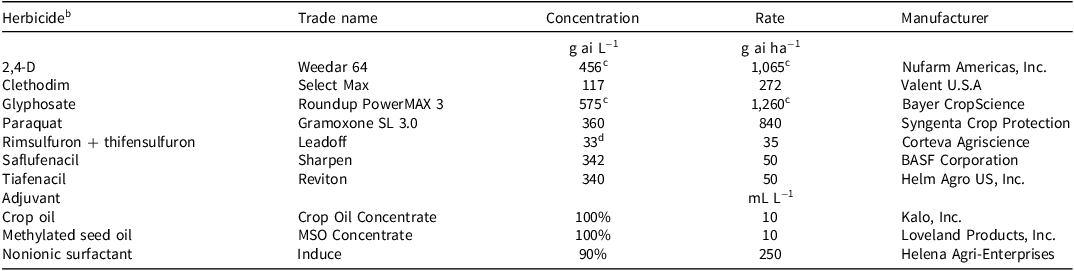
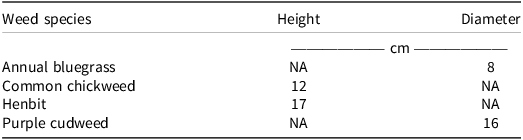
The experimental design was a randomized complete block with four replications. Individual plots measured 3.6 m by 9.1 m. The experiment included seven different herbicides, with each applied alone and in selected combinations, for a total of 19 treatments plus a nontreated control plot. The herbicides, adjuvants, and corresponding application rates used in the field experiments are listed in Table 1. Average weed size at time of application are reported in Table 2. In 2022, treatments were applied on March 2 at the Johnston County site and March 16 at the Rocky Mount site, whereas in 2023, both the Wayne County and Johnston County sites were treated on March 8. All treatments were applied using a CO2-pressurized backpack sprayer calibrated to deliver 140 L ha−1 at 207 kPa. Backpack sprayers were equipped with AIXR 11002 flat-fan nozzles (TeeJet Technologies, Glendale Heights, IL). Weed control was visually estimated using a scale of 0 to 100, where 0 indicated no control and 100 indicated plant death (Frans et al. Reference Frans, Talbert, Marx, Crowley and Camper1986). Weed densities were collected 42 d after treatment (DAT) by arbitrarily placing two 0.25-m2 quadrats per plot and counting the number of individuals within each quadrat.
Herbicides, adjuvants, and corresponding application rates used in the field experiment. a

a Specimen labels for each product, mailing address, and website of each manufacturer can be found at www.cdms.net.
c The formulation concentration and rate for glyphosate and 2,4-D is reported in grams per acid equivalent (g ae).
d The formulation concentration for rimsulfuron + thifensulfuron is reported in g g−1.

All weed control data were analyzed using ANOVA within the MIXED procedure with SAS software (v.9.4; SAS Institute Inc., Cary, NC). Herbicide treatment was considered a fixed effect, while year, location, and replication nested within year and location were treated as random effects to allow inferences across a range of environments (Blouin et al. Reference Blouin, Webster and Bond2011; Moore and Dixon Reference Moore and Dixon2015). Model assumptions of normality and homogeneity of variance were evaluated using residual diagnostics, including studentized residual plots, Q-Q plots, and plots of residuals versus predicted values. When the overall treatment effect was significant (α = 0.05), means were separated using a Fisher protected LSD test. The nontreated control was excluded from weed control analysis due to lack of within-treatment variance.
Results and Discussion
Henbit Control
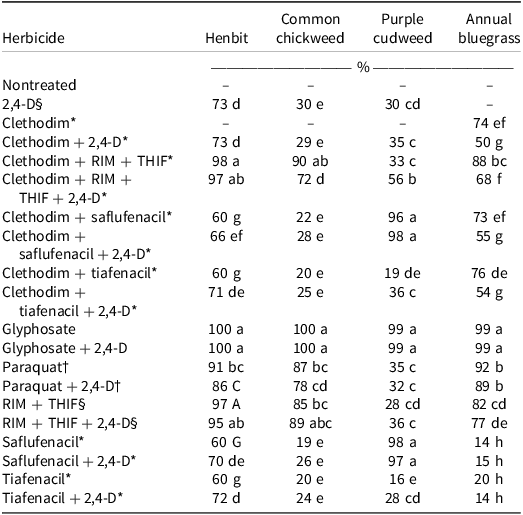
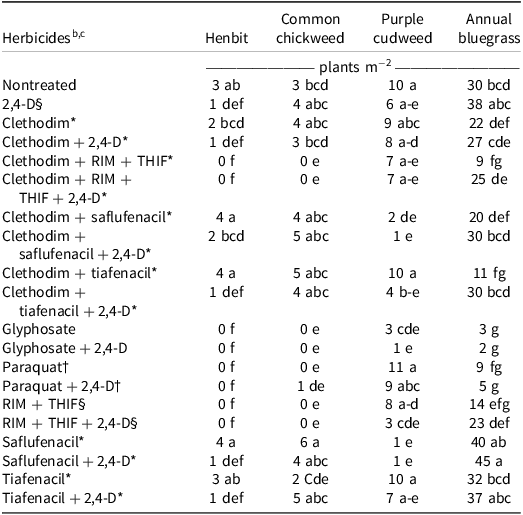
The main effect of treatment was significant for henbit control (P ˂ 0.0001). As expected, glyphosate alone and glyphosate + 2,4-D were among the most effective treatments, each providing 100% control 42 DAT (Table 3). Henbit density translated equally, with both resulting in 100% fewer plants relative to the nontreated control (Table 4). Similarly, all herbicide combinations containing rimsulfuron + thifensulfuron provided control that was comparable to that of both glyphosate and glyphosate + 2,4-D, with control ranging from 95% to 98% (Table 3). Henbit density was consistent with these results, as each treatment reduced henbit density by 100% compared to the nontreated control (Table 4). These findings suggest that rimsulfuron + thifensulfuron can provide henbit control that is comparable to glyphosate-based combinations, even when clethodim, or 2,4-D, or both are included.

a Abbreviations: RIM, rimsulfuron; THIF, thifensulfuron.
b Means within a column followed by the same letter are not different according to the Fisher Protected LSD test at α = 0.05.
c An asterisk (*) indicates that methylated seed oil was added, a dagger (†) indicates that crop oil concentrate was added; a section symbol (§) indicates a nonionic surfactant was added.
Weed densities 42 d after treatment. a

a Abbreviations: RIM, rimsulfuron; THIF, thifensulfuron.
b Means within a column followed by the same letter are not different according to the Fisher protected LSD test at α = 0.05.
c An asterisk (*) indicates that methylated seed oil was added, a dagger (†) indicates that crop oil concentrate was added; a section symbol (§) indicates a nonionic surfactant was added.
Paraquat alone provided 91% control of henbit, which was comparable to that of rimsulfuron + thifensulfuron combined with either 2,4-D or clethodim + 2,4-D (Table 3). This aligns with previous findings by Johnson (Reference Johnson1977), who reported 98% control of henbit with paraquat. Control of henbit was 86% when paraquat + 2,4-D was applied, which is comparable to that of paraquat alone, but resulted in statistically less control compared to any rimsulfuron + thifensulfuron combinations (Table 3). Regardless, all paraquat treatments reduced henbit density to a degree that was equivalent to treatments with rimsulfuron + thifensulfuron or glyphosate (Table 4). While paraquat treatments were generally less effective than the most efficacious rimsulfuron + thifensulfuron treatments, they still outperformed all other combinations we evaluated.
Henbit control was greater with 2,4-D (73%) than with either tiafenacil (60%) or saflufenacil (60%) when applied alone (Table 3). This was reflected in henbit density 42 DAT, as 2,4-D resulted in two fewer plants per square meter relative to the nontreated plots, whereas density for both tiafenacil and saflufenacil were comparable to that of the nontreated control plots (Table 4). No differences in control were observed when clethodim and 2,4-D were applied in combination. Likewise, control remained unchanged when tiafenacil or saflufenacil were applied in combination with clethodim (Table 3). However, control with tiafenacil and saflufenacil improved when each was applied in combination with 2,4-D, resulting in 72% and 70% control, respectively (Table 3). As anticipated, combining clethodim with tiafenacil + 2,4-D or with saflufenacil + 2,4-D resulted in no differences in henbit control (Table 3). Overall, these findings indicate that henbit can be controlled with other herbicides and combinations beyond glyphosate.
Common Chickweed Control
The main effect of treatment was significant for common chickweed control (P ˂ 0.0001). Like with henbit, glyphosate alone and glyphosate + 2,4-D were among the most efficacious treatments, with both resulting in 100% control at 42 DAT (Table 3). Rimsulfuron + thifensulfuron combined with either clethodim (90%) or 2,4-D (89%) were the only treatments that provided common chickweed control that was comparable to that provided by glyphosate and glyphosate + 2,4-D (Table 3). Although rimsulfuron + thifensulfuron (85%) alone resulted in statistically less control than glyphosate and glyphosate + 2,4-D, it was still comparable to that of rimsulfuron + thifensulfuron combined with either 2,4-D or clethodim. However, rimsulfuron + thifensulfuron was not nearly as effective when applied in combination with both clethodim and 2,4-D, resulting in only 72% control (Table 3).
Paraquat alone (87%) was less effective than every treatment that contained glyphosate, but it was comparable to that of rimsulfuron + thifensulfuron alone and when applied with 2,4-D or clethodim (Table 3). Paraquat + 2,4-D (78%) controlled common chickweed in a way that was comparable to that of rimsulfuron + thifensulfuron alone and when applied with 2,4-D; however, it was less effective than rimsulfuron + thifensulfuron + clethodim (Table 3). Despite differences in visual estimates of control, no differences in common chickweed density were observed across all treatments that contained glyphosate, paraquat, and rimsulfuron + thifensulfuron (Table 4). Saflufenacil, tiafenacil, and 2,4-D were among the least effective treatments, with each resulting in 19%, 20%, and 30% control, respectively (Table 3). Additionally, common chickweed control was not improved when tiafenacil and saflufenacil were applied with either 2,4-D or clethodim, or both (Table 3). Every treatment that contained tiafenacil and saflufenacil resulted in common chickweed densities that were comparable to the nontreated control (Table 4).
Purple Cudweed Control
The main effect of treatment was significant for purple cudweed (Gamochaeta purpurea L. Cabrera) control (P ˂ 0.0001). Treatments that contained glyphosate or saflufenacil were the most effective (≥97%) (Table 3). All treatments with glyphosate or saflufenacil reduced purple cudweed density by at least 7 plants m−2 compared with density in the nontreated control plots (Table 4). Aside from these treatments, no other treatment provided control of purple cudweed that exceeded 56% (Table 3). It is notable that all treatments with paraquat, tiafenacil alone, tiafenacil + clethodim, rimsulfuron + thifensulfuron, clethodim alone, and clethodim + 2,4-D resulted in purple cudweed densities that were comparable to those of the nontreated controls (Table 4). All other treatments yielded densities that were similar to those observed with treatments that contained glyphosate or saflufenacil (Table 4). Although density data suggest that several treatments were comparable to glyphosate and saflufenacil, those treatments would likely require sequential applications to achieve effective control.
Annual Bluegrass Control
The main effect of treatment was significant for annual bluegrass control (P ˂ 0.0001). Glyphosate and glyphosate + 2,4-D were the most effective treatments, providing 99% control and at least 90% reduction in annual bluegrass density relative to the nontreated control plots (Tables 3, 4). Paraquat alone provided 92% control of annual bluegrass, which was comparable to that of paraquat + 2,4-D (89%) and clethodim + rimsulfuron + thifensulfuron (88%) (Table 4). Each of those treatments resulted in at least 21 fewer plants per square meter than the nontreated controls (Table 3). Rimsulfuron + thifensulfuron provided 82% control, and no statistical differences in control were observed when 2,4-D was included (77%) (Table 4). Conversely, including both clethodim and 2,4-D with rimsulfuron + thifensulfuron resulted in a significant reduction in annual bluegrass control, resulting in 68% control (Table 4). Clethodim alone provided moderate control of annual bluegrass (74%), but it was less effective than rimsulfuron + thifensulfuron applied alone (82%) or applied with clethodim (88%) (Table 3). However, no differences in annual bluegrass densities were observed across these treatments (Table 4).
Saflufenacil and tiafenacil applied alone or with 2,4-D were the least effective treatments (≤20%) (Table 3). This translated to greater annual bluegrass densities, as each of these treatments resulted in more plants than the nontreated control plots. As anticipated, control was drastically increased when saflufenacil and tiafenacil were applied in combination with clethodim, resulting in 73% and 76% control, respectively (Table 3); both of which were comparable to the control provided by clethodim alone and rimsulfuron + thifensulfuron + 2,4-D (Table 3). Likewise, no statistical differences were observed across these treatments in annual bluegrass densities (Table 4). Overall, our data indicate that several herbicide combinations have the potential to control annual bluegrass if glyphosate is unavailable.
Practical Implications
Given the ongoing challenges of herbicide resistance and increasing regulatory concerns, growers need to know which herbicide combinations effectively control winter annual weeds. Results from this research demonstrate that rimsulfuron + thifensulfuron can serve as a strong foundation for preplant foliar weed control, providing henbit and common chickweed control similar to that of treatments with glyphosate. The mixture remained effective when applied with 2,4-D or clethodim, offering growers flexibility for managing mixed populations of broadleaf and grass weeds prior to planting. Additionally, paraquat also proved to be a viable preplant herbicide, delivering effective control of henbit, chickweed, and annual bluegrass. Although paraquat was inferior in controlling purple cudweed, it can be incorporated into preplant foliar herbicide applications that include saflufenacil, which provided excellent purple cudweed control and has been proven to effectively control glyphosate- and ALS-resistant horseweed.
Tiafenacil applied alone provided limited control of most of the weeds evaluated in this study, but its compatibility in herbicide mixtures and proven efficacy against hairy fleabane and horseweed indicate it has potential utility in targeting those weeds. While the loss of glyphosate would undoubtedly complicate weed management, these findings collectively demonstrate that effective winter annual weed control can still be achieved through thoughtful use of alternative herbicides and combinations. Because glyphosate is still available for use, incorporating one or more of these herbicides with it could aid in controlling prevalent glyphosate-resistant weed biotypes, while also reducing selection pressure on glyphosate. Overall, rimsulfuron + thifensulfuron, paraquat, saflufenacil, tiafenacil, and clethodim, whether applied alone or in mixtures, provide practical options for preplant foliar control that can strengthen existing glyphosate-based programs and maintain effective winter annual weed control should glyphosate become limited or unavailable. Many of the herbicides and combinations evaluated in this study can be applied prior to planting corn, cotton, soybean, and winter wheat with minimal restrictions; however, some restrictions do exist, and crop rotation intervals can vary by cultivar, application rate, and state, necessitating careful review of product labels prior to application.
Acknowledgments
We thank Joshua Joyner (Insight Agronomics) and staff members at the Upper Coastal Plains Research Station for providing locations for this study.
Funding
Funding for this research was provided by the Corn Growers Association of North Carolina and the North Carolina Cotton Producers Association.
Competing Interests
The authors declare they have no competing interests.

 Open access

