




Impact statement
The article discusses the effectiveness of serious games in enhancing ocean literacy, using a specific example of the dual challenges of jellyfish blooms and microplastic pollution. Researchers engaged high school students in three different – but coastal – geographical locations in Norway in gameplay that simulates environmental scenarios, to foster a deeper understanding of marine ecosystems and the impact of human activities on ocean health. The article assesses that serious games can be an effective tool for environmental education, offering an immersive and interactive experience that traditional teaching methods may lack, which can lead to not only increased awareness among students about marine issues but also motivate them to learn more and take action.
Introduction
Ocean literacy is defined as “…an understanding of the ocean’s influence on you and your influence on the ocean” and an ocean-literate person embodies three qualities: (1) they understand fundamental concepts around how the ocean functions; (2) they communicate meaningfully about the ocean; and (3) they can make decisions that are both informed and responsible with regards to the ocean and the resources therein (Cava et al., Reference Cava, Schoedinger, Strang and Tuddenham2005). This was after a group of scientists brought to the surface their concern that the general public had a lack of understanding about the importance of the ocean, which could hinder the uptake of knowledge around its importance (Costa and Caldeira, Reference Costa and Caldeira2018; McCauley et al., Reference McCauley, Mchugh, Davison and Domegan2019). This is further contextualized by Oceanographer Robert Ballard, who said in a TED talk that “we went to the moon, played golf up there, before we went to the largest feature on our own planet” (Robert Ballard, 2008), referring to the underwater mountain range the Great Rift Valley in the Southern Hemisphere, which covers 23% of the Earth’s surface. Research has demonstrated that the ocean is fundamental for life on Earth and human prosperity, and learning and sharing knowledge to sometimes shift community perceptions through education or capacity building around ocean literacy is critical, though it should be noted that it arguably also can be considered controversial, depending on the approach or positionality of the ocean literacy educator. The ocean has often been thought of as immortal, and so large and robust that it would be impossible to ruin (Mead, Reference Mead2021). However, we now know that its health is under systemic threat (Cowan and Tiller, Reference Cowan and Tiller2021; Cullum et al., Reference Cullum, Stevens and Joshi2016; De Santo et al., Reference De Santo, Ásgeirsdóttir, Barros-Platiau, Biermann, Dryzek, Gonçalves, Kim, Mendenhall, Mitchell, Nyman, Scobie, Sun, Tiller, Webster and Young2019; Laffoley et al., Reference Laffoley, Baxter, Amon, Currie, Downs, Hall-Spencer, Harden-Davies, Page, Reid, Roberts, Rogers, Thiele, Sheppard, Sumaila and Woodall2020; Levin and Le Bris, Reference Levin and Le Bris2015; Tiller et al., Reference Tiller, De Santo, Mendenhall and Nyman2019b). In light of this, in recent years, there has been a surge in scientific and popular literature on this topic leading to extensive research and discussion in the field of political science regarding multilevel and comparative governance approaches to tackle the growing environmental crisis of plastic pollution (Barrowclough and Birkbeck, Reference Barrowclough and Birkbeck2020; Bergmann et al., Reference Bergmann, Almroth, Brander, Dey, Green, Gundogdu, Krieger, Wagner and Walker2022; Brandon et al., Reference Brandon, Vanapalli, Martin, Dijkstra, De la Torre, Hartmann, Meier, Pathak, Busch and Ma2023; Cowan et al., Reference Cowan, Holmberg, Nøklebye, Rognerud and Tiller2024, Reference Cowan, Tiller, Oftebro, Throne-Holst and Normann2023; Gago et al., Reference Gago, Booth, Tiller, Maes, Larreta, Rocha-Santos, Costa and Mouneyrac2022; Maes et al., Reference Maes, Wienrich, Weiand and Cowan2023; March et al., Reference March, Roberts and Fletcher2022; Raubenheimer et al., Reference Raubenheimer, McIlgorm and Oral2018; Tessnow-von Wysocki and Le Billon, Reference Tessnow-von Wysocki and Le Billon2019; Tiller et al., Reference Tiller, Booth and Cowan2022).
One of these threats comes from plastic pollution, and a significant stride to ameliorate this was taken on 2 March 2022, in Nairobi, Kenya, during the fifth session of the United Nations Environment Assembly. This day, heads of state, environmental ministers and representatives from 175 nations united to endorse a historic resolution to end plastic pollution and forge an international legally binding agreement by 2024 (UNEP, 2022). Following the resolution’s adoption, four sessions of intergovernmental negotiations occurred, including the most recent one in April 2024. However, the foundation of forming a plastic treaty was not a sudden development – it was the culmination of decades of research and implementation of numerous national and regional level regulations that came before it (Dauvergne, Reference Dauvergne2018; Diana et al., Reference Diana, Vegh, Karasik, Bering, Llano, Caldas, Pickle, Rittschof, Lau and Virdin2022; Harris et al., Reference Harris, Maes, Raubenheimer and Walsh2023). The goal of the agreement is to address the full lifecycle of plastics, including their production, design and disposal, to stop them from, among others, leaking into the ocean and harmfully affecting marine biodiversity with unknown effects on humans and nature alike. During the second session of negotiations, a ‘potential options’ paper was created along with the input of the United Nations (UN) member states. The paper, which included elements that the treaty may have, had one possible core obligation on strengthening waste management, which included commitments to develop new technologies for collecting and disposing of plastic pollution (UNEP, 2023), which was later brought forth in the revised draft treaty text that was circulated prior to the fourth and second to last negotiation session for a plastic treaty in Ottawa, Canada, in April 2024 (UNEP, 2024).
Though a multilateral treaty is critical to achieving a joint effort to curb plastic pollution in the ocean, it should be acknowledged that it alone cannot address all technical and social challenges with plastic. Therefore, solutions must be fostered and developed from the ground level including citizens, industry, local governments and researchers. One technological solution for waste management that has shown potential is based on another environmental challenge to human prosperity in coastal communities, namely jellyfish blooms. In a laboratory setting, Patwa et al. (Reference Patwa, Thiéry, Lombard, Lilley, Boisset, Bramard, Bottero and Barthélémy2015) found that there were inherent properties in jellyfish mucus that allowed it to rapidly capture micro- and nanoparticles, thereby ensuring that they could be removed from the water and, in turn, further reduce the quantities of plastic particles released to the environment when used during the last stages in wastewater management facilities (Freeman et al., Reference Freeman, Booth, Sabbah, Tiller, Dierking, Klun, Rotter, Ben-David, Javidpour and Angel2020).
This is just one example of solutions that are sought to ensure a clean ocean. However, when stepping outside the realm of ocean research, we are faced with the fact that the public often has lower literacy in these matters of the ocean. In a study by the Ocean Conservation Trust in the United Kingdom, for example, they found that – as recent as in 2022 – still only 29% of the respondents said they had very good or good awareness of global challenges, and only 29% of respondents found the principle “The Earth has one big ocean with many features” to be completely true – with in fact 15% finding this principle to not be at all true (Ansell, Reference Ansell2022). To ensure that a future plastic treaty is efficient, it will need public support and a common understanding that this is a matter of utmost importance to themselves also (Tiller et al., Reference Tiller, Booth and Cowan2022). Are there tools that can be used to ensure that the public becomes further knowledgeable about the ocean, and the functioning thereof, to collectively take action to preserve it?
We argue that serious games can contribute towards sharing knowledge of the ocean with the public, knowledge that is necessary for positive change. This article will set out by examining ocean literacy and serious games as an innovative methodology towards increasing ocean literacy. We first discuss the concept of Ocean Literacy, followed by a focus on the pedagogy of gaming. After this, we present the game itself and report on results from three gaming sessions with high school students in three different regions of Norway and the narratives from these to exemplify the efficacy of using serious games for ocean literacy. We conclude by considering the applicability of using this game as an educational tool for ocean literacy in the majority world as well, and with participants that are not part of the formal educational system.
Ocean literacy
We have now entered the UN Decade of Ocean Science, where we will work for global mobilization of the ocean community towards “The ocean we need for the future we want” (United Nations, 2021). Efforts are made to directly contribute to the implementation of the Sustainable Development Goals (SDGs), even beyond SDG 14 – Life Below Water – by working to ensure that the public understands the ocean’s importance within the context of the SDGs as well as demands for innovation in communication. In the beginning of the 21st century, the concept of ocean literary was rarely taught in formal science education (Hoffman and Barstow, Reference Hoffman and Barstow2007). The absence triggered an ocean literacy movement in the United States, with both top-down and bottom-up reactions. Two US national commissions – the Pew Ocean Commission and the US Commission on Ocean Policy – both called for more ocean literacy and noted the importance of inspiring the next generation to understand and appreciate oceans (Fauville, Reference Fauville2019). The year 2002 marked the start of the grassroots movement to promote ocean science education (Panto, Reference Panto2019) and there were debates on what citizens should know to be considered ocean-literate (Schoedinger et al., Reference Schoedinger, Tran and Whitley2010). These discussions resulted in a list of seven principles of ocean literacy. While acknowledging that these principles are critiqued for not encompassing among others, the contributions that Indigenous perspectives and worldviews (MacNeil et al., Reference MacNeil, Hoover, Ostertag, Yumagulova and Glithero2021), for the purposes of this study we will frame our study around how:
1) the Earth has one big ocean with many features; 2) the ocean and life in the ocean shape the futures of the Earth; 3) the ocean is a major influence on weather and climate; 4) the ocean makes Earth habitable; 5) the ocean supports a great diversity of life and ecosystems; 6) the ocean and humans are inextricable interconnected and finally; 7) the ocean is largely unexplored (National Oceanic and Atmospheric Administration (NOAA), 2013).
Although 2002 marked the start of the grassroots ocean literacy movement, it was not until 10 years later that it gained significant European attention. In 2013, the European Marine Board highlighted, in its position paper on seas and ocean research in Europe, the need for a European agreement on how to improve ocean literacy (European Marine Board, 2013). As a consequence of the growing European ocean literacy movement, other national and regional marine science education associations were established (Francesca et al., Reference Francesca, Selvaggia, Scowcroft, Fauville and Tuddenham2017), for example, the Canadian Network for Ocean Education and the Asian Marine Educators Association. Although these national and regional institutions were important, the need for international collaboration on ocean literacy led to the engagement of the United Nations Educational, Scientific and Cultural Organization. Another example of ocean literacy being recognized on the international scene is the Galway Statement on Atlantic Ocean Cooperation, a research alliance between the EU, Canada and the United States, which states that:
We further intend to promote our citizens’ understanding of the value of the Atlantic by promoting oceans literacy. We intend to show how results of ocean science and observation address pressing issues facing our citizens, the environment and the world and to foster public understanding of the value of the Atlantic Ocean (Geoghegan-Quinn et al., Reference Geoghegan-Quinn, Fast, Jones and Damanaki2013).
These initiatives, among others, have subsequently led to several different tools being applied to educate the general public about the ocean. For example, the ResponSEAble project was funded under Horizon 2020 to identify knowledge gaps in the European population in relation to oceans and to design and implement various tools. Some of the ocean literacy tools they implemented were films, cartoons, social media, table games and applied games (Panto, Reference Panto2019).
Serious games
Serious games are increasingly used to communicate the importance of environmental sustainability and natural resource management, including oceans to the public (Edwards et al., Reference Edwards, Wallace, Wreford, Holt, Cradock-Henry, Flood and Velarde2019; Katsaliaki and Mustafee, Reference Katsaliaki and Mustafee2012; Madani et al., Reference Madani, Pierce and Mirchi2017; Panto, Reference Panto2019). Although the term serious game dates back only half a century (Abt, Reference Abt1987), its use can be traced further back (Djaouti et al., Reference Djaouti, Alvarez, Jessel and Rampnoux2011), notably to military strategy simulations, which have been used for centuries (Caffrey, Reference Caffrey2019). Games and serious games are, however, difficult to define (Crookall, Reference Crookall2011; Stenros, Reference Stenros2016) – there is no one agreed-upon definition of serious games to this day, and different definitions were developed because of different perspectives and for different purposes (Susi et al., Reference Susi, Johannesson and Backlund2007). However, the most common understanding is that serious games are games that have a purpose beyond pure entertainment and enjoyment (Laamarti et al., Reference Laamarti, Eid and El Saddik2014; Michael and Chen, Reference Michael and Chen2005) and that though they can be fun, it is not their sole purpose (Madani et al., Reference Madani, Pierce and Mirchi2017) – learning and enjoyment are both necessary and are considered complimentary processes (Abdul and Felicia, Reference Abdul and Felicia2015; Gee, Reference Gee2003). Some have also argued that it is possible for entertainment games to become serious games if an educational or training purpose is inserted (Susi et al., Reference Susi, Johannesson and Backlund2007), though others believe a purpose must be present during the development of the game (Girard et al., Reference Girard, Ecalle and Magnan2013; Madani et al., Reference Madani, Pierce and Mirchi2017).
Although serious games have been used for a long time, it was not until the popularization of digital games, around the turn of the millennium, that serious games rose to prominence in academia (Gee, Reference Gee2003; Maier and Größler, Reference Maier and Größler2000). During the last two decades, vast amounts of serious games research have been published each year (Zhonggen, Reference Zhonggen2019) – chiefly on digital games. Following this, some scholars have equated the term ‘serious game’ with ‘digital serious game’ (Djaouti et al., Reference Djaouti, Alvarez, Jessel and Rampnoux2011; Michael and Chen, Reference Michael and Chen2005; Rooney, Reference Rooney2012), yet analogue and hybrid serious games also remain prevalent (Lamb et al., Reference Lamb, Annetta, Firestone and Etopio2018; Wouters and Oostendorp, Reference Wouters and Oostendorp2017). Games that offer significant interaction between players to enable collaborative learning are especially fruitful in this context (Almås et al., Reference Almås, Hakvåg, Oliveira, Torvatn, Fletcher, Ma, Göbel, Baalsrud Hauge and Marsh2021; Chen et al., Reference Chen, Wang and Lin2015; Den Haan and Van der Voort, Reference Den Haan and Van der Voort2018). These strengths are not inherent to games but should rather be interpreted as possibilities that can be leveraged through consciously designing for enjoyment and engagement and learning while accounting for individual differences (Almås et al., Reference Almås, Pinkow and Giæver2023; Klabbers, Reference Klabbers2018). To further elucidate the role of engagement and learning, and the rationale for using serious games, learning and engagement in games are presented briefly in the next sections to better conceptualize the game played for ocean literacy.
Learning and knowledge
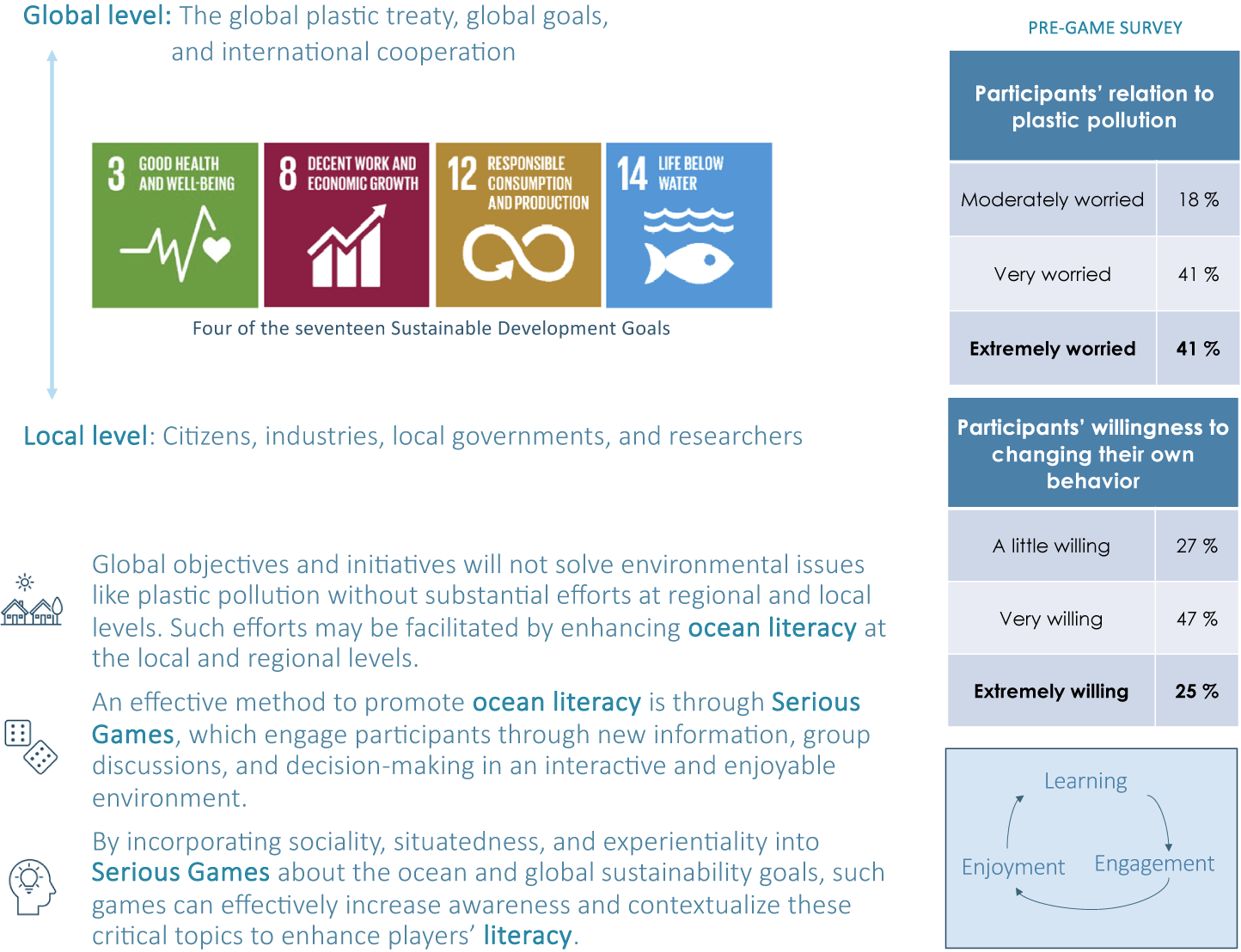
There are three forms of learning that become especially relevant when using serious games to develop knowledge, as these differentiate the learning that occurs in games from most other forms of learning activity. These three interconnected forms or concepts are sociality, situatedness and experientiality, and the results of the gaming session presented for the purposes of this study will reflect upon these.
(1) Sociality denotes the idea that more or better learning occurs when the learning situation includes collaborative social interaction and is likely the least utilized of the three concepts in serious game research, as many games are solitary endeavours. For instance, in a recent meta-analytic study of instructional techniques in serious games, only 12% of included comparisons employed collaboration (Wouters and Oostendorp, Reference Wouters and Oostendorp2017). However, social interaction as an approach to learning more generally is well-founded in research from several divergent traditions (e.g. Bandura, Reference Bandura1986; Bruner, Reference Bruner1991; Lave and Wenger, Reference Lave and Wenger1991; Vauras and Volet, Reference Vauras and Volet2013; Wells, Reference Wells1999). Serious games can create a space in which social interaction is encouraged and directed towards learning objectives, incorporating dialog both among peers and with content experts.
(2) Situatedness, or simply ‘situated’, has been used as a prefix for other concepts, most notably learning and cognition. The common idea of these concepts is that the situation in which knowledge develops is inseparable from the knowledge itself. Situations produce knowledge through action (Brown et al., Reference Brown, Collins and Duguid1989). Understanding learning like this is at odds with the persistent view that knowledge is to be mechanistically acquired, simply receiving facts (Freire, Reference Freire1970; Lave and Wenger, Reference Lave and Wenger1991). Serious games can create situations where players are required to actively engage, and the situation can be closer to reality than that created through passive forms of learning (Greco et al., Reference Greco, Baldissin and Nonino2013).
Lastly, (3) experientiality denotes the understanding of learning as being intrinsically linked with experience. Just like situatedness, experientiality builds on the idea of active learning or learning by doing (Dewey, Reference Dewey1938), and in one conception of experiential learning, “Experiential Learning Theory,” learning is seen as movement between the dialectically opposed processes of action/reflection and experience/abstraction (Kolb, Reference Kolb2015). Simply put, it involves having an experience, reflecting on, thinking about, analyzing it and (actively) experimenting with it – in a recurring spiral. Serious games as such can incorporate this form of learning rather explicitly by moving the player between getting information and acting on that information – requiring some degree of interim reflection and analysis.
Engagement and enjoyment
Even if the content and the pedagogical underpinnings of a serious game are sound, there is no guarantee that the play experience will be both engaging and enjoyable. However, these factors can (and often do) go hand in hand, but that does not happen automatically. To leverage the opportunities of enjoyment and an engaging experience, the concepts of self-determination and flow are useful – both in the design and the use of serious games. The first, self-determination, is linked to self-determination theory (Ryan and Deci, Reference Ryan and Deci2018). This is a theory of intrinsic motivation in which competence, relatedness and autonomy are understood as base needs for self-motivation and healthy psychological development. Competence need can also be understood as the innate desire to expand abilities and master challenges, whereas relatedness represents the need for meaningful connection (Rigby and Ryan, Reference Rigby and Ryan2011). Finally, the need for autonomy is constituted by the desire to act volitionally. The need for competence coincides with the objective of serious games learning as well. To fulfil this need, games must be appropriately difficult while providing the right kind and amount of feedback to players. The need for autonomy can also be satisfied by games, insofar as the game provides choices and opportunities for decision-making through volitional action, more so than mere freedom to do anything. Lastly, the need for relatedness can be strongly supported in serious games, not only by playing together but more profoundly through the feeling of mattering to others when cooperating. This can lead to pleasure and connectedness when sharing experiences if the individual is being acknowledged and supported while having an impact.
The second concept to consider, flow, can be understood as a mental state related to motivation – specifically the sensation experienced from acting with total involvement (Csikszentmihalyi, Reference Csikszentmihalyi1990). This creates a total immersion in which the individual “blocks out” everything outside of the action in question. Play activities are a common way of experiencing flow. For flow to occur, the play experience must not only be engaging and enjoyable but also strike a balance between boredom and anxiety, i.e., between being too easy and too hard, simply put (Kiili et al., Reference Kiili, de Freitas, Arnab and Lainema2012). How to achieve this is rarely an easy question to answer, but having goals, challenges, feedback and (some) control helps (note similarities to self-determination theory, especially the need for competence, here). Reaching this state of involvement is a lot to ask of a serious game, of course, but there are some ways in which theorizing around flow can explain the engagement that accompanies a good game. First, there is a discussion around microflow as a counterpart to “proper,” deep flow and how the feelings associated with flow can exist on a continuum, in which microflow denotes the low-challenge, weakly structured end (Csikszentmihalyi, Reference Csikszentmihalyi1975). This non-fixed view of flow can legitimize looking at the antecedents of flow without the expectation of necessarily fully reaching flow (Sweetser and Wyeth, Reference Sweetser and Wyeth2005), and in combination, these present a framework for understanding the role of the building blocks of flow in the experience of play. These theoretical developments explicate the link between flow and serious games, emphasizing the importance of enjoyment and motivation.
Consciously designing for each of these concepts, as we did for the purposes of the current game, can help leverage the potential benefits of serious games. However, it is the interaction between them that creates a lasting experience for players. For instance, social interaction is a crucial aspect of situated learning (Lave and Wenger, Reference Lave and Wenger1991), especially for tacit knowledge (van Haaften et al., Reference van Haaften, Lefter, Lukosch, Van Kooten and Brazier2020), connected to the base need of relatedness (Rigby and Ryan, Reference Rigby and Ryan2011). Furthermore, it has a potential strength when employing experiential learning, drawing on sharing of and learning from varied experiences (Kolb, Reference Kolb2002). Experiential learning can also be further strengthened when mapped to the antecedents of flow (Kiili, Reference Kiili2006), both of which can be seen as related to the self-determination theory needed for competence (Rigby and Ryan, Reference Rigby and Ryan2011). Furthermore, despite the perceived importance of these concepts, there are several other potential benefits a game can have over traditional learning, such as multimodality, self-explanation (Mayer, Reference Mayer2019), personalization and adaptivity (Wouters and Oostendorp, Reference Wouters and Oostendorp2017), to name a few. These, however, are not as widely applicable as the grand concepts within learning and enjoyment focused on here, which largely substantiates two profound concepts that learning efforts commonly lack – action and interaction (Freire, Reference Freire1970).
Despite these perceived benefits, recent meta-analytic studies (Mayer, Reference Mayer2019; Wouters and Oostendorp, Reference Wouters and Oostendorp2017) are partially inconclusive (Loh et al., Reference Loh, Yanyan and Ifenthaler2015). One potential reason for this is a one-sided focus on learning outcomes rather than the whole picture of learning, enjoyment, context and game design (Abdul and Felicia, Reference Abdul and Felicia2015). Applying a more holistic approach in design, reporting and study of serious games might, therefore, improve future knowledge (Nadolny et al., Reference Nadolny, Valai, Cherrez, Elrick, Lovett and Nowatzke2020). In the same vein, it could be argued that the meta-analysis, de-emphasizing the quality of serious games, is an inherently flawed approach in the case of evaluating serious games (Almås et al., Reference Almås, Pinkow and Giæver2023).
Methodology
Building on this, we consciously designed a serious game on the topic of marine plastic pollution and jellyfish blooms for both enjoyment and learning, with the added element of harvesting data from the players (Figures 1– 5). We then, from 2020–2021, invited high school students from three different cities in Norway (Figure 1) to participate in a total of six serious game sets (two in each city). The students were recruited using the snowball method (Biernacki and Waldorf, Reference Biernacki and Waldorf1981), a convenience sampling method used when samples of participants with the target characteristics are not easily accessible to the research group, and existing subjects recruit further subjects to the study among their acquaintances until data saturation has been reached (Naderifar et al., Reference Naderifar, Goli and Ghaljaie2017). The quality of the results sampled from this group far outweighs the relatively small number, as is often the case in qualitative research studies where large samples can be ineffective and do not provide the detailed and contextual information wanted by the researcher. In total, six players attended in Trondheim, eight in Tromsø and eight in Bergen. We chose to focus on high school student because of their category of “future generations,” notifying that they too are stakeholders within the context of pollution and solutions thereto. This is also clearly stated by Heads of State and Government and high-level representatives that met at the United Nations Conference on Sustainable Development in Rio de Janeiro from 20 to 22 June 2012 and renewed their commitment to sustainable development not only for the present but also for future generations (United Nations, 2012). In addition, one of the drivers of the movement towards more ocean literacy was the lack of ocean topics on core curricula in the formal K-12 education system (Cava et al., Reference Cava, Schoedinger, Strang and Tuddenham2005). The placement of these schools in coastal cities in Norway was a sample of convenience, with the main research partners located in these three cities that are relatively large in population size in Norway (2nd, 4th and 16th largest).Footnote 1
Map of Norway and case area locations (Tromsø, Trondheim, and Bergen).

The game was developed through a collaboration with game developer House of Knowledge and the research institute SINTEF Ocean, both located in Norway. Given that the background for the game was a research project, the topic of the game was to illustrate the twin ocean challenges of both plastic pollution and jellyfish blooms. The development started with a brainstorming session on what the game logic should be and what the setup should be, in terms of physical or digital. The session ended with a decision that the game was to be played live, with a map of Norway as the backdrop and with a story of plastic pollution and jellyfish blooms building up to proposals for technological solutions. It was decided that it would be a physical game board for the participants, but shortly thereafter, COVID-19 made this more difficult, and it was decided that we would develop a digital version to play with the participants from Bergen because the school the students represented was under lockdown. In Tromsø and Trondheim, the game was played physically under periods of lower restrictions. The digital version was developed to simulate the board game pieces and game setting as close as possible (Figure 5).
The logic of the game was centred on an assessment of the serious game as a communication tool for ocean literacy, with an emphasis on assessing similarities and differences between groups of future-generation representatives from three different geographical regions in Norway (western, mid- and northern Norway) and diverse backgrounds. The game was to be played as a multi-player game with no more than four players, to ensure that all players were given ample time to discuss and participate in the game. The players first had to fill in a personal questionnaire to ensure General Data Protection Regulation compliance and then, as a group, they were presented with four sustainable development goals: SDGs 3 – good health and well-being, 8 – decent work and economic growth, 12 – responsible consumption and production and 14 – life below water (Figure 2). The logic behind the choice of these four SDGs was based on the expertise of the research team at the game conceptualization stage. They were selected through a process of coding all the SDGs and their targets in terms of their relevance and efficacy either for regulating the harvesting of jellyfish or the prevention of plastic pollution and chose for inclusion the SDGs that had elements of both pollution and sustainable use of marine resources included. At the target level of detail, the cards chosen were not difficult to choose qualitatively. The relevant targets were also specified on the back side of the cards so that the participants could read and understand this choice.
The four SDGs presented to the players at the beginning of the game. The description of the relevant indicators and targets were given on the back of the cards to give full context to the players.

The game started with each participant filling out a questionnaire focusing primarily on demographics, but also four questions on their background knowledge and experience with both jellyfish and pollution. The survey was taken on their phones prior to the game starting and there was not post-survey to assess learning, which we acknowledge would have greatly enhanced this study. After this survey, the participants were provided with contextual cards and an emphasis on these SDGs. We wanted to bring more awareness and contextualization to the concept of SDGs and as such, we gave background information about the case of microplastics rising in the ocean and jellyfish blooms happening in selected areas of the world, including in Norway. The latter was done for the participants to gain knowledge and have a background in a real environmental problem, to which the SDGs can be related specifically.
In the serious game, the students had to select the three most important goals from their perspectives and rank them in terms of importance in the context of assessing microplastic pollution and jellyfish blooms and their effects on coastal communities in Norway. This was a choice made based on the three interconnected forms or concepts of learning relevant when using serious games to develop knowledge that frame this development, namely sociality, situatedness and experientiality, with a special focus on the two latter – namely situatedness – where situations produce knowledge through action and players have to actively engage with a situation that can be considered closer to reality than that created through passive forms of learning; and experientiality – or learning by having an experience, and having a requirement of reflecting on and analyzing this experience. In this case, they were in an experimental decision-making situation of the game and asked to make rational choices based on the knowledge at hand.
Discarding an SDG meant that one of the SDGs would have to be discarded from the top ranking. We did this to give a better understanding to the participants of the real-life challenges that policymakers are faced with when having to make decisions where there is no one agreed-upon solution or that a good solution is discarded because others are perceivably better. By both forcing the groups to actively remove one of the SDGs, and subsequently rank them in terms of their perceived importance, our aim was to demonstrate the difficulties in making choices like these but also for them to reflect on their values vis-a-vis the results at the end of theme – i.e., did they proceed to follow their values throughout the game or were political realities and choices during the game in contradiction with their original values. They were allowed to change the order and inclusion of SDGs two more times during the game, each time after having received more information that could influence this choice.
Because of the contextual setting, the game was set up around a map of Norway, and the players received game cards that gave background information on the marine environmental challenges in question, preparing the students to play. Next, players received game cards that outlined a hypothetical event that happens in a community somewhere in Norway. They had to assess how this event would affect the social, economic and environmental sustainability of the region from −3 (very negative) to +3 (very positive).
The participants were then presented with three governance options for this given event, and they were asked to decide which governance choice they would choose, followed by a discussion on how this governance choice in turn would affect the three sustainability pillars. They were presented with nine events and nine governance cards (a total of 27 governance options) during the game (see Figures 3 and 4).
Event card with three sustainability pillars to be evaluated.

Governance strategies where the player(s) must choose one of the alternatives and then assign the effect on three sustainability pillars.

Digital game board.

Results
The pre-game survey showed that only 20% of the players had had no experience at all with jellyfish, and almost 70% considered them a natural part of the ocean environment though 25% considered them dangerous. In terms of plastic pollution, all players were either moderately worried (18%), very worried (41%) or extremely worried (41%). In terms of changing their lifestyle to reduce how much they affected the environment negatively, only 25% were extremely willing, 47% were very willing and 27% were a little willing. When challenged with the SDGs, the groups from the three high schools in Norway all found connections between the four SDGs, and three out of six groups chose to change which goals they wanted to rank as more important than others throughout the game (Table 1). At the beginning of the game sessions, for example, one of the groups from Tromsø and both groups from Trondheim ranked SDG 12 – responsible production and consumption – as the most important among the goals. SDG 12 was discussed as being generally among the most important goals, comprehensive and beneficial for the other SDGs. One of the groups from Bergen discussed how the goal could be perceived as both most and least important among the four SDGs, depending on the context. The other group from Bergen as well as the groups from Tromsø pointed out that SDG 12 could be specifically beneficial for the ocean and life below water. Participants from the group from Bergen also said that working towards SDG 12 may positively affect human and animal health and could contribute to reaching SDG 14 if use and production were to be carried out more responsibly, especially in terms of plastics.
SDG goal rankings from each area

The other group from Tromsø and both groups from Bergen ranked SDG 3 – good health and well-being – as the most important among the four SDGs, although it was seen as very important by all the participating groups in different ways. Good health and well-being were seen as fundamental and vital for the human population and necessary for the other SDGs to be achieved. The participants in one of the groups from Tromsø agreed on that “If you don’t feel good, you won’t bother to do anything at all.” Additionally, the participants in one of the groups from Trondheim raised the question “If we don’t have this one [SDG 3] with us, how are the rest of them [SDGs 8, 12 and 14] going to be solved?” This indicates awareness of how the SDGs can depend on each other and affect the achievement of each other.
SDG 8 – decent work and economic growth – was not ranked among the most important SDGs for any of the groups but was discussed both positively and negatively in various ways by the students across and within the groups. The groups from Tromsø and Bergen experienced difficulties fully understanding the goal. One of the participants from one of the groups from Bergen said that “I don’t understand how SDG 8 can have anything to do with this, plastic in the ocean, and so on.” Whereas a participant from the other group said, “I didn’t quite understand the thing about the economy.” In Tromsø, one of the groups said that it was more important to care for the environment than jobs and decent work, even though jobs too were important. For example, one of the students from Tromsø stated that "this one [SDG 8] is important to make people follow [sustainability measures].” However, during discussion about how decent work and economic growth were perceived as necessities for sustainable development, one of the other students from Tromsø stated that:
I believe that this one [SDG 8] is the least important one. Or “decent work” is important to maintain a certain [living] standard, but I don’t know if economic growth is as important when it comes to sustainable development.
The students in the other group from Tromsø said that it was more important with economic growth than protecting the ocean since economic growth facilitates development and reduces poverty. Both groups from Bergen emphasized the importance of development when they discussed SDG 8. One of the groups specifically pointed out the importance of being employed for peoples’ well-being (SDG 3). The other group from Bergen focused more on investments having a key role in solving environmental issues. In Trondheim, one of the groups downplayed the importance of SDG 8 by saying that “the economy always makes it.” This group perceived economic growth as something that may be achieved through the other goals, and that this goal was therefore not as important but rather redundant. The other group was split, and although they ranked SDG 8 the lowest, it was still considered as important. They mentioned that solutions to address sustainability challenges, such as marine plastic pollution, need to be both attractive and profitable to be actively used or implemented as well as that overall economic growth is important.
High importance of SDG 14 – Life below water – was only perceived and pointed out explicitly by the groups from Tromsø and Bergen. It was seen as important for marine ecosystems, peoples’ health, and for other SDGs to be facilitated or have any effect, including SDGs 3 and 8. Although the students first discussed how, for example, SDG 3 was necessary to work with SDG 14, this showed that the students also reflected on relationships between the goals the other way around. Furthermore, one of the groups from Bergen and one of the groups from Trondheim were of the opinion, though, that SDG 14 focused more on marine life, marine (especially plastic) pollution and life below water – not above water, disregarding or choosing not to focus on connectivity between marine and terrestrial systems. Still, the group from Bergen pointed out that it was important to focus on life below water through SDG 14 and that this was more important than economic growth. The group from Trondheim, on the other hand, believed that the intentions of SDG 14 may be excessive and that they could be achieved through work to achieve the other SDGs.
The first time prioritizing or ranking the SDGs, all groups with high school students in the three cities placed SDG 3 as either number 1 or number 2 out of the four goals. Furthermore, all but one of the groups from Bergen positioned SDG 12 as either number 1 or 2. The one group that stood out from Bergen chose SDG 14 as goal number 2 instead of SDG 3 or 12. This showed that, with one exception, all groups initially prioritized good health and well-being and responsible production and consumption above life below water and decent work and economic growth.
After receiving a few cards with background information, the students had the opportunity to rank the goals once more. Only one of the groups (from Trondheim) chose to do so. They kept SDGs 3 and 12 as the two highest-ranked goals but chose to change from SDG 14 to SDG 8 for their third place as they recognized higher value relating to decent work and economic growth after looking at the SDG cards one more time. After going through all the informative cards and events and measures throughout the game, the students had the opportunity to re-rank the SDGs again. At this point in time, the students had carried out many discussions and been introduced to the topic of marine plastic pollution and jellyfish blooms more in-depth. Three out of the six groups (one from each city) chose to re-position their goals. The group from Trondheim changed position of one goal, the group from Tromsø changed the position of two goals and the group from Bergen repositioned all the goals.
The highest and second highest-ranked goals remained in the same position for all but one of the groups from Bergen and one of the groups from Tromsø. The group from Bergen switched out their highest-ranked goal SDG 3 with SDG 14, and the group from Tromsø changed their second-ranked goal from SDG 3 to SDG 14. That is, both groups chose to move SDG 14 – Life below water – above SDG 3 – Good health and well-being when given the opportunity to re-position the order of the goals. The group from Bergen said that their choice to prioritize SDG 14 was “based on what we have been through now,” demonstrating that they had gained more knowledge and arguably increased their ocean literacy in the process of playing the game and ranking the SDGs accordingly with the knowledge they gained through the gaming session. The group from Tromsø discussed their re-ranking where one student said that “I believe that responsible production is also about decent work because it concerns a safe and responsible workplace that produces righteously,” indicating that parts of the achievements from working with SDG 8 may be reached by working with SDG 12. Another student from the same group added that:
The reason for why we placed SDG 12 at the top was to have less plastics in the ocean because [this leads to] less waste, and [SDG] number 3 was so that people wouldn’t throw things in the ocean so that we would be okay.
This latter also shows that the students had gained information about how the ocean is affected and that they also saw this in connection with land-based actions, which is critical for ocean literacy and the sixth principle on how “…the ocean and humans are inextricable interconnected…” (Panto, Reference Panto2019). All the groups ended with SDG 12 on either first or second place, except for one of the groups from Bergen. All but one of the groups from Tromsø ended with SDG 3 in either first or second place. The group from Tromsø chose the SDGs 14 and 12 as the two highest-ranked goals instead of the SDGs 3 and 12, which the other groups prioritized. SDG 8 was positioned last by four out of six groups, and in third place by the two groups choosing to have SDG 8 as one of their three prioritized ones.
The results from start to finish in terms of prioritized order of the SDGs were relatively consistent, where SDG 3 – Good health and well-being – and SDG 12 – Responsible consumption and production – were overall perceived as highly important for the case, also after receiving information and discussing the topic at hand. However, the arguments for why they chose to prioritize the way they did change as they at the third re-ranking referred to the discussions, events and alternative measures they were exposed to during the game when prioritizing goals.
Since there was no post-game survey, the results only showed the baseline data for these groups. However, the qualitative data reflect their learning and at the end of the session, the students were asked to give oral feedback on the experience to work with marine plastic pollution and jellyfish blooms in a serious games format to gain some understanding on whether or not they had gained an increase in ocean literacy as expressed by the seven principles (National Oceanic and Atmospheric Administration (NOAA), 2013; Panto, Reference Panto2019). Each group discussed, and mentioned that, for example, “I knew nothing about jellyfish [before playing the game].” The students said that they did not know that jellyfish could be used to capture microplastics, that it could be eaten, or that it could even be a problem. Relating to the measures and governance actions against plastic pollution, the students reflected and discussed. One of the students emphasized that “There are many things here that we do not know how it will affect other animals, or like the food chain or something, so if we only knew exactly how [actions affect] ….” This indicated a reflection around how knowledge gaps on the relationship between actions and consequences in ecosystems can challenge governance, and how they had gained knowledge around the principles on ocean literacy, especially “…(5) the ocean supports a great diversity of life and ecosystems; (6) the ocean and humans are inextricable interconnected….”
Discussion and conclusion
The issue of environmental degradation of the ocean from climatic and non-climatic stressors, whether it is ocean acidification or plastics, has gained increased saliency over the years in the research community and in some select industries particularly affected (Galdies et al., Reference Galdies, Bellerby, Canu, Chen, Garcia-Luque, Gašparović, Godrijan, Lawlor, Maes and Malej2020; Jewett et al., Reference Jewett, Romanou, Wuebbles, Fahey, Hibbard, Dokken, Stewart and Maycock2017; Mangi et al., Reference Mangi, Lee, Pinnegar, Law, Tyllianakis and Birchenough2018; Tiller et al., Reference Tiller, Arenas, Galdies, Leitão, Malej, Romera, Solidoro, Stojanov, Turk and Guerra2019a; Tiller and Richards, Reference Tiller and Richards2018). The year 2004, however, marked the start of the grassroots on ocean literacy movement to ensure that the public would become more knowledgeable about the importance of the ocean. Throughout the years, there have been both top-down and bottom-up initiatives. These initiatives have subsequently led to several different tools being applied to educate the public about the ocean and its importance, and various tools to bridge the gap in knowledge have been tested and developed during these years. For the purposes of this study, we chose to use serious games as a tool for communicating knowledge about important ocean issues. In this case, the high school students who played the game took on the role as decision-makers to manage specific ocean issues they were presented to. Although, as this article shows, there is not one agreed-upon definition of serious games, it is evident that they may promote awareness about environmental and sustainability issues.
Serious games, according to the literature, need to incorporate social interaction, create a situation in which knowledge develops and facilitate experiential learning. These three concepts were incorporated into the serious game in this study. Consciously designing for each of these concepts around SDGs for ocean literacy can help leverage the potential benefits of serious games where the interaction between them can create a lasting experience for players while making it more likely that the participants gain knowledge about the topic at hand. Keeping in mind the three forms of learning that the literature considers relevant when using serious games to develop knowledge, namely sociality – where more or better learning occurs when the learning situation includes collaborative social interaction including both dialogue with peers and content experts; situatedness – where situations produce knowledge through action and players have to actively engage with a situation that can be considered closer to reality than that created through passive forms of learning; and experientiality – or learning by having an experience, and having a requirement of reflecting on and analyzing this experience. For the purposes of this study, we wanted to bring more awareness and contextualization to the concept of SDGs and as such, we gave background information about the case of microplastics rising in the ocean and jellyfish blooms happening in selected areas of the world, including in Norway. The latter was done for the participants to gain knowledge and have a background in a real environmental problem, to which the SDGs can be related specifically, linked to both situatedness and experientiality, mixed with sociality.
First, the game in this study created a space in which social interaction was encouraged – sociality. That is, the students worked together to make choices, including to rank the SDGs. The importance of social interaction as an approach to learning is well-founded (Bandura, Reference Bandura1986; Bruner, Reference Bruner1991; Lave and Wenger, Reference Lave and Wenger1991; Vauras and Volet, Reference Vauras and Volet2013; Wells, Reference Wells1999) and is key to the serious game in this study. Second, the game created a situation in which knowledge would expectedly be developed – situatedness. That is, the students could gain knowledge of ocean literacy through discussing and ranking the SDGs, through reading the cards on marine environmental challenges, by assessing how the hypothetical events given to them affect the social, economic and environmental sustainability of the region and through ranking the governance choices they made. Finally, the game is expected to have facilitated experiential learning, experientiality – which is defined as having an experience, reflecting on it, thinking/analyzing about it and (actively) experimenting with it – in a recurring spiral (Kolb, Reference Kolb2015). In the game, students were moved between getting information and acting on that information. They were also required to do some degree of interim reflection and analysis. Provided that a serious game designed to incorporate social interaction, create a situation in which knowledge develops and facilitate experiential learning results in that participants’ knowledge of the topics presented during the game would increase (Kolb, Reference Kolb2015), the serious game played by students in this study would expectedly have contributed to increasing the participants’ ocean literacy.
Serious games, as argued for, can increase players’ ocean literacy through presenting them with an ocean-related case, which in this case were the examples of marine plastic pollution and jellyfish blooms as a potential solution to the former, and encourage them to look at the case as part of a larger system through the ranking of the global SDGs. That is, at the beginning of the serious game in this study, students were instructed to rank the importance of game-specific SDGs, and, in the middle and at the end of the game, students were then instructed to think about their ranking and were given the opportunity to re-rank their choices should they deem it necessary. Some of the students did re-rank the SDGs when given the opportunity, and this re-ranking indicates that the game had impacted the way that the students thought about the SDGs in relation to the case at hand: regulation of the harvesting of jellyfish and marine plastic pollution and the discussions that were made throughout the game.
Furthermore, the results demonstrate that students playing the game thought about all the SDGs and the relationships between them rather than latching on to perhaps the most obviously relevant SDG. Indeed, the results show that the students, in large part, saw the goals as interconnected, with many of the groups prioritizing SDG 3 – good health and well-being – and SDG 12 – responsible consumption and production, seeing them as foundational and comprehensive in content, and affecting all other SDGs. In the context of ocean literacy, serious games have been applied to promote awareness about environmental and sustainability issues. Recent reviews of serious games within this context have found that games can improve engagement and motivation, strengthen problem-solving and establish positive effects between players. However, a lack of longitudinal studies and measures of opinion changes may limit the applicability of the findings (Baird et al., Reference Baird, Plummer, Haug and Huitema2014; Edwards et al., Reference Edwards, Wallace, Wreford, Holt, Cradock-Henry, Flood and Velarde2019; Madani et al., Reference Madani, Pierce and Mirchi2017). Pre- and post-testing quantitatively and in a structured manner was not specifically focused on in this study, however, which may be addressed in future research during the gaming session. Future studies should also focus on unanswered questions about the scaling of the approach, how serious games such as these might work outside the formal education sector, or how it might work in countries of the global majority.
Still, in our case, with students sampled from three coastal cities in Norway, the students emphasized increased ocean literacy themselves during the game and in the wrap-up session at the end of the gaming session. Reflection after a session is important when playing a learning game. This way, feedback can be given on learning experiences, if any. For example, one of the players said that they knew nothing about the topic (jellyfish and plastics) before the gaming session. Another student said that even though they knew a little about jellyfish and plastics beforehand, what they learned, however, was that when playing the game, and thus making governance choices, they did indeed value environmental choices more than economic ones. Another student said that when they were ranking events and governance strategies, they felt that they were the prime minister, and that had been fun. One student also said that they were surprised about the complexity around the task of solving environmental challenges and that there was so much more to it than they had ever imagined.
This type of thinking is important as we are in the UN Decade of Ocean Science, where we need to mobilize the ocean community towards thinking about “the ocean we need for the future we want” (United Nations, 2022) and directly contributing to the implementation of the SDGs – even beyond number 14 – Life Below Water. In general, the results demonstrate that serious games can increase students’ knowledge of aspect of the ocean – ocean literacy – and stimulate critical thinking about interconnected SDGs, important to the future of our ocean, as they said themselves as well. As such, serious games can be a good way of promoting and raising awareness of environmental and sustainability issues, and, as this study shows, they are a way to educate future generations about the ocean and thus increase ocean literacy.
Although an increasing number of organizations are seeking to educate the public about the ocean, the public still knows far too little about the ocean. By using tools like serious games, we can work to educate the public about the ocean in a fun and engaging way. For, as the UN Secretary-General António Guterres said, the Intergovernmental Panel on Climate Change report was “code red for humanity” (United Nations, 2021), and, “Caring for, and using, our oceans in sustainable ways is critical to achieving ecological and economic goals for communities everywhere” (United Nations, 2022). The implementation of the SDGs, which are key to the survival of our planet, will take moving beyond traditional methods and including future generations in the discussions. Part of that move includes ocean literacy – ensuring “the understanding of the ocean’s influence on humans and of our influence on the ocean” (Costa and Caldeira, Reference Costa and Caldeira2018) – and that this understanding is reached at a younger age so that the future decision-makers already have a thorough understanding of the importance of the ocean. We are now fast approaching the dusk of the allotted time for the Intergovernmental Negotiating Committee to Develop an International Legally Binding Instrument on Plastic Pollution, Including in the Marine Environment (INC), scheduled to be completed in 2024 in Busan, Republic of Korea. This global agreement on curbing plastic pollution may have started with lofty ambitions, but now have to streamline and come to an agreement on a legally binding language to steer policymakers in individual states to make changes necessary to stop plastic pollution. Using serious games in grassroots movements for increasing ocean literacy may be one tool for gaining ground in local communities to assert pressure on local policymakers.
Open peer review
To view the open peer review materials for this article, please visit http://doi.org/10.1017/plc.2024.35.
Supplementary material
The supplementary material for this article can be found at http://doi.org/10.1017/plc.2024.35.
Data availability statement
The data that support the findings of this study are available from the corresponding author (IHA) upon reasonable request.
Financial support
This article acknowledges funding by the Horizon 2020 project nr 774499 and the Norwegian Research Council projects nr 309097, nr 315402 and nr 318730.
Competing interest
No potential competing interest was reported by the authors.
Human participants
The authors declare that the project obtained ethical approval it must have for all protocols from the National Review Board NSD (Norwegian Centre for Research Data), and the study meets national guidelines for research on humans.


 Open access


Comments
Dear Editor,
We wish to submit an original research article entitled “Ocean literacy and how serious games can play a part: the case of the jellyfish and microplastics governance game MoreGojelly!” for consideration by Cambridge Prisms: Plastics.
We confirm that this work is original and has not been published elsewhere, nor is it currently under consideration for publication elsewhere.
In this paper, we report on the use of Serious Games as a method to increase Ocean literacy, with a special focus on microplastic pollution and jellyfish blooms. This is significant because although efforts such as the multilateral treaty to end plastic pollution and forging an internationally legally binding agreement by 2024 takes the world in the right direction, to be efficient, especially the treaty will need public support and a common understanding that this is a matter of utmost importance. This, however, depends on tools that can ensure that the public becomes more knowledgeable about the ocean, and the functioning thereof, to collectively take action to preserve it.
We believe that this manuscript is appropriate for publication by Cambridge Prisms: Plastics because it provides evidence of the necessary and potential benefits of Serious Games as a tool to tackle major societal challenges posed by plastics. It covers topics that underpin the intersection of science and policy relating to marine plastic pollution and the role of ocean literacy to take appropriate action.
We have no conflicts of interest to disclose.
Please address all correspondence concerning this manuscript to me at ina.h.ahlquist@sintef.no
Thank you for your consideration of this manuscript.
Sincerely,
Ina Helene Ahlquist