


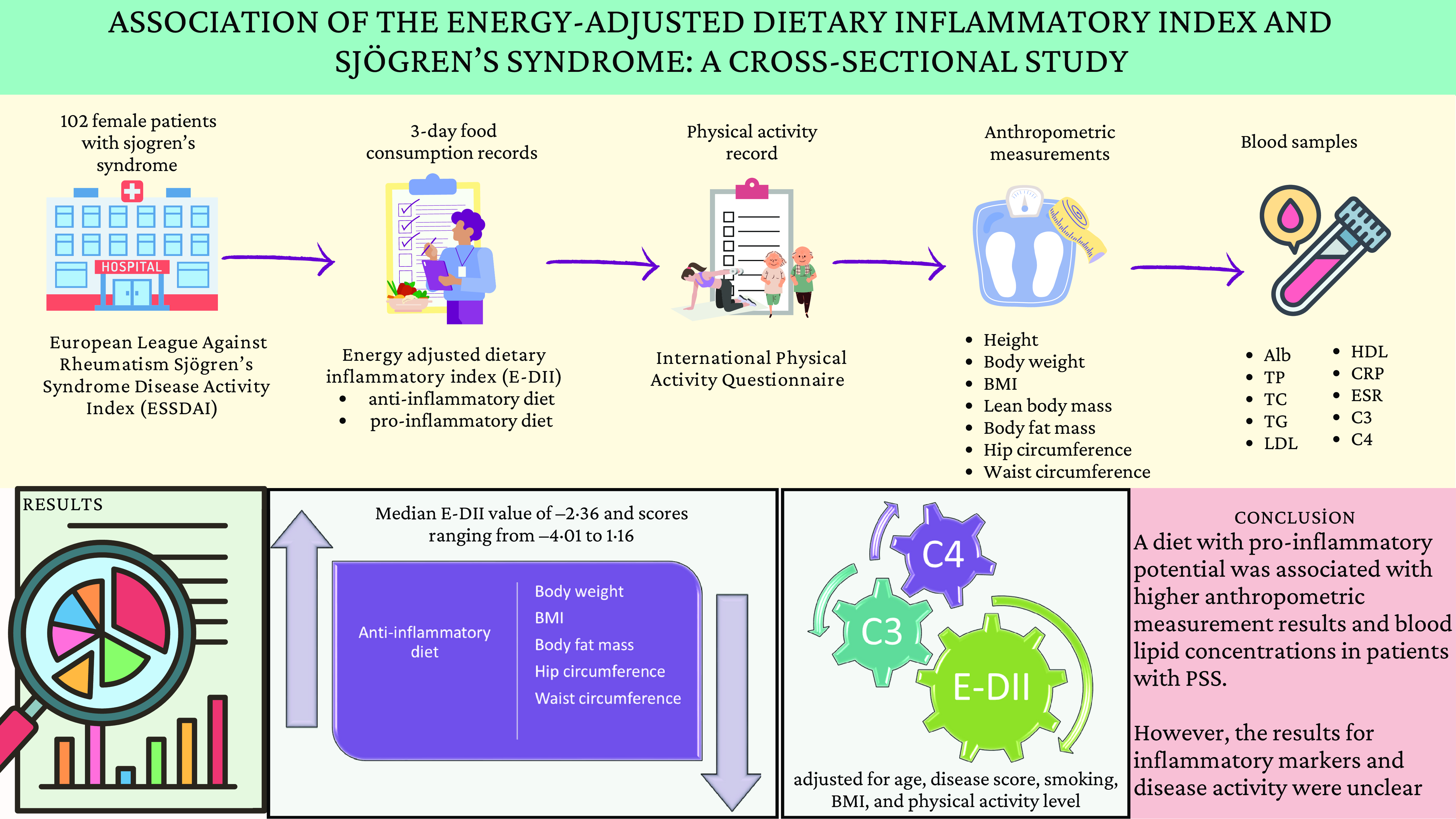



Sjögren’s syndrome (SS) is a chronic autoimmune disease affecting middle-aged women, with its prevalence varying between 0·01 % and 0·05 %(Reference Beydon, McCoy and Nguyen1). Primary SS (PSS) is characterized by lymphocyte infiltration and destruction of salivary and lacrimal glands and extra-glandular manifestations in the lungs, kidneys, nervous system, skin, and musculoskeletal system(Reference Rischmueller, Tieu and Lester2). Assessing disease activity is difficult in most patients because the predominant symptoms are relatively stable. The European League Against Rheumatism (EULAR) Sjögren’s Syndrome Disease Activity Index (ESSDAI) is used to assess disease activity(Reference Seror, Bootsma and Saraux3). Besides genetic and epigenetic factors, potential environmental risk factors, such as a history of autoimmune disease in first-degree relatives, infections, and adverse stressful living conditions, also affect the occurrence of PSS(Reference Jin, Dai and Li4). C-reactive protein (CRP) levels and erythrocyte sedimentation rate (ESR) are significantly higher in patients with PSS than in healthy individuals and correlate strongly with disease activity. No response to treatment is seen unless the levels of these markers of inflammation decrease(Reference Moghaddam, Saremi and Atabati5). Diet is a modifiable environmental factor that plays a crucial role in regulating inflammation and immune function(Reference Maslowski and Mackay6). The intake of foods with anti-inflammatory properties, such as fish, vitamin A, vitamin C was found to be associated with a lower risk of PSS(Reference Machowicz, Hall and De Pablo7). Similarly, an animal model study investigating the effect of a gluten-free diet on salivary gland and pancreatic islet inflammation found that a gluten-free diet reduced the infiltration of monocytes/macrophages and T cells in salivary glands and inflammation in pancreatic islets(Reference Haupt-Jorgensen, Groule and Reibel8). In nutrition research, several diet quality indices have been designed to assess the effects of inflammation and overall diet. Among these, the most widely used Dietary Inflammatory Index (DII) is designed to measure the potential inflammatory properties of a diet(Reference Shivappa, Steck and Hurley9). Some previous studies have examined the association between DII and several clinical conditions, including cardiovascular disease and diabetes(Reference Ji, Hong and Chen10,Reference Laouali, Mancini and Hajji-Louati11) . Recent clinical studies have demonstrated an association between DII and a rheumatologic autoimmune disease such as PSS(Reference Nayebi, Soleimani and Mostafaei12–Reference Xiang, Wang and Qian14). Considering that diet may be effective in inflammatory processes and the inflammatory potential of diet in patients with PSS has not been investigated, this study was performed to investigate the relationship between DII score and anthropometric measurements, disease activity, inflammatory markers, and blood lipids in female patients with PSS.
Materials and methods
A cross-sectional study was conducted between November 2020 and November 2021 involving 102 female patients aged 19 years or older and meeting the inclusion criteria. These patients were admitted to the Ege University Department of Internal Medicine, Division of Rheumatology, and had a confirmed diagnosis of PSS by a specialist doctor. After collecting patient anamnesis and examining their medical records, detailed information about the study was provided to the patients, and informed consent was obtained.
Population and sample of the study
All female patients diagnosed with PSS who applied to the outpatient clinic of the Ege University Faculty of Medicine, Department of Internal Medicine, Division of Rheumatology, were invited to participate in the study. This study was approved by the Medical Research Ethics Committee of Ege University Faculty of Medicine. No: 21-10.1T/27. According to the results of G * Power analysis, 119 people were included in the study with 95 % power (1-β); moderate effect size (ρ:0·15); 0·05 sampling error (α)(Reference Tandorost, Kheirouri and Moludi13). A total of 119 female patients who agreed to participate and met the inclusion criteria were included in the study. During the study, one patient died, two patients were diagnosed with cancer, the biochemical findings of four patients could not be completed, four patients wanted to leave the study, and the food consumption records of six patients could not be completed.
The inclusion criteria included the following: female patients aged 19 years and older, diagnosis of PSS by a rheumatologist using the American-European criteria(Reference Tezcan, Kucuk and Goker15), and clinical stability with no change in medical treatment for 6 months prior to the study. The exclusion criteria included the following: pregnant or breastfeeding mothers, presence of any mental disease (schizophrenia and dementia), eating disorders (anorexia and bulimia), cancer, chronic renal failure, and chronic liver failure.
Data collection
A questionnaire form prepared to determine the sociodemographic characteristics, medical history, and dietary habits of the patients, The multiple-pass 3-day food consumption record form, and the International Physical Activity Questionnaire (Short) – IPAQ (short) was used to collect the data. Anthropometric measurements were taken, and the disease activity index (European League Against Rheumatism) Sjögren’s syndrome disease activity index (EULAR Sjögren’s Syndrome Disease Activity Index (ESSDAI) was applied to determine disease activity. Additionally, biochemical data were obtained.
Food intake and DII scores
The food consumption records were obtained by a nutritionist for 3 consecutive days, including 2 weekdays and 1 weekend day, to evaluate the daily energy and nutrient intakes of patients with PSS participating in the study. The average daily macro- and micronutrient intakes were calculated using the ‘Computer Assisted Nutrition Program, Nutrition Information Systems Package Program’ (BeBIS 8·2) program developed for Turkey. An average of 3 d was taken. DII scores were calculated using the method described by Shivappa et al.(Reference Shivappa, Steck and Hurley9) for each food or nutrient individually, and these values were then summed to obtain the overall DII score for each individual. The calculation was based on the average daily intake values for 42 foods and nutrients. Foods and nutrients that were not included in the BeBIS program (flavan-3-ol, flavones, flavonols, flavonones, anthocyanidins, isoflavones, and eugenol) and whose consumption was extremely limited in Turkey (rosemary and saffron) were not used for calculating the DII score. Among the nutrients, the contents of green tea and black tea were calculated based on their dry weights. When calculating the DII score, the consumption amounts of onion, garlic, pepper, thyme, and ginger were manually determined by analyzing the total amount of ingredients in the dishes within the BeBIS program. Subsequently, the consumption values of the relevant nutrient parameters were calculated manually. All reported intakes of nutrient parameters were converted into the amount per 1000 kcal energy intake to calculate energy-DII (E-DII) scores(Reference Harmon, Wirth and Boushey16). The lowest and highest values of the E-DII score were – 4·01 and 1·16, respectively. After the E-DII calculation, the participants were divided into two groups based on their E-DII scores from the median value. A diet with an E-DII score < –2·36 was classified as anti-inflammatory, and a diet with a score > –2·36 was categorized as pro-inflammatory.
Anthropometric measurements
Participants’ height (cm), body weight (kg), waist circumference (cm), and hip circumference (cm) were measured by the researcher, and their body mass index (BMI) was calculated. The body composition of the participants was evaluated using the Tanita BC-418 MA device by the bioelectrical impedance analysis method. The body fat mass (kg) and lean body mass (kg) were analyzed based on the differences in electrical conductivity of adipose tissue and lean tissue mass(Reference Kyle, Bosaeus and De Lorenzo17).
European league against rheumatism Sjögren’s syndrome disease activity index (ESSDAI)
The ESSDAI, developed by a consensus of researchers from Europe and North America and supported by EULAR, was used to assess disease activity in patients with PSS. ESSDAI comprises 12 components, including evaluations of skin, respiratory, renal, joint, muscular, peripheral nervous system, central nervous system, hematologic, glandular, constitutional, lymphadenopathic, and biologic aspects. Each component is further divided into three to four activity levels, all accompanied by detailed descriptions(Reference Seror, Bowman and Brito-Zeron18).
Biochemical measurements
Total protein, albumin, triglycerides, total cholesterol, high-density lipoprotein (HDL) cholesterol, low-density lipoprotein (LDL) cholesterol, and CRP measurements were performed using the Cobas ® 8000 Modular analyser (Roche Diagnostics, Mannheim, Germany) in the Clinical Biochemistry Laboratory of Ege University Medical Faculty. Complement C3 (mg/dl) and complement C4 (mg/dl) measurements were performed using the Dade-Behring BN II Nephelometer (Siemens Healthineers, Germany). The ESR (mm) was determined using the modified Westerngren method on the Starrsed RS (Sysmex Europe GmbH) automatic ESH device.
Statistical analysis
The data obtained from the study were analyzed using the IBM SPSS Statistics Standard Campus Edition package program 25·0. Descriptive statistics were expressed as mean (standard deviation) for variables with normal distribution and median [interquartile range (IQR)] for variables with non-normal distribution. Continuous variables were considered as numbers and percentages. The normality of the data sets was determined using the Shapiro–Wilk test, histograms, normality graphs, and kurtosis and skewness. The independent-samples t test was performed for normally distributed groups and the Mann–Whitney U test for non-normally distributed groups to examine the relationship between different variables and DII groups. Logistic regression was performed to determine the relationship between E-DII groups and anthropometric measurements, blood lipids, and inflammatory markers. The models were constructed with the enter method, and the analysis was adjusted for age, disease score, drug use for SS, physical activity level, smoking, and BMI. The overall goodness-of-fit of the models was assessed by Hosmer and Lemeshow test. The Omnibus test was used to analyze the significance of the models developed. The results of the logistic regression analysis were shown as β-coefficients [95 % confidence interval (CI)] and P values.
Results
The sociodemographic and clinical characteristics of 102 female patients with PSS are presented in Table 1. When E-DII scores were divided into two groups based on the median value, the mean E-DII value was –2·89 (sd 0·45) and –1·46 (sd 0·65) in the anti-inflammatory (–4·01 to –2·36) and pro-inflammatory diet (–2·36 to 1·16) groups, respectively. According to the E-DII scores, no significant difference was observed in the sociodemographic characteristics of the patients, such as educational status, marital status, employment status, and social security.
Characteristics of patients with Sjögren’s syndrome according to the E-DII score (Mean values and standard deviations; numbers and percentages; median values and interquartile ranges)

DMARD = Disease-modifying antirheumatic drugs; E-DII = Energy-adjusted dietary inflammatory index; ESSDAI = European League Against Rheumatism (EULAR) Sjögren’s Syndrome Disease Activity Index; NSAID = Nonsteroidal anti-inflammatory drug; SS = Sjögren’s syndrome.
*There is more than one drug use.
Bold values indicate statistically significant differences (p < 0.05).
† Student t test mean (sd) deviation.
‡ Chi-square test.
§ Mann Whitney U median (IQR).
When assessing the medical status of the patients, no correlation was found between the E-DII scores and drug use or specific drug types. According to E-DII scores, the disease duration was 12·73 (sd 6·90) years and 12·25 (sd 7·33) years for those consuming the anti-inflammatory and pro-inflammatory diets, respectively. The inflammatory content of the diet was not associated with the disease score (ESSDAI). Similarly, no statistically significant relationship association was found in the ESSDAI classification between those who consumed anti-inflammatory diets and those who did not. The median IQR physical activity value of patients with PSS consuming anti-inflammatory and pro-inflammatory diets was 925·00 (891·00) min/week and 1014·00 (1747·00) min/week.
As depicted in Table 2, the E-DII scores of patients with PSS were categorized according to the median value, and the changes in anthropometric measurements and biochemical findings were evaluated. Patients consuming the anti-inflammatory diets had lower body weight, BMI, body fat mass, and hip and waist circumference measurements than those consuming the pro-inflammatory diets. Similarly, the blood concentrations of lipids other than HDL cholesterol were better in the group consuming the anti-inflammatory diets. Among the inflammatory markers, the levels of complements C3 and C4 were statistically higher in the group consuming the pro-inflammatory diets, whereas no significant difference was found in CRP levels and ESR.
Distribution of anthropometric measurements and biochemical findings according to the E-DII score in patients with Sjögren’s syndrome (Mean values and standard deviations; median values and interquartile ranges)

C reactive protein (CRP), Erythrocyte sedimentation rate (ESR), Body mass index (BMI), Low density lipoprotein (LDL), High density lipoprotein (HDL).
Bold values indicate statistically significant differences (p < 0.05).
* Student t test mean (sd) deviation.
† Mann Whitney U median (IQR).
As depicted in Table 3, the consumption of a pro-inflammatory diet was associated with higher body weight, BMI, body fat mass, hip and waist circumference, total cholesterol, triglycerides, LDL, and levels of complements C3 and C4 in crude analyses. Anthropometric measurements were associated with age, physical activity level, and disease score, and blood lipids were associated with E-DII independent of age, BMI, physical activity level, disease score, and smoking. In addition, Model 2 showed that each increase in E-DII score was associated with a 1·03 (95 % CI: 1·00, 1·05; P= 0·021) and 1·08 (95 % CI: 1·01, 1·13; P= 0·019) fold increase in complements C3 and C4, respectively.
Logistic regression association of the E-DII with anthropometric measurements, blood lipids, and inflammatory markers (Odds ratios and 95 % confidence intervals)

Anthropometric measurement; Model 1: age, physical activity level Model 2: age, physical activity level, disease score, drug use for SS.
Blood lipids; Model 1: age, physical activity level Model 2: age, BMI, physical activity level, disease score, drug use for SS, smoking.
Inflammatory markers; Model 1: age, disease score, smoking Model 2: age, disease score, drug use for SS, smoking, physical activity level.
Bold values indicate statistically significant differences (p < 0.05).
The distribution of daily energy and macro- and micronutrient intakes in the anti-inflammatory and pro-inflammatory diet groups according to the median value of E-DII scores of patients with PSS is presented in Table 4. The findings showed that the energy intake, total fat, saturated fat, and monounsaturated fat (MUFA) intake of individuals consuming the anti-inflammatory diet were statistically significantly lower than the values for those consuming the pro-inflammatory diet. However, no relationship was found between other macro- and micronutrients.
Distribution of daily energy and macro- and micronutrient intakes according to the E-DII score (Mean values and standard deviations)

MUFA monounsaturated fatty acid, PUFA polyunsaturated fatty acid, RE retinol equivalent.
Bold values indicate statistically significant differences (p < 0.05).
Discussion
This study investigated the relationship between the inflammatory index of the diet and anthropometric measurements, disease activity, inflammatory markers, and blood lipids in 102 female patients with PSS. The study results showed a statistically significant association between E-DII and anthropometric measurements, inflammatory markers, and blood lipids in patients with PSS. However, no association was found between systemic disease activity as assessed by ESSDAI and E-DII.
Increased adipose tissue may cause chronic low-grade inflammation by increasing the secretion of inflammatory adipocytes(Reference Chang, Eisenberg and Zhao19). In addition, high energy intake, simple carbohydrate intake, fat intake, and consumption of packaged food, fast food, and sugary drinks, compared with low intake of vegetables, fruits, and foods with high fiber content, can trigger obesity and inflammation(Reference Devaraj, Wang-Polagruto and Polagruto20–Reference Malesza, Malesza and Walkowiak22). Many studies have shown a relationship between DII and obesity. BMI, waist circumference, and fat mass of individuals increased with the increase in the pro-inflammatory properties of the diet(Reference Corrêa, da Costa and Silva23–Reference Wang, Shivappa and Hébert27). Similar results were obtained in rheumatologic inflammatory diseases such as systemic lupus erythematosus and rheumatoid arthritis(Reference Nayebi, Soleimani and Mostafaei12,Reference Barbhaiya, Tedeschi and Sparks28) . In this study, E-DII was correlated with body weight, BMI, waist circumference, hip circumference, and body fat mass measured using the bioimpedance scale. When the results were adjusted for age, physical activity level, disease score, and smoking, an increase in the anti-inflammatory content of the diet was found to be associated with a decrease in body weight BMI, waist circumference, hip circumference, and body fat mass.
Inflammation plays an essential role in lipid profile disruption(Reference Tsoupras, Lordan and Zabetakis29). This view is supported by several studies showing that the inflammatory characteristics of the diet are associated with the early determinants of cardiovascular diseases such as hypertension and lipid profile disorders(Reference Camargo-Ramos, Correa-Bautista and Correa-Rodríguez30,Reference Neufcourt, Assmann and Fezeu31) . In a study of 266 overweight or obese Iranian women, the DII score was significantly associated with lower HDL and higher triglyceride levels(Reference Yarizadeh, Mirzababaei and Ghodoosi32). Similarly, a more pro-inflammatory diet, reflected by higher E-DII scores, was associated with pro-atherogenic lipoprotein profiles in the Cork and Kerry Diabetes and Heart Disease Study(Reference Phillips, Shivappa and Hébert33). In another study on 454 patients with coronary artery bypass graft, male patients in the third and fourth quartiles with high DII scores and pro-inflammatory characteristics had significantly higher total cholesterol, triglyceride, creatinine, and high-sensitivity CRP (hsCRP) concentrations and lower HDL concentrations compared with male patients in lower quartiles. In contrast, only lipoprotein(a) concentrations differed between quartiles in female patients(Reference Farhangi and Najafi34). The cardiovascular disease risk and risk factors are seen more frequently in diseases with severe and intense inflammation(Reference Magder and Petri35). Rheumatologic inflammatory diseases are also included in this group. In a study of 105 Spanish women with systemic lupus erythematosus, a positive correlation was found between DII and total cholesterol concentration, but no association was found with other cardiovascular risk factors such as HDL cholesterol, LDL cholesterol, triglycerides, hsCRP, and homocysteine concentrations(Reference Pocovi-Gerardino, Correa-Rodríguez and Callejas-Rubio36). In a study conducted on patients with rheumatoid arthritis, a significant positive correlation was found between DII score and elevated LDL cholesterol concentration, but no correlation was observed among total cholesterol, triglyceride, and HDL cholesterol concentrations(Reference Tandorost, Kheirouri and Moludi13). The results of this study showed that patients with PSS with higher E-DII scores had higher total cholesterol, triglyceride, and LDL concentrations compared with those with PSS with lower E-DII scores when the E-DII score was separated from the median value. In addition, the logistic regression model indicated that this correlation was independent of age, disease score, smoking, BMI, and physical activity level.
The pro-inflammatory content of the diet affects inflammatory markers in diseases with lower inflammation compared with autoimmune or inflammatory diseases such as obesity, cardiovascular diseases, type 2 diabetes mellitus, and metabolic syndrome(Reference Mohammadi, Hosseinikia and Ghaffarian-Bahraman37). However, the results are not as evident as in other patients with severe and high inflammation. In two studies conducted on patients with systemic lupus erythematosus, the levels of inflammatory markers, such as tumour necrosis factor-α (TNF-α), CRP, and hsCRP, were not found to be associated with DII(Reference Pocovi-Gerardino, Correa-Rodríguez and Callejas-Rubio36–Reference Meza-Meza, Shivappa and Montoya-Buelna38). In a cross-sectional and longitudinal analysis using 6-year data from 208 patients with rheumatoid arthritis, the hsCRP levels were not associated with the DII score. In contrast, ESR was lower in those consuming anti-inflammatory diets(Reference Matsumoto, Shivappa and Sugioka39). In PSS patients, hypocomplementemia (C3 and C4) has been associated with disease activity and damage accumulation(Reference Jordán-González, Gago-Piñero and Varela-Rosario40). However, hypercomplementemia (C3 and C4) is also considered an indicator of inflammation(Reference Jin, Kusters and Houben41). Thus, in autoimmune diseases such as Sjogren’s syndrome, both hypocomplementemia and hypercomplementemia may pose risks. Complement proteins have been found to correlate positively with adipose tissue and obesity(Reference Nakamura, Imaoka and Sakai42). Furthermore, high-fat diets have been shown to induce complement activation, mediating intestinal inflammation and neoplasia independent of obesity(Reference Jin, Kusters and Houben41). Studies have demonstrated that low-calorie and weight-loss diets can improve complement C3 and C4 levels(Reference Hernández-Mijares, Bañuls and Bellod43,Reference Hermsdorff, Zulet and Abete44) . Similarly, diet-induced weight reduction has been reported to decrease C3 levels in individuals with abdominal obesity, potentially exerting a protective effect against cardiovascular diseases(Reference Doerner, Reis and Leung45). In this study, hypocomplementemia was not observed in either group. The present study found that the levels of complements C3 and C4 were significantly lower in patients with PSS who consumed anti-inflammatory diets than in those who did not. Similar results were obtained when these data were adjusted for age, disease score, smoking, BMI, and physical activity level. However, each unit increase in E-DII score had a low and limited effect on the levels of complements C3 and C4, with a 1·03 (95 % CI: 1·00, 1·05; P= 0·021) and 1·08 (95 % CI: 1·01, 1·13; P= 0·019) fold increase, respectively. The other inflammatory markers, including ESR and CRP levels, were not correlated with E-DII. It was unlikely that diet alone would have a large enough effect to change the levels of biomarkers easily, especially because patients with PSS actively experience inflammatory processes characteristic of the disease(Reference Moghaddam, Saremi and Atabati5). In addition, when the E-DII scores of the individuals participating in the study were compared with the previously reported scores, the anti-inflammatory content of the diets of patients with PSS (–4·01 to 1·16) was higher. Hence, the difference between the groups was not clearly reflected in inflammatory markers and disease activity(Reference Mazidi, Shivappa and Wirth25,Reference Shivappa, Wirth and Murphy46) .
A statistically significant difference was noted in daily energy, total fat, saturated fat, and monounsaturated fat intakes between the anti-inflammatory and pro-inflammatory diet groups determined according to the median value of the E-DII score. However, no significant difference was found between the micronutrients with high anti-inflammatory and antioxidant properties. High-fat diet consumption and saturated fat intake have been shown to trigger intestinal dysbiosis, contributing to low-grade inflammation and decreased expression of anti-microbial peptides and gap junction proteins(Reference Araújo, Tomas and Brenner47). However, patients with PSS consuming a pro-inflammatory diet consume high amounts of not only total and saturated fatty acids but also monounsaturated fatty acids, which do not trigger inflammation due to the single double bond in their structure. The E-DII score recorded in this study was within a narrower range, influenced by the comparable intake of micronutrients with high anti-inflammatory and antioxidant properties in both groups, as well as the elevated MUFA content in their diets.
This study had some limitations, Sjögren’s disease represents a patient group with limited prevalence, making it challenging to achieve a larger sample size in this study. The energy intake of the patients was lower than that of the healthy population due to limited physical activity and the complication of dry mouth associated with the disease. The E-DII score was applied to address this. Although the patients who participated in the study were not given nutrition education before the study, the E-DII score was within a smaller range. This can be attributed to the prevalence of Mediterranean-style eating habits, which were more common among the patients due to the geographical region they inhabited.
In conclusion, this study showed that body weight, BMI, waist circumference, hip circumference, and body fat mass in patients with PSS were associated with E-DII score independent of age, physical activity level, disease score, and smoking. Similarly, total cholesterol, triglyceride, and LDL concentrations were associated with E-DII scores independent of age, physical activity level, disease score, BMI, and smoking. These associations were evident in anthropometric measurements and blood lipids but not in the case of inflammatory markers. No significant correlation was found between ESR and CRP levels and E-DII. In contrast, a significant correlation was found between E-DII and the levels of complements C3 and C4 when adjusted for age, disease score, smoking and physical activity level. Based on these findings, nutrition and the inflammatory content of the diet are considered essential factors in patients with PSS. However, further studies are warranted due to limited data and resource constraints in this field.
Supplementary material
For supplementary material/s referred to in this article, please visit https://doi.org/10.1017/S0007114525103474
Acknowledgments
We would like to thank the patients enrolled in the trial as well as the clinical trial teams.
This research was supported by Ege University Scientific Research Projects Unit Grant TGA-2020-22205.
E. K.: Conceptualization, Data curation, Formal analysis, Investigation, Methodology, Software, Visualization, Writing – original draft, Writing – review & editing. F. T.: Conceptualization, Data curation, Formal analysis, Investigation, Methodology, Software, Writing – original draft. F. Y. Z.: Validation, Visualization, Writing – review & editing. B. B.: Validation, Visualization, Writing – review & editing. G. K.: Methodology, Software, Supervision, Validation, Visualization, Writing – review & editing.
There is no conflict of interest in financial or other benefits between the authors of this study.


 Open access

