




Introduction
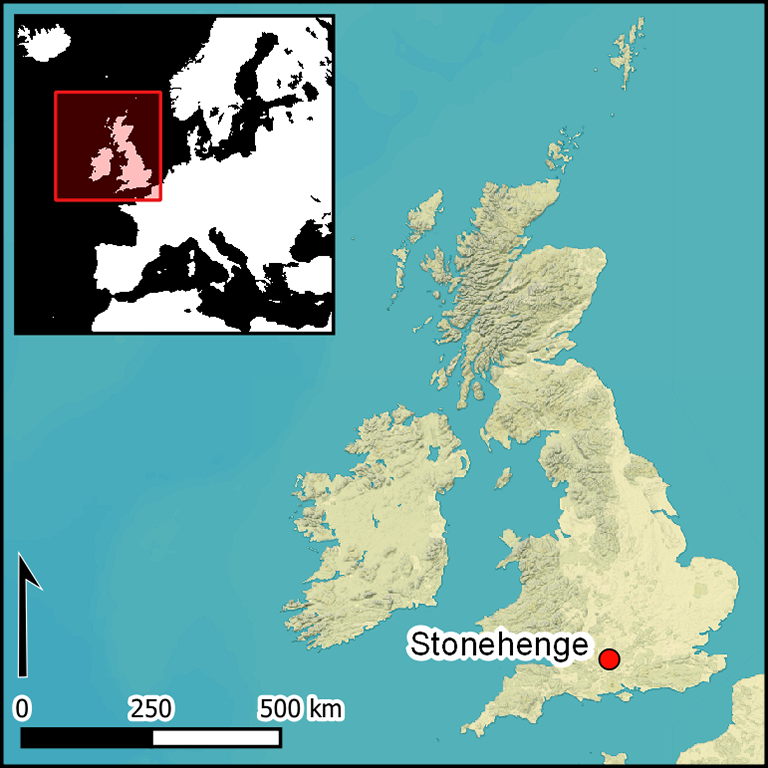
Located on the chalk downlands of southern Britain, Stonehenge has long been thought to incorporate some kind of calendar, although its specific purpose and exactly how it worked remain far from clear. At the beginning of the twentieth century, Lockyer (Reference Lockyer1909: 473–77) proposed that the monument represented a ‘May Calendar’ based on ‘clock-stars’. Later, Hawkins (Reference Hawkins1965: 116–17 & 174–81) advanced its interpretation as a ‘Neolithic computer’, aligned to eight extreme positions of the sun and moon, for the purposes of time-reckoning and predicting eclipses. Thom (Reference Thom1967: 107–17), meanwhile, favoured a calendar of 16 months, using the solstices, equinoxes, May/Lammas and Martinmas/Candlemas as turning points in the cycle. These and many other interpretations, however, are all unsatisfactory, as they often use non-contemporaneous elements of the monument, reference astronomical alignments that do not withstand close scrutiny (Ruggles Reference Ruggles, Cunliffe and Renfrew1997: 203), or perpetuate the discredited idea of a ‘Celtic Calendar’ (Hutton Reference Hutton1996: 408–11).
Recent remodelling of the developmental sequence at Stonehenge shows that the three sarsen structures—the Trilithons, Sarsen Circle and the Station Stone Rectangle—all belong to Stage 2 and were set up during the period 2620–2480 BC (Darvill et al. Reference Darvill, Pearson, Jordon and Wainwright2012: tab. 3; Darvill Reference Darvill2016). Once in place, these components were not moved or changed, and their integrity is further supported by analysis showing that most of the stones derive from a single source on the Marlborough Downs (Nash et al. Reference Nash2020). Understanding the sarsen elements as a unified group and recognising the numerical significance of the elements in each component opens up the possibility that they represent the building blocks of a simple and elegant perpetual calendar based on the 365.25 solar days in a mean tropical year. Here, I examine the evidence at Stonehenge to suggest how such a time-reckoning system might have worked, going on to address the question of its origins and development, and to ask why such a calendar might be materialised in the architecture of this exceptional monument.
Building time into the fabric of Stonehenge
The ensemble of sarsen structures at Stonehenge is unique in north-western Europe; in terms of its design and construction, it resembles no other stone monument of the mid-third millennium BC. The three main components described briefly below sit astride a central axis.
The Sarsen Circle
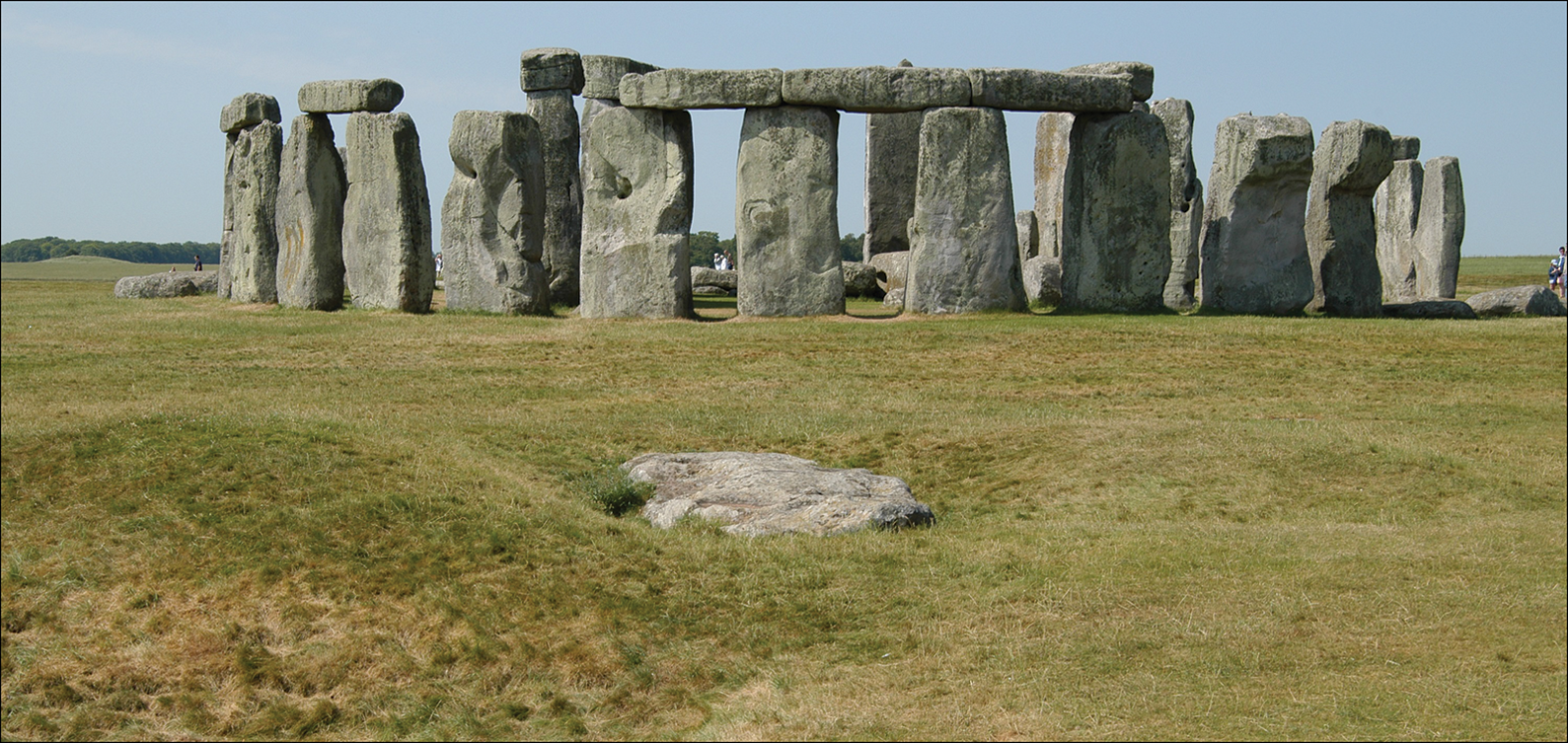
The most visually prominent structure at Stonehenge is the ring of 30 upright sarsen stones, linked at the top with 30 lintels (Figure 1). The uprights are conventionally numbered S(tone)1 to S30 in clockwise fashion, starting at the north-east. Seventeen of the uprights are still standing in their original positions, seven are extant but fallen and six are missing. Six lintels remain in place atop their supporting uprights, while two fallen examples lie on the ground; 22 are missing. Although the missing stones have sometimes been suggested to indicate that the Sarsen Circle was never completed (e.g. Ashbee Reference Ashbee1998), sockets for some fallen or missing uprights are known through excavation (Cleal et al. Reference Cleal, Walker and Montague1995: 192–94), and the positions of the others are known through parch-marks recorded in 2013 (Banton et al. Reference Banton2014: fig. 1). Moreover, constructional features relating to the method for fitting the stones together, as revealed by field examination and photogrammetric survey, provide evidence of an intention to form a compete circuit (Field et al. Reference Field2015: 135). As such, it must be concluded that the missing sarsen uprights and lintels were robbed in antiquity.
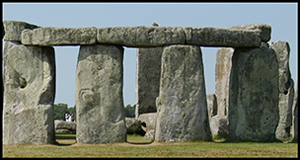
Stonehenge, viewed from the north-east, showing the post-and-lintel construction of the Sarsen Circle (photograph by T. Darvill).
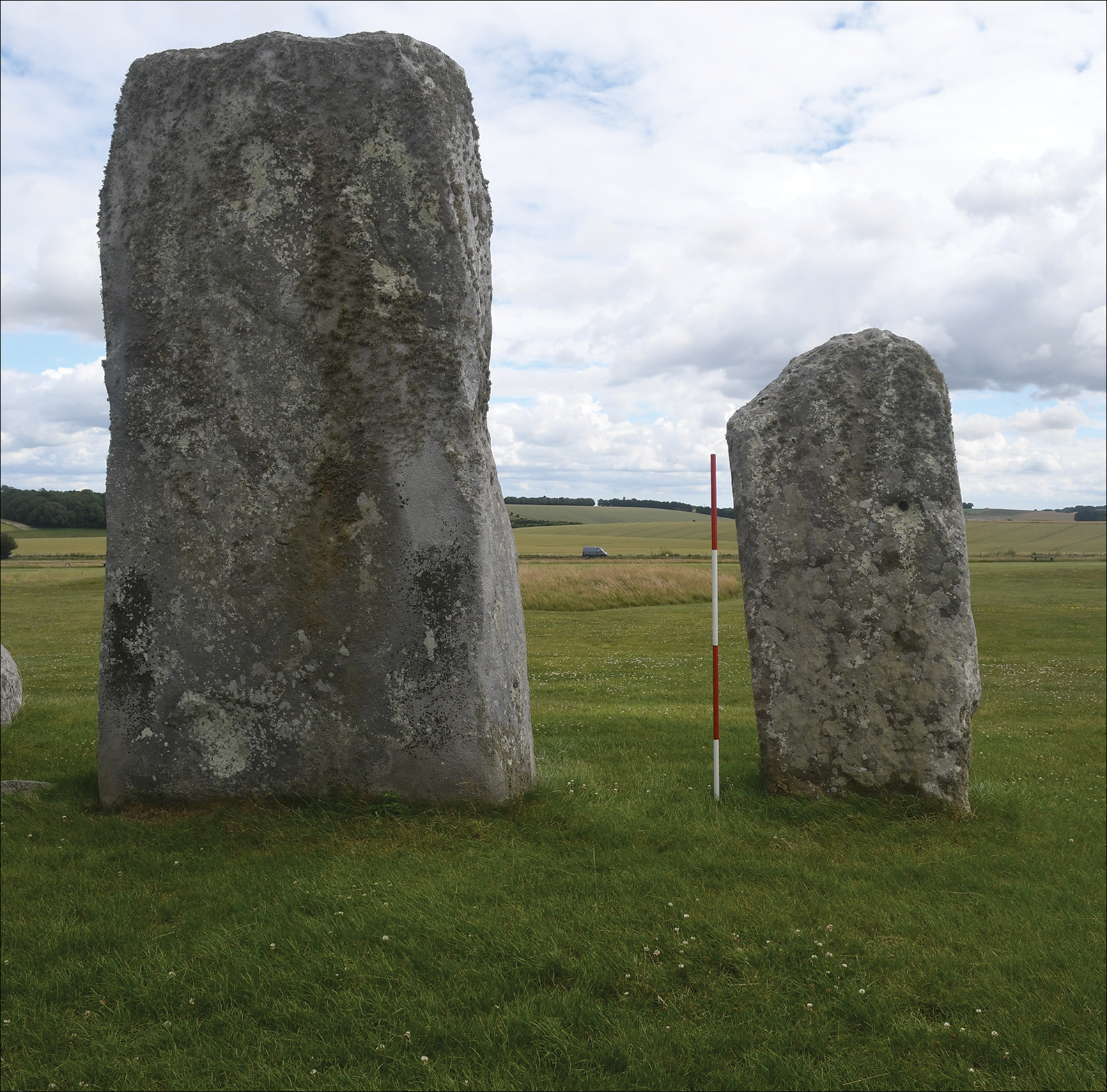
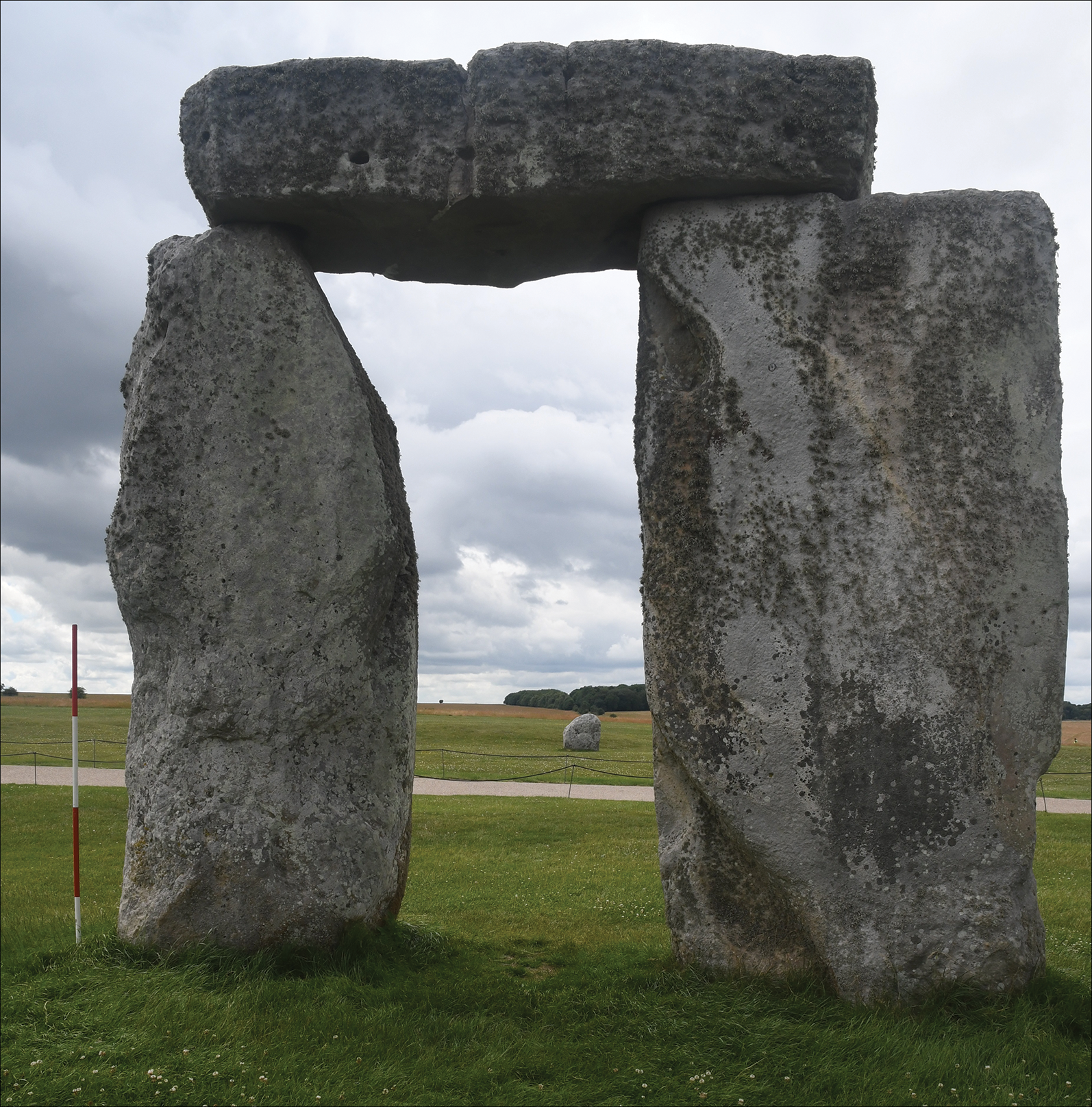
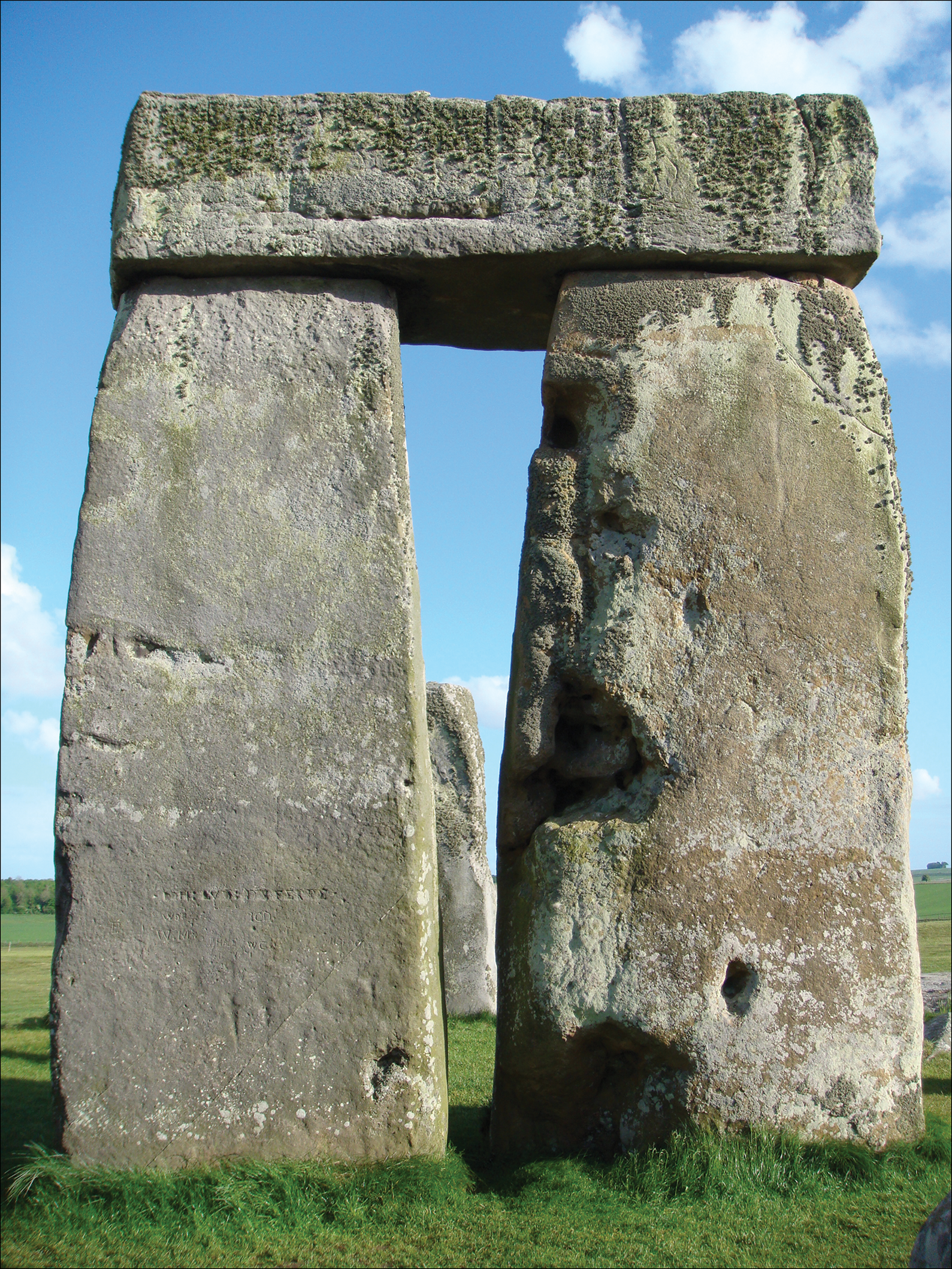
The extant Sarsen Circle demonstrates the intricacy of its construction. The spacing of the pillars is fairly regular, but the gap between S1 and S30 to the north-east is larger than average, at 1.38m, suggesting that this was an entrance; as S15 is missing, it is difficult to judge whether there was a correspondingly wide gap to the south-west. Most of the uprights are uniform in shape and size, the ‘standard width’ being approximately 1.9m, measured 1.5m above ground level. Two uprights, however, stand out. S11 (Figure 2) in the south-eastern sector is notably narrower, at 1.1m wide; it is also thinner and shorter than most, although recent work suggests that its top has been broken off (Abbott & Anderson-Whymark Reference Abbott and Anderson-Whymark2012: 50). S21 (Figure 3) in the western sector appears complete but is narrower, at 1.5m wide, and thinner than average. Figure 4 shows the pattern of stone widths and gaps around the circumference of the Sarsen Circle. Although the six missing uprights lie in the south-western sector of the circle, the size of their sockets—known through excavation or parch-marks—suggest they were ‘standard width’ stones. Counting sun-wise from S1, there seem to be three distinct groups of ten uprights: S1–10, S11–20 and S21–30. Each group is preceded by a slightly wider-than-usual gap, with S11 and S21 standing out due to their smaller size.
Sarsen stone S10 (left) in the Sarsen Circle, with the small-sized S11 to the right. View looking outwards from inside the circle. Scale = 2m (photograph by T. Darvill).
Small-sized sarsen stone S21 (left) in the Sarsen Circle, with the normal-sized S22 to the right. View looking outwards from inside the circle. Scale = 2m (photograph by T. Darvill).
Plot showing the spacing and size of stones forming the Sarsen Circle (figure by T. Darvill).

All the extant stones have been shaped and dressed. Through either selection or modification, most widen towards the top in a type of entasis to create the optical illusion of straight-sidedness (Atkinson Reference Atkinson1979: 37; but see Abbott & Anderson-Whymark Reference Abbott and Anderson-Whymark2012: 21–22). The height of the uprights varies around the circumference in order to account for the natural slope on the ground, ensuring that the ring of lintels is level. The lintels are secured to the uprights with hemispherical protuberances and corresponding hollows known as stub-tenon joints—a distinctive method, as the mortice holes into which the tenons fit do not extend through the full thickness of the lintels. Tongue-and-groove joints lock the ends of the lintels together in a continuous ring.
The Trilithon Horseshoe
Inside the Sarsen Circle are five sarsen trilithons arranged in a horseshoe shape that opens to the north-east. All stones survive on site, although some have fallen. The south-western trilithon (comprising uprights S55 and S56, and lintel S156) is the tallest and largest; the others reduce in height towards the north-east, giving both vertical and horizontal emphasis to the south-western trilithon. All the stones of the Trilithon Horseshoe have been shaped and dressed, with stub-tenon joints securing the lintels to the uprights. Whittle (Reference Whittle, Cunliffe and Renfrew1997: 155–61) observed an alternating rhythm to the dressing and shaping of the uprights, with one stone in each pair smooth and sharply dressed, while the other is rougher and more natural in appearance (Figure 5).
Trilithon S53 and S54, with lintel S154, showing contrasting pairs of smoothed and rough uprights. View looking outwards from the inside of the Trilithon Horseshoe (photograph by T. Darvill).
Station Stone Rectangle
Outside the Sarsen Circle is a rectangular setting of four ‘Station Stones’. Only two survive: S91 at the north-east corner (Figure 6) and S93 at the south-west corner (Figure 7), although empty sockets representing the other two (S92 and S94) are known through excavation (Cleal et al. Reference Cleal, Walker and Montague1995: 273). Together, these four stones define a relatively precise rectangle measuring 80 × 30m. Lines representing the two long sides would pass close to the outside faces of stones S1/S30 and S15/S16 on the outer circumference of the Sarsen Circle. The Station Stones are much smaller than the other sarsens and they are minimally dressed.
Surviving Station S91 at the north-east corner of the Station Stone Rectangle (photograph by T. Darvill).

Surviving Station S93 at the south-west corner of the Station Stone Rectangle (photograph by T. Darvill).

The Stonehenge axis
Embedded into the footprint and architecture of all three sarsen elements is a single, coherent astronomical axis: a line orientated north-east to south-west. This line joins the points on the locally visible horizons where the sun rises during the summer solstice to the north-east and sets during the winter solstice to the south-west. This is the only major alignment embedded in the architecture of Stonehenge, although Daw (Reference Daw2015) has argued that the positioning of the south-western trilithon incorporates a closely related secondary solstitial axis based on the skyline positions of the rising midwinter sun to the south-east and the setting midsummer sun to the north-west.
The principal axis runs through the entrance to the Sarsen Circle, which is flanked by S1 and S30 on the north-east side, and between S15 and S16 on the south-west side. The Trilithon Horseshoe sits symmetrically astride the axis. The two short sides of the Station Stone Rectangle run parallel to the principal axis, albeit displaced to the north-west and south-east. Ruggles (Reference Ruggles, Cunliffe and Renfrew1997: 218–21) has suggested that the two long sides of the rectangle are approximately orientated on major extreme moonrise positions, but whether deliberately or by chance remains unclear.
Beyond the central settings, the principal axis is perpetuated by two stones positioned in the entrance through the earlier earthwork enclosure, the Heel Stone (S96) and its now-missing companion (S97), and by the embanked Avenue that was added in Stage 3 (Darvill et al. Reference Darvill, Pearson, Jordon and Wainwright2012: 1035).
Time-reckoning
How do the elements of this ensemble fit together as the physical expression of a calendar and a mnemonic for its operation? A system based on the cycles of the moon is feasible but reconciling the observable pattern of lunar months of 29 or 30 solar days with the solar year that structures the seasons and human daily routines has posed a challenge for agrarian societies across time and space (Nilsson Reference Nilsson1920: 267–81; Thorpe Reference Thorpe, Ruggles and Whittle1981: 277–78). At Stonehenge, the emphasis on the solstices embedded into the architecture in the form of the principal axis and its orientation strongly suggests a solar-based system. The period between the recurrence of either one of these solstitial events is, in practical terms, a tropical year of 365.25 solar days. With this figure in mind, the numerology of the three sarsen structures comes together neatly as a tropical year (Figure 8).
Summary of the way in which the numerology of sarsen elements at Stonehenge combine to create a perpetual solar calendar. Non-sarsen elements have been omitted for clarity (drawing by V. Constant).
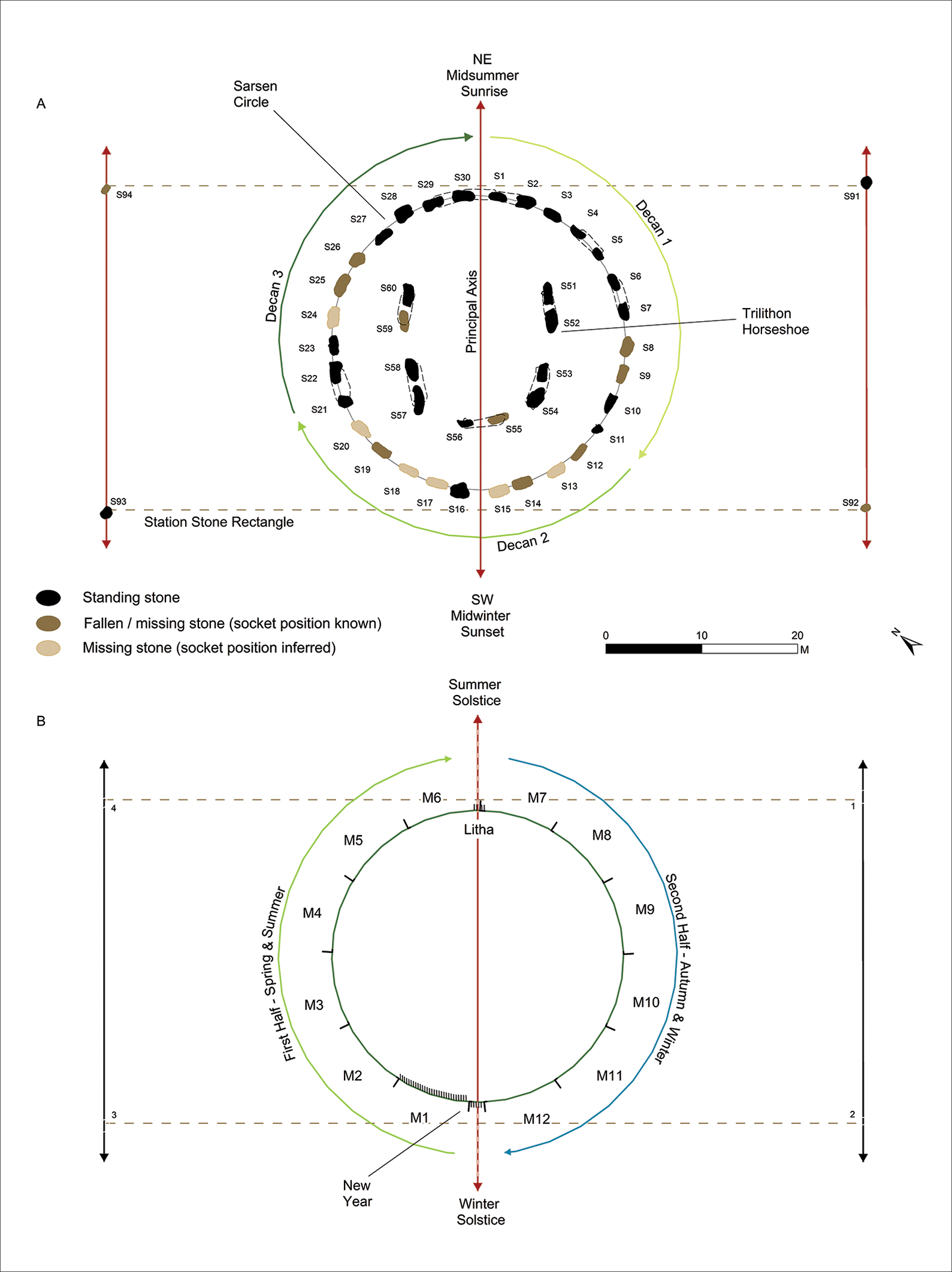
The core of the year is represented by the Sarsen Circle. Here, each of the 30 uprights represents a solar day within a repeating 30-day month. Running sun-wise from the main axis, with S1 representing Day 1, S11 and S21 become significant, as they divide the month into three ‘weeks’ or ‘decans’, each of 10 days; the anomalous stones mark the start of the second and third decans. Twelve monthly cycles of 30 days, represented by the uprights of the Sarsen Circle, gives 360 solar days. While no stones within the central setting can specifically be identified with the 12 months, it is possible that the poorly known stone settings in and around the north-eastern entrance (Cleal et al. Reference Cleal, Walker and Montague1995: fig. 156) somehow marked this cycle.
Completing the basic tropical year requires an additional five days: an intercalary month of days known in later calendars as epagomenal days. The five components of the Trilithon Horseshoe, situated prominently in the centre of the structure, fit this role. Working from the north-east, they grow incrementally in stature, with the tallest—known as the Great Trilithon (S55 and S56, and lintel S156)—to the south-west. We have no names for these days, but they could represent significant deities (Darvill Reference Darvill2006: 144–45), the contrasting treatment of the uprights noted by Whittle (Reference Whittle, Cunliffe and Renfrew1997: 155–61) perhaps imparting some kind of left–right symbolism. Adding the intercalary month gives 365 solar days.
Making the solar calendar a perpetual one, in which the days, decans and months keep pace with the seasons and the movements of the sun to describe a tropical solar year with accuracy, requires periodic adjustment, specifically, the addition of one day every four years to create a leap-year of 366 solar days. The four Station Stones provide a means of keeping tally so that a sixth day could be added to the intercalary month every fourth year.
Bringing these parameters into line with the accumulation of solar days, weeks and months, and recognising the solstitial axis and a clear focus on the midwinter setting sun, the basic shape of a Late Neolithic solar calendar emerges. Starting at the winter solstice-emphasised architecturally by the orientation of the Trilithon Horseshoe to the south-west-the year starts with the first movement of the setting sun away from its most extreme south-westerly setting point. New Year's Day, or Month 1/Day 1 (the equivalent of 24 December in the modern proleptic Gregorian calendar, or PGC) is physically symbolised by Stone 1. Six months (18 decans or 180 solar days) later, Month 6/Day 29 (19 June PGC), is the start of the summer solstice, whose five days of standstill span the last three days of Month 6 and the first two days of Month 7 (19–23 June PGC). Six months on again, Month 12/Day 30 (18 December PGC) marks the start of the intercalary month of five epagomenal days, forming the period of the winter solstice (19–23 December PGC): the end of the old year. An additional day would be added to the intercalary month every four years to keep the solstices aligned with observations of the sun's movements in relation to the principal axis of the monument. Using the solstitial alignment ensures that the calendar was synchronised with celestial movements and the changing of the seasons. Arranging the entire complex around a principal axis might relate to processional movement, and a sense of order, sequence and meaning played out in the way the site was used: a directional force with physical, visual and emotional power.
Fragments of this prehistoric calendar can be found surviving into recent times. Hutton (Reference Hutton1996: 8) has delicately unpicked Christian and modern scholastic overlays to reveal the existence of a “major pre-Christian festival marking the opening of the New Year, at the moment at which the sun had reached the winter solstice and its strength was being renewed”. One important piece of supporting evidence is De temporum ratione, written c. AD 725 by the Northumbrian monk and scholar Bede. This account records that the pre-Christian New Year was marked by the midwinter festival of Yule; combined with a midsummer festival known as Litha, the year was divided into two parts (DTR 15; Willis Reference Willis1999: 53–54). Using linguistic evidence, Mallory and Adams (Reference Mallory and Adams2006: 302) reconstruct two words for ‘year’ that express the notion of ‘new season’ in the proto-Indo-European language thought to be current during the third millennium BC. At Stonehenge, the principal axis naturally divides the monument and, by implication, the calendar it represents into two halves, with both the winter and summer solstices clearly embedded in the architecture of the structure.
Local innovation or external influence?
It is entirely possible that communities living in north-western Europe during the late fourth and third millennia BC developed a solar calendar of the type suggested here on their own initiative. Evidence for the alignment of several passage graves, including, for example, Newgrange in Ireland and Maes Howe in Orkney, on celestial events during the winter solstice may support this idea. The uniqueness of Stonehenge, however, prompts a pause for thought. External influences may also be possible, especially given contemporaneous developments 3500km away in the Eastern Mediterranean. Here, during the fourth millennium BC, a variety of lunar-stellar calendars used observational astronomy to reconcile the movements of the moon and stars with the daily and seasonal cycles of the sun (Parker Reference Parker and Hodson1974; Sachs Reference Sachs and Hodson1974). During the early third millennium BC, however, increased interest in solar deities, such as the cult of Ra (Quirke Reference Quirke2001), led to the development in Egypt of a 365-day solar calendar, known as the Civil Calendar. The origins, development and form of the Egyptian Civil Calendar have been described in detail by Nilsson (Reference Nilsson1920: 277–81) and Stern (Reference Stern2012: 125–66). Just as at Stonehenge, the calendar comprises twelve 30-day months, together with an intercalary month of five epagomenal days. The months are each divided into three weeks of 10 days. The need for an additional day every four years to keep track with the seasons was understood, although not implemented until much later (Parker Reference Parker and Hodson1974: 53). As an expression of the solar cosmology, the 12 months were named after the constellations that form the signs of the zodiac, and the epagomenal days were festivals celebrating the five children of Geb (earth god) and his sister-spouse Nut (sky goddess): Osiris, Horus, Seth, Isis and Nephthys (Spalinger Reference Spalinger1995).
Back-calculations using the pre-existing lunar-stellar calendar suggest that the Civil Calendar started in 2773 BC. Like the cult of Ra, with which it was closely associated, the Civil Calendar was widely used during the Third Dynasty at the start of the Old Kingdom, c. 2658 BC. By the Fifth Dynasty (c. 2500–2300 BC), the cult of Ra had become the state religion, with rulers taking the title ‘Son of Ra’ (Quirke Reference Quirke2001: 17).
Egypt was not alone in developing a solar calendar. Englund (Reference Englund1988: 122) has convincingly shown that similar time-reckoning systems were being used in Mesopotamia by the late fourth millennium BC, and their adoption in the Eastern Mediterranean might have been more widespread at this time than previously realised. It was patently successful, as many of its key features were adopted in later calendars (Stern Reference Stern2012: 125).
Archaeologically, the question is whether the Egyptian Civil Calendar, or a variation thereof, could have been known to communities living in southern Britain in the mid-third millennium BC, and adopted by them. Barely a century ago, the answer would have been resoundingly affirmative (e.g. Childe Reference Childe1929). As diffusionist models crumbled and connections between the Mediterranean world and Northern Europe were systematically uncoupled to emphasise autonomous local development (Renfrew Reference Renfrew1973: 84–108), such thinking became deeply unfashionable. Now, however, the pendulum of interpretation is swinging back in favour of long-distance contacts and extensive social networks. Tight radiocarbon chronologies allow synchronicities to be recognised, while aDNA and isotope studies emphasise the nature and extent of population movements during the third millennium BC (Furholt Reference Furholt2018; Armit & Reich Reference Armit and Reich2021). Especially relevant here is the life-story of the Amesbury Archer, who was buried 5km south-east of Stonehenge c. 2300 BC in a simple grave, accompanied by an extraordinary array of grave goods, including some from continental Europe. Isotope analysis shows that he was born and raised in the Alps and moved to Britain as a teenager (Fitzpatrick Reference Fitzpatrick2011: 65–166).
Wilkinson (Reference Wilkinson and Lloyd2010: 59–60) has documented the growth of long-distance trade beyond Egypt's traditional borders, in all directions, during Early Dynastic times. Stone vessels provide the earliest secure evidence, dating to the early third millennium BC, of Egyptian exports to Minoan Crete, on the south-eastern extreme edge of Europe, with scarabs present in Early Minoan contexts after 2300 BC (Warren Reference Warren and Matz2009: 384–90). From the early second millennium BC, the flow of prestige objects and materials between the Eastern Mediterranean and Northern Europe, and vice versa, is well recognised, although much debated (see Harding Reference Harding1983: 4–115, Reference Harding, Fokkens and Harding2013: 379–80). Amongst the earliest known imports to Britain is the large, red-glass bead from the Wilsford G42 bowl barrow, located 2.3km south-west of Stonehenge—an object probably made in Egypt in the early second millennium BC (Guido et al. Reference Guido1984). The source of the much-discussed faience beads found in prehistoric British contexts may also be worth revisiting, recalling Harding's (Reference Harding1983: 87) comment that “all authorities accept that the technology originated in the Near East; what is in question is the place of manufacture of these beads.” Working back beyond 2000 BC, the archaeological trail marked by visible imports goes cold, although circumstantial indicators may be relevant. Particularly important here is the adoption of solar cosmologies across large areas of Northern Europe during the third millennium BC (Jones-Bley Reference Jones-Bley1993; Kristiansen & Larsson Reference Kristiansen and Larsson2005: 251–319; Kaul Reference Kaul2017) and its connection with the social construction of time (Kristiansen Reference Kristiansen and Lehoërff2008).
The unique architecture of Stonehenge in the context of mid third-millennium BC north-western Europe is also relevant. Post-and-lintel construction in stone, the use of stub-tenons to secure lintels to uprights, and the understanding of entasis to create the optical illusion of straightness, are all features found only in Egypt at that time (Arnold Reference Arnold2003). Although circular structures in Egypt are few—the so-called ‘Calendar Circle’ with solstitial alignments dating to the fifth millennium BC at Nabta Playa being something of an exception (Malville Reference Malville and Ruggles2015)—the circle motif was symbolic of the sun and the cycle of time (Quirke Reference Quirke2001: 161–67). The adoption of a circle as the physical expression of a calendrical cycle makes good sense, and in the context of Stonehenge is potentially significant, as it perpetuated existing local, indigenous traditions of building stone and timber circles extending back to before 3000 BC (Darvill Reference Darvill, Barnwell and Darvillin press).
Less secure, but tantalising nonetheless, is the garbled reworking of eleventh-century AD oral traditions recorded by Geoffrey of Monmouth. In his History of the kings of Britain, Monmouth records that Africa was the original source of the stones, which were taken first to Ireland to form the gigantium chora (the Giants’ Ring) and then to Stonehenge (HKB viii.11; Thorpe Reference Thorpe1966: 196). Perhaps significantly, the word chorea has a series of meanings in medieval Latin, including references to the movement (dance/circle) of the heavenly bodies.
Why build a calendar?
Materialising a time-reckoning system in the structure and form of a major monument, with all the effort implied in doing so, should come as no surprise, for it is a common practice amongst non-literate and semi-literate societies. One only has to marvel at recent astronomical clocks, such as the fifteenth-century example on the Town Hall in Prague, Czechia, to see the effort invested in creating grand public timepieces. Whether or not the Stonehenge calendar was a local development or part of an imported cosmology, the crucial question is: why construct a calendar at all? To address this, four aspects can be considered.
First is the routine of everyday life. Although archaeological accounts often rehearse the notion that early farmers needed time-reckoning systems to know when to plant and when to harvest, no self-respecting farmer needs to be told these things—their skill and experience dictates how they work the land. Where farmers do need guidance, however, is in knowing when to celebrate the harvest festival for best effect, or when to please the gods with their presence at key ceremonies. Hutton (Reference Hutton1996: 427) reviewed 40 festivals recorded in Britain over recent centuries, and while many were modern inventions, he found a vigorous seasonal, festive culture surviving from ancient times. These are not so much calendar festivals as festivals whose timing has been calendarised: important events that serve as landmarks in time (Nilsson Reference Nilsson1920: 83).
Second, as Stern (Reference Stern2012: 53) has cogently argued, ancient calendars provided a way for political elites to legitimise power: who makes time makes power (Meller et al. Reference Meller, Reichenberger, Risch, Meller, Reichenberger and Risch2021). Not only did elites control people and life on earth, but they also controlled the cosmos by using epagomenal days and leap-days to harmonise time with the workings of the universe. This idea resonates with ethnographic work by Hayden and Villeneuve (Reference Hayden and Villeneuve2011) on the religio-political context of astronomy and timekeeping amongst complex hunter-gatherer societies.
Third, time-reckoning systems give substance to conceptual cosmologies, so that the received narratives could be understood in ways that structured behaviours and relationships. As Helms (Reference Helms1988: 266–67) explains, the acquisition of esoteric knowledge transcends geographical distance, with elites acquiring superior powers from more potent places to enhance their own positions. At Stonehenge, a new interest in the cycle of the sun in the later third millennium BC may have replaced earlier lunar ideologies, a transition seen physically in the eastwards shift by five degrees in the axis of the Stonehenge Stage 1 enclosure to the principal (solstitial) axis in Stage 2 (Cleal et al. Reference Cleal, Walker and Montague1995: 170). By combining the solar cycle and the natural cycle of life in monumental form, the days, weeks, months and years served to structure ritual cycles of responsibility and obligation.
Finally, time-reckoning systems bring communities closer to their gods by ensuring that events occur at propitious moments. Astrology was an important, though controversial, tool in ancient medicine and healing rites. An accurate calendar was required to maximise effects that depended on people being in the right place at the right time. Salt and Boutsikas (Reference Salt and Boutsikas2005) have argued that the primary purpose of early Greek calendars was to structure access to Apollo and to know when to consult the oracle or engage in healing rituals at Delphi. Similarly, Meyer (Reference Meyer2019) has emphasised the relationship between finds of calendrical clepsydra (water clocks), springs and healing rituals in Roman Britain. Elsewhere, I have argued that the Bluestone elements at Stonehenge, imported to the site from west Wales, represent the power of the place and were intimately connected with healing rituals (Darvill Reference Darvill, Barrowclough and Malone2007). Ensuring that healing ceremonies happened at the right time is why the very structure of Stonehenge from Stage 2 onwards embedded a means whereby its user-communities could literally make, mark and keep pace with time.
Conclusions
The Stonehenge calendar hypothesised here provides a workable and archaeologically grounded solution to an age-old interpretation. It adds a new dimension to the multi-faceted structure and its uses from Stage 2 onwards, providing a secure cosmologically referenced framework for the observance of festivals, ceremonies and rituals that were the reason for the monument's construction. The selection of the existing Stage 1 earthwork enclosure, which had formerly been used as a cemetery, as the site for this innovative development elicits no surprise. The site was already part of a well-established ceremonial centre that was located beside good communication routes, and was a prominent node within trading networks that extended across Britain and beyond. Thinking more widely about the origins of the solar calendar, its meanings and its ramifications, now requires a detailed review of the connections between early farming communities across the Old World during the third millennium BC.
Acknowledgements
In preparing this article, I would like to thank Katherine Barker, Julian Henderson, Heather Sebire, Fabio Silva and Peter Warren for their help and guidance on various aspects of the material assembled and discussed here; the final text also benefits from the comments made by two anonymous reviewers.
Funding statement
This research received no specific grant from any funding agency or from commercial and not-for-profit sectors.


 Open access

