


The cheetah Acinonyx jubatus is categorized globally as Vulnerable on the IUCN Red List (Durant et al., Reference Durant, Groom, Ipavec, Mitchell and Khalatbari2022). In Somaliland the status and distribution of the cheetah are considered unknown (IUCN, 2007; Marker et al., Reference Marker, Cristescu, Morrison, Flyman, Horgan and Sogbohossou2018) beyond reports from social science surveys with local communities (Evangelista et al., Reference Evangelista, Mohamed, Hussein, Saied, Mohammed and Young2018). Although these survey data are a first step in documenting cheetah presence, additional information is required to confirm the distribution of the species, particularly as it can be confused with other carnivores such as the leopard Panthera pardus or serval Leptailurus serval (Dickman et al., Reference Dickman, Hazzah, Carbone and Durant2014; Verschueren et al., Reference Verschueren, Briers-Louw, Torres-Uribe, Siyaya and Marker2020). Cheetahs were historically widespread in the Horn of Africa and Somaliland (IUCN, 2007) but have been thought to be potentially extirpated since 2010, primarily because of illegal trade of cubs. To our knowledge, the most recently published confirmed record of the cheetah in Somaliland dates from September–October 2010, when a cheetah that had been trapped, presumably after attacking goats, was released and monitored briefly through footprint tracking in the Beira Hills, east of the capital city of Hargeisa (Mallon & Jama, Reference Mallon and Jama2015).
In 2011, the Cheetah Conservation Fund, in collaboration with the Ministry of Environment and Climate Change in Somaliland, initiated a comprehensive effort to document the status of cheetahs and the threats they face, and to address illegal wildlife trade in the Horn of Africa. Although efforts have, by necessity, focused primarily on providing care to cheetah cubs confiscated by the government authorities, the presence of illegal trade in cubs is not by itself evidence that cheetahs still exist in the wild in Somaliland. The cubs could originate from areas outside Somaliland, with Somaliland being a transit route for cub trafficking across the Gulf of Aden to the Arabian Peninsula.
To gain a better understanding of cheetah status in Somaliland, we carried out two rapid surveys in February 2021 and February–March 2022 in the Awdal region, western Somaliland. The surveys combined the collection of social science and ecological data in a random sample of villages along the survey routes. The routes (Fig. 1) covered high-elevation plateaus of central and southern Awdal and low-elevation coastal plains of northern Awdal. We accessed the areas by driving small convoys of 4 × 4 vehicles departing from Hargeisa and spending 6 days (in 2021) and 7 days (in 2022) collecting data, for a total survey effort of 13 days.
The 2021 and 2022 rapid transect surveys for the cheetah Acinonyx jubatus in the Awdal region of Somaliland. Symbology indicates which villages reported cheetah sightings and predation of livestock by cheetahs in the previous year. Some villages reported neither sightings nor livestock predation by cheetahs. Locations of physical evidence of cheetah presence (carcasses, tracks and potential scrape marks) are shown. (Readers of the printed journal are referred to the online article for a colour version of this figure).

We visited a total of 26 villages in the Awdal region, four of which we visited in both years (Fig. 1). We administered questionnaires to key informants (e.g. village elders) and focus groups (e.g. villagers who raise livestock) in the local Somali language with the help of translators. We chose interviewees through consultation with communities during pre-survey assessment trips by the Ministry of Environment and Climate Change and the Somali Consultant Association. In addition, we investigated reports of cheetah presence from the local communities as far as possible within the time constraints of our study.
In 2021, respondents from eight villages reported sightings of cheetahs in the preceding 12 months, and respondents from three villages reported predation on livestock by cheetahs (Fig. 1). In 2022, 19 respondents across 11 villages reported sightings of cheetahs within a day's walk from the village in the previous 12 months. Also in 2022, respondents from 11 villages reported livestock losses to cheetahs. Most respondents (84%, n = 21) reported that kills took place > 1 km from the village but participants also sometimes reported kills within 1 km of their village (36%, n = 9; per cents do not sum to 100% because we allowed participants to select more than one option when reporting kill locations). Residents of the surveyed villages primarily raise small livestock (goats and sheep) but also large livestock (camels and donkeys, and cattle less frequently). Depredation by cheetahs involved exclusively small livestock.
We visited four villages in both years: Boon, Kalawle, Sheed-Dheer and Xariirad. Respondents at two of the villages, Boon (one individual in 2021 and one individual in 2022) and Xariirad (one focus group in 2021 and one individual in 2022), reported sightings of cheetahs in both years, whereas only respondents at Boon reported livestock predation by cheetahs in both years (one individual in 2021 and one individual in 2022). Respondents at Kalawle (one focus group) reported cheetah sightings only in 2021. Respondents at Sheed-Dheer reported cheetah sightings in 2021 (one focus group) and cheetah predation in 2022 (one focus group). Respondents at Xariirad (one focus group) reported cheetah predation only in 2021.
In addition to collecting these data, we investigated two reports of cheetah presence that were communicated to the survey team whilst conducting the questionnaire surveys (Table 1). In the first instance, on 27 February 2022 a local community member reported having seen a mature cheetah that morning, and we inspected the site of this observation. We found a set of cheetah tracks that we were able to track for > 250 m (Plate 1a). The cheetah had come from a hilly area moving towards a wide, dry riverbed in a south to north direction. On the same day, we deployed eight Browning Strike Force Pro XD (Browning, Morgan, USA) camera traps in a concentrated area (1.5-km radius from where we found the tracks) in an effort to photograph the animal. This brief camera-trapping effort (144 camera-trap nights) failed to detect the animal, which was not surprising given the expected large home ranges of cheetahs in this arid system and the fact that because of time constraints we were unable to locate landmarks such as play trees for camera-trap deployment. Play trees, large termite mounds and small kopjes are landscape features to which cheetahs may return periodically for territorial marking and can therefore be important elements for cheetah population surveys, in particular when direct observations are difficult to achieve (Walker et al., Reference Walker, Nghikembua, Bibles and Marker2016, Fabiano et al., Reference Fabiano, Sutherland, Fuller, Nghikembua, Eizirik and Marker2020).
Recent records indicating the presence of mature cheetahs Acinonyx jubatus in rural areas of the Awdal region, Somaliland (Fig. 1).

1 Boon District of the Awdal region.
Photographic records indicative of mature cheetahs Acinonyx jubatus in the Awdal region, Somaliland: (a) tracks, (b) scrape and (c,d) carcasses. Photos by the Cheetah Conservation Fund and community members who contacted the Fund.
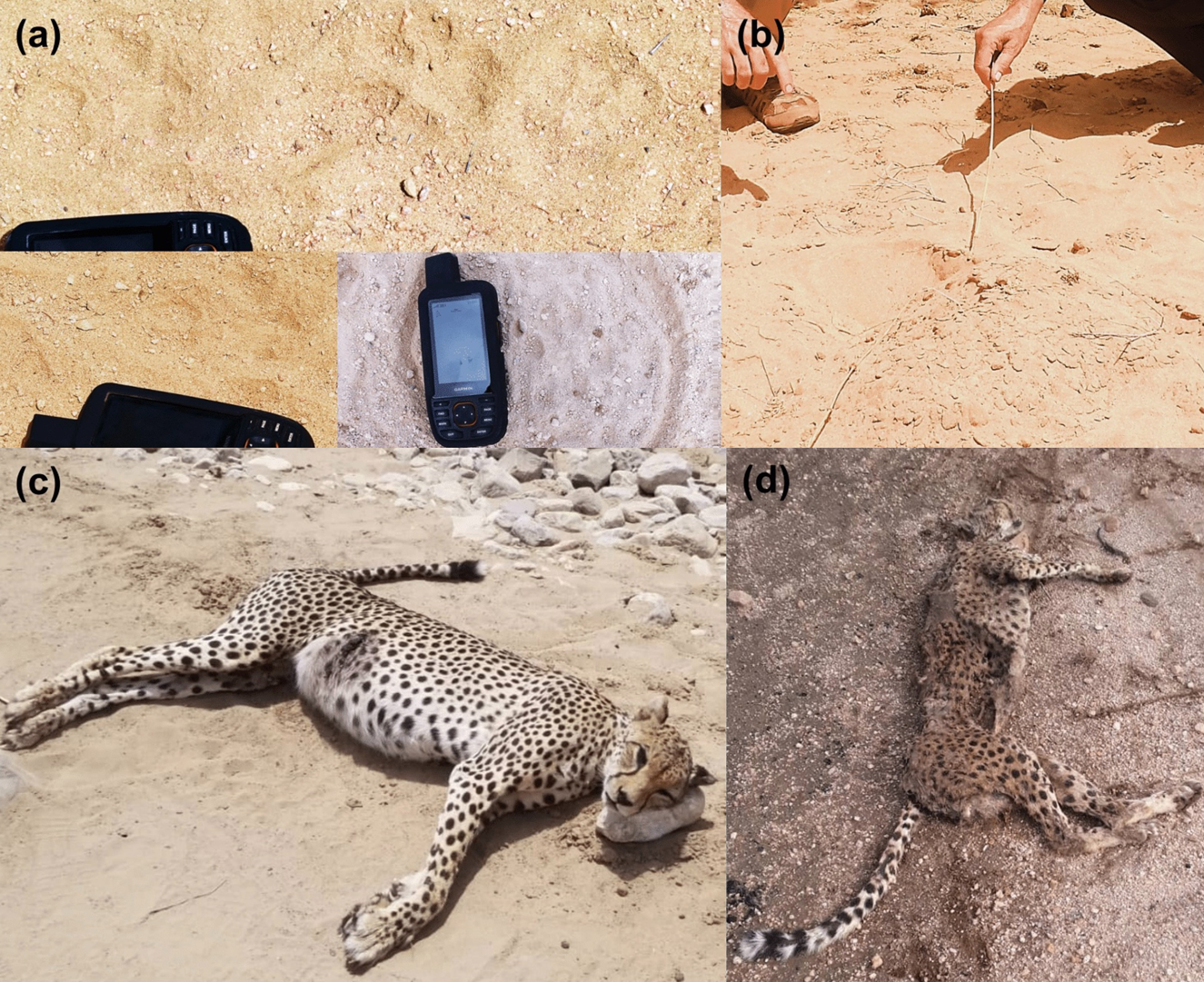
In the second instance, on 3 March 2022 a local community member reported that someone had seen two cheetahs moving through a sandy dry riverbed. We travelled to the location and met the person who had observed the cheetahs, who showed us where the observations had occurred c. 1 week prior. An extensive search did not reveal cheetah tracks but the area was trampled heavily by livestock, exposed to wind and had received some recent rainfall. However, we found two large potential feline scrapes, one on either side of the riverbed and c. 40 m from each other (Plate 1b). The widths of the scrapes matched what we expect of cheetah size (i.e. they were larger than scrapes that caracals Caracal caracal or servals would produce). Although we were unable to validate whether the scrapes belonged to cheetahs and not to leopards, two adult leopards travelling together is an uncommon occurrence outside the reproductive season, and the overall open and flat habitat appeared more indicative of cheetah habitat than that of leopards.
Lastly, we obtained direct evidence of cheetah presence from carcasses of mature cheetahs accompanied by photographic records. In July 2020, we received a report from a local community member that one mature cheetah had been shot in defence of livestock and the record was accompanied by a photograph (Plate 1c). We were subsequently able to collect the carcass for sampling and made a follow-up visit to the site of the shooting in February 2022 to record the coordinates, with a GPS, at the precise location in the Boon District of Awdal. In 2022, local community members found two dead mature cheetahs, and it was reported that both had apparently been bait-poisoned. They supplied two photographs with the report, each detailing a cheetah carcass, but we only present one (Plate 1d) as it is uncertain whether both photographs pertained to the same animal or each depicts a distinct individual. We were unable to identify the precise location of this incident but it was reported that it occurred in the Boon District. This district includes the village of Boon, which is the only village included in the social science survey for which respondents reported livestock predation by cheetahs in both survey years.
Using a combination of data sources, we can confirm the presence of wild cheetahs in western Somaliland as recently as March 2022. Our priority is to work with local communities, particularly in the Boon District, which appears to be a human–cheetah conflict hotspot based on cheetah carcasses and the depredation reported. We will also work with other communities that reported predation on livestock by cheetahs. We plan to initiate a systematic survey of cheetahs using non-invasive methods for cheetah detection and to expand the rapid surveys to other rural regions of Somaliland. The data we have collected thus far indicate that Somaliland merits the attention of the conservation community and the need to update the IUCN distribution map of the cheetah to include western Somaliland. The most defensible cheetah presence data (carcasses of mature cheetahs killed as a result of human–wildlife conflict) suggest that human–wildlife conflict is an issue that needs to be better understood and addressed in Somaliland.
Acknowledgements
We thank the Ministry of Environment and Climate Change in Somaliland for allowing the surveys to take place and for supporting this work; the local communities for taking the time to participate in the surveys and for informing us of cheetah incidents; Susan Yanetti, Mark Natt, Xamse Ahmed Yusuuf, Joaquín García-Menacho de Vargas, Anahi Hidalgo Cordero and Ladan Abdilahi Jaamac of the Cheetah Conservation Fund for involvement at various stages; Abdinasir Ahmed Osman, Abdihamid Mohamed Jama and Abdishakur Abdilahi Muhumed of the Somali Consultant Association for their logistical assistance on one of the trips; the UK government for supporting the surveys through a Defra grant; and The Explorers Club.
Author contributions
Conceptualization: LM; study design: LM, BC; fieldwork: LM, AHS, ER, KYA, BC; writing: LM, EC, BC; revision: all authors.
Conflicts of interest
None.
Ethical standards
We asked questionnaire survey participants for their consent to be interviewed prior to the survey and we kept their identities anonymous for reporting purposes. The research did not involve animal capture and handling or behavioural experiments on wildlife, and otherwise abided by the Oryx guidelines on ethical standards.


 Open access

