




1 Introduction
This study is a corpus-based analysis of multi-word verbal expressions known as composite predicates (CPs) and their historical development in American English from the nineteenth century to the early twenty-first century. One of the most common types of CPs contains a polysemous transitive verb or light verb (e.g. take or make), which often combines with an abstract NP complement that carries the semantic weight of a verb (e.g. take a look and make an assumption). However, verbo-nominal CPs come in many shapes and sizes, including those with ‘heavier’, more lexically specific verbs that are paired with a variety of NP complements (e.g. bear witness or lose sight). CPs with light verbs and those with more lexically specific verbs generally share a number of characteristics but differ in several important ways, including varying degrees of idiomaticity and syntactic flexibility (Brinton Reference Brinton, Seoane, López-Couso and Fanego2008: 34).
Following the assumptions laid out for an exemplar-based Construction Grammar model in Bybee & Eddington (Reference Bybee and Eddington2006), Taylor (Reference Taylor2012) and Bybee (Reference Bybee2006, Reference Bybee, Hoffmann and Trousdale2013) in this study, I evaluate the extent to which some verb + complement pairings function as exemplars in the formation of other similar pairings with the same verb. Exemplars are central, highly frequent constructions, words or phrases that serve as a basis for grouping similarities together. Thus, a CP like take a look serves as an exemplar for pairings of this verb with other semantically similar nouns (e.g. glance, peek, gander, etc.). As a point of departure in the discussion on exemplars, I focus on the differences between types of verbs in CPs, comparing those with light verbs like make or take with those that contain more lexically specific verbs like bear and lose. The main research question of the study is: are light verbs in CPs more likely to generate exemplars than more lexically specific verbs?
Focusing on the differences between types of CPs, I aim to identify factors that test which verbs in CPs are more or less likely to generate exemplars. These factors include the relative size of each family of semantically similar nouns that occur in complements with each verb, the token frequency bands of these families, and the overall distributional pattern of frequencies within families of similar nouns. Nominal pairings with two of the most common light verbs are considered, namely, take and make, and compared with those that occur with two typical examples of lexically specific verbs, bear and lose.
The article is organized as follows: in section 2, I provide an overview of terminology and classification of different CPs before discussing how they relate to exemplars within a diachronic, usage-based Construction Grammar model. In section 3, I describe the corpus-based methodology and data collection procedures, including an overview of ways to identify semantically related nouns in NP complements to verbs within CPs. After presenting the empirical results in section 4, I discuss these findings in section 5 in terms of their relevance to exemplars and the ways in which the factors outlined above affect entrenchment, productivity and coverage. Conclusions will address the diachronic implications of these findings for our understanding of how various CP types generate exemplars and follow different trajectories that may be attributed to grammaticalization and lexicalization over time.
2 Background
2.1 Classification of composite predicates
Although there is little consensus in previous literature on ways to classify CPs, there is general agreement on some basic assumptions.Footnote 1 Most studies converge on the principle that verbo-nominal phrases such as make an assumption are CPs that consist of multiple grammatical elements, with the verb's NP complement expressing the verbal action of the phrase. Moreover, there is general agreement that verbs in CPs are in some way different from full verbs; they have been described as semantically deficient versions of full verbs (Bowern Reference Bowern2008: 163) whose ‘contribution to the meaning of the predication is relatively small in comparison with that of their complements’ (Huddleston & Pullum et al. Reference Huddleston and Pullman2002: 290). The most extensively discussed CP of this type in English involves verbs usually referred to as light verbs (e.g. do, give, have, make and take).Footnote 2 While many studies of CPs focus on only one or more of these five frequent verbs, like Brinton & Akimoto (Reference Brinton and Akimoto1999) or Elenbaas (Reference Elenbaas2013), others like Allerton (Reference Allerton2003) and Ronan (Reference Ronan, Davidse, Gentens, Ghesquière and Vandelanotte2014) follow Quirk et al. (Reference Quirk, Greenbaum, Leech and Svartvik1985) and assume that lightness is a matter of degree. Allerton (Reference Allerton2003: 187–91) includes verbs of medium token frequency (e.g. feel, find, grant) and low frequency (e.g. add, lodge, launch), alongside the high-frequency light verbs. Whether or not both light and heavier verbs should be categorized together, all of these verbs share characteristics of being relatively polysemous and occurring with a variety of NPs that carry the essential meaning of an action or event. In terms of the NP complement, many CPs include deverbal nouns (e.g. take a walk) or nouns that are derivationally related to a verb (e.g. make a decision) or other nouns that, as Quirk et al. (Reference Quirk, Greenbaum, Leech and Svartvik1985: 751) point out, share the characteristic that the NP complement contributes to the essential meaning of the CP (e.g. make an effort).Footnote 3
As discussed in Brinton & Traugott (Reference Brinton and Traugott2005: 130) and Brinton (Reference Brinton, Seoane, López-Couso and Fanego2008: 44), CPs generally fall into two broad categories. On the one hand, take-a-look CPs are often pairings of a light verb and an eventive noun. NP complements of this type are diverse, including some that are zero derivations (take a walk), bare NPs (take care), plurals (make choices), some that are preceded by indefinite articles (make a wish) or optionally by definite articles (make the/a choice), and some that display the possibility of adjectival modifiers (take a (quick) look). Moreover, the parts of this type of CP are, to some extent, interchangeable, on account of the general semantics of the verb, as in take or have a drink or make or do a study (Brinton Reference Brinton, Seoane, López-Couso and Fanego2008: 34), although it is not possible to replace light verbs with roughly synonymous heavier verbs (e.g. give a kick vs *bestow a kick, *grant a kick) (Brinton Reference Brinton, Seoane, López-Couso and Fanego2008: 46). Moreoever, as will be discussed below, light verbs occur with a greater variety of NP complements. On the other hand, lose-sight CPs consist of pairings with a greater variety of verbs but less diversity of grammatical options: the type of NP complement is most often a bare NP (lose sight), usually without the possibility of adjectival modification (*lose good sight). It is more often the case that the verb in this type of CP cannot be easily substituted with another (e.g. lose sight but *find sight) (Brinton Reference Brinton, Seoane, López-Couso and Fanego2008: 45) and occur with a narrow range of NP compelements. Unlike the take-a-look type of CP, these are non-compositional and generally have a more idiomatic usage. As discussed in Sundquist (Reference Sundquist2020: 355) and Claridge (Reference Claridge2000: 73), the differences between the two types of CPs are often unclear, with exceptions to rules based on various grammatical characteristics. However, general distinctions are easier to capture: the first type exhibits greater flexibility of grammatical options within the NP, while the second is more idiomatic and exhibits less variability within the NP. The characteristic that allows for the most clearcut distinction between the two is the verb: take-a-look CPs contain one of the five most frequent light verbs and lose-sight CPs contain more lexically specific transitive verbs of lower frequency.
2.2 An exemplar-based Construction Grammar model
Both types of CPs lend themselves well to an analysis within a Construction Grammar theoretical framework (Goldberg Reference Goldberg2003, Reference Goldberg2006; Croft Reference Croft2001; Croft & Cruse Reference Croft and Cruse2004). Any approach within this framework is useful for analyzing verb–noun pairings in CPs, since it captures their idiosyncrasies in an attempt to explain why some pairings are possible while others are not.Footnote 4 The basic notion of a construction used in the study at hand follows from Goldberg (Reference Goldberg2003) and the idea that constructions are ‘stored pairings of form and function, including morphemes, words, idioms, partially lexically filled and general linguistic patterns’ (2003: 219). As Bybee & Eddington (Reference Bybee and Eddington2006: 327) note, the core concept of storage in this definition is important: grammar and the lexicon are closely connected when multiple grammatical elements occur frequently together, and any usage-based Construction Grammar approach assumes that these co-occurrences are stored in human memory through repetition. Associations that are most frequently reinforced become the building blocks for retention and subsequent use in new contexts. As patterns emerge through speaker experience, the constructions become entrenched, with greater linguistic strength of association and are more readily retrieved as a single unit (Clausner & Croft Reference Clausner and Croft1997: 252). In the case of verb–noun pairings in CPs, a light verb like make or take occurs with a variety of moveable parts (Bybee & Eddington Reference Bybee and Eddington2006), as in make + NP, whose open slot may be filled with any number of NPs in the complement position.
The importance of frequency in the process of categorization in exemplar models has been discussed widely in Bybee & Eddington (Reference Bybee and Eddington2006) and Bybee (Reference Bybee2006, Reference Bybee2010, Reference Bybee, Hoffmann and Trousdale2013).Footnote 5 Following Pierrehumbert (Reference Pierrehumbert, Bybee and Hopper2001), Bybee (Reference Bybee, Hoffmann and Trousdale2013: 53) defines exemplars as categories formed from tokens of experience that are judged to be the same, are structured by similarity and frequency, and exhibit prototype effects. Simply put, speakers map incoming tokens, or instances of actual usage, onto similar existing representations, or exemplars, and if these representations are already present and stored, they are strengthened. Thus, token frequency is the defining characteristic in the formation of exemplars, since it is through repetition of linguistic experiences that prototypical characteristics become stored with the greatest strength of association (Bybee Reference Bybee2006: 714). The mapping process involves evaluation of the degree of similarity between the existing representation and probes of new linguistic experience. In this way, exemplar clusters of relatively similar linguistic data are formed, with some members that are more central to the overall category (Bybee Reference Bybee2010: 18).
As an example, building on this notion of categorization in psychological literature (Nosofsky Reference Nosofsky1988), Bybee & Eddington (Reference Bybee and Eddington2006) apply an exemplar-based model to the idiosyncratic patterns of combination of four different Spanish verbs of becoming with certain adjectives. The combinations appear idiosyncratic despite some commonalities across verbs and adjectives. For instance, ponerse nervioso is ‘to get nervous’, ponerse furioso is ‘to get angry’ and ponerse pesado is ‘to become annoying’; all convey similar negative emotions (e.g. nervousness, anger or annoyance), but a similar adjective loco ‘crazy’ combines with a different verb altogther, volverse loco (‘to go/become crazy’) while ?ponerse loco is only marginal (Bybee & Eddington Reference Bybee and Eddington2006: 330–1). Even though it might not be possible to capture all the uses of a particular verb of becoming and the characteristics of all adjectives that go with each of the four verbs, as Bybee & Eddington (Reference Bybee and Eddington2006: 324) note, it is possible to identify high-frequency tokens of use as more central than others, especially when taking frequency into consideration along with varying degrees of semantic similarity. Subjects in the experimental portion of their study tended to accept low-frequency pairings that were semantically similar to high-frequency exemplars; in comparison, subjects were significantly less accepting of low-frequency items if they are not semantically similar to high-frequency pairings.
2.3 Exemplars and verb–noun pairings in composite predicates
There are a number of similarities between the Spanish becoming construction and English verb–noun pairings in CPs with respect to the possibility that exemplars shape patterns of use. As Bonial (Reference Bonial2014: 125) points out, in both cases, there are two separate grammatical elements that form a single, meaningful unit, and the ways in which these elements combine with each other is at times more idiosyncratic than systematic. While it is possible to combine make with recommendation along with similar nouns like suggestion, the combination of make with another similar noun like advice is not well formed. On the other hand, there does appear to be a certain degree of regularity with respect to categorization of some groups of nouns that occur with the same light verb. According to North (Reference North2005: 2), for instance, most nouns of motion combine with take to form CPs like take a stroll, take a run, but nouns that convey non-verbal expressions do not (e.g. *take a groan, *take a smile). Moreover, the relative frequency of certain verbs + noun combinations is important. Much like the exemplars of Spanish verb + adjective pairings, the presence of both low-frequency pairings and a handful of high-frequency verb–noun combinations allows for the evaluation of the role that frequency plays in the production of CPs.
Bonial (Reference Bonial2014) demonstrates a way to apply the exemplar-based model of Bybee & Eddington (Reference Bybee and Eddington2006) to the English data on light verb constructions. She examines several families of nouns that share semantic properties and occur with the same light verb (e.g. make a statement, announcement, etc.). Using the lexical semantic database FrameNet (Fillmore et al. Reference Fillmore, Johnson and Petruck2002) and the 1.7-billion-word Gigaword corpus, she identifies nouns in the corpus that occur with the same light verb and which are part of the same semantic frame – a description of a type of event, relation or entity, and the participants in it. Results of the study provide further support for the claim that high-frequency exemplars significantly affect the acceptability of low-frequency, semantically similar light verb–noun combinations (Bonial Reference Bonial2014: 154). There are several factors at play in this result, including the relative size of a noun family, the overall frequency band from which the majority of its tokens come, and the family's distributional profile (i.e. long tail vs split tail families).Footnote 6
2.4 An exemplar-based diachronic approach to CPs
Constructional change has been the subject of much discussion in recent diachronic research (e.g. Hilpert Reference Hilpert2013; Barðdal & Gildea Reference Barðdal, Gildea, Barðdal, Smirnova, Sommerer and Gildea2015; Perek Reference Perek, Sommerer and Smirnova2020). However, few studies specifically address the notion of exemplars from a diachronic perspective. As noted by Bybee (Reference Bybee2010: 66–7), a usage-based approach that takes language change into account must consider the relative strength of exemplar representations measured by their token frequency. However, Pierrehumbert (Reference Pierrehumbert, Bybee and Hopper2001) also points out the impact of temporal factors in the increased strength of exemplars. In her discussion of the perception of phonetic parameter values, she states that, ‘Exemplars encoding frequent recent experiences have higher resting activation levels than exemplars encoding infrequent and temporally remote experiences’ (Reference Pierrehumbert, Bybee and Hopper2001: 141). Ettlinger (Reference Ettlinger, Trouvain and Barry2007) applies this same principle to historical sound change, taking this a step further to analyze chain shifts and discussing the strength of exemplars as a function of how recently an exemplar is activated through repetition (Reference Ettlinger, Trouvain and Barry2007: 686). Thus, successful exemplars exhibit a higher token frequency than other similar representations and stand out uniquely from the group, but more importantly in a diachronic analysis, this higher frequency is also related to time by means of the recency of repetition.
As discussed extensively in previous diachronic Construction Grammar literature, token frequency is essential to our understanding of the process of entrenchment.Footnote 7 Although the concept of entrenchment is wide-ranging, as Schmid (Reference Schmid2017a) points out, there are several core aspects emphasized in cognitive approaches that can be traced back to Langacker's (Reference Langacker1987) original use of the term: novel structures become progressively entrenched to the point that they may become a unit that is variably entrenched, depending on the frequency of subsequent occurrences (Reference Langacker1987: 59). Israel (Reference Israel and Goldberg1996), in particular, describes this process in his diachronic exemplar-based analysis of the way-construction (e.g. make/dig/claw your way), in earlier periods of English, noting the importance of token frequency information as part of speakers' prior knowledge during the categorization and mapping process (Reference Israel and Goldberg1996: 227). In a similar way, as we see in Bonial (Reference Bonial2014), token frequency of certain verb–noun pairings in CPs provides us with a clear way to identify exemplars, to evaluate the extent to which they stand alone compared to other semantically similar pairings, and to track how these higher-frequency combinations continue to separate themselves over time.
Equally important to token frequency is type frequency in diachronic analyses based on exemplars. In approaches to language change within a usage-based framework, the type frequency of a pattern determines its degree of productivity (Bybee & Thompson Reference Bybee and Thompson1997: 384).Footnote 8 New forms are created based on analogy to previously experienced utterances: through the categorization of similar expressions, these new forms take on independent meanings and in new contexts (Bybee Reference Bybee2010: 57).Footnote 9 In terms of exemplars with verb–noun CPs, for instance, high-frequency verb–noun pairings in CPs may serve as the basis for novel utterances in which a semantically similar noun can be paired with the same verb. By means of analogical extension based on semantic properties of the noun in NP complements, the number of different nouns that combine with the same verb may increase over time. This process resembles what Goldberg (Reference Goldberg2019) recently calls coverage: ‘A potential productive use of an existing construction (a coinage) is acceptable to the degree that the category which would be required to include the previously attested examples and the coinage is well attested within the hyper-dimensional conceptual space in which exemplars cluster’ (Reference Goldberg2019: 62–3). Coverage in this sense relates to (i) a construction's type frequency, (ii) semantic and phonological variability and (iii) the similarity of a given coinage to previously attested types (Goldberg Reference Goldberg2019: 63). Novel expressions may lose out in the long term due to stronger associations to more conventional formulations, though these properties of coverage allow for the creation and development of novel expressions in the short term. In the context of verbo-nominal CPs, coverage is a function of the number of unique nouns that are already paired with a particular verb (i.e. its type frequency), its semantic variability (i.e. the polysemy of the verb) and the closeness in meaning between the new and already-existing pairings.
Thus, in the case of the present analysis of verbo-nominal CPs, there are three aspects of exemplars to consider when evaluating their development diachronically. First, comparatively higher token frequency indicates that some individual verb–noun pairings stand out from other similar ones. Secondly, this higher token frequency rises over time; although there may be some temporary ups and downs, the long-term trend is represented by an overall increase. Lastly, greater type frequency is an indication of higher productivity: exemplary verb–noun pairings serve as models in the formation of new pairings that are more closely bound by their semantic similarities.
3 Methodology
3.1 The corpus
This study examines verb–noun pairings in CPs in a subcorpus of the larger Corpus of Historical American English (COHA, Davies Reference Davies2010). COHA contains approximately 475 million words from over 115,000 texts written between 1820 and 2009. These texts represent four different genres: magazines, newspapers, fiction and non-fiction. The corpus has a balanced design to ensure that all decades have a similar percentage of texts from each genre. A subcorpus of 114 million words was used in this study that was equally balanced across magazines, fiction and non-fiction for texts written between 1820 and 2009.Footnote 10 All words are tagged in COHA by context for part of speech and parsed to allow for consideration of grammatical features. For the purposes of this study, COHA is useful for tracking frequency trends among CPs. Using each verb as the starting point in the identification of CPs in the subcorpus, one is in a position to evaluate the type frequency of each verb, measured by the number of different nouns that occur in NP complements in CPs with that verb, and the token frequency, measured by the overall instances in which a verb is paired up with nouns in NP complements.
3.2 Identification of verb–noun pairings in CPs
Using the full text format available through COHA, I ran SQL search queries on the subcorpus to find possible candidates of verb–noun combinations. First, searching by lemma, I collected all examples of verb–noun combinations with make and take as representative of the take-a-look type of CP. Next, in order to compare these results with those from lose-sight CPs, I ran the same search query on a medium-frequency verb (lose) and a lower-frequency verb (bear).Footnote 11 These latter two verbs are more lexically specific; yet they have been known to share properties with typical light verbs when paired with nouns in CPs (Claridge Reference Claridge2000: 122; Allerton Reference Allerton2003: 174–91). For each verb lemma, I conducted an initial search that yielded all lemmatized forms of nouns that occur within five slots after the verb in the subcorpus.Footnote 12 For a highly frequent verb like make, this yielded over 15,000 different lemmas of nouns per verb; in the case of the verb bear, there were as few as 4,898 different lemmas. This approach is in line with synchronic analyses of English like Quirk et al. (Reference Quirk, Greenbaum, Leech and Svartvik1985) and Bonial (Reference Bonial2014), as well as diachronic studies like Claridge (Reference Claridge2000) and Ronan (Reference Ronan, Davidse, Gentens, Ghesquière and Vandelanotte2014), in which a variety of verbs and nouns in CPs are identified by means of semantic and grammatical properties.
In order to get an accurate count of type and token frequencies, several steps were necessary to filter out a large number of verb–noun pairings that are not CPs. First, I used concreteness scores as listed in Brysbaert et al. (Reference Brysbaert, Warriner and Kuperman2014) to include only abstract nouns while temporarily excluding concrete ones. By crosschecking the nouns in the verb–noun combinations from COHA with concreteness scores and using a cutoff score of 3.5, I was able to shorten the list to temporarily include only nouns that were more abstract.Footnote 13 For instance, pairings like take + house (concreteness score = 5.0), make + bread (4.9) or make + word (3.6) were filtered out at this step. Secondly, I used WordNet's (Fellbaum Reference Fellbaum1998) lexical file information to check which nouns fit the categories of stative and eventive nouns, as suggested by Chen et al. (Reference Chen, Bonial and Palmer2015) and listed here in table 1.
WordNet lexical file information types of interest for eventive and stative nouns (from Chen et al. Reference Chen, Bonial and Palmer2015)
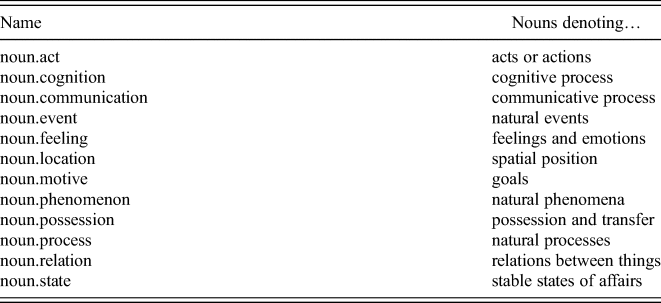
A noun's WordNet status allowed for additional truncating of the original list by including only those nouns that shared the semantic properties represented by the lexical file types listed in table 1. For instance, the noun offer in the CP make an offer would be considered an eventive noun and categorized as such by virtue of it being a noun of relation (e.g. ‘noun.relation’ in table 1) in WordNet (Chen et al. Reference Chen, Bonial and Palmer2015). Thus, all pairings of the lemmas of make and offer would be included. Additional examples are make + appearance (noun.action), make + improvement (noun.event), take + ownership (noun.possession) or take + swing (noun.action). Pairings that were omitted because they are not eventive or stative nouns included, for instance, take + fact or make + basis, which do not fall into any of the WordNet categories listed in table 1. Thirdly, a low-frequency cutoff was used. Any noun collocates that occurred alongside a verb at a rate of .05 words per million or less (5 tokens or fewer in the entire COHA subcorpus) were filtered out. This cutoff allowed for the exclusion of those verb–noun pairings that occurred at such a low rate that they appeared only sporadically.Footnote 14 For instance, the pairing of make + estimation occured only 5 times and was not considered in the empirical analysis, and many of the low-frequency pairings for sounds (e.g. peep, plop, plunk) that occurred with make fewer than 5 times in total in the subcorpus for the period under investigation were excluded. Finally, a manual check with crosschecking of the context in COHA was used. This was especially important in the case of nouns that were not listed in Brysbaert et al. (Reference Brysbaert, Warriner and Kuperman2014) or in WordNet annotations. The guidelines set up in Bonial et al. (Reference Bonial, Bonn, Conger, Hwang, Palmer and Reese2015) for light verb constructions were used to check for false positives that may have been included mistakenly or for any false negatives with nouns that, for various reasons, may have been unwittingly initially filtered out.
3.3 Identification of noun families
The next step involved identifying families of semantically similar nouns that occur in CPs with the same verb. I used FrameNet (Fillmore et al. Reference Fillmore, Johnson and Petruck2002) to identify families of noun collocates that occur with make, take, bear and lose. FrameNet allows for the classification of semantically similar nouns that are all part of the same semantic frame. It displays each frame along with a definition, the required and optional frame elements, and all lexical units that evoke this frame, with human annotations based on how words are used in actual texts. Although each frame evokes lexical units of varying parts of speech, nouns are the only lexical units of direct relevance to this study. In many cases, a family of nouns may consist of close synonyms in FrameNet, but in other instances, the words are related more generally by virtue of belonging to the same semantic frame (e.g. safari, pilgrimage and odyssey in the ‘Travel’ semantic frame). As Bonial (Reference Bonial2014: 176) notes, while it is possible that other factors may play a role in the semantic similarity of nouns that occur with the same verb, FrameNet comes close to capturing the semantic similarity between lexical items and identifies their shared membership in a real-world context.
After identifying nouns with common membership in frames according to FrameNet, I selected a number of families for comparative analysis based on several variables. First, I considered family size, operationalizing size according to the overall number of nouns that are members of a frame and which occur with the same verb in the COHA subcorpus. A ‘small’ family was defined as including 3 to 9 nouns, while a ‘large’ family contains 10 or more.
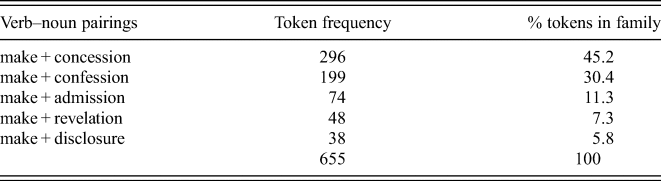
Secondly, I examined a range of families according to the frequency band to which the largest percentage of each family's tokens belong. After determining the aggregate token count of all members in a family from the decades between 1820 and 2009, I identified the frequency bands according to the following scale: high frequency (≥1000 tokens), medium frequency (300–999 tokens) or low frequency (≤ 299 tokens). For instance, consider the nouns in the ‘Similarity’ frame that occur with make in table 2. This group is considered a high-frequency family, because the largest percentage of tokens comes from the high-frequency band (i.e. greater than 1,000 tokens). Difference occurs with make 1,836 times in the subcorpus and makes up the largest percentage of tokens in the family. For comparison, consider table 3 and the low-frequency family of nouns like those from the ‘Reveal Secret’ frame which occur with make. The tokens in this family include verb–noun pairings that occur in the low-frequency band. All tokens occur at a rate of less than 300 in this family.Footnote 15
A high-frequency family of verb–noun pairings with nouns from the ‘Similarity’ frame and their token frequency and percentage of tokens in the family

A low-frequency family of verb–noun pairings with nouns from the ‘Reveal Secret’ frame and their token frequency and percentage of tokens in the family
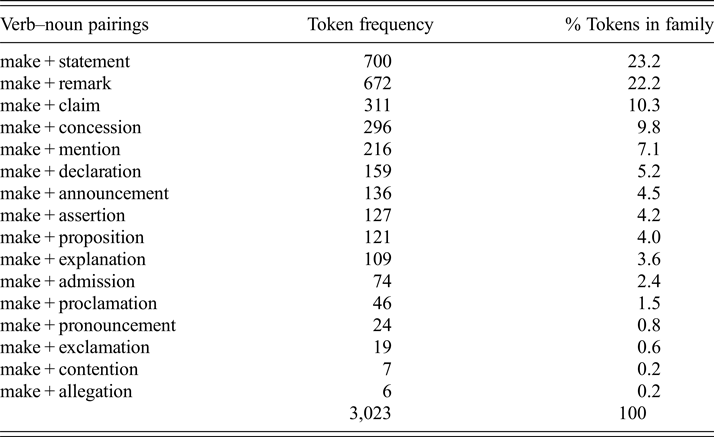
Thirdly, I examined families with different distributional patterns among the highest-frequency members. Bonial (Reference Bonial2014) compares families with a ‘long tail’ distributional pattern in which a single noun stands out from the other family members. This pattern differs from another pattern that she refers to as a ‘split tail’, with two members that have a proportionately higher token count than all other family members. Consider the difference between the family associated with make from the ‘Statement’ frame in table 4 and the family from the ‘Similarity’ frame in table 2. The ‘Statement’ family in table 4 exhibits a split tail, with similar token counts for both statement and remark. In comparison, the ‘Similarity’ frame nouns in table 2 exhibit a classic long-tailed distribution, with one dominant noun (e.g. difference) and other family members that exhibit a low token frequency.
A split tail family of verb–noun pairings with nouns from the ‘Statement’ frame and their token frequency and percentage of tokens in the family
4 Results
4.1 Type and token frequencies of CPs by verb
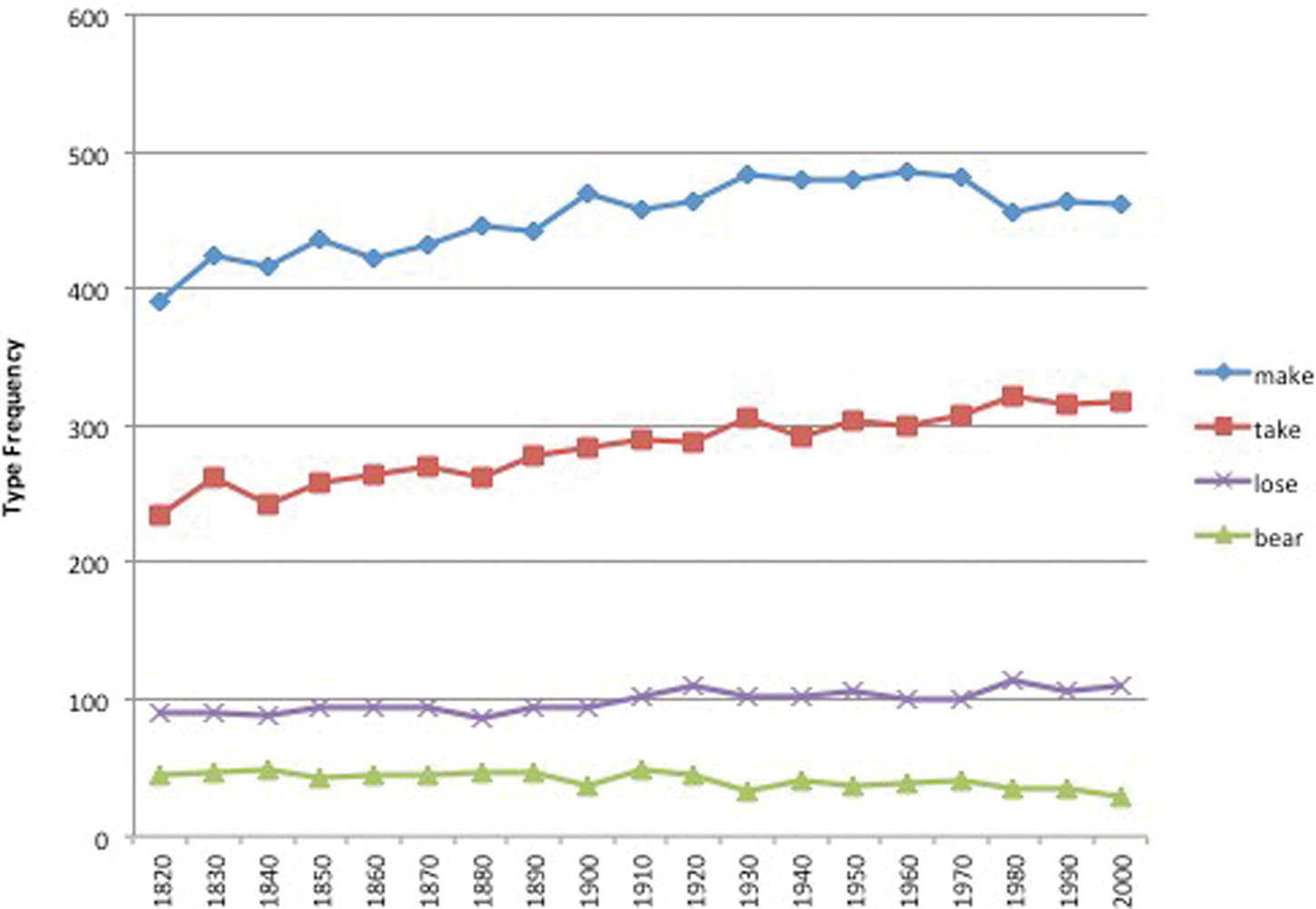
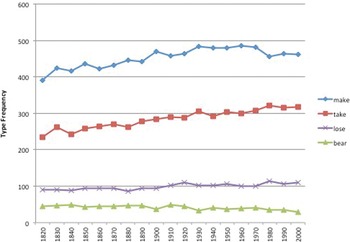
After identifying CPs with the methods of detection that are outlined above, I compiled the results of the frequency analysis for make, take, lose and bear (see figure 1). Both make and take exhibit high type frequencies that increase gradually between 1820 and 2009, while lose and bear exhibit comparatively low type frequency that rarely increases. A non-parametric test for significance (Mann–Whitney U Test) was conducted and revealed that there are significant differences in type frequency between make and take on the one hand and bear and lose on the other (Z-score is 7.495, p-value <.00001, significant at the level p < .05). Both make and take occur with a greater variety of nouns in NP complements in CPs, and this variety increases over the period under investigation. Unsurprisingly, lose and bear have a more narrow expressive range, with less variety of nouns in NP complements in CPs.
Type frequency of CPs with make, take, lose and bear
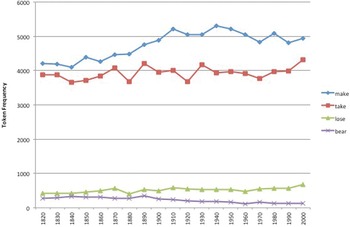
The pattern of token frequency of these four verbs is similar to that of type frequency. As indicated by figure 2, make and take are very different from lose and bear. As expected, the number of instances in which make and take occur in CPs is much higher than it is for the more lexically specific verbs. A Mann–Whitney U test indicates that the two pairs of verbs (make and take vs bear and lose) are significantly different from each other in terms of their token frequency (Z-score is 7.501, p-value <.00001, significant at the level p < .05). The frequency of take in light verb constructions undergoes some ups and downs but increases generally over time; make has a prominent and steady increase followed by a slight decrease. The token frequency of verbo-nominal CPs with lose remains relatively flat between 1820 and 2009, and in the case of bear, the number of tokens undergoes a consistent, gradual decline.
Token frequency of CPs with make, take, lose and bear

Another quantitative measurement that combines both type and token frequencies reveals noteworthy differences between these two groups of verbs over time. Following Sundquist's (Reference Sundquist2020) overview of measurements of lexical diversity, I use Margalef's Richness Index, a statistic that incorporates type and token frequencies for comparison on an equal scale over multiple time periods. Margalef's Richness Index allows for an analysis of how many unique verb–noun combinations occur over time and avoids issues of scaling which may arise when comparing high token frequency verbs like take or make with lower token frequency verbs like bear or lose.Footnote 16 Results of this test indicate that make and take increase in richness over the period between 1820 and 2009 (where R increases from 6.03 to 6.56 for make and 3.43 to 4.63 for take), while lose (4.42 to 4.21) and bear (2.66 to 2.61) decrease in terms of the unique combinations of NP complements with these verbs.
4.2 Family size
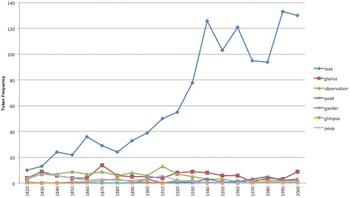
As pointed out in section 3.3, families of nouns vary in size, including small ones like the seven members of the ‘Perception Active’ frame in figure 3. The noun look occurs most frequently with take, as in the light verb construction take a look, while others like glance, glimpse, observation, etc. remain consistently and relatively infrequent. Some new nouns like gander appear with take for the first time later (e.g. in 1940) and occur only sporadically without any noticeable increase before the final decade.
A small family of nouns from the ‘Perception Active’ frame that occur with take

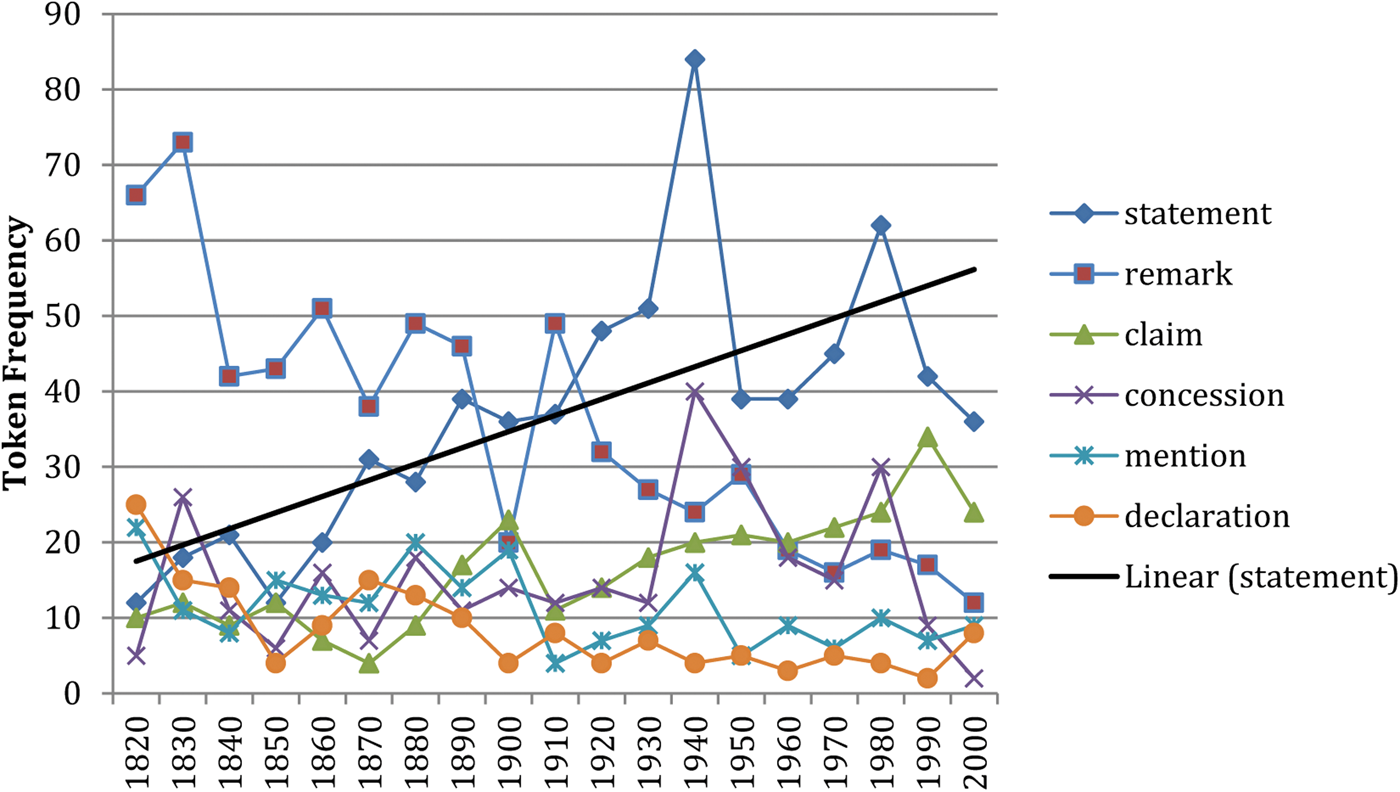
An example of a large family is associated with the ‘Statement’ frame, as noted in table 4. Frequency data from this family are depicted in figure 4 and display changes in token frequency over time. There are 16 members of this family that occur with make in the COHA subcorpus, (e.g. make a remark or make a claim).Footnote 17 Remark and statement have the highest token counts, although they exhibit divergent trends, with statement leading the way. The frequency of the other nouns, despite some temporary increases (e.g. claim in the 1990s) and decreases (e.g. declaration in 1800s), remains relatively low.
A large family of nouns from the ‘Statement’ frame that occur with make
4.3 Frequency bands
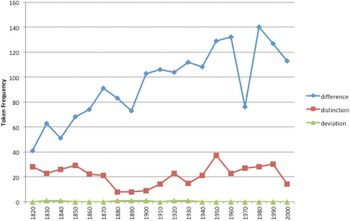
Following the method described in section 3.3, high-, medium- and low-frequency families were identified. An example of a high-frequency family was mentioned in figure 3, with CPs like take a look associated with the ‘Perception Active’ frame. Another example of a high-frequency family is given in figure 5 and includes nouns in the ‘Similarity’ frame that occur with make. The noun difference occurs in 81.3 percent (1836/2,258) of all the tokens in this family, putting the family in the high-frequency band. As figure 5 shows, difference continues to increase over time, while distinction and deviation remain at a low frequency.
A high-frequency family of nouns from the ‘Similarity’ frame with make

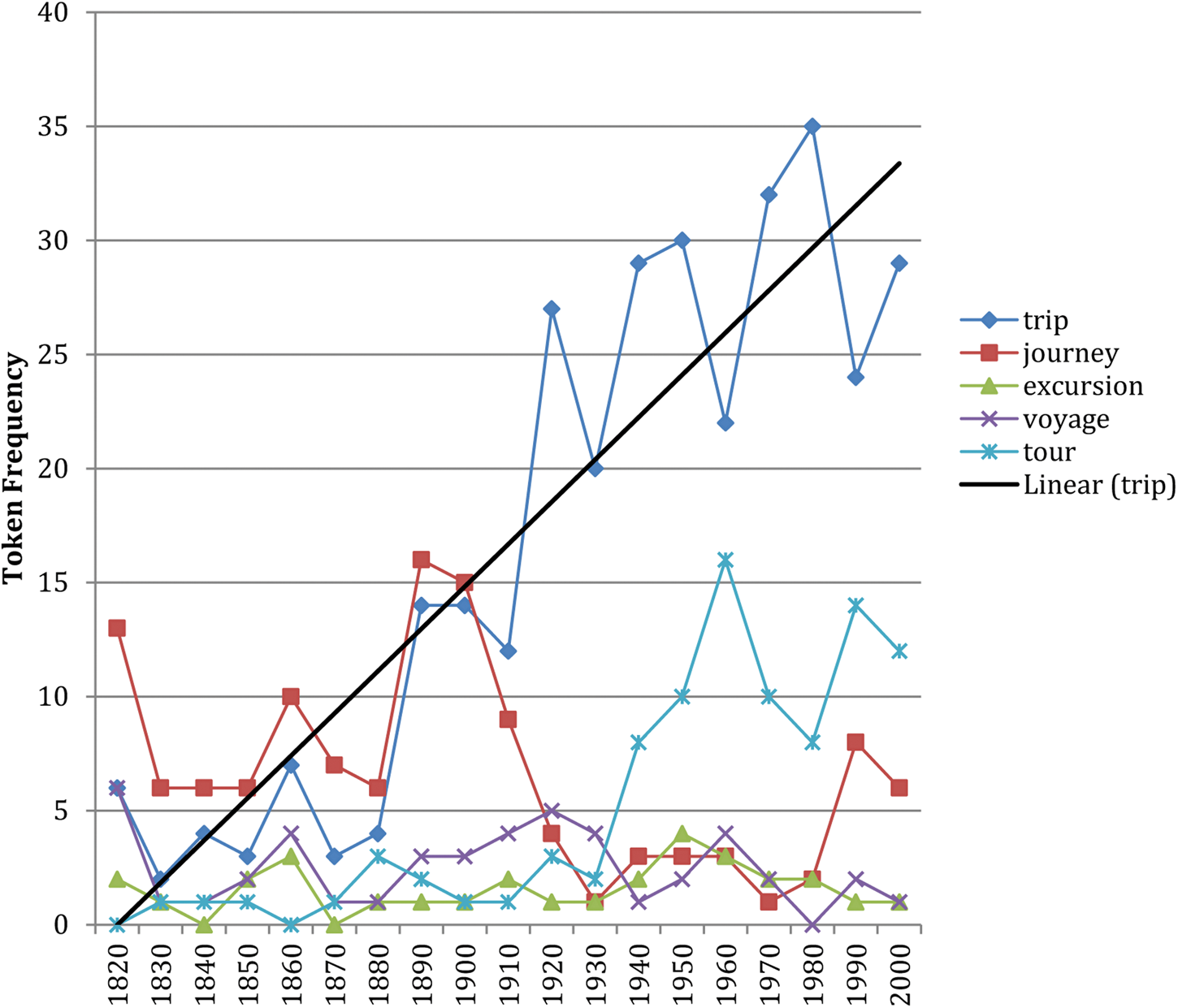
A family from the medium-frequency band includes nouns from the ‘Travel’ frame that occur with take, including nouns like trip, journey and excursion. In figure 6, the most frequent and consistently increasing pairing (take + trip) continues to rise while others remain lower or decline.
A medium-frequency family of nouns from the ‘Travel’ frame with take
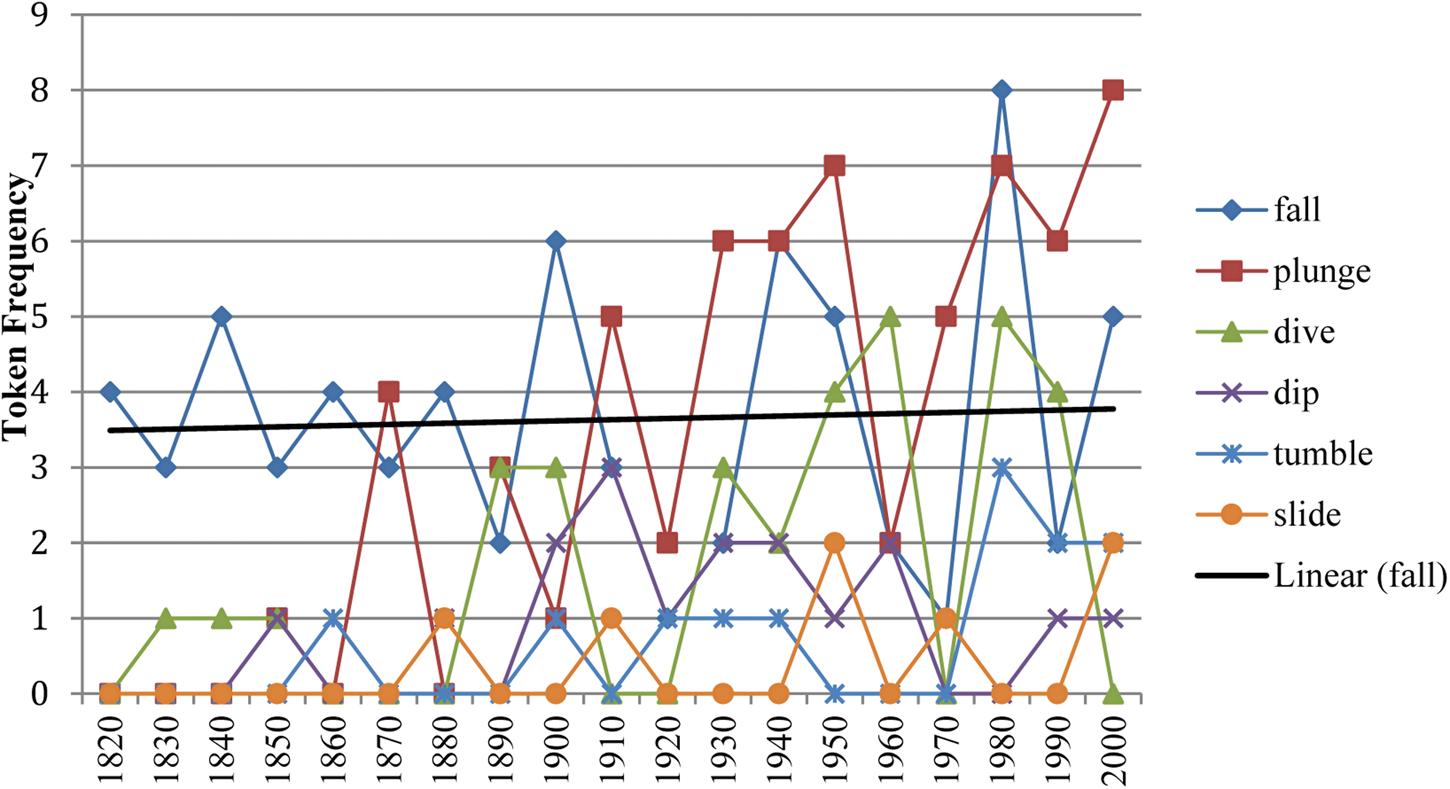
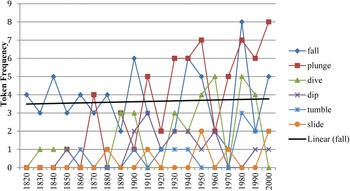
Lastly, an example of a low-frequency family includes nouns that evoke the semantic frame ‘Change position on a scale’ in FrameNet, as seen in figure 7. These include, for example, the light verb construction take a fall. The largest portion of tokens in this group involves verb–noun pairings that are in the low-frequency band. Although plunge exhibits an increase in the last several decades, none of the verb–noun pairings in this family show a noticeable trend toward becoming increasingly dominant, and all six members remain at a low token frequency between 1820 and 2009.
A low-frequency family of nouns from the ‘Change of Position’ frame with take
Thus, families whose majority of tokens occurs in medium- or high-frequency bands have at least one increasingly high-frequency pairing that stands out, while those families whose tokens mainly come from the low-frequency band do not. The diachronic data here also indicate that all low-frequency families in this study have fewer than ten family members. While there are both large and small families from medium- or high-frequency bands, there are no large families whose majority of tokens belongs to low-frequency bands.
4.4 Long-tailed and split-tailed families
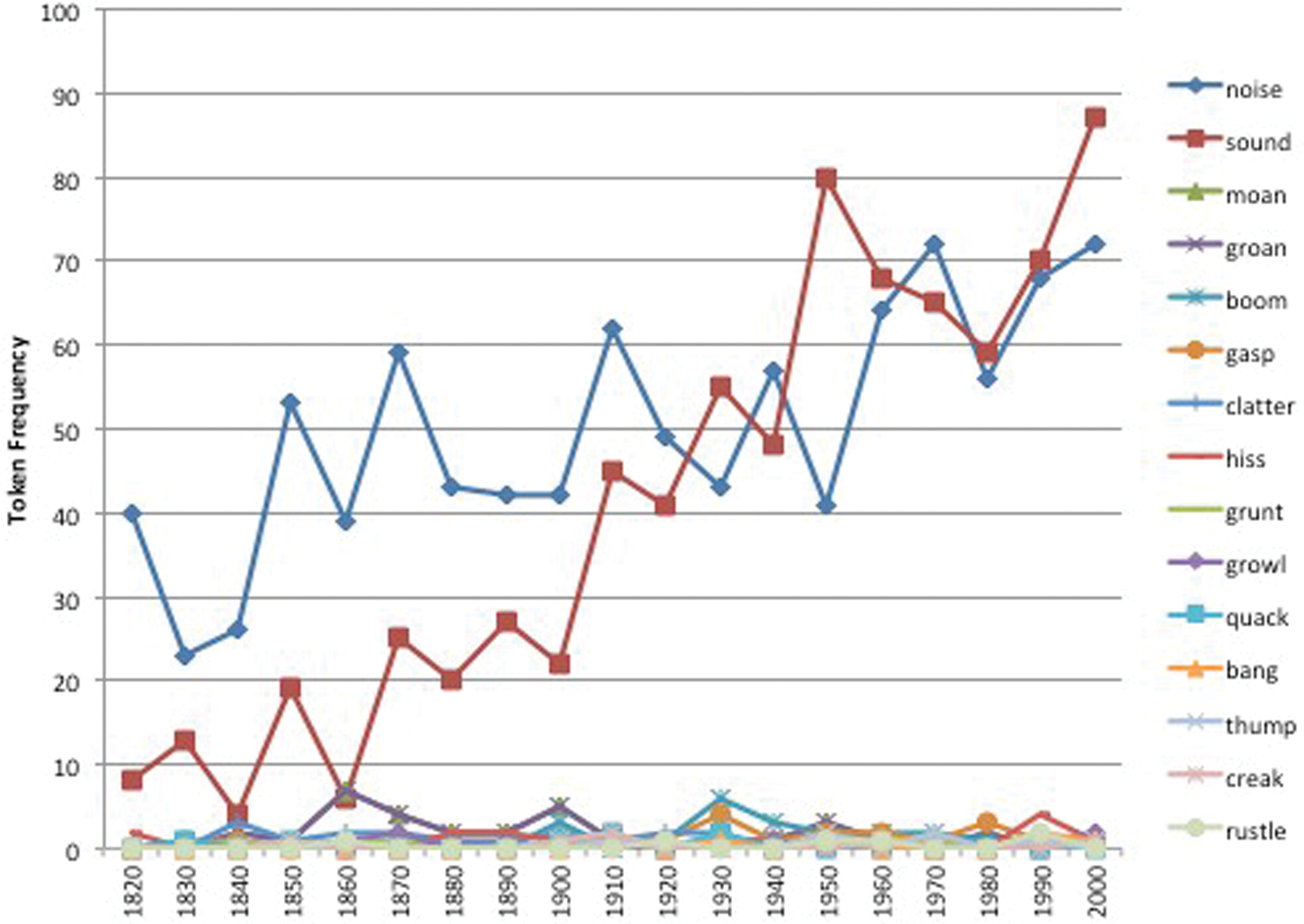
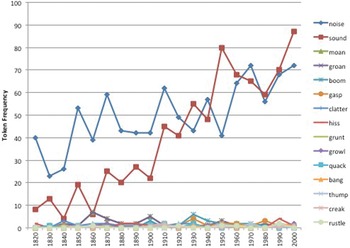
Data on the distributional patterns of high- and low-frequency verb–noun pairings indicate that most families have a long-tailed distribution, like those presented in figures 3, 5 and 6. A single verb–noun pairing separates itself from the others and increases in frequency. Some families, however, exhibit a split-tailed distribution, like nouns in the ‘Sounds’ frame that occur with make, as depicted in figure 8. This is a medium-frequency, large family with 15 members in a split-tailed distributional pattern. Pairings with both noise and sound separate themselves over time and continue to increase in frequency, while the other members remain at a low frequency. If extremely low-frequency nouns in this family were included in a post hoc analysis (e.g. blast, crunch, peep, plunk, plop, etc.), the membership of the family would be even greater. There are 12 additional nouns in the COHA subcorpus that occur below the minimum threshold of .05 words per million. Even with these additional members, the distributional pattern of frequency within the family stays the same: make + sound and make + noise continue to separate themselves as high-frequency pairings.
A split-tailed family of nouns from the ‘Sounds’ frame with make
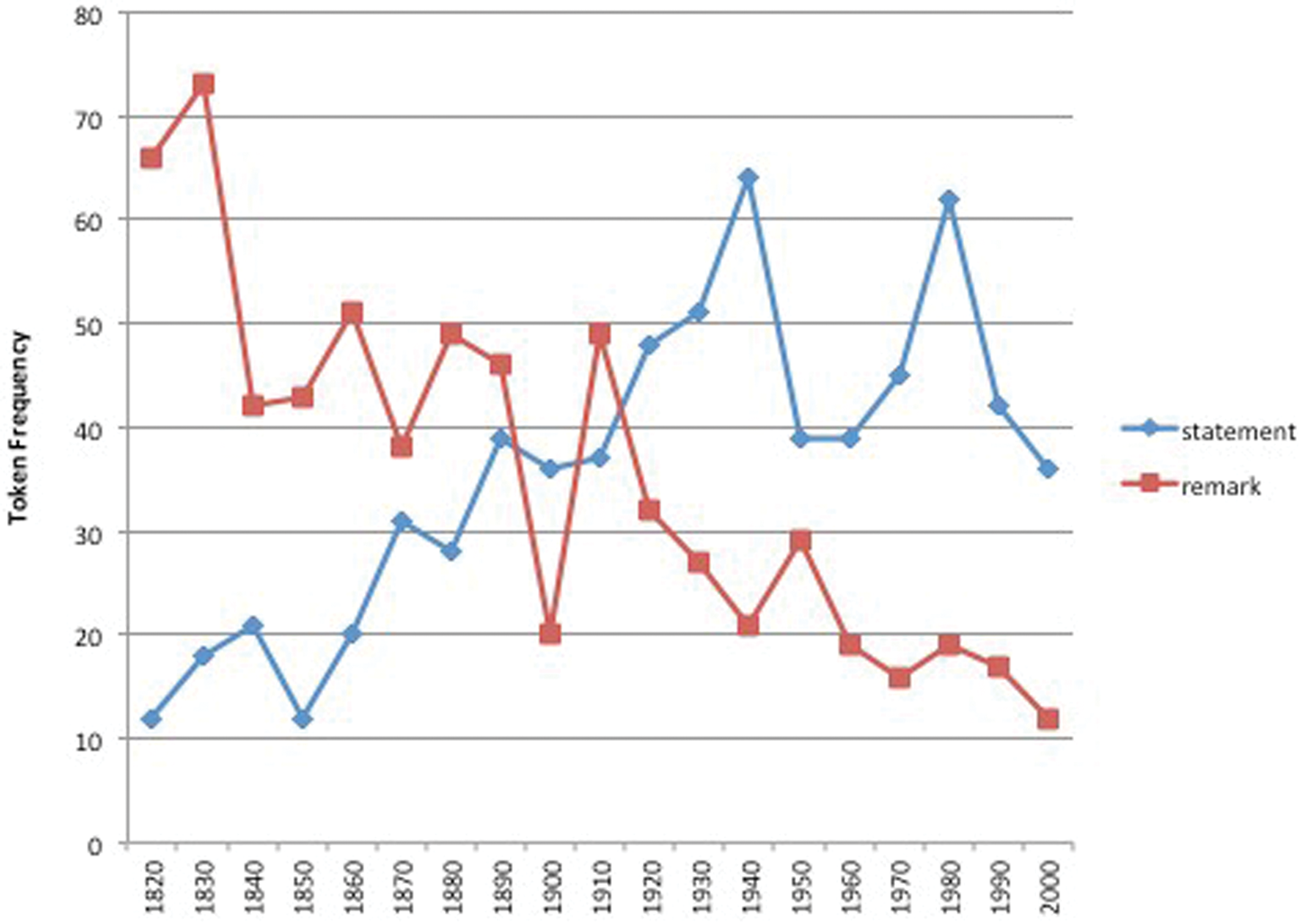
A similar tendency is seen in another large family, namely, the 16 nouns in the ‘Statement’ frame that were described in figure 4. In order to highlight the pattern of development of the two most frequent members, the data in figure 3 are repeated in figure 9 without the other members of the family. Although the family exhibits a split-tailed distribution, the most frequent member of the family switches midway near the beginning of the twentieth century. Remark undergoes a gradual drop in frequency between 1820 and 2000, while the frequency of statement increases.
Pairings of statement and remark from the ‘Statement’ frame with make
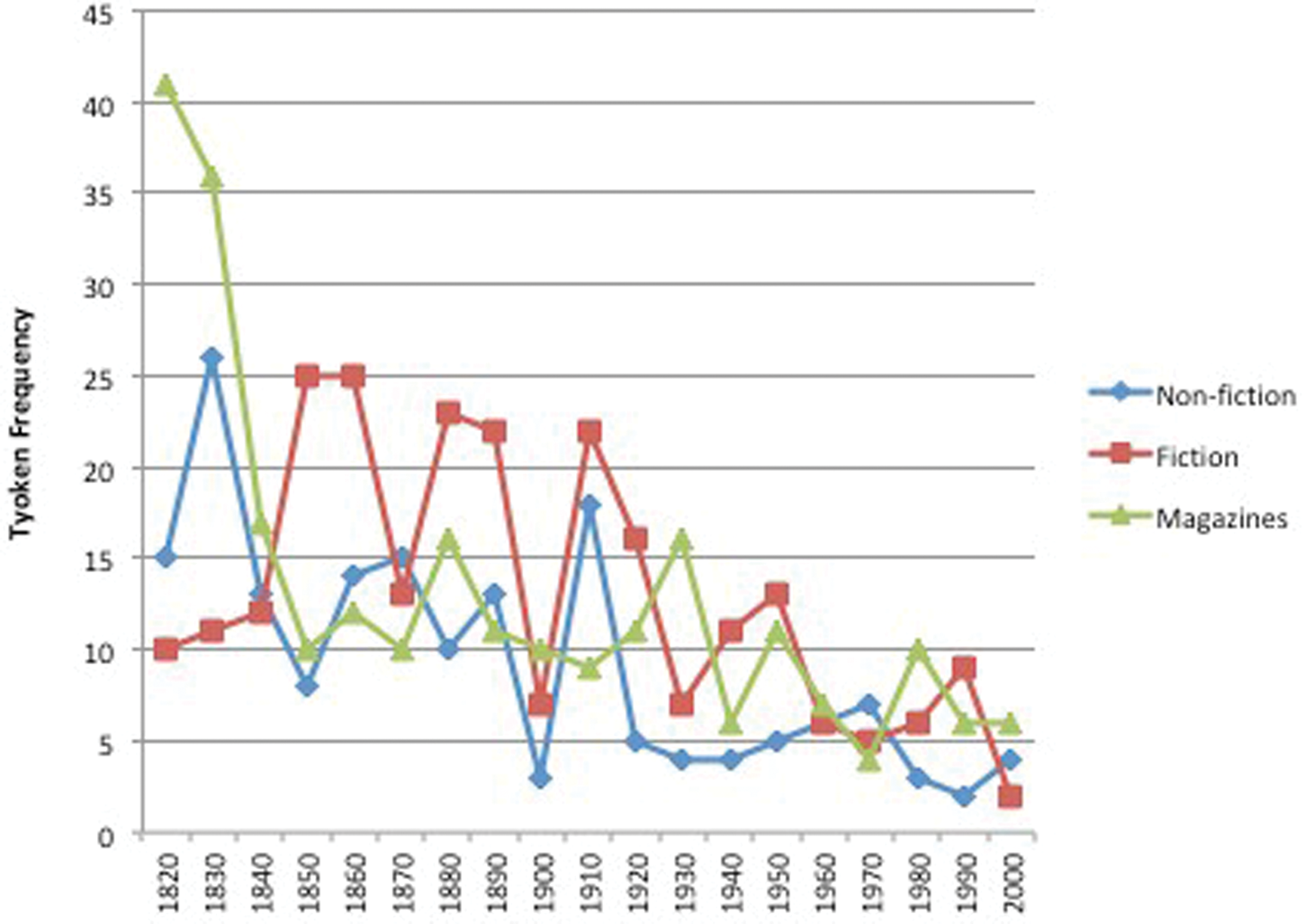
A closer analysis of make + remark indicates that the most noticeable drop in frequency occurs in texts from one genre, namely, magazines (see figure 10). Although the same declining trend is evident in texts from the non-fiction and fiction genres, the most noteworthy change comes from texts in this single genre, particularly in the decades from 1820 to 1850. Without these few early data points, the frequency of make + remark would not be much different than other pairings, and the family would not have a split tail. Make + statement would be the only high-frequency exemplar in the group, following a gradual increase in frequency that is typical of long-tailed distributional patterns.
A family of nouns from the ‘Statement’ frame with make in the COHA subcorpus (1820–2009) divided by genre
4.5 Similarities and differences between CPs with different verbs
The data presented thus far are limited to examples of families of nouns that occur with make and take. Results from the analysis of these families indicate that there are no noticeable differences between these two verbs with respect to variables like family size, frequency bands and distributional patterns. Both make and take occur with a wide variety of families, including those that are both small and large whose majority of tokens occur in any of the three frequency bands. In addition, there are split-tailed and long-tailed families of nouns that occur with make and take.
In contrast, examples of families that occur in CPs with lose and bear are rare. In some cases, the semantic frame with which a particular collocate noun is associated does not include enough other nouns in the corpus to achieve family status, or in other cases, the noun does not belong to any frames that are annotated in FrameNet. For example, bear occurs with risk, a noun that belongs to the ‘Daring’ frame and occurs in a well-formed CP in the COHA subcorpus (e.g. bear the risk). Even though there are several other nouns in this semantic frame with risk (e.g. chance, audacity, etc.), none of them are CPs with bear or occur in the study's subcorpus. Other nouns that occur in pairings with bear, like grudge, do not belong to a frame in FrameNet at all. Moreover, in some cases there might be a noun in a CP that shares a frame with another noun, but there are no other family members attested in the subcorpus. For example, control belongs to the same frame as command, and both occur frequently enough with lose to be considered for further analysis. However, two nouns are not enough for ‘family’ status, according to the data collection procedures outlined above that specify a minimum of three members.
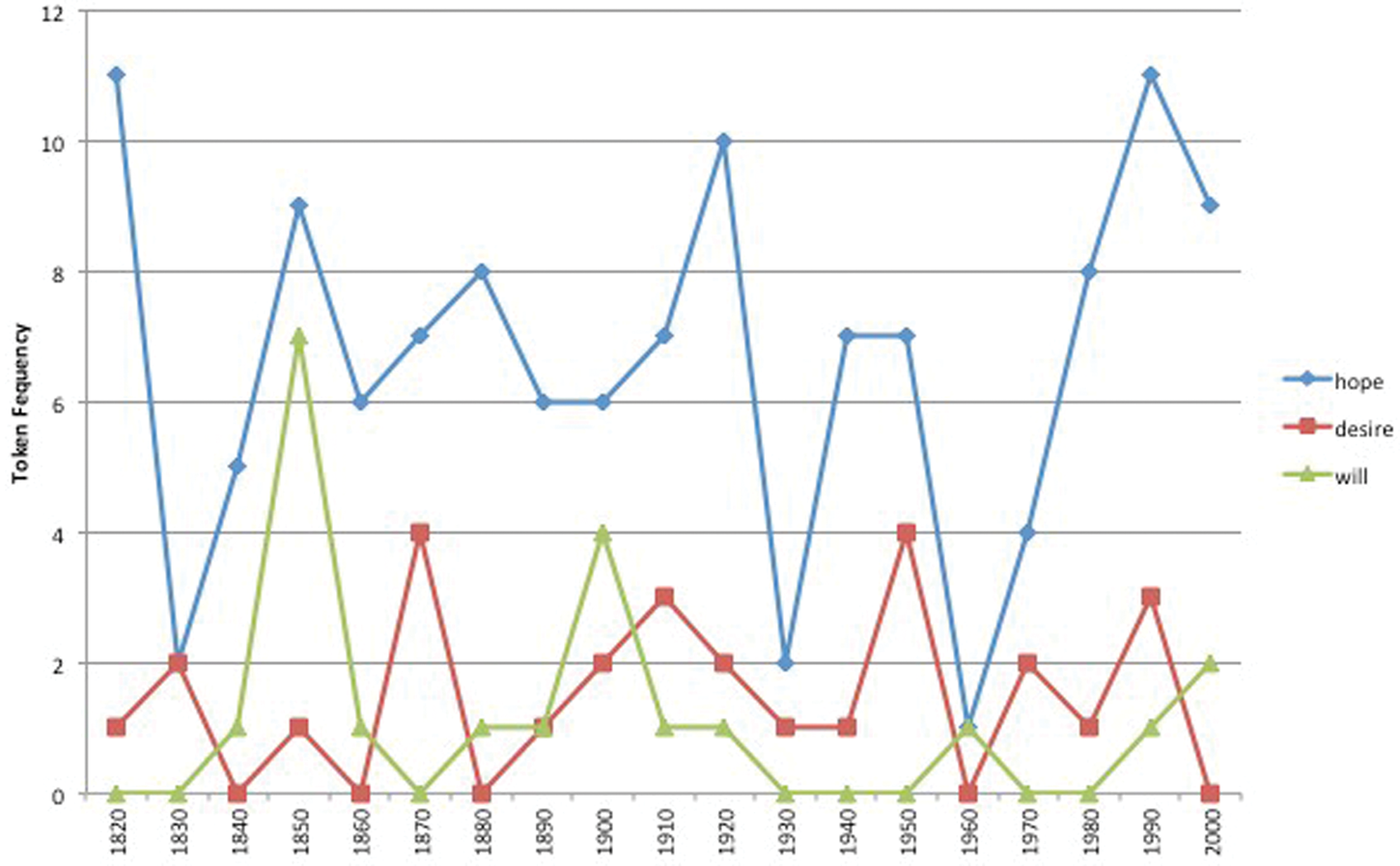
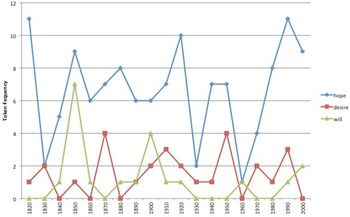
There are some exceptions in the case of both lose and bear. For instance, there is one family of three nouns associated with the ‘Desiring’ frame in figure 11. However, this is a small family from the low-frequency band with only hope, desire and will with lose. While lose + hope is the most frequent member, its token frequency is sporadic throughout the period under investigation and remains low, with fewer than 10 instances per decade.
Nouns from the ‘Desiring’ frame with lose
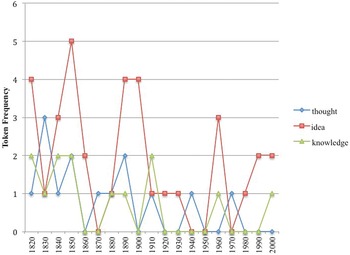
In a similar way, families with bear are also rare. One small family from the ‘Awareness’ frame includes three nouns that occur in CPs with bear, as seen in figure 12. This is another small family from the low-frequency band (i.e. the majority of nouns in this family when paired with bear have a token frequency ≤ 299). Although idea has the highest total token count, its frequency fluctuates at a low level and decreases. The frequency of the other members of the family also remains low and decreases.
Nouns from the ‘Awareness’ frame with bear

5 Discussion
This study poses the question whether light verbs in CPs are more likely to generate what might be considered exemplars than more lexically specific verbs. It also considers which factors are relevant to the evolution of exemplars in a diachronic analysis. Recall that three characteristics of exemplars of verb-nominal CPs with semantically lighter verbs are considered in this study: how certain verb–noun pairings separate themselves by nature of their high token frequency, how their token frequency consistently increases rather than decreases, and how many unique pairings with semantically similar nouns occur with the same verb. Moreover, the previous literature on multi-word verbal expressions notes general differences between types of CPs, differentiating those like take a look with a light verb and others like lose sight with a more lexically specific verb. Results indicate that there are several families with semantically similar nouns that combine with take and make to generate CP exemplars, while those that pair with lose and bear do not. CPs of the take-a-look type include exemplars with make (e.g. make + sound or make + statement) and take (e.g. take + trip or take + look), where a high-frequency pairing separates itself, increases in token frequency over several centuries and, as will be addressed below, exhibits an expanding range of semantically similar nouns that may be paired with the verb. Data reveal that lose-sight CPs follow a different pattern: other than a few isolated high-frequency combinations with bear or lose (e.g. bear witness or lose sight), there are no high-frequency pairings that consistently increase in token frequency and function as successful exemplars that could be the basis for analogy over a long period of time.
By focusing more specifically on the distribution of high token and type frequencies among these families for the two different CP types, I was able to determine which factors shape the generation of exemplars or lack thereof. Findings from the analysis of representative types of families indicate that family size and the distributional pattern of tokens within a family do not have a noticeable effect on the presence or success of exemplars. In the case of family size, for example, families with as few as three members or as many as 16 verb–noun pairings have exemplars that stand out and increase consistently in token frequency. The number of family members does not affect whether one pairing separates itself from others or not. Moreover, the distribution of tokens within a family does not play a noticeable role: families that exhibit either a long-tailed distribution or split-tailed distribution have pairings that have characteristics of exemplars. In the case of some split-tailed distributional patterns, one of two high-frequency pairings may replace another over time (e.g. ‘Statement’ nouns with make), or in other instances, two pairings rise in tandem with each other (e.g. ‘Sounds’ nouns with make). However, there is no difference between split-tailed families and long-tailed families with respect to the presence or absence of a leading exemplar. In sum: in the case of most CPs, neither the family size of nouns nor the distribution of tokens within the families has an effect the presence of certain exemplars.
The frequency band of a family's tokens, on the other hand, does have a noticeable effect on whether a family will include a certain pairing that separates itself from the others. Recall that families whose majority of tokens is in the high- and medium-frequency bands are more likely to have pairings whose token frequency consistently rises. High-frequency bands of tokens like those in the make + difference family or even medium-frequency bands (e.g. take + trip) yield examples of singular verb–noun pairings that set themselves apart – regardless of the size of the family. Moreover, these pairings continue to increase over time. Verb–noun pairings in low-frequency bands (e.g. take a fall), even those CPs with light verbs, fail to separate themselves or show any increases at all.
This pattern is expected if we consider their exemplars to be cases of simple entrenchment. In terms of the high- and medium-frequency bands of tokens among families of nouns, the more frequent and readily accessible pairings become, the more likely it is that they will be used more frequently. In a sense, ‘the rich get richer’, and the most frequent pairings are the ones that will continue to increase over time.Footnote 18 In other words, once an exemplar begins to separate itself, it continues along this trajectory – with only temporary decreases. During this same time, low-frequency pairings in high-frequency bands occur but never increase consistently like the exemplar(s) in the family. Novel expressions lose out in the long term due to stronger associations to the more conventional formulations (Goldberg Reference Goldberg2019: 61). Moreover, as we see in the case of the low-frequency bands of verb–noun pairings, there are no conventional formulations that provide the basis for strong associations for entrenchment in these cases. No pairings separate themselves from the other in terms of token frequency.
Specific data on frequency bands in take-a-look CPs vs lose-sight CPs indicate noteworthy differences in the trajectory of high-frequency pairings in these two types of CPs. Recall that both take and make occur with a wider variety of noun families, most of which have a high-frequency verb + complement combination or two. As indicated in section 4, take a look provides a clear example: look occurs frequently with take as the lone example in a family of many similar nouns; the token frequency of this single pairing continually rises while other nouns fail to increase in CPs with take. In the case of lose and bear, there are simply no examples in which a verb–noun pairing's token frequency both separates itself from others and increases over time. Instead, tokens of pairings in the few families with lose and bear occur primarily in the low-frequency bands, if at all. Any nouns in high-frequency pairings that occur with these verbs are isolated instances that show no long-term increases and do not belong to a semantically similar family of other nouns in CPs.
More fine-grained analysis of individual pairings with lose-sight CPs reveals the idiomatic, non-compositional nature of this type of CP. For instance, both lose + sight (910 total tokens) and another more fixed expression, bear + witness (379 tokens), exhibit high frequencies throughout the whole period. However, bear + witness and lose + sight undergo occasional decreases rather than any kind of long-term, prominent increases. In the case of bear + witness, mutual information (MI) scores in COHA indicate high collocational strength in each decade between 1820 and 2009 (mean MI score = 8.55, SD = 0.41 for co-occurrence within five slots), with a slight decrease in MI score from 9.09 in 1820 to 9.04 in 2009. For lose + sight, the MI score is also consistently high in each decade (mean MI score = 7.74, SD=0.36 for co-occurrence within five slots), but with a slight decrease over time (7.96 in 1820 and 7.50 in 2009). In other words, the collocational strength mirrors the high but gradually decreasing token frequency of these fixed expressions in the eighteenth and nineteenth centuries. The idiomatic use of these pairings is reflected in their specific meanings: neither witness nor sight belongs to any kind of larger families of similar nouns that occur with the same verb in other CPs. In both cases, the verbo-nominal CP contains a bare NP and is attested in COHA with no other modifications within the NP (e.g. *bear a good witness, *bear witnesses vs bear witness). Moreover, the nouns in these CPs are irreplaceable (e.g. *lose vision, *lose view vs lose sight). Their token frequency remains relatively high, but they are clearly more formulaic expressions that are used only in specific contexts (Brinton Reference Brinton, Seoane, López-Couso and Fanego2008: 45). In the case of bear + witness, the CP is often used in legal or religious contexts. Lose + sight has developed a metaphorical meaning, as in ‘not able to keep fresh in one's mind’, alongside the more literal meaning in which one is ‘no longer able to see’ (Brinton Reference Brinton, Seoane, López-Couso and Fanego2008: 45). In other words, CPs of this type are more often restricted to specific idiomatic usages and lack interchangeability of parts. On the other hand, light verbs like take or make, while they do occur in some more idiomatic phrases (e.g. make a killing, take the reins), occur with a wide range of NP complements with more substitutability of component parts.
Differences between the two types of CPs underscore the importance of frequency bands in explaining the generation of exemplars. As Bybee (Reference Bybee2010: 38–9) points out, the most frequent exemplars are the most accessible and promote faster recognition of and greater clustering with other similar forms; constructions with high type frequency will be more likely to be used simply because of the ever-increasing strength of association and the greater number of candidates on which to base analogy (2010: 95). In the case of frequency bands like those in take-a-look CPs, exemplars and other high-frequency similar pairings continue this trend by continually providing more evidence in favor of the stronger associations. Similar findings provided by Bonial (Reference Bonial2014) in her analysis of perception of novel light verb constructions support these findings. Conversely, while lose-sight CPs do occur with high-frequency individual pairings (e.g. lose + sight or bear + witness), these pairings do not group together to strengthen association with other similar forms. Any group of similar pairings like these isolated, idiomatic pairings remains small and fails to grow over time to be a part of a larger and more robust pattern that is typical among high-frequency bands.
These differences between verbs shed light on issues of the relative productivity of the different types of CPs and the role of exemplars. Assuming type frequency to be a strong indicator of productivity as discussed in section 2.4, it is not surprising that make and take are associated with a greater number of families – and larger families. In the same way, the paucity of families with bear and lose is expected if we consider their low type frequencies and more limited expressive range. As Allerton (Reference Allerton2003: 173) describes it, there is a niche that is created by the semantic preciseness of lexically specific verbs.
Differences in the relative productivity of each type of CP relates to the notion of coverage outlined in Goldberg (Reference Goldberg2019: 61). CPs with make and take exhibit wider coverage by virtue of their generalized meaning, their high type frequency (e.g. the number of unique co-occurring NP pairings), the great variability of semantically related noun families that can be associated with them, and the similarity with which a new verb + noun coinage might resemble others that include nouns from previously established families. In the case of take a look, several similar pairings with take occur at a low frequency as early as 1820, including glance, peak, glimpse or observation. This family appears to expand to include novel pairings at a low frequency, such as gander, which first appears with take in the 1940s in the COHA subcorpus, after the steep rise of take a look in the late 1800s (figure 3). Take a gander fades out of use, along with other low-frequency CPs like take a peep by the 1930s. Even though these novel creations are short-lived in this subcorpus, they provide evidence that take + look is a productive pairing that functions as the basis for new pairings that share some overlap in meaning. In a similar way, make occurs with nouns similar to difference as early as 1820. A new pairing like make a deviation occurs for the first time shortly thereafter in 1830 before it continues at a low rate and ultimately disappears by 1930. Moreover, novel pairings similar to make + sound and make + noise occur throughout the eighteenth and nineteenth centuries, showing further temporary expansion: make + boom first occurs in 1880 and other newer combinations like make + bang or make + thump come on the scene in 1910, in the middle of the increase of these two exemplars in the late nineteenth and early twentieth centuries. There are many low-frequency pairings with make that occur between 1820 and 2009, including rare pairings with blast, crunch, peep, plunk or plop that provide further evidence that this is an expansive family of nouns which resembles the two exemplary pairings make + sound/noise. While many of these coinages remain at a low frequency or die out, this more fruitful breeding ground for exemplars is made possible by the extensive coverage provided by CPs with generalizable, semantically lighter verbs.
On the other hand, CPs with bear and lose do not show this kind of coverage. One of the few examples of a family of similar nouns that occur with the same verb is nouns from the ‘Awareness’ frame with bear. The highest-frequency pairing in this group is bear + thought, and the family associated with this frame contains only three members; yet all three members exhibit declining frequency. Moreover, no novel pairings similar to bear + thought appear throughout the entire period of 200 years. High-frequency idiomatic pairings with lexically specific verbs (bear + witness, lose + sight) remain isolated instances with few similar expressions that share semantic properties. Unlike take or make which allow for a wider variety of eventive nouns, bear and lose generate no clear exemplars and do not follow this pattern of productivity over time.
6 Conclusions
Results indicate that an exemplar-based model may be useful in any study of differing types of CPs from a diachronic perspective. This approach sheds light on the ways in which changes to type and token frequencies play out over a longer period of time: one is better able to evaluate the dynamic relationship between high- and low-frequency CPs from different points in time rather than being limited to a snapshot of current usage. Quantitative analysis of families of semantically similar nouns reveals that it is common for one or two verb–noun pairings with take-a-look CPs to separate themselves from others and continue to become more frequent while at the same time allowing for the introduction of novel or low-frequency pairings within the same family. On the other hand, lexically specific verbs in CPs like lose sight generate few exemplars that are part of larger families. Various explanations for the findings were offered, including discussion of entrenchment, coverage and productivity of these two types of CPs.
Analysis of several variables reveals that the frequency band from which the majority of tokens in a family occurs and the verb itself (i.e. make/take vs bear/lose) contribute to the success of certain exemplars. The size of the family does not affect the presence and proliferation of these high-frequency verb–noun pairings, although the distribution of tokens can have an effect on the success of some exemplars if the families have a large membership and split tail. Several different kinds of families were considered representative of these variables across verb–noun combinations that include each of these four verbs.
These findings have theoretical implications for our understanding of how an exemplar-based model of composite predicates might relate to grammaticalization and lexicalization.Footnote 19 In particular, the data here support the view in Brinton & Traugott (Reference Brinton and Traugott2005) and Brinton (Reference Brinton, Seoane, López-Couso and Fanego2008) that the historical trajectories of CPs are not all alike, and that some are the product of wholly different diachronic processes. Take-a-look CPs exhibit characteristics typical of grammaticalization, since they exhibit host-class expansion and greater grammatical flexibility. Exemplary verb–noun pairings with light verbs continue on a consistent path of entrenchment with expanded coverage. Lose-sight CPs, on the other hand, exhibit typical characteristics of lexicalization: when such CPs are considered as a whole unit, they tend to become more idiomatic and non-compositional. The greater lexical specificity of the verbs leads to host-class reduction rather than expansion. The more idiomatic expressions in CPs with such verbs as lose or bear remain non-productive as they follow a path typical of lexicalization where high-frequency exemplars and ever-growing families of semantically similar pairings are lacking.
Future research of this topic could explore several new avenues of discovery related to CPs and exemplars from a diachronic perspective, addressing some of the limitations of the study. First of all, only four verbs were analyzed here. It would be interesting to include other light verbs, such as give, have or do, as well as other more lexically specific verbs. In this way, one would be able to find additional support for the view here that verbs in some CPs are more likely to generate exemplars than others. Moreover, we would also be able to examine more families of semantically similar nouns to analyze the variables of family size, token distribution and frequency bands, and the interaction of these variables. This study is limited to just a handful of families that exemplify some of the effects of these variables, and a greater number of families is necessary for more robust hypothesis testing. A wider selection of verbs would allow for more in-depth analysis of split- and long-tailed distributions within some families in order to gain understanding of what factors are at work. Lastly, a qualitative analysis of certain verb–noun pairings would help explain the varying degrees of productivity and divergence of these two CP types over time. Cross-family comparisons might reveal similar characteristics among exemplars or uncover reasons for differing paths of diachronic development. Such follow-up studies may shed new light on the link between exemplars and lexicalization, grammaticalization and productivity of CPs in a variety of cross-linguistic analyses.







 Open access

