




Introduction: from ecological strain, to mobilization, to scholarly inquiry
Across Turkey, the signs of ecological strain are hard to miss: wildfires consuming vast stretches of forest; fertile olive groves threatened by legislation favoring mining ventures; rivers and valleys transformed by energy infrastructures; cities suffering under extreme heat and depleted water supplies. Unable to sustain smallholder farmers, agricultural produce is left to rot in the fields, while consumers approach even the simplest items at the market with suspicion about their purity and safety. These are no longer isolated incidents but amount to a cumulative ecological crisis that is increasingly existential in scope, reshaping landscapes, livelihoods, and collective imaginaries alike. What emerges, then, is not a crisis that can be addressed through technical solutions alone but one that demands a holistic reckoning at the entanglement of ecology, economy, culture, and society.
Against this backdrop of cascading ecological crises, a set of questions arises: how can scholarship keep pace with the urgency of these developments in an academic climate that has historically remained largely unengaged, if not openly hostile, toward the study of the environment? To what extent has environmental scholarship in Turkey matured to address the magnitude of these transformations, and where does it continue to lag behind the scope of the ecological crisis and the response it has provoked? In 2012, Murat Arsel captured the problem succinctly when he described environmental studies (ES) on Turkey as “relatively weak,” shaped by sharp disciplinary divides and overshadowed by a staunch belief in developmentalism (Arsel Reference Arsel2012, 72). He also pointed to the poor fit between the interdisciplinary orientation of ES and the rigid disciplinary organization of Turkish academia, as well as the limited institutional presence of geography and anthropology departments that nurtured the field in other contexts. Equally important was the failure of environmental conflicts in Turkey to attain emblematic status that elsewhere energized research.
As persuasive as Arsel’s diagnosis was in 2012, much has changed in how environmental problems are experienced, discussed, and contested in Turkey. Since then, a host of developments – from the galvanizing effect of the Gezi uprising to the government’s inadequate responses to natural disasters (e.g. wildfires, earthquakes, flash floods, and the COVID-19 pandemic), from the deadly coal-mining catastrophe in Soma, to the delayed ratification of the Paris Climate Agreement – has made the environment more than ever a matter of public concern, and an unavoidable political agenda item.
As this heightened public and political salience has spilled into academia, the past decade has witnessed a surge of scholarship on environmental issues in Turkey. In fact, ES for many has come to present more than a narrow technical engagement with socio-ecological problems; it has also become a way of rethinking Turkey’s broader political and social transformations, with the ecological lens offering new analytical and theoretical openings.Footnote 1 This surge has covered virtually every aspect of environmental inquiry, touching on social movements (Arsel et al. Reference Arsel, Akbulut and Adaman2015; Aydın and Turhan Reference Aydın, Turhan, Dinç and Ünler2025), climate history (Pehlivan Reference Pehlivan2020), green income support (Doğan et al. Reference Doğan, Tekgüç and Yeldan2023), urban greenery (Erensü et al. Reference Erensü, İne and Adanalı2022), governance of genetically modified organisms (Yağcı Reference Yağcı2019), environmental heritage (Yüceer et al. Reference Yüceer, Baba, Gönülal, Uştuk, Gerçek, Güler and Uzelli2021), urban adaptation (Yazar and York Reference Yazar and York2023), gendered environmental attitudes (Öztekin et al. Reference Öztekin, Teksöz, Pamuk, Sahin and Kilic2017), agro-ecology (Atasoy Reference Atasoy2017), seed politics (Nizam and Yenal Reference Nizam and Yenal2020), and environmental tourism (Örs et al. Reference Örs, Ermeç, Çatlı and Çağay2022), and has been complemented by a number of comprehensive edited volumes that delineate the field’s contours (Adaman et al. Reference Adaman, Akbulut and Arsel2017; Aksu et al. Reference Aksu, Erensü and Evren2016; İnal and Turhan Reference İnal and Turhan2020; Kaşdoğan et al. Reference Kaşdoğan, Kurtiç and Ekinci2025). What remains missing, however, is a systematic assessment of this body of work – its trajectories, silences, and methodological tendencies. This paper, therefore, revisits the earlier diagnosis of ES on Turkey, assessing its subsequent growth, diversification, and persistent gaps within this shifting landscape.Footnote 2 Combining bibliometric mapping with close readings of the literature, demographic and disciplinary profiling of authors and institutions, as well as semi-structured interviews with scholars, this paper offers a mixed-methods assessment of the field’s trajectories.
Critically reflecting on a subdiscipline’s evolution requires clarity about its boundaries. If the said subdiscipline is as interdisciplinary as ES, this reflection is preceded by a form of disciplinary soul-searching, an attempt to clarify core assumptions and intellectual commitments that give the subdiscipline its shape. We therefore begin with a brief conceptual and historical inquiry asking how ES has been defined, how its boundaries have been drawn, and what these tensions imply for the case of Turkey. Building on this conceptual groundwork, the analysis unfolds across four dimensions, collectively tracing the field’s formation from its intellectual architecture to its political–economic conditions. We first map the field’s material and social footprint by charting its explosive growth, demographic composition, and the institutional pathways. We then probe its intellectual contours, analyzing the disciplinary orientations and methodological habits that define scholarly practice, revealing a fragmented knowledge landscape. To understand how these patterns are justified and contested, we turn to scholars’ own narratives, exploring how the field’s perceived boundaries, professional circuits, and political entanglements shape its internal logic. Finally, we situate these epistemic formations within the larger forces that structure them: the dual pressures of an authoritarian political climate and an international funding regime that simultaneously constrains and propels environmental research.
A conceptual hardship: defining environmental studies
Although environmental thought has deep historical roots, the consolidation of ES as a recognizable academic field is a relatively recent development, taking place in the final third of the twentieth century (Soulé and Press Reference Soulé and Press1998). Earlier intellectual milestones, such as the seismic impact of Darwinian evolution and the rise of the conservationist movement, generated conceptual foundations, yet did not cohere into a unified scholarly project linking ecological dynamics with social life. That convergence emerged only in the late 1960s and early 1970s, a period marked by growing public awareness of environmental degradation, a series of widely mediatized ecological disasters (e.g. mercury poisoning in Minamata, Japan and the Santa Barbara oil spill in the United States), and the establishment of new interdisciplinary journals such as Natural Resources Journal (1960), Environment and Planning (1969), Antipode (1969), and Environmental Conservation (1974). These journals provided critical platforms for scholars whose interdisciplinary work often found little space in traditional disciplinary venues.
The field expanded further in the 1990s as “sustainable development” rose to global prominence, followed by the ascendance of climate change as a central organizing problem starting in the late 2000s. ES evolved into a capacious intellectual space that asked not only how ecosystems change, but how such transformations reverberate through politics, culture, and social inequality. In this regard, ES seeks to understand nature’s degradation and its impact on human communities and other species, while recognizing that the relationship between nature and society is not unidirectional but co-constitutive (Kanazawa Reference Kanazawa2017; Zapf Reference Zapf2022). Nature is never just a passive backdrop to human activity; it is mediated through language, culture, and power (Castree et al. Reference Castree, Hulme, Proctor, Castree, Hulme and Proctor2018). As such, representations of nature, myths, narratives, and scientific models are as central to ES as the empirical tracking of the biophysical reality of environmental change.
Although the history of the establishment of ES as an academic field follows a lineage composed of developments from the Global North, it must be noted that scholars and environmental justice movements across the Global South have simultaneously questioned the assumptions of Western scholarship (Caminero-Santangelo Reference Caminero-Santangelo2014; Martinez-Alier Reference Martinez-Alier2002) and cultivated a rich tradition of their own (Dwivedi Reference Dwivedi2001; Shiva Reference Shiva1988). ES scholarship of the Global South has been deeply influenced by the ecological struggles and the colonial past of their respective loci of focus, and has questioned the theoretical foundations of Western notions of environmentalism, highlighting struggles over development, land rights and dispossession; drawing attention to the unequal dynamics of environmental knowledge production (Jasanoff Reference Jasanoff2010); and proposing alternative frameworks rooted in traditional and Indigenous knowledge systems. ES on Turkey, while influenced by diverse geographies of scholarship, has nonetheless more broadly adopted Western theories, methods, and concepts. However, a small but important body of work within ES on Turkey seeks to develop analyses grounded in local struggles, histories, and socio-ecological specificities, rather than simply applying externally produced frameworks (Arsel et al. Reference Arsel, Akbulut and Adaman2015; Pehlivan Reference Pehlivan2020; Zeybek Reference Zeybek, Turhan and İnal2020). Recognizing these exceptions is crucial, as they point to the potential for strengthening ES on Turkey through locally rooted theorization emerging from the country’s own lived realities, rather than a complete rejection of transnational influences.Footnote 3
A persistent axis of differentiation in this knowledge landscape lies between Environmental Studies (ES) and Environmental Sciences (ESc). While the latter remains anchored in the epistemologies of the natural sciences, drawing heavily from disciplines like biology, chemistry, geology, and atmospheric science, the former foregrounds the cultural, social, political, economic, and ethical dimensions of environmental issues (Johnson et al. Reference Johnson, Ilhan and Frickel2020). Cross-pollination between ES and ESc has become a shared aspiration across the field, with many programs bringing natural scientists, social scientists, and critical theorists into closer conversation.Footnote 4 In practice, however, these integrative ambitions sit alongside persistent disciplinary habits, institutional separations, and differentiated publication cultures. Against this backdrop, ES provides a particularly relevant entry point for our analysis, not because it resolves these tensions, but because it intentionally engages the social, cultural, and political dimensions of environmental issues. For the purposes of this article, we focus on ES as a field whose very heterogeneity makes it a useful vantage point for tracing how environmental research in Turkey has developed and been shaped over time.
Research design and methodology
To assess the evolution and conceptual boundaries of environmental scholarship in Turkey, we designed a multi-method research strategy combining bibliometric analysis, qualitative coding, and expert interviews with key scholars. This triangulated design moves beyond descriptive mapping toward a more situated account of how environmental knowledge is produced, structured, and circulated.
The study proceeds along three analytical axes. First, we conducted a bibliometric analysis of 585 peer-reviewed articles and book chapters published between 2013 and 2023, drawn from the Web of Science (WoS) Core Collection (Fekete and Subramanian Reference Fekete and Subramanian2023). This involved both thematic mapping using bibliometrix and biblioshiny (Aria and Cuccurullo Reference Aria and Cuccurullo2017) as well as performance analysis of authorship and institutional concentration (Zupic and Čater Reference Zupic and Čater2015). Second, we manually coded additional information on (first) author’s educational background, gender, disciplinary orientation, and the research design using MAXQDA24, complementing the quantitative mapping with close readings of all abstracts to distinguish superficial keywords. Finally, we conducted semi-structured interviews with twelve scholars from different disciplinary backgrounds and career stages, including several based abroad. These interviews helped situate our bibliometric findings within the lived experience of the field, shedding light on how scholars themselves draw boundaries, navigate tensions, and describe institutional constraints. Crucially, the interviews functioned as a bridge between quantitative patterns and intellectual practice, allowing us to interpret bibliometric trends through the categories, anxieties, and expectations of the community itself. Altogether, these methods provide a layered account of the epistemic formations, thematic shifts, and infrastructural conditions shaping ES on Turkey.
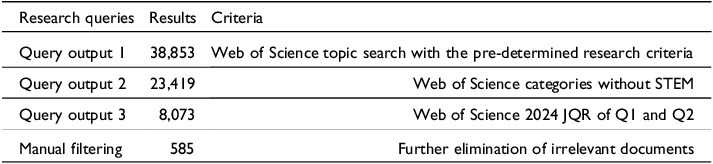
To operationalize this inquiry, we first implemented a multi-stage filtering process to compile and refine a dataset (see Table 1). Query output 1 established the broad universe of publications. Query output 2 was run with non-STEM (Science, Technology, Engineering, and Mathematics) ES categories. Query output 3 restricted the sample to journals in quartile 1 (Q1) and quartile 2 (Q2) of the 2024 journal quartile rankings in WoS, thereby standardizing the publication quality and reducing the dataset to a manageable scale. Remaining irrelevant entries persisted, which were identified through a manual abstract review conducted by the authors with the support of six undergraduate research assistants, yielding a final dataset of 585 documents.Footnote 5
Bibliometric filtering process and dataset refinement

STEM, Science, Technology, Engineering, and Mathematics; JQR, journal quartile ranking; Q1, quartile 1; Q2, quartile 2.
As shown in Table 1, the refinement process reduced the dataset but also exposed the porous boundaries of ES. Because we aimed not to miss any work that might fall under ES, the initial query was intentionally broad, yet it inevitably drew in publications that used environmental terminology in unrelated contexts (e.g. state of nature, business environment, kinetic energy, and turkey the animal). Such entries, which fell outside the conceptual scope of our study, were removed in a final round of manual screening. The same manual elimination process was used to delineate the fluid boundary between ES and ESc: we retained only studies that intentionally incorporated at least one social dynamic into environmental analysis (such as institutions, community response, economic well-being) (e.g. Erdönmez and Atmiş Reference Erdönmez and Atmiş2021), excluding works approaching the ecological realm through exclusively technical or natural-science lenses (e.g. Çağlayan et al. Reference Çağlayan, Yeşil, Tolunay and Petersson2023).
Pathways, identity tensions, and the expansion of the field
Within this analytically defined field, the trajectories that have guided scholars into this field are diverse. For some, exposure came through graduate training or studies abroad; for others, it developed through critical reflection on the limits of their primary disciplines, prompting them to incorporate environmental questions to expand the scope of inquiry. A further group of scholars entered the field through activist commitments; their academic interest in ES was closely intertwined with involvement in environmental movements and policy-making.
However, most of the scholars we interviewed expressed unease in adopting ES as the label for their own work. A small minority explicitly rejected the term, citing its lack of analytical precision; others recognized its utility as an umbrella category but preferred to foreground their disciplinary training. Several even associated “environmental studies” primarily with natural-science research agendas, effectively conflating ES with ESc. Some political ecologists, in contrast, questioned the need for a separate interdisciplinary label, arguing that political ecology already constitutes a field that brings environment and society into relation. These perspectives suggest that in Turkey, ES functions less as a self-conscious disciplinary identity than as a loose designation, with scholars continuing to operate primarily within their home disciplines while selectively reaching across boundaries.
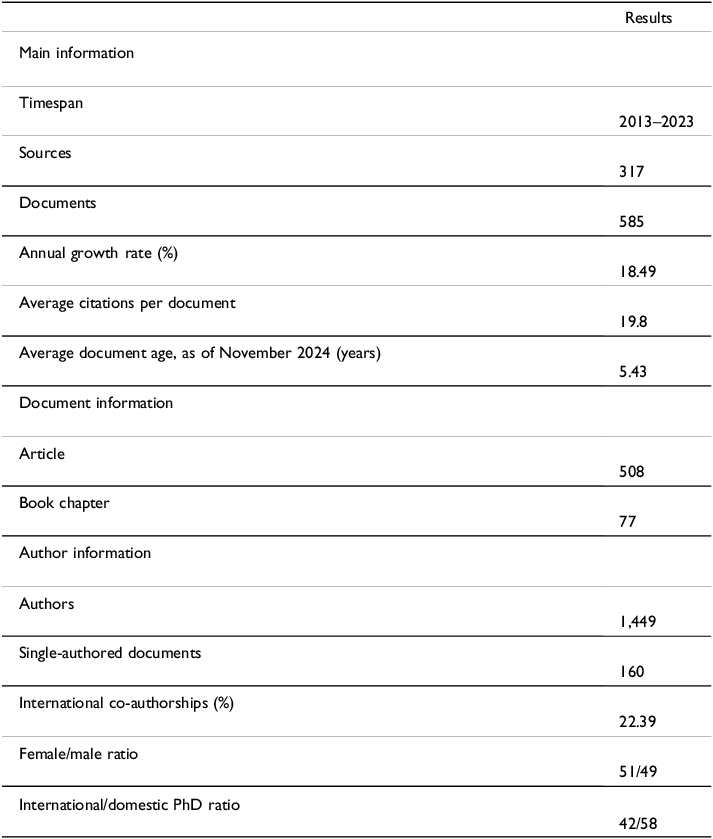
Despite persistent ambivalence toward ES as a disciplinary label, scholarship in this area has expanded rapidly in Turkey. Between 2013 and 2023, ES publications grew at an annual rate of 18.49 percent, indicating a marked acceleration in academic attention to environmental issues in the Turkish context (see Table 2). While in 2013 only twenty-two documents were published, by 2023 annual scholarly output had risen to 120, representing nearly one-quarter of the field’s total production. These figures notably exceed the overall global average growth rate in scientific publications, estimated at 8 and 9 percent between 1980 and 2012 (Bornmann and Mutz Reference Bornmann and Mutz2015), and also surpass the rapid expansion of climate change literature, which grew at approximately 11–13 percent annually between 2000 and 2014 (Haunschild et al. Reference Haunschild, Bornmann and Marx2016). An annual growth rate of this magnitude implies a doubling of scholarly output every four years and a tripling in roughly six years, underscoring the rapid pace at which research in this domain has gained momentum. While this expansion alone does not indicate conceptual cohesion or institutional maturity, it does signal a heightened and sustained scholarly engagement with environmental questions in and about Turkey.
Descriptive overview of the dataset
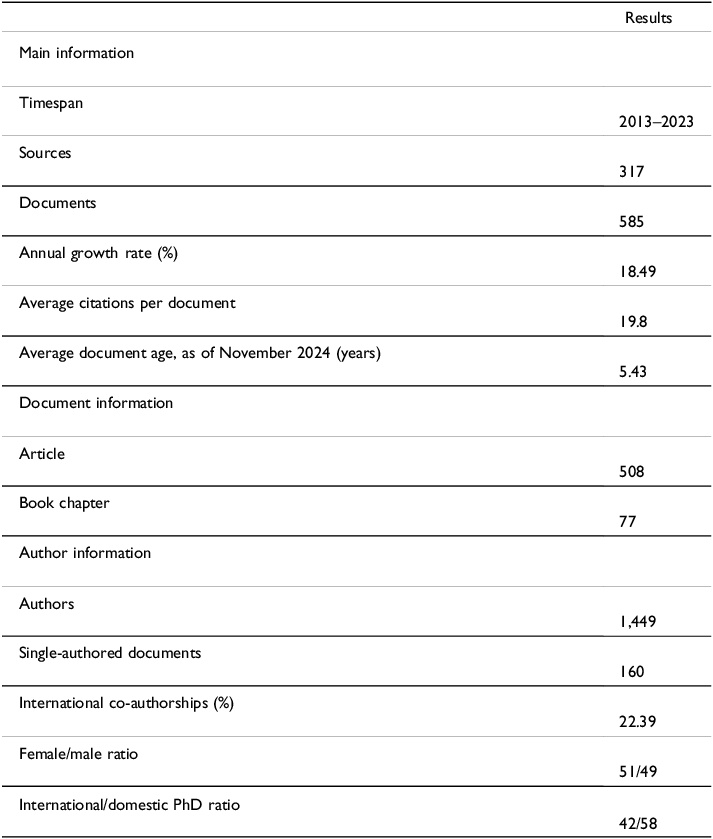
Source: Web of Science database.
While our bibliometric analysis demonstrates a significant expansion in ES, our interviews foreground the uneven ways in which scholars position themselves epistemically, ethically, and politically in this growth. Some researchers understand themselves as working within ES in a strong sense as they treat human–environment relations as a central problematic, often closely tied to their involvement with environmental non-governmental organizations (NGOs) or advisory work in state agencies. In applied subdisciplines like forestry and agriculture, this engagement is often reinforced by a sense of professional responsibility toward the very objects of study. Among political ecologists, this commitment sometimes takes an even more explicit form: many frame their research as aligned with communities contesting environmental harm. One interviewee described their methodological stance through this lens, noting that their “primary loyalty lies with people resisting on the ground,” even if such a position might render their work “less objective and scientific” by certain conventional standards.
Others, by contrast, approach the environment as an important yet ultimately delimited topic, one variable among many, creating confusion among the more committed ES scholars. As a different interviewee remarked after hearing our tally of publications: “Who are all these people doing environmental research? I’m not sure all of those papers actually see themselves as part of the field.” These divergent orientations also map onto different methodological tempos. Holistic, conceptually integrated, and often field-intensive work tends to appear more slowly, partly because it is less amenable to the rapid production enabled by secondary datasets. Studies that could be labeled as managerialist or techno-centric, which have grown in number, scale up more quickly.
The analysis of author backgrounds reveals a fairly balanced gender distribution among scholars contributing to ES publications in Turkey. Looking at the dataset, just over half of the corresponding authors are women (51 percent), while men account for 49 percent. This balance is also evident when focusing on authors: of the 504 unique contributors, 264 are female, and 240 are male. This indicates that women are not only present but are nearly equally represented in driving scholarly output in the field, highlighting an important point given that many academic disciplines still show male dominance (O’Neil et al. Reference O’Neil, Aldanmaz, Quirant Quiles, Rose, Altuntaş and Tekmen2019). This distribution mirrors the relatively high level of gender equality in Turkish academia, where women’s overall representation surpasses that of many European countries, although their share declines at higher ranks (Ucal et al. Reference Ucal, O’Neil and Toktas2015). Our dataset, however, shows an even stronger female presence than this overall trend.
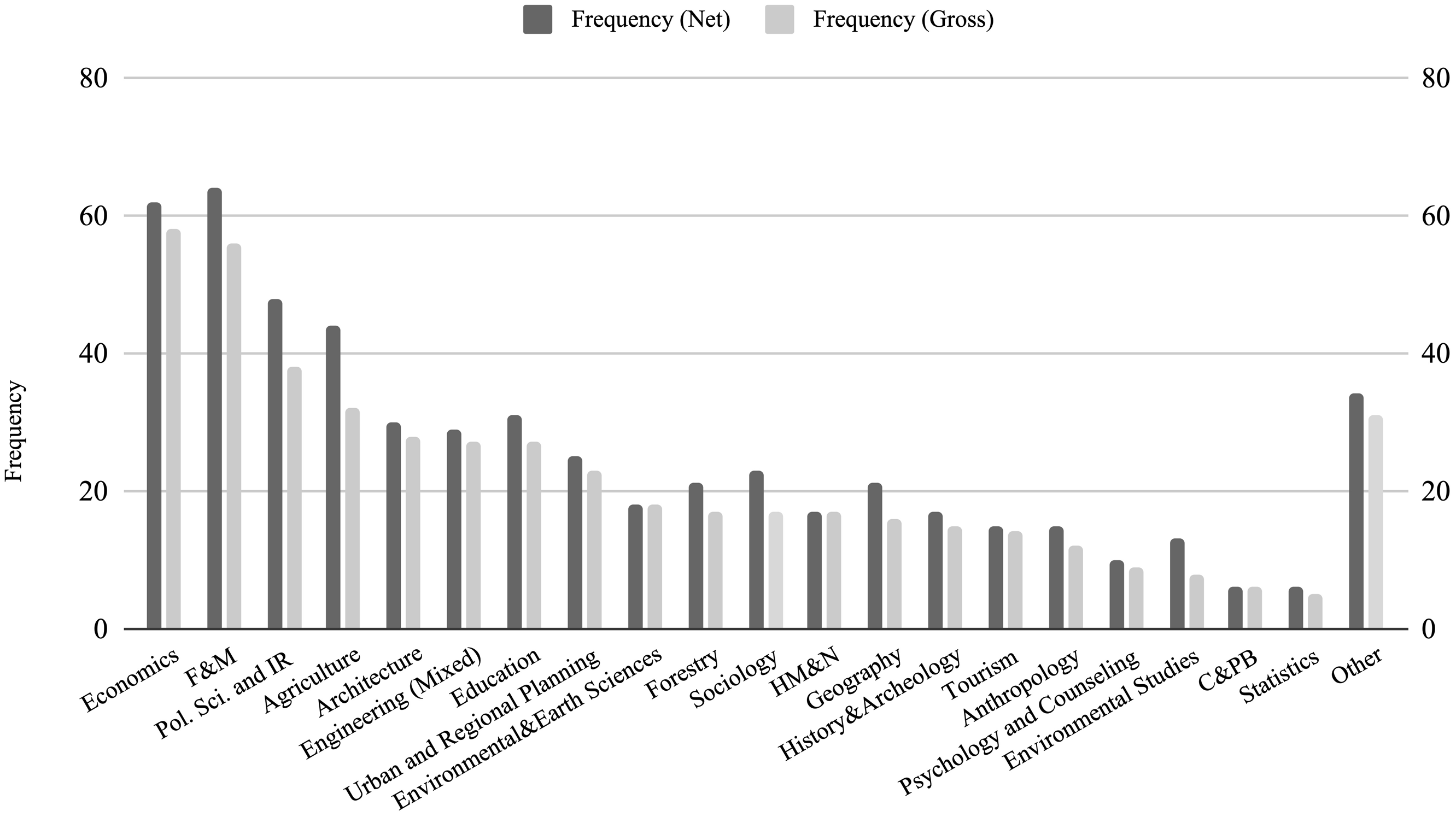
Beyond gender composition, patterns of doctoral training provide another lens into the social organization of knowledge production. At the author level, contributors to the dataset come from a wide range of doctoral disciplines, indicating substantial disciplinary diversity (see Figure 1). While Economics, Finance and Management, and Political Science and International Relations appear somewhat more frequently than others, the distribution does not suggest a narrowly bounded or clearly hierarchical disciplinary configuration. While a majority of documents (58 percent) were authored by scholars who received their Doctor of Philosophy (PhD) degrees in Turkey, the relatively high share of internationally trained scholars (42 percent) is noteworthy. More striking, though, is the uneven distribution of domestic v. international PhDs across disciplines. Internationally trained scholars dominate several core social science fields: they account for roughly 71 percent of authors in sociology, over 90 percent in anthropology, virtually all contributors in history and archaeology, and a clear majority in political science (60 percent). By contrast, in applied and professionally oriented fields, the pattern is reversed: numbers of internationally trained scholars are negligible in disciplines like education (6 percent) and tourism (7 percent), and remain a minority even in high-output fields like agriculture (23 percent) and management (25 percent). These patterned contrasts point to disciplinary differences in international embeddedness and modes of academic reproduction within Turkish academia. Many scholars with international doctorates have Bachelor of Arts degrees in Turkey, underscoring the interplay between domestic and international pathways, yet their doctoral training abroad suggests that international academic circles have served as a crucial source of training and inspiration for the field. At the same time, this international imprint may be amplified by the relative advantage of scholars with foreign doctorates in publishing in high-impact, English-language Q1–Q2 journals, which form the basis of our dataset.
Doctoral disciplines of authors publishing in environmental studies on Turkey. F&M, Finance and Management; Pol. Sci. and IR, Political Science and International Relations; HM&N, Health Sciences, Medicine and Nursing; C&PB, Communications and Public Relations.

These patterns point to the structural constraints and rigidity of Turkish academia, which cannot incubate relatively new interdisciplinary fields (more in the “Fragmented foundations: institutional gaps and interdisciplinarity” section). Interviews suggest that many scholars entered ES through doctoral training abroad or international collaborations, later translating these intellectual traditions into the Turkish context, often within departments that were not originally designed to host such interdisciplinary work. As a result, ES on Turkey has developed through individual efforts, initiatives in international networks, rather than through institutional design.
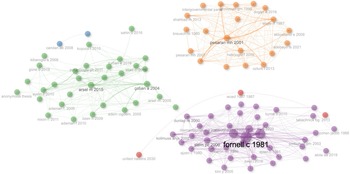
Figure 2 visualizes the co-citation network among references cited in the ES literature on Turkey, revealing the field’s intellectual architecture and patterns of influence. The green cluster is primarily composed of documents rooted in political science, sociology, and political ecology; the orange cluster is dominated by publications in economics or related fields, emphasizing market mechanisms, resource allocation, and macroeconomic perspectives. Meanwhile, the purple cluster consists of works situated at the intersection of behavioral economics and psychology, including studies on environmental values, attitudes, and decision-making. Notably, the network reveals relatively few cross-cluster linkages, suggesting low interdisciplinarity. Despite the prominence of behavioral studies in publication trends, their intellectual influence remains largely self-contained within their own cluster.
Key contributors to environmental studies on Turkey (2013–2023).

This compartmentalization resonates strongly with interview accounts. Many scholars described the field as interdisciplinary in principle, but still shaped in practice by siloed academic traditions and publication cultures, as proven by the scholars’ surprise when confronted with co-citation data and their unfamiliarity with often-cited scholars outside their disciplines. Another intriguing insight from the co-citation analysis is that even authors occupying central positions in the field tend to be clustered within specific circles, rather than serving as bridges across clusters.
Mapping the field: disciplinary orientations, methods, and themes
To move beyond disciplinary training and better capture how environmental knowledge is produced in practice, we introduced another layer of classification: disciplinary orientation. While the PhD field of the first author gives insight into academic background, it does not always reflect the epistemic commitments or research questions of the published work. Scholars in ES are, by definition, expected to go beyond the confines of their formal disciplines and engage with other academic communities, learning from their ways of asking questions and contributing to their research practices. To inquire into the scope of this interdisciplinary interaction in the case of Turkey, the research team manually coded each article’s orientation based on titles, abstracts, and keywords, with attention to the framing of research questions, selection of methodologies, the disciplinary profile of the journals, and patterns of citation. Our aim was to identify the primary orientation of each academic paper in the dataset (albeit most employ more than one) and to map how shared analytical logics emerge across different training backgrounds.
The resulting typology consists of eighteen disciplinary orientations. Their frequency within the dataset and development over the 2013–2023 period is illustrated in Figure 3. While this classification primarily draws on PhD-granting established disciplines (e.g. Sociology, Economics, Political Science), based on article content and publication venues, it quickly became evident that these categories were insufficient to capture the diversity of the field. As a result, we had to introduce a number of interdisciplinary orientations that were not necessarily tied to formal doctoral programs but reflected coherent epistemic clusters across the dataset. These include Political Ecology, Urban Studies, Energy Systems and Emissions Research, and Environmental Heritage and Conservation, among others. Each of these interdisciplinary orientations brings together distinct disciplinary lineages. For example, Political Ecology clusters conflict-centered scholarly work that is explicitly critical about the role of the state, and thus often aggregates contributions from sociology, geography, political science, and anthropology. Energy Systems and Emissions Research captures work that models and projects energy/emission dynamics in relation to social factors, drawing primarily on engineering, ESc, and policy studies, with links to economics and international relations.
Development of disciplinary orientations in environmental studies on Turkey (2013–2023). Natural Resource Man., Natural Resource Management.

Accordingly, over this ten-year period, Political Ecology emerged as the most represented orientation in the dataset, with a total of seventy-seven entries out of 585.Footnote 6 Political Ecology was followed by Economics (n = 64), Management and Marketing (n = 64), Urban Studies (n = 44), and Sociology (n = 42). While most orientations exhibit a steady increase in publication over time, mirroring the overall growth of environmental scholarship in Turkey, some disciplinary orientations show particularly sharp upticks in recent years. Notably, Management and Marketing and Psychology, both of which had minimal early presence, display significant growth from 2019 onward, potentially signaling broader institutional or funding shifts favoring behavioral and managerial framings of environmental issues.
In addition to disciplinary orientation, we also manually coded each study by its primary research methodology (see Figure 4). This allowed us to explore how environmental questions in Turkey are being investigated, not just what kinds of topics are being addressed. Rather than listing every method mentioned, we aimed to identify the primary research design that shaped the study. When the use of mixed methods was clearly intentional and conceptually highlighted, we coded it as such. In most other cases, we privileged the primary method of inquiry that shaped the overall analytical framework of the study (e.g. a study built around spatial modeling but incorporating policy analysis was still coded as spatial/geographical). Among the 585 documents, we identified fourteen distinct research methodologies, with surveys clearly dominating the field, used in slightly more than 30 percent of the studies (n = 179). Next in prevalence are 14.5 percent of studies (n = 85) that employ quantitative analysis of secondary data, often compiled by public or intergovernmental institutions, and by a similar number of case studies (n = 85) that comprehensively focus on a single environmental problem, typically within one specific location. The top three methodological choices, which cover almost 60 percent of the dataset, were followed by policy analysis (n = 54), spatial or geographical analysis (n = 31), archival or archaeological work (n = 31), content analysis (n = 30), and interview-based qualitative studies (n = 25). A smaller number of studies relied upon ethnographic fieldwork (n = 18), conceptualized around interpretive or critical approaches (n = 18), utilized mixed methods (n = 20), experiments (n = 11), or modeling (n = 4).
Dominant and marginal methods in environmental studies on Turkey (2013–2023).

Using a Sankey diagram, we visualized the joint dynamics of three patterns central to our analysis: the first author’s PhD field; the contribution’s disciplinary orientation; and research method (see Figure 5). The diagram traces the movement from doctoral training to disciplinary orientation and, finally, to research design, allowing readers to follow how scholars traverse disciplinary boundaries and mobilize specific methodological tools across four clusters: Political Ecology; Economics; Agrarian Studies; and Psychology. The juxtaposition of these clusters offers illuminating results. The Political Ecology strand of ES on Turkey (n = 74), a natural byproduct of interdisciplinarity, attracts scholars from the highest number of PhD-awarding disciplines and is marked by methodological plurality, albeit mostly qualitative designs such as case studies, ethnographic work, and interpretive approaches. In contrast, contributions in Economics (n = 54) show a very tight coupling between PhD training and orientation, and a strong reliance on one method: secondary data analysis. Psychology-oriented contributions (n = 30) are authored by nearly twice as many scholars as there are trained psychologists and rely almost exclusively on surveys. Most focus on measuring the relationship between environmental concern, consumption, anxiety, knowledge, and attitudes, which helps explain the substantial participation of scholars from fields such as education and marketing. The cluster of Agrarian Studies (n = 39) shows greater disciplinary closure, with many contributors being graduates of Faculties of Agriculture, yet displays somewhat greater diversity despite the continued dominance of survey-based approaches in rural research.
Comparative pathways in environmental studies on Turkey: four disciplinary orientations. PhD, Doctor of Philosophy; misc., miscellaneous; urban & r. planning; urban and rural planning; envir. & earth sci., environment and earth science; envir. studies; environmental studies; natural sci., natural sciences.

Looking beyond disciplinary and methodological distributions, the Sankey diagrams highlight important divergences in terms of gender composition and the domestic or international background of scholars’ PhD training. Political Ecology stands out as the most welcoming orientation for women academics (64.9 percent), in sharp contrast to Agrarian Studies (28.1 percent) and Economics (39.4 percent), with Psychology (46.7 percent) occupying a middle ground. A parallel divergence emerges in terms of PhD provenance: As mentioned earlier, as opposed to Agrarian Studies scholars (74.4 percent) or Psychology scholars (66.7 percent), only 24.7 percent of Political Ecology contributors earned their doctorates at domestic public universities, making it by far the most internationally trained cluster.Footnote 7
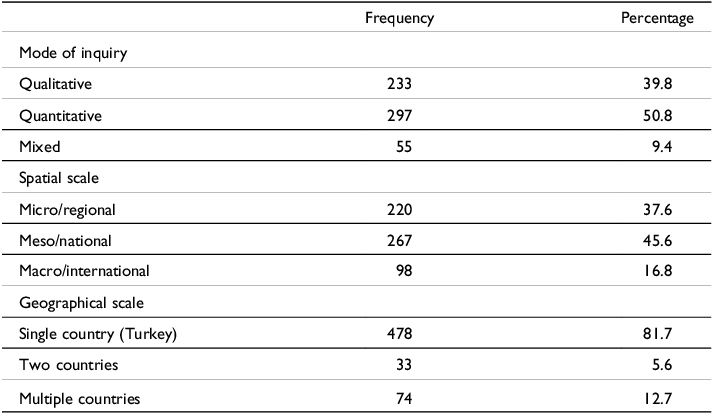
Table 3 summarizes the dataset in terms of method type, and spatial and geographic scales. Overall, just over half of the studies in the dataset (50.8 percent) rely on quantitative methods, a substantial share employs qualitative approaches (39.3 percent), with a smaller proportion adopting a purposefully mixed-methods strategy (9.6 percent). This quantitative dominance largely reflects the widespread use of secondary data analysis, accounting for 45 percent of the studies. The distribution of methods is closely tied to the spatial scale. Quantitative approaches prevail at the meso-level, where 45.6 percent of the work analyzes issues such as Turkey’s forestry regimes, water management, environmental laws, or climate change policies at the scale of the nation-state. By contrast, micro-level studies (37.6 percent) focusing on regions, cities, or even neighborhood-specific cases are more likely to employ qualitative methods, such as case studies or ethnographies. Macro-level research (16.8 percent) situates Turkey within international or transnational frameworks, relying on multi-author collaborations and large-scale cross-national datasets, and rarely employing qualitative methods. Taken together, these patterns highlight the close alignment between methodological choice, spatial scale, and geographic scope. While most studies remain focused on Turkey alone (81.7 percent), a smaller share adopts multi-country (12.7 percent) or bilateral (5.6 percent) designs – an unsurprising distribution given the dataset’s Turkey-centered focus, but one that nonetheless points to underdeveloped opportunities for comparative and cross-national research.
Research strategies and scales

Note: Coded manually on MAXQDA.
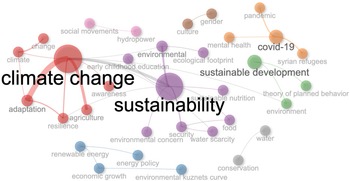
The network of authors’ keyword co-occurrences (see Figure 6) suggests two prominent thematic clusters about climate change and sustainability, where the former has a stronger orientation toward climate adaptation, and the latter diverges between different aspects of sustainability, like water, food, or ecological footprint. Similarly, the blue cluster reflects a thematic interest in energy alternatives and economic growth, supported by our findings about the expansion of research in Energy Systems and Emissions Research, where an upward trend is prominent (see Figure 3). These findings suggest a rupture from energy-related work centered on geopolitics and energy as a proxy for national sovereignty. Heightened relevance following the Paris Climate Agreement, since 2016, and its ratification by the Turkish Parliament in 2021, may have influenced research, such as the studies on the development of market-based mechanisms for transitioning away from carbon-intensive production, while also being shaped by topics like mitigation, and sustainability, becoming central themes in funding calls and academic discourse (more in the “Authoritarian drift, funding regimes, and the field’s growing visibility” section).
Keyword co-occurrence network in environmental studies on Turkey.

The pink cluster on the top left highlights a context-specific dynamic characterized by bottom-up resistance to hydropower projects, particularly small-scale plants, by local communities beginning in the late 2000s. This proliferated a wave of scholarship on local mobilizations (Aksu et al. Reference Aksu, Erensü and Evren2016; Erensü Reference Erensü, Adaman, Akbulut and Arsel2017; Evren Reference Evren2022; Işlar Reference Işlar2012; Kavak Reference Kavak2021; Yaka Reference Yaka2023). This reflects how the rapid expansion of hydropower capacity during the 2010s compelled many regions to host infrastructures that disrupted local livelihoods and, in turn, brought these struggles into the heart of the environmental literature. However, compared to other research themes, the prominence of this topic has diminished over time (relative to other co-occurrences), suggesting an inevitable and productive yet ephemeral impact of social movements on academic production.
In addition, the recent COVID-19 pandemic has increased public health-related research within ES. However, we have identified several studies that explore this topic through its effects on mental well-being and marginalized groups, as shown in Figure 6, where the orange cluster highlights these co-occurrences. The prominence of these particular issues relating to mental health may be linked to the often poorly conceived implementation of safety regulations during the pandemic concerning social isolation and layoffs, and the disproportionate impacts of these measures on the most vulnerable segments of society. We found that research in Economics and Management fields dominates the publication landscape, especially in recent years. Publications categorized under Management largely focus on green consumer behavior, corporate social responsibility, and marketing. These studies frequently draw on social psychological frameworks, such as the theory of planned behavior, and often remain conceptually insulated from critical perspectives in ES.
The mappings above (disciplinary orientations, thematic clusters, and research designs) do not themselves automatically amount to epistemologies, nor do they translate directly onto political positions. However, these patterns are not epistemically neutral; they shape which forms of expertise are privileged and how ES engages with policy and governance. Consequently, debates over the environment are not merely disagreements over policy or norms, but are influenced by the political–economic conditions under which environmental knowledge is produced. Drawing on analyses of neoliberalism and the production of environmental knowledge, Lave (Reference Lave2012) argues that ESc has increasingly been reorganized around constraints of policy relevance, technical applicability, and managerial utility, reshaping research agendas and priorities. This reorientation has been linked to a growing emphasis on “actionable” knowledge aligned with prevailing political–economic rationalities, a shift that a recent bibliometric analysis of environmental social science identified as a defining feature of the field’s current development (Theis and Light Reference Theis and Light2024). One prominent manifestation of this orientation is the persistence of eco-managerialism, which frames environmental problems primarily as issues of optimization, efficiency, and management, requiring technical and policy-driven solutions rather than structural transformation (Luke Reference Luke, Fischer and Hajer1999). Topics around sustainability, economic growth, renewable energy transitions, and adaptation are often studied through such framings. ES on Turkey does not lack critical or justice-oriented scholarship in ES, evident in the sizable and ever-expanding political ecology cluster in our dataset. Rather, the asymmetry lies in the limited circulation of political ecological sensibilities, such as attention to power, distributional justice, lived experiences, rejection of nature/society dualism, epistemic pluralism, and grassroots grievances, across other dominant disciplinary streams of ES. As a result, policy-oriented and economistic approaches often engage sustainability or energy transition without systematically incorporating justice-based perspectives, producing a segmented rather than fully integrated field of scholarship.
Authoritarian drift, funding regimes, and the field’s growing visibility
A further set of forces shaping the trajectory of environmental research in Turkey concerns the structural conditions within which scholarship is produced. For much of the early period, the environment appeared to occupy a relatively “safe” research area, comfortably distanced from the historically and politically contentious issues that drew intensive state scrutiny, such as the Kurdish question or debates around the Armenian genocide. This relative insulation enabled environmental scholars to cultivate close working relationships with bureaucratic actors, civil society groups, and affected communities without the constant specter of political exposure.
Over the 2010s, however, this boundary eroded in parallel with the country’s intensifying authoritarian turn, especially where research overlapped with public health, local activism, or the governance of natural resources. Early signals were already visible in 2011, when public health scholar Onur Hamzaoğlu was prosecuted for reporting carcinogenic pollution in Kocaeli on the grounds of “causing public fear and panic” (Hamzaoğlu et al. Reference Hamzaoğlu, Etiler, Yavuz and Çağlayan2011). The 2018 prosecution of Bülent Şık, a food engineer who disclosed government-commissioned data on toxic contaminants in food and water samples in Western Turkey, confirmed that Hamzaoğlu’s case was no aberration (McTighe Reference McTighe2019). These episodes underscored a more general fact: communicating inconvenient scientific/environmental evidence could now be reclassified as a dissident act. No event, however, impacted the academics’ freedom as much as the Academics for Peace purges, which led to 372 signatory scholars being removed from public service and 505 facing criminal investigations, for having signed a petition criticizing the government’s heavy-handed response to the Kurdish conflict (Tekdemir et al. Reference Tekdemir, Toivanen and Baser2018). The purges radically narrowed the boundaries of what counted as permissible academic inquiry, reshaping which forms of critical engagement were still thinkable and doable.
Interview accounts vividly capture this shift. One senior scholar observed that “when we started, this was not a criminalized field … it was much easier to do interviews; now the ethics of protecting both researchers and participants have become more complicated.” Others pointed to the erosion of trust between NGOs and state institutions: “if you are not an NGO with government connections, communication is very hard now.” The legacy of the 2013 Gezi uprising is especially consequential. While Gezi catalyzed an unprecedented public appetite for environmental conflict as an academic and civic concern, its subsequent criminalization, which culminated in the imprisonment of high-profile civil society figures, cast a long shadow. As one political ecologist put it, environmentalists were suddenly recorded “from tree-huggers to terrorists,” a discursive shift that inevitably shaped how openly researchers could align themselves with grassroots movements or contested ecologies.
If the political climate reconfigured the risks of environmental scholarship, the rise of environmental research was also propelled, and at times disciplined, by shifting funding architectures. European research frameworks, United Nations-led sustainability agendas, and national coordination mechanisms converged on sustainability and the Sustainable Development Goals (SDGs), generating a landscape in which environmental inquiry became not only intellectually urgent but also strategically valuable. Horizon 2020 introduced Turkish scholars to the European Union’s “Societal Challenges” agenda, which prefigured the SDGs; Horizon Europe subsequently made SDG-alignment and the European Green Deal explicit pillars. Although only a minority of internationally connected scholars directly apply for such grants in Turkey, their conceptual and procedural repertoires rippled outward, shaping expectations across the academic system. National agencies quickly adapted: TÜBİTAK began referencing SDGs in its calls; the Council of Higher Education integrated sustainability metrics, green campus protocols, and SDG terminology into university governance. Environmental NGOs and state agencies became increasingly reliant on European Union and United Nations project funding, routinely enlisting academics as consultants – often in ways that shaped methodological habits, even when not producing academic publications per se. Interviewees frequently noted how “getting into the field early” was framed as a smart idea pushed by academic advisors, while others drew moral distinctions between “committed scholars” and “opportunistic careerists” who “picked up sustainability topics because that’s where the money was.” Such boundary work is itself revealing of a semi-peripheral knowledge environment where academic agendas are pulled by powerful external infrastructures. As researchers navigate this terrain, they sometimes find themselves in an awkward position: trying to apply imported conceptual vocabularies to local settings that resist or unsettle them. At the same time, these very frameworks have contributed significantly to field formation in the form of expanding funding opportunities and conceptual repertoire. This duality captures a central tension in debates about decolonializing academic production: how to cultivate locally grounded, analytically autonomous knowledge while operating within powerful, externally driven research architectures.
These dual pressures of political constraint and funding-driven expansion place ES on Turkey in an ambivalent position. Political pressures heighten the risks of working on contentious sites, while international funding regimes widen the opportunities for critical environmental research, albeit often through imported vocabularies and agenda-setting frameworks. The field thus evolves as it navigates its way between constraint and possibility. Scholars face new vulnerabilities while accessing unprecedented resources and a still largely uncharted field. They work through conceptual repertoires conceptualized elsewhere while insisting on analytical autonomy grounded in local ecologies. This ambivalence between risk and opportunity now shapes much of the field’s development, particularly as scholars attempt to balance external alignment with local relevance.
Fragmented foundations: institutional gaps and interdisciplinarity
What exists of the institutional landscape of ES on Turkey has emerged relatively late and largely through top-down, bureaucratic initiatives rather than as a result of organic academic curiosity and cross-fertilization. Many political science and public administration departments host Urban and Environmental Problems subfields (Kent ve Çevre Sorunları Anabilim Dalı; Department of Urban and Environmental Problems), and numerous state universities host similarly named research and implementation centers (araştirma ve uygulama merkezi) founded in the 1990s by government decrees. These units, however, are widely perceived as archaic and largely inactive, with little to no academic interdisciplinary impact (Öksüz-Gül and Alpaydın Reference Öksüz-Gül and Alpaydın2017; Şengün Reference Şengün2024). By contrast, environmental engineering programs (specifically at İstanbul Technical University [ITU] and Yıldız Technical University) have enjoyed greater institutional weight, supplying cadres to the environmental bureaucracy, albeit with curricula largely detached from socio-political matters.
Among the few institutions approximating an interdisciplinary ES agenda, Ankara University’s Societal Environmental Sciences Program (Sosyal Çevre Bilimleri), founded in 1994 as part of its Social Sciences Institute, stands out as the only graduate unit of its kind. The same faculty (also known as mülkiye) also features a dedicated subfield on “Urban, Environmental, and Local Government Policies,” which hosts a number of faculty members and has produced a significant number of graduate theses over the last three decades. In İstanbul, two research institutes, i.e. Boğaziçi University’s (BU) Institute of Environmental Sciences (1984) and ITU’s Eurasia Institute of Earth Sciences (1997), play a comparable role. Both were founded as ESc institutions (the former specialized in water quality, the latter in geology and climate science) and have only recently shown modest attempts to expand towards the social sciences: ITU has created a “Geoanthropology” graduate track at the intersection of earth, behavioral, and social sciences, while BU has redefined its “Socio-Ecological Sustainability” track (once overlooked, according to a respondent, as a “light option for failing students”) into a robust program attracting growing graduate student demand. Despite these developments, these institutes have remained primarily homes for natural science and engineering research, with social science engagement largely instrumental. A fourth institutional center of gravity, Sabancı University’s İstanbul Policy Center (IPC), has been particularly influential, following its 2012 partnership with Germany-based Stiftung Mercator. By offering fellowships, running research projects, and organizing public events in climate research and other related areas, the IPC has made one of the most substantial contributions to ES on Turkey. Despite these few examples, interdisciplinary institutionalization in ES remains rare and difficult to sustain due to disciplinary and interpersonal rivalries. As one researcher observed of a recent drive, “the initial excitement of bringing scholars together quickly gives way to disillusionment” when centers are dominated “by a handful of individuals and disciplines.”
In Figure 7, the institutional affiliations of authors also reveal important dynamics in the development of ES on Turkey. The most productive institutions are Middle East Technical University (n = 47), BU (n = 36), ITU (n = 32), İstanbul University (n = 31), and Ondokuz Mayıs University (n = 30). The prominence of BU is especially noteworthy, given its relatively small size and boutique profile compared to larger, more comprehensive universities. More striking, however, is that the list is dominated entirely by long-established public universities, with neither newer institutions nor prominent private foundation universities appearing among the top contributors. This pattern suggests that the growth of ES on Turkey has been largely carried by the resources, perspectives, and commitments embedded in the public university system, while private institutions remain marginal to the field.
Institutional affiliations of environmental studies authors on Turkey (2013–2023). UNIV, University.

Despite the institutional mapping presented above, these organizations do not exercise a consolidating or field-defining influence over ES on Turkey. They are rarely invoked by researchers as reference points of intellectual orientation or research hubs of innovation, a pattern also reflected in our interviews. None of these institutions has emerged as a fully fledged school of ES; instead, each operates as a partial and internally bounded node of influence. The Ankara–Mülkiye tradition remains anchored in political science, law, and public administration with limited input from the natural sciences; ITU and BU operate from the opposite end, with heavy reliance on earth and engineering sciences and cautious engagement with the social sciences; and the IPC, while closest to the spirit of ES, functions as a boutique location with limited permanent positions and no graduate program.
As our interviewers also confirm, ES on Turkey has not crystallized around institutional “pillars,” but has rather advanced through personal endeavors and ad hoc collaborations, reflecting both the promise and fragility of the field. While there are pockets of collaboration within the fields of forestry, political ecology, water management, and agricultural sustainability, collaboration reproduces existing academic silos rather than bridging them. Even in respected centers and institutes, our respondents noted, “individual disciplines either dominate or at best persist alongside one another” rather than generating new syntheses, echoing the broader diagnoses made a decade ago. This institutional account, however, should be qualified by the global nature of scholarly production: nearly half of the scholars active in the field hold PhDs from abroad and often continue to work in foreign universities, indicating that the field’s intellectual orientation is shaped as much by external academic lineages as it is by local ones.
What is often dismissed as Western influence is better understood as a structural response to the absence of an academic infrastructure that might have locally founded ES as a distinct field. This gap widened as environmental problems in Turkey became more visible and partially filled through overseas training, transnational networks, and funding schemes. But rather than producing detached scholarship, many scholars with external connections and networks have grounded their research in local connections, often collaborating with grassroots and environmental organizations. As one scholar noted, NGOs often take up environmental issues before academia does, acting as “accelerators” that push certain topics into scholarly debate. ES on Turkey, therefore, emerges at the intersection of external epistemic lineages, local structural constraints, and the lived realities of environmental struggles, producing a field that is neither fully subsumed under the colonial gaze nor fully autonomous, but shaped by the tensions between these forces.
Conclusion and future directions
The analysis presented in this paper ultimately underscores what is at stake when disciplines come together to confront multidimensional challenges. As Bernstein (Reference Bernstein2015) reminds us, transdisciplinarity has emerged precisely in response to “wicked problems” such as climate change and sustainability, which exceed the capacities of any single field. Max-Neef’s (Reference Max-Neef2005) point is sharper: multidisciplinarity often amounts to “an accumulation of visions” without true synthesis. What is required instead, he suggests, is strong transdisciplinarity, an integrative mode of knowledge production that breaks with disciplinary silos altogether.Footnote 8 Any discussion on ES must be situated within this broader debate wrestling with the necessity and difficulty of bridging the gap between academic silos.
With this motivation, this article has traced the contours of ES on Turkey over the past decade, situating its development within a wider landscape of ecological crises, institutional constraints, and shifting academic trends. By combining bibliometric mapping with qualitative coding and expert interviews, our analysis has provided a multi-layered picture of a field that has grown rapidly yet unevenly, remaining fragmented in its institutional foundations. On one hand, ES on Turkey has achieved significant visibility, marked by a steady increase in scholarly output, a balanced gender profile, and the rise of climate change and sustainability as core themes. New generations of scholars are diversifying the field’s intellectual profile, bringing insights from economics, political ecology, law, planning, and education. This suggests that despite the late institutionalization of ES on Turkey, it is no longer marginal to academic life and is beginning to shape broader debates on society–environment relations.
On the other hand, critical limitations persist. Research remains clustered within a small set of universities. Methodologically, the dominance of quantitative (survey and secondary data analysis) and policy-oriented approaches has limited the field’s ability to capture the lived, localized, and justice-oriented dimensions of environmental change. Interviews with scholars underscore a continued ambivalence toward embracing ES as a disciplinary identity, with many choosing to identify themselves in their home disciplines, raising doubts about whether ES on Turkey is consolidating as a field in its own right or continuing as a set of parallel conversations. Crucially, the gaps are not only institutional and disciplinary but also epistemic. Justice-oriented perspectives, grassroots mobilizations, and post-anthropocentric approaches remain underrepresented, despite intensifying environmental conflicts.
Looking ahead, three directions appear particularly urgent. First, expanding methodological repertoires to include more ethnographic, participatory, and historical approaches would deepen ES’s capacity to capture the complexity of environmental conflicts and practices in Turkey. Second, fostering stronger institutional platforms, beyond a handful of universities, could enable more sustained interdisciplinary collaboration and embed ES more firmly within academic structures. Third, embracing a more reflexive, justice-oriented, and globally connected ES would allow the field on Turkey not only to speak to domestic concerns but also to contribute to international debates on sustainability transitions and the Anthropocene.
The relationship between institutions and environmental mobilizations has played a central role in shaping the character of ES across national contexts. As Johnson et al. (Reference Johnson, Ilhan and Frickel2020) argue, the rise of ES in the United States was part of a “long green wave” of institutionalization, where interdisciplinarity functioned less as a rupture than as a pragmatic niche strategy within higher education. Hasegawa’s (Reference Hasegawa2021) periodization of Japanese environmental sociology, triggered by Minamata, institutional consolidation, and the Fukushima nuclear disaster, similarly shows how crises can serve as catalysts for academic fields. The Turkish case resonates with this crisis and mobilization-driven growth patterns, particularly with the environmental awakening around the Gezi uprising and local struggles against hydropower and mining, yet it has remained weakly institutionalized. Moreover, rather than a strong connection between scarce institutions and these triggers, the growth of ES on Turkey has depended more on global publication trends, funding opportunities, and international linkages.
Our study also has several limitations. First, it relies exclusively on the WoS Core Collection, which excludes contributions published in Turkish and in less visible but substantially relevant academic outlets. While this filtering enables the construction of a manageable and internationally comparable corpus, it also risks reproducing a hierarchy that over-privileges impact factor-based rankings. Moreover, the WoS indexing infrastructure itself is uneven. During data collection, we identified several relevant publications, including a few yet impressive manuscripts (Evren Reference Evren2022; Scaramelli Reference Scaramelli2021; Yaka Reference Yaka2023), some edited volume contributions, and even a small number of Social Sciences Citation Index/Arts and Humanities Citation Index-indexed articles that were omitted despite meeting the criteria. More critically, the dataset does not capture the vibrant body of gray literature produced by environmental NGOs and grassroots collectives. As one of our respondents noted, such texts are widely circulated and are sometimes more influential than academic publications. While our aim here was to trace trends in formal scholarly production, future research would benefit from a broader methodological lens that includes alternative knowledge practices operating outside conventional academic channels.
Returning to Arsel’s (Reference Arsel2012) diagnosis of ES on Turkey as being “relatively weak,” it is difficult to sustain this characterization today given the steady expansion and increasing diversity of scholarly production. This expansion has occurred without robust institutional support and deeper inter-/trans-disciplinary restructuring, leaving the field vulnerable to funding, market, and political pressures. In this sense, ES on Turkey exhibits consolidation without collaboration, an expansion that remains thin in its institutional and epistemic foundations. However, the uneven growth of ES on Turkey ultimately reflects the tensions of a country grappling with overlapping crises of development, democracy, and ecology. Perhaps rather than a weakness, this ambivalence can be a generative condition, pushing scholars to continually renegotiate the boundaries of the field and resist settling into rigid academic orthodoxies. By tracing both insights and oversights, this study has sought to provide not just an overview of what ES on Turkey currently is, but also a gesture towards what it could become: more inclusive, interdisciplinary, and reflexive, capable of engaging with Turkey’s ecological crisis while contributing substantially to the global debates.
Supplementary material
To view supplementary material for this article, please visit https://doi.org/10.1017/npt.2026.10074
Acknowledgments
This article is part of a research project funded by the Boğaziçi University Research (BAP) Fund (grant no. 24B08P1). We gratefully acknowledge the contributions of Yağmur Gedik, İlke Kırca, Ceyda Nişli, Nihan Ars, Serap Cinoğlu, and İnci Babur, the scholars who generously shared their insights in interviews; the anonymous reviewers for their constructive feedback; and Ethemcan Turhan, Zafer Yenal, and Cem İskender Aydın for discussions that helped shape the article’s conceptual framework.
Competing interests
The authors have no financial or proprietary interests in any material discussed in this article.




 Open access

