




Introduction
A Taste of Millefeuille is a poetic, non-linear, visual theatre performance created by the French artist Éric de Sarria, a key collaborator with Compagnie Philippe Genty. The first version of the piece was presented at a theatre festival in Egypt in 2008, though it was developed within a French artistic framework. Since then, the work has been restaged in different contexts, including its Shanghai adaptation, which forms the focus of this article. De Sarria’s piece draws on his personal memories and emotional conflicts surrounding his identity as a performer, particularly the tensions between his artistic choices and internalized voices of doubt. Through puppetry, material manipulation, poetry, and abstract visual composition, the work evokes associative rather than linear dramaturgy. The performance opens with a childhood poem by de Sarria, spoken aloud by the ‘inner voice’ performer (myself). As the reading ends, de Sarria enters and sequentially reveals a strip of Lycra, a piece of plastic fabric, and kraft paper – materials that recur throughout the piece in a cyclical structure. In the Shanghai version, the ‘inner voice’ not only countered de Sarria’s presence but also served as a performative counterpart to his adult identity, alternating between conflict and collaboration in manipulating objects. Rather than following a storyline, the work develops through images, gestures, and material interactions, using dreams and memories to explore selfhood and the performer–object relationship.
Philippe Genty, a French director and puppeteer, and his wife, the British choreographer Mary Underwood, established Compagnie Philippe Genty in 1968, and Genty has been widely recognized since as a pioneering figure in contemporary visual theatre. French scholarship positions Compagnie Philippe Genty at the centre of object-based dramaturgy. Polish puppetry scholar Henryk Jurkowski adds that Genty’s work shows how puppets can appear as ‘magical creatures in revolt against their master’, sometimes even becoming self-reflective and aware of their own manipulation – a struggle that may lead to their destruction and serve as a metaphor of powerlessness and external control.Footnote 1 The World Encyclopedia of Puppetry Arts (UNIMA) and the French association THEMAA [National Association of Puppet Theatres and Associated Arts] underline the company’s distinctive visual poetics and influence on the field, with THEMAA regularly featuring the company in its professional journal Manip. Footnote 2 French critics likewise emphasize the singularity of Genty’s ‘inner landscapes’ and his continual reinvention of visual theatre).Footnote 3 In ‘The Genty Effect’, Joseph Seelig, co-founder of the London International Mime Festival, argued that Genty ‘created a genre, using elements of choreography, mask and object theatre, circus, puppetry, and magic to create a performance that is separate and distinctive’.Footnote 4 His signature works – including Désirs-Parade (1983), Voyageur Immobile (1995), and Ligne de fuite (2001) – have toured widely across Europe, Asia, and South America, contributing significantly to the evolution of non-verbal theatre practices.
The creative method of Compagnie Philippe Genty has often been described as both surreal and materially inventive. Yet, as Mello points out in her study of the company’s training practices, their contribution is not limited to the stage: they devised a pedagogical framework rooted in improvisation, material manipulation, and collective devising.Footnote 5 This emphasis on process, rather than narrative or text, can be understood as central to their exploration of dreams, memory, and unstable identities, and has made the company influential for subsequent generations of visual theatre practitioners. Their work is characterized by its exploration of the human subconscious, using visual metaphors and physical theatre to develop into themes of dreams, memory, and identity. Genty and Underwood’s creative methodology in theatre transcends conventional puppetry, incorporating elements of illusion, dance, and mime to create a language of performance that speaks through visual elements more than words. Their productions combine poetic visual sequences with surreal imagery, creating immersive theatrical experiences that evoke dreamlike states and unconscious associations through movement, space, and material transformation. The company’s artistic legacy has shaped generations of performers, designers, and directors working within visual and object-based dramaturgies, de Sarria among them.
De Sarria has collaborated with Philippe Genty since 1988, initially as a performer in such productions as Dérives, Dédale (revival), and Zigmund Follies (revival). Since 2001, he has also assisted Genty in creation and pedagogy, contributing to such works as Boliloc (2008), Ne m’oublie pas (2012 version), and Paysages Intérieurs (2016), and co-leading intensive training sessions with Underwood and other company members. Beyond his work with the company, de Sarria has performed and co-directed with L’Illustre Famille Burattini (a family-run puppet and street theatre company founded in 1981), Théâtre de l’Unité (a French experimental troupe known for site-specific and politically engaged performance since 1968), as well as collectives such as Les Maladroits (a French documentary-object theatre group established in 2008). De Sarria and Nancy Rusek, who was also a principal performer with Compagnie Philippe Genty, founded a theatre company called Mots de Tête in around 2008, whose members transmit and update the pedagogical corpus developed by Genty and Underwood. Through workshops, long-term training programmes, and collaborations with international artists, they carry forward Genty’s philosophy of visual dramaturgy, imaginative embodiment, and the metaphorical relationship between body and object. The company’s work reflects a commitment to both artistic continuity and methodological innovation.
The creations of de Sarria, including A Taste of Millefeuille, continue and transform Compagnie Philippe Genty’s aesthetic, shifting its poetic visual grammar towards more personal, fragmented, and affectively oriented modes of performance. That title, borrowed from the French multilayered pastry, suggests a dramaturgical logic built not on plot but on accumulation, disjunction, and affective resonance. In keeping with the broader Genty–Underwood methodology, the piece proceeds as a set of image-led sequences shaped by gesture, silence, and spatial texture rather than linear plot.Footnote 6 However, inviting another local performer to express de Sarria’s ‘inner world’ is a creative technique unique to him, aiming to allow audiences from different countries to directly understand the poetry and concise spoken text.Footnote 7 For the 2024 Shanghai production, I took on this role as the first female ‘inner voice’. Rehearsals became experimental, with issues of gender, translation, and cultural rhythms reconfiguring the relationship between body, material, and audience, as this article will now explain.
During rehearsals, we explored how gender, language, and cultural rhythms influenced not only the text but also the relationships on stage. As de Sarria noted, ‘Everyone has many inner voices – they can be masculine, feminine, and everything in between.’Footnote 8 This approach aligns with my experience in rehearsal, where the inner voice did not operate as a fixed character with stable traits, but rather as a shifting presence, bridging my personal memories and emotions with the performative actions on stage. Rather than representing ‘a woman’, the casting complicated conventional distinctions between author and interpreter, foregrounding multiplicity within memory and subjectivity.
The Shanghai performance took place at Theatre YOUNG, formerly known as Yangpu Grand Theatre, originally established in 1996. Rebranded as ‘YOUNG’ – echoing both the Chinese ‘yang’ (the Chinese character 杨) and the English ‘young’ – the venue centres on theatre while also supporting cross-disciplinary collaboration, artistic incubation, education, and community engagement. Theatre YOUNG (Shanghai) serves as a venue for experimental and cross-cultural performance practices. Its flexible space and artist-oriented programming provided a productive background for this iteration. Within this context, the Shanghai staging not only required linguistic and physical adaptation but also invited a negotiation with local spectatorship norms – particularly expectations around narrative clarity, realism, and the expressive role of puppetry.
In China, puppetry is still often linked to children’s entertainment or to heritage display, and, as such, is quite traditional. The Shanghai Puppet Theatre, for example, defines its mission as ‘serving children’, while the Puppetry Department at the Shanghai Theatre Academy is rooted in Chinese opera traditions, with many instructors trained in that background. Chinese shadow puppetry is listed as an intangible cultural heritage by UNESCO, and exhibitions such as ‘The Puppetry of China’ present puppets in museums as artefacts of cultural heritage. These institutional contexts shape how puppetry is perceived locally and frame the cultural ground into which A Taste of Millefeuille was introduced.
This article looks at the project through an auto-ethnographic, practice-based lens. It explores how visual theatre – as a form that focuses on the body, non-linear expression, and the link between performer, material, and space – gives insights into performance-making, identity, and intercultural dramaturgy. This perspective shows not only the practical changes needed in cross-cultural performance but also how embodied practice creates knowledge about spectatorship, translation, and cultural framing that cannot come from textual study alone. The piece has toured in many countries, but this article examines the Shanghai production. There, issues of rhythm, language, and audience reception showed most clearly the challenges of, and opportunities for, intercultural dramaturgy.
In what follows, I reflect on three key aspects of the process: the manipulation of puppets and objects on stage; the process of adapting the ‘inner voice’ role to a new linguistic and cultural setting; and the intercultural adaptation of the performance in Shanghai, focusing on linguistic translation, stage rhythm, and audience reception.
My approach places the researcher-performer inside the work. This makes embodied practice a way to produce insight. I use Robin Nelson’s model of ‘practice as research’, in particular his explanation that creative work can bring together three kinds of knowing: ‘know how’, ‘know what’, and ‘know that’.Footnote 9 In this view, knowledge does not come only from later reflection. It is also made in the act of doing, in handling materials, in working with space, and in the choices made from moment to moment in performance. My own method also draws on three workshops I attended with Mots de Tête. These focused on puppetry, materials, and object manipulation. The training gave me concrete techniques and embodied strategies. They became part of how I created performance and how I analyzed it afterwards.
Performing with Objects: Embodied Manipulation as Creative Practice
In rehearsals and performances of A Taste of Millefeuille, the relationship between performer and object was not based on manipulation or the idea of ‘bringing life’ to inert matter. Instead, it developed through listening, response, and co-creation. The materials – paper, Lycra, plastic – were not passive objects; their texture, tension, and resistance already suggested a kind of agency. The key was the performer’s ability to notice and respond to these qualities with care.
As Paul Piris argues, the puppet appears not as a literal Other, but as the image of an Other – a subjectivity imagined by the audience through its objecthood, materiality, and manipulation.Footnote 10 Jane Bennett’s theory of ‘vital materialism’ reinforces this view, arguing that ‘different materialities, composed of different sets of protobodies, will express different powers’, which, as Eleanor Margolies observes, blurs the boundaries between body and object.Footnote 11 Material seems to encompass its own subjectivity; it has not been given meaning by humans or anthropomorphism. This was important during the creation and rehearsals of A Taste of Millefeuille. This meant allowing materials – paper, Lycra, plastic – to ‘speak first’, letting their affordances guide my choices, gestures, and rhythms. Presence, in this context, is less about mastery than about attunement. As Genty notes, ‘The object proves to be a source of multilayered play … a surprising motor for stimulating the sense of distancing.’Footnote 12 In rehearsal, I began to let the materials take the lead. The sound of paper folding, or the tension in Lycra, often guided my actions. These material cues opened more possibilities than planned gestures. The materials guided the performance; I followed.
This cyclical understanding is informed by Daoist philosophy, particularly Laozi’s formulation that ‘Things grow and grow, / But each goes back to its root’, which positions transformation as an ecological and reciprocal process.Footnote 13 This principle is enacted in the recurring appearance of objects throughout the piece. In the opening sequence, de Sarria retrieves a small piece of plastic fabric from his pocket, then extracts a strip of Lycra from his mouth, and finally unfolds a paper boat made from kraft paper. These same materials reappear across later scenes in altered forms, culminating in an image where the enlarged Lycra and paper elements envelop de Sarria’s body. Rather than functioning as props, the materials participate in a literally unfolding cycle of emergence, return, and absorption – an embodiment of Daoist rhythm onstage.
In performance, two aspects define the manipulation of puppets and materials. The first is physical training and technical skill, which shapes how the performer moves and controls the object. The second is the performer’s ability to establish emotional resonance with the audience, so that the material action is not only precise but also affective.
Effective manipulation relies on the performer’s ability to articulate the body precisely and to respond in real time. As Genty notes, ‘We must always make a particular effort to apply it, for our fixed points, articulations, gaze, and positions are not the same as those of the puppet.’Footnote 14 Flexibility alone is insufficient; puppetry also demands control of rhythm, impulse, and bodily segmentation, since ‘it is striking to discover what the body suddenly reveals – fragmentations or unusual rhythms’.Footnote 15 Spatial awareness is equally central, extending beyond the performer to the material itself: ‘The object proves to be a source of multilayered play … leading each person to diversify their attention and to develop a peripheral perception.’Footnote 16 Together, these elements require the actor to combine articulation, rhythm, and spatial sensitivity within an integrated practice shaped by both body and object.
Achieving this responsiveness requires rigorous bodily awareness, which can be cultivated through a range of somatic practices. In my own training with Nancy Rusek, the Feldenkrais Method proved particularly influential, enabling me to refine my awareness of joints and breath and to apply this sensitivity to the manipulation of materials and puppets. Such observations echo established perspectives within puppetry and material performance. Claire Heggen, co-founder of Théâtre du Mouvement and a leading figure in French corporeal performance, notes that ‘each blocked articulation in the body offers a new possibility for the imagination; each opened articulation expands imaginative and theatrical possibilities’.Footnote 17 In rehearsal, even subtle bodily adjustments – minor shifts in weight, breath, or joint isolation – directly influenced the quality of manipulation. The transition from mechanical control to expressive interaction often hinged on such micro-level adaptations.
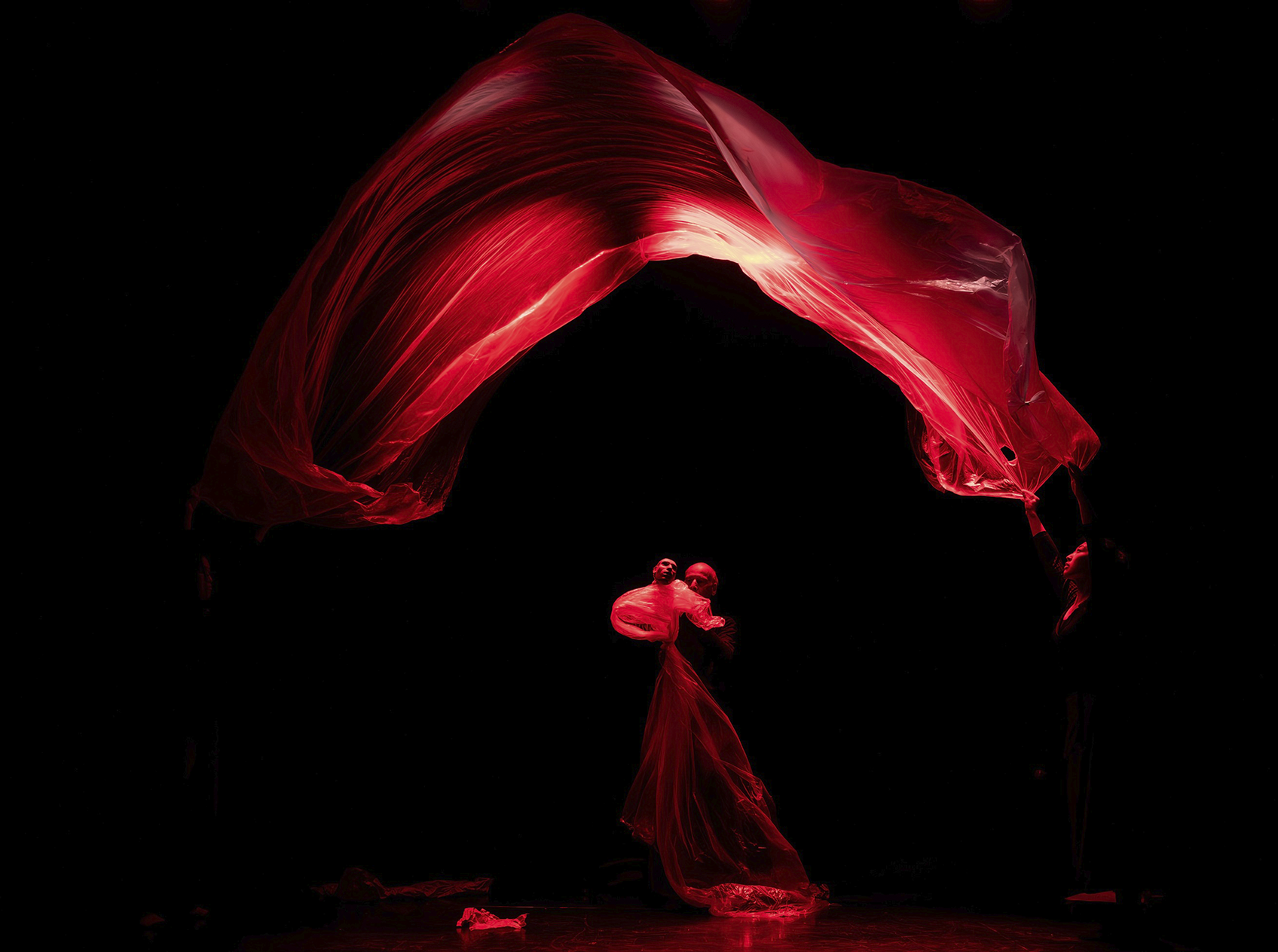
For example, during the scene ‘Dream River’, a paper boat appeared. De Sarria had shown it at the beginning, and it floated on the plastic river. As the river moved, the boat suddenly disappeared, and a puppet head with the same face as de Sarria appeared (Figure 1). The plastic river then transferred into his body. At the same time, another large sheet was placed underneath. I had to manipulate this plastic fabric so that the river effect could continue. With blue light on the sheet, the fabric also needed to be moved as a large bubble to let de Sarria enter. For the audience, it may look simple to move the plastic fabric, but because of its large size and the nature of the material, some special techniques were required. When I was manipulating the large piece of plastic fabric, it involved the precise differentiation of movement across shoulders, elbows, wrists, and fingers. Guided by Feldenkrais principles, these actions unfolded in a sequential yet fluid manner, allowing the material to develop its own dynamic arc without being overly predetermined. The plastic fabric is delicate and lightweight, but it generates a noticeable rustling sound. To create the effect of a tranquil river, the performer should engage their entire arm, ensuring smooth and continuous movements. If the movement relies only on the wrist, it results in rigid and awkward motions, accompanied by an intrusive crunching sound that disrupts the illusion. This experience has shown me the importance of body awareness and training, which have significantly improved my control and connection to the materials. In contrast, working with kraft paper called for sensitivity to weight, resistance, and kinetic impulse, engaging the body in a calibrated negotiation of tempo, vertical range, and spatial tension. In both cases, the performer’s task was not to impose movement onto the material but to engage in a reciprocal process, where the body acts simultaneously as initiator and as a sensor of the material’s response.
A Taste of Millefeuille, Theatre YOUNG (Shanghai), October 2024. Yun Geng (inner voice, right) and Éric de Sarria (centre) co-manipulating plastic fabric. Photographer: Li Wang.
Beyond physical technique and material responsiveness, a second dimension of manipulation in A Taste of Millefeuille concerns the performer’s capacity to establish emotional resonance with the audience. This process begins not with outward expression, but with the performer’s immersion. Through this internal investment, the performer invites the audience to set aside their everyday frames of reference and enter the affective world of the performance. This becomes particularly significant in a piece that deliberately avoids realist or narrative-driven structures. In the absence of a fixed storyline or clearly defined character arc, performers cannot rely on conventional dramaturgical cues to evoke emotional authenticity. As Konstantin Stanislavsky suggests, belief onstage does not arise from the literal reproduction of reality but from the performer’s capacity to invest in the given circumstances and act ‘as if’ they were real.Footnote 18 In abstract or non-representational contexts, performers often need to construct such circumstances internally – for example, by drawing on memory or imagined environments – to sustain their own belief. At the same time, sound, lighting, and materials provide external cues that frame the action and guide the audience’s reception.
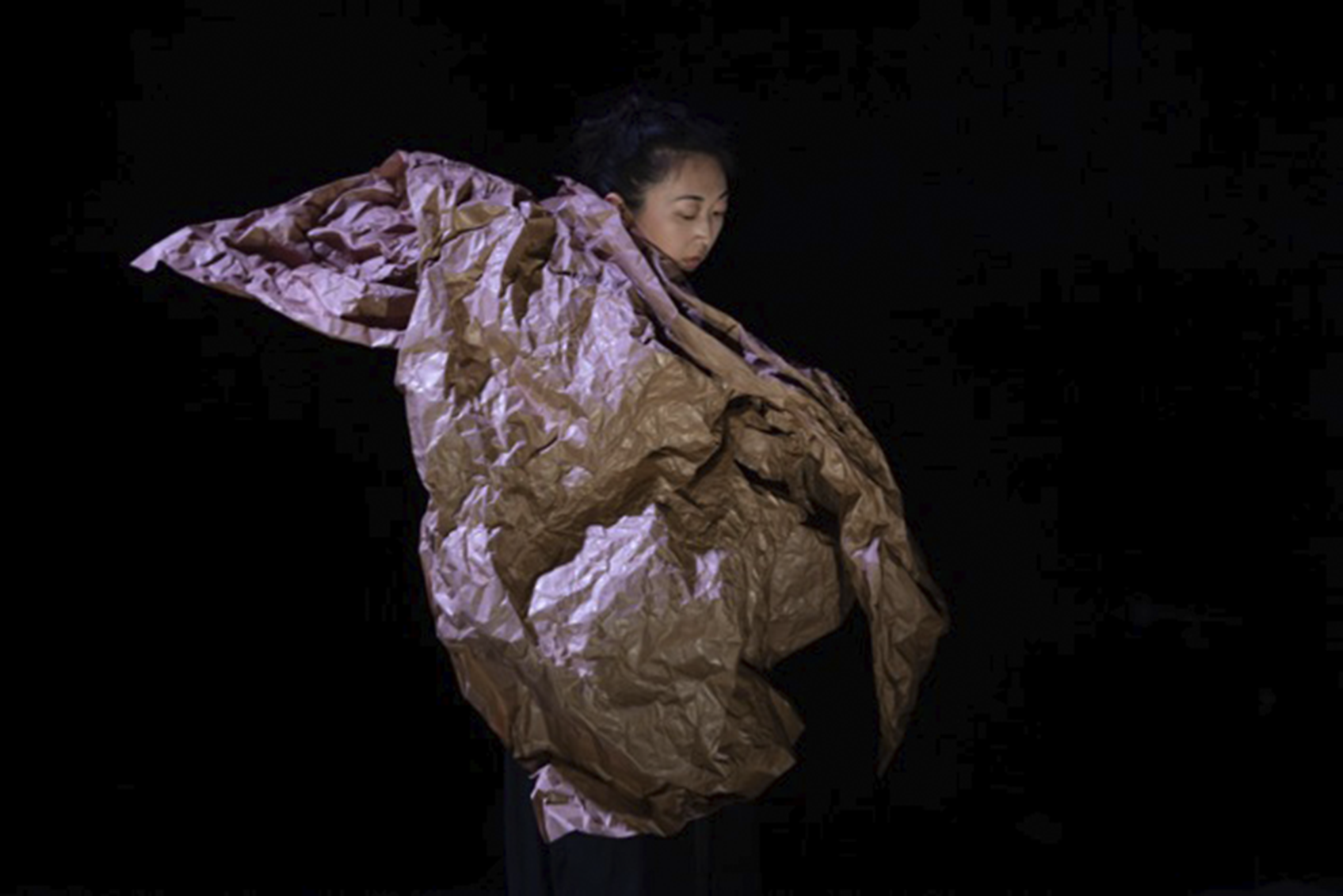
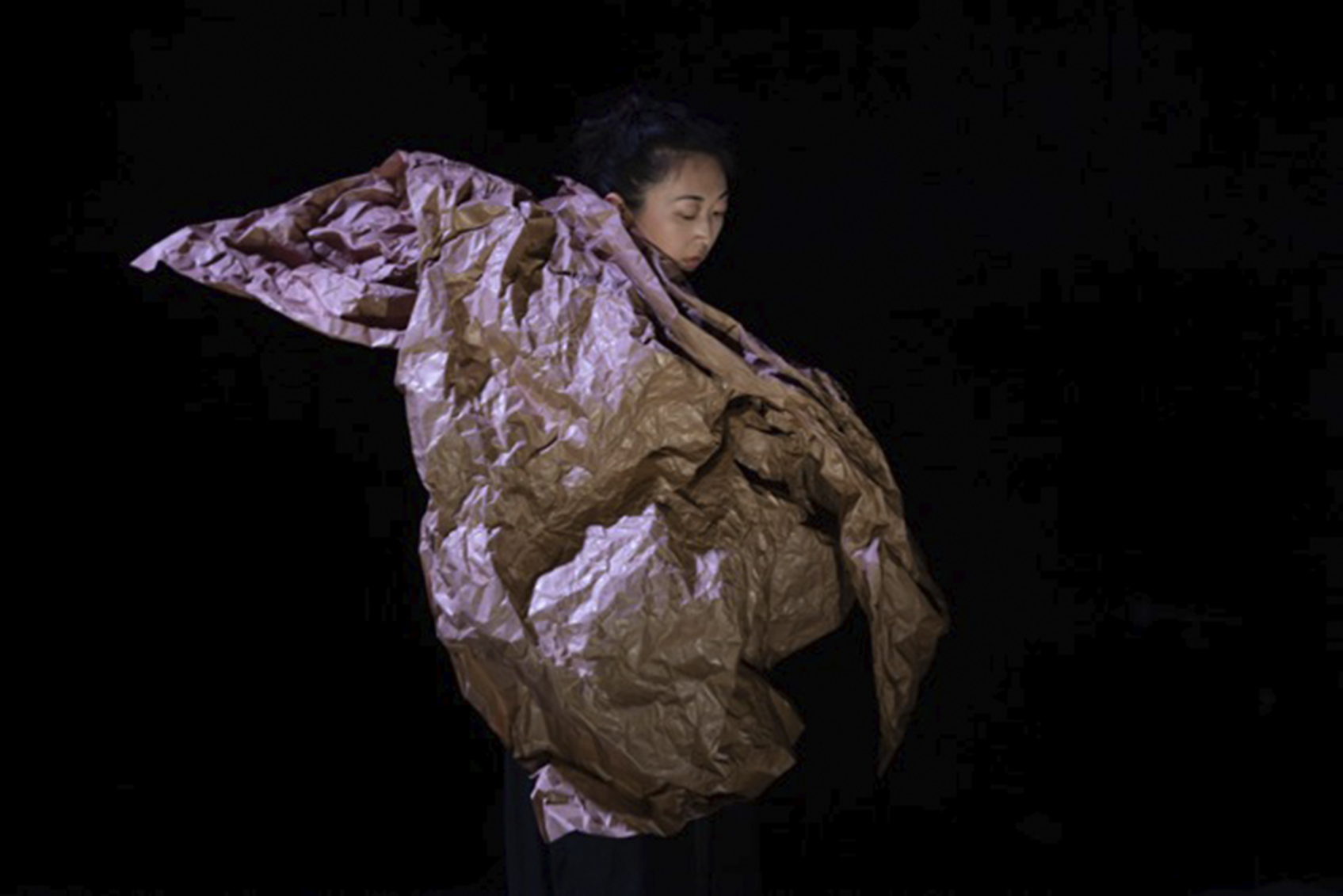
This challenge became especially observable during rehearsals for a scene in which I manipulated a piece of kraft paper, initially introduced as an ambiguous object associated with fragments of de Sarria’s memory (Figure 2). Similar uses of large sheets of kraft paper also appear in the training of Underwood and Genty, for example in their exercise ‘étreinte’ (French for ‘embrace’), in which kraft paper was treated not merely as a prop but as a performing partner. Its unpredictable resistance and tearing reconfigured the intimacy of the embrace, while also fostering ‘peripheral perception’ and an awareness of distancing.Footnote 19 By this stage of the performance, the paper had not yet assumed a defined symbolic or narrative function. However, from the audience’s perspective, the paper appeared animated, moving through space in a manner suggestive of an independent rhythm and internal logic. As the performance unfolded, its presence encouraged spectators to engage imaginatively with the scene, constructing associative responses and entering the object’s affective framework. Achieving this effect requires more than technical proficiency; the performer must also construct a bridge between the object’s physical animation and the audience’s imaginative activation. In my case, I became overly focused on the paper’s external properties – its shape, rhythm, spatial trajectory, and breath control – while overlooking the internal impulses that might imbue the material with affective resonance. The result was a technically precise manipulation that lacked the deeper sense of presence and affective charge that might otherwise have emerged.
A Taste of Millefeuille, Theatre YOUNG (Shanghai), October 2024. Yun Geng (inner voice) manipulating the kraft paper. Photographer: Li Wang.
This gap between external accuracy and internal affectivity has been widely theorized in performer training, particularly in the work of Jerzy Grotowski. Grotowski places emphasis on what he terms the ‘impulse’ – a pre-rational, embodied signal that originates deep within the performer and becomes the authentic source of action. Unlike external mimicry or stylized gesture, the impulse emerges from the actor’s lived experience, memory, or internal conflict, and only later manifests through movement, voice, or spatial interaction. Grotowski explicitly rejects mechanical performance based solely on technical routine, advocating instead a via negativa approach – not a collection of skills, but the eradication of blocks to allow genuine inner activation.Footnote 20 Reflecting this same principle in practice, de Sarria remarked during one rehearsal: ‘Your manipulation techniques are perfect right now, but you are still blank in your heart, and audiences can feel it.’Footnote 21 His critique highlighted precisely the divide between external control and internal impulse, reinforcing the idea that effective performance, even in material-based theatre, must arise from affective sincerity rather than formal precision alone.
In response to this feedback, I began exploring ways to activate internal impulses through memory and association. In subsequent rehearsals, I drew on personal memories – some joyful, others melancholic or unresolved – to shape my tactile relationship with the paper. These associations were not translated into character or story but rather served as impulses that anchored the manipulation in affective immediacy.
As this shift took hold in rehearsals, the impact extended beyond the manipulation of kraft paper. Once I began performing with memory and imagination, the quality of presence changed – not merely in form but in vitality. De Sarria acknowledged this shift during a later rehearsal, noting that ‘now, with emotional energy inside, your performance becomes visible, not just technical’.Footnote 22 What had previously felt externally controlled now carried a sense of lived urgency, of inner movement meeting external form.
This approach aligns with Jacques Lecoq’s notion of material imagination, in which the performer’s internal landscape enters into dialogue with the material world. Rather than illustrating a theme, the body becomes a vessel through which feeling flows into form. In such moments, the performer does not act about emotion, but enacts it – through gesture, rhythm, and touch. The result is not narrative clarity, but a kind of poetic authenticity that audiences can intuitively perceive.Footnote 23 This mode of presence does not depend on linguistic understanding or linear storytelling; rather, it offers spectators a shared sensory and emotional field – an experience grounded in bodily truth and spatial rhythm. Puppetry, in this sense, becomes a medium not merely of representation, but of transmission – not of fixed meaning, but of affective immediacy.
While these embodied and emotional strategies were critical in animating materials on stage, they also shaped the way I approached the ‘inner voice’ role – particularly in adapting it across linguistic and cultural contexts. In the following section, I reflect on how this role, traditionally performed by male actors in French or other languages, was reconfigured through a female body speaking Mandarin. This shift required not only linguistic adaptation, but also a rethinking of rhythm, gendered presence, and audience reception.
Adapting the Inner Voice Role in Shanghai: Gender, Embodiment, and Performer Reinterpretation
In each version of A Taste of Millefeuille, a local performer takes on the role of de Sarria’s ‘inner voice’. The inspiration of this role comes from the universe of Genty and Underwood, whose work shows the conflict within the self and aims to reach the spectator’s subconscious.Footnote 24 Genty explains that illusion and dreamlike shifts can break logic and open a ‘gate’ to the unconscious, where images link through association rather than narrative.Footnote 25 The ‘inner voice’ reflects this tension of the psyche and brings subconscious conflict into performance. In most versions, the role has been played by male actors, often in the local language, as a double to de Sarria’s silent, physical presence. The structure of the piece gives the role its frame, but each performer shapes it with their own language and culture. What follows examines a sensorial dramaturgy in which material, memory, and movement – rather than dialogue or plot – stage an inner, at times feminine, subjectivity.
In the 2024 Shanghai production, this casting convention was modified: I was invited to assume the ‘inner voice’ role as the first female performer. This decision emerged not only from my position as the production’s local organizer and producer, but also from my long-term training with de Sarria and Rusek’s Mots de Tête. The result introduced a notable shift in both vocal register and dynamic, prompting questions of gender, reception, and intercultural translation that shaped the rehearsal and performance process.
Initially, the idea of gendering the inner voice raised questions about authorship, identification, and the performer’s interpretive agency. Could a female voice inhabit the same internal intimacy that had previously been conveyed through a male body? Would this shift alter the power dynamics between the silent main figure and the voice guiding or haunting him? These questions became central to the rehearsal process. Although de Sarria was at first hesitant, our discussions affirmed that, as mentioned above, memory and inner voice are not tied to a single gender. This perspective echoes contemporary views of subjectivity as relational and unstable rather than fixed. The task, then, was not simply to replicate a masculine register with a feminine one, but to explore how gendered embodiment could open new affective registers within the piece’s non-verbal dramaturgy.
The challenge was not simply vocal or tonal. It required discovering how the inner voice could operate through a different bodily presence – one shaped by my gender, movement vocabulary, and emotional expression. Unlike conventional voiceover work, this voice was spatially present – moving, gesturing, reacting – yet emotionally elusive. Rather than representing a fixed persona, the voice had to be porous, shifting between observation and projection, empathy and critique. In early rehearsals, I found myself replicating a more neutral tone, consciously avoiding femininity for fear of disrupting the original balance. Over time, however, I began to explore how subtle shifts in posture, eye contact, and proximity could transform the voice’s quality from passive commentary to intimate participation. The voice became less about content and more about relation.
As the performance developed, this reimagined inner voice complicated – but also deepened – the dramaturgical structure. Rather than simply replacing a male figure with a female one, the gender shift opened up an ambiguity: was this voice maternal, spectral, or simply a mirror? This ambiguity proved productive, allowing the audience to project multiple interpretations without narrative resolution.
From a dramaturgical perspective, these material contrasts implicitly activated gendered resonances: the angular, structured, and assertive qualities of kraft paper aligned with traditionally masculine coding, while the pliability and fluidity of the plastic fabric gestured towards an internalized, arguably feminine, affective register. This does not reduce the materials to gendered essence but instead illustrates how expressive motion is read through culturally sedimented associations. As dance theorist and performance scholar Susan Leigh Foster suggests, choreographed gestures activate a social semiotics of the body, whereby even abstract movement becomes intelligible through cultural codings of gender, emotion, and power.Footnote 26 In this sense, the performer’s interaction with materials is not only aesthetic but also a negotiation between somatic presence and cultural inscription. Without spoken language or fixed narrative, these scenes articulated a sensorial dramaturgy through which an inner feminine subjectivity could be staged via the relational dynamics of material, memory, and movement.
This exploration became particularly critical during rehearsals for the scene in which de Sarria and I co-manipulated a piece of kraft paper. Originally conceived to express the fragmented nature of memory, the paper served as both a symbolic and kinetic material. However, once the ‘inner voice’ – previously portrayed by male actors – was embodied by a visibly present female performer, the spectator’s interpretive frame shifted significantly.
As Erika Fischer-Lichte, the prominent German theorist of theatre and performance studies, argues, meaning in live performance emerges not simply from authorial intention, but from the audience’s culturally embedded modes of perception – shaped by co-presence and habitual patterns of recognition.Footnote 27 In this case, the pairing of male and female actors, working closely with the same object, triggers a code of intimacy. In earlier versions of A Taste of Millefeuille, the male ‘inner voice’ was framed within the dramaturgy as an internal projection of de Sarria’s subjectivity, embodied by another male performer. By contrast, in the 2024 Shanghai production, my presence as a female performer, sharing the stage and manipulating the same material, introduced a different potential reception. In the post-performance discussion, some spectators remarked that the scene suggested intimacy or partnership, showing how casting choices can reconfigure perception even in an abstract dramaturgical frame. This tendency to read intimacy from mixed-gender proximity was not unique to Shanghai; it is a widespread habit of spectatorship. In Shanghai, however, and for Shanghai audiences, there remained a strong expectation of dramatic storytelling structured around time, place, character, climax, and resolution. In the post-performance discussions following all five shows, spectators repeatedly asked what story the piece was telling, signalling a sense of confusion when faced with the more fragmentary, poetic dramaturgy of visual theatre. This same expectation shaped their interpretation of stage relationships: the presence of both a male and a female performer working with the same object was often read as a romantic relationship. Together, these responses highlight how local audiences sought to anchor abstraction in narrative terms, making the recalibration of spatial and movement choices especially crucial in this context.
This shift in perception did not stem from a failure in performance design but from naturally embedded habits of spectatorship. The directorial response, therefore, required not a narrative clarification, but a spatial and kinetic reorientation – one that would guide audiences away from relational projection and back towards the abstraction intended by the original dramaturgy.
These refinements were developed through extended rehearsal and dialogue, allowing us to preserve the material’s metaphorical weight while preventing unintended relational readings. The piece employs non-linear material manipulation and visual composition to evoke de Sarria’s philosophical reflection on memory, identity, and the nature of existence – rather than to depict inter-character relationships. To address this challenge, we made deliberate adjustments to the spatial grammar (i.e. the performative logic of gaze, distance, and orientation that shapes how meaning is constructed through space) of the scene, focusing on the distribution of gaze, physical proximity, and movement dynamics. Throughout the segment, de Sarria intentionally avoided making eye contact with me, maintaining focus on the material. I, in turn, refrained from directing my attention towards him, channelling my gestures towards the object or the audience. This mutual absence of eye contact and physical responsiveness disrupted any suggestion of interpersonal interaction, clarifying our respective dramaturgical positions: I was not performing a character with narrative agency, but rather appearing as a spatial embodiment of fragmented memory.
My movement vocabulary was also modified: I avoided approaching him directly, maintained inward-facing gestures, and structured my physical rhythm in contrast to his. Together, these choices anchored the role in abstraction, steering audience attention back to the material rather than trying to guess the relationship between characters.
This case suggests that adaptation must attend not only to local language or casting but also to spectators’ habits of perception, which may be amplified differently in local contexts. Therefore, my female ‘inner voice’ was not neutralized or desexualized; instead, it was rendered perceptually distinct through spatial and visual design, inviting spectators into a non-narrative mode of reception that embraced multiplicity and ambiguity. During the performance, I suddenly appeared like a manifestation of de Sarria’s subconscious, confronting him and embodying his inner conflicts. These conflicts could stem from his mother’s disappointment in his failure to become a banker, or from innocent memories of images from his childhood. Such ambiguity invited audiences to remain attentive, engaging more fully with the unfolding performance.
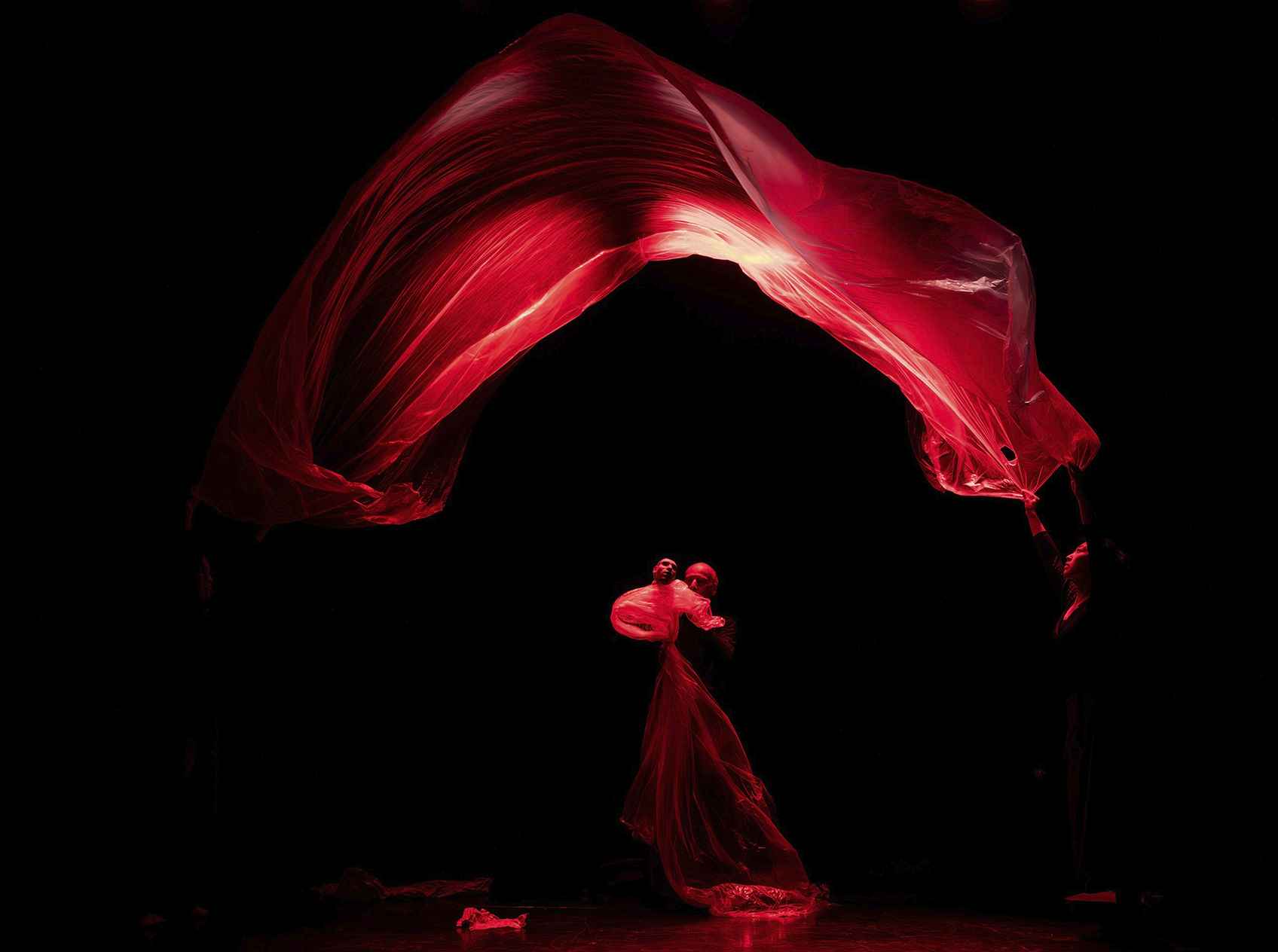
A contrasting example emerged in a subsequent scene, where de Sarria performed alone, manipulating a puppet head and a flowing length of translucent plastic fabric. The resulting imagery was abstract and dreamlike: the puppet head served as a focal point of subjectivity, while the fabric extended the body in soft, undulating motion. Although the sequence did not explicitly signal gender, the fabric’s supple, non-confrontational movement quality suggested a kind of internal tenderness or vulnerability – traits often associated with femininity.
This stood in marked contrast to the earlier kraft paper scene, in which the material’s rigidity and sharp acoustic feedback produced staccato movements characterized by fragmentation and tension. While the kraft paper projected energy through sharp edges and discrete articulation, the plastic fabric absorbed and diffused energy, evoking a more immersive and atmospheric sensibility.
Taken together, these explorations show that adapting the ‘inner voice’ role in the Shanghai version was more than vocal substitution or gender changing. The performer’s body, cultural coding, and the material’s expressive potential intersected to produce new dramaturgical readings. In Shanghai, the spectators’ strong orientation towards narrative and relational interpretation prompted their post-performance questions and their tendency to read intimacy into mixed-gender staging. These dynamics were not obstacles but opportunities to expand the piece’s interpretive range. The adaptation included gendered embodiment and audience perception as dramaturgical material; rather than a replication of earlier productions, it became a situated reinvention created by local expectations and embodied presence.
While gendered embodiment significantly altered the dynamics of the inner voice, another key layer of adaptation emerged through language. In the Shanghai production, the ‘inner voice’ text – originally written and performed in French – was translated into Mandarin, raising questions about rhythm, nuance, and cultural resonance. Mandarin’s tonal and grammatical features changed how the French poetic text was delivered. This reshaped audience engagement with abstraction. Translation acted as a form of dramaturgical adaptation. It affected both the texture of the language and the audience’s response. The difference between European and Chinese spectators was not fixed. It appeared in how each group received non-linear dramaturgy and in which meanings shifted across contexts.
Performing Across Cultures: Translation, Rhythm, and Reception
As noted above, puppetry in China is often framed through children’s entertainment or heritage display. Against this background, A Taste of Millefeuille introduced an unfamiliar theatrical grammar to Shanghai spectators, both in its manipulation of objects and its non-narrative structure. Some audience members asked for a clearer storyline or character relationship, while others described the work as ‘visually powerful’, ‘poetic’, and ‘deeply moving’; on Xiaohongshu (a popular platform for cultural commentary), viewers variously responded to the ‘novelty and wonder’ of the performance, ‘truly magical’ for its symbolic resonance through space, material, and light, and ‘a feast for the eyes’, presumably beyond the need for any spoken dialogue.Footnote 28 Within this setting, then, translation worked as a form of adaptation. The goal was not to follow the French text word for word, but to keep its emotion and meaning so that the audience could enter the character’s inner conflict. This section looks at two examples: the prologue poem in translation; and later spoken fragments combined with material action.
Spoken text occupies a limited role in A Taste of Millefeuille, yet its placement is dramaturgically significant. One such moment occurs in the prologue, where a short poem, composed by de Sarria, is spoken aloud to initiate the memory sequence. This prologue does not belong to the later kraft paper or plastic fabric scenes; instead, it functions as an opening frame for the performance’s exploration of memory. As de Sarria explained in rehearsal, the poem should be read as if an adult self returns to a childhood place and unexpectedly discovers a poem written long ago. The words may now sound naive or humorous, but they trigger a flow of memory fragments. In the Shanghai production, this poem was translated into Mandarin and performed in a manner carefully aligned with the affective atmosphere established by the original French version.
The task was not merely one of linguistic substitution, but of preserving a particular intention. The spoken delivery was conceived not as public recitation, but as an introspective act – comparable to discovering a childhood diary and reading it aloud in solitude. The performer’s voice functions less as a communicative gesture and more as a catalyst for temporal transition, inviting the audience into a shared space of recollection through tonal and spatial modulation.
The French version facilitated this atmosphere through the language’s inherent softness and rhythmic continuity. Mandarin, with its tonal structure and different syntactic rhythm, required adaptation in pacing and vocal inflection. However, the objective remained constant: to sustain the dramaturgical threshold between past and present, and between memory and embodiment. In this context, translation was not limited to textual accuracy but constituted an embodied dramaturgical act – shifting linguistic form while retaining the original temporal and emotional architecture of its grammar.
A particularly delicate moment of intercultural adaptation occurred during the final scene, which was set to the French song ‘Avec le Temps’, by Léo Ferré.Footnote 29 In the original staging, de Sarria’s performance is closely synchronized with the emotional and lyrical progression of the song. This dramaturgical structure assumes a francophone audience’s familiarity with both the song’s cultural resonance and the semantic content of its lyrics.
In the Shanghai performance, however, comprehension of the lyrics could not be assumed. To address this, I initially proposed projecting a Mandarin translation onto the set or distributing printed translations in the programme. De Sarria declined this approach, arguing that ‘when the audience is focused on deciphering the meaning of the lyrics in real time, they inevitably lose connection with what is happening onstage’.Footnote 30 This raised a dramaturgical problem: how to preserve the emotional continuity between text and gesture without fragmenting the performance space.
The solution required a careful recalibration of pacing, voice, and delivery. Simply reading the Mandarin version of the lyrics in real time would have risked creating a parallel track of communication – text versus movement – thus rupturing the illusion of unity between sound and stage image. Instead, we experimented with rhythm: I began speaking each translated line precisely one beat before the corresponding lyric began in the French soundtrack. This cueing technique allowed the audience to receive the semantic content just before de Sarria’s gestures responded to it, maintaining the emotional synchrony of word and movement.
Tonally, my delivery adopted a restrained narrative cadence – neither overly emotional nor flat – evoking a sense of reflective detachment. The voice functioned not as a character but as a narrative presence, guiding the audience through a temporal and emotional landscape without interrupting the visual dramaturgy. While French audiences were already attuned to the song’s content, and could focus primarily on the performance, the Mandarin narration offered Shanghai viewers a bridge across linguistic and cultural difference without compromising the performance’s internal rhythm.
Another layer of adaptation involved modifying certain lines to align with the audience’s cultural framework. In one key scene, de Sarria’s character is immersed in a moment of memory when his mother’s voice suddenly interrupts, questioning the validity of his artistic practice. The lines originally read:
INNER VOICE: Éric, what are you doing?
ÉRIC: This is theatre.
INNER VOICE: Theatre? Is this a theatre? Just a cabaret! Do you think they bring you there for a cabaret? Do you know who finances all your art activities? It is the people! With their taxes!
ÉRIC: But Mama? Mama!
These lines reflect a specific cultural reality in France, where independent artists may receive monthly state subsidies under the intermittents du spectacle system. Thus, the mother’s criticism references not only personal disapproval but also the perceived misappropriation of public support.
However, when presenting this scene to a Chinese audience, many of whom may be unfamiliar with such welfare structures, the direct translation of ‘It is the people! With their taxes!’ risked miscommunication or narrative opacity. In response, I revised the line to: ‘Theatre? Is this a theatre? You’re just fooling the audience – do you deserve their ticket money?’ This shift reframed the critique in terms of audience accountability rather than state funding, a concern more immediately recognizable to viewers in the Shanghai context. While the content changed, the emotional charge remained intact, still confronting the artist with external judgement and ethical scrutiny.
This approach aligns with that of the translation scholar Susan Bassnett, whose ‘Translating for the Theatre: The Case Against Performability’ (1991) argues that theatrical translation cannot be treated as a purely linguistic act. She critiques the unrealistic assumption that a written text, originally part of a complex network of performance signifiers, including kinesic and paralinguistic elements, can be fully translated by a single person removed from the live context. As she explains, ‘the translator thus becomes superhuman – he or she is expected to translate a text that a priori in the source language is incomplete, containing a concealed gestic text, into the target language which should also contain a concealed gestic text’.Footnote 31 By ‘gestic text’, Bassnett refers to the non-verbal dimensions of theatre – gesture, action, tone, and staging – that remain implicit within the script. In reality, she argues, meaning in theatre emerges through performance, not transcription.
This insight reinforces the need for culturally resonant adaptations in cross-cultural settings. In A Taste of Millefeuille, the Mandarin translation of scenes such as the mother’s confrontation or the poetic narration of childhood memory were not intended to produce a verbatim equivalent of the French text, but to evoke comparable emotional and social responses in a different cultural framework. Bassnett’s perspective legitimizes such interventions by positioning performance, not the original script, as the ultimate locus of meaning.
Through staging the inner conflict, de Sarria highlighted a universally resonant theme: the difficulty of remaining authentic in the face of external judgement, particularly from family, whose expectations often shape the individual’s identity. For me as a young Chinese performer, the theme of family expectation versus personal desire resonated strongly with my own experience and with those of my peers. In this social context, it was difficult to ignore how the scene’s conflict might speak to a wider generational struggle – between listening to one’s inner voice and meeting external demands. It is important to find a balance between listening to this inner voice and satisfying external demands. This resonance suggests that the meaning of the drama arises not only from the translation of the text but also from the social framework in which it is accepted.
In the East Asian context, and particularly within Chinese urban environments, many young people experience life as a series of high-stakes decisions under intense structural pressure – school entrance exams, university rankings, career paths, and familial milestones such as marriage and childbirth. As Bourdieu argues, ‘habitus’ – the historically inscribed system of dispositions – shapes perception and possibility from within, rendering certain life paths socially implausible before they are consciously rejected.Footnote 32 What appears to be a linear, unquestionable trajectory is in fact a product of embodied submission to structural constraints. In such a framework, the pursuit of unconventional or creative vocations becomes not merely discouraged, but often unthinkable – what Bourdieu calls ‘a virtue made of necessity’.Footnote 33 Rather than enforcing limits through coercion, the habitus naturalizes them, producing compliance without command.
For some audience members, de Sarria’s inner dialogue about the legitimacy of his artistic path may have prompted personal reflections on the tension between social expectations and individual vocation. While not all societies offer the same cultural acceptance or institutional support for ‘gap years’ or unconventional career choices, the underlying dilemma remains: how does one persist on a path that resists the expectations of those we love?
Rather than providing a definitive answer, the performance deliberately left this question unresolved, emphasizing the complexity and temporality of such existential tensions. In this light, the exchange between de Sarria and his mother did not suggest resolution or failure but rather illustrated a moment of lived enquiry – an open, affectively resonant space in which the self was being reconfigured. In staging such indeterminacy, the work invited spectators not to arrive at judgement, but to engage in reflection. Although de Sarria did not provide a clear answer to this question, the movement captured the nuanced and unresolved nature of such dilemmas, recognizing them as an inevitable part of life.
Ultimately, the Shanghai performances of A Taste of Millefeuille revealed both the challenges and generative potential of intercultural dramaturgy. Originally programmed for three performances at Theatre YOUNG, the production extended to five, due to full houses and growing demand – an encouraging indication of the work’s resonance with local audiences. Despite its creation within a French cultural context, the Shanghai performances evoked strong emotional responses, suggesting that the work’s thematic core – personal memory, inner conflict, and the fluidity of identity – resonates beyond cultural and linguistic boundaries. In doing so, the production enabled a shared sensory and emotional field through which new modes of spectatorship could emerge, expanding the expressive potential of visual theatre in cross-cultural performance contexts.
Conclusion
Through the rehearsals and performances of A Taste of Millefeuille in Shanghai, I gained several practical experiences. As the performer of the ‘inner voice’, I had to change how I used body movement, space, and rhythm so that the scene would not be seen primarily in terms of a man–woman relationship. I also worked with gesture, gaze, and body rhythm to guide how the audience made meaning. In the rehearsal process, I learned to work with the director and to use the feedback from local audiences in later rehearsals. This became a kind of embodied dramaturgy. I also took part in the translation and the performance of the text. From this I saw how tone, rhythm, and context changed the way the audience understood the play.
These experiences also gave me new ideas for research. I saw that audiences in Shanghai often read abstract action as a relationship. This seemed to demonstrate that cross-cultural adaptation is not only about words or language: it is also about how people watch, and how culture shapes their way of watching. I was also able to connect Practice-as-Research methods with audience responses. Rehearsal notes, audience feedback, and translation choices all worked together to build dramaturgical knowledge. I found that a performance’s meaning is not fixed according to the director’s plan, but that meaning arises from the meeting of materials, bodies, and the cultural habits – and habitus – of the audience. This perspective adds dimension to previous studies of visual theatre, which I consider especially important as so little is written and available in English on Genty and Underwood’s work and its legacy.
These findings also show what is at risk in intercultural theatre. If the differences between cultures are not seen, audiences may merely read the work as a story of relationships. This can weaken its symbols and dream-like images. If these differences are used as part of the dramaturgy, the director and the actors can open new ways to read the work which can also give it new life. As I hope my study has shown, cross-cultural adaptation is not just a matter of ‘copy and translation’: it is, rather, a new act of making, and one that demonstrates how culture shapes what people see and how they make meaning.
Finally, the Shanghai performances also displayed the power of visual theatre across cultures. Puppets, objects, and materials do not need language. They speak through texture, movement, and space. They give audiences new ways to imagine and feel. For many Chinese audiences used to story-based theatre, A Taste of Millefeuille offered a new kind of theatre. It was poetic and fragmentary. Some felt confused, but they also saw that theatre can be more than a story. It can also be an experience. Puppets and objects are not only for children or for the margins of theatre: they can hold memory and emotion. Watching, with focus, what is seen and felt in the moment can also be meaningful. This performance gave Chinese audiences a wider view of puppetry and material theatre, but also supplied scholars with a case study that shows both the problems and the creative power of visual theatre in cross-cultural work.

 Open access

