


Introduction
While an array of factors that contribute to political engagement have been identified, including contextual, demographic, social and endogenous elements (Blais, Reference Blais2000; Blais and Daoust, Reference Blais and Daoust2020), a significant proportion of the variation in political engagement remains unexplained, even after accounting for key variables such as political interest, efficacy or sense of civic responsibility (Blais and Daoust, Reference Blais and Daoust2020; Levy and Akiva, Reference Levy and Akiva2019; Blais and St-Vincent, Reference Blais and St-Vincent2011). In this article, we turn to motivational psychology in search of another contributing factor in explaining political engagement.
As motivational psychology focuses on understanding what drives behaviour, it provides an insightful framework to explore the underpinnings of political engagement and determine what distinguishes politically active citizens from those who are disaffected. While scholars are now considering the psychology of political engagement, the relationship between motivational psychology and political behaviour remains an understudied, but potentially significant, area of research. Previous research (for example, Barrett and Brunton-Smith, Reference Barrett and Brunton-Smith2014) shows that personality traits can provide insight into how individuals relate to politics (Blanchet, Reference Blanchet2019; Bergeron and Galipeau, Reference Bergeron and Galipeau2021; Blais et al., Reference Blais, Mungall and Pruysers2022; Federico, Reference Federico, Osborne and Sibley2022) and who chooses to become politically engaged (Bakker et al., Reference Bakker, Jolly and Polk2020; Mondak, Reference Mondak2010; Mondak et al., Reference Mondak, Hibbing, Canache, Seligson and Anderson.2010 ). Furthermore, measures of ability, such as personal and political efficacy, have been documented as robust predictors of political engagement (Mazzurco, Reference Mazzurco2012; Reichert, Reference Reichert2016; Vecchione and Caprara, Reference Vecchione and Caprara2009). Yet, often overlooked are key components of motivational psychology: whether individuals want to participate (Miller, Reference Miller and La Raja2013) and have a reason to be engaged. Rather than a single theory, motivational psychology contains a diverse set of approaches to study human action, including propulsive factors such as curiosity, competition, reward and hope (Murayama, Reference Murayama2018). In this study, we concentrate on understanding the impact of hope specifically, defined as confidence that one’s goals will be fulfilled (Snyder, Reference Snyder and Snyder2000), on one’s willingness to engage with politics. While prior inquiries have notably considered the effects of the presence or absence of hope (Panagopoulos, Reference Panagopoulos2014), we propose to investigate the extent to which both the Locus of Hope (LoH; Bernardo, Reference Bernardo2010) and the presence of political goals, two measures of behavioural motivation, explain and contribute to predicting individual variation in political engagement.
Because it incorporates goals and diverse strategies into a single behavioural model, we expect LoH to improve our understanding of variation in political engagement (Blais et al., Reference Blais, Young and Lapp2000) beyond typical measures of political efficacy and interest. Given the focus of LoH on goal achievement, we also present in this article a novel measure of political goals. Hence, we ask two research questions: Does LoH positively predict greater political engagement? And do the loci of an individual’s sense of agency (internal versus external) influence their likelihood of political engagement?
Political engagement
Extant research has considered a variety of explanations for differences in political engagement. Socioeconomic status (Solt, Reference Solt2008), ethnicity (Stepick et al., Reference Stepick, Stepick and Labissiere2008; Torney-Purta et al., Reference Torney-Purta, Barber and Wilkenfeld2007), age or generation (Nemcok and Wass, Reference Nemcok, Wass and Thompson2021), gender (Giger, Reference Giger2009), family background (Janmaat and Hoskins, Reference Janmaat and Hoskins2022) and level of education (Le and Nguyen, Reference Le and Nguyen2021) have notably been studied. The overall findings show that age, income, as well as personal and parental education positively influence the likelihood of political engagement. Women are commonly found to be less knowledgeable and interested in politics as well as less efficacious (Verba et al., Reference Verba, Burns and Schlozman1997), or at least to believe that politics is too complicated (Gidengil et al., Reference Gidengil, Giles and Thomas2008; Thomas, Reference Thomas2012), although recently these gendered divergences have been debated (see Kraft and Dolan, Reference Kraft and Dolan2022). Women may also choose to partake in different, and frequently less visible, modes of political participation (Buranajaroenkij et al., Reference Buranajaroenkij, Doneys, Kusakabe and Doane2018).
Beyond these factors, scholarly attention in understanding political behaviours has also turned to psychology. Authors have notably investigated the impact of emotions, values, attitudes and personality traits, like the Big Five (Mondak, Reference Mondak2010), on participation (Loewen, Reference Loewen2010; Settle et al., Reference Settle, Dawes, Loewen and Panagopoulos2017). Personality traits are defined as “features of psychological individuality that account for consistencies in behaviour, thought, and feeling across situations and over time” (McAdams and Olson, Reference McAdams and Olson2010: 519). For example, Vecchione and Capara (Reference Vecchione and Caprara2009) find the relationship between efficacy and participation is mediated by two personality characteristics: openness to experience and extraversion. Further, Klemmensen et al. (Reference Klemmensen, Hatemi, Hobolt, Petersen, Skytthe and Nørgaard2012) demonstrate a strongly heritable component to political participation and political efficacy but not to an individual’s self-reported sense of politics as a civic duty. However, McAdams and Pals (Reference McAdams and Pals2006: 208) note that the study of traits only offers a partial understanding of human personality and behaviour, which is also shaped by context, personal narratives, and “a wide range of motivational, social-cognitive, and developmental adaptations, contextualized in time, place, and/or social role.”
Authors have also noted the importance of cognitive factors. For example, civic knowledge and education (Galston, Reference Galston2007) as well as trust in democratic institutions (Grönlund and Setälä, Reference Grönlund and Setälä2007) have positive influences on engagement. Personal attitudes also matter, including a sense of civic duty (Blais et al., Reference Blais, Young and Lapp2000; Green & Shachar, Reference Green and Shachar2000) and the strength of one’s political preferences and interest in politics. Going back to Downs (Reference Downs1957), individuals have the incentive to vote if they have a preference over the likely outcomes under different winners. Blais and Achen (Reference Blais and Achen2019) show that the decision not to vote is notably driven by the absence of a clear preference regarding the outcome of an election (unless citizens maintain a strong sense of civic duty). Caring about the outcome can therefore motivate individuals to get involved.
Relatedly, the scale and complexity of democratic politics are, for many individuals, an obstacle to engagement (Hanson et al., Reference Hanson, Haridakis, Cunningham, Sharma and Ponder2010; Koc-Michalska et al., Reference Koc-Michalska, Lilleker and Vedel2016; Sloam, Reference Sloam2014). Efficacy, in terms of one’s sense of political competence, institutional responsiveness as well as belief in the effectiveness of collective action (Barrett and Brunton-Smith, Reference Barrett, Brunton-Smith, Bee and Guerrina2017), has gathered substantial scholarly attention (for example, Becker, Reference Becker2004; Karp and Banducci, Reference Karp and Banducci2008; Reichert, Reference Reichert2016; Schur and Kruse, Reference Schur and Kruse2000). Common sentiments from disaffected citizens include the feeling that their vote does not matter or that their interests are not reflected in the decisions of elected representatives (Birch and Dennison, Reference Birch and Dennison2019). Unsurprisingly, an individual’s belief in their ability to comprehend and influence political affairs (Carpara et al., Reference Caprara, Vecchione, Capanna and Mebane2009) is a significant predictor of voter turnout (Condon and Holleque, Reference Condon and Holleque2013; Karp and Banducci, Reference Karp and Banducci2008; Moeller et al., Reference Moeller, De Vreese, Esser and Kunz2014; Wolak, Reference Wolak2017).
Given what we already know about efficacy, why could motivational psychology help us to further understand political engagement? Motivation is commonly defined as a state that “energizes, directs, and sustains behaviour” over time (Reeve, Reference Reeve2016:31). To Baumeister (Reference Baumeister2016), motivation is, at its core, a desire for change. These definitions show what fundamentally differentiates motivation from efficacy: whereas effective citizens think they can understand and influence politics, motivated citizens want to act to attain their political goals. Consequently, relying solely on efficacy does not truly allow us to assess one’s motivation to engage in politics.
Given motives, individuals can be moved to “effortful goal pursuit” (Wright, Reference Wright2016: 18). Miller (Reference Miller and La Raja2013) argues that this holds true in politics and that the decision to engage in politics notably rests on the existence of political motives. The macro-level factors perhaps most often associated with motivation include party activities and competitive elections (for an overview, see Settle et al., Reference Settle, Bond, Coviello, Fariss, Fowler and Jones2016), but authors have also investigated a wide range of individual-level possibilities (Miller, Reference Miller and La Raja2013), from the attraction of material gains to developing a sense of group identity (for example, Van Zomeren et al., Reference Van Zomeren, Postmes and Spears2008). Past findings also suggest that a common theme among disaffected citizens is a lack of efficacy and an inability to meet one’s political goals through traditional means of political participation (Van Wessel, Reference Van Wessel2010). A key question then becomes how to identify the motivations that distinguish the politically engaged from the politically disaffected, and specifically what characteristics are relevant in the choice to express oneself politically.
In the current study, we extend the research on the correlates of political engagement by focusing on the role of motivational psychology, building upon existing work that shows the importance of both motivation and efficacy. We investigate how variation in individual strategies for objective seeking and goal attainment (Locus of Hope) may influence willingness to engage in politics.
Locus of Hope
A part of motivational psychology, Hope Theory is an approach to studying human action. Developed by Snyder et al. (Reference Snyder, Sympson, Ybasco, Borders, Babyak and Higgins1996), hope is defined as reflecting an individual’s sense of agency or determination to reach a goal and their pathways or methods/strategies to reach that goal. In other words, a hopeful individual thinks they can effect change and employs a strategy to meet their objective. Hope theory stipulates that goals, agency and pathways are necessary components (Snyder et al., Reference Snyder, Sympson, Ybasco, Borders, Babyak and Higgins1996), and a deficit in any one of these components results in low hope (Worley, Reference Worley2018). It should be noted that the term “goals” refers to an aim or desired result, the object of a person’s ambition or effort. Consequently, taking hope into account could allow us to understand how individuals are set in motion toward their political goals, as “individual differences in trait hope explain variations in how people attain their goals” (Bernardo, Reference Bernardo2010: 948).
Bernardo (Reference Bernardo2010) expanded upon Hope Theory by distinguishing the source, or locus, of hope. In developing the Locus of Hope (LoH) model, Bernardo (Reference Bernardo2010) replicated the internal source of hope from Hope Theory and introduced the distinction that external sources of hope may originate from different sources: friends or family relationships, spiritual identification or community. Following from this, the LoH model suggests that the hope that one can reach political goals could come from within or be fuelled by various external sources. In other words, LoH helps us to determine what exactly motivates individuals to become politically engaged, and if different sources of motivation lead to different outcomes. This distinction introduced by Bernardo seems to be a fruitful avenue of research in political science, given that they notably resonate with Miller’s (Reference Miller and La Raja2013) work showing the different effects of value-expressive, identity and self-interest motives on political engagement. LoH allows us to complement these results by also considering an array of external motives.
Indeed, as an approach to studying behavioural motivation, LoH focuses specifically on goal attainment and integrates individual differences in strategies by considering hope originating from oneself (internal) and hope from external sources. In contrast to rational accounts that focus on self-interested goals as the motivation for political behaviour (Green and Shapiro, Reference Green and Shapiro1994), and efficacy accounts that focus on self-assessed competency (Caprara et al., Reference Caprara, Vecchione, Capanna and Mebane2009), LoH incorporates diverse psychological strategies for goal attainment. What distinguishes LoH from other behavioural motivation models is the explicit consideration of different strategies (pathways) to meet objectives. Moreover, regarding the distinction between LoH and efficacy, although the definition of political efficacy, or one’s “own competence to understand and to participate effectively in politics” (Niemi et al., Reference Niemi, Craig and Mattei1991: 1408), traditionally encompasses self-assessed capability and perception of system responsiveness (Craig & Maggiotto, Reference Craig and Maggiotto1982; Niemi et al., Reference Niemi, Craig and Mattei1991), LoH considers the willingness to engage in politics through a variety of strategies aimed at achieving political goals, including an expanded understanding of external sources of agency that distinguishes between spiritual, familial and friendship-based hope (Bernardo, Reference Bernardo2010). Overall, LoH theory considers both individual variation on self-assessed efficacy for goal attainment (high versus low efficacy) as well as internal (individual/self-actualized) or external (collective/inter-reliant) sources of agency (Bernardo, Reference Bernardo2010).
Furthermore, while political efficacy emphasizes capability, most accounts omit a direct consideration of whether individuals have an explicit motivation to participate, beyond having an undefined impact on eventual policy choices. The presence of political goals is important because whereas efficacy focuses on knowing the system, having goals implies wanting to achieve an objective. LoH theory emphasizes having a specific goal as a requisite motivation. Consequently, LoH theory is consistent with the finding that while personal efficacy typically has a non-significant negative correlation with voter turnout among minority communities, individuals’ beliefs about the existence of community goals and their sense of community efficacy have a positive relationship with voting behaviour (Mangum, Reference Mangum2003). LoH theory is also compatible with work that suggests researchers need to go beyond traditional measures of efficacy, either because it is unclear that they measure a stable concept (Chamberlain, Reference Chamberlain2013) or because of their relevance for the individual in question (Phoenix and Chan, Reference Phoenix and Chan2024). Thus, LoH theory may help to better understand political engagement by expanding the idea of what it means to feel efficacious and investigating multiple aspects of motivation. In keeping with our argument, Bell and Schermer (Reference Bell and Schermer2023) have shown that political orientation on the left-right spectrum can predict the anchor point of hope, with conservatives being more likely to turn to religion or family, while left-leaning individuals tend to look at their peers.
To date, little is known about the relationship between political engagement, political goals and hope. Past work has tended to focus on dispositional hope, a concept which strongly overlaps with personal efficacy or an individual’s belief in their capacity to execute behaviours necessary to produce a desired outcome (Bandura, Reference Bandura1977; Synder, Reference Snyder1994; Snyder et al., Reference Snyder, Sympson, Ybasco, Borders, Babyak and Higgins1996). For example, certain studies within this literature attempt to increase political engagement by using reflections about positive political experiences to experimentally induce higher levels of hope. While these studies have been successful in increasing hope scores, corresponding to positive changes in candidate evaluation, they failed to produce tangible effects on political behaviours such as voter turnout (Civettini, Reference Civettini2011; Just et al., Reference Just, Crigler, Belt, Marcus, Neuman and MacKuen2008; Panagopoulos, Reference Panagopoulos2014). These null findings are hardly surprising, as induced emotions are temporary states which are unlikely to produce lasting behavioural changes unless continuously primed. Nonetheless, Miller (Reference Miller and La Raja2013) demonstrates that a threat to one’s goals is powerful in motivating participation, which implies that political goals themselves are significant. By leveraging Hope Theory to better understand political engagement, our intent is to focus on how engagement may be perceived by individuals as a way to realize political goals they believe are achievable. Our approach differs from previous studies because it examines hope as a pathway to greater political engagement by comparing behavioural outcomes among individuals who naturally vary on this characteristic. By using a relatively stable psychological characteristic, as opposed to hope as a state or emotion, we can potentially isolate the long-term effects of hope on political engagement.
Hypotheses
Hope theory is concerned with whether and how individuals gather the motivation to work toward a desired goal. In this project, we use the LoH measure to explore how pathways, goals and agency impact political engagement. To facilitate our investigation, we developed and administered a 6-item instrument measuring general political goals. In LoH theory, it is the presence or absence of goals that matters, so our expected outcome is a significant interaction effect, such that individuals scoring high on the LoH dimensions who have clear political goals are more likely to be politically engaged. Consequently, we do not investigate the impact of the source of the goal, such as a specific religion or partisan affiliation, on behaviour. Instead, we focus on the difference between internal and external hope loci. The LoH differs from other measures of political efficacy because it includes both aspects; thus, in this article, we seek a more nuanced understanding of what motivates political engagement.
This project has two objectives: 1) to evaluate whether the interactions between LoH subscales and political goals predict overall political engagement; 2) to compare the value of LoH and political goals, independently, as predictors of engagement against two traditional political science measures: political efficacy and political interest. This study includes one pre-registered hypothesis and two exploratory hypotheses, as outlined below.
Our pre-registered hypothesis is:
-
(H1) The interaction between the LoH scales and political goals will positively predict political engagement.
This hypothesis was registered on 31 March 2022 (https://osf.io/x4z6v/?view_only=bbb726a13d974124bf8c9c). Footnote 1
Our exploratory hypotheses are:
-
(H2) LoH and political goals will significantly correlate with political engagement after controlling for political efficacy; and
-
(H3) LoH and political goals will significantly correlate with political engagement after controlling for political interest.
Method
Data and research design
We administered a 15-minute online survey to a sample of 784 (50.77% men) Canadian participants from Leger, a well-known Canadian market research company. While the choice of sample is primarily based on the location of the investigators, the nature of Canadian democracy makes it well-suited for this research. As a multi-party system, Canadians have more opportunities to engage with a diverse set of political actors, which research on electoral supply shows promotes wider engagement and minimizes the cynicism associated with two-party or polarized systems (Kittilson and Anderson, Reference Kittilson, Anderson, Dalton and Anderson2011). The sample was restricted to Canadian residents over the age of 18 years and is demographically representative of age, education and income: the mean age is 50.67 years (SD = 15.89); 29.6 per cent of participants have completed a bachelor’s degree; and the mean and modal incomes are between CAD $30,000 and CAD $60,000. Participants were compensated approximately CAD $2.50 for their time. The survey was administered from 18–25 March 2022.
A total of 899 participants opened a link to the survey, but 18 individuals declined to give informed consent and 58 did not complete the full study. An additional 39 were removed from the analysis because they were identified as straight liners (n = 9) or failed one or more attention checks (n = 30). The study completion rate is 87 per cent.
Pilot study
To assess our measure of political goals, a pilot study of 12 questions was conducted between 11–12 December 2021. The pilot sample of 420 participants was recruited through Leger. Participants were compensated roughly the equivalent of CAD $2.50 for completing the approximately 15-minute survey. Following best practices for scale development, the scale included both positive items indicating the presence of political goals, and negative items indicating the absence of political goals. An exploratory factor analysis (EFA) of the political goal items (unexpectedly) supported a two-factor solution, one factor for positive items and a second for negative items. In motivational terms, the presence or absence of goals can be distinguished as two distinct psychological states, which could explain why we observed a two-factor solution. All six of the positive items and five of the six negative items showed factor loadings greater than 0.6. Both scales showed good internal reliability with strong coefficient alpha (α) and omega (ω) scores: positive (α = 0.91, ω = 0.91) and negative (α = 0.80, ω = 0.81). However, during the full analysis, the negative items showed weaker overall correlations and did not improve model fit over and above the positive items. Consequently, we focus our discussion on the positive scale, but we report the negative items in Appendix A.
Dependent variables
We assess political engagement with a 20-item measure of engagement based on questions used in recent Canadian Election Study surveys (Stephenson et al., Reference Stephenson, Harell, Rubenson and Loewen2020, Reference Stephenson, Harell, Rubenson and Loewen2022). We modified the battery by adding eight items to better capture online engagement and political donations. The measures of engagement include a range of individual and group-oriented outcomes (see online Appendix Table 84). The root question asks participants: “Here are some things people can do to participate in politics. Please indicate how many times you’ve done these things over the past 12 months.” Responses options are “Never,” “Just Once,” “A few times,” “More than five times,” and “Don’t know/Prefer not to answer.” Possible activities included “Volunteered for a political party or candidate” and “Donated money to a charitable cause not counting a religious organization.”
We coded each variable into a 4-point continuous scale. The response “Don’t know/Prefer not to answer” was recoded into the reference category “Never.” Because respondents were allowed to skip items they did not want to respond to, we have 14–22 missing observations for each of the 20 items, or 1.7 to 2.8 per cent of observations. To keep the largest possible sample, these missing responses were also recoded into the reference category. Consistent with a conservative strategy which attempts to minimize biases from recoding, for each of the 20 questions, the modal response category before recoding was “Never” with approximately 50 per cent or more of the respondents selecting this category on most items. The pattern of results does not change if missing data is dropped or recoded to the mean or modal response categories.
To create a single measure of political engagement, we ran an exploratory factor analysis and retained all items with factor loadings > 0.60 as per our project pre-registration. We kept 14 of the original 20 items [#1, 2, 3, 4, 5, 6, 7, 8, 9, 16, 17, 18, 19, 20]. Together these items yield strong internal reliability (α = 0.91, ω = 0.91).
Independent variables
We have two independent variables of interest: 1) Locus of Hope and 2) Political Goals. LoH was assessed using the 40-item Locus of Hope scale (Bernardo, Reference Bernardo2010). This scale assesses four separate loci or subscales: i) Individual, ii) Familial, iii) Peer, iv) Spiritual (Bernardo, Reference Bernardo2010). Each item’s response options are on a 7-point Likert scale from “Definitely False” to “Definitely True,” plus a “Don’t know/Prefer not to answer” option. On average, fewer than 10 participants (1.3%) chose the “Don’t know” response option; we recoded these responses to the neutral category.
The LoH scale includes eight filler items, which were excluded from the final subscales (see Table 83 of the Appendix). According to alpha and omega coefficients, each of the four subscales shows strong internal reliability: Individual (α = 0.88, ω = 0.88), Family (α = 0.95, ω = 0.95), Friends (α = 0.95, ω = 0.95) and Spiritual (α = 0.98, ω = 0.98).
Political goals were assessed using a 6-item measure developed specifically for this study. The scale uses statements such as “I have a clear idea of the policies I want the government to adopt.” The full items are listed in Table 87 of Appendix E. The scale comprises six positive items and uses a 7-point Likert scale plus a “Don’t know/Prefer not to answer” option. Consistent with the results of our pilot, the scale had excellent internal reliability estimates (α = 0.92, ω = 0.92). Table 1 provides the correlations between LoH and political goals.
Pearson’s Correlation between the Locus of Hope and Political Goals Scales

Note: *p < 0.050; **p < 0.001.
We also assessed participants’ levels of political efficacy and political interest. Political efficacy was assessed using seven items taken from the 2019 Canadian Election Study (see Table 84 in the online Appendix). To create a single composite measure of political efficacy Footnote 2 , we followed the same procedure applied elsewhere, recoding “Don’t know” responses to the neutral response and retaining items with factor loadings > 0.60. We kept four of the seven items [#1,2,3,4]. The measure had good internal reliability (α = 0.83, ω = 0.84). Political interest was assessed using the standard 11-point scale, “How interested are you in politics generally?” The responses of five participants who selected “Don’t know” (0.64%) were recoded to the reference category “0 - Not at all interested.”
Analyses
Our main analyses were conducted using OLS regressions. A preliminary analysis showed that our dependent variable, political engagement, had significant skewness and kurtosis commonly associated with measures of engagement, as a large percentage of the overall population does not widely participate in politics. It resulted in heteroscedasticity. To address this issue, we conducted our analysis using heteroscedasticity-robust (Huber–White) standard errors. Each model used 95 per cent confidence intervals and included standard demographic controls: age, education, gender and income. We control for these variables since past research (see Brady et al., Reference Brady, Verba and Schlozman1995) indicates strong associations between these measures and political engagement (coding information is available in online Appendix E). To examine the two-way interaction effect between LoH and political goals on levels of political engagement, models were run separately for each of the four LoH sub-domains: i) Individual, ii) Spiritual, iii) Familial and iv) Peer. In each model, the LoH, political goals and political engagement scales were standardized.
A limitation of this study is the possibility of an endogenous relationship whereby engagement increases LoH and political goals. With LoH, the risk of endogeneity is minimal, as it is understood as a product of early childhood socialization, and the measure we employ has no direct relationship to politics. For political goals, as with studies of political efficacy and interest, we are unable to address this problem without a longitudinal design. However, to give it consideration, we reran each of our regression models controlling for partisanship, drawn from a measure that asked, “Do you usually think of yourself as close to any particular federal political party?” Our reasoning is that partisans should, on average, have more political goals due to their greater level of political participation (supporting a specific party). If the relationship between goals and engagement was endogenous, then including partisanship as a control variable should partially mediate the significance of the relationship (and our results). We verified that, as expected, individuals who identify with a political party score higher on political goals. However, including partisanship in our models did not meaningfully affect the relationship between goals and engagement. This provides limited support for the idea that goals drive engagement, our hypothesized causal order. The results of these regressions are available upon request.
Results
Unconditioned models
We examined the correlations between LoH and political goals individually with political engagement. Each of the LoH scales had positive and significant correlations with engagement: Individual: r = 0.129, p < .001, Spiritual: r = 0.095, p < .006, Family: r = .087, p < .008 and Peer: r = .112; p < .001. However, each scale only accounts for a small portion of explained variation (4.9%–5.7%). The political goals scales also had significant positive correlations with engagement (r = 0.374, p < .001). Furthermore, these scales captured 17.1 per cent and 9.3 per cent of explained variation, respectively, a much larger percentage than captured by each of the LoH subscales. The full results are provided in the online Appendix A, Tables 1–6.
Conditioned models
As shown in Figure 1, the conditioned models containing both LoH and political goals demonstrate that Spiritual: r = 0.081, p < .011, Family: r = 0.059, p < .049 and Peer LoH: r = 0.085, p < .009 each remain significantly related to political participation. Only after controlling for goals does one measure, Individual LoH, fail to reach significance: r= 0.037, p < .272. In addition, political goals reach significance in each of the four models, with correlations between r = 0.365 and r = 0.377. The full results are provided in Tables 7–14 in Appendix A. These results indicate that, while LoH makes a small contribution to overall political engagement, the presence or absence of political goals has a larger effect.
The Predicted Effect of Each Locus of Hope Scale and Political Goals on Political Engagement.
Note: Figure displays the predictive margins of the effect of LoH and goals from Tables 7–10 in Appendix A with 95 per cent confidence intervals. Each model includes controls for age, education, income and gender.

Interaction of LoH and goals
Testing H1, the results of the interaction between the LoH subscales and political goals are listed in Appendix B. We find significant interactions between the Individual, Family, and Peer LoH scales and goals, but not Spiritual LoH. For H1, we can therefore technically reject the null, as the interaction between LoH and positive political goals positively predicts political engagement. However, compared to the results of the conditioned regression models (Figure 1), including the interactions between the LoH scales and political goals only minimally increases explained variation. Although significant, the interactions that form the core of the LoH theory, and hence our main expectation, only minimally contribute to levels of political engagement. More important is the presence or absence of strong LoH or political goals independently.
Efficacy and interest
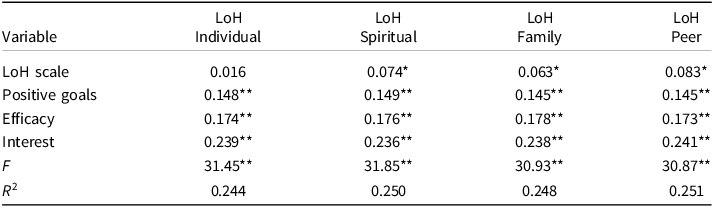
To address our second and third hypotheses, we analyze the LoH and goals scales while including controls for two well-established predictors of political engagement: i) political efficacy and ii) political interest. Consistent with past models, Individual LoH does not reach significance. However, positive goals, and Spiritual, Family and Peer LoH all reach significance after controlling for political efficacy and interest. Therefore, for H2 and H3, we reject the null hypothesis, as LoH and political goals meaningfully contribute to explanations of political engagement above traditional political science predictors. The results are summarized in Table 2 and depicted in Fig 2. The full results are reported in Appendix C, Tables 47–50.
Summary Statistics from Multiple Independent Models: Standardized Regression Coefficients for the Effect of LoH, Positive Goals, Efficacy and Interest on the Dependent Variable Political Engagement

Summary of Results by Hypothesis

The Predicted Effect of Each Locus of Hope Scale and Political Goals on the Political Engagement Subscale after Controlling for Political Efficacy and Political Interest.
Note: Figure displays the predictive margins of the effect of LoH and goals from Appendix C, Tables 47–50 with 95 per cent confidence intervals. Each model includes controls for age, education, income and gender.

Additional models of political engagement
In a set of additional analysis, we also examined the relationship between LoH, political goals and three political engagement subscales: 1) Traditional engagement [#2,4,5,6,7,8]; 2) Non-organized engagement [#16,17,18,19]; and 3) Organized engagement [#11,12,15]. The three subscales reflect theoretical expectations about how different forms of political engagement relate to each other. These expectations are not pre-registered but emerged prior to data analysis. Traditional engagement involves activities that would be thought of as specifically political and individual, such as volunteering for a political party or contacting an elected representative. Non-organized engagement involves activities such as circulating material online or discussing politics on social media, ways of engaging with politics that are modern options available because of technology. Organized engagement activities include volunteering for a group or organization like a school, religious organization or sports or community association. While these activities may be explicitly political (such as promoting a specific policy preference), the activities may also be related to one’s local community. The key distinction is that they are likely to involve some aspect of socialization, which could be a motivation. These scales were created using the same EFA criterion as the overall measure of engagement, retaining items with factor loadings > 0.60.
These results, provided in Appendix C, suggest that LoH, as a pathway to achieve one’s goals, is more important for organized forms of engagement than the presence or absence of goals themselves. Furthermore, our results show that spiritual, family and peer LoH are consistently the best predictors of organized forms of engagement, even after controlling for both political efficacy and political interest. This provides sound evidence that externalized forms of personal efficacy and motivation are important, and understudied, sources of political engagement.
Discussion
This article investigates whether using Locus of Hope (LoH) can provide new insights into who participates in politics, and how. A concept from motivational psychology, Bernardo’s (Reference Bernardo2010) LoH was developed from Snyder’s (Reference Snyder1994) Hope Theory and suggests that the source of hope may be from an internal source (as is the case with Hope Theory) or from external sources, including family, peers and religion. Political science tends to only consider efficacy, which concerns an individual’s sense of agency and capacity. What distinguishes LoH from other constructs assessed in examining political behaviour is its focus on motivation, or one’s willingness to act, and explicit consideration of internalized and externalized strategies (pathways) to meet their goals, as well as the existence of goals themselves. Overall, efficacy and LoH are different but complementary. Put simply, one may, for example, think that they could influence politics, but fail to engage due to a lack of motivation. As summarized in Table 3, our results show that LoH and political goals meaningfully contribute to our understanding of political engagement. In other words, these scales are meaningful additions to our existing toolbox of explanations for engagement. Even when efficacy and political interest are considered, our results nonetheless show the importance of one’s spirituality, family and peers in motivating them to engage with politics.
More precisely, we investigated the value of internalized and externalized hope strategies and goals for understanding wider political engagement through three hypotheses. Through H1, we expected that the interactions between the LoH scales and political goals would positively predict political engagement. Consistent with this, we find significant interactions between positive goals and the individual, family and peer LoH scales. However, we also note that the inclusion of these interaction terms did not meaningfully increase the statistical models’ explained variation, which is contrary to the expectation of Hope Theory. Nonetheless, more important to the explanation of political engagement was the presence of LoH, and of political goals themselves. In all scenarios, the influence of the novel 6-item measure of political goals we developed for this study reached statistical significance.
Limitations
A limitation with this study is that non-voters are under-represented in our sample. This under-representation is a result of using an online sample instead of a random or probability sample. This limitation is somewhat moderated by the fact that our study focuses on wider measures of political engagement and not directly on voting. Furthermore, our expectation is that the results should become more significant, not less significant, as the number of non-voters increases. A second limitation is that the spiritual LoH scale is very God-centred, which may be of limited relevance for individuals with non-monotheistic (or no) religious identities. The lack of significance for this scale may reflect its non-inclusive nature.
Conclusions
Our results suggest that adding considerations of both the Locus of Hope and the measure of political goals we developed is a positive step in the search for explanations about political engagement. Although we expected to find that it was the interaction of LoH and goals that predicted behaviour, we instead find that it is the presence of various forms of hope and political goals that motivate people to engage in politics. Further, this encouragement is not merely a proxy for measures of efficacy or interest. We show that, as predicted by the motivational psychology literature, motivation is both separate and complementary to the effects of those well-established factors. Consequently, our findings suggest that motivation is a key element that cannot be ignored. This has positive consequences for those studying political engagement, as it opens a new avenue of research that can help us to better understand why some people engage in politics in some ways and not others. In particular, the study of the impacts of spiritual, family, and peer LoH as well as political goals on political behaviours seem like a fruitful avenue for future research.
Supplementary material
To view supplementary material for this article, please visit https://doi.org/10.1017/S0008423925000228.
Competing interests
The authors declare none.




 Open access

