

State decorations are a common means to recognize individuals for outstanding service to the state or society or other achievements in countries around the world (Frey Reference Frey2006). While often perceived as merely part of the pageantry of national holidays and state visits, awarding such decorations has significant political and social significance. In the field of international diplomacy, the exchange of state decorations is an essential tool for fostering good relations (Fourie Reference Fourie2007; Nishikawa-Pacher Reference Nishikawa-Pacher2023), whereas they play an important role in the construction of national identity in the domestic arena (Fox Reference Fox2014; Ihl Reference Ihl2006) and have even been linked to economic outcomes (Benveniste, Coulomb, and Sangnier Reference Benveniste, Coulomb and Sangnier2022; Raff and Siming Reference Raff and Siming2019). Most importantly, however, systems of state decorations express “officially endorsed social values” (Fox Reference Fox2010, 377; cf. Vogt Reference Vogt1997, 191). Hence, the answer to the question of who receives which award for what services—and who is excluded—is indicative not only of historical legacies and discourses (e.g., Fox Reference Fox2013, Reference Fox2014; Harper Reference Harper2020; Smith Reference Smith2008). Precisely because of their highly symbolic nature, patterns in the awarding of state decorations are also indicative of prevailing sociopolitical structures and inequalities (e.g., Fox Reference Fox2010, Reference Fox2022; Harper Reference Harper2015a, Reference Harper2015b; Vogt Reference Vogt1997), and thus they are a particularly promising avenue for research.
One of the most notable inequalities in the awarding of state decorations to date is the underrepresentation of women among award recipients—not only in terms of overall numbers, but even more so among the higher classes of awards (see, e.g., Baumert and Valbuena Reference Baumert and Valbuena2020; Fox Reference Fox2010; Ihl Reference Ihl2006). This gender gap is problematic for a number of reasons. Through decorations and awards, governments confer status and symbolic capital that elevates and differentiates recipients. As such, decorations are a means for incentivizing and rewarding certain behaviors (Frey and Neckermann Reference Frey, Neckermann, Baurmann and Lahno2009; Vogt Reference Vogt1997). Thus, not only do state decorations represent yet another aspect of politics and society in which women remain underrepresented (cf. Fox Reference Fox2010). The lack of gender parity—in terms of overall numbers and recognized achievements—also raises concerns that women’s contributions are systematically undervalued compared to those of men (Harper Reference Harper2015a) and that awards fail to fulfill their “integrative function” by not showcasing meritorious service across the whole of society (cf. Ihl Reference Ihl2006).
Previous studies have provided valuable insights into the historical evolution of individual state decoration systems and the experience of women within them. Scholars have focused overwhelmingly on constitutional monarchies in the British Commonwealth. There, women were long barred from receiving civil decorations (Harper Reference Harper2015a), and the primacy of established traditions and ties to the British Crown has hindered reform, resulting in a persistent gender gap among recipients (Fox Reference Fox2013, Reference Fox2014; Harper Reference Harper2015b). As a result, we still know very little about whether systems of state decorations in modern republics exhibit the same disparities. Given that women were eligible to receive republican state decorations from the start, and that the officials administering republican honors are not tied by centuries-old traditions like those in monarchies, it would, in fact, be reasonable to expect that republics show a significantly smaller gender gap in awards. Furthermore, research has been conducted almost exclusively in the form of single-case studies and has rarely sought to develop more general arguments or gauge the transferability of findings beyond national contexts. This raises the question to what extent the gender gap in awards is tied to factors specific to countries or decoration systems, and whether we can identify common mechanisms and patterns that exist irrespective of such factors.
This article seeks to address these shortcomings by presenting the most comprehensive cross-national comparative analysis of the gender gap in state decorations to date. We argue that state decoration systems should be understood as gendered institutions that share common features across political systems, which, in turn, reinforce the inequalities present in the societies in which they are embedded. While republican systems of state decorations differ in their history and operation, this does not necessarily lead to greater convergence in the number and class of awards made to men and women. Our study relies on an original data set of all 11,559 recipients of civil state decorations in the Baltic states (Estonia, Latvia, and Lithuania) from 1994 to 2020—that is, modern republics that experienced major political upheavals during the twentieth century and (re)introduced state decorations comparatively recently. Using this data, we systematically explore patterns and trends in the number and classes of awards to women and the categories of recognized achievements.
Our analysis finds that—despite recent advances—a gender gap persists in all three countries in relation to (a) the total number of awards, (b) the classes awarded, and (c) the categories of recognized achievements. Irrespective of differences in the design of the state decoration systems, women received significantly fewer awards than men, and any improvements over time are largely due to a reduction in the number of awards for men rather than a numerically greater recognition of women. Similar inequalities persist in all three countries in terms of recognized achievements, as women received awards primarily in fields that are traditionally perceived as feminine. Notably, even in those fields in which women received more awards than the national average, they were still awarded significantly lower classes. Finally, we show how the introduction of an award for motherhood in Lithuania led to a significant decrease in awards to women for other achievements.
The findings of our comparative analysis not only corroborate the validity of state decorations as an indicator of institutionalized gender inequalities and the role of women in society (cf. Fox Reference Fox2010, 377), but also contribute to current debates about strategies to achieve gender parity in awards. Moreover, our research contributes to the study of gendered institutions and a more holistic understanding of gender inequalities in politics and society, while also highlighting how patterns in the awarding of decorations can serve as indicators of political phenomena that are otherwise difficult to measure in cross-national comparison.
Women and State Decorations: Evidence and Approaches
Scholars from a range of disciplines have engaged with civil state decorations and demonstrated the relevance of researching their sociopolitical implications. Nevertheless, political scientists have rarely addressed these topics in their research. Instead, authors have focused on the use of awards as a tool of international diplomacy (e.g., Fourie Reference Fourie2007; Nishikawa-Pacher Reference Nishikawa-Pacher2023; Pacher Reference Pacher2020) and a means of political patronage (Raimundo Reference Raimundo2017). Even in other disciplines, the number of studies that have specifically focused on and systematically analyzed the gender gap in state decorations is limited. In this section, we summarize these works before formulating a broader framework for analysis.
Historical research has produced the most comprehensive engagement with the interplay of societal norms and structures with systems of state decorations. Focusing largely on the honors systems in the United Kingdom and other Commonwealth nations, scholars have provided rich histories of individual awards and decoration systems and explicated their interrelationship with political and social developments (e.g., Fox Reference Fox2022; Fox and Furphy Reference Fox and Furphy2017; Harper Reference Harper2020; Lord Reference Lord2021; Smith Reference Smith2008). Thereby, research has highlighted how state decorations served to reproduce prevailing social hierarchies (e.g., by applying different criteria to members of the elite; Harper Reference Harper2018) and how attempts to reform them were often hindered by established traditions as well as by ties to the British Crown (Fox Reference Fox2013, Reference Fox2014; Harper Reference Harper2015b). Some studies have sought to compare developments across two or more Commonwealth nations (e.g., Fox Reference Fox2013, Reference Fox2014); nevertheless, research that seeks comparative perspectives beyond these systems—such as Clark’s (Reference Clark2017) study of the origins and evolution of state honors in Western Europe—remains the exception.
Given that royal orders historically barred women from membership, the relationship between state decorations and the changing role of women in society features prominently in several studies. Nevertheless, the lower proportion of women receiving awards is often not the specific focus of these studies, but one of several points discussed (e.g., Clark Reference Clark2017; Harper Reference Harper2020; Lord Reference Lord2021). Karen Fox’s studies of women’s experiences in the honors systems of New Zealand (Fox Reference Fox2010) and Australia (Fox Reference Fox, Francis, Grimshaw and Standish2012, Reference Fox2022) are noteworthy exceptions in this regard. Fox (Reference Fox2010, 380) argues that the honors system represents a gendered space and hence can be seen as “indicative of women’s unequal, though changing, place in society generally.” Her analyses corroborate this assertion. For New Zealand, she shows that women not only received significantly fewer and lower-ranking awards, but they were also mostly honored for contributions in areas that are traditionally perceived as female (e.g., nursing, teaching, charity work), even when their primary achievements lay in other fields (Fox Reference Fox2010). Strikingly similar patterns emerged in Australia (Fox Reference Fox, Francis, Grimshaw and Standish2012),Footnote 1 where women’s access to state honors and their underrepresentation among recipients is one of the most consistent criticisms of the honors system (Fox Reference Fox2022, 256). Interestingly, although women began to be recognized in previously male-dominated fields over time (Fox Reference Fox, Francis, Grimshaw and Standish2012, 180), the proportion of women receiving honors actually decreased for long periods in both the imperial honors system and the Order of Australia, which was created in 1975 (Fox Reference Fox2022, 121–25, 206–9). Even if initiatives such as the “Honour a Woman” campaign have had a positive impact in recent years, this does not necessarily mean that women receive the same substantive recognition as men (see, e.g., Ford, Pietsch, and Tall Reference Ford, Pietsch and Tall2021 on the representation of women recipients of Australian honors on Wikipedia).
State decorations have also received attention from economists. These studies tend not to consider the impact of societal structures on the awarding of state decorations and instead primarily conceptualize them as incentives for behaviors that benefit the state (Frey Reference Frey2006; Frey and Neckermann Reference Frey, Neckermann, Baurmann and Lahno2009). As a result, scholars have focused on the detrimental effects of a proliferation of orders (Baumert Reference Baumert2012) and analyzed the effects of honors on the compensation and behavior of CEOs (Raff and Siming Reference Raff and Siming2019; Siming Reference Siming2016) as well as the market value of their companies (Benveniste, Coulomb, and Sangnier Reference Benveniste, Coulomb and Sangnier2022). Baumert and Valbuena’s (Reference Baumert and Valbuena2020) analysis of the gender bias in seven national civil orders and 39 regional government decorations in Spain from 1979 to 2018 engages only tangentially with the impact of societal norms; nevertheless, the authors provide striking evidence for a persistent underrepresentation of women among award recipients. Testing for statistically significant differences in the percentage of awards to men and women, they show that, with few exceptions, men were overrepresented among recipients of both national and regional decorations. Contrary to their expectations of convergence, this gap persists over the whole period of observation. Unfortunately, their data allows them to differentiate only between the highest class and all remaining lower classes of each order, and it contains no indication of the respective recognized achievements. Hence, while they conclude that there is likely a structural bias against women in the system of proposal and approval of awards, their study provides only limited evidence on the determinants of women’s underrepresentation.
Extant scholarship provides an important starting point for further research on the gender gap in state decorations. Nevertheless, the aforementioned studies also highlight the need for further theorization and empirical analysis. In particular, theoretical accounts have often concentrated on specific features of state awards (or on decoration systems of individual countries) and only rarely sought to develop more general arguments or gauge the transferability of findings beyond national contexts, respectively. However, such an approach would be necessary to differentiate more clearly between context-specific and general determinants of the gender bias in state decorations. Furthermore, research has largely focused on constitutional monarchies, where state awards emerged from monastic and chivalric orders and did not admit women (Nishikawa-Pacher Reference Nishikawa-Pacher2023, 14). In contrast, systematic empirical evidence on civil awards in modern republics, where decorations were created without these restrictions, or in countries that introduced awards relatively recently is still missing. Finally, there are hitherto hardly any comprehensive data sets that allow for both a comparative assessment of the total number of awards and a systematic analysis of the individual achievements recognized through civil decorations (Ford, Pietsch, and Tall Reference Ford, Pietsch and Tall2021 is a major exception). The remainder of this article seeks to address these shortcomings by first outlining a broader theoretical perspective on the interplay of gender and state awards and then applying it to the analysis of the most comprehensive data set on the recipients of state decorations to date.
Mechanisms of Inequality in State Decorations Systems
Modern systems of state decorations evolved from monastic and chivalric orders, yet especially over the course of the last 200 years, they came to serve different purposes and were adapted to suit changing societal and political demands (Clark Reference Clark2017; Harper Reference Harper2020). Although state-issued decorations still function as means of social differentiation and vesting select individuals with a particular status and symbolic capital (Vogt Reference Vogt1997, 191), their primary purpose is to reward meritorious service to the state and society and achievements in a wide variety of fields, including social activism, arts, literature, sports, industry, and defense (Frey Reference Frey2006). The aim of this section is twofold: first, we seek to formulate more general arguments on how systems of state decorations as they are operating today can be understood as gendered institutions; second, we elaborate on the differences in how republics award state decorations compared to monarchies and reflect on how this affects the gender gap in awards.
Systems of State Decorations as Gendered Institutions
State decorations should—at least theoretically—“be available to all who achieve highly or who give valuable service” (Fox Reference Fox2010, 380).Footnote 2 In an ideal world, awards based solely on merit could provide for equal recognition of men and women (Baumert and Valbuena Reference Baumert and Valbuena2020, 146f). However, feminist scholars have long highlighted that formally neutral institutions have different effects for men and women, who see themselves placed in different positions of hierarchies as a result (Acker Reference Acker1992; Lovenduski Reference Lovenduski1998). Gender, understood as a dynamic process involving actors at all levels, is manifested in these differential effects (Beckwith Reference Beckwith2005; Chappell Reference Chappell2006) and embodied by both the formal rules and the informal norms that make up political institutions (Acker Reference Acker1992, 567). Furthermore, any outcomes produced by these institutions are likewise shaped by the gender norms embedded within them and “help to re/produce broader social and political gender expectations” (Chappell Reference Chappell2006, 226).
As systems of state decorations are created with the express purpose of upholding and promoting particular values and behaviors (Fox Reference Fox2010, 377; Vogt Reference Vogt1997, 191; see also Ihl Reference Ihl2006), the norms embedded within these institutions may appear more obvious than in other cases—they are (at least partly) defined by law and precedent. Nevertheless, the gendered nature of state decorations does not result in direct causality from these explicitly stated sets of norms. Rather, and in addition to disparities on the “input side” of state decorations (i.e., women are less frequently nominated), it emerges from established practices and heuristics employed in the implementation of virtually all decoration systems. In our view, three practices are particularly relevant and justify the conceptualization of state decorations as gendered institutions.
First, state decorations are designed to recognize achievements that benefit society as a whole; therefore, they necessarily prioritize public service. The public sphere is traditionally seen as a masculine space and “embedded assumptions about appropriate forms of behavior in the public service are, in fact, masculine” (Chappell Reference Chappell2006, 227). In contrast, women and the tasks they typically perform as part of their social roles (e.g., caring for children or relatives, taking care of the household) are relegated to the private sphere (Lovenduski Reference Lovenduski1998, 334). The dominance of men in public office has been widely documented. While women have made important inroads in this regard (cf. Dahlerup and Leyenaar Reference Dahlerup and Leyenaar2013; O’Brien and Reyes-Housholder Reference O’Brien, Reyes-Housholder, Andeweg, Elgie, Helms, Kaarbo and Müller-Rommel2020), the mere fact that they often still occupy a minority of public positions means that they are less likely to receive state awards.
Second, state decorations are generally awarded for individual achievements (although some systems also allow for awards to be made to companies or other entities; cf. Raimundo Reference Raimundo2017). As a result, they tend to focus on individuals who have achieved leadership positions. High-level positions in politics, society, or the economy are still overwhelmingly held by men (Rhode Reference Rhode2017), and they are generally associated with longer working hours, less flexibility, and other demands. Consequently, women—who often bear primary responsibility for domestic work even in more egalitarian societies—face greater barriers to taking on such roles (Hoyt Reference Hoyt2010, 485), even in fields in which they otherwise comprise the majority of the workforce (Smith Reference Smith2011). Even when awards are made at all levels of an organization, (all) leaders usually receive individual decorations, while only a select few at lower levels receive an award—usually a lower-ranking or less prestigious one—as representatives of a larger group (cf. Fox Reference Fox2010, 384). Although it would be impractical to award all members of a group (Baumert Reference Baumert2012) and honoring one representative of a particular group may be an efficient way to recognize the work of many (Vogt Reference Vogt1997, 193), it introduces a bias in awards that disproportionately affects women and others who rank lower in social or economic hierarchies.
Third, civil state decorations usually emphasize contributions over long periods of time. Even when laws and regulations do not mention this explicitly, the committees and bureaucracies tasked with vetting nominations are likely to establish and apply their own (informal) thresholds. Even if formal barriers are removed (cf. Fox Reference Fox2022, 153) or societal inequalities are no longer present to the same extent, their impact will continue to be present in the award of decorations. Furthermore, as women are more likely to take breaks from employment or other commitments (Hoyt Reference Hoyt2010), the focus on long-term contributions in defining meritorious service further contributes to the persistence of a gender gap in awards. Even where such inequalities are acknowledged, this does not necessarily lead to a more fundamental rethinking of what should be considered meritorious,Footnote 3 and the “tension between the persistence of old conventions and the acceptance of new practices” (Fox Reference Fox2010, 386) is likely to be resolved only in the long term.
Modern industrial societies are still characterized by gendered social structures that limit the public recognition and opportunities for women. Yet, these structures and their interplay with the factors discussed earlier are likely to contribute not only to a quantitative gender gap, but also to a qualitative one. The different classes and ranks of state decorations allow for further differentiation of merit among those whose contributions have been recognized (Harper Reference Harper2015b, 658; Vogt Reference Vogt1997, 199). Even when women are recognized for their achievements, they are likely to receive a lower-ranking award. Similarly, areas of recognized achievements are likely to differ for men and women depending on whether these are traditionally associated with men or women. In this context, political science research has largely relied on the public/private divide to differentiate between stereotypically masculine or feminine domains (cf. Krook and O’Brien Reference Krook and O’Brien2012; Landes Reference Landes1999). Hence, men should be more likely to receive awards for achievements in areas associated with the public sphere, such as government, industry, agriculture, and religion. In contrast, women’s recognized achievement are more likely to be concentrated in areas associated with the private sphere that are traditionally considered feminine, such as health, education, and care (cf. Fox Reference Fox2010, 2020).Footnote 4
Considerations of State Decorations in Republics
Extant research focuses largely on constitutional monarchies and the British Commonwealth in particular. Although research on systems of state decorations elsewhere is limited, it is still possible to highlight some differences and reflect on their potential impact on women’s representation within civil state decorations. First, and perhaps most importantly, the vast majority of republican state decorations in use to date were created in the twentieth century to align with the more egalitarian founding principles of the new polities. This not only included a clear break from feudal status structures, but also meant that decorations were open to both men and women from the start (France is a notable exception here; Clark Reference Clark2017, 325).
Second, civil decorations in monarchies are—at least formally—awarded by the monarch as a personal favor. In contrast, decorations in republics are always awarded in the name of the state (i.e., not in the name of the president, even if the president is the titular head of a decoration). Qualifying merits as well as bestowal procedures are usually clearly defined by law (cf. Vogt Reference Vogt1997, 195). While informal mechanisms are still likely to play a role, these only emerge within the constraints of formal rules, rather than evolving from established customs—for example consider the “resignation honors” found in many Commonwealth nations but not beyond these.
Third, in republics, the rules governing decorations are agreed upon by legislators and do not have to receive the personal approval of the head of state. This means that republics can theoretically be more responsive to public opinion and changing societal demands. Finally, whereas constitutional monarchies shield the monarch from political accountability (also with regard to honors; cf. Hartmann and Kempf Reference Hartmann and Kempf2011, 23, 44), presidents as republican heads of states can be held politically accountable for their actions – even for how they award decorations (e.g., in 2010, the Slovenian opposition even tried to impeach the president over a decoration awarded to a former head of the Yugoslav secret police; Köker Reference Köker, Monaghan, Flinders and Huq2024, 250–51).
The foregoing factors all point toward a different operation of systems of state decorations in republics. Nevertheless, they do not necessarily result in a greater recognition of women. In republics and monarchies alike, awards are still a means of (additional) social differentiation (cf. Vogt Reference Vogt1997, 199), and most republican decorations are modeled on the structure and nomenclature of chivalric orders (Nishikawa-Pacher Reference Nishikawa-Pacher2023). At first glance, one could expect that the fact that decorations were open to women from the beginning would result in a smaller gender gap in republics (or at least an earlier convergence). Nevertheless, while the successful campaign to open awards for women in monarchies was a notable achievement for the feminist movement (cf. Fox Reference Fox2022), this hardly played a role in early feminist discourses in republics. The resulting lack of public awareness and mobilization of this issue in republics could potentially be a hindrance to efforts to combat gender-based disparities in awards in the present day. The importance of formal rules in republics is a similarly double-edged sword: policies designed to deal with specific challenges (e.g., the underrepresentation of women) might easily produce inadvertent consequences, and those administering the system will have less leeway (and perhaps even less motivation) to adjust. Finally, although presidents are politically accountable for their awarding of state decorations, they only serve limited terms and their perceived legitimacy is primarily tied to the strength of their electoral mandate (Köker Reference Köker2017, 42, 213). In contrast, constitutional monarchies that are part of modern democracies are under much greater pressure to continuously legitimize their positions through their actions (Hartmann and Kempf Reference Hartmann and Kempf2011, 81–82, 311), and thus they should have greater incentives to ensure that state decorations accurately represent society.
The general and more specific mechanisms outlined in this section are admittedly not exhaustive. Nevertheless, they present a sufficiently detailed framework in relation to the scope of the study at hand and its aim to analyze general patterns in award bestowals and to assess the gender gap in civil state decorations across several countries. In the next section, we turn to the empirical analysis of the gender gap in civil state decorations in the Baltic states.
Women, Society, and State Decorations in the Baltic States
Until now, there has been little cross-national comparative research on the politics of civil state decorations in modern political regimes. This, as well as the focus on constitutional monarchies and the British Commonwealth in particular, has limited the generalizability of findings beyond individual countries and their honors systems. In order to provide a comprehensive assessment of the gender gap in state decorations and apply the arguments developed in the previous section, our study analyzes and compares patterns of award bestowals in the three Baltic states—Estonia, Latvia, Lithuania—between 1994 and 2020. These three countries are particularly suitable cases for analysis as they not only share a common history and comparable trajectories of political development, but also experienced similar social transformations over the last decades. While all three countries (re)introduced systems of state decorations after regaining independence in the early 1990s, there are important differences in their structure and operation. In the following, we first provide an overview of the role of women in Baltic society and the different systems of state awards. Thereafter, we introduce our original data set of 11,559 recipients of civil state awards.
Gender and Society in the Baltic States
Similar to other countries in Central and Eastern Europe, the Baltic states experienced a period of fundamental transformation in the early 1990s. Following more than 40 years of Soviet occupation, they faced the challenge of rebuilding a functioning democratic state, economy, and society. In this process, the role and social status of women changed dramatically (Auers Reference Auers2015, 186), yet women continue to face important barriers—most prominently in relation to their economic status and political participation—that are likely to be reflected in the awarding of state decorations.
Before 1990, the participation of women in the labor market was almost equal to that of men. However, despite the Soviet Union’s official commitment to gender equality, men were still seen as the main breadwinners, and women were expected to take care of the household. This was also due to gendered patterns of horizontal and vertical segregation in the Soviet system: women generally worked in so-called unproductive sectors that were considered less relevant (e.g., health care, administration, retail) and lower paid, yet they rarely occupied leadership positions in those sectors (Brainerd Reference Brainerd2000, 142; Kaskla Reference Kaskla2003, 304ff). Nevertheless, although women were expected to return to work after childbirth, they still enjoyed guaranteed maternity leave and overall comprehensive state support (Michoń Reference Michoń, Klenner and Leiber2009, 166). In the wake of the economic reforms after 1990, women’s participation in the labor market declined dramatically (Smith Reference Smith2011). Despite a growth in job opportunities, women across all three countries were more likely to work part time or to be inactive due to caring responsibilities compared to other European nations (Basant Reference Basant, Roosalu and Hofäcker2016), largely because of a lack of childcare options or other support by the state (Michoń Reference Michoń, Klenner and Leiber2009, 173). In contrast with many other Central and Eastern European countries, all three Baltic states eventually saw a large-scale return of women to the labor market. Despite these similarities, Lithuania’s gender pay gap remains well below European Union average, while Latvia has long been above it, and Estonia regularly shows the greatest gap (Eurostat 2022).
Women in the Baltic states are also still underrepresented (at least in descriptive terms) in politics. Under communism, women occupied only one-third of the seats in the Supreme Soviets of the Baltic Soviet Republics and were generally excluded from executive decision-making bodies (Kaskla Reference Kaskla2003, 306). Although all three countries elected women as presidentsFootnote 5 and prime ministersFootnote 6 after their transition to democracy, institutions in postsocialist countries still create barriers to women’s political participation. Studies show that women candidates are consistently disadvantaged at the ballot box as they are often not placed in electable list positions by political parties (Allik Reference Allik2015) and they are discriminated against by voters (Dean Reference Dean2021). The percentage of female legislators in all three countries has long remained around or below 20% and only increased to around 30% in the most recent Latvian and Estonian elections (Lithuania, however, remained at 21%). Furthermore, the first decade of independence was characterized by significantly lower levels of female civic activism (Einhorn and Sever Reference Einhorn and Sever2003), and (nationalist) political discourses on the role of women have generally undermined their political agency by focusing on their roles as mothers and wives (Dean Reference Dean2021; Kaskla Reference Kaskla2003).
As a consequence, women across the Baltic states were less likely to occupy roles in society that were considered meritorious by the standards of traditional systems of state decorations. Especially in the economic and political sphere, they still face important barriers to assuming the type of leadership positions that would allow them to do so, which should be reflected in the number and classes of state decorations women receive. Nevertheless, as women’s situation has generally improved over time, we should at the very least expect a moderate move toward parity in awards. Indicators such as the gender pay gap and women’s representation in politics, however, do not necessarily point in the same direction, so that it is difficult to formulate expectations on how these should be reflected in patterns of award bestowals. The specific features of each country’s system for processing and awarding decorations provide better indications in this regard and are discussed in the next section.
State Awards in the Baltic States
When the Baltic states first declared their independence in 1918, the creation of state decorations alongside other symbols of statehood was a key task for the new regimes. The first decorations mostly honored soldiers from the wars of independence, yet throughout the 1920s and 1930s, civil state decorations were created to reward both men and women who had contributed to building the new states in a variety of fields. Nevertheless, the bestowal of these awards was universally discontinued during Soviet occupation (1944–90) and replaced by the Soviet system of decorations. The latter was characterized by a proliferation of orders, medals, and badges by central authorities and various government departments. These were awarded not only for meritorious service but also for an ever-growing number of workplace anniversaries, participation in regime-sanctioned events or organizations, and other mundane activities. Hence, awards were eventually only valued for their (modest) accompanying monetary reward and were devoid of substantive meaning (Freiherr von Ow Reference Freiherr von Ow1987; Guillebaud Reference Guillebaud1953; Vogt Reference Vogt1997). In reestablishing their independence, all three countries sought a clear and conscious break with the legacies of the Soviet regime, which included readopting their old systems of decorations together with other symbols of independent statehood.
The major civil state decorations in all three countries are officially bestowed by the president (see Table 1). In Estonia and Latvia, citizens can make suggestions directly to the presidential office, whereas in Lithuania, nominations can be submitted only through legislators, the speaker of parliament, the prime minister, or individual cabinet ministers. Estonia’s decorations system was jointly administered by the presidential office and the Office of Decorations (part of the central government agency) until 2009; since then, the presidential office has handled all nominations internally. Latvia and Lithuania have established an Order Chapter and an Awards Council, respectively, as auxiliary institutions to vet nominations, advise the president, and administer the decorations. Presidents in all three countries can also award decorations of all orders at their own discretion—an important difference from monarchies, where decorations are generally awarded by the monarch in name only (Baumert and Valbuena Reference Baumert and Valbuena2020, 129). This would allow presidents to be more responsive to societal changes and to exert greater influence in addressing inequalities in awards. Notably, even though the presidency in all three countries is not the central executive institution—Estonia’s and Latvia’s indirectly elected presidents fulfill largely ceremonial roles, and Lithuania’s popularly elected president only takes a leading role in foreign policy—its incumbents have often sought to stretch their powers beyond constitutional limits (Köker Reference Köker2017). Furthermore, as there is no cap on the number of decorations that can be awarded in any of the orders, this makes personal influence by incumbents a real possibility.
Civil state decorations in the Baltic states

Note: Decorations are listed in their order of protocollary precedence.
* Quotas restricting nominations by government departments and local authorities, 1998–2008 (available in the Supplementary Material).
** Nominations for highest class only by the whole cabinet; nominations for lower classes only by the speaker of parliament, the prime minister, cabinet ministers, and members of parliament; citizen nominations are only processed through the aforementioned institutions.
† Order consists of five classes and a medal of honor (gold/silver/bronze).
†† Order consists of five classes, a badge of honor (large/small), and a medal of honor (gold/silver/bronze).
Sources: Websites of presidential offices; national laws on awards and decorations.
The award committees in Latvia and Lithuania are nevertheless likely to stifle overdue presidential influence (particularly in Lithuania, where the president is not even a voting member of the Awards Council). Given that committee members are recruited from previous recipients, these institutions are more likely to favor stability and limited change. Remarkably, committees in both countries only featured a single woman member for long periods of time; while Latvia’s Order Chapter has had a balanced composition since 2019 (and two women have served as chair since 2015), men still outnumber women in Lithuania’s Awards Council by 7:2. Similarly, Estonia’s restrictions on the number of nominations that could be submitted by government departments and local authorities between 1998 and 2008 likely favored men who already held leadership positions for longer periods of time.Footnote 7 The laws on decorations specify that decorations should only be awarded on certain days of national significance, yet deviations are possible (e.g., Mother’s Day and Father’s Day in Lithuania; we discuss this later in the article). Finally, public discourse on the system of state decorations and its development is generally limited—in the last decade, only the decision of the Estonian president to revoke the decorations of several former politicians and businesspeople (BNS 2014) and a sales advertisement for a forged high-level award in Latvia made notable headlines (Barkans Reference Barkans2019). Discussions on the number of women among award recipients have not entered the mainstream, and presidential offices have made no explicit statements in relation to their priorities in distributing awards.
Data and Methods
Our analysis is based on an original data set containing all 11,559 recipients of civil state decorations in Estonia, Latvia, and Lithuania between January 1, 1994 (coinciding with the institution of the decorations and/or first awards by democratically elected presidents; see Table 1), and December 31, 2020. We focus only on citizens of the respective countries, as decorations for foreigners are often awarded as part of diplomatic exchanges (Nishikawa-Pacher Reference Nishikawa-Pacher2023), and diplomatic protocol does not consider gender a relevant criterion in this context. Furthermore, we focus only on recipients of civil decorations—that is, those that are not awarded exclusively for contributions to national defense or to members of the armed forces. Women are not only traditionally underrepresented in the military, but conscription across the three Baltic states covers only men; women were even barred from serving in the military in Latvia and Estonia until 2004 and 2013, respectively.
Information on award recipients is publicly available and was obtained from the respective presidential offices. For each recipient, our data set includes the full name, citizenship, award type and class, and date of the award. For Estonia and Latvia, the awards data also contained a brief description of the services rendered to the state, individual achievements, or the relevant professional position; the Lithuanian data did not include this information, so we extracted it from the texts of the presidential decrees. In coding recipients’ gender, we employed two strategies. Latvian and Lithuanian grammar requires particular endings to indicate the grammatical gender of first and last names, so we coded recipients’ gender automatically based on the last letters of their names, with only a handful of names and exceptions left for manual coding. The Estonian language does not have a grammatical gender, so we relied on lists of common male and female first names and information provided by the Estonian statistical office on name frequency. Where uncertainties remained, we coded gender manually based on further background research. Importantly, while a dichotomous coding appears adequate given the nature of the research question and the foregoing approaches offer a high degree of methodological convenience, we recognize that an approach based on recipients’ legal names may not always represent their individual gender identity.
Each of the orders considered consists of at least six classes (Table 1).Footnote 8 Classes follow a clearly defined and uniform hierarchy within each order; furthermore, the respective laws on decorations establish a clear hierarchy (also known as protocollary precedence) of all decorations. To compare the differences in awards between women and men, we created ordinal variables expressing the rank of each order and the classes within them. This allows for a more nuanced approach than only comparing proportions of awards to either gender in the highest or lower ranks (cf. Baumert and Valbuena Reference Baumert and Valbuena2020). Finally, we manually coded categories of recognized services and achievements in several steps, using a pooled data set of all countries. We first identified potential categories based on the descriptions of the awards on the websites of the presidential offices, including informational brochures, and the respective laws on orders and decorations. Based on this first coding, we developed further subcategories and grouped others that could not be adequately distinguished based on the information available (e.g., it was not always possible to differentiate between merits in scientific and educational work or ascertain whether recipients’ achievements were directly related to their given profession). The resulting 13 categories consequently vary in scope yet allow for an unambiguous coding of achievements; hence, they are valid and comparable across countries and time periods (see the Supplementary Material for further details).
Analysis: Gauging the Gender Gap in State Decorations
The majority of analyses of gender differences in state decorations have only looked at selected aspects of awards and patterns of bestowal in individual countries. Our study seeks to provide a more comprehensive assessment that combines the analysis of country-specific trends and cross-national comparisons. First, we examine gender differences in the total number of awards. Second, we delve deeper into differences in individual decorations and analyze differences in the classes of decorations awarded to men and women. Third, we compare differences in categories of recognized achievements. Finally, we discuss the medal for motherhood in Lithuania as a specific example of the gendered nature of state decorations.
Country Differences and Trends
Figure 1 presents trends in the total number of civil awards for women and men in the Baltic states between 1994 and 2020. All countries initially issued a comparatively large number of awards before reducing and stabilizing their numbers from the late 2000s onward. The distinct spikes in all three countries can largely be attributed to the awarding of decorations on the occasion of anniversaries or events, as well as large numbers of recipients being awarded decorations quasi ex officio. For instance, all three countries honored members of the first democratically elected parliaments and constitutional assemblies on the tenth anniversary of their election in the early and mid-2000s; similarly, groups of individuals who had contributed to the restoration of independence or leading civil servants and diplomats involved in the countries’ first presidencies of the Council of the European Union were honored in large groups. Nevertheless, this practice has now been discontinued across the three countries.
Trends in the total number of civil awards to men and women in the Baltic states, 1994–2020.
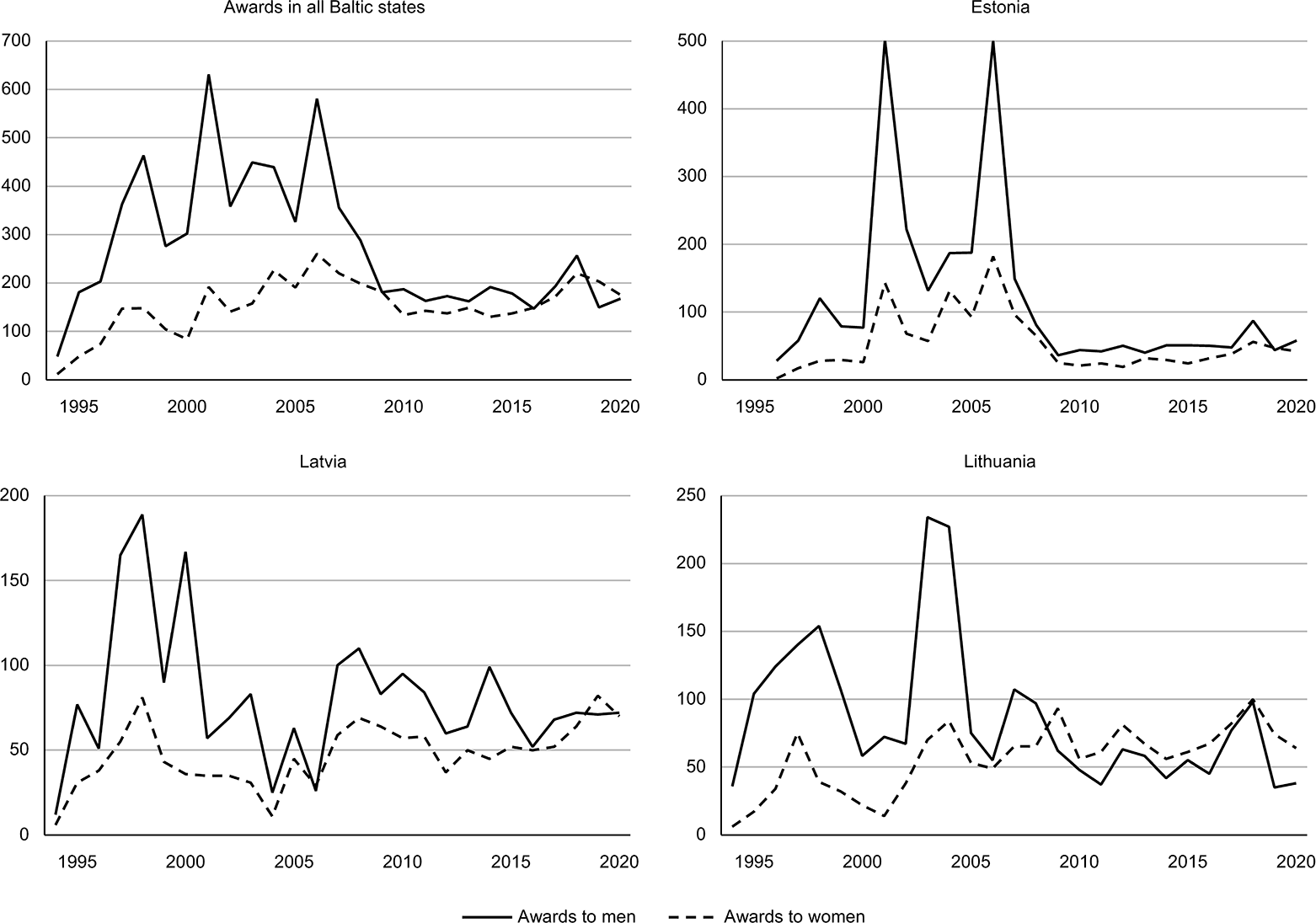
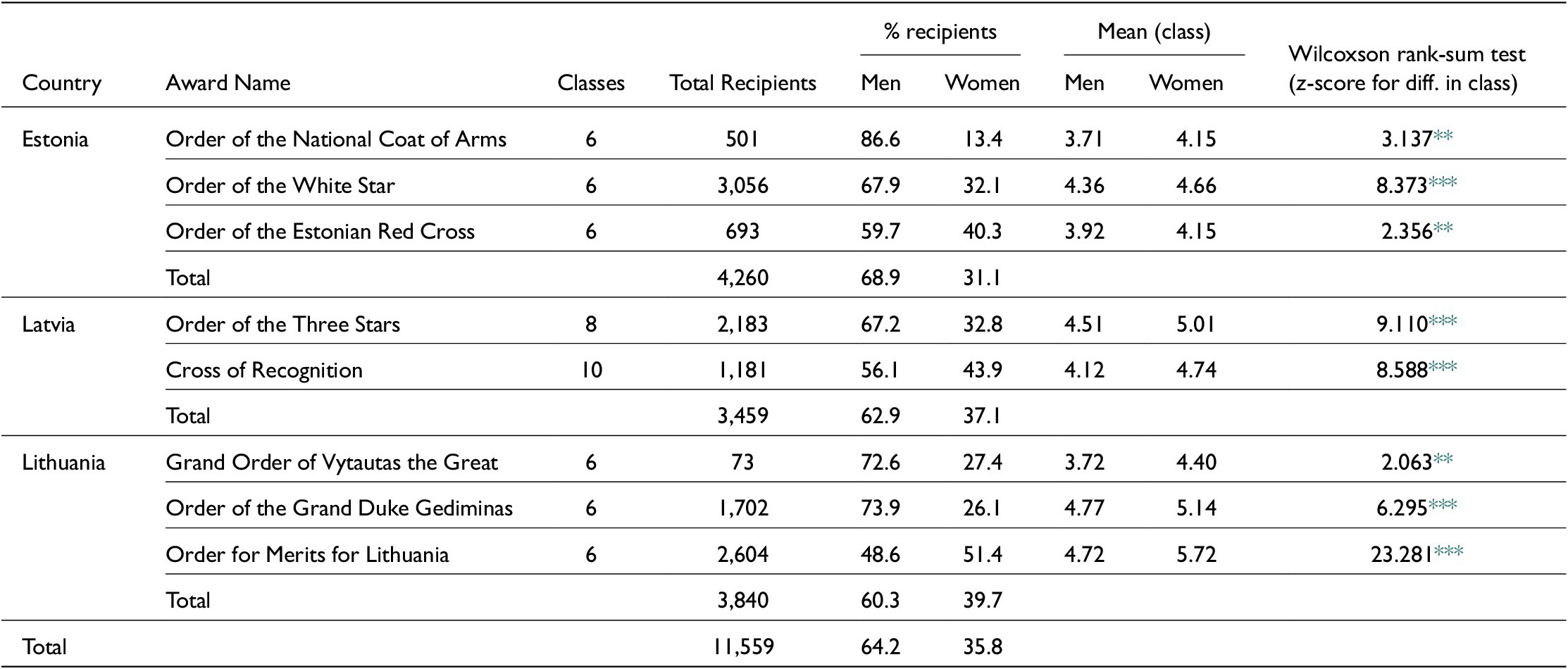
Figure 1 also highlights some trends in gender differences in the number of awards. Especially in the early years, women received considerably fewer awards than men. Men also represented the vast majority of those honored in larger groups, which created enormous disparities in several years (e.g., only 9 out of 121 of members of the Latvian transitional parliament who received a decoration in February 2000 were women). While there appears to be a trend toward greater gender parity in the number of awards in each country (in Lithuania, even toward an overrepresentation of women among recipients), this has not been achieved by increasing the number of female recipients, but by reducing the number of men receiving awards. Furthermore, on the whole, men still received more awards over the last 25 years than women. Table 2 summarizes these numbers for the different civil decorations considered in this article; it shows that men received more than 60% of all awards across the three countries and often even higher shares in the individual orders. The only exception is the Order for Merit for Lithuania, which not only shows an almost equal distribution between women and men, but also is the only order in which women received more awards than men. However, as we explain later, the Lithuanian case shows how analyzing only absolute figures can be misleading. Hence, the next section of our analysis takes a closer look at the classes of awards given to men and women within each order.
Gender differences in the number of classes of civic decorations awarded in the Baltic states, 1994–2020
Note: Orders are listed in order of their protocollary precedence.
*** p < .01;
** p < .05.
The Higher, the Fewer? Gender Differences in the Class of Award
Table 2 compares the classes awarded to men and women across the individual orders. Across the whole period of observation, women received, on average, lower classes of awards than men, irrespective of the total or relative number of recipients. These differences are statistically significant for all civil decorations across the three countries and mirror similar observations by Fox (Reference Fox2010) and Baumert and Valbuena (Reference Baumert and Valbuena2020). Furthermore, women were rarely represented in the top ranks of each order.
In Estonia, 27 men were awarded the highest classes of all orders compared to only 8 women; furthermore, no woman ever received the highest class of the Order of the National Coat of Arms.Footnote 9 This disparity in the Order of the National Coat of Arms is still notable in the second-highest class—while 50 men received an award in this class, in the 12 years that an award was made, only 4 women ever received one. Patterns of bestowal in Latvia show the same pattern. While the Order of the Three Stars was only awarded once in its highest class outside of diplomatic exchanges (to Imants Freibergs, husband of then president Vaira Vīķe-Freiberga), 24 men received the second-highest class of the order since 1995 compared to only 1 woman. The ratios of awards to men and women for the two highest classes of the Cross of Recognition, on the other hand, show similarly striking differences (men outnumber women 39:2 and 39:11, respectively). Finally, Lithuania exhibits a similar lack of gender parity. The Grand Order of Vytautas the Great was bestowed 73 times, yet only 20 times to women, and while 5 men received the highest class, only 1 woman did (Irena Degutienė, the first female speaker of parliament). In the Order of the Grand Duke Gediminas, all awards of the highest class went to men, as did 27 out of 35 awards in the second-highest class. Finally, more women have received awards in the Order for Merits for Lithuania than men. However, 81% of awards to women were bestowed in lowest class of the order, while men received 78% of awards in the higher classes (only one woman ever received the highest class, former first lady Alma Adamkienė).
Despite these notable differences, there is some development over time. Figure 2 shows the differences in the average classes awarded to men and women over time for the different orders in the three countries (the highest orders in Estonia and Lithuania are excluded because of irregular bestowal patterns). An overall trend toward equal recognition of both genders can only be found in Latvia: while men still receive, on average, higher classes than women, that difference is slowly but consistently decreasing. In Estonia, a similar trend can be observed for the Order of the Estonian Red Cross—women now tend receive, on average, even higher classes than men. Nevertheless, women are still not recognized on equal terms in the higher-ranking Order of the White Star. Lithuania shows an almost opposite development. There, women were consistently awarded lower classes in the Order for Merit, whereas the average class was higher (at least temporarily) in the Order of the Grand Duke Gediminas. The latter, however, was attributable to the fact that members of the women’s beach volleyball and basketball teams received awards in the second-lowest class after winning silver medals at the 2017 Deaf Olympics.
Differences in the average order classes awarded to men and women (three-year moving average). Values above 0 indicate that men received on average a higher order class than women, values below zero indicate the opposite; solid lines indicate orders with a higher rank of protocollary precedence.
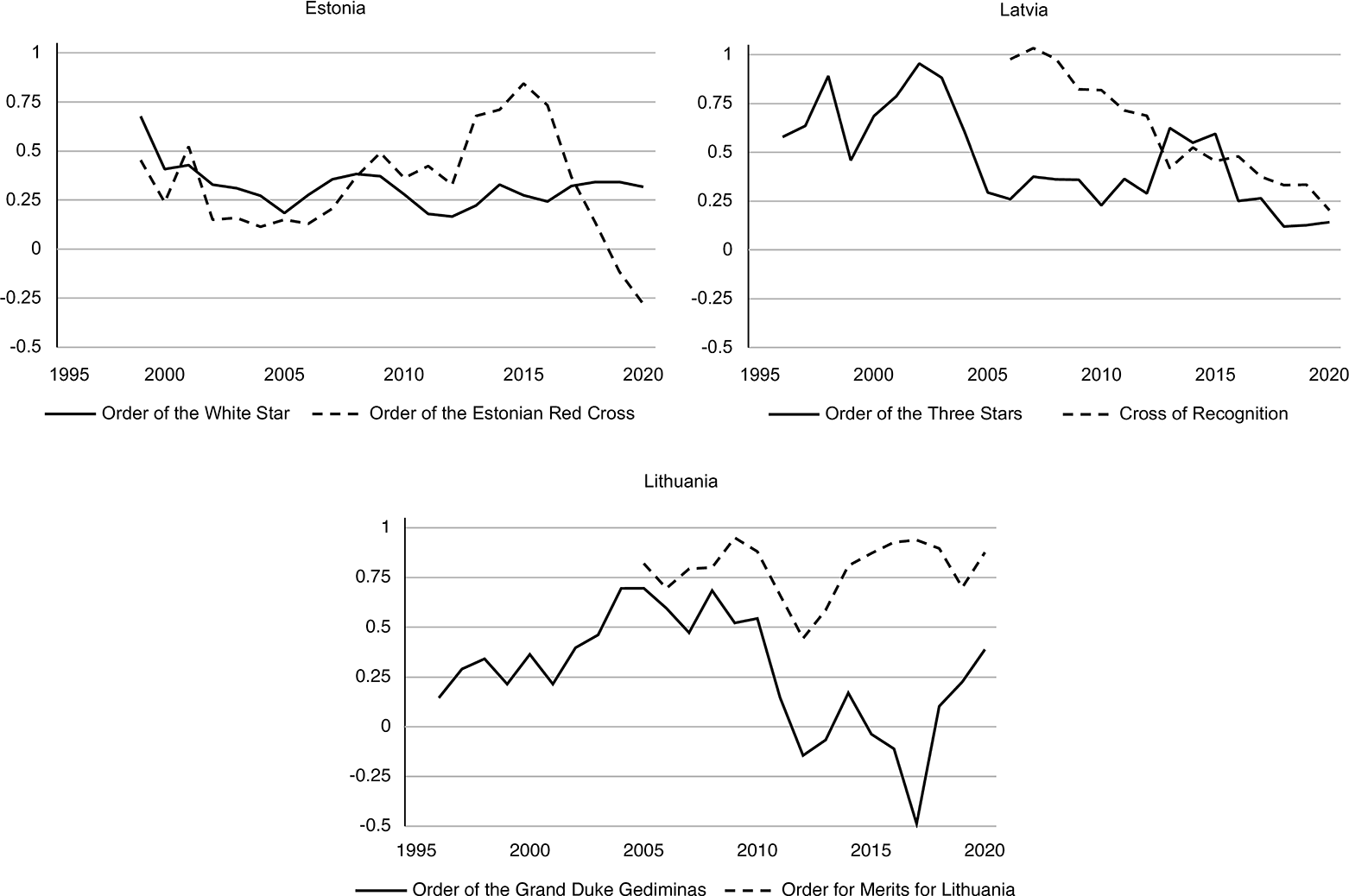
Notably, none of the patterns identified here are clearly associated with the tenure of women presidents or prime ministers. For instance, although the trend toward equal recognition in the Order of the Estonian Red Cross coincides with the election of Kersti Kaljulaid as Estonia’s first female president in 2016, the greatest disparities in the bestowal of Latvia’s Orders were present during the first term of Vaira Vīķe-Freiberga (1999–2004). Similarly, Dalia Grybauskaitė’s presidency (2009–19) in Lithuania saw contradictory trends.
Differences in Recognized Achievements
Our analysis of the number and classes of awards has already shown significant differences in the awarding of decorations to women and men. Yet, gendered patterns also emerge with regard to the categories of recognized achievements, mirroring findings from other studies (cf. Fox Reference Fox2010, 2020; Ford, Pietsch, and Tall Reference Ford, Pietsch and Tall2021). Table 3 shows the distribution of awards across 13 categories for each country. Once again, the results are remarkably similar across the three countries. In particular, women received a higher proportion of awards in categories that are traditionally considered feminine (e.g., education, health and social service) and comparatively fewer awards in predominantly masculine fields (e.g., politics, business). However, even in these fields, women tended to receive lower classes of awards on average. This is particularly striking in the categories of health and social services and science and education, where women received comparatively large numbers of awards—women in Estonia and Latvia even outnumber men in the former category. Care work and teaching are stereotypically seen as particularly suited to women because of their empathetic and caring character, and hence they are considered classically female occupations. Nevertheless, these are also fields in which women are more likely to hold lower-level positions—for example, nurse instead of doctor or teacher instead of principal. Hence, even though women present a large proportion of those engaged in this type of work, men tend to achieve and hold leadership positions and receive more prestigious awards.
Gender differences in recognized contributions and achievements
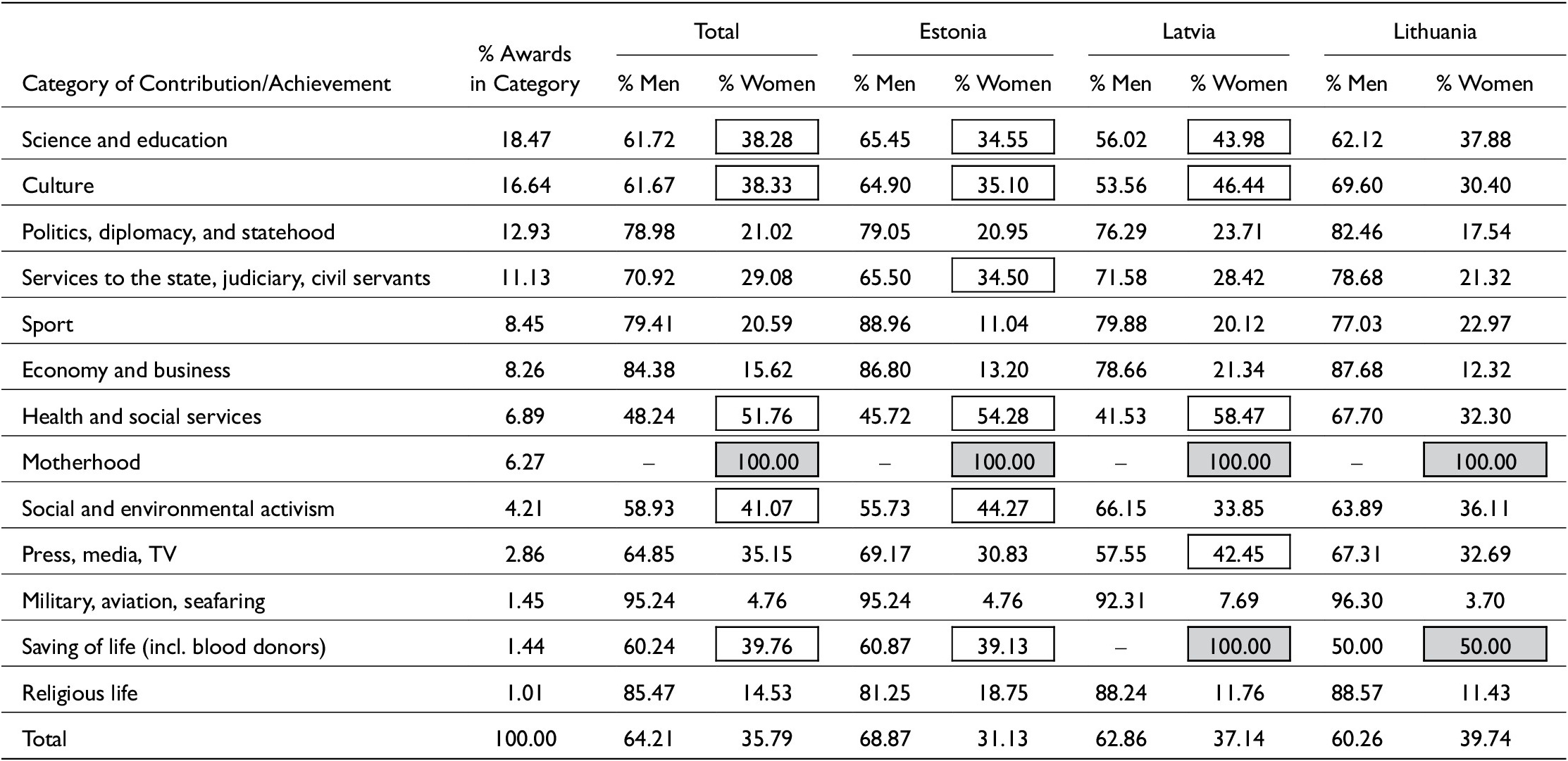
Notes: Categories are ordered by total number of awards; boxes indicate categories in which women received a higher percentage of orders than the national average; shading indicates categories where women received as many or more awards than men; absolute numbers available in the Supplementary Material.
In a similar vein, the dominance of men in the awarding of decorations for achievements and services in politics, business, and religious life is not surprising. One the one hand, these awards mirror the societal structures of the Baltic states. On the other hand, politics and business in particular are fields that are associated with stereotypically male traits, such as courage and leadership,Footnote 10 whereas most religious traditions have excluded women from leadership positions. Notably, Estonia’s first female Lutheran pastor, who had been ordained in 1967, was only given an award in 2004 (the first for a woman in this category), while men received similar or higher-ranking awards for shorter periods of service. The admittedly very broad area of culture shows a more unexpected pattern. Culture has traditionally been considered masculine, yet in all countries, awards were also made in comparatively large proportions to women. Nevertheless, a closer look at the reasons for the awards and the professions included still highlights some expected gendered patterns of awards, as women were more likely to receive awards in the fine arts or as musicians (most prominently, as opera singers or violinists), while men once again dominated in leadership positions (be it as conductors or heads of cultural institutions). Finally, awards for motherhood need to be discussed here. The category has little to no relevance in Estonia and Latvia, where only five women received an award (four in Estonia, one in Latvia), yet it is the single most important category in Lithuania. Here, almost half (47.2%) of all awards to women are concentrated in this category. The next section takes a closer look at orders for motherhood in Lithuania.
Awards for Motherhood in Lithuania
Historically, awards for motherhood have often evoked negative connotations, not only because they essentially reduce women to the role of child bearers, but also because of the use of the “Mutterkreuz” award in Nazi Germany (Weyrather Reference Weyrather1993).Footnote 11 The Soviet Union similarly awarded women who had given birth to and raised at least 10 children the title of Mother Heroine, while those having raised at least five children were granted the Order of Maternal Glory (seven to nine children) or the Medal of Motherhood (five to six children; Freiherr von Ow Reference Freiherr von Ow1987). Given that the Baltic states universally rejected the Soviet system of state decorations, it is surprising that an award for motherhood can be found in Lithuania—even more so as it was only introduced in 2003. Although the initial intentions of the award appear to have been honorable, its introduction and subsequent amendments resulted in significantly fewer women receiving state awards for achievements in other categories.
In June 2002, Lithuania passed a new version of its Law on State Awards, replacing the 1991 law and introducing the new Order of Merit for Lithuania together with a list of achievements it was meant to recognize. Yet, in May 2003—a mere five months after the new law entered into force—four deputies (three of whom were women) of the governing Lithuanian Social Democratic Party proposed an amendment. They argued that in light of discussions about Lithuania’s poor demographic situation, women who had raised many children should receive further recognition. Consequently, a decoration of the lowest class of the Order of Merit should be awarded to “mothers who gave birth to and raised seven or more well-educated children” on Mother’s Day each year (Purvaneckienė et al. Reference Purvaneckienė, Vėsaitė, Šiaulienė and Kirkilas2003; translation by the authors). Although the opposition criticized that the initiative only covered up the government’s failings in providing appropriate support to families by other means and highlighted its similarity to the Soviet motherhood award (Seimas 2003a), it was eventually passed by a large margin (Seimas 2003b).
A consecutive amendment to the Law on State Awards from 2016 then allowed for mothers of five or more children to be awarded the same decoration. This time, the amendment was introduced following a petition from a private citizen titled “On the Endangered Nation of Lithuania” (which included further measures to increase the birth rate and promote a “healthy and sober” lifestyle) and eventually passed unanimously without substantive debate in parliament (Seimas 2016). The latest amendment was passed in October 2020 on the initiative of President Gitanas Nausėda and removed the mentioning of a specific number of children. Instead, the medal of the Order of Merit is now awarded “for merits to motherhood, paternity, custody or care,” broadening the circle of potential recipients. However, while the justification for the amendment stated that it should “draw attention to the importance of the role of mother as well as the father and display due attention and respect of state and society to guardians and caregivers” (Nausėda Reference Nausėda2020; translation by the authors), individuals could have already been honored for such achievements under the current provisions.
Figure 3 shows the empirical relevance of awards for motherhood in Lithuania. In the first three years, they only represented a small share of the total number of awards made to women. However, with the exception of 2018, they have represented the majority of all civil awards since 2006. The situation is even more dramatic when only the Order of Merit is considered—starting in 2005, awards for motherhood constituted, on average, 72.5% of awards. Notably, as the number of mothers awarded has remained largely stable from 2010 onward, this disparity is largely driven by the fact that women are systematically less frequently recognized for other achievements. Furthermore, even if awards for motherhood within the Order of Merit are excluded from analysis, women still received, on average, lower classes of the award than men (differences are statistically significant at p < .001). It is also questionable whether the most recent amendments led to a more general recognition of women and men on equal footing. In 2021, 43 women received awards on Mother’s Day, yet exclusively for their role as mothers. While the presidential decree now used a much more general introductory wording than in previous years, it still listed the number of children born, raised, and cared for by each recipient (notably, only three women recipients had given birth to and raised less than five children; Nausėda Reference Nausėda2021a). In contrast, when 10 men received the same decoration on Fathers’ Day 2021, any mention of the number of children they raised or cared for was missing from the decree and press materials (Nausėda Reference Nausėda2021b).
Awards to women and the impact of awards for motherhood in Lithuania, 2000–2020
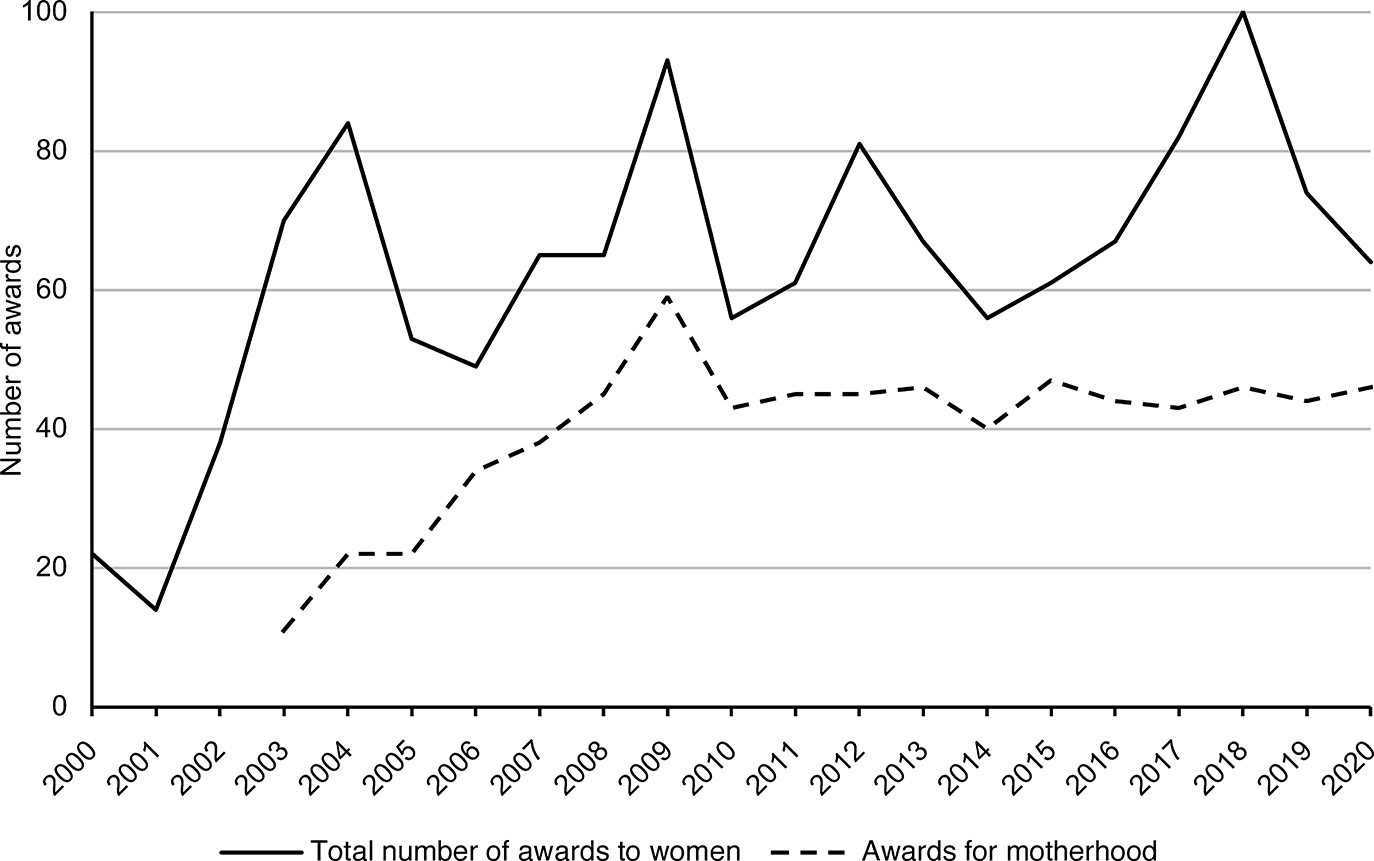
In sum, both the initial initiative to increase the recognition of women through state awards and the later amendment that was (at least superficially) aimed at stressing gender equality eventually had the opposite effect: Lithuanian women were increasingly reduced to their role as mothers, whereas men now have an additional avenue to receive an award.Footnote 12 The changes as well as the frequent application of the new regulations in the following years further institutionalized an existing pattern of gender inequality in the Lithuanian system of state decorations. Although general trends in the total number of awards mean that it is plausible that the Awards Council follows certain target quotas, these appear to be applied almost blindly with only little regard to the qualitative dimension of awards.
The Gender Gap in Decorations: Ways Forward in Research and Practice
Systems of state decorations exist in virtually every modern political regime. Despite the fact that the awarding of decorations is highly indicative of sociopolitical structures and inequalities, they have received surprisingly little attention from political scientists.
Our comparative analysis of an original data set containing all 11,599 recipients of civil state decorations in the Baltic states has provided comprehensive evidence for a gender gap in the total number of awards, the classes awarded, and the categories of recognized achievements. This underscores the notion of state decorations as gendered institutions (Fox Reference Fox2010). Our results are also remarkably similar to earlier findings by historians and economists for royal honors systems, which long restricted women’s access to state decorations. Thus, even though state decorations in the Baltic republics were open to women from the start and the countries only recently (re)introduced state decorations after experiencing several major breaks in their political history, significant inequalities persist. Whereas there are differences how system state decorations operate, the almost universal prioritization of civil decorations in rewarding (1) public service of (2) individuals in leadership positions (3) over long periods of time serves to reproduce structural gender inequalities and disadvantages women.
Several countries have begun to address the gender imbalance in awards, although with varying success. For instance, France instituted a 50% quota for proposals to the Legion of Honor in 2008, yet parity in the number of awards (not the classes) was only achieved in 2019. In Germany, an informal 30% women quota introduced in 2004 has only been fulfilled by reducing the total number of awards to men, and it is unclear how recently announced plans for a 40% quota will be achieved (Mäurer Reference Mäurer2022). While stricter quotas could lead to greater awareness of inequalities in awarding decorations and the recognition of a wider range of achievements, our research on Lithuania shows that quotas can easily have the opposite effect. In this regard, efforts to increase the number of women nominated by citizens (such as the “Honour a Woman” campaign in Australia; cf. Fox Reference Fox2022, 235, 256) and thus to change the “input side” of decorations systems could be more effective in raising awareness and addressing imbalances. Nevertheless, any initiatives must consider not only total numbers, but also qualitative differences in classes of decorations and recognized achievements.
The findings of our study contribute to these real-life debates, as well as to the study of gendered institutions and a more holistic assessment of gender inequalities in state and society. In particular, they highlight the role of the state in shaping and upholding systems of social values.Footnote 13 However, the study of state decorations also has considerable significance for political science scholarship in other subfields. Most generally, systems of state decorations can easily be conceived as collections of written and unwritten rules, and thus allow for studying the interplay between formal and informal institutions, as well as their effects in both democracy and autocracy (cf. Lauth Reference Lauth, Gandhi and Ruiz-Rufino2015). Moreover, our study not only found similar trends across three different countries, but also corroborated findings from previous research on other cases. This suggests that by focusing on key elements of state decorations systems, patterns in the awarding of decorations can be used as a reasonably standardized and valid indicator of some political phenomena that are otherwise difficult to measure in cross-national comparison. As a start, research should focus on those areas in which political scientists have already engaged with state awards. For instance, cross-national comparative studies of political patronage primarily rely on cross-sectional expert surveys (e.g., Kopecký, Mair, and Spirova Reference Kopecký, Mair and Spirova2012), yet focusing on state awards could yield valuable longitudinal individual-level data (cf. Raimundo 2021). Similarly, while there are case studies of the use of state awards in international diplomacy (Fourie Reference Fourie2007; Pacher Reference Pacher2020), a more quantitative approach using data on the number of decorations exchanged between countries over time would not only allow for gauging countries’ changing foreign policy priorities but also provide a measure of the relative strength of bilateral relationships.
Supplementary material
The supplementary material for this article can be found at http://doi.org/10.1017/S1743923X23000636.
Data availability
The data that support the findings of this study contain personal information on living individuals and cannot be made publicly available due to data protection restrictions. The data are available to researchers on request from the corresponding author.
Acknowledgments
We would like to thank Benjamin G. Engst for his help with data collection. We also benefited from helpful comments and suggestions by Inese Āboliņa, Victoria A. Bauer, Felicia Riethmüller, and participants at the UACES Annual Conference 2021. Finally, we are grateful to the editors and three anonymous reviewers for their insightful comments and recommendations on how to improve this paper.


 Open access

