





1 Introduction
Pseudo-Anosov homeomorphisms of surfaces are a generalization of Anosov homeomorphisms to higher-genus surfaces which play an important role in the Nielsen-Thurston classification of isotopy classes of homeomorphisms of surfaces. Indeed, by this classification, any homeomorphism of a surface which does not preserve the isotopy class of any finite collection of disjoint essential simple closed curves has to be isotopic to a pseudo-Anosov homeomorphism.
The dynamics of a homeomorphism which is isotopic to a pseudo-Anosov homeomorphism is rather well-understood. Indeed, Handel proved that any such homeomorphism possesses an invariant closed subset on which it is semiconjugate to its pseudo-Anosov representative (see [Reference HandelHan85]). In this note, we are interested in a more precise result by Fathi (see Theorem 2.6 in [Reference FathiFat90]), which states that such homeomorphisms have also a stable and an unstable partition which are similar to that of its pseudo-Anosov representative. However, Fathi’s approach is rather abstract and does not give an explicit construction of those partitions. In this note, we propose an explicit construction of those stable and unstable partitions. We obtain this partition by shadowing the orbits of the pseudo-Anosov homeomorphism only in the future or only in the past. In the last section, we provide an extension of this theorem in the case of a surface with marked points. This extension allows to recover some of the results of a recent preprint by Alejo García-Sassi and Fábio Armando Tal [Reference García-Sassi and Armando TalGST24].
I would like to thank Jonathan Bowden, Alejo García-Sassi, Pierre-Antoine Guihéneuf, Sebastian Hensel and Frédéric Le Roux for helpful discussions about this note and Pierre-Antoine Guihéneuf for his comments on a first version of this note. Finally, I am very thankful to Nastaran Einabadi, Federica Fanoni, Sebastian Hensel, Frédéric Le Roux, Nelson Schuback for finding an important flaw and especially to Frédéric Le Roux for indicating many smaller mistakes in a previous version of the article.
2 Notation
Let S be a closed surface with genus $\geq 2$
. Let A be a pseudo-Anosov homeomorphism of S and denote by
$\geq 2$
. Let A be a pseudo-Anosov homeomorphism of S and denote by $\tilde {A}$
one of its lifts to the universal cover
$\tilde {A}$
one of its lifts to the universal cover $\tilde {S}$
of S. We refer to [Reference Farb and MargalitFM12] and [MR079] for a precise definition of pseudo-Anosov homeomorphisms and more context. We identify
$\tilde {S}$
of S. We refer to [Reference Farb and MargalitFM12] and [MR079] for a precise definition of pseudo-Anosov homeomorphisms and more context. We identify $\tilde {S}$
with the hyperbolic plane
$\tilde {S}$
with the hyperbolic plane $\mathbb {H}^2$
. By definition, the homeomorphism A preserves two transverse singular foliations, the stable one
$\mathbb {H}^2$
. By definition, the homeomorphism A preserves two transverse singular foliations, the stable one $\mathcal {F}^s$
and the unstable one
$\mathcal {F}^s$
and the unstable one $\mathcal {F}^u$
. Let us denote
$\mathcal {F}^u$
. Let us denote $\tilde {\mathcal {F}}^s$
and
$\tilde {\mathcal {F}}^s$
and $\tilde {\mathcal {F}}^u$
the lifts of those foliations to
$\tilde {\mathcal {F}}^u$
the lifts of those foliations to $\tilde {S}$
. For
$\tilde {S}$
. For $i=s,u$
, we call leaf of
$i=s,u$
, we call leaf of $\tilde {\mathcal {F}}^i$
either a regular leaf of
$\tilde {\mathcal {F}}^i$
either a regular leaf of $\tilde {\mathcal {F}}^i$
or the union of a singularity with all the branches of
$\tilde {\mathcal {F}}^i$
or the union of a singularity with all the branches of $\tilde {\mathcal {F}}^i$
which converge to this singularity.
$\tilde {\mathcal {F}}^i$
which converge to this singularity.
The foliations $\tilde {\mathcal {F}}^s$
and
$\tilde {\mathcal {F}}^s$
and $\tilde {\mathcal {F}}^u$
are endowed with respective transverse measures
$\tilde {\mathcal {F}}^u$
are endowed with respective transverse measures $\mu ^u$
and
$\mu ^u$
and $\mu ^s$
with the following property. There exists
$\mu ^s$
with the following property. There exists $0<\lambda <1$
such that, for any arc
$0<\lambda <1$
such that, for any arc $\tilde {\alpha } : [0,1] \rightarrow \tilde {S}$
and any
$\tilde {\alpha } : [0,1] \rightarrow \tilde {S}$
and any $n \geq 0$
,
$n \geq 0$
,
 $$ \begin{align*}\left\{ \begin{array}{@{}rcl} \mu^u(\tilde{A}^{-n}(\tilde{\alpha})) & = & \lambda^n \mu^u(\tilde{\alpha}) \\ \mu^s(\tilde{A}^{n}(\tilde{\alpha})) & = & \lambda^n \mu^s(\tilde{\alpha}). \end{array} \right.\end{align*} $$
Moreover, the transverse measures $\mu ^u$
and
$\mu ^u$
and $\mu ^s$
are invariant under the action of the group
$\mu ^s$
are invariant under the action of the group $\pi _1(S)$
of deck transformations of
$\pi _1(S)$
of deck transformations of $\tilde {S}$
.
$\tilde {S}$
.
We can then define pseudo-distances $d_u$
and
$d_u$
and $d_s$
on
$d_s$
on $\tilde {S}$
in the following way. For
$\tilde {S}$
in the following way. For $i=s,u$
, and
$i=s,u$
, and $\tilde {x},\tilde {y} \in \tilde {S}$
,
$\tilde {x},\tilde {y} \in \tilde {S}$
, $d_i(\tilde {x},\tilde {y})$
is the infimum of
$d_i(\tilde {x},\tilde {y})$
is the infimum of $\mu ^i(\tilde {\alpha })$
over all arcs
$\mu ^i(\tilde {\alpha })$
over all arcs $\tilde {\alpha }:[0,1] \rightarrow \tilde {S}$
with
$\tilde {\alpha }:[0,1] \rightarrow \tilde {S}$
with $\tilde {\alpha }(0)=\tilde {x}$
and
$\tilde {\alpha }(0)=\tilde {x}$
and $\tilde {\alpha }(1)=\tilde {y}$
. Observe that, for
$\tilde {\alpha }(1)=\tilde {y}$
. Observe that, for $\tilde {x},\tilde {y} \in \tilde {S}$
,
$\tilde {x},\tilde {y} \in \tilde {S}$
,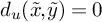 $d_{u}(\tilde {x},\tilde {y})=0$
if and only if
$d_{u}(\tilde {x},\tilde {y})=0$
if and only if $\tilde {x}$
and
$\tilde {x}$
and $\tilde {y}$
belong to the same leaf of
$\tilde {y}$
belong to the same leaf of $\tilde {\mathcal {F}}^s$
and a similar result holds for
$\tilde {\mathcal {F}}^s$
and a similar result holds for $d_s$
. The deck transformations of
$d_s$
. The deck transformations of $\tilde {S}$
are isometries for both pseudo-distances
$\tilde {S}$
are isometries for both pseudo-distances $d_u$
and
$d_u$
and $d_s$
. Finally, recall that
$d_s$
. Finally, recall that $d=d_s+d_u$
defines a distance on
$d=d_s+d_u$
defines a distance on $\tilde {S}$
which is compatible with the topology of
$\tilde {S}$
which is compatible with the topology of $\tilde {S}$
. Finally, due to the properties of
$\tilde {S}$
. Finally, due to the properties of $\mu ^u$
and
$\mu ^u$
and $\mu ^s$
, for any two points
$\mu ^s$
, for any two points $\tilde {x}$
and
$\tilde {x}$
and $\tilde {y}$
of
$\tilde {y}$
of $\tilde {S}$
,
$\tilde {S}$
,
 $$ \begin{align*}d_u(\tilde{A}^{-1}(\tilde{x}),\tilde{A}^{-1}(\tilde{y}))=\lambda d_u(\tilde{x},\tilde{y})\end{align*} $$
and
 $$ \begin{align*}d_s(\tilde{A}(\tilde{x}),\tilde{A}(\tilde{y}))=\lambda d_s(\tilde{x},\tilde{y}).\end{align*} $$
In what follows, we will need to compactify the universal cover $\tilde {S}$
with a circle at infinity which we denote by
$\tilde {S}$
with a circle at infinity which we denote by $\partial \tilde {S}$
. When we see
$\partial \tilde {S}$
. When we see $\tilde {S}=\mathbb {H}^2$
as the Poincaré disk, which is the unit open disk, the circle at infinity is just the unit circle. We set
$\tilde {S}=\mathbb {H}^2$
as the Poincaré disk, which is the unit open disk, the circle at infinity is just the unit circle. We set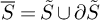 $\overline {S}=\tilde {S} \cup \partial \tilde {S}$
.
$\overline {S}=\tilde {S} \cup \partial \tilde {S}$
.
This compactification satisfies the following properties that we will use.
-
1. Any end of a leaf in $\tilde {\mathcal {F}}^s$
or in
$\tilde {\mathcal {F}}^u$
converges to a point of
$\partial \tilde {S}$
.
$\tilde {\mathcal {F}}^s$
or in
$\tilde {\mathcal {F}}^u$
converges to a point of
$\partial \tilde {S}$
. -
2. For
$i=s,u$
, no point of
$\partial \tilde {S}$
is the end of two different leaves of
$\tilde {\mathcal {F}}^i$
. -
3. Any homeomorphism
$\tilde {g}$
of
$\tilde {S}$
which is a lift of a homeomorphism g of S extends continuously to
$\overline {S}$
. By abuse of notation, we will still denote by
$\tilde {g}$
this continuous extension. -
4. Given two isotopic homeomorphisms f and g of S, their isotopic lifts
$\tilde {f}$
and
$\tilde {g}$
are equal on the boundary at infinity
$\partial \tilde {S}$
.


For any subset A of $\tilde {S}$
, we denote by
$\tilde {S}$
, we denote by $\overline {A}$
its closure in
$\overline {A}$
its closure in $\overline {S}$
. In the case where
$\overline {S}$
. In the case where $A=L$
is a regular leaf, it consists of L with two extra points on
$A=L$
is a regular leaf, it consists of L with two extra points on $\partial \tilde {S}$
. In the case of a leaf L which contains a k-pronged singularity, it consists of L with k extra points on
$\partial \tilde {S}$
. In the case of a leaf L which contains a k-pronged singularity, it consists of L with k extra points on $\partial \tilde {S}$
.
$\partial \tilde {S}$
.
For $C>0$
, and
$C>0$
, and $L \in \tilde {\mathcal {F}}^s$
, we define
$L \in \tilde {\mathcal {F}}^s$
, we define
 $$ \begin{align*}L_C= \left\{ \tilde{x} \in \tilde{S} \ | \ d_u(\tilde{x},L) \leq C \right\}.\end{align*} $$
We define similarly $L_C$
for
$L_C$
for $L \in \tilde {\mathcal {F}}^u$
.
$L \in \tilde {\mathcal {F}}^u$
.
The distance $d_u$
induces a distance on the space
$d_u$
induces a distance on the space $\mathcal {L}^s$
of leaves of the foliation
$\mathcal {L}^s$
of leaves of the foliation $\tilde {\mathcal {F}}^s$
. However, this metric space is not necessarily complete. We will denote by
$\tilde {\mathcal {F}}^s$
. However, this metric space is not necessarily complete. We will denote by $\overline {\mathcal {L}}^s$
the completion of
$\overline {\mathcal {L}}^s$
the completion of $(\mathcal {L}^s,d_u)$
. We will see this completion as the set of equivalence classes of Cauchy sequences
$(\mathcal {L}^s,d_u)$
. We will see this completion as the set of equivalence classes of Cauchy sequences $(L_n)$
of elements of
$(L_n)$
of elements of $\mathcal {L}^s$
for the equivalence relation defined by
$\mathcal {L}^s$
for the equivalence relation defined by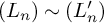 $(L_n) \sim (L^{\prime }_n)$
if and only if
$(L_n) \sim (L^{\prime }_n)$
if and only if
 $$ \begin{align*}\lim_{n \rightarrow +\infty} d_{u}(L_n,L^{\prime}_n)=0.\end{align*} $$
Constant sequences define an embedding $\mathcal {L}^s \subset \overline {\mathcal {L}^s}$
and the distance
$\mathcal {L}^s \subset \overline {\mathcal {L}^s}$
and the distance $d_u$
on
$d_u$
on $\mathcal {L}^s$
extends to a distance
$\mathcal {L}^s$
extends to a distance $d_u$
on
$d_u$
on $\overline {\mathcal {L}^s}$
. For any Cauchy sequence
$\overline {\mathcal {L}^s}$
. For any Cauchy sequence $(L_n)$
of leaves of
$(L_n)$
of leaves of $\mathcal {L}^s$
, the sequence
$\mathcal {L}^s$
, the sequence $(\overline {L}_n)$
of compact subsets of
$(\overline {L}_n)$
of compact subsets of $\overline {S}$
converges for the Hausdorff topology to a connected compact subset of
$\overline {S}$
converges for the Hausdorff topology to a connected compact subset of $\overline {S}$
. When this sequence
$\overline {S}$
. When this sequence $(L_n)$
is equivalent to a constant sequence, then the sequence of subsets is converging to the closure of the leaf of the constant sequence. Otherwise, this sequence will converge to one point on the boundary at infinity. This limit point does not change if we change the sequence
$(L_n)$
is equivalent to a constant sequence, then the sequence of subsets is converging to the closure of the leaf of the constant sequence. Otherwise, this sequence will converge to one point on the boundary at infinity. This limit point does not change if we change the sequence $(L_n)$
to an equivalent one. Hence, to any point
$(L_n)$
to an equivalent one. Hence, to any point $\xi $
of
$\xi $
of $\overline {\mathcal {L}}^s$
, we associate a subset
$\overline {\mathcal {L}}^s$
, we associate a subset $\overline {L}(\xi )$
which is either the closure of a stable leaf or one point on
$\overline {L}(\xi )$
which is either the closure of a stable leaf or one point on $\partial \tilde {S}$
.
$\partial \tilde {S}$
.
Similarly, we define $\overline {\mathcal {L}}^u$
as the completion of
$\overline {\mathcal {L}}^u$
as the completion of $(\mathcal {L}^u,d_s)$
, where
$(\mathcal {L}^u,d_s)$
, where $\mathcal {L}^u$
is the space of leaves of the foliation
$\mathcal {L}^u$
is the space of leaves of the foliation $\tilde {\mathcal {F}}^u$
.
$\tilde {\mathcal {F}}^u$
.
Observe that the lift $\tilde {A}$
of the pseudo-Anosov homeomorphism as well as any deck transformation in
$\tilde {A}$
of the pseudo-Anosov homeomorphism as well as any deck transformation in $\pi _1(S)$
act on the complete spaces
$\pi _1(S)$
act on the complete spaces $\overline {\mathcal {L}}^s$
and
$\overline {\mathcal {L}}^s$
and $\overline {\mathcal {L}}^u$
by homeomorphisms.
$\overline {\mathcal {L}}^u$
by homeomorphisms.
3 The generalized foliation
Let f be a homeomorphism which is isotopic to A. Take an isotopy $(f_t)$
with
$(f_t)$
with $f_1=f$
and
$f_1=f$
and $f_0=A$
and lift it to an isotopy
$f_0=A$
and lift it to an isotopy $(\tilde {f}_t)_{t \in [0,1]}$
of
$(\tilde {f}_t)_{t \in [0,1]}$
of $\tilde {S}$
with
$\tilde {S}$
with $\tilde {f}_0=\tilde {A}$
. Then
$\tilde {f}_0=\tilde {A}$
. Then $\tilde {f}=\tilde {f}_1:\tilde {S} \rightarrow \tilde {S}$
is a lift of f, which is equal to
$\tilde {f}=\tilde {f}_1:\tilde {S} \rightarrow \tilde {S}$
is a lift of f, which is equal to $\tilde {A}$
on the boundary at infinity
$\tilde {A}$
on the boundary at infinity $\partial \tilde {S}$
.
$\partial \tilde {S}$
.
Theorem 1. Fix $i=s,u$
. To each point
$i=s,u$
. To each point $\xi $
of
$\xi $
of $\overline {\mathcal {L}}^i$
, we associate a compact connected subset
$\overline {\mathcal {L}}^i$
, we associate a compact connected subset $\overline {\eta }^i(\xi )$
of
$\overline {\eta }^i(\xi )$
of $\overline {S}$
with the following properties.
$\overline {S}$
with the following properties.
-
1. The subsets
$\eta ^{i}(\xi )=\overline {\eta }^i(\xi ) \cap \tilde {S}$
, for
$\xi \in \overline {\mathcal {L}}^i$
, are pairwise disjoint and cover
$\tilde {S}$
. Moreover, if
$L \in \mathcal {L}^i$
, then
$\eta ^i(L) \neq \emptyset $
. -
2. For every
$L \in \mathcal {L}^i$
, the set
$\overline {S} \setminus \overline {\eta }^{i}(L)$
has the same number of connected components as
$\overline {S} \setminus \overline {L}$
. For every
$\xi \in \overline {\mathcal {L}}^i \setminus \mathcal {L}^i$
, the set
$\overline {S} \setminus \overline {\eta }^{i}(\xi )$
has only one connected component. -
3. For every
$\xi \in \overline {\mathcal {L}}^i$
,
$$ \begin{align*}\tilde{f} \left( \overline{\eta}^i(\xi) \right)=\overline{\eta}^i \left(\tilde{A}(\xi) \right)\hspace{-1pt}.\end{align*} $$
-
4. For every
$\xi \in \overline {\mathcal {L}}^i$
and any deck transformation
$\gamma \in \pi _1(S)$
,
$$ \begin{align*}\gamma \left( \overline{\eta}^i(\xi) \right)=\overline{\eta}^i \left( \gamma(\xi) \right)\hspace{-1pt}.\end{align*} $$
-
5. For every
$\xi \in \overline {\mathcal {L}}^i$
,
$\overline {\eta }^i(\xi ) \cap \partial \tilde {S}= \overline {L}(\xi ) \cap \partial \tilde {S}$
. -
6. The sets
$\eta ^s(\xi )$
are the stable sets of all its points, namely for every
$\xi \in \overline {\mathcal {L}}^{s}$
and
$\tilde {x} \in \eta ^{s}(\xi )$
, The sets
$$ \begin{align*}\eta^{s}(\xi)= \left\{ \tilde{y} \in \tilde{S} \ | \ \exists C'>0, \ \forall n \geq 0, d(\tilde{f}^{n}(\tilde{x}),\tilde{f}^{n}(\tilde{y})) \leq C' \right\}\hspace{-1pt}.\end{align*} $$
$\eta ^u(\xi )$
are the unstable sets of all its points, namely for every
$\xi \in \overline {\mathcal {L}}^{u}$
and
$\tilde {x} \in \eta ^{u}(\xi )$
,
$$ \begin{align*}\eta^{u}(\xi)= \left\{ \tilde{y} \in \tilde{S} \ | \ \exists C'>0, \ \forall n \geq 0, d(\tilde{f}^{-n}(\tilde{x}),\tilde{f}^{-n}(\tilde{y})) \leq C' \right\}\hspace{-1pt}.\end{align*} $$
-
7. For every point
$\xi $
of
$\overline {\mathcal {L}^i}$
such that
$\eta ^{i}(\xi ) \neq \emptyset $
and every neighbourhood U of
$\overline {\eta }^i(\xi )$
in
$\overline {S}$
, there exists
$\varepsilon>0$
such that, for every point
$\xi '$
of
$\overline {\mathcal {L}}^i$
such that
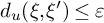
$d_u(\xi ,\xi ') \leq \varepsilon $
, we have
$\overline {\eta }^i(\xi ') \subset U$
.







Fix $i=s,u$
. By Theorem 1, the sets
$i=s,u$
. By Theorem 1, the sets $\eta ^{i}(\xi )$
, with
$\eta ^{i}(\xi )$
, with $\xi \in \overline {\mathcal {L}}^i$
, form an
$\xi \in \overline {\mathcal {L}}^i$
, form an $\tilde {f}$
-invariant partition of
$\tilde {f}$
-invariant partition of $\tilde {S}$
which projects to an f-invariant partition of S.
$\tilde {S}$
which projects to an f-invariant partition of S.
Remark 3. It is possible to build examples where, for some points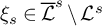 $\xi _s \in \overline {\mathcal {L}}^{s} \setminus \mathcal {L}^s$
,
$\xi _s \in \overline {\mathcal {L}}^{s} \setminus \mathcal {L}^s$
, $\eta ^{s}(\xi _s) \cap \tilde {S} \neq \emptyset $
. Fix any pseudo-Anosov homeomorphism A of S. To do this, we use a result from the unpublished preprint [Reference Fathi and LaudnebachFL] which states that, for any lift
$\eta ^{s}(\xi _s) \cap \tilde {S} \neq \emptyset $
. Fix any pseudo-Anosov homeomorphism A of S. To do this, we use a result from the unpublished preprint [Reference Fathi and LaudnebachFL] which states that, for any lift $\tilde {A}$
of A to its universal cover
$\tilde {A}$
of A to its universal cover $\tilde {S}$
, there exists
$\tilde {S}$
, there exists $n \geq 1$
and a deck transformation
$n \geq 1$
and a deck transformation $\gamma $
such that
$\gamma $
such that $\gamma \tilde {A}^n$
has no fixed point in
$\gamma \tilde {A}^n$
has no fixed point in $\tilde {S}$
. We also use the construction of the partition
$\tilde {S}$
. We also use the construction of the partition $\eta ^s$
which implies that, for a homeomorphism f isotopic to a pseudo-Anosov homeomorphism A, for a leaf
$\eta ^s$
which implies that, for a homeomorphism f isotopic to a pseudo-Anosov homeomorphism A, for a leaf $L \in \mathcal {L}^s$
, the points of
$L \in \mathcal {L}^s$
, the points of $\eta ^{s}(L)$
are those whose
$\eta ^{s}(L)$
are those whose $\tilde {f}$
-orbits forward shadow the
$\tilde {f}$
-orbits forward shadow the $\tilde {A}$
-orbits of L.
$\tilde {A}$
-orbits of L.
Now compose the homeomorphism $\gamma \tilde {A}^n$
with the lift of a homeomorphism isotopic to the identity in such a way that the resulting homeomorphism f has a lift
$\gamma \tilde {A}^n$
with the lift of a homeomorphism isotopic to the identity in such a way that the resulting homeomorphism f has a lift $\tilde {f}$
isotopic to
$\tilde {f}$
isotopic to $\gamma \tilde {A}^n$
which has a fixed point
$\gamma \tilde {A}^n$
which has a fixed point $\tilde {p}$
(for instance using a path between a point
$\tilde {p}$
(for instance using a path between a point $\tilde {p}$
of
$\tilde {p}$
of $\tilde {S}$
and its image under
$\tilde {S}$
and its image under $\gamma \tilde {A}^n$
and the isotopy extension theorem). If the point
$\gamma \tilde {A}^n$
and the isotopy extension theorem). If the point $\tilde {p}$
forward shadowed an orbit of
$\tilde {p}$
forward shadowed an orbit of $\gamma \tilde {A}^n$
, this would mean that
$\gamma \tilde {A}^n$
, this would mean that $\gamma \tilde {A}^p$
has a bounded orbit, hence a fixed point in
$\gamma \tilde {A}^p$
has a bounded orbit, hence a fixed point in $\tilde {S}$
by the Brouwer plane translation theorem, a contradiction. Hence, the point p must belong to some
$\tilde {S}$
by the Brouwer plane translation theorem, a contradiction. Hence, the point p must belong to some $\eta ^{s}(\xi )$
, for
$\eta ^{s}(\xi )$
, for $\xi \in \overline {\mathcal {L}}^s\setminus \mathcal {L}^s$
. For the same reasons, it must also belong to some
$\xi \in \overline {\mathcal {L}}^s\setminus \mathcal {L}^s$
. For the same reasons, it must also belong to some $\eta ^{u}(\xi )$
, for
$\eta ^{u}(\xi )$
, for $\xi \in \overline {\mathcal {L}}^u\setminus \mathcal {L}^u$
.
$\xi \in \overline {\mathcal {L}}^u\setminus \mathcal {L}^u$
.
As the preprint [Reference Fathi and LaudnebachFL] is not so easy to find, let us sketch the construction of lifts of pseudo-Anosov homeomorphisms without fixed points. Take a lift $\tilde {A}$
of a pseudo-Anosov homeomorphism A. If
$\tilde {A}$
of a pseudo-Anosov homeomorphism A. If $\tilde {A}$
has no fixed point in
$\tilde {A}$
has no fixed point in $\tilde {S}$
, we are done. Otherwise,
$\tilde {S}$
, we are done. Otherwise, $\tilde {A}$
has only one fixed point
$\tilde {A}$
has only one fixed point $\tilde {p}$
in
$\tilde {p}$
in $\tilde {S}$
because of the definition of a pseudo-Anosov homeomorphism. Denote by
$\tilde {S}$
because of the definition of a pseudo-Anosov homeomorphism. Denote by $L_s$
the stable leaf passing through p and by
$L_s$
the stable leaf passing through p and by $L_u$
the unstable leaf passing through p and remember that
$L_u$
the unstable leaf passing through p and remember that $L_s$
and
$L_s$
and $L_u$
can have multiple branches if
$L_u$
can have multiple branches if $\tilde {p}$
is a singular point. Take a power
$\tilde {p}$
is a singular point. Take a power $n \geq 1$
such that
$n \geq 1$
such that $\tilde {A}^n$
preserves each connected component of
$\tilde {A}^n$
preserves each connected component of $L_s \setminus \left \{ \tilde {p} \right \}$
and
$L_s \setminus \left \{ \tilde {p} \right \}$
and $L_u \setminus \left \{ \tilde {p} \right \}$
. Each of those connected components touches a unique point on the circle
$L_u \setminus \left \{ \tilde {p} \right \}$
. Each of those connected components touches a unique point on the circle $\partial \tilde {S}$
which is an attractor for a connected component in
$\partial \tilde {S}$
which is an attractor for a connected component in $L_u$
and a repellor for a connected component in
$L_u$
and a repellor for a connected component in $L_s$
. The dynamics of
$L_s$
. The dynamics of $\tilde {A}^p$
on the circle
$\tilde {A}^p$
on the circle $\partial \tilde {S}$
is of Morse-Smale type: any orbit converges in the future to some of these attracting points and in the past to some of these repelling points. Now, take the lift
$\partial \tilde {S}$
is of Morse-Smale type: any orbit converges in the future to some of these attracting points and in the past to some of these repelling points. Now, take the lift $\tilde {g}$
of a closed geodesic of S such that the endpoints of
$\tilde {g}$
of a closed geodesic of S such that the endpoints of $\tilde {g}$
on
$\tilde {g}$
on $\tilde {S}$
belong to two different connected components of
$\tilde {S}$
belong to two different connected components of $(\tilde {S} \cup \partial \tilde {S}) \setminus \overline {L}_s$
and to two different connected components of
$(\tilde {S} \cup \partial \tilde {S}) \setminus \overline {L}_s$
and to two different connected components of $(\tilde {S} \cup \partial \tilde {S}) \setminus \overline {L}_u$
. In particular, the geodesic
$(\tilde {S} \cup \partial \tilde {S}) \setminus \overline {L}_u$
. In particular, the geodesic $\tilde {g}$
meets
$\tilde {g}$
meets $L_s$
and
$L_s$
and $L_u$
. Take the nontrivial deck transformation
$L_u$
. Take the nontrivial deck transformation $\gamma $
which preserves the oriented geodesic
$\gamma $
which preserves the oriented geodesic $\tilde {g}$
. Then some power of
$\tilde {g}$
. Then some power of $\gamma ^m$
of
$\gamma ^m$
of $\gamma $
must send
$\gamma $
must send $L_s \cup L_{u}$
disjoint from itself, in such a way that
$L_s \cup L_{u}$
disjoint from itself, in such a way that $\gamma ^{m}(L_s \cup L_u)$
and
$\gamma ^{m}(L_s \cup L_u)$
and $\gamma ^{-m}(L_s \cup L_u)$
belong to disjoint connected components of
$\gamma ^{-m}(L_s \cup L_u)$
belong to disjoint connected components of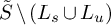 $\tilde {S} \setminus (L_s \cup L_u)$
. Then some attracting fixed point of
$\tilde {S} \setminus (L_s \cup L_u)$
. Then some attracting fixed point of $\gamma ^{m}\tilde {A}^n$
and some repelling fixed points of
$\gamma ^{m}\tilde {A}^n$
and some repelling fixed points of $\gamma ^{m}\tilde {A}^n$
on
$\gamma ^{m}\tilde {A}^n$
on $\partial \tilde {S}$
must belong to disjoint connected components of
$\partial \tilde {S}$
must belong to disjoint connected components of $\tilde {S} \cup \partial \tilde {S} \setminus \overline {L_s \cup L_u}$
. If the homeomorphism
$\tilde {S} \cup \partial \tilde {S} \setminus \overline {L_s \cup L_u}$
. If the homeomorphism $\gamma ^{m}\tilde {A}^n$
had a fixed point
$\gamma ^{m}\tilde {A}^n$
had a fixed point $\tilde {q}$
in
$\tilde {q}$
in $\tilde {S}$
, then some leaf passing through
$\tilde {S}$
, then some leaf passing through $\tilde {q}$
which is either stable or unstable must cross
$\tilde {q}$
which is either stable or unstable must cross $L_s$
and
$L_s$
and $L_u$
, a contradiction.
$L_u$
, a contradiction.
Remark 4. To each point $\tilde {x}$
of
$\tilde {x}$
of $\tilde {S}$
, one can associate a unique point
$\tilde {S}$
, one can associate a unique point $\xi _s \in \overline {\mathcal {L}}^s$
and a unique point
$\xi _s \in \overline {\mathcal {L}}^s$
and a unique point $\xi _u \in \overline {\mathcal {L}}^u$
such that
$\xi _u \in \overline {\mathcal {L}}^u$
such that $\tilde {x} \in \eta ^{s}(\xi _s) \cap \eta ^u(\xi _u)$
. Hence the above theorem defines a map
$\tilde {x} \in \eta ^{s}(\xi _s) \cap \eta ^u(\xi _u)$
. Hence the above theorem defines a map $\tilde {S} \rightarrow \overline {\mathcal {L}}^s \times \overline {\mathcal {L}}^u$
. We prove now that this map is continuous.
$\tilde {S} \rightarrow \overline {\mathcal {L}}^s \times \overline {\mathcal {L}}^u$
. We prove now that this map is continuous.
Proof. By point 7. in Theorem 1, the map, which to any pair of points $(\xi _{s},\xi _u) \in \overline {\mathcal {L}}^s \times \overline {\mathcal {L}}^u$
associates the subsets
$(\xi _{s},\xi _u) \in \overline {\mathcal {L}}^s \times \overline {\mathcal {L}}^u$
associates the subsets $(\overline {\eta }^{s}(\xi _s), \overline {\eta }^{u}(\xi _u))$
is continuous for a suitable topology on the spaces of partitions given by
$(\overline {\eta }^{s}(\xi _s), \overline {\eta }^{u}(\xi _u))$
is continuous for a suitable topology on the spaces of partitions given by $\eta ^{s}$
and
$\eta ^{s}$
and $\eta ^u$
. Moreover, we can endow the partitions given by
$\eta ^u$
. Moreover, we can endow the partitions given by $\overline {\eta }^s$
and
$\overline {\eta }^s$
and $\overline {\eta }^u$
with distances
$\overline {\eta }^u$
with distances $d^{\prime }_s$
and
$d^{\prime }_s$
and $d^{\prime }_u$
which are compatible with the topology so that the maps
$d^{\prime }_u$
which are compatible with the topology so that the maps $\xi _s \mapsto \overline {\eta }^{s}(\xi _s)$
and
$\xi _s \mapsto \overline {\eta }^{s}(\xi _s)$
and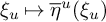 $\xi _u \mapsto \overline {\eta }^{u}(\xi _u)$
are isometries. Hence the map
$\xi _u \mapsto \overline {\eta }^{u}(\xi _u)$
are isometries. Hence the map
 $$ \begin{align*}(\xi_s,\xi_u) \mapsto (\overline{\eta}^{s}(\xi_s), \overline{\eta}^{u}(\xi_u))\end{align*} $$
is a homeomorphism. Now the map which, to a point $\tilde {x}$
of
$\tilde {x}$
of $\tilde {S}$
associates the unique pair
$\tilde {S}$
associates the unique pair $(\overline {\eta }^{s}(\xi _s), \overline {\eta }^{u}(\xi _{u}))$
such that
$(\overline {\eta }^{s}(\xi _s), \overline {\eta }^{u}(\xi _{u}))$
such that $\tilde {x} \in \overline {\eta }^{s}(\xi _s) \cap \overline {\eta }^{u}(\xi _u)$
is continuous, which proves the continuity of the map
$\tilde {x} \in \overline {\eta }^{s}(\xi _s) \cap \overline {\eta }^{u}(\xi _u)$
is continuous, which proves the continuity of the map $\tilde {S} \rightarrow \overline {\mathcal {L}}^s \times \overline {\mathcal {L}}^u$
.
$\tilde {S} \rightarrow \overline {\mathcal {L}}^s \times \overline {\mathcal {L}}^u$
.
This map semi-conjugates the homeomorphism $\tilde {f}$
to the restriction of the action of
$\tilde {f}$
to the restriction of the action of $\tilde {A}$
on
$\tilde {A}$
on $\overline {\mathcal {L}}^s \times \overline {\mathcal {L}}^u$
to an invariant subset. This makes the connection with Fathi’s result (see Theorem 2.6 in [Reference FathiFat90]).
$\overline {\mathcal {L}}^s \times \overline {\mathcal {L}}^u$
to an invariant subset. This makes the connection with Fathi’s result (see Theorem 2.6 in [Reference FathiFat90]).
Proof of Theorem 1.
We will prove this theorem in the case $i=s$
. The case
$i=s$
. The case $i=u$
is made by exchanging the roles of
$i=u$
is made by exchanging the roles of $\tilde {f}$
and
$\tilde {f}$
and $\tilde {f}^{-1}$
, of
$\tilde {f}^{-1}$
, of $\tilde {A}$
with
$\tilde {A}$
with $\tilde {A}^{-1}$
, of u and s in the proof below.
$\tilde {A}^{-1}$
, of u and s in the proof below.
The starting point of the proof is the following claim.
Claim 5. There exists $C_0>0$
such that, for any
$C_0>0$
such that, for any $\tilde {x} \in \tilde {S}$
,
$\tilde {x} \in \tilde {S}$
,
 $$ \begin{align*}\left\{ \begin{array}{@{}rcl} d(\tilde{f}(\tilde{x}),\tilde{A}(\tilde{x})) & \leq & C_0 \\ d(\tilde{f}^{-1}(\tilde{x}),\tilde{A}^{-1}(\tilde{x})) & \leq & C_0 \end{array} \right.\end{align*} $$
Proof. Let $D \subset \tilde {S}$
be a compact subset with
$D \subset \tilde {S}$
be a compact subset with $\pi (D)=S$
, where
$\pi (D)=S$
, where $\pi :\tilde {S} \rightarrow S$
is the projection. By compactness
$\pi :\tilde {S} \rightarrow S$
is the projection. By compactness
 $$ \begin{align*}C^{\prime}_0= \max_{\tilde{x} \in D} d(\tilde{f}(\tilde{x}),\tilde{A}(\tilde{x}))\end{align*} $$
exists. However, by construction of $\tilde {f}$
, for any deck transformation
$\tilde {f}$
, for any deck transformation $\gamma \in \pi _1(S)$
, there exists a deck transformation
$\gamma \in \pi _1(S)$
, there exists a deck transformation $\xi (\gamma )$
such that
$\xi (\gamma )$
such that
 $$ \begin{align*} \left\{ \begin{array}{@{}rcl} \tilde{f} \circ \gamma & = & \xi(\gamma) \circ \tilde{f} \\ \tilde{A} \circ \gamma & = & \xi(\gamma) \circ \tilde{A}. \end{array} \right. \end{align*} $$
Indeed, denote by $\xi (\gamma )$
the deck transformation such that
$\xi (\gamma )$
the deck transformation such that $\tilde {A} \circ \gamma = \xi (\gamma ) \circ \tilde {A}$
. Then the isotopies
$\tilde {A} \circ \gamma = \xi (\gamma ) \circ \tilde {A}$
. Then the isotopies $(\tilde {f}_t \circ \gamma )_t$
and
$(\tilde {f}_t \circ \gamma )_t$
and $(\xi (\gamma ) \circ \tilde {f}_t)_t$
both lift the isotopy
$(\xi (\gamma ) \circ \tilde {f}_t)_t$
both lift the isotopy $(f_t)_t$
and are equal for
$(f_t)_t$
and are equal for $t=0$
. Hence, for any t,
$t=0$
. Hence, for any t, $\tilde {f}_t \circ \gamma =\xi (\gamma ) \circ \tilde {f}_t$
and, in particular,
$\tilde {f}_t \circ \gamma =\xi (\gamma ) \circ \tilde {f}_t$
and, in particular, $\tilde {f} \circ \gamma =\xi (\gamma ) \circ \tilde {f}$
.
$\tilde {f} \circ \gamma =\xi (\gamma ) \circ \tilde {f}$
.
As d is $\pi _1(S)$
-invariant and as
$\pi _1(S)$
-invariant and as
 $$ \begin{align*} \tilde{S}= \bigcup_{\gamma \in \pi_1(S)} \gamma(D), \end{align*} $$
we obtain that $C^{\prime }_0= \max _{\tilde {x} \in \tilde {S}} d(\tilde {f}(\tilde {x}),\tilde {A}(\tilde {x})).$
In the same way, we can prove that
$C^{\prime }_0= \max _{\tilde {x} \in \tilde {S}} d(\tilde {f}(\tilde {x}),\tilde {A}(\tilde {x})).$
In the same way, we can prove that $C^{\prime \prime }_0= \max _{\tilde {x} \in \tilde {S}} d(\tilde {f}^{-1}(\tilde {x}),\tilde {A}^{-1}(\tilde {x}))$
exists. It suffices then to take
$C^{\prime \prime }_0= \max _{\tilde {x} \in \tilde {S}} d(\tilde {f}^{-1}(\tilde {x}),\tilde {A}^{-1}(\tilde {x}))$
exists. It suffices then to take $C_0=\max (C^{\prime }_0,C^{\prime \prime }_0)$
.
$C_0=\max (C^{\prime }_0,C^{\prime \prime }_0)$
.
Observe that $L_C$
is a union of leaves of
$L_C$
is a union of leaves of $\tilde {\mathcal {F}}^s$
and that the closure
$\tilde {\mathcal {F}}^s$
and that the closure $\overline {L}_C$
of
$\overline {L}_C$
of $L_C$
in
$L_C$
in $\overline {S}$
is a compact connected subset of
$\overline {S}$
is a compact connected subset of $\overline {S}$
.
$\overline {S}$
.
Lemma 6. For any $C> \frac {C_0}{1-\lambda }$
, there exists
$C> \frac {C_0}{1-\lambda }$
, there exists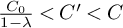 $\frac {C_0}{1-\lambda }<C'<C$
such that, for any leaf
$\frac {C_0}{1-\lambda }<C'<C$
such that, for any leaf $L \in \tilde {\mathcal {F}}^s$
, the following inclusion holds.
$L \in \tilde {\mathcal {F}}^s$
, the following inclusion holds.
 $$ \begin{align*}\tilde{f}^{-1} \left( \tilde{A}(L)_{C} \right) \subset L_{C'}.\end{align*} $$
Proof. Fix a leaf $L \in \tilde {\mathcal {F}}^s$
and take
$L \in \tilde {\mathcal {F}}^s$
and take $\tilde {x} \in \tilde {A}(L)_C$
. Then there exists
$\tilde {x} \in \tilde {A}(L)_C$
. Then there exists $\tilde {y} \in \tilde {A}(L)$
such that
$\tilde {y} \in \tilde {A}(L)$
such that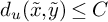 $d_u(\tilde {x},\tilde {y}) \leq C$
. Then
$d_u(\tilde {x},\tilde {y}) \leq C$
. Then
 $$ \begin{align*}\begin{array}{rcl} d_{u}(\tilde{f}^{-1}(\tilde{x}),\tilde{A}^{-1}(\tilde{y})) & \leq & C_0 + d_u(\tilde{A}^{-1}(\tilde{x}),\tilde{A}^{-1}(\tilde{y})) \\ & \leq & C_0 +\lambda d_{u}(\tilde{x},\tilde{y}) \\ & \leq & C_0+\lambda C. \end{array} \end{align*} $$
By taking $C> \frac {C_0}{1-\lambda }$
, we obtain that
$C> \frac {C_0}{1-\lambda }$
, we obtain that $C_0+ \lambda C <C$
. We take then
$C_0+ \lambda C <C$
. We take then $C'$
such that
$C'$
such that $C_0+ \lambda C< C'<C$
. With those choices, for any leaf
$C_0+ \lambda C< C'<C$
. With those choices, for any leaf $L \in \mathcal {L}^s$
and for any point
$L \in \mathcal {L}^s$
and for any point $\tilde {x} \in \tilde {A}(L)_C$
, the point
$\tilde {x} \in \tilde {A}(L)_C$
, the point $\tilde {f}^{-1}(\tilde {x})$
belongs to
$\tilde {f}^{-1}(\tilde {x})$
belongs to $L_{C'}$
.
$L_{C'}$
.
For the rest of the proof, we fix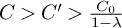 $C>C'>\frac {C_0}{1-\lambda }$
given by Lemma 6. Fix a Cauchy sequence
$C>C'>\frac {C_0}{1-\lambda }$
given by Lemma 6. Fix a Cauchy sequence $(L_n)$
of elements of
$(L_n)$
of elements of $\mathcal {L}^s$
such that, for any
$\mathcal {L}^s$
such that, for any $k \geq n$
,
$k \geq n$
, $d_u(L_n,L_{k}) \leq \lambda ^{n} (C-C')$
so that
$d_u(L_n,L_{k}) \leq \lambda ^{n} (C-C')$
so that $d_u(\tilde {A}^{n}(L_n),\tilde {A}^{n}(L_{k})) \leq C-C'$
. We say that such a Cauchy sequence is adapted.
$d_u(\tilde {A}^{n}(L_n),\tilde {A}^{n}(L_{k})) \leq C-C'$
. We say that such a Cauchy sequence is adapted.
By Lemma 6, for any $n \geq 0$
,
$n \geq 0$
,
 $$ \begin{align*}\tilde{f}^{-1} \left( \tilde{A}^{n+1}(L_{n+1})_C \right) \subset \tilde{A}^{n}(L_{n+1})_{C'} \subset \tilde{A}^{n}(L_n)_C\end{align*} $$
so that
 $$ \begin{align*}\tilde{f}^{-n-1} \left( \tilde{A}^{n+1}(L_{n+1})_C \right) \subset \tilde{f}^{-n} \left(\tilde{A}^{n}(L_n)_C \right).\end{align*} $$
We define
 $$ \begin{align*}\begin{array}{rcl} \overline{\eta}^{s}((L_n)_{n \geq 0}) & = & \displaystyle \bigcap_{n \geq 0} \overline{\tilde{f}^{-n} \left( \tilde{A}^n(L_n)_C \right)} \\ & = & \displaystyle \bigcap_{n \in \mathbb{Z}} \overline{\tilde{f}^{-n} \left( \tilde{A}^n(L_n)_C \right)}, \end{array}\end{align*} $$
where we set $L_n=L_0$
for
$L_n=L_0$
for $n<0$
The subset
$n<0$
The subset $\overline {\eta }^{s} \left ( (L_n)_{n \geq 0} \right )$
is the intersection of a nested sequence of non empty compact connected subsets of
$\overline {\eta }^{s} \left ( (L_n)_{n \geq 0} \right )$
is the intersection of a nested sequence of non empty compact connected subsets of $\overline {S}$
. Hence
$\overline {S}$
. Hence $\overline {\eta }^{s}(L)$
is a nonempty compact and connected subset of
$\overline {\eta }^{s}(L)$
is a nonempty compact and connected subset of $\overline {S}$
.
$\overline {S}$
.
Fix two adapted Cauchy sequences $(L_n)_{n \geq 0}$
and
$(L_n)_{n \geq 0}$
and $(L^{\prime }_n)_{n \geq 0}$
of elements of
$(L^{\prime }_n)_{n \geq 0}$
of elements of $\mathcal {L}^s$
which are equivalent, and let us check that
$\mathcal {L}^s$
which are equivalent, and let us check that $\overline {\eta }^{s}((L_n))=\overline {\eta }^{s}((L^{\prime }_n))$
. First, observe that, when the sequence
$\overline {\eta }^{s}((L_n))=\overline {\eta }^{s}((L^{\prime }_n))$
. First, observe that, when the sequence $(L^{\prime }_k)_k=(L_{n_k})_k$
is a subsequence of
$(L^{\prime }_k)_k=(L_{n_k})_k$
is a subsequence of $(L_n)$
, then it is adapted. Moreover, we have, for any k,
$(L_n)$
, then it is adapted. Moreover, we have, for any k,
 $$ \begin{align*}\tilde{f}^{-k-1} \left( \tilde{A}^{k+1}(L_{n_{k+1}})_C \right)\subset \tilde{f}^{-k} \left( \tilde{A}^{k}(L_{n_{k+1}})_{C'}\right) \subset \tilde{f}^{-k} \left( \tilde{A}^{k}(L_{k})_{C}\right),\end{align*} $$
as $k \leq n_{k+1}$
and
$k \leq n_{k+1}$
and $d_u(A^{k}(L_k),A^{k}(L_{n_{k+1}})) \leq C-C'$
. Hence, taking intersections,
$d_u(A^{k}(L_k),A^{k}(L_{n_{k+1}})) \leq C-C'$
. Hence, taking intersections,
 $$ \begin{align*}\overline{\eta}^{s}((L_{n_k})_{k \geq 0}) \subset \overline{\eta}^{s}((L_{n})_{n \geq 0}).\end{align*} $$
For any integer k, we can choose an integer $n_k \geq k+1$
so that
$n_k \geq k+1$
so that $d_u(L^{\prime }_{n_k},L_{n_k}) \leq (\lambda ^k-\lambda ^{k+1})(C-C').$
so that
$d_u(L^{\prime }_{n_k},L_{n_k}) \leq (\lambda ^k-\lambda ^{k+1})(C-C').$
so that $d_u(L^{\prime }_{n_k},L_{k+1}) \leq \lambda ^k (C-C')$
. Also, the integers
$d_u(L^{\prime }_{n_k},L_{k+1}) \leq \lambda ^k (C-C')$
. Also, the integers $n_k$
can be chosen in such a way that, for any k,
$n_k$
can be chosen in such a way that, for any k, $n_{k+1}>n_k$
. Then, as
$n_{k+1}>n_k$
. Then, as $d_u(L_{n_k},L_k) \leq \lambda ^{k+1}(C-C')$
,
$d_u(L_{n_k},L_k) \leq \lambda ^{k+1}(C-C')$
,
 $$ \begin{align*}\tilde{f}^{-k-1} \left( \tilde{A}^{k+1}(L_{k+1})_C \right) \subset \tilde{f}^{-k} \left(\tilde{A}^{k}(L_{k+1})_{C'} \right)\subset \tilde{f}^{-k} \left(\tilde{A}^{k}(L^{\prime}_{n_k})_C \right)\end{align*} $$
so that
 $$ \begin{align*}\overline{\eta}^s \left( (L_n)_{n\geq 0} \right) \subset \overline{\eta}^{s}\left( (L^{\prime}_{n_k})_k \right) \subset \overline{\eta}^s \left((L^{\prime}_n)_{n\geq 0}\right).\end{align*} $$
Changing the roles of the sequences $(L_n)$
and
$(L_n)$
and $(L^{\prime }_n)$
, we prove the reverse inclusion.
$(L^{\prime }_n)$
, we prove the reverse inclusion.
We just proved that two equivalent Cauchy sequences of elements of $\mathcal {L}^s$
define the same subset. Observe that, by taking subsequences, any Cauchy sequence of elements of
$\mathcal {L}^s$
define the same subset. Observe that, by taking subsequences, any Cauchy sequence of elements of $\mathcal {L}^s$
is equivalent to an adapted one. Hence, for any element
$\mathcal {L}^s$
is equivalent to an adapted one. Hence, for any element $\xi \in \overline {\mathcal {L}}^s$
, we define
$\xi \in \overline {\mathcal {L}}^s$
, we define $\overline {\eta }^s(\xi )=\overline {\eta }^s((L_n)_{n \geq 0})$
, where
$\overline {\eta }^s(\xi )=\overline {\eta }^s((L_n)_{n \geq 0})$
, where $(L_n)_{n \geq 0}$
is any adapted Cauchy sequence in the class
$(L_n)_{n \geq 0}$
is any adapted Cauchy sequence in the class $\xi $
.
$\xi $
.
Moreover, for any $\xi \in \overline {\mathcal {L}}^{s}$
which is represented by the adapted Cauchy sequence
$\xi \in \overline {\mathcal {L}}^{s}$
which is represented by the adapted Cauchy sequence $(L_n)$
, and by setting
$(L_n)$
, and by setting $L_n=L_0$
if
$L_n=L_0$
if $n < 0$
,
$n < 0$
,
 $$ \begin{align*}\begin{array}{rcl} \tilde{f}^{-1} \left( \overline{\eta}^{s}(\xi) \right) & = & \displaystyle \bigcap_{n \in \mathbb{Z}} \overline{\tilde{f}^{-n-1} \left( \tilde{A}^n(L_n)_C \right)} \\ & = & \displaystyle \bigcap_{n \in \mathbb{Z}} \overline{\tilde{f}^{-n} \left( \tilde{A}^n(\tilde{A}^{-1}(L_{n-1}))_C \right)} \\ & = & \overline{\eta}^{s} \left( \tilde{A}^{-1}(\xi) \right), \end{array}\end{align*} $$
as the sequence $(\tilde {A}^{-1}(L_{n-1}))_n$
is equivalent to the sequence
$(\tilde {A}^{-1}(L_{n-1}))_n$
is equivalent to the sequence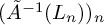 $(\tilde {A}^{-1}(L_{n}))_n$
. Hence point
$(\tilde {A}^{-1}(L_{n}))_n$
. Hence point $3.$
of Theorem 1 holds for
$3.$
of Theorem 1 holds for $\overline {\mathcal {L}}^{s}$
. As
$\overline {\mathcal {L}}^{s}$
. As $\tilde {f}_{|\partial \tilde {S}}=\tilde {A}_{|\partial \tilde {S}}$
, point 5. of Theorem 1 holds.
$\tilde {f}_{|\partial \tilde {S}}=\tilde {A}_{|\partial \tilde {S}}$
, point 5. of Theorem 1 holds.
Let us prove point $4.$
now. Let
$4.$
now. Let $\gamma \in \pi _1(S)$
,
$\gamma \in \pi _1(S)$
, $\xi \in \overline {\mathcal {L}}^{s}$
which is represented by an adapted Cauchy sequence
$\xi \in \overline {\mathcal {L}}^{s}$
which is represented by an adapted Cauchy sequence $(L_n)$
of leaves and
$(L_n)$
of leaves and $n \geq 0$
. Then there exists a deck transformation
$n \geq 0$
. Then there exists a deck transformation $\delta \in \pi _1(S)$
such that
$\delta \in \pi _1(S)$
such that
 $$ \begin{align*}\left\{ \begin{array}{@{}rcl} \tilde{A}^{n} \gamma & = & \delta \tilde{A}^n \\ \tilde{f}^{n} \gamma & = & \delta \tilde{f}^n. \end{array} \right. \end{align*} $$
Therefore, as the pseudo-distance $d_u$
is invariant under
$d_u$
is invariant under $\pi _1(S)$
,
$\pi _1(S)$
,
 $$ \begin{align*}\begin{array}{rcl} \tilde{f}^{-n} \left((\tilde{A}^{n}(\gamma L_n))_C \right) & = & \tilde{f}^{-n} \left( \left(\delta\tilde{A}^{n}( L_n) \right)_C \right) \\ & = & \tilde{f}^{-n} \left( \delta(\tilde{A}^{n}( L_n))_C \right) \\ & = & \gamma \tilde{f}^{-n} \left( (\tilde{A}^{n}( L_n))_C \right). \end{array}\end{align*} $$
Hence, by taking the intersection of the closures of these sets over $n \geq 0$
, we obtain
$n \geq 0$
, we obtain
 $$ \begin{align*}\overline{\eta}^s \left(\gamma(\xi) \right)=\gamma \left(\overline{\eta}^{s}(\xi) \right).\end{align*} $$
Now, let us prove the first point. We start by showing that, for any $\xi \neq \xi ' \in \overline {\mathcal {L}}^s$
, the sets
$\xi \neq \xi ' \in \overline {\mathcal {L}}^s$
, the sets $\overline {\eta }^{s}(\xi )$
and
$\overline {\eta }^{s}(\xi )$
and $\overline {\eta }^{s}(\xi ')$
are disjoint. Fix such
$\overline {\eta }^{s}(\xi ')$
are disjoint. Fix such $\xi \neq \xi '$
. Let
$\xi \neq \xi '$
. Let $(L_n)$
and
$(L_n)$
and $(L^{\prime }_n)$
be adapted Cauchy sequences which are respectively associated to
$(L^{\prime }_n)$
be adapted Cauchy sequences which are respectively associated to $\xi $
and
$\xi $
and $\xi '$
. For any
$\xi '$
. For any $n \geq 0$
 $$ \begin{align*}d_u(L_n,L^{\prime}_n)=d_{u} \left( \tilde{A}^{-n}(\tilde{A}^{n}(L_n)),\tilde{A}^{-n}(\tilde{A}^{n}(L_n)) \right) = \lambda^{n} d_u \left(\tilde{A}^{n}(L_n),\tilde{A}^{n}(L^{\prime}_n)\right)\end{align*} $$
so that, as the sequence $(d_u(L_n,L^{\prime }_n))_n$
converges to a positive real number,
$(d_u(L_n,L^{\prime }_n))_n$
converges to a positive real number,
 $$ \begin{align*}\lim_{n \rightarrow +\infty}d_u \left(\tilde{A}^{n}(L_n),\tilde{A}^{n}(L^{\prime}_n)\right)=+\infty.\end{align*} $$
Hence there exists $N \geq 0$
such that
$N \geq 0$
such that
 $$ \begin{align*}\tilde{A}^{N}(L_N)_C \cap \tilde{A}^{N}(L^{\prime}_N)_C= \emptyset.\end{align*} $$
As distinct leaves of $\tilde {\mathcal {F}}^s$
have distinct endpoints on
$\tilde {\mathcal {F}}^s$
have distinct endpoints on $\partial \tilde {S}$
, we deduce that
$\partial \tilde {S}$
, we deduce that
 $$ \begin{align*}\overline{\tilde{A}^{N}(L_N)_C} \cap \overline{\tilde{A}^{N}(L^{\prime}_N)_C}= \emptyset.\end{align*} $$
Hence
 $$ \begin{align*}\overline{\eta}^{s}(\xi) \cap \overline{\eta}^{s}(\xi') \subset \overline{\tilde{f}^{-N} \left(\tilde{A}^{N}(L_N)_C \cap \tilde{A}^{N}(L^{\prime}_N)_C \right)} =\emptyset.\end{align*} $$
Recall that, for any $L \in \mathcal {L}^s$
,
$L \in \mathcal {L}^s$
, $\overline {\eta }^{s}(L)\cap \partial \tilde {S}=L \cap \partial \tilde {S}$
consists of a finite number of points, and more than one. Moreover, the set
$\overline {\eta }^{s}(L)\cap \partial \tilde {S}=L \cap \partial \tilde {S}$
consists of a finite number of points, and more than one. Moreover, the set $\overline {\eta }^{s}(L)$
is connected so that
$\overline {\eta }^{s}(L)$
is connected so that $\eta ^{s}(L) \neq \emptyset $
.
$\eta ^{s}(L) \neq \emptyset $
.
Now, let us prove that, for any point $\tilde {x} \in \tilde {S}$
, there exists a point
$\tilde {x} \in \tilde {S}$
, there exists a point $\xi $
of
$\xi $
of $\overline {\mathcal {L}}^s$
such that
$\overline {\mathcal {L}}^s$
such that $\tilde {x} \in \eta ^{s}(\xi )$
, which will prove the first point.
$\tilde {x} \in \eta ^{s}(\xi )$
, which will prove the first point.
Fix $n \geq 0$
and
$n \geq 0$
and $\tilde {x} \in \tilde {S}$
. Let us consider the set
$\tilde {x} \in \tilde {S}$
. Let us consider the set $E^{n}_{\tilde {x}}$
which is the closure in
$E^{n}_{\tilde {x}}$
which is the closure in $\overline {\mathcal {L}}^s$
of the set of the leaves L of
$\overline {\mathcal {L}}^s$
of the set of the leaves L of $\tilde {\mathcal {F}}^{s}$
such that
$\tilde {\mathcal {F}}^{s}$
such that
 $$ \begin{align*}\tilde{f}^{n}(\tilde{x}) \in \tilde{A}^n(L)_C.\end{align*} $$
Observe that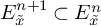 $E^{n+1}_{\tilde {x}} \subset E^{n}_{\tilde {x}}$
. Indeed, if
$E^{n+1}_{\tilde {x}} \subset E^{n}_{\tilde {x}}$
. Indeed, if $d_u \left (\tilde {A}^{n+1}(L),\tilde {f}^{n+1}(\tilde {x}) \right ) \leq C$
for some stable leaf L, then
$d_u \left (\tilde {A}^{n+1}(L),\tilde {f}^{n+1}(\tilde {x}) \right ) \leq C$
for some stable leaf L, then
 $$ \begin{align*}\begin{array}{rcl} d_u \left(\tilde{A}^{n}(L),\tilde{f}^{n}(\tilde{x}) \right) & = & d_u \left(\tilde{A}^{-1}\tilde{A}^{n+1}(L),\tilde{A}^{-1}\tilde{A}\tilde{f}^{n}(\tilde{x}) \right) \\ & = & \lambda d_u \left(\tilde{A}^{n+1}(L),\tilde{A}\tilde{f}^{n}(\tilde{x}) \right) \\ & \leq & \lambda \left( d_u \left(\tilde{A}^{n+1}(L),\tilde{f}^{n+1}(\tilde{x}) \right) +C_0 \right) \\ & \leq & \lambda(C+C_0) \leq C \end{array} \end{align*} $$
as C was chosen so that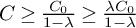 $C\geq \frac {C_0}{1-\lambda } \geq \frac {\lambda C_0}{1-\lambda }$
. We obtain then the wanted inclusion by taking closures in
$C\geq \frac {C_0}{1-\lambda } \geq \frac {\lambda C_0}{1-\lambda }$
. We obtain then the wanted inclusion by taking closures in $\overline {\mathcal {L}}^s$
.
$\overline {\mathcal {L}}^s$
.
Let us prove that the diameter of the set $E^n_{\tilde {x}}$
tends to
$E^n_{\tilde {x}}$
tends to $0$
as n tends to
$0$
as n tends to $+\infty $
. Indeed, for any two stable leaves L and
$+\infty $
. Indeed, for any two stable leaves L and $L'$
in
$L'$
in $E^n_{\tilde {x}}$
,
$E^n_{\tilde {x}}$
,
 $$ \begin{align*}d_u(A^{n}(L),A^{n}(L')) \leq 2C\end{align*} $$
so that
 $$ \begin{align*}d_u(L,L') \leq 2C \lambda^{n}.\end{align*} $$
The diameter of the set $E^n_{\tilde {x}}$
is smaller than
$E^n_{\tilde {x}}$
is smaller than $2C \lambda ^{n}$
and tends to
$2C \lambda ^{n}$
and tends to $0$
.
$0$
.
Therefore, the set $\displaystyle \bigcap _{n \geq 0} E^{n}_{\tilde {x}}$
is a decreasing sequence of nonempty closed subsets of
$\displaystyle \bigcap _{n \geq 0} E^{n}_{\tilde {x}}$
is a decreasing sequence of nonempty closed subsets of $\overline {\mathcal {L}}^s$
whose diameters tend to
$\overline {\mathcal {L}}^s$
whose diameters tend to $0$
. As the latter set is complete, this intersection consists of a single point
$0$
. As the latter set is complete, this intersection consists of a single point $\xi $
. Any sequence
$\xi $
. Any sequence $(L_n)$
of stable leaves which satisfies that, for any n,
$(L_n)$
of stable leaves which satisfies that, for any n, $L_n$
belongs to
$L_n$
belongs to $E^{n}_{\tilde {x}}$
, is a Cauchy sequence which represents
$E^{n}_{\tilde {x}}$
, is a Cauchy sequence which represents $\xi $
. Fix such a sequence
$\xi $
. Fix such a sequence $(L_n)$
. By definition of the sets
$(L_n)$
. By definition of the sets $E^n_{\tilde {x}}$
,
$E^n_{\tilde {x}}$
,
 $$ \begin{align*}\tilde{x} \in \bigcap_{n \geq 0} \tilde{f}^{-n}\left(\tilde{A}^n(L_n)_C \right).\end{align*} $$
Take a subsequence $(L_{n_k})_{k \geq 0}$
of
$(L_{n_k})_{k \geq 0}$
of $(L_n)$
which is adapted. By Lemma 6, for any
$(L_n)$
which is adapted. By Lemma 6, for any $k\geq 0$
, as
$k\geq 0$
, as $n_k \geq k$
 $$ \begin{align*}\tilde{f}^{-n_k}\left(\tilde{A}^{n_k}(L_{n_k})_C\right) \subset \tilde{f}^{-k}\left(\tilde{A}^{k}(L_{n_k})_C\right).\end{align*} $$
Hence
 $$ \begin{align*}\tilde{x} \in \bigcap_{k \geq 0} \tilde{f}^{-k}\left(\tilde{A}^k(L_{n_k})_C \right)=\eta^s(\xi).\end{align*} $$
The first point of Theorem 1 is proved.
Let us prove the second point now. If E is a closed and connected subset of $\tilde {S}$
which is a union of leaves in
$\tilde {S}$
which is a union of leaves in $\mathcal {L}^s$
, denote by
$\mathcal {L}^s$
, denote by $\overline {\mathcal {L}}^s_E$
the subset of
$\overline {\mathcal {L}}^s_E$
the subset of $\overline {\mathcal {L}}^s$
consisting of points which are represented by Cauchy sequences of leaves which are contained in E. Let
$\overline {\mathcal {L}}^s$
consisting of points which are represented by Cauchy sequences of leaves which are contained in E. Let
 $$ \begin{align*}\overline{\eta}^{s}(E)=\bigcap_{n \geq 0} \overline{\tilde{f}^{-n}\left( \tilde{A}^n(E)_{C} \right)}.\end{align*} $$
The subset $\overline {\eta }^{s}(E)$
is compact and connected as a decreasing intersection of compact and connected subsets of
$\overline {\eta }^{s}(E)$
is compact and connected as a decreasing intersection of compact and connected subsets of $\overline {S}$
.
$\overline {S}$
.
Observe that
 $$ \begin{align*}\overline{\eta}^{s}(E)\cap \tilde{S}=\bigcup_{\xi \in \overline{\mathcal{L}}^s_E} \eta^{s}(\xi).\end{align*} $$
Indeed, suppose that the point $\tilde {x}$
belongs to
$\tilde {x}$
belongs to $\overline {\eta }^{s}(E)\cap \tilde {S}$
. Then, by definition, for any
$\overline {\eta }^{s}(E)\cap \tilde {S}$
. Then, by definition, for any $n \geq 0$
, there exists a stable leaf
$n \geq 0$
, there exists a stable leaf $L_n \subset E$
such that
$L_n \subset E$
such that $\tilde {f}^{n}(\tilde {x}) \in \tilde {A}^n(L_n)_C$
. As we saw in the proof of the first point, the sequence
$\tilde {f}^{n}(\tilde {x}) \in \tilde {A}^n(L_n)_C$
. As we saw in the proof of the first point, the sequence $(L_n)_{n \geq 0}$
has to be a Cauchy sequence and
$(L_n)_{n \geq 0}$
has to be a Cauchy sequence and $\tilde {x} \in \eta ^s(\xi )$
, where
$\tilde {x} \in \eta ^s(\xi )$
, where $\xi $
is the class of the sequence
$\xi $
is the class of the sequence $(L_n)$
. The reverse inclusion is clear. Hence
$(L_n)$
. The reverse inclusion is clear. Hence
 $$ \begin{align*}\overline{\eta}^{s}(E)= \overline{\bigcup_{\xi \in \overline{\mathcal{L}}^s_E} \eta^{s}(\xi)}.\end{align*} $$
Suppose now that E is an open and connected subset of $\tilde {S}$
which is a union of leaves of
$\tilde {S}$
which is a union of leaves of $\tilde {\mathcal {F}}^s$
. We write
$\tilde {\mathcal {F}}^s$
. We write $E=\cup _{n\geq 0} E_n$
, where
$E=\cup _{n\geq 0} E_n$
, where $(E_n)$
is defined as follows. Fix a leaf
$(E_n)$
is defined as follows. Fix a leaf $L_E$
which is contained in E and define
$L_E$
which is contained in E and define $E_n$
as the connected component of
$E_n$
as the connected component of $L_E$
in the closure of the set of points
$L_E$
in the closure of the set of points $\tilde {x} \in \tilde {S}$
such that
$\tilde {x} \in \tilde {S}$
such that $d_u(\tilde {x}, E^{c}) \geq \min \left (\frac {1}{n},d_u(L_E, E^{c})/2 \right )$
. The set
$d_u(\tilde {x}, E^{c}) \geq \min \left (\frac {1}{n},d_u(L_E, E^{c})/2 \right )$
. The set
 $$ \begin{align*}\overline{\eta}^{s}(E)=\bigcup_{n \geq 0} \overline{\eta}^{s}(E_n)\end{align*} $$
is connected as an increasing sequence of connected subsets. The definition of $\overline {\eta }^{s}(E)$
does not depend on the chosen leaf
$\overline {\eta }^{s}(E)$
does not depend on the chosen leaf $L_E$
.
$L_E$
.
Fix a leaf $L_0$
of
$L_0$
of $\tilde {\mathcal {F}}^s$
. Let
$\tilde {\mathcal {F}}^s$
. Let $\kappa $
be the finite set consisting of connected components of
$\kappa $
be the finite set consisting of connected components of $\tilde {S} \setminus L_0$
. Observe that
$\tilde {S} \setminus L_0$
. Observe that
 $$ \begin{align*}\tilde{S} \setminus L_0= \bigcup_{E \in \kappa} E.\end{align*} $$
Then, as the subsets $\eta ^{s}(\xi )$
, for
$\eta ^{s}(\xi )$
, for $\xi \in \mathcal {L}^s$
, cover
$\xi \in \mathcal {L}^s$
, cover $\tilde {S}$
and are pairwise disjoint,
$\tilde {S}$
and are pairwise disjoint,
 $$ \begin{align*}\tilde{S} \subset A= \overline{\eta}^{s}(L_0) \cup \bigcup_{E \in \kappa} \overline{\eta}^{s}(E) \subset \overline{S}\end{align*} $$
and the sets appearing in this decomposition are pairwise disjoint. Indeed, as the sets of the form $\eta ^{s}(\xi )$
are disjoint for different
$\eta ^{s}(\xi )$
are disjoint for different $\xi $
the intersection of two of those sets with
$\xi $
the intersection of two of those sets with $\tilde {S}$
is empty. Moreover,
$\tilde {S}$
is empty. Moreover,
 $$ \begin{align*}\overline{\eta}^{s}(L_0) \cap \partial \tilde{S}=\overline{L}_0 \cap \partial \tilde{S}\end{align*} $$
and, for any $E \in \kappa $
written as union of the sequence
$E \in \kappa $
written as union of the sequence $(E_n)$
of closed subsets which are union of leaves,
$(E_n)$
of closed subsets which are union of leaves,
 $$ \begin{align*}\overline{\eta}^{s}(E) \cap \partial \tilde{S}= \bigcup_{n \geq 0} \overline{E_n} \cap \partial \tilde{S}\end{align*} $$
have to be pairwise disjoint (otherwise $L_0$
would have to belong to one of those sets
$L_0$
would have to belong to one of those sets $E_n$
, a contradiction). Moreover, as ends of leaves of
$E_n$
, a contradiction). Moreover, as ends of leaves of $\tilde {\mathcal {F}}^s$
are dense in
$\tilde {\mathcal {F}}^s$
are dense in $\partial \tilde {S}$
, the set
$\partial \tilde {S}$
, the set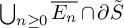 $\bigcup _{n \geq 0} \overline {E_n} \cap \partial \tilde {S}$
is a connected component of
$\bigcup _{n \geq 0} \overline {E_n} \cap \partial \tilde {S}$
is a connected component of $\partial \tilde {S} \setminus \overline {L}_0$
so that
$\partial \tilde {S} \setminus \overline {L}_0$
so that
 $$ \begin{align*}\overline{\eta}^{s}(L_0) \cup \bigcup_{E \in \kappa} \overline{\eta}^{s}(E)=\overline{S}.\end{align*} $$
For any $E \in \kappa $
, let
$E \in \kappa $
, let $c(E)$
be the closure of E in
$c(E)$
be the closure of E in $\tilde {S}$
. Observe that
$\tilde {S}$
. Observe that $c(E)=E \cup L_0$
. Let us prove also that
$c(E)=E \cup L_0$
. Let us prove also that
 $$ \begin{align*}\overline{\eta}^{s}(c(E))=\overline{\eta}^s(E) \cup \overline{\eta}^s(L_0).\end{align*} $$
The reverse inclusion is clear. Fix a decomposition $E= \cup _n E_n$
as above. For the direct inclusion, first,
$E= \cup _n E_n$
as above. For the direct inclusion, first,
 $$ \begin{align*}\overline{\eta}^{s}(c(E))\cap \partial \tilde{S}=\overline{c(E)}\cap \partial \tilde{S}=\overline{E} \cap \partial \tilde{S}=(\overline{\eta}^s(E) \cup \overline{\eta}^s(L_0)) \cap \partial \tilde{S}.\end{align*} $$
Now, any point in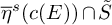 $\overline {\eta }^{s}(c(E)) \cap \tilde {S}$
belongs to some
$\overline {\eta }^{s}(c(E)) \cap \tilde {S}$
belongs to some $\eta ^{s}(\xi )$
, for some
$\eta ^{s}(\xi )$
, for some $\xi \in \mathcal {L}^s_{c(E)}$
. Take a Cauchy sequence
$\xi \in \mathcal {L}^s_{c(E)}$
. Take a Cauchy sequence $(L^{\prime }_n)$
of leaves which represents
$(L^{\prime }_n)$
of leaves which represents $\xi $
. Then either the sequence
$\xi $
. Then either the sequence $(d_u(L^{\prime }_n,L_0))_n$
has to be eventually bounded below and hence
$(d_u(L^{\prime }_n,L_0))_n$
has to be eventually bounded below and hence $(L^{\prime }_n)$
is eventually contained in some
$(L^{\prime }_n)$
is eventually contained in some $E_k$
or the sequence
$E_k$
or the sequence $(L^{\prime }_n)$
is equivalent to the constant sequence
$(L^{\prime }_n)$
is equivalent to the constant sequence $(L_0)$
. In this second case,
$(L_0)$
. In this second case, $\eta ^{s}(\xi )=\eta ^{s}(L_0)$
. This proves the direct inclusion.
$\eta ^{s}(\xi )=\eta ^{s}(L_0)$
. This proves the direct inclusion.
Then, for any $E \in \kappa $
, the set
$E \in \kappa $
, the set
 $$ \begin{align*}\overline{S} \setminus \overline{\eta}^{s}(E)= \bigcup_{E'\in \kappa, \ E' \neq E} \overline{\eta}^{s}(c(E'))\end{align*} $$
is closed as a finite union of closed subsets, so that each $\overline {\eta }^{s}(E)$
, for
$\overline {\eta }^{s}(E)$
, for $E \in \kappa $
, is open in
$E \in \kappa $
, is open in $\overline {S}$
. Hence each
$\overline {S}$
. Hence each $\overline {\eta }^{s}(E)$
, for
$\overline {\eta }^{s}(E)$
, for $E \in \kappa $
, has to be a connected component of
$E \in \kappa $
, has to be a connected component of $\overline {S} \setminus \overline {\eta }^{s}(L_0)$
.
$\overline {S} \setminus \overline {\eta }^{s}(L_0)$
.
Now, let $\xi \in \overline {\mathcal {L}}^s \setminus \mathcal {L}^s$
. Fix a leaf
$\xi \in \overline {\mathcal {L}}^s \setminus \mathcal {L}^s$
. Fix a leaf $L_0 \in \mathcal {L}^s$
. In this case, we define, for any
$L_0 \in \mathcal {L}^s$
. In this case, we define, for any $n \geq 1$
,
$n \geq 1$
, $E_n$
as the connected component of
$E_n$
as the connected component of $L_0$
in the set of leaves L of
$L_0$
in the set of leaves L of $\mathcal {L}^s$
such that
$\mathcal {L}^s$
such that
 $$ \begin{align*}d_u(L,\xi) \geq \min \left(\frac{d_u(L_0,\xi)}{2} ,\frac{1}{n} \right).\end{align*} $$
Then the union B of the $\overline {\eta }^s(E_n)$
, for
$\overline {\eta }^s(E_n)$
, for $n\geq 1$
, is connected as an increasing union of connected subsets. Moreover,
$n\geq 1$
, is connected as an increasing union of connected subsets. Moreover,
 $$ \begin{align*}B \cup \overline{\eta}^{s}(\xi)= \overline{S}\end{align*} $$
and the subsets B and $\overline {\eta }^{s}(\xi )$
are disjoint. Hence the complement of the subset
$\overline {\eta }^{s}(\xi )$
are disjoint. Hence the complement of the subset $\overline {\eta }^{s}(\xi )$
, which is B, is connected.
$\overline {\eta }^{s}(\xi )$
, which is B, is connected.
We move to the proof of point 6. of Theorem 1.
For this point, we need the following claim, where the constant $C_0$
is given by Claim 5.
$C_0$
is given by Claim 5.
Claim 7. For any two points $\tilde {x}$
and
$\tilde {x}$
and $\tilde {y}$
and any
$\tilde {y}$
and any $n\geq 0$
,
$n\geq 0$
,
 $$ \begin{align*}d_s(\tilde{f}^{n}(\tilde{x}), \tilde{f}^n(\tilde{y})) \leq \frac{2C_0}{1- \lambda}+d_s(\tilde{x},\tilde{y}).\end{align*} $$
Proof. Fix $n \geq 0$
.
$n \geq 0$
.
 $$ \begin{align*}\begin{array}{rcl} d_s(\tilde{f}^{n+1}(\tilde{x}),\tilde{f}^{n+1}(\tilde{y})) & \leq & d_s(\tilde{f}^{n+1}(\tilde{x}),\tilde{A}\tilde{f}^{n}(\tilde{x}))+d_s(\tilde{A}\tilde{f}^{n}(\tilde{x}),\tilde{A}\tilde{f}^{n}(\tilde{y}))+d_s(\tilde{A}\tilde{f}^{n}(\tilde{y}),\tilde{f}^{n+1}(\tilde{y})) \\ & \leq & C_0+ \lambda d_s(\tilde{f}^{n}(\tilde{x}),\tilde{f}^{n}(\tilde{y}))+C_0. \end{array}\end{align*} $$
Then, an induction implies that, for any $n \geq 0$
,
$n \geq 0$
,
 $$ \begin{align*}d_s(\tilde{f}^{n}(\tilde{x}),\tilde{f}^{n}(\tilde{y})) \leq 2C_0 \left( \sum_{i=0}^{n-1} \lambda^i \right) + \lambda^n d_s(\tilde{x},\tilde{y}).\end{align*} $$
As
 $$ \begin{align*}\sum_{i=0}^{n-1} \lambda^i \leq \frac{1}{1-\lambda}=\sum_{i=0}^{+\infty} \lambda^i,\end{align*} $$
this implies the claim.
Fix a point $\xi \in \overline {\mathcal {L}}^s$
which is represented by an adapted Cauchy sequence
$\xi \in \overline {\mathcal {L}}^s$
which is represented by an adapted Cauchy sequence $(L_n)$
of leaves. By construction of
$(L_n)$
of leaves. By construction of $\eta ^{s}(\xi )$
, for any
$\eta ^{s}(\xi )$
, for any $n \geq 0$
and any
$n \geq 0$
and any $\tilde {y} \in \eta ^{s}(\xi )$
,
$\tilde {y} \in \eta ^{s}(\xi )$
,
 $$ \begin{align*}d_u(\tilde{f}^{n}(\tilde{y}),\tilde{A}^{n}(L_n)) \leq C,\end{align*} $$
where $C>0$
is given by Lemma 6. Hence, for any pair of points
$C>0$
is given by Lemma 6. Hence, for any pair of points $\tilde {x}$
and
$\tilde {x}$
and $\tilde {y}$
in
$\tilde {y}$
in $\eta ^s(\xi )$
,
$\eta ^s(\xi )$
,
 $$ \begin{align*}d_{u}(\tilde{f}^{n}(\tilde{x}),\tilde{f}^{n}(\tilde{y})) \leq 2C\end{align*} $$
and
 $$ \begin{align*}\begin{array}{rcl} d(\tilde{f}^{n}(\tilde{x}),\tilde{f}^{n}(\tilde{y})) & \leq & 2C+d_s(\tilde{f}^{n}(\tilde{x}),\tilde{f}^{n}(\tilde{y})) \\ & \leq & 2C+ \frac{2C_0}{1- \lambda}+d_s(\tilde{x},\tilde{y}) \end{array}\end{align*} $$
by the above claim. This proves the direct inclusion.
To prove the reverse inclusion, we will actually prove that the set $\tilde {S} \setminus \eta ^{s}(\xi )$
is contained in the complement of the right hand set in the statement. Let
$\tilde {S} \setminus \eta ^{s}(\xi )$
is contained in the complement of the right hand set in the statement. Let $\tilde {y} \in \tilde {S} \setminus \eta ^{s}(\xi )$
and take
$\tilde {y} \in \tilde {S} \setminus \eta ^{s}(\xi )$
and take $\xi ' \in \mathcal {L}^s$
such that
$\xi ' \in \mathcal {L}^s$
such that $\tilde {y} \in \eta ^{s}(\xi ')$
. Let
$\tilde {y} \in \eta ^{s}(\xi ')$
. Let $(L^{\prime }_n)$
be an adapted Cauchy sequence of leaves which represents
$(L^{\prime }_n)$
be an adapted Cauchy sequence of leaves which represents $\xi '$
. Then, for any point
$\xi '$
. Then, for any point $\tilde {x} \in \eta ^s(\xi )$
,
$\tilde {x} \in \eta ^s(\xi )$
,
 $$ \begin{align*}\begin{array}{rcl} d_u(\tilde{f}^{n}(\tilde{x}),\tilde{f}^n(\tilde{y})) & \geq & d_{u}(\tilde{A}^{n}(L_n),\tilde{A}^{n} (L^{\prime}_n))-d_u(\tilde{A}^{n}(L_n),\tilde{f}^{n}(\tilde{x}))-d_u(\tilde{A}^{n}(L^{\prime}_n),\tilde{f}^{n}(\tilde{y})) \\ & \geq & \lambda^{-n}d_u(L_n,L^{\prime}_n)-2C \rightarrow +\infty. \end{array}\end{align*} $$
which proves the wanted inclusion.
Now, let us prove point 7. Fix a point $\xi \in \overline {\mathcal {L}^s}$
.
$\xi \in \overline {\mathcal {L}^s}$
.
We will use here point 6. which implies that the definition of $\overline {\eta }^s(\xi )$
does not depend on the chosen
$\overline {\eta }^s(\xi )$
does not depend on the chosen $C>0$
. Fix
$C>0$
. Fix $C>\frac {C_0}{1-\lambda }$
, a neighbourhood U of
$C>\frac {C_0}{1-\lambda }$
, a neighbourhood U of $\overline {\eta }^s(\xi )$
in
$\overline {\eta }^s(\xi )$
in $\overline {S}$
and an adapted Cauchy sequence
$\overline {S}$
and an adapted Cauchy sequence $(L_n)$
of stable leaves which represents
$(L_n)$
of stable leaves which represents $\xi $
.
$\xi $
.
Recall that
 $$ \begin{align*}\overline{\eta}^{s}(\xi)=\bigcap_{n \geq 0} \tilde{f}^{-n}\left( \overline{\tilde{A}^n(L_n)_{C}} \right).\end{align*} $$
Then, as the subset $\overline {\eta }^{s}(\xi )$
is the intersection of a nested sequence of compact subsets of
$\overline {\eta }^{s}(\xi )$
is the intersection of a nested sequence of compact subsets of $\overline {S}$
, there exists
$\overline {S}$
, there exists $N>0$
such that
$N>0$
such that
 $$ \begin{align*}\tilde{f}^{-N}\left( \overline{ \tilde{A}^N(L_N)_{C}} \right)=\bigcap_{n = 0}^N \tilde{f}^{-n}\left( \overline{ \tilde{A}^n(L_n)_{C}} \right) \subset U.\end{align*} $$
Observe that, by Lemma 6 and the definition of an adapted sequence, there exists $C'>\frac {C_0}{1-\lambda }$
such that, for any
$C'>\frac {C_0}{1-\lambda }$
such that, for any $n> N$
,
$n> N$
,
 $$ \begin{align*}\overline{\eta}^s(\xi) \subset \tilde{f}^{-n}\left( \overline{ \tilde{A}^n(L_n)_{C}} \right) \subset \tilde{f}^{-N}\left( \overline{ \tilde{A}^N(L_n)_{C'}} \right) \subset \tilde{f}^{-N}\left( \overline{ \tilde{A}^N(L_N)_{C}} \right) \subset U.\end{align*} $$
Now, fix a constant D with $\frac {C_0}{1-\lambda }<D<C'$
. Applying Lemma 6 with this constant D gives a new constant
$\frac {C_0}{1-\lambda }<D<C'$
. Applying Lemma 6 with this constant D gives a new constant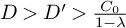 $D>D'>\frac {C_0}{1-\lambda }$
such that the lemma holds. Take a point
$D>D'>\frac {C_0}{1-\lambda }$
such that the lemma holds. Take a point $\xi ' \in \overline {\mathcal {L}}^s$
such that
$\xi ' \in \overline {\mathcal {L}}^s$
such that $d_u(\xi ',\xi ) < \lambda ^N( C'-D')$
. Take an adapted Cauchy sequence
$d_u(\xi ',\xi ) < \lambda ^N( C'-D')$
. Take an adapted Cauchy sequence $(L^{\prime }_n)$
of stable leaves for the constants D and
$(L^{\prime }_n)$
of stable leaves for the constants D and $D'$
which represents
$D'$
which represents $\xi '$
. Then, for any large enough n,
$\xi '$
. Then, for any large enough n, $d_u(L_n,L^{\prime }_n) < \lambda ^N(C'-D')$
. Fix such an integer
$d_u(L_n,L^{\prime }_n) < \lambda ^N(C'-D')$
. Fix such an integer $n> N$
. Then
$n> N$
. Then $d_u(\tilde {A}^N(L_n), \tilde {A}^N(L^{\prime }_n))<C'-D'$
so that
$d_u(\tilde {A}^N(L_n), \tilde {A}^N(L^{\prime }_n))<C'-D'$
so that
 $$ \begin{align*}\tilde{A}^N(L^{\prime}_n)_{D'} \subset \tilde{A}^N(L_n)_{C'}\end{align*} $$
and
 $$ \begin{align*}\overline{\eta}^s(\xi') \subset \tilde{f}^{-N} \left( \overline{ \tilde{A}^N(L^{\prime}_n)_{D'}} \right) \subset \tilde{f}^{-N}\left( \overline{ \tilde{A}^N(L_n)_{C'}} \right) \subset U.\end{align*} $$
This proves point 7. and completes the proof of Theorem 1.
4 Extension to the case of surfaces with marked points
Let S be a closed surface and F be a finite subset of S. In this section, we fix a homeomorphism A of S which is pseudo-Anosov relative to F. The homeomorphism A preserves two transverse singular foliations $\mathcal {F}^s$
and
$\mathcal {F}^s$
and $\mathcal {F}^u$
. The only difference with the case of an actual pseudo-Anosov homeomorphism of S is that these foliations can have one-pronged singularities. Let us denote by
$\mathcal {F}^u$
. The only difference with the case of an actual pseudo-Anosov homeomorphism of S is that these foliations can have one-pronged singularities. Let us denote by $\tilde {\mathcal {F}}^s$
and
$\tilde {\mathcal {F}}^s$
and $\tilde {\mathcal {F}}^u$
the respective lifts of
$\tilde {\mathcal {F}}^u$
the respective lifts of $\mathcal {F}^s$
and
$\mathcal {F}^s$
and $\mathcal {F}^u$
to the universal cover
$\mathcal {F}^u$
to the universal cover $\tilde {S}$
of S. As before, we denote by
$\tilde {S}$
of S. As before, we denote by $\overline {\mathcal {L}}^s$
(respectively
$\overline {\mathcal {L}}^s$
(respectively $\overline {\mathcal {L}}^u$
) the completion of the space of stable (resp. unstable) leaves of
$\overline {\mathcal {L}}^u$
) the completion of the space of stable (resp. unstable) leaves of $\tilde {A}$
.
$\tilde {A}$
.
Let f be a homeomorphism which is isotopic to A. Take an isotopy $(f_t)$
with
$(f_t)$
with $f_1=f$
and
$f_1=f$
and $f_0=A$
which pointwise fixes F and lift it to an isotopy
$f_0=A$
which pointwise fixes F and lift it to an isotopy $(\tilde {f}_t)_{t \in [0,1]}$
of
$(\tilde {f}_t)_{t \in [0,1]}$
of $\tilde {S}$
with
$\tilde {S}$
with $\tilde {f}_0=\tilde {A}$
. Then
$\tilde {f}_0=\tilde {A}$
. Then $\tilde {f}=\tilde {f}_1:\tilde {S} \rightarrow \tilde {S}$
is a lift of f.
$\tilde {f}=\tilde {f}_1:\tilde {S} \rightarrow \tilde {S}$
is a lift of f.
The following theorem is a generalization of Theorem 1 to this setting. However, in this statement, we do not mention any behaviour of the generalized leaves with respect to the boundary at infinity of $\tilde {S}$
, as, in this case, we do not control a priori the behaviour at infinity of the leaves of
$\tilde {S}$
, as, in this case, we do not control a priori the behaviour at infinity of the leaves of $\tilde {\mathcal {F}}^s$
and
$\tilde {\mathcal {F}}^s$
and $\tilde {\mathcal {F}}^u$
. However, all the other results are still true.
$\tilde {\mathcal {F}}^u$
. However, all the other results are still true.
Theorem 8. Fix $i=s,u$
. To each point
$i=s,u$
. To each point $\xi $
of
$\xi $
of $\overline {\mathcal {L}}^i$
, we associate a nonempty connected subset
$\overline {\mathcal {L}}^i$
, we associate a nonempty connected subset $\eta ^i(\xi )$
of
$\eta ^i(\xi )$
of $\tilde {S}$
with the following properties.
$\tilde {S}$
with the following properties.
-
1. The
$\eta ^{i}(\xi )$
, for
$\xi \in \overline {\mathcal {L}}^i$
, form a partition of
$\tilde {S}$
. -
2. For every
$L \in \mathcal {L}^i$
, the set
$\tilde {S} \setminus \eta ^{i}(L)$
has the same number of connected components as
$\tilde {S} \setminus L$
. -
3. For every
$\xi \in \overline {\mathcal {L}}^i$
,
$$ \begin{align*}\tilde{f} \left( \eta^i(\xi) \right)=\eta^i \left(A(\xi) \right).\end{align*} $$
-
4. For every
$\xi \in \overline {\mathcal {L}}^i$
and any deck transformation
$\gamma \in \pi _1(S)$
,
$$ \begin{align*}\gamma \left( \eta^i(\xi) \right)=\eta^i \left( \gamma(\xi) \right).\end{align*} $$
-
5. The sets
$\eta ^s(\xi )$
are the stable sets of all its points, namely for every
$\xi \in \overline {\mathcal {L}}^s$
and
$\tilde {x} \in \eta ^{s}(\xi )$
, The sets
$$ \begin{align*}\eta^{s}(\xi)= \left\{ \tilde{y} \in \tilde{S} \ | \ \exists C'>0, \ \forall n \geq 0, d(\tilde{f}^{n}(\tilde{x}),\tilde{f}^{n}(\tilde{y})) \leq C' \right\}.\end{align*} $$
$\eta ^u(\xi )$
are the unstable sets of all its points, namely for every
$\xi \in \overline {\mathcal {L}}^u$
and
$\tilde {x} \in \eta ^{u}(L)$
,
$$ \begin{align*}\eta^{u}(L)= \left\{ \tilde{y} \in \tilde{S} \ | \ \exists C'>0, \ \forall n \geq 0, d(\tilde{f}^{-n}(\tilde{x}),\tilde{f}^{-n}(\tilde{y})) \leq C' \right\}.\end{align*} $$


We will prove this theorem by using Theorem 1 and a finite branched covering map. This covering trick was indicated to me by Sebastian Hensel.
Remark 9. By construction, the subsets $\eta ^u(\xi ) \cap \eta ^s(\xi ')$
have a diameter which is uniformly bounded, which makes the connection with the recent preprint by Alejo García-Sassi and Fábio Armando Tal [Reference García-Sassi and Armando TalGST24].
$\eta ^u(\xi ) \cap \eta ^s(\xi ')$
have a diameter which is uniformly bounded, which makes the connection with the recent preprint by Alejo García-Sassi and Fábio Armando Tal [Reference García-Sassi and Armando TalGST24].
Proof. Denote by $\sigma \subset F$
the subset consisting of one-pronged singular points of the foliation
$\sigma \subset F$
the subset consisting of one-pronged singular points of the foliation $\mathcal {F}^s$
(which is also the set of one-pronged singular points of
$\mathcal {F}^s$
(which is also the set of one-pronged singular points of $\mathcal {F}^u$
) and fix a point
$\mathcal {F}^u$
) and fix a point $p \in S \setminus F$
. For each such singularity
$p \in S \setminus F$
. For each such singularity $s \in \sigma $
choose a simple loop based at p which bounds a once punctured disk of
$s \in \sigma $
choose a simple loop based at p which bounds a once punctured disk of $S \setminus F$
, with puncture at s. Let E be the finite subset of
$S \setminus F$
, with puncture at s. Let E be the finite subset of $\pi _1(S\setminus F,p)$
consisting of such loops. As any free group is residually finite, there exists a finite index normal subgroup of
$\pi _1(S\setminus F,p)$
consisting of such loops. As any free group is residually finite, there exists a finite index normal subgroup of $\pi _1(S\setminus F,p)$
which does not contain any point of E. This subgroup in turn defines a finite cover of
$\pi _1(S\setminus F,p)$
which does not contain any point of E. This subgroup in turn defines a finite cover of $S \setminus F$
and a branched cover
$S \setminus F$
and a branched cover $b:\hat {S}\rightarrow S$
.
$b:\hat {S}\rightarrow S$
.
The homeomorphisms f and A lift to isotopic homeomorphisms $\hat {f}$
and
$\hat {f}$
and $\hat {A}$
of
$\hat {A}$
of $\hat {S}$
. Observe that
$\hat {S}$
. Observe that $\hat {A}$
is now a pseudo-Anosov homeomorphism relative to
$\hat {A}$
is now a pseudo-Anosov homeomorphism relative to $b^{-1}(F)$
with no one-pronged singularity points at points of
$b^{-1}(F)$
with no one-pronged singularity points at points of $b^{-1}(F)$
so that
$b^{-1}(F)$
so that $\hat {A}$
is a pseudo-Anosov homeomorphism of
$\hat {A}$
is a pseudo-Anosov homeomorphism of $\hat {S}$
. Theorem 1 yields a stable and an unstable partition of
$\hat {S}$
. Theorem 1 yields a stable and an unstable partition of $\hat {S}$
which correspond to
$\hat {S}$
which correspond to $\hat {f}$
. By construction of this partition (see the proof of Theorem 1), this partition is invariant under the deck transformations of b. Hence this partition projects to a stable and an unstable partition of S for f which in turn lift to
$\hat {f}$
. By construction of this partition (see the proof of Theorem 1), this partition is invariant under the deck transformations of b. Hence this partition projects to a stable and an unstable partition of S for f which in turn lift to $\tilde {S}$
to give the wanted partitions.
$\tilde {S}$
to give the wanted partitions.

 Open access

