

Since the passage of the Convention on the Elimination of All Forms of Discrimination Against Women (CEDAW) in 1979, the international community has remained committed to the goal of gender equality. The 187 States Parties to the Convention pledged to ban gender discrimination and promote women's equality in all spheres and agreed to incorporate these principles in their national legal frameworks (UN General Assembly 1979, Art. 1 and 2). World leaders reaffirmed these commitments at the Fourth World Conference on Women (1995) in Beijing. Fifteen years later, representatives from all United Nations (UN) states declared achieving women's equality and empowerment to be a top priority for the new millennium (UN General Assembly 2000). In 2010, the UN General Assembly created UN Women, an entity devoted to accelerating the achievement of this goal (UN General Assembly 2010).
These international agreements and declarations have repeatedly emphasized the need for women's rights to be protected at the national level. As the fundamental documents outlining countries' political and socioeconomic organization, values, and goals, it is particularly important that constitutions guarantee equality. Although provisions that promote gender equality may be delineated in national legislation and policy documents, including these protections in constitutions carries both symbolic and practical weight. Constitutions are typically more difficult to repeal or amend than other legislative or policy commitments, which can help to guard against reversal when political administrations change. Most significantly where women's rights are concerned, constitutional protections can be a catalyst for action and provide a legal foundation for citizens to advance equality and combat discrimination. Although the discrepancy between rights protections and implementation has raised concerns about the extent to which the commitments entrenched in constitutions and amendments are translated into outcomes on the ground (Cross Reference Cross1999; Davenport Reference Davenport1996; Keith Reference Keith2002; Keith, Tate, and Poe Reference Keith, Tate and Poe2009; Pritchard Reference Pritchard1986; Strauss Reference Strauss2001), evidence from around the world demonstrates that the constitutional framework or “building blocks” in place can significantly bolster or hinder movements to promote gender equality (Scribner and Lambert Reference Scribner and Lambert2010; Waylen Reference Waylen2007, 203).
This article provides the first detailed global assessment of the status, strength, scope, and evolution of constitutional gender protections across the spheres of general equality and nondiscrimination, political participation, social and economic rights, family life, and customary and religious law. The rest of this section reviews the evidence that constitutions are important tools for advancing women's rights in each of these areas. We go on to explain the methodology we used to collect and analyze data on the constitutional rights entrenched in 191 countries as of June 2011. We then describe the status of equal rights across gender in the world's constitutions, analyze how these protections differ according to the decade in which a country's constitution was adopted and last amended, and examine regional variation in the status of customary and religious law. Finally, we discuss the implications of our findings and next steps for future research. This study provides an assessment of the progress that has been made—and the gaps that persist—following the introduction of various international commitments to gender equality. It also aims to provide researchers, policy makers, and civil society leaders with better tools to introduce gender protections where they are lacking and to leverage them where they are not being implemented.
LEVERAGING CONSTITUTIONS TO PROMOTE EQUAL RIGHTS
Around the world, citizens have leveraged constitutional protections to oppose the passage of discriminatory legislation, litigate against existing laws and practices that violate women's rights, challenge customary and religious traditions that restrict gender equality, and encourage the passage of new legislation that promotes equal rights for women. The following summary of landmark women's rights cases that drew on constitutional protections is not exhaustive, and it can be argued that some cases represent important steps forward while others primarily prevent costly retrenchment. Nonetheless, these examples illustrate the significant ramifications of including or omitting gender protections in constitutions.
Constitutions' Role in Limiting the Passage of Discriminatory Laws
Constitutional provisions have provided an important rallying point for those opposing the enactment of discriminatory legislation. In 2009, the government of Afghanistan passed the Shiite Personal Status Law, which would affect the lives of the estimated 15% of the population who identified as Shiites (Mackey Reference Mackey2009). Several provisions of the law violated Afghanistan's constitutional guarantee of women's equal rights: it compelled wives to submit to their husbands' requests for sex, restricted women's ability to leave the house or be employed without their husbands' permission, and gave fathers automatic custody of their children after they reached a certain age (Shiite Personal Status Law 2009). Women's groups and other members of civil society were vocal about the law's incompatibility with Afghanistan's constitutional guarantee of gender equality (Gebauer and Najafizada Reference Gebauer and Najafizada2009). Following intense domestic and international pressure, President Karzai asked the country's Parliament to remove any unconstitutional provisions (Radio Free Europe/Radio Liberty 2009). Although the amended bill still contained several problematic clauses, it omitted the articles prohibiting women from leaving the house without permission and mandating that women have sex with their husbands at least once every four days (Vogt Reference Vogt2009).
When Egypt's Council of States voted to ban women from serving as judges, women's rights activists protested that the decision violated the constitutional guarantee of equality. Despite heated opposition and threats of legal action from his peers, the head of the Council also characterized the vote as unconstitutional and vowed to ignore it (Zayan Reference Zayan2010). In light of these events, the prime minister asked the Constitutional Court for clarification regarding the legitimacy of the Council's decision; the court ruled that there was no legal basis for the ban and reaffirmed the right of all citizens to be equal before the law (ElSaed Reference ElSaed2010; The Guardian 2010).
Constitutions as a Basis for Challenging Laws or Actions that Violate Women's Rights
When discriminatory laws are already in place or state actions violate gender equality, litigation provides one of the most effective channels through which women can advance their rights. In Botswana, Kenya, and Zimbabwe, constitutional provisions prohibiting gender discrimination were used to challenge regulations that banned pregnant female students from attending school (Center for Reproductive Rights 2005). In Swaziland, constitutional protections of women's equal economic rights and equality before the law were effectively leveraged against the 1968 Deeds Registry Act, which prevented married women from registering property in their own names (IRIN 2010). When Kuwait's Justice Ministry stated that only male applicants would be considered for an entry-level position, six female law graduates successfully challenged the restriction as unconstitutional (Human Rights Watch 2012). In Malaysia, the High Court ruled that the Ministry of Education violated the constitutional prohibition of gender discrimination when it retracted an employment contract upon discovering the candidate was pregnant (Noorfadilla Binit Ahmad Saikin v. Chayed Bin Basirun and Others 2011).
The impact of such rulings often extends beyond the individual litigants. A far-reaching court case found Uganda's Divorce Act, which imposed stricter conditions under which women could file for divorce compared to those that applied to men, to be in direct contravention of women's constitutional rights to equality and nondiscrimination. The Court encouraged litigants to challenge other laws that violated the constitution's protection of gender equality, and subsequent rulings overturned discriminatory provisions of the Penal Code and the Succession Act (Ssenyonjo Reference Ssenyonjo2007).
As well as setting precedents for future litigation, court victories can catalyze women's rights movements. In Botswana, Unity Dow successfully leveraged the constitution's sole protection of equal rights based on sex to challenge the Citizenship Act of 1982. The Act stipulated that female citizens whose husbands were noncitizens could not pass citizenship onto their children, whereas male citizens married to noncitizens did not face the same restriction (Scribner and Lambert Reference Scribner and Lambert2010). The High Court and the Court of Appeals ruled that the Citizenship Act was unconstitutional because it discriminated on the basis of gender. Botswana's Parliament amended the Citizenship Act in 1995, and Unity Dow's children, along with numerous others, were granted citizenship (Dow Reference Dow2001). The case mobilized a broader movement to overturn laws that discriminated against women (Maluwa Reference Maluwa1999).
Constitutions as a Basis for Overturning Discriminatory Customary Laws
While Unity Dow's challenge succeeded in overturning a piece of formal legislation, Botswana's constitution offers little leverage against discriminatory customary laws (Scribner and Lambert Reference Scribner and Lambert2010). Indeed, the constitution specifies that customary law can prevail over the right to nondiscrimination. In contrast, provisions outlining the superiority of constitutional law over customary or religious law have been used to challenge discriminatory traditions. In South Africa, where the constitution explicitly prevails over custom, advocates have mounted successful challenges against laws that prevented women from owning property, excluded them from holding traditional leadership positions, and granted a husband legal guardianship over his wife (Center for Reproductive Rights 2005; Scribner and Lambert Reference Scribner and Lambert2010; Thakali and Gerardy Reference Thakali and Gerardy2008).
Although explicit provisions declaring the supremacy of the constitution are ideal, even countries whose constitutions do not address the status of customary law have seen successful court cases leveraging gender protections against discriminatory traditions. Nigeria's 1979 constitution prohibited laws from discriminating on the basis of sex but did not specify whether customs that violated the constitution were permitted (Ewelukwa Reference Ewelukwa2002). The nondiscrimination clause was successfully used in the case of Mojekwu v. Mojekwu to oppose a custom that denied inheritance rights to female children (Center for Reproductive Rights 2005). In this landmark decision, the Court ruled that all discrimination on the basis of sex was unconstitutional (Ewelukwa Reference Ewelukwa2002). The Nigerian Supreme Court upheld the decision, and a subsequent case in the Court of Appeal reaffirmed the right of female children to inherit property (Center for Reproductive Rights 2005).
Constitutions' Role in Passing New Laws that Protect Equality
Constitutional provisions have also been used to pressure governments to pass laws that promote women's equality. In India, women's groups argued successfully for a legal prohibition of sexual harassment in the workplace based on the government's constitutional and international obligations to protect gender equality. Recognizing that it would take time for the ruling to be translated into legislation, the Supreme Court issued guidelines on the prevention and redress of sexual harassment, which employers were required to implement immediately (Vishaka and Others v. State of Rajasthan and Others 1997).
During the 1990s, the women's movement in Turkey campaigned for a reformed civil code that would reflect the country's constitutional protection of gender equality (Turquet et al. Reference Turquet, Seck, Azcona, Menon, Boyce, Pierron and Harbour2011). When a draft law incorporating their demands was opposed by some legislators on the basis that gender equality in the division of spousal property was incompatible with the country's traditions, the movement increased public awareness of women's constitutionally and internationally recognized rights in their fight to keep the bill alive. They succeeded: the new Civil Code protected women's equal rights to inheritance and matrimonial property and instituted an equal age of marriage for men and women (Turquet et al. Reference Turquet, Seck, Azcona, Menon, Boyce, Pierron and Harbour2011).
The cases reviewed above make it clear that, although it takes more than the presence of rights in a constitution to make them real on the ground, constitutional protections are a valuable tool to promote gender equality. The sections below examine the extent to which these protections are present or absent in the constitutions of the world.
METHODS
In order to obtain the information on gender protections necessary for this study, we reviewed the national constitutions of 191 UN member states as amended to June 2011. At that time, the state of South Sudan did not yet have a constitution, and Fiji's constitution was suspended (Government of Fiji 2009). Constitutions were acquired from government websites where possible. If an official version was not available, we consulted three additional resources: Constitutions of the Countries of the World Online (Blaustein and Flanz Reference Blaustein and Flanz2007); Constitution Finder, a database of world constitutions sourced by the University of Richmond School of Law (2012); and HeinOnline's (2012) World Constitutions Illustrated.
In the case of UN member states that did not have a written codified constitution or that had multiple constitutional documents, we reviewed any laws considered to have constitutional status. Finally, we collected and coded any other national legislation that the constitution itself designated as part of the constitutional order. A coding team fluent in several UN languages read all constitutions in their entirety and classified provisions into individual rights categories. The subsequent sections outline how we defined gender protections for the purpose of this study, how we categorized the rights included in constitutions, and how we coded different levels of protection for each right.
Capturing Gender-specific And Universal Protections
Gender-Specific Protections
We considered a right to be granted to women if the constitution referred to sex or gender, mentioned women specifically, or used both masculine and feminine language. For example, the following were all considered protections of women's right to work: (a) Women have the right to work; (b) Citizens of both sexes have the right to work; (c) The right to work is protected regardless of gender; and (d) Everyone is entitled to exercise his or her right to work. Articles that granted a right solely in masculine language, such as by stating that “all men have the right to work,” were neither coded as protections nor as denials of women's rights. These provisions were interpreted to reflect language in common use at the time of drafting rather than explicit exclusions based on gender.
Universal Protections
Constitutions often protected rights in universal terms, with or without specifying additional protections for women. For instance, a provision might state that “everyone has the right to education.” We categorized such articles as universal protections. We believe that either a gender-specific or a universal guarantee of a right offers better protection to women than not having any constitutional commitment to the right at all. Therefore, while this study focuses on rights that are explicitly granted to women, we also present results for countries that only guaranteed rights in universal terms.
Constitutional Protections Analyzed
We identified five broad spheres of relevant rights that constitutions addressed: general equality and nondiscrimination, equality in political life, equality in social and economic rights, equality within the family, and the status of customary and religious law. This section details the individual rights provisions that we included within each of these categories.
General Equality and Nondiscrimination
Our first measure of women's rights assessed whether the constitution contained any protections against discrimination. We identified four relevant types of provisions: (1) those prohibiting discrimination; (2) those protecting equality before the law; (3) those guaranteeing formal equality or equality of opportunities; and (4) those entrenching the equality of rights. Articles that permitted or promoted state action to advance women's rights or equality were also included in this category.
Equality in Political Life
We analyzed gender equality in two spheres of political life: (1) voting and (2) eligibility for public office. We also captured references to special measures in place for women to attain equal political representation.
Equality in Social and Economic Rights
This study captured five measures of gender equality in the spheres of education and work: (1) the right to education, which includes the rights to primary, free and/or compulsory education; (2) protection from discrimination in education; (3) the right to work; (4) broad protection from discrimination in work; and (5) protection from discrimination in hiring, promotion, working conditions, or pay.
Equality in Family Rights
We measured women's equality in family life across three stages: (1) when entering marriage; (2) during marriage; and (3) when dissolving a marriage. For this category, a gender-based protection was coded if the provision referred to spouses, women, or wives.
Status of Customary and Religious Law
Because women's constitutional rights can be jeopardized when customary or religious laws prevail over the constitution, this study also identified the status of these laws. Countries were categorized according to whether (1) legislation could contravene customary or religious law; (2) customary or religious laws could specifically prevail over all or some constitutional provisions; and (3) customary or religious laws were explicitly subordinate to the constitution. When a constitution was declared to be the supreme law of the state but contained no provisions expressing where customary and religious law stood in relation to it, we did not make assumptions about the status of customary and religious law.
Categorizing Levels of Protection
In order to evaluate the level of constitutional protection afforded to women globally, we recorded the quality of the language used to describe constitutional rights.
Guaranteed Rights
Constitutional articles that unambiguously protected a right or phrased its implementation as a duty or obligation of the state were coded as guaranteed rights. For example, the Dominican Republic “guarantees the equality and equity of women and men in the exercise of the right to work” (Const. Dominican Republic 2010, Art. 62), and in Ecuador, “[e]ducation is a right of persons throughout their lives and an unavoidable and mandatory duty of the State” (Const. Republic of Ecuador 2008, Art. 26). We also coded a guarantee when constitutions declared violations of particular rights to be prohibited or illegal.
Aspirational Protections
Rights phrased in nonauthoritative language or described as state objectives were categorized as aspirational protections. Examples of this occurred when the enforcement of a right was limited by the state's resources or the constitution specified that the right could not be claimed in court. If the constitution only granted a right in the preamble and did not specify that the preamble was an integral part of the constitution, we coded the right as an aspiration.
Denied Rights
We also reviewed constitutions for any clauses that explicitly denied rights to women. These included any disqualifications for elected office, statements restricting rights on the basis of gender, or provisions that specifically denied women's freedom of choice within marriage.
Rights with Exceptions
When a constitution granted a right to women but allowed for possible restrictions on the basis of gender in specific circumstances, we categorized the relevant provisions as rights with exceptions.
Affirmative Protections
Finally, we captured cases where constitutions permitted, promoted, or mandated positive measures to advance equality in general or in family, economic, social, or political life. Provisions included those committing the state to prioritize women's education and articles that reserved a minimum number of seats for women in the legislature.
Classifying Constitutions By Era
This study examines how likely constitutions were to protect women's rights as of June 2011, either because these protections were included at the time the constitution was introduced or were added through amendments. In addition to assessing the current state of gender protections in all of the world's constitutions, we compared the status of gender protections across constitutions' year of adoption and year of last amendment. In light of the international community's emphasis on translating global commitments into national guarantees, we would expect those constitutions written and/or amended after CEDAW to include stronger protections of women's rights. In examining the evolution of constitutional gender equality protections, we therefore asked the following questions:
-
• Among all constitutions passed in a given decade, what percentage address gender equality?
-
• Among all constitutions that were last amended in a given decade, what percentage address gender equality?
Most constitutional provisions are written at the time of adoption. Constitutions are typically difficult to amend, and they tend to change infrequently. Furthermore, amendment processes vary considerably across countries, and substantive changes to constitutions can be extremely difficult to initiate and approve. Because the adoption of a new constitution is virtually always a landmark event, this study focuses on protections by year of constitutional adoption.
Although substantive changes to constitutions are infrequent, constitutions do evolve. Because there is no readily available way to compare the difficulty of amendment processes across countries, we use the date of most recent amendment as a proxy for the last time a country had the opportunity to add gender protections to its constitution.Footnote 1 This is an imperfect indicator because the most recent amendment may have been procedural or substantive, and it is not possible to determine whether those constitutions that have had only minor recent amendments were minimally amended because the political will to make more substantive changes was lacking, or because the structure of the constitution made the barriers to substantive amendments particularly high.
When analyzing gender protections by the year a constitution was originally enacted, we categorized constitutions into six time periods: those introduced before 1960 and those adopted in each subsequent decade (Table 1). This categorization allowed us to examine women's rights in constitutions after the adoption of CEDAW in 1979 and the Millennium Development Goals (MDGs) in 2000. While several other significant political events occurred across these time periods, the historical markers that impacted different countries' constitutional development most significantly are likely to vary and overlap. For example, the Latin American constitutional revolution (1983–1994) overlaps partially but not completely with the emergence of new democracies from the former USSR (1989–present). This would make it difficult and potentially misleading to categorize our data according to dominant historical narratives other than global agreements.
Table 1. Regional and global distribution of constitutions by year of adoption

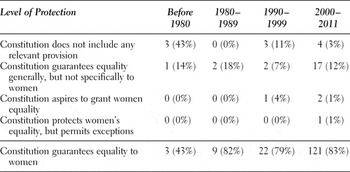
Our examination of trends in gender protections based on year of last amendment revealed that most of the world's constitutions have been amended since 1980. Due to a small sample size of constitutions last changed prior to 1980, we categorized the timing of most recent amendment according to those constitutions last amended before CEDAW was passed in 1979 and in subsequent decades. When we categorized the data in this way, the patterns of rights protections over time were similar to those observed when the data were categorized by year of adoption. This pattern is clearest when it comes to protections of broad equality for women, as demonstrated in Tables 2 and 3. Due to the lower levels of overall protection in other specific rights spheres, it is more difficult to draw comparisons about the trends by year of adoption and by year of most recent amendment. In order to avoid duplicating these tables in this article, we have made them available online at http://worldpolicyforum.org/public/gendertables.pdf.
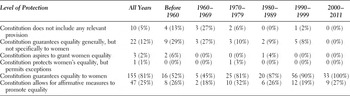
Table 2. Constitutional protection of gender equality and nondiscrimination by year of constitutions' adoption

Table 3. Constitutional protection of gender equality and nondiscrimination by year of constitutions' most recent amendment

RESULTS
General Equality and Nondiscrimination
Countries took diverse, but often overlapping, approaches to protecting gender equality in their constitutions. In a typical formulation, Colombia's constitution guaranteed that all individuals will “receive equal protection and treatment from the authorities, and will enjoy the same rights, freedoms, and opportunities without any discrimination on account of gender” and went on to specify that “[w]omen and men have equal rights and opportunities. Women cannot be subjected to any type of discrimination” (Political Const. Republic of Colombia 1991 [amended to 2009], Art. 13 and 43). Austria's constitution both protected and promoted gender equality by stating that “[t]he Federation, Laender and municipalities subscribe to the de facto equality of men and women. Measures to promote factual equality of women and men, particularly by eliminating actually existing inequalities, are admissible” (Federal Const. Laws of Austria 1920 [amended to 2009], Art. 7).
Constitutional provisions were often explicit about the need for positive measures to rectify past discrimination and present inequality based on gender. For example, in Greece “[t]he State shall take measures for the elimination of inequalities actually existing, in particular to the detriment of women” (Const. Greece 1975 [amended to 2008], Art.116). Ethiopia's constitution promised that “[t]he historical legacy of inequality and discrimination suffered by women in Ethiopia taken into account, women … are entitled to affirmative measures. The purpose of such measures shall be to provide special attention to women so as to enable them to compete and participate on the basis of equality with men in political, social and economic life” (Const. Federal Democratic Republic of Ethiopia 1994, Art. 35). In Paraguay, “[m]en and women have equal civil, political, social, and cultural rights. The State will foster the conditions and create the mechanisms adequate for making this equality real and effective by removing those obstacles that prevent or curtail its realization, as well as by promoting women's participation in every sector of national life” (Political Const. Republic of Paraguay 1992 [amended to 2011], Art. 48).
The four approaches to gender equality that we identified in this study—prohibition of discrimination, equality before the law, equality of rights, and broad equality provisions—all address important aspects of social equity and provide different tools for advancing women's rights on the ground. In Tables 2 and 3, we considered countries to protect women if they took at least one of these approaches to gender equality and nondiscrimination in their constitutions.
Globally, 81% of countries took at least one approach to guaranteeing equality specifically for women in their constitutions. Of the four rights included in the category of “equality and nondiscrimination” in Tables 2 and 3, the most common gender-based protection was prohibition of discrimination, with 63% of constitutions guaranteeing this right specifically to women, compared to 38% protecting equality of rights, 27% granting equality before the law, and just 9% guaranteeing broad equality. Additionally, a quarter of constitutions around the world permitted, encouraged, or mandated measures to promote gender equality.
There was a strong trend toward constitutional protection of women's rights from the 1970s through to 2011, when equality for women became entrenched in a majority of constitutions. Of the constitutions adopted in the 30 years after the passage of CEDAW, only Saudi Arabia's did not include either a universal equality clause or one specific to women. Furthermore, all of the constitutions passed between 2000 and 2011 included specific guarantees of gender equality. Table 3 demonstrates that when constitutions are categorized according to the year of last change, there is a similar trend toward the increased inclusion of gender protections over time. Whereas a minority of constitutions that were last changed before 1980 guaranteed some aspect of equality for women, a strong majority of those last amended in subsequent decades did so.
We did not identify any constitutional provisions that explicitly denied women's equality, but constitutions did place gender equality at risk indirectly. Worldwide, 5% of countries did not provide either a gender-specific or universal protection of equality in their constitutions. Furthermore, several countries implicitly jeopardized this right by according customary or religious law superiority over constitutional protections against discrimination (as discussed in more detail below). Finally, Zimbabwe's constitution prohibited discrimination on the basis of sex but permitted exceptions based on “physiological differences between persons of different sex or gender” (Const. Zimbabwe 1979 [amended to 2009], Art. 23).
Equality In Political Life
As a foundational document outlining a country's political structure, a constitution can be an important channel for entrenching women's equal right to vote and access positions of leadership in government. Several countries in this study did so either by broadly protecting gender equality in political rights or by specifying that women were equally eligible to participate in specific aspects of political life. For example, Guyana provided the broad guarantee that “[w]omen and men have equal rights and the same legal status in all spheres of political … life” (Const. Co-Operative Republic of Guyana 1980 [amended to 2001], Art. 29), while in Italy, “[a]ll citizens, men or women, who have attained their majority are entitled to vote,” and “[c]itizens of one or the other sex are eligible for public office and for elective positions under equal conditions” (Const. Italian Republic 1947 [amended to 2007], Art. 48 and 51).
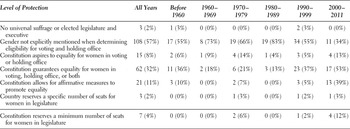
Measures to ensure women's participation in political life took three broad forms in the constitutions we examined, each with different implications for gender equality in this sphere. Firstly, some countries made nonspecific promises of action to ensure women's political representation or assured women a presence in elected bodies but did not specifically reserve seats for them. While such provisions may influence electoral policies, they do not by themselves prescribe specific actions that governments must take. For example, Argentina's constitution provides that “actual equality of opportunities for men and women to elective and political party positions shall be guaranteed by means of positive actions in the regulation of political parties and in the electoral system” (Const. Argentine Republic 1853 [amended to 1994], Art. 37). In contrast, a second group of constitutions required governments to undertake specific actions, such as reserving a minimum number of seats for women in their legislatures. Nepal's constitution stipulated that “at least one-third of such total number of candidates nominated [to the Constituent Assembly] shall be women,” (Interim Const. Nepal 2006 [amended to 2008], Art. 63). A third group of countries reserved a specific (rather than a minimum) number of seats for women in the legislature. For example, Uganda's constitution specified that “the Parliament shall consist of—(a) members directly elected to represent constituencies; (b) one woman representative for every district,” (Const. Republic of Uganda 1995 [amended to 2005], Art. 78) and in Pakistan, 60 seats out of a total of 342 in the National Assembly are reserved for women (Const. Islamic Republic of Pakistan 1973 [amended to 2011], Art. 51). This approach may restrict rather than promote women's representation in political bodies.
The majority of countries globally did not address gender when determining eligibility for or exclusions from political participation (Table 3). Of the constitutions, 32% explicitly guaranteed gender equality in both access to voting and elected office (23%) or in one of these spheres (9%). Across all decades, 17% of constitutions allowed affirmative measures or quotas for women. Nonspecific measures to ensure women's participation in political life were included in 11% of constitutions, while 4% of constitutions reserved a minimum number of seats for women in the legislature, and 2% reserved a specific number of seats for women.
Explicit protection of gender equality in political life was most pronounced in recently adopted constitutions. The 2000s were the only decade when a majority of countries (53%) protected women's equality in voting, eligibility for office, or both. Constitutions introduced between 2000 and June 2011 were also considerably more likely to include affirmative measures (39%) or nonrestrictive quotas (12%) for women.
Equality In Social And Economic Rights
Equality in Education
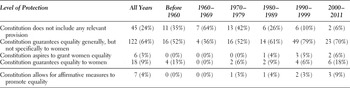
Equal access to education and work is fundamental to women's long-term social and economic well-being. Constitutions varied considerably in the scope and specificity of their protection of women's rights in these spheres. Provisions on education included general promises about gender equality in access to schooling, articles mandating a minimum level of schooling for boys and girls, and guarantees of gender equality at all levels of education. For instance, Senegal's constitution guaranteed that “[a]ll children, boys and girls, throughout the national territory, shall have the right to attend school,” (Const. Republic of Senegal 2001 [amended to 2009], Art. 22) while in Cuba, “all citizens, regardless of … sex, … have a right to education at all national educational institutions, ranging from elementary schools to the universities, which are the same for all” (Const. Republic of Cuba 1976 [amended to 2002], Art. 43). As indicated in Table 5, countries more commonly protected universal access to education without mentioning gender. This was the case in Bolivia, where “[e]very person has the right to receive an education at all levels” and “[t]he State shall guarantee access to education and continuing education to all citizens under conditions of full equality” (Political Const. of the State [Bolivia] 2009, Art. 17 and 82).
Table 4. Constitutional protection of gender equality in political life by year of constitutions' adoption
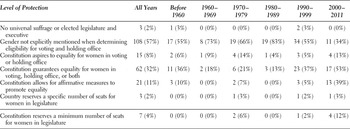
Note: Results by date of last amendment are available at http://worldpolicyforum.org/public/gendertables.pdf.
Table 5. Constitutional protection of gender equality in education by year of constitutions' adoption
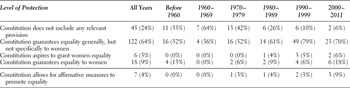
Note: Results by date of last amendment are available at http://worldpolicyforum.org/public/gendertables.pdf.
Provisions encouraging or mandating state action to support equality in education typically took the form of vague references rather than specific policies. Kenya's constitution stipulated that “[t]he State shall put in place affirmative action programmes designed to ensure that minorities and marginalised groups … are provided special opportunities in educational and economic fields” (Const. of Kenya 2010, Art. 56). The constitution includes those disadvantaged by discrimination on the grounds of sex in its definition of marginalized groups.
On a global scale, 64% of constitutions protected educational equality in universal terms, but only 9% included gender-specific protections. A majority of constitutions adopted in all periods except the 1960s contained universal or gender-based guarantees of equality in this sphere, including 70% of those adopted after 1980, 85% of those introduced in the 1990s, and 88% of constitutions adopted in the 2000s. The 4% of constitutions that encouraged measures to eliminate gender inequalities in education were adopted after 1970. The Middle East and North Africa was the only region where constitutions across all time periods up to June 2011 contained no explicit goals, guarantees, or affirmative measures regarding gender equality in education.
Equality in Work
As with education, constitutions adopted a wide range of approaches to protecting gender equality in work. In Timor-Leste, “[e]very citizen, regardless of gender, has the right and the duty to work” (Const. Democratic Republic of Timor-Leste 2002, Art. 50); similarly, Venezuela's constitution “guarantees the equality and equitable treatment of men and women in the exercise of the right to work” (Const. Bolivarian Republic of Venezuela 1999 [amended to 2009], Art. 88). Other countries addressed specific aspects of employment equality. Haiti's constitution stipulated that “[t]he State guarantees workers equal working conditions and wages regardless of their sex …” (Const. Haiti 1987, Art. 35), while Portugal specified that the State was “charged with promoting … the conditions needed to avoid the gender-based preclusion or limitation of access to any position, work or professional category” (Const. Portuguese Republic 1976 [amended to 2005], Art. 58). On the other hand, Angola took a universal approach by granting “[e]qual opportunities in the choice of profession or type of work and conditions which prevent preclusion or limitation due to any form of discrimination” (Const. Republic of Angola 2010, Art. 76). Nepal's general promise that “[t]he State shall pursue a policy of making women participate, to the maximum extent, in the task of national development, by making special provisions for their […] employment” (Interim Const. Nepal 2006 [amended to 2008], Art. 35) was typical of the nonspecificity of provisions on affirmative measures in work.
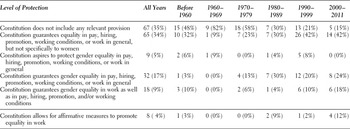
Globally, 9% of constitutions guaranteed women's equality both in work in general and in at least one additional aspect of employment (wages, working conditions, hiring, or promotion) (Table 6). Another 17% protected gender equality in one of these areas (either work in general, pay, working conditions, hiring, or promotion), while 34% of constitutions protected at least one general or specific aspect of employment on a universal basis without explicitly protecting women. As with education, protection was lowest in constitutions that were adopted during the 1960s: only one constitution from this decade guaranteed universal equality in some aspect of work, and none did so in gender-specific terms. Explicit protection in work for women occurred most frequently in the constitutions introduced after the adoption of CEDAW. Of the constitutions introduced in this period, 34% guaranteed women's protection in at least one aspect of employment, compared to 14% of those adopted earlier. When considering universal and gender-specific clauses, 74% of post-1980 constitutions and 38% of those adopted earlier protected some aspect of equality in work. Furthermore, of the 8 (4%) constitutions globally that mentioned affirmative measures for women in employment, 7 (88%) were enacted after 1980. Finally, gender-specific protection in work also generally increased with time: 42% of constitutions adopted after 2000 specifically protected gender equality in some aspect of work, compared to 30% of those adopted in the 1990s, 34% in the 1980s, and 19% in the 1970s.
Table 6. Constitutional protection of gender equality in work by year of constitutions' adoption
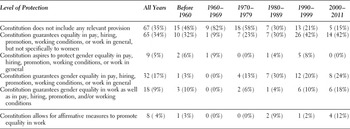
Note: Results by date of last amendment are available at http://worldpolicyforum.org/public/gendertables.pdf.
Equality In Family Rights
Several constitutions protected women's equality at various stages of marital life. Armenia's constitution affirmed that “[m]en and women of marriageable age have the right to marry and found a family according to their free will. They are entitled to equal rights as to marriage, during marriage and divorce” (Const. Republic of Armenia 2005, Art. 35). Ecuador additionally protected parental and property rights: “[t]he State shall guarantee equal rights and equal opportunity to men and women in access to property and decision-making in the management of their common marital estate,” and “the mother and father shall be obliged to take care, raise, educate, feed, and provide for the integral development and protection of the rights of their children” (Const. Republic of Ecuador 2008, Art. 324 and 69).
Importantly, a few countries protected women from losing any rights upon changing their civil status. In a typical provision, Equatorial Guinea guaranteed that “[w]omen, irrespective of their civil status, shall have the same rights and opportunities as her male counterpart at the political, economic, social and cultural levels, and at all levels of life; public, private or family” (Const. Republic of Equatorial Guinea 1991 [amended to 1995], Art. 13). Malawi's constitution guaranteed that “women … have the right not to be discriminated against on the basis of their gender or marital status, which includes the right … to acquire and maintain rights in property, independently or in association with others, regardless of their marital status; to acquire and retain custody, guardianship and care of children and to have an equal right in the making of decisions that affect their upbringing; and to acquire and retain citizenship and nationality” (Const. Republic of Malawi 1994 [amended to 1999], Art. 24). Conversely, the constitution of Cyprus specified that “a married woman shall belong to the Community to which her husband belongs,” which suggests that a woman does not have full equality of status upon marriage (Const. Republic of Cyprus 1960 [amended to 1996], Art. 2). In Table 7, we considered equal rights during marriage to be granted when the constitution protected spousal equality and did not deny or attach any exceptions to the retention of equal rights during marriage, the equality of property rights, or the equality of parental rights.
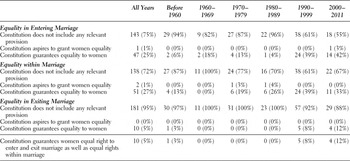
Table 7. Constitutional protection of gender equality in family life by year of constitutions' adoption
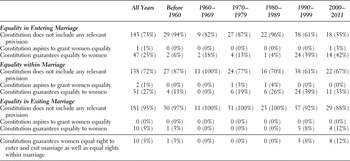
Note: Results by date of last amendment are available at http://worldpolicyforum.org/public/gendertables.pdf.
Even using this broad definition, only 25% of constitutions around the world guaranteed the equal right to freely enter marriage, 27% protected equality within marriage, and 5% granted equality in exiting marriage. All but one of the ten constitutions that protected equality in ending a marriage were introduced during the last two decades before June 2011. None of the constitutions introduced in the 1960s protected gender equality within marriage or in divorce. Across all decades through to June 2011, no provisions on equality at any stage of marriage were present in the constitutions of South Asian, Middle Eastern, and North African states.
Status Of Customary And Religious Law
Each of the constitutional protections outlined above is affected by the status of other forms of law in relation to the constitution. Of the constitutions in this study that protected some aspect of gender equality, 5% also stated that traditional laws could prevail over antidiscrimination provisions or the constitution as a whole. In contrast to the rights examined in this study, variation in the status of customary and religious law appears to be more influenced by regional than temporal factors. Table 8 categorizes constitutional provisions on customary and religious law by region.
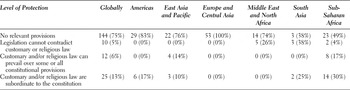
Table 8. Constitutional provisions on the status of customary and religious law by region
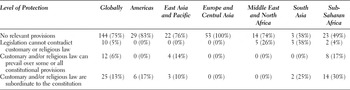
In 12 countries (6%), including eight in sub-Saharan Africa and four in East Asia and the Pacific, customary and religious laws were explicitly permitted to prevail over all or some constitutional provisions. Among these, customary and religious laws could supersede antidiscrimination clauses or personal law in 10 countries (5%). This was the case in Zambia (Const. Zambia 1991 [amended to 2009], Art. 23), where constitutional prohibition against discrimination “shall not apply to any law so far as that law makes provision … for the application in the case of members of a particular race or tribe, of customary law with respect to any matter to the exclusion of any law with respect to that matter, which is applicable in the case of other persons.”
Worldwide, an additional 10 countries (5%) specified that legislation could not contravene customary or religious principles (five in the Middle East and North Africa, three in South Asia, and two in sub-Saharan Africa.) In Afghanistan, “[n]o law shall contravene the tenets and provisions of the holy religion of Islam” (Const. Islamic Republic of Afghanistan 2004, Art. 3), and in Maldives, “[n]o law contrary to any tenet of Islam shall be enacted …” (Const. Republic of Maldives 2008, Art. 10). To the extent that customary or religious laws may be used to limit women's rights, such provisions restrict the degree to which gender equality can be protected and promoted in a country.
At the other end of the spectrum, 25 constitutions (13%) specified that customary and/or religious laws were subordinate to the constitution. Several of these constitutions contained provisions similar to Namibia's stipulation that “[b]oth the customary law and the common law … in force on the date of Independence shall remain valid to the extent to which such customary or common law does not conflict with this Constitution” (Const. Republic of Namibia 1990 [amended to 2010], Art. 66).
DISCUSSION
Considerable progress has been made in the protection of gender-specific constitutional rights in the three decades since CEDAW's passage. However, the majority of constitutions that protected equality in politics, education, and employment as of June 2011 still did so in the form of universal guarantees rather than explicit guarantees of gender equality. How one evaluates the status of women's rights therefore depends largely on the potential for these universal clauses to protect gender equality. To the extent that universal protections can be leveraged to advance equality for women, there is reason for cautious optimism. When including both universal and gender-specific protections, a majority of constitutions globally guaranteed equality in general (93%), in education (73%), and in some aspect of work (60%). Similarly, 89% of countries either specifically protected women's right to vote or hold office or did not mention gender in determining eligibility. As discussed in more detail below, however, universal protections do not always offer consistent and permanent protection to women. Furthermore, it is problematic that a substantial proportion of countries offered no universal protection in education, work, and marriage, and the picture worsens when considering the global status of gender-specific protections. Women are explicitly guaranteed some aspect of equality in 81% of constitutions, some aspect of political equality in 32%, marital equality in 27%, some aspect of work equality in 26%, and educational equality in just 9% of constitutions.
Over the past 30 years, however, constitutional protection of women's rights has increased substantially, both when categorizing constitutions by year of adoption and by year of last amendment. Only one constitution introduced between 1980 and June 2011 contained neither a universal nor a gender-specific protection of general equality. Whereas 57% of constitutions that were last changed before CEDAW was passed in 1979 included a universal or gender-specific guarantee of equality, 94% of those last amended in subsequent decades did so. Of the constitutions introduced after 1979, 83% included a universal or gender-specific protection of equality in education, compared to 58% of those adopted earlier. Similarly, 74% of post-CEDAW constitutions protected equality in work specifically for women or universally, compared to 38% of those adopted before then. Moreover, gender-specific protection is on the rise: 87% of constitutions enacted in the 1980s, 90% in the 1990s, and 100% in the 2000s guaranteed general equality explicitly for women. Of the constitutions that protected gender equality within marriage, 80% were enacted between 1980 and June 2011, and 19% of constitutions introduced in that period included affirmative measures or quotas for women in political life, compared to 11% of those adopted in previous decades.
There are several possible explanations for this progress. The adoption of CEDAW in 1979 and the reaffirmation of its goals by the global community in subsequent decades both reflected and bolstered the rising prominence of women's rights organizations in international forums. The increasingly visible and effective mobilization of organized women's rights movements has also been critical in securing the inclusion of gender protections in constitutions around the world—through sustained pressure and incremental change in some contexts and by seizing opportunities for rapid transformation during times of marked political change in others. The recent increase in participatory constitution making has further enabled domestic women's rights advocates to push for the protection of gender equality at the constitutional level as participants in the constitution-drafting process. These strong domestic movements for women's rights are often bolstered by the international community's powerful support for constitutionalizing gender equality, particularly in contexts where international advisors are actively involved in the constitution-making process.
At the same time, the diverse political contexts in which post-1980 constitutions were drafted partially explain the incremental and uneven nature of gender protections. Constitutions adopted after the fall of communism, in the wake of ethnically based civil wars, or during a transition to democracy after military or one-party rule were drafted within different time frames and driven by diverse visions of the nation's future and the role of the constitution. These factors influence the scope and detail of constitutional rights across all spheres (Brandt et al. Reference Brandt, Cottrell, Ghai and Regan2011).
Variations in protection took on regional patterns as well. No country in the Middle East and North Africa guaranteed gender-specific protection in education, in work, or at any stage of marriage, and there were no protections of marital equality in South Asian constitutions. One in five states in sub-Saharan Africa permitted customary or religious law to prevail over laws or constitutional provisions. In the Middle East and North Africa, and in South Asia, legislation cannot contradict religious or customary law in 26% and 38% of constitutions, respectively. The explicit subordination of constitutional rights to customary law severely weakens women's constitutional protection and their potential for recourse through litigation, as illustrated in the introduction.
These findings come with certain limitations. Constitutional rights are not the only measure of a country's commitment to gender equality. Several countries with older constitutions that lack gender-specific provisions have strong national legislation protecting women's equality. For example, Denmark's constitution, which has not been changed since 1953, does not contain gender-specific protections of, among others, general equality or employment rights. However, the country has extensive legislation protecting women's equality in hiring, working conditions, and remuneration; the country's Gender Equality Act further prohibits discrimination on the basis of sex in all spheres that are not protected by specific laws (Prechal and Burri Reference Prechal and Burri2010). As mentioned in the introduction, litigation also plays an important role in creating a body of jurisprudence that can further extend women's constitutional protections beyond what is contained in the text itself. Including national legislation and case law in future analyses would therefore create a more in-depth picture of how individual rights are protected.
Furthermore, daily accounts of rights violations and persistent gender inequities demonstrate that the level of protection that women enjoy on paper does not translate neatly into outcomes on the ground. Countries with sparse constitutional protections of women's rights may have excellent records in practice, and the opposite is certainly true. The cases reviewed in the introduction are testaments to both the potential of constitutional protections as well as their inadequacy: for example, Afghanistan's women were able to leverage the constitutional protection of their rights against the Shiite Personal Status Law, but they continue to face violence and discrimination in education, marriage, employment, and political life (Cortright and Wall Reference Cortright and Wall2012; Human Rights Watch 2013). While Afghanistan may represent an extreme case due to the ongoing conflict, constitutional litigation in countries around the world illustrates the gap between rights on paper and in practice.
Future research should therefore examine the relationship between constitutional protections and gender equality on the ground in order to develop a more nuanced picture of women's rights around the world. These studies should pay particular attention to the specific mechanisms that enhance and accelerate the translation of constitutional rights into policies and outcomes that promote gender equality. Important questions are raised by this study but are beyond its scope: Is there an empirical difference between the protection offered by universal and gender-specific constitutional clauses? How does the wording of provisions, such as those reserving minimum percentages of legislative positions for women or requiring an affirmative promotion of gender equality in education, impact gender equality in the relevant spheres? Are there measures that reduce the time lag between the adoption of rights in constitutions, their consolidation into policies, and their implementation in practice? Do specific rights guarantees in political life, education, employment, and family life offer greater protection than broad guarantees of gender equality? Do international agreements influence countries' inclusion of gender protections in their constitution, and if so, in what ways? For example, are countries that have ratified particular conventions more likely to include corresponding protections in their constitutions? The answers to these questions are likely to differ considerably depending on national political and legal contexts, and these differences are also worthy of investigation.
Despite these limitations, understanding which rights are granted in constitutions is the first step to introducing those that are not protected and claiming those that are not implemented. The first place to start is with countries drafting new constitutions. Constitution building can be a contentious process, but it also presents a unique opportunity for previously excluded or marginalized groups to have their rights recognized at the highest level. Women should be meaningfully involved in the constitution-making process, and their rights must be fully protected and defendable and must not be subordinate to customary or religious laws. Knowing which rights are protected in contemporary constitutions, how they are phrased, and how they have been used to further women's rights can provide crucial information at this formative stage.
Second, countries lacking gender protections in their constitutions should consider drafting amendments that explicitly protect women's equality. Broad equality clauses that do not specify gender are preferable to no constitutional protection. However, to the extent that they require interpretation from the judiciary to determine which groups they include, such articles may not always protect women's rights. For example, the 14th amendment to the United States' constitution contains a universal clause that grants “any person within its jurisdiction the equal protection of the laws” (Const. United States of America 1787 [amended to 1992], Sec. 1). In Reed v. Reed (1971), the clause was interpreted to prohibit discrimination on the basis of sex, and subsequent rulings have upheld this interpretation. But without an explicit constitutional prohibition of gender-based discrimination, these decisions do not prevent the courts from reversing the initial interpretation (Harrison Reference Harrison, Dobrowolsky and Hart2004; Terkel Reference Terkel2011). For this reason, women's groups in the United States spent decades mobilizing for an Equal Rights Amendment to the constitution in order to ensure explicit and permanent protection from discrimination on the basis of sex at the federal level that “would not be subject to the vagaries of changing political winds or even court personnel” (Harrison Reference Harrison, Dobrowolsky and Hart2004, 162).
Thirdly, countries with gender protections in their constitutions should look carefully at how thoroughly these rights are being implemented in practice. Governments must combine legislation with legal, economic, and social resources to ensure true gender equality. If women do not have access to courts or legal support, gender protections may remain mere goals. Constitutional rights should therefore be accompanied by mechanisms making enforcement accessible to all. Governments should take measures to make citizens aware of their rights and the means available to claim them, with special attention to ensuring that women in particularly vulnerable positions are aware of their legal rights and avenues for claiming them.
Finally, policy makers and civil society advocates should take stock of the status of women's rights in other countries to see where theirs could improve in comparison. With the global scope of communication, transportation, employment, and immigration, it is now increasingly the case that when a law is passed in one country, it will affect people from other states. Thus from a practical as well as a legal and ethical standpoint, every country that does not protect equal rights presents a problem for all of us, and every step forward spells progress for everyone. The slow but steady advancement in gender protection in constitutions therefore presents both a challenge and a promise for the future of women's rights.