

Hostname: page-component-77f85d65b8-jkvpf Total loading time: 0 Render date: 2026-04-21T13:08:30.122Z Has data issue: false hasContentIssue false

Development of solution-processed nanowire composites for opto-electronics

Published online by Cambridge University Press:  20 December 2016

David S. Ginley*
Affiliation:
National Renewable Energy Laboratory, Process Tech and Adv Concepts, Golden, CO 80401, USA
Shruti Aggarwal
Affiliation:
University School of Basic and Applied Sciences, Guro Gobind Singh Indraprastha University, New Delhi 110075, India
Rajiv Singh
Affiliation:
National Physical Laboratory, New Delhi 110012, India
Tom Gennett
Affiliation:
National Renewable Energy Laboratory, Process Tech and Adv Concepts, Golden, CO 80401, USA
Maikel F. A. M. van Hest
Affiliation:
National Renewable Energy Laboratory, Process Tech and Adv Concepts, Golden, CO 80401, USA
John D. Perkins
Affiliation:
National Renewable Energy Laboratory, Process Tech and Adv Concepts, Golden, CO 80401, USA
*
Address all correspondence to David S. Ginley at David.ginley@nrel.gov
Get access

Abstract

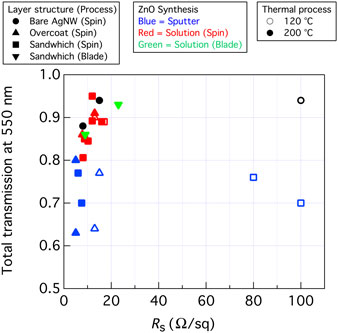
Silver nanowire-based contacts represent one of the major new directions in transparent contacts for opto-electronic devices with the added advantage that they can have Indium-Tin-Oxide-like properties at substantially reduced processing temperatures and without the use of vacuum-based processing. However, nanowires alone often do not adhere well to the substrate or other film interfaces; even after a relatively high-temperature anneal and unencapsulated nanowires show environmental degradation at high temperature and humidity. Here we report on the development of ZnO/Ag-nanowire composites that have sheet resistance below 10 Ω/sq and >90% transmittance from a solution-based process with process temperatures below 200 °C. These films have significant applications potential in photovoltaics and displays.

Information

Type
Functional Oxides Research Letters
Copyright
Copyright © Materials Research Society 2016 

Access options

Get access to the full version of this content by using one of the access options below. (Log in options will check for institutional or personal access. Content may require purchase if you do not have access.)

Article purchase

Temporarily unavailable