





1. Introduction
Modern small-scale aircraft, such as drones, are increasingly used in a range of operations, including logistics, emergency response, infrastructure inspection and national security. However, aerodynamically challenging flight environments have been reluctantly avoided (Gianfelice, Aboshosha & Ghazal Reference Gianfelice, Aboshosha and Ghazal2022; Jones, Cetiner & Smith Reference Jones, Cetiner and Smith2022; Mohamed et al. Reference Mohamed, Marino, Watkins, Jaworski and Jones2023). In particular, airspace with high occurrences of gusts, such as urban canyons and mountainous areas, is hazardous because the gust disturbances can be relatively strong due to the small size and low velocity of the aircraft (Mueller & DeLaurier Reference Mueller and DeLaurier2003; Jones et al. Reference Jones, Cetiner and Smith2022). Such strong gust encounters lead to unsteady, complex dynamics with strong nonlinearities in the flowfield around the vehicles and exert significantly large transient forces on their bodies.
To deepen our understanding of aerodynamics in such severely gusty environments, there have been recent studies in extreme aerodynamics, where the gust ratio $G$
, the ratio between gust velocity and free-stream velocity, is larger than 1 (Jones et al. Reference Jones, Cetiner and Smith2022; Taira Reference Taira2026). Recent studies have analysed and modelled two-dimensional extreme vortex-gust encounters by an aerofoil at
$G$
, the ratio between gust velocity and free-stream velocity, is larger than 1 (Jones et al. Reference Jones, Cetiner and Smith2022; Taira Reference Taira2026). Recent studies have analysed and modelled two-dimensional extreme vortex-gust encounters by an aerofoil at ${\textit{Re}}=100$
(Fukami & Taira Reference Fukami and Taira2023; Fukami, Nakao & Taira Reference Fukami, Nakao and Taira2024). In these studies, a machine-learned model was used to implement lift attenuation control in low-dimensional latent space during the encounters. Building on this latent space model, Mousavi & Eldredge (Reference Mousavi and Eldredge2025) performed flow estimation with uncertainty quantification using sparse sensor measurements. Furthermore, Fukami, Smith & Taira (Reference Fukami, Smith and Taira2025) presented machine-learning-based data compression of extreme gust encounters by a spanwise periodic wing at a Reynolds number of
${\textit{Re}}=100$
(Fukami & Taira Reference Fukami and Taira2023; Fukami, Nakao & Taira Reference Fukami, Nakao and Taira2024). In these studies, a machine-learned model was used to implement lift attenuation control in low-dimensional latent space during the encounters. Building on this latent space model, Mousavi & Eldredge (Reference Mousavi and Eldredge2025) performed flow estimation with uncertainty quantification using sparse sensor measurements. Furthermore, Fukami, Smith & Taira (Reference Fukami, Smith and Taira2025) presented machine-learning-based data compression of extreme gust encounters by a spanwise periodic wing at a Reynolds number of $5000$
. To further investigate wingtip effects on the extreme aerodynamic events, Odaka, Smith & Taira (Reference Odaka, Smith and Taira2025) conducted direct numerical simulation (DNS) of extreme vortex-gust encounters by a square wing at
$5000$
. To further investigate wingtip effects on the extreme aerodynamic events, Odaka, Smith & Taira (Reference Odaka, Smith and Taira2025) conducted direct numerical simulation (DNS) of extreme vortex-gust encounters by a square wing at ${\textit{Re}}=600$
and analysed the complex three-dimensional vortex dynamics and the modified lift loads.
${\textit{Re}}=600$
and analysed the complex three-dimensional vortex dynamics and the modified lift loads.
Most of these studies in extreme aerodynamics with massive flow separation have been performed at low Reynolds numbers (Jones Reference Jones2020; Taira Reference Taira2026). A critical question that follows is as follows. How can we apply insights from massively separated flows in the laminar regime of extreme aerodynamics to their turbulent regime counterpart? The current study answers this question by performing numerical simulations of extreme vortex-gust–square-wing interaction using DNS at ${\textit{Re}}=600$
and large eddy simulation (LES) at
${\textit{Re}}=600$
and large eddy simulation (LES) at ${\textit{Re}}=$
10 000. We in particular focus on the vortex dynamics and the pressure evolution around the wing in the extreme flows. We further identify vortical structures that play aerodynamically important roles in the unsteady flowfield using the force element method (Chang Reference Chang1992), showing that the prominent structures are shared across the low and high Reynolds numbers. Moreover, scale decomposition analysis (Motoori & Goto Reference Motoori and Goto2019; Fujino, Motoori & Goto Reference Fujino, Motoori and Goto2023) is performed on the
${\textit{Re}}=$
10 000. We in particular focus on the vortex dynamics and the pressure evolution around the wing in the extreme flows. We further identify vortical structures that play aerodynamically important roles in the unsteady flowfield using the force element method (Chang Reference Chang1992), showing that the prominent structures are shared across the low and high Reynolds numbers. Moreover, scale decomposition analysis (Motoori & Goto Reference Motoori and Goto2019; Fujino, Motoori & Goto Reference Fujino, Motoori and Goto2023) is performed on the ${\textit{Re}}=$
10 000 flow to extract large-scale, dominant flow structures, where a quantitative similarity to those observed at
${\textit{Re}}=$
10 000 flow to extract large-scale, dominant flow structures, where a quantitative similarity to those observed at ${\textit{Re}}=600$
is uncovered. This work shows that insights from laminar extreme aerodynamics can be extended to turbulent cases, suggesting that we can potentially simplify flow analysis, modelling and control for turbulent extreme aerodynamics.
${\textit{Re}}=600$
is uncovered. This work shows that insights from laminar extreme aerodynamics can be extended to turbulent cases, suggesting that we can potentially simplify flow analysis, modelling and control for turbulent extreme aerodynamics.
The remainder of the paper is organised as follows. The problem set-up for the extreme vortex-gust–square-wing interaction for a gust ratio of $\pm 2$
is provided in § 2. In § 3, we present vortex dynamics and identify vortical structures responsible for large transient lift change for both laminar and turbulent conditions at
$\pm 2$
is provided in § 2. In § 3, we present vortex dynamics and identify vortical structures responsible for large transient lift change for both laminar and turbulent conditions at ${\textit{Re}}=600$
and 10 000, respectively. This study reveals striking similarity of large-scale flow structures between the two Reynolds numbers. In § 4, a summary of our findings is offered.
${\textit{Re}}=600$
and 10 000, respectively. This study reveals striking similarity of large-scale flow structures between the two Reynolds numbers. In § 4, a summary of our findings is offered.
2. Problem set-up
We consider a vortex gust, modelled as a spanwise-oriented Taylor vortex (Taylor Reference Taylor1918), impacting a full-span square wing (aspect ratio $AR=1$
), as shown in figure 1
$AR=1$
), as shown in figure 1 $(a)$
. The azimuthal velocity of this vortex is
$(a)$
. The azimuthal velocity of this vortex is
 \begin{equation} u_{\theta }=u_{\theta , {\textit{max}}} \frac {r}{R} \exp \left [ \frac {1}{2} \left ( 1- \frac {r^2}{R^2} \right ) \right ]\!, \end{equation}
where $u_{\theta , {\textit{max}}}$
is the maximum velocity at radius
$u_{\theta , {\textit{max}}}$
is the maximum velocity at radius $r=R$
. The profiles of the tangential velocity
$r=R$
. The profiles of the tangential velocity $u_{\theta }$
and the spanwise vorticity
$u_{\theta }$
and the spanwise vorticity $\omega _z$
are also presented in figure 1
$\omega _z$
are also presented in figure 1 $(a)$
. The strength of this vortex is characterised by the gust ratio,
$(a)$
. The strength of this vortex is characterised by the gust ratio,
 \begin{equation} G \equiv u_{\theta ,{\textit{max}}}/u_{\infty }, \end{equation}
where $u_{\infty }$
is the free stream velocity. We choose two gust ratios
$u_{\infty }$
is the free stream velocity. We choose two gust ratios $G= \{2,-2 \}$
and set the radius to
$G= \{2,-2 \}$
and set the radius to $R/c=0.25$
. The square wing has a straight-cut tip with a chord length
$R/c=0.25$
. The square wing has a straight-cut tip with a chord length $c$
and an angle of attack
$c$
and an angle of attack $\alpha =14^\circ$
. We examine the flows at chord-based Reynolds numbers
$\alpha =14^\circ$
. We examine the flows at chord-based Reynolds numbers ${\textit{Re}}=u_{\infty }c/\nu =600$
and 10 000, where
${\textit{Re}}=u_{\infty }c/\nu =600$
and 10 000, where $\nu$
is the kinematic viscosity. We select these values of
$\nu$
is the kinematic viscosity. We select these values of ${\textit{Re}}$
to characterise the extreme aerodynamic flows in laminar and turbulent regimes.
${\textit{Re}}$
to characterise the extreme aerodynamic flows in laminar and turbulent regimes.
(a) A square NACA0015 wing encountering a gust vortex. Q-criterion isosurface $Q=5$
is shown. (b) Computational domain and spatial discretisation.
$Q=5$
is shown. (b) Computational domain and spatial discretisation.

We perform DNS for ${\textit{Re}}=600$
and LES for
${\textit{Re}}=600$
and LES for ${\textit{Re}}=$
10 000 with a compressible flow solver CharLES (Brès et al. Reference Brès, Ham, Nichols and Lele2017) – a finite-volume solver with second-order accuracy in space and third-order accuracy in time. For LES, the Vreman subgrid-scale model (Vreman Reference Vreman2004) is used. The Mach number
${\textit{Re}}=$
10 000 with a compressible flow solver CharLES (Brès et al. Reference Brès, Ham, Nichols and Lele2017) – a finite-volume solver with second-order accuracy in space and third-order accuracy in time. For LES, the Vreman subgrid-scale model (Vreman Reference Vreman2004) is used. The Mach number $u_\infty /a_\infty =0.1$
is set to minimise compressible effects. The computational domain is presented in figure 1
$u_\infty /a_\infty =0.1$
is set to minimise compressible effects. The computational domain is presented in figure 1 $(b)$
. We define
$(b)$
. We define $x$
,
$x$
, $y$
and
$y$
and $z$
in the streamwise, transverse and spanwise directions, respectively, with the leading edge of the wing root placed at the origin. We prescribe an adiabatic wall boundary condition at the wing surface, a Dirichlet boundary condition of
$z$
in the streamwise, transverse and spanwise directions, respectively, with the leading edge of the wing root placed at the origin. We prescribe an adiabatic wall boundary condition at the wing surface, a Dirichlet boundary condition of $u_\infty /a_\infty =0.1$
at the inlet and farfield boundaries, and a sponge zone next to the outlet boundary. At the spanwise boundaries along
$u_\infty /a_\infty =0.1$
at the inlet and farfield boundaries, and a sponge zone next to the outlet boundary. At the spanwise boundaries along $z/c=\pm 10$
, we apply a symmetry boundary condition to maintain the form of the gust vortex column far from the wing.
$z/c=\pm 10$
, we apply a symmetry boundary condition to maintain the form of the gust vortex column far from the wing.
The grid and domain set-ups have been carefully verified. The current mesh has $31$
million control volumes with
$31$
million control volumes with $n_{\textit{airfoil}}=480$
,
$n_{\textit{airfoil}}=480$
, $n_z=90$
and
$n_z=90$
and $y^+_0=0.24$
, where
$y^+_0=0.24$
, where $n_{\textit{airfoil}}$
and
$n_{\textit{airfoil}}$
and $n_z$
are the grid points along the wing tangent (around the upper and lower surfaces) and the wingspan, and
$n_z$
are the grid points along the wing tangent (around the upper and lower surfaces) and the wingspan, and $y^+_0$
is the first grid off the wall surface in viscous wall units at
$y^+_0$
is the first grid off the wall surface in viscous wall units at ${\textit{Re}}=$
10 000. The refined mesh used for verification has
${\textit{Re}}=$
10 000. The refined mesh used for verification has $62$
million cells with
$62$
million cells with $n_{\textit{airfoil}}=760$
,
$n_{\textit{airfoil}}=760$
, $n_z=144$
and
$n_z=144$
and $y^+_0=0.15$
. The time step is chosen to ensure that the local Courant number is smaller than 1 over the entire computational domain. The current simulation set-up has been carefully validated by Fukami et al. (Reference Fukami, Smith and Taira2025).
$y^+_0=0.15$
. The time step is chosen to ensure that the local Courant number is smaller than 1 over the entire computational domain. The current simulation set-up has been carefully validated by Fukami et al. (Reference Fukami, Smith and Taira2025).
The gust vortex is introduced at $(x_0/c,y_0/c)=(-3,0)$
in the undisturbed flow at a reference time of
$(x_0/c,y_0/c)=(-3,0)$
in the undisturbed flow at a reference time of $\tau =u_\infty t/c=-3$
and convects with the free stream. Time of
$\tau =u_\infty t/c=-3$
and convects with the free stream. Time of $\tau =0$
corresponds to the moment at which the centre of the gust vortex would reach the leading edge of the wing if there were no wing.
$\tau =0$
corresponds to the moment at which the centre of the gust vortex would reach the leading edge of the wing if there were no wing.
3. Results and discussion
We begin by presenting the lift fluctuation for the $G=2$
case in the laminar and turbulent regimes. In figure 2
$G=2$
case in the laminar and turbulent regimes. In figure 2 $(a)$
, the light and dark red lines represent the lift histories for
$(a)$
, the light and dark red lines represent the lift histories for ${\textit{Re}}=600$
and 10 000, respectively. The lift coefficient is defined as
${\textit{Re}}=600$
and 10 000, respectively. The lift coefficient is defined as $C_L=F_L/(( {1}/{2}) \rho u_\infty ^2 bc)$
, where
$C_L=F_L/(( {1}/{2}) \rho u_\infty ^2 bc)$
, where $F_L$
is the lift force on the wing,
$F_L$
is the lift force on the wing, $\rho$
is the fluid density and
$\rho$
is the fluid density and $b$
is the span length. Before the gust vortex is introduced in the flowfield, the flow is steady at
$b$
is the span length. Before the gust vortex is introduced in the flowfield, the flow is steady at ${\textit{Re}}=600$
with
${\textit{Re}}=600$
with $C_{L,{base}}=0.22$
, while it is unsteady at
$C_{L,{base}}=0.22$
, while it is unsteady at ${\textit{Re}}=$
10 000 with a time-averaged lift coefficient of
${\textit{Re}}=$
10 000 with a time-averaged lift coefficient of $\bar {C}_{L,{base}}=0.32$
. As the gust vortex approaches the wing, the wing experiences a substantial lift increase, which peaks at
$\bar {C}_{L,{base}}=0.32$
. As the gust vortex approaches the wing, the wing experiences a substantial lift increase, which peaks at $\tau =\tau _1$
for both
$\tau =\tau _1$
for both ${\textit{Re}}=600$
and 10 000. After the positive peak, the lift drops and reaches its negative peak at
${\textit{Re}}=600$
and 10 000. After the positive peak, the lift drops and reaches its negative peak at $\tau =\tau _2$
. Subsequent to these lift fluctuations, the lift recovers to the baseline values.
$\tau =\tau _2$
. Subsequent to these lift fluctuations, the lift recovers to the baseline values.
(a) Lift history for the $G=2$
case at
$G=2$
case at ${\textit{Re}}=600$
(light red) and 10 000 (dark red). (b) Top-port view of the Q-criterion isosurface
${\textit{Re}}=600$
(light red) and 10 000 (dark red). (b) Top-port view of the Q-criterion isosurface $Q=10$
, coloured in grey, at
$Q=10$
, coloured in grey, at $\tau =\tau _1$
and
$\tau =\tau _1$
and $\tau _2$
noted in panel (a). The Q-criterion isosurface
$\tau _2$
noted in panel (a). The Q-criterion isosurface $Q=10$
of the large-scale structures extracted by the scale decomposition analysis with
$Q=10$
of the large-scale structures extracted by the scale decomposition analysis with $\sigma /c=0.05$
in the
$\sigma /c=0.05$
in the ${\textit{Re}}=$
10 000 case is superposed in green.
${\textit{Re}}=$
10 000 case is superposed in green.

The time evolution of the vortex cores is presented in figure 2 $(b)$
, where we visualise the Q-criterion isosurface at
$(b)$
, where we visualise the Q-criterion isosurface at ${\textit{Re}}=600$
and 10 000 in grey. For the
${\textit{Re}}=600$
and 10 000 in grey. For the ${\textit{Re}}=$
10 000 case, the Q-criterion isosurface of large-scale structures extracted through scale decomposition (Motoori & Goto Reference Motoori and Goto2019; Fujino et al. Reference Fujino, Motoori and Goto2023) is also visualised in green, where we decompose a velocity component
${\textit{Re}}=$
10 000 case, the Q-criterion isosurface of large-scale structures extracted through scale decomposition (Motoori & Goto Reference Motoori and Goto2019; Fujino et al. Reference Fujino, Motoori and Goto2023) is also visualised in green, where we decompose a velocity component $u_i$
into the large-scale
$u_i$
into the large-scale $\widetilde {u}_{i_L}$
and the small-scale
$\widetilde {u}_{i_L}$
and the small-scale $\widetilde {u}_{i_S}$
by applying a Gaussian filter
$\widetilde {u}_{i_S}$
by applying a Gaussian filter $K$
in three spatial directions such that
$K$
in three spatial directions such that
 \begin{align} &\widetilde {u}_{i_L}(x,y,z; \sigma ) = \sum _{x_p}\sum _{y_p}\sum _{z_p} u_i(x_p,y_p,z_p) K(x_p,y_p,z_p;x,y,z), \end{align}
 \begin{align} &\widetilde {u}_{i_S}(x,y,z; \sigma ) = u_i - \widetilde {u}_{i_L}(x,y,z; \sigma ). \end{align}
Here, $x_p$
,
$x_p$
, $y_p$
and
$y_p$
and $z_p$
are the coordinates of grid points. The Gaussian kernel is
$z_p$
are the coordinates of grid points. The Gaussian kernel is
 \begin{equation} K(x_p,y_p,z_p;x,y,z)= C(x,y,z) \exp { \left [\!-\frac {(x_p-x)^2+(y_p-y)^2+(z_p-z)^2}{2\sigma ^2}\!\right ]} \Delta x \Delta y \Delta z \end{equation}
and the coefficient $C(x,y,z)$
is selected to ensure the sum of the kernel is unity;
$C(x,y,z)$
is selected to ensure the sum of the kernel is unity;
 \begin{equation} \sum _{x_p}\sum _{y_p}\sum _{z_p} K(x_p,y_p,z_p;x,y,z)=1. \end{equation}
Parameter $\sigma$
is the effective size of the Gaussian filter, where information approximately smaller than
$\sigma$
is the effective size of the Gaussian filter, where information approximately smaller than $\sigma$
is smoothed out in the filtered velocity
$\sigma$
is smoothed out in the filtered velocity $\widetilde {u_i}_{|L}$
(Motoori & Goto Reference Motoori and Goto2019). Here,
$\widetilde {u_i}_{|L}$
(Motoori & Goto Reference Motoori and Goto2019). Here, $\sigma /c=0.05$
is chosen to uncover the large-scale vortical structures that are primarily responsible for the lift peaks, shown in figure 2
$\sigma /c=0.05$
is chosen to uncover the large-scale vortical structures that are primarily responsible for the lift peaks, shown in figure 2 $(b)$
. The influence of
$(b)$
. The influence of $\sigma /c$
is examined later.
$\sigma /c$
is examined later.
As shown in figure 2 $(b)$
, the large-scale flow structures between the laminar and turbulent flows are strikingly similar. At the first lift peak
$(b)$
, the large-scale flow structures between the laminar and turbulent flows are strikingly similar. At the first lift peak $\tau =\tau _1$
, we observe the development of a large leading-edge vortex (LEV) for both
$\tau =\tau _1$
, we observe the development of a large leading-edge vortex (LEV) for both ${\textit{Re}}=600$
and 10 000. This results from a substantial amount of gust-induced wall-normal vorticity production at the leading edge (Taira Reference Taira2026). Notably, these accentuated vorticity production levels at the leading edge are directly related to the enhanced surface pressure gradients caused by the incoming gust vortex (Lopez-Doriga, Jones & Taira Reference Lopez-Doriga, Jones and Taira2025). During the gust–leading-edge interaction, which is up until the impingement, viscous effects are not prominent (Peng & Gregory Reference Peng and Gregory2015) and similar large-scale topological features are observed across the two Reynolds numbers. Even at
${\textit{Re}}=600$
and 10 000. This results from a substantial amount of gust-induced wall-normal vorticity production at the leading edge (Taira Reference Taira2026). Notably, these accentuated vorticity production levels at the leading edge are directly related to the enhanced surface pressure gradients caused by the incoming gust vortex (Lopez-Doriga, Jones & Taira Reference Lopez-Doriga, Jones and Taira2025). During the gust–leading-edge interaction, which is up until the impingement, viscous effects are not prominent (Peng & Gregory Reference Peng and Gregory2015) and similar large-scale topological features are observed across the two Reynolds numbers. Even at ${\textit{Re}}=$
10 000, the locally accelerated flow near the leading edge experiences stabilising effects (Linot, Schmid & Taira Reference Linot, Schmid and Taira2024), producing large-scale, laminar flow structures.
${\textit{Re}}=$
10 000, the locally accelerated flow near the leading edge experiences stabilising effects (Linot, Schmid & Taira Reference Linot, Schmid and Taira2024), producing large-scale, laminar flow structures.
Furthermore, the tip vortices (TiVs) grow in size near the leading edge for both Reynolds-number flows during the encounter. This is because the impacting gust vortex induces a large vorticity flux at the tip near the leading edge while increasing the pressure difference between the two sides of the wing (Odaka et al. Reference Odaka, Smith and Taira2025). Similar to the LEV, the large-scale features of the TiVs are shared across the Reynolds numbers since the formation of the vortices is pressure-driven. Around the negative lift peak $\tau =\tau _2$
, we observe the LEV transforms into an arch vortex and a large trailing-edge vortex (TEV) shed for both
$\tau =\tau _2$
, we observe the LEV transforms into an arch vortex and a large trailing-edge vortex (TEV) shed for both ${\textit{Re}}=600$
and 10 000. Despite the presence of finer-scale vortical structures at
${\textit{Re}}=600$
and 10 000. Despite the presence of finer-scale vortical structures at ${\textit{Re}}=$
10 000, the large-scale structures are remarkably similar to those observed at
${\textit{Re}}=$
10 000, the large-scale structures are remarkably similar to those observed at ${\textit{Re}}=600$
.
${\textit{Re}}=600$
.
Next, let us examine the negative gust vortex case with $G=-2$
. During the encounter, the wing experiences a sharp lift decrease with its negative peak at
$G=-2$
. During the encounter, the wing experiences a sharp lift decrease with its negative peak at $\tau =\tau _1$
followed by a rapid increase with its positive peak around
$\tau =\tau _1$
followed by a rapid increase with its positive peak around $\tau =\tau _2$
, as shown in figure 3
$\tau =\tau _2$
, as shown in figure 3 $(a)$
. Lift gradually recovers to its baseline value afterward. These trends are shared across the laminar and turbulent flow cases.
$(a)$
. Lift gradually recovers to its baseline value afterward. These trends are shared across the laminar and turbulent flow cases.
Same plot as figure 2 for the negative gust vortex case with $G=-2$
.
$G=-2$
.

In figure 3 $(b)$
, we visualise the Q-criterion isosurface for the
$(b)$
, we visualise the Q-criterion isosurface for the $G=-2$
cases at
$G=-2$
cases at ${\textit{Re}}=600$
and 10 000. At
${\textit{Re}}=600$
and 10 000. At $\tau =\tau _1$
, an LEV develops below the wing due to a large vorticity flux at the leading edge induced by the approaching negative gust vortex. Furthermore, the impacting gust vortex increases the pressure on the upper surface while decreasing it below the wing, inverting the suction and pressure sides of the wing. This causes the TiVs to weaken and even reverse their orientation (Odaka et al. Reference Odaka, Smith and Taira2025). As discussed in the positive gust vortex case, the gust-induced, large wall-normal vorticity production and flow acceleration near the leading edge lead to these similar core vortical structures across the Reynolds numbers.
$\tau =\tau _1$
, an LEV develops below the wing due to a large vorticity flux at the leading edge induced by the approaching negative gust vortex. Furthermore, the impacting gust vortex increases the pressure on the upper surface while decreasing it below the wing, inverting the suction and pressure sides of the wing. This causes the TiVs to weaken and even reverse their orientation (Odaka et al. Reference Odaka, Smith and Taira2025). As discussed in the positive gust vortex case, the gust-induced, large wall-normal vorticity production and flow acceleration near the leading edge lead to these similar core vortical structures across the Reynolds numbers.
Over time, the LEV below the wing forms an arch vortex, while the gust vortex convects above the wing. At the positive lift peak around $\tau =\tau _2$
, the legs of the arch vortex are pushed towards the wing root, transforming into a hairpin vortex (Odaka et al. Reference Odaka, Smith and Taira2025). Although there is an increased number of finer structures around the wing in the turbulent flow, the hairpin vortex is clearly observed in the large-scale structures at
$\tau =\tau _2$
, the legs of the arch vortex are pushed towards the wing root, transforming into a hairpin vortex (Odaka et al. Reference Odaka, Smith and Taira2025). Although there is an increased number of finer structures around the wing in the turbulent flow, the hairpin vortex is clearly observed in the large-scale structures at ${\textit{Re}}=$
10 000. Again, we observe strong similarities in large-scale vortical structures across the two Reynolds numbers throughout the encounter.
${\textit{Re}}=$
10 000. Again, we observe strong similarities in large-scale vortical structures across the two Reynolds numbers throughout the encounter.
Furthermore, we confirm strong similarity in the pressure fields at ${\textit{Re}}=600$
and 10 000 influenced by their respective large-scale vortical structures. In figure 4, we show the spanwise slices of the pressure coefficient
${\textit{Re}}=600$
and 10 000 influenced by their respective large-scale vortical structures. In figure 4, we show the spanwise slices of the pressure coefficient $C_p \equiv {(p-p_{\infty })}/{(({1}/{2}) \rho u_\infty ^2) }$
and the spanwise vorticity
$C_p \equiv {(p-p_{\infty })}/{(({1}/{2}) \rho u_\infty ^2) }$
and the spanwise vorticity $\omega _z$
along the wing root
$\omega _z$
along the wing root $z/c=0$
and near the tip
$z/c=0$
and near the tip $z/c=0.48$
, where
$z/c=0.48$
, where $p_{\infty }$
is the farfield pressure. For the
$p_{\infty }$
is the farfield pressure. For the $G=2$
case (figure 4
a), the LEV carries a low-pressure core around the leading edge at
$G=2$
case (figure 4
a), the LEV carries a low-pressure core around the leading edge at $\tau =\tau _1$
at both
$\tau =\tau _1$
at both ${\textit{Re}}$
. Moreover, the stronger spanwise vorticity of the gust vortex at
${\textit{Re}}$
. Moreover, the stronger spanwise vorticity of the gust vortex at $\tau =\tau _1$
for the
$\tau =\tau _1$
for the ${\textit{Re}}=$
10 000 case is observed in the denser contour lines of
${\textit{Re}}=$
10 000 case is observed in the denser contour lines of $\omega _z$
, because there is lower viscous diffusion at the higher Reynolds number, enabling the gust vortex to retain higher intensity in the spanwise vorticity. This leads to a higher first lift peak at
$\omega _z$
, because there is lower viscous diffusion at the higher Reynolds number, enabling the gust vortex to retain higher intensity in the spanwise vorticity. This leads to a higher first lift peak at $\tau =\tau _1$
for the
$\tau =\tau _1$
for the ${\textit{Re}}=$
10 000 case than that for the
${\textit{Re}}=$
10 000 case than that for the ${\textit{Re}}=600$
case, as shown in figure 2
${\textit{Re}}=600$
case, as shown in figure 2 $(a)$
.
$(a)$
.
Spanwise slices of $C_p$
(colour contours) with
$C_p$
(colour contours) with $\omega _z$
(line contours) along the root
$\omega _z$
(line contours) along the root $z/c=0$
and near the tip
$z/c=0$
and near the tip $z/c=0.48$
at
$z/c=0.48$
at $\tau =\tau _1$
and
$\tau =\tau _1$
and $\tau _2$
for (a)
$\tau _2$
for (a) $G=2$
and (b)
$G=2$
and (b) $G=-2$
. Dashed line contours indicate negative
$G=-2$
. Dashed line contours indicate negative $\omega _z$
.
$\omega _z$
.

At $\tau =\tau _2$
for the
$\tau =\tau _2$
for the $G=2$
case, the lowest-pressure regions are above the wing near the tips for both laminar and turbulent flows, as shown in figure 4
$G=2$
case, the lowest-pressure regions are above the wing near the tips for both laminar and turbulent flows, as shown in figure 4 $(a)$
. These regions correspond to the TiVs and the gust vortex near the wingtips, as seen in the visualised Q-criterion at
$(a)$
. These regions correspond to the TiVs and the gust vortex near the wingtips, as seen in the visualised Q-criterion at $\tau =\tau _2$
in figure 2
$\tau =\tau _2$
in figure 2 $(b)$
. The
$(b)$
. The ${\textit{Re}}=$
10 000 case exhibits lower-pressure regions above the wing near the tips, resulting in a smaller negative lift peak compared with the
${\textit{Re}}=$
10 000 case exhibits lower-pressure regions above the wing near the tips, resulting in a smaller negative lift peak compared with the ${\textit{Re}}=600$
case, as seen in figure 2
${\textit{Re}}=600$
case, as seen in figure 2 $(a)$
. At
$(a)$
. At ${\textit{Re}}=$
10 000, fine-scale structures are present over a broad region above the wing, but are absent below it at
${\textit{Re}}=$
10 000, fine-scale structures are present over a broad region above the wing, but are absent below it at $\tau =\tau _2$
, as seen in the contour lines of
$\tau =\tau _2$
, as seen in the contour lines of $\omega _z$
in figure 4
$\omega _z$
in figure 4 $(a)$
. This is due to the flow below the wing having been accelerated by the lower portion of the gust vortex. As discussed previously, accelerated flows have the tendency to be stabilised with coherent, laminar features, whereas decelerated flows tend to trigger instabilities with flow structures broken into finer structures (Linot et al. Reference Linot, Schmid and Taira2024).
$(a)$
. This is due to the flow below the wing having been accelerated by the lower portion of the gust vortex. As discussed previously, accelerated flows have the tendency to be stabilised with coherent, laminar features, whereas decelerated flows tend to trigger instabilities with flow structures broken into finer structures (Linot et al. Reference Linot, Schmid and Taira2024).
For the negative gust vortex case with $G=-2$
shown in figure 4
$G=-2$
shown in figure 4 $(b)$
, the LEV below the wing at
$(b)$
, the LEV below the wing at $\tau =\tau _1$
and the gust vortex convecting above the wing at
$\tau =\tau _1$
and the gust vortex convecting above the wing at $\tau =\tau _2$
create low-pressure cores at both Reynolds numbers. At
$\tau =\tau _2$
create low-pressure cores at both Reynolds numbers. At $\tau =\tau _2$
, the intensity of the gust vortex convecting above the wing is larger in the turbulent case than in the laminar case, due to lower vortex diffusion at the higher Reynolds number. This leads to lower-pressure regions above the wing for the
$\tau =\tau _2$
, the intensity of the gust vortex convecting above the wing is larger in the turbulent case than in the laminar case, due to lower vortex diffusion at the higher Reynolds number. This leads to lower-pressure regions above the wing for the ${\textit{Re}}=$
10 000 flow compared with the
${\textit{Re}}=$
10 000 flow compared with the ${\textit{Re}}=600$
flow at
${\textit{Re}}=600$
flow at $\tau =\tau _2$
(figure 4
b), contributing to the larger second lift peak seen in figure 3
$\tau =\tau _2$
(figure 4
b), contributing to the larger second lift peak seen in figure 3 $(a)$
. These findings suggest that the effects of extreme gusts are pressure-dominated, driven by large-scale vortices, whose primary dynamics is similar across laminar and turbulent regimes.
$(a)$
. These findings suggest that the effects of extreme gusts are pressure-dominated, driven by large-scale vortices, whose primary dynamics is similar across laminar and turbulent regimes.
Next, let us extract the vortical structures responsible for the large lift change during the encounters. To identify vortical structures responsible for the lift, we use the force element analysis (Chang Reference Chang1992). An auxiliary potential $\phi _y$
is defined for a boundary condition of
$\phi _y$
is defined for a boundary condition of $-\boldsymbol{n}\boldsymbol{\cdot }\boldsymbol{\nabla }\phi _y=\boldsymbol{n}\boldsymbol{\cdot }\boldsymbol{e}_y$
on the wing surface. Here,
$-\boldsymbol{n}\boldsymbol{\cdot }\boldsymbol{\nabla }\phi _y=\boldsymbol{n}\boldsymbol{\cdot }\boldsymbol{e}_y$
on the wing surface. Here, $\boldsymbol{e_y}$
is the unit vector in the
$\boldsymbol{e_y}$
is the unit vector in the $y$
direction. Integrating the inner product of the Navier–Stokes equations with the gradient of the auxiliary potential over the fluid domain, the lift force can be expressed as
$y$
direction. Integrating the inner product of the Navier–Stokes equations with the gradient of the auxiliary potential over the fluid domain, the lift force can be expressed as
 \begin{equation} F_L=\int _V\boldsymbol{\omega }\times \boldsymbol{u}\boldsymbol{\cdot }\boldsymbol{\nabla }\phi _y \,{\rm d}V + \frac {1}{Re}\int _S \boldsymbol{\omega }\times \boldsymbol{n}\boldsymbol{\cdot }\left ( \boldsymbol{\nabla }\phi _y+\boldsymbol{e}_y \right )\,{\rm d}S. \end{equation}
The first and second integrands represent volume and surface lift elements, respectively. The unsteady lift force is primarily attributed to the volume lift elements for the present flows at ${\textit{Re}} = 600$
and 10 000 (Ribeiro et al. Reference Ribeiro, Neal, Burtsev, Amitay, Theofilis and Taira2023; Odaka et al. Reference Odaka, Smith and Taira2025). As such, the volume lift element is hereafter referred to as lift element
${\textit{Re}} = 600$
and 10 000 (Ribeiro et al. Reference Ribeiro, Neal, Burtsev, Amitay, Theofilis and Taira2023; Odaka et al. Reference Odaka, Smith and Taira2025). As such, the volume lift element is hereafter referred to as lift element $L_e$
.
$L_e$
.
We can further decompose the lift element field for the ${\textit{Re}}=$
10 000 case such that
${\textit{Re}}=$
10 000 case such that
 \begin{align} \boldsymbol{\omega }\times \boldsymbol{u}\boldsymbol{\cdot }\boldsymbol{\nabla }\phi _y&= \left (\widetilde {\boldsymbol{\omega }}_{L}+\widetilde {\boldsymbol{\omega }}_{S}\right ) \times \left (\widetilde {\boldsymbol{u}}_{L}+\widetilde {\boldsymbol{u}}_{S}\right )\boldsymbol{\cdot }\boldsymbol{\nabla }\phi _y \notag\\ &= \underbrace {\widetilde {\boldsymbol{\omega }}_{L}\times \widetilde {\boldsymbol{u}}_{L}\boldsymbol{\cdot }\boldsymbol{\nabla }\phi _y}_{{L}_{e_{L,L}}} + \underbrace {(\widetilde {\boldsymbol{\omega }}_{S}\times \widetilde {\boldsymbol{u}}_{L})\boldsymbol{\cdot }\boldsymbol{\nabla }\phi _y}_{{L}_{e_{S,L}}} + \underbrace {(\widetilde {\boldsymbol{\omega }}_{L}\times \widetilde {\boldsymbol{u}}_{S})\boldsymbol{\cdot }\boldsymbol{\nabla }\phi _y}_{{L}_{e_{L,S}}} + \underbrace {\widetilde {\boldsymbol{\omega }}_{S}\times \widetilde {\boldsymbol{u}}_{S}\boldsymbol{\cdot }\boldsymbol{\nabla }\phi _y}_{{L}_{e_{S,S}}}, \end{align}
where $\widetilde {\boldsymbol{\omega }}_{L}=\boldsymbol{\nabla }\times \widetilde {\boldsymbol{u}}_{L}$
and
$\widetilde {\boldsymbol{\omega }}_{L}=\boldsymbol{\nabla }\times \widetilde {\boldsymbol{u}}_{L}$
and $\widetilde {\boldsymbol{\omega }}_{S}=\boldsymbol{\nabla }\times \widetilde {\boldsymbol{u}}_{S}$
. The terms of
$\widetilde {\boldsymbol{\omega }}_{S}=\boldsymbol{\nabla }\times \widetilde {\boldsymbol{u}}_{S}$
. The terms of ${L_e}_{L,L}$
,
${L_e}_{L,L}$
, ${L_e}_{S,L}$
,
${L_e}_{S,L}$
, ${L_e}_{L,S}$
and
${L_e}_{L,S}$
and ${L_e}_{S,S}$
represent the lift contribution from interactions between (i) large-scale vorticity and large-scale velocity, (ii) small-scale vorticity and large-scale velocity, (iii) large-scale vorticity and small-scale velocity, and (iv) small-scale vorticity and small-scale velocity, respectively. Here, we expect dominance of
${L_e}_{S,S}$
represent the lift contribution from interactions between (i) large-scale vorticity and large-scale velocity, (ii) small-scale vorticity and large-scale velocity, (iii) large-scale vorticity and small-scale velocity, and (iv) small-scale vorticity and small-scale velocity, respectively. Here, we expect dominance of ${L_e}_{L,L}$
over
${L_e}_{L,L}$
over ${L_e}_{S,S}$
, since large-scale vortices are the primary structures. In addition, we expect the contribution of
${L_e}_{S,S}$
, since large-scale vortices are the primary structures. In addition, we expect the contribution of ${L_e}_{S,L}$
(small-scale vorticity and large-scale velocity) to be larger than that of
${L_e}_{S,L}$
(small-scale vorticity and large-scale velocity) to be larger than that of ${L_e}_{L,S}$
(large-scale vorticity and small-scale velocity) because the vorticity distribution is more spatially compact than the velocity profile.
${L_e}_{L,S}$
(large-scale vorticity and small-scale velocity) because the vorticity distribution is more spatially compact than the velocity profile.
In figure 5, the spanwise slices of $L_e$
and
$L_e$
and $\omega _z$
at
$\omega _z$
at ${\textit{Re}}=600$
and
${\textit{Re}}=600$
and ${L_e}_{L,L}$
and
${L_e}_{L,L}$
and $\widetilde {{\omega }}_{z_L}$
extracted with
$\widetilde {{\omega }}_{z_L}$
extracted with $\sigma /c=0.05$
at
$\sigma /c=0.05$
at ${\textit{Re}}=$
10 000 along the wing root
${\textit{Re}}=$
10 000 along the wing root $z/c=0$
and near the tip
$z/c=0$
and near the tip $z/c=0.48$
are shown for
$z/c=0.48$
are shown for $G=2$
and
$G=2$
and $-2$
. For the positive gust vortex case shown in figure 5
$-2$
. For the positive gust vortex case shown in figure 5 $(a)$
, the LEV and TiVs are responsible for lift generation at
$(a)$
, the LEV and TiVs are responsible for lift generation at $\tau =\tau _1$
in both laminar and turbulent flows. Similar to the discussion in our previous work (Odaka et al. Reference Odaka, Smith and Taira2025), the enhanced TiVs at
$\tau =\tau _1$
in both laminar and turbulent flows. Similar to the discussion in our previous work (Odaka et al. Reference Odaka, Smith and Taira2025), the enhanced TiVs at $\tau =\tau _1$
have large low-pressure cores above the wing, contributing to lift near the tips. At the negative lift peak around
$\tau =\tau _1$
have large low-pressure cores above the wing, contributing to lift near the tips. At the negative lift peak around $\tau =\tau _2$
, the bottom-surface boundary layer strongly contributes to negative lift.
$\tau =\tau _2$
, the bottom-surface boundary layer strongly contributes to negative lift.
Spanwise slices of $L_e$
(colour contours) with
$L_e$
(colour contours) with $\omega _z$
(line contours) at
$\omega _z$
(line contours) at ${\textit{Re}}=600$
and
${\textit{Re}}=600$
and ${L_e}_{L,L}$
with
${L_e}_{L,L}$
with $\widetilde {{\omega }}_{z_L}$
extracted with
$\widetilde {{\omega }}_{z_L}$
extracted with $\sigma /c=0.05$
in the
$\sigma /c=0.05$
in the ${\textit{Re}}=$
10 000 flow along the root
${\textit{Re}}=$
10 000 flow along the root $z/c=0$
and near the tip
$z/c=0$
and near the tip $z/c=0.48$
at
$z/c=0.48$
at $\tau =\tau _1$
and
$\tau =\tau _1$
and $\tau _2$
for (a)
$\tau _2$
for (a) $G=2$
and (b)
$G=2$
and (b) $G=-2$
. Dashed contour lines indicate negative
$G=-2$
. Dashed contour lines indicate negative $\omega _z$
and
$\omega _z$
and $\widetilde {{\omega }}_{z_L}$
.
$\widetilde {{\omega }}_{z_L}$
.

We further examine the dominant structures in terms of lift production for the negative gust vortex case shown in figure 5 $(b)$
. The LEV below the wing contributes to the negative lift peak at
$(b)$
. The LEV below the wing contributes to the negative lift peak at $\tau =\tau _1$
. However, the positive lift peak around
$\tau =\tau _1$
. However, the positive lift peak around $\tau =\tau _2$
is attributed to the vortical structure generated from the leading edge and the gust vortex convecting above the wing. These coherent large-scale structures responsible for the lift peaks are similar between the low- and high-Reynolds-number flows.
$\tau =\tau _2$
is attributed to the vortical structure generated from the leading edge and the gust vortex convecting above the wing. These coherent large-scale structures responsible for the lift peaks are similar between the low- and high-Reynolds-number flows.
Let us also note that the extracted large-scale vortical structures at ${\textit{Re}}=$
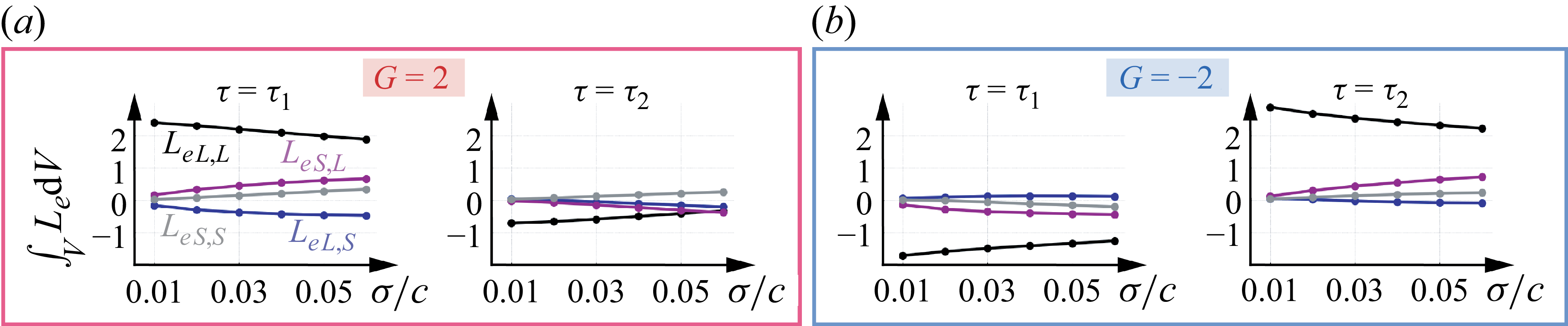
10 000 are primarily responsible for the significant lift peaks during the gust encounters. In figure 6, we present the volume integral of each term in (3.6) at
${\textit{Re}}=$
10 000 are primarily responsible for the significant lift peaks during the gust encounters. In figure 6, we present the volume integral of each term in (3.6) at $\tau =\tau _1$
and
$\tau =\tau _1$
and $\tau _2$
for
$\tau _2$
for $G=2$
and
$G=2$
and $-2$
with varying
$-2$
with varying $\sigma /c$
. Here, the lift contribution from
$\sigma /c$
. Here, the lift contribution from ${L_e}_{L,L}$
accounts for the majority of the lift peak values at
${L_e}_{L,L}$
accounts for the majority of the lift peak values at $\tau =\tau _1$
and
$\tau =\tau _1$
and $\tau _2$
for both
$\tau _2$
for both $G=2$
and
$G=2$
and $-2$
. Note that, for the minimum lift peaks at
$-2$
. Note that, for the minimum lift peaks at $\tau =\tau _2$
for
$\tau =\tau _2$
for $G=2$
and at
$G=2$
and at $\tau =\tau _1$
for
$\tau =\tau _1$
for $G=-2$
, the total lift values are negative, to which
$G=-2$
, the total lift values are negative, to which ${L_e}_{L,L}$
contributes the most. This means that the extracted large-scale structures are the main contributors to the significant lift changes during the extreme gust encounters in the turbulent flow.
${L_e}_{L,L}$
contributes the most. This means that the extracted large-scale structures are the main contributors to the significant lift changes during the extreme gust encounters in the turbulent flow.
Volume integral of ${L_e}_{L,L}$
,
${L_e}_{L,L}$
, ${L_e}_{S,L}$
,
${L_e}_{S,L}$
, ${L_e}_{L,S}$
and
${L_e}_{L,S}$
and ${L_e}_{S,S}$
at
${L_e}_{S,S}$
at $\tau =\tau _1$
and
$\tau =\tau _1$
and $\tau _2$
over
$\tau _2$
over $\sigma /c$
for (a)
$\sigma /c$
for (a) $G=2$
and (b)
$G=2$
and (b) $G=-2$
at
$G=-2$
at ${\textit{Re}}=$
10 000.
${\textit{Re}}=$
10 000.

As $\sigma$
increases, a wider range of scales is incorporated as ‘small-scale’ structures, while the coverage of ‘large-scale’ structures decreases. Consequently, as
$\sigma$
increases, a wider range of scales is incorporated as ‘small-scale’ structures, while the coverage of ‘large-scale’ structures decreases. Consequently, as $\sigma$
increases, the contribution of
$\sigma$
increases, the contribution of ${L_e}_{L,L}$
decreases, while that of
${L_e}_{L,L}$
decreases, while that of ${L_e}_{S,S}$
increases, as seen for both gust ratios at
${L_e}_{S,S}$
increases, as seen for both gust ratios at $\tau =\tau _1$
and
$\tau =\tau _1$
and $\tau _2$
in figure 6. Furthermore, the contribution of
$\tau _2$
in figure 6. Furthermore, the contribution of ${L_e}_{S,L}$
rises as
${L_e}_{S,L}$
rises as $\sigma$
increases. This term holds components based on the spatially compact vorticity field with spatially non-compact velocity field. With increased value of
$\sigma$
increases. This term holds components based on the spatially compact vorticity field with spatially non-compact velocity field. With increased value of $\widetilde {\boldsymbol{\omega }}_{S}$
for a larger
$\widetilde {\boldsymbol{\omega }}_{S}$
for a larger $\sigma$
, the contribution of
$\sigma$
, the contribution of ${L_e}_{S,L}$
increases slowly, even with more components being smoothed out for
${L_e}_{S,L}$
increases slowly, even with more components being smoothed out for $\widetilde {\boldsymbol{u}}_{L}$
. For instance, at
$\widetilde {\boldsymbol{u}}_{L}$
. For instance, at $\tau =\tau _2$
for the
$\tau =\tau _2$
for the $G=2$
case (figure 6
a), while
$G=2$
case (figure 6
a), while ${L_e}_{L,L}$
remains the largest contributor among the four terms for
${L_e}_{L,L}$
remains the largest contributor among the four terms for $\sigma /c \lesssim 0.05$
,
$\sigma /c \lesssim 0.05$
, ${L_e}_{S,L}$
becomes the most dominant past
${L_e}_{S,L}$
becomes the most dominant past $\sigma /c \approx 0.06$
. In contrast, the contribution of
$\sigma /c \approx 0.06$
. In contrast, the contribution of ${L_e}_{L,S}$
does not grow as much with
${L_e}_{L,S}$
does not grow as much with $\sigma$
. The larger
$\sigma$
. The larger $\sigma$
is, the less local motion of the fluid is contained in
$\sigma$
is, the less local motion of the fluid is contained in $\widetilde {\boldsymbol{u}}_{L}$
, causing
$\widetilde {\boldsymbol{u}}_{L}$
, causing $\widetilde {\boldsymbol{\omega }}_{L}$
to decrease significantly. Physically speaking, there cannot be a non-compact vorticity field producing a compact velocity field. As a result, the lift contribution of
$\widetilde {\boldsymbol{\omega }}_{L}$
to decrease significantly. Physically speaking, there cannot be a non-compact vorticity field producing a compact velocity field. As a result, the lift contribution of ${L_e}_{L,S}$
remains low.
${L_e}_{L,S}$
remains low.
Based on the observation of ${L_e}_{L,L}$
being the most responsible for the lift peaks at
${L_e}_{L,L}$
being the most responsible for the lift peaks at $\sigma /c \lesssim 0.05$
with both gust ratios, we have visualised the flowfield evaluated on
$\sigma /c \lesssim 0.05$
with both gust ratios, we have visualised the flowfield evaluated on $\widetilde {\boldsymbol{u}}_{L}$
with
$\widetilde {\boldsymbol{u}}_{L}$
with $\sigma /c=0.05$
in figures 2, 3 and 5. These findings show that the large-scale vortical structures in extreme gust encounters in turbulent regimes of at least
$\sigma /c=0.05$
in figures 2, 3 and 5. These findings show that the large-scale vortical structures in extreme gust encounters in turbulent regimes of at least $\sim \mathcal{O}(10^4)$
are not only similar to those observed in the laminar regimes, but also primarily responsible for the substantial transient lift changes, suggesting that studies in extreme aerodynamics at low Reynolds numbers can provide critical insights into those at higher Reynolds numbers.
$\sim \mathcal{O}(10^4)$
are not only similar to those observed in the laminar regimes, but also primarily responsible for the substantial transient lift changes, suggesting that studies in extreme aerodynamics at low Reynolds numbers can provide critical insights into those at higher Reynolds numbers.
Next, to mathematically quantify the similarity between these large-scale structures, we assess the similarity in the velocity field between the flows at ${\textit{Re}}=600$
and 10 000. Here, we use the cosine similarity in
${\textit{Re}}=600$
and 10 000. Here, we use the cosine similarity in $L^2$
between velocity fields
$L^2$
between velocity fields $\boldsymbol{u}_A$
and
$\boldsymbol{u}_A$
and $\boldsymbol{u}_B$
defined as
$\boldsymbol{u}_B$
defined as
 \begin{equation} S_c(\boldsymbol{u}_A,\boldsymbol{u}_B) = \frac {\int _V\boldsymbol{u}_A \boldsymbol{\cdot }\boldsymbol{u}_B\, {\rm d}V}{({\int _V||\boldsymbol{u}_A||^2\,{\rm d}V})^{1/2} ({\int _V||\boldsymbol{u}_B||^2\,{\rm d}V})^{1/2}}. \end{equation}
In this study, $V=[0,3]\times [-1,1]\times [-0.8,0.8]$
and we set
$V=[0,3]\times [-1,1]\times [-0.8,0.8]$
and we set $\boldsymbol{u}_A=\boldsymbol{u}-\boldsymbol{u_\infty }$
in the
$\boldsymbol{u}_A=\boldsymbol{u}-\boldsymbol{u_\infty }$
in the ${\textit{Re}}=600$
flow. We present the time history of
${\textit{Re}}=600$
flow. We present the time history of $S_c(\boldsymbol{u}_A,\boldsymbol{u}_B)$
in figure 7 with
$S_c(\boldsymbol{u}_A,\boldsymbol{u}_B)$
in figure 7 with $\boldsymbol{u}_B={\boldsymbol{u}}-\boldsymbol{u_\infty }$
,
$\boldsymbol{u}_B={\boldsymbol{u}}-\boldsymbol{u_\infty }$
, $\boldsymbol{u}_B=\widetilde {\boldsymbol{u}}_{L}-\boldsymbol{u_\infty }$
and
$\boldsymbol{u}_B=\widetilde {\boldsymbol{u}}_{L}-\boldsymbol{u_\infty }$
and $\boldsymbol{u}_B=\widetilde {\boldsymbol{u}}_{S}$
for the
$\boldsymbol{u}_B=\widetilde {\boldsymbol{u}}_{S}$
for the ${\textit{Re}}=$
10 000 flow with
${\textit{Re}}=$
10 000 flow with $\sigma /c=0.05$
when filtering is considered.
$\sigma /c=0.05$
when filtering is considered.
Time history of $S_c$
for (a)
$S_c$
for (a) $G=2$
and (b)
$G=2$
and (b) $G=-2$
. The Q-criterion isosurface of the
$G=-2$
. The Q-criterion isosurface of the ${\textit{Re}}=600$
case (grey) and extracted large-scale structures of the
${\textit{Re}}=600$
case (grey) and extracted large-scale structures of the ${\textit{Re}}=$
10 000 case with
${\textit{Re}}=$
10 000 case with $\sigma /c=0.05$
(green) at
$\sigma /c=0.05$
(green) at $\tau =\tau _3$
are visualised on the right of each panel.
$\tau =\tau _3$
are visualised on the right of each panel.

High level of quantitative similarity $S_c$
of the
$S_c$
of the ${\textit{Re}}=$
10 000 case to the
${\textit{Re}}=$
10 000 case to the ${\textit{Re}}=600$
case is presented for both
${\textit{Re}}=600$
case is presented for both $G=2$
and
$G=2$
and $-2$
in figure 7. As shown, the similarity is attributed to the large-scale structures in the
$-2$
in figure 7. As shown, the similarity is attributed to the large-scale structures in the ${\textit{Re}}=$
10 000 flow, and not the small-scale structures. Here,
${\textit{Re}}=$
10 000 flow, and not the small-scale structures. Here, $S_c$
with
$S_c$
with $\boldsymbol{u}_B={\boldsymbol{u}}-\boldsymbol{u_\infty }$
or
$\boldsymbol{u}_B={\boldsymbol{u}}-\boldsymbol{u_\infty }$
or $\boldsymbol{u}_B=\widetilde {\boldsymbol{u}}_{L}-\boldsymbol{u_\infty }$
rises towards approximately
$\boldsymbol{u}_B=\widetilde {\boldsymbol{u}}_{L}-\boldsymbol{u_\infty }$
rises towards approximately $\tau =0$
. This is due to an increasing level of shared large-scale topological features, e.g. LEV, towards the initial interaction, where the incoming gust vortex mainly interacts with the leading edge of the wing. Past
$\tau =0$
. This is due to an increasing level of shared large-scale topological features, e.g. LEV, towards the initial interaction, where the incoming gust vortex mainly interacts with the leading edge of the wing. Past $\tau \approx 0$
, we notice that
$\tau \approx 0$
, we notice that $S_c$
with
$S_c$
with $\boldsymbol{u}_B={\boldsymbol{u}}-\boldsymbol{u_\infty }$
and
$\boldsymbol{u}_B={\boldsymbol{u}}-\boldsymbol{u_\infty }$
and $\boldsymbol{u}_B=\widetilde {\boldsymbol{u}}_{L}-\boldsymbol{u_\infty }$
begin to decrease. This is caused by the differences in the evolution of the large-scale structures at different Reynolds numbers, as shown on the right of each panel in figure 7 that visualises the Q-criterion isosurface at
$\boldsymbol{u}_B=\widetilde {\boldsymbol{u}}_{L}-\boldsymbol{u_\infty }$
begin to decrease. This is caused by the differences in the evolution of the large-scale structures at different Reynolds numbers, as shown on the right of each panel in figure 7 that visualises the Q-criterion isosurface at ${\textit{Re}}=600$
and 10 000 (for
${\textit{Re}}=600$
and 10 000 (for $\sigma /c=0.05$
) at
$\sigma /c=0.05$
) at $\tau =\tau _3$
. For instance, in the case with
$\tau =\tau _3$
. For instance, in the case with $G=2$
(figure 7
a), the TEV is located further downstream at
$G=2$
(figure 7
a), the TEV is located further downstream at $\tau =\tau _3$
for the
$\tau =\tau _3$
for the ${\textit{Re}}=$
10 000 case compared with that for
${\textit{Re}}=$
10 000 case compared with that for ${\textit{Re}}=600$
. Nevertheless, the quantitative similarity remains high with
${\textit{Re}}=600$
. Nevertheless, the quantitative similarity remains high with $S_c$
above 0.6 even at
$S_c$
above 0.6 even at $\tau =2$
. The resemblance of the large-scale structures identified at higher Reynolds numbers to those observed at lower Reynolds numbers underscores the importance of laminar flow analysis for deepening our fundamental understanding of the dominant dynamics in extreme aerodynamic flows. We note that the cosine similarity is a strict measure, since even the slightest difference in vortex position can significantly reduce the similarity. Other approaches such as the optimal transport analysis (Tran, Yeh & Taira Reference Tran, Yeh and Taira2026) can also be considered for convective physics highlighting similarities in a more generalised manner.
$\tau =2$
. The resemblance of the large-scale structures identified at higher Reynolds numbers to those observed at lower Reynolds numbers underscores the importance of laminar flow analysis for deepening our fundamental understanding of the dominant dynamics in extreme aerodynamic flows. We note that the cosine similarity is a strict measure, since even the slightest difference in vortex position can significantly reduce the similarity. Other approaches such as the optimal transport analysis (Tran, Yeh & Taira Reference Tran, Yeh and Taira2026) can also be considered for convective physics highlighting similarities in a more generalised manner.
4. Concluding remarks
This study revealed a high degree of similarity in extreme vortex-gust encounters by a square wing between ${\textit{Re}}=600$
and 10 000. We first presented similar coherent vortex cores initially formed via a significant vorticity production from the wing surface induced by the impacting gust vortex at both Reynolds numbers. Through the use of scale decomposition, the large-scale flow structures were extracted at
${\textit{Re}}=600$
and 10 000. We first presented similar coherent vortex cores initially formed via a significant vorticity production from the wing surface induced by the impacting gust vortex at both Reynolds numbers. Through the use of scale decomposition, the large-scale flow structures were extracted at ${\textit{Re}}=$
10 000. The identified large-scale vortical structures in the
${\textit{Re}}=$
10 000. The identified large-scale vortical structures in the ${\textit{Re}}=$
10 000 flow exhibit qualitative and quantitative similarity to those observed at
${\textit{Re}}=$
10 000 flow exhibit qualitative and quantitative similarity to those observed at ${\textit{Re}}=600$
. The similar pressure fields dominated by these large-scale vortical structures were also found, resulting in comparable lift fluctuations across the two Reynolds numbers. Moreover, with the force element analysis, we presented that the prominent vortical structures responsible for the significant lift change during the extreme gust encounters are similar between the low and high Reynolds numbers. Our findings also showed that the large-scale structures are the main contributors to significant lift peaks in the turbulent extreme flow. The current insights serve as a crucial bridge for understanding extreme gust encounters at high Reynolds numbers of at least
${\textit{Re}}=600$
. The similar pressure fields dominated by these large-scale vortical structures were also found, resulting in comparable lift fluctuations across the two Reynolds numbers. Moreover, with the force element analysis, we presented that the prominent vortical structures responsible for the significant lift change during the extreme gust encounters are similar between the low and high Reynolds numbers. Our findings also showed that the large-scale structures are the main contributors to significant lift peaks in the turbulent extreme flow. The current insights serve as a crucial bridge for understanding extreme gust encounters at high Reynolds numbers of at least $\sim \mathcal{O}(10^4)$
through those with laminar cores, potentially paving the way to reduce the complexity of flow analysis, modelling and control of massively separated flows in extreme aerodynamics. Future efforts at much higher Reynolds numbers are warranted to further examine the laminar core dynamics during violent extreme aerodynamic gust encounters.
$\sim \mathcal{O}(10^4)$
through those with laminar cores, potentially paving the way to reduce the complexity of flow analysis, modelling and control of massively separated flows in extreme aerodynamics. Future efforts at much higher Reynolds numbers are warranted to further examine the laminar core dynamics during violent extreme aerodynamic gust encounters.
Funding
This work was supported by the US Department of Defense Vannevar Bush Faculty Fellowship (N00014-22-1-2798). H.O. acknowledges partial support from Honjo International Scholarship Foundation.
Declaration of interests
The authors report no conflict of interest.




 Open access

