




Introduction
Music, at its essence, is a deeply rooted cultural artefact that reflects the heritage and identity of communities. Law and Ho (Reference LAW and HO2015) encapsulate this duality within the concept of a ‘multileveled cultural world’, wherein it reflects various musical styles and preferences, indicative of the diverse stakeholders in music education. This fabric of music mirrors the multifaceted nature of human societies, where each thread contributes to a larger pattern of social, cultural and political values, each with its own distinct significance, as argued by Green (Reference GREEN2006). Law and Ho (Reference LAW and HO2015) contend that students’ preferences for, and challenges with, learning various genres of music both within and outside of school settings are shaped by the interactions of various influences, ranging from the individual to the global. As such, the notion of a ‘multileveled cultural world’ in music education emphasises the interplay of cultural, social and individual strata that both influence and delineate music learning. Each layer of the ‘multileveled cultural world’, such as global cultural currents, local traditions, societal norms, or personal experiences, contributes to a rich, dynamic mosaic of students’ musical preferences. In the system of formal music education, which predominantly focuses on Western art music traditions, there lies a risk of constraining students within an incomplete spectrum of this ‘multileveled cultural world’. Such an approach, Law and Ho (Reference LAW and HO2015) suggest, reduces students to mere passive recipients, stunting their potential growth as connoisseurs and creators of music. In contrast, when students actively engage, selecting and resonating with music that aligns with their cultural bearings and personal inclinations, they come to appreciate music that resonates with them both personally and culturally. Green (Reference GREEN2002) champions the integration of informal music learning within formal educational structures, advocating for a pedagogy that honours students’ musical choices, respects their natural learning inclinations and embraces methods such as aural learning, performance, improvisation and peer-led exploration.
Although pinning down a precise definition of informal music learning can be elusive, scholars (Green, Reference GREEN2002, Reference GREEN2006, Reference GREEN2008; Jenkins, Reference JENKINS2011) generally refer to it as the organic process prevalent in vernacular music creation. This process often sees musicians banding together in self-selected ensembles to produce music of their choosing, relying primarily on auditory skills and embracing a rich blend of experimentation, improvisation and diverse creative practices. Some informal music programmes (e.g. Karlsen, Reference KARLSEN2010) provide participants with fully equipped recording studios, giving participants the opportunity to record, mix and remix their work. This approach emphasises process over fixed outcomes, allowing participants to set their own goals and assess their progress, thus incorporating the responsibility of self-evaluation to monitor their advancement. In the digital era, Stowell and Dixon (Reference STOWELL and DIXON2014) champion the integration of various technologies into informal music learning, emphasising that teaching and learning involve a diverse array of technological tools and modalities. As such, informal music learning extends to using virtual communities for musical collaboration, where various platforms serve as conduits for participatory culture, enabling discussions within online communities (e.g. Salavuo, Reference SALAVUO2006; Waldron, Reference WALDRON2013). In addition, participants can engage deeply with a collaborative digital audio workstation which serves as an interactive platform for creating, composing, editing and mixing music (e.g. Knapp et al., Reference KNAPP, POWELL, SMITH, COGGIOLA and KELSEY2023). It facilitates real-time collaboration among users, regardless of their physical locations and instrumental techniques. These self-directed informal teaching approaches cultivate an environment conducive to personal exploration and collaborative learning (Hallam et al., Reference HALLAM, CREECH and MCQUEEN2017). Moreover, the integration of popular music into educational settings has emerged as a method to increase student involvement and motivation in formal music education (Hargreaves & Marshall, Reference HARGREAVES and MARSHALL2003; McPherson & O’Neill, Reference MCPHERSON and O’NEILL2010; Coutts; Reference COUTTS2018; Cremades-Andreu & Lage-Gómez, Reference CREMADES-ANDREU and LAGE-GÓMEZ2024). Engagement with music among the youth frequently takes the form of a communal pastime that encourages group composition and the exchange of musical techniques, reflecting the customs of both amateur and seasoned musicians (Jaffurs, Reference JAFFURS2004; Davis, Reference DAVIS2005; Green, Reference GREEN2008; Abramo, Reference ABRAMO2011; Biasutti & Concina, Reference BIASUTTI and CONCINA2021; Mariguddi, Reference MARIGUDDI2021). It is within this dynamic crucible that individuals not only learn but also contribute to the evolving narrative of the ‘multileveled cultural world’.
In the context of Macau
Macau serves as a unique example of how tradition and contemporary practices can coexist and inform each other; despite its modest geographical footprint, it offers profound insights for the global scholarly community. Wong (Reference WONG2022) noted Macau’s unique blend of historical European influences and modern Asian culture. Music education there is marked by a diversity that stems from its colonial past and its position as a melting pot of immigrants from various parts of China. The pedagogical landscape in Macau grants music educators significant autonomy, allowing them to craft curricula that reflect a harmonious symphony of influences – from the resounding chords of Western and Chinese traditions to the contemporary rhythms of popular and Portuguese melodies, and the sacred hymns of Macau’s Catholic heritage. This eclectic curriculum mirrors the diverse preferences of Macau’s students; as reported by Hui (Reference HUI2009), young people in Macau exhibit a penchant for Cantopop and Western Pop/Rock, yet hold an ambivalent stance towards the ancestral echoes of traditional Chinese music. Wong also (Reference WONG2022) noted that the expectations from students were to engage with a broad spectrum of music-making activities that encompass instrumental performance, vocal expression, the innovative use of music technology and the creative processes of arranging and composing music. However, Wong (Reference WONG2022) noted a disconnect exists between what students seek and what is offered. Teacher training in Macau did not align with the students’ broad musical interests.
In many countries, the current music education challenge lies in the delicate balance between formal and informal music learning (Green, Reference GREEN2006; Evans et al., Reference EVANS, BEAUCHAMP and JOHN2015; Hallam et al., Reference HALLAM, CREECH and MCQUEEN2018). The current pedagogic paradigm in Macau leans heavily towards a Western art music orientation, a result of the Eurocentric education that music teachers themselves received. This approach emphasises the time-honoured disciplines of musicianship, history and theory, yet often overlooks the vibrant landscape of popular music that forms the soundtrack of the students’ everyday lives and leisure pursuits, such as karaoke (Law & Ho, Reference LAW and HO2015). The divide between formal music education in schools and students’ informal music experiences outside of school is clear, pointing to a potential gap in the education system’s ability to foster an understanding and practice of informal music learning.
The model of generative change
In my capacity as both educator and researcher (Cochran-Smith, Reference COCHRAN-SMITH2005), I have discerned a conspicuous discrepancy between the musical experiences of students within the structured environs of Macau’s academic institutions and the music they encounter in their extracurricular lives. This discrepancy is not only pedagogical, contrasting formal instruction with informal engagement, but also curricular, in terms of the disparity between the music genres taught in schools and those that students interact with externally. Moreover, there is a divergence in how students assimilate and internalise musical education. Therefore, I adapted the Model of Generative Change, developed by Ball (Reference BALL2009), as the theoretical framework for this research. It provides an academically robust framework, particularly germane to the intricacies of a multicultural educational milieu. This model sequentially charts the cognitive evolution of learners through the phases of metacognitive awareness, ideological development, internalisation and generativity. The facilitation of cognitive transitions within educational settings hinges on the creation of environments that encourage risk-taking, enabling learners to extend their competencies within their zone of proximal development. While originally conceived for the professional development of educators, I have recalibrated the Model of Generative Change to cater to students, with the aim of fostering generative learning. Generative knowledge, as characterised by Franke et al. (Reference FRANKE, CARPENTER, LEVI and FENNEMA2001), emerges when learners discern the necessity to assimilate new information with their existing knowledge base, propelling continuous learning and enabling the application of this integrated knowledge to novel and unfamiliar problems.
The application of the Model of Generative Change (Ball, Reference BALL2009) is pivotal in devising a structured, four-stage strategy to rectify educational disparities. This strategy is designed to balance formal music education with the students’ personal cultural narratives, thus cultivating an academic milieu where the pedagogical process is both a reflective and responsive mechanism attuned to the diverse educational needs and cultural backgrounds of students. The first stage of this model accentuates reflective practice through the narrative reconstruction of personal experiences, which promotes increased metacognitive awareness regarding the significance of various literacies in both educators’ and students’ lives. This reflective engagement fosters a heightened sense of self-awareness. The subsequent stage involves ideological becoming, wherein learners acquire new perspectives via introspection, a transformative process that brings into question and gives priority to personal and pedagogical agency. In the third stage, the practice of critical reflection and the awareness of ideological shaping are internalised and critically examined, with these internalised beliefs being actively disseminated by both educators and learners (Figure 1).
The model of generative change, adapted and modified from Ball (Reference BALL2009).

Aims of the study
To embed the ‘multileveled cultural world’ into current music education in Macau, I recognise the gap between formal and informal, particularly within the education setting in music. The students strongly preferred popular music in their daily lives; however, the strong emphasis of music education heavily relies on western classical music. In this study, I take the stance from Folkestad (Reference FOLKESTAD2006), who suggested that ‘formal – informal should not be regarded as a dichotomy, but rather as the two poles of a continuum’ (p. 135). Many scholars (Green, Reference GREEN2002; Allsup, Reference ALLSUP2008; Cain, Reference CAIN2013; Hess, Reference HESS2020) have also urged that, instead of the ‘either, or’ approach, students engage in both formal and informal learning and navigate along a continuum that spans between these two. By doing so, students can access the optimal learning and performance opportunities presented by the musical situation (Folkestad, Reference FOLKESTAD2006). However, to fill the gap between the ‘formal–informal continuum’, I decided to focus on three research questions, under the lens of the model of generative change (Ball, Reference BALL2009):
RQ1: How do learners in Macau experience informal music learning?
RQ2: What forms of awakening, introspection and critique are involved?
RQ3: How is generativity achieved from the researcher’s perspective in this context?
Methodology
Cain (Reference CAIN2008) characterises action research as a method through which teachers actively seek answers by investigating their own practices. They plan and implement interventions to enhance these practices and then evaluate both the intended and unintended outcomes of their actions. Teachers interrogate data to ensure that their evaluations are evidence-based (p. 284). In that sense, I employed Participatory Action Research (PAR), as outlined by Cochran-Smith and Lytle (Reference COCHRAN-SMITH and LYTLE2015) and Kemmis et al. (Reference KEMMIS, MCTAGGART and NIXON2014), to underscore the collaborative nature between researchers and participants in this study. PAR comprises three key components: (1) active engagement of both researchers and participants in the co-construction of knowledge, (2) the fostering of self-awareness and critical thinking and (3) the establishment of alliances between researchers and participants throughout the planning, execution and dissemination of outcomes (McIntyre, Reference MCINTYRE2008, p. ix). The action research process is described as a recurring spiral of planning, acting, observing (or evaluating) and reflecting. Action research empowers practitioners to be architects of their own understanding, heralding it as an inherently democratic process. Ormell (Reference ORMELL2000) aptly describes it as a ‘grass-roots movement’. This approach to research is often aligned with political objectives, primarily aimed at achieving greater social justice for both the participants and those they represent. In various settings, including educational institutions, action research is utilised as a tool to confront and rectify inequitable structures and practices. The methodology is intrinsically collaborative, uniting individuals in a collective endeavour to drive meaningful change through a democratic process. I chose PAR specifically for its democratic process that aims to bring about change and improvement through action. It is particularly well-suited to educational settings because it involves a cyclical process of planning, acting, observing and reflecting, which can lead to continuous improvement in teaching and learning practices.
Participants
In the autumn semester of 2023, I had the opportunity to instruct two Musicianship courses, targeting first-year students enrolled in an education programme at a university in Macau. The cohort comprised 41 students across two courses. Although the students brought a diverse range of musical experiences, all had some exposure to music education during their secondary schooling, though not all had experience playing an instrument. The gender distribution within the classes was predominantly female, with 95.1% of the students being female (n = 39) and 4.9% being male (n = 2). The median age of the students was 19.4 years. For the purposes of this study, these individuals will be collectively referred to as ‘learners’.
Data collection
The PAR approach promotes transparency by uncovering the complexities and challenges intertwined with moments of enlightenment, revelation and resolution during advocacy processes. In addition, the process of PAR involves identifying the issue. For this study, as a research practitioner, I noticed the lack of informal music learning experiences among students in Macau, especially within the school setting. Consequently, I planned a four-stage research plan utilising the Model of Generative Change and implemented the plan to collect multiple data. This plan was executed following approval from the university’s ethics board during the Fall semester of 2023. I incorporated multiple data collection points across the four stages, including two reflective essays, vlogs and detailed observation notes from (N = 41) university students. During the four stages of PAR under the Model of Generative Change, learners were scaffolded with various tasks to integrate the concept of informal music learning into their learning journey. Consequently, learners were required to complete two reflective essays and vlogs throughout the various stages of informal music learning, aiming to transform their learning from awakening to efficacy. I then took the data and analysed them to evaluate the effectiveness of the new strategies and to reflect on the introspection, critique and generativity processes within the learning environment. Based on the findings, I further refined planning and implementation for the next cycle of teaching.
Limitations
PAR has faced criticism for potentially reducing the validity and rigour of research due to its focus on participation, democracy and co-ownership (Walker, Reference WALKER1993). Ozanne and Saatcioglu (Reference OZANNE and SAATCIOGLU2008) highlight concerns in PAR that prioritise local contexts while neglecting broader power relations, thus affecting the political neutrality of participation. In response, I employed three main practices to address these limitations and ethical considerations (De Oliveira, Reference DE OLIVEIRA2023): First, I ensured genuine participation from all learners by actively including diverse voices and valuing their feedback for its thoughtfulness and genuineness, thereby minimising power imbalances. Second, I established multiple data collection points to gather inputs from all participants, allowing for a multi-voiced narrative that captures the complexity of the context and the diversity of experiences and opinions. Lastly, I engaged in continuous critical reflection to recognise and address my own biases and assumptions in my dual role as researcher and teacher. I emphasised reflection as an ongoing part of the research process, helping to question and revise any preconceived notions by making assumptions explicit throughout the research process. With proper addressing and careful design, PAR could be a powerful method for communities to explore their societal structures and catalyse change (De Oliveira, Reference DE OLIVEIRA2023).
Data analysis
To answer the three research questions, I engaged in a coding process using the CAQDAS software, adhering to Punch’s (Reference PUNCH2014) coding instructions. My process was divided into first-level and second-level coding. According to Punch (Reference PUNCH2014),
First level coding mainly uses these descriptive, low inference codes, which are very useful in summarising segments of data and which provide the basis for later higher order coding. Later codes may be more interpretive, requiring some degree of inference beyond the data. Thus, second level coding tends to focus on pattern codes. A pattern code is more inferential, a sort of ‘meta-code.’ Pattern codes pull together material into a smaller number of more meaningful units…. a pattern code is a more abstract concept that brings together less abstract, more descriptive codes. (Punch, Reference PUNCH2014, p. 174)
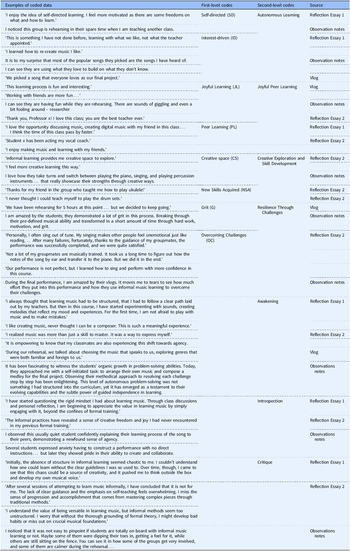
With the density of data which includes reflective essays, vlogs and observation notes, I explored the process Punch (Reference PUNCH2014) suggested in order to thoroughly understand the learners’ experiences and viewpoints. For example, to address ‘how do learners in Macau experience informal music learning?’ I engaged in an open coding process such as ‘self-directed’, ‘exploration’, ‘creative space’, ‘interest-driven’ and ‘peer-learning’. Then, I conducted second-level coding to look for specific patterns and merged the themes together. The coding data includes (a) short reflection essays from Stage 1, referred to as ‘Reflection Essay 1’; (b) vlog analysis; (c) short reflection essays from Stage 4, referred to as ‘Reflection Essay 2’; and (d) the researcher’s observation notes. Initially, I identified eight open codes: Self-Directed (SD), Interest-Driven (ID), Joyful Learning (JL), Peer Learning (PL), Creative Space (CS), New Skills Acquired (NSA), Grit (G) and Overcoming Challenges (OC). To enhance the precision of the analysis, I subsequently consolidated these codes into four broader themes: (a) autonomous learning, (b) joyful peer learning, (c) creative exploration and skill development and (d) resilience through challenges. Given the extensive volume of coded data, Table 1 provides a selection of coded data examples for reference.
Examples of Coded Data and Analysis

To answer the second question, ‘what forms of awakening, introspection, and critique are involved?’ To explore awakening, I coded instances signifying students’ new realisations or changes in their viewpoints, specifically noting any expressions of surprise, discovery or challenges to their pre-existing beliefs. For introspection, I pinpointed segments where students contemplate their learning journey, assess their advancements or acknowledge their self-awareness. Regarding critique, I scrutinised the learners’ assessments of their educational experiences, noting their preferences for formal or informal learning approaches.
Four stages of PAR under the Model of Generative Change
In the following sections, I delineate the four stages of PAR as applied in this study. The aim is to provide readers with a lucid framework for comprehending the structure of the investigation, which is anchored in the four stages of the Model of Generative Change as outlined by Ball (Reference BALL2009). The ensuing exposition is intended to be expository in nature, setting the stage for a subsequent, in-depth analysis of all data gathered throughout the four stages, which will be thoroughly presented in the results. In addition, to design the informal music learning approach, I referred to Folkestad (Reference FOLKESTAD2006)’s guidelines on which informal learning activity ‘steers the way of working/playing/composing, and the process proceeds by the interaction of the participants in the activity’ (p. 141) and focuses on ‘open and self-regulated learning’ (p. 142). As Folkestad (Reference FOLKESTAD2006) emphasises,
The distinction between these ways of using ‘formal’ and ‘informal’, is sometimes blurred…It is rather a question of whether the intentionality of the individuals is directed towards music making, or towards learning about music, and of whether the learning situation is formalised in the sense that someone has taken on the role of being ‘the teacher’, thereby defining the others as ‘students.’ (Folkestad, Reference FOLKESTAD2006, p. 142).
Therefore, the course is intentionally guiding learners towards embracing informal music learning methods, thereby transforming their roles into their own teachers.
Stage 1: awakening
During the initial phase of this study, the objective was to enhance consciousness among learners about the intersection of formal and informal music learning experiences. This was initiated by engaging learners in the creation of a word cloud to encapsulate their understanding of ‘formal music education’. This activity was inspired by Bruner’s Spiral Curriculum (1960) and employed a constructivist, student-centred pedagogical approach to link learners’ prior experiences with new concepts. With most learners already acquainted with formal music education in their high schools (note: not all with formal instrumental training), the discourse was extended to their perceptions of ‘informal music education’. Subsequent to their conjectures, I introduced the principles of informal music learning as theorised by Green (Reference GREEN2008), setting the foundation for our class’s exploration into these principles: (1) learners learn music that they choose, and identify with; (2) learners learn by listening and copying recordings; (3) learners play and learn alongside friends; (4) holistic learning; and (5) integration of listening, performing, composing and improvising. In the early phase of the course, I facilitated several collaborative activities that encouraged learners to immerse themselves in informal music learning. One such activity involved learners choosing and learning popular music pieces using YouTube as a resource. Additionally, they participated in music creation on online digital music platform, where the emphasis was placed on the creative process rather than solely on the final musical product. To deepen their engagement and reflection, learners were asked to compose a brief essay reflecting on how these novel experiences confronted and possibly reshaped their previously held beliefs about music learning.
Stage 2: agency
In this phase of the course, the focus was on empowering both learners and educators to actively engage in the music learning process. In alignment with Vygotsky’s concept of the Zone of Proximal Development (Vygotsky, Reference VYGOTSKY1978) and the goal of fostering generative change, I tasked learners with forming bands. These groups, consisting of 3 to 4 learners from varied musical backgrounds, were provided time during class to enhance their informal music learning experiences.
To initiate their band experience, learners were instructed to apply Green’s (Reference GREEN2008) five core principles of informal music learning. Within their small groups, they were challenged to discover and master new musical techniques, such as singing and playing the ukulele, guitar or drums. Upon mastering these techniques, groups were expected to share their newfound knowledge with their peers. Subsequently, each band was tasked with selecting and preparing a repertoire sufficient for a 5-min performance, to be presented as their final project. I encouraged them to choose any musical genre and language to foster diversity and inclusivity. Bands were responsible for determining the distribution of roles among members, with each individual utilising informal learning strategies to prepare for their performance role. To complement their musical journey, I also required the learners to chronologically document their learning process through video logs (vlogs). These vlogs were to be showcased prior to their live performances, providing a narrative context to their musical development and final presentation.
Stage 3: advocacy
In this phase of the course, learners transformed into advocates for one another’s musical journeys, culminating in performances before their peers. This stage of the action research began with each band presenting their vlogs, which detailed their formation, the members involved, the chosen songs and the progression leading up to their final performance. The vlogs highlighted the bands’ rehearsal processes, illustrating the evolution from initial discussions to tackling the challenges faced during rehearsals. Witnessing individuals progress from minimal musical backgrounds to performing in a band was indeed a transformative and poignant experience.
Despite the freedom to choose any genre, bands gravitated towards music that resonated with them personally, such as Cantopop, Chinese and Western pop songs. Instrumentation varied widely, with learners employing vocals, rap, piano, guitar, ukulele, cajón, drum sets and various percussion instruments. Some learners adapted to their limitations by sharing instrumental duties, such as alternating turns on the piano, and they frequently switched roles between instrumental performances and singing across different pieces. I noticed that many learners ventured into new musical territories, picking up instruments they had scarcely touched before, including the piano, drum set, guitar and ukulele, or stepping into singing roles for the first time. For numerous participants, this was their debut performance within a band setting, marking a significant milestone in their musical and personal development.
Stage 4: efficacy
Following their performances, learners were tasked with introspectively considering their experiences of informal music learning throughout the course and articulating their thoughts in a reflective essay. This essay was structured around the research questions, providing a means for the collected data to inform the continued refinement of informal music learning integration strategies in Macau’s educational context. This reflective exercise also served as an indicator of whether the learners had reached self-efficacy or even generativity – where they are not only applying their new skills and knowledge but also innovatively contributing to the field. The insights garnered from these reflections are invaluable for me, assisting in the iterative process of problem-solving and making informed adjustments for future course implementations.
Results
Informal music experiences
Autonomous learning
Autonomous learning stands out as a central theme in the context of informal music education, with learners showing a keen interest in directing their own learning paths – a significant shift from traditional, teacher-led instruction to pupil-centred exploration. This shift is particularly evident in the initial stages of the study. One learner remarked, ‘I enjoy the idea of self-directed learning. I feel more motivated as there are some freedoms on what and how to learn’. This autonomy extends beyond merely choosing instruments or pieces; it includes the freedom to explore various musical genres and to experiment with different roles within a band. Learners managed their rehearsal schedules, utilised digital tools for independent learning and tackled the challenges of their final performances with a degree of self-guidance. Another learner shared, ‘I learned how to re-create music I like’, underscoring the deep personal connection and creativity involved in selecting their music. Through the analysis of reflective essays and vlogs, it becomes apparent that learners place great value on the process of acquiring and honing their musical skills, illustrating a distinct progression from beginners to adept musicians.
Joyful peer learning
The emergence of joyful peer learning as a key theme is evident both from direct observation and the data collected. This theme underscores the significant increase in engagement and camaraderie observed among learners as they embarked on their musical journeys. These interactions, characterised by a profound sense of friendship and shared seal, suggest that the essence of music classes extends beyond mere instruction to include the joy of learning collaboratively. One learner’s reflection encapsulates this sentiment: ‘I love the opportunity to discuss music, create digital music with my friend in this class… I think the time in this class passes by faster.’ This indicates that engagement is crucial to the appeal of music classes. Moreover, a reflection essay disclosed that ‘My groupmate has been acting as my vocal coach’, highlighting the essential role of mutual support in informal music learning and the value of collaboration in the educational experience. Initially, there were apprehensions about completing the final project. However, these concerns were alleviated within the peer-learning environment, as learners motivated one another, creating a nurturing space filled with laughter, creativity and encouragement. In this vibrant setting, learners not only shared knowledge and skills but also forged meaningful connections, illustrating the transformative power of Joyful Peer Learning in music education.
Creative exploration and skill development
The third theme, creative exploration and skill development, underscores an educational paradigm where learners engaged in informal music learning are not merely recipients of knowledge but active contributors to their own path to mastery. This blend of creativity and skill acquisition is evident in learners’ reflections, with one stating, ‘Informal learning provides me a creative space to explore’. This sentiment was echoed by others who found that the creative process facilitated growth, and the learning of new skills not previously encountered. For instance, several learners took the initiative to learn drumming, utilising online resources such as simplified drumming sheets, tutorial videos and performance clips to grasp the fundamentals of playing drum sets. As a researcher, I aimed to foster their creativity in both their learning approaches and objectives, positioning myself as a facilitator to support their exploratory journey, rather than assuming the traditional role of a master teacher.
Resilience through challenges
The final theme illuminated the challenges learners faced during their informal music learning experience, underscoring the necessity of a scaffolded four-stage process for success. Learners reflected on how overcoming adversity played a crucial role in shaping them into more resilient and versatile musicians. Both my observations and their reflections revealed the diverse challenges they encountered, ranging from achieving group cohesion to conquering stage fright. A common concern among the learners, reflecting their limited musical training, was a pervasive belief that lacking a strong musical background would preclude success in their final project. As a facilitator, I reassured my learners that while prior musical training might ease the project’s execution, it was not a determinant of its quality. Overcoming these challenges was paramount. One learner shared, ‘Personally, I often sing out of tune. My singing makes other people feel unemotional just like reading… After many failures, fortunately, thanks to the guidance of my groupmates, the performance was successfully completed, and we were quite satisfied.’ Another noted, ‘Not many of my groupmates are musically trained. It took us a long time to figure out the notes of the song by ear and transfer them to the piano. But we did it in the end.’ Their resilience was also vividly captured in their vlogs, which condensed their rehearsal and self-practice sessions, and discussions with peers, to the final product of short video clips. These videos not only showcased their journey from novice to performers but also highlighted their critical and creative approaches to overcoming numerous challenges.
Under the lens of the model of generativity
Awakening
Ball (Reference BALL2009) noted that an awakening in learners can be recognised by notable changes in their perspectives. Such an awakening is characterised by increased metacognitive awareness and a clear sense of realisation in their reflective writing, which in turn cultivates a sense of agency as learners begin to take charge of their educational path. Alongside this, a budding sense of advocacy starts to emerge. Observing this phenomenon, I have seen a growing awareness among my learners regarding the distinction between formal and informal music learning, an awareness that was previously overshadowed by the prevalent focus on formal music education in Macau. Prior to this stage of awakening, some learners grappled with how to embrace this newfound freedom to learn and to transform it into active agency. One learner claimed,
‘I always thought that learning music had to be structured, that I had to follow a clear path laid out by my teachers. But then in this course, I have started experimenting with sounds, creating melodies that reflect my mood and experiences. For the first time, I am not afraid to play with music and to make mistakes.’
Upon reaching the stage of awakening, my learners demonstrated an ability to ‘figure out’ learning independently, without direct instruction, allowing everything to start ‘clicking together’. Within their reflective essays, there is an observable trend where many have begun to describe their experiences as ‘meaningful learning’, suggesting that their preconceived notions of what constitutes music learning have been significantly broadened and altered.
Introspection
Ball (Reference BALL2009) characterises introspection as a process that enables ‘ideological becoming’. It involves individuals examining their beliefs to ascertain their roles within the teaching and learning community. This reflective process leads them to take a stand on issues, gauge their personal engagement and determine whether to internalise (making ideas internally persuasive) or to dismiss these emerging perspectives. During this introspective stage, my observation was particularly intriguing. Despite the high levels of autonomy and the evident enjoyment and collaboration that the informal music approach fostered, there were learners who internally resisted adopting these new ways of learning. In the reflective essays, which I used to prompt discussions on formal versus informal music experiences, a minority of learners explicitly resisted the concept of informal music learning, despite overall positive experiences. One learner contemplated,
‘I have started questioning the rigid mindset I had about learning music. Through class discussions and personal reflection, I am beginning to appreciate the value in learning music by simply engaging with it, beyond the confines of formal training.’
Conversely, many learners expressed a preference for informal methods, especially those without formal music training. They felt that they could not have completed the project without the informal approaches that essentially made them their own teachers. These approaches, they reported, significantly enhanced their musical abilities. Some learners even noted that while formal music education is necessary, it can also be monotonous. Yet, many acknowledged the value of integrating both formal and informal learning. By recognising the foundational aspects of formal music education alongside the expansive possibilities offered by informal methods, they appreciated the merits of combining both approaches.
Critique
At this stage, which is the final stage before reaching generativity, learners are presented with opportunities to challenge established norms and propose innovative educational strategies. Initially, some learners harboured reservations about navigating their learning autonomously without direct instruction. Nevertheless, as they began to achieve progress independently, their confidence notably increased. It was also noted that a minority of learners resisted informal approaches to music education. For example, one learner reflected,
‘After several sessions of attempting to learn music informally, I have concluded that it is not for me. The lack of clear guidance and the emphasis on self-teaching feels overwhelming. I miss the sense of progression and accomplishment that comes from mastering complex pieces through traditional methods.’
Their resistance is attributed primarily to a disruption of their entrenched learning methodologies, which in turn sparked a sense of uncertainty and discomfort. Accustomed to a traditional structured approach, these learners found the adaptability required for informal learning to be daunting. This included tasks such as learning to play instruments by sight rather than through notation or having to transcribe music and chords by ear. Some even expressed concerns that engaging in informal music learning might establish ‘bad habits’. The learner claimed,
‘I worry that without the thorough grounding of formal theory, I might develop bad habits or miss out on crucial musical foundations.’
In the reflective essay, those who dismissed informal music learning maintained that formal instruction is imperative for systematic knowledge acquisition and skill development. They somewhat believed only formal music learning can provide a comprehensive understanding of musical theory and practical skills, establishing a robust foundation for their musical education. Furthermore, there was a particular group of learners encountering substantial challenges during their rehearsal sessions. It became apparent that their growing frustration was hindering progress. My intervention was necessary to facilitate a dialogue, identifying and addressing the underlying communicative discrepancies, which, once resolved, allowed for a more harmonious and effective rehearsal process.
Generativity
According to Ball (Reference BALL2009), generativity is described as the capacity of teachers to perpetually enhance their understanding by integrating their individual and professional knowledge with insights gained from their learners. This integrated knowledge is then applied to effectively resolve pedagogical issues and to fulfil the educational needs of their learners, fostering an environment where learning is not only transmitted but also created anew. In my context, I interpret generativity as the ability of music learners to continuously enhance their understanding by merging their personal insights and learning experiences, in this context, bridging formal and informal music. This synthesis leads to the creation of knowledge that is not only new but also practically applicable to their teaching challenges and responsive to their learners’ educational requirements. Drawing from the ideas of Franke et al. (Reference FRANKE, CARPENTER, LEVI and FENNEMA2001), knowledge transitions to a generative state when educators perceive the necessity of fusing newly gained understanding with their existing educational framework, prompting a continuous re-evaluation and reinforcement of their knowledge base. This notion of generative change refers to an ongoing transformative process where an educator’s teaching methods are constantly being shaped and enriched by pedagogical strategies and theoretical frameworks. Such knowledge becomes truly generative when it is woven into the fabric of learners’ needs and experiences, guiding the educator’s instructional design.
This participatory action research provided a fertile ground for observing the interplay between informal and formal music education. With the deliberate introduction of informal learning experiences within a traditionally formal setting, the study facilitated a unique awakening among learners, prompting them to reconsider and often reconcile their preconceived notions of music learning. For learners with established formal music backgrounds, the research illuminated the potential for a synthetic approach to music education, where the rigidity of formal training could be balanced with the adaptability and creativity fostered by informal practices. The ability to integrate formal music theory with the spontaneous, self-directed aspects of informal learning highlighted a generative development, learners began collaboratively producing music and musical ideas that were both technically sound and creatively vibrant. Interestingly, learners without formal musical training reflected in their essays with less rigid expectations, allowing them to embrace the informality with greater ease. Their musical perceptions, less encumbered by traditional constraints, proved more malleable, readily absorbing the new methods, and often showing greater enthusiasm for the participatory and collaborative aspects of music making. This openness not only accelerated their musical growth but also hinted at a form of generativity that is intrinsically experimental and innovative. This juxtaposition in the experiences of learners underscores a crucial finding: while formal training provides a solid foundation, its inherent rigidity can potentially inhibit the spontaneity necessary for creative exploration. Conversely, the flexibility inherent in informal learning can catalyse generativity, particularly when it encourages learners to become active co-creators in their musical journey.
As a product of formal music education, the initial exposure to informal learning methodologies was daunting. The structured nature of sheet music and predefined compositions had been the comfort zone, while the improvisational, free-form nature of jamming was a foreign landscape. Yet, this very challenge sparked a transformation in my pedagogical approach. Over the years, as I immersed myself in the world of informal music learning, my identity as an educator began to broaden. The pursuit of creative teaching methods became a vocation, not just a professional requirement. The action research conducted has been as much a path of discovery for me as it has been for the learners involved. It has been an iterative process of learning how to better facilitate and guide learners through the less structured, more collaborative and often intuitive experiences of informal music learning.
Discussion and recommendations
Informal learning typically encompasses more than just the main subject; in this case, music offers an integrated, holistic learning experience (Folkestad, Reference FOLKESTAD2006). Echoing the advocacy of a broad spectrum of informal music research (Feichas, Reference FEICHAS2010; McPhail, Reference MCPHAIL2013; Abramo & Austin, Reference ABRAMO and AUSTIN2014; Kastner, Reference KASTNER2014; Mok, Reference MOK2018; de Bruin, Reference DE BRUIN2019; Poblete et al., Reference POBLETE, LEGUINA, MASQUIARÁN and CARREÑO2019; Carroll, Reference CARROLL2020; Hess, Reference HESS2020), these studies regard informal music learning as valuable and effective across various educational settings for learners, educators and musicians. Within this informal framework, learners in Macau engaged in autonomous learning, creativity and the acquisition of new musical skills by navigating challenges inherent in the music learning process, leading to deep involvement that surpasses conventional educational boundaries and promotes continuous growth. This research demonstrates that learners are ardently pursuing musical proficiency through creative exploration and skill enhancement, composing novel pieces and forging a profound connection with their music. Concurrently, the joy of peer learning breaks down formal educational barriers, nurturing a dynamic, supportive community that celebrates and cultivates each learner’s musical journey. Virkkula (Reference VIRKKULA2016) characterises informal learning as ‘multi-level learning’, fostering the growth of a music community (p. 171). The concept of music as a ‘multileveled cultural world’ (Law & Ho, Reference LAW and HO2015) echoes the experiences of learners in Macau, where bridging formal and informal music approaches has enabled them to extend their musical mastery beyond conventional boundaries. Informal music learning empowers learners to explore and assimilate diverse musical styles and cultural influences, mirroring the complex tapestry of human societies highlighted by Green (Reference GREEN2006). Moreover, the findings indicate that informal music learning in Macau nurtures student autonomy, innovation and the acquisition of new musical competencies, which aligns with Law and Ho’s (Reference LAW and HO2015) observation of the limitations inherent in traditional formal music education.
In addition, this study aligns with Mok (Reference MOK2018)’s findings among Hong Kong college students, revealing that university-level students generally view both formal and informal music learning as effective, with a preference for informal learning by personal choice, except for a minority who perceived informal music as less effective than formal methods. Similarly, regarding critiques, Green (Reference GREEN2006) identified several faced by students learning as popular musicians, such as pitch matching, attentive listening and synchroniation. While my students encountered some of these issues, the most prevalent critique came from the entrenched belief that formal music learning is the sole systematic way to build foundational skills, particularly among those with years of formal instrumental training. Notably, one learner reflected,
‘I understand the value of being versatile in learning music, but informal methods seem too unstructured. I worry that without the thorough grounding of formal theory, I might develop bad habits or miss out on crucial musical foundations.’ (Learner’s reflection essay 2)
Fautley and Daubney (Reference FAUTLEY and DAUBNEY2023) pointed out, ‘There is often a notion of a self-evidencing valuing of certain sorts of music, the “classical,” as opposed to other sorts, with the music of urban youth well down the axiological scale.’ (p. 293). Similar to the notion that music teachers, who are typically trained in the Western classical tradition, have been observed discouraging students without instrumental skills from pursuing music further (Ofsted, 2009). The notion that formal music learning is the ‘best’ or ‘better’ way to learn perpetuates the perception of music as an elite pursuit.
As an action researcher, it is a reflective point of learning for me that I was not able to expand the perspectives of this minority of learners on their views of music learning. In light of bridging formal and informal music learning in Macau, this research underscores further the need to investigate scaffolding informal music learning in educational design, a way to gradually build upon existing knowledge and comfort levels, coaxing learners to take calculated risks and explore new musical terrains. Similarly, Mariguddi and Shirley (Reference MARIGUDDI and SHIRLEY2023) have highlighted the difficulties of integrating informal learning approaches into traditional music education settings, where teachers might view these methods as chaotic or unstructured, a description referred to by Green as ‘haphazard’. This perception could deter learners from fully engaging with informal music learning, challenging Green’s (Reference GREEN2002) perspective that informal learning should not be planned in advance. While I agree that informal music learning involves learners’ own navigation and agency, which cannot be entirely planned, I disagree that all informal learning should not be planned. I believe that a well-scaffolded informal music learning approach, combined with the freedom to explore, will help learners enhance their learning experiences. Hewitt (Reference HEWITT2018) emphasised that to successfully incorporate informal strategies into the classroom, especially with younger or less experienced learners, ‘teachers need to be cognizant of who is providing the scaffolding (teacher or peers), to what extent, and must be able to adapt the amount of assistance necessary’ (p. 48). Kastner (Reference KASTNER2014) also discussed the pedagogical practices exploring informal music learning in a professional development setting, which the author categorised into one of two continua: a continuum of teacher and student control and a continuum of teacher scaffolding (p. 81). These continua not only distinguish between the dynamics of authority and support in the educational process but also underscore the important role of scaffolding as a critical element in the cultivation of an effective environment for informal music learning.
Additionally, utilising the four stages of the Model of Generative Change: awakening, agency, advocacy and efficacy (Ball, Reference BALL2009), to evaluate informal music learning is found to be an effective framework, especially in filling the gap between the ‘formal–informal continuum’ (Folkestad, Reference FOLKESTAD2006). This approach integrates informal music education with learners’ personal cultural narratives, fostering an academic environment where the pedagogical process is both reflective and responsive, thereby aligning with the diverse educational needs and cultural backgrounds of the learners. Future research can explore informal music learning under this model across various cultural settings, potentially providing insights that could lead to more tailored educational frameworks that respect and utilise the full spectrum of pupils’ cultural and personal backgrounds.
With the lack of informal music implementation and published literature in the context of Asia internationally, I see the current curriculum as a canvas still unfinished. It holds promise and has demonstrated effectiveness to a degree, but it beckons for refinement. Although many countries have incorporated popular music learning or informal music approaches into school settings, I believe there is a further need to integrate informal learning practices within formal music education curricula to foster a holistic and adaptable musical skill set in learners in Macau. This also calls for further research into the impact of informal music learning in different educational contexts, especially within Asia, to develop evidence-based practices (Mok, Reference MOK2014; Reference MOK2017). Through this action research, I recommend adopting flexible pedagogical strategies (Kastner, Reference KASTNER2014; Hewitt, Reference HEWITT2018; Mariguddi & Shirley, Reference MARIGUDDI and SHIRLEY2023) that can cater to both formally trained learners and those new to music, allowing for individualised learning pathways. I advocate for the inclusion of diverse musical traditions and practices in music programmes to reflect the ‘multileveled cultural world’ (Law & Ho, Reference LAW and HO2015) and to expand learners’ cultural and musical understanding. The ultimate goal is to create a learning environment that not only allows for but also celebrates the leap from the safety of formal methodologies to the liberating world of informal practice. For learners ingrained in formalism, this approach could be the key to unlocking a more adventurous, risk-taking musical self and leading them into the ‘multileveled cultural world’ as described by Law and Ho (Reference LAW and HO2015).
Prof. Katy Ieong Cheng Ho Weatherly is an Assistant Professor of Music and Music Education at the University of Macau. She holds degrees from Columbia University’s Teachers College and The Juilliard School. Previously working as a district music supervisor, her contributions to the field have been acknowledged, as evidenced by her recognition as a Washington Performing Arts Education Honoree. Dr. Weatherly’s research interests include creative music pedagogy, informal music learning, collaborative learning, and contemporary music education.


 Open access

