


Introduction
In 2024, the National Cotton Council (2024) reported that 11.5 million acres of cotton (Gossypium hirsutum L.) were planted in the United States. Globally, the total potential loss due to pests varied in crops, but was reported to be above 80% in cotton production. Weeds were observed to have the most significant effect on cotton yield loss at 34% (Oerke Reference Oerke2006). Palmer amaranth is one of the most widespread, troublesome, and economically damaging weeds in agronomic fields throughout the southeastern United States. Palmer amaranth’s dominance and difficulty to control are driven by its rapid growth, high seed production, genetic variability, ability to withstand undesirable environmental conditions, and the remarkable capacity to develop herbicide resistance. Palmer amaranth is recognized as the most economically significant herbicide-resistant weed in U.S cotton production (Heap Reference Heap2025; Vulchi et al. Reference Vulchi, Bagavathiannan and Nolte2022).
Auxinic herbicides are synthetic auxins that have been used extensively for more than 60 yr to control broadleaf weeds (Grossmann Reference Grossmann2000). Synthetic auxins mimic natural auxins that are found within the plant, and the effects of synthetic herbicides can be described as an auxin overdose (Gleason et al. Reference Gleason, Foley and Singh2011; Grossmann Reference Grossmann2000). While weed resistance to auxinic herbicides has been confirmed in 44 species globally, the mechanism for resistance is still under study (Busi et al. Reference Busi, Goggin, Heap, Horak, Jugulam, Masters, Napier, Riar, Satchivi and Torra2018; Heap Reference Heap2025). Busi et al. (Reference Busi, Goggin, Heap, Horak, Jugulam, Masters, Napier, Riar, Satchivi and Torra2018) supports the theory that the mechanism for resistance to synthetic auxin herbicides can include target site and non-target site mechanisms.
In 2015, multi-gene transgenic herbicide-resistant cotton and soybean [Glycine max (L.) Merr.] varieties such as XtendFlex (Bayer Crop Science, St. Louis, MO) became commercially available to growers. This allowed postemergence applications of select dicamba formulations, glufosinate, and glyphosate (Bland Reference Bland2024; Delong Reference Delong2020). With roughly 11.4 million cotton acres planted, the U.S. Environmental Protection Agency has estimated that 75% of those acres are planted with XtendFlex (US EPA 2024; National Cotton Council 2024). The broad adoption of this technology has led to increased use of dicamba and glufosinate; likewise, increased use leads to greater selection, resulting in a higher probability of resistance evolving in Palmer amaranth. With the documentation of dicamba-resistant Palmer amaranth in Tennessee in 2020 by Foster and Steckel (Reference Foster and Steckel2022), the need for alternative control measures is evident.
Use of glufosinate has increased following the introduction of XtendFlex soybean and cotton systems. A study conducted at Kansas State University evaluated herbicides applied preemergence, early postemergence and late postemergence for managing glyphosate-resistant Palmer amaranth (Shyam et al. Reference Shyam, Chahal, Jhala and Jugulam2021). Treatments that included an effective preemergence application followed by glufosinate alone or glufosinate + 2,4-D showed greater than 90% control. These results demonstrate that glufosinate remains a dependable option for managing glyphosate-resistant and multiple herbicide-resistant Palmer amaranth (Shyam et al. Reference Shyam, Chahal, Jhala and Jugulam2021).
The initial dicamba herbicide formulations labeled for use on XtendFlex crops did not allow glufosinate as a labeled tank-mix partner. Split-boom applications are considered an on-label application with the original over-the-top dicamba labels. This could offer another way to combat herbicide-resistant Palmer amaranth where single mode of action applications are failing (US EPA 2022).
Previous research has demonstrated that certain dicamba-based tank mixtures can result in antagonistic interactions on broadleaf weed species. Specifically, dicamba tank mixed with glyphosate and glufosinate and applied at multiple rates produced predominantly antagonistic effects on glyphosate-resistant Palmer amaranth (Constine Reference Constine2021; Priess et al. Reference Priess, Norsworthy, Godara, Mauromoustakos, Butts, Roberts and Barber2022). Antagonism was quantified using the Colby equation by comparing expected versus observed growth reduction. Similar antagonistic responses were observed in additional broadleaf species, including glyphosate-susceptible waterhemp (Amaranthus tuberculatus Sauer), GR waterhemp, and glyphosate-resistant horseweed (Erigeron canadensis L.), indicating that the three-way mixture consistently reduced herbicide efficacy across species (Constine Reference Constine2021).
The goal of this research was to evaluate whether Palmer amaranth control could be improved with a tank mixture compared with a split application of dicamba and glufosinate. Another goal was to assess whether sequential applications would mitigate resistance-related failure. An additional objective was to determine whether response differs by a known auxin-resistance level, and finally, to evaluate whether carrier volume affected Palmer amaranth control.
Materials and Methods
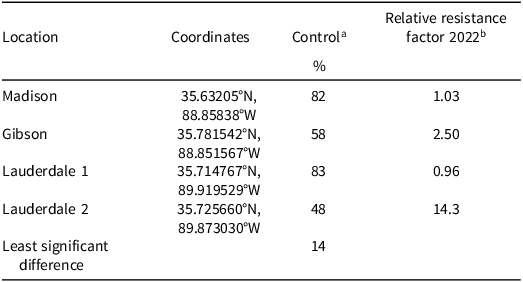
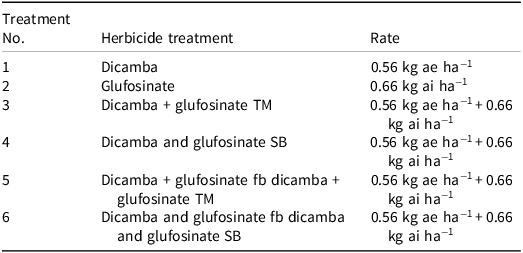
In 2024 and 2025, research was conducted at four locations in western Tennessee to evaluate herbicide-resistant Palmer amaranth control. Each population was numbered and given a corresponding site name, and global positioning system coordinates and county information was recorded (Table 1). The split-boom vs. tank-mixture study was an arrangement of treatments within a randomized complete block design with four replications at the Madison location and three replications in Lauderdale 1, Lauderdale 2, and Gibson. The study examined the control of Palmer amaranth with single-ingredient, tank-mixed, and split-applied applications. The six treatments consisted of 1) dicamba, 2) glufosinate, 3) dicamba + glufosinate tank mixed, 4) dicamba and glufosinate split-boom, 5) dicamba + glufosinate tank mixed followed by a second application of that same treatment applied 21 d later, and 6) dicamba and glufosinate split-boom followed by a second application of that same treatment applied 21 d later (Table 2). All treatments, herbicide names, and rates are listed in Table 2. The treated plot size was 2 m wide by 9 m long. Split-applied applications were conducted with two applicators, both of whom used a 1.52-m boom. The first applicator began spraying a herbicide with a single mode of action, and the second applicator also had a bottle with a single mode-of-action herbicide. As the first applicator was 0.5 m ahead, the second applicator began spraying, following the first applicator. Each herbicide was used at the 1× rate according to the label directions (dicamba, 0.56 kg ae ha−1; glufosinate, 0.66 kg ai ha−1) (Table 2). All herbicides were applied using a CO2-pressurized backpack sprayer equipped with AIXR 11002 nozzles (TeeJet Technologies, Springfield, IL) calibrated to deliver 140 L ha−1 at 4.8 kph at a pressure of 220 kPa.
Palmer amaranth control in 2023, dicamba relative resistance factor in 2022, and Palmer amaranth control at trial site locations.

a Control was evaluated after applications of dicamba (0.56 kg ha−1).
b The relative resistance factor represents herbicide resistance levels of Palmer amaranth populations (Foster and Steckel, Reference Foster and Steckel2022).

Locations and Site History
The first location was the West Tennessee Research and Education Center in Madison County. Cotton and soybean had been grown in rotation at the site from 2021 to 2024. In 2024, poor weed control (<40%) occurred with one application of 2,4-D (1.07 kg ae ha−1; data not shown) when examined 14 d after application (DAA).
The history of the Gibson field consisted of cotton grown continuously, most recently with 2,4-D-resistant cotton (Enlist Corteva AgriSciences, Indianapolis, IN) in 2020, and then dicamba-resistant cotton (Xtend Bayer Crop Science, St. Louis, MO) from 2021 to 2024. From 2021 to 2024, the grower observed escapes of Palmer amaranth after multiple applications of dicamba (0.56 kg ae ha−1).
The third (Lauderdale 1) and fourth (Lauderdale 2) locations differed by less than 2.8 km (Table 1). The history of both locations consisted of herbicide-resistant Palmer amaranth biotypes that had been present for more than a decade. The surrounding fields had been in a cotton-soybean rotation; the locations used in the Lauderdale experiments were fallow ground.
The Madison location was equipped with lateral overhead irrigation, while all other locations received rain only. Each site consisted of a native glyphosate-resistant Palmer amaranth population that was known for escaping dicamba applications (Foster and Steckel Reference Foster and Steckel2022). The Madison and Gibson trials were conducted with Enlist cotton in 2024. Lauderdale 1 and 2 trials were conducted on fallow ground. In 2025, no crops were planted in any of the tested locations.
In 2024, Enlist cotton was planted on May 4 and May 10 at the Gibson and Madison locations, respectively. A burndown application of paraquat (Gramoxone, Syngenta Crop Protection Greensboro, NC) (0.86 kg ai ha−1) plus a nonionic surfactant (250 mL L−1) (Preference; Winfield United, Arden Hills, MN) was used to ensure the trials were free of weeds before planting. No residual herbicides were applied to the treated plots in 2024. The Lauderdale County locations were conducted on fallow ground that received no burndown or residual herbicide in 2024. In 2025, pyroxasulfone (Zidua; BASF, Research Triangle Park, NC) (0.12 kg ai ha−1) was applied at the first application timing across all the treatments to prevent later weed flushes. The treatments were identical to those described for the other locations. Applications were initiated at all locations when Palmer amaranth reached a height of 10 cm.
Palmer amaranth control was visually assessed at 7, 14, and 21 DAA on a scale of 0% to 100%, where 0% = no injury and 100% = plant death. Following the second application, Palmer amaranth was rated again following the same rating scale. Counts were taken using one 0.145-m2 quadrat per treatment, following the initial 14-d and 21-d evaluations and the subsequent 14-d and 21-d periods. Herbicides were applied a second time to evaluate sequential treatments for the tank-mix and split-boom methods. Single-ingredient treatments were not included in the second application. Ratings for the initial application were continued through 35 DAA for treatments 1 through 4 (Table 2). Treatments 5 and 6 received the sequential application and were evaluated 14 d after the second application (Table 2).
Data were analyzed using the GLIMMIX procedure in SAS software (v. 9.4; SAS Institute, Cary, NC) to analyze variance. Normal distribution of data was observed using the UNIVARIATE procedure, with both the stem-leaf and box plots showing a central peak with tails of equal length. Therefore, no data transformation was necessary to improve normality. Individual treatment differences were determined using the Fisher protected LSD test at the α = 0.05 level. Mean separation was performed only when the overall F-test was significant.
To examine whether the change in control was due to the application method as opposed to simply increased carrier volume, we conducted a study at three locations (Madison, Lauderdale 1, Gibson) in 2025 to compare a tank mix of dicamba + glufosinate applied at 140 L ha−1 with the same two herbicides applied at 280 L ha−1. Treatments consisted of one pass and were applied as previously described for 140 L ha−1 and by using a CO2-pressurized backpack sprayer equipped with TeeJet AIXR 11004 nozzles calibrated to deliver 280 L ha−1 at 4.8 kph using 207 kPa.
Weed control and plant density data were collected as previously described. A single degree-of-freedom contrast statement in SAS software was conducted to compare results.
Results and Discussion
Data Collection
Data were initially subjected to an analysis across years and populations, with each location defined as a population. In the model, locations were different but years did not differ so data were pooled across years. A significant year × population × treatment interaction (P < 0.0001) was detected. Results from the mixed-model analysis indicated that location significantly influenced Palmer amaranth control, demonstrating that treatment performance varied across site conditions and population characteristics. Therefore, treatment effects were analyzed separately by population. Within each population, year was treated as a random effect and treatment was considered fixed (Carmer et al. Reference Carmer, Nyquist and Walker1989).
Previous research by Foster and Steckel (Reference Foster and Steckel2022) supports this approach, as populations of Palmer amaranth in western Tennessee exhibited a wide range of dicamba resistance levels, with relative resistance factors of 1.03 and 0.96 for the Madison and Lauderdale 1 populations, respectively, indicating dicamba susceptibility. However, Lauderdale 2 and Gibson populations showed higher resistance, with relative resistance factor values of 14.3 and 2.5, respectively (Table 1). These documented differences in dicamba sensitivity, combined with the significant location effects observed in this study, justified analyzing each location independently to accurately capture treatment responses across resistant and susceptible Palmer amaranth populations.
Madison
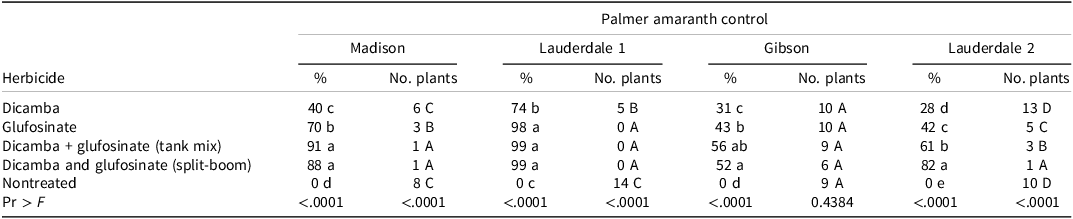
At the Madison location, when evaluated at 14 DAA, 40% of Palmer amaranth was controlled % when dicamba was applied alone at 0.56 kg ae ha−1 (Table 3). Glufosinate applied alone controlled Palmer amaranth by 70%, although both the tank-mix (88%) and the split-boom (91%) methods provided greater control.
Palmer amaranth control and density observed 14 d after initial applications of dicamba and glufosinate.a,b

a Palmer amaranth density was determined by manually counting the number of plants per 0.145 m2.
b Lowercase letters indicate mean separation for percent Palmer amaranth control; uppercase letters indicate mean separation for Palmer amaranth plant density.
Plant count data supported the visual evaluations. Plots treated with glufosinate alone had fewer plants than those treated with dicamba alone. The combination treatments (tank-mix and split-boom) contained fewer plants than plots treated with a single product (Table 3). These results demonstrate that using both herbicides, regardless of application method, improved Palmer amaranth control relative to dicamba or glufosinate applied alone when evaluated at 14 DAA.
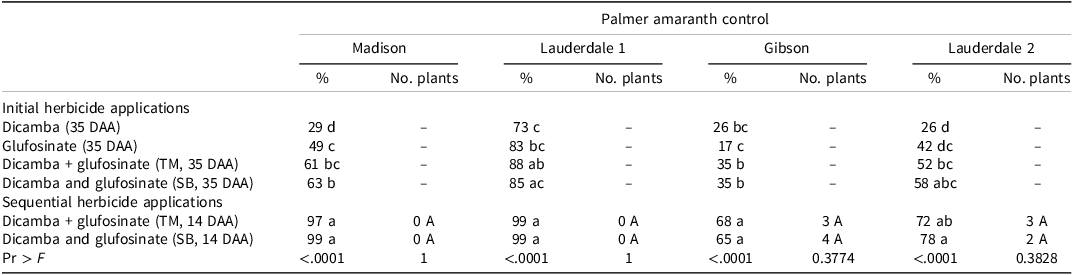
For the treatments that did not receive a sequential application, control declined by 35 DAA (Table 4). The split-boom treatment provided similar control to that of the tank mix, but better than dicamba or glufosinate applied alone. When herbicides were applied sequentially, there was no difference between methods with ≥ 97% control. These results indicate that a sequential application is needed to achieve high levels of Palmer amaranth control at this site, regardless of whether the herbicides are applied as a tank mix or in a split-boom configuration.
Palmer amaranth control and density observed 35 d after initial applications (14 d after second applications) of dicamba and glufosinate.a–d

a Abbreviations: DAA, days after application; SB, split-boom; TM, tank mix.
b Palmer amaranth control was determined by manually counting the number of plants per 0.145 m2.
c 35 DAA evaluations occurred after the initial postemergence application only; 14 DAA evaluations occurred after sequential applications of postemergence herbicides and were evaluated 14 d after that.
d Lowercase letters indicate mean separation for percent Palmer amaranth control; uppercase letters indicate mean separation for Palmer amaranth plant density.
Lauderdale 1
At the Lauderdale 1 location, Palmer amaranth was controlled by 74% with dicamba, which was higher than at any other site at 14 DAA (Table 3). Glufosinate applied alone provided excellent control of Palmer amaranth, averaging 98%, and control was similar with both the tank-mix and split-boom application methods (99%). Although dicamba applied alone provided 74% control, levels were still lower than all treatments that contained glufosinate. These results suggest that using glufosinate is necessary for achieving high levels of Palmer amaranth control at this site.
Plant count data reflected the results of the observed control. Fewer plants were counted in the plots that received dicamba alone than the plots that were used as control checks. All treatments that included glufosinate further reduced the number of plants to zero (Table 3).
For treatments that did not receive a sequential application, visual ratings declined substantially over time and were similar at 35 DAA (Table 4). Regardless of application technique, sequential treatments averaged 99% control. These results indicate that a sequential herbicide application is necessary to achieve adequate control of Palmer amaranth at this location.
Gibson
All four herbicide applications at the Gibson location failed to provide effective control of the native Palmer amaranth population at 14 DAA. Glufosinate alone provided better control than dicamba alone (Table 3). The tank-mix and split-boom application methods achieved better control than dicamba applied alone. The poor control with glufosinate is concerning and would be consistent with grower reports and the documented glufosinate resistance in the neighboring state of Arkansas (Priess et al. Reference Priess, Norsworthy, Godara, Mauromoustakos, Butts, Roberts and Barber2022). However, resistance was not experimentally confirmed in this study. Plant counts at 14 DAA that received dicamba alone and glufosinate alone were similar to counts in the check plots. Plant counts were similar for all treatments.
Treatments that did not receive a sequential application exhibited a further decline in control 35 DAA (Table 4). Dicamba applied alone provided 26% control, while glufosinate applied alone declined to 17%, which is due to escapes from the initial application. The initial tank-mix and split-boom treatments each averaged 35% control at 35 DAA, which was better than glufosinate alone. Sequential applications improved control and results were similar. Although this level of control remains below what would be considered acceptable in a commercial production system, the results suggest that a sequential application is necessary to improve management of this Palmer amaranth population. Plant counts for the sequential applications were also similar.
Lauderdale 2
The Palmer amaranth at the Lauderdale 2 location had been confirmed to be resistant to dicamba (Foster and Steckel Reference Foster and Steckel2022), and our results confirmed this. Following the initial 14-d rating (Table 3) the level of control observed was the split boom > tankmix > glufosinate alone > dicamba alone. Plant counts supported the visual ratings. All plots except those that served as nontreated checks had fewer plants after all treatments except dicamba alone. The split-boom treatment reduced plants by 90% compared with the check.
Control of Palmer amaranth declined over time after the initial applications, except for glufosinate, for which control remained the same. A reduction in control was observed at 35 d after dicamba was applied, while the tank-mix and split-boom treatments declined to 52% and 58% control, respectively (Table 4). Sequential applications provided similar control regardless of method. These results indicate that a sequential application may be beneficial for managing Palmer amaranth at this location. Plant counts correlated to visual ratings.
Carrier Volume
In 2025, the tank mix of dicamba + glufosinate was evaluated for its effect against Palmer amaranth populations at three locations (Madison, Lauderdale 1, Gibson) to determine whether a greater carrier volume would enhance control of dicamba-resistant Palmer amaranth. Resistance levels at these locations were previously characterized by Foster and Steckel (Reference Foster and Steckel2022) (Table 1).
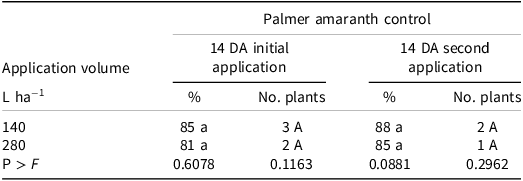
At the three locations in 2025, increasing the carrier volume from 140 to 280 L ha−1 did not improve control of dicamba-resistant Palmer amaranth (Table 5). When assessed at 14 d after the initial application, visual control was 85% with an application of 140 L ha−1 compared with 81% after 280 L ha−1 was applied (P = 0.6078). Likewise, plant density did not differ between the carrier volumes. Following the second application, control followed the same trend with no difference (P = 0.0881), and plant density was also similar (P = 0.2962). Additionally, control and plant density were similar following the second application. Overall, these results indicate that increasing the carrier volume from 140 to 280 L ha−1 had no effect on Palmer amaranth control, suggesting that the standard 140 L ha−1 application volume is sufficient under these conditions.
Contrast statement for control of dicamba-resistant Palmer amaranth comparing 140 L ha−1 with 280 L ha−1 carrier volume, pooled across three locations in 2025.a–d

a Abbreviation: DA, days after.
b Palmer amaranth control was determined by manually counting the number of plants per 0.145 m2.
c The Gibson, Lauderdale 1, and Madison locations are included in the analysis.
d Lowercase letters indicate mean separation for percent Palmer amaranth control; uppercase letters indicate mean separation for Palmer amaranth plant density.
Practical Implications
The poor Palmer amaranth control with dicamba and glufosinate applied alone at the three test locations where resistance to auxinic herbicides is high would be consistent with reports by growers and an author’s personal experience. These results suggest that this confirmed dicamba-resistant Palmer amaranth population may also exhibit resistance to glufosinate. Additional research is needed to confirm these findings. Furthermore, the results indicate that the most effective strategy for managing highly resistant Palmer amaranth is to apply dicamba and glufosinate using a split application approach in combination with other management practices. These may include applying residual herbicides at planting to limit Palmer amaranth emergence, overlapping residual herbicides throughout the season, and applying a sequential application of postemergence herbicides if Palmer amaranth emerges after the initial application.
From the regulatory standpoint, a tank mix of dicamba and glufosinate in a single spray solution was not permitted with the original dicamba over-the-top herbicide labels, meaning combinations of the two products would be considered an off-label application. In contrast, applying dicamba separately (split-boom) over the top would fall in accordance with its individual label instructions and is considered an on-label application when all other label requirements are met (US EPA 2022). Though the new labels for over-the-top application of dicamba (Bayer 2026) currently allow a tank mix with glufosinate, given all the changes with the labels since 2018 this could change in the future.
Acknowledgments
We thank Hayden Love, Sally Reed, Jared Buck, David Cartwright, Maddie Douglas, Ernest Merriweather, and Julie Reeves for their assistance with this research.
Funding
Cotton Incorporated provided partial financial support of this project.
Competing interests
The authors declare they have no conflicts of interest.

 Open access

