




1. Introduction
Rhythm is typical to human actions. Walking is an example of rhythm in our everyday life. Walking exhibits self-entrainment, in which one oscillator entrains another so that their movements are kept in the same relation to each other regardless of the speed of the movement (Port, Tajima & Cummins Reference Port, Tajima, Cummins, Savelsbergh, van der Maas and van Geert1999).
Rhythm is generally considered a temporal phenomenon based on repetition. Rhythm is seen as intervals of motion, which means that rhythm is quantitative rather than qualitative (Allen Reference Allen1973:96–97). On the other hand, rhythm units do not need to be based on strict repetition. Rhythm can also be understood as a chain of patterns, in which the rhythmical impression is created by patterns within patterns that differ from each other in accent, which forms a hierarchy, in which the units are perceived as existing on different levels (Sadeniemi Reference Sadeniemi1949:10).
Language is also considered to have rhythm. Rhythm typology has traditionally classified languages according to their rhythm types into stress-timed, syllable-timed, and mora-timed languages. Rhythm typology has been criticised for not finding measurable correlates corresponding to the phonetic reality of language (Dauer Reference Dauer1983, Pamies Bertrán Reference Pamies Bertrán1999). A method called speech cycling was developed in studies that utilise repetitive speech adjusted to a metronome to seek the regularity of rhythmical elements in speech. Speech cycling creates a cyclical stimulus that forces speech into regular cycles. This is intended to find the oscillators that in the case of speech are cognitive (Port, Cummins & Gasser Reference Port, Cummins, Gasser, Luka and Need1996, Cummins & Port Reference Cummins and Port1998, Tajima Reference Tajima1998, Port et al. Reference Port, Tajima, Cummins, Savelsbergh, van der Maas and van Geert1999).
This paper presents a speech cycling experiment in Finnish. The research questions are as follows.
-
1. What rhythmic features does Finnish exhibit?
-
2. What is the role of the mora in Finnish in relation to the syllable?
-
3. Is a speech cycling task manageable in Finnish at all and what kinds of unit does it indicate?
In Section 2, the previous literature of linguistic rhythm and speech cycling is presented. In Section 3, the method is explained, in Section 4 the results of the experiment are presented, and in Section 5 the conclusions of the results are presented.
2. Background
2.1 Rhythm typology
Rhythm typology seeks to assign languages to certain rhythm types. The traditional view uses two types, stress-timed and syllable-timed. Rhythm typology aims to find the phonological units that are isochronous in speech. In this view, in a stress-timed language stressed syllables are placed at regular intervals, which means that unstressed syllables are compressed or expanded depending on their number in the interval, while in a syllable-timed language syllables are kept equally long without stresses affecting them (Abercrombie Reference Abercrombie1965:17–18, Reference Abercrombie1967:97). A third type used in rhythm typology is mora-timed, in which morae instead of syllables are seen as having regular duration and which has most often been used to describe Japanese rhythm (Bloch Reference Bloch1950, Warner & Arai Reference Warner and Arai2001a).
Rhythm typology has been questioned by various studies. Dauer (Reference Dauer1983) did not find significant differences in the duration of stress intervals between stress-timed and syllable-timed languages. Pointon (Reference Pointon1980) did not find any kind of isochrony either in stress intervals or syllable durations in Spanish. Wenk & Wioland (Reference Wenk and Wioland1982) denounce syllable isochrony in French, and suggest that French stress intervals are actually more similar to English, with the difference that in French stresses are placed at the end of the foot (trailer-timing), contrary to English which places them at the beginning of the foot (leader-timing). They also criticise rhythm typology for being too Germanic-centred. Beckman (Reference Beckman1982) found no regular durations in Japanese morae, and Roach (Reference Roach and Crystal1982) did not find stress or syllable isochrony either, but states that languages may have different factors that give rise to the rhythmic impression, which means that linguistic rhythm is predominantly perceptual. Pamies Bertrán (Reference Pamies Bertrán1999) even claims that linguistic rhythm is not a real phenomenon but a metaphor based on classical poetry, and thus does not describe the phonology of languages spoken in reality.
On the other hand, there are also studies that do not completely denounce phonetic rhythmic differences. Hoequist (Reference Hoequist1983a,b) found that English, Spanish, and Japanese, a putative stress-timed, syllable-timed, and mora-timed language, respectively, have similar kinds of effects but to different magnitudes, e.g. lengthening when stressed, and effects that set one language apart, e.g. following syllables shortening the preceding syllables. Regarding mora-timing, in Japanese adding a mora affected syllable length the most, as expected, whereas the other effects were smaller than in English and Spanish. Hoequist (Reference Hoequist1983b:229) concludes that instead of the traditional rhythm descriptions Japanese could be classified as a duration-controlling language, English a duration-compensating language, and Spanish as neither, though Japanese best fits its putative rhythm type.
Out of the three most commonly used rhythm classifications, mora-timing has got the most support. Port, Al-Ani & Maeda (Reference Port, Al-Ani and Maeda1980) found that in Japanese, morae tend to keep a regular duration by compensating the inherent durations of the sounds both in a mora and over mora boundaries, which they did not observe in Arabic and English. Port, Dalby & O’Dell (Reference Port, Dalby and O’Dell1987) found that the word and phrase duration in Japanese depends on the number of morae, not of syllables, although Warner & Arai (Reference Warner and Arai2001b) found that neat mora compensation does not happen in spontaneous speech, but the mora count still predicts the word duration better than other segments. Port et al. (Reference Port, Al-Ani and Maeda1980, Reference Port, Dalby and O’Dell1987) do not consider mora isochrony to mean that each individual mora has a similar duration (cf. Bloch Reference Bloch1950, Beckman Reference Beckman1982) but that the morae compensate each other over larger strings of morae.
Dauer (Reference Dauer and Gamkrelidze1987) concludes that mere instrumental phonetic research fails to bring any evidence for rhythm types, and mere phonological grouping of units looks identical in every language. Therefore Dauer suggests that rhythm is based on certain rhythmic elements (duration,
 $$f0$$
, vowel quality, and the function of stress) whose relationship to stresses determines the rhythm type. Based on these features, languages form a continuum from a more stress-timed language to a less stress-timed language rather than a dichotomy. If stresses are related to syllable complexity, intonation, and duration, the rhythm of the language is based on stresses, and if not, the rhythm units lie elsewhere.
$$f0$$
, vowel quality, and the function of stress) whose relationship to stresses determines the rhythm type. Based on these features, languages form a continuum from a more stress-timed language to a less stress-timed language rather than a dichotomy. If stresses are related to syllable complexity, intonation, and duration, the rhythm of the language is based on stresses, and if not, the rhythm units lie elsewhere.
Rhythm is also sought in syllable variability by comparing vocalic and consonantal sequences. Ramus, Nespor&Mehler (Reference Ramus, Nespor and Mehler1999) found that the vocalic percentage and the standard deviation of consonantal intervals indicate the rhythm type, because the more different syllable types a language has, the more consonantal variation it has and its vocalic percentage decreases, which leads to stress-timing. They did not find a clear connection between the standard deviation of vocalic intervals, but it may explain why some languages fall between the types. Grabe & Low (Reference Grabe, Ling Low, Gussenhoven and Warner2002) used the pairwise variability index (PVI). They found that the putative syllable-timed languages had low vocalic durational variation, whereas the stress-timed languages showed more variation in vowel duration. Some languages fell between these types, because they had high vocalic variation but low consonantal variation (Catalan), or vice versa (Polish). They suggest that the rhythmical impression may be based on languages’ having great variation in either of the intervals, and if both had high variation, rhythm could not be formed. Nolan & Asu (Reference Nolan and Liina Asu2009) measured the PVI of feet in addition to syllables and found that languages that differ in syllable structure can still be foot-timed (stress-timed). They found that Estonian and English both have isochronous feet, although English has lower vocalic percentage due to vowel reduction and more complex syllables, and Estonian has phonemic quantity. This means that languages can base their rhythm on more than one type of unit, and that syllable-timing and stress-timing can coincide.
Rathcke & Smith (Reference Rathcke and Smith2015) note that the differences in timing can stem from different phonetic realisations of phonological features. For example, reduction and quantity contrasts can be manifested as differences in duration or quality, which give different results in timing and therefore may not be good indicators of phonological rhythm. Katz-Brown & Mandal (Reference Katz-Brown, Mandal, Sarvnaz and Verspoor2013) note that PVI correlates with a language’s phonotactics and thus tells us little about timing. Arvaniti (Reference Arvaniti2009) criticises rhythm typology for focusing almost solely on duration, and says that instead of observing timing it would be better to concentrate on grouping and patterns of prominence. Different speaking styles and even different kinds of sentences can give different rhythmic results (Krull & Engstrand Reference Krull and Engstrand2003, Arvaniti Reference Arvaniti2009).
2.2 Speech cycling
Speech cycling is intended to respond to the difficulties of previous studies on linguistic rhythm. In a speech cycling task, the speaker repeats a given phrase accommodating to an external sound stimulus. The instructions can vary, and their purpose is to extract certain rhythm units. Tajima (Reference Tajima1998) used increasing stimulus intervals in one of his speech cycling series. This was intended to reveal if the speaker has a stable rhythmical structure that is not interrupted by the tempo. Tajima (Reference Tajima1998) and Tajima & Port (Reference Tajima, Port, Local, Ogden and Temple2003) also used a task in which the speakers were instructed to produce the phrases in a waltz rhythm, which was supposed to reveal whether prominent syllables tend to be located at a fixed time.
The objective of speech cycling is not to prove or disprove phonological rhythmic categories. A speech cycling task is intended to create rhythmic speech so that temporal units that can constitute linguistic rhythm can be observed. Its focus is on the temporal domain and phonetic segments and durations rather than on phonological rhythm, which has been the focus of many past studies (e.g. Wenk & Wioland Reference Wenk and Wioland1982, Arvaniti Reference Arvaniti2009, Rathcke & Smith Reference Rathcke and Smith2015). On the other hand, because of the temporal domain, the focus is not only on phonetic durations either, which has been the main criticism of many past studies on rhythm (e.g. Roach Reference Roach and Crystal1982, Dauer Reference Dauer1983, Reference Dauer and Gamkrelidze1987, Arvaniti Reference Arvaniti2009).
Port et al. (Reference Port, Cummins, Gasser, Luka and Need1996, Reference Port, Tajima, Cummins, Savelsbergh, van der Maas and van Geert1999) criticise traditional rhythm concepts for overlooking physical time in the search for rhythm. Speech cycling aims to find temporal binding of events to certain phases in a cycle (Cummins & Port Reference Cummins and Port1998:147). Speech cycling forces the speaker to adapt to periodic speech production. This eliminates the irregularities of free or read-aloud speech that obscure the hierarchical structure. Producing speech by adapting to a stimulus enables the observation of rhythm units appearing regularly without interference. Speech cycling aims to reveal the cognitive oscillators behind the rhythm (Cummins & Port Reference Cummins and Port1998, Tajima Reference Tajima1998, Port et al. Reference Port, Tajima, Cummins, Savelsbergh, van der Maas and van Geert1999, Cummins Reference Cummins, Bel and Marlien2002). Speech cycling is an artificial speech situation but it is not unnatural: a similar kind of adaptation is used in poetry, joint speech such as protest rallies, and other synchronised speech (Cummins Reference Cummins2013). If the speaker manages to complete the speech cycling task, their speech has a hierarchical rhythm structure. Speech cycling tasks are not always as manageable in every language. Speakers of Spanish and Italian found it difficult to target the stresses to given stimuli, because stresses do not form regular feet in Spanish and Italian (Cummins Reference Cummins, Bel and Marlien2002). On the other hand, lexical stress is not a necessary requirement to succeed in speech cycling, as speakers of Korean placed the prominent syllables on the stimuli, even though Korean lacks lexical stress (Chung & Arvaniti Reference Chung and Arvaniti2013).
Speech cycling produces evidence for rhythm typology. It both confirms some existing concepts and brings in new details. Tajima (Reference Tajima1998) found that English and Japanese behave differently in speech cycling tasks, and these differences can be explained by rhythm typology. For instance, English speakers kept their phrases stable in relation to the cycle despite the increasing rate of repetitions, and ended halfway through the cycle, whereas Japanese speakers ended later and later in the cycle as the repetition rate increased. English stresses and Japanese morae were stable within the phrase. Japanese speakers also had a bigger gap between the repetitions if the phrase had odd-numbered morae than when it had even-numbered morae. The places of English stressed syllables and the duration of the phrase were affected less by increasing unstressed syllables in the phrase than in Japanese. These findings fit into the traditional views of stress and syllable or mora timing.
A common finding in speech cycling tasks on English is that the last stressed syllable is most commonly placed on either the 1/2 point or the 2/3 point of the cycle, according to its syllable count. These regular points are called simple harmonic phases (Port et al. Reference Port, Tajima, Cummins, Savelsbergh, van der Maas and van Geert1999). Port et al. (Reference Port, Cummins, Gasser, Luka and Need1996) found that it is difficult to make speakers produce a timing different from these simple harmonic phases, even though the speech cycling stimuli tried to force it. Malisz (Reference Malisz2013:24) reports that in her speech cycling task on Polish the last stressed syllable of a short phrase was placed more often on the 1/2 point and a longer phrase on the 3/4 point of the cycle, which shows that Polish behaves similarly to English and Arabic, putative stress-timed languages.
Speech cycling also brings out details that may be overlooked by traditional rhythm typology. For instance, Tajima, Zawaydeh & Kitahara (Reference Tajima, Zawaydeh, Kitahara and Ohala1999) and Zawaydeh, Tajima & Kitahara (Reference Zawaydeh, Tajima, Kitahara, Parkinson and Benmamoun2002) found that English and Arabic both behave in a stress-timed manner but Arabic less so than English, because less reduction and bigger variation in vowel lengths make Arabic stressed syllables deviate more from fixed locations. This means that rhythm types form a continuum. According to Tajima (Reference Tajima1998), rhythm types are real, although not based on strict isochrony but on prominent syllables being placed at harmonic phases that are stable in time.
2.3 Finnish rhythm
Finnish has phonemic quantity which is independent of stress. Both consonants and vowels can occur as short and long. There is no consensus as to the rhythm type of Finnish. Lehtonen (Reference Lehtonen1970:34) suggests that the mora best explains the Finnish quantity structure. According to O’Connor (Reference O’Connor1973:240), a quantity language such as Finnish cannot base its rhythm either on stress groups that alternate the syllable length or equally long syllables. Karlsson (Reference Karlsson1983:176) states that Finnish is syllable-timed, because stressed and unstressed syllables alternate regularly, and Finnish does not have vowel reduction. Iivonen (Reference Iivonen, Hirst and Di Cristo1998:316) calls Finnish an accent language as opposed to an intonation language, but sees it as a subset of syllable-timing. Aoyama (Reference Aoyama2001:117) found that children could produce [ɑnɑ] and [ɑnːɑ] with identical durations but making the quantity difference between them. This could mean that both mora- and syllable-timing might apply to Finnish.
Sadeniemi (Reference Sadeniemi1949:55) uses the traditional Finnish concepts of foot (Finnish tahti), which is a stressed syllable and the following unstressed syllables, and speech foot (Finnish puhetahti), which is a foot with a primary stress along with any following feet with no primary stress. Lehiste (Reference Lehiste1990) found that in read-aloud Finnish poetry, there was no tendency for the feet to be stabilised into equal length, because the unstressed long syllables were not affected by the lack of stress. Wiik (Reference Wiik1991) suggests foot-timing that is based on groups of two or three syllables. In this model, the syllable nucleus (which in the case of a long vowel means here only the first part of the vowel) is one mora and all the following parts of the syllable constitute the second mora. The following syllable until the end of its nucleus is the latter part of the foot. According to Wiik, the feet are isochronous, which is shown in that the syllable lengths compensate each other so that the second syllable of a foot is relatively long when the first syllable is short (monomoraic), and relatively short when the first syllable is long (bimoraic). O’Dell & Nieminen (Reference O’Dell, Nieminen, Aulanko, Wahlberg and Vainio2006) found in their experiment that some subjects produced foot-timing, and some did not. In O’Dell, Lennes & Nieminen (Reference O’Dell, Lennes, Nieminen, Barbosa, Madureira and Reis2008), rhythm was found to be based on phrase stress in which bimoraic sequences may have an effect.
Because the mora is an abstract concept, which is however systematic within a language, it requires research separately in every language (Ogden Reference Ogden1995). Typically a short open syllable is considered to equal one mora and a syllable with a long vowel or a consonant coda is two morae (Fox Reference Fox2002:46). Finnish fits the first criterion for morae presented by Trubetzkoy (Reference Trubetzkoy1969:173): a morpheme boundary can occur within a long monophthong, e.g. omena (‘apple’, nominative singular), omenaa (‘apple’, partitive singular) (the same is true for long (geminate) consonants as well, e.g. olut (‘beer’, nom. sing.), olutta (‘beer’, part. sing.)). Morae can be counted in different ways. It is agreed that a short syllable (i.e. (C)V) counts as a single mora. Karlsson (Reference Karlsson1983:134) states that in Finnish a (C)VV or (C)VC syllable has two morae, and in syllables with more segments (e.g. (C)VVC or (C)VCC) every following consonant in the same syllable contributes an additional mora. This can be called the multimoraic hypothesis. Alternatively, the bimoraic hypothesis states that any long syllable (with segments following (C)V) counts as a two morae (Wiik Reference Wiik1991). O’Dell et al. (Reference O’Dell, Lennes, Nieminen, Barbosa, Madureira and Reis2008) found that the bimoraic hypothesis seems more plausible in Finnish. Speech cycling is a good method to explore this as well. In the present study, one of the research questions is whether the quantity shape CVVCCV has three morae like CVVCV and CVCCV or whether it has greater moraic weight. In the present study, the mora is observed from a phonetic point of view, i.e. how the additional morae affect the timing.
Bimoraic feet are thought to have relevance for Finnish prosody and segment durations. Stressed bimoraic feet are lengthened, and this lengthening also makes room for a rise–fall tonal movement, when the foot is accentuated (emphasised) (Suomi, Toivanen & Ylitalo Reference Suomi, Toivanen and Ylitalo2003, Suomi Reference Suomi2005). Suomi & Ylitalo (Reference Suomi and Ylitalo2004) state that bisyllabic feet are isochronous, as their segments exhibit durational compensation, but this does not occur in trisyllabic feet. Polysyllabic shortening is not found in Finnish according to Suomi (Reference Suomi2007). Arnhold (Reference Arnhold2014:186) states that Finnish has a three-step durational hierarchy, in which CV syllables are the shortest, CVV and CVC are longer than CV syllables, and CVVC are the longest.
The aim of the present study is to conduct a speech cycling experiment on Finnish. It is hypothesised that a change in quantity affects the placing of the phases in the cycle.
3. Method
3.1 The speech cycling task
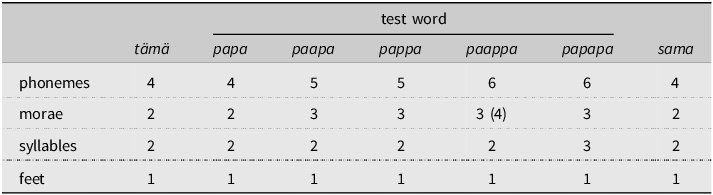
Five mora/syllable variants were embedded in identical carrier sentences. The varied word was used to test the effect of quantity, i.e. the mora count, separately from the syllable count, as opposed to the previous speech cycling studies which did not vary mora and syllable count independently (Tajima Reference Tajima1998, Tajima et al. Reference Tajima, Zawaydeh, Kitahara and Ohala1999, Tajima & Port Reference Tajima, Port, Local, Ogden and Temple2003). The test phrases were nonsensical phrases, whose first word was always tämä (‘this’) and the last word sama (‘same’). Of the varied words, pappa and paappa are real words used in Finnish (‘grandfather’), whereas paapa and papapa are nonsensical, and papa is recognised as a pan-European word, though not usually used in Finnish. As Finnish has only a handful of monomoraic function words and open-class words always have at least two voiced morae (Suomi Reference Suomi, Peltola and Tuomainen2004:94), the test phrases were constructed according to this. The test word is varied in its quantity shape and syllable count. The number of units in the phrase are shown in Table 1. In the number of phonemes, long sounds count as two individual phonemes, as is the standard in Finnish phonology (Karlsson Reference Karlsson1983:71). The same vowel height was used for all words in the phrase so that it would not cause compensation in segmental timing (cf. Lehtonen Reference Lehtonen1970:86). The phrases used were
1.
Tämä papa sama [ˈtæmæˈpɑpɑˈsɑmɑ]
2.
Tämä paapa sama [ˈtæmæˈpɑːpɑˈsɑmɑ]
3.
Tämä pappa sama [ˈtæmæˈpapːɑˈsɑmɑ]
4.
Tämä paappa sama [ˈtæmæˈpɑːpːɑˈsɑmɑ]
5.
Tämä papapa sama [ˈtæmæˈpɑpɑpɑˈsɑmɑ]
Number of units contained in the phrases
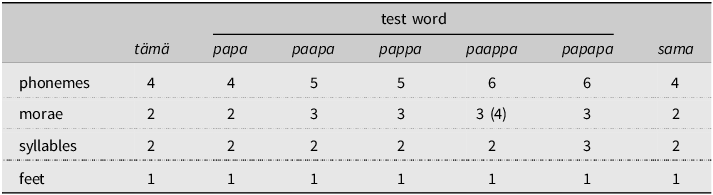
Table 1 Long description
The table presents a comparison of the number of phonemes, morae, syllables, and feet in different test words. The test words include tämä, papa, paapa, pappa, paappa, papapa, and sama. The table has five columns for the test words and five rows for phonemes, morae, syllables, and feet. Each cell contains numerical values representing the count of each unit for the corresponding test word. For example, tämä has 4 phonemes, 2 morae, 2 syllables, and 1 foot, while papa has 4 phonemes, 2 morae, 2 syllables, and 1 foot. The table highlights the variations in the quantity shape and syllable count of the test words, providing a detailed breakdown of their phonetic structure.
The speakers were given written instructions in Finnish: ‘Your task is to repeat the phrases given to you. You will simultaneously hear a series of beeps. First, listen to four beeps to find out their speed. Start repeating the sentence at the fifth beep. Repeat the sentence so that its beginning will always coincide with the beep. Repeat the sentence wholly before the next beep. Do the whole series of repetitions in one breath and repeat the sentence as long as you can without breathing or until the beeps end. There are five sentences altogether, and each of them has its own series of beeps. Don’t be confused by the fact that the sentences are not sensible in meaning.’
Ten Finnish-speaking subjects took part in the experiment. The phrases were given on paper one at a time in random order. The stimulus was a 440 Hz beep of 50 ms repeated every 1500 ms. The subjects repeated the same phrase once for every beep as long as the beeps continued, which totalled 11 repetitions for every phrase if the subject managed to do them all. The first and last repetitions were left out of the measurement (as done by Tajima Reference Tajima1998). In this study, the varied word is called the test word. The whole interval from the onset of the phrase until the onset of the next repetitive phrase is called the cycle, and the phrase within the cycle the phrase.
3.2 Measurement
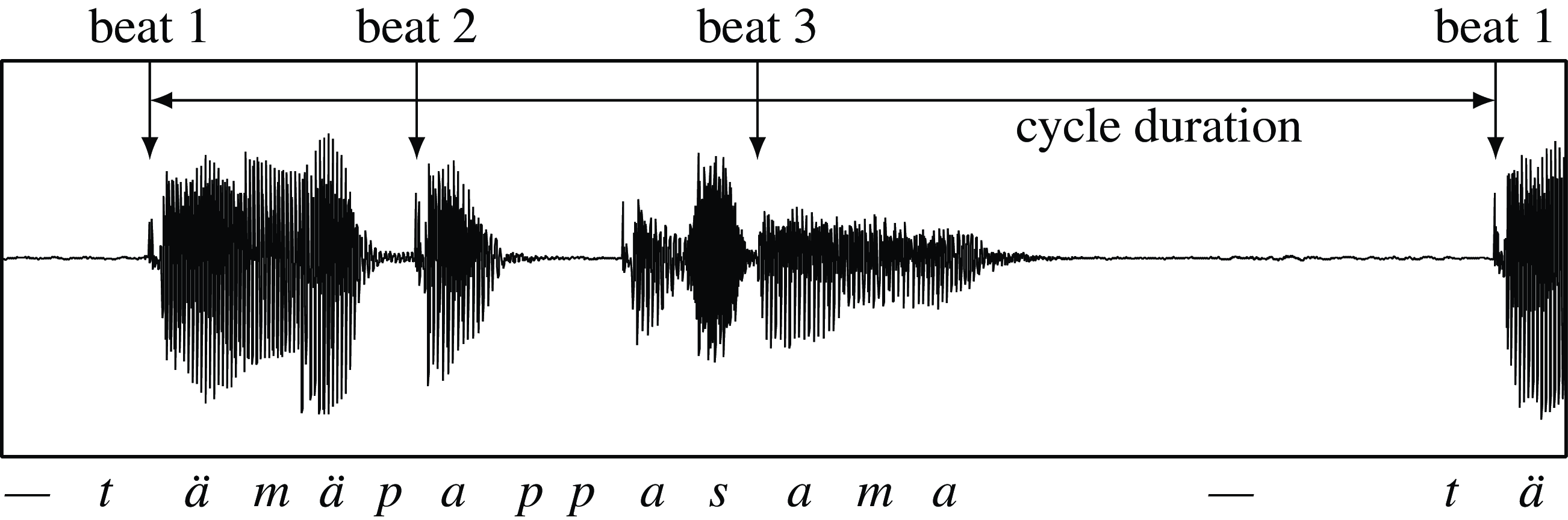
In this study, the measurements are done from the beginning of the vowel, which means here the explosion in the case of stops (Turk, Nakai & Sugahara Reference Turk, Nakai, Sugahara and Sudhoff2006). This way of measuring is also in line with common ways of counting morae (Auer Reference Auer1989). Because the focus is on the timing of these vocalic onsets, this also means that the intervals do not reflect phonological segmentation (Tajima Reference Tajima1998:26). The measurement points, which are the onsets of tämä, the test word, and the word sama, are called beat 1, beat 2, and beat 3 respectively. Beat 1 is therefore also the onset of the phrase and what the speaker targeted to the stimulus sound. The speaker’s accuracy in matching the onset to the beep is not relevant in this study. Because of that, the stimulus was only used to make the speakers produce rhythmically regular speech and its location is not taken into account. These measurement points are shown in Figure 1.
Example showing measurement points of the phases for one cycle.
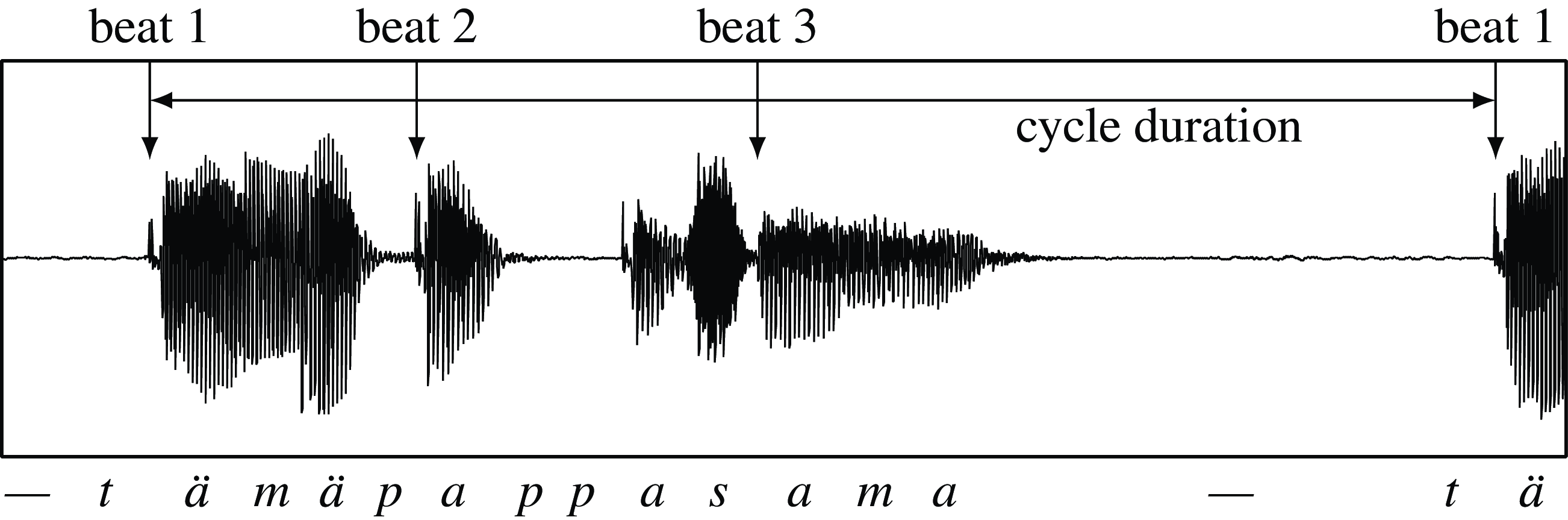
Figure 1 Long description
A line graph displays the measurement points of the phases for one cycle. The x-axis is labeled with beats 1, 2, and 3, and the cycle duration. The y-axis represents the amplitude of the sound waves. The graph shows three distinct peaks corresponding to beats 1, 2, and 3, with the cycle duration spanning from beat 1 to the next beat 1. Below the graph, there are syllables labeled as t ä m ä p a p p a s a m a. All values are approximated.
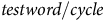
To find out the relative timing, certain intervals are measured in relation to the cycle. The cycle means the interval between beat 1 and the following beat 1. The measured intervals are called the external phase and internal phase, as used for example by Tajima (Reference Tajima1998) and Port et al. (Reference Port, Tajima, Cummins, Savelsbergh, van der Maas and van Geert1999). External phase means the position of a beat in relation to the entire cycle. Therefore, the external phase of beat 2 is tämä/cycle and the external phase of beat 3 is (tämä + test word)/cycle. Internal phase means the position of the beat in relation to the interval between beat 1 and beat 3, so the internal phase of beat 2 is tämä/(tämä + test word). In addition to the phases, the proportion of the test word is measured. This means the relation of the interval between beat 2 and beat 3 to the cycle and is therefore
 $$testword/cycle$$
. Because the measurements are taken at the vocalic onset, the proportions and measures of the words in the cycle are in practice ämäp, a(a)p(p)a(pa)s, and ama.
$$testword/cycle$$
. Because the measurements are taken at the vocalic onset, the proportions and measures of the words in the cycle are in practice ämäp, a(a)p(p)a(pa)s, and ama.
The calculation of the beats goes as follows. One of the paapa phrase repetitions from speaker A is used as an example. The cycle is 1506 ms, of which tämä is 381 ms and the test word paapa is 408 ms. The external phase of beat 2 is therefore
 $$381 \div 1506 \approx 0.2530$$
and the external phase of beat 3 is
$$381 \div 1506 \approx 0.2530$$
and the external phase of beat 3 is
 $$\left( {381 + 408} \right) \div 1506 \approx 0.5239$$
. The internal phase of beat 2 is
$$\left( {381 + 408} \right) \div 1506 \approx 0.5239$$
. The internal phase of beat 2 is
 $$381 \div \left( {381 + 408} \right) \approx 0.4829$$
. The proportion of the test word is
$$381 \div \left( {381 + 408} \right) \approx 0.4829$$
. The proportion of the test word is
 $$408 \div 1506 \approx 0.2709$$
. This gives the percentages that are used to denote the placement of the beats within the cycle. The external and internal phases are the main interest in this study, so they will be discussed the most.
$$408 \div 1506 \approx 0.2709$$
. This gives the percentages that are used to denote the placement of the beats within the cycle. The external and internal phases are the main interest in this study, so they will be discussed the most.
3.3 Expectations
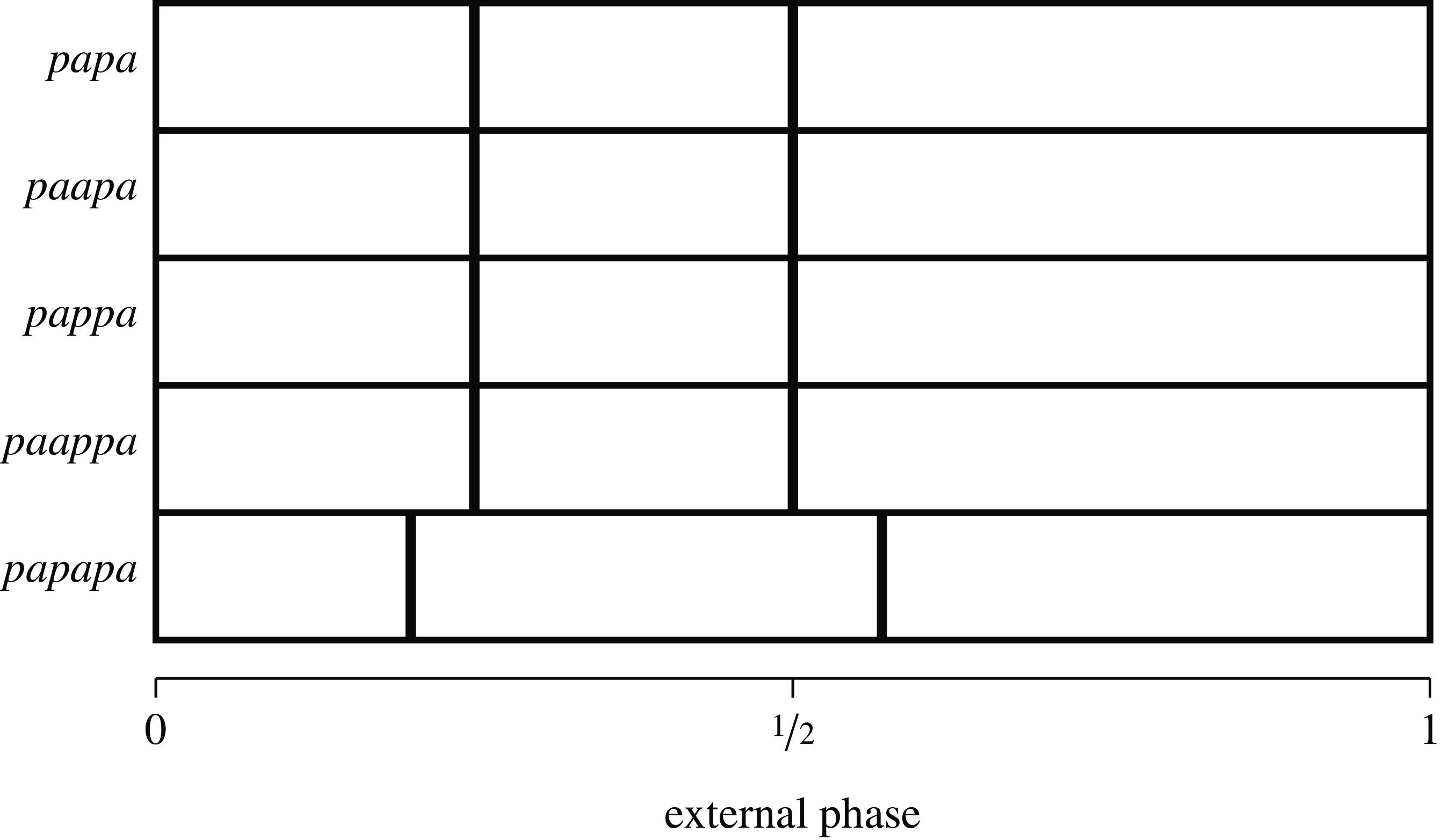
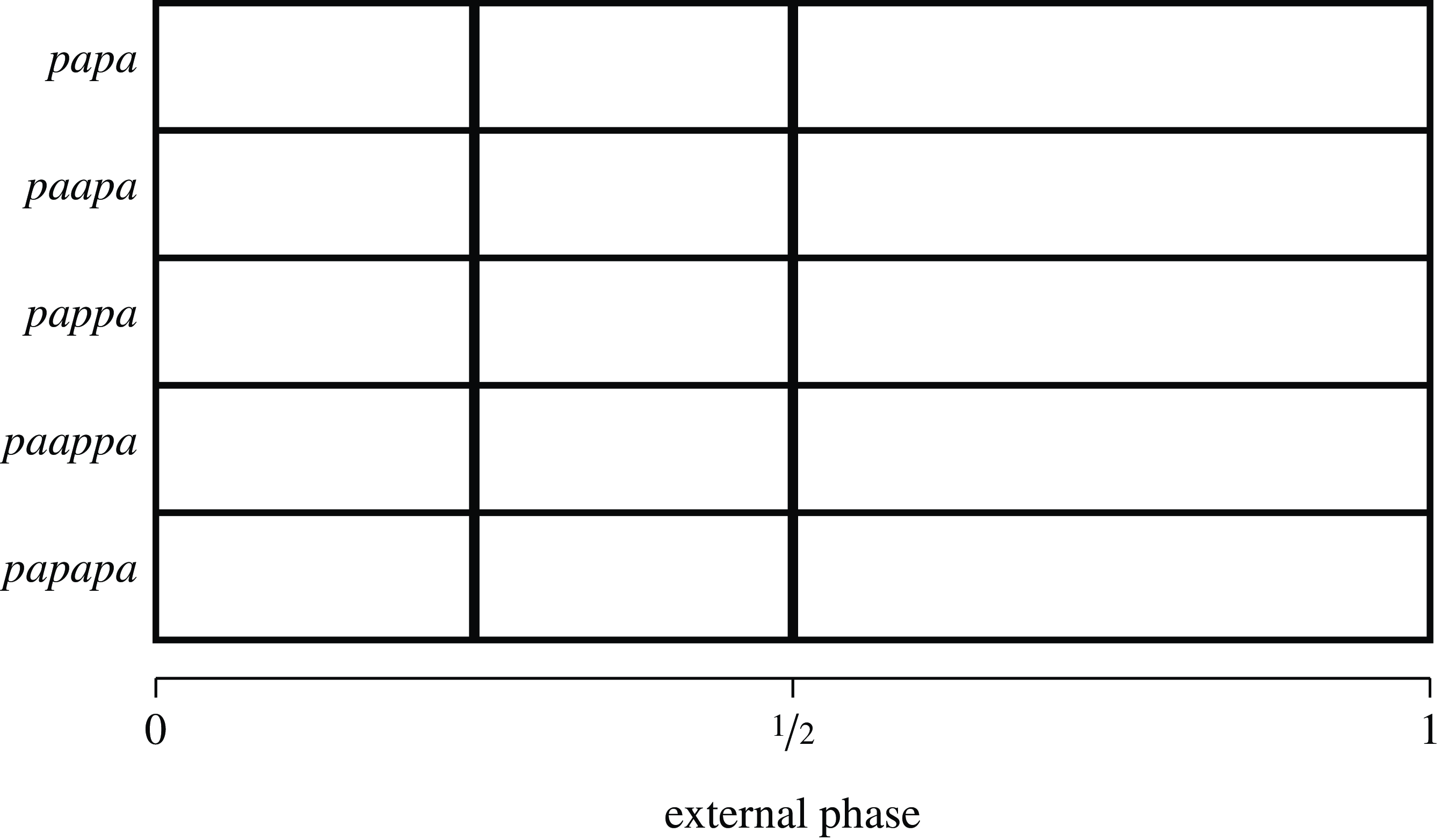
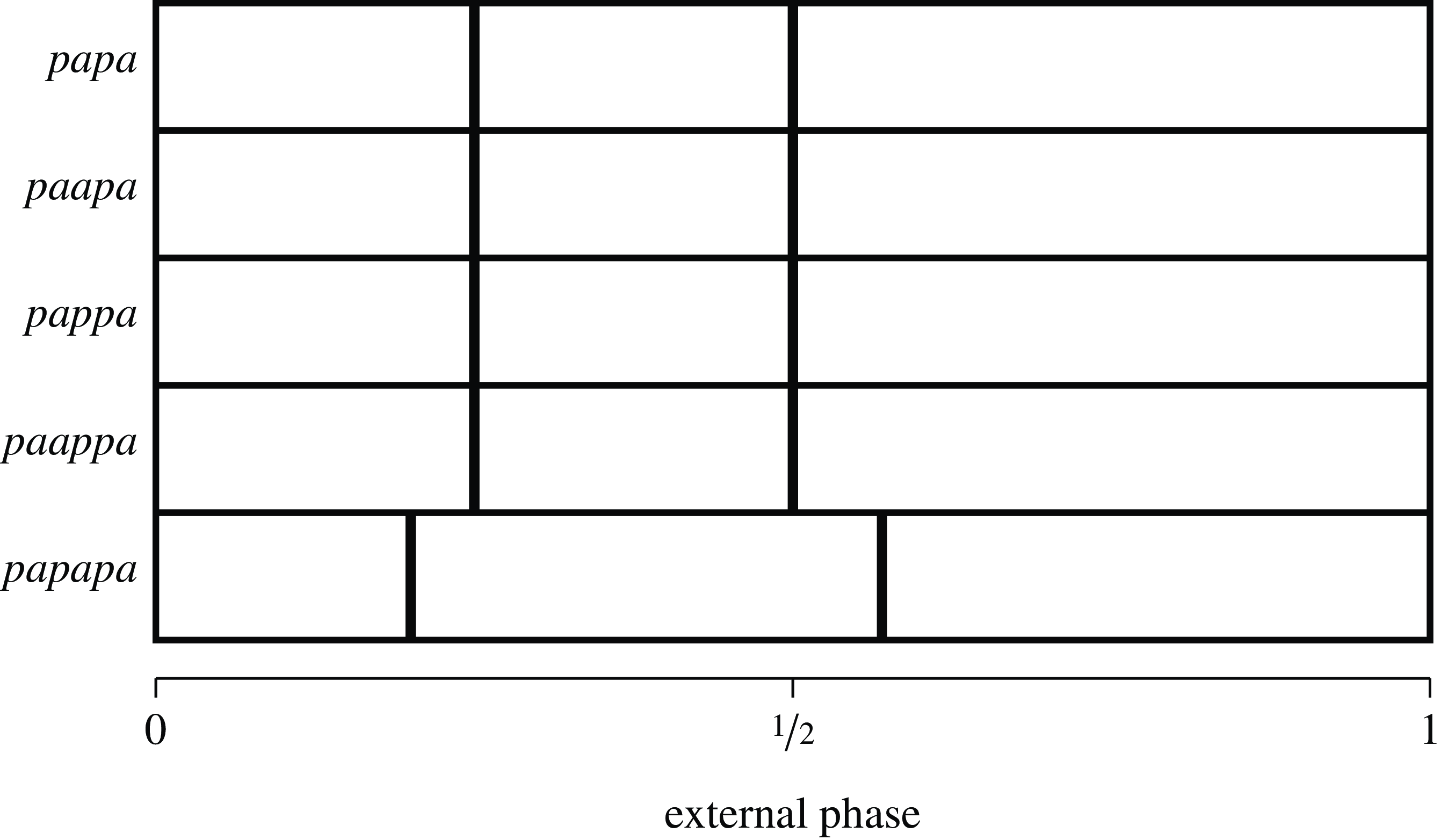
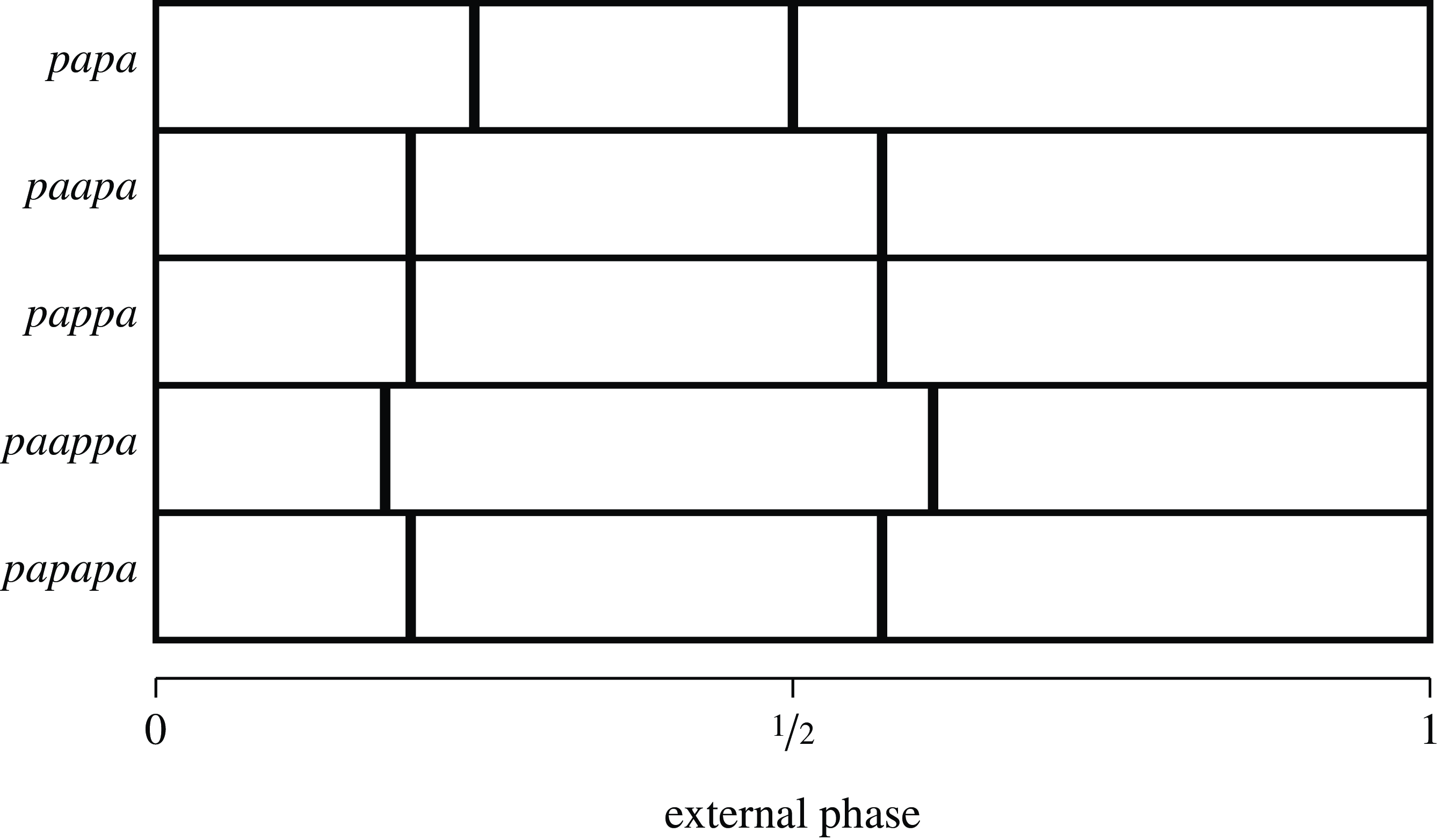
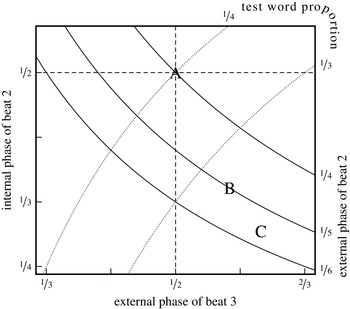
Hypothesised results according to different rhythm types are presented here as bar plots in Figures 2, 3, and 4 and also as a scatterplot in Figure 5 according to the example in Tajima (Reference Tajima1998). How stable the phases are show how fixed the stressed syllables are and how much the number of syllables or morae affect them. If the phases are always placed nearly on the same points, it can be seen as a sign of stress-timing, and if they are affected by the changing syllable or mora count, it can be seen as a sign of syllable- or mora-timing (Port et al. Reference Port, Tajima, Cummins, Savelsbergh, van der Maas and van Geert1999). The internal phase can be seen in the bar plots as the distance of beat 2 to beat 1 and beat 3. In stress-timing it is expected to be halfway between the other beats, and in syllable- and mora-timing increasing the syllable or mora count in the test word would shift it closer to beat 1 (Tajima et al. Reference Tajima, Zawaydeh, Kitahara and Ohala1999, Zawaydeh et al. Reference Zawaydeh, Tajima, Kitahara, Parkinson and Benmamoun2002).
Bar plots for beat 2 and beat 3 in pure stress-timing.
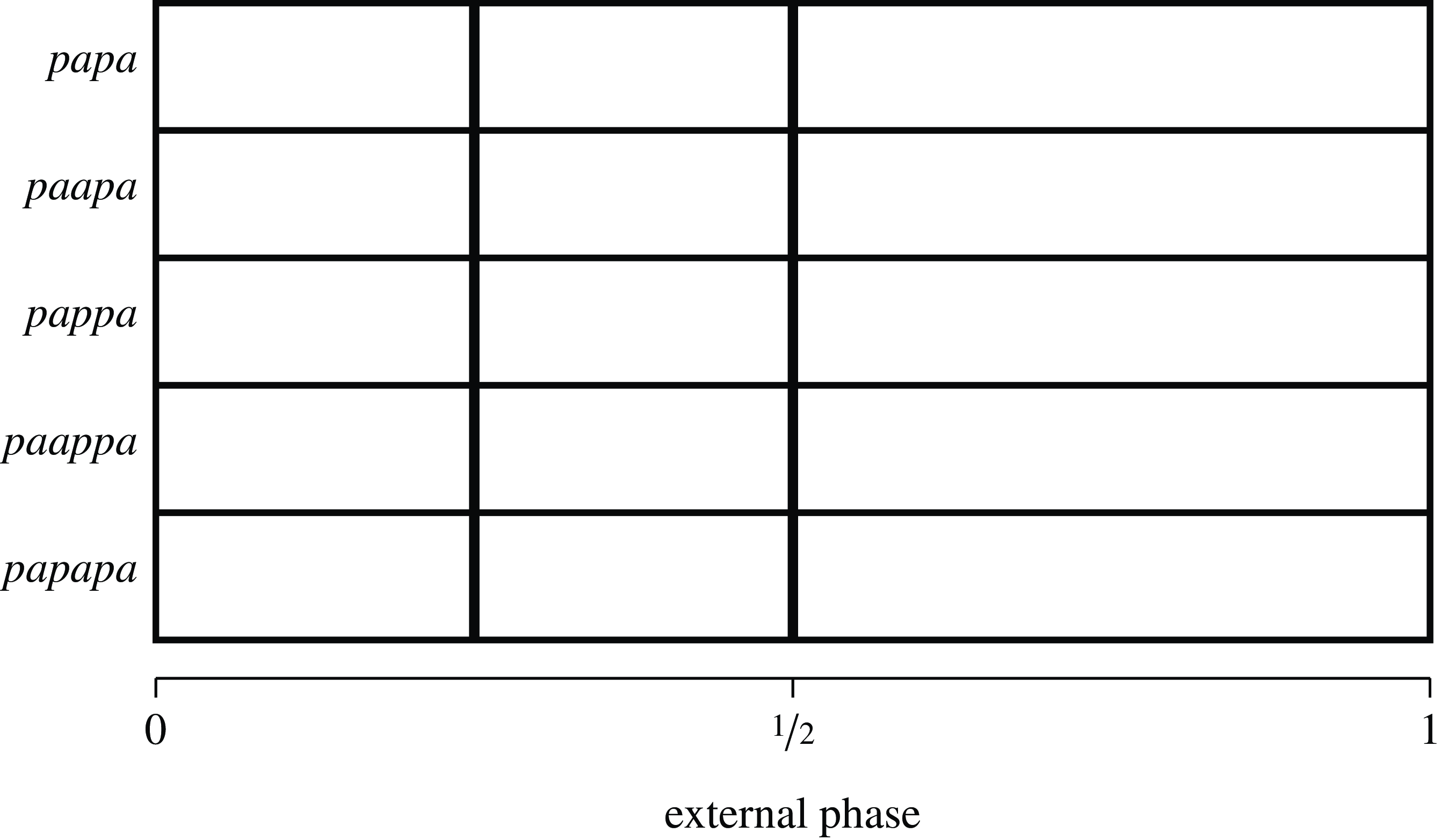
Figure 2 Long description
A table with five rows and three columns. The rows are labeled with different word patterns: papa, paapa, pappa, paappa, and papapa. The columns represent external phase values ranging from 0 to 1, with a midpoint at 0.5. Each cell in the table corresponds to a specific word pattern and its associated external phase value.
Bar plots for beat 2 and beat 3 in pure syllable-timing.
Bar plots for beat 2 and beat 3 in pure mora-timing.
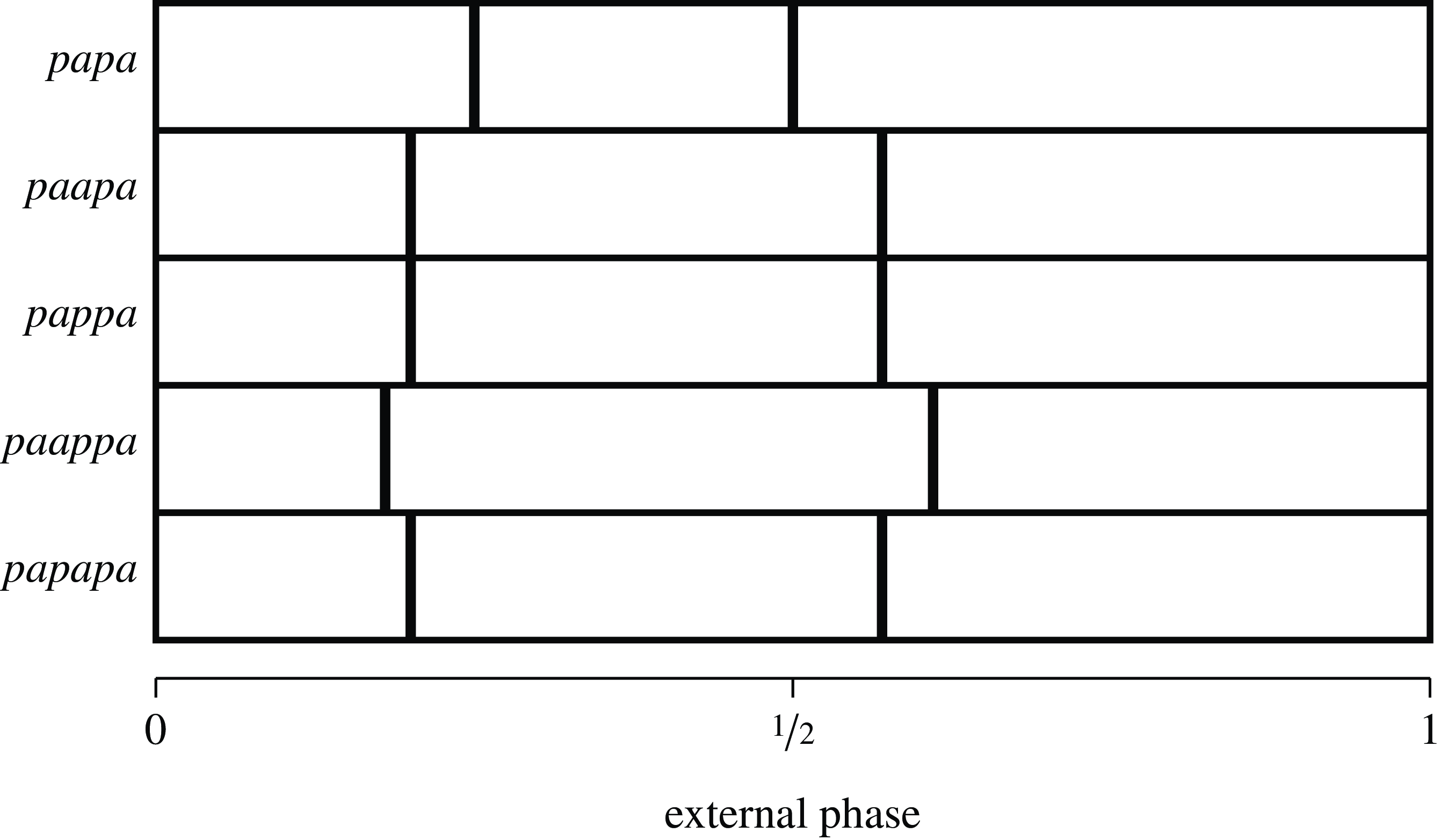
Figure 4 Long description
The bar graph compares different patterns of beats in pure mora-timing. The x-axis represents the external phase ranging from 0 to 1, while the y-axis lists different beat patterns: papa, paapa, pappa, paappa, and papapa. Each row corresponds to a specific beat pattern and contains multiple bars indicating different data points. The bars are divided into segments, some of which are shaded in gray. The graph shows variations in the timing and structure of the beats across different patterns. All values are approximated.
Theoretical Tajima-type scatterplot for different types of timing. Stress-timing predicts a location near A for all test phrases; syllable-timing predicts phrase 5 papapa should be located near B, and a location near A for all other test phrases; for mora-timing test phrase 1 papa should be located near A, phrase 4 paappa near C, and all other phrases near B.
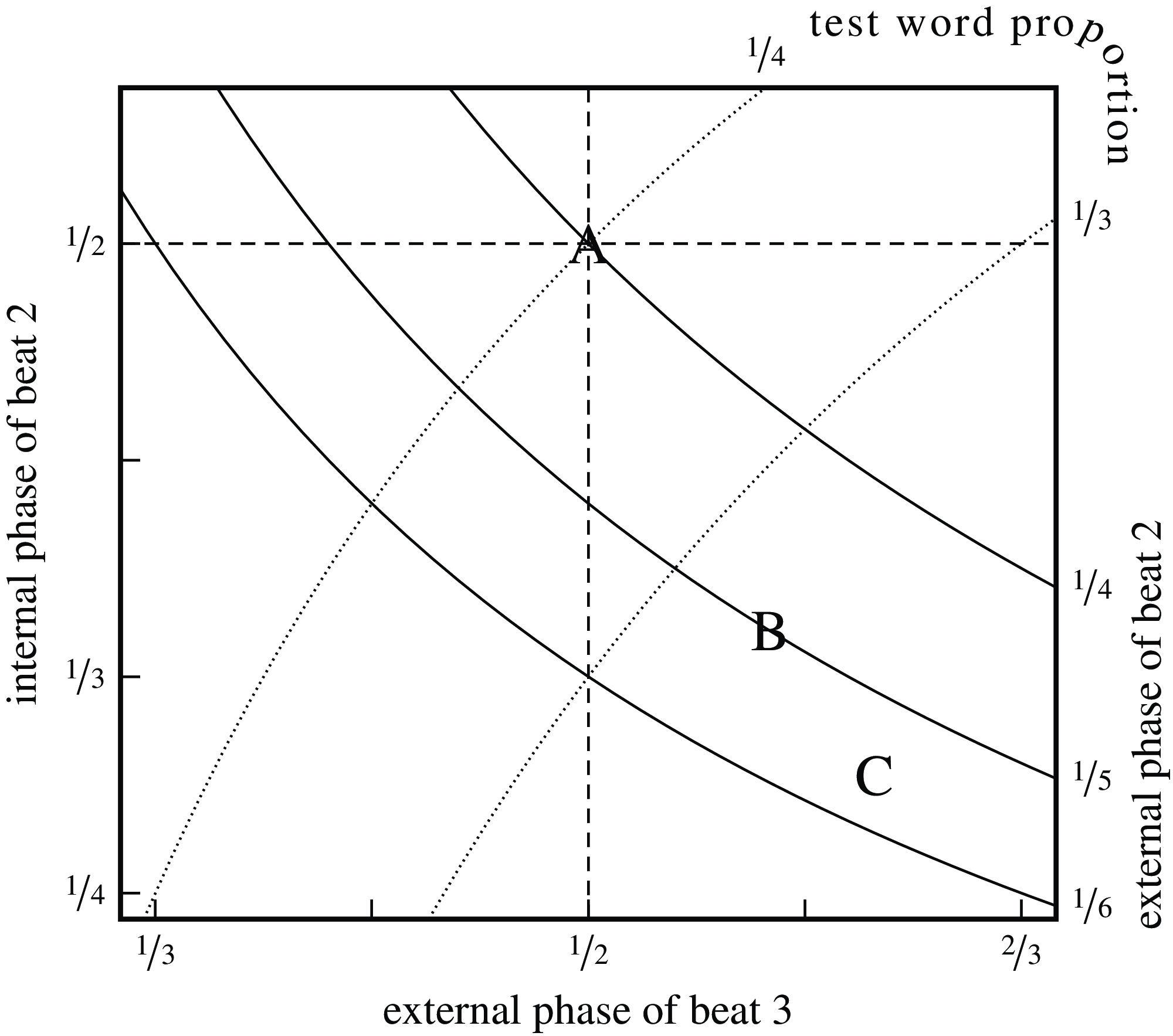
Figure 5 Long description
A line graph illustrating the theoretical Tajima-type scatterplot for different types of timing in language rhythm. The x-axis represents the external phase of beat 3, while the y-axis represents the internal phase of beat 2. The graph includes multiple lines representing different test phrases and their predicted locations based on stress-timing, syllable-timing, and mora-timing. Stress-timing predicts a location near point A for all test phrases. Syllable-timing predicts that phrase 5, papapa, should be located near point B, and all other test phrases near point A. For mora-timing, test phrase 1, papa, should be located near point A, phrase 4, paappa, near point C, and all other phrases near point B. The graph visually represents these predictions with intersecting lines and labeled points.
If Finnish is stress-timed, the stressed syllables should be at the same points in every phrase. Based on the earlier speech cycling studies, it can be expected that beats 2 and 3 would be located at the 1/3 and 1/2 points on the external phase (e.g. Port et al. Reference Port, Tajima, Cummins, Savelsbergh, van der Maas and van Geert1999), as presented in Figure 2. The internal phase of beat 2 would always be located at the 1/2 point and the test word proportion could be expected to be a 1/4 of the cycle. When presented as a scatterplot, it would mean that all phrases would have the proportions A presents in Figure 5.
If Finnish is syllable-timed, phrases 1–4 should have the beats placed at different points compared with phrase 5. In this scenario, test word 5 is 50 % longer than the other test words, and beat 2 is therefore earlier and beat 3 later than in the other test phrases, as is presented in Figure 3. When shown as a scatterplot in Figure 5, syllable-timing would mean that phrases 1–4 would be located at A similarly to the hypothesised stress-timed phrases and the papapa phrase at B.
Mora-timing functions similarly to syllable-timing with the difference that quantity and coda consonants shift the beats as well. If Finnish is mora-timed, phrase 1 should have different timing from phrases 2, 3, 5, which would be equal to each other and again different from phrase 4, at least if the multimoraic hypothesis is true. Possible bar plots for mora-timing are presented in Figure 4. As a scatterplot in Figure 5, in mora-timing, the phases of the papa phrase would be located at A, phrases 3, 2, and 5 at B, and the paappa phrase at C.
It is not expected that the results would show any of these types alone, but that some effects of syllable- and mora-timing combined with possible effects of feet may emerge.
4. Results
In the results, the average durations and proportions for the test words and beats are presented both averaged over all subjects and for individual subjects. Calculations were performed using an isometric log ratio (ilr) transformation for proportions (a multivariate version of the logit transformation; see e.g. Egozcue & Pawlowsky- Glahn Reference Egozcue and Pawlowsky-Glahn2019). For presentation purposes all values have been transformed back to percentages. In order to carry out statistical inference for various differences, a Bayesian analysis of the data was performed using a hierarchical model (see Gelman & Hill Reference Gelman and Hill2007) with phrase, subject, and phrase
 $${\rm{\;}} \times {\rm{\;}}$$
subject interaction as factors. Posterior distributions and probabilities were computed using R and JAGS (R Core Team 2023, Plummer Reference Plummer2017). The term posterior refers to estimated distributions and probabilities updated with the evidence provided by the data (see e.g. Vasishth, Nicenboim, Beckman, Li & Kong Reference Vasishth, Bruno Nicenboim, Beckman and Jong Kong2018).
$${\rm{\;}} \times {\rm{\;}}$$
subject interaction as factors. Posterior distributions and probabilities were computed using R and JAGS (R Core Team 2023, Plummer Reference Plummer2017). The term posterior refers to estimated distributions and probabilities updated with the evidence provided by the data (see e.g. Vasishth, Nicenboim, Beckman, Li & Kong Reference Vasishth, Bruno Nicenboim, Beckman and Jong Kong2018).
4.1 Average durations and timing for all speakers
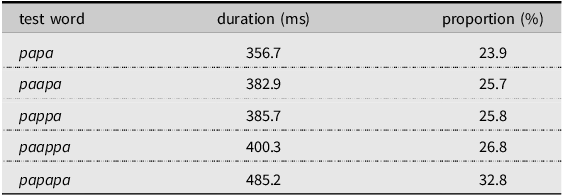
The average durations of the parts of the cycle and the average proportion of the test word are shown in Table 2. The durations of the test words increase as expected when the mora number increases, and when a syllable is added in the fifth test word the duration greatly increases. The proportions of the test words are as expected: papa has the smallest proportion and papapa the biggest one. Test word paappa has a smaller proportion than papapa but a bigger proportion than test words 1–3.
Average duration and proportion of the cycle for each test word
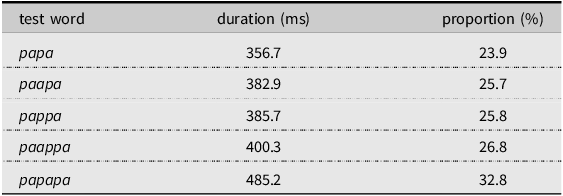
Table 2 Long description
The table presents data on the average duration in milliseconds and the proportion in percentage for each test word. It includes five test words: papa, paapa, pappa, paappa, and papapa. The duration increases progressively from papa at 356.7 milliseconds to papapa at 485.2 milliseconds. The proportion also increases from 23.9 percentage for papa to 32.8 percentage for papapa. Notably, the addition of a syllable in the fifth test word results in a significant increase in duration.
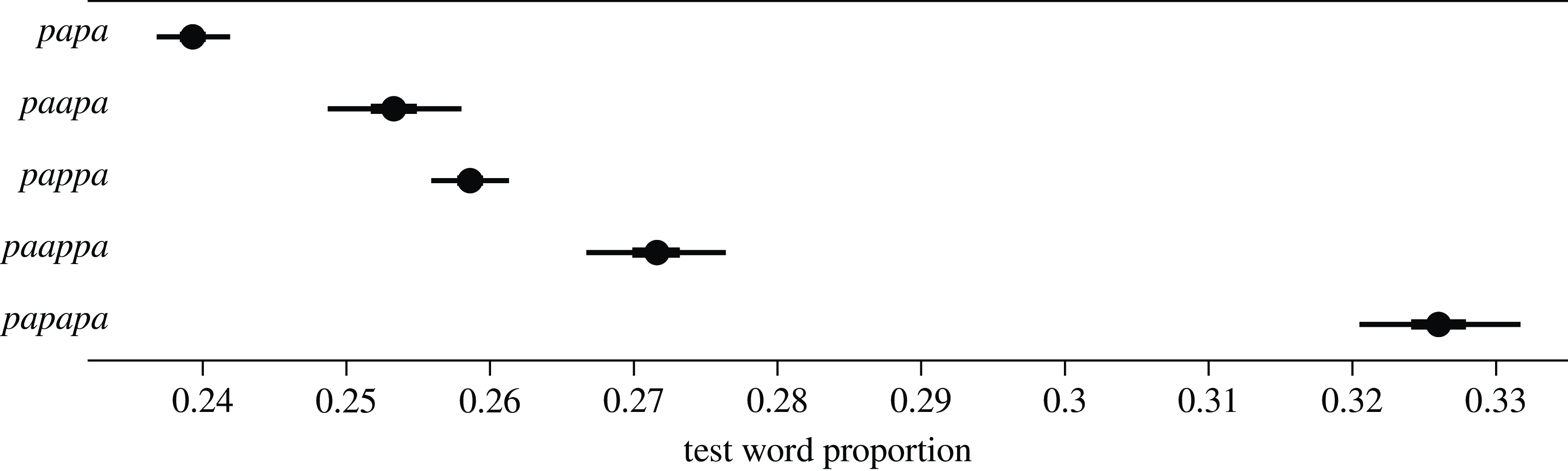
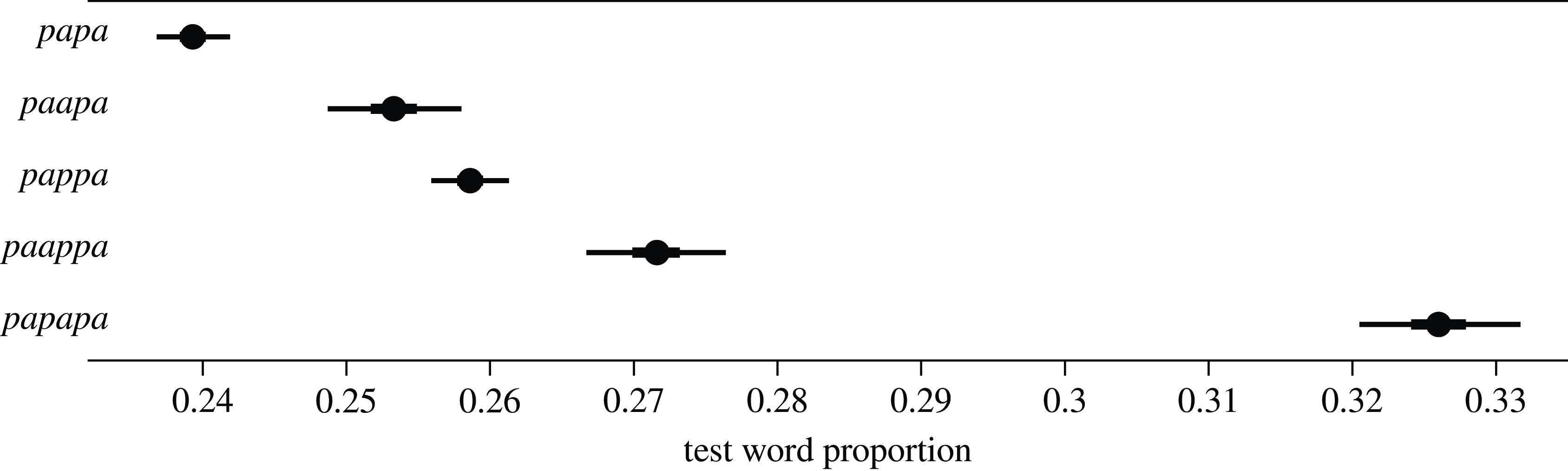
Figure 6 shows the estimated average test word proportion (posterior distribution) for each phrase. The thick line presents the 50 % credible interval (CI), the thin line presents the 95 % CI, and the dot represents the median. As can be seen in the figure, papapa clearly has a larger proportion than the other test words. Test word paappa is closer to the test words 1–3, but its proportion is clearly larger than their proportions. The proportion of papa is also clearly smaller than that of the other test words. Test words paapa and pappa have almost the same average proportions (Table 2), but the posterior distribution in Figure 6 shows that it is likely that pappa has a somewhat larger proportion than paapa. In fact, the posterior probability that average test word proportion is greater for pappa than for paapa is
 $$p = 0.973$$
; for all other adjacent pairs in Table 2, the posterior probability is
$$p = 0.973$$
; for all other adjacent pairs in Table 2, the posterior probability is
 $$p \gt 0.999$$
that the average test word proportion is larger for the latter phrase.
$$p \gt 0.999$$
that the average test word proportion is larger for the latter phrase.
Estimated (posterior) average test word proportion (subject effects removed).
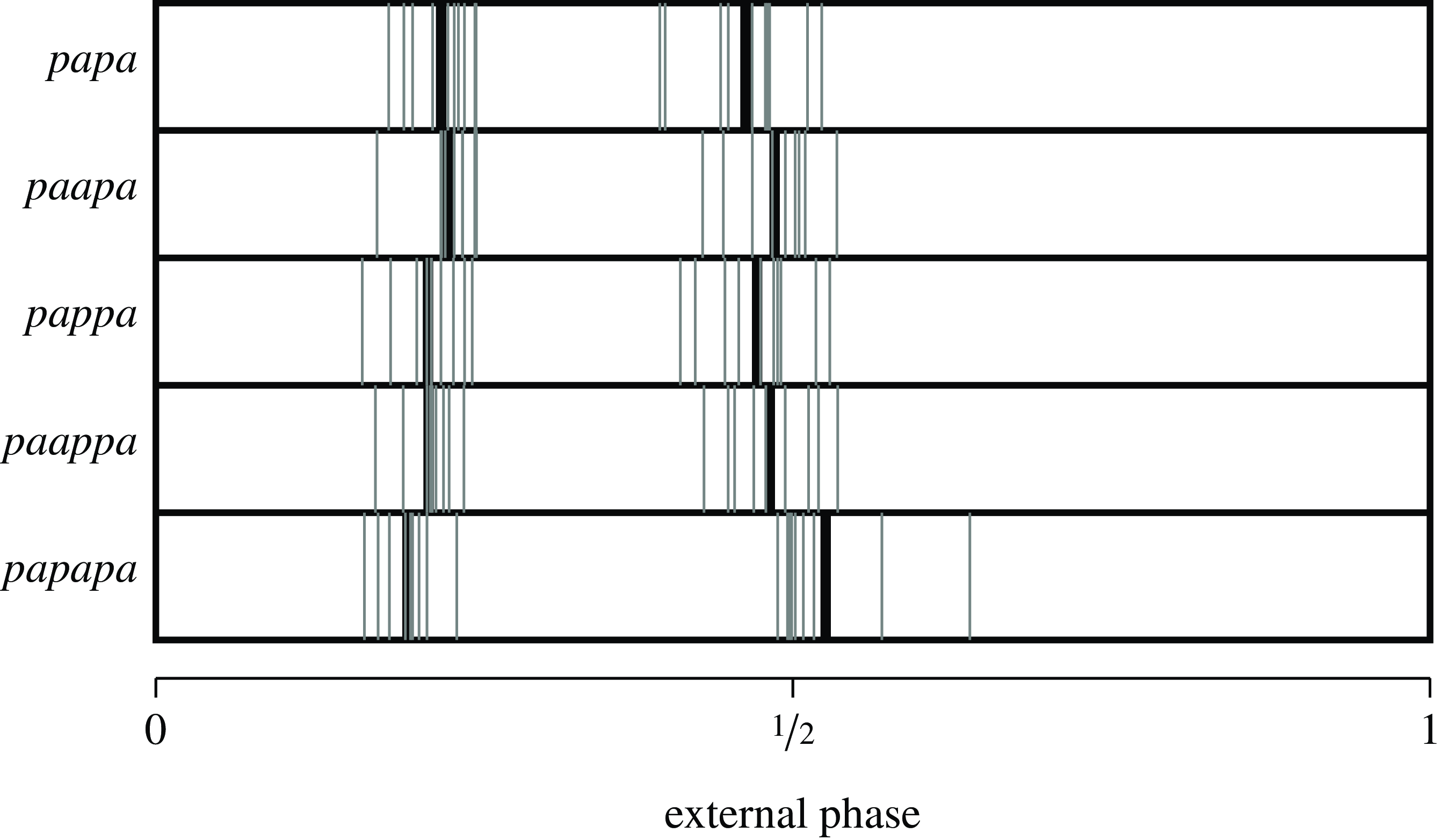
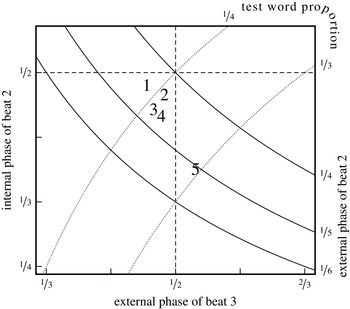
Average timing, i.e. the alignment of the onsets to the phases of the cycle, is shown as bar plots in Figure 7. The figure shows average external phases (i.e. alignment in relation to the cycle) for beat 2 and beat 3 in black and the means of individual speakers in grey. Figure 8 presents the average timing as scatterplots so that the internal phase of beat 2 is on the
 $$y$$
axis, the external phase of beat 3 on the
$$y$$
axis, the external phase of beat 3 on the
 $$x$$
axis, the external phase of beat 2 on the black curved lines, and the test word proportion on the dotted curved lines.
$$x$$
axis, the external phase of beat 2 on the black curved lines, and the test word proportion on the dotted curved lines.
Bar plots for beat 2 and beat 3, averaged over all subjects, shown as thick bars. Individual subject averages in grey.
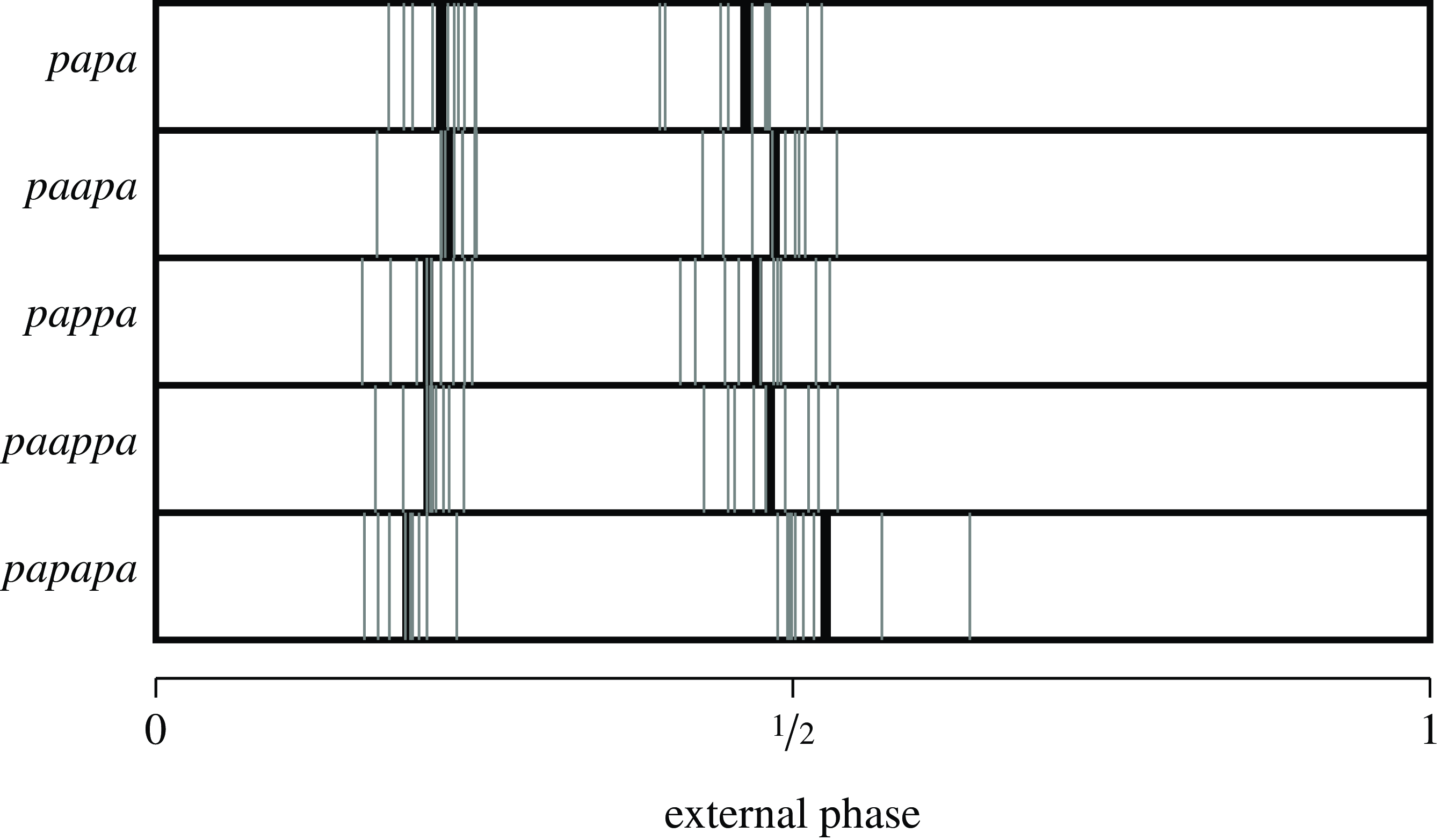
Figure 7 Long description
The line graph displays the external phase on the x axis, ranging from 0 to 1, with key points at 0, 1/2, and 1. The y axis lists different patterns: papa, paapa, pappa, paappa, and papapa. Each pattern is represented by a series of vertical lines indicating specific data points. The lines vary in thickness and density, with some patterns showing more concentrated lines around certain external phase values. All values are approximated.
Tajima-type scatterplot, averaged over all subjects (test phrases
 $$1 = papa$$
,
$$1 = papa$$
,
 $$2 = paapa$$
,
$$2 = paapa$$
,
 $$3 = pappa$$
,
$$3 = pappa$$
,
 $$4 = paappa$$
,
$$4 = paappa$$
,
 $$5 = papapa$$
).
$$5 = papapa$$
).
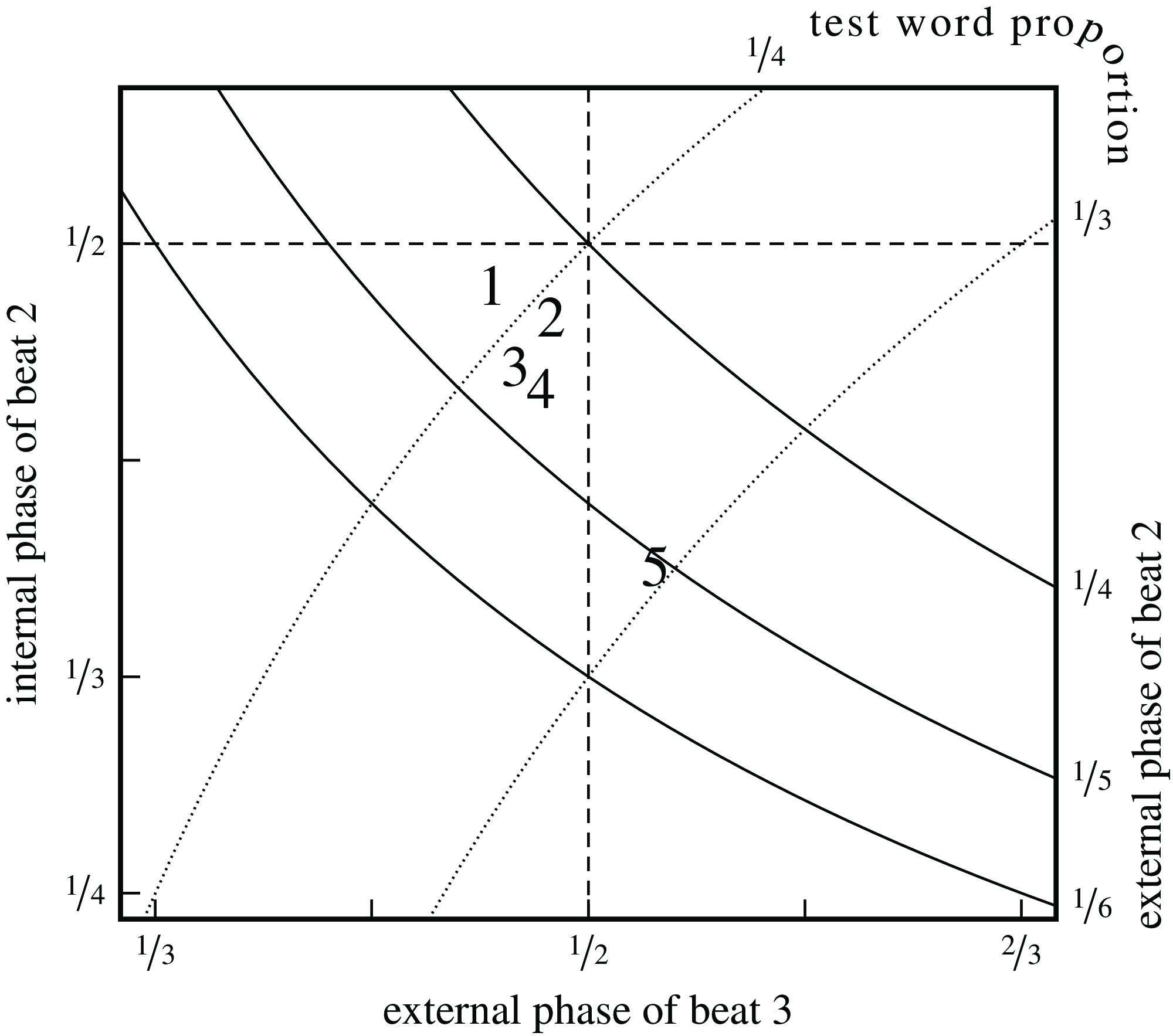
Figure 8 Long description
A line graph titled 'test word proportion' displays the relationship between the internal phase of beat 2 on the y-axis and the external phase of beat 3 on the x-axis. The graph features multiple curved lines intersecting at various points, with regions labeled 1 through 5. Dotted lines mark specific values such as 1/2, 1/3, and 1/4 on both axes. The graph illustrates how different phases interact, with the labeled regions indicating distinct areas of interest. All values are approximated.
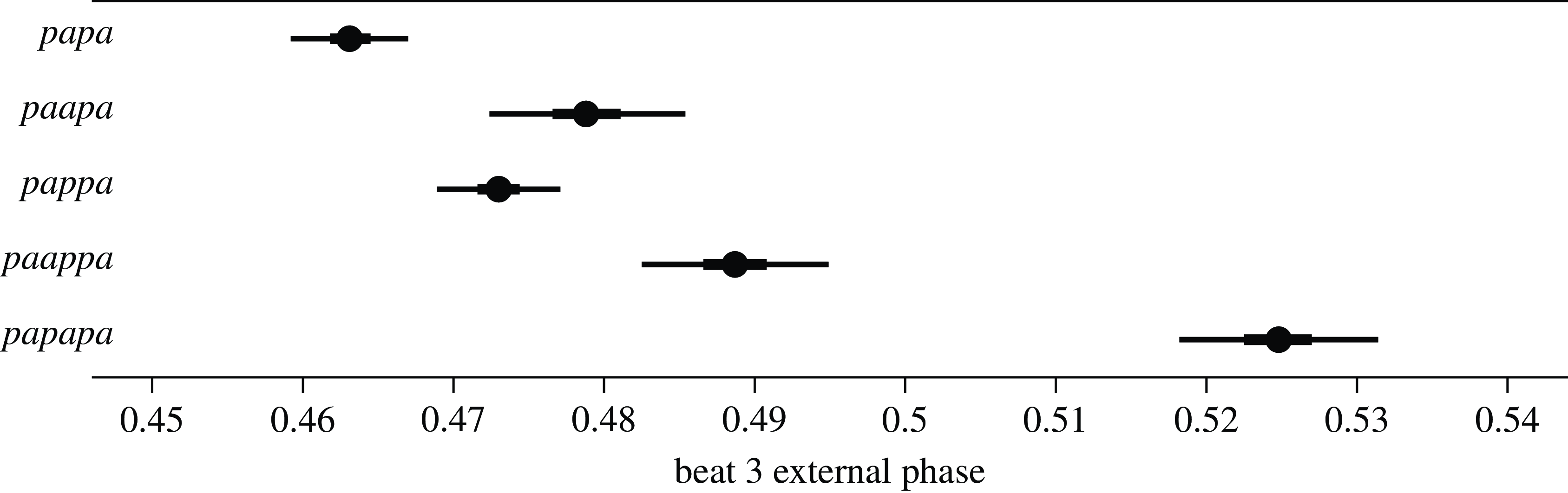
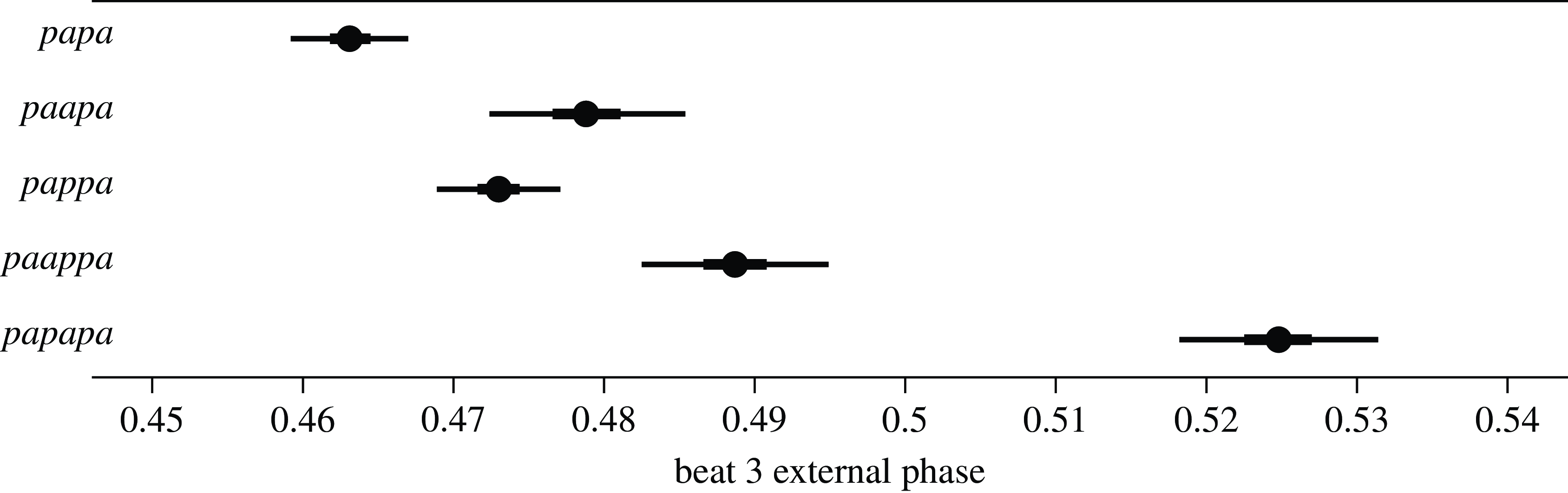
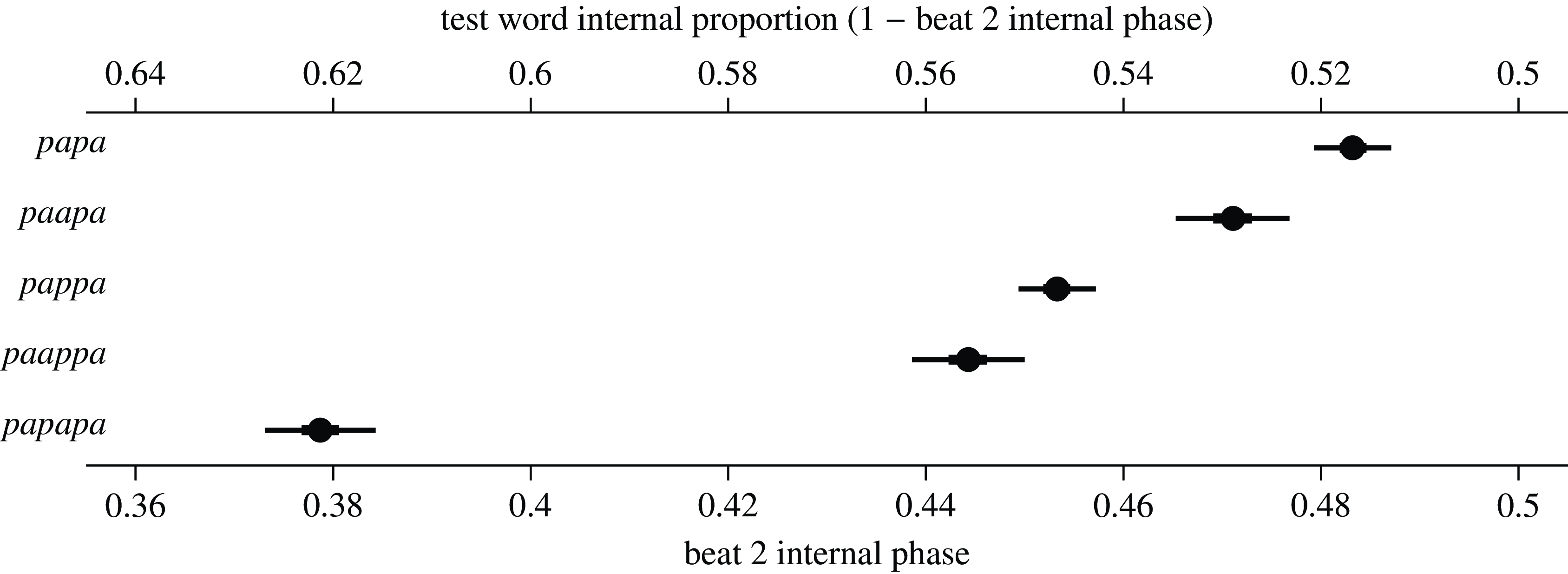
Figures 9, 10, and 11 show estimated (posterior) distributions of average phases for each phrase. As in Figure 6, the thick line in these figures indicates the 50 % CI, the thin line the 95 % CI, and the dot represents the median. Figures 9 and 10 show the external phases of beat 2 and beat 3, respectively. Figure 11 shows the internal phase of beat 2 and the proportion of the test word within the internal phase (1
 $$ - $$
the internal phase of beat 2).
$$ - $$
the internal phase of beat 2).
Estimated (posterior) average beat 2 external phase (subject effects removed).
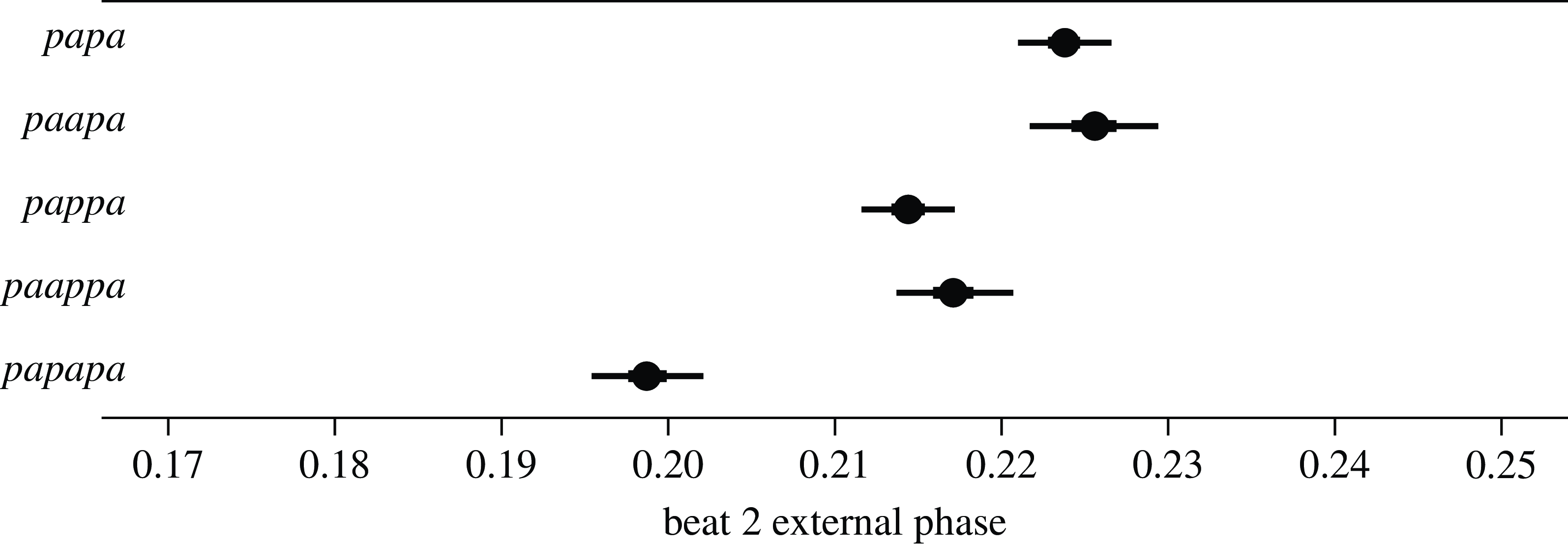
Figure 9 Long description
A horizontal dot plot displays the estimated average beat 2 external phase for different rhythm patterns. The x-axis represents the beat 2 external phase, ranging from 0.17 to 0.25. The y-axis lists five rhythm patterns: papa, paapa, pappa, paappa, and papapa. Each dot represents the average phase for a rhythm pattern, with horizontal error bars indicating variability. The rhythm patterns papa, paapa, pappa, paappa, and papapa have average phases around 0.20, 0.21, 0.22, 0.23, and 0.23 respectively. The dots for paapa and papapa show less variability compared to the others. All values are approximated.
Estimated (posterior) average beat 3 external phase (subject effects removed).
Estimated (posterior) average beat 2 internal phase (subject effects removed).
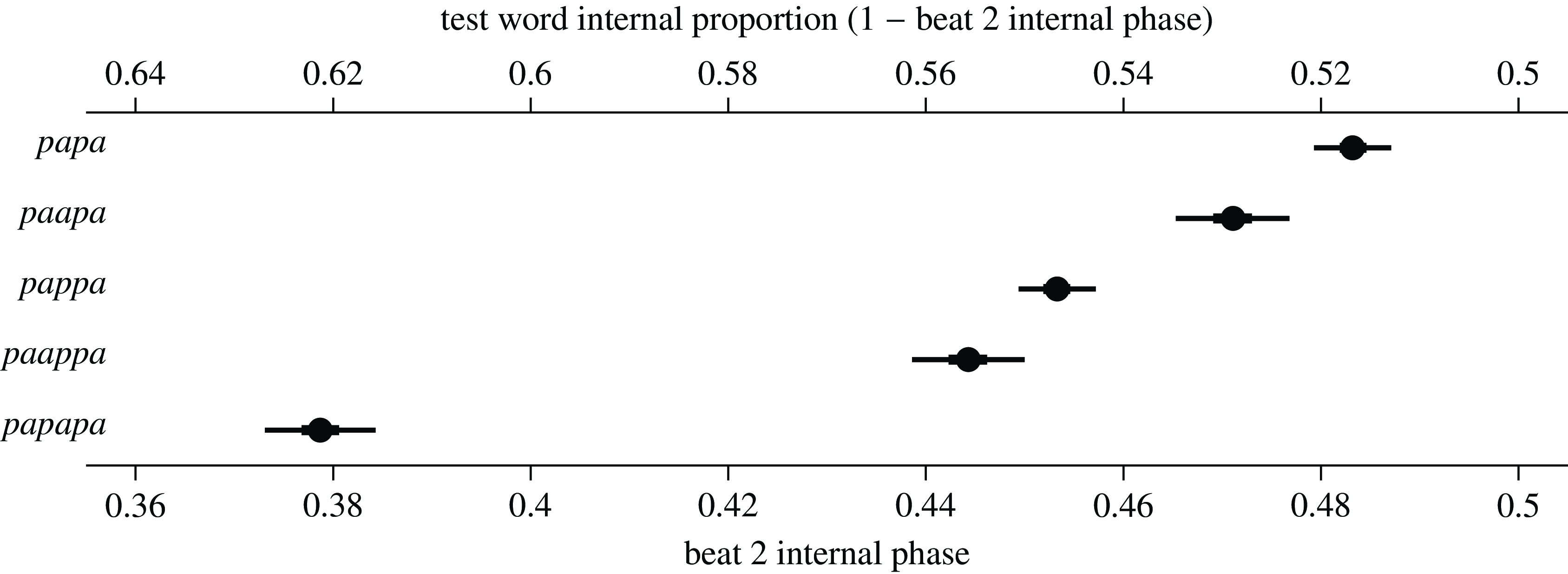
Figure 11 Long description
The dot plot displays the estimated average beat 2 internal phase for various word patterns, with subject effects removed. The x-axis represents the beat 2 internal phase, ranging from 0.36 to 0.5, while the y-axis lists different word patterns: papa, paapa, pappa, paappa, and papapa. Each dot represents the average internal phase for a specific word pattern, with error bars indicating the variability. The word pattern 'papa' has the lowest internal phase around 0.38, while 'papapa' has the highest around 0.48. The other patterns fall between these values, showing a gradual increase in internal phase as the word patterns lengthen. All values are approximated.
It can be clearly seen that the papapa phrase differs from the other phrases. While the other test words have their external phases for beat 2 between the 1/4 and 1/5 points, the posterior distributions in Figure 9 show that the papapa phrase has beat 2 placed on average around 1/5, and its posterior distribution is very separate from the other test phrases. The posterior probability is
 $$p \gt 0.999$$
that the beat 2 external phase for papapa is earlier than for any other phrase.
$$p \gt 0.999$$
that the beat 2 external phase for papapa is earlier than for any other phrase.
The difference is even clearer for beat 3, whose external phase is earlier than 1/2 for phrases 1–4 and later for phrase 5. This means that papapa takes time from tämä and pushes beat 3 further, as can be seen in Figure 7. The posterior distributions in Figure 10 indicate that beat 3 for the papapa phrase is quite different from the other phrases. The posterior probability is
 $$p \gt 0.999$$
that the beat 3 external phase for papapa is later than for any other phrase. The posterior probability is also
$$p \gt 0.999$$
that the beat 3 external phase for papapa is later than for any other phrase. The posterior probability is also
 $$p \gt 0.999$$
that the beat 3 external phase for papa is earlier than for any other phrase. The other phrases also differ, although there is more overlap in their posterior distributions. The paapa phrase probably has slightly later beat 3 external phase than pappa (posterior probability
$$p \gt 0.999$$
that the beat 3 external phase for papa is earlier than for any other phrase. The other phrases also differ, although there is more overlap in their posterior distributions. The paapa phrase probably has slightly later beat 3 external phase than pappa (posterior probability
 $$p = 0.926$$
) and paappa probably has later beat 3 external phase than paapa (
$$p = 0.926$$
) and paappa probably has later beat 3 external phase than paapa (
 $$p = 0.984$$
).
$$p = 0.984$$
).
Another way to observe the effect of the number of syllables or morae to the beats is the internal phase of beat 2, i.e. the alignment of the medial beat between the phrase onset and the onset of the word following the test word. The average internal phase of beat 2 also separates the different phrases (Figure 11). The posterior probability that the average beat 2 internal phase is greater for pappa than for paappa is
 $$p = 0.994$$
. For all other adjacent pairs (in the order of Table 2), the posterior probability is
$$p = 0.994$$
. For all other adjacent pairs (in the order of Table 2), the posterior probability is
 $$p \gt 0.999$$
that the average beat 2 internal phase is earlier for the latter phrase. The internal phase of beat 2 for phrases 1–4 is closer to 1/2, whereas for the papapa phrase it is nearer to 1/3 (Figure 8).
$$p \gt 0.999$$
that the average beat 2 internal phase is earlier for the latter phrase. The internal phase of beat 2 for phrases 1–4 is closer to 1/2, whereas for the papapa phrase it is nearer to 1/3 (Figure 8).
The pappa and paappa phrases are grouped close to each other both for the internal and external phase of beat 2, whereas the papa and paapa phrases are close for the external phase of beat 2 but more distinct from each other for the internal phase of beat 2, as can be seen in Figures 9 and 11. Interestingly, the beat 2 external phase for pappa is earlier than for paapa with high probability (posterior probability
 $$p \gt 0.999$$
), so that the beat 2 external phase roughly divides the phrases into three groups: {papa, paapa}
$$p \gt 0.999$$
), so that the beat 2 external phase roughly divides the phrases into three groups: {papa, paapa}
 $$ \gt $$
{pappa, paappa}
$$ \gt $$
{pappa, paappa}
 $$ \gt $$
{papapa}. This means that the paapa and pappa phrases do not behave identically, despite their words having the same number of morae and an average proportion with only a 0.1 percentage point difference. Test word paapa generally has a later timing than pappa, as can be seen in Figure 7.
$$ \gt $$
{papapa}. This means that the paapa and pappa phrases do not behave identically, despite their words having the same number of morae and an average proportion with only a 0.1 percentage point difference. Test word paapa generally has a later timing than pappa, as can be seen in Figure 7.
4.2 Between-speaker differences
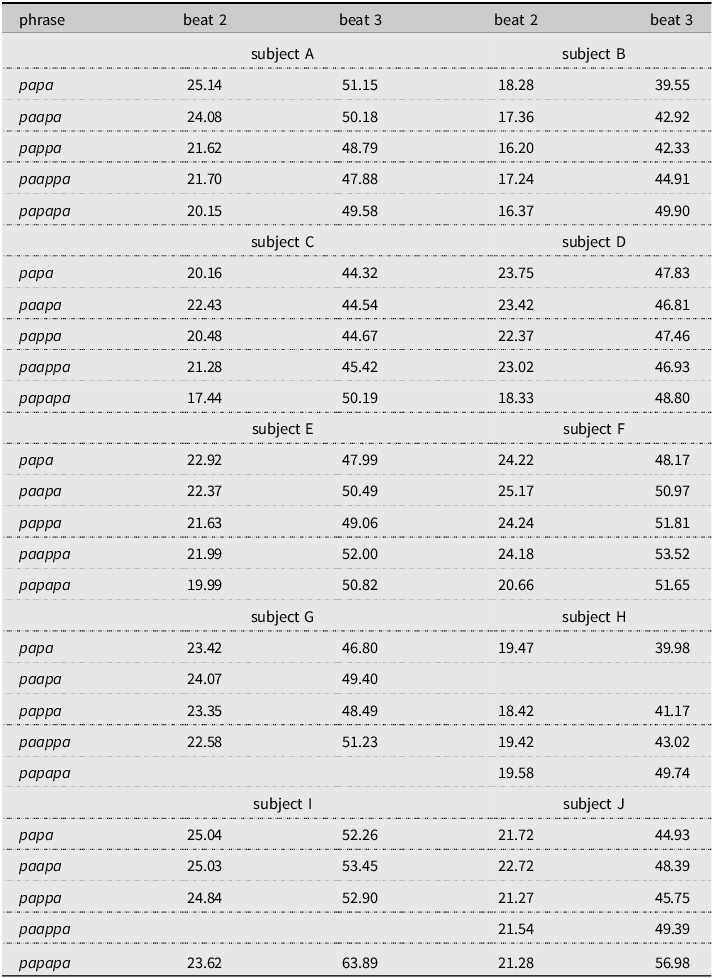
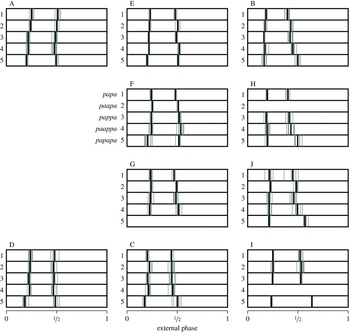
The ten speakers show different timing strategies. Their relative timings are shown numerically in Table 3. The external phases for each speaker are shown as bar plots in Figure 12, which shows the average beats in black and the beats in individual repetitions in grey. Figure 13 shows the relative timing for each speaker in a style similar to Tajima (Reference Tajima1998) so that the internal phase of beat 2 is on the
 $$y$$
axis, the external phase of beat 3 on the
$$y$$
axis, the external phase of beat 3 on the
 $$x$$
axis, the external phase of beat 2 on the black curved lines, and the test word proportion on dotted curved lines. Phrase 5 (papapa) is missing for speaker G, because G had difficulties producing this phrase. Phrase 2 (paapa) is missing for speaker H and phrase 4 (paappa) is missing for speaker I due to technical failures in recording.
$$x$$
axis, the external phase of beat 2 on the black curved lines, and the test word proportion on dotted curved lines. Phrase 5 (papapa) is missing for speaker G, because G had difficulties producing this phrase. Phrase 2 (paapa) is missing for speaker H and phrase 4 (paappa) is missing for speaker I due to technical failures in recording.
Average external phases of beat 2 and beat 3 for each subject (%)
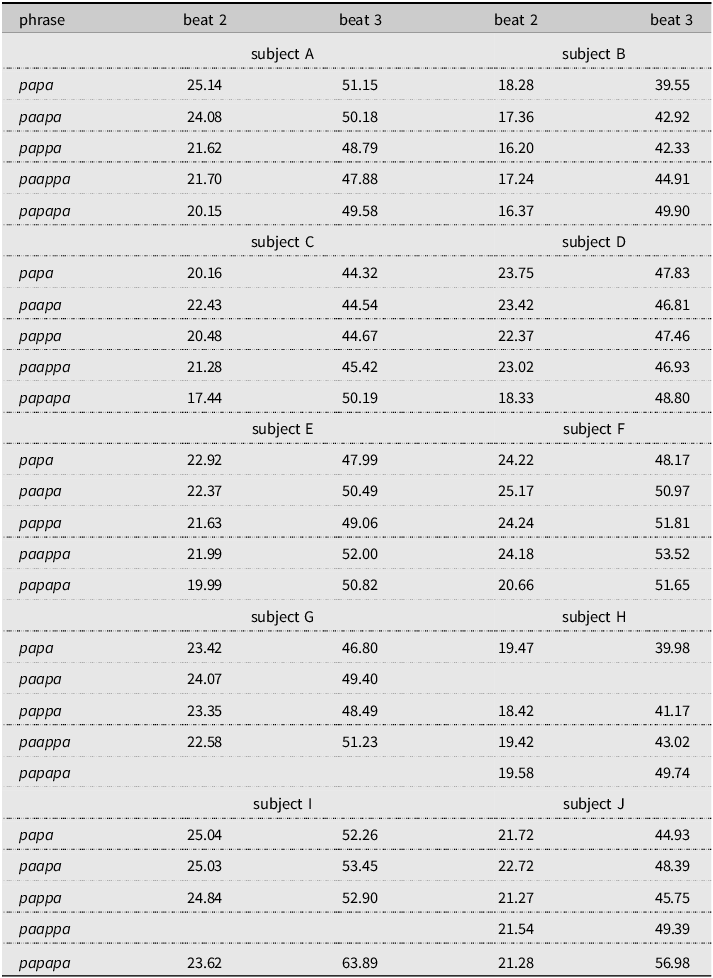
Table 3 Long description
The table presents the average external phases of beat 2 and beat 3 for each subject, measured in percentages. It includes data for ten subjects labeled A through J. Each subject's data is divided into five phrases: papa, paapa, pappa, paappa, and papapa. The table has ten rows for each subject and five columns for each phrase, with two beats measured for each phrase. Notable trends include variations in timing strategies across different subjects and phrases. For instance, subject A shows a significant difference between beat 2 and beat 3 across all phrases, while subject B exhibits a more consistent pattern. Subject G is missing data for the phrase papapa due to difficulties in production, and subjects H and I have missing data for phrases paapa and paappa, respectively, due to technical recording failures.
Bar plots for individual subjects (test phrases
 $$1 = papa$$
,
$$1 = papa$$
,
 $$2 = paapa$$
,
$$2 = paapa$$
,
 $$3 = pappa$$
,
$$3 = pappa$$
,
 $$4 = paappa$$
,
$$4 = paappa$$
,
 $$5 = papapa$$
). Average timing is shown as thick bars and individual repetitions in grey.
$$5 = papapa$$
). Average timing is shown as thick bars and individual repetitions in grey.
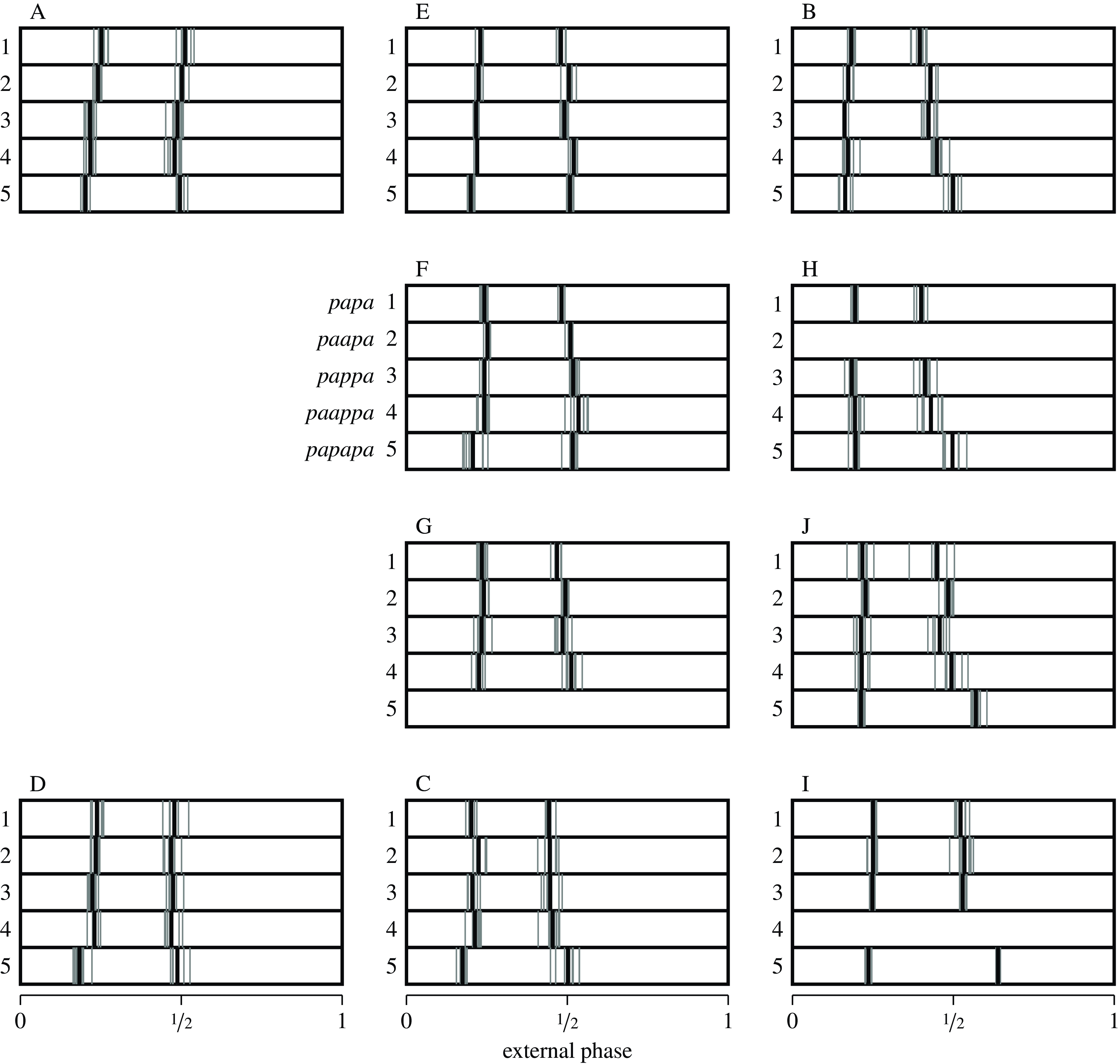
Figure 12 Long description
The image contains multiple bar plots labeled A, B, C, D, E, F, G, H, I, and J. Each plot represents individual subjects with test phrases labeled as 1, 2, 3, 4, and 5. The average timing is shown as thick bars, while individual repetitions are depicted in grey. The x-axis represents the external phase, and the y-axis represents the timing. The plots illustrate the timing variations for each test phrase across different subjects. All values are approximated.
Tajima-type scatterplots for individual subjects (test phrases
 $$1 = papa$$
,
$$1 = papa$$
,
 $$2 = paapa$$
,
$$2 = paapa$$
,
 $$3 = pappa$$
,
$$3 = pappa$$
,
 $$4 = paappa$$
,
$$4 = paappa$$
,
 $$5 = papapa$$
).
$$5 = papapa$$
).
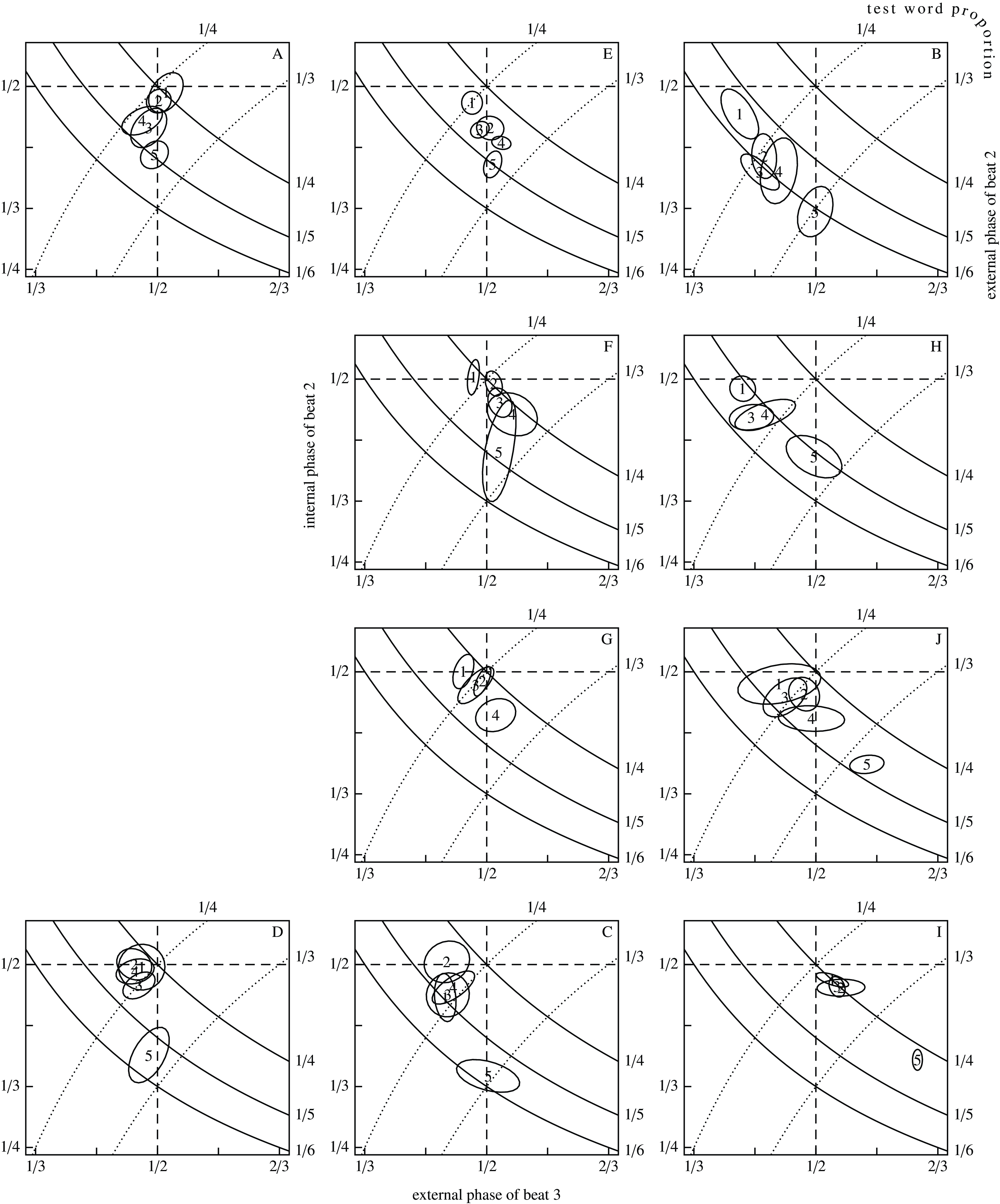
Figure 13 Long description
A scatter plot showing the relationship between the internal phase of beat 2 and the external phase of beat 3 for different test phrases. The plot contains several data points grouped into clusters labeled 1 through 5, representing test phrases papa, paapa, pappa, paappa, and papapa respectively. The x-axis represents the external phase of beat 3, ranging from 1/3 to 2/3, while the y-axis represents the internal phase of beat 2, ranging from 1/6 to 1/2. The plot includes dashed lines indicating specific phase values and curved lines representing different test word proportions. The data points form distinct clusters, indicating the adaptation of speech to periodic stimuli. The overall trend shows how different test phrases align with specific phases in the cycle, revealing the hierarchical structure of speech rhythm. All values are approximated.
Speakers I and D are the most syllable-timed. Their timings are very similar for the phrases with a two-syllable test word, but their papapa phrases are different: for I, papapa pushes beat 3 further and keeps the external phase of beat 2 near 1/4, whereas for D papapa takes time away from tämä, moving the external phase of beat 2 from near 1/4 to earlier than 1/5 (Figures 12 and 13). For both speakers the internal phase of papapa is closer to 1/3, whereas for the other phrases it is 1/2 (Figure 13). Speaker C is also very syllable-timed, and he combines the movements caused by papapa as shown by speakers I and D, since for him, the test word takes time away from tämä and also pushes beat 3 forward. An interesting aspect of C’s timing is that his beat 2 in the paapa phrase is over 2 percentage points later than in his papa and pappa phrases, but the timing of beat 3 is not affected, meaning that the proportion of paapa is smaller.
Speaker A is the most stressed-timed. Her external phase of beat 3 is stable near 1/2. Her external phase of beat 2 shifts from near 1/4 closer to 1/5 (Figure 12), but the relation between the timing of beat 2 and beat 3 is almost the same for each phrase (Table 3), which suggests that she has just produced the first two phrases in a slower tempo. Only papapa causes a little more movement in the phases. However, the changes in the internal phase (Figure 13) do not support stress-timing. Speaker E can also be seen to have features of stress-timing for similar reasons to A (Figure 12), but he also has more changes due to the morae, which also groups him close to speaker F (Table 3), who is probably the most mora-timed speaker. For speaker F, the paapa and pappa phrases have later external phases for beat 3 than the papa phrase does, and the paappa phrase has them even later. In these speakers’ timing, the papapa phrase is close to the paappa phrase in having a similar kind of relation between the external phases of beat 2 and beat 3, but the difference between these two phrases is that for both speakers beat 2 of the papapa phrase comes earlier, which enables beat 3 to come earlier as well compared to the paappa phrases (Figure 12 and Table 3). Speaker G also looks mora-timed because for him the paapa and pappa phrases have later timing for beat 3 than the papa phrase does, and the paappa phrase has it even later. The internal phase of G’s paappa phrase also speaks for mora-timing, as it is earlier than that of the other phrases (Figure 13). (G’s fifth phrase was left out, as G had difficulties with the test word, producing it as [pɑˈpɑpːɑ].)
Speakers B, H, and J are between mora-timing and syllable-timing. As can be seen in Figure 13, for them, adding a mora affects the external phase of beat 3, making it later in the paapa and pappa phrases than in the papa phrase (H’s paapa phrase is missing due to technical problems), and in their paappa phrases it is even later. However, papapa in turn makes the external phase of beat 3 later. The internal phases of beat 2 of their phrases 1–4 also show evidence of mora-timing. On the other hand, all of them have overlap in the variation of some of the beats: speaker B has overlap in phrases 2–4, speaker H in phrases 3 and 4, and speaker J in phrases 1–3. Their external phases of beat 2 are quite stable.
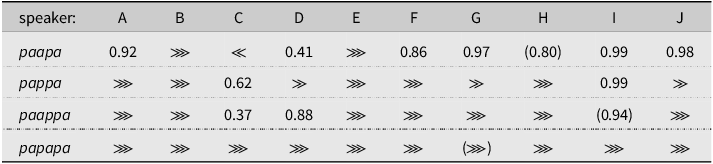
Since the timing of the internal phase suggests the degree of stress-timing, it is instructive to look at speakers’ posterior probabilities for the internal phase of beat 2, presented in Tables 4 and 5. In these tables, probabilities involving missing cases (papapa for G, paapa for H, and paappa for I) are enclosed in parentheses as a reminder, although in the Bayesian statistical analysis posterior probabilities are computed for these cases as well.
Posterior probability for individual speakers that the average beat 2 internal phase is later than the average beat 2 internal phase for papapa
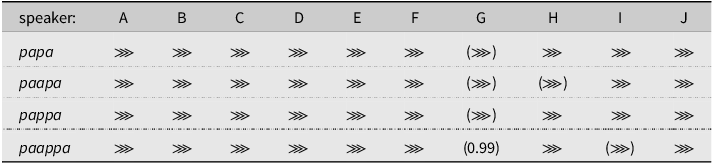
Table 4 Long description
A table displays posterior probabilities for individual speakers labeled A through J. The table compares the probabilities for different syllable patterns: papa, paapa, pappa, and paappa. Arrows indicate the direction of the probabilities, with some values enclosed in parentheses, suggesting missing cases. The table provides a visual representation of the timing of internal phases, which is related to the degree of stress-timing in speech.
⋙:
 $$p \gt 0.999$$
.
$$p \gt 0.999$$
.
Posterior probability for individual speakers that the average beat 2 internal phase is earlier than the average beat 2 internal phase for papa
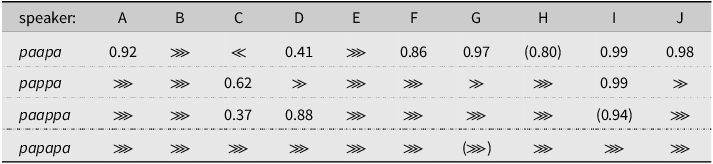
Table 5 Long description
A table with ten columns labeled A through J and four rows labeled paapa, pappa, paappa, and papapa. The table shows posterior probabilities for individual speakers that the average beat 2 internal phase is earlier than the average beat 2 internal phase for papa. Each cell contains a probability value or an arrow symbol indicating directionality. Probabilities involving missing cases are enclosed in parentheses. Notable values include high probabilities for speakers A, F, and J across different beats, while speakers C and G show lower probabilities. The table provides insights into the timing of internal phases and stress-timing across different speakers.
⋙:
 $$p \gt 0.999$$
, ≫:
$$p \gt 0.999$$
, ≫:
 $$p \gt 0.99$$
, ≪:
$$p \gt 0.99$$
, ≪:
 $$p \lt 0.01.$$
Table 4 shows the posterior probability for individual speakers that the average internal phase of beat 2 in phrases 1–4 is later than the average internal phase for papapa. As can be seen, the probability for the internal phase of beat 2 of being later than the average internal phase of papapa is
 $$p \gt 0.999$$
for every speaker for every phrase, whose data was collected. This means that an additional syllable in the test word affects timing.
$$p \gt 0.999$$
for every speaker for every phrase, whose data was collected. This means that an additional syllable in the test word affects timing.
Table 5 shows the posterior probability for individual speakers that the average internal phase of beat 2 for phrases 2–5 is earlier than the average internal phase of beat 2 for the papa phrase. More variation between the speakers than in Table 4 can be seen here, although for most of the pairs the posterior probability is
 $$p \gt 0.999$$
. Speaker C deviates from this pattern the most; for this speaker there is a high posterior probability (
$$p \gt 0.999$$
. Speaker C deviates from this pattern the most; for this speaker there is a high posterior probability (
 $$p \approx 0.999$$
) that the average internal phase of beat 2 for papa is actually later than for paapa. The test word paapa exhibits the most variation among speakers and the lowest probability overall of having an earlier internal phase than papa. The most unified test word for all speakers is papapa, whose probability of having an earlier internal phase than papa is
$$p \approx 0.999$$
) that the average internal phase of beat 2 for papa is actually later than for paapa. The test word paapa exhibits the most variation among speakers and the lowest probability overall of having an earlier internal phase than papa. The most unified test word for all speakers is papapa, whose probability of having an earlier internal phase than papa is
 $$p \gt 0.999$$
for all speakers.
$$p \gt 0.999$$
for all speakers.
5. Discussion
The speech cycling task was successful, which could not be known beforehand, as speech cycling has not been easy to carry out in all languages, as noted by Cummins (Reference Cummins, Bel and Marlien2002). The task appeared strange to the speakers, and some required several takes, but every speaker managed to produce all phrases, except for speaker G, whose papapa phrase was considered to deviate from the target so much that it was left out of the analysis. Although no speaker was able to follow the instructions not to breathe between cycles, this did not appear to hinder the rhythmical production, and the productions fell into the regular form that is sought in speech cycling. It can be concluded that speech cycling fits Finnish, and it also makes units visible that may have relevance for Finnish rhythm and mora count.
5.1 Timing of the CVVC syllable in Finnish
One of the research questions was to observe the effects of the mora in Finnish rhythm. This was done by using test words that differed from each other in both syllable and mora count (e.g. papa vs. pappa vs. papapa) and quantity shape (paapa vs. pappa vs. paappa). The question with the test word paappa was to observe whether its quantity shape tends towards the trimoraic two-syllable test words (paapa and pappa), towards the trimoraic three-syllable test word (papapa), or whether it has another kind of timing.
The test word paappa was on average 400.3 ms, which is shorter than the three-syllable papapa (485.2 ms) but longer than the two-syllable paapa (382.9 ms) and pappa (385.7 ms). However, it is closer to the bimoraic two-syllable words than to the trimoraic, three-syllable word. The mean proportion of paappa is 26.8, which is closer to those of paapa (25.7) and pappa (25.8) than that of papapa (32.8) (the durations and proportions are presented in Table 2). The posterior distributions in Figure 6 show that the proportion of paappa is between the test words 1–3 on the one hand and papapa on the other. In order to have four morae, paappa would be expected to be even longer than papapa, which is not the case. When looking at the averages of the individual speakers (presented graphically in Figure 12), the proportions of paappa vary. For some speakers, paappa is grouped together with the two-syllable test words. For example, for speaker A, all four test words have their proportion within a little over 1 percentage point, and for C, paappa is almost the same as pappa and papa, whereas papapa has a bigger proportion. For some speakers, papapa is grouped together with paappa. For E, for example, they are almost identical. For D, paappa has a smaller proportion than pappa.
The durational differences between these three words are also not big enough to support the multimoraic hypothesis in Finnish. This means that similarly to the fact that words can have the same quantity but a different duration, words that have a different quantity can have the same mora count. These findings can be interpreted to suggest that a coda consonant is a mora in Finnish if it follows a short vowel but not if it follows a long vowel. Thus, in CVVCCV the VC sequence shares one mora. Sharing a mora between two segments is common in languages (Hubbard Reference Hubbard1995, Nam Reference Nam, Cole and Ignacio Hualde2004). It also supports the bimoraic hypothesis, according to which Finnish syllables can be divided into groups having one mora or two morae, and all syllables having more than one mora are seen as bimoraic regardless of the number of their segments, as opposed to the multimoraic hypothesis, in which each segment increases the mora count one by one. This conclusion is the same as that of O’Dell et al. (Reference O’Dell, Lennes, Nieminen, Barbosa, Madureira and Reis2008).
5.2 Re-visiting the Finnish rhythm type
The speech cycling task exhibited units that can be seen as the basis of linguistic rhythm. The results were not unexpected for speech cycling: conclusive evidence for or against a single rhythm type did not emerge but there was an indication of components on which the rhythm can be considered to be based.
The test word papapa has an earlier external phase for beat 2 than the other test words, which is compatible with syllable-timing. Within the phrase, syllable-timing is not seen in the two-syllable test words, as different test words shift beat 3 differently. This is understandable, because due to quantity differences pure syllable-timing is not expected without heavy durational compensation, which does not happen here. Some individual speakers, however, are very close to syllable-timing (D, I).
As expected, in general Finnish did not prove to be stress-timed, although in regard to the external phase, speaker A comes close to it. According to Tajima et al. (Reference Tajima, Zawaydeh, Kitahara and Ohala1999), Zawaydeh et al. (Reference Zawaydeh, Tajima, Kitahara, Parkinson and Benmamoun2002), and Tajima & Port (Reference Tajima, Port, Local, Ogden and Temple2003), in order to be interpreted as stress-timed, the internal phase of beat 2 should always be at 1/2, and neither speaker A nor any other speaker exhibited that. The internal phase decreased when the mora or syllable count increased, which means that the phase of the stressed syllable is not fixed, which in turn means that the proportion of the word that increases with the mora or syllable count also increases in duration. In pure stress-timing, the additional segments should be compressed, which did not happen in the present study.
Mora-timing can be seen in the results. Increasing quantity, i.e. adding a mora, increases the proportion of the test word and shifts the external phase for beat 3 further. Beat 2 is also timed earlier, except for paapa, for which it is timed later. One observation which speaks against mora-timing is the difference between the phrases with paapa and pappa. In pure mora-timing, they would be expected to be the same, which is not the case here. No rhythm theory proposes this kind of timing that is based on the quantity shape. These two test words have the same segments on every level (mora and syllable count, phoneme count, and phoneme identity) and almost the same proportion (although pappa has a greater probability of having a slightly greater proportion), so they should be expected to have the same timing as well. Although according to Lehtonen (Reference Lehtonen1970) segment durations vary between different quantity shapes, this should not affect timing when the vocalic onset is considered to serve as the beat that the speaker is assumed to place at some particular phase (Cummins & Port Reference Cummins and Port1998). Since the vocalic onset is what is placed at simple harmonic phases, the duration of the preceding consonant should not have an effect on that, but it should be expected to make room for the vocalic onset instead. This means that a possible difference in the duration of the initial [p] should not have any relevance.
The differences between speakers can also be a sign of mora-timing, as Tajima & Port (Reference Tajima, Port, Local, Ogden and Temple2003) found that Japanese speakers had different kinds of rhythm strategies, whereas English speakers all used the same strategy. This indicates that greater variation in timing may be due to mora-timing. On the other hand, Japanese has been the only putative mora-timed language investigated with speech cycling experiments so far. The relevance of the mora in Finnish rhythm may also be supported by the findings of O’Dell & Nieminen (Reference O’Dell, Nieminen and Calhoun2019) that in addition to the number of syllables, the number of morae affects perceived speech rate in Finnish.
Warner & Arai (Reference Warner and Arai2001b) note that in Japanese the number of segments were comparable with morae in determining a word’s duration. In the present study the phonemes were kept the same, so the grouping of the segments into quantity shapes can predict the duration, which means that the rhythm unit is the quantity shape. Because segmental timing differences in Finnish arose in speech cycling, they can be considered more important than the segments’ differences in Japanese: in Japanese those were observable in spontaneous speech (Warner & Arai Reference Warner and Arai2001b) but not in controlled carrier sentences (Port et al. Reference Port, Dalby and O’Dell1987), which suggests that in Finnish they are a more prominent part of the timing, as they are not erased in controlled speech. The effect of segments or phonemes on timing has also been noted by Yun (Reference Yun1998), who suggests that Korean could be described as segment- or phoneme-timed.
The number of feet was not varied in this study, but it is possible to draw some conclusions about feet based on the results. The timing of the phrases that contain a two-syllable test word is more similar to each other and differs from that of phrase 5, which has a three-syllable test word. For average papapa phrase, the test word has an earlier external and internal phase than the other four phrases but it also pushes the external phase of beat 3 further forward (see Figures 7 and 8 and Table 3). When looking at the individual subjects (Figures 12 and 13), it can be seen that papapa has a different external phase for many of them. For some of the subjects, beat 2 in the papapa phrase is close to that of the other phrases, while beat 3 moves further, whereas for some subjects beat 2 also moves back towards beat 1. There is no unified way to treat the timing in the papapa phrase.
If quantity alone determined the external phase of beat 2, we would not expect a big difference in it between papapa and the other test words. One explanation is that papapa breaks the two foot timing, which makes it take time from tämä as well as push beat 3 more than the two-syllable test words do. This suggests that the timing is based on feet of two syllables and not of two morae, as the difference in the mora count does not cause a similar change. This also fits the finding by Suomi & Ylitalo (Reference Suomi and Ylitalo2004) that three-syllable feet function differently from two-syllable feet.
This also fits into the final foot (beat 3) moving more in the papapa phrase than in the other phrases, because in the case of the papapa phrase, they are pushed by an additional syllable (or half of a foot), not by an additional mora. Based on this interpretation, an important unit in Finnish rhythm is a syllable-based foot, whose increasing quantity moves the beats of the other feet. Therefore, Finnish rhythm can be considered a combination of foot-timing and syllable-timing, as suggested for Estonian by Nolan & Asu (Reference Nolan and Liina Asu2009).
Tajima (Reference Tajima1998:102–103) considers isochrony as certain units being attracted to regular parts of the cycle. In his study, stressed syllables in English were placed on these attractors. In the present study, a fixed attractor for the beats in every phrase was not found, but the test words were grouped according to their syllable count both on average and for individual speakers, that is, papapa differed in its phases from the other test words. As the quantity shape affects every word differently, it is reasonable to say that true attractors were not found, which again speaks against stress-timing. On the other hand, in the present study the speakers were not asked to imitate waltz rhythm, as in Tajima (Reference Tajima1998) and Tajima & Port (Reference Tajima, Port, Local, Ogden and Temple2003); they were not given instructions on how to organise their utterance, which may affect the emergence of attractors.
6. Conclusions
The results do not put Finnish into any individual rhythm type, which is an expected outcome in a speech cycling study. The traditional view of Finnish being syllable-timed is not completely true, but it cannot be denied either. The syllable has an effect but there are other factors as well.
As was expected, speech cycling did not provide clear proof of isochrony or that Finnish behaves according to a certain rhythm type: instead it exhibited different units that form the timing of Finnish. Both the mora and the syllable were shown to have relevance in timing. Morae and syllables affect phases of the beats differently. Increasing the syllable count moves beat 3 more than increasing the mora count, but it also moves beat 2 back, as a bigger proportion of the three-syllable word is reflected in the phases. Segments also have an effect, because they produce differences within the same mora count, making the phases of the paapa and pappa phrases differ from each other, which was not expected.
Based on these results, Finnish rhythm is a combination of syllable-timing and mora-timing, which favours two-syllable feet. The fact that the speakers managed the speech cycling task also tells something about Finnish rhythm on a broad level. Speech cycling clearly brought forth possible rhythm units in Finnish.
Acknowledgements
I present thanks to the four anonymous peer reviewers for their constructive feedback and to Michael L. O’Dell for his help with the figures and statistical analysis. This study was funded by the Emil Aaltonen Foundation.

 1=papa
 2=paapa
 3=pappa
 4=paappa
 5=papapa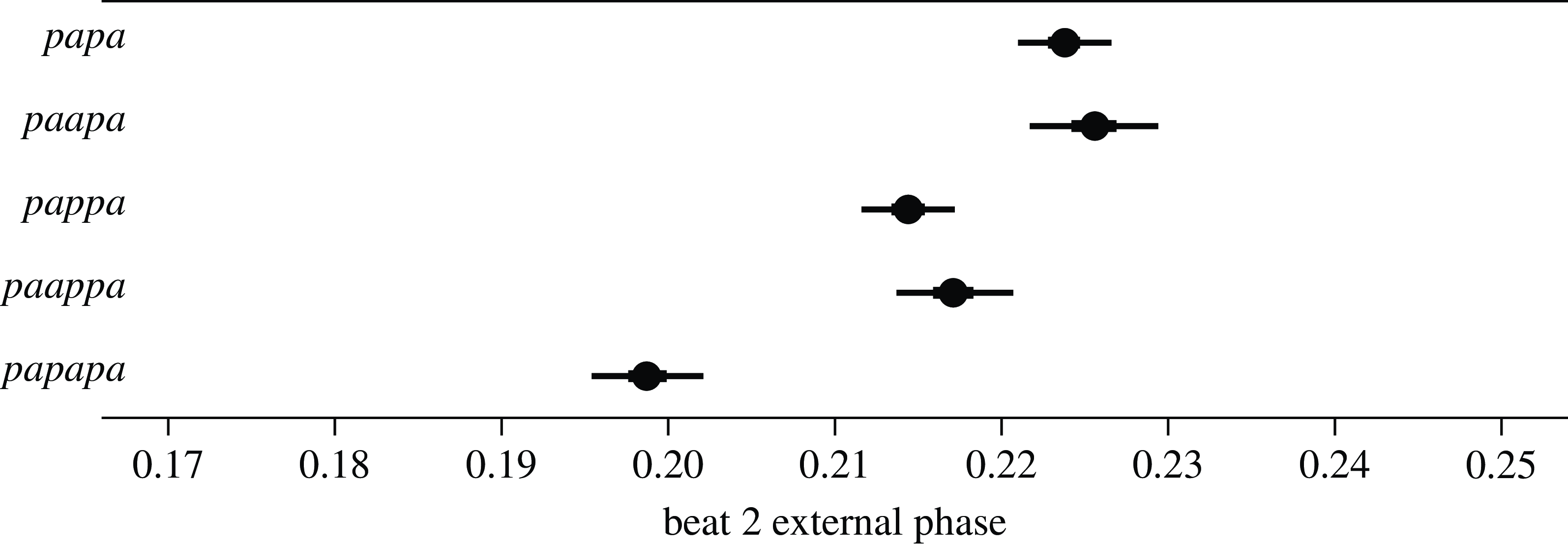
 1=papa
 2=paapa
 3=pappa
 4=paappa
 5=papapa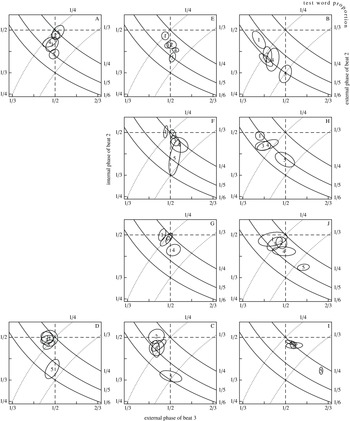
 1=papa
 2=paapa
 3=pappa
 4=paappa
 5=papapa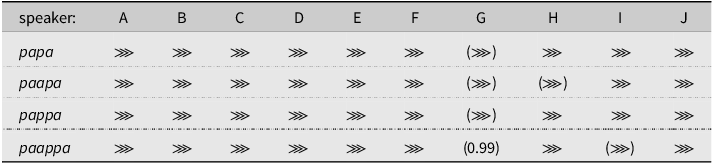

 Open access

