




Introduction
On 13 May 1835, the Portuguese Minister of Foreign Affairs informed the Minister of the Realm that a ship carrying Azorean migrants had arrived in the British West Indies (BWI). According to the former, a joint-stock company was promoting “the emigration of European labourers to [British] colonies, to address the labour shortage caused by the end of the slave trade and, more recently, the Emancipation of enslaved people”.Footnote 1 This was a serious concern because the “unfortunate individuals recruited are being sent to a tropical climate, where only Africans can endure the type of work required of them”.Footnote 2
Several pieces of evidence suggest that this migratory flow had begun a few months earlier. On 20 July 1834, “the first forty-four Azorean Portuguese labourers landed at Las Cuevas on the northern coast of Trinidad”.Footnote 3 Between September and October 1834, another three ships carried Azoreans to Trinidad, and, on 12 November 1834, twenty-eight Madeirans left on the Stralhista to the same destination. On 11 February 1835, another thirty-two Madeirans migrated to Trinidad.Footnote 4 On 3 May 1835, “the Louisa Baillie docked in the Demerara River bringing in her hold the first forty Madeiran agricultural labourers to British Guiana”.Footnote 5 This marked the beginning of a migratory flow that intensified in the early 1840s.
Also in 1835, the Brazilian Minister of Foreign Affairs requested the Brazilian vice-consuls stationed in the Azores to support the captain of the Maria Adelaide ship, responsible for engaging and transporting Azorean labourers to Brazil. On 5 September 1835, the Maria Adelaide arrived in Rio de Janeiro with 222 Azorean migrants. Upon arrival, those unable to afford the travel fares were forbidden to disembark until hired by an employer, who paid their travel expenses to the captain. Thus, they signed contracts that bound them to their employers for six to twenty-four months to repay their debts.Footnote 6 In the same year, a prominent Brazilian politician, Miguel Calmon du Pin e Almeida, founded the Companhia Colonizadora da Bahia, which committed to paying the migrants’ fares upon arrival and housing them until they were hired. In 1836, a group of planters and politicians launched a similar initiative, the Sociedade Promotora da Colonização do Rio de Janeiro.Footnote 7
The simultaneity of events is striking, as are the similarities between the displacements from the Azores and Madeira (both Portuguese Atlantic islands) to the BWI and Brazil. These resemblances suggest that both movements were part of a broader phenomenon linked to the labour experiments and global displacements prompted by British pressure to end the Atlantic slave trade and by the emancipation of enslaved workers in the British colonies. This article conducts a joint analysis of the nineteenth-century migratory movements of Portuguese islanders to the BWI, particularly to Demerara (British Guiana), and to Rio de Janeiro in the Brazilian Empire. It argues that both flows stemmed from the search for a complementary workforce and from the development of new coercive strategies in economies shaped by slavery. Additionally, it discusses the effort of Portuguese authorities to distinguish Portuguese citizens from other subaltern labourers in an attempt to preserve former colonial hierarchies and Portugal’s status within them.
By analysing these movements in conjunction, this article does not aim to undertake a comparative approach, but rather to draw attention to the shared causes that drove them. A truly comparative perspective would require further research on the insertion of these migrants into their host societies and would need to consider important differences, such as the persistence of slavery in Brazil until 1888 and the prior existence of a significant Portuguese community in the country. Instead, by placing the flows in dialogue and highlighting their similarities, the article argues that, in spite of their different destinations, they were both part of a single phenomenon.
This is an innovative endeavour, since, to date, no study has analysed these two flows in conjunction. While Brazilian and Portuguese historiographies tend to focus on Portuguese emigration to Brazil, often interpreting the early nineteenth-century movements as a continuation of earlier colonial displacements, Madeiran emigration to Demerara is scarcely studied in Portugal, largely because it does not fit within the imperial framework that dominates the country’s historiography. This displacement has primarily been explored in Guyana, by scholars who fail to take into account the simultaneous emigration of islanders to Brazil. On the other hand, with few exceptions, historians have overlooked the specific characteristics that emigration from the Azores to Brazil assumed in the 1830s. As a result, the labour experiment in which Madeirans participated in the BWI appears to be strictly local. Thus, this joint approach offers new insights into both migratory flows and contributes to the “de-imperialization of Lusophone studies”Footnote 8 by showing that Portuguese islanders moved beyond “the traditional geographies of empire” and became involved in projects that unsettled former imperial hierarchies.
This approach enriches both Global Labour History and scholarship on indentured migrations, by highlighting the various forms of coercion experienced by migrants of diverse origins, prompted by British efforts to abolish the slave trade at a time of growing labour demand. Historians associated with Global Labour History challenge frameworks in which “social systems are defined by one type of labor relation”.Footnote 9 This scholarship, reinforced by studies on the second slavery,Footnote 10 emphasizes the temporal and geographical coexistence of multiple forms of labour exploitation under capitalism, thereby contesting the notion of a linear transition from slavery to a free wage-labour regime.Footnote 11 It is precisely this coexistence that emerges from the migratory flows examined here.
This perspective also contributes to studies of nineteenth-century indentured migrations, by demonstrating that Asian migrants were not the only ones subjected to “contracts and other forms of servitude”. As Mishra has noted, the standard accounts of population movements tend to assume that “African migrants were to be enslaved, Asian to be indentured and atop the pyramid were white free migrants”, the latter being the only group endowed with agency.Footnote 12 Yet although the island of Mauritius “was the site of the crucial test case for the use of free agricultural laborers working under long-term written contracts”,Footnote 13 over two million people migrated under such contracts from 1831 to 1920,Footnote 14 including European labourers.
Thus, by examining the emigration of Portuguese islanders to economies shaped by slavery, this article underscores that white Europeans participated in a system often described as a new kind of slavery. The association drawn by Portuguese authorities between islander emigration and slavery will be discussed later. For now, it is important to note that, as Stanziani has argued, indentured labourers (including the Portuguese islanders), along with those subjected to other forms of forced labour and wage earners, “belonged to one and the same world comprising legal inequalities between employers (masters) and workers (servants)”.Footnote 15
The article is structured in four parts. The first guides the reader through the geographical, economic, and social characteristics of the Azores and Madeira islands, examining the factors that may have motivated many islanders to emigrate. The second section contextualizes the efforts made by employers and local governments to attract an alternative workforce to the British colonies and Brazil and presents the organization and scale of these displacements. The third section describes the labour conditions that migrants encountered in their destinations, showing that they performed both urban and agricultural tasks. Finally, the fourth section focuses on the response of Portuguese authorities to the emigration from the islands, exploring their concerns about losing the position Portugal once held within the colonial hierarchy it helped to construct.
The Mountainous Portuguese Islands
The Azores are a scattered archipelago of nine volcanic islands (Figure 1a). The landscape is rugged, and the climate is mild and humid, although marked by strong winds. Located in the North Atlantic Ocean, the archipelago remained uninhabited until it was discovered by the Portuguese in the fifteenth century. By the mid-sixteenth century, the Azores had become an important producer of wheat and woad. However, Azorean society soon reproduced the typical inequalities of the ancien régime, with lands concentrated in the hands of a few. The majority of the population consisted of landless peasants, who often faced crises of subsistence.Footnote 16
The Azores and Madeira archipelagos.

Figure 1 Long description
The first map illustrates the Azores archipelago, consisting of nine islands: Corvo, Flores, Faial, Pico, Sao Jorge, Graciosa, Terceira, Sao Miguel and Santa Maria. Key locations such as Horta, Angra do Heroísmo and Ponta Delgada are marked. The second map provides a broader view, showing the Azores' position in the North Atlantic Ocean relative to Portugal, Madeira, the Canarian Islands, Cape Verde, British Guyana and the Brazilian Empire. The third map focuses on Madeira and Porto Santo islands, highlighting their geographical layout. The maps are credited to cartographicstudio.eu, 2026.
Throughout the history of the archipelago, recurrent subsistence crises led to the diagnosis of overpopulation. To ease demographic pressure, the Crown encouraged emigration to Portuguese colonies in the Americas. The Azoreans soon contributed to “the consolidation of the settlement of its [Brazilian] northern (Maranhão) and southern (Santa Catarina) border regions”.Footnote 17 These long-standing migratory patterns made Brazil a natural destination for Azoreans during times of political or economic crisis. According to Meneses, in the eighteenth century, “a predominant trend of population growth stands out, resulting in population densities far higher than those of mainland Portugal”. However, “this occurrence does not necessarily imply the commonly accepted notion of a demographic surplus”. In his view, Azorean society, marked by characteristics typical of the ancien régime, had a “fragile ability to respond to the most ordinary natural adversities”.Footnote 18
In the nineteenth century, the archipelago had three main cities, serving as administrative capitals: Horta, on the island of Faial; Ponta Delgada, on São Miguel; and Angra do Heroísmo, on Terceira. Structural social inequalities persisted throughout the century. The descendants of the noble families who first settled the islands held most of the fertile land. In São Miguel, much of the population lived precariously due to the leasing of small plots of land for three-year periods at high rents, resulting in a large number of impoverished day labourers.Footnote 19 Moreover, agriculture, highly dependent on climate conditions, remained the main economic activity. During grain crises, protests frequently erupted against cereal exports, which intensified famine.Footnote 20 Ecological factors often devastated export-oriented production. By the mid-nineteenth century, the Azores, especially the island of São Miguel, were major exporters of oranges, primarily to the British market. In the late 1830s, before the peak of orange production (between 1840 and 1859), many orchards were destroyed by pests, worsening living conditions on the islands.Footnote 21 A similar fate befell the archipelago’s vineyards, particularly abundant in the district of Horta, which were destroyed by a fungal disease in 1853.Footnote 22
Structural social inequalities, recurrent subsistence crises, and production shortfalls due to ecological reasons explain why the history of the Azores is deeply marked by migratory movements. However, as Henrique and Esteves observed, the strong “culture of emigration” that developed in the Azores is also a consequence of the islands’ geographic location. Serving as a stopover point for sailing ships on long voyages, the archipelago created frequent opportunities for islanders to depart.Footnote 23 Political unrest also compelled individuals to depart.
In the late 1820s, political clashes erupted in mainland Portugal, with several implications for the archipelago. In 1828, the absolutist D. Miguel seized power through a coup d’état. However, the liberal government of Terceira Island resisted. In an attempt to regain control over the island, D. Miguel sent a naval force to defeat the liberals in 1829. On its way to Terceira, the squad stopped in São Miguel and perpetrated violence and attacks, forcing many individuals to flee the island on passing vessels.Footnote 24 During the war, the liberal forces united in Terceira, whose male population had to join the armed forces. At the end of the civil war, in 1834, the islands’ economy was struggling, and the liberal victory did not improve overall living conditions.
Local authorities were aware of the main factors that motivated Azorean emigration. In 1843, the governor of Angra stated that emigration from the district was driven by: a natural desire among a people surrounded by the sea to explore new lands; the widespread belief that it was easy to amass comfortable fortunes in Brazil; the limited opportunities for improving living conditions on the islands; and the frequent military conscriptions. According to the governor of Horta, the factors that compelled islanders to emigrate included the lack of subsistence conditions, low wages, and the absence of industries capable of employing workers and offering better incomes.Footnote 25 To sum up, emigration offered broader employment opportunities to impoverished islanders seeking to improve their living conditions, especially at a time when the slave trade in Brazil, the traditional destination of Azorean migrants, was under threat.
Similar reasons compelled Madeirans to leave their homeland. Madeira is a Portuguese archipelago consisting of the larger island of Madeira, the smaller island of Porto Santo, and other islets. Located in the Atlantic Ocean, the archipelago lies 320 miles northwest of Africa, at 32° N latitude. Madeira remained uninhabited until 1420, when Portuguese settlement began. Soon after, a small group of settlers came to control the best lands, while the majority of the population became a mass of landless peasants on an island most of whose surface was not arable due to its rugged topography.
Madeira holds particular significance in the history of capitalism. On the island, Portuguese settlers conducted the first experiments in intensive sugar production. To sustain this system, coerced labourers from the Canary Islands and Africa were introduced on the island. In 1532, the Portuguese administration introduced the plantation model in Brazil, where conditions proved more favourable for the expansion of sugar production. After the decline of Madeiran sugar production, Madeira wine became a valuable commodity on the international market. British traders emerged as the main investors, gaining control over wine production on the island, as well as its commercialization. While the Madeira wine trade enriched British capitalists and the island’s largest landowners, most Madeirans lived under harsh conditions. The landholding structure produced deep social inequalities characteristic of the ancien régime: seigneurial estates were inalienable and indivisible, while peasant plots were continually subdivided among descendants, giving rise to a “community of impoverished peasants, confined to increasingly smaller and economically unviable plots of land”.Footnote 26
With an export-oriented economy, the archipelago relied on imports to meet the needs of its population. During periods of global political or economic disturbances, the archipelago faced subsistence crises. As Bastos summarizes: “Amid food dependency, structural inequalities, and insurmountable hardships during agricultural crises, Madeirans were compelled to emigrate”.Footnote 27 In the early to mid-nineteenth century, a combination of factors contributed to emigration from Madeira. During the Portuguese civil war (1828–1834), liberals and absolutists alternately occupied the island; as a result, “many Madeirans unwilling to take part in these struggles sought quieter climes”.Footnote 28 In 1847, a disease struck Madeira’s potato crops, which were a staple of the population’s diet. A few years later, in the early 1850s, another disease devastated the vineyards, worsening living conditions on the island.Footnote 29
Although social and economic hardships explain why Azoreans and Madeirans left their islands, they do not fully account for why these migrants chose Brazil and the BWI as their destinations.
In Search of Cheap and Docile Labourers
At the beginning of the nineteenth century, the British government banned the slave trade to its colonies, and in 1833 it abolished slavery in the BWI, subjecting freed black people to an apprenticeship period that ended on 1 August 1838. At the same time, British authorities pushed other countries to ban the transatlantic slave trade. In exchange for the recognition of its independence, the Brazilian government agreed to cease importing enslaved people until 1830. Worried about a labour shortage, in the 1830s planters from Brazil and the BWI began seeking alternative labour supplies and ways to force free wage labourers and freed men and women to work on plantations. This is the broader context that explains why planters from Brazil and the West Indies turned their attention to the Portuguese islands. Nonetheless, it is important to consider the particularities of each region.
The BWI is a group of territories located in parts of Central and South America that were once part of the British Empire (Figure 1b). Most of these territories lie in the Caribbean, where Christopher Columbus arrived in the late fifteenth century. The Spanish Crown claimed the region for its empire, but other European powers soon sought to establish their own colonies there, making the area highly contested over the following centuries. Throughout the seventeenth and eighteenth centuries, British control expanded across the region, where British settlers oversaw the production of valuable commodities such as sugar. The Atlantic slave trade supplied the colonies with enslaved Africans, who were responsible for planting, harvesting, and processing the sugarcane.
The Caribbean islands, British Guiana, and the Brazilian Empire.

Figure 2 Long description
The map consists of two sections. The top section displays the Caribbean islands, including Bahamas, Cayman Islands, Jamaica, Turks and Caicos Islands, Virgin Islands, Antigua and Barbuda, St. Kitts and Nevis, Dominica, St. Lucia, St. Vincent, Grenada, Barbados, Tobago and Trinidad. The bottom section shows parts of Central and South America, highlighting British Guiana, Suriname and the Brazilian Empire. British Guiana is detailed with regions like Demerara, Essequibo and Berbice. The Brazilian Empire is marked with areas such as Maranhão, Paraiba, Minas Gerais, Santa Catarina and Rio de Janeiro. The map distinguishes between the British West Indies and the Brazilian Empire using different shades.
When emancipation came, planters feared that a labour shortage would disrupt commodity production and began seeking regions to supply cheap and docile labourers for the plantations. They soon turned their attention to the Portuguese Atlantic islands, likely because of their geographical proximity, though other factors also help to explain this choice. As previously noted, Britain had long-standing economic ties with Madeira (whose wine trade was controlled by British merchants) and, to a lesser extent, with the Azores. Consequently, many British ships passed through these archipelagos, carrying not only goods but also information about the harsh living conditions endured by peasants on the Portuguese islands. Aware of these conditions, planters from the BWI identified these archipelagos as promising sites for labour recruitment.
As described in the introduction, the first ships transporting Portuguese islanders from the Azores and Madeira arrived in Trinidad and British Guiana in the 1830s. Other territories of the BWI, such as Jamaica, Antigua, St. Vincent, and St. Kitts, also received migrants from the Atlantic Portuguese islands in the post-emancipation period. Although many Madeiran Protestants fleeing religious persecution migrated to Trinidad, British Guiana became the principal destination for Portuguese from Madeira. As Ferreira observed, although the overall number of Portuguese migrants “remained generally lower than for other ethnolinguistic groups of European and Non-European origin”, Madeirans constituted “the only significant post-emancipation European group across the Anglophone territories” of the West Indies.Footnote 30
This statement is supported by Lai, who notes that “between 1838 and 1918, just over a million new immigrant labourers (536,310) had entered the British West Indian plantation system, 80% from India alone, 7.5 percent from Madeira, and 3.5 percent from China”. British Guiana alone received “56 percent of the total immigration, 55.6 percent of the 430,000 Indians, and 76 percent of the approximately 18,000 Chinese”.Footnote 31 Indians, thus, formed the largest immigrant community in British Guiana, where 55,101 Indian migrants were recorded in 1871.Footnote 32
The exact number of Madeirans who left the island for the British colony is uncertain, but it is estimated that between 30,501 and 36,724 Madeirans migrated to British Guiana between 1835 and 1882.Footnote 33 The period from 1841 to 1858 saw the highest number of Madeirans arrive. According to Ferreira, over 12,000 Portuguese from Madeira entered British Guiana from 1835 to 1846.Footnote 34 Official data from the Arquivo da Marinha indicate that 14,526 people left for “Demerara” between 1839 and 1856. This figure is likely an underestimate, as clandestine migration rates were high during this period (see Table 1).
Departures from Madeira to Demerara (1839–1856)

Table 1 Long description
The table records the number of departures from Madeira to Demerara between 1839 and 1856. The data reveals a peak in 1841 with 3878 departures, followed by a sharp decline in subsequent years. Notably, 1844 had the lowest number of departures, with only 3 recorded. The years 1846 and 1855 also saw high numbers, with 1229 and 1454 departures respectively. Overall, the data indicates significant variability in departures over the period, suggesting possible external factors influencing these numbers. The table is split into two columns, each covering different years, which may require careful comparison for trend analysis.
Source: “Entradas e Saídas de Navios – porto do Funchal”, AHM 32/234.
This article has already discussed the reasons for the desire of the Madeirans to leave the island. However, these factors alone do not explain why so many chose British Guiana as their destination. Understanding this choice requires a closer look at the colonial government’s efforts to attract Madeiran migrants, including the subsidies offered to cover their travel expenses.
British Guiana, today the Republic of Guyana, is located on the mainland of South America, and is bordered by the Atlantic Ocean, Brazil, Venezuela, and Suriname (formerly Dutch Guiana) (Figure 1b). The region came under British control in the late eighteenth century. In 1831, the “amalgamation of the hitherto separate Colony of Berbice and the United Colony of Demerara and Essequibo” gave rise to British Guiana.Footnote 35 Between 1789 and 1802, the region experienced a considerable increase in exports of sugar, coffee, and cotton, as well as in the importation of enslaved Africans.Footnote 36
However, the times of prosperity came to an end. As coffee and cotton prices declined, planters shifted to sugar production but faced several obstacles, including a lack of British investment, as attention turned to the East Indies. In response, planters fought to preserve their privileges in the British market and became even more entrenched in their support for slavery, just as Britain was adopting abolitionist measures. According to Laurence, when slavery was abolished in 1833, planters in British Guiana and in the West Indian Islands feared that the end of the apprenticeship system would lead “to the complete failure of the supply of labour for their plantations”.Footnote 37
Madhavi Kale noted that sugar planters established a labour-shortage orthodoxy, claiming that the economy of the BWI was on the brink of collapse because former enslaved workers had withdrawn from plantation work and become petty traders. They also stated that wages were increasing due to their dependency on the Creole population and started to look around for a cheap and reliable labour force.Footnote 38 They turned to places like India and China, but also to Madeira.
According to Kale, in 1836, John Gladstone, a merchant from Liverpool who owned a sugar plantation in the West Indies, wrote to a Calcutta shipping agency expressing his interest in importing Indian labourers. He stated: “It is of great importance to us to endeavour to provide a portion of other labourers, whom we might use as a set-off, and, when the time for it comes, make us as far as it is possible, independent of our negro population”. At the end, Gladstone added: “Several importations from the Madeira and Azores have taken place into Demerara and so far with good effects on the minds of the blacks”.Footnote 39 The letter highlights that the encouragement of Portuguese emigration was part of a broader search for labourers that enabled the reallocation of workers within the British Empire.
As Kale has demonstrated, the orthodoxy of labour shortage was reinforced to persuade the government to allocate resources for an immigration scheme that would reduce planters’ dependency on Creole labourers. In the early 1840s, the colonial government began financing labour migration, which explains the surge in emigration from Madeira to Demerara in 1841. The Madeiran newspaper O Defensor reported that 1841 was “noteworthy for Madeira for the large emigration that took place to British Guiana as a consequence of the invitation that was made to peasants and other workers”.Footnote 40 According to Mello, “between 1841 and 1845 […], the colony spent more than £100,000 on the recruitment and transport of immigrants from neighbouring Caribbean colonies, the Cape Verde islands and Madeira”.Footnote 41
Thus, while the initial influx of islanders to the West Indies in the 1830s stemmed from private initiatives, Madeiran migration was soon integrated into a subsidized system that funded the recruitment and transportation of labourers. In 1841, the governor of the colony appointed James Taylor to act as his representative on the island and to oversee the recruitment of migrants. Taylor received an annual salary, along with a fixed amount for each migrant he recruited. Moreover, it was his responsibility to counter the objections raised by the Portuguese government regarding emigration to British Guiana. As Teixeira has shown, at that time a significant number of Portuguese began working as recruiters on the island, likely in cooperation with Taylor. By leasing the many British vessels that passed through Madeira en route to the BWI, these agents arranged the boarding of migrants, whose travel fares were covered by the colonial government.Footnote 42 Upon arrival in the colony, the migrants were assigned to various sugar estates, where they remained bound until the completion of their contractual obligations.
The efforts undertaken in the BWI to attract labourers, along with other labour experiments and information about colonization in the British world, reached Rio de Janeiro through Brazilian diplomatic channels. According to Meléndez, the Brazilian legation in Paris regularly shipped books and periodicals to Brazil, such as The Revue Britanique, which offered “a thorough survey of the last articles in British publications pertaining to political economy, emigration to overseas colonies, and on the companies involved”. Moreover, “the periodical arrived uninterruptedly, supplying models, points of reference and a language for Brazilian statesmen to articulate a defense of such enterprises”.Footnote 43
Brazilian diplomats stationed in Portugal also supplied information about emigration to British Guiana, detailing the recruitment system implemented by the colonial government. In 1843, the Brazilian Minister in Lisbon reported on the dire living conditions on the Portuguese islands and on British efforts to relocate the islanders to their colonies. According to his account, “on the islands, properties are not divided” and the workers receive “wages that are not proportional to their work, but to their Lords’s will”. He observed that the British capitalized on these circumstances by establishing a company in London to promote emigration. According to him, as a result, by 1843 approximately 13,000 islanders had departed for Demerara.Footnote 44
Later, the Brazilian vice-consul in Madeira, Luís Thomé Miranda, who closely monitored the departure of Madeirans to Demerara, lamented “how much my country loses by not imitating the British government, which is bringing excellent settlers of all ages and both sexes from this island to Demerara and other possessions”. He added: “It is a pity to see the vast number of people the English are taking from here to their colonies, while my country, which needs these people so much, does not seize the opportunity and fails to follow their example”. Miranda sought, unsuccessfully, to persuade the Ministry to emulate the British strategy, ensuring that Madeirans would rather depart for Brazil than for “the unhealthy territory of Demerara”.Footnote 45
These sources reveal not only the movement of migrants across imperial boundaries, but also the circulation of information about strategies for relocating labourers at a moment when planters and authorities in Brazil recognized that the end of the slave trade was approaching.
Despite its similarities with the West Indies’ search for new sources of labourers, the Brazilian case presents several particularities. Brazil became a Portuguese colony in the fifteenth century. Its vast territory, fertile lands, and tropical climate proved ideal for the production of commodities, where sugar and tobacco relied on the labour of enslaved Africans and indigenous people. In the eighteenth century, gold mining in Minas Gerais emerged as a profitable economic activity, sustained by the Atlantic slave trade. The mining boom attracted Portuguese migrants and contributed to the development of the colony’s Centre-South region. As a result, in 1763, Rio de Janeiro was designated the colonial capital.
In 1807, D. João, the prince regent of Portugal, decided to transfer the capital of the Portuguese Empire to Rio de Janeiro in response to Napoleon’s military threats. The royal family, accompanied by a large administrative apparatus and approximately 10,000 subjects, arrived in Rio in early 1808, attracting an even greater number of Portuguese migrants and merchants. By the time Brazil declared independence in 1822, a substantial Portuguese community, composed of people of varying social statuses, was already established in the country. In 1825, Brazil achieved recognition of its independence, aided by British diplomacy, which required the new country’s commitment to banning the slave trade in 1830.Footnote 46 Thus, fears of labour shortage began to spread.
At the end of the 1820s, “envisioning the end of the slave trade […], the slave-owning elites of the Southeast resorted to the rampant purchase of Africans”.Footnote 47 Furthermore, in an effort to prepare for the future, in 1830 Congress approved a law regulating contracts signed between wage labourers and employers, including provisions for the imprisonment of workers who did not fulfil their contractual terms.Footnote 48 In 1831, a Brazilian law was enacted to prohibit the importation of enslaved Africans. The legislation imposed harsh punishments on slave traders and anyone who aided or abetted the illegal trade. Moreover, it declared free all Africans illegally brought into the country. Between 1831 and 1835, the arrival of enslaved Africans declined dramatically and, as Parron has pointed out, the African slave trade in Brazil became residual.Footnote 49
This legal framework and the decline of the slave trade in the early 1830s explain the foundation of the colonization companies in Rio and Bahia that initiated a “colonos trade” and encouraged Azorean immigration. According to Meléndez, at that time, the transportation of colonos emerged as a proposed solution for many Brazilian challenges: it could replace enslaved people in urban tasks or complement them even on plantations. It could also help to populate remote areas of the country, contributing to the protection of Brazil’s borders.Footnote 50
Hence, as previously mentioned, in 1835 the Brazilian Minister of Foreign Affairs encouraged the emigration from Portuguese islands, especially from the Azores, to Brazil. As Galvanese has demonstrated, that year marked the emergence of a network composed of Brazilian representatives in Portugal, ship captains, employers in Brazil, and colonization companies that facilitated the emigration of dispossessed migrants to Brazil.Footnote 51 Also in 1835, the founder of the Companhia Colonizadora da Bahia asserted that Portugal and its islands were the most suitable places to recruit labourers, given that the Portuguese people shared the same habits and culture as Brazilians.Footnote 52
However, by the late 1830s, the illegal import of enslaved Africans intensified. As Parron suggested, the British Emancipation Act of 1833 “represented a turning point in the world history of slavery, deeply influencing the way other slave powers – the USA, Brazil, and Spain/Cuba – understood the international political conjuncture”.Footnote 53 The decline of Caribbean production after the end of the apprenticeship system created opportunities for Brazilian commodities to fill the gap in commodities in the market. The new conjuncture sparked a public defence of both the slave system and trade. In 1837, when a conservative government took office, the “contraband policy” began. Although the new government did not repeal the 1831 law, illegal slave trade persisted with the connivance of the Brazilian authorities until 1850. To meet the labour demands of expanding coffee plantations, principally in Rio de Janeiro, nearly 740,000 Africans were illegally enslaved in Brazil between 1836 and 1850.Footnote 54
Nonetheless, once declared illegal, the slave trade underwent profound transformations. During this period, ships became smaller and faster and disembarkation took place at clandestine ports. The risks were considerable and the continuity of the trade was constantly under threat. For this reason planters and traders likely diversified their strategies, simultaneously investing in the smuggling of African captives and the recruitment of Azorean colonists.Footnote 55
Unlike the immigration to the BWI, the arrival of European wage labourers in Brazil from the mid–1830s to 1850 coincided with the illegal importation of enslaved Africans. Although the colonization companies from Bahia and Rio de Janeiro had ceased operations in the late 1830s, impoverished islanders continued migrating to Brazil in the following years, supported by the Brazilian authorities in Portugal. The persistence of this migratory flow suggests that, amid the uncertain future of the illegal slave trade, the transportation of impoverished Azoreans remained a profitable enterprise for ship captains, while employers continued to show interest in hiring wage labourers.
In 1850, the conservative Brazilian government had no choice but to end the illegal slave trade. Consequently, there was a growing sense of urgency in attracting foreign wage labourers to Brazil. The 1850s saw the foundation of numerous colonization companies and the diversification of labour experiences. Even if supported by the government, the encouragement of immigration remained primarily a private undertaking. Migration agents appointed by planters or companies, ship captains, and Brazilian representatives recruited dispossessed individuals willing to migrate to Brazil. Migrants either departed with their travel expenses covered in advance by an employer, with whom a labour contract had been signed beforehand, or they embarked under the condition that they would not leave the ship upon arrival until hired by an employer who would assume their travel costs. In both cases, the migrant became bound to the employer for the period required to repay the debt incurred through the journey.Footnote 56
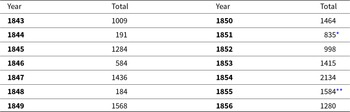
Although this system favoured the immigration from Azoreans to various provinces of Brazil, the majority of sources found in Brazilian and Portuguese archives concern the province of Rio de Janeiro. Due to the lack of reliable statistics, it is difficult to determine the exact number of Azoreans who arrived in the city during the mid-nineteenth century. Nonetheless, the Portuguese consul in Rio, João Baptista Moreira, was responsible for reporting the arrival of ships carrying passengers. According to his reports, 15,984 Azoreans arrived at the port of Rio between August 1846 and December 1856 (see Table 2). The following table is primarily based on these reports, with missing information supplemented by additional sources.
Azorean migrants arriving in Rio de Janeiro (August 1843–December 1856)

Table 2 Long description
The table records the number of Azorean migrants arriving in Rio de Janeiro annually from 1843 to 1856. The data reveals significant fluctuations in migration numbers, with the highest influx in 1854 at 2134 migrants and the lowest in 1844 with 191 migrants. Notable peaks also occurred in 1845 and 1849, with 1284 and 1568 migrants respectively. The years 1850 and 1853 also saw high numbers, with 1464 and 1415 migrants. The data suggests varying migration patterns, possibly influenced by external factors not detailed in the table. The asterisks next to 1851 and 1855 indicate additional context or data adjustments not fully explained here.
Sources: ANTT-MNE 313; ANTT-MNE 314; ANTT-MR 3266; AHD-MNE 539; AHD-MNE 540.
* 717 according to the consul’s report, plus 118 found in DRJ, 3 May 1851.
** 1400 according to the consul’s report, plus 184 found on AHM 32/224.
It is evident that the number of Portuguese migrants that entered the city is low compared to the volume of enslaved Africans introduced in the empire during the first half of the nineteenth century. However, the presence of Azorean migrants in both the city and its surrounding areas is evidenced by numerous archival documents, as will be shown in the next section.
Located in southeastern Brazil, the province (now a state) of Rio de Janeiro held both economic and political significance for the Brazilian Empire. The province was the world’s largest producer and exporter of coffee, and it encompassed the imperial capital, the city of Rio de Janeiro, which attracted prominent members of Brazil’s political and economic elite. Moreover, the port of Rio was the most important in the country, receiving ships from various origins to unload goods and export coffee. Rio was also the largest slave-holding city in the Americas. In 1834, of a total population of 97,599 people, 43,349 were enslaved individuals.Footnote 57
Enslaved labourers transported goods, water, people, and waste throughout the city. They worked as boatmen and sailors, public labourers, street cleaners, vendors, and skilled artisans and musicians. They were also responsible for draining swamps, paving roads, and renovating administrative buildings. Their overwhelming presence in the city shocked European travellers who first arrived in Rio. As Santos has summarized, “slave labor was thus the foundation on which global relations […] were established in the city of Rio de Janeiro”.Footnote 58 In this “black-and-white city”,Footnote 59 Portuguese migrants, enslaved, and freed labourers shared the same spaces, living and working side by side, often performing similar tasks.
Migrants’ Working Conditions
So far, this article has focused on the factors that stimulated the emigration of Portuguese islanders to Brazil and the BWI. It has emphasized that the abolition of slavery in British Caribbean colonies and British pressure on the Atlantic slave trade, together with the laws passed in Brazil prohibiting the importation of enslaved Africans into the empire, triggered the search for a complementary labour force. It has also been noted that the consequences of emancipation in the BWI boosted commodity production in Brazil, leading to increased demand for labour. This, in turn, encouraged the illegal slave trade and the simultaneous recruitment and transportation of Portuguese islanders to Brazil. Thus, this article has argued that transformations in the broader Atlantic context connected both migratory flows, each composed of individuals seeking to escape poverty in Madeira and the Azores. It is now pertinent to analyse the living and working conditions experienced by these immigrants in the BWI and in Brazil, whose convergent characteristics strengthen the argument that both migratory flows form part of a single phenomenon.
Concerning the Azoreans in Brazil, the reports sent by the Portuguese consul to his superiors in Portugal provide detailed accounts on the type of services they performed in Rio de Janeiro. These accounts align with descriptions found in the scholarly literature. According to Ribeiro, the Portuguese workforce played a significant role in services such as urban lighting, street cleaning, and the construction of aqueducts and fountains.Footnote 60 As Terra observed, alongside enslaved individuals, Portuguese immigrants used to deliver barrels of water and “transport waste from individual residences to designated sites for disposal”.Footnote 61
Moreira detailed the conditions stipulated in the contracts signed by migrants to repay their travel debts. According to him, women were frequently employed as maids, while men commonly worked as tillers.Footnote 62 Many migrants, however, remained in the city, taking jobs in public works, factories, and in the navy or army arsenals. In 1849, he noticed that the Azoreans had surpassed wage-earning slaves in the water transportation service.Footnote 63 The duration of the contracts ranged from six to thirty months, depending on the worker’s skills. Those hired as apprentices were typically bound for two to two and a half years to settle their debts.
Skilled workers employed at the arsenals enjoyed the best working conditions. Their contracts were of shorter duration, and they received a monthly wage (from which a portion was deducted to cover travel costs) as well as accommodation. However, many contracts did not stipulate any monetary remuneration, and migrants were provided only with “housing, food, clothing and medical care”.Footnote 64 This suggests that islanders, like other impoverished labourers in nineteenth-century Rio, likely “resided in the homes and commercial establishments in which they worked, having neither accommodation of their own, nor any defined work schedule, carrying out an innumerable array of subaltern tasks”.Footnote 65
The information provided by the consul corresponds to a set of contracts signed by Azorean colonists, which are available online in the National Archive databaseFootnote 66 and which were the focus of Souza’s analysis.Footnote 67 In all of them, employers covered the colonist’s travel expenses in exchange for labour. The colonists, in turn, committed to performing all tasks appropriate to their strength and age – although these tasks are not specified. In most cases, employers agreed to pay the labourers a monthly wage, but only a portion of the payment was delivered directly, while the remaining amount was withheld to gradually repay their debts.
One contract stands out. According to it, twelve young men from the Azores, aged between twelve and sixteen, had sailed to Rio de Janeiro on the Saudade. The planter Luiz Corrêa de Azevedo paid the boys’ travel expenses. Indebted, they committed “to working and providing all farming and cultivation services on the employer’s estate” for three years. The planter committed to “providing them throughout this entire period with the necessary clothing and shelter for their use, as well as to give them healthy and sufficient food for their nourishment and to care for them in their illnesses with charity and diligence”.Footnote 68 Unlike the previous contracts analysed, in this one “no additional monetary remuneration was stipulated”.Footnote 69
The contract offers little insight into the migrants’ living and working conditions. However, in a travel report first published in 1866, the Swiss traveller Johann Jakob von Tschudi detailed their living conditions on an estate belonging to J.C. de A:
At dawn, they have coffee, after which they go to work alongside the Black workers in the field under the orders of an overseer, where they remain until two o’clock in the afternoon. […] At two o’clock, they have lunch; the meal consists of black beans with bacon. They rest for an hour and then continue working until sunset, when they return to the estate to have dinner. The white workers sleep together in a large, well-ventilated shed, separate from the Black workers’ quarters. On Sundays, they work until nine o’clock in the coffee fields. Then, each worker receives their Sunday clothes and can spend the day as they wish. On these days, they have a piece of dried meat for lunch.Footnote 70
A rich coffee planter offered similar working conditions. In 1855, the governor of Viseu, in mainland Portugal, reported to the Minister of the Realm about recruiters engaging individuals to work on the estates of the Baron of Nova Friburgo.Footnote 71 The governor had access to a document outlining the labour conditions offered by the Baron, a prominent coffee grower in the Paraíba Valley (Rio de Janeiro). It claimed the recruits were to be strong, healthy young men, familiar with agricultural work. The employers would cover their travel expenses and at the end of each month a portion of the debt would be deducted from their wages. Upon arrival, the migrants received a mattress, a blanket, a pillow, three pairs of white pants, three cotton shirts, one straw hat, and working tools. They were required to work every day from dawn to dusk, clearing weeds, planting and harvesting coffee, corn, beans, rice, and manioc for a three-year period.Footnote 72
Moreira’s reports also contained information about onerous contracts celebrated between Portuguese migrants and other planters. In 1856, the Portuguese vice-consul in Campos sent a report stating that employers used to treat the Portuguese as if they were “slaves from the African Coast”. According to the vice-consul, these individuals were sent deep into the hinterland and later appeared before him “in a miserable state, like runaway slaves, because those who had taken them would immediately pursue them and even advertise in the local newspapers as if they were runaway Black slaves”.Footnote 73
The colonists also compared themselves to slaves to denounce unacceptable working conditions. In 1847, four Azoreans presented a complaint at the Portuguese Consulate in Rio against João Copley, who had hired them. They stated that they had agreed to serve on Copley’s estate for thirteen months to repay their travel fares. Copley committed to treating them well, providing food, clean clothing, and medical assistance. However, despite their hard labour, they received the “worst possible treatment, no different from that given to slaves”. They claimed they could no longer work for Copley, due to the harsh treatment and constant verbal abuse, and they pleaded to be released from their contractual obligations.Footnote 74
Hence, Azoreans in Brazil worked both on estates and in urban areas, often side by side with enslaved labourers. After the end of the African slave trade, many enslaved individuals who had been employed in the city of Rio were sold to coffee planters, who required an ever-growing labour force. Portuguese migrants took over urban tasks previously performed by enslaved people, thereby contributing to the coffee plantation system, which remained sustained by slavery. In the BWI, Portuguese islanders were also compared to slaves, due to the harsh working and living conditions they faced. However, in Demerara, Madeirans gradually became retail traders, displacing the Creole population that previously dominated this sector, which, in turn, pushed them to sugar plantations.
In 1838, Captain Studholme Hodgson published a book describing colonial iniquities in the BWI and denouncing the “white slavery”. According to him, as soon as the Emancipation Act was passed, planters began to fill the gap left by freed people with white men from Madeira and Faial.Footnote 75 On estates, the Portuguese were “indiscriminately mixed with the negroes”, and “compelled to toil in the cane-fields, under a tropical sun, and the same quantum of labour was demanded from them as from their fellow slaves – the negroes”.Footnote 76 To warn the Portuguese islanders about the harsh conditions faced by their compatriots, Hodgson published a petition signed by 26 migrants settled in Trinidad in 1836. They claimed their relatives had fallen “victims to the unhealthiness of the climate or to the cruelties of the slave system”.Footnote 77 They also declared they had “to work far beyond their strength and by coercion of the whip, without proper shelter at night, or adequate food during the day”.Footnote 78
A journal kept by Barton Premium, owner of the Fortune estate in British Guiana, who lived in the colony from 1840 to 1848, contains several passages addressing the presence of Madeirans in British Guiana. According to Premium, in 1839, the Fortune’s crop yield decreased by half because, after Emancipation, “nearly one half of the former [estate’s] population had gone away”.Footnote 79 Throughout the journal, there is a prevailing tone of lamentation due to the increasing wages and to the freed people’s awareness that they “are now in a position to exact their own terms”.Footnote 80 Therefore, in Premium’s view, no means should be spared to reduce the planters’ dependency on Creole labourers. Thus, despite being sceptical of the Madeirans’ capacity to endure the tough labour, Premium engaged 50 Madeirans in 1846. To accommodate them, he built “a new range of cottages of suitable dimensions”, since the law required a certificate “of their ample accommodation, and also of proper drainage […] implying a salubrious locality”.Footnote 81
According to him, these “yellow buckram” excited “the jealousy of their black compatriots [sic.]; and this may be by their diligence, for it is said that they are so anxious to acquire riches that they work too zealously under the burning sun”.Footnote 82 Because they worked too hard and lacked “the robust form of the negroes”,Footnote 83 many of them fell ill. As a result, six months later Premium seemed disappointed. In his words, “the Portuguese were doing fully as well as we expected, until sickness began to appear among them”.Footnote 84 In July 1847, a hopeless Premium wrote: “I have derived no comfort from my immigrants. Nearly all the Portuguese have left me – in fact, only a few sugar boilers remain”.Footnote 85
In spite of the high mortality rate among Portuguese individuals in the Caribbean, the colonial government of British Guiana continued to finance the transportation of Madeiran migrants, on condition they worked on estates. In 1849, the Portuguese consul in Demerara informed the Portuguese Minister of Foreign Affairs that “the colony’s legislature passed a law requiring that all immigrants arriving in the colony be assigned as apprentices for a period of time on sugar plantations, on properties deemed appropriate by the governor”. According to him “Portuguese immigrants are no exception”. In his view, it was unjust “to His Majesty’s most loyal subjects to induce them to emigrate from Madeira with the offer of free passage and, without their consent, subject them to forced servitude”.Footnote 86
For unknown reasons, Ordinance No. 20 of 1851, enacted by the Court of Policy of British Guiana, exempted immigrants from Madeira, the Azores, Cape Verde, and the Canary Islands from the requirement to be assigned to plantations and to enter into one-to-three-year contracts. This exception was absent from Ordinance No. 13 of 1853, which stipulated that any migrant whose transport had been funded by the colonial government would be assigned to plantations. By then, however, many Madeirans had already become retail traders. In 1851, the consul of Portugal in Demerara observed that “many of them [Portuguese migrants] are affluent, having attained the status of merchants, and almost all retail trade is in their hands”.Footnote 87 It is likely that wealthy Demerarists (as Madeirans who attained higher social status in Demerara were known in Madeira) began supporting relatives and acquaintances from Madeira in migrating to Demerara free from the contractual obligations imposed by the colonial government. As a result, only the less fortunate, without well-connected contacts in British Guiana, were required to work in the fields under one-to-three-year contracts.
It is unclear how and why Madeirans moved into the retail trade. According to Menezes “by 1843, the Portuguese were importing their own goods from Madeira, especially their Madeira wines which they missed […]. The next step was the establishment of shops and these, provision as well as spirit shops”.Footnote 88 The author presents the petition of a Madeiran named Manuel Pereira, who arrived in the colony in 1841. Pereira and his wife worked as field labourers for three years, and “with the savings of the joint labour of himself and his wife, commenced business as a shopkeeper”.Footnote 89 Another source quoted by Menezes mentioned the “assistance they [Madeirans] received from many mercantile firms” in the colony. Thanks to this support, “these foreigners, whose savings had not then amounted to enough to raise them from a condition of the most abject misery, and many of whom had shortly before arrived in the colony as indentured labourers” were able to take over the small retail or huckster trade, which had formerly been “in the hands of a large number of [our] native population”.Footnote 90 These sources align with Wagner’s statement that, by 1848, over fifty per cent of rum shop licences belonged to the Portuguese because, unlike the Creole population, they had facilitated access to credit.Footnote 91
The rise of Madeirans as shopkeepers and retail traders in British Guiana has been the subject of debate. According to Moore, white European colonial authorities favoured the Portuguese migrants due to a perceived racial affinity.Footnote 92 Wagner challenges this racial perspective, arguing that the colonial elite racialized the Portuguese as non-European. Williams focuses on the construction of stereotypes, proposing that as Madeirans transitioned from sugarcane fields to urban areas, a widespread belief in their cultural inclination toward retail trade emerged. This stereotype aligned with “the European elite’s need for a means to close off these [commercial] opportunities to other segments of the population”.Footnote 93 Despite the differing hypotheses, Williams’s assertion appears accurate: the Portuguese were well-suited “to the maintenance of the plantation system”.Footnote 94
The hypotheses presented do not fully account for the role of Portuguese authorities in discouraging migratory movements that threatened colonial hierarchies. Further research is needed to assess the impact of Portuguese rulers on the fate of migrants in host societies. However, evidence suggests that Portuguese authorities perceived retail activities as a more suitable avenue for Portuguese migrants abroad, viewing them as a viable path to social ascension.
Portuguese Authorities and the “White Slavery”
In October 1835, the arrival of the Fayalense with 56 Azoreans in Salvador (Bahia, Brazil) outraged the local Portuguese community. The captain handed over the passengers as labourers to anyone who paid for their travel fares.Footnote 95 Later, the consul recalled the episode and remarked: “There is in this type of transaction some analogy to those of slavery, and this has led to the general use of the same language regarding the colonists as if a ship with slaves from Africa had arrived”.Footnote 96 Similar reports began to reach Portugal, both from the Brazilian Empire and from the West Indies, and were widely circulated by the press. Soon, the emigration of impoverished islanders under such conditions became known as “white slavery”. As Marques pointed out, the “white slave trade” provoked greater indignation among Portuguese authorities (and within the Portuguese community in Brazil) than the ongoing “black” slave trade.Footnote 97 In response, in November 1836, Sá da Bandeira, then Portugal’s Minister of Foreign Affairs, drafted a proposal outlining several measures to suppress the “white slave trade”. According to him, the proposal was crucial to preserving national dignity and protecting Portugal’s reputation abroad, where Portuguese subjects “were treated as slaves”.Footnote 98
The comparison between white wage earners and enslaved Africans was not unique to Portuguese discourse. Throughout the nineteenth century, this analogy was a widespread rhetorical device. At a time when the definition of free labour was being debated across the world, references to slavery were often invoked to delineate unacceptable levels of coercion.Footnote 99 Authorities in China, for instance, used the comparison to denounce the treatment of coolies and to demand better working conditions for Chinese indentured migrants.Footnote 100 In the United States, white labourers also compared themselves to slaves. As Roediger has noted, unlike the term “wage slavery”, “white slavery” carries a distinct racial connotation, emphasizing “the continuing desire not to be considered anything like an African-American”.Footnote 101
For the Portuguese authorities, the use of the term “white slavery” carried an additional dimension. The fact that Portuguese workers were performing tasks alongside or replacing enslaved and emancipated workers undermined the colonial hierarchies that had once benefited Portugal and its citizens. Moreover, it underscored Portugal’s diminished position in the global order of the time, highly dependent on Britain and stripped of its former largest colony – Brazil. Thus, when impoverished islanders began to emigrate, it became evident that Portugal had become a country that exported labour.
A few sources collected at Torre do Tombo deepen our understanding of the Portuguese authorities’ concerns about the subaltern position occupied by their citizens abroad. As previously mentioned, in 1853, the colonial government of British Guiana nullified earlier provisions that had favoured Portuguese citizens in the colony. For the Portuguese consul in Demerara, it was an insult to force Portuguese migrants (whose transportation had been funded by the colonial government) to be assigned to plantations, thereby equating them with “savages and natives”. The consul sent the Portuguese Minister in London a translation of the earlier ordinance, highlighting the exceptions that had previously benefited the Portuguese over “the chins, Africans, and other migrants”.Footnote 102 The Portuguese Minister in London then recommended that the government in Lisbon disseminate the new ordinance among Madeirans to inform them of “the fate prepared for them in the British colonies, where they are a kind of slaves”.Footnote 103
Although Portugal’s political elite condemned what was termed “white slavery”, which equated Portuguese citizens with other colonized peoples and undermined former colonial hierarchies, preventing emigration proved difficult, as emigration was a constitutional right. Additionally, tighter restrictions risked disrupting an economically beneficial migratory flow: that of young men, mostly from northern Portugal, sent by their relatives to Brazilian cities under the care of compatriots running successful commercial houses. This emigration was part of a long-standing family strategy for economic advancement, which contributed to the regional economy.Footnote 104 Thus, Portuguese authorities faced the challenge of curbing emigration that revealed the secondary role played by Portugal in the world order without disrupting an economically important migratory flow.Footnote 105
It was not until the mid-1850s that the Portuguese parliament devised a solution and enacted an emigration law. While the Act of 20 July 1855 did not prohibit emigration, it introduced stricter regulations to address the problem. According to the legislation, emigration was permitted as long as individuals met the conditions for obtaining a passport. However, migrants who contracted their services to cover travel costs were also required to present their labour contracts for review by the Portuguese authorities.Footnote 106 The 1855 Law thus distinguished between contracted and free emigrants. The former, associated with “white slavery”, had to submit their contracts for official approval in order to leave the country legally. The latter, not bound by labour contracts, were free to emigrate as long as they fulfilled the passport requirements. This distinction also marked a social divide between subaltern labourers and those employed in commercial houses.
It is important to note that emigrants did not always comply with the legal requirements for leaving the country. Instead, they devised innovative strategies to evade the law, emigrating without passports – or even using forged ones. In the case of Portuguese Atlantic islands, the dispersion of the islands, their geographical features, and their distance from centres of power made it easy for ships to embark passengers away from official ports.Footnote 107
Aware of the challenges of preventing dispossessed islanders from emigrating under labour contracts, the Portuguese authorities throughout the nineteenth century frequently encouraged an alternative: directing those willing to emigrate toward the Portuguese colonies in Africa, particularly Angola. In 1852, for instance, the Conselho Ultramarino proposed several measures to “redirect the migratory disposition of the islands in favour of our African possessions”.Footnote 108 This alternative seemed appealing, as in Africa the Portuguese would maintain their status as “colonizers” rather than being associated with colonized peoples. Some attempts were made, but the results fell far short of expectations.
In an effort to prevent Portuguese migrants from being equated with colonized peoples, the authorities devised strategies that did not infringe upon the constitutional right to emigrate. Reviewing labour contracts and publicizing the legal requirements imposed abroad on migrants who had not prepaid their travel costs were ways of discouraging the emigration of individuals destined for subaltern work, while still permitting a migratory flow that could provide sales clerks, shopkeepers, and retail traders to foreign lands.
Conclusion
The fact that the Portuguese authorities employed the term “white slavery” to describe the migration of Madeirans and Azoreans to both the BWI and Brazil reinforces the argument that these movements formed part of a single phenomenon, driven by the search for alternative sources of labour prompted by Britain’s intensifying efforts to suppress the Atlantic slave trade and abolish slavery within its own colonies. In the BWI, planters upheld the narrative of labour shortage to persuade the colonial government to fund the transportation of dispossessed migrants to work on plantations. In Brazil, the abolition of slavery within the British Empire intensified commodity production, thereby increasing the demand for labour. At the same time, sustained British pressure to end the importation of enslaved Africans in Brazil posed a constant threat to the continuation of Brazil’s slave trade, officially banned in 1831 and effectively suppressed in 1850.
In the mid-1830s, colonial authorities in the BWI, imperial officials in Brazil, and ship captains and businessmen all turned their attention to impoverished Azoreans and Madeirans, who were enduring harsh living conditions and political unrest. Geographical proximity, together with long-standing commercial ties between Britain and Madeira, facilitated labour recruitment on the island. From 1841 onward, the colonial government of British Guiana assumed the transportation costs of Madeiran migrants, further consolidating this recruitment network. Although Azoreans also migrated to the BWI, most took advantage of opportunities to leave the archipelago when travel required no upfront payment. Former colonial ties, along with Brazil’s reputation as a promising destination, strongly encouraged migration in that direction. Unlike the BWI, in Brazil “colonos trade” operated as a private enterprise, although it was stimulated by imperial government. In both regions, those unable to pay their travel costs were bound to their employers for periods ranging from six months to three years. These migrants often performed tasks formerly carried out by enslaved, freed, or emancipated labourers, or even worked alongside them. Like Indian and Chinese indentured labourers, Portuguese islanders formed part of a mass of subaltern, displaced workers.
By placing these two flows in dialogue and emphasizing their shared characteristics, this article has demonstrated the value of an analytical perspective that does not fragment migratory movements according to their destinations. This broader contextual approach has shed light on both flows. The simultaneity of the displacement of Portuguese islanders to the BWI and to Brazil, along with the similarities observed in their recruitment and transportation schemes, challenges the interpretation that Portuguese migration to Brazil in the early nineteenth century was merely a continuation of long-standing colonial patterns. Rather, it constituted a new migratory flow, shaped by innovative and wider circumstances. Moreover, the joint analysis developed in this article showed that information about experiments with different labour arrangements circulated across empires and inspired similar recruiting and transportation schemes, in which Portuguese islanders took place.
The analysis of the living and working conditions Portuguese migrants faced in both host societies illustrates the porous boundaries between free and unfree labour and questions the idea of a linear transition from slavery to free labour system. The case studies presented show that, in the nineteenth century, labourers of different statuses and ethnicities coexisted and lived and worked side by side. The article therefore supports the perspectives advanced by historians associated with Global Labour History, who argue that, throughout its development, capitalism relied on a wide range of labour arrangements, not solely on free and waged industrial worker. Furthermore, by emphasizing the harsh living conditions on the Portuguese islands and the contractual obligations migrants were required to fulfil, this article challenges the established idea that Asians were indentured migrants with constrained options, whereas Europeans migrated freely and entirely by choice.
The article also highlights that the working and living conditions that Portuguese islanders shared with enslaved, freed, emancipated labourers, and Asian indentured workers in both the BWI and Brazil often provoked their discontent. These migrants frequently compared themselves to enslaved Africans as a means of denouncing labour conditions they deemed unacceptable. For them, moving from plantation labour and other subordinate activities into the retail trade represented a pathway to social advancement. For reasons that remain uncertain, Madeirans in Demerara soon came to dominate the small retail and huckster trade, pushing emancipated workers and the Creole population out of this commercial sector. In Rio de Janeiro, although many Azoreans worked on rural estates, a significant number performed urban tasks, likely pushing enslaved workers onto the coffee plantations. Further research is still needed on this subject, but it is possible to suggest that, by limiting urban opportunities for other subordinate labourers, Portuguese migrants contributed to the persistence of the plantation systems that developed in both regions.
In the view of the Portuguese authorities, the subaltern position occupied by Portuguese citizens abroad was a bitter reminder of the country’s diminished status in the international order that emerged from the Age of Revolutions. Preventing Portuguese islanders from being associated with enslaved Africans or other colonized peoples appeared crucial to upholding former colonial hierarchies that had benefited white Europeans. Within such hierarchies, it was unthinkable for Portuguese subjects to be bound to foreign employers, to have their freedom restricted by contractual obligations, as was the case with Asian indentured labourers, or even to perform the same labour activities as enslaved and emancipated individuals. Authorities therefore sought to prevent the so-called “white slavery” by discouraging islanders from leaving the country under contract. The measures adopted, however, were not intended to hinder the emigration of those who had well-established connections in Rio de Janeiro or Demerara, where they could enter the retail trade and potentially attain higher social standing.
Future research may reveal whether Portuguese migrants contributed to maintaining racial inequities in post-slavery Brazilian and Guyanese societies by claiming what Roediger termed the “wages of whiteness”, that is, the array of social and material advantages that distinguished poor and subordinate white workers from their black counterparts.Footnote 109 For now, it can be asserted that Portuguese migrants not only moved beyond the geographical boundaries of the Portuguese Empire, but also acted against the imperial aspirations of the Portuguese authorities, thereby undermining the colonial hierarchies that had long placed them at the top.
Acknowledgements
I would like to thank the Fundação de Amparo à Pesquisa do Estado de São Paulo (FAPESP) for the funding that made this research possible – grant no. 2022/09657-1. This research draws on Brazilian and Portuguese archives. The Arquivo Histórico do Itamaraty (AHI) in Rio de Janeiro preserves reports from Brazilian vice-consuls stationed in the Portuguese islands, detailing emigration to Brazil and the BWI. In Lisbon, the Arquivo Nacional da Torre do Tombo (ANTT) holds numerous records related to the departure of islanders to these destinations, along with diplomatic correspondence until 1850. Other archives, including the Arquivo Histórico Parlamentar (AHP) and the Arquivo Histórico da Marinha (AHM), both in Lisbon, and the Arquivo Nacional (AN) and Arquivo Público do Estado do Rio de Janeiro (APERJ), in Rio de Janeiro, further complemented our corpus of documents. To connect Brazil and the BWI through Azorean and Madeiran migration, we additionally consulted online primary sources and secondary sources on the presence of Portuguese islanders in the BWI.



 Open access

