


Introduction
Marine turtles have represented nutritional, economic and spiritual resources to many human communities for at least 7,000 years (see Frazier, Reference Frazier, Lutz, Musick and Wyneken2003, for a review). Among these possible uses, consumption is predominant. It was widely practised (Campbell, Reference Campbell, Lutz, Musick and Wyneken2003; Frazier, Reference Frazier, Lutz, Musick and Wyneken2003) and associated with the traditional and cultural heritage of various communities (Cliffton et al., Reference Cliffton, Cornejo, Felger and Bjorndal1982; Figueroa et al., Reference Figueroa, Alvarado, Hernandez, Rodriguez and Robles1992). From the 17th century onwards marine turtle consumption increased because of factors such as the increase in the human population, increased fishing and capture capacity, and more efficient trade that responded to wider market demand (National Research Council, 1990; Lutcavage et al., Reference Lutcavage, Plotkin, Witherington, Lutz, Lutz and Musick1997; Fleming, Reference Fleming2001; Campbell, Reference Campbell, Lutz, Musick and Wyneken2003). Turtle trade is a major factor driving declines of marine turtle populations (Fleming, Reference Fleming2001), and six of the seven extant marine turtle species are categorized as threatened on the IUCN Red List (IUCN, 2010). Consumption of, and trade in, marine turtles were banned or regulated through several international conventions and national legislation (Wold, Reference Wold2002; Campbell et al., Reference Campbell, Silver, Gray, Ranger, Broderick and Fisher2009). Nevertheless, consumption of turtle meat and eggs still occurs, legally or not, in many places (Fleming, Reference Fleming2001; Campbell, Reference Campbell, Lutz, Musick and Wyneken2003; Mancini & Koch, Reference Mancini and Koch2009). Capture by fishing gear, however, has become a major threat to marine turtle populations (Lutcavage et al., Reference Lutcavage, Plotkin, Witherington, Lutz, Lutz and Musick1997) because of the general increase in fishing effort, and is a serious conservation challenge for marine magafauna in general (Lewison et al., Reference Lewison, Crowder, Read and Freeman2004; Soykan et al., Reference Soykan, Moore, Zydelis, Crowder, Safina and Lewison2008).
In the Mediterranean Sea fishing is severely affecting ecosystems (Tudela, Reference Tudela2004; Sacchi, Reference Sacchi2008) and is a major threat for large vertebrates of conservation concern such as sharks (Ferretti et al., Reference Ferretti, Myers, Serena and Lotze2008), cetaceans (Bearzi, Reference Bearzi and Notarbartolo di Sciara2002), monk seals (Karamanlidis et al., Reference Karamanlidis, Androukaki, Adamantopoulou, Chatzispyrou, Johnson and Kotomatas2008) and marine turtles (Casale, Reference Casale2008). Two species of marine turtles have populations in the Mediterranean, the loggerhead turtle Caretta caretta and the green turtle Chelonia mydas; the latter has a relatively small population restricted to the easternmost Mediterranean (Broderick et al., Reference Broderick, Glen, Godley and Hays2002).
Egypt was one of the first markets to trade in marine turtles in the Mediterranean Sea: both loggerhead and green turtles have been sold in several fish markets along the Mediterranean coast (Alexandria, Abou Keer, Brullos, Port Said and Damietta) since at least the beginning of the 20th century (Laurent et al., Reference Laurent, Abd El-Mawla, Bradai, Demirayak and Oruc1996, and references therein). Probably most of these turtles were captured off Cyprus, Turkey and Palestine, transported to Egypt and then to Europe (Laurent et al., Reference Laurent, Abd El-Mawla, Bradai, Demirayak and Oruc1996, and references therein). Since the 1970s turtle consumption has been an established tradition in some places in Egypt and, in 1992, official records of landings of marine turtles on the Mediterranean coast of Egypt totalled 231 t (Laurent et al., Reference Laurent, Abd El-Mawla, Bradai, Demirayak and Oruc1996).
Egypt is a signatory of several conventions for nature conservation and several national regulations that cover marine turtles were issued in the 1980s and 1990s. The most important is the Environmental Law 4/1994, which states that ‘killing, capturing, transportation, selling, nest destruction and display of an endangered species either dead or alive is prohibited when Egypt is signatory to an International Convention’. However, in spite of this regulation, egg consumption was observed in 1998 (Clarke et al., Reference Clarke, Campbell, Hameid and Ghoneim2000) and trade in marine turtle meat and blood in Alexandria fish markets went on at least until 1999, with 18–25 turtles slaughtered per week in the Anfoushi fish market (Laurent et al., Reference Laurent, Abd El-Mawla, Bradai, Demirayak and Oruc1996; Nada, Reference Nada2001). The government increased the enforcement of laws in the Alexandria fish markets in 1999 (Venizelos & Nada, Reference Venizelos and Nada2000) but the present situation is unknown, as is the number of turtles caught by Egyptian fishing boats on the Mediterranean coast, although Laurent et al. (Reference Laurent, Abd El-Mawla, Bradai, Demirayak and Oruc1996) suggested that a high number was caught by trawlers alone.
This bycatch and the associated illegal turtle trade probably affect several marine turtle populations in the Mediterranean. Satellite tracking of nesting females has shown that Egyptian waters are foraging grounds and migratory corridors for green turtles originating from Cyprus and Syria (Broderick et al., Reference Broderick, Coyne, Fuller, Glen and Godley2007; Rees et al., Reference Rees, Jony, Margaritoulis and Godley2008a), two of the three nesting areas for this species in the Mediterranean (Kasparek et al., Reference Kasparek, Godley and Broderick2001; Rees et al., Reference Rees, Saad and Jony2008b). Nesting loggerhead turtle females have been tracked from Cyprus to Egypt (Broderick et al., Reference Broderick, Coyne, Fuller, Glen and Godley2007) and genetic markers indicate that loggerhead turtles found in Egypt also originate from Turkey and, possibly, Greece (Casale et al., Reference Casale, Freggi, Gratton, Argano and Oliverio2008a), which represent most of the major nesting grounds for this species (Margaritoulis et al., Reference Margaritoulis, Argano, Baran, Bentivegna, Bradai, Caminas, Bolten and Witherington2003). There are no data available regarding potential use of Egyptian foraging grounds by turtles from the other two major marine turtle nesting areas in the Mediterranean, i.e. green turtle rookeries in Turkey and loggerhead turtle rookeries in Libya. Egyptian waters are thus an area of concern for the conservation of marine turtles in the Mediterranean (Laurent et al., Reference Laurent, Abd El-Mawla, Bradai, Demirayak and Oruc1996; Margaritoulis et al., Reference Margaritoulis, Argano, Baran, Bentivegna, Bradai, Caminas, Bolten and Witherington2003; WWF, 2005).
This study provides an assessment of the threats to marine turtle populations along the Mediterranean coast of Egypt using information collected by interviews. Although this implies an intrinsic degree of uncertainty, we assess the current level of marine turtle consumption and trade in Alexandria and the potential trade in other areas, estimate the magnitude of bycatch, and assess the effectiveness of conservation actions undertaken so far.
Methods
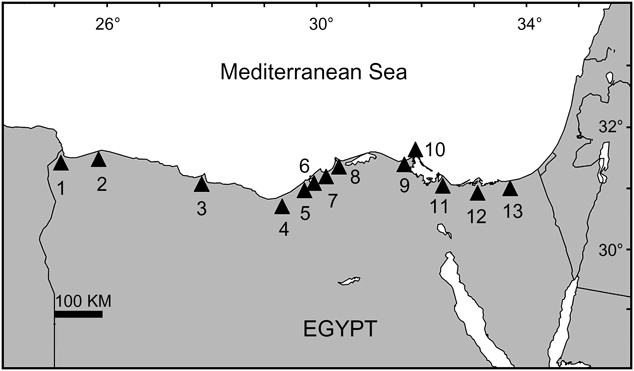
Field surveys were carried out during June–October 2007 in the 15 most important fishing ports along the Egyptian Mediterranean coast, in four regions (Fig. 1). This division follows the common geographical division of Mediterranean Egypt, which has also been adopted for other surveys (Clarke et al., Reference Clarke, Campbell, Hameid and Ghoneim2000).
The Mediterranean coast of Egypt with the 13 places where surveys were carried out. Western Region: 1, El Salum; 2, Sidi Barani; 3, Marsa Matruh; 4, El Hamam; 5, Alexandria Governorate (El Max, Anfoushi, Abou Keer); Central or Delta Region: 6, El Maadiya; 7, Edco; 8, Rousata; 9, Azzbat El Borg; 10, Domiat; Eastern or Sinai Region: 11, Port Said; 12, Lake Bardawil; 13, Areash.
A total of 445 people were interviewed by MN. The interviewees were selected by convenience sampling (Kelley et al., Reference Kelley, Clark, Brown and Sitzia2003), i.e. persons encountered by chance at the place and time of the survey, and all the people approached accepted to be interviewed. Although this was not a random sample from the statistical populations of target groups, the occurrence of interviewees at the time of the survey was assumed not to be associated with a bias in the information asked; i.e. the interviewees were assumed to be representative of their population. Interviewees were informed that (1) the only purpose of the interview was to collect information on the status and biology of marine turtles in the Mediterranean Sea and their interaction with fishermen and local communities, (2) they could retain any information that they did not wish to share, and (3) their names were not required and would not be recorded.
One set of interviews included 219 fishermen, 88 fishmongers and 92 members (61 male and 31 female) of local communities. The main questions asked (directly or indirectly) were (1) Which type of fishing gear do you use? (2) Do you capture turtles? (3) Do you kill turtles? (4) If yes, why? (5) Do you sell turtles to someone else? (6) Are you aware that killing turtles is illegal? How do you deal with this? (7) On average, how many turtles do you capture per year? (8) With which fishing gear? (9) On the basis of your experience, are turtles increasing, stable or decreasing? (10) Which species of turtles do you catch or see?
Another set of interviews were conducted with key stakeholders in various government and non-government institutions: 32 governmental officers (four at the national level and 28 at the community level) and 14 representatives of six NGOs. They were asked about their knowledge of the turtle trade and the protection status of sea turtles. In addition, 14 focus groups (seven with fishermen, two with fishmongers, four with members of local communities and one with the police officers mandated to oversee the conservation of marine turtles in Alexandria fishing port), Rapid Rural Appraisal (Crawford, Reference Crawford1997; discussing whilst walking and with local people, paying specific attention to people, activities, resources and environmental features) and life history exercises (collection of detailed life and work histories) were conducted with local communities.
Results
The fishermen interviewed were able to distinguish the three marine turtle species occurring in Egypt (loggerhead and green turtles, and leatherback turtle Dermochelys coriacea). Fishermen from Alexandria have names for two species and these imply that green turtles (balady, national species, referring by this to its authentic taste) have a better taste than loggerhead turtles (gashawy, fake turtle). Fishermen from all regions reported that they catch all three species, although loggerhead turtles are the most common, followed by green turtles, and leatherback turtles are rare. From the descriptions provided by the fishermen, most of the turtles they captured were large juveniles or adults.
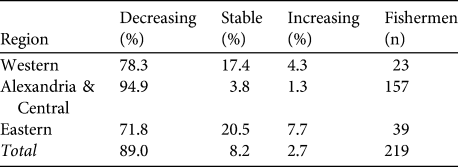
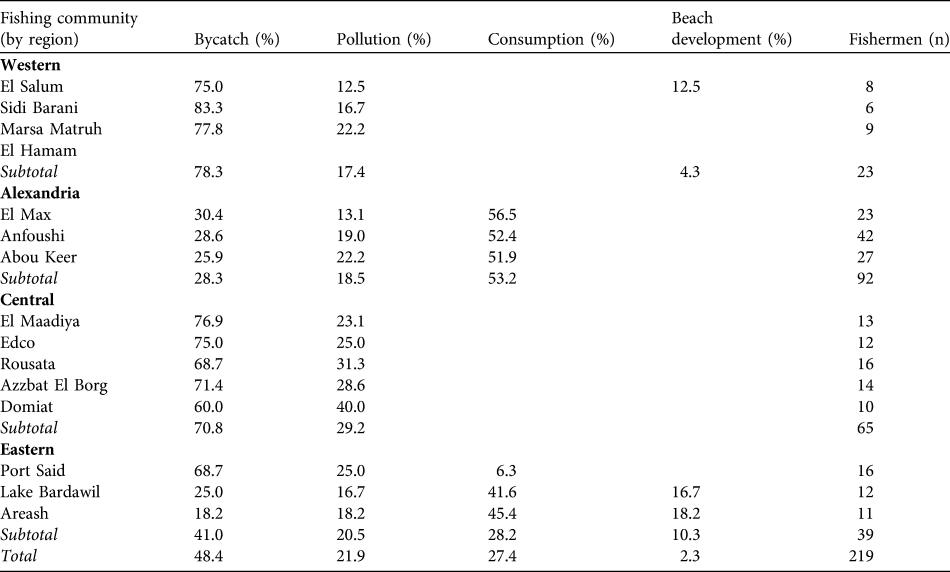
According to 89% of the 219 fishermen the number of turtles is decreasing, 8.2% of them did not perceive any change and 2.7% stated turtles are increasing (Table 1). Fishermen of the Western Region attributed decreases in turtles mainly to bycatch. Fishermen in Alexandria attributed declines to killing for consumption, bycatch and pollution (because they often found plastic bags in the digestive tract of turtles). Fishermen of the Central Region believed that the decline is mainly because of bycatch and pollution. In the Eastern Region fishermen stated that the main reasons are bycatch, consumption and pollution (Table 2) and they also mentioned destruction of nesting sites as an important factor.
Percentages (by row) of the 219 fishermen interviewed who perceived turtle abundance to be decreasing, stable or increasing, by region and overall.
Percentages (by row) of the 219 fishermen interviewed who perceived bycatch, pollution, killing for consumption and beach development to be threats to marine turtles, by region and fishing community.
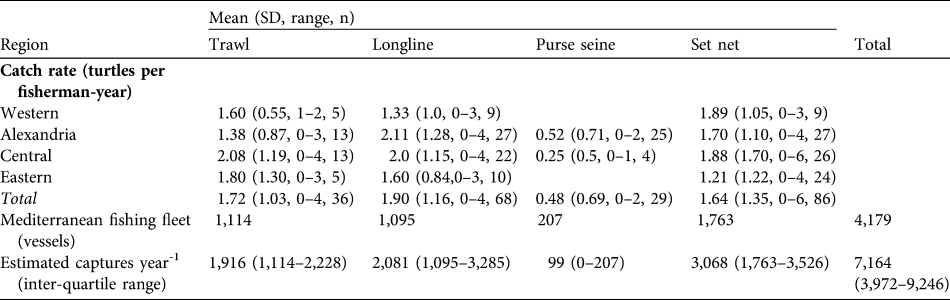
With the exception of purse seines fishermen declared similar bycatch rates of turtles by various fishing gears (Table 3). However, this could be partially because of fishermen’s inability to remember with which fishing gear they caught a specific turtle, because most fishermen use a variety of gears during the same year, depending on the season and the target species. On the basis of these catch rates and on fishery statistics (Table 3) we estimate the annual total number of turtles caught along the Mediterranean coast of Egypt is 7,164 (these are captures, not necessarily individual turtles, because the same turtle can be caught more than once).
Bycatch rates (turtles per year), by fishing gear and region, declared by the 219 fishermen interviewed, the number of vessels by fishing gear in 2007 (source: General Fisheries Commission for the Mediterranean), and number of turtle captures per year estimated for each fishing gear from catch rates and fleet statistics.
The attitude towards marine turtle consumption differed dramatically between the four regions (Table 4; χ 2 = 135.54, df = 3, P < 0.001, n = 399). Turtle consumption is commonest in the Alexandria Region, with 61.7% of people interviewed declaring that they ate turtles, compared to 19.7% in the Eastern Region, 3.7% in the Central Region and none in the Western Region. The interviews indicated that these differences between regions are cultural. In Alexandria consuming turtle meat and blood is an old tradition, whereas it is seen as a bizarre custom in the Western Region.
Percentage (by row) of fishermen, fishmongers and community members admitting to turtle consumption, by region and fishing community, and overall. The total number of people to which percentages refer is in parentheses beside each percentage.
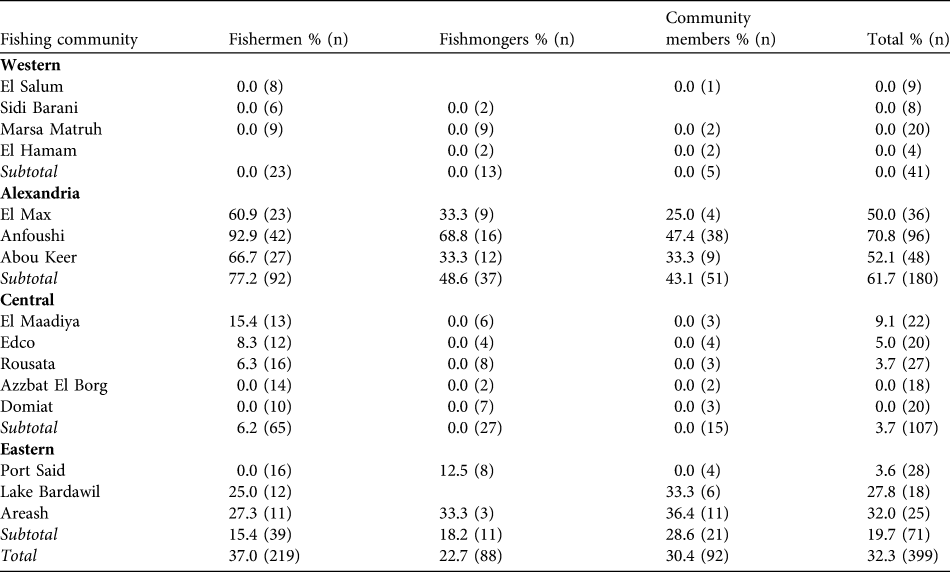
Where turtle consumption occurs it is most common amongst fishermen (Table 4). In Alexandria, 77.2% of the 92 fishermen interviewed reported they have eaten marine turtle meat and 38% did so at least once in the previous 6 months. They stated that when they catch a marine turtle they slaughter and consume it during the fishing trip. Sometimes, however, they put the meat in plastic bags and throw the carapace and bones in the sea, so that police officers will not be able to identify them. This practice was confirmed by 68.4% of fishermen interviewed in Alexandria (n = 92).
In Alexandria we did not observe any marine turtles on sale in the public fish markets and 88% of 24 interviewed police officers inspecting the landing sites were aware that Egyptian law prohibits turtle trade and consumption. They also affirmed they received strict instructions that turtle protection should be enforced. However, 71% of the 42 fishmongers interviewed indicated that a black market still exists and that smuggling of marine turtles is still taking place. During the survey we found three marine turtles on sale on the black market: an adult female green turtle in El Max, and an adult female loggerhead turtle and a juvenile loggerhead turtle in Anfoushi. We did not find evidence of turtle trade in the other regions. However, four turtles, one in Rousata and three in Domiat, were observed on display in water tanks in fish restaurants, to attract clients.
Of the 23 fishermen interviewed in the Western Region, 20 (87%) mentioned they observed at least one turtle nesting in the previous 10 years, 13 (57%) in the last 3 years and two (8.7%) in the last year (2006). All the fishermen interviewed stated that only loggerhead turtles nest in this area. Of the 39 fishermen interviewed in the Eastern Region these figures were 38 (97%), 35 (89.7%) and 25 (64.1%), respectively. These fishermen said that both loggerhead and green turtles nest in this region but that the former is more common. All 157 fishermen interviewed in the Alexandria and Central Regions stated that they have not seen any turtles nesting in the past 10 years. However, three fishermen indicated that some nesting occurred on Alexandria beaches > 30 years previously. Rangers of the Zaranik protected area (the main marine turtle nesting site along the Mediterranean coast of Egypt, in the Eastern Region; Clarke et al., Reference Clarke, Campbell, Hameid and Ghoneim2000), confirmed that nesting still occurs there (mostly loggerhead turtles but also green turtles) and they recorded 15 nests in 2007 and 17 in 2006.
Discussion
Our results show that marine turtles in the Mediterranean region of Egypt are more threatened by human activities than previously thought (Laurent et al., Reference Laurent, Abd El-Mawla, Bradai, Demirayak and Oruc1996; Nada, Reference Nada2001) and that the issue of turtle trade has only been partially solved by the conservation actions so far undertaken. Previous surveys reported that high numbers of turtles were traded in the Anfoushi fish market of Alexandria (Laurent et al., Reference Laurent, Abd El-Mawla, Bradai, Demirayak and Oruc1996; Nada, Reference Nada2001) but turtles are no longer publicly traded there. The percentage of fishermen and fishmongers who are aware that trading in marine turtles is illegal (79 and 85%, respectively) has increased compared to 1999 (< 30%; Nada, Reference Nada2001). This is probably because of awareness campaigns by NGOs and increased enforcement of marine turtle protection, with inspections at the Anfoushi fish market and official landing sites. However, in the Anfoushi area turtles are still traded on the black market, and in the Abou Keer fish market of Alexandria marine turtles are still traded publicly according to the interviewed fishmongers. The difference between the Anfoushi and Abou Keer markets could be because more enforcement activities and awareness campaigns (Venizelos & Nada, Reference Venizelos and Nada2000) have focused on Anfoushi. The Anfoushi fish market has been given increasing attention by the Alexandria Governorate since 2000 because it is in one of the main tourist destinations of Alexandria (M. Nada, pers. obs.). The recent attention to marine turtle conservation is probably because of the establishment of the Egyptian Environmental Affairs Agency (EEAA) and its branch in Alexandria, international pressure on Egypt to protect these species, pressure from national NGOs, and the enhanced capacity on marine turtle issues of a group of government officers who were involved in a survey by research institutes and the EEAA (Clarke et al., Reference Clarke, Campbell, Hameid and Ghoneim2000).
Our results indicate that marine turtle mortality from intentional killing and consumption by fishermen while out fishing is more important than mortality from trade. Only parts of turtles caught are landed and only some of these are traded in public or black markets. Both on-board killing and landing of turtle meat, which is difficult to recognize as such, easily escape current controls. Turtle consumption by fishermen and local community members is particularly common in Alexandria and occurs to a lesser extent in other regions. Given the high number of turtles estimated to be caught in Egypt (Table 3) and that as a whole 37% of fishermen and 30.4% of community members declared that they consume turtle meat (Table 4), it is likely that several hundreds of turtles are slaughtered every year.
In addition to the mortality caused by intentional killing for consumption, our results suggest that there is high mortality from interactions with fishing gear. Considering that catch rates declared by fishermen might have been lower than the actual catch (and the opposite is unlikely) and that official fishery statistics may underestimate the number of fishing vessels, it is possible that the total annual number of turtles captured by the Egyptian Mediterranean fishing fleet is higher than our estimate of 7,164. Egypt is therefore a priority for marine turtle conservation in the Mediterranean. Moreover, as the Egyptian fishery mostly comprises small vessels (Seham & Salem, Reference Seham and Salem2004), our results provide additional evidence of the importance of small-scale fisheries as a threat to marine vertebrates in the Mediterranean (Godley et al., Reference Godley, Gucu, Broderick, Furness and Solomon1998; Bearzi, Reference Bearzi and Notarbartolo di Sciara2002; Casale, Reference Casale2008; Karamanlidis et al., Reference Karamanlidis, Androukaki, Adamantopoulou, Chatzispyrou, Johnson and Kotomatas2008).
Mortality of marine turtles from bottom trawling depends on tow duration. Laurent et al. (Reference Laurent, Abd El-Mawla, Bradai, Demirayak and Oruc1996) reported an average tow duration of 3.1 hours for Mediterranean Egypt, which would be expected to cause high mortality of marine turtles. Sasso & Epperly (Reference Sasso and Epperly2006) estimated a mortality rate of < 1% for tow durations < 10 minutes, rapidly increasing to 50–100% for tows > 60 minutes. Mortality induced by drifting longlines has been estimated to be > 30% (Casale et al., Reference Casale, Freggi and Rocco2008b) and mortality from bottom longlines could be even higher because this gear is anchored to the sea bottom and captured turtles may thus drown. For the same reason set nets are known to cause turtle mortality of 50% or higher (Casale et al., Reference Casale, Freggi, Basso and Argano2005). The interviewed fishermen reported higher turtle mortality for set nets (which are left at sea for between 8 hours and 3 days) and longlines. Hence, with a potential 50% or higher mortality rate of the estimated 3,068 captures by set nets, 30% or higher mortality rate of the estimated 2,081 captures by longliners, and a relatively low mortality of the 1,916 captures by trawlers (Table 4), it is likely that several hundred turtles die every year as a consequence of capture by fishing gear along the Mediterranean coast of Egypt.
According to the fishermen interviewed most of the turtles caught as bycatch or killed by fishermen for meat are large individuals. This is supported by fish market data (mean 64.7 cm curved carapace length, CCL, range 49.4–830, n = 16; Laurent et al., Reference Laurent, Abd El-Mawla, Bradai, Demirayak and Oruc1996) and partially by stranding data. For stranded turtles listed by Clarke et al. (Reference Clarke, Campbell, Hameid and Ghoneim2000) the mean CCL of loggerhead turtles was 57.5 cm (range 11.5–124, n = 38) and that of green turtles was 37.4 cm (range 28–70, n = 8).
Large marine turtles have high reproductive values and are more important for population growth than small individuals (Crouse et al., Reference Crouse, Crowder and Caswell1987), and thus a high number of turtles of these sizes dying as consequence of incidental capture and intentional killing represents a serious threat to their populations. Fishermen mostly reported perceptions of negative trends in marine turtle populations and some reported that in the past they caught one turtle per week, compared to less than two turtles per year now. Reducing human-induced mortality of turtles in Egypt is therefore a high priority for the conservation of Mediterranean populations of both loggerhead and green turtles, for which Egyptian waters are an important foraging ground.
Although law enforcement provides the necessary protection context and should be improved, it is not sufficient to halt the current level of mortality from bycatch and meat consumption, and further protection measures are required. Based on our results we make four recommendations: (1) As the drivers of turtle consumption in Alexandria are cultural, intentional killing can be reduced only by changing the view of turtles as a good short-term meat resource to one as a resource to be valued and preserved for the long-term. (2) Measures to reduce capture and mortality by fishing gear need to be implemented (e.g. technical modifications of fishing gears, such as turtle excluder devices or circle hooks) although this will require further research on turtle bycatch and associated factors such as fishing gear and practices. (3) Research on spatio-temporal distribution and habitat use of loggerhead and green turtles in Egyptian Mediterranean waters and on the origin of turtles frequenting these waters. (4) Protection and management of nesting sites, including monitoring of nesting activity. The results of our study are being communicated to the relevant Egyptian authorities, and specific conservation actions based on our recommendations have been designed and will be implemented when the necessary funds have been secured.
Acknowledgements
This project was funded by the Species and TRAFFIC programme of WWF Italy. We thank M. Rocco for continuous support and advice, L. Venizelos for providing relevant information, all the members of the fishing community along the Egyptian Mediterranean coast for willingly sharing their time and knowledge, the key informants for their valuable information, Amira Wafaki, Ahmed Abd Allah and Mohamed Mahmoud for their assistance with fieldwork in Alexandria, Ahmed Mahmoud for assistance in Sinai, and two anonymous referees for helpful comments. Fig. 1 was prepared with the software Maptool (from http://www.seaturtle.org).
Biographical sketches
Mohamed Nada is manager of the Governance and Civic Engagement programme in CARE International in Egypt. He has undertaken several socio-economic and marketing research projects focusing on marine turtle conservation in Egypt. Paolo Casale coordinates the WWF Mediterranean sea turtle programme and the WWF Italy sea turtle project. He also conducts fundamental and applied research on marine turtle biology, ecology and bycatch in the Mediterranean.



