


Introduction
In late February 2022, Ukraine’s Vice Prime Minister Mykhailo Fedorov publicly pleaded Elon Musk to assist Ukraine with Starlink terminals after Russian attacks on Ukraine’s communications infrastructure. Shortly after, Musk announced the activation of Starlink over Ukraine and dispatched terminals.Footnote 1 Since then, the use of Starlink has brought a persistent military advantage to Ukraine. Technical features of the system, including its high levels of redundancy and resiliency, have proven crucial on the battlefield even when facing repetitive denial attempts from Russian forces. These advantages have impressed officials in both the Pentagon and US Space Command, with Starlink effectively advertising the use of satellite mega-constellations as a military enabler.Footnote 2
Outer space is increasingly central to international security. The use of Starlink on the Ukrainian battlefield both reflects and drives a broader trend characterising the space domain, namely the onset of mega-constellations.Footnote 3 While satellite systems have historically been characterised by limited numbers of specialised satellites, recent technological developments have made mega-constellations a feasible alternative. As the offensive and defensive advantages of mega-constellations have become evident, several state and commercial actors are developing mega-constellations of their own. States highly dependent on space power to enable their military operations, particularly the United States and China, see mega-constellations as a means of leveraging space capabilities while reducing vulnerability to counterspace attacks.Footnote 4
This article asks how mega-constellations affect stability in space. It makes two main arguments. First, mega-constellations foster stability in conditions of symmetry, meaning between countries similarly dependent on space. Mega-constellations are expected to alleviate satellite vulnerabilities and make counterspace more difficult, thereby lowering first-strike incentives for states highly dependent on space. Second, mega-constellations may decrease stability in conditions of asymmetry. Indeed, recent reports of a Russian nuclear anti-satellite (ASAT) capability reveal a dangerous incentive structure.Footnote 5 If mega-constellations disempower conventional counterspace capabilities, states seeking to deprive an adversary of space-enabled advantages may face stark incentives to utilise destructive ASAT capabilities, including nuclear weapons, which currently represent the only certain alternative of destroying mega-constellations.Footnote 6 Additionally, the anticipated proliferation of mega-constellations across multiple states raises the possibility that several adversaries will field comprehensive, low-vulnerability space postures. In this scenario, any attack would likely provoke retaliation while also creating a cascading debris effect in orbit – commonly referred to as Kessler syndrome – that could render orbit unusable. This dynamic would resemble the logic of mutually assured destruction (MAD) and make survival in space reliant upon mutual strategic restraint.
Theoretically, this article builds on and adds to existing scholarly debates from space-power theory on stability and offence–defence dynamics in space. Drawing on existing perspectives, the article develops a framework for assessing how first-strike incentives to strike space assets are shaped. Applying this framework to mega-constellations shows how emerging space architectures are expected to affect offence–defence dynamics in space, as well as analysing conditions that are likely to foster stability.
Scholarly analysis on mega-constellations is important for several reasons. First, the proliferation of distributed architectures will further drive interdependence between space systems and terrestrial military capabilities. This will effectively raise the stakes of pursuing control or denial of space, as the resilience or vulnerability of space architectures now feeds directly into states’ assessments of risk, opportunity, and escalation during a conflict. Second, mega-constellations matter beyond deterrence and warfighting dynamics within space. They also generate spillover effects for both nuclear and conventional stability. The integration of proliferated architectures into strategic functions such as early warning, missile tracking, and command-and-control will carry implications for broader military postures. The recent US proposal for a space-based missile defence initiative – Golden Dome – illustrates this trajectory.Footnote 7 Effectively taking the form of a mega-constellation in orbit, the strategic implications of Golden Dome will extend far beyond outer space by affecting states’ second-strike capabilities and escalation thresholds in both nuclear and conventional domains.
This article contributes to a scarce literature on how contemporary technological development influences space and its role in future conflicts. The literature surrounding the changing character of the space domain and mega-constellations is broadly concentrated in three main categories. The first is literature analysing and explaining the prevalence of commercial space actors on security.Footnote 8 The second consists of analyses on the isolated impact of mega-constellations and space warfare in the Russo–Ukrainian war.Footnote 9 There are also numerous academic analyses on the impact of mega-constellations on the physical space environment, but which omit the international security dimension.Footnote 10 Finally, there is a scarce pool of work that analyses security implications of mega-constellations or diversified satellite systems, but this field is limited and does not adequately address stability in space.Footnote 11 In sum, while academic attention to the political and security dimensions of contemporary space dynamics is growing, there is a clear research gap that this article seeks to address.
A framework for stability in space
The combination of fragile satellites, predictable orbital movements, limited defences, and increasingly flexible counterspace capabilities has formed the perception of space as a domain in which actors can disable critical capabilities more easily than they can protect them. Accordingly, much of the space security literature has long characterised the space domain as being structurally offence-dominant.Footnote 12
While the categorisation of space as offensively or defensively dominant is subject to debate, the fundamental point is the dynamics creating this perception. These dynamics are recurring in the space-power literature: while space capabilities underpin military, economic, and political power, they also create vulnerabilities that adversaries are likely to exploit.Footnote 13 This tension has particularly been relevant in US strategic circles due to the long-lasting US position as the hegemonic power in space – this position having only been recently challenged by China.Footnote 14 Addressing this tension has caused divides in whether the pursuit of space power leading to space warfare is inevitable, or whether escalation in space can be managed.Footnote 15 Despite these tensions, most scholars of the space-power literature focus on identifying what stability in the space domain would require to support long–term security. As argued by Johnson-Freese, however, the term ‘space stability’ is generally subject to abstractions suffering from limited conceptual development, instead being denoted as a loose and underspecified ambition.Footnote 16 In this sense, stability functions more as a broad normative goal than as an operational framework.
Differing perspectives in space-power theory offer several ideals of pursuing stability. Dolman’s ‘Astropolitik’ perspective, seeing the weaponisation of space and orbital warfare as deterministic certainties, posits the need of a ‘benevolent hegemon’ in the form of the United States to provide stability in space.Footnote 17 This thinking argues, in neo-Hobbesian fashion, that the absence of such a hegemon will cause states to compete for the command of space, ultimately leading to instability. A different perspective is advocated by Townsend, who identifies an orbital security dilemma in which the indistinguishability of offensive and defensive capabilities and intentions makes cooperation difficult. The possible solution, he argues, is a defensive posture emphasising denial capabilities.Footnote 18 Finally, Moltz has shown how historical predictions of space as a highly competitive domain have overlooked the recurring tendency of space powers to pursue strategic restraint in space due to the recognition of interdependence and benefits of competition.Footnote 19 Looking ahead, Moltz sees the conditions of ‘net-centric space power’ characterised by resilient, commercially led constellations of small satellites as a contrast to previous space postures of vulnerable, military-led satellite structures.Footnote 20
Stability in space: Conceptualisation and factors
This article discusses stability in space using a framework employing the definition of ‘first-strike stability’ from the original work by Kent and Thaler.Footnote 21 This definition posits that stability is robust when ‘neither leader perceives the other as pressured by the posture of forces to strike first in a crisis’.Footnote 22 This term is designed with nuclear weapons in mind, which gravely surpass ASAT weapons in destructive potential and political effects. Nonetheless, the concept intuitively describes dynamics that are also at play in the space domain. Applied to the context of space, in line with Morgan’s previous work on first-strike stability in space, striking first is not restricted to another actor’s satellites but also extends to the terrestrial elements of a space infrastructure, including ground systems and data transmission networks.Footnote 23 To be clear, first-strike stability is delimited to space in the sense that first strikes means striking against space capabilities.
Which factors affect the robustness of stability? This framework builds on existing space-power scholarship to identify principal dynamics affecting stability in space. As previously discussed, differing perspectives in the space-power literature diverge in how offensively dominated they perceive space as being. Accordingly, this framework serves a clarifying analytical purpose of identifying factors affecting first-strike incentives in space, thereby offering indicators of how the offence–defence balance can be affected in different configurations. Four categories organise these underlying dynamics: (1) architectural redundancy and resilience; (2) the value and vulnerability of different space systems; (3) the escalatory potential of counterspace capabilities; and (4) geopolitical conditions and strategic context.
Redundancy and resilience of architectures
Space-power theorists have long recognised that architectural design influences strategic stability. Moltz’s concept of ‘net-centric space-power’ argued that distributed and commercially integrated architectures could reduce the risks inherent in traditional satellite structures.Footnote 24 More recent work by Morgan similarly highlights the stabilising potential of disaggregation and redundancy.Footnote 25
A key factor affecting first-strike incentives in space is a space capability’s level of redundancy, meaning the numerical surplus of satellites and ground capabilities in the system. Most satellite systems consist of relatively few satellites and thereby low levels of redundancy, which make them vulnerable to sabotage or destruction. How vulnerable they are, however, is different depending on the system. An example is early warning satellites. The US Space-Based Infrared System (SBIRS), which forms the cornerstone of the US ballistic early warning system, is limited to only ten satellites.Footnote 26 Accordingly, the loss of only a small number of satellites could have detrimental consequences to the US nuclear supporting infrastructure.Footnote 27
Related to redundancy is the concept of resiliency, identified by Morgan as central to deterrence by denial in space.Footnote 28 Resiliency, referring to the system’s ability to absorb and adapt to disruption, is generally weak in most cases of satellite systems.Footnote 29 Notably, resiliency is not merely a product of numbers but also the technological features of the system. Factors such as hardening and soft hardening, meaning defensive capabilities against kinetic and non-kinetic attacks, respectively, also bolster resiliency. Additionally, Morgan mentions factors such as active propulsion systems for evading manoeuvrability, rapid satellite replacement capabilities, and decentralised terminals that similarly strengthen resiliency by making the system less vulnerable to disruption.Footnote 30 However, resilience in one orbital regime does not eliminate vulnerability in others. The coexistence of proliferated low earth orbit (LEO) systems with small, strategically critical geosynchronous orbit (GEO) satellites will not affect the stability of the latter regime.
Value and vulnerability of space systems
A central determinant of the incentives to attack space systems is what one specifically gains from their removal. Space power is often denoted as an aggregated concept as states are comprehensively dependent on space capabilities. As noted by Klein, US operational concepts have often been centred on technological applications creating reliance on space – without access to space, the concept is compromised.Footnote 31 However, targeting certain space systems will appear more destabilising than others. As explained by Colin Gray, ‘space-power must always be useful, but its precise roles and actual strategic utility will be distinctive to each class and case of conflict’.Footnote 32
Indeed, an important consideration from Morgan is how first-strike stability is not common to the entire space domain but varies across different types of satellite functions and systems. Certain types of satellites, due to their roles, technological composition, or number of units, generate higher first-strike incentives.Footnote 33 For example, striking satellites that support nuclear command-and-control or early warning is perceived as more escalatory than those supporting conventional military operations. This is due to not only their unique enabling roles for both strategic and conventional warfare but also low levels of redundancy. Conversely, intelligence, surveillance, and reconnaissance (ISR) or satellite communications (SATCOM) systems may carry lower escalatory potential due to higher redundancy, thereby lowering the threshold of being targeted in a first strike.
Orbit also matters for the value and vulnerability of space systems. While most satellites are concentrated in LEO, many of the most escalation-sensitive satellites – including those supporting nuclear command, control, and communication – are located in GEO. GEO satellites remain relatively small in number, highly specialised, and critical to strategic stability.Footnote 34 Their strategic value and limited numbers mean that even partial degradation could generate profound misperceptions in a crisis. Although this article focuses primarily on the implications of proliferated LEO architectures, the broader stability framework must acknowledge that GEO systems remain pivotal to first-strike stability.
Escalatory potential of counterspace capabilities
A third factor shaping stability concerns the choice of available counterspace capabilities. Non-kinetic capabilities like electronic warfare and cyber-attacks may appear more stabilising if they offer adversaries a way to impose temporary effects with reversible damage.Footnote 35 As highlighted by Krepon, the limited use of non-kinetic counterspace capabilities is unlikely to generate disproportional retaliation.Footnote 36 Instead, reversible means of disruption offer ways for states to signal resolve without crossing major escalation thresholds.
By contrast, the use of kinetic ASATs, especially in GEO, has been widely understood as a clear escalatory step. Kinetic, debris-inducing attacks against foreign satellites would represent an unprecedented escalation. Such an action would not only be escalatory by itself but also act in a destabilising manner by setting a new precedence of extending kinetic warfare to outer space. Additionally, as noted by Grego, kinetic attacks in space are escalatory not only due to permanently destroying its target, ‘but because many of these technologies create indiscriminate follow-on effects’.Footnote 37 A kinetic destruction in orbit unleashes clouds of space debris that remain in orbit, potentially triggering cascading collisions with additional satellites in a phenomenon known as the Kessler syndrome.Footnote 38 A nuclear explosion in orbit would cause further hazards, including the indiscriminate spread of nuclear radiation, threatening other satellites in the same orbit.Footnote 39 Meanwhile, deployments of co-orbital ASATs create ambiguity and can drive escalation: despite being explained as a debris clean-up satellite, China’s Shijian-21 has been described as potentially destabilising as it maintains the ability to tow satellites in GEO from their intended orbit, thereby representing a potential threat to US strategic satellites in GEO.Footnote 40
Geopolitical conditions and strategic context
Importantly, the technological conditions of satellites and counterspace capabilities are not the only factors affecting stability. Equally important is the geopolitical and strategic context states operate within, and the power relations between them. As explained by Bowen, ‘space warfare is the continuation of Terran politics by other means; what happens in Earth orbit will reflect the politics of the international system on Earth’.Footnote 41
In space, geopolitical conditions shape how states interpret risk, opportunity, and restraint. As shown by Moltz, the initial US and Soviet militarisation of space in the early Cold War was a continuation of military competition on Earth extended to a new domain.Footnote 42 In the context of tense political relations on Earth, a conflict in space between the two superpowers was unlikely to stay limited. In contemporary space security, the great power competition between China and the United States has similarly extended to space, with China developing offensive and defensive capabilities in line with a national security strategy planning for a war with the United States – and vice versa.Footnote 43 American and Chinese analyses on the other’s activities in space are generally characterised by inherent suspicion and allegations of weaponised dual-use capabilities, stemming from geopolitical rivalry and uncertainty about intent. These suspicions shape how both sides interpret ambiguous actions such as rendezvous-and-proximity operations, which can be portrayed as benign but also perceived as offensive. Accordingly, incentives to pull the trigger in space will also be shaped by the underlying politics between states, in addition to technological conditions.
Phases of first-strike stability in space
The factors influencing stability in space has historically developed across two primary time phases. In the first phase, during the Cold War, space was intimately tied to nuclear deterrence between the United States and the Soviet Union, as satellites supported early warning and transparency regarding the parties’ nuclear capabilities.Footnote 44 The idea of employing counterspace capabilities was constrained by the realisation that targeting early warning or ISR satellites could be interpreted as a prelude to a nuclear first strike. Furthermore, weapons suitable to counterspace were primarily restricted to kinetic missiles, which were easily attributable, inflexible, and costly to employ. Accordingly, counterspace was politically costly due to the escalatory risks involved, as well as being technologically challenging. With neither state possessing significant first-strike incentives against an adversary’s space capabilities, stability in space was high.Footnote 45
The second phase, taking place following the end of the Cold War, was characterised by the role of space in military operations changing technologically and politically. Technologically, the US ‘revolution in military affairs’ heavily relied on space capabilities, including global positioning system (GPS), advanced ISR capabilities, and SATCOM. As exemplified in the Gulf War, these capabilities enabled the United States to conduct a sustained campaign of precision warfare far from its own shores.Footnote 46 Space-based capabilities had become key enablers for conventional military operations, rather than primarily nuclear operations. In addition, US satellites were increasingly relied upon for civil tasks, including navigation assistance and television access.
Politically, a broader reliance on space involved two main implications. First, the escalatory potential of targeting space capabilities was less fixed – the prospect of destroying a satellite used for conventional operations carried less retaliatory potential than destroying a satellite used for nuclear command-and-control. In other words, space capabilities became legitimate military targets. Second, more states saw space capabilities as a means to further their national interests. The emergence of new players in the space domain aided in creating a narrative of space as a multipolar domain.Footnote 47 However, while the power balance began shifting, there remained an excessive power gap between the United States and any other space power for at least two decades following the end of the Cold War.Footnote 48
Growing dependence on space for both military and civil purposes led to a sense of vulnerability, particularly within US military circles. With US satellites having become increasingly legitimate military targets, the fear of a ‘space Pearl Harbor’ scenario – a blinding first-strike against US space capabilities – became prevalent in US policy circles in the early 2000s.Footnote 49 This concern effectively grew from first-strike instability as military leaders perceived adversarial incentives to target US space capabilities early in a conflict. Indeed, Washington’s global situational awareness, precision warfare capabilities, and intelligence apparatus largely rest on satellites. Similarly, the Joint All Domain Command and Control operational concept heavily relies on a permissive space environment as a constant enabler.Footnote 50 Since the end of the Cold War, any potential US adversaries have therefore had incentives to develop counterspace capabilities. Notably, technological development has enabled increasingly sophisticated counterspace capabilities, including non-kinetic options.Footnote 51 Accordingly, from the end of the Cold War until the 2020s, first-strike stability in space has been steadily lowered.
Despite concerns about vulnerability within Washington, lowered first-strike stability in space did not drive significant action in reducing space vulnerabilities throughout the 2000s and 2010s. Several factors can explain this inertia. The high costs involved in bolstering space infrastructure is a common impediment for any state. Additionally, from Washington’s perspective, there may have been few credible threats capable of exploiting its vulnerabilities. For example, although some were concerned about the effects of GPS jamming during the Iraq War, Iraqi attempts to degrade GPS were generally ineffective.Footnote 52 Resultingly, the long-term absence of redundancy or resiliency measures against its space assets have exacerbated Washington’s vulnerabilities, leading to a further reduction in first-strike stability by raising the incentives to exploit gaps in the US space infrastructure.Footnote 53
Since the beginning of the 2020s, several developments invoke the question of whether we have entered a third phase of first-strike stability in space. Geopolitically, the relationship between the three biggest space powers – the United States, China, and Russia – has become increasingly confrontational. The aim to maintain both control and denial of space is reflected in their force postures, which increasingly prioritise space and counterspace capabilities.Footnote 54 Importantly, the military balance between the United States and China in space has become increasingly symmetric as both states find themselves highly dependent on space capabilities.Footnote 55 While both countries draw strong advantages from their advanced space capabilities, their mutual dependencies also make both states vulnerable.
Technological developments have contributed to a drastic lowering of launch costs, thereby reducing entry barriers to the space domain. Notably, this has enabled a range of new actors competing for space power. This includes commercial actors that are taking on progressively larger roles, including defence.Footnote 56 Another consequence of technological development is increasingly sophisticated counterspace capabilities. While offensive options against space systems have mainly been limited to kinetic missiles, states can now utilise a broader array of counterspace capabilities, including non-kinetic weapons systems.Footnote 57 Accordingly, conventional satellites are growing more vulnerable and exposed to interference. The sum of these trends is that counterspace operations are becoming more legitimate, more feasible, and increasingly attractive to states, ultimately undermining stability in the space domain.
Do these developments indicate the start of a third phase? While these trends are substantial in affecting first-strike stability in space, they can arguably be described as an intensification of the second phase rather than warranting a new phase. What can potentially be described as a gamechanger, however, is the impact of mega-constellations. Accordingly, the next section will detail how mega-constellations may tangibly affect first-strike stability.
Development and use of mega-constellations
What are mega-constellations?
Mega-constellations have been loosely conceptualised and there exists no universally accepted operationalisation regarding their scope and boundaries. Jonathan McDowell distinguishes between satellite constellations surpassing fifty satellites, defined as ‘large’, and those surpassing 1000 satellites, defined as ‘enormous’ or ‘mega’.Footnote 58 The European Space Agency (ESA) denotes mega-constellations as systems comprising ‘hundreds to thousands of satellites’.Footnote 59 In the absence of a consensus operationalisation, this article matches ESA’s floor of ‘hundreds of satellites’ by defining mega-constellations as any satellite constellation surpassing 200 satellites. While broadly conceptualised, the aim of this article is to capture the overarching tendency of space postures moving in the direction of proliferated satellite systems with higher levels of redundancy.Footnote 60 This definition does not exclude any orbital regime, but given how all current and prospective mega-constellations exist in LEO, such a specification would be arbitrary.
The promise of mega-constellations stems from the combination of global coverage and high speed. With a high number of satellites in orbit, a mega-constellation can provide continuous coverage across the globe. If deployed in LEO, the proximity to Earth entails a short distance between users and satellites, resulting in lower latency and faster communication.Footnote 61 In contrast, while a lower number of satellites in GEO also can provide nearly global coverage, the greater distance between the satellites and its users means higher latency and slower communication. The reliability of a mega-constellation is a particularly useful prospect for remote areas with little communications infrastructure, such as oceans. It also provides another layer of robustness to communications networks under strain, from either limited infrastructure or the threat of natural or hostile interference. Unlike most satellite systems where the loss of a few satellites could significantly degrade the system, redundant and resilient mega-constellations can continue to operate effectively in contested environments even after sustaining damage.Footnote 62
Development of mega-constellations
While mega-constellations are associated with the recent Starlink system, the foundations of mega-constellations began in the 1980s. In conjunction with the Strategic Defense Initiative (SDI), the idea of an orbital ballistic missile defence system consisting of thousands of small, weaponised satellites was envisioned. However, in line with most other SDI projects, technical infeasibility and exorbitant costs stalled any progress.Footnote 63
That dynamic shifted in the 2010s.Footnote 64 Spearheaded by SpaceX, developments in reusable launch technologies, miniaturisation, and increased demand dramatically reduced barriers to deployment.Footnote 65 In 2015, both SpaceX and OneWeb announced plans to launch their mega-constellations of 4425 and 720 satellites, respectively.Footnote 66 The following year, Telesat announced plans to build its own constellation of 117 satellites, which in 2020 was expanded to a planned 1671 satellites.Footnote 67 Later, OneWeb, now known as Eutelsat, expanded their ambition to a constellation consisting of 48,000 satellites.Footnote 68
In particular, the Starlink system’s performance in Ukraine demonstrated the strategic value of resilient satellite constellations under continuous pressure from Russian counterspace. By mid-2022, over 20,000 Starlink terminals had been distributed throughout Ukraine, and the system had quickly become an integral part of Ukrainian defence efforts, enabling battlefield communications, intelligence sharing, and coordination of drone operations.Footnote 69 The primary reason for this was Starlink’s high levels of redundancy and resiliency directly bolstering one of Ukraine’s most critical vulnerabilities, namely their communications infrastructure.Footnote 70 In addition, Starlink also showed itself to be technologically capable of resisting Russian non-kinetic counterspace attacks, leading to minimal downtime.Footnote 71 Combined, these factors made Starlink far more effective and flexible than traditional SATCOM options. The system’s resistance to both kinetic and non-kinetic interference highlights how LEO mega-constellations can deny adversaries the ability to degrade space capabilities quickly or effectively. In total, the stabilising effect as witnessed in Ukraine is twofold: mega-constellations raise the threshold for successful counterspace attacks, while also lowering the escalatory risk of satellite loss by rendering such losses marginal.
Starlink’s demonstration of the military advantages in LEO mega-constellations has driven two key developments. First, it has cemented SpaceX’s role as the key provider to the United States of both launch and satellite services through an influx of military contracts.Footnote 72 Second, this has emboldened several state and non-state actors to launch bids for their own mega-constellations. As shown in Table 1, there is a growing number of prospective mega-constellations in development, with most traction gained in the aftermath of Starlink’s emergence over Ukraine. Notably, many plans are early in development, and it is unlikely that all constellations will be completed. Russia’s Sfera constellation only has one demonstration satellite, and the EU’s IRIS2 is yet to reach orbit.Footnote 73 It is nonetheless clear that Starlink has prompted widespread emulation by other actors. In addition, other countries have announced undetailed plans to launch mega-constellations of their own, including South Korea and Taiwan.Footnote 74
While mega-constellations are currently relevant for SATCOM, the model is likely to encapsulate additional functions. Washington has announced plans to deploy early warning satellites in LEO as part of a proliferated architecture.Footnote 75 Meanwhile, the United Kingdom has proposed a mega-constellation providing Precision, Navigation and Timing (PNT).Footnote 76 Commercial ISR constellations, such as those operated by Planet and Maxar, already demonstrate scalable frameworks that could be significantly expanded or replicated by states. Summarised, the uses of mega-constellations are likely to widen as states seek stabilising measures in a contested space domain.
Planned and deployed mega-constellations.Footnote 77

Implications of mega-constellations on first-strike incentives
Kinetic and non-kinetic counterspace
Mega-constellations adjust the calculus of kinetic counterspace attacks. While satellites have traditionally been predictable and vulnerable, mega-constellations are both redundant and resilient. A broader proliferation of mega-constellations in orbit weakens the prospect of utilising kinetic ASATs. The reason is twofold. First, a drastic increase in individual satellites to target implies that attacking mega-constellations kinetically will be technologically and economically unsustainable. In traditional satellite systems the loss of key satellites, especially those used for early warning, PNT and SATCOM, can hamper military operations. Starlink’s use in Ukraine shows how a mega-constellation can persist under the assumption of attrition – it can maintain overall functionality while taking losses. This means that disabling Starlink would require an impractically large arsenal of ASATs in combination with tracking capabilities. The high economic cost of developing and launching hundreds to thousands of interceptors into space further diminishes the incentives to rely on kinetic first strikes.
Second, the numerical increase in satellites means that a kinetic onslaught in orbit will generate unprecedented levels of space debris, which will be self-damaging and may render the orbit uninhabitable at worst.Footnote 86 As Oelrich et al. have argued, this may itself have a deterrent effect against kinetic ASAT weapons.Footnote 87 As previously discussed, the threat of cascading orbital debris threatens not only the originally intended target but also any other satellite in the affected orbit, including the attacker’s own. This raises the costs of any kinetic action in space, particularly in LEO, where satellites are most densely concentrated.Footnote 88 As space, and especially LEO, becomes increasingly congested through the emergence of mega-constellations, this mutual vulnerability incentivises restraint in considering kinetic counterspace capabilities.
The underlying logic of mega-constellations moderating the calculus of attacking space capabilities is already debated in the space-power literature. Moltz has suggested the possibility of a resilient mega-constellation being ‘able to convince an adversary that its forces will not be able to accomplish their objective of denying space-derived information’.Footnote 89 Townsend has previously argued that ‘the ongoing proliferation of small satellite constellations will increasingly shift the overall [offence–defence] balance in favor of the defense’.Footnote 90 Glaser has connected proliferated satellite constellations to the robustness of a nuclear deterrent, arguing that such constellations can effectively deny an adversary’s ability to target command, control, communications, and intelligence capabilities.Footnote 91
To be sure, an actor’s stakes in a conflict will influence its willingness to employ destructive ASATs. For example, the stakes are higher for China in a US–Chinese conflict over Taiwan than for the United States. If finding itself at a critical juncture, China may be willing to take more drastic measures to secure victory, even at the risk of its own space capabilities. Generally, however, mutual dependencies on space will incentivise restraint for both parties in using debris-inducing counterspace. A CSIS wargame of a Taiwan conflict showed space treated as a relative sanctuary, with parties resorting to non-debris-inducing co-orbital ASATs as weapons in space.Footnote 92
In contrast to kinetic capabilities, non-kinetic counterspace is likely to become more common due to a combination of increased technological feasibility, lower escalatory risk, and absence of space debris. However, non-kinetic counterspace can nonetheless face constraints in dealing with the resiliency of mega-constellations. In Ukraine, Russian forces have repeatedly made attempts to interfere with Starlink using non-kinetic counterspace capabilities in the form of jamming, spoofing, and cyber-attacks. According to both SpaceX and US officials, these efforts have been consistently met with immediate technical responses from SpaceX, which has deployed software patches within hours.Footnote 93 This responsiveness has been praised by US Space Command, noting that the mega-constellation has demonstrated redundancy and resiliency beyond what can be matched by traditional satellite structures.Footnote 94 As the war has progressed, some Russian attempts have been successful in temporarily interfering with Starlink, causing local outages and forcing Ukrainian forces to use alternative communications capabilities.Footnote 95 However, reports indicate these outages to be minimal and that Starlink has remained consistently resilient throughout the war.Footnote 96
From a military standpoint, Starlink has operated under constant threat and has yet maintained near-continuous uptime. Its performance under non-permissive conditions has demonstrated a central advantage of mega-constellations, namely their low vulnerability to counterspace capabilities. This distinguishes them from all other traditional satellite structures, which have been persistently characterised by their high vulnerability and difficulty to replace. It is difficult to ascertain how much of Starlink’s resiliency is due to technological solutions unique to SpaceX, or due to the inherent defensive advantages of mega-constellations. Reinforced with SpaceX’s control of reusable rockets and high production of satellites, the resiliency of Starlink is unmatched by any other satellite system. Notably, several characteristics of Starlink are not given in other mega-constellations, and SpaceX’s capital base through owner Elon Musk provides flexibility that few states and commercial actors can compete with. However, the fundamental enablers of Starlink’s success on the battlefield – redundancy, resiliency, and disaggregation – are inherent to the mega-constellation architecture itself.
The difficulty of disabling Starlink can nonetheless drive states to focus more on ground segments when countering mega-constellations. This includes ground stations, data networks, and launch sites. The terrestrial parts of space infrastructures are likely targets of non-kinetic counterspace as their low redundancy and resiliency, relative to satellites in orbit, make them more vulnerable targets.Footnote 97 Through jamming or cyber-attacks against ground stations, disrupting or tapping into data networks, or interfering with launch operations, an attacker can indirectly deny or hamper the effectiveness of a mega-constellation with lower escalatory risk than would be required to target hundreds or thousands of satellites in orbit.Footnote 98 However, the resiliency of Starlink in Ukraine has nonetheless demonstrated how non-kinetic attacks can be easier managed than kinetic through counter-measures such as software patches and soft hardening.
The development of mega-constellations and Starlink’s demonstration in a contested environment has implications for first-strike stability. During the first phase of stability in space, attacking a single satellite could significantly impact the defence posture of an adversary. In contrast, the redundancy and resiliency of mega-constellations make it almost impossible to disable them in a short timeframe using conventional counterspace capabilities. This significantly reduces the incentive to strike first in the hope of achieving a strategic advantage, as any attempt using contemporary technology is unlikely to succeed. Instead, a first strike is likely to escalate a conflict without generating a meaningful advantage.
Nuclear counterspace
While the current military utility of mega-constellations is concentrated in SATCOMs, as witnessed in Ukraine, there are strong incentives for mega-constellations to be utilised for functions such as early warning and PNT. For a country like the United States, which has grappled with ‘space Pearl Harbor’ concerns for several decades, maximising the defensive advantages of mega-constellations to cover their entire space posture is an attractive prospect.
If additional states pursue these incentives, mega-constellations will become more deeply embedded into national force postures, thus heightening their relevance to first-strike calculations in space. Paradoxically, this could both enhance and challenge stability. On the one hand, diversified systems are harder to disable through conventional counterspace capabilities – this ultimately promotes stable deterrence. On the other hand, the strategic significance of mega-constellations may generate incentives to threaten more destructive weapons, such as nuclear escalation, in the absence of capable alternatives. If reports from 2024 are true, Russia has already deployed a nuclear counterspace weapon in orbit for this purpose.Footnote 99 While the credibility and intent of such a weapon is uncertain, the logic is clear: only a nuclear detonation in space could feasibly disable an entire mega-constellation.
Even though non-kinetic counterspace will become increasingly ubiquitous, the scale of counter-measures required to disable or deter the use of mega-constellations is likely prohibitively costly. The lack of proportional alternatives has the potential to re-introduce the idea of nuclear warheads as ASAT weapons.Footnote 100 Paradoxically, the very characteristics that make mega-constellations resilient against conventional attacks may increase the strategic rationale to threaten more extreme measures. For states that perceive themselves as technologically disadvantaged or facing asymmetries in space, the threat – or in extreme cases, use – of nuclear counterspace weapons may be perceived as a coercive equaliser. Like the logic in Cold War–era deterrence, the mere possession of an extreme retaliatory option may be seen as sufficient to constrain adversary behaviour.
To be clear, there are enormous incentives not to detonate nuclear weapons in space. The use of nuclear ASATs, which have already been tested and discarded decades ago, carry disadvantages that would outweigh any short-term gains.Footnote 101 Detonating a nuclear device in space would generate an indiscriminate and uncontrollable electromagnetic pulse and radiation, damaging not only an adversary’s satellites but also those of neutral states, including the attacker’s own. The resultant space debris and long-term environmental hazards could render orbital regimes unusable for decades, denying the use of space for everyone. Furthermore, such an action would constitute an unprecedented escalation, breaching long-standing international norms and provoking military backlash, likely extending beyond the space domain. While distinct from terrestrial nuclear usage, a targeted nuclear explosion in space would nonetheless break the nuclear taboo, setting a dangerous precedent.Footnote 102 The point, however, is that as space becomes more central to military operations, and as redundancy and resiliency in space infrastructures increase, the threshold for considering nuclear options in space – while still high – may no longer be unthinkable.
Finally, the proliferation of mega-constellations can fundamentally change the strategic environment of space. As multiple actors develop mega-constellations, the cumulative effect could resemble a space-based form of MAD, where any attempt to kinetically disable an adversary’s constellation risks reciprocal degradation and widespread orbital disruption from space debris. An important distinction lies in the problem of credible deterrence: a nuclear MAD dynamic builds on the credible threat of directly causing mass destruction. In space, credibility is partly ensured by laws of physics as mass destruction is caused indirectly by kinetic counterspace capabilities, leaving the remaining damage to orbital mechanics. From a stability standpoint, this creates a deterrence balance similar to nuclear stability: redundancy raises the cost of aggression, and interdependence discourages escalation. This outcome, however, depends on there being sustained parity between several states in terms of mega-constellations in orbit. With most non-US mega-constellations still in planning stages, this condition is not guaranteed.
Symmetry and stability
Having established that mega-constellations can both enhance and reduce stability, the question becomes under which circumstances mega-constellations appear stabilising. While this article has focused on technological capabilities, the actors possessing them are equally important. When deciding whether to attack another state’s space infrastructure, the considerations facing China, a country highly dependent upon space, would be different from those facing North Korea. The target’s level of dependency would be similarly important in affecting the attacker’s rationale, as a strong space power’s ability to retaliate differs from a that of a weak space power.
Indeed, the idea of space capabilities as attractive targets for a decisive first strike – as echoed in ‘space Pearl Harbor’ concerns – is moderated by symmetry in space dependency. In this regard, dependency is understood in line with Burdette as ‘a function of how effectively [a state] can operate without support from satellites’.Footnote 103 Symmetry in these terms refers to a situation in which two states exhibit comparable levels of dependence on space.
In practice, dependency entails the extent to which a permissive space environment is treated as a premise for the planning and execution of military operations. For example, US dependence on GPS for precision-guided munitions and global navigation is fundamental to its military forces. While certain terrestrial capabilities may provide mitigating PNT functions, depending on geography, the loss of space-based PNT would omit a major enabler of US military power. Conversely, Russia’s military operations in Ukraine have demonstrated a more limited dependence on space assets. Russian forces often rely on terrestrial communication systems, traditional artillery fire, and pre-programmed missile guidance rather than continuous satellite support. This relative independence from orbital infrastructure reduces the payoff of a counterspace strike against Russia, since its operational effectiveness is not as tightly bound to satellite availability.Footnote 104
China’s level of dependency on space has been subject to debate. Having historically been less dependent than the United States, perceptions of China’s own vulnerabilities in space are beginning to converge.Footnote 105 China sees space as a comprehensive enabler, having integrated space capabilities as a pillar of its military modernisation process and as the backbone of its concept of informatised warfare.Footnote 106 This pursuit has made China a space power rivalling the United States, as it increasingly leverages power from space as a comprehensive enabler not limited to certain key functions in terrestrial warfare. Having realised the potential losses of a kinetic escalation in space, Beijing has predicated its space posture on pursuing restrained, calibrated use of force while keeping any conflict in space limited.Footnote 107 To be sure, geographical circumstances can heighten or lower the level of space dependency – a conflict in the Taiwan Strait would make Washington’s dependence on space more pronounced while mitigating Beijing’s, as the latter would have greater terrestrial alternatives.Footnote 108 Nonetheless, even in such a scenario China would face significant incentives to limit escalation in space, particularly through pursuing reversible counterspace attacks.
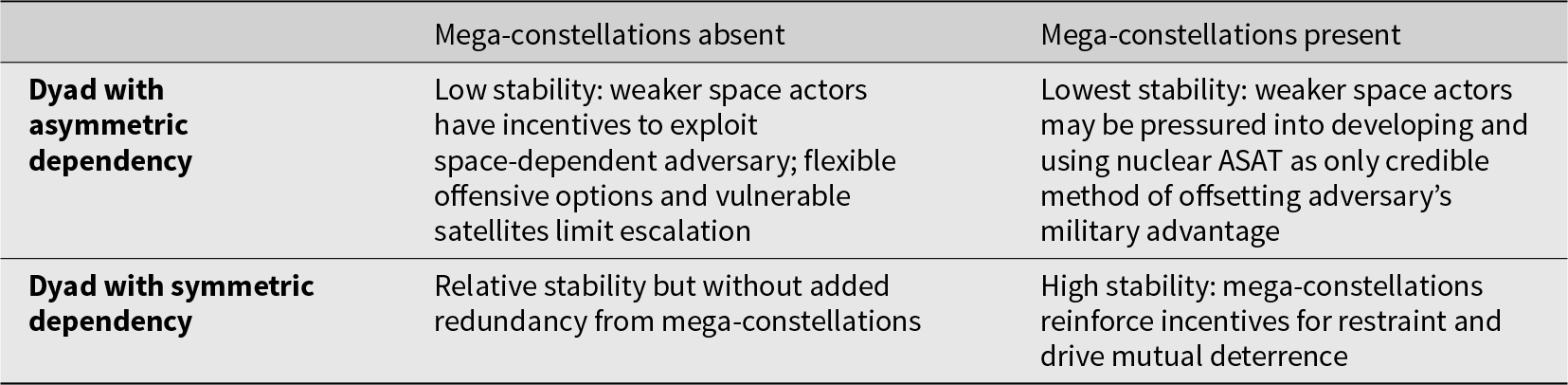
Accordingly, the advantages gained from attacking space capabilities will depend on how much the attacker has to lose from escalation. For dyads symmetrically dependent on space, such as the United States and China or Europe and Russia, mutual dependency incentivises restraint in space. This is due to both parties having a lot to lose from escalation in space, especially kinetic warfare. For asymmetrical dyads, such as the United States and North Korea, the weaker state will have far less to lose and more to gain by depriving the stronger power of its space capabilities early in a conflict.Footnote 109 Table 2 shows a visualisation of these dynamics.
Effect of mega-constellations on stability, moderated by space dependency.
The idea of symmetry shaping first-strike incentives in space is not new. Klein details asymmetrical advantages as a component in the larger strategy of irregular warfare in space, building on the premise of an attacker neutralising the strengths of its adversary using as limited force as possible.Footnote 110 This is precisely the premise of US vulnerability concerns regarding the backside of its own space power, namely that vulnerability emerges from dependency.Footnote 111 As shown by Townsend, space is characterised by the inherent concern of one’s vulnerabilities being exploited by a competitive adversary. Mitigating this concern, he argues, builds on pursuing disaggregated space capabilities and a defensive posture.Footnote 112
Taking this into consideration, the proliferation of mega-constellations is likely to intensify asymmetrical power gaps, widening the incentives for weaker states to exploit an adversary’s space dependency early in a conflict. Accordingly, mega-constellations will negatively affect stability in space under conditions of asymmetry, as a first strike may appear rational for the party with relatively little to lose from risking its space capabilities. As argued by Grossfeld, Russia’s limited dependence on space reconnaissance capabilities is internally recognised as providing incentives to develop – and potentially use – ASAT weapons.Footnote 113 The consequences of such instability are especially destructive given the limited and escalatory means available to target a mega-constellation. On one hand, the only current option that can credibly disable a mega-constellation is a nuclear warhead, which implies weaker space powers have incentives to pursue such options. These incentives have already been recognised in existing literature. As argued by Moltz, ‘a less-developed country with little reliance on space might carry out an even less discriminating attack using a nuclear weapon’.Footnote 114
On the other hand, the use of kinetic counterspace capabilities would generate immense amounts of orbital debris that could potentially endanger the entire orbital regime over time, including targeted mega-constellations. Doboš and Pražák have similarly argued that weaponising space debris is a potential tool in weak space actors’ strategic arsenals, explicitly suggesting Russia, Iran, and North Korea as potential proponents.Footnote 115 However, as the cascading debris effect would not be immediate and kinetic counterspace would be insufficient for disabling a mega-constellation directly, weaponising space debris is unlikely an attractive method for weak space actors.
Given the status of mega-constellation development, one question is relevant to ask: what if the United States succeeds with mega-constellations and all other states fail? In practice, this would mean the United States actively re-posturing its space capabilities, including ISR, PNT, and early warning systems, into mega-constellations. As previously shown in Table 1, most planned mega-constellation are far from active deployment. The only mega-constellation having shown significant effects is US commercially owned Starlink, and no other state has successfully replicated SpaceX’s reusable launch technology. Although China appears closest to such a replication, the possibility of a US long-term mega-constellation monopoly is credible.Footnote 116 In this scenario, the US prospect of exerting space control would be uncontested, which would raise concerns even in Beijing. With every dyad inherently asymmetrical and an overwhelming US reliance on mega-constellations, the temptation for any actor in a conflict with the US to escalate in space would be clear. Indeed, the ‘Astropolitik’ prescription of a benevolent hegemon providing domain-wide stability is unlikely to translate into contemporary power relations. Instead, such a development is likely to aggravate incentives to offset US space power. With sufficient power asymmetry, the robustness of mega-constellations could incentivise destructive first strikes by adversaries, thereby eroding their stabilising benefits.
The question of lone US success in mega-constellations is particularly relevant given President Trump’s recent announcement of Golden Dome. Backed by a proposed $178 billion investment, the initiative envisions a comprehensive global shield built on an architecture of space-based interceptors and orbital sensors.Footnote 117 Given its proposed scale, the system will effectively be a mega-constellation if ever completed.Footnote 118 Regardless of its completion, the planned investments in software, sensor, and rocket technology may alone act as force multipliers. In addition to benefiting mega-constellation development, the investments in space technologies envisioned in Golden Dome have the potential to deepen US power and dependency on space further while widening existing asymmetries. As an operational Golden Dome would threaten nuclear states’ second-strike capabilities and thereby incentivise armament of – probably nuclear – counterspace capabilities; adversarial first-strike incentives would increase, making Golden Dome deeply destabilising. Indeed, the credible threat of Golden Dome could enable asymmetrically weak space actors to explain nuclear ASAT armaments as defensive and reactive, rather than radical and destabilising.
Conclusion and implications
As this article shows, mega-constellations are set to become a formative component of military competition in space, bringing both advantages and challenges to upholding stability. Mega-constellations, even if remaining a US monopoly, may widen existing asymmetries and sharpen adversaries’ first-strike incentives for counterspace operations. Their effects will still hinge on the degree of dependency between states: in symmetric dyads, incentives for a first strike remain limited, as neither side benefits from escalation. In asymmetric dyads, weaker space actors may perceive greater incentives to employ destructive measures when their stakes in a conflict are high. To be sure, these dynamics are structural and exist in some form regardless of mega-constellations. As argued in this paper, however, the emergence of mega-constellations is likely to adjust the configurations these incentives take place in. Space is already characterised by stability concerns and an offence-dominated environment – the emergence of mega-constellations will add a new layer of complexity that may drive certain incentives further. Most significantly, proliferated mega-constellations can act as a mechanism creating dangerous incentives for asymmetrically weak space actors to escalate using destructive measures, including nuclear weapons in orbit.
This analysis has three main implications. First, as the unregulated race to build mega-constellations can drive escalation, there should be natural incentives for space-dependent states to engage in dialogue on regulation. Space could be a rare avenue for Washington and Beijing to find common ground through arms control, as neither gains from large-scale escalation in space. Aside from regulation pertaining to the mega-constellations themselves, both states may find mutual interest in curtailing any development of nuclear counterspace capabilities, as any third party-use of such weapons in space would affect all satellites in that orbit. Nevertheless, the US announcement of Golden Dome limits these opportunities significantly. A functional Golden Dome would create incentives for adversaries to drive armament rather than limiting it, and the announcement alone has validated and exaggerated Chinese concerns surrounding their second-strike capability and US interests in space.Footnote 119 Progress on arms control is therefore unlikely while Golden Dome remains an active ambition.
Second, the issue of civil–military entanglement in space will become increasingly relevant. While operated by a private company, Starlink has become militarily indispensable to both Ukraine and, increasingly, the United States. Moreover, the influx of contracts from the US government has become a key source of financing for SpaceX, thus creating a mutual dependency and blurring the line between whether Starlink can be regarded as civil or military infrastructure.Footnote 120 Adversaries, such as Russia, must weigh whether an attack on Starlink is an attack on a Ukrainian enabler, a US commercial asset, or a de facto extension of the US military. This ambiguity may drive escalation by leading military leaders into believing that commercial systems are easier targets, thereby lowering the threshold of engaging in a first strike. As several prospective mega-constellations are controlled fully or partially by commercial actors, the stability implications of civil–military entanglement will not be an issue unique to Starlink.Footnote 121
Third, if a mega-constellation becomes central to both conventional and nuclear forces, which may be the case with Golden Dome, this may actualise the issue of conventional-nuclear entanglement in space.Footnote 122 The lack of transparency and situational awareness in space makes it a domain already subject to ambiguity regarding intent and attribution. Scenarios may occur wherein the use of counterspace capabilities may aggravate this ambiguity and thereby cause inadvertent escalation. States seeking to deprive an actor of a conventional warfighting capability may simultaneously affect nuclear infrastructure by attacking a dual-capable mega-constellation. In a conflict, such actions may create perceived ‘use-it-or-lose-it’ dilemmas and miscalculations, highlighting the dangers of entanglement in space.
Acknowledgements
Thank you to the reviewers’ comments, which significantly improved the quality and contribution of the article. I would also like to thank Henrik Stålhane Hiim, James Cameron, and Carl Henrik Knutsen for their valuable feedback throughout the development of the manuscript.
Jonas Vidhammer Berge is a doctoral fellow at the Norwegian Institute for Defense Studies. His work focuses on technological development and international security, and the use of strategic non-nuclear weapons. His doctoral thesis focuses on security developments in the space domain and the role of space in military operations.


 Open access

