





The increasing prevalence of obesity, type 2 diabetes mellitus (T2DM) and Metabolic Syndrome (MetS) poses a significant global health threat, with substantial socioeconomic impact and burden worldwide(Reference Kazibwe, Tran and Annerstedt1–Reference Nagi, Ahmed and Rezq4). Data available from the WHO, estimates that in 2022 more than 2·5 billion adults were overweight, of which 890 million had obesity(5). According to data from the International Diabetes Federation, in 2017 there were 451 million people with diabetes worldwide, a number expected to increase by approximately 53·7 % (693 million) by 2045(Reference Cho, Shaw and Karuranga6). The incidence of MetS often matches that of obesity and T2DM, as these conditions are directly correlated. As a consequence, this cluster of noncommunicable diseases has become one of the major causes of morbidity and mortality(Reference Naghavi, Ong and Aali7,Reference Roth, Abate and Abate8) , making the prevention and amelioration of its risk factors a priority.
Irregular eating patterns might be a contributing factor to these numbers(Reference Wennberg, Gustafsson and Wennberg9–Reference Dashti, Scheer and Saxena11). Eating over an extended period of time has been associated with the development of these pathologies(Reference Taetzsch, Roberts and Bukhari12–Reference Sierra-Johnson, Undén and Linestrand15). According to a study by Wilkinson et al. (2020)(Reference Wilkinson, Manoogian and Zadourian16), conducted on patients with MetS, the majority of all energy-containing events, i.e. eating occasions, occurred in an eating window (time between the first and last energy-eating occasion of the day) of approximately 15 h, resulting in a fasting window of less than 10 h.
The biological circadian rhythms are part of a complex system that enhances energy expenditure and coordinates metabolic pathways, separating incompatible biochemical and physiological processes(Reference Kessler and Pivovarova-Ramich17,Reference Panda18) . Appropriate functioning of the circadian clocks is of the utmost importance for sustaining metabolic health since circadian disruption disturbs metabolic homeostasis and is linked with an increased risk of obesity and MetS(Reference Chaput, McHill and Cox19–Reference Zimmet, Alberti and Stern21). In turn, circadian rhythms are affected by obesity and other metabolic diseases(Reference Vieira, Ruano and Figueroa22,Reference Gómez-Abellán, Hernández-Morante and Luján23) . This bidirectional relationship creates a complex interplay where it is not clear which factor is the cause and which is the consequence. This mutual influence makes it challenging to determine the initial trigger in the cycle of metabolic and circadian disruptions.
Some studies have previously linked the dysfunctions in peripheral clock genes with alterations in glucose homeostasis(Reference Gachon, Loizides-Mangold and Petrenko24,Reference Turek, Joshu and Kohsaka25) and inflammatory pathways(Reference Hergenhan, Holtkamp and Scheiermann26). Although the main synchroniser of the suprachiasmatic nucleus (SCN) of the hypothalamus is the light/dark cycles, the peripheral clocks seem to be synchronised by the feeding/fasting cycles(Reference Lewis, Oster and Korf27). Based on these findings it was hypothesised that disruption of the circadian rhythm caused by the misalignment between the timing of food intake and circadian timing, might be the primary cause for disruption of metabolic homeostasis and increased metabolic risks(Reference Pot, Almoosawi and Stephen28).
Among the first lines of treatment, management and prevention of metabolic diseases are dietary intervention and increased physical activity(Reference Yumuk, Tsigos and Fried29–Reference ElSayed, Aleppo and Aroda32). However, these measures have limited success, in part due to the low adherence of the patients and the difficulty of maintaining these lifestyle changes in the long term. This highlights the necessity for new and more effective nutritional strategies that can complement current guidelines, improving the effectiveness of the lifestyle interventions prescribed. This includes personalisation of the interventions and adaptation to each individual’s unique rhythm and routine. In recent years, researchers have been assessing the efficacy of novel approaches that intend to restore disrupted circadian rhythms through nutritional challenges, including the modulation of timing and duration of daily food intake(Reference Eckel-Mahan, Patel and de Mateo33,Reference Chambers, Seidler and Barrow34) . Time-restricted eating (TRE) is a nutritional intervention in which the eating window is reduced to a fixed number of hours per day, allowing prolonged overnight fasting. This strategy does not intend to reduce energy intake and is based on the hypothesis that by re-setting the eating/fasting cycles the circadian rhythms will be reestablished and the overall metabolic pathways will be improved(Reference Chaix, Manoogian and Melkani35).
Although research on the effect of TRE interventions on chronobiology markers is a relatively new field, the impact of TRE on body weight and body composition has been more systematically reported; however, it is important to assess the overall effects of these interventions on metabolic pathways by compiling the data currently available. By doing so, we can identify which clinical, laboratory and genetic biomarkers are most affected by TRE interventions within a certain population, ensuring that future studies focus on the most impactful areas. Different study protocols often assess a variety of variables and biomarkers, leading to a diverse range of findings. Furthermore, within various TRE protocols, the duration of eating can differ significantly. Participants may choose between earlier, mid-day or later TRE windows, and some may even self-select their TRE periods. A structured search was conducted in the electronic databases Scopus and PubMed to identify articles reporting the results of TRE protocols on individuals with overweight or obesity, ensuring a comprehensive representation of TRE protocols in this population. Animal studies or in vivo experiments, studies involving periodic fasting or alternating days fasting, studies combining TRE protocols with energy restriction and/or exercise interventions and studies on religious fasting were not included in this review. Therefore, the present review aims to provide an overview of the impact of TRE protocols on metabolic, inflammatory and oxidative stress biomarkers, as well as their influence on circadian rhythms biological markers, based on the findings of clinical studies conducted on individuals with overweight or obesity.
Characteristics of the time-restricted eating studies in people with overweight or obesity
The studies discussed in the present review followed these characteristics: (1) population: adults aged 18 years or older with overweight or obesity; Intervention: a fixed daily fasting period between 10 and 20 h with ad libitum intake; (3) comparators: control group in randomised controlled trials or non-randomised controlled trials or subjects before TRE intervention in studies with a one-group pretest-posttest design; (4) outcomes: data on changes in at least one of the following: insulin, glucose, cortisol, melatonin, ghrelin, leptin, adiponectin, interleukin-1 (IL-1), interleukin-6 (IL-6), 8-isoprostane, TNF-α or nitric oxide and (5) study design: clinical trials using TRE.
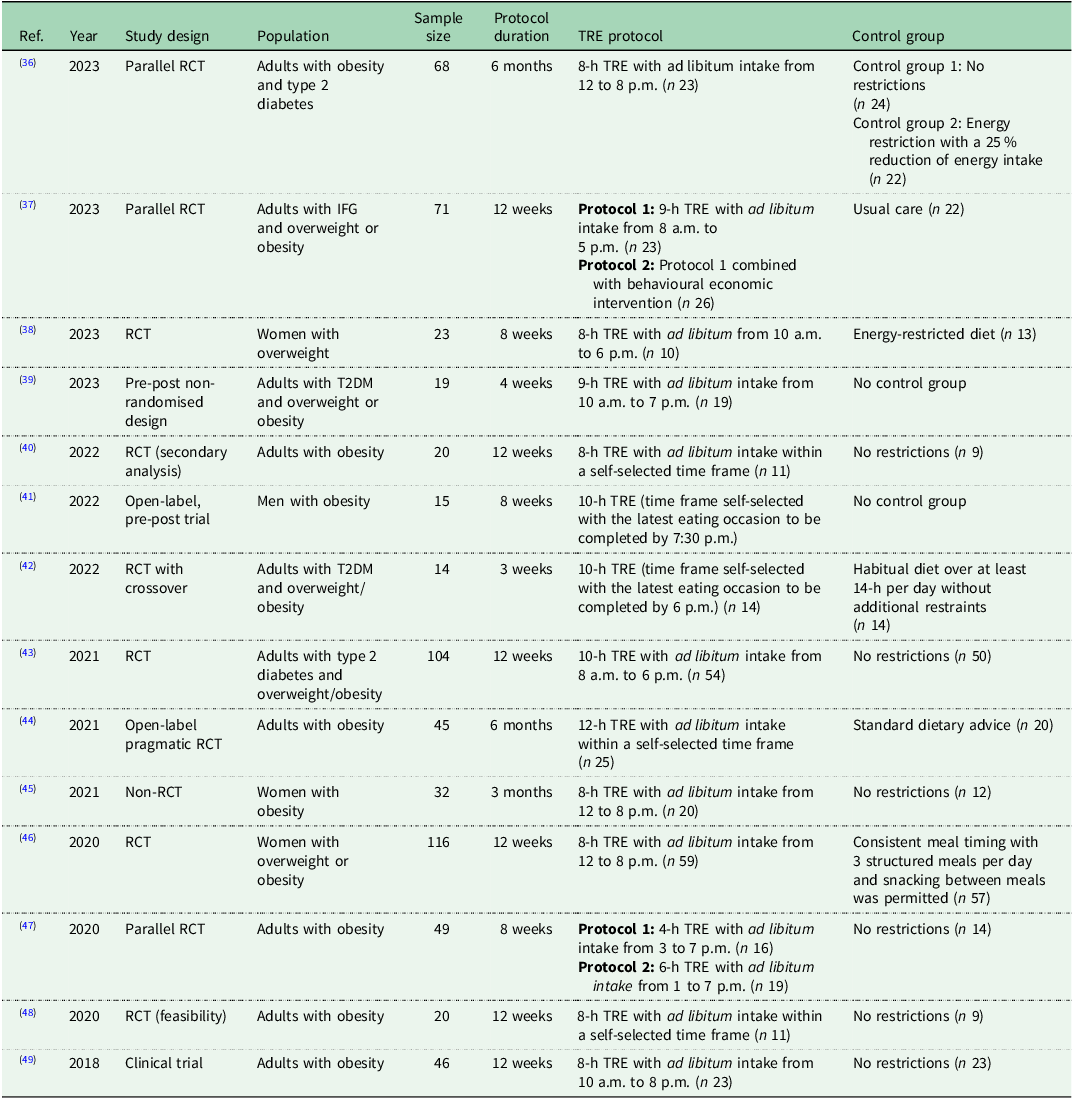
Fourteen studies are explored in this review (Table 1), and of those, eight were randomised clinical trials and one was a secondary analysis. The duration of the TRE protocols ranged from 3 weeks to 6 months and the sample size of the TRE groups ranged from 10 to 59 participants. The shortest eating window was 4 h (20 h of fasting) and the longest was 12 h (12 h of fasting), with 8 h being the most common eating window (16 h of fasting).
Overall characteristics of the reviewed studies

TRE, time-restricted eating; RCT, randomised controlled trial; IFG, impaired fasting glucose; T2DM, type 2 diabetes mellitus.
Effects of time-restricted eating on body weight and body composition
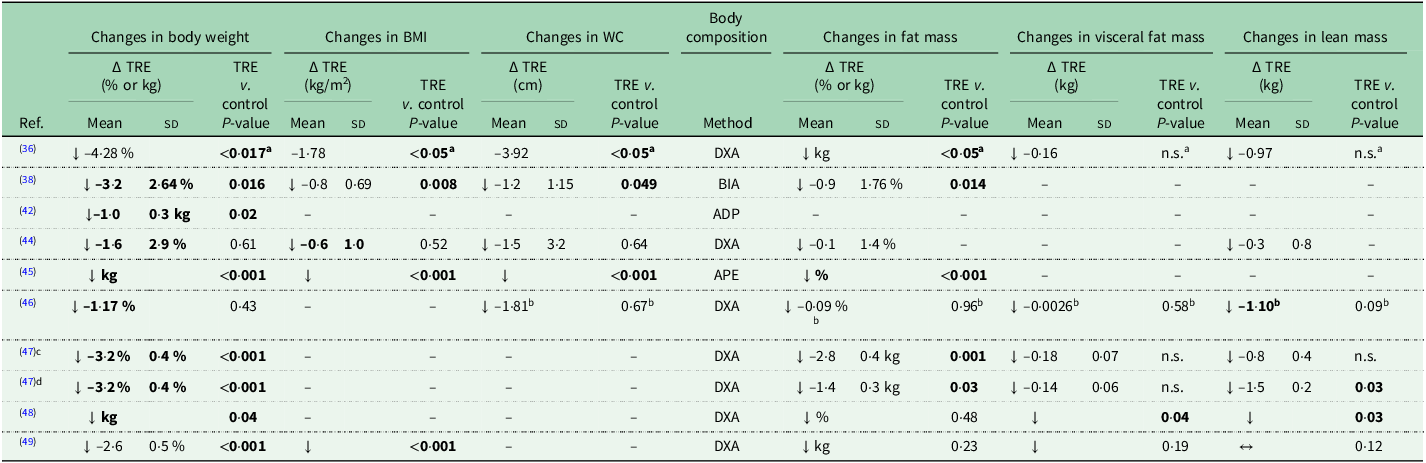
In most of the studies, there was a statistically significant change in body weight(Reference Mengi Çelik, Köksal and Aktürk38,Reference Andriessen, Fealy and Veelen42,Reference Phillips, Mareschal and Schwab44–Reference Chow, Manoogian and Alvear48) , with all the TRE protocols resulting in weight loss (Table 2). Compared with the control groups, the participants in eight TRE protocols showed greater body weight loss(Reference Pavlou, Cienfuegos and Lin36,Reference Andriessen, Fealy and Veelen42,Reference Phillips, Mareschal and Schwab44–Reference Gabel, Hoddy and Haggerty49) , while only two studies did not find significant differences between groups(Reference Phillips, Mareschal and Schwab44,Reference Lowe, Wu and Rohdin-Bibby46) . The control groups of the studies by Cienfuegos et al. (Reference Cienfuegos, Gabel and Kalam47), Pavlou et al. (Reference Pavlou, Cienfuegos and Lin36), Chow et al. (Reference Chow, Manoogian and Alvear48), Schroder et al. (Reference Schroder, Falqueto and Mânica45) and Gabel et al. (Reference Gabel, Hoddy and Haggerty49) were instructed to maintain their daily eating routines without any restrictions. The control group of the study by Pavlou et al. (Reference Pavlou, Cienfuegos and Lin36) presented an average daily eating window of 10 h 23 min ± 1 h 26 min at baseline that was preserved by the end of the study. The control group of the study conducted by Chow et al. (Reference Chow, Manoogian and Alvear48) showed a mean daily eating window of 15·5 ± 1·1 h that also was preserved by the end of the intervention. Andriessen et al. (Reference Andriessen, Fealy and Veelen42) instructed the participants of the control group to distribute their habitual diet over a minimum of 14 h per day, resulting in an average eating window of 13·4 ± 0·1 h(Reference Andriessen, Fealy and Veelen42).
Effects of time-restricted eating on body weight and body composition compared with the control groups

WC, waist circumference; TRE, time-restricted eating; DXA, dual X-ray absorptiometry; n.s., not significant; BIA, bioelectrical impedance analysis; ADP, air displacement plethysmography; APE, anthropometric prediction equations.
a Comparison of the mean differences between the TRE group and the control group.
b Results from the in-person cohort that did not include all the participants.
c Results from the 4-hour TRE group.
d Results from the 6-hour TRE group; ↓, decrease in the mean value; ↔, no changes in the mean value; ↑, increase in the mean value.
Other studies compared the results of the TRE intervention with different dietary strategies or nutritional approaches. Mengi et al. (Reference Mengi Çelik, Köksal and Aktürk38) compared the TRE protocol with an energy-restricted diet (ERD) protocol, in which the participants consumed a diet based on their total energy expenditure minus 500 kcal. In this particular study, the decrease in body weight was higher in the ERD group compared to the TRE group (5·5 % and 3·2 %, respectively)(Reference Mengi Çelik, Köksal and Aktürk38). Lowe et al. (Reference Lowe, Wu and Rohdin-Bibby46) compared the TRE intervention with a consistent meal timing (CMT) approach, in which the participants ate three structured meals daily and were allowed to snack between meals. Lastly, Phillips et al. (Reference Phillips, Mareschal and Schwab44) compared the TRE intervention with standard dietary advice, which consisted of a 10-minute nutritional counselling session and a leaflet summarising the food pyramid and Swiss recommendations for a healthy, balanced diet(Reference Phillips, Mareschal and Schwab44). The study found no differences in the mean eating window (14·89 ± 1·21 h) before and after the standard dietary advice intervention(Reference Phillips, Mareschal and Schwab44).
Cienfuegos and colleagues(Reference Cienfuegos, Gabel and Kalam47) tested two TRE protocols, with a 4-hour and a 6-hour eating window, but the results indicated no difference in weight loss between the two interventions. Pavlou et al. (Reference Pavlou, Cienfuegos and Lin36) studied three groups, the TRE and control groups and an additional group with ERD. After 6 months of intervention, the ERD group showed no differences in mean body weight. Furthermore, there were no differences in the percentage of body weight loss between the TRE group and the ERD group(Reference Pavlou, Cienfuegos and Lin36).
The weight loss observed in TRE studies might be partially attributed to a reduction in energy intake, as eating within a limited window frame decreases opportunities for consuming calories in excess. Of all the studies analysed in this review, eight reported collecting data on dietary intake(Reference Pavlou, Cienfuegos and Lin36–Reference Parr, Steventon-Lorenzen and Johnston39,Reference Zhao, Hutchison and Liu41–Reference Che, Yan and Tian43,Reference Chow, Manoogian and Alvear48) , but only six provided information on changes in nutrient and/or energy intake(Reference Pavlou, Cienfuegos and Lin36–Reference Parr, Steventon-Lorenzen and Johnston39,Reference Che, Yan and Tian43,Reference Chow, Manoogian and Alvear48) . Three of these studies found a significant decrease in energy intake(Reference Pavlou, Cienfuegos and Lin36,Reference Mengi Çelik, Köksal and Aktürk38,Reference Che, Yan and Tian43) , and in one study, although the authors did not report a decrease in energy intake, they observed a greater reduction in the number of eating occasions in the TRE group(Reference Chow, Manoogian and Alvear48). Suthutvoravut et al. (Reference Suthutvoravut, Anothaisintawee and Boonmanunt37) reported that the mean difference in energy intake between the TRE and usual care was NS.
Regarding changes in body fat mass percentage, the study by Cienfuegos et al. (Reference Cienfuegos, Gabel and Kalam47) reported significant differences across the three groups after the intervention, with participants in the 4-hour TRE and 6-hour TRE groups losing significantly more fat mass than those in the control group. Mengi Çelik et al. (Reference Mengi Çelik, Köksal and Aktürk38) found a significant decrease in body fat percentage in the ERD group, while the TRE group showed no significant changes. In four studies(Reference Pavlou, Cienfuegos and Lin36,Reference Phillips, Mareschal and Schwab44,Reference Lowe, Wu and Rohdin-Bibby46,Reference Chow, Manoogian and Alvear48) the reduction in body fat percentage was greater in TRE interventions but not different compared to the control group. In the study by Gabel and colleagues(Reference Gabel, Hoddy and Haggerty49) and the one by Schroder et al. (Reference Schroder, Falqueto and Mânica45), no changes in fat mass were observed in the control group.
Concerning lean mass, Cienfuegos et al. (Reference Cienfuegos, Gabel and Kalam47) found that the 6-hour TRE group lost significantly more lean mass than the 4-hour TRE and control groups. The control group experienced lower loss of lean mass, although there were no differences compared with the 4-hour(Reference Cienfuegos, Gabel and Kalam47). Chow et al. (Reference Chow, Manoogian and Alvear48) also reported differences in lean mass between groups, reporting a significant decrease in the TRE with no change in the control group. Lowe et al. (Reference Lowe, Wu and Rohdin-Bibby46) found no differences in lean mass between the TRE and CMT groups, but there was a significant decrease in the TRE group after the intervention. In the study by Pavlou et al. (Reference Pavlou, Cienfuegos and Lin36), the TRE intervention had no effect on lean mass. Furthermore, no differences in lean mass were observed in the control groups of the studies by Pavlou et al. (Reference Pavlou, Cienfuegos and Lin36), Phillips et al. (Reference Phillips, Mareschal and Schwab44) and Lowe et al. (Reference Lowe, Wu and Rohdin-Bibby46).
Effect of time-restricted eating on metabolic, inflammatory and oxidative stress biomarkers
From the total of studies that employed TRE protocols with the assessment of glucose, only two studies reported a significant decrease in glucose levels following the TRE intervention(Reference Suthutvoravut, Anothaisintawee and Boonmanunt37,Reference Chow, Manoogian and Alvear48) (Table 3). Furthermore, only two studies showed statistical differences between the TRE and control groups(Reference Pavlou, Cienfuegos and Lin36,Reference Che, Yan and Tian43) . Among the studies analysed, glycated Hb A1c (HbA1c) remained unchanged following TRE interventions(Reference Pavlou, Cienfuegos and Lin36,Reference Suthutvoravut, Anothaisintawee and Boonmanunt37,Reference Che, Yan and Tian43,Reference Phillips, Mareschal and Schwab44,Reference Lowe, Wu and Rohdin-Bibby46–Reference Chow, Manoogian and Alvear48) ; however, three studies showed differences between the TRE and control groups(Reference Pavlou, Cienfuegos and Lin36,Reference Suthutvoravut, Anothaisintawee and Boonmanunt37,Reference Phillips, Mareschal and Schwab44) . Similar results were found for insulin levels and Homeostatic Model Assessment for Insulin Resistance, with no differences after TRE interventions(Reference Suthutvoravut, Anothaisintawee and Boonmanunt37,Reference Mengi Çelik, Köksal and Aktürk38,Reference Che, Yan and Tian43,Reference Schroder, Falqueto and Mânica45–Reference Gabel, Hoddy and Haggerty49) , but different between TRE and control groups in two studies(Reference Che, Yan and Tian43,Reference Cienfuegos, Gabel and Kalam47) .
Effects of time-restricted eating on metabolic biomarkers compared with the control groups

HbA1c, glycated haemoglobin A1c; HOMA-IR, Homeostatic Model Assessment for Insulin Resistance; TRE, time-restricted eating; n.s., not significant.
a Comparison of the mean differences between the TRE group and the control group.
b Comparison of the differences between the TRE alone group and the control group.
c Glucose AUC (mg h/dl).
d Insulin AUC (mU h/l).
e Results from the in-person cohort that did not include all the participants.
f Results from the 4-hour TRE group.
g Results from the 6-hour TRE group; ↓, decrease in the mean value; ↔, no changes in the mean value; ↑, increase in the mean value.
In addition to the control group, the study by Pavlou et al. (Reference Pavlou, Cienfuegos and Lin36) also included a third group with CR. While the reduction in HbA1c was slightly greater in the CR group and showed significant differences compared to the control group, no significant differences were observed between the TRE and CR groups. Moreover, no differences were observed in mean glucose values between the CR and TRE groups; however, this parameter was different between the CR group and the control group(Reference Pavlou, Cienfuegos and Lin36).
Andriessen et al. (Reference Andriessen, Fealy and Veelen42) and Parr et al. (Reference Parr, Steventon-Lorenzen and Johnston39) measured interstitial glucose using continuous glucose monitoring systems and both found that the mean 24-hour glucose levels were significantly lower after the TRE intervention. Additionally, in both studies, TRE participants exhibited glucose levels within the normal range for longer periods of time and less time with high glucose(Reference Parr, Steventon-Lorenzen and Johnston39,Reference Andriessen, Fealy and Veelen42) . In the study by Parr et al. (Reference Parr, Steventon-Lorenzen and Johnston39), improved glycaemic control, including postprandial meal responses, was achieved with no changes in dietary intake from the baseline (habitual) period to the TRE period, according to the complete 24-hour continuous glucose monitoring data analysed. No differences were found between the TRE group and the control group for time spent in hypoglycaemia, or time spent in the low glucose range, in the study by Andriessen et al. (Reference Andriessen, Fealy and Veelen42). Similarly, in the study by Parr and colleagues(Reference Parr, Steventon-Lorenzen and Johnston39), there were no differences in the time spent in hypoglycaemia between the two study periods (habitual and TRE).
Zhao and colleagues(Reference Zhao, Hutchison and Liu41) assessed ghrelin levels in their study but did not observe changes in this biomarker after the TRE intervention. In this same study, TRE seemed to alter the 24-hour profile of insulin with a post hoc analysis showing an increase in insulin at midday and a decrease at midnight in response to TRE(Reference Zhao, Hutchison and Liu41).
Only one study, by Mengi Çelik and colleagues(Reference Mengi Çelik, Köksal and Aktürk38), assessed leptin and adiponectin, observing no impact of TRE in these levels, but an increase in adiponectin in the ERD group. However, no differences were found between groups for both biomarkers(Reference Mengi Çelik, Köksal and Aktürk38).
Regarding inflammatory biomarkers, some studies measured the values of c-reactive protein(Reference Suthutvoravut, Anothaisintawee and Boonmanunt37,Reference Mengi Çelik, Köksal and Aktürk38,Reference Schroder, Falqueto and Mânica45) , IL-6 (IL-6)(Reference Mengi Çelik, Köksal and Aktürk38,Reference Cienfuegos, Gabel and Kalam47) and TNF-alpha (TNF-α)(Reference Cienfuegos, Gabel and Kalam47). There were no differences in the mean values of IL-6 after following TRE interventions, and these values were comparable to those in control groups(Reference Mengi Çelik, Köksal and Aktürk38,Reference Cienfuegos, Gabel and Kalam47) . Cienfuegos et al. (Reference Cienfuegos, Gabel and Kalam47) showed that neither the 4-hour nor the 6-hour TRE protocols had an effect on TNF-α values, with no differences compared to the control group. Only one study, Suthutvoravut and colleagues(Reference Suthutvoravut, Anothaisintawee and Boonmanunt37), reported a decrease in c-reactive protein values between the TRE group and the control group(Reference Suthutvoravut, Anothaisintawee and Boonmanunt37).
The results concerning the effects of the different TRE protocols on lipid profile are heterogeneous (Table 4), but nevertheless, most of those changes did not reach statistical significance when comparing them to the changes in the control groups or pre and post-intervention. Mengi Çelik et al. (Reference Mengi Çelik, Köksal and Aktürk38) observed a decrease in total cholesterol and LDL-cholesterol after the TRE intervention but these changes were not different when compared with the control group. They also reported a decrease in total cholesterol in the group with energy restriction(Reference Mengi Çelik, Köksal and Aktürk38). Che et al. (Reference Che, Yan and Tian43) reported differences in total cholesterol, LDL-cholesterol and triglycerides between the TRE and control groups. In contrast, Pavlou and colleagues(Reference Pavlou, Cienfuegos and Lin36) found no differences in the lipid profile parameters in the calorie restriction group, nor were there differences when comparing the TRE and calorie groups with the control group. Similarly, the consistent meal timing group in the study by Lowe et al. (Reference Lowe, Wu and Rohdin-Bibby46) exhibited no changes in lipid profile biomarkers, and no differences were observed in the Standard Dietary Advice group in the study by Phillips et al. (Reference Phillips, Mareschal and Schwab44).
Effects of time-restricted eating on lipid profile biomarkers and comparison with the control groups

n.s., not significant.
a Comparison of the differences between the TRE alone group and the usual care in patients with impaired fasting glucose group.
b Results from the 4-hour TRE group.
c Results from the 6-hour TRE group.
In a study by Zhao and colleagues(Reference Zhao, Hutchison and Liu41), the authors measured the 24-hour profile of triglycerides and found that in response to TRE, there was a decrease in triglycerides at midnight and 3:00 am. Andriessen and colleagues(Reference Andriessen, Fealy and Veelen42), evaluated certain metabolites on days 20 and 21 of each intervention but found no differences in triglyceride levels between the TRE group and the control groups.
Two studies examined the impact of TRE on oxidative stress biomarkers. Cienfuegos et al. (Reference Cienfuegos, Gabel and Kalam47) reported that TRE interventions decreased plasma levels of 8-isoprostane, an oxidative stress marker to lipids. These changes were significantly different across the three groups (4-hour TRE, 6-hour TRE and control), with the 4-hour TRE group exhibiting a 37 % reduction and the 6-hour TRE group a 34 % reduction, both greater than in the control group, although the difference between the two intervention groups was NS.
Mengi Çelik and colleagues(Reference Mengi Çelik, Köksal and Aktürk38) found no changes in total antioxidant status and total oxidant status by the end of the TRE protocol. However, the ERD group showed a significant increase in total antioxidant status after the intervention, although no differences were observed between the TRE and ERD interventions(Reference Mengi Çelik, Köksal and Aktürk38).
Effect of time-restricted eating on circadian biomarkers
Clock genes and circadian biomarkers, such as cortisol and melatonin, are critical to align metabolic processes with the day-night cycles(Reference Reppert and Weaver50–Reference O’Byrne, Yuen and Butt52). Studies have demonstrated that TRE influences the expression of clock genes and metabolic regulators(Reference Zeb, Wu and Fatima53). Therefore, food consumption within a specific time window is a cue to reinforce circadian rhythms by modulating the expression of clock genes, which in turn govern various downstream metabolic pathways(Reference Manoogian, Chow and Taub54–Reference Jakubowicz, Wainstein and Landau56). This synchronisation optimises the timing of metabolic processes, ultimately improving metabolic health(Reference Chaix, Manoogian and Melkani35).
Zhao et al. (Reference Zhao, Hutchison and Liu41) conducted the only study that assessed the impact of a 10-hour TRE protocol on circadian biomarkers, including the expression of core clock genes, and melatonin and cortisol rhythms, in a population of 15 men with obesity. The study included a 35-hour in-laboratory with controlled conditions stay for comprehensive metabolic assessments, conducted both at baseline and after the 8-week intervention. During these periods, researchers evaluated 24-hour profiles of plasma metabolites, glucoregulatory hormones and the transcriptome of subcutaneous adipose tissue (SAT)(Reference Zhao, Hutchison and Liu41). Results demonstrated that the TRE protocol significantly altered the expression of clock genes and genes involved in metabolic regulation within SAT. Specifically, TRE enhanced the expression of CLOCK and NR1D2 (REV-ERBβ) genes while reducing the expression of PER1 and NR1D1 (REV-ERBɑ) at 12:00 am. Although TRE did not alter the timing of dim light melatonin onset, it significantly reduced the morning cortisol AUC(Reference Zhao, Hutchison and Liu41).
Considering the limited number of studies investigating the influence of TRE on circadian genes, further research is needed to explore the potential of TRE as a relevant modulator of gene expression and its broader impact on metabolic health.
Current perspective of time-restricted eating and future challenges
TRE is an innovative dietary and behavioural strategy that restricts food intake to a consistent and specific window during the day to optimise nutrient uptake and promote health. Over recent years, this approach has gained significant attention due to its potential to improve metabolic health(Reference Panda18,Reference Chaix, Manoogian and Melkani35,Reference Manoogian, Chow and Taub54) . The premise behind TRE is based on the fact that the synchronisation of eating/fasting cycles with the intrinsic circadian rhythm helps optimise metabolic processes, reducing the risk of obesity, metabolic syndrome, T2DM and cardiovascular diseases(Reference Manoogian, Chow and Taub54,Reference Flanagan, Bechtold and Pot57) .
Restricting food consumption to a consistent daily window, typically ranging from 8 to 12 h, has been shown to improve insulin sensitivity, lower blood glucose levels and promote weight loss and beneficial changes in body composition, as demonstrated in the studies discussed in the present review. Additionally, TRE can also reduce cholesterol and triglyceride levels, contributing to overall cardiovascular health(Reference Gabel, Cienfuegos and Kalam58). These positive effects are likely due to both direct metabolic effects and indirect effects from weight loss and improved dietary habits.
The significant changes in body weight and, consequently body composition, observed across most included studies, regardless of the specific TRE protocols employed, suggest that the weight loss is likely attributed to a combination of factors, including both the timing of food intake and the indirect energy restriction imposed by a narrowed eating window(Reference Adafer, Messaadi and Meddahi59). The indirect energy restriction promoted by TRE interventions can create an energy deficit, promoting fat utilisation and facilitating a negative energy balance. Previous work has indicated that TRE can enhance fat oxidation during fasting time(Reference Antoni, Johnston and Collins60). Specifically, on adipose tissue, TRE increases β-oxidation and lipolysis(Reference Manoogian, Chow and Taub54).
Furthermore, fasting has been linked to decreased susceptibility to oxidative stress and improved antioxidant defences(Reference Bloomer, Kabir and Trepanowski61), while an increase in body weight is associated with increased oxidative stress and reduced antioxidant potential(Reference Manna and Jain62,Reference Lechuga-Sancho, Gallego-Andujar and Ruiz-Ocaña63) . However, Mengi Çelik et al. (Reference Mengi Çelik, Köksal and Aktürk38) did not find statistically significant changes in total antioxidant status. In contrast, previous research by Sutton and colleagues(Reference Sutton, Beyl and Early64) demonstrated that TRE reduced oxidative stress, as evidenced by the decreased plasma levels of 8-isoprostane.
Meal timing also plays a crucial role in regulating metabolism, circadian rhythms and hormonal responses, which can influence weight management independently of energy intake(Reference Chaix, Manoogian and Melkani35,Reference Adafer, Messaadi and Meddahi59) . Mealtime is an important zeitgeber that synchronises peripheral clocks in tissues and organs with the central clock in the SCN(Reference Flanagan, Bechtold and Pot57). Eating at the ‘wrong’ time can impair glucose tolerance and alter the expression of genes involved in circadian regulation, also highlighted by a review by Johnston and colleagues(Reference Johnston, Ordovás and Scheer65), emphasising the importance of meal timing in maintaining circadian rhythm integrity. These outcomes underline the significance of regular and appropriately timed meals in supporting circadian rhythm health and metabolic efficiency.
However, implementing TRE protocols also requires consideration of potential negative effects. The 8-hour eating window is the most common protocol among the reviewed studies, allowing a balance between achieving metabolic benefits and ensuring adherence to the dietary regimen within the limitations of everyday life. Deviating from this timeframe, particularly with a narrower eating window, may pose challenges to adherence due to lifestyle constraints such as work schedules, family responsibilities and societal mealtimes(Reference Jefcoate, Robertson and Ogden66,Reference O’Neal, Gutierrez and Laing67) . Moreover, restrictive eating windows may contribute to disordered eating behaviour in some individuals(Reference Ganson, Cuccolo and Hallward68), potentially limiting the real-world effectiveness of TRE interventions. This underscores the importance of considering not only the physiological effects but also the social and behavioural aspects when designing and implementing TRE protocols. Tailoring interventions to individual characteristics, motivators and barriers is crucial for determining adherence and also effectiveness of the protocol(Reference O’Connor, Boyd and Bailey69).
Importantly, restricting the eating events to a limited timeframe, especially when not taking into consideration the diet quality and quantity, may result in an inadequate nutrient intake or, i.e. increased intake of saturated fats(Reference Mengi Çelik, Köksal and Aktürk38,Reference Parr, Steventon-Lorenzen and Johnston39,Reference Che, Yan and Tian43,Reference Parr, Devlin and Hawley70) . Therefore, the diet of individuals practising TRE needs to be carefully managed to ensure the consumption of a balanced healthy diet and to prevent deficits, particularly when this intervention is followed over a long period.
Lastly, the effectiveness of TRE protocols can vary widely among individuals due to several factors, including different genetic backgrounds, lifestyle and environmental influences(Reference O’Neal, Gutierrez and Laing67,Reference Garaulet, Corbalán and Madrid71–Reference Garaulet, Corbalán-Tutau and Madrid73) . While some individuals may experience significant benefits, others may have little to no improvement, underscoring the importance of personalised dietary approaches to maximise the impact of TRE on metabolic health.
Conclusions
TRE might be a promising complementary approach for weight management and improved metabolic health, with most studies demonstrating improvements in body weight, glucose levels and insulin resistance. However, data regarding its influence on circadian rhythms, inflammatory markers and key metabolic hormones such as leptin, ghrelin and adiponectin remains scarce. This highlights the need to further explore the broader impact of TRE interventions. A refined understanding and personalised application of TRE are crucial for optimising its benefits across different populations while attempting to mitigate its drawbacks. Therefore, medium- and long-term studies are needed to fully assess the lasting effects and potential benefits of TRE, as most existing research has been conducted in small samples and over relatively short periods.
Author contributions
ML, SCS, RB and MPG conceived and designed the study and contributed to the protocol development. ML conducted the literature search, article selection and analysis and wrote the first draft of the manuscript. All authors contributed to the manuscript by revising it critically for intellectual content. All authors read and approved the final manuscript submitted.
Financial support
This work was supported by Portuguese national funds provided by FCT – Fundação para a Ciência e Tecnologia, I.P., (UI/05704/2020), by the Portuguese Society of Diabetology through the award of the 2020 Emilio Peres Scholarship and by the Faculty of Nutrition and Food Sciences of the University of Porto and LabITR (LA/P/0064/2020). ML is supported by a PhD Scholarship from the FCT – Fundação para a Ciência e Tecnologia, I.P. (DOI 10·54499/2021·07673.BD). MPG work is funded by national funds through FCT – Fundação para a Ciência e Tecnologia, I.P., under the Scientific Employment Stimulus – Institutional Call (DOI 10·54 499/CEECINST/00051/2018/CP1566/CT0009).
Competing interests
The authors declare no conflicts of interest.


 Open access

