




Introduction
On 10 July 1749, Charles Emmanuel III of Savoy addressed rising rent prices experienced in the capital of his kingdom, Turin, by publishing Regie patenti , royal decrees that directly intervened on the issue.Footnote 1 Through this decree, the sovereign entrusted the vicariate, one of the city’s most important institutions, with the task of setting fair rents. The sovereign’s measure touched on one of the most sensitive sectors for the economies of Italian cities under the ancien régime , where the majority of inhabitants were tenants: 80 per cent in Florence, 90 per cent in Rome, 93 per cent in Milan, 94 per cent in Venice and an impressive 95 per cent in Turin.Footnote 2 Considering that access to citizenship rights and to the privileges associated with local belonging was formally or indirectly tied to permanent city residence, it is clear that the matter of rent had highly significant social and legal implications.Footnote 3
The issue of rent increases raises a recurring problem in urban history linked to episodic crises – wars, epidemics, natural catastrophes – or long-term phenomena – such as migratory and tourist flows – that can affect the urban fabric, population distribution and housing market. In recent years, rising rents have returned to the forefront of public debate and attracted scholarly attention across disciplines, mainly due to the gentrification of working-class neighbourhoods or the ‘airbnbfication’ of city centres, resulting in the expulsion of their inhabitants.Footnote 4 Recent studies have shifted the focus from the exclusive social aspects of this phenomenon to the crucial role played by institutions and the government in encouraging gentrification processes through policies that provide many opportunities for financial capital to take over urban spaces to make a profit.Footnote 5 These studies describe a ‘neoliberal’ and ‘gentrified’ city model in which state policies and financial interests are intertwined. It is also for this reason that institutions and the state are called upon to implement policies capable of curbing this problem and guaranteeing fundamental rights to housing.
The intertwining of state policies and real estate speculation is not an exclusive feature of neoliberal cities. In other forms and through other mechanisms, this alliance also dominated the ‘production’ of cities of the ancien régime , including the capital of Savoy’s states. Between the seventeenth and eighteenth centuries, state intervention in favour of large investments in the housing sector was essential for the implementation of important urban projects in Turin, conceived as a form of investment to generate profits. This form of housing speculation significantly impacted rental prices, reaching a scale that required state intervention.
Charles Emmanuel III’s initiative on rents, mentioned at the beginning of this introduction, was not novel in early modern Europe.Footnote 6 Examples of rent control policies can be found in Rome as early as the 1470s, when Pope Paul II prohibited the eviction of insolvent tenants, and later, in 1549, when Pope Paul III intervened in prohibiting rent increases during Jubilee in 1550. Papal interventions became regular after the establishment of the ghetto (1555) and the consequent uncontrolled increase in rents in this area of the city, to the detriment of the Jewish community.Footnote 7 Another example can be found in Paris during the Wars of Religion and the siege of the city, when parliament, with its arrêt on 14 April 1589, forced landlords to reduce rents by a third.Footnote 8 In Madrid, rents were subject to court control from 1564 onwards. In Lisbon, state intervention was necessary after the 1755 earthquake, which caused rents to rise dramatically in a completely devastated city.Footnote 9
The peculiarity of the Turin case lies in the proceedings and resulting documentation triggered and produced by the decree of 1749. From that moment on, vicariate officials were accompanied by public assessors to extensively inspect Turin homes, either at the request of tenants or ex officio. Over the course of a few years, they covered a large part of the urban territory. What remains to this day is a large body of documentation that allows us to observe the procedures used to assess property values and the process by which fair rent was determined. As Michela Barbot, Jean-François Chauvard and Luca Mocarelli have pointed out, in the furrow of economics of conventions, it is by observing the process that leads to the attribution of value to properties, rather than by studying price series, that we can see the extra-economic criteria that deeply influenced the property market under the ancien régime .Footnote 10
Despite its key role in city economies, the issue of estimating rental values has rarely been the subject of any specific research. Historians and economic historians have mostly focused on estimates and property values related to auctions or sales, which include income and, therefore, the value of rents.Footnote 11 In the early 2000s, the monographic issue of Quaderni Storici edited by Renata Ago and Gérard Delille, drew attention to various aspects of the economic and social life of a city that the issue of rents allows us to re-examine.Footnote 12
The example of Turin provides an opportunity to closely examine the process of determining rental prices, a crucial issue affecting access to the city. In this context, rents become an observatory on the production, appropriation and transformation of urban spaces. The relations between the different interests involved in this process emerge through conflict and negotiation when stances become polarized, clarified and expressed. Rent becomes the subject around which these different interests converge and clash. The solutions implemented to determine fair rent reveal a system of values that shaped cities at the very moment when, as Jean-Claude Perrot suggested, modern cities were emerging, and their transformations were matched by the ‘invention de la question urbaine’.Footnote 13
This article examines the different elements of legislative intervention and legal procedures introduced in Turin in the mid-eighteenth century, and pieces together the context, how they were actually used and what they meant. We start by presenting our archival source and the procedure for estimating the rents of the first properties visited by public officials. To understand the reasons behind this state intervention, we will analyse the major urban development projects that took place in Turin between the seventeenth and eighteenth centuries, and, particularly, their impact on the distribution of property ownership. Ultimately, through a detailed analysis of the process involved in determining fair rent, we highlight the system of economic and non-economic values that contributed to defining the conditions governing access to the city.
An unprecedented procedure
On 23 November 1750, a public official, accompanied by the lieutenant of the vicar of Turin, began an inspection of the marquis of Caraglio’s home, located in the Santa Croce block near Porta Palatina, and the city’s cathedral in Città Vecchia.Footnote 14 For three days, the assessor visited all apartments in the building and drew up a detailed report in which he recorded not only the dimensions, but also the general features of each room: exposure, openings, views, finishes, ornaments and every element useful for an evaluation. A few days later, the assessor provided his opinion on the rents charged for that property, deciding to revise eight of them downwards: the workshops of a wood turner and shoemaker with adjoining rooms, and six residential properties with different layouts. The new evaluation resulted in an average reduction in rent of over 10 per cent, from a total (of all the rents) of 503 to 447 liras.
This was the beginning of a large-scale operation affecting a significant number of homes. In just six months, between the end of November 1750 and the beginning of June 1751, approximately 180 properties or corpi (parts of houses) were visited, with dwellings of various sizes and layouts, in around 60 city blocks.Footnote 15 Public officials’ inspection of private homes was an unprecedented procedure for a city that had never been subjected to a cadastre because it was exempt from property taxes. The operations continued throughout 1750–51, gradually covering most of the city.
The involvement of public officials was authorized by the royal decree of 1749, in which the sovereign, having been ‘informed that rents for houses in our metropolis had risen excessively’, instructed the vicar to ‘investigate and resolve disputes concerning excessive rent increases between landlords…and their tenants’, setting a new rent.Footnote 16 The 1749 royal decree marked the beginning of a string of legislative initiatives aimed at capping the rise in rents. In an edict of 2 November 1750, the sovereign revisited the matter to define the vicar’s jurisdiction more precisely.Footnote 17 He was responsible for conducting the trials using summary proceedings without procedural formalities. Visits were initiated either ex officio or at the request of landlords and tenants. Upon completion, the vicar could set a new rent, with the advice of an expert appointed ex officio. Once set, any owner or lessor had to comply with this rent, whether a private individual, corporation, community, institution, privileged body or person. There was no possibility of appealing against its rulings, except directly to the sovereign. The edict also instructed all landlords, tenants and lodgers to notify the vicar of all existing rental agreements and contracts, and the vicar was responsible for reviewing and, if necessary, reducing fair rent.
The visit to the palace of the marquis of Caraglio was followed a few days later by a visit to the palace of the prince of Francavilla, on the central block of Sant’Emanuele, overlooking Piazza Castello and Palazzo Madama.Footnote 18 This procedure then spread to the neighbouring blocks: the houses and buildings on the neighbourhoods of Sant’Eusebio, Santa Caterina, San Mattia, San Federico, San Vincenzo, San Damiano and Sant’Aventino, in the Città Vecchia, were the first to be visited by the vicariate officials and the public assessor in December and January. Città Vecchia, the ancient Roman Quadrilatero or castrum, was the most densely populated neighbourhood and the one with the highest concentration of artisan workshops, journeymen, labourers and apprentices (e.g. in 1721, 36 per cent of the population lived there);Footnote 19 it seems to be no coincidence that vicar officers began their visits to this part of the city. The process started to spread to other areas of the city (Figure 1). This pattern of public officials’ interventions, radiating outwards in circles, probably followed the flow of information: the arrival of the inspector, who might work for several days in the same building to complete the necessary surveys, announced the possibility of a procedure that would lower the cost of rent, and the news would spread quickly throughout the neighbourhood. The requests brought to the vicariate quickly grew to such an extent that the procedure spread like a wildfire in the following months. If, as Michael Sonenscher observed regarding the labour market,Footnote 20 protests under the ancien régime took place in courtrooms rather than in public squares, then what occurred in Turin around 1750 was genuine collective mobilization to obtain more affordable rents.
City map, with the blocks’ names (c. 1775), in ASTo, Corte, Carte topografiche per A and B, Torino, Torino 1, c. 15, fol. 1. We have marked in green the first blocks visited by the vicariate officials.

Figure 1. Long description
Monochrome printed topographic map of the city of Turin, rendered in black. Approximately three quarters of the sheet is occupied by the representation of the urban blocks and squares. The names of the blocks are indicated within their rectangular forms. Places of worship, marked with a Latin cross, can be distinguished. The squares and several blocks are identified by letters. Surrounding the grid of urban blocks, the city walls are represented in an irregular almond-shaped form. At the upper edge of the map, adjoining the walls, the citadel can be identified. The city blocks occupy almost all the available space within the fortifications, with the exception of an open area left around the citadel. Outside the city walls, at the lower edge of the map, the river is represented together with a small inhabited settlement on both of its banks. On the left-hand side of the topographic map is the legend, listing the names of the places of interest corresponding to the letters indicated on the map, namely places of worship, charitable institutions, and other sites of primarily administrative importance. At the top of the map are the title and the city’s coat of arms, depicting the bull and the crown.
Archival records documenting the extent of this phenomenon raise several questions, starting with the reasons for their existence. Why, around the 1750s, did it become necessary for authorities to intervene in rents? What had caused this ‘excessive increase’? The introduction of the 1750 edict sheds light on the causes of the increase in rent. Population growth, first, led to a strong demand for housing, which had been met by private initiatives, as residential construction was considered a promising area of investment and encouraged on this front by the government itself. The factors identified by the sovereign were the result of a long-term process that began in the previous century, which is worth reviewing to understand the context in which our source is placed.
The economic and demographic growth of Turin
Since the second half of the seventeenth century, Turin had experienced significant economic growth driven primarily by the construction and silk manufacturing industries. The former was probably the most important sector in the seventeenth century and the early decades of the eighteenth century.Footnote 21 Enrico Stumpo estimated the value of property investments in the second half of the seventeenth century at around 10–12 million Piedmontese liras. After a hiatus due to the Savoys’ participation in the War of the Spanish Succession (1701–13), private and public investment resumed, partly because of the promotion of Turin to the status of capital of a kingdom – first Sicily and then Sardinia – in accordance with the agreements reached in the Treaty of Utrecht (1713). For approximately two decades, the city was a large construction site. The Baroque masterpieces designed by the Sicilian architect Filippo Juvarra were built, and their walls were expanded to accommodate new neighbourhoods and new residents. Contrary to what people traditionally think, investing in construction did not pull resources away from economic growth; instead, it generated a ripple effect (to use modern terms) by boosting the local economy.Footnote 22
With respect to the silk industry, from the second half of the seventeenth century onwards, Piedmont gradually transformed from a region exporting raw silk to one of the leading exporters of organzine, a very resistant yarn used in weaving. Among the factors favouring the development of silk manufacturing, state legislative and financial interventions were significant incentives. Turin took full part in this phase of expansion, hosting the region’s first ‘Bolognese-style’ water-powered spinning machine in 1665 and, in 1670, the first manufacturing complex that integrated a spinning mill, spinning machine, weaving mill, dyeing workshop and workers’ housing. Following this encouraging start, by the early eighteenth century, over 70 hydraulic spinning machines were in operation in Piedmont,Footnote 23 while 27 were operational in Turin and its surrounding areas, comprising 67 production plants and 895 employees.Footnote 24 The key players in this economic growth were Turin’s noble and bourgeois families, who were able to take advantage of these opportunities.Footnote 25 They also represented a significant consumer base for luxury goods, and the growing population since the early seventeenth century had maintained a high demand for essential goods, which was partly met by local production.
Turin was one of the few European cities that experienced population growth in the seventeenth century at a time of widespread crisis. From around 24,500 inhabitants in the 1610s, the population doubled in 100 years, reaching around 47,500 inhabitants in the 1710s.Footnote 26 Economic growth was temporarily interrupted by the Duchy of Savoy’s involvement in the War of the Spanish Succession, but its promotion as the capital of a kingdom, the strengthening of its bureaucratic apparatus and services, the urban development programme in line with new needs for prestige and the policy of incentives for the city’s economic development were all effective in attracting the population.
Population growth in Turin, much like in other European cities, was largely due to the arrival of immigrants from the kingdom and, to a lesser extent, from neighbouring states. A study on the origins of married couples in two of the city’s most populous neighbourhoods allowed Giovanni Levi to show that in some areas, immigrants accounted for 51.6 per cent of married couples in the first decade of the century and 68.1 per cent in the middle decade (1740–49).Footnote 27 These data are consistent with the census recorded in the city in 1705, when several neighbourhoods appeared to be inhabited by a majority of immigrants; for example, 65 per cent of family leaders residing in the San Cristoforo neighbourhood and 60 per cent of those residing in San Giovenale declared that they were not originally from Turin.Footnote 28 The War of the Austrian Succession (1740–48) and two economic crises in the mid-1730s and 1740s had a negative impact on population growth, but only temporarily. After each crisis, growth resumed at a fast pace, and the city reached a population of more than 70,000 by the end of the 1790s, growing by about 10 per cent every 20 years.Footnote 29
Urban planning interventions amid regulation and speculation
Population growth quickly resulted in an increase in the demand for housing, which was met by both public and private initiatives. In Turin, these were regulated and placed under central control.Footnote 30 Since 1566, it had been forbidden to build in the city without specific permission from the duke. In 1621, the Magistrate of Buildings (Magistrato sopra le Fabbriche) was appointed and replaced in 1635 by the Council of Buildings and Fortifications (Consiglio delle Fabbriche e Fortificazioni). This governing body supervised ducal building sites and oversaw all construction matters in the city, while project selection and approval (i.e. both on an urban or individual-building scale) remained the exclusive prerogative of the duke.
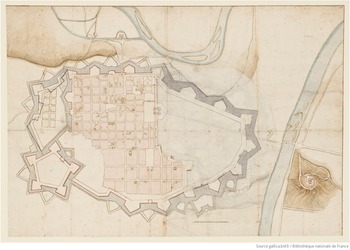
This early centralized decision-making in urban planning and housing construction had effects that are still visible in urban texture, where one can distinguish the three successive expansions from the seventeenth and eighteenth centuries carried out to accommodate the growing population.Footnote 31 The first major urban development project began in the 1620s, in south-western Turin, and involved the construction of the Città Nuova District, which was designed by Ascanio Vitozzi and continued by Carlo di Castellamonte. At the same time, a second expansion of the city was planned in the eastern sector along the axis of Contrada di Po, which ran from the city gate towards the river. The project began in 1673 and involved the extension of city walls and the construction of the new Porta Po district, designed by Amedeo di Castellamonte (Figure 2). The third expansion of the city began in the 1720s based on a design by Filippo Juvarra, which involved demolishing and extending the city walls and building 18 new blocks in the north-western part of the city, adjacent to Porta Susina. Once the building plots within city walls were exhausted, new premises were created by raising existing buildings and occupying the interstitial spaces of the city. At the end of the 1760s, a plan was approved to raise buildings around Piazza Castello, followed a few years later by the construction of buildings in Via Nuova (now Via Roma). The scheme was extended to other areas of the city, whilst new wings and buildings were erected in the inner courtyards, resulting in high population densities and often poor sanitary conditions.Footnote 32
Map of the city and citadel of Turin in Bibliothèque nationale de France, département Estampes et photographie, VB-132 (Z, 3)-FT 6.

Figure 2. Long description
Starting from the central area, a dense rectangular grid of streets and blocks forms the urban core. The next layer outward is a series of angular, polygonal fortifications with bastions and walls, outlined in gray and red. Within the street grid, a distinct central square nucleus can be identified, corresponding to the classical Roman castrum layout. Adjacent to this original nucleus, a second residential core is formed by the blocks constituting the city’s first expansion. Between these built-up nuclei and the fortification walls lies a large undeveloped area, which would subsequently accommodate the city’s second expansion. On the left-hand side of the image, the third expansion of the fortification walls is depicted. Beyond the fortifications, to the northeast and southeast, rivers with branching channels and a hill with a spiral path and a small structure are depicted. Roads and landscape contours extend from the city, connecting to the outer environment. The fortifications are irregularly shaped, adapting to the terrain, and the city expansion is shown by additional blocks outside the main grid.
The three expansions were the result of centralized urban planning, whose implementation was made possible by private capital contributions. It was the first expansion, that of Città Nuova, that provided the first examples of buildings conceived ‘as an economic tool, or rather as a revenue-generating machine proportionate to the capital invested’Footnote 33 – namely, the first houses designed as rental units for a growing population. The rental house model would be used, renewed and perfected again in the two subsequent expansions, thus fuelling a profitable market (Figure 3).
Example of a house designed as a rental unit. Facciata riguardante verso la contrada detta di Dora Grossa – Torino, Archivio Storico di Torino.

Figure 3. Long description
The top panel displays the symmetrical façade of a four-story building with a central arched entrance, rectangular windows arranged in rows, and attic dormers. The lower panel shows a vertical cross-section from the street side, revealing internal structural elements including staircases, landings, and multiple floors. The section exposes the spatial arrangement of rooms, stairwells, and the courtyard, with architectural labels in Italian marking the façade, stair, and courtyard zones. Decorative script and official stamps are present in the margins.
During these urban transformations, civil construction became an important source of income for major investors who began to dominate the property market. The growth in demand for housing in a city where expansion was limited by fortified city walls offered investors the guarantee that land values would be preserved and their properties would generate a steady income.
The rise of construction as a field of speculation was openly encouraged by state policy, which, on several occasions, intervened directly to favour large investors at the expense of small owners. To encourage investment in the construction of new buildings, the second expansion was preceded by the ‘donation of new sites’ to prominent noble families, officials and wealthy bourgeoisie, who settled in the new neighbourhood.Footnote 34 At the same time, the owners of land and pre-existing buildings along the Contrada di Po, which were now enclosed within the city walls, were forced to rebuild according to a uniform plan approved by the Council of Buildings and Fortifications, or sell to those who had the necessary capital to complete the project.Footnote 35 Furthermore, new buyers were required to pay ‘three-fifths of the increased value of the sites’, namely a ‘contribution equal to three-fifths of the difference in value (increased value) that the land located in the new expansion acquired by changing from suburban land to urban construction areas’.Footnote 36 The design of the new neighbourhood was not limited to drawing up new spaces in the city; it also defined its social content, reflecting the prestige of the ruling dynasty and the ruling class.
This approach was further reinforced during the construction of the drizzamento (alignment) works in the quarters of Dora Grossa (now Via Garibaldi) and Porta Palazzo (now Via Milano),Footnote 37 the implementation of which required significant investment from the owners. Several targeted legal measures once again forced owners who did not have sufficient financial resources to bear the costs of demolishing and rebuilding relevant buildings to sell their properties to those who could guarantee necessary investments.Footnote 38 These forced sales were a great opportunity for large investors, and a process which encouraged the concentration of ownership.
Although the procedures were different, the same polarization of the property market was also observed in the third expansion towards Porta Susina.Footnote 39 In this case, the lots of land put up for sale were those that had become available and were suitable for building after the expansion of the city walls in the north-western part of the city. The new layout of the city walls meant that the main entrance to the city crossed the new urban complex. Because it was intended to be used by the embassies of European courts to reach Piazza Castello, the main axis was given a political significance and precise urban design. Most plots were purchased by noble families and religious institutions at the sovereign’s request, with the expectation that they would build prestigious palaces. The remaining, less prestigious plots in the third expansion were mostly bought by building contractors who were part of an elite group active in royal construction projects in the early eighteenth century and knew how to easily navigate the Turin property market.Footnote 40
The concentration of real estate ownership affected all neighbourhoods in the city and became more pronounced in the second half of the century. In Città Vecchia, the aggregation of lots occurred at the initiative of the bourgeoisie. In the neighbourhoods of Città Nuova and Porta Susina, the number of owners, who were mainly nobles and religious institutions, decreased by 18 per cent in the latter half of the century.Footnote 41 A similar concentration of property ownership can also be observed in other Italian and European cities. In eighteenth-century Paris, where tenants accounted for approximately 90 per cent of the total population, investments in real estate followed the same speculative logic with very similar effects.Footnote 42
This rush to buy bricks and mortar to secure income from rent became clear when vicariate officials began their inspections. The owners of the properties visited between November 1750 and June 1751 were mainly members of Turin and Piedmontese aristocracies. Approximately 50 noble families had their palaces or buildings inspected, including the Count of Rubilant, Count Ceveris of Burolo, Count Richelmi, who had rented out three of his properties, and Count Verdina, whose two palaces were inspected. Many properties also belonged to religious orders and charitable organizations: 13 convents for women and men profited from renting out part of their real estate holdings, as did the Carità Hospital and the San Giovanni Hospital, the latter being the owner of seven of the properties visited by the vicar’s officers in the winter of 1750.
An emerging issue
The concentration of property ownership in the hands of a relatively small number of owners,Footnote 43 population growth and chronic housing shortages predictably affected rent. Unfortunately, no data are available to assess changes in rental prices. Many agreements were formalized only in private documents, whereas others remained verbal. The tax exemption on city property and the absence of cadastres until the end of the century mean that there are no data on taxable income. However, we can reconstruct the trend for a specific sector of the rental market, namely, properties owned by the city, consisting of 18 houses scattered throughout the city and an unspecified number of shops. The city’s financial statements, which record its income, including that derived from the rental of each property, allow us to reconstruct the rent trend in the 35 years preceding the legislative intervention of 1749.Footnote 44 During this period, the number of properties generating income for the city remained unchanged, although their composition changed. Of the 18 properties recorded in 1714, only 7 still appear on the list of 18 properties recorded in 1749. Others either no longer appear on the list or their names have changed, making a direct comparison difficult. Throughout these years, their rental prices remained unchanged, as in the case of Casa Ruschis (1,015 liras a year), the house at Molini delle Catene (60 liras) and Casa Luanga (20 liras), or even fell, as in the case of Casa al Macello Grande, whose price dropped from 475 liras in 1716 to 410 liras in 1749. What prompted the alarm and intervention of the state authorities in the rental market?
The answer comes from a judicial source – the civil orders of the vicariate of Turin – where signs of emerging tensions are evident. It was a political and police authority, also a court of first instance, that ruled on disputes that could or should be resolved through summary proceedings on specific matters, including ‘contracts, taxes and any other income’ owed to the City of Turin, such as rents from the city’s properties.Footnote 45 Unfortunately, the records provide a complete account of the vicariate’s judicial activity for only a short period between 1724 and 1730. Therefore, the information we can draw from this source is partial, covering a short period of a specific segment of the rental market (that of the city’s properties), but it also allows for some useful considerations. The cases discussed in the vicariate mostly began with complaints about the tenants’ delays in paying rent. The amounts claimed varied greatly, from a few dozen to a few hundred liras, as did the size of the rented property, which ranged from a single room to an entire house. Based on the available data, it is not possible to estimate average rents in Turin, as property descriptions are too brief and it is unclear whether the amounts refer to total rents or only a portion. Thus, in 1727, the price of a dressing room or a room with a crotta (cellar) ranged from 17 to 30 liras per semester (six months), while in 1730, the price of a workshop varied from 47 to 80 liras per semester. For context, the average daily wage of a master mason was around 1 lira and 4 denari.
Contracts could be annual or multiannual, and payments were due every six months: the first around Easter and the second on St Michael’s Day (29 September). This explains why requests and demand for payments were concentrated in March–April and August–September. While only 5 per cent of the more than 1,200 instances examined between 1725 and 1730 concerned rents, during these periods of the year they accounted for about 30 per cent of the disputes discussed.
Whenever the city, through a public prosecutor, filed a claim with the vicariate, the amount requested was substantial and equivalent to the rent for large properties or entire buildings. Thus, in May 1725, the City of Turin demanded that Matteo Persenda pay 340 liras for the semester’s rent on an entire building; in August 1726, the prosecutor Giovanni Antonio Odazzo sued Francesco Maffei, demanding payment of 990 liras ‘for the rent of the house for the current six-month period’. Besides the city’s prosecutors, private individuals often requested payments for rent arrears. The aforementioned Francesco Maffei, 15 days after responding to the city’s request, filed a lawsuit against Giovanni Antonio Gribaud, demanding the sum of 70 liras for ‘the rent of two workshops with rooms and fixtures located in the Macellaio di Porta di Po neighbourhood, for the semester accrued at San Michele’.Footnote 46 This case highlights the widespread practice of subletting: entire buildings or blocks of flats were rented to intermediaries who then sublet parts of them to make a profit. The owner, whether an organization or an individual, was thus relieved of all the tasks associated with managing the property, focusing solely on collecting rent from a single tenant (affittavolo). Usually, these tenants also bore the cost of the work needed to make the properties desirable on the market: splitting them into separate residential units, creating new rooms, carrying out routine maintenance, as well as dealing with all matters concerning relations with subtenants and rent collection. The sublease agreements were approved by law. The Legal Handbook compiled by the Turin Bar Association in the 1840s explicitly refers to them, referring to Roman law for their regulation in the Savoy States.Footnote 47
After 1730, the vicariate records became more fragmentary, but for the preceding years, this source reveals that the issue of rent was one of the main problems dealt with by the city’s justice system. The housing issue resurfaced a few years later as a problem of such proportions that it threatened to have negative repercussions on the city’s economy. In March 1747, the Guild of Silk Weavers, Goldsmiths and Silversmiths sent a plea to the Consulate of Commerce to grant the vicar’s office the authority to compel the owners of properties from Porta Palazzo to Porta di Po, where the majority of the guild’s members had workshops, to rent rooms at a moderate price, set after arbitration with the vicar himself.Footnote 48 This plea came from representatives of one of the driving forces of the city’s economy, on which, as mentioned above, the government pinned its hopes for economic growth and international prestige.
The problem of rising rents was not limited to certain neighbourhoods, but affected the entire city. Against this backdrop, the Royal Decree of July 1749 assigned the vicariate the task of resolving disputes over rents.Footnote 49 According to the legislator, subletting was the cause of this undue increase, as he claimed to be ‘informed that rents in our metropolis are rising excessively due to the undue practice introduced by various individuals of renting an entire house in order to sublet rooms to its occupants, driven by greed for profit and to the detriment of the public, and especially the poor’.Footnote 50 The rental market seemed to be controlled by a few affittavoli who managed entire buildings and sublet parts, allowing them to set rents in a monopolistic manner.
Many people embarked on this brokering activity in the rental market. Among the 180 affittavoli involved in rent-review procedures between November 1750 and June 1751, we know the principal occupation of about 30. These included seven tavern keepers, five merchants, three bakers, goldsmiths, surgeons, distillers, carpenters and master builders. Most of the renters were men, but noteworthy is the presence of a large group of 11 widows who probably used the management of the rentals to ensure their livelihood or to use their dowries, which they had regained after the death of their husbands. Among those registered, seven affittavoli managed several properties simultaneously, such as Cristofaro Cerutti, who managed at least three properties in the neighbouring blocks of San Tommaso and San Matiniano. The same source also shows that, in certain cases, landlords explored the availability of several affittavoli, entrusting the management of the property to those who offered the best conditions. Thus, for example, since ‘several parties emerged’ to manage the rents of the prince of Francavilla’s palace, this task was entrusted to master builder Antonio Maffei and his partners.Footnote 51 On some occasions, it appears that property management was undertaken by a group of affittavoli who shared the costs and risks of the venture, including the investments required to make the properties attractive and profitable and the inconveniences associated with non-compliant subtenants. According to data provided by Maffei et al., rent for the entire Francavilla palace required an investment of over 14,000 liras, including routine maintenance, furnishings and some necessary work.
The affittavoli were not the last link in the rental market chain; subletting by subtenants was also very common. At the time of inspection, there were at least a dozen subtenants in the prince of Francavilla’s building who had rented a room, workshop, or mezzanine from another tenant and not from the general affittavolo, which further inflated prices. Among them, for example, the leather merchant Ettore Antonio Bonettino rented four workshops, three mezzanines, a room used as a kitchen and a storage room from Maffei and his partners for a total of approximately 225 square metres for 1,170 liras per year. The same merchant sublet one of these workshops, measuring approximately 22 square metres, to Gio Batta Bisazza for 300 liras per year, thus making a clear profit.
Fair rent and honest profit
The visit by the vicariate officials was intended to ‘take the necessary measurements of all the rooms…, so that the necessary calculations could be made to determine the required surface area’ to ascertain the fairness of the rents charged by landlords and affittavoli. According to preliminary calculations, the prince of Francavilla’s palace was sublet to 26 tenants, forming a heterogeneous neighbourhood typical of cities under the ancien régime . The same building housed the count of San Giorgio and the count of Gresi, as well as several tradesmen who ran their businesses and lived there, including a leather merchant, a tavern keeper, two bakers, two cobblers, a wigmaker, two tailors, a swordsmith, a minusiere (woodworker), a cabinetmaker, a glazier and people of modest means who could only afford to rent a room on the top floor of the building. By renting out sumptuous noble apartments, workshops and rooms, the affittavolo Maffei and his partners earned, according to the initial calculations, a total of 9,121 liras.
The assessor’s inspection was, therefore, intended to proceed with ‘taxing rented houses’, that is, establishing a fairer rent. Once the surveys had been carried out and due consideration was made, the assessor lowered the rent for the entire property to 8,450 liras, a reduction of approximately 18 per cent. All rents charged on the property were recalculated with reductions ranging from 2.4 per cent for a workshop measuring approximately 35 square metres at a price of 450 liras per year, to 20 per cent for a room at a price of 50 liras per year. Which criteria led the public evaluator to set a new and fair rent?
The concept of fair pricing is one of the most debated topics in economic ethics among early modern moralists and theologians, who revisited and reworked Thomist and nominalist thinking.Footnote 52 Its influence can also be found in the procedure employed in Turin to determine the fairness of rents charged by landlords and affittavoli.
When establishing the criteria for measuring and estimating rents, appraisers appointed by the vicariate based their work on professional practices that had not yet been codified in Piedmont, as in other parts of Europe.Footnote 53 This would happen much later, at the end of the century, thanks to another appraiser, Tommaso Beria, who in 1796 decided to provide future valuers with a manual ‘since, to my knowledge, there is no author who has dealt extensively with everything pertaining to the profession of appraiser’.Footnote 54 The manual attempted to provide a pedagogical consolidation of knowledge acquired mainly through practical experience. Regarding the valuation of properties, the manual mainly focuses on their value in the event of a hypothetical sale. It is precisely by considering the general value of a property, consisting of its intrinsic and extrinsic values, that the author addresses the issue of income and, therefore, rent. To establish the extrinsic value of a house, that is, its income, first of all, ‘the dimensions of each room making up the house must be measured’; thereafter, ‘the most reliable information must be gathered on the usual rents paid for rooms in adjacent houses, not far from the house to be valued’.Footnote 55 Along with these, the appraiser must consider maintenance costs, such as ‘repairing floors, plastering and metal fittings’.Footnote 56 Therefore, the rent depended on the property’s features and how it compared to the prices of nearby houses. Similar criteria were applied by the appraiser appointed in the winter of 1750 to visit the houses and apartments of tenants who appealed to the vicariate court. After presenting his report, appraiser Bussi explained the criteria used to determine rent reductions. His decision was based on considerations regarding the intrinsic qualities of the premises visited – surface area, ‘quality, condition and exposure’ of the premises and common areas (‘courtyards, staircases, loggias’) – together with those regarding the rents ‘that are usually…paid for neighbouring houses of similar quality, exposure and condition’.Footnote 57 When assessing rents, the ‘micro-urban criteria of the view’ also need to be considered,Footnote 58 namely its location in relation to the key areas of the city, particularly commercial areas. The vicariate’s actions were based on several principles of economic ethics typical of the ancien régime . On the one hand, the principles of commutative justice were firmly upheld, linking price or rent to the value of a property and its intrinsic features. On the other hand, the legitimacy of the increase in rents was assessed by an expert who had to refer to the communis aestimatio and was legitimized in his work by the public authority. The same criteria were applied simultaneously in other European cities, from Paris to Marseille and from Milan to Venice.Footnote 59
However, the appraiser’s recommendation of a ‘fair rent’, was not the end of the procedure, but rather its beginning. This was the basis for a negotiation process between landlords, affittavoli and vicariate officials which, regardless of the final outcome or the mere numerical value of the price set, revealed the areas of disagreement and arguments that made each party’s claims legitimate in the legal culture of the time.
Therefore, after receiving a report from the public assessor and architect, Rocca, the prince of Francavilla called upon his prosecutor to intervene, opposing the decisions of the vicariate office. Prosecutor Richetti declared that the sovereign decree encouraged landowners to make a profit if it was not exorbitant. To prevent this, the rents charged for the prince of Francavilla’s property should have been compared with those of similar neighbouring properties, which the expert claimed he had done – although the prosecutor had his doubts. To prove the fairness of the rents charged, the prosecutor presented the results of a brief survey conducted on the botteghini (small shops) under the arcades of the property: those owned by the prince of Francavilla were rented at a significantly lower price than the others. According to the prosecutor, the claims made by the property tenants were clearly biased and motivated simply by the desire to take advantage of the opportunity offered by the newly introduced procedure. To prove this point, he was willing to release all tenants from their contractual obligations and invite them to find similar accommodations at better prices. Prosecutor Rocchetti’s response operated on several levels: on the one hand, he referred to current prices, and on the other, he attempted to discredit his opponents, including the court-appointed expert. The latter was particularly sensitive given that the validity of the procedure was based on the reputation of court-appointed experts.Footnote 60
The affittavoli of the prince of Francavilla’s palace, Matteo Antonio Maffei and his associates, also opposed the public assessor’s decision. To demonstrate the legitimacy of the increase, the rental agents stressed the conditions imposed by the owner on the one hand, and the investments made on the other. The rent for the entire property was 13,345 liras per year. One of the owners’ first conditions concerned the apartment on the main floor, which the owner rented on the condition that it would be returned to his disposal, in part or in whole, with only three months’ notice. To overcome this obstacle, the affittavoli decided to divide the flat into two units, allocating one for short-term rentals and furnishing it ‘with decent and proportionate furniture…to rent it out on a monthly basis to visitors who happened to be in town’.Footnote 61 Renovation work and the purchase of furnishings involved an investment of approximately 7,000 liras borne by the renters. As for the other apartments in the building, the affittavoli had implemented a rent increase that was ‘moderate and discreet, compared to the increase that had generally been applied over several years and in several stages to rents throughout the city’.Footnote 62 This increase, which had not been applied in the previous 20 years, was in agreement with the subtenants. Furthermore, among the other flats, two benefited from the special conditions imposed by the prince himself: the flat of engineer Castello and that of Marquise Beaufort, who had obtained that their rent would remain unchanged. According to the calculations reported by Maffei et al., given the expenses incurred and considering the restrictions imposed, the annual income was just 1,325 liras.
Beyond considerations relating to the features of the property, the arguments put forward by affittavoli highlight the social content of the agreements reached with tenants, whether they were directly involved in determining an increase or were protected by a privilege, such as that enjoyed by engineers Castelli and Marquise Beaufort. Personal relationships mattered more than the intrinsic value of the property when it came to setting the rent. What emerges here is what has already been noted in this and other forms of exchange, namely embeddedness or the action of non-economic factors in non-market economies, such as those of the ancien régime , aimed at protecting certain tenants from rent increases that could have compromised their respectability. In addition to the principles of commutative justice, the principles of distributive justice also played a role in estimating the ‘fair rent’, whereby the value of goods was assigned based on the quality of the people, in this case the tenants.Footnote 63
Every argument brought up by the affittuari was meant to show that the rent increases were not too high and that, in the end, the income they earned was too low, to the point that without a rent increase, they would have lost money. At this point, we refer to a crucial aspect of the arguments and economic culture of the time. In sovereign edicts, one argument insistently recurs in the setting of fair rent: the honest profit. In the edict of 1750, the legislator recommended that the vicar, when determining a reduction in rents, should not deprive landlords of ‘the honest freedom to derive a moderate and reasonable income from them, so that such rents are kept within the limits of duty and fair moderation’. So what was a ‘reasonable income’ judged to be? This was a recurring topic in the debate that shaped the economic ethics of the ancien régime . According to several moralists, the merchant’s earnings were legitimate and justified not only by the need to provide for his own needs and those of his family in accordance with his social position but also by the industriam and sollecitudinem he displayed in his work and the risks he took.Footnote 64 In addition, there was social value in his work. According to Christian economic ethics, which took shape in the thirteenth century but still had a strong influence five centuries later, what made trade and the profits it generated legitimate was how those profits were used, if they were applied for the public good.Footnote 65 This explains why, in the introduction to the 1750 edict, the legislator was pleased that landlords ‘would also see a fair increase’ in rents, ‘which would encourage them to seek by every means to increase the number of dwellings’.Footnote 66 The profits guaranteed by the growth in the demand for housing encouraged new investments in urban construction and the property market, which were considered crucial for the city’s economic growth. However, the same edict considered ‘undue’ the profits made by those who rented entire properties and parts of them ‘to sublet them in whole or in part with excessive profit and to the detriment of the sublessors’.Footnote 67 Therefore, the same criterion of public utility did not apply to affittavoli whose profits were not reinvested in new real estate and who, therefore, became the main target of royal decrees and vicar procedures.
Finally, the procedure for setting fair rent was the result of a combination of written rules, professional practice and negotiations between the parties. The tension between these different instances ultimately defines the boundary between inclusion and exclusion from the city and between those who enjoyed protection and those who were expendables.
Unexpected consequences
The restrictions on rents imposed by the sovereign with the edict of 1750 had immediate and unexpected effects, so much so that the following year, the legislator had to review the issue, ordering affittavoli who had been forced to reduce their rents not to terminate their contracts with subtenants.Footnote 68 Following the 1750 edict, many rental contracts were terminated before their expiry date and replaced with annual verbal agreements, placing the most vulnerable subtenants in a precarious position. In 1752, to tighten control over the rental market, the vicar was assisted by district captains to whom landlords and tenants were required to report on existing rental contracts.Footnote 69 The issue was revisited a decade later, in 1762, when a royal edict prohibited ‘landlords from dismissing any tenant’, giving them preferential treatment even in the event of the renewal of an expired contract, ‘especially if the tenant is punctual in paying the rent, does not cause any damage through negligence to the property he rents, and lives honestly and peacefully with the neighbours’.Footnote 70 The royal decree was aimed specifically at protecting ‘shopkeepers and merchants who, in addition to the cost of transporting their furniture, would suffer serious damage by having to abandon their workshops, where they have already established a business’.Footnote 71 This decree encouraged housing stability for tenants who paid their rent on time and built good neighbourhood relations.
In the second half of the eighteenth century, the concentration of real estate ownership continued at a rapid pace, as did a significant increase in rents.Footnote 72 The laws passed in the 1750s and the intervention of the vicariate failed to improve the conditions of silk workers, whose pleas prompted the authorities to act. In the 1770s, their situation was still critical, worsened by a crisis in the silk industry that forced workers to leave the city: in 1773, the Consulate of Commerce reported that 40 young workers in the silk industry had already left due to lack of work, ‘if not all, many married with families out of desperation, having no work from their masters; and that more than 60 are determined to leave, and abandon their wives and children’.Footnote 73 The situation was resolved in 1781 with the construction of a building designed to house 55 families of textile workers and their looms in Piazza Carlina in the vicinity of the Po district, where the largest concentration of workers in this sector was already located.Footnote 74 Once again, the authorities attempted to take action to prevent the departure of a portion of the population deemed useful to the city’s welfare or economic growth.
Conclusion: an idea of city
From the second half of the seventeenth century, Turin experienced significant economic and demographic growth, which resulted in a profound transformation of the city, and its city walls were expanded to accommodate three new neighbourhoods built at different times. The transformation of the city quickly became a way to create and concentrate wealth, and assert the power of the sovereign. From a planning perspective, the three successive expansions were co-ordinated by the central government, which set up specific institutions and an efficient bureaucracy. The expansion of the construction sector proved to be a tempting opportunity for the Piedmontese aristocracy and wealthy bourgeois, encouraged by state policy to invest in property. Several government measures favoured the concentration of property ownership in the hands of a small number of investors while promoting the rise of a new ruling class. This concentration of property wealth was legitimized by a solid ideological apparatus that used common interest to justify ‘honest profit’, or rather the accumulation of wealth in the hands of a few. As is often the case, the definition of common interest provides the key to understanding a state’s policies. For the sovereign, the drive to build new houses and develop manufacturing were two essential aspects of the city’s common interest, in line with the mercantilist approach that still dominated Piedmontese political culture in the eighteenth century. However, the concentration of property ownership and the increase in demand for housing in cities surrounded by walls, which limited the possibilities for expansion, inevitably led to an increase in rent.
On 10 July 1749, sovereign Charles Emmanuel III intervened directly, in an attempt to stop the indiscriminate increase in rents, by a somewhat unprecedented decree. Even though in his decrees the sovereign claims to be acting in defence of the ‘poor’, his concern was certainly not about respecting the right to housing, which was still too far away from the legal consciousness of the time. By defining the criteria for fair rent, prioritizing some tenants over others and distributing responsibility for the deterioration of the situation, the sovereign decrees conveyed a precise idea of the city and citizenship, outlining a hierarchy of legitimacy to live in the city, of inclusion and exclusion. While investors’ interests were protected, those of intermediaries in the rental market were not. Tenants who had lived in the city for a long time were favoured over those who did not guarantee housing stability and good neighbourly relations, and priority was given to tenants who ran businesses that were useful to the neighbourhood.
The hierarchy of legitimacy of living in the city is also reflected in the process of setting rents. The negotiations that lead to the definition of fair rent reveal a system of shared values that combines the logic of profit with that of privileges and social opportunity. Social relationships played a major role in this process, both between landlords and certain tenants, protected by their status, and between affittavoli and subtenants, who were able to negotiate the terms of contracts, agree on rent increases and obtain payment deferrals in court. Unfortunately, little is known about these negotiations or their underlying social relationships. These sources convey the voices of legislators, institutions, landlords and affittavoli, while subtenants remain in the background. However, it was the plea of the silk workers to the sovereign and the demands of the inhabitants of Turin to the vicariate that prompted such a vast intervention, triggering a process which, through negotiations between the parties, contributed to defining and redefining the social composition of Turin’s neighbourhoods and the characteristics of their inhabitants beyond the dictates of the legislator. The production of the city emerged from this balance of power: on the one hand, a city planned by the central government and built with the capital of the ruling class; on the other, a city shaped by those who worked and lived there and sought full inclusion in it.
Acknowledgments
I would like to thank Virginia Amorosi, Michela Barbot, Andrea Caracausi and Corine Maitte for reading an earlier version of this article and for providing their suggestions. I am also most grateful to Rufo Iannelli for his linguistic assistance. My sincere thanks go to them all; responsibility for the content rests solely with the author.



 Open access

