




Introduction
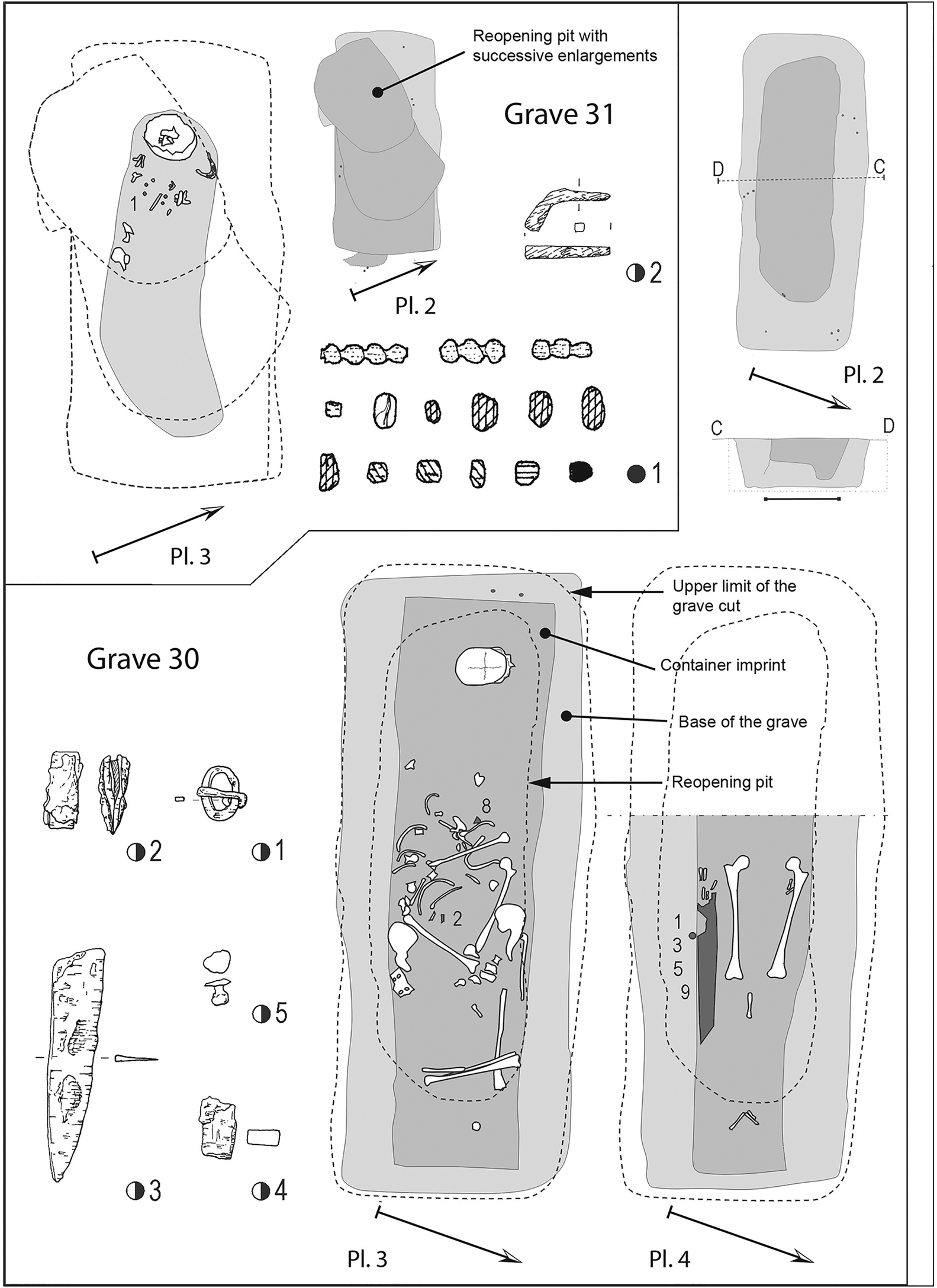
Archaeologists have long recognised that many graves in early medieval (fifth to eighth centuries AD) European inhumation cemeteries were disturbed during the distant past (e.g. Cochet Reference Cochet1854; Lindenschmidt Reference Lindenschmidt1880; Stoll Reference Stoll1939; Werner Reference Werner1953; Müller Reference Müller1976; Grünewald Reference Grünewald1988; Perkins Reference Perkins1991; Codreanu-Windauer Reference Codreanu-Windauer1997; Urlacher et al. Reference Urlacher, Passard-Urlacher and Gizard2008; Figure 1). In some cemeteries just one or two graves are affected, but in others almost all are reported as having been reopened, often so soon after burial that coffins and occasionally even bodies had not yet decomposed. Skeletons and grave goods are found incomplete or disordered, often within intrusive cuts, while missing artefacts are sometimes indicated by the presence of small fragments or residual metallic staining. Thus, disturbed burials are usually labelled in cemetery reports as having been ‘robbed’. Although disposal of the dead in the past is understood as a complex social and emotional process, secondary interventions, such as the reopening of burials, have been subject to rationalising explanations, especially economic gain. As the breadth and nuance of reopening activities emerging across a range of archaeological contexts grows, however, such explanations have been and are being challenged (e.g. Aspöck et al. Reference Aspöck, Klevnäs, Müller-Scheeßel, Aspöck, Klevnäs and Müller-Scheeßel2020).
Graves 30 and 31 at Burgweinting-Schule, Regensburg, Germany, showing intrusive cuts and displaced contents (figure by S. Zintl, after Zintl Reference Zintl2019: pl. 13).
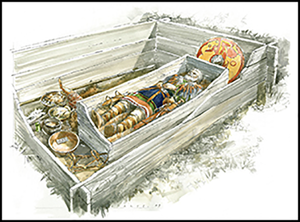
The early medieval reopening of graves is particularly associated with ‘row-grave’ cemeteries (Reihengräberfelder), variations of which are found across fifth- to eighth-century Western and Central Europe (e.g. Samson Reference Samson1987; Effros Reference Effros2002; Ament Reference Ament, Beck, Geuenich and Steuer2003; Halsall Reference Halsall2010; Dobos Reference Dobos and Gligor2014). These cemeteries are generally characterised by single inhumation graves, oriented broadly east to west and often arranged in loose rows. Wooden containers are commonly used, sometimes placed within large burial chambers. Dress accessories, jewellery, weapons and other objects attest a clothed, furnished burial practice, with considerable geographic and chronological variation in styles. While grave assemblages vary by age and sex, and in the numbers of artefacts found with each individual, the evidence points to broadly shared mortuary rituals that included the visual display of the body and any accoutrements immediately before closure of the grave (Figure 2). Finds from these cemeteries are central for our understanding of social life in this period.
Reconstruction of a chamber grave from eastern France (figure by B. Clarys, PCR espaces et pratiques funéraires en Alsace aux époques mérovingienne et carolingienne).

Disturbed burials, depleted of the artefacts on which many archaeological analyses depend, have been conceptualised in terms of a loss of data. As a result, despite the recording of many examples, almost no systematic research into the distribution, timing or causes of grave reopening has been undertaken. Instead, the practice has generally been subject to speculation, with debate circumscribed by national and language-based traditions, and the extent of the phenomenon has therefore not been fully appreciated (see Aspöck Reference Aspöck2005; Klevnäs Reference Klevnäs2013). Roth (Reference Roth, Jankuhn, Nehlsen and Roth1978) provides some rare regional and inter-site comparisons; beyond this, excavation reports have been the main medium for discussion, alongside occasional articles focusing on particular geographic areas (e.g. Bofinger & Przemyslaw Reference Bofinger, Przemyslaw and Brunecker2008; Chenal & Barrand-Emam Reference Chenal and Barrand-Emam2014).
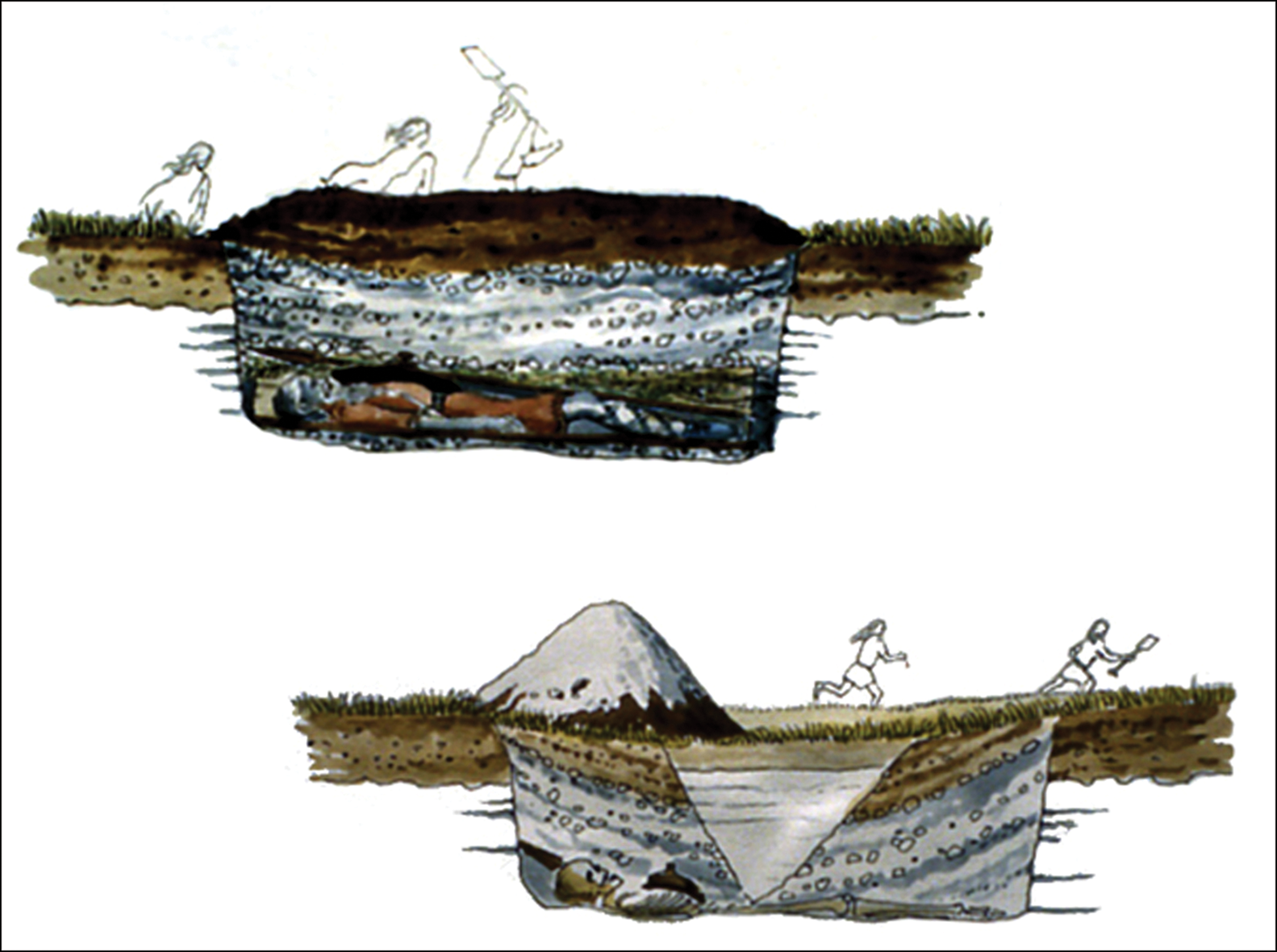
The overwhelming assumption has been that grave reopening represents a form of illicit robbery or desecration, unconnected to the original burial rite. A number of early medieval law-codes prohibit grave robbery (Nehlsen Reference Nehlsen, Jankuhn, Nehlsen and Roth1978; Effros Reference Effros2002: 49–61; Nótári Reference Nótári2012). These have generally been understood to refer to the practices witnessed in row-grave cemeteries, promoting a ‘common-sense’ explanation that the archaeological evidence for reopening indicates theft or greed (Figure 3). Other suggested motives include economic crises, shortages of iron or precious metals, or the recovery of grave goods by relatives (Werner Reference Werner1953). Where population changes are indicated, plundering of the graves of departed groups is sometimes put forward (e.g. Adler Reference Adler1970: 145–47). Christianisation has also been invoked on the basis that a reduced emphasis on furnished burial perhaps made grave robbery more acceptable (e.g. Koch Reference Koch1973; Roth Reference Roth, Jankuhn, Nehlsen and Roth1978). Alternatively, if reopening took place in ancestral cemeteries after these were abandoned in favour of burial in churchyards, could Christianisation have involved the transfer of human remains to these new burial grounds (e.g. Perkins Reference Perkins1991)? Finally, explanations have sometimes looked to ethnographic or prehistoric contexts, with the risk of anachronism or circularity (Aspöck et al. Reference Aspöck, Klevnäs, Müller-Scheeßel, Aspöck, Klevnäs and Müller-Scheeßel2020).
Artist's reconstruction of a burial and reopening at Ozengell, England (figure by L. Jay, courtesy of the Trust for Thanet Archaeology).
New research
In-depth investigations of the archaeological evidence for early medieval reopening of graves have recently been completed in five European regions (Aspöck Reference Aspöck2005, Reference Aspöck2011; Klevnäs Reference Klevnäs2013; Noterman Reference Noterman, Gardeła and Kajkowski2015, Reference Noterman2016; van Haperen Reference van Haperen2017, Reference van Haperen, Kars, Van Oosten, Roxburgh and Verhoeven2018; Zintl Reference Zintl and Brather2017, Reference Zintl2019; see Table S1 in the online supplementary material (OSM)). Although conceived, funded and conducted independently, these analyses share a bottom-up approach based on material evidence (Aspöck et al. Reference Aspöck, Gerdau-Radonic, Noterman, Knüsel and Schotsmansin press). They have focused on the detailed reconstruction of the timing and actions of those who reopened each individual grave as key to understanding their motives. By synthesising and contextualising the results, this article presents significant new findings concerning the chronology, extent and nature of Merovingian-period (fifth- to eighth-century) reopening practices.
Aspöck's Reference Aspöck2005 publication of the cemetery at Brunn am Gebirge in Austria initiated a new wave of research, setting a benchmark for the reporting of evidence for the reopening of graves, and providing a detailed history of its interpretation in the regional context. Klevnäs (Reference Klevnäs2013) shows that the reopening of graves in Anglo-Saxon England was much more common than previously recognised—mainly in Kent—and closely resembles practices in mainland Europe. In Bavaria, Zintl (Reference Zintl2019) examined 12 sites around Regensburg using recent, carefully excavated evidence to investigate the phenomenon. Building on this work, van Haperen (Reference van Haperen2017, Reference van Haperen, Kars, Van Oosten, Roxburgh and Verhoeven2018) has explored the high incidence of reopening in ten cemeteries in the Netherlands and Belgian Flanders. Meanwhile, Noterman (Reference Noterman, Gardeła and Kajkowski2015, Reference Noterman2016) has carried out a large-scale study of around 40 sites in northern France, using archaeothanatological methods to reconstruct reopening practices, alongside a critical discussion of the contemporaneous written sources.
Developing methodologies
These studies show that considerable information can be elicited about the process and dating of grave disturbance, especially where recent excavations have sought explicitly to investigate the practice. Re-examination of legacy data can also be profitable. Even today, minimal recording and publishing standards limit understanding. Developing protocols for identifying, recording and categorising post-burial interventions is therefore a priority (Klevnäs Reference Klevnäs2013: 131–34; Noterman Reference Noterman2016: 125–48; Aspöck et al. Reference Aspöck, Gerdau-Radonic, Noterman, Knüsel and Schotsmansin press; see also Kinkopf & Beck Reference Kinkopf and Beck2016).
Within the studies synthesised here, evidence for grave reopening was extracted from descriptions, drawings and photographs in publications and archives. Field observations taken to indicate reopening range from traces of surface digging to locate graves, to intrusive pits and displaced objects in the backfill, through to disarticulation or fragmentation of human remains and other finds within the grave itself (Figure 1; Aspöck et al. Reference Aspöck, Gerdau-Radonic, Noterman, Knüsel and Schotsmansin press). Such evidence was evaluated at the level of individual graves in order to develop systematic approaches to establishing degrees of certainty in identifying burials as having been reopened. Furthermore, the approach allows us to address questions of how deliberate interventions may be distinguished from other processes of disturbance, how grave reopening can be dated and what actions were carried out during such intrusions. Depending on the documentation, evidence for disturbance could be assessed against the wider taphonomic history of the deposit. Confounding factors to be excluded include animal activity, the deterioration of the wooden and textile elements, and the characteristic movement of skeletal elements caused by water infiltration (Noterman Reference Noterman2016: 318–28).
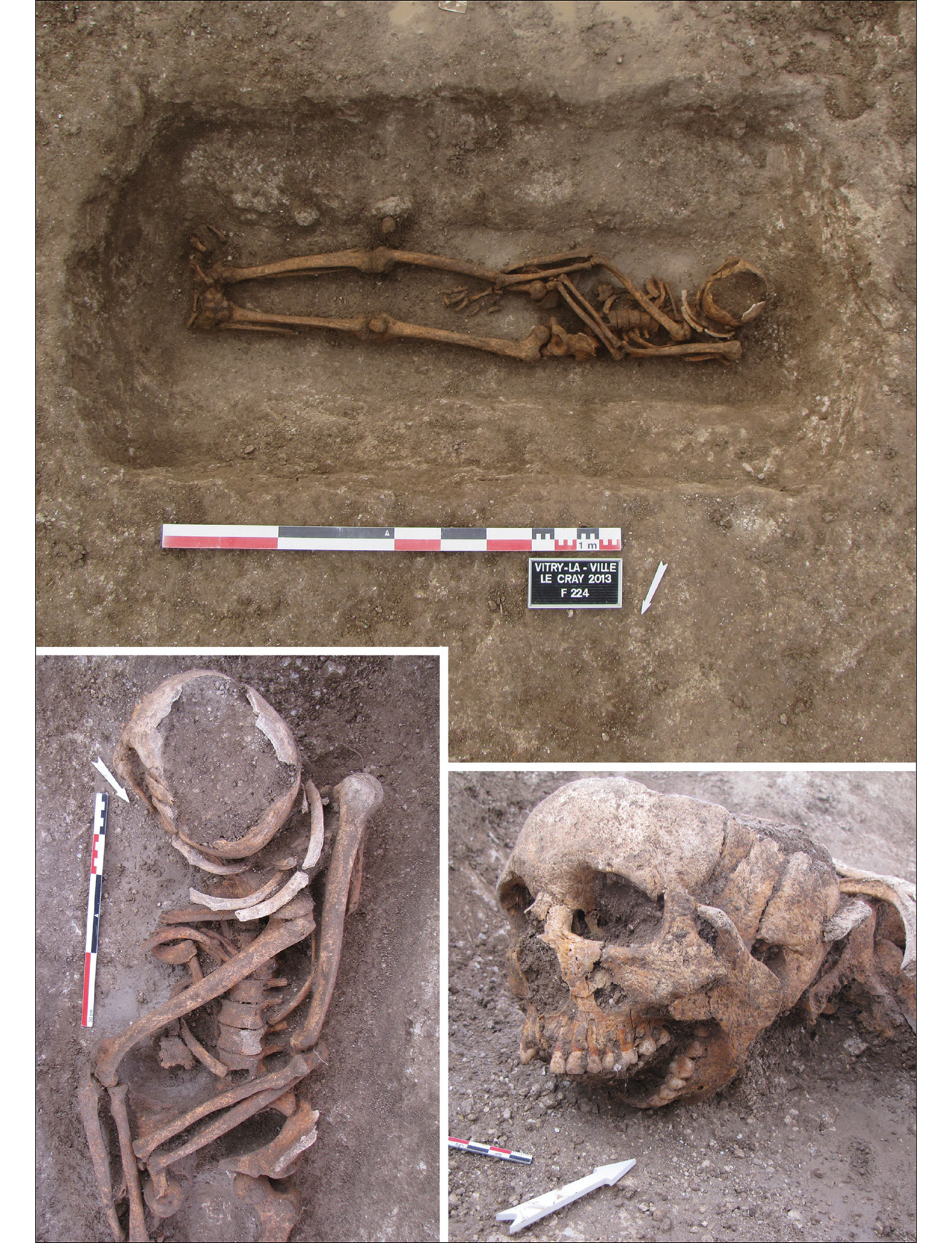
For dating purposes the stratigraphic relationship of the reopening pit with other features may be informative. The condition of the body and other materials at the time of reopening, however, more often indicates how much time had passed between burial and reopening of the grave. Hence, dating with precision requires good preservation as well as careful recording in order to establish the date of the original interment and the interval between burial and reopening. Here, archaeothanatological methodologies provide a systematic approach (Figure 4; Noterman Reference Noterman2016; Aspöck et al. Reference Aspöck, Gerdau-Radonic, Noterman, Knüsel and Schotsmansin press).
Grave 224 at Vitry-la-Ville, France, showing a body that has been moved while partially articulated and within an intact container (photographs courtesy of Éveha-Études et valorisations archéologiques).
Manipulation or removal of grave contents is commonly reported as evidenced directly through the presence of fragments, imprints or oxidised traces of missing metal items on bone, or indicated by disturbance of bones in areas of the body that are typically adorned (e.g. the chest area in female burials). Comparisons with contemporaneous, intact burials in the same cemeteries are important for assessing the completeness of grave inventories and understanding which types of object may have been targeted.
In general, our re-analysis of hundreds of burials emphasises a need for caution in attributing grave disturbance to deliberate human action, as a significant minority of suspected cases of post-depositional intervention were deemed to be unsupported by the recorded data. Combined, however, the results show widespread evidence of similarities in the timing and processes of reopening across a vast geographic region.
Geography
For the first time, it is possible to appreciate the huge scale of the phenomenon in detail (Figure 5). The reopening of furnished burials on comparable timescales, and with the characteristic removal of selected grave goods, has been recognised at sites in Romania, Hungary, Czechia, Slovakia, Switzerland, Austria, Germany, Belgium, the Netherlands, France and south-eastern England (e.g. Codreanu-Windauer Reference Codreanu-Windauer1997; Leitz & Troyon Reference Leitz and Troyon2002; Hawkes & Grainger Reference Hawkes and Grainger2006; Lauermann & Adler Reference Lauermann, Adler, Bemmann and Schmauder2008; Urlacher et al. Reference Urlacher, Passard-Urlacher and Gizard2008; Bóna & Horváth Reference Bóna and Horváth2009; Schmidtová et al. Reference Schmidtová, Šefčáková, Thurzo, Brůžek, Castex and Ruttkay2009; Hincker & Mayer Reference Hincker and Mayer2011; Tejral Reference Tejral2011; Theuws & van Haperen Reference Theuws and van Haperen2012; de Haas & Theuws Reference de Haas and Theuws2013; Dobos Reference Dobos and Gligor2014; Andrews Reference Andrews2015; Benedix Reference Benedix, Lauermann and Trebsche2016; Annaert Reference Annaert2018; Sebrich Reference Sebrich2019).
Map of early medieval cemeteries at which grave reopening has been recorded. The sites studied in detail by each author are highlighted (map by the authors).
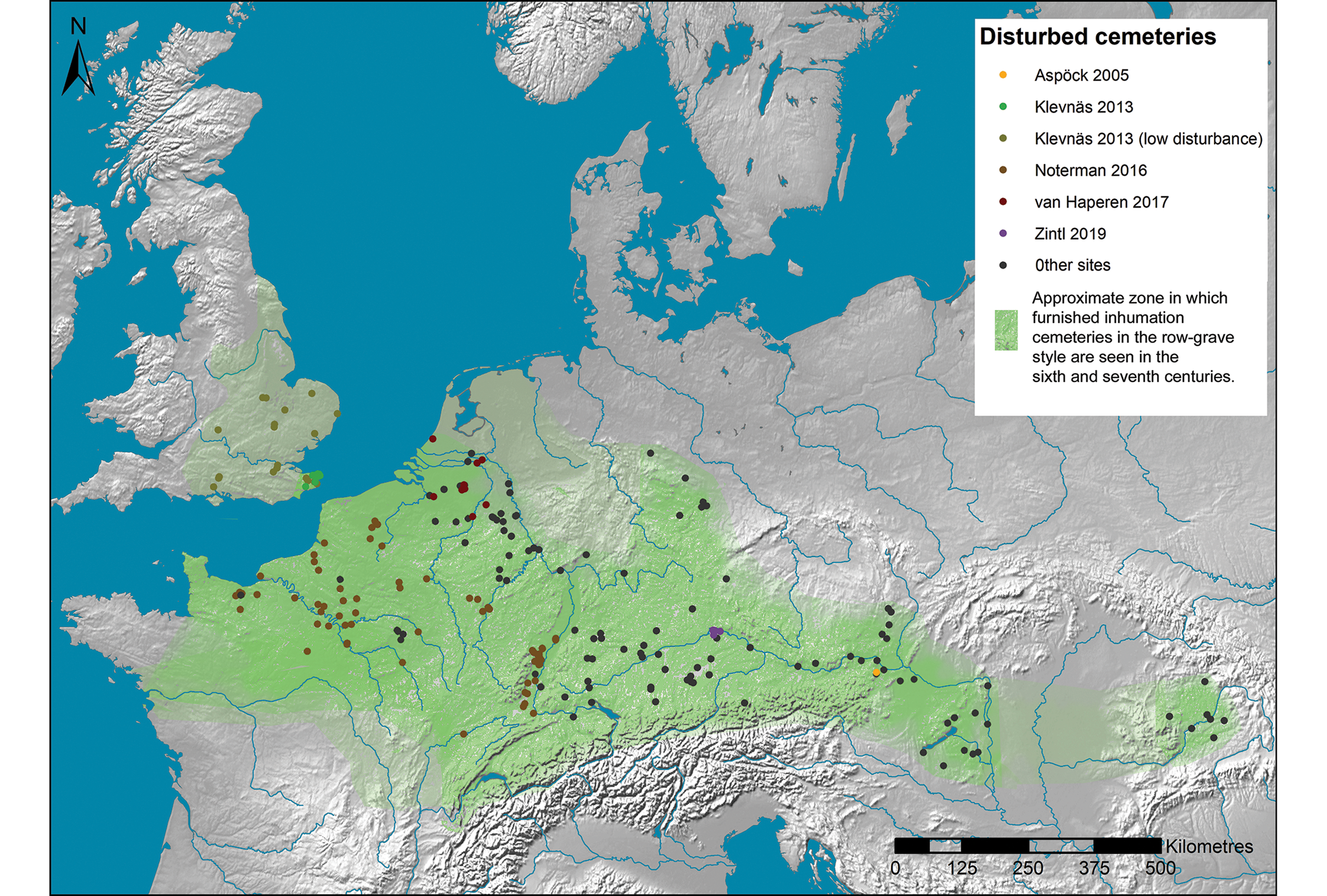
In areas with related inhumation practices but fewer grave goods, such as southern France and western Switzerland, forms of grave reopening seem instead mainly to relate to the reuse of interred stone sarcophagi, the addition of bodies as consecutive burials, or the intercutting of graves (e.g. Gleize Reference Gleize, Aspöck, Klevnäs and Müller-Scheeßel2020). A preference for the use of stone in tomb construction in many of these regions also increased the ease with which graves could be located and accessed.
Within the furnished zone (Figure 5) the prevalence of grave reopening varies considerably. Some of the variation is regional, with higher average rates in Bavaria (at least 54 per cent of graves) than in northern France (30 per cent), the Low Countries (41 per cent) or Kent (15 per cent). In the large French dataset the reopening rate rarely exceeds 50 per cent at any site, whereas in southern Germany, Austria, Hungary and Romania, almost all graves are disturbed in some cemeteries (e.g. Bofinger & Przemyslaw Reference Bofinger, Przemyslaw and Brunecker2008; Bóna & Horváth Reference Bóna and Horváth2009: 58–77; Dobos Reference Dobos and Gligor2014). Regional patterns in early medieval burial customs are traditionally interpreted as being linked to historically named ethnic groups. Thus, varying prevalence in grave reopening has been suggested to relate to differing attitudes towards the dead among populations (Roth Reference Roth, Jankuhn, Nehlsen and Roth1978). The recent studies, however, emphasise that much of this variation is local. Burial grounds within a close vicinity—even neighbouring cemeteries—exhibit widely different levels of post-burial interventions (Roth Reference Roth, Jankuhn, Nehlsen and Roth1978: 60; Klevnäs Reference Klevnäs2013: 35–36; Dobos Reference Dobos and Gligor2014: 137–38). Even in regions with high average rates of reopening, some sites have no or few disturbed burials, and across all regions, sites with different rates are intermingled (Figure 6).
Map of selected early medieval cemeteries in Kent, England, showing intermingling of disturbed and undisturbed sites (after Klevnäs Reference Klevnäs2013).
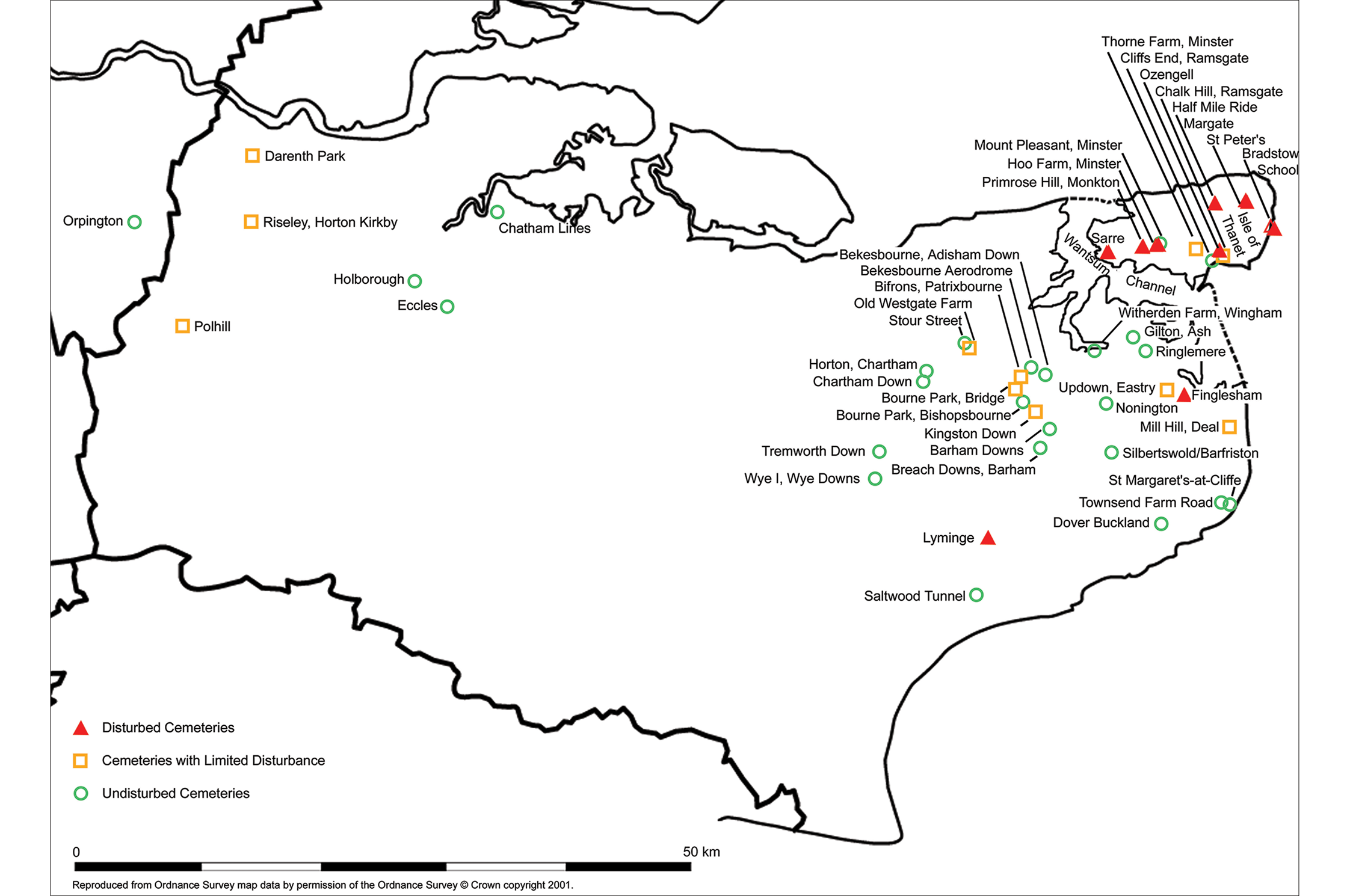
The reopening of graves was thus a possibility anywhere within the zone of row-grave-style cemeteries, but its occurrence at a particular site seems to have been driven by local considerations. This picture is consistent with current understandings of early medieval mortuary practices, which increasingly emphasise long-term, widespread themes combined into regionally and locally varied repertoires (e.g. Dickinson Reference Dickinson2002: 77; Hills & Lucy Reference Hills and Lucy2012: 327).
Chronology
Dating reopening
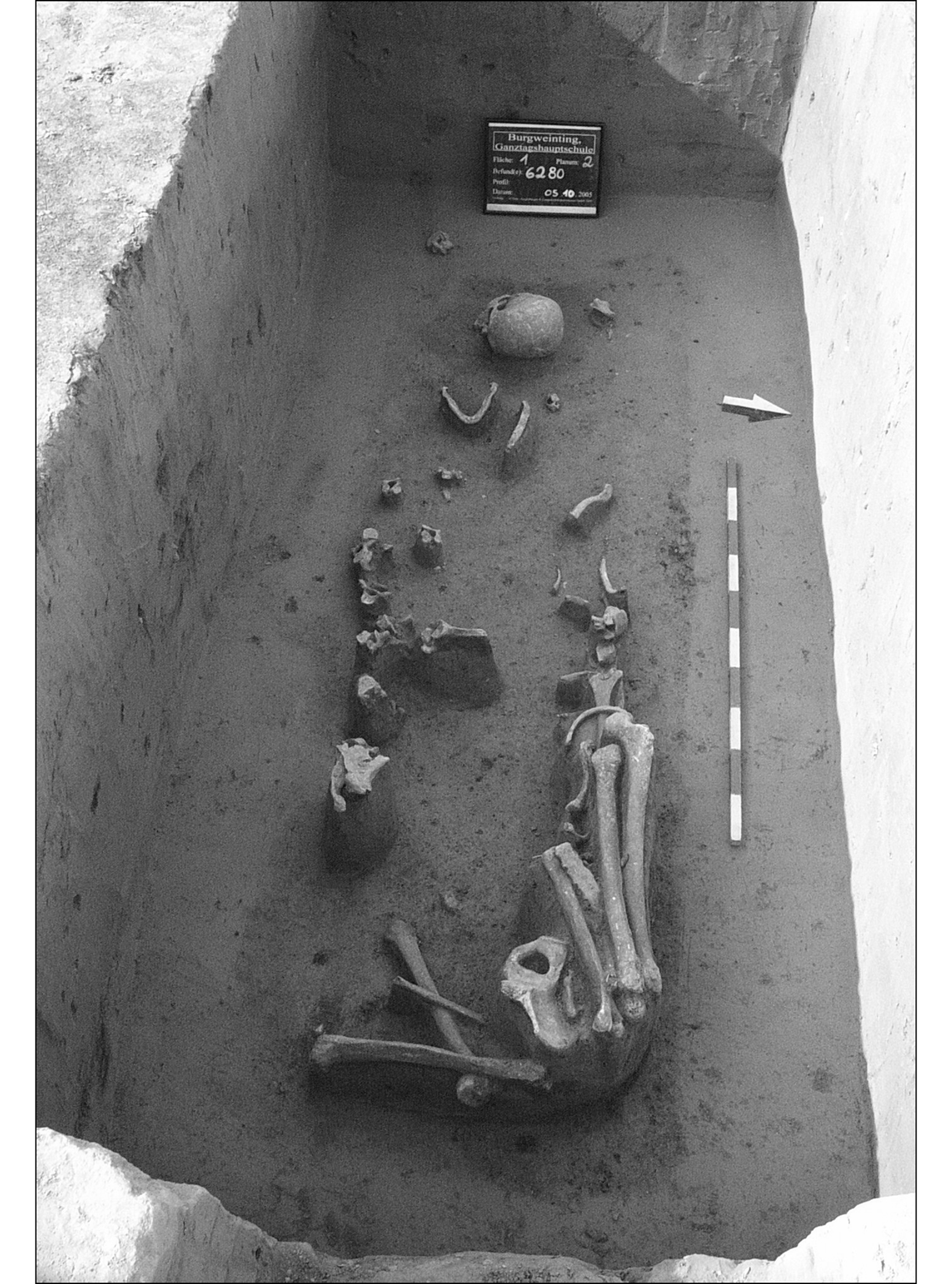
Across the recent studies, results show burials most commonly being reopened within about a generation of interment, and sometimes less. The most frequent timeframe for reopening was after soft tissue decay, but before any wooden container had collapsed or become filled with sediment (Klevnäs Reference Klevnäs2013: 42–47; van Haperen Reference van Haperen2017: 134–35; Zintl Reference Zintl2019: 295–301). In such cases, skeletal elements and artefacts were moved within an open space, becoming displaced but remaining on the floor of the grave (Figure 7). Here, again, there is local variation. In the Low Countries, for example, only about one-third of the graves at Broechem had been reopened while the coffin was intact, whereas at Bergeijk the numbers of graves with intact and collapsed containers were almost equal; at Lent all reopening seems to have happened within intact containers (van Haperen Reference van Haperen2017: 135). The disturbance of graves containing partly fleshed cadavers indicates a shorter interval between burial and reopening. In all research areas, only a tiny minority of graves were reopened during the process of decomposition (Figure 4), although graves were occasionally reopened while the organic components of grave goods were still intact (e.g. Klevnäs Reference Klevnäs2013: 43–47).
Grave 12 at Burgweinting-Schule, Germany. During the reopening, the bones were moved within the open space of the coffin (after Zintl Reference Zintl2019: 151, fig. 28; photograph by M. Hensch, ArcTron).
Onset and duration of grave reopening
A broadly similar chronological trajectory is seen in Bavaria, the Low Countries, northern France and southern England. Here, most reopenings took place from the later sixth century onwards, peaking in the seventh century. There are a few examples from earlier in the sixth century and a number of late cases in areas where burial in ancestral cemeteries continued into the eighth century (Klevnäs Reference Klevnäs2013: 47–49; Noterman Reference Noterman2016: 420–22; van Haperen Reference van Haperen2017: 139; Zintl Reference Zintl2019: 295–301). Within the Merovingian cultural area reopening therefore did not appear alongside the first phases of furnished burial in the fifth century as an original part of the shared mortuary customs. This apparent absence could be partly due to low numbers of burials datable to the fifth century (especially the earlier fifth century) in many areas, but where reopening is reported in fifth-century graves, there are no indications that it was carried out soon after interment (Lémant Reference Lémant1985; Klevnäs Reference Klevnäs2013: 47–48; Sebrich Reference Sebrich2019: 211–19).
In Romania reopening seems to have been ongoing during both the sixth and seventh centuries, with a preponderance from the mid sixth century (Dobos Reference Dobos and Gligor2014: 162). Current chronologies for Austria, Hungary and Czechia indicate considerable levels of reopening within the sixth and, to some extent, fifth centuries (e.g. Vávra et al. Reference Vávra, Jiřlík, Kuchařík, Jarošová, Víšková and Kubálek2012). Meanwhile earlier practices of re-entering and re-working inhumation burials are known in neighbouring regions, but appear to involve different customs (e.g. Kokowski Reference Kokowski, Straume and Skar1991; Körösfői & Sincovici Reference Körösfői, Incovici, Cociș, Lăzărescu, Gui and Deac2015; Skóra Reference Skóra2019).
Repeated acts
Once the practice of reopening graves became established, it continued as repeated, small-scale events at individual cemeteries, often over many decades (Grünewald Reference Grünewald1988: 40; Dobos Reference Dobos and Gligor2014: 160; Zintl Reference Zintl2019: 158–63 & 295–301). In eastern France, for example, the cemetery of Kolbsheim shows reopening occurring from the late sixth to the late seventh centuries, while such disturbances at Vendenheim predominantly took place between the late sixth and the mid seventh centuries (Noterman Reference Noterman2016: 421–22). There are exceptions, such as at the short-lived Hemmingen cemetery in Baden-Württemberg, which may have experienced grave reopening in a concentrated period after its abandonment in the early sixth century (Müller Reference Müller1976: 121–25). Many sites, however, include later burials overlying reopened graves (Codreanu-Windauer Reference Codreanu-Windauer1997: 28–34; Klevnäs Reference Klevnäs2013: 47; Zintl Reference Zintl2019: 302–305). Occasionally, skeletal or artefactual material that may derive from another grave is found associated with the main deposit of a reopened one, suggesting that more than one burial was opened at a time (e.g. Aspöck Reference Aspöck2005: 252–53; Klevnäs Reference Klevnäs2013: 18; Dobos Reference Dobos and Gligor2014: 151–52).
Burial therefore continued in cemeteries in which graves had already been reopened—probably individually or a few at a time—and where others would be reopened in the future. Moreover, as more occupation sites are discovered, it is clear that some cemeteries with repeated reopenings were located next to contemporaneous settlements (Zintl Reference Zintl2019: 186–97). It is therefore unlikely that post-depositional interventions were conducted in secrecy.
We found no evidence that grave reopening affected the ongoing use of cemeteries. Two sites in the Bavarian study area illustrate this point: Burgweinting-Schule and Burgweinting-Kirchfeld, only 150m apart (Zintl Reference Zintl and Brather2017: 251–55). At Kirchfeld 29 of the 30 excavated graves were intact, while at Schule, 56 of 57 graves had been opened. At both sites, burial started c. AD 500, with graves comparable in both layout and contents. The sites developed in parallel during the sixth century, but at Schule graves were periodically reopened. Kirchfeld went out of use in the late sixth century, whereas both burial and reopening continued at Schule well into the second half of the seventh century. Reopening at Schule thus appears to have been associated with the active use and longevity of the cemetery, rather than its decline. The practice of grave reopening often ceased before the burial grounds went out of use, leaving a last phase of graves untouched (Figure 8; Klevnäs Reference Klevnäs2013: 61; Dobos Reference Dobos and Gligor2014: 162; van Haperen Reference van Haperen2017: 132).
Plan of the excavated part of the cemetery at Posterholt-Achterste Voorst, the Netherlands. The cemetery developed from west to east, so that the lines of undisturbed burials represent the final phase of use (after de Haas & Theuws Reference de Haas and Theuws2013: 71).

Reopening practices
Selecting artefacts
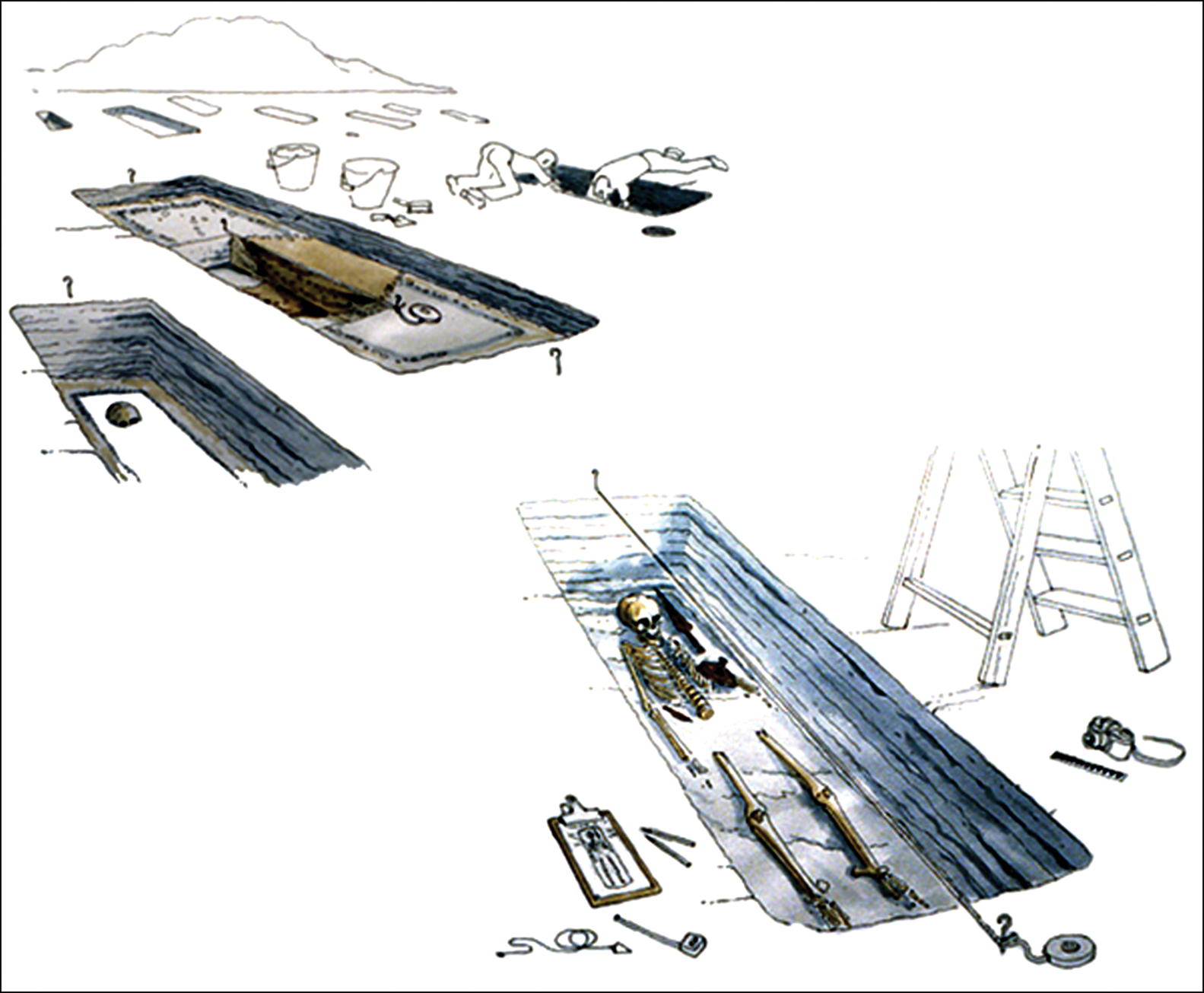
The removal of grave goods was a major focus of the practice. Both the methods of entering graves and the actions once inside evidence this objective. Across the recent studies, the material bears witness to the accessing and manipulation of grave contents, but not, for example, to attempts to eradicate graves (Figure 9). Such intent is evidenced by the focusing of efforts on areas of the grave where grave goods were concentrated, the absence of certain object types in disturbed graves, and metal-staining and fragments from missing artefacts.
Artist's drawing of a disturbed grave at Ozengell, England, under modern excavation (figure by L. Jay, courtesy of the Trust for Thanet Archaeology).
Not all types of grave goods, however, were equally sought. Some object types were almost always removed, particularly swords, seaxes (large knives) and brooches. This pattern stands out across the study area, from Romania to England (e.g. Klevnäs Reference Klevnäs2013: 65–74; van Haperen Reference van Haperen2017: 143–47; Zintl Reference Zintl, Aspöck, Klevnäs and Müller-Scheeßel2020: 101–109). In Kent, for example, only one complete sword has ever been found in a reopened burial, although a number contained fragments that fell from poorly preserved swords or scabbards when removed (Klevnäs Reference Klevnäs2013: 70–71). Beyond this, there is regional and probably local variation in which grave goods were taken, just as there is in the types of artefact that were originally buried. Thus, comparisons of the contents of intact and reopened interments can only be made within small areas, or even individual cemeteries. In some areas, for example, other weapon types were also removed: in Bavaria, spears and shields were taken when visible and accessible, although they were usually deposited towards the edges of graves, and no extra effort was made to access them (Zintl Reference Zintl2019: 309–317). Across the study area, however, many such items were left in reopened burials, demonstrating that neither weapons as a general category nor iron objects were targeted for removal. In Kent, for example, necklaces seem to have been left behind, even when they included precious metal pendants. In one case, while brooches were taken from a semi-decomposed corpse, a necklace comprising 78 beads, along with six pendants of silver, silver-gilt, glass and garnet was left (Klevnäs Reference Klevnäs2013: 68–69). Elsewhere, beads and other necklace elements were removed (Aspöck Reference Aspöck2005: 256–60; Zintl Reference Zintl, Aspöck, Klevnäs and Müller-Scheeßel2020: 106–107). There are also examples of only parts of objects being taken, such as elements of multipartite belt sets in Bavaria (Zintl Reference Zintl2019: 309–17), and portions of swords in France, leaving imprints of the removed parts (Urlacher Reference Urlacher, Passard-Urlacher and Gizard2008: 73–74, 343; Noterman Reference Noterman2016: 464).
The aim therefore was not to maximise returns through the acquisition of entire assemblages, but rather the retrieval of specific objects. Further evidence that motivations went beyond the material is that some objects were in such poor condition when retrieved—particularly the abovementioned swords—that they would have been of no practical use or economic value (Codreanu-Windauer Reference Codreanu-Windauer1997: 28–34; Klevnäs Reference Klevnäs2013: 88–89; Noterman Reference Noterman2016: 245–97; Zintl Reference Zintl2019: 309–18).
The recent studies identify no evidence to support the notion that objects with Christian symbolism were deliberately left in graves (Zintl Reference Zintl, Aspöck, Klevnäs and Müller-Scheeßel2020: 103), as has been suggested (e.g. Roth Reference Roth, Jankuhn, Nehlsen and Roth1978: 4). Nor could it be demonstrated that any items had been added (cf. Koch Reference Koch2001: 189 & 245–49) upon reopening, or that objects removed from burials had been reburied in later graves (cf. Werner Reference Werner1953: 7; Codreanu-Windauer Reference Codreanu-Windauer1997: 32). Confirmation of either of these scenarios would require considerable dating precision.
Selecting graves
Given the strong association between reopening and the removal of grave goods, it is counterintuitive that the reopening practice does not principally affect burials dating from the sixth-century peak of grave-good usage. Instead, incidences of reopening rise in the seventh century and often concentrate on recent graves, rather than the more richly furnished burials of preceding generations, which were still visible in the same cemeteries. In some cemeteries, wealthy ‘founding’ graves seem also to have been deliberately spared (e.g. Ichtratzheim; Noterman Reference Noterman2016: 492). As part of the preference for relatively recent interments, better furnished burials appear to have been targeted (e.g. Klevnäs Reference Klevnäs2013: 65–67). At mid seventh- to early eighth-century Burgweinting-Villa, for example, radiocarbon dates show that although there were unfurnished burials contemporaneous with more elaborate interments, only the latter were reopened (Zintl Reference Zintl2019: 181–83 & 291–95). This might indicate foreknowledge of grave contents, but equally, these furnished graves may have been identifiable from above-ground markings.
Similarly, it has frequently been proposed that those reopening burials knew the gender of the buried individual and thus targeted their activities to the areas of graves where they believed the associated artefact assemblages would be found. The recent studies, however, generally refute this idea. It is just as likely that methods and targets were adjusted during the reopening process, depending on what was found (Zintl Reference Zintl, Aspöck, Klevnäs and Müller-Scheeßel2020: 99–100). Conversely, some well-documented cases of grave reopening in eastern France suggest prior knowledge of the internal organisation of burial chambers, such as a pit that is off-centre on the grave's surface, but which corresponds to the location of the interred container (Noterman Reference Noterman2016: 410).
In Kent and the Low Countries there are some indications that child-sized burials were avoided, but in Bavaria the graves of children and adults were equally targeted (Zintl Reference Zintl, Aspöck, Klevnäs and Müller-Scheeßel2020: 99–100). Gender preferences may vary by region and locality, with male graves apparently selected at some sites and in some regions (e.g. Nord-Pas-de-Calais; Noterman Reference Noterman2016: 338). It has been previously suggested that the graves of certain kin-based groups were particularly affected (Codreanu-Windauer Reference Codreanu-Windauer1997: 28–34); the recent studies found no such examples. Overall, given the inconsistent evidence for the targeting of particular sections of communities, and the tendency for reopened graves to be distributed across cemeteries (e.g. Klevnäs Reference Klevnäs2013: 59–64), a more convincing suggestion may be that graves were selected for reopening as representatives of the community's dead as a collective entity, rather than as individuals (Zintl Reference Zintl2019: 347).
Intentional damage
For the most part, disordering and damage of skeletons and artefacts resulted from digging into and searching graves. Although intentional damage to objects as a goal in itself has been suggested (e.g. Grünewald Reference Grünewald1988: 38; Châtelet Reference Châtelet, Leroy and Verslype2017: 179–81), this is difficult to demonstrate. In the Low Countries apparently deliberate breakage of pottery vessels was noted in some cases, along with a broken belt plate exhibiting an impact fracture and some fragmented weapons (van Haperen Reference van Haperen2017: 146–47). Just two of the 325 reopened graves in Bavaria show traces of probable intentional damage, including a heavily fragmented shield boss in a grave that was reopened before the corpse had skeletonised (Zintl Reference Zintl2019: 318 & 346).
Removal or manipulation of human remains
Evidence for deliberate manipulation of human remains is also limited, but appears persistently over wide distances. The removal or rearrangement of skulls is particularly common (Dannhorn Reference Dannhorn and Schmotz1994: 303; Aspöck Reference Aspöck2005; Klevnäs Reference Klevnäs, Gardeła and Kajkowski2015; Zintl Reference Zintl2019: 319–20 & 342–43). At some Romanian sites human bones have been found strewn between reopened burials; at Szőreg-Téglagyár more skulls were registered as stray finds than were excavated from grave contexts (Dobos Reference Dobos and Gligor2014: 144 & 150). Cut and impact marks on bones are also sometimes recorded (Barrand-Emam et al. Reference Barrand-Emam, Chenal and Fischbach2013; Noterman Reference Noterman2016: 175–78) (Figure 10). Current evidence at most sites, however, does not suggest that affected burials were reopened with the primary intention of manipulating human remains (but see Aspöck Reference Aspöck2011); rather, the removal or deliberate rearrangement of body parts were activities that sometimes took place during reopening.
Grave 441 at Vendenheim, France. Twelve of the 27 reopened burials excavated at this site showed multiple cut marks made on the upward faces of bones—mostly lower limbs—as they lay in the graves (figure courtesy of Antea Archéologie).

Backfilling
The fill of reopened graves is often overlooked. Unless a reopening pit or displaced objects are clearly evident in the uppermost levels, disturbance is often only identified during excavation once the main burial deposit is reached, by which point important potential observations about the overlying fill may have been lost. Yet upon examination, the fill can sometimes show that reopened burials were backfilled only partially, or not immediately (Klevnäs Reference Klevnäs2013: 57–59; van Haperen Reference van Haperen2017: 140). At Brunn, for example, only the burials that had been reopened before decomposition of the deceased were fully backfilled (Aspöck Reference Aspöck2005). Ritual deposits in reopening pits are rare, but the Bavarian study includes one case of a deposited animal—a dog at Obertraubling-Köstlmeierfeld (Zintl Reference Zintl2019: 80 & 270–76).
Conclusions
Far from anomalous, burial reopening was a common part of the life course of early medieval cemeteries. The reopening of recent burials occurred over the broad zone of European row-grave-style furnished inhumation burial, especially in the late sixth to mid seventh centuries. There is regional and especially local variability in the prevalence of reopening and the range of targeted artefacts. Similarities, however, are seen in how and when the interventions were carried out, and in the removal of certain types of object. Understanding these consistencies is central to revealing the motivations of the reopeners. When combined with the observation that grave reopening was practised over a number of generations, it becomes increasingly clear that the phenomenon was related to mortuary customs, whether as a transgressive act (Klevnäs Reference Klevnäs2013) or as part of productive interactions between the living and the dead (van Haperen Reference van Haperen2017; Zintl Reference Zintl2019).
As the evidence has mainly been described and discussed in previous accounts on site-by-site or regional bases, it has been reasonable to envisage grave reopening as an isolated phenomenon. As its scale becomes apparent, however, the need for a more holistic explanation becomes clear. Many elements of funerary practice were shared over wide areas, but were given different emphases at different times in different areas, and were always prone to local interpretation. Likewise, grave reopening became part of a repertoire of possible engagements with mortuary remains over a wide geographic area, but motivations were probably driven as much by local concerns as by broadly shared understandings of death and its rites. The rapid uptake of reopening practices shows the need for further exploration of how early medieval burial customs were developed and communicated over long distances, and how individual, local motivations and understandings tie into large-scale patterns.
Understood as representing a part of mortuary behaviour, reopened early medieval burials do not represent a loss of data. Instead, they extend the temporal scale on which we can see interactions with materials associated with the dead, or which were owned or used by them in life. Increasing attention is paid to the ways in which early medieval inhumation and cremation rites connect, display and transform different bodily and artefactual materialities on various timescales, creating, maintaining and fragmenting social personhood (e.g. Williams Reference Williams, Buckberry and Cherryson2010; Kars Reference Kars and Ludowici2013). The reopening of graves extends the timeframe in which burials were places of transformation—not merely sites of past investment, but actively managed commemorative contexts.
Acknowledgements
We are grateful to all the colleagues who have provided support and access to data during the many years of research represented here, and to the reviewers for their comments, which greatly improved this article.
Funding statement
Funding was provided by the Swedish Research Council (project 1566402), Riksbankens Jubileumsfond Research Initiation, European Research Council (grant 741340), Arts and Humanities Research Council, Dutch Research Council (NWO), John Templeton Foundation and Bayerisches Landesamt für Denkmalpflege.
Supplementary material
To view supplementary material for this article, please visit https://doi.org/10.15184/aqy.2020.217.


 Open access

