


Globally, many grandparents support working parents by providing home-based informal care to their grandchildren. In Australia, nearly one in four children (23 %) under 5 years old are regularly cared for by grandparents (mean 11 h/week)( Reference Baxter 1 ), making them the largest informal care providers( 2 ). This phenomenon is also common in other high-income countries. In the UK grandparents are the most popular informal caregivers of children aged 5 years or below, with most providing 10 h/week or less( Reference Statham 3 ). In the USA, 24 % of children aged under 5 years regularly receive grandparental care of between 15 and 23 h/week( Reference Laughlin 4 ). In comparison with formal childcare providers (e.g. centre-based or family day care), informal childcare providers (e.g. nannies, family or friends) do not receive government support and there are no regulations governing their provision of care( Reference Baxter 1 ). Many parents rely on both formal and informal care to meet their childcare needs with grandparents viewed as a flexible and economical informal care option( Reference Hamilton and Jenkins 5 ). With Australian grandparents providing care for an average of 11 h/week, usually across one or two days( Reference Baxter 1 ), it is reasonable to assume that grandparents are regularly involved in the provision of food to grandchildren when in their care.
As dietary behaviours in childhood track into adulthood( Reference Campbell, Lioret and McNaughton 6 ), the role of grandparents in shaping these behaviours during the early years of care is crucial. Some grandparents are traditionally viewed as being lenient and indulgent towards grandchildren( Reference Kivnick 7 ). Research investigating grandparental feeding practices suggests that some grandparents may utilise food as a reward, to regulate children’s emotions and as a tool to express their love( Reference Farrow 8 – Reference Li, Adab and Cheng 10 ). In several studies parents commented that grandparents indulge grandchildren with foods and beverages, usually in the form of discretionary choices (e.g. those high in sugar, fat and/or sodium)( 11 ), which may undermine parental efforts towards a healthy diet for their children( Reference Roberts and Pettigrew 9 , Reference Eli, Hornell and Etminan Malek 12 – Reference Dwyer, Needham and Simpson 16 ). Conversely, some studies show that grandparents are more likely to offer whole fruits and vegetables than parents( Reference Speirs, Braun and Zoumenou 17 ), and less likely than parents to have discretionary foods in the home( Reference Farrow 8 ). Grandparents may also allow their grandchildren greater control over food choice, timing and intake, thereby fostering eating self-efficacy( Reference Farrow 8 ). A recent study suggests that, compared with mothers, the feeding style of grandparents is less indulgent/permissive( Reference Barrett, Wasser and Thompson 18 ). Importantly, negative reports regarding grandparental feeding practices stem predominantly from parental complaints and perceptions( Reference Roberts and Pettigrew 9 , Reference Eli, Hornell and Etminan Malek 12 , Reference Eli, Howell and Fisher 13 , Reference Styles, Meier and Sutherland 15 , Reference Dwyer, Needham and Simpson 16 , Reference Pocock, Trivedi and Wills 19 ).
Despite contrasting findings in the literature, it is generally perceived that grandparents indulge their grandchildren with food( Reference Chambers, Rowa-Dewar and Radley 20 – Reference Bell, Perry and Prichard 22 ), yet the reasons underpinning this behaviour are poorly understood. The most common explanation is role differentiation arising from the division of responsibility between parent and grandparent, commonly termed ‘grandparent privilege’( Reference Eli, Hornell and Etminan Malek 12 – Reference Knight, O’Connell and Brannen 14 ). Although previous studies have explored the reasons underlying parental provision of discretionary foods as treats to their children( Reference Petrunoff, Wilkenfeld and King 23 – Reference Gram and Grønhøj 25 ), no studies to date have explored this in grandparents. Additionally, previous studies have explored the meaning of grandparenthood and factors involved in grandparent identity( Reference Kivnick 7 , Reference Kivnick 26 , Reference Thiele and Whelan 27 ) yet none have researched how this might inform grandparental feeding practices. Therefore, the aim of the present study was to explore the definition, meaning and role of food treats among grandparents who provide informal care to their grandchildren aged 1–5 years. The objectives were to: (i) investigate how grandparents think about core foods (grains/cereals, vegetables, fruit, dairy/alternatives and lean meats/alternatives)( 11 ) and discretionary foods( 11 ) and explore what foods they classify as treats and why; (ii) understand if, how and why grandparents use food treats with their grandchildren; and (iii) explore any incongruences between grandparents’ beliefs and behaviours.
Methods
Study design
The present qualitative study used a grounded theory approach( Reference Leary 28 , Reference Hennink, Hutter and Bailey 29 ) to explore grandparents’ experiences regarding the provision of treats to their grandchildren. The foundations of grounded theory allow researchers to begin data collection without a preconceived hypothesis, enabling theories to emerge from the data unrestrained( Reference Leary 28 , Reference Hennink, Hutter and Bailey 29 ). Interviews were conducted to allow exploration of the participants’ lived experience which is unobtainable through quantitative methods( Reference Hennink, Hutter and Bailey 29 ). Ethics approval (Project No. 7188) was obtained from the Social and Behavioural Research Ethics Committee (SBREC) at Flinders University.
Recruitment and sample
Participants were recruited using a mix of purposive and snowball sampling( Reference Hennink, Hutter and Bailey 29 ) between September and November 2017. Advertisements were displayed in public libraries, community centres, churches, formal childcare centres and playgroups across multiple suburbs in metropolitan Adelaide, South Australia, with the aim of recruiting participants of varied socio-economic backgrounds. Similar to previous research( Reference Kirby and Sanders 30 ), grandparents were eligible for inclusion if they provided care for at least 10 h/week to one or more grandchild/ren aged 1–5 years. This minimum time spent caring for grandchild/ren was set to capture multiple eating occasions. Children aged 1 year or younger were excluded because during this period they are exclusively bottle- or breast-fed and, from approximately 4–6 months, consume complementary foods that generally differ from the family diet and are predominantly prepared by the primary caregiver/parent. However, from 1 year of age children are usually consuming family foods( 11 ), and thus food preparation and feeding responsibilities are more likely to be shared among carers including grandparents as informal carers. Full-time caregivers and grandparents were excluded as their child feeding practices appear to be different from those of part-time grandparents( Reference Farrow 8 ).
Data collection
Participants were encouraged to attend a focus group interview; however, if this was not feasible, they were offered individual interviews thereby allowing all respondents to participate in the research. Consequently, semi-structured individual (telephone or in-person) or focus group (in-person) interviews with participants were conducted concurrently over eight weeks by the lead researcher at Flinders University or in libraries or church halls. Individual interviews enable in-depth exploration of one’s perspectives, whereas focus groups are particularly valuable for facilitating discussion between individuals to compare perspectives( Reference Hennink, Hutter and Bailey 29 ). Collecting both types of data allowed comparison of themes to identify similarities or divergences between individual and group discussions( Reference Lambert and CG 31 ). Participants provided written informed consent prior to completing a short demographic questionnaire on grandparent and grandchild/ren age, days of care provided each week, employment and marital status, ethnicity and postcode. Residential postcodes were used to determine participants’ Index of Relative Socio-economic Advantage and Disadvantage (IRSAD) from the Socio-Economic Indexes of Australia( 32 ). This index ranks suburbs from highest disadvantage (score 1) to lowest disadvantage (score 10), providing a decile that reflects socio-economic status.
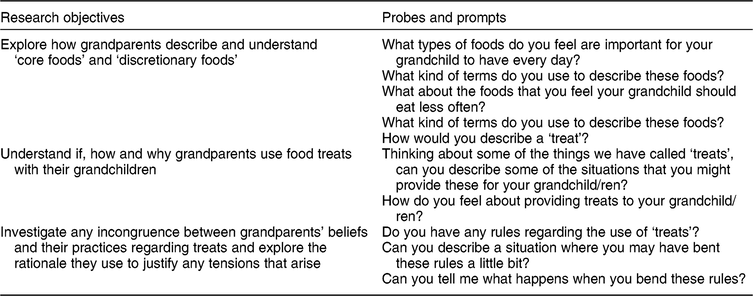
An interview schedule was developed to explore the situations in which grandparents use food treats with their grandchildren (Table 1). Questions were informed by concepts raised in the relevant literature and aimed to address gaps in knowledge. Probes and prompts were included to facilitate deeper discussion on the provided topics. The schedule was piloted among peers to evaluate the content and flow of the interview schedule. Twelve grandparents attended either semi-structured individual (n 4) or one of two focus group interviews (n 8; Table 2). Interviews ranged in length from 60–90 min. The first grandparent interview was conducted as a pilot and resulted in minor amendments to the question probes; however, data collected were rich enough to warrant inclusion in the final analysis. Interviews and focus groups were audio-recorded and transcripts were coded immediately after each interview to identify emerging themes. Data saturation (i.e. no new themes or codes) was confirmed after transcribing and coding the second focus group; however, a final individual interview was conducted to allow the grandparent to participate. A nominal ($AU 25⋅00) supermarket gift voucher was provided to participants on completion of the interview.
Interview schedule developed to explore situations in which grandparents use food treats with their grandchildren
Order of interviews/focus groups and details of participants: grandparents (n 12) providing informal care for grandchild/ren aged 1–5 years, Adelaide, South Australia, September–November 2017

F, female; M, male.
Analysis
Interviews were transcribed verbatim by the primary researcher upon completion of each interview, enabling deep immersion in the data. Transcripts were de-identified and anonymised to ensure participant confidentiality. Coding was conducted by the primary researcher in multiple stages using qualitative analysis software (NVivo version 11, 2016). Deductive codes were developed initially from the interview questions, with reference to the literature and study objectives, and detailed in a codebook( Reference Hennink, Hutter and Bailey 29 ). Inductive codes were developed from participants’ responses. Verbatim quotes were recorded against each code for accuracy. Thematic analysis was conducted using the Sort and Sift: Think and Shift( Reference Maietta, Curry, Shield and Wetle 33 ) approach to categorise codes and identify dominant themes. This is an iterative process of data collection and immersion followed by review and reflection that facilitates the emergence of concepts and themes( Reference Maietta, Curry, Shield and Wetle 33 ). Rigour was maintained through review and discussion of transcripts, codes and thematic analysis between three of the researchers( Reference Hennink, Hutter and Bailey 29 ). The primary author recorded reflections regarding participant interactions and comments in a field journal that was discussed during team meetings, whereupon individual experiences, assumptions and professional biases were discussed and addressed.
Results
Participants were predominantly female (n 10), aged between 50 and 79 years (mean age = 66 years) and born in Australia (n 8). Most participants (n 8) resided in suburbs with high relative socio-economic advantage, i.e. IRSAD decile 9–10( 32 ). None of the participants identified as Aboriginal or Torres Strait Islander (Table 3). Respondent quotes are denoted as (FG) for focus group or (I) for interview.
Characteristics of participants: grandparents (n 12) providing informal care for grandchild/ren aged 1–5 years for 10 h/week or more, Adelaide, South Australia, September–November 2017
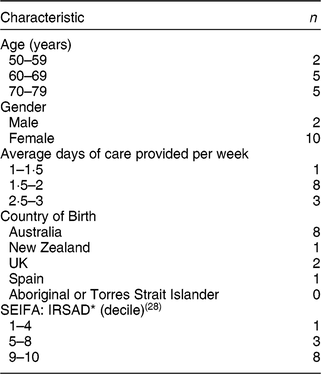
* Socio-economic Index for Areas: Index of Relative Socio-Economic Advantage and Disadvantage 2016 ranking within Australia (lower deciles indicate higher levels of disadvantage)( Reference Leary 28 ).
Prior to approaching the thematic analysis, it was necessary to determine how grandparents defined a treat. Collectively, grandparents defined a treat in two ways; food and non-food related. Unexpectedly, all grandparents had an expanded definition of treats that included non-food items such as books, toys and activities as well as spending quality time together. Although the use of non-food treats is integral to grandparent–grandchild relations, it was beyond the scope of the study; consequently the findings of the present paper focus on food treats only. Grandparents described food treats as something that gives grandchildren pleasure but that are not given frequently. One 68-year-old grandmother explained (FG):
‘I guess something they don’t have very often. Ummm but it probably – it’s something that they’d like to have more often but because you restrict it more, it is a treat when they do get it.’
Most grandparents explained that food treats did not have to be discretionary foods, they frequently used core foods (e.g. cheese, blueberries) as a treat.
Thematic analysis of data pertaining to the meaning and role of treats yielded three major themes: (i) the functional role of treats; (ii) grandparental role, responsibility and identity; and (iii) the rules surrounding the provision of treats (Fig. 1).
Authors’ interpretation of the influences on grandparents’ provision of treats. The provision of treats to grandchildren appears to be influenced by grandparents’ desire to be remembered as a valued elder which is in turn influenced by (i) the rules regarding the provision of treats; (ii) grandparent role, responsibility and identity; and (iii) the functional use of treats. * denote realms of Kivnick’s framework for grandparent identity

The functional roles of treats
Grandparents discussed the use of treats in behavioural or emotional situations, as an educational tool and as an expression of love.
Most grandparents were opposed to using food treats for comfort, to ameliorate negative emotions or to control outbursts such as tantrums. Instead, most viewed food treats as an appropriate reward for an accomplishment, to reinforce good behaviour and to teach manners. A 63-year-old grandmother explained (I):
‘If they are having a temper tantrum, a treat wouldn’t be appropriate then. (…) the treat should be something special and something you get for y’know, maybe, just you have to be good to get it kind of thing. You can’t be bad to get it.’
When discussing discretionary foods as treats, most grandparents believed that it was important for children to be exposed to discretionary foods so that they could learn to balance and moderate their intake and apply self-control. When discussing the restriction of discretionary foods, a 72-year-old grandfather shared (FG):
‘Y’know the balance (…) and you’ve brought the real point out, which is self-discipline. Ummm to try and impose it on kids and say “you can’t have” and “you can’t have” – gives them in their mind “the second that I get out of home I go berserk”.’
Most grandparents felt that providing food treats to their grandchildren while in adult settings, such as cafés, was a way to help them feel included and teach them social etiquette. As a grandmother, aged 52 years, explained (FG):
‘It’s part of their social development as well that, y’know, we’re sitting down and having a coffee so it is inclusion ummm and, y’know, part of being social.’
Grandparents discussed using food treats as a way of expressing love and care towards their grandchildren, as seen during the following discussion between two grandparents. One grandmother (aged 62 years) said (FG):
‘I don’t know whether I’ve ever given it much thought about how I feel when I give [refers to grandchild] a treat. I don’t.’
At which point a grandfather (aged 76 years) interjected (FG):
‘You just do it, don’t you?’
The grandmother concluded by saying (FG):
‘It’s just ahh a natural thing I guess it’s ahhh – a showing of love.’
This met with group agreement. Grandparents also reported deriving pleasure themselves when providing grandchildren with food treats. For example, one grandmother (aged 68 years) described the pleasure associated with treat provision and the role treats play in her identity (FG):
‘Well, yeah, I mean it gives me great pleasure actually because they, they’re pleased to receive a treat (…). Ummm I think that’s one of the benefits of being a grandparent, you can give them treats (…) this is the sort of things they’ll remember.’
Many grandparents also discussed the demands on modern parents and feared that grandchildren were ‘missing out’ on a variety of childhood experiences due to parents’ lack of time and money. As such, they sought to compensate and aimed to provide grandchildren with treats that parents could not. Grandparents were able to provide core foods that were perceived by parents as cost prohibitive and frame these as treats. One grandmother, aged 63 years, mentioned berries (I):
‘Blueberries, oh my gosh, that is a real treat because they are so expensive and they absolutely love them’.
Another grandmother, aged 75 years, discussed avocado (FG):
‘I buy the bag from [the supermarket] and they were up to nine dollars the other day for half a dozen, but he absolutely loves avocado.’
This further illustrates grandparents’ definition of a treat as something that is given infrequently, is not provided by parents, is enjoyed by grandchildren and differentiates their role from other caregivers.
Grandparental role, responsibility and identity
All grandparents clearly expressed ‘we are not the parent’ and therefore they did not claim the same role or responsibility as parents. One 72-year-old grandmother stated (FG):
‘Grandparents are not parents and they should be able to do something different from parents because that’s what the children will remember when they’re grown up.’
This also relates to their identity through illustrating the importance of being remembered by their grandchildren as unique and special. One of the ways they affirmed this unique identity was through the use of treats. Grandparents often reconnected with their own past, some recounted tales of their own grandparents’ indulgence and wanted to recreate that sensation for their grandchildren. One grandmother (aged 70 years) said (I):
‘I try to give them some of the things that I had myself as ahh a youngster and I know how jolly lucky I was.’
Some grandparents felt grandparenthood was a second chance to care for children and they discussed using both food and non-food treats to provide their grand-children with experiences that they had been unable to give their own children. A 76-year-old grandfather said (FG):
‘I think back to when my kids or our kids were little (…) you didn’t spend the time with the kids I think that you should have, that’s how I feel now and now I’ve got a second chance I guess.’
Some grandparents indicated they felt an increased sense of responsibility for their grandchildren due to the shift from casual visitation to informal caregiving. One 69-year-old grandmother, who refers to herself as ‘Granny’, explained (FG):
‘I think the slight differences, because as grandparents now we’re looking after the children a lot more often, it’s not like going to visit Granny once a month or something. Granny always had treats there for you, I think we’re more aware and that’s why I will give ours chocolate now and again, or something, because I am a grandparent and I’m allowed to spoil them.’
This quote illustrates that grandparents’ food treating is modulated by their increased sense of responsibility as informal caregivers. Further, they are making conscious choices to balance their wish to offer treats as a way of showing love with their responsibilities as influencers on their grandchild’s health.
The rules surrounding the provision of treats
Grandparents’ own rules were predominantly informed by their personal health beliefs. Most discussed the importance of modelling healthy behaviours and being mindful of their own diet when grandchildren were present. One 53-year-old grandmother sought balance between health and pleasure (FG):
‘I try to go for those kinds of things that will make her happier but is still healthy for her. I think the health issue is very important in today’s world’.
Another grandmother, aged 52 years, said (FG):
‘Even cottage cheese on a celery stick, peanut butter on a celery stick, to me that’s not so bad [group agreement] ummm but it’s a bit of a novelty, they perceive it as a treat.’
This health awareness demonstrated by grandparents was supported by their beliefs regarding the importance of a good meal to provide essential nutrition and their practice of restricting food treats when a main meal (e.g. lunch or dinner) was imminent either back with the child’s parents or while in the care of the grandparent themselves. For example, one 63-year-old grandmother said (I):
‘I don’t want to spoil their appetite either for when they get home so I either make sure that they’re fed before they leave or hungry enough to eat when they get home.’
Another grandmother, aged 61 years, explained how she responded to demands from her grandchild close to mealtime (I):
‘Ummm just sort of say “Oh no we’ll be having lunch soon” and he’s sort of happy with that. If he puts on a turn, I just cut him up a piece of pear (…) “Oh you can have some pear after, you need to have your lunch first” and he’s sort of happy with that.’
In most cases grandparents felt their family feeding practices had been passed down through the generations, and as such food-related rules and beliefs were relatively consistent between care environments resulting in a low level of conflict between grandparent and parent. Naturally, grandparents and parents differed occasionally in their beliefs and practices, and the manner in which grandparents approached these differences varied. Some grandparents felt the parent’s rules were overly strict and sought to counterbalance with a softer, more lenient approach. One 72-year-old grandfather stated (FG):
‘What happens at Grandma’s stays at Grandma’s. Ummm that’s in her [the grandchild’s] interests because her mother is very up and down the line with rules and that – that sometimes we vary the rule but there’s a good reason.’
In contrast one grandmother, aged 53 years, feared a contrary approach would have significant consequences and thus respected the parent’s rules even when she disagreed (I):
‘While I am looking after my granddaughter I want to make sure that my daughter is happy for me to do that. I love my granddaughter, but I love my daughter as well, so the last thing I want is to make her upset and then she may withdraw the granddaughter from me.’
She further suggested that flexibility and understanding were key components in limiting conflict:
‘I think you can have rules, but rules cannot be implemented one hundred per cent of the time. If you manage to implement your rule eighty per cent of the time, that’s a good rule. But you have to be aware there is going to be those twenty per cent of the times where it’s not possible.’
Regardless of whether grandparents agreed with parental rules, they all mentioned the importance of consistency, which often presented them with a dilemma. In one focus group, two grandmothers discussed breaking their own rules regarding treats as incentives in order to align with other family members. One grandmother (aged 72 years) mentioned the child’s mother using treats as an incentive for toilet training the grandchild (FG):
‘That wasn’t instituted by me, that was instituted by Mum and the other Gran, so I went along with it because it was easy.’
The other grandmother (aged 68 years) shared a similar tale (FG):
‘Same here as well with [refers to granddaughter], when we were potty training, it wasn’t me that started it. It was Mum [that] gave her a little treat afterwards if she performed.’
Although these grandmothers said they did not normally use food treats as an incentive, they continued for the sake of consistency among carers for the child. Additionally, many grandparents indicated that parents bend their own rules and transgression by one family member was considered permission to emulate. A grandmother, aged 69 years, mentioned the child’s father breaking one of his rules and remarked (FG):
‘So I figure if he can bend the rules, I can bend the rules I want to bend, occasionally’.
As most grandparents and parents shared the same beliefs around whether grandchildren should have access to food treats, the final rules involved negotiation between grandparents and their grandchildren regarding the type and quantity of treats. This category intersected heavily with grandparent identity, as grandparents seemed to enjoy being viewed by their grandchildren as indulgent but at the same time they did not want to be manipulated or taken for granted. Therefore, grandchildren could request food treats, however there were clear rules and boundaries set. A 72-year-old grandmother said when discussing a jar of confectionery (FG):
‘They get one or two and then they don’t ask again. They know that’s it, and it sits up on the shelf. They could go and get it if they climbed up on the chair and got it, but they don’t.’
One 70-year-old grandmother discussed the balance between being indulgent and being manipulated (I):
‘They con me two or three times and then I think nup, enough’s enough! We’ll bring a little rule in so that it’s not every time [they] see nanna [they] can have a doughnut.’
Discussion
The present study explored grandparents’ perspectives regarding the role and meaning of food treats within the grandparent–grandchild relationship. Grandparents broadly discussed the act of treating and differentiated between food treats (either core foods or discretionary foods) and non-food treats. All treats had a functional role and may be used for behavioural or emotional reasons, as an educational tool and/or to express love. Grandparents used both food and non-food treats to differentiate their role from parents and to create a special relationship with their grandchildren. They enjoyed indulging their grandchildren; however, this was moderated by their own health beliefs, the desires of the parents and the well-being of the child.
The insights gained from this group of grandparents provide a deeper understanding of the division of responsibility, described previously( Reference Roberts and Pettigrew 9 , Reference Eli, Hornell and Etminan Malek 12 – Reference Knight, O’Connell and Brannen 14 ) by drawing upon aspects of identity theory. Kivnick( Reference Kivnick 7 , Reference Kivnick 26 ) proposed a framework for grandparent identity and satisfaction that includes five realms: (i) centrality (i.e. grandparenthood is at the core of the individual’s identity); (ii) immortality through clan (i.e. continuity through descendants); (iii) valued elder (i.e. the desire to be remembered with reverence); (iv) reinvolvement with personal past (i.e. interacting with personal history); and (v) spoiling (i.e. attitudes of lenience and indulgence). When grandparents discussed both food and non-food treats, it was frequently linked to their role and identity. Both food and non-food treats were used to indulge their grandchildren and differentiate their role from that of the parents, thereby creating a special bond with the grandchild. These three aspects of grandparent identity (valued elder, reinvolvement with personal past and spoiling) appear to be interconnected determinants regarding the provision of treats to grandchildren. The findings from the present study suggest that grandparent identity, specifically how they wish to be remembered and seen by their grandchildren, appears to underpin grandparent indulgence regarding food treats.
Thiele and Whelan( Reference Thiele and Whelan 27 ) built upon the work of Kivnick( Reference Kivnick 7 , Reference Kivnick 26 ) to explore satisfaction and generativity among grandparents who provide informal care to their grandchildren. Satisfaction is described as the level of enjoyment and comfort pertaining to the role of grandparent( Reference Thiele and Whelan 27 ), with higher levels of identity and meaning linked to increased satisfaction( Reference Reitzes and Mutran 34 ). Generativity, in this context, can be described as grandparents’ desire to foster and guide future generations, which is also linked to grandparent satisfaction( Reference Thiele and Whelan 27 ). This was evident through the present study in the effort grandparents invested in providing experiences that their grandchildren were not able to get from their parents (e.g. buying expensive foods). The findings suggest that treats were a tool that grandparents used to enhance and negotiate their way through the grandparenting experience. They gained personal pleasure from providing treats to their grandchildren and used them to express love and caring. Grandparents used treats in their role as educators, teaching their grandchildren socially acceptable behaviours and as positive reinforcement. Their judicious use of treats could also have served an educational role for children, around moderation in relation to discretionary foods. The spoiling aspects of grandparent identity strongly interact with treats because treats allow grandparents to differentiate themselves from the role and responsibilities of parents. This is supported by Knight et al. ( Reference Knight, O’Connell and Brannen 14 ), who suggest that indulgence and spoiling is a mechanism for grandparents to differentiate their role from the authoritative position of the primary caregiver. Each of these themes suggests that treats are a tool grandparents use to express their identity and increase their generativity and role satisfaction.
When discussing treats, grandparents consistently spoke of their wish to provide balance between core and discretionary foods. Most grandparents believed restricting discretionary food treats created a desire for them and therefore believed that children needed to be exposed to limited amounts to learn self-discipline. This supports the findings of Eli et al. ( Reference Eli, Howell and Fisher 13 ), who suggest that both parents’ and grandparents’ decisions regarding child feeding are influenced by their desire to provide a balanced lifestyle. Generally, the feeding practices of the parents emulated those of the grandparents, which resulted in a high degree of consistency and low conflict. Johnson et al. ( Reference Johnson, Sharkey and McIntosh 35 ) also observed that where parents had adopted similar feeding practices to the grandparents there was less conflict regarding food provided to the grandchild. Roberts and Pettigrew( Reference Roberts and Pettigrew 9 ) suggest ‘rebellious grandparents’ may use treats to counterbalance strict parental feeding; however, our grandparents reported using restraint and respecting parental feeding guidelines. Indeed, most grandparents indicated the need to respect and adhere to parental rules for the sake of harmony and consistency. Thus, grandparents appear to juggle their desire for distinction from parents with the need to respect parent rules, maintain a harmonious relationship with parents and support their grandchildren’s health.
In conjunction with their use in identity formation and role differentiation, food treats are a tool that grandparents used for functional purposes; i.e. to reward good behaviour, to teach manners, for social inclusion, and as an expression of love and care. Food appears to be a universal metaphor for expressing love and providing reward( Reference Hamburg, Finkenauer and Schuengel 36 ) and is gratifying to both the provider and recipient, increasing interpersonal closeness between individuals( Reference Hamburg, Finkenauer and Schuengel 36 ). Not surprisingly, grandparents indicated that they found the provision of treats to be personally rewarding, adding to their role satisfaction. Although grandparents may be more likely to use food as a reward than parents( Reference Farrow 8 ), many of the other negative behaviours reported in the literature (e.g. supplying excessive amounts of discretionary foods) were not expressed by the group of grandparents in the present study. For example, rather than undermining parental rules as previous studies suggest( Reference Roberts and Pettigrew 9 , Reference Eli, Hornell and Etminan Malek 12 – Reference Knight, O’Connell and Brannen 14 ), grandparents in the present study generally aimed to align with them. Grandparents explained that while they claimed the right to be indulgent, they also felt a strong responsibility to help parents raise healthy children. One possible explanation for these divergences is that this sample of grandparents was well educated and health conscious.
Although the grandparents in the present study expressed the desire to spoil their grandchildren, when it came to providing food, they remained mindful of the negative consequences of overindulgence, such as poor dental health. Grandparents preferentially chose to provide core-food or non-food treats rather than the discretionary-food treats which have typically been cited in the literature( Reference Chambers, Rowa-Dewar and Radley 20 ). When they did wish to provide a food treat to their grandchildren, they sought innovative ways to frame core foods as treats, e.g. cutting fruit into fun shapes. They displayed awareness of the complex psychosocial space they were required to navigate and prioritised the parental rules for harmony and consistency. Our findings demonstrate congruence between grandparents’ own beliefs and behaviours, although they appeared willing to bend their own rules if requested by the parents, e.g. using food as a bribe. This suggests that although grandparents are viewed as being indulgent and lenient with grandchildren, this may not always result in negative feeding practices such as the regular provision of unhealthy foods.
There are several strengths to the current research. The study was designed with a strong methodological foundation based on the principles of grounded theory. Academic rigour throughout was achieved through use of reflective practice, discussion and transparency( Reference Hennink, Hutter and Bailey 29 ). However, there are several limitations that should be considered when reviewing these findings. Our participants resided in areas of relatively high socio-economic advantage and are therefore, based on previous literature, more likely to have a higher education level( Reference Karmel and Lim 37 ), a higher-quality diet( Reference Backholer, Mannan and Magliano 38 ), to maintain a healthy weight and have better health outcomes( 39 ), which may have impacted on their beliefs and practices regarding treating their grandchildren. The participants were predominantly female and, although this reflects the gendered nature of grandparent caregiving( Reference Thiele and Whelan 27 , Reference Smorti, Tschiesner and Farneti 40 ), our findings may not accurately represent the views of caregiving grandfathers. Similarly, the ethnic homogeneity of our sample means the cultural influences of grandparents on child feeding were not fully explored( Reference Johnson, Clark and Goree 41 ).
Finally, we acknowledge the use of both focus groups and individual interview methods to collect these data is uncommon. As some respondents encountered barriers in attending focus groups, inviting participation through individual interviews captured data that might otherwise have been lost. While interviews and focus groups have varied strengths in the comparison of data generated across mixed study contexts( Reference Guest, Namey and Taylor 42 ), the use of both methods for data collection in the present study may have enhanced the richness of data( Reference Lambert and CG 31 ) obtained in the present first qualitative study of the use and meaning of food treats in grandparents who provide informal care to children aged 1–5 years.
Areas for future research and implication for practice
The present study’s findings add valuable insight to the existing knowledge regarding the potential influence of grandparents on children’s food preferences and dietary patterns. The findings, however, are not generalisable and cannot be used to inform practice. Instead, these findings should be used to guide further research to understand grandparents’ use of food treats in different socio-economic and cultural settings. Areas of importance include research to examine and compare parents’ and grandparents’ approaches to using both food and non-food treats, together with quantitative research on the type, frequency, timing and quantity of discretionary foods that grandparents provide to their grandchildren. Another finding that warrants further investigation is the notion that grandparents may moderate the food treats provided to their grandchildren based on the amount of time they spend providing care. Such information may identify whether grandparental provision of discretionary-food treats is an area of concern. Research to quantify grandparents’ nutritional knowledge is also recommended to fully understand the health beliefs they use when making decisions regarding the provision of food to their grandchildren.
Conclusion
To our knowledge, the present study is the first qualitative one to explore the use and meaning of food treats among grandparents who provide informal care to children aged 1–5 years and to draw connections between grandparent identity and the use of treats. The findings suggest that although these grandparents readily claimed grandparent privilege and believed they have the right to indulge their grandchildren, they discussed a discerning approach to food treats and used them judiciously. Grandparents moderated their indulgent tendencies and sought balance between their own desires and those of their grandchildren and parents. Grandparents expressed responsibility for the health and well-being of their grandchildren and sought innovative ways to frame core foods as indulgent treats. Importantly, grandparents identified treats as a valuable tool for them to differentiate their relationship from other carers and be remembered as a valued elder. These insights can be used to inform future research aimed at better understanding the way grandparents use food-related treats in a broad range of cultural and socio-economic settings.
Acknowledgements
Acknowledgements: The authors thank the grandparents who participated in this research together with the staff at various playgroups, libraries and churches for their assistance. Financial support: This study was funded by Flinders Foundation. Flinders Foundation had no role in the design, analysis or writing of this article. Conflict of interest: None. Authorship: M.P. was the lead author and researcher, K.M. and L.B. were involved in the study design and provided ongoing supervision throughout data analysis. The remaining authors were part of the initial project group and contributed as co-authors through discussion and revision. Ethics of human subject participation: This study was conducted according to the guidelines laid down in the Declaration of Helsinki and all procedures involving research study participants were approved by the Social and Behavioural Research Ethics Committee (SBREC) at Flinders University. Written informed consent was obtained from all subjects.
Author ORCIDs
Carly J Moores, 0000-0003-0762-7482. Lucinda Bell, 0000-0001-7251-9176.



