




Introduction
In the present article, I examine how codeswitching serves as a resource for taking stances and constructing a range of different personae. As Auer (Reference Auer2005:403) points out, bilingual speakers can participate in various ‘semiotic constellations such as local versus regional versus national, urban versus rural, autochthonous versus colonial, minority versus majority, etc.’, beyond indexing a hybrid identity. But what is the nature of these semiotic constellations and what is the role of codeswitching in both delineating and reinforcing these oppositions? In other words, what are the social meanings of codeswitching? One method of answering these questions is by considering places where the indexical field (Eckert Reference Eckert2008) associated with codeswitching is particularly salient and nearly tangible, where high drama facilitates discerning intentionality—I am referring here to the world of Spanish-language telenovelas. I address these questions of social meaning by analyzing how codeswitching on Betty en NY (‘Betty in New York’; Telemundo 2019) serves as a dynamic strategy for stancetaking in discourse, since the multidimensional nature of stance allows us to observe how codeswitching functions both interactionally and semiotically. Furthermore, I demonstrate how the calibration of stances connects to the realignment of participant roles and personae, a process I call recursive recalibration. As speakers use codeswitching to take stances in a conversation, they are also positioning themselves with respect to other interlocutors while concurrently indexing specific personae. The recalibration of specific stances then is tied to changes in participant roles and persona construction. This is especially apparent when speakers use codeswitching to assert their epistemic rights during argumentative exchanges, thereby drawing on particular participant roles and personae to take stances.
Betty en NY is Telemundo's adaptation of Yo soy Betty, la fea (‘I am Betty, the ugly one’; RCN 1999–2001). In modernizing the original storyline, Telemundo used a higher proportion of Spanish-English codeswitching across characters than the original. Unlike more mainstream American telenovela remakes, such as Ugly Betty (ABC 2006–2010) or Jane the Virgin (The CW 2014–2019), Betty en NY is aimed primarily at a Spanish-speaking audience, and as such, codeswitching is embedded into storylines about class-based distinctions more so than race and ethnicity (cf. Murillo Sandoval & Escala Rabadán Reference Murillo Sandoval and Rabadán2013). Thus, Betty en NY offers an opportunity to expand our understanding of the social dimensions of codeswitching, to take note of what other semiotic constellations exist. Grounded in a discussion of epistemic rights and participant roles, I argue that through recursive recalibration, codeswitching can serve as a resource for persona construction and simultaneously be used as a discourse strategy to take stances and recalibrate the relationship between speakers.
From codeswitching to stance
The distinction between discrete language categories—however ideological and socially motivated this distinction may be (Auer Reference Auer, Akande and Taiwo2013; MacSwan Reference MacSwan, MacSwan and Faltis2019; Otheguy, García, & Reid Reference Otheguy, García and Reid2019)—continues to be relevant, even within theories which seek to problematize language separation (Jaspers & Madsen Reference Jaspers and Madsen2016; Bhatt & Bolonyai Reference Bhatt and Bolonyai2022). From a semiotic standpoint, the social meaning of certain bilingual practices derives precisely from the ideological distinctions between languages. At its most extreme, speakers may use different languages to enact opposing affective displays or personae (Koven Reference Koven2006; Song Reference Song2019), or bilingual talk itself might constitute a social style (Auer Reference Auer, Akande and Taiwo2013). As has been proposed for language variation in monolingual contexts (Eckert Reference Eckert2012), bilingual speakers agentively employ their full linguistic repertoire across languages to index particular qualities and stances. Speakers can exploit the contrasts between languages to create new indexicalities (Otsuji & Pennycook Reference Otsuji and Pennycook2010) or delineate differences among groups (Lo Reference Lo1999; Gal & Irvine Reference Gal and Irvine2019), particularly in codeswitching contexts. Rarely does the use of one language index one macrosocial category (e.g. speaking Spanish indexes a Mexican identity), but rather these practices encompass a range of more nuanced, localized meanings (e.g. what it means to be Mexican in this specific context, community, history, etc.; Eckert Reference Eckert and Linton2014). Therefore, this article bridges interactional approaches to codeswitching with sociolinguistic research on social meaning in order to demonstrate how speakers are simultaneously taking more than one stance through recursive recalibration. I begin by defining stance, epistemic rights, and participant roles. Then, I expand on the role of personae and the context for the study, which lays the groundwork for the analysis of codeswitching and stancetaking.
Stance
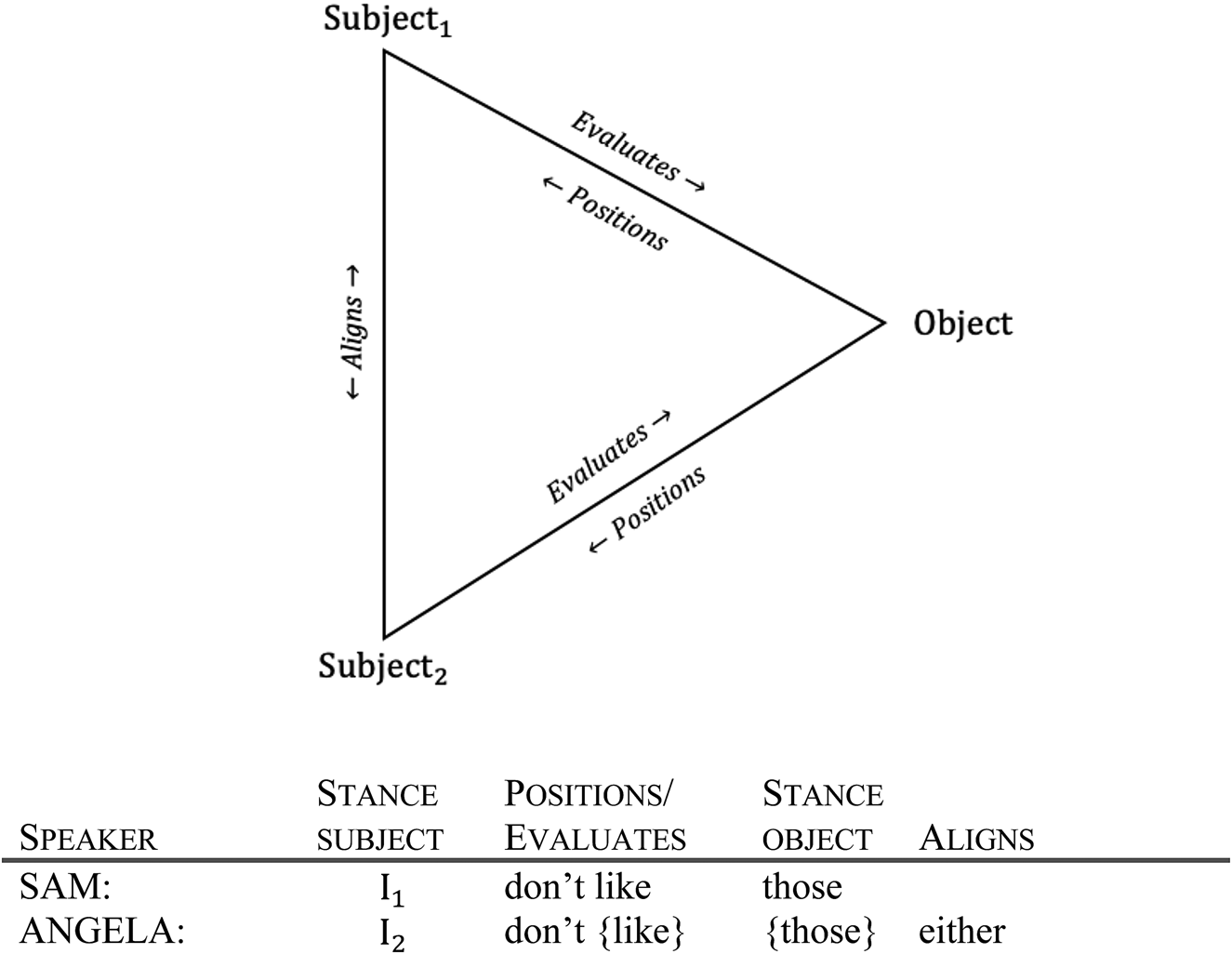
Du Bois (Reference Du Bois2007) argues that all acts of stance involve three underlying principles: evaluation, positioning, and alignment. As stancetakers (or stance subjects) make evaluations about referents in discourse, they are also orienting themselves in relation to these referents, thereby positioning themselves in the social landscape. In the example—“Those glass slippers are lovely”—the stancetaker is attributing a quality or value to the ‘glass slippers’, the target of evaluation, or the stance object. The stancetaker could have also said that the slippers were “impractical” or “expensive”, instead of “lovely”. These responses do not elicit the same sociocultural values, and consequently, they correspond to different positionings for the stancetaker. Moreover, stancetakers can share the same stance object with another stance subject. If Speaker A states, “Glass slippers really work better in theory than in practice”, Speaker B might respond, “I agree”. These speakers then enter an intersubjective process of alignment, that is, ‘the act of calibrating the relationship between two stances, and by implication between two stancetakers’ (Du Bois Reference Du Bois2007:144). Since speakers can express different degrees of alignment (e.g. ‘I agree’ versus ‘I strongly agree’), we can describe alignment between subjects as converging, diverging, or ambiguous (Du Bois Reference Du Bois2007:162).
These three key processes—evaluation, positioning, and alignment—constitute what Du Bois calls the stance triangle, a framework for analyzing stancetaking in discourse (Figure 1). Importantly, Du Bois argues that speakers do not undertake generic stances but instead take specific stances embedded in a particular dialogic context (Reference Du Bois2007:145). Any study of stancetaking then requires a careful analysis of discourse and the relevant semiotic context.
The stance triangle (adapted from Du Bois (Reference Du Bois2007:163, fig. 1; 166, ex. 53).

The stance triangle demonstrates that speakers use stance to not only linguistically calibrate alignments between social actors but also to draw upon a mutually recognized system of sociocultural values and interactional positions. Stance objects are not limited to material objects but can refer to any entity relevant in discourse (Kiesling Reference Kiesling, Hall and Barrett2018:4). Thus, stance operates on multiple ‘types and scales of analysis’, taking us ‘from the grammatical through the interactional and on to the cultural and sociological’ (Irvine Reference Irvine and Jaffe2009:3). As speakers assume numerous context-specific and temporary stances, the repetition and accumulation of such stances may result in linguistic forms ideologically associated with certain identities, personae, and characterological figures (Agha Reference Agha2005; Bucholtz & Hall Reference Bucholtz and Hall2005; Moore & Podesva Reference Moore and Podesva2009; Kiesling Reference Kiesling, Hall and Barrett2018, Reference Kiesling2022). Building on this prior work, I argue that stance and personae are also connected through recursive recalibration—the process by which the alignment of individual stances connects to the repositioning of participant roles and personae. By analyzing Betty en NY, I demonstrate how characters use stancetaking to construct and negotiate personae in interaction by using codeswitching to take particular stances and converge (or diverge) in alignment along multiple axes.
Recalibrating participant roles
As speakers take up stances, they are implicitly making claims concerning their epistemic rights. These are their rights to obtain information or evaluate a given stance object. Such claims to knowledge reflect social relations among participants, since knowledge is socially distributed among parties (Heritage & G. Raymond Reference Heritage and Raymond2005; G. Raymond & Heritage Reference Raymond and Heritage2006). Speakers are generally aware of differences in knowledge and relative positioning among participants, and they may make these distinctions interactionally relevant at specific moments in time by drawing upon linguistic resources (Heritage Reference Heritage, Sidnell and Stivers2012a,Reference Heritageb). C. Raymond (Reference Raymond2016) highlights how epistemic rights tie directly into social relations as Spanish speakers select second person singular reference forms in a conversation. Raymond argues that shifts in pronominal forms are used to invoke new identity stances (Reference Raymond2016:642), and thereby recalibrate the relationship between speakers, the context of the interaction, and the goals within that context.
Raymond's approach to recalibration is useful for understanding the dynamics of codeswitching in Betty en NY. Similar to how Spanish speakers exploit meaning distinctions between reference forms to recalibrate the relationship between speakers, codeswitching can also be used to invoke shifts in participant roles, or the temporary orientations assumed by speakers in discourse (cf. Goffman Reference Goffman1981; Bucholtz & Hall Reference Bucholtz and Hall2005). In Cashman's (Reference Cashman2005) conversation analysis of a game of bingo in an urban Midwestern Latinx community, one participant alternated languages to indicate when she was acting as ‘facilitator’ of the bingo game (by speaking English) compared to when she was a fellow ‘participant’ (by speaking Spanish). Similarly, in Mondada (Reference Mondada and Heller2007), speakers used French-English codeswitching to differentiate activities by invoking their respective participant roles during a surgery attended by surgeons and trainees.
The present study: Betty en NY
Betty en NY offers an excellent opportunity to analyze stancetaking and the social meaning of codeswitching in context, in part because scripted media permits us to observe what ideological associations exist in the popular imaginary. With 123 episodes in total, the series contains a vast range of social interactions—business meetings, social events, family dinners, arguments, flirting, and so on—all embedded within an intricate web of many characters and plot lines. The exaggerated nature of telenovelas, coupled with the many levels of production (e.g. directors, actors, screenwriters, costume designers, etc.), allows for more space to discern characters’ motivations and the social meanings at play. Following Lopez & Bucholtz (Reference Lopez and Bucholtz2017:4), the goal is not to empirically verify the authenticity of language practices on the show, but rather to understand how the perception of ‘authenticity’ is semiotically achieved via the linguistic devices recruited to create these characters. In the context of a telenovela, authenticity refers to the recognizability of these characters by viewers as personae in the social landscape. I define personae as the embodied instantiations of ‘holistic, ideologized character types that are identifiable in the imaginations of communities… [and are] specified for macro-social, personality-based, and behavioral characteristics, and of course, linguistic styles, with individual speakers dynamically enacting different personae in different interactional moments’ (D'Onofrio Reference D'Onofrio2019:347). While telenovelas, like other artistic representations, deal closely with ideologized figures, I treat the characters on Betty en NY as personae since they are the concrete manifestations of character types that have been intentionally crafted by a production team. After discussing the relevant background of Betty en NY, this section dives into the key personae on the show, laying the groundwork for the present analysis of stancetaking.
Betty en NY is part of a cultural legacy as the twentieth anniversary edition of Yo soy Betty, la fea (‘I am Betty, the ugly one’; RCN 1999–2001), which holds the record for the most successful telenovela in television history. Betty en NY aired from February 2019 until August 2019 on Telemundo, an American Spanish-language television network. The show was well received, at times garnering more viewers than English-language competition (Guerra Reference Guerra2019; Pucci Reference Pucci2019). The show is essentially a romantic comedy about Betty (Elyfer Torres), a brilliant financial analyst who is repeatedly discriminated against for being ‘ugly’. After multiple failed interviews, she accepts work as a secretary at a high-end fashion company (V&M), despite being overly qualified. The show follows her love story with the president of the company, Armando (Erick Elías). The central plotlines involve tensions across three groups: the secretaries, the V&M executives, and minor characters who function as comedic foils. These groups differ not only in age, fashion, and socioeconomic status, but also in their use of English.
Betty en NY sets itself apart from the original version by using Spanish-English codeswitching to construct various personae. These switches are marked (literally through the use of subtitles) since the show remains primarily in Spanish. In previous work, Fernández-Lizárraga & Goebel-Mahrle (Reference Fernández-Lizárraga and Goebel-Mahrle2019), we exhaustively extracted all codeswitches (N = 354) across ten episodes of Betty en NY. Through an analysis of code choice, we found that English is used to differentiate three social types. The first social type is the Young Hot Elite (Figure 2), who are conventionally attractive and wealthy. The show emphasizes their excellent fashion sense, sophisticated interests, and power at V&M. Unlike the Young Hot Elite, the Socially Mobile Professionals (Figure 3) cannot rely on their social status or wealth to succeed; instead, any merits are the direct result of their work ethic and skillset. They are ambitious yet grounded, in contrast to the lofty aspirations of the Wannabes (Figure 4), who are overconfident and seemingly oblivious to their own shortcomings. The Wannabes’ attempts to index the affluence of the Young Hot Elite typically fail, frequently forming part of humorous side plots. These three types come at the cost of othering the Spanish Monolinguals. These are typically older characters, but they do not form a coherent social type. Instead, the show includes specific scenes to demonstrate that they are not bilingual, and consequently, they are cut off from the indexical possibilities of English.
The Young Hot Elite. Key figures: Armando, Ricardo, and Patricia.

The Socially Mobile Professionals. Key figures: Betty and Nicolás.

The Wannabes. Key figures: Frank and Peter.

This previous research suggests that codeswitching plays a role in delineating the oppositions that arise among these various social types, but it leaves open the question of how codeswitching can both position characters on a social landscape and also have different social meanings across these characters. For example, why is it that Betty's use of English groups her with the Socially Mobile Professionals and not the Elite? Why are some uses of English considered ‘cool’ (Young Hot Elite) while others are ‘goofy’ (Wannabes)? Drawing on a corpus of 157 scenes (Fernández-Lizárraga & Goebel-Mahrle Reference Fernández-Lizárraga and Goebel-Mahrle2019), the present article addresses how the social meanings of codeswitching arise in interaction by undertaking a sequential analysis of key scenes in Betty en NY. I use the stance triangle (Du Bois Reference Du Bois2007) to analyze how codeswitching is used to make overt stancetaking moves and recalibrate participant roles (C. Raymond Reference Raymond2016). I build my argument using examples from multiple episodes to demonstrate how codeswitching results in three distinct personae for the characters of Betty, Patricia, and Ricardo. The end product is a theory for how the various social nuances of codeswitching—stance, participant roles, and personae—are connected through the process of recursive recalibration.
Data and analysis
I begin by analyzing how codeswitching is used to invoke participant roles and make epistemic claims, while simultaneously being used in persona construction. Then, I examine the complexity of alignment through how these epistemic rights are leveraged and contested as characters take stances. Finally, I conclude by analyzing how characters converge and diverge in terms of alignment over the course of an interaction. With each set of examples, I build on how these characters make evaluations, position themselves, and ultimately, align with other characters. In each section, I develop an analysis of how codeswitching is involved in multiple layers of stancetaking through recursive recalibration. That is, as characters take stances, they recalibrate their broader social positioning as captured through participant roles and personae.
Recalibrating participant roles and personae
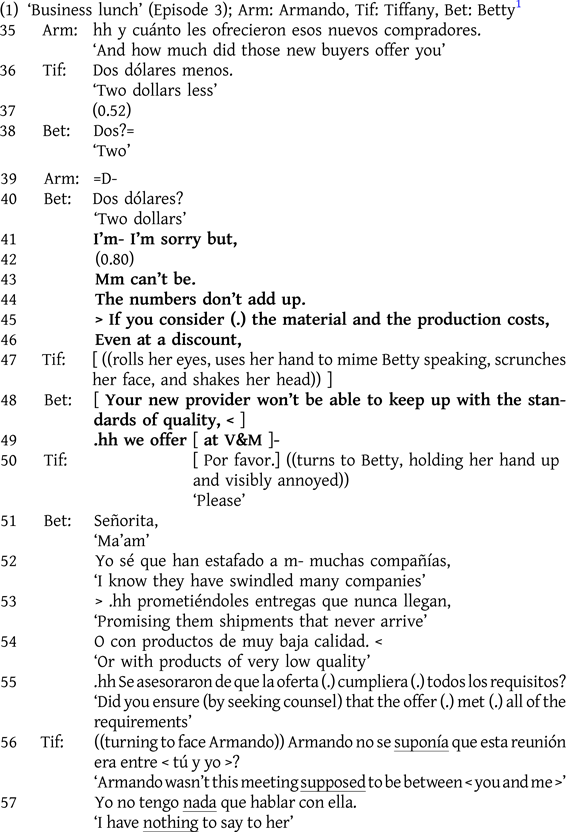
Codeswitching allows characters to challenge or reiterate their social positioning by serving as an important resource for establishing epistemic rights and participant roles. Throughout the series, Betty must repeatedly assert her business expertise since she is often dismissed because of her appearance. In (1), Betty uses codeswitching between English and Spanish to invoke her roles as a ‘financial expert’ and as a ‘concerned colleague’, respectively, to prevent her financial assessments from going ignored. In the scene, Armando and Betty are meeting with a business contact, Tiffany, to discuss why an agreement with Tiffany's father's company has gone awry. Disappointed Armando brought his assistant along, Tiffany is openly disapproving of Betty (e.g. line 47), especially when Betty questions her father's business decisions.

The crux of the scene comes in line 36, when Tiffany finally reveals why the business deal with V&M is off. Betty's questions (lines 38 and 40) register her surprise and anticipate her negative evaluation in line 41. The codeswitch in line 41 is coupled with a prolonged turn for Betty, her first substantive turn in this interaction. The increase in speech rate (lines 45–48) emphasizes the sudden influx of information, which in turn might index qualities such as ‘nerdiness’ or point to her knowledge of financial issues. This shift to English marks Betty's change from ‘Armando's secretary/assistant’ to a ‘financial expert’ in her own right, establishing her epistemic right to assess and negotiate. This example illustrates that participant roles can be taken up as stance objects. In this case, Tiffany responds by disparaging Betty's role as ‘financial expert’. She belittles Betty, using gesture to mock Betty's increased speech rate (lines 45–48), before interrupting her in line 50. What matters here is not only Betty's shift to English but also her second shift immediately following. After Tiffany's outright dismissal of Betty's social positioning, Betty responds in Spanish with a deferential term of address (line 51) followed by insight from a first-person perspective (line 52). Betty's switches across these turns are reminiscent of what Cromdal (Reference Cromdal2004:47) describes as a peaking device; codeswitching can signal the ‘climax of an argumentative exchange by adding another layer of contrast between the opponents … such turns are typically followed by a switch back into the language originally established for the exchange, either commencing an oppositional step-down sequence or promptly terminating the dispute’. After her codeswitch signals the peak of her negative evaluation, Betty begins a de-escalating sequence. Rather than continue invoking her financial prowess, Betty levels the playing field by taking up a different participant role, that of a ‘concerned colleague’. She even enquires whether Tiffany's company sought counsel in making this decision, a question laid out with some hesitation as evidenced by the micro-pausing in line 55. The question makes Tiffany indignant, who instead chooses to address Armando (line 56) and reduce any reference to Betty to a prepositional phrase, con ella ‘with her’ (line 57). While essentially refusing this entire interaction, Tiffany's reaction demonstrates the dialogic nature of emergent social relations. As Betty uses codeswitching to shift participant roles, the implications of these shifts are evidenced by Tiffany's responses.
Betty en NY does not follow the telenovela trope of relegating English to only matters of finance. Instead, codeswitching is used to invoke various personae associated with English as characters establish their epistemic rights. As both a secretary and part of the Young Hot Elite, Patricia is positioned as Betty's nemesis. However, Patricia's social status is in decline. While Patricia spends much of her time mocking the other secretaries, characters like Daniel (Rodolfo Salas), more powerful and wealthier than Patricia, do the same to her. Daniel spares no opportunity to be cruel to Patricia, even as he pays her to spy on Armando.
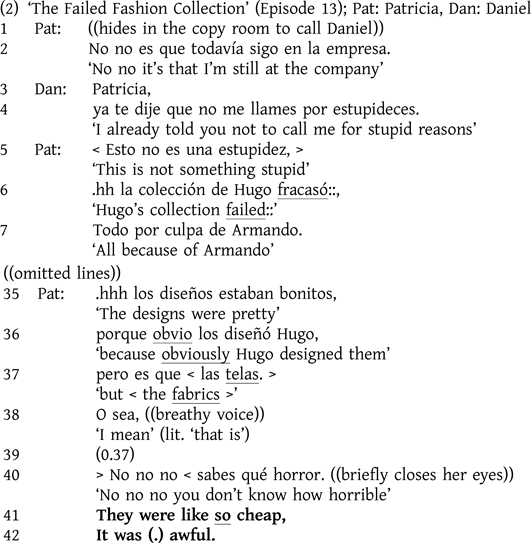
Scene (2) begins with Patricia calling Daniel with information about Armando's failed fashion collection. Armando has opted for cheaper clothing materials, but buyers and investors were not impressed with the quality of the final product.

Before Patricia can begin her report, Daniel chides her about unnecessary calls (line 4), emphasizing his negative impression of her by assuming she called for a foolish reason. Thus, Patricia must not only prove the newsworthiness of her information but also her epistemic right to judge what constitutes a successful V&M fashion collection, from the creativity of the designs to the quality of the fabrics. In line 37, she begins her assessment of the fabric, the key detail in pinning Armando, Daniel's target, as the one responsible and not the fashion designer, Hugo (line 6–7). She upgrades her negative evaluation by shifting to English in line 41. In doing so, she is also invoking her role as a fashion connoisseur by showcasing her knowledge of high fashion and expensive goods. Her evaluation aligns her with others, mainly fashion experts and shareholders, who were shocked and even outraged by the quality of the fabric. This position is underscored by Patricia's use of Mexican Fresa-style elements (lit. ‘strawberry’), a characterological figure associated with upper-class youth, typically white and feminine. For instance, the use of the discourse marker o sea in line 38 (Martínez Gómez Reference Martínez Gómez2014; Holguín Mendoza Reference Holguín Mendoza, Potowski and Bugel2015, Reference Holguín Mendoza2018) is a salient feature of Fresa speech. In Holguín Mendoza's (Reference Holguín Mendoza2018) analysis of sociolinguistic capital and Spanish-English bilingual Fresas, codeswitching to English in Fresa speech indexes a privileged, cosmopolitan, and materialistic persona. This is reinforced when the speaker's English speech style is also associated with mainstream, upper- and middle-class linguistic practices. Likewise, Patricia's codeswitch contains elements associated with young women in English, such as discourse particle like in combination with intensifier so in line 41 (Tagliamonte Reference Tagliamonte2008), and the materialistic tenor of the interaction and overall stance of disgust resembles qualities sometimes attributed to Valley Girls (Pratt & D'Onofrio Reference Pratt and D'Onofrio2017). Thus, the codeswitch in line 41 is the climax of Patricia's negative evaluation, concluding the scene and solidifying her status as part of the Young Hot Elite via her cosmopolitan knowledge concerning high-end fashion goods. While Patricia is crafting a different persona than Betty, nevertheless the underlying mechanisms regarding stancetaking are the same—Patricia too uses English to shift participant roles as Daniel challenges her social positioning and epistemic rights. Patricia's phone call with Daniel demonstrates how carefully intertwined participant roles and personae really are. As characters shift participant roles, the types of epistemic claims they make are tied to the personae they are indexing.
In these scenes, Betty and Patricia were each faced with a contentious exchange that required a recalibration of participant roles. They respond by using codeswitching to signal shifts in participant roles and to establish their epistemic rights to make assessments. These shifts do not occur in isolation since recalibration appears to be recursive; changes in participant roles are connected to the recalibration of personae through epistemic rights. That is, personae are not only specified for ‘macro-social, personality-based, and behavioral characteristics’ (D'Onofrio Reference D'Onofrio2019:347) but also for epistemic rights. This is evident in how both Betty and Patricia use the same linguistic resource, codeswitching, to invoke new participant roles and yet do not index the same persona when they speak English. As they draw upon disparate types of knowledge, financial versus high-end fashion expertise, they are also constructing different personae. In the next section, I examine what is at the core of recursive recalibration—recalibrating intersubjective alignments.
Recalibrating intersubjective alignments through stancetaking
While previously I focused on how characters shift participant roles to make evaluations, now I turn to the alignment consequences of these shifts. Alignment refers to the intersubjective process ‘of calibrating the relationship between two stances, and by implication between two stancetakers’ (Du Bois Reference Du Bois2007:144). I expand on the notion of alignment by considering how codeswitching signals alignment as well as how alignment is dialogically constructed as characters contest epistemic rights and negotiate participant roles.
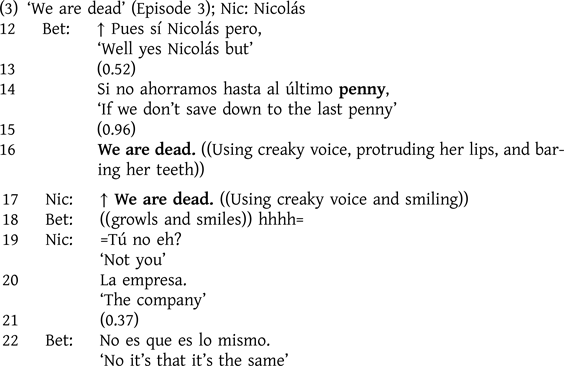
First, codeswitching does not always signal the same type of alignment, such as agreement or social solidarity. When we analyze individual acts of stance used to achieve specific interactional goals, we find that codeswitching can display a range of social meanings. I demonstrate this variability in alignment through two examples. The first involves Betty and her best friend, Nicolás (Mauricio Garza), bickering over Armando's business plan to save V&M money. In (3), Nicolás argues that the very notion of ‘saving money’ is antithetical to the goals of the fashion industry, while Betty defends Armando's position in light of V&M's dubious financial standing.

The codeswitch in line 16 differs from the earlier examples in that Betty does not seem to be the principal of this message but rather the animator (Goffman Reference Goffman1981). Betty is voicing the position of V&M, a position Nicolás disapproves of. The use of English, along with gesture and voice quality, seem to mitigate a potentially dispreferred response (Valdés Reference Valdés1981; Li Wei Reference Wei1994; Zentella Reference Zentella1997), giving it the same lighthearted tone her conversations with Nicolás tend to take. In other words, Betty attempts to rebuild their rapport as they navigate their disagreement. Nicolás responds in kind, smiling and mimicking her back. However, he immediately clarifies the stance object at issue and his position. The contrast between lines 17 and 19 elucidates the function of line 17. While Betty uses codeswitching to voice V&M's stance, Nicolás’ following codeswitch serves to align him with Betty through providing a high degree of parallelism in his verbatim repetition, thus invoking his role as her best friend. Consequently, he must clarify that their views differ on V&M's financial plan and Betty's respective role, even though he is on her side (lines 19–22).
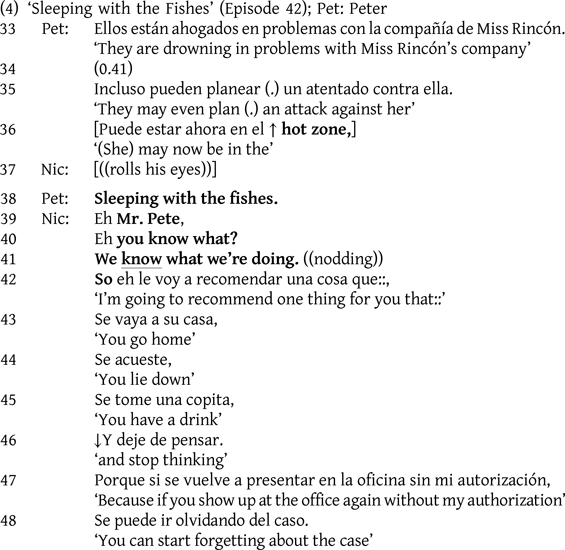
Matching a codeswitch or use of a particular language alone does not necessarily mean alignment with the prior speaker. Rather, codeswitching signals a recalibration process at work. As a point of contrast with (3), codeswitching is used to emphasize the disalignment and power differentials between the interlocutors in (4). Nicolás is upset with Betty's lawyers, Peter (Salim Rubiales) and Frank (Jorge Consejo), since they showed up at V&M without permission. By contrast, the lawyers are not sure what to make of Betty working for the company she is also seizing financially. Consequently, they are overly suspicious when they arrive at V&M and are not allowed to meet with Betty, quickly assuming foul play. In the next excerpt, they call Nicolás to let him know their concerns.

As part of the Wannabes (Figure 4), Peter and Frank often serve as comedic foils on the show as they strive to become big shot lawyers in Manhattan. Thus, Peter's codeswitching in lines 36 and 38 is tied to his own process of persona construction, as he assumes the role of a knowledgeable lawyer and legal counsel. This use of English also functions as an upgraded evaluation of the stance object in line 35; that is, not only is Betty in danger, she may even already be dead, according to Peter. However, Peter and Frank's knowledge of the situation is limited, and so they are unaware that their presence at V&M threatens to expose the entire fraudulent plan to save V&M. Peter's claim to epistemic authority seems to annoy Nicolás (line 37) since it implies a possible oversight on his end. Thus, Nicolás’ main goal in this interaction is to ensure that Peter and Frank will not return to V&M unannounced (lines 47–48). He responds to Peter's stance on Betty's welfare by codeswitching (lines 39–42). Notice that the codeswitch here, even though also in second position (i.e. in the subsequent turn after Peter's initial codeswitch), functions differently from his interaction with Betty. In (3), matching the codeswitch and copying Betty's actions signaled their friendship. With the lawyers, a codeswitch in the same position indicates Nicolás’ superiority as the epistemic authority and as their client. This is emphasized by his sarcastic remarks immediately following (lines 42–46). Codeswitching not only marks shifts in participant roles at the discourse level, but it appears that codeswitching is also engaged in recalibrating intersubjective alignments between two stances, and through recursion, the relationship between two stancetakers.
If we only consider recalibration in terms of participant roles, we risk missing how codeswitching is also engaged in the process of recalibrating individual stances between speakers, which is ultimately what undergirds the recalibration of interpersonal relationships. By teasing apart intersubjective alignments from participant roles, we can analyze more closely how stancetakers pivot in orientation to stance objects and thereby also converge and diverge in terms of alignment. Examples (3) and (4) demonstrate the complexity of alignment as well as the ramifications of using codeswitching to recalibrate intersubjective alignments. In his conversation with Betty, Nicolás uses codeswitching to indicate his alignment and solidarity in terms of friendship, but this is only a partial alignment since the second codeswitch in Spanish (see (4), lines 19–20) clarifies that they are not aligned when it comes to their perspectives on V&M's financial status. Conversely, Nicolás’ codeswitching with the lawyers conveys their strong disalignment and distinctions in epistemic authority, demonstrating how characters dialogically construct alignment as they invoke opposing stances.
Recursive recalibration across an interaction
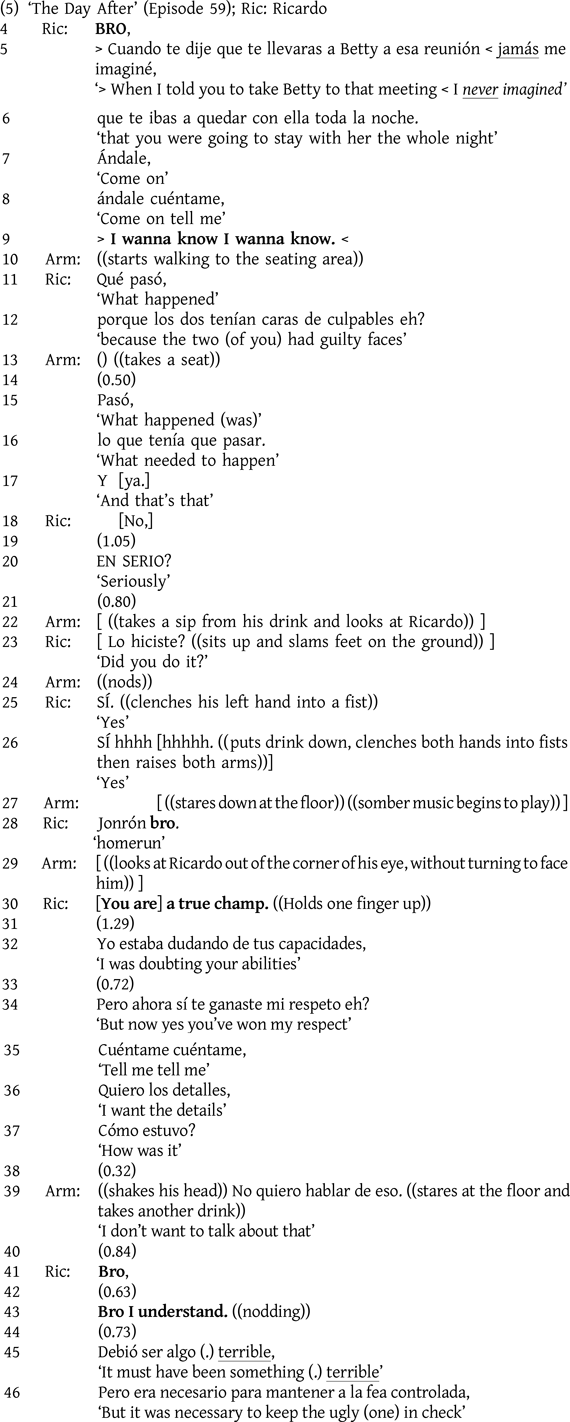
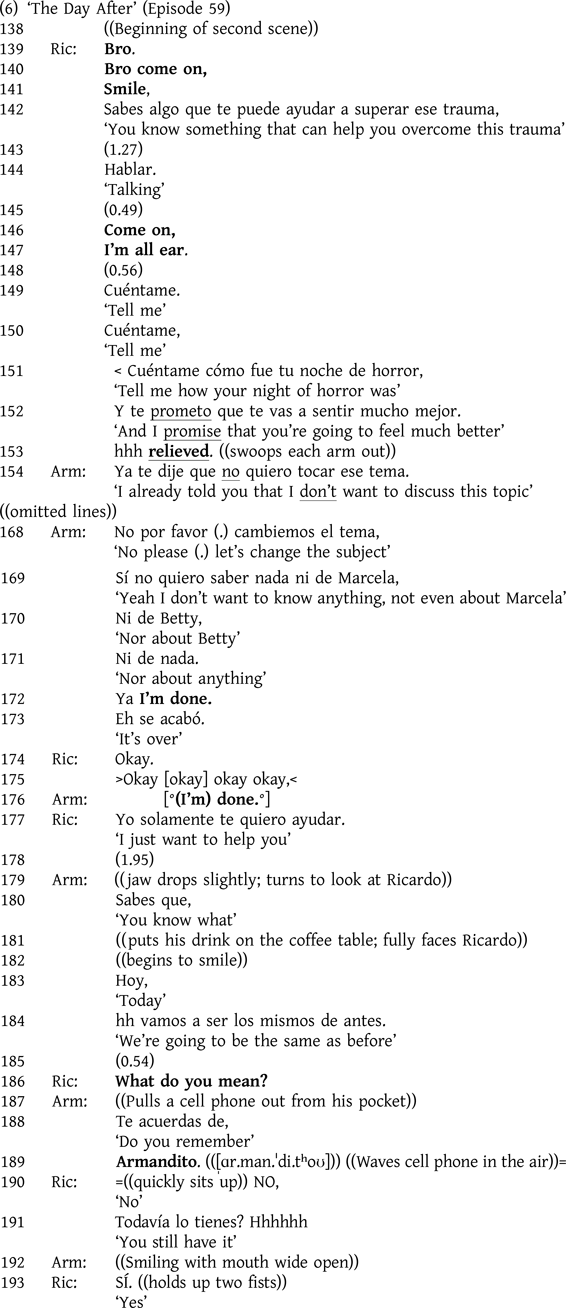
I now analyze a prolonged example in (5) and (6) of codeswitching, bringing together all the elements of recursive recalibration, to demonstrate how speakers seek to recalibrate social positionings over the course of an interaction. I use multiple stance objects as axes for positionings to track how these stances accumulate and result in recursive recalibration. In (5) and (6), the notion of broadening alignment manifests in how Ricardo (Aarón Díaz), Armando's best friend, persists in obtaining a particular reaction from Armando. What we find is that even in situations where participant roles seem more or less settled, codeswitching still functions as a powerful resource for stancetaking as characters continue to invoke their epistemic rights and dialogically construct alignment.
Excerpts (5) and (6) are longer than the previous examples because this example spans two scenes. Ricardo eagerly wants to know whether Armando and Betty slept together the night before. Previously, Ricardo had encouraged Armando to seduce Betty, convincing him that otherwise Nicolás would do so and take over the company. Up until this point, Armando had begrudgingly followed his advice and continued to consult Ricardo, but now a divide has begun to form as Armando copes with his growing sense of guilt coupled with his increasing affection for Betty. This interaction contains at least three key stance objects with regard to codeswitching. First, the principal stance object (SO1) is the embedded event, Armando and Betty's night in the cabin. Building on SO1, the other stance objects are Armando's sexual prowess (SO2) and his emotional orientation towards the event (SO3). I argue that Ricardo's evaluations and codeswitches work towards a singular overarching goal in this interaction—restoring his friendship with Armando (alignment), preferably as it used to be before Armando became president of V&M.
The interaction begins with Armando making himself a drink, while Ricardo lays back on a couch, drink in hand and legs propped up on a coffee table.

Much of this interaction is characterized by Armando's and Ricardo's differing perspectives on SO1, which consequently results in misalignments for SO2 and SO3. For Ricardo, SO1 is a newsworthy event, worth a thorough discussion, as evidenced by his many requests for details (e.g., lines 7–12, 35–37). Indeed, line 9—“I wanna know I wanna know”—functions as an upgraded evaluation of SO1 as newsworthy. Line 9 also upgrades the epistemic claim begun in line 8, in which Ricardo establishes his epistemic right to know the details of SO1. This claim is rooted in Ricardo's role as the orchestrator behind this scheme (line 5), but now that Armando has acted of his own accord and gone beyond Ricardo's expectations (lines 5–6), there seems to be an increased urgency to know what happened. Furthermore, Ricardo's epistemic rights to evaluate SO1–SO3 also stem from his role as Armando's best friend. The use of bro in line 4 and elsewhere reaffirm Ricardo's claim to their homosociality, their solidarity and heterosexual closeness (Kiesling Reference Kiesling2004, Reference Kiesling, Hall and Barrett2018). Armando, meanwhile, makes clear that he does not want to talk about SO1 (line 39). He explains that he slept with Betty only in vague terms (lines 15–17) or with no words at all (lines 23–24). He avoids facing Ricardo, staring at the ground instead. Nowhere is the stark contrast in gesture and affect more noticeable than when Armando confirms that they slept together (lines 23–27). While Ricardo gleefully yells and laughs, waving his arms in victory, Armando somberly stares at the ground.
Unfazed by Armando's bleak demeanor, Ricardo moves forward with an assessment of SO2. In lines 28–30, Ricardo uses sports metaphors to positively evaluate Armando's sexual prowess. The use of English here indexes a gendered masculine persona, perhaps tied to the US characterological figure of a bro through the use of brospeak (Kiesling Reference Kiesling, Hall and Barrett2018). In Kiesling's analysis of stance in enregistered speech styles, he argues that brospeak is characterized by a high degree of positive evaluative stances that serve to reinforce the solidarity among bros achieved through their homosocial closeness. Likewise, Ricardo recruits this masculine persona to upgrade his evaluation of SO2 in order to highlight his solidarity with Armando. Loaded with misogynistic undertones, Ricardo's positive evaluations in lines 28–30 position him as a ‘sport spectator’ evaluating an athlete. We see a continuation of this participant role in lines 32–34, as Ricardo admits to first doubting Armando's abilities to now Armando winning over his respect. However, Armando does not partake in Ricardo's excitement or accept his compliments. Armando's reticence results in Ricardo continuing to seek out alignment by enacting the same gendered persona.
Finally, Ricardo assumes he understands Armando's perspective with regards to SO3, Armando's emotional orientation to SO1. When Armando refuses to share details in line 39, Ricardo invokes his participant role as an empathetic friend who understands the ‘ordeal’ Armando has undergone. In line 43, nodding, Ricardo says, “Bro I understand”, and he then immediately presents the wrong evaluation of SO3. He assumes Armando had a “terrible” night (line 45), when quite the opposite is the case. Ricardo's attempt at solidarity and understanding as an empathetic friend continues into the next scene.

While Ricardo assumes only the worst about the previous night's events (line 142, 151), he expects a positive attitude from Armando in the present moment. The second scene begins with Ricardo urging Armando to “smile” (line 141), also analyzable as a negative evaluation of Armando's current emotional status. He repeatedly appeals to his role as a sympathetic friend (lines 146–147) to persuade Armando to talk. This culminates in line 153, in which Ricardo also uses codeswitching and gesture to upgrade the evaluation in line 152, emphasizing the emotional relief awaiting Armando if he speaks. However, they continue to be disaligned as Armando remains silent or reiterates that he does not want to speak (line 154).
The tension reaches its climax in the second half (line 168) when Armando firmly asserts these stance objects are no longer up for discussion (lines 168–173). The codeswitch in line 172 does not clearly indicate a new participant role but rather functions as a negative evaluation of the entire interaction, marking Armando's refusal to continue being questioned. Along with line 176, this is the only time Armando codeswitches in these scenes. Once Ricardo concedes, the conversation shifts as Armando takes up a new participant role. He decides to revert to his old ways and return to partying with Ricardo. This shift is confirmed in line 189, when he pulls out a cell phone he calls ‘Armandito’, the name itself a mix of Spanish and English phonology, which contains the numbers of many pretty women. Ricardo immediately understands the significance of the phone. At this point, Ricardo and Armando's intersubjective positions finally converge.
This final example in (5) and (6) showcases the interplay between stances, participant roles, and personae. Ricardo repeatedly invokes his epistemic rights through using codeswitching to take stances, a process closely tied to his bro persona construction as well as his participant roles as Armando's best friend and co-conspirator. The present analysis furthers our understanding of alignment by considering how speakers manage multiple stance objects simultaneously. By tracing Ricardo and Armando's convergence and divergence with respect to three stance objects, we can evaluate alignment at the interactional level, rather than confining it to the calibration of only two stances. In doing so, we can observe how the recalibration of stances and intersubjective alignments builds to the recalibration of interpersonal relationships.
I began with an example of Betty assessing a financial issue and concluded with Ricardo seeking alignment with Armando. While Betty and Ricardo are polar opposites as characters, enemies even, they both use codeswitching when their participant roles and epistemic rights are challenged as well as when they seek to recalibrate the alignment with their interlocuter. And yet, each is also using codeswitching to construct very different personae. While the underlying mechanisms regarding stancetaking may be the same, they are using codeswitching to take different types of stances, which with repetition, result in distinct personae. What this demonstrates is that the meaning of codeswitching is neither fixed nor static; the use of one language does not map onto a singular meaning. Betty and Ricardo each draw upon separate ideological associations already present in the indexical field of English, namely English as the language of finance and brospeak, to construct their respective personae. Thus, it is through this process of recursive recalibration that Betty en NY crafts a range of personae in opposition, who use the same linguistic strategy, codeswitching, to take stances and position themselves in the social landscape.
Conclusion
Codeswitching on Betty en NY brings a sparkling clarity to the processes underlying stancetaking because characters are actively exploiting—and thereby also constructing and enacting—the boundaries between named languages in order to achieve the recalibration work underway. As characters strategically use codeswitching to take stances, the sharp contrast in codes illustrates how specific acts of stance achieved through invoking epistemic rights connect to the recalibration of intersubjective alignments, participant roles, and personae. By recognizing the social significance and agentive potential of linguistic boundaries, the implications of the present analysis are not limited to codeswitching. Recursive recalibration is likely underway at other types of semiotically constructed boundaries, such as style-shifting between varieties of the same language (e.g. Sharma Reference Sharma2018), but this remains to be tested using naturally occuring data.
Betty en NY maximizes the distinctions produced through bilingual styles, crafting a range of characters and interactions that employ codeswitching. These varying scenarios are united through the processes underlying stancetaking and recursive recalibration. Characters may draw upon different facets of the indexical field, but they each use codeswitching to take stances, recalibrate interpersonal relationships, and perhaps also, change their place in the narrative.
Regarding stance, the main contributions of this article are twofold. First, I argue that the calibration of individual stances or intersubjective alignments (Du Bois Reference Du Bois2007) may result in the realignment of participant roles and personae—a process I call recursive recalibration. I expand upon the connections among the various levels of recursive recalibration by analyzing codeswitching as a resource for stancetaking. Codeswitching provides an interesting vantage point into the theoretical underpinnings of stance because in certain contexts, codeswitching may serve as a highly marked discourse strategy (Gardner-Chloros, Charles, & Cheshire Reference Gardner-Chloros, Charles and Cheshire2000; Smith-Christmas Reference Smith-Christmas, Auer, Reina and Kaufmann2013) with overt intersubjective properties, such as signaling the peak of an argumentative interaction (Cromdal Reference Cromdal2004) among other discourse-level uses (MacSwan Reference MacSwan, MacSwan and Faltis2019). In the context of Betty en NY, we see how the production team uses codeswitching to drive the narrative forward by highlighting the power dynamics and relationships among characters.
By thinking of stance in terms of recursive recalibration, we catch a glimpse of how personae are constructed in interaction and to what end. Particularly in the case of argumentative exchanges, we see how codeswitching can signal one's epistemic rights, thereby recalibrating the participant roles at play. Building on research regarding the accumulation of stances resulting in personae (Bucholtz & Hall Reference Bucholtz and Hall2005; Moore & Podesva Reference Moore and Podesva2009; Kiesling Reference Kiesling, Hall and Barrett2018), the scenes analyzed in Betty en NY demonstrate that personae also arise from interaction-specific goals. As these characters use codeswitching to take stances, they are also recalibrating personae. Since these personae are specified for certain epistemic rights, this recalibration in turn permits characters to expand the types of stances and participant roles they can take up. Thus, codeswitching to English enables Betty to make claims about finance, Patricia about fashion shows, Ricardo about Armando's love life, and so forth. These epistemic rights can be contested as alignment is dialogically constructed.
The second theoretical contribution regarding stance is developing the notion of alignment. Codeswitching does not categorically specify a certain type of alignment (e.g. (3) and (4)), nor is alignment a binary process (e.g. (5) and (6)). Rather, speakers can manage multiple stance objects at once, and consequently, speakers can converge and diverge in alignment along multiple axes. By tracking the stance objects at play, we can observe the changing social positionings of characters throughout an interaction. Alignment then is not confined to the calibration of two stance acts but instead may encompass an entire interaction. Together with recursive recalibration, this has important implications for future work on stance and alignment. Namely, alignment does not easily boil down to extracting and codifying stance acts as either aligned or disaligned. Instead, we must consider how alignment is being dialogically constructed across an interaction through each stance act and its interplay with other stance objects.
The leap from stance to personae through recursive recalibration also has ramifications for rethinking approaches to the social meaning of codeswitching. Recursive recalibration demonstrates that when speakers codeswitch, they are simultaneously engaged in multiple levels of stance. Therefore, the social meaning of codeswitching cannot be reduced to a singular meaning with a one-to-one correspondence with one language and a different meaning with the other. Applying the notion of personae to the study of codeswitching breaks the all-too-common monolithic treatment of bilingual speakers, who do not necessarily share the same interactional goals nor access to the same linguistic resources. Patricia and Betty use codeswitching to take stances, but the resulting personae are quite distinct since they are drawing upon different stylistic resources available across Spanish and English. In other words, it is not only that these characters can codeswitch but also how they codeswitch. For example, Ricardo recruits brospeak as part of his masculine persona, indexing coolness and invoking his homosocial closeness to Armando. These meanings, of course, are not solely indexed by language but also by the context, sartorial choices, camera framing, and even cues in the background music. By thinking of codeswitching in terms of personae, we see how codeswitching is involved in a larger meaning-making enterprise, that it is one more semiotic resource, albeit a critical one, in situating speakers in the social landscape.
Appendix: Transcription conventions
The transcription style below is adapted from C. Raymond (Reference Raymond2016), which follows the conventions laid out in Jefferson (Reference Jefferson and Lerner2004) and Hepburn & Bolden (Reference Hepburn, Bolden, Sidnell and Stivers2012).
- ?
fully rising terminal intonation
- ,
slightly rising ‘continuing’ terminal intonation
- .
fully falling terminal intonation
- [
overlapping talk (or other behavior) begins
- ]
overlapping talk (or other behavior) ends (if detectable)
- (0.5)
periods of silence, in seconds.
- (.)
micropause (i.e. a silence less than two-tenths of a second)
- :
lengthening of the segment just preceding, proportional to the number of colons
- wor-
abrupt cut off, usually a glottal stop
- word
stress or emphasis
- WORD
exceptionally loud speech relative to the surrounding talk
- °word°
speech lower in volume relative to the surrounding talk
- ↑word
marked pitch rise
- ↓word
marked pitch fall
- =
latching between lines or turn-constructional unites (i.e. no silence between them)
- <word
left push (i.e. the immediately following talk is ‘jump-started’)
- >word<
speech delivered faster than the surrounding talk
- <word>
speech delivered slower than the surrounding talk
- hh .hh
audible aspiration, proportional to the number of hs. If preceded by a period, the aspiration is an in-breath.
- ()
talk too obscure to transcribe. Words or letters inside such parentheses indicate a best estimate of what is being said.
- ((looks))
transcriptionist's comments (e.g. for nonvocal behavior)
- word
speech spoken in English



 Open access

