


Introduction
The phylum Annelida is a major metazoan clade comprising a vast diversity of species. Recent phylogenetic studies show that, apart from basal taxa that comprise a relatively low number of species, this phylum contains two main taxa: Errantia and Sedentaria (Kuo, Reference Kuo2017; Weigert and Bleidorn, Reference Weigert and Bleidorn2016). Polychaetes belonging to Errantia have great mobility due to their parapodia with chitinous chaetae that facilitate crawling and swimming. Additionally, these polychaetes developed several types of sense organs that help them orientate in the surrounding environment to search for food, evade predation, and locate potential partners (Purschke, Reference Purschke2005). According to the current cladistic perspective, Sedentaria is a very large and highly diversified annelid clade, encompassing not only polychaetes with low mobility that spend most of their lives in tubes built of cemented sand grains, but also the Clitellata (earthworms and leeches) (Kuo, Reference Kuo2017; Weigert and Bleidorn, Reference Weigert and Bleidorn2016).
The common ragworm Hediste diversicolor (Müller, 1776) is a well-known commercially important errant polychaete species belonging to the family Nereididae Blainville, 1818. It is a common infaunal species in shallow marine and estuarine sandy and muddy sediments throughout the European and North African Atlantic coastline, Baltic and Mediterranean Seas (Teixeira et al., Reference Teixeira, Bakken, Vieira, Langeneck, Sampieri, Kasapidis, Ravara, Nygren and Costa2022). It also occurs in the Atlantic coast of North America where it was introduced (Einfeldt et al., Reference Einfeldt, Doucet and Addison2014). This vast geographical distribution is allowed by the species tolerance to large variations in abiotic factors, such as temperature, salinity, and oxygen deficiency. This species occupies an important position in the trophic web and its burrowing activity improve sediment reworking and oxygenation (Fidalgo e Costa et al., Reference Costa, Sarda and da Fonseca1998; Gilbert et al., Reference Gilbert, Kristensen, Aller, Banta, Archambault, Belley, Bellucci, Calder, Cuny, Montaudouin, Eriksson, Forster, Gillet, Godbold, Glud, Gunnarsson, Hulth, Lindqvist, Maire, Michaud, Norling, Renz, Solan, Townsend, Volkenborn, Widdicombe and Stora2021; Scaps, Reference Scaps2002). The size of full-grown common ragworms vary in different populations, with a maximum length of about 11−16 cm recorded in several field studies, comprising up to 100–110 segments (Abrantes et al., Reference Abrantes, Pinto and Moreira1999; Clark and Scully, Reference Clark and Scully1964; Esselink and Zwarts, Reference Esselink and Zwarts1989; Kristensen, Reference Kristensen1984). The common ragworm is an omnivorous and opportunistic species with diverse feeding modes, such as filter-feeding, deposit feeding, scavenging and predation. Consequently, this polychaete has a wide diet range that includes detritus, bacteria and other microorganisms, macroalgae, salt marshes plants, small crustaceans and other invertebrates (Fidalgo e Costa et al., Reference Costa, Oliveira and da Fonseca2006; Jumars et al., Reference Jumars, Dorgan and Lindsay2015). In turn, it is preyed upon by crustaceans, birds, and fishes (Esselink and Zwarts, Reference Esselink and Zwarts1989; Scaps, Reference Scaps2002). Thus, H. diversicolor is commonly exploited as bait for both professional and recreational fishing, having economic value and potential for use as ingredient in aquaculture feeds (Carvalho et al., Reference Carvalho, Vaz, Sérgio and Santos2013; Pombo et al., Reference Pombo, Baptista, Granada, Ferreira, Gonçalves, Anjos, E, Chainho, Cancela da Fonseca, Costa and Costa2020).
In polychaetes, several sensory organs are located on the head (Fauchald and Rouse, Reference Fauchald and Rouse1997; Purschke, Reference Purschke2005). In H. diversicolor, as in other nereidids, the peristomium possesses four pairs of tentacular cirri, and the prostomium contains two pairs of eyes, a pair of palps and a pair of short antennae (Teixeira et al., Reference Teixeira, Bakken, Vieira, Langeneck, Sampieri, Kasapidis, Ravara, Nygren and Costa2022). Typical nereidid palps are tapered appendages constituted by two articles. The palpophore is the wider and longer basal article connected to the prostomium, followed by the thinner and shorter palpostyle that contains the majority of sensory cells. The palpostyle can be retracted into the palpophore, pulled back by muscle cells attached in a ring, forming the appearance of an articulation (Haper, Reference Harper1979; Fauchald and Rouse, Reference Fauchald and Rouse1997). These appendages are believed to have mainly a chemical sensory function (Dorsett and Hyde, Reference Dorsett and Hyde1969), and eventually in association with other sensory organs can be involved in food detection and predator avoidance (Schaum et al., Reference Schaum, Batty and Last2013). Among other features, palp morphology is important for species characterization and identification (Santos et al., Reference Santos, Pleijel, Lana and Rouse2005; Teixeira et al., Reference Teixeira, Bakken, Vieira, Langeneck, Sampieri, Kasapidis, Ravara, Nygren and Costa2022). However, few histological and ultrastructural studies concerning these appendages have been carried out in the family Nereididae and in the species H. diversicolor (Dorsett and Hyde, Reference Dorsett and Hyde1969). Thus, this study aimed to improve knowledge on palp histology and ultrastructure in H. diversicolor, subjects that were understudied in this species.
Material and methods
Animal collection
Specimens of the common ragworm H. diversicolor were collected from the lower estuary of the Minho River, near the locality Pedras Ruivas (41°53≺28.4”N, 8°49≺30.8”W), Caminha municipality, North Portugal, at low tide in February 2023. Sediment was collected manually in spots where borrows and bioturbation typical of H. diversicolor were observed. In the laboratory, small quantities of sediment were sequentially observed in a plastic tray containing estuary water (salinity 22–24) to isolate H. diversicolor individuals. Only adult specimens with more than 90 segments were selected for this study.
Sample processing for light and transmission electron microscopy
Adult specimens were processed according to Beckers et al. (Reference Beckers, Pein and Bartholomeus2021). Worms were relaxed in a solution prepared by mixing a 7% MgCl2 solution in ultrapure water 1:1 with estuary water. After about 10–15 min in the relaxation solution, palps were removed at the base of the palpophore using a scalpel, fixed with a 2.5% glutaraldehyde solution buffered in 0.2 M sodium cacodylate with 0.14 M NaCl (pH 7.2) at 4 °C for 1 h, and rinsed in the same buffer. Post-fixation was carried out with 2% OsO4 in the same buffer for 2 h. Samples were dehydrated in a graded ethanol series, followed by embedding in epoxy resin. For light microscopy observations, semithin sections (2 μm) were either stained with methylene blue-Azure II or processed for histochemical techniques. For transmission electron microscopy (TEM), ultrathin sections were double stained with uranyl acetate and lead citrate. For glycogen and collagen staining, ultrathin sections were treated with 5% tannic acid for 10 min and stained with uranyl acetate for 10 min (Sannes et al., Reference Sannes, Katsuyama and Spicer1978). Ultrastructural observations were performed using a JEOL 100 CXII TEM, operated at 60kV, equipped with a Gatan Orius SC200 camera.
Histochemical techniques
Histochemical techniques were applied to semithin sections. These included the tetrazonium coupling reaction for protein detection, periodic acid-Schiff (PAS) reaction for neutral polysaccharides, and Alcian blue stain for acid polysaccharides. For the tetrazonium coupling reaction, semithin sections were treated with a freshly prepared 0.2% solution of fast blue salt B in veronal-acetate buffer (pH 9.2) for 15 min, washed with 0.1% HCl followed by water, treated with a saturated solution of β-naphthol in veronal-acetate buffer (pH 9.2), and washed with water (Nöhammer, Reference Nöhammer1978). For PAS reaction and Alcian blue staining, the embedding medium was removed from semithin sections using an alcoholic solution of sodium ethoxide (Lane and Europa, Reference Lane and Europa1965). For PAS reaction, sections were treated with 1% periodic acid for 20 min, washed with water, and treated with Schiff reagent for 30 min before being washed with water. For Alcian blue staining, sections were stained with Alcian blue (pH 1.0 or 2.5) for 30 min and washed with water. All semithin sections were mounted using DPX medium.
Results
Morphology, histology, and histochemistry of the palps
Fresh palps exhibited a pale brown hue, with a hint of greenish colour at the base of the palpophore. Under the light microscope, yellowish-brown cells could be observed on both palpophore and palpostyle, being more abundant along the dorsal side of the palpophore, and in the area between the palpophore and the palpostyle (Figure 1A). The palps are covered by the cuticle, which was thicker on the palpophore than on the palpostyle (Figure 1B−D). In semithin sections, the cuticle was moderately stained by PAS reaction and Alcian blue at both pH 1 and 2.5 (Figure 1E, F), but was not stained by the tetrazonium coupling reaction. Some clusters of ciliated sensory cells were seen along the surface of the palpostyle. These ciliated cells extend to the palp interior where they connect to the palp nerve (Figure 1D).
Light microscopy of Hediste diversicolor palps, observed fresh (A) and in semithin sections stained with methylene blue and azure II (B−D, G), PAS reaction (E) and Alcian blue (F). (A) the palpophore and palpostyle contain yellowish-brown cells (arrowheads). (B) Palp in longitudinal section. The dashed line indicates the section plan observed in C, and the box corresponds to the area in D. (C) Transverse section of the palpophore. Cells with unstained multivesicular vesicles (mv) are abundant in this region. Eleocytes (el) and small coelomocytes (arrowheads) are present in the coelomic cavity. The box corresponds to the area in G. (D) Cluster of ciliated sensory cells (arrows) of the palpostyle. (E) Cuticle stained by PAS reaction. (F) Cuticle moderately stained by Alcian blue. (G) Palpophore tissues include cells with unstained multivesicular vesicles (mv) and cells with lightly stained vesicles (asterisk). the eleocyte (el) in the coelomic cavity (cc) contains several osmiophilic lipid droplets (arrowheads). cc, coelomic cavity; cu, cuticle; el, eleocytes; mv, cells with multivesicular vesicles; mu, muscle tissue; pn, main palp nerve; pp, palpophore; ps, palpostyle.

Diverse secretory cell types occur in the palpophore. The most abundant were the cells with multivesicular vesicles that were not stained by methylene blue and azure II (Figure 1C, G). The multivesicular vesicles of these cells were also unstained by the tetrazonium coupling reaction for proteins (Figure 2A, B), but were stained by Alcian blue at both pH values (Figure 2C), and very weakly stained by PAS reaction (Figure 2D). However, the cytoplasm around the multivesicular vesicles was stained by the tetrazonium coupling reaction (Figure 2A). Other cells contained vesicles that were lightly stained by methylene blue and azure II (Figure 1G), and very weakly stained by the tetrazonium coupling reaction and Alcian blue (Figure 2B, C). The vesicles of these cells seem to be partially fused. The light microscopy technique for protein detection revealed another cell type characterised by very small vesicles strongly stained by this reaction (Figure 2A). The coelom cavity housed small, rounded coelomocytes, about 7−9 µm in diameter, forming rosettes, and eleocytes with an irregular and variable shape, reaching 20−30 µm in length, containing some osmiophilic lipid droplets (Figure 1C, G). The cytoplasm of the eleocytes stained with Alcian blue and PAS reaction, except the lipid droplets (Figure 2C, D). In the central region of the palpophore, a ring of muscle cells responsible for the retraction of the palpostyle encircled the main palp nerve (Figure 1C).
Histochemistry of Hediste diversicolor palps in semithin sections. (A) The tetrazonium coupling reaction does not stain the vesicles of the cells with multivesicular vesicles (mv), but another cell type contains small vesicles that are strongly stained (arrowheads). The cytoplasm of the different cell types is moderately stained. (B) Cells with vesicles very weakly stained by the tetrazonium coupling reaction, which seem to be partially fused (asterisks). (C) Alcian blue stains the cells with multivesicular vesicles (mv) and eleocytes (el). Other secretory cell types are very weakly stained (asterisk) and the cuticle (cu) is moderately stained. (D) PAS reaction stains the eleocytes (el), but the cells with multivesicular vesicles (mv) are very weakly stained. cc, coelom cavity; co, coelomocytes; cu, cuticle; el, eleocytes; mv, cells with multivesicular vesicles; mu, muscle tissue.

Palp ultrastructure
Ultrastructural analysis evidenced the difference in cuticle thickness between the palpophore and the palpostyle previously noticed in light microscopy observations. In the palpophore, the cuticle, with a total thickness of around 4.5 µm, comprised a main portion consisting of roughly 26–30 layers of collagen fibres covered by an epicuticle about 0.6–0.8 µm thick, with deep pits containing secretion. The collagen fibres were surrounded by a matrix containing electron-dense filaments that also formed a layer with few and thin collagen fibres at the base of the cuticle (Figure 3A, B). Collagen fibres were absent in the epicuticle, which was coated by an electron-dense layer with an approximate thickness of 40 nm. Although electron-lucent in ultrathin sections stained with uranyl acetate and lead citrate (Figure 3A, B), the collagen fibres became strongly stained by uranyl acetate after treatment with tannic acid (Figure 3C). In each layer, the collagen fibres had a parallel orientation, being practically orthogonal in relation to the layer above and below. It was also noticed that the width of collagen fibres was higher in the middle of the cuticle and smaller at the top and basal layers. The thinnest fibres, about 20−25 nm thick, were found in the layers close to the epidermis, whereas the thicker fibres in the middle layers of the cuticle could reached a thickness of 180 nm. Below the epicuticle, the thickness of the collagen fibres was reduced to 40–80 nm. The epidermal cells contained large vesicles in the apical region (Figure 3A, B), in which the tannic acid-uranyl acetate staining revealed the presence of collagen fibres (Figure 3D). The images also suggested that the fusion of these vesicles with the cell membrane releases collagen fibres into the subcuticular space to be incorporated in the cuticle. Adjacent epidermal cells were connected by zonula adherens, septate junctions, and cell junctions reminiscent of desmosomes. These cells also contained bundles of filaments and formed thin microvilli that crossed the cuticle ending at the bottom of the epicuticular pits (Figure 3B).
Ultrastructure of the cuticle and epidermis of Hediste diversicolor palpophore. (A, B) The cuticle (cu) comprises a main portion with several layers of collagen fibres (cf), the epicuticle (ec), and a basal layer mainly formed by electron-dense filaments (arrowheads). epidermal cells (ep) possess large apical vesicles (ve) and long microvilli (arrows) that cross the cuticle. A subcuticular space (asterisks) is visible between the cell membrane of epidermal cells and the cuticle. (C, D) Cuticular collagen fibres (cf) are strongly marked by tannic acid-uranyl acetate staining, revealing very thin fibres (arrowheads) close to the epidermis (ep). stained collagen fibres (arrows) are also visible within apical vesicles (ve) of the epidermal cells. cf, collagen fibres; cu, cuticle; ec, epicuticle; ep, epidermal cells; mi, microvilli; ve, vesicles.

In the palpostyle, the cuticle presented a similar structure but was thinner, especially over the ciliated sensory cells where the total thickness was about 0.8 µm (Figure 4A, B), whereas in other parts of the palpostyle the cuticle could reached a thickness of approximately 1.2 µm (Figure 4C). Digitiform epicuticular projections were observed only around the cilia of sensory cells, and the thin electron-dense coat of the epicuticle also coated the cilia (Figure 4A, B). At high magnification, tubular structures with a width of about 15 nm were observed in the epicuticle, some perpendicularly attached to the epicuticular electron-dense coat (Figure 4D). In the apical region, the ciliated sensory cells contained several microtubules and small vesicles (Figure 4A).
Ultrastructure of cuticle and sensory cells of Hediste diversicolor palpostyle. (A, B) The cuticle (cu) above ciliated sensory cells is thinner and displays epicuticular projections (arrows) coated by an electron-dense layer (arrowheads) that also coats the cilia (ci). Sensory cells contain several vesicles in the apical region. (C, D) Palpostyle cuticle contained only a few layers of collagen fibres (cf) covered by the epicuticle (ec). The latter contained tubular structures (arrowheads), and was coated by an electron-dense layer (arrows). cf, collagen fibres; ci, cilium; cu, cuticle; ec, epicuticle; mi, microvilli; sc, sensory cells.

Several types of secretory cells were observed in the palpophore, which could be differentiated based on their ultrastructural features. One of these cell types was characterised by the presence of multivesicular vesicles, most of which measuring around 1.5–2.5 μm in diameter, filled with small vesicles with low electron-density content and about 0.1–0.3 μm in diameter. In these cells, the multivesicular vesicles occupied a large portion of the cytoplasm, which also contained large amounts of flattened rough endoplasmic reticulum cisternae (Figure 5A, B). The portion of these cells that stained with the tetrazonium coupling reaction (Figure 2A) probably correspond to these cytoplasmic regions with large amounts of rough endoplasmic reticulum cisternae. Another cell type displayed round vesicles with electron-dense spots (Figure 5C, D). In these cells, rough endoplasmic reticulum cisternae with flocculent material were abundant, and some of these cisternae presented dilated portions. The images suggested a gradual condensation of the larger vesicles with flocculent material to form smaller and more electron-dense mature secretory vesicles about 0.3–0.6 μm in diameter (Figure 5C, D). Some mitochondria could be observed close to the nucleus (Figure 5C). These cells probably correspond to the cells whit small vesicles strongly stained by the tetrazonium coupling reaction in semithin sections (Figure 2A).
Ultrastructure of secretory cells from the palps of Hediste diversicolor. (A, B) Cells with multivesicular vesicles (asterisks) in which the outer vesicle membrane (arrowheads) surrounds a group of inner vesicles (iv). (C, D) Cells with spotted vesicles. Mature secretory vesicles with higher electron-density (ve) seem to result from the gradual condensation of immature vesicles with flocculent material (asterisks). iv, inner vesicles; mt, mitochondria; nu, nucleus; rer, rough endoplasmic reticulum; ve, secretory vesicles.

Other cells contained highly electron-dense elongated secretory vesicles with round or oval cross sections usually about 0.3−0.6 μm in diameter, some of which reaching a length of 2.5 μm in ultrathin sections. In these cells, several Golgi stacks could be identified, as well as numerous rough endoplasmic reticulum cisternae. Large vesicles with flocculent material found close to the Golgi stacks seemed to be immature secretory vesicles (Figure 6A, B). Another cell type was characterised by rounded vesicles with fine granular content, and a diameter of about 0.5−0.9 μm. These cells also had a large amount of densely packed dilated rough endoplasmic reticulum cisternae with a granular content (Figure 6C, D). These two cell types were not identified in semithin sections. The last secretory cell type recognised by TEM enclosed numerous secretory vesicles of variable sizes with median electron-density, and that showed tendency to fuse with each other. These cells presented less rough endoplasmic reticulum cisternae and were richer in Golgi stacks with flattened cisternae that produced immature secretory vesicles (Figure 7A, B). This last cell type seems to correspond to the cells with vesicles lightly stained by methylene blue and azure II (Figure 1G), and very weakly stained by the tetrazonium coupling reaction in semithin sections (Figure 2B).
Ultrastructure of secretory cells from the palps of Hediste diversicolor. (A, B) Cells with highly electron-dense vesicles (ve), some of which elongated. immature vesicles (asterisks) can be seen close to Golgi stacks (gs). (C, D) In another cell type, vesicles have a fine granular content (ve) that is also visible within the rough endoplasmic reticulum cisternae (rer). gs, golgi stacks; nu, nucleus; rer, rough endoplasmic reticulum; ve, secretory vesicles.

Ultrastructure of secretory cells, coelomocytes, and reserve cells from the palps of Hediste diversicolor. (A, B) The cells with fusing secretory vesicles (ve) presented less rough endoplasmic reticulum cisternae and were richer in Golgi stacks (gs). (C) Coelomocytes containing electron-dense and electron-lucent vesicles forming a rosette in the celomic cavity (cc). (D) Eleocyte filled with glycogen granules (asterisks), and with lipid reserves (li); tannic acid-uranyl acetate staining. ve, secretory vesicles; gs, golgi stacks; cc, celomic cavity; li, lipid reserves; gs, golgi stacks; nu, nucleus.

Two types of coelomocytes could be recognised in the celomic cavity of the palps. The small coelomocytes presented a roughly round or oval shape and formed pseudopodia. The central region of these cells contained the nucleus, a few small mitochondria, rough endoplasmic reticulum cisternae, cisternae with smooth membrane, and many electron-dense and electron-lucent vesicles. A thin peripheral layer of cytoplasm was almost devoid of organelles. The small coelomocytes were frequently seen forming rosette aggregates (Figure 7C). Other coelomocytes, which were much larger and irregular in shape, had their cytoplasm almost entirely filled by glycogen granules. Additionally, some osmiophilic lipidic droplets were also present (Figure 7D). These large coelomocytes were identified as eleocytes, which were stained by Alcian blue and PAS reaction in semithin sections (Figure 2C, D).
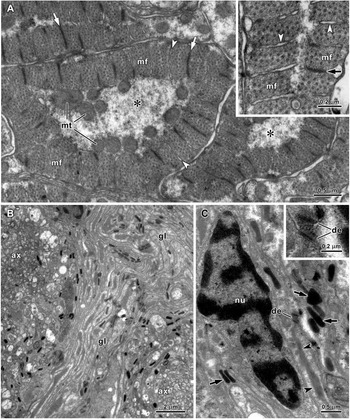
More internally, muscle fibres surrounded the central palp nerve. These cells exhibited arrays of myofilaments at the periphery, and the central region contained the nucleus, several mitochondria and glycogen deposits (Figure 8A). The main palp nerve consisted of numerous axons with small mitochondria and vesicles, and glia cells with thin cytoplasmic processes (Figure 8B). Glia cells and their cytoplasmic processes contained several flattened electron-dense gliosomes and bundles of filaments connected to the desmosomes attaching these cells (Figure 8C).
Ultrastructure of muscle fibres and main nerve in the palps of Hediste diversicolor. (A) Transverse sections of muscle cells. Electron-dense z bars (arrows) and sarcoplasmic reticulum tubules (arrowheads) are visible between the myofilaments (mf) at the cell periphery. The central region contains mitochondria (mt) and glycogen deposits (asterisks). (B) Ultrathin section of the main palp nerve showing numerous axons (ax) and glia cells (gl). (C) Glia cells contain bundles of filaments (arrowheads) and gliosomes (arrows) in their fine cellular processes. ax, axons; de, desmosome; gl, glia cell processes; mf, myofilaments; mt, mitochondria; nu, nucleus.

Discussion
The common ragworm H. diversicolor is among the most abundant species of the macrobenthic community in several estuaries (Gillet et al., Reference Gillet, Mouloud, Durou and Deutsch2008; Kristensen, Reference Kristensen1984; Nithart, Reference Nithart1998), including the Minho River estuary where the specimens used in this study were collected (Picanço et al., Reference Picanço, Almeida, Antunes and Reis2014). For this polychaete, and others in general, palps and other sensory organs are crucial for survival. Due to the large diversity of species, the external morphology and internal anatomy of palps varies greatly among polychaetes. The grooved feeding palps, found in Spionida, Sabellida, and other sedentary polychaetes, are appendages with a longitudinal ciliated groove for gathering and conveying food particles to the mouth, but also have sensory functions (Fauchald and Rouse, Reference Fauchald and Rouse1997; Lindsay et al., Reference Lindsay, Tj and Forest2004; Meyer et al., Reference Meyer, André and Purschke2021). The elongated prostomial appendages of Protodriliformia errant polychaetes, which have been considered to be palps based on their specific innervation, possess a variety of sensory cells and, at least in several species, appear to not be involved in the collection of food particles (Lehmacher et al., Reference Lehmacher, Fiege and Purschke2014; Purschke, Reference Purschke1993; Wilkens and Purschke, Reference Wilkens and Purschke2009). The ventral sensory palps, like those of Nereididae and many other errant polychaetes, are usually tapered or digitiform and relatively short compared to the grooved palps (Fauchald and Rouse, Reference Fauchald and Rouse1997). However, so far only a limited number of studies were dedicated to the ultrastructure of these appendages, and these were mainly focused on sensory cells and nerves (Dorsett and Hyde, Reference Dorsett and Hyde1969; Forest and Lindsay, Reference Forest and Lindsay2008; Lindsay et al., Reference Lindsay, Tj and Forest2004; Meyer et al., Reference Meyer, André and Purschke2021; Purschke, Reference Purschke1993), with little information being available on other cell types.
In annelids, the cuticle functions as a strong yet flexible exoskeleton. The thickness and architecture of the annelid cuticle is very variable, with some relationship to species size and lifestyle. A nearly orthogonal grid of collagen fibre layers is the main structural component of the cuticle in many polychaetes. However, the cuticle of very small polychaetes of the interstitial fauna may lack collagen fibres or have them irregularly arranged. Collagen fibres are also absent in the thin cuticle of tubicolous polychaetes of the families Sabellidae and Serpulidae, among others (Hausen, Reference Hausen2005; Meyer et al., Reference Meyer, André and Purschke2021; Westheide and Rieger, Reference Westheide and Rieger1978). In the large errant polychaete Alitta vires (formerly Nereis virens), which can reach 30 cm in length (Simonsen et al., Reference Simonsen, Pedersen, Jensen, Elberling and Bach2019), the body cuticle has approximately 40 layers of collagen fibres and can attain a thickness of 10 µm (Murray et al., Reference Murray, Tanzer and Cooke1981). In H. diversicolor, which is a smaller errant polychaete, the cuticle has the same structure as in A. vires, but with a lower number of collagen fibre layers and less thickness (Pilato and La Rosa, Reference Pilato and La Rosa1992). Nonetheless, cuticle thickness and number of collagen fibres layers is not the same in all parts of the annelid body. In the anterior segments of H. diversicolor, the dorsal cuticle is 5−6 µm thick with 33 collagen layers, and the ventral cuticle 6−6.5 µm thick with 38 collagen layers. In posterior segments, the cuticle is only about 2.5 µm thick, with 17−20 collagen layers (Pilato and La Rosa, Reference Pilato and La Rosa1992). In the palpophore of H. diversicolor, the cuticle is thinner than in the anterior segments (approximately 4.5 µm) and has a higher number of collagen fibres layers (26−30) than the 15 layers previously reported in the palps of this species (Dorsett and Hyde, Reference Dorsett and Hyde1969).
In the palps of H. diversicolor, collagen fibres are thinner at the basal and top layers of the cuticle and ticker in the central region. This variation in the diameter of collagen fibres was also noticed in the body cuticle of H. diversicolor (Pilato and La Rosa, Reference Pilato and La Rosa1992), as well as in other polychaetes (Lepescheux, Reference Lepescheux1988; Murray et al., Reference Murray, Tanzer and Cooke1981). However, fibre cross sections in H. diversicolor palpophore and body cuticle (Pilato and La Rosa, Reference Pilato and La Rosa1992) have a lesser diameter than in A. virens, in which the thicker fibres in the middle layers of the cuticle have a diameter of 250−300 nm (Murray et al., Reference Murray, Tanzer and Cooke1981). The fibres of the cuticle of annelids are formed by collagens molecules that differ from other collagen types, lacking the banded pattern typical of connective tissue collagens (Hausen, Reference Hausen2005; Murray et al., Reference Murray, Tanzer and Cooke1981). In H. diversicolor, as in other annelids, cuticle staining by Alcian blue and PAS reaction can be mainly attributed to neutral polysaccharide and acid mucopolysaccharide components of the matrix surrounding collagen fibres. Nevertheless, some degree of staining can be due to sugars linked to collagen molecules (Hausen, Reference Hausen2005; Welsch and Storch, Reference Welsch and Storch1986).
Our observations of H. diversicolor palps revealed a marked difference in cuticle thickness between the palpophore and the palpostyle. This difference was mainly due to a substantial reduction in the number of collagen fibre layers in the palpostyle, an aspect that may be relevant to enhance the sensitivity of the palpostyle. The epicuticular digitiform projections that were only seen around the cilia of sensory cells may also contribute to the sensory functions of the palps, or just be involved in the protection of the sensory cilia (Dorsett and Hyde, Reference Dorsett and Hyde1969). A filamentous and fine granular structure has been described from the epicuticle of different annelids (Dorsett and Hyde, Reference Dorsett and Hyde1969; Gustavsson and Erséus, Reference Gustavsson and Erséus2000; Hausen, Reference Hausen2005). However, in favourable ultrathin sections of H. diversicolor palps, at high magnification it was possible to see numerous thin tubular structures not previously reported in the epicuticle of annelids.
The use of tannic acid-uranyl acetate staining for visualization of glycogen and collagen by TEM (Afzelius, Reference Afzelius1992) was useful to highlight the thin collagen fibres located at the base of the cuticle and inside the vesicles of epidermal cells, which were much less evident in ultrathin sections stained by uranyl acetate and lead citrate. Epidermal cells are involved in the formation of the cuticle (Bartolomaeus, Reference Bartolomaeus1992). In the palps of H. diversicolor, the detection of collagen fibres inside large vesicles of epidermal cells indicates that segments of collagen fibres are assembled within epidermal cells prior to being released by exocytosis into the subcuticular space. The epidermal cells of H. diversicolor and other annelids possess numerous microvilli that cross the cuticle and may be involved in the uptake of small organic molecules, such as amino acids, from the interstitial water of the sediments (Westheide and Rieger, Reference Westheide and Rieger1978). Another feature of annelid epidermal cells are the filament bundles characteristic of cells that need to withstand mechanical forces (Bartolomaeus, Reference Bartolomaeus1992; Hausen, Reference Hausen2005).
Several types of secretory cells have been identified in the integument of polychaetes (Gardiner, Reference Gardiner, Harrison and Gardiner1992; Hausen, Reference Hausen2005). Many years ago, Dorsett and Hyde (Reference Dorsett and Hyde1970a, Dorsett and Hyde, Reference Dorsett and Hyde1970b) described six types of secretory cells in the integument of A. virens and H. diversicolor, without mentioning any differences between the secretory cells of these two species that were both formerly included in the genus Nereis. In our study, only five types of secretory cells could be clearly recognised by TEM in the palps of H. diversicolor, distinguished mainly by the ultrastructural features of their secretory vesicles, not all of them corresponding to the cell types described by Dorsett and Hyde (Dorsett and Hyde, Reference Dorsett and Hyde1970a, Reference Dorsett and Hyde1970b). The most abundant secretory cells observed in our study were those with multivesicular vesicles. Considering their ultrastructural aspects, these cells seem to correspond to the type 5 cells described by Dorsett and Hyde (Reference Dorsett and Hyde1970b). According to these authors, these cells were stained by PAS reaction but not by Alcian blue (Dorsett and Hyde, Reference Dorsett and Hyde1970b). However, according to our results, the cells with multivesicular vesicles stain with Alcian blue and only weakly with the PAS reaction, indicating that they secrete acid mucopolysaccharides. The type 6 cells reported by Dorsett and Hyde (Reference Dorsett and Hyde1970b) also seem to contain multivesicular vesicles, but with inner vesicles having higher electron-density. The cells with spotted vesicles were designated as type 1 by Dorsett and Hyde (Reference Dorsett and Hyde1970a), and our results with the tetrazonium coupling reaction clearly show that these are protein-secreting cells. In spite of some differences in light microscopy staining, Dorsett and Hyde (Reference Dorsett and Hyde1970a) have not found significant ultrastructural differences between cell types 1 a 3, and considered these as variants of the same cell type.
The cells displaying abundant flat rough endoplasmic reticulum cisternae and elongated high electron-density vesicles are also most likely protein-secreting cells, as suggested by these ultrastructural features. However, this cell type was not identified in the semithin sections, and do not seem to correspond to any of the secretory cell types described by Dorsett and Hyde (Dorsett and Hyde, Reference Dorsett and Hyde1970a, Reference Dorsett and Hyde1970b). The other two cell types found in the palps of H. diversicolor present ultrastructural features of mucus-secreting cells, namely, secretory vesicles with lower electron-density, dilated rough endoplasmic reticulum cisternae and many Golgi stacks (Tandler, Reference Tandler1993). The ones containing dilated rough endoplasmic reticulum cisternae with flocculent material, and vesicles with fine granular content that did not fuse together, seem to correspond to the type 2 cells described by Dorsett and Hyde (Reference Dorsett and Hyde1970a). We could not clearly identify these cells in semithin sections, and according to Dorsett and Hyde (Reference Dorsett and Hyde1970a), they do not stain neither with Alcian blue nor with the PAS reaction. The last cell type, characterised by fusing vesicles with median electron-density, could correspond of the type 4 cells described by Dorsett and Hyde (Reference Dorsett and Hyde1970b). In our observations these cells contain several Golgi stacks and not many endoplasmic reticulum cisternae, while in the type 4 cells of Dorsett and Hyde (Reference Dorsett and Hyde1970b), endoplasmic reticulum cisternae seem much more abundant. However, these differences could result from the observation of cells at different stages of activity.
Coelomocytes of annelids are involved in defence against infections and parasites (Adamowicz, Reference Adamowicz2005; Porchet-Henneré and M’Berri, Reference Porchet-Henneré and M’Berri1987). The smaller coelomocytes found in the celomic cavity of H. diversicolor palps can be classified as granulocytes because they contain numerous membrane-delimited electron-dense granules (Baskin, Reference Baskin, Hanna and Cooper1974; Dhainaut, Reference Dhainaut1984). However, these cells formed pseudopods and were seen in aggregations, which are features more typical of amoebocytes in other annelids (Adamowicz, Reference Adamowicz2005). The large coelomocytes found in the celomic cavity of H. diversicolor palps have features typical of eleocytes, namely, large size, paucity of cytoplasmic organelles and abundance of glycogen and lipid reserves (Adamowicz, Reference Adamowicz2005; Dhainaut, Reference Dhainaut1984). On the other hand, the large acidic vacuole also typical of eleocytes (Baskin, Reference Baskin, Hanna and Cooper1974; Dhainaut, Reference Dhainaut1984; Hoeger et al., Reference Hoeger, Dunn and Märker1995) was not observed in the eleocytes found in the palps of H. diversicolor. Eleocytes seem to be multifunctional, not only operating as a reserve cell with very large amounts of glycogen and lipids, but also being capable of phagocytosis and vitellogenin production in females, naturally presenting different ultrastructural aspects according to the functions in which they are involved (Baskin, Reference Baskin, Hanna and Cooper1974; Bonnier et al., Reference Bonnier, Porchet-Hennere and Baert1991).
The main nerve that occupies the central region of the palps comprises numerous axons and supportive glia cells. The nervous system of nereidid polychaetes is rich in glial cells with extensive cytoplasmic processes containing bundles of filaments attached to the numerous desmosomes that link these cells (Baskin, Reference Baskin1971). The electron-dense vesicles of glial cells, known as gliosomes, which are abundant in the main nerve of H. diversicolor palps, have important physiological roles in the nervous tissues of other animals (Milanese et al., Reference Milanese, Bonifacino, Zappettini, Usai, Tacchetti, Nobile and Bonanno2009) and, therefore, will expectedly be important also in the nervous system of annelids.
This study offers a comprehensive view of the tissues that constitute the palps of H. diversicolor, covering the epidermis and cuticle, secretory cells, coelomocytes, muscle, and nerve tissue, providing new information about these sense organs of an errant polychaete species that has great relevance in European estuarine ecosystems.
Acknowledgements
The authors thank Ângela Alves for her excellent technical support.
Author contributions
JA: specimen collection, microscopy studies and writing; ALC: microscopy studies and writing; DAC: research conception, specimen collection and manuscript revision; CA: manuscript revision; SR: microscopy studies and manuscript revision. All authors reviewed and approved the manuscript.
Funding
This research was supported by national funds through FCT – Foundation for Science and Technology, within the scope of the employment contract 2022.06670.CEECIND, and by funds from the School of Medicine and Biomedical Sciences (ICBAS), University of Porto, Portugal.
Competing interests
The authors declare none.



 Open access

