




Introduction
The Canadian healthcare system is facing the concurrent trends of an aging population and physician shortages. The increasing needs of an aging population and reduced working hours have resulted in persistent challenges associated with physician shortages and prolonged wait times (Islam et al., Reference Islam, Kralj and Sweetman2023). These changes disproportionately impact older adults, who are among the highest users of the healthcare system due to the prevalence of chronic conditions. Canada has fewer than 400 geriatricians for the over 7 million people aged 65 or older (Basu et al., Reference Basu, Cooper, Kay, Hogan, Morais, Molnar, Lam and Borrie2021). This shortage, which was further exacerbated by the COVID-19 pandemic (Malagón et al., Reference Malagón, Yong, Tope, Miller and Franco2022; Ontario Medical Association, 2021), means that most older Canadians will rely on their primary care provider (PCP) to manage their healthcare needs, even as their needs become more complex (Cooper et al., Reference Cooper, Edwards, Williams, Evans, Avery, Hibbert, Makeham, Sheikh, Donaldson and Carson-Stevens2017). Although primary care has been identified as a patient’s ‘medical home’ (Gutkin, Reference Gutkin2011; Lemire, Reference Lemire2019), the way in which primary care is funded and managed does not always allow for the proper assessment, treatment, and management of patients with complex care needs (Elliott et al., Reference Elliott, Stolee, Boscart, Giangregorio and Heckman2018; Frank & Wilson, Reference Frank and Wilson2015; Tracy et al., Reference Tracy, Bell, Nickell, Charles and Upshur2013). Canadian PCPs ranked the lowest among 10 Commonwealth countries in their preparedness to care for patients with complex needs (Osborn et al., Reference Osborn, Moulds, Schneider, Doty, Squires and Sarnak2015), putting older adults at increased risk for adverse events (Nothelle et al., Reference Nothelle, Colburn and Boyd2021). Understanding the characteristics of older patients in primary care is important to develop appropriate and targeted programs (Stolee et al., Reference Stolee, Elliott, Giguere, Mallinson, Rockwood, Sims Gould, Baker, Boscart, Burns, Byrne, Carson, Cook, Costa, Giosa, Grindrod, Hajizadeh, Hanson, Hastings, Heckman and Witteman2021). In this paper, we describe the characteristics of older adults accessing primary care in three Canadian provinces.
Methods
Setting and study design
Our study was conducted in nine primary care sites, two in Alberta, three in Ontario, and four in Quebec. All clinics operate under a ‘team’ model, with multiple PCPs (general practitioners, nurse practitioners), nurses (RNs, RPNs), allied health (physiotherapists, occupational therapists, social workers, dietitians), and administrative staff. Quebec clinics serve predominantly French-speaking patients; the other two provinces serve predominantly English-speaking patients. Clinics were in both urban and rural settings. This study received ethics clearance from Research Ethics Boards in all three provinces.
Survey data were collected in late 2018 and early 2019 prior to the COVID-19 pandemic. These data represent the baseline data for a primary care intervention (Stolee et al., Reference Stolee, Elliott, Giguere, Mallinson, Rockwood, Sims Gould, Baker, Boscart, Burns, Byrne, Carson, Cook, Costa, Giosa, Grindrod, Hajizadeh, Hanson, Hastings, Heckman and Witteman2021) later canceled due to the pandemic.
Recruitment
Eligible participants were patients aged 70+, able to provide informed consent, and able to complete the data collection in English or French. Patients living in long-term care homes and those rostered for less than 6 months were excluded. Recruitment was governed by REB requirements in each province. In the Alberta and Ontario study sites, patients were approached by their health care provider to participate in the study during appointments; in Quebec, clinical staff at the front desk distributed printed invitations that directed interested patients to a research team member located in a clinic office. Recruited patients included those participating in clinic programs that served our target population (e.g., blood pressure clinics offered on-site).
Data collection and measures
Participants were asked to complete a survey package comprising demographics, health system usage over the previous 3 months, self-rated health and presence of chronic conditions, and a quality-of-life measure, the EuroQol - 5 Dimensions - 5 Levels (EQ-5D-5L) (Herdman et al., Reference Herdman, Gudex, Lloyd, Janssen, Kind, Parkin, Bonsel and Badia2011). Data collection was completed in person, with members of the research team assisting as needed (e.g., reading questions aloud as requested).
EQ-5D-5L
The EQ-5D-5L describes the health of individuals using five dimensions: mobility (MO), self-care (SC), usual activities (UA), pain/discomfort (PD), and anxiety/depression (AD). Questions have five levels of response (no problems, slight problems, moderate problems, severe problems, extreme problems) (Herdman et al., Reference Herdman, Gudex, Lloyd, Janssen, Kind, Parkin, Bonsel and Badia2011). The EQ-5D-5L includes a visual analog scale (EQ VAS) on which participants rate their health on a vertical scale ranging from 0 (‘worst imaginable health state’) to 100 (‘best imaginable health state’). Additionally, the scores on the EQ-5D-5L were used to calculate a time trade-off value. The time trade-off (TTO) method in the EQ-5D-5L is a valuation technique used to assign utility scores to health states, reflecting societal preferences for quality of life for a particular population. For the Canadian population, the health utilities range from −0.148 for the worst (55555) to 0.949 for the best (11111) EQ-5D-5L states (Xie et al., Reference Xie, Pullenayegum, Gaebel, Bansback, Bryan, Ohinmaa and Johnson2016).
Frailty index calculation
Frailty was assessed using a deficit accumulation frailty index (FI; Rockwood & Mitnitski, Reference Rockwood and Mitnitski2007) constructed using a total of 23 health deficit variables (Supplementary Appendix 1) following the method of Searle et al. (Reference Searle, Mitnitski, Gahbauer, Gill and Rockwood2008). Recoding procedures were applied for categorical, ordinal, and interval variables such that they could be mapped to the interval 0–1, where 0 = absence of a deficit, and 1 = full expression of the deficit. Individual deficit scores were combined and divided by 23 to create an FI, whereby 0 = no deficit present, and 1 = all 23 deficits present; we have considered the following four categories: relatively fit (FI ≤ 0.03), less fit (0.03 < FI ≤ 0.10), least fit (0.10 < FI ≤ 0.21), and frail (FI > 0.21) (Rockwood et al., Reference Rockwood, Song and Mitnitski2011).
Statistical analysis
Data were entered into Excel, cleaned, and then imported into IBM SPSS version 28 (IBM SPSS Corp., Armonk, NY) for analysis. Dichotomous variables were compared using Pearson chi-square or Fisher’s exact test as appropriate, continuous variables using unpaired t-tests, and multiple comparisons using analysis of variance with Tukey’s post-hoc test and Mann–Whitney tests, as appropriate. Pearson correlation coefficients were computed to assess relationships between variables. All statistical tests were two-tailed with p < .05 taken to indicate statistical significance.
We disaggregated our data by sex as supported by the Pan American Health Organization Guidelines (Haworth-Brockman & Isfeld, Reference Haworth-Brockman and Isfeld2009) and also by the SAGER guidelines (Heidari et al., Reference Heidari, Babor, De Castro, Tort and Curno2016) which have been endorsed by CIHR. Disaggregation of data by sex is recommended as women and men may have different levels of education and income, different risks for disease, different responses to treatment, and different patterns of use of health care services (Haworth-Brockman & Isfeld, Reference Haworth-Brockman and Isfeld2009). Data should be disaggregated by both sex and gender if possible, but by sex only if available data do not support a gender-based analysis. Consistent with the guidelines, we present data disaggregated by biological sex only given the very small numbers of patients who reported a gender other than male or female.
Results
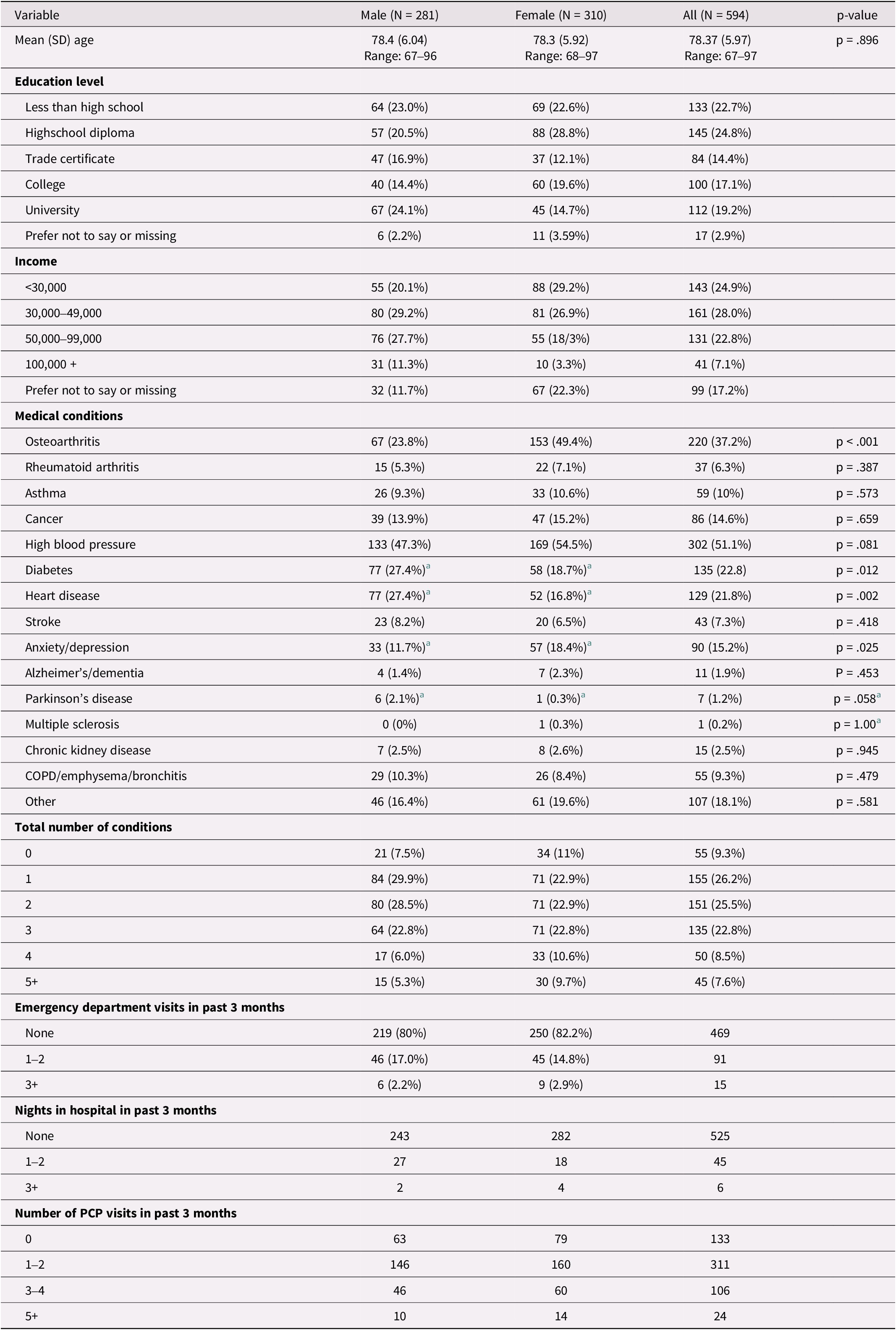
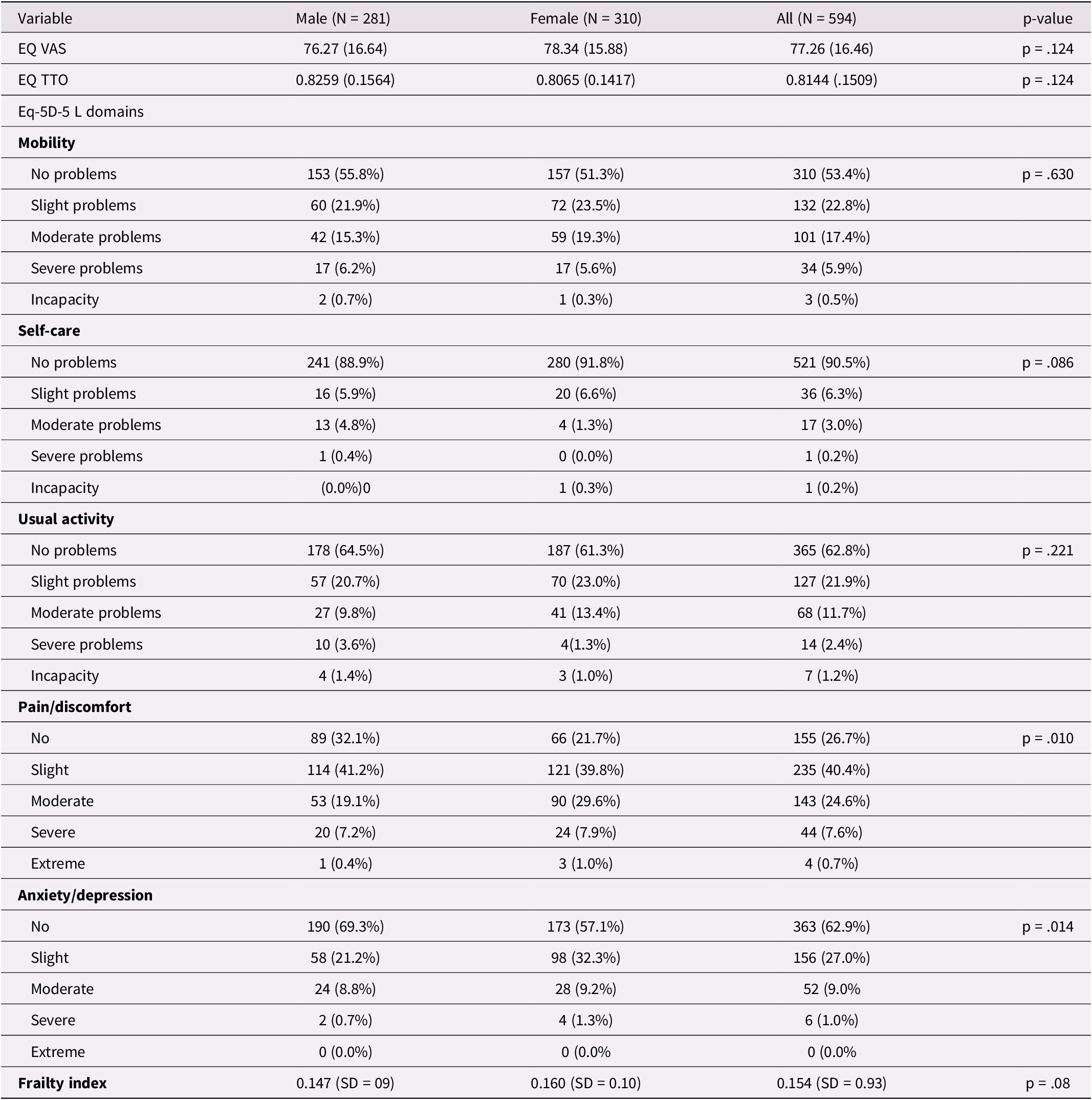
A total of 594 participants completed the survey package (Alberta = 140, Ontario = 212, Quebec = 242). Demographic survey results, including chronic health conditions, can be found in Table 1. Results related to quality of life and frailty are presented in Table 2. Reported income and education levels of participants were similar across provinces, with Ontario participants somewhat less likely to report having a college or university education. As there were few significant differences found across provinces in any measure, we have chosen to report only our gender-based analysis.
Participant demographics by biological sex
a Fisher’s exact test.
EQ-5D-5L scores, and frailty index by biological sex
Gender-based analysis
Participants were asked to indicate sex at birth (male or female) as well as their gender identity (male, female, other, prefer not to say). Most participants indicated that they were cisgender (same sex at birth and gender identity), however, three participants left both questions blank and another 13 participants left the gender identity question blank. One male participant indicated ‘other gender’, and two male and three female participants indicated that they would ‘prefer not to say’ when asked about their gender identity. For this analysis, we made comparisons using the sex at birth variable (male or female), as this had fewer missing data. We recognize that those who left the gender question blank, or who checked ‘prefer not to say’ may be misidentified in this analysis.
There was no significant difference in self-rated health on the EQ VAS between male and female participants (t(584) = −1.54, p = .124). In contrast, females reported significantly higher levels of pain/discomfort (χ2(4, N = 581) = 13.33, p = .01) and anxiety/depression (χ2(3, N = 577) = 8.52, p = .014) compared to males on the EQ-5D-5L. The TTO values derived from this sample ranged from 0.949 to 0.0801. Men (n = 62, 24%) were more likely than women (n = 44, 15%) to have the highest possible TTO score of 0.949, suggesting a greater proportion of men reported optimal health across all five EQ-5D-5L dimensions. Nonetheless, there was no statistically significant difference in average TTO scores between men and women (t(560) = 1.541, p = .124).
A chi-square test of independence was performed to examine the relation between sex and level of education. The relation between these variables was significant, X2 (5, N = 584) =16.62, p = .005, with the largest difference being between the proportion of male participants (24.1%) versus female participants (14.7%) that attended university. Additionally, male participants reported higher incomes and were more than three times more likely to indicate that their household income was more than $100,000 (X2 (4, N = 575) =132.923, p < .001).
Chronic conditions
Across all three provinces, the most common chronic conditions reported were high blood pressure (51.1%), osteoarthritis (37.2%), diabetes (22.8%), and heart disease (21.8%).
The EQVAS score was negatively correlated with the number of chronic conditions, such that as the number of chronic conditions increased, the person’s self-rated health on the EQVAS decreased, r(587) = −.373, p < .001.
Age
There was no significant correlation between age and number of chronic conditions (r(584) = .029, p = .484) and a weak negative correlation between age and the EQ VAS (r(579) = −.135, p = .001). There were low correlations between age and the FI (r(584) = .132, p < 001) and the TTO score (r(581) = −.146, p < 0.001).
Frailty
The mean FI in our sample was .153 (range 0–.52) with a skewed density distribution (histogram) approximated by a gamma distribution. Approximately 4.5 per cent of the sample were relatively fit (FI ≤ 0.03), 28.6 per cent were less fit (0.03 < FI ≤ 0.10), 43.9 per cent were least fit (0.10 < FI ≤ 0.21), and 22.9 per cent were frail (FI > 0.21). There was no significant difference in mean FI between men and women; however, frailty was more prevalent in women (27.1%) than in men (18.5%). There was a strong negative correlation between the FI and the EQ VAS (r(579) = −.581, p < .001). The FI was also strongly negatively correlated with the TTO score r(565) = −.719, p < .001).
Discussion
This study provides Canadian benchmark and baseline data of value to organizations planning to deliver primary care to complex older patients (Elliott et al., Reference Elliott, Stolee, Boscart, Giangregorio and Heckman2018), to teams promoting senior-friendly primary care principles (Frank et al., Reference Frank, Feldman and Wyman2018), and to other researchers examining primary care of older adults.
Our study has several limitations that should be noted when interpreting the findings. Firstly, we did not ask those recruiting patients to record the number of patients who were approached but declined to participate. Recruitment relied on healthcare providers and clinic staff to approach patients or provide printed invitations; this may have influenced participation rates or introduced variability based on staff time constraints or other patient factors. This limits our ability to assess potential selection bias, as we are unable to determine how the characteristics of non-participants might differ from those of participants. The study sample, although drawn from three provinces, may not be representative of all older adults accessing primary care across Canada, as it includes only patients from clinics with team-based care models and excludes those living in long-term care. In addition, data were collected prior to the COVID-19 pandemic, which may have altered primary care dynamics and healthcare access. Finally, we acknowledge limitations in capturing the complexity of gender identity and its intersections with health outcomes. Some participants did not disclose their gender identity, and comparisons were made based on sex at birth, which may not fully account for gender-related health disparities.
Beyond these limitations, our results highlight factors that can inform the design of primary care models for older adults and guide future practice and research.
Consistent with population-based studies (Fisher et al., Reference Fisher, Griffith, Gruneir, Panjwani, Gandhi, Sheng, Gafni, Chris, Markle-Reid and Ploeg2016), many participants in our study were experiencing multimorbidity as well as pre-frailty or frailty. As others have suggested (Fisher et al., Reference Fisher, Griffith, Gruneir, Panjwani, Gandhi, Sheng, Gafni, Chris, Markle-Reid and Ploeg2016; Koné Pefoyo et al., Reference Koné Pefoyo, Bronskill, Gruneir, Calzavara, Thavorn, Petrosyan, Maxwell, Bai and Wodchis2015) interventions to support older patients cannot adopt the traditional single-disease, one-issue-at-a-time model of care. As expected, a greater number of co-morbidities was associated with perceived worse health in our sample. It is also important to acknowledge that many participants were in relatively good health; many had only one or no chronic conditions and most did not meet the criterion for frailty. There may be opportunities to create care plans more proactively for healthier or less complex patients, and to engage patients in care decisions, with emphasis on prevention and prolonged good health, and avoiding functional decline (Tazkarji et al., Reference Tazkarji, Lam, Lee and Meiyappan2016).
In this sample, TTO values ranged from 0.949 (best possible health state) to 0.0801, indicating considerable variability in health-related quality of life among participants. These findings are consistent with the Canadian EQ-5D-5L TTO value set, which also uses 0.949 as the highest possible score, and align with previous Canadian studies showing that older adults generally report lower health utility values than the broader population (Xie et al., Reference Xie, Pullenayegum, Gaebel, Bansback, Bryan, Ohinmaa and Johnson2016). While most participants in our sample rated more positive health states, the observed range highlights the presence of significant health challenges within this older adult population. Compared to population norms, these results reflect the expected shift toward lower health utility in older age groups, while still capturing a range of health experiences (Xie et al., Reference Xie, Pullenayegum, Gaebel, Bansback, Bryan, Ohinmaa and Johnson2016). Additionally, the strong negative correlation between the frailty index and the EQ VAS and TTO scores indicates that as frailty increases, health-related quality of life decreases, which is consistent with existing literature showing that greater frailty is associated with lower quality of life (Nikolova et al., Reference Nikolova, Hulme, West, Pendleton, Heaven, Bower, Humphrey, Farrin, Cundill, Hawkins and Clegg2020) and poorer health outcomes in older adults (Rosenberg et al., Reference Rosenberg, Montgomery, Hay and Lattimer2019).
It is notable that more than half our sample lives on an annual income of less than $50,000, nearly half did not complete higher education, and 22 per cent did not complete high school. Future interventions and supports should be designed with an awareness of these potential limitations and limited resources and tailored to individuals with low health literacy. Offering free community-based leisure or physical activities would aid in enabling participation and maintaining health. Providers and those designing interventions in this context should also be aware that the females in our sample were less likely to have received a higher education (which also often has financial implications) and reported higher rates of pain, anxiety, and depression. Those with the greatest number of comorbidities were also more likely to be female; females were also more likely to be frail. Medically complex older females may require tailored interventions and/or additional supports in primary care. These findings reiterate that patient complexity is multidimensional, impacted by socio-economic factors, and not reflected by simply tabulating comorbidities (Grant et al., Reference Grant, Ashburner, Hong, Chang, Barry and Atlas2011). Additionally, they indicate that for effective patient-centered care, providers need to consider the intricate social and economic circumstances in which their patients are situated (Webster et al., Reference Webster, Rice, Bhattacharyya, Katz, Oosenbrug and Upshur2019).
Estimates of the prevalence of frailty among older adults in primary care settings vary widely depending on the measure used. A Spanish study of older adults in primary care used four different frailty tools which yielded prevalence estimates ranging from 29 per cent to 55 per cent (Vergara et al., Reference Vergara, Mateo-Abad, Saucedo-Figueredo, Machón, Montiel-Luque, Vrotsou, Nava del Val, Díez-Ruiz, Güell, Matheu, Bueno, Núñez and Narvaiza2019). Sutorius et al. (Reference Sutorius, Hoogendijk, Prins and van Hout2016) administered 10 frailty tools to 102 older adults in a primary care practice in Amsterdam; the resulting prevalence estimates ranged from 14.8 per cent to 52.9 per cent. We note that their prevalence estimate based on the FI with a cut point of 0.25+ for frailty was 14.8 per cent, similar to our estimate of 16.2 per cent using the same cut point. The distribution of FI scores in our sample was consistent with previously published indices of ‘well’ older adults in Canada (Mitnitski et al., Reference Mitnitski, Mogilner and Rockwood2001; Rockwood et al., Reference Rockwood, Song and Mitnitski2011). We note that in our study, the FI had a low correlation with age, in contrast to high correlations (>.96) found in other studies (Rockwood & Mitnitski, Reference Rockwood and Mitnitski2007). There may be several explanations for this. Our FI was constructed with fewer items (23) than are commonly used (Searle et al., Reference Searle, Mitnitski, Gahbauer, Gill and Rockwood2008, recommend 30–40); which may result in a lower correlation. Also, our sample of older primary care patients is likely more homogeneous than population samples, which could also result in a lower correlation. Further investigation of the relationship between frailty and age in primary care is warranted, but our results (such as that the EQVAS had a high correlation with the FI and a low correlation with age) suggest that frailty is a more informative predictor of health than age in primary care settings. This is consistent with the growing interest in case-finding for frailty in primary care (Abbasi et al., Reference Abbasi, Khera, Dabravolskaj, Garrison and King2019) which arises from evidence of the effectiveness of frailty interventions in this setting (Travers et al., Reference Travers, Romero-Ortuno, Bailey and Cooney2019). We note that these analyses are exploratory and so we did not hypothesize expected correlation levels. These analyses may nonetheless yield insights in how these measures (particularly the FI) might be used in primary care practice.
While this study provides valuable benchmark data, additional similar research conducted with diverse samples across a wider range of settings will be important to ensure findings are broadly applicable and responsive to the varied needs of older adults. Further research is also needed to deepen understanding of how primary care models can best serve older adults, particularly those with complex health needs. Future work should examine implementation strategies across diverse settings, evaluate both clinical and patient-reported outcomes, and explore innovative approaches that integrate organizational, provider, and patient perspectives. Comparative and longitudinal studies will be especially important to inform policy and guide the development of sustainable, senior-friendly primary care practices.
Supplementary material
The supplementary material for this article can be found at http://doi.org/10.1017/S0714980825100500.
Acknowledgments
We are grateful to the study participants and the participating primary care teams for their contributions to this project. This study was funded by the Canadian Frailty Network (CFN, grant #TG2015-24) which is funded by the Government of Canada’s Networks of Centres of Excellence (NCE) program.
Competing interests
The authors declare none.



 Open access

