




Background
The Bayuda Desert covers more than 140 000km2 in the central part of Sudan and is one of the least-explored areas of the country. Initial archaeological investigation of the Bayuda began in the mid-twentieth century (Chittick Reference Chittick1955; Mallinson & Smith Reference Mallinson and Smith1996; Meinhold Reference Meinhold2009), but systematic research was undertaken only in the twenty-first century (Kendall Reference Kendall2006; Karberg & Lohwasser Reference Karberg, Lohwasser, Lohwasser, Karberg and Auenmüller2018; Paner Reference Paner, Lohwasser, Karberg and Auenmüller2018, Reference Paner, Obłuski, Paner and Masojć2021). Between 2017 and 2023, a combined programme of aerial reconnaissance and ground survey was carried out at targeted locations in an area covering approximately 30 000km2 (Figure 1). As a result, 448 new archaeological sites were identified, and 126 previously known sites were verified.
Bayuda Desert and the territorial scope of the project (figure by authors).

Methods and results
Excavations were carried out at 88 of all 574 documented sites, including 36 cemeteries and 55 settlements. In total, 84 graves were excavated, with burials dating from the Mesolithic to the Middle Ages, although the majority (51 graves) may be associated with the Kerma Culture (2500–1500 BC). So far, 114 radiocarbon dates have been obtained, including 21 Mesolithic, one Neolithic, 39 Old Kush (i.e. Kerma Horizon), 15 New Kingdom, four Napata, seven Meroe, 19 medieval and eight post-medieval sites (calibration according to Reimer et al. Reference Reimer2020). Most (69) are derived from graves, a further 41 are from settlements and four are from fortresses.
Ceramic or metal vessels, tools, jewellery, Nile shells and, occasionally, animal sacrifices are found as grave goods. Application of remote sensing techniques allowed the acquisition of accurate 3D data; the objects were recorded using 3D photogrammetric imaging techniques in reference to GPS co-ordinates. The spatial data were then embedded in an open-source Geographic Information System (QGIS ver. 3.32 Lima), enabling further processing, archiving and vectorisation of artefacts and the provision of information layers and attributes for each site.
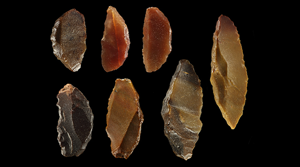
The oldest sites, generally identified as Palaeolithic and located in the north-western and south-eastern part of Bayuda, contain artefacts related to the Oldowan stone tool tradition (BP87, 1044; Figure 1). Among the settlement sites in south-eastern part of the desert, the oldest also provide materials related to the Early Stone Age (c. 3.3 Ma–300 ka)—for example, the remnants of an Acheulean workshop (Figure 1, BP1258) where large flakes and bifacial tools were produced (Figure 2).
Above) a selection of finds from sites BP177, BP1258 and BP1316 associated with the Early Stone Age (BP1258) and Middle Stone Age (BP1316 and BP177) where horizon II is dated >300 ka: 1) fragment of bifacial foliate, volcanic rock; 2–4) Nubian cores of type 2 made of petrified wood (photographs by Maciej Jórdeczka); 5) BP1258—large flake made of volcanic rock (photographs by Grzegorz Michalec); 6) BP1316—Nubian core of type 2 made of chert (photographs by Grzegorz Michalec); below) 3D modelling of site topography for BP1316 (figure by authors).

Research in the Bayuda also reveals Middle Stone Age (c. 300–50 ka) industries related to Nubian variants of the Levallois method indicating the early presence of Homo sapiens in this part of Africa (BP1316, BP1317). On stratified site BP177 (Goat Mountain), more than 60 000 stone artefacts belonging to two Nubian Levallois horizons were explored (Masojć et al. Reference Masojć, Kusiak, Standzikowski, Paner, Kuc, Parafiniuk and Szmit2017). Infrared stimulated luminescence dating for these two archaeological levels indicates the functioning of the settlement between c. 320 and 20 ka. The terminus post quem of the older horizon is estimated at 322±106 ka. This chronological position is confirmed by the specificity of the lithic industry containing large bifacial leaf points and Nubian 1 Levallois cores, as well as single hand-axes characteristic for the initial Middle Stone Age phases from the eastern Sahara.
The only Mesolithic cemetery (BP952) thus far identified in the Bayuda is located centrally, on the slope of Jebel El Gharra, and contains at least 16 burials of adults arranged in three or four layers (Figure 3). The site was used sporadically, and the dead were buried at intervals in locations that were probably not marked.
Topography and selected burials from sites BP904 and BP952 (photographs by Patryk Muntowski & Henryk Paner).

Direct radiocarbon dating of the burials indicates use of the cemetery in the seventh and sixth millennia BC. Shells, a stone pendant and beads made of ostrich eggshell were found in the burials. A similar chronology was established for the area named Hunter's Settlement (BP1044) located in the eastern part of the desert at the foot of Jebel El-Fuel. Nearly 300 fragments of animal bones, almost 3400 stone artefacts and about 2000 fragments of pottery were excavated at the site (Figure 4). All the bones are from wild, hunted animals and were radiocarbon dated to the sixth millennium BC.
A) location of the site BP1044; B) selection of microlithic fragments from the mesolithic stage of site's occupation; C) examples of decorated pottery from the Mesolithic/Early Neolithic period from site BP1044 (photographs by Patryk Muntowski, Maciej Jórdeczka & Krzysztof Wiącek).

Valuable data were also obtained on issues related to climate change. The most important include the discovery of a palaeolake (BP903) in the central Bayuda that was extant in the early Holocene, savannah animal bones dating from the Mesolithic at site BP1044 and insect remains at Kerma cemetery BP937.
A Neolithic settlement (BP1346), 55km south-east of Karima, has also been examined. The younger phase of this settlement, dating to the Kerma Culture period, can be associated with nearby cemeteries (BP164, BP165, BP166). Cemeteries located on Jebel El-Gharra (BP904) and a complex of cemeteries on Jebel Cristal (BP708 and others), north-east of the Marawi Dam, together with accompanying settlements are also associated with the Kerma Culture (Figure 5). In one grave, a bronze arrowhead is preserved in the skull of a buried male. The bronze has a high arsenic content (10.46%), which may provide a clue to the origin of this metal.
Jebel Cristal complex: A, B, C) clay vessels from graves dated to the beginning of the second millennium BC; D) faience beads from the beginning of the second millennium BC found in grave 5 at site BP941; E) burial of an adult male with grave goods in the form of two sheep (photographs by Ewa Lesner & Patryk Muntowski).

Salt Lake, in the volcanic fields complex, is identified as an area where natron deposits have been exploited for centuries. Natron is a sodium carbonate mineral that occurs only in a few regions of the globe. In northern Africa, one of its main sources is Wadi Natrun in Egypt. In ancient Egypt, natron was used in the mummification of corpses and the production of glass and earthenware. This find forces a reanalysis of the importance of communication routes between the volcanic fields and the Nile and further north in the context of possible trade with Egypt.
Rock art sites (BP1250) and numerous settlements, from the second and third millennium BC (BP1254, 1255), through the Meroitic period (BP1255, 1303) to the Middle Ages (BP784), were also identified (Figure 6).
Remains of medieval hut: A) stone structure and postholes remaining from the construction of a wooden hut with an annex; B) site BP1250, panel 1—representations of animals and anthropomorphic figures (photographs by Patryk Muntowski).

Conclusion
Archaeological exploration of the Bayuda Desert has so far revealed many new archaeological sites located both on the outskirts of and deep in the desert, far from the Nile Valley. These sites allow for the comparison of adaptative socioeconomic strategies of local communities with those of Nile Valley inhabitants. They further provide valuable data on 6000 years of biological, environmental and climatic changes in the Bayuda Desert and the transformation of natural and cultural landscapes.
Acknowledgements
We thank the National Corporation for Antiquities and Museums, Sudan, and all colleagues and friends who supported us during the project.
Funding statement
The project ‘Prehistoric communities in the Bayuda Desert – new borders of the Kerma Kingdom’ (NCN 2016/23/B/HS3/00845) (www.sudanarcheo.pl) was funded by the Polish National Science Centre.


 Open access

