




1. Introduction
The catenary is the solution to the problem of minimizing the potential gravitational energy of a chain hanging under its weight when supported only at its ends. Euler proved that by rotating a catenary about the reference line with respect to which the weight is measured, the resulting surface of revolution has zero mean curvature [Reference Euler3, Reference Struik9]. This surface is called a catenoid, the only non-planar minimal surface of revolution in Euclidean space. Recently, the second author extended the notion to the catenary in the sphere and the hyperbolic plane [Reference López5]. After we fix a reference geodesic $\ell$ , the energy functional to be minimized is the potential energy, which is given by integrating the distance of points of the chain to $\ell$
 . A critical point of this functional is called an (intrinsic) catenary.
Embedding the hyperbolic plane (2-sphere) in the hyperbolic space (3-sphere, respectively), we may ask, as Euler did in Euclidean space, whether the revolution of a catenary about $\ell$ is a minimal surface. It turns out that the resulting surface of revolution is not minimal. This problem was circumvented in the spherical case by introducing the notion of an extrinsic catenary. More precisely, instead of measuring the potential using the intrinsic distance, one uses the distance in the ambient Euclidean space to a plane passing by the centre of the sphere [Reference López5]. This paper aims to provide a similar extension of Euler's result to the hyperbolic space.
Contrarily to the three-dimensional Euclidean space and sphere, in the hyperbolic space, $\mathbb {H}^3(r)$ , three types of surfaces of revolution exist. Indeed, considering $\mathbb {H}^3(r)$
 as a hypersurface of the $4$
 -dimensional Lorentz–Minkowski space $\mathbb {E}_1^4$
 (the hyperboloid model), rotations in $\mathbb {H}^3(r)$
 correspond to orthogonal transformations in $\mathbb {E}_1^4$
 that leave a 2-dimensional subspace $P^2$
 point-wise fixed. (We refer to $P^2$
 as the axis of revolution.) Thus, depending on the causal character of the axis of revolution $P^2\subset \mathbb {E}_1^4$
 , the corresponding surface of revolution is of elliptic, hyperbolic, or parabolic typeFootnote 1 . Motivated by this classification, instead of measuring the gravitational potential in the hyperbolic plane $\mathbb {H}^2(r)$
 from the intrinsic distance to a fixed geodesic of $\mathbb {H}^2(r)$
 , as in Ref. [Reference López5], the potential will be measured using the extrinsic distance. More precisely, the extrinsic catenary problem consists in finding the shape of a curve $\gamma \colon [a,b]\to \mathbb {H}^2(r)\subset \mathbb {H}^3(r)$
 , which is a critical point of the potential energy

where $\textrm {dist}_{\mathbb {E}_1^4}(\gamma (t),P^2)$ is the distance in $\mathbb {E}_1^4$
 between $P^2$
 and the point $\gamma (t)$
 .
.
Depending on the causal character of $P^2$ , critical points of the potential energy functional will be called extrinsic catenaries of elliptic, hyperbolic, and parabolic types. Our main theorem will extend Euler's result about the catenoid to the hyperbolic space. Namely, we have (we prove it as theorem 5.3 in §5)
Main Theorem 1.1 The generating curves of minimal surfaces of revolution in $\mathbb {H}^3(r)$ of elliptic, hyperbolic, and parabolic types are extrinsic catenaries of spherical, hyperbolic, and parabolic types, respectively.
In addition, we show that one of the families of extrinsic catenaries admits an intrinsic characterization by using the so-called horocatenaries. In other words, a horocatenary is a critical point of the potential energy functional obtained by replacing $\textrm {dist}_{\mathbb {E}_1^4}(\gamma (t),P^2)$ with the length of a horocycle orthogonal to a fixed reference geodesic. Thus, we obtain the following theorem (we prove it as theorem 6.1 in §6)
Main Theorem 1.2 Every hyperbolic horocatenary is an extrinsic catenary in $\mathbb {H}^2(r)$ of the elliptic type. Consequently, the generating curves of minimal surfaces of revolution in $\mathbb {H}^3(r)$
 of the elliptic type are horo-catenaries.
Surfaces of revolution in $\mathbb {H}^3(r)$ are well-known objects of investigation. First, Mori found minimal surfaces of revolution of elliptic type [Reference Mori6].Footnote 2 Later, do Carmo and Dajczer obtained all the minimal surfaces of revolution and, among other results, established their relation with helicoids [Reference do Carmo and Dajczer2]. To our knowledge, this work is the first to characterize minimal surfaces of revolution in hyperbolic space through a variational formulation for their generating curves.
The rest of this paper is divided as follows. In §2, we formulate the extrinsic catenary problem in $\mathbb {H}^2(r)$ . Theorem 2.5 characterizes extrinsic catenaries in terms of their curvature function. In §3, we characterize extrinsic catenaries by prescribing the curvature in terms of an equation involving Killing vector fields of $\mathbb {E}_1^3$
 (theorem 3.2). These vector fields indicate the direction of the geodesics in $\mathbb {E}_1^3$
 used to measure the weight. To be self-contained, in §4, we provide a detailed construction of all surfaces of revolution in hyperbolic space along with the computation of their mean curvature. In §5, we prove our main result concerning the characterization of the generating curves of surfaces of revolution in the hyperbolic space (theorem 5.3). In §6, we prove that horocatenaries are extrinsic catenaries of the elliptic type, thus providing an intrinsic characterization for minimal surfaces of revolution of the elliptic type (theorem 6.1). Finally, we present our concluding remarks and formulate some open problems in the last section.
2. The extrinsic catenary problem
Minimal surfaces in a three-dimensional Riemannian manifold are critical points of the area functional. They are characterized by the vanishing of the mean curvature $H$ . If $g_{ij}$
 and $h_{ij}$
 denote the coefficients of the first and second fundamental forms of a minimal surface, the minimality condition reads

We want to classify the minimal surfaces of revolution in the hyperbolic space $\mathbb {H}^3(r)$ of constant sectional curvature $K=-({1}/{r^2})$
 . In other words, surfaces generated by 1-parameter subgroups of isometries whose orbits are curves of constant curvature $\kappa$
 contained in a totally geodesic surface, i.e., a copy of $\mathbb {H}^2(r)$
 in $\mathbb {H}^3(r)$
 . A surface of revolution is then foliated by hypercycles if $0<\kappa < {1}/{r}$
 , horocycles if $\kappa ={1}/{r}$
 , and circles if $\kappa >{1}/{r}$
 . Thus, we have three classes of minimal surfaces of revolution, and the classification of the minimal ones will be done regarding their generating curves.
Let $\mathbb {E}_1^{n+1}=(\mathbb {R}^{n+1},\langle X,Y\rangle _1=-X_0Y_0+\sum _{i=1}^nX_iY_i)$ be the $(n+1)$
 -dimensional Lorentz–Minkowski space. In the hyperboloid model of the hyperbolic space, we see $\mathbb {H}^n(r)$
 as a hypersurface in $\mathbb {E}_1^{n+1}$
 of constant sectional curvature $K=-1/r^2$
 :
:

We shall denote by $\langle \cdot,\cdot \rangle$ the induced inner product of $\mathbb {H}^n(r)$
 . In addition, we embed $\mathbb {H}^2(r)$
 into $\mathbb {H}^3(r)$
 by the natural inclusion

The extrinsic catenary problem is formulated as follows:
The extrinsic catenary problem. Given a subspace $P^2$ of $\mathbb {E}_1^{4}$
 , find the shape of a chain $\gamma :[a,b]\to \mathbb {H}^2(r)\subset \mathbb {H}^3(r)$
 that optimizes the potential energy

where $\textrm {dist}(\gamma (t),P^2)$ is the distance in $\mathbb {E}_1^{4}$
 of the point $\gamma (t)$
 to $P^2$
 .
.
Remark 2.1 The functional $\mathcal {W}[\gamma ]$ is a generalization of the gravitational potential energy in Euclidean space. In a region close to the surface of the Earth, the gravitational acceleration $g$
 can be considered constant, and the difference $\Delta U$
 in potential energy from one height to another is, to a good approximation, linearly related to the difference in height $\Delta h$
 : $\Delta U = mg\Delta h.$
 Thus, if a plane $P^2$
 represents the level of height zero on the Earth's surface, each point of a chain of equation $\gamma$
 and linear mass density $\mu$
 will contribute an amount $\mu g\,\textrm {dist}(\gamma (s),P^2)$
 to the gravitational potential energy. Integration over $\gamma$
 gives $\mathcal {W}[\gamma ]$
 ($g=\mu =1$
 ). Minimizing (2.4) does not model a real physical situation, but we shall keep calling $\mathcal {W}[\gamma ]$
 a potential energy.
Definition 2.2 Critical points of $\mathcal {W}[\gamma ]$ are called extrinsic catenaries.
In the definition of extrinsic catenaries, it is implicitly assumed that $\gamma$ lies on one side of the plane $P^2$
 , implying that the integrand in (2.4) is positive. In contrast to how catenaries are defined in Ref. [Reference López5], the weight is now calculated using the extrinsic distance in $\mathbb {E}_1^4$
 , rather than the intrinsic distance to a given geodesic in $\mathbb {H}^2(r)$
 .
.
In $\mathbb {E}_1^{n+1}$ , there are three types of planes $P^2$
 according to their causal character. In general, if $P^k$
 denotes a $k$
 -dimensional subspace of $\mathbb {E}_1^{n+1}$
 , $P^k$
 is said to be Lorentzian, Riemannian, or degenerate, if the restriction of the metric $\langle \cdot,\cdot \rangle _1$
 to $P^k$
 is a Lorentzian, Riemannian, or degenerate metric, respectively. Therefore, we define three types of extrinsic catenaries: $\gamma$
 is an extrinsic catenary of (i) elliptic type, (ii) hyperbolic type, and (iii) parabolic type if $\gamma$
 is a critical point of (2.4) when $P^2$
 is (i) Lorentzian, (ii) Riemannian, and (iii) degenerate, respectively.
Let $\{\mathbf {e}_x,\mathbf {e}_y,\mathbf {e}_z\}$ be the unit velocity vectors of the canonical Cartesian coordinates $(x,y,z)$
 of $\mathbb {E}_1^3$
 and denote $[\mathbf {v}_1,\ldots,\mathbf {v}_k]= \mbox {span}\{\mathbf {v}_1,\ldots,\mathbf {v}_k\}$
 . Without loss of generality, we can suppose that the subspace $P^2$
 is one of the following:
(i) $P^2=[\mathbf {e}_{x},\mathbf {e}_{y}]$
 (Lorentzian).
(ii) $P^2=[\mathbf {e}_y,\mathbf {e}_z]$
(Riemannian).(iii) $P^2= [\tfrac {1}{\sqrt {2}}(\mathbf {e}_{y} +\mathbf {e}_{x}),\mathbf {e}_z]$
(degenerate).



To characterize the extrinsic catenaries, we will obtain the Euler–Lagrange equations of the functional (2.4). This task can be significantly simplified by choosing a suitable system of coordinates and then applying the standard techniques of the Calculus of Variations.
Without loss of generality, let $\ell$ be the geodesic in $\mathbb {H}^2(r)$
 obtained from the intersection with the plane of equation $z=0$
 :
:

If $\beta _v(u)$ denotes the geodesic with unit velocity $X(v)=(0,0,1)\in T_{\ell (v)}\mathbb {H}^2(r)$
 at $u=0$
 , $\langle X(v),\ell '(v)\rangle _1=0$
 , then we can parametrize $\mathbb {H}^2(r)$
 by
by

This coordinate system is known as the semi-geodesic coordinates [Reference Struik9]. Since

the induced metric on $\mathbb {H}^2(r)$ takes the form

Now, we compute the distance in $\mathbb {E}_1^3$ from $\gamma (t)$
 to $P^2$
 . If we write $\gamma (t)=\psi (u(t),v(t))\in \mathbb {H}^2(r)\subset \mathbb {E}_1^3$
 , then from (2.6), we have

and

The first two distances are the length of the line segment orthogonal to $P^2$ , which connects $\gamma (t)$
 to $P^2$
 . The third distance is trickier since the reference plane is degenerate. (Thus, it contains its orthogonal line.) To circumvent this difficulty, we choose $\mathbb {E}_1^3= [\tfrac {1}{\sqrt {2}}(\mathbf {e}_{y}-\mathbf {e}_{x}), \tfrac {1}{\sqrt {2}}(\mathbf {e}_{y}+\mathbf {e}_{x}),\mathbf {e}_z]$
 and then consider $\tfrac {1}{\sqrt {2}}(\mathbf {e}_{y}-\mathbf {e}_{x})$
 as playing the role of the director vector of the ‘line segment orthogonal to $P^2$
 , which connects $\gamma (t)$
 to $P^2$
 .’ The distance $\textrm {dist}(\gamma (t),P^2)$
 is then the (Euclidean) length of this line segment. (Note that $L_1=\tfrac {1}{\sqrt {2}}(\mathbf {e}_{y}-\mathbf {e}_{x})$
 and $L_2=\tfrac {1}{\sqrt {2}}(\mathbf {e}_{y}+\mathbf {e}_{x})$
 are two lightlike vectors orthogonal to $\mathbf {e}_z$
 and normalized by the condition $\langle L_1,L_2\rangle =1$
 .) The definition's suitability for the degenerate case is justified a posteriori: it is the ‘distance’ allowing us to characterize minimal surfaces of revolution of parabolic type similarly to the classification of surfaces of elliptic and hyperbolic types.
Up to multiplication by a constant, the distance to $P^2$ can be taken as $\sinh {u}/{r}$
 (elliptic), $\cosh {u}/{r}\cosh {v}/{r}$
 (hyperbolic), and $e^{-v/r}\cosh {u}/{r}$
 (parabolic). Therefore,
(i) Extrinsic catenaries of elliptic type are critical points of
(2.9)\begin{equation} \mathcal{W}_{\mathcal{E}}[\gamma(t)] = \int_a^b\sinh\frac{u}{r}\sqrt{\dot{u}^2+\dot{v}^2\cosh^2\frac{u}{r}}\,\mathrm{d} t,\quad u>0. \end{equation}
(ii) Extrinsic catenaries of hyperbolic type are critical points of
(2.10)\begin{equation} \mathcal{W}_{\mathcal{H}} [\gamma(t)]= \int_a^b\cosh \frac{u}{r}\cosh\frac{v}{r}\sqrt{\dot{u}^2+\dot{v}^2\cosh^2\frac{u}{r}}\,\mathrm{d} t,\quad u>0. \end{equation}
(iii) Extrinsic catenaries of parabolic type are critical points of
(2.11)\begin{equation} \mathcal{W}_{\mathcal{P}}[\gamma(t)] = \int_a^b \mathrm{e}^{-{v}/{r}}\cosh\frac{u}{r}\sqrt{\dot{u}^2+\dot{v}^2\cosh^2\frac{u}{r}}\,\mathrm{d} t,\quad u>0. \end{equation}The assumption $u>0$
means that $\gamma$ lies on one side of the plane $P^2$.


The functionals $\mathcal {W}_{\mathcal {E}}$ , $\mathcal {W}_{\mathcal {H}}$
 , and $\mathcal {W}_{\mathcal {P}}$
 are all of the form $\int f(u,v) \Vert \dot {\gamma }\Vert \mathrm {d} t$
 . To compute the corresponding Euler–Lagrange equations, we first need the expression of the geodesic curvature $\kappa$
 in $\mathbb {H}^2(r)$
 with respect to coordinates (2.6).
Lemma 2.3 If $\gamma (t)=\psi (u(t),v(t))$ is a smooth regular curve in $\mathbb {H}^2(r)$
 , its signed curvature in $\mathbb {H}^2(r)$
 is given by

Proof. Let $\Gamma _{ij}^k$ be the Christoffel symbols of the metric $\mathrm {d} s^2$
 associated with the coordinates (2.6). The expression for $\kappa$
 is then given by

For the metric $\mathrm {d} s^2$ given in (2.8), we have $g_{11}=1$
 , $g_{12}=0$
 , and $g_{22}=\cosh ^2 {u}/{r}$
 . As a consequence, $\Gamma _{11}^1=\Gamma _{12}^1=\Gamma _{11}^2=\Gamma _{22}^2=0$
 and
and

Now, using that $\Vert \dot {\gamma }\Vert =\sqrt {g_{11}\dot {u}^2+2g_{12}\dot {u}\dot {u}+g_{22}\dot {v}^2}$ and substituting the expressions for $\Gamma _{ij}^k$
 , Eq. (2.12) is immediate.
Lemma 2.4 Consider the functional

where $f$ is some smooth, positive function. The Euler–Lagrange equations of $\mathcal {E}_f$
 are
are

where $\kappa$ is the geodesic curvature of $\gamma$
 in $\mathbb {H}^2(r)$
 . If, in addition, $\gamma$
 is regular, then $\gamma$
 is a solution of the Euler–Lagrange equations if, and only if,

Proof. The Euler–Lagrange equations associated with the Lagrangian $\mathcal {L}=f\Vert \dot {\gamma }\Vert$ are
are

These equations are

Equivalently, we have

After some manipulations, both equations can be expressed as

and

The identities (2.14) are now obtained using the above two equations and the expression of $\kappa$ given in Eq. (2.12).
Finally, we are in a position to characterize the extrinsic catenaries in the hyperbolic plane.
Theorem 2.5 Let $\gamma (t)=\psi (u(t),v(t))$ be a regular curve in $\mathbb {H}^2(r)$
 . Then, $\gamma$
 is an extrinsic catenary if, and only if, its curvature $\kappa$
 in $\mathbb {H}^2(r)$
 satisfies:
(i) Elliptic type:
(2.17)\begin{equation} \kappa = \frac{1}{r\Vert\dot{\gamma}\Vert}\frac{\dot{v}\cosh^2 {u}/{r} }{\sinh {u}/{r}}. \end{equation}
(ii) Hyperbolic type:
(2.18)\begin{equation} \kappa = \frac{1}{r \Vert\dot{\gamma}\Vert} \left( - \frac{\dot{u}\sinh {v}/{r}}{ \cosh {u}/{r}\cosh {v}/{r}} +\dot{v} \sinh\frac{u}{r}\right) . \end{equation}
(iii) Parabolic type:
(2.19)\begin{equation} \kappa =\frac{1}{r\Vert\dot{\gamma}\Vert}\left(\frac{\dot{u}}{\cosh {u}/{r}} + \dot{v}\sinh\frac{u}{r}\right). \end{equation}


Proof. Just apply lemma 2.4 to the functionals in Eqs. (2.9)–(2.11). In other words, choose $f$ in Eq. (2.15) as $\sinh {u}/{r}$
 , $\cosh {u}/{r}\cosh {v}/{r}$
 , and $\mathrm {e}^{- {v}/{r}}\cosh {u}/{r}$
 , respectively.
Remark 2.6 If in the variational formulation of the extrinsic catenary problem, §1, we assumed that the chain's length is prescribed, there would be a constraint $\int _a^b\Vert \dot {\gamma }(t)\Vert \, \mathrm {d} t=c$ . Consequently, the quantity $\textrm {dist}(\gamma (t),P^2)$
 in (2.4) would have to be replaced by $\textrm {dist}(\gamma (t),P^2)+\lambda$
 , where $\lambda$
 is a Lagrange multiplier. In the functional (2.13), adding a Lagrange multiplier implies that the function $f$
 should be replaced by $f+\lambda$
 . The corresponding Euler–Lagrange equations coincide with those of theorem 2.5 after a translation in $\mathbb {E}_1^4$
 of the plane $P^2$
 .
.
3. Characterization of extrinsic catenaries
In this section, we provide a coordinate-free characterization of extrinsic catenaries with the help of Killing vector fields of $\mathbb {E}_1^4$ . The motivation comes from the Euclidean catenary $y(x)= {1}/{a}\cosh (ax+b)$
 in the $(x,y)$
 -plane. This curve is the solution to the hanging chain problem in the Euclidean plane. In this setting, the reference line is the horizontal line $\ell$
 of equation $y=0$
 , and the corresponding Euler–Lagrange equation is

The left-hand side is just the curvature $\kappa$ of the curve $y=y(x)$
 . The right-hand side is the Euclidean product ${\bf n}\cdot \mathbf {e}_y$
 divided by the distance to $\ell$
 , where $\mathbf {n}=(-y',1)/\sqrt {1+y'^2}$
 is the unit normal of $y=y(x)$
 and $-\mathbf {e}_y=(0,-1)$
 is the direction of gravity in Euclidean plane. Thus, Eq. (3.1) can be expressed as

Observe that the direction of gravity $-\mathbf {e}_y$ also has a geometric interpretation. It gives the direction of the geodesics orthogonal to $\ell$
 used to compute $\textrm {dist}(\gamma,\ell )$
 .
.
We can provide a similar result for extrinsic catenaries in hyperbolic space. However, since the potential energy (2.4) measures the distance in $\mathbb {E}_1^4$ from the plane $P^2$
 , it is natural to expect that the right-hand side of Eq. (3.2) will incorporate the extrinsic nature of (2.4). Such a characterization of hyperbolic extrinsic geodesics will be obtained as a corollary of a more general result:
Theorem 3.1 A regular curve $\gamma (t)=\psi (u(t),v(t))$ in $\mathbb {H}^2(r)$
 is a critical point of the functional (2.13) if, and only if, its curvature $\kappa$
 in $\mathbb {H}^2(r)$
 satisfies

where $\mathbf {n}$ is the unit normal of $\gamma$
 and $\nabla f$
 is the gradient vector field of $f$
 .
.
Proof. The tangent vector of $\gamma$ is $\dot {\gamma }=\dot {u}\partial _u+\dot {v}\partial _v$
 . Thus, the unit normal $\mathbf {n}$
 is
is

where $\{\partial _u,\partial _v\}$ is the coordinate basis determined by the parametrization $\psi$
 . The expression of the gradient of $f$
 with respect to this basis is

It follows from Eqs. (3.4) and (3.5) that

Finally, we are in a position to provide the following characterization for extrinsic catenaries.
Theorem 3.2 A regular curve $\gamma (t)=\psi (u(t),v(t))$ in $\mathbb {H}^2(r)$
 is an extrinsic catenary if, and only if, its curvature $\kappa$
 in $\mathbb {H}^2(r)$
 satisfies

where $X$ is the Killing field in $\mathbb {E}_1^3$
 of the geodesics in $\mathbb {E}_1^3$
 orthogonal to $P^2$
 . If $\gamma$
 is a catenary of hyperbolic or elliptic type, such geodesics connect $\gamma$
 to a point of $P^2$
 .
.
Proof. If $X$ is a vector field in $\mathbb {E}_1^3$
 , its tangent part $X^\top$
 in $\mathbb {H}^2(r)$
 is given by

where $\psi$ is the parametrization (2.6) of $\mathbb {H}^2(r)$
 . Consider now the three types of Killing vector fields that determine the distance between a point of $\mathbb {H}^2(r)$
 and a subspace $P^2$
 depending on the causal character of $P^2$
 . Denote by $\{\mathbf {e}_x,\mathbf {e}_y,\mathbf {e}_z\}$
 the canonical basis of $\mathbb {E}_1^3$
 .
.
(i) If $P^2=[\mathbf {e}_{x},\mathbf {e}_{y}]$
, the Killing vector field is $X=\mathbf {e}_z$ and, from (3.7), we have
\begin{align*} X^\top & ={-}\frac{1}{2} \sinh \frac{2 u}{r} \cosh \frac{v}{r}\mathbf{e}_x - \frac{1}{2} \sinh \frac{2 u}{r} \sinh \frac{v}{r}\mathbf{e}_y+ \left(1-\sinh ^2\frac{u}{r}\right)\mathbf{e}_z \\ & = \cosh\frac{u}{r}\psi_u. \end{align*}
(ii) If $P^2=[\mathbf {e}_y,\mathbf {e}_z]$
, the Killing vector field is $X=-\mathbf {e}_x$ and, from (3.7), we have
\begin{align*} X^\top & = \left({-}1 - \cosh ^2\frac{u}{r} \cosh ^2\frac{v}{r}\right) \mathbf{e}_x - \frac{1}{2} \cosh ^2\frac{u}{r} \sinh \frac{2 v}{r}\mathbf{e}_y - \frac{1}{2} \sinh \frac{2 u}{r} \cosh \frac{v}{r}\mathbf{e}_z \\ & = \sinh\frac{u}{r}\cosh\frac{v}{r}\,\psi_u + \frac{\sinh {v}/{r}}{\cosh {u}/{r}}\,\psi_v. \end{align*}
(iii) If $P^2= [\tfrac {1}{\sqrt {2}}(\mathbf {e}_{y}+\mathbf {e}_{x}),\mathbf {e}_z]$
, the Killing vector field $X=-\tfrac {1}{\sqrt {2}}(\mathbf {e}_x+\mathbf {e}_y)$ and, from (3.7), we have
\begin{align*} X^\top & ={-} \frac{1}{\sqrt{2}}\left(1 + \mathrm{e}^{- {v}/{r}} \cosh ^2\frac{u}{r} \cosh \frac{v}{r}\right)\mathbf{e}_x \\ & \quad - \frac{1}{\sqrt{2}}\left[1 + \mathrm{e}^{- { v/}{r}}\cosh^2 \frac{u}{r}\sinh\frac{v}{r}\right] \mathbf{e}_y - \frac{\mathrm{e}^{- {v}/{r}}}{2\sqrt{2}} \sinh \frac{2 u}{r}\mathbf{e}_z \\ & = \frac{\mathrm{e}^{- {v}/{r}}}{\sqrt{2}} \sinh\frac{u}{r} \, \psi_u - \frac{\mathrm{e}^{- {v}/{r}}}{\sqrt{2}\cosh {u}/{r}}\,\psi_v. \end{align*}


Let us compute the gradient $\nabla f$ in $\mathbb {H}^2(r)$
 of the distances to each of the above planes $P^2$
 .
.
(i) In the elliptic case, $f(u,v)=r \sinh {u}/{r}$
. Using Eq. (3.5) and $\partial _u=\psi _u$ and $\partial _v=\psi _v$ in (2.7), we obtain that $\nabla f=X^\top$.(ii) In the hyperbolic case, $f(u,v)=r\cosh {u}/{r}\cosh {v}/{r}$
. Using Eq. (3.5) and $\partial _u=\psi _u$ and $\partial _v=\psi _v$ in (2.7), we obtain that $\nabla f=X^\top$.(iii) In the parabolic case, $f(u,v)=\tfrac {r}{\sqrt {2}}\mathrm {e}^{- {v}/{r}} \cosh {u}/{r}$
. Using Eq. (3.5) and $\partial _u=\psi _u$ and $\partial _v=\psi _v$ in (2.7), we obtain that $\nabla f= X^\top$.


Finally, applying theorem 3.1 gives the desired result. Indeed,

4. Surfaces of revolution in hyperbolic space
This section describes the three types of surfaces of revolution in $\mathbb {H}^3(r)$ . To define them, we first exploit the fact that all isometries of $\mathbb {H}^{3}(r)$
 are induced by orthogonal transformations of $\mathbb {E}_1^{4}$
 . Later, after introducing a convenient coordinate system for each surface type, we compute their mean curvature.
Let $P^k$ denote a $k$
 -dimensional subspace of $\mathbb {E}_1^{4}$
 and $O(P^k)$
 be the set of orthogonal transformations of $\mathbb {E}_1^{4}$
 with positive determinant and that leave $P^k$
 pointwise fixed. (In the context of the Lorentzian geometry, the orthogonal transformations of $\mathbb {E}_1^{4}$
 are often referred to as Lorentzian transformations.) Following do Carmo–Dajczer [Reference do Carmo and Dajczer2], we have the following classification for surfaces of revolution in $\mathbb {H}^3(r)$
 .
.
Definition 4.1 Consider two subspaces $P^2,P^3\subset \mathbb {E}_1^{4}$ such that $P^2\subset P^3$
 and $P^3\cap \mathbb {H}^{3}(r)\not =\emptyset$
 . Let $\gamma :I\to \mathbb {H}^2(r)= P^3\cap \mathbb {H}^{3}(r)$
 be a regular curve that does not intersect $P^2$
 . The orbits of $\gamma$
 under the action of $O(P^2)$
 is called a surface of revolution in $\mathbb {H}^{3}(r)$
 generated by $\gamma$
 and rotated around $P^2$
 . In addition, the surface of revolution is said to be of
(i) elliptic type, if $P^2$
is Lorentzian,(ii) hyperbolic type, if $P^2$
is Riemannian, and(iii) parabolic type, if $P^2$
is degenerate.


Remark 4.2 In the hyperboloid model, the orbits of the action of a revolution of elliptic, hyperbolic, and parabolic types are ellipses, hyperbolas, and parabolas, respectively. In [Reference do Carmo and Dajczer2], surfaces of elliptic type are said to be spherical. However, the orbits are elliptic unless $P^2$ is orthogonal to the $x$
 -axis (i.e., the canonical timelike direction). Finally, note that from an intrinsic viewpoint, we can alternatively describe the orbits as circles, hypercycles, and horocycles.
Now, we shall explain the general recipe of how to choose the planes $P^2$ and $P^3$
 and the generating curve $\gamma$
 in the constructions below. First, we fix a basis $\{\mathbf {e}_1,\mathbf {e}_2,\mathbf {e}_3,\mathbf {e}_4\}$
 of $\mathbb {E}_1^4$
 (not necessarily the canonical one). Later, we shall take $P^2=[\mathbf {e}_1,\mathbf {e}_2]$
 and $P^3=[\mathbf {e}_1,\mathbf {e}_2,\mathbf {e}_3]$
 . Finally, to generate a surface of revolution, we take a curve $\gamma (t)=x_1(t)\mathbf {e}_1+x_2(t)\mathbf {e}_2+x_3(t)\mathbf {e}_3$
 and then rotate it around $P^2$
 . Without loss of generality, the parametrizations of the three types of surfaces of revolution are the following:
(i) Surfaces of elliptic type. Consider $P^2=[\mathbf {e}_{x},\mathbf {e}_{y}]$
and $P^3=[\mathbf {e}_{x},\mathbf {e}_{y},\mathbf {e}_{z}]$. The members $\mathcal {E}_{\theta }$ of $O(P^2)$ take the form
\[ \mathcal{E}_{\theta} = \left( \begin{array}{@{}cccc@{}} 1 & 0 & 0 & 0 \\ 0 & 1 & 0 & 0 \\ 0 & 0 & \cos\theta & -\sin\theta \\ 0 & 0 & \sin\theta & \cos\theta \end{array}\right). \]Given a curve $\gamma (t)=(x(t),y(t),z(t),0)\in \mathbb {H}^2(r)=P^3\cap \mathbb {H}^3(r)$
, we obtain a surface of revolution $S_{\mathcal {E}}$ parametrized by
(4.1)\begin{equation} S_{\mathcal{E}}(t,\theta)=\mathcal{E}_{\theta}(\gamma(t)) =(x(t),y(t),z(t)\cos\theta,z(t)\sin\theta). \end{equation}
(ii) Surfaces of hyperbolic type. Consider $P^2=[\mathbf {e}_y,\mathbf {e}_z]$
and $P^3=[\mathbf {e}_y,\mathbf {e}_{z},\mathbf {e}_{x}]$. The members $\mathcal {H}_{\theta }$ of $O(P^2)$ take the form
\[ \mathcal{H}_{\theta} = \left( \begin{array}{@{}cccc@{}} \cosh\theta & 0 & 0 & \sinh\theta \\ 0 & 1 & 0 & 0 \\ 0 & 0 & 1 & 0 \\ \sinh\theta & 0 & 0 & \cosh\theta \\ \end{array} \right). \]Given a curve $\gamma (t)=(x(t),y(t),z(t),0)\in \mathbb {H}^2(r)=P^3\cap \mathbb {H}^3(r)$
, we obtain a surface of revolution $S_{\mathcal {H}}$ parametrized by
(4.2)\begin{equation} S_{\mathcal{H}}(t,\theta) = \mathcal{H}_{\theta}(\gamma(t))=(x(t)\cosh\theta,y(t),z(t),x(t)\sinh\theta). \end{equation}
(iii) Surfaces of parabolic type. Consider the subspaces $P^2=[ {(\mathbf {e}_{y}+\mathbf {e}_{x})}/{\sqrt {2}},\mathbf {e}_z]$
and $P^3=[ {(\mathbf {e}_{y}+\mathbf {e}_{x})}/{\sqrt {2}},\mathbf {e}_z, {(\mathbf {e}_{y}-\mathbf {e}_{x})}/{\sqrt {2}}]$. The members $\mathcal {P}_{\theta }$ of $O(P^2)$ take the form
\[ \mathcal{P}_{\theta} = \left( \begin{array}{@{}cccc@{}} 1+\dfrac{\theta^2}{2} & -\dfrac{\theta^2}{2} & 0 & -\theta \\ \dfrac{\theta^2}{2} & 1-\dfrac{\theta^2}{2} & 0 & -\theta \\ 0 & 0 & 1 & 0 \\ - \theta & \theta & 0 & 1 \\ \end{array} \right). \]Now, given a curve $\gamma (t)=(x(t),y(t),z(t),0)\in \mathbb {H}^2(r)=P^3\cap \mathbb {H}^3(r)$
, we obtain a surface of revolution $S_{\mathcal {P}}(t,\theta )=\mathcal {P}_{\theta }(\gamma (t))$ parametrized by
(4.3)\begin{equation} S_{\mathcal{P}}(t,\theta) = \left(x+\frac{\theta^2}{2}(x-y),y+\frac{\theta^2}{2}(x-y),z,-\theta (x- y)\right). \end{equation}


Let us calculate the mean curvature of the surfaces of revolution parametrized as above.
Proposition 4.3 Let $S_{\gamma }$ be a surface of revolution in $\mathbb {H}^3(r)\subset \mathbb {E}_1^4$
 with generating curve $\gamma (t)=(x(t),y(t),z(t),0)$
 . Let $H$
 be the mean curvature of $S_{\gamma }$
 . We have,
(i) If $S_{\gamma }$
is of elliptic type, then
(4.4)\begin{equation} H = \frac{z\left[x(\ddot{y}\dot{z}-\dot{y}\ddot{z}) -y(\ddot{x}\dot{z}-\dot{x}\ddot{z})+z(\ddot{x}\dot{y}-\dot{x}\ddot{y}) \right]+(x\dot{y}-\dot{x}y)\Vert\dot{\gamma}\Vert^2}{2rz\Vert\dot{\gamma}\Vert^{3}}. \end{equation}
(ii) If $S_{\gamma }$
is of hyperbolic type, then
(4.5)\begin{equation} H = \frac{x\left[x(\ddot{y}\dot{z}-\dot{y}\ddot{z}) -y(\ddot{x}\dot{z}-\dot{x}\ddot{z})+z(\ddot{x}\dot{y}-\dot{x}\ddot{y})\right] -(y\dot{z}-\dot{y}z)\Vert\dot{\gamma}\Vert^2}{2rx\Vert\dot{\gamma}\Vert^{3}}. \end{equation}
(iii) If $S_{\gamma }$
is of parabolic type, then
(4.6)\begin{align} H & ={-}\frac{(x-y)\left[x(\ddot{y}\dot{z}-\dot{y}\ddot{z}) -y(\ddot{x}\dot{z}-\dot{x}\ddot{z})+z(\ddot{x}\dot{y} -\dot{x}\ddot{y})\right]}{2r(x-y)\Vert\dot{\gamma}\Vert^{3}} \nonumber\\ & \quad - \frac{\left[(x-y)\dot{z}-(\dot{x}-\dot{y})z\right] \Vert\dot{\gamma}\Vert^2}{2r(x-y)\Vert\dot{\gamma}\Vert^{3}}. \end{align}


Proof. First, note we may employ the ternary product $\times _1$ of $\mathbb {E}_1^4$
 to define a vector product $\times$
 in $\mathbb {H}^3(r)$
 . Indeed, if $X,Y\in T_p\mathbb {H}^3(r)$
 , we have

where $p=(x,y,z,w)$ , $X=(x_1,y_1,z_1,w_1)$
 , and $Y=(x_2,y_2,z_2,w_2)$
 . Here, the vectors of the orthonormal basis $\{\mathbf {e}_x, \mathbf {e}_y, \mathbf {e}_z, \mathbf {e}_w\}$
 are placed in the last line to guarantee that $\mathbf {e}_x \times _1 \mathbf {e}_y \times _1 \mathbf {e}_z = \mathbf {e}_w$
 .
.
Consider a parametrization $\Phi =\Phi (u^1,u^2)$ of a surface of $\mathbb {H}^3(r)$
 . Recall that the coefficients $(g_{ij})$
 of the first fundamental form are $g_{ij}=\langle {\partial \Phi }/{\partial u^i}, {\partial \Phi }/{\partial u^j}\rangle$
 . Fix the unit normal

The coefficients $(h_{ij})$ of the second fundamental form are

Then, the mean curvature $H$ of $\Phi (u^1,u^2)$
 is given by

We now compute (4.7) in each of the three types of surfaces of revolution.
(i) Let $S_{\gamma }$
be of revolution of spherical type. Without loss of generality, we may parametrize it as in (4.1): $S_{\gamma }=S_{\mathcal {E}}$. The tangent plane is spanned by
\[ \frac{\partial S_{\mathcal{E}}}{\partial t} = (\dot{x},\dot{y},\dot{z}\cos\theta,\dot{z}\sin\theta) \quad \mbox{and} \quad \frac{\partial S_{\mathcal{E}}}{\partial \theta} = (0,0,-z\sin\theta,z\cos\theta). \]Thus, the first fundamental form of $S_{\mathcal {E}}$
becomes
\[ \mathrm{d} s^2 = (-\dot{x}^2+\dot{y}^2+\dot{z}^2)\mathrm{d} t^2+z^2\mathrm{d}\theta^2 = \Vert\dot{\gamma}\Vert^2\mathrm{d} t^2+z^2\mathrm{d}\theta^2. \]
The unit normal $\xi$
of $S_{\mathcal {E}}$ is given by
\[ \xi = \frac{1}{r\Vert\dot{\gamma}\Vert}\Big(y\dot{z} -\dot{y}z,x\dot{z}-\dot{x}z,(\dot{x}y-x\dot{y})\cos\theta,(\dot{x}y-x\dot{y})\sin\theta \Big). \]Let us compute the second fundamental form's coefficients $h_{ij}$
. The second derivatives of $S_{\mathcal {E}}$ are
\[ \frac{\partial^2 S_{\mathcal{E}}}{\partial t^2} = (\ddot{x},\ddot{y},\ddot{z}\cos\theta,\ddot{z}\sin\theta), \quad \frac{\partial^2 S_{\mathcal{E}}}{\partial t\partial\theta} = (0,0,-\dot{z}\sin\theta,\dot{z}\cos\theta), \]and
\[ \frac{\partial^2 S_{\mathcal{E}}}{\partial \theta^2} = (0,0,-z\cos\theta,-z\sin\theta). \]Thus, we have $h_{12}=0$
and
\[ h_{11} = \frac{1}{r\Vert\dot{\gamma}\Vert}\left[x(\ddot{y}\dot{z}- \dot{y}\ddot{z})-y(\ddot{x}\dot{z}-\dot{x}\ddot{z})+z(\ddot{x}\dot{y} -\dot{x}\ddot{y})\right],\quad h_{22} = \frac{z(x\dot{y}-\dot{x}y)}{r\Vert\dot{\gamma}\Vert}. \]Substitution of $h_{ij}$
and $g_{ij}$ in Eq. (4.7) gives the desired expression (4.4).(ii) Let $S_{\gamma }$
be a surface of revolution of hyperbolic type. Without loss of generality, we may parametrize it as in (4.2): $S_{\gamma }=S_{\mathcal {H}}$. The tangent plane is spanned by
(4.8)\begin{equation} \frac{\partial S_{\mathcal{H}}}{\partial t} = (\dot{x}\cosh\theta,\dot{y},\dot{z},\dot{x}\sinh\theta) \quad \mbox{and} \quad \frac{\partial S_{\mathcal{H}}}{\partial \theta} = (x\sinh\theta,0,0,x\cosh\theta). \end{equation}Thus, the first fundamental form of $S_{\mathcal {H}}$
becomes
(4.9)\begin{equation} \mathrm{d} s^2 = (-\dot{x}^2+\dot{y}^2+\dot{z}^2)\mathrm{d} t^2+z^2\mathrm{d}\theta^2 = \Vert\dot{\gamma}\Vert^2\mathrm{d} t^2+x^2\mathrm{d}\theta^2. \end{equation}
The unit normal $\xi$
of $S_{\mathcal {H}}$ is given by
\[ \xi = \frac{1}{r\Vert\dot{\gamma}\Vert}\Big((y\dot{z}-\dot{y}z) \cosh\theta,x\dot{z}-\dot{x}z,\dot{x}y-x\dot{y},(y\dot{z}-\dot{y}z)\sinh\theta\Big). \]Let us compute the second fundamental form's coefficients $h_{ij}$
. The second derivatives of $S_{\mathcal {H}}$ are
\[ \frac{\partial^2 S_{\mathcal{H}}}{\partial t^2} = (\ddot{x}\cosh\theta,\ddot{y},\ddot{z},\ddot{x}\sinh\theta), \quad \frac{\partial^2 S_{\mathcal{H}}}{\partial t\partial\theta} = (\dot{x}\sinh\theta,0,0,\dot{x}\cosh\theta), \]and
\[ \frac{\partial^2 S_{\mathcal{H}}}{\partial \theta^2} = (x\cosh\theta,0,0,x\sinh\theta). \]Thus, we have $h_{12}=0$
and
\[ h_{11} = \frac{1}{r\Vert\dot{\gamma}\Vert}\left[x(\ddot{y}\dot{z} -\dot{y}\ddot{z})-y(\ddot{x}\dot{z}-\dot{x}\ddot{z})+z(\ddot{x}\dot{y} -\dot{x}\ddot{y})\right], \quad h_{22} ={-}\frac{x(y\dot{z}-\dot{y}z)}{r\Vert\dot{\gamma}\Vert}. \]Again, a substitution of $h_{ij}$
and $g_{ij}$ in Eq. (4.7) gives (4.5).(iii) Let $S_{\gamma }$
be a surface of revolution of parabolic type. Without loss of generality, we may parametrize it as in (4.3): $S_{\gamma }=S_{\mathcal {P}}$. The tangent plane is now spanned by
\[ \frac{\partial S_{\mathcal{P}}}{\partial t} = \left(\left(1+\frac{\theta^2}{2}\right)\dot{x} -\frac{\theta^2}{2}\dot{y}, \frac{\theta^2}{2}\dot{x}+\left(1-\frac{\theta^2}{2}\right) \dot{y},\dot{z},\theta\dot{y}-\theta\dot{x}\right) \]and
\[ \frac{\partial S_{\mathcal{P}}}{\partial \theta} = \Big(\theta (x- {y}),\theta (x- {y}),0,y-x \Big). \]Thus, the first fundamental form of $S_{\mathcal {P}}$
becomes
\[ \mathrm{d} s^2 = (-\dot{x}^2+\dot{y}^2+\dot{z}^2)\mathrm{d} t^2+(x-y)^2\mathrm{d}\theta^2 = \Vert\dot{\gamma}\Vert^2\mathrm{d} t^2+(x-y)^2\mathrm{d}\theta^2. \]
The unit normal $\xi$
of $S_{\mathcal {P}}$ is given by
\begin{align*} \xi & = \left[ \frac{\theta^2}{2}(x\dot{z}-\dot{x}z) -\left(1+\frac{\theta^2}{2}\right)(y\dot{z}-\dot{y}z)\right] \frac{\mathbf{e}_x}{r\Vert\dot{\gamma}\Vert} \nonumber \\ & \quad -\left[\frac{\theta^2}{2}(y\dot{z}-\dot{y}z) +\left(1-\frac{\theta^2}{2}\right)(x\dot{z}-\dot{x}z) \right]\frac{\mathbf{e}_y}{r\Vert\dot{\gamma}\Vert}\nonumber \\ & \quad + \Big(x\dot{y}-\dot{x}y\Big)\frac{\mathbf{e}_z}{r\Vert\dot{\gamma}\Vert}- \theta\left[(x-y)\dot{z}-(\dot{x}-\dot{y})z\right]\frac{\mathbf{e}_w}{r\Vert\dot{\gamma}\Vert}. \end{align*}Let us compute the second fundamental form's coefficients $h_{ij}$
. The second derivatives of $S_{\mathcal {P}}$ are
\begin{align*} & \frac{\partial^2 S_{\mathcal{P}}}{\partial t^2} = \left(\left(1+\frac{\theta^2}{2}\right)\ddot{x}-\frac{\theta^2}{2}\ddot{y},\quad \frac{\theta^2}{2}\ddot{x}+\left(1-\frac{\theta^2}{2}\right)\ddot{y}, \ddot{z},\theta\ddot{y}-\theta\ddot{x}\right),\\ & \frac{\partial^2 S_{\mathcal{P}}}{\partial t\partial\theta} = (\dot{x}-\dot{y})\Big(\theta ,\theta ,0,-1 \Big), \quad \mbox{and} \quad \frac{\partial^2 S_{\mathcal{P}}}{\partial \theta^2} = \Big(x- {y},x- {y},0,0 \Big). \end{align*}Thus, we have $h_{12}=0$
and
\begin{align*} h_{11} & ={-}\frac{1}{r\Vert\dot{\gamma}\Vert}\left[x(\ddot{y}\dot{z}-\dot{y}\ddot{z})-y(\ddot{x}\dot{z}-\dot{x}\ddot{z})+z(\ddot{x}\dot{y}-\dot{x}\ddot{y})\right],\\ h_{22} & ={-}(x-y)\frac{(x-y)\dot{z}-(\dot{x}-\dot{y})z}{r\Vert\dot{\gamma}\Vert}. \end{align*}Substitution of $h_{ij}$
and $g_{ij}$ in Eq. (4.7) gives (4.6).


5. Minimal surfaces of revolution
This section proves the first of our main results, theorem 5.3 below, concerning the characterization of minimal surfaces of revolution in hyperbolic space. (See figure 1.) To do that, we use proposition 4.3 to express the mean curvature in terms of the curvature $\kappa$ of the generating curve, proposition 5.2. Then, we compare the resulting expression with the curvatures of the extrinsic catenaries that appear in theorem 2.5.
Examples of minimal surfaces of revolution in the Poincaré ball model of $\mathbb {H}^3(1)$ obtained from the hyperboloid model (2.2) through stereographic projection $(x_0,x_1,x_2,x_3)\mapsto ({x_1}/{(1+x_0)},{x_2}/{(1+x_0)},{x_3}/{(1+x_0)})$
 . (In the figures, the purple spheres indicate the points in the ideal boundary of $\mathbb {H}^3(1)$
 .) The generating curves of the surfaces are found by numerically solving the differential equation obtained by equating the expressions for the curvature given in lemma 2.3 and theorem 2.5. (a) Elliptic type. (b) Parabolic type. (c) Hyperbolic type.

First, we need an expression for the curvature of a generic curve in $\mathbb {H}^2(r)$ .
.
Lemma 5.1 The curvature $\kappa$ of $\gamma (t)=(x(t),y(t),z(t))$
 in $\mathbb {H}^2(r)$
 is given by

Proof. The unit normal of the hyperbolic plane $\mathbb {H}^2(r)$ seen as a surface of $\mathbb {E}_1^3$
 is given by $N= \gamma /r$
 . Thus, it follows that we may express the curvature $\kappa$
 of $\gamma (t)=(x(t),y(t),z(t))$
 in $\mathbb {H}^2(r)$
 as
as

where the vector product of $V=(v_x,v_y,v_z)$ with $W=(w_x,w_y,w_z)$
 in $\mathbb {E}_1^3$
 is defined as $V\times _1 W=(-v_yw_z+v_zw_y,-v_xw_z+v_zw_x,v_xw_y-v_yw_x)$
 . A straightforward computation shows that $\gamma \times _1\dot {\gamma } = (\dot {y}z-y\dot {z},\dot {x}z-x\dot {z},x\dot {y}-\dot {x}y)$
 . Therefore,

Substitution of $\langle \gamma \times _1\dot {\gamma },\ddot {\gamma }\rangle _1$ in Eq. (5.2) proves (5.1).
Proposition 5.2 Let $S_{\gamma }$ be a surface of revolution in $\mathbb {H}^3(r)\subset \mathbb {E}_1^4$
 with generating curve $\gamma (t)=(x(t),y(t),z(t),0)\in \mathbb {H}^2(r)\subset \mathbb {H}^3(r)$
 . Then, $S_\gamma$
 is minimal if, and only if, the curvature of its generating curve satisfies
(i) if $S_{\gamma }$
is of elliptic type, then
(5.3)\begin{equation} \kappa= \frac{x\dot{y}-\dot{x}y}{rz\Vert\dot{\gamma}\Vert}, \end{equation}
(ii) if $S_{\gamma }$
is of hyperbolic type, then
(5.4)\begin{equation} \kappa={-} \frac{y\dot{z}-\dot{y}z}{rx\Vert\dot{\gamma}\Vert}, \end{equation}
(iii) if $S_{\gamma }$
is of parabolic type, then
(5.5)\begin{equation} \kappa={-} \frac{(x-y)\dot{z}-(\dot{x}-\dot{y})z}{2r(x-y)\Vert\dot{\gamma}\Vert}. \end{equation}


Proof. It is enough to substitute the formula for $\kappa$ obtained in (5.1) in each of the expressions for the mean curvature of surfaces of revolution given in proposition 4.3.
Theorem 5.3 Let $S_{\gamma }$ be a surface of revolution in $\mathbb {H}^3(r)\subset \mathbb {E}_1^4$
 with generating curve $\gamma (t)=(x(t),y(t),z(t),0)\in \mathbb {H}^2(r)\subset \mathbb {H}^3(r)$
 . Then, $S_{\gamma }$
 is a minimal surface of revolution in $\mathbb {H}^3(r)$
 of elliptic, hyperbolic, or parabolic type if, and only if, $\gamma$
 is an extrinsic catenary of elliptic, hyperbolic, or parabolic type, respectively.
Proof. Let $\gamma (t)=\psi (u(t),v(t))$ be the generating curve of a surface of revolution. We calculate the right-hand sides of Eqs. (5.3)–(5.5). Using the parametrization $\psi$
 given in (2.6), we can write

Then


Finally, we conclude the proof using the expressions for the curvature $\kappa$ of an extrinsic catenary given in theorem 2.5.
6. Hyperbolic horocatenary
In this section, we consider a variation of the hanging chain problem introduced by López [Reference López5] where one measures the distance to a reference geodesic by using the so-called horocycle distance [Reference Izumiya4]. In other words, we shall employ $d_h(\ell,p)$ defined as the distance measured along the horocycle passing through $p$
 and orthogonal to the geodesic $\ell$
 . The solutions to this problem will be called hyperbolic horocatenary [Reference López5]. Using horocatenaries will allow us to provide an intrinsic characterization of the extrinsic catenaries of the elliptic type, theorem 6.1.
As done for hyperbolic catenaries, we first introduce a coordinate system adapted to the problem. In the hyperboloid model, horocycles correspond to the curves given as the intersection of $\mathbb {H}^2(r)$ with lightlike planes of $\mathbb {E}_1^3$
 not passing through the origin [Reference Spivak8]. (Thus, horocycles are implicitly written as Euclidean parabolas.) Alternatively, we may describe horocycles as the orbits of the one-parameter subgroup of parabolic rotations [Reference do Carmo and Dajczer2], i.e., rotations induced in $\mathbb {H}^2(r)$
 by the orthogonal transformations of $\mathbb {E}_1^3$
 that leave a lightlike plane $P^2$
 pointwise fixed. As a concrete example, consider the plane $P^2=[\mathbf {e}_x+\mathbf {e}_y,\mathbf {e}_z]$
 , where $\{\mathbf {e}_x,\mathbf {e}_y,\mathbf {e}_z\}$
 is the canonical basis given by the unit velocity vectors associated with the Cartesian coordinates $(x,y,z)$
 . The orthogonal transformations of $\mathbb {E}_1^3$
 that leave $P^2$
 pointwise fixed correspond to a lightlike rotation $L_{\theta }$
 with axis $(1,1,0)$
 and whose matrix is given by [Reference Nešović7]

Now, let $\ell (v)$ be the geodesic

The horocycles orthogonal to $\ell$ are given by $u\mapsto L_{u/r}(\ell (v))$
 . We may then parametrize $\mathbb {H}^2(r)$
 as $\phi (u,v) = L_{u/r}(\ell (v))$
 , which gives

Alternatively, using the identity $\cosh {v}/{r}-\sinh {v}/{r}=\mathrm {e}^{- {v}/{r}}$ , we may rewrite the parametrization as

The tangent vectors of the parametrization $\phi$ are
are

Then, the coefficients $g_{ij}$ of the metric are

and

In short, the metric of $\mathbb {H}^2(r)$ in the coordinates system $\phi (u,v)$
 is
is

This coordinate system is similar to the semi-geodesic coordinate system. From now on, we shall refer to $\phi$ as the horo-geodesic parametrization. Note that the coordinate curves $v\mapsto \phi (u,v)$
 are geodesics: $\phi _{vv}= ({1}/{r})\phi \Rightarrow \nabla _{\phi _v}\phi _v=0$
 . On the other hand, the coordinate curves $u\mapsto \phi (u,v)$
 are horocycles.
By construction, the coordinate horocycles are orthogonal to the geodesic $\ell (v)=\phi (0,v)$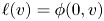 . Thus, the horocycle distance can be computed as

Note that $d_h$ is nothing but the height of $\phi$
 with respect to the $xy$
 -plane. Therefore, we can provide an intrinsic characterization of extrinsic catenary of spherical type
Theorem 6.1 Every hyperbolic horocatenary in $\mathbb {H}^2(r)$ is an extrinsic catenary of the elliptic type. Consequently, the generating curves of minimal surfaces of revolution in $\mathbb {H}^3(r)$
 of the elliptic type are horocatenaries.
Remark 6.2 The horo-geodesic coordinates are analogous to the semi-geodesic coordinates after we exchange $u$ and $v$
 . Thus, the Christoffel symbols are

where $F=\mathrm {e}^{- {v}/{r}}$ . The curvature of $\gamma (t)=\phi (u(t),v(t))$
 in $\mathbb {H}^2(r)$
 is given by

7. Conclusion
We introduced the concept of extrinsic catenaries in the hyperbolic plane, providing novel insights into the variational formulation of curves in non-Euclidean ambient manifolds. Utilizing the hyperboloid model, we defined extrinsic catenaries as critical points of the gravitational potential functional calculated from the extrinsic distance to a fixed reference plane in the ambient Lorentzian space. We delved into the characterization of extrinsic catenaries in terms of their curvature and as solutions to a prescribed curvature problem involving specific vector fields, and we showed that the generating curve of any minimal surface of revolution in the hyperbolic space is an extrinsic catenary.
We note that catenaries of the elliptic type obey a conservation law. Indeed, the Lagrangian $L$ associated with catenaries of the elliptic type, see Eq. (2.9), does not depend on the coordinate $v$
 , which implies $\partial L/\partial \dot {v}$
 is a first integralFootnote 3 . Geometrically, this first integral is associated with a Clairaut-like relation, thus providing information about the angle $\vartheta$
 between an extrinsic catenary of the elliptic type and the $v$
 -coordinate curves of the parametrization (2.6): following theorem 4.1 of Ref. [Reference da Silva and López1], we can prove that

In this context, the $v$ -coordinates curves play the role of parallels if we see the hyperbolic plane as an invariant surface generated by rotations of the hyperbolic type. (We obtain (2.6) by applying $\mathcal {H}_{u/r}$
 , Eq. (4.2), to the geodesic $\ell (v)=r (\cosh (v/r),\sinh (v/r),0)$
 followed by the exchange $(x,y,z,w)\mapsto (x,z,w,y)$
 .)
.)
Extrinsic catenaries of the hyperbolic and parabolic types have no obvious first integrals. Thus, we may ask whether similar conservation also holds for them or whether the absence of circular coordinates in the Lagrangian is just an artefact of a bad choice of coordinates for the hyperbolic plane.
In many aspects, horocycles behave as extrinsically flat curves in hyperbolic geometry, and replacing geodesics with them often leads to problems with good properties. In this work, we established that extrinsic catenaries of the elliptic type could be intrinsically characterized by replacing the extrinsic distance with the intrinsic length of horocycles orthogonal to a reference geodesic, in analogy with (intrinsic) catenaries [Reference da Silva and López1, Reference López5]. The notion of extrinsic catenaries only makes sense when working with the hyperboloid model. Thus, we may also ask whether providing intrinsic characterizations for extrinsic catenaries of the hyperbolic and parabolic types is possible. Consequently, we ask whether it is possible to characterize the generating curve of any hyperbolic minimal surface of revolution without resorting to a specific model for $\mathbb {H}^3$ . A similar question can also be posed concerning minimal surfaces of revolution in $\mathbb {S}^3$
 .
.
Acknowledgements
The authors would like to thank the Referee for thoroughly reading the submitted manuscript. Their comments and suggestions certainly improved the quality of the presentation of our work.
In addition, Luiz da Silva acknowledges the financial support provided by the Morá Miriam Rozen Gerber fellowship for Brazilian postdocs and the Faculty of Physics Postdoctoral Excellence Fellowship during his training at the Weizmann Institute of Science. Rafael López is a member of the IMAG and of the Research Group ‘Problemas variacionales en geometría,’ Junta de Andalucía (FQM 325). This research has been partially supported by MINECO/MICINN/FEDER grant no. PID2020-117868GB-I00, and by the ‘María de Maeztu’ Excellence Unit IMAG, reference CEX2020-001105-M, funded by MCINN/AEI/10.13039/501100011033/CEX2020-001105-M.


 Open access

