


This paper contains supplementary material that can be found online at http://journals.cambridge.org
Introduction
The Mediterranean region, with almost 5,000 islands and islets (de Montmollin & Strahm, Reference de Montmollin and Strahm2005), is known for its high plant diversity and is recognized as one of 34 Global Biodiversity Hotspots (Mittermeier et al., Reference Mittermeier, Gil, Hoffman, Pilgrim, Brooks and Mittermeier2004). Circa 25,000 species are native to the region, with a high percentage of endemism (50–59%: Greuter, Reference Greuter1991; Médail & Quèzel, Reference Médail and Quézel1997), and the archipelagos of the Mediterranean are thus a natural laboratory for evolutionary studies (Thompson, Reference Thompson1999).
A taxon is considered endemic when its distribution is circumscribed to a well-defined geographical district (Anderson, Reference Anderson1994; Cuttelod et al., Reference Cuttelod, García, Abdul Malak, Temple, Katariya, Vié, Hilton-Taylor and Stuart2008). Endemic taxa may be defined as rare and potentially threatened (Ellstrand & Elam, Reference Ellstrand and Elam1993; Fjeldså, Reference Fjeldså1994; Linder, Reference Linder1995; Ceballos et al., Reference Ceballos, Rodriguez and Medellin1998; Myers et al., Reference Myers, Mittermeier, Mittermeier, da Fonseca and Kent2000; Işik, Reference Işik2011), and therefore they may be considered conservation priorities (Schnittler & Ludwig, Reference Schnittler and Ludwig1996; Gruttke et al., Reference Gruttke, Ludvig, Binot-Hafke and Rieken1999). Populations of many species have declined (Butchart et al., Reference Butchart, Walpole, Collen, van Strien, Scharlemann and Almond2010; SCBD, 2010) and extinction rates exceed background extinction rates by two to three orders of magnitude (Pimm et al., Reference Pimm, Russell, Gittleman and Brooks1995).
The most authoritative source of information on the global conservation status of species is the IUCN Red List (Miller et al., Reference Miller, Rodríguez, Aniskowicz-Fowler, Bambaradeniya, Boles and Eaton2007), which uses objective standards based on the assessment of extinction risk at the global level to provide researchers with a system for comparing data (IUCN, 2001, 2011; Mace et al., Reference Mace, Collar, Gaston, Hilton-Taylor, Akcakaya and Leader-Williams2008).
The IUCN Centre for Mediterranean Cooperation and the IUCN Species Survival Commission have highlighted plant conservation and assessment as regional priorities for action (Delanoë et al., Reference Delanoë, de Montmollin and Olivier1996). A project to assess the conservation status of 454 aquatic plant species and 19 subspecies in the Mediterranean was carried out during 2007–2010 (IUCN, 2013) and an evaluation of Mediterranean endemic plants is in progress. However, there has not been sufficient research examining the extent to which global criteria are applicable to small geographical regions such as islands (Martin, Reference Martin2009). Although there has been some research on individual taxa (de Montmollin & Strahm, Reference de Montmollin and Strahm2005; Fenu et al., Reference Fenu, Mattana and Bacchetta2011, Reference Fenu, Mattana and Bacchetta2012), few projects have used the IUCN categories to assess the status of endemic flora for regional red lists (Domínguez Lozano et al., Reference Domínguez Lozano, Galicia Herbada, Moreno Rivero, Moreno Saiz and Sainz Ollero1996; Médail & Verlaque, Reference Médail and Verlaque1997; Trigas et al., Reference Trigas, Iatrou and Panitsa2008) and few have focused on entire archipelagos (Costion et al., Reference Costion, Kitalong and Holm2009; Martin, Reference Martin2009).
The Conservation Working Group of the Italian Botanical Society has initiated an evaluation of the Italian flora to establish a National Red List (Rossi & Gentili, Reference Rossi and Gentili2008). Several taxa of the endemic flora of the Tuscan Archipelago are listed in Conti et al. (Reference Conti, Manzi and Pedrotti1997) and Sposimo & Castelli (Reference Sposimo and Castelli2005); however, to date, only one species in the archipelago (Centaurea gymnocarpa; Foggi, Reference Foggi, de Montmollin and Strahm2005) has been evaluated using the IUCN criteria. Consequently, we started an extended work to assess all the rare and vulnerable plants of the Tuscan Archipelago. Our aim here is to assess all the endemic vascular plants of the Archipelago, based on IUCN criteria (2001, 2011), and highlight threats to the flora in this territory.
Study area
The Tuscan Archipelago comprises seven islands and c. 20 islets (Fig. 1). It originated with the rotation of the Cyrno–Sardinian tectonic plate and the consequent evolution of the northern Apennine. The flora of the archipelago consists of c. 1,400 taxa, 80% of which are herbaceous, reflecting the Mediterranean setting and the prevalence of secondary forms of vegetation; 1.14% of the taxa are strictly endemic, most of which are related to Cyrno–Sardinian elements, suggesting that the Tuscan Archipelago is a biogeographical bridge between the floristic Cyrno–Sardinian dominion and the Italian peninsula. The landscape of the region has changed significantly over recent decades as the traditional economy based on pastoralism, forestation and cultivation has given way to an economy based mostly on tourism (Papayannis & Sorotou, Reference Papayannis, Sorotou, Vogiatzakis, Pungetti and Mannion2008).
The islands of the Tuscan Archipelago. The rectangle on the inset shows the location of the main map off the coast of Italy.

Methods
Species
The conservation status of the 16 plant taxa (species and subspecies) endemic to the Tuscan Archipelago (Table 1) was assessed using the IUCN criteria and guidelines (IUCN, 2001, 2011). The species included those listed by Arrigoni et al. (Reference Arrigoni, Baldini, Foggi and Signorini2003), with the addition of Crocus ilvensis (Peruzzi & Carta, Reference Peruzzi and Carta2011). Contrary to a previous report (Fossi Innamorati, Reference Fossi Innamorati1991), and in accordance with Frignani & Iiriti (Reference Frignani and Iiriti2011), Romulea insularis is considered an endemic species of Capraia Island.
The 16 plant taxa endemic to the Tuscan Archipelago (Fig. 1), with information on distribution and habitat codes (Directive 92/43/EEC).

* Habitat of high importance for conservation
Three of the five IUCN criteria were employed. Criteria A and E were not used because there is insufficient information to assess population dynamics or estimate the minimum viable population. Three main types of information were available for assessment: distribution, population sizes and threats.
Distribution data
The distribution data were obtained from field surveys, museum collections (only records from 2005 onwards were used) and a georeferenced phytosociological database of > 1,000 relevés and permanent plots (from the Laboratory of Plant Biology, Department of Biology, University of Florence). For herbarium specimens and information from phytosociological relevés (mainly collected for vegetation mapping; Foggi et al., Reference Foggi, Cartei, Pignotti, Signorini, Viciani, Dell'Olmo and Menicagli2006, Reference Foggi, Cartei and Pignotti2008, Reference Foggi, Cioffi, Ferretti, Dell'Olmo, Viciani and Lastrucci2011a; Foggi & Pancioli, Reference Foggi and Pancioli2008; Viciani et al., Reference Viciani, Albanesi, Dell'Olmo and Foggi2011) we discarded all records with a georeferencing uncertainty of > 500 m. We conducted field surveys during 2007–2010, from early spring to late summer, to investigate the species localities reported in the historical floristic bibliography on the area, check for species presence data, complete the distribution information, count mature individuals, detect typical habitats of the different taxa, and identify threats and pressures. We recorded the geographical coordinates of each individual, using a global positioning system, to an accuracy of ± 10 m.
All geographical data were plotted using ArcGis v. 10 (ESRI, Redlands, USA). The distribution information was used to compute Extent of Occurrence and Area of Occupancy of each species, following the IUCN guidelines for applying criterion B (IUCN, 2011). Extent of Occurrence was obtained by delimiting a polygon that encompassed all the known localities of a taxon. For species that occurred on several islands (e.g. Linaria capraria) the polygon was computed with the exclusion of the sea areas between islands (IUCN, 2011). Area of Occupancy was calculated by overlaying a 4 km2 Universal Transverse Mercator (UTM) grid on the maps and summing the areas in which each species was located. Because of the narrow distributions of the species and the detail of spatial information available we also calculated the Area of Occupancy using a grid of 1 km2. A 1 km2 grid can be used for assessment when high-precision data are available (IUCN, 2011). The Extent of Occurrence was often lower than the Area of Occupancy for narrowly distributed species. In such cases the Extent of Occurrence was taken to be equal to the Area of Occupancy (IUCN, 2011).
Population size
Population sizes were estimated for the application of criteria C and D by sampling or by counting all mature individuals. All individuals were counted where the population was well circumscribed and comprised few individuals. Where this was infeasible the population was sampled. Sampling was carried out on Elba, Capraia and Formica di Grosseto Islands in a single survey, counting only mature individuals.
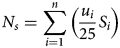
On Elba sampling mostly followed a random stratified design. Ninety-eight plots of 5 × 5 m were selected randomly in the habitats preferred by the endemic taxa, as indicated by Guidi (Reference Guidi2010). Habitats were identified in the field on the basis of the vegetation map of Foggi et al. (Reference Foggi, Cartei, Pignotti, Signorini, Viciani, Dell'Olmo and Menicagli2006). The number of individuals was estimated using:
 $$N_s = \sum\limits_{i = 1}^n {\left( {\displaystyle{{u_i } \over {25}}S_i } \right)} $$
where N s is the number of individuals of a species, μ i is the mean number of individuals in habitat i, and S i is the total area of habitat i; μ i /25 is the density per m2 (Guidi, Reference Guidi2010).
On Capraia, Formica di Grosseto and some parts of Elba sampling was carried out using a simple random design, with 46, 40 and 76 plots, respectively, without stratification as the surveyed species were distributed within a single habitat (Guidi, Reference Guidi2010; Peruzzi & Carta, Reference Peruzzi and Carta2011). Given the narrow distributions of the species surveyed, each plot was 1 m2. The number of individuals was estimated using:
 $$N_s = \mu _i S_{\,ji} $$
where N s is the number of individuals, μ i is the mean number of individuals per plot of the ith species (in this case, the mean number of individuals per m2 because the plot size is 1 × 1 m) and S ji is the area of the jth habitat for the ith species (Guidi, Reference Guidi2010). The data collection methods employed for each species are summarized in Supplementary Table S1.
Locations
We defined the number of locations according to the distribution of populations and the threats affecting them, based on IUCN (2012).
Although the term locations may be considered subjective (Robbirt et al., Reference Robbirt, Roberts and Hawkins2006) we followed the IUCN (2011) guidelines that define a location as ‘a geographically or ecologically distinct area in which a single event can rapidly affect all individuals of the taxon’. We considered subpopulations of the same species from different islands as belonging to different locations because, given the distance between them, a threat affecting one subpopulation could not threaten the whole species with extinction. On a given island we considered that all individuals of the same taxon living in adjacent cells belonged to the same subpopulation, following Rivers et al. (Reference Rivers, Bachman, Meagher, Nic Lughadha and Brummitt2009).
Risk value
For each taxon we defined a synthetic risk-value index considering the increase in the risk of extinction, assigning numerical values to IUCN categories: Near Threatened = 1, Vulnerable = 2, Endangered = 3 and Critically Endangered = 4. The total risk value is the sum of the risk values of all the taxa of the Archipelago.
Results
The distribution maps for the taxa studied, based on the UTM 1 km2 grid, are shown in Figs 2 & 3 and the results of the risk assessment are presented in Supplementary Table S1 and Table 2. Of the 16 taxa evaluated we categorized three as Near Threatened, two as Vulnerable, eight as Endangered and three as Critically Endangered.
The Area of Occupancy (grid 1 × 1 km) of eight endemic taxa in the Tuscan Archipelago (Fig. 1): Biscutella pichiana subsp. ilvensis, Centaurea aetaliae, Centaurea ilvensis, Crocus ilvensis, Festuca gamisansii subsp. aethaliae, Limonium ilvae, Viola corsica subsp. ilvensis and Linaria capraria.

Previous status and proposed threat category of the 16 taxa studied. Risk values are assigned to IUCN Red List categories as follows: LC or NT, 1; VU, 2; EN, 3; CR, 4.

* LC, Least Concern (including LR, Lower Risk, in the old IUCN categorization); NT, Near Threatened; VU, Vulnerable; EN, Endangered; CR, Critically Endangered
We identified two main groups of threats to these endemic plants: human activities and invasion by alien species. The main threats associated with invasive alien species are those that directly affect habitats and/or species as competitors or predators (code 8.1.2; IUCN, 2012), with 10 taxa affected. Predation by free-roaming goats is a threat to seven taxa (code 2.3). Six taxa are indirectly affected by loss of habitat as a result of human activities (code 7.3) and eight taxa by changes in vegetation dynamics (code 8.2.1). Human influence involves infrastructure, tourism and recreational activities (codes 1.1, 1.3, 4.1 and 5.2.1, nine taxa affected). Landslides are a minor threat (code 10.3), affecting only the Giglio subpopulation of L. capraria (Coppi et al., Reference Coppi, Guidi, Viciani and Foggi2013).
All taxa apart from three localized species (Limonium doriae, R. insularis and Silene capraria) were present in at least two locations and not all populations were under threat. The number of locations was higher for species occurring on more than one island, with L. capraria and Limonium sommierianum having the highest number of locations, on five and three islands, respectively, and for Limonium ilvae, which occurs along the coast of Elba.
Discussion
Of the 16 endemic taxa, eight are Endangered and three are Critically Endangered. IUCN criterion B was the most commonly used for risk categorization, perhaps because of the ease of collecting reliable distribution data (Rossi et al., Reference Rossi, Gentili, Abeli, Foggi, Rossi, Gentili, Abeli, Gargano, Foggi, Raimondo and Blasi2008b). In this study the use of criterion B has resulted in higher risk categories compared with categorization based on number of individuals. Both measures of Area of Occupancy (based on UTM grids of 1 and 4 km2) led to the same Red List categorization. Hence species with a large population but a narrow distribution, such as R. insularis (population c. 1 million), may nevertheless be categorized as Critically Endangered. Many species are under threat as a result of changes in habitat management (Wilcove et al., Reference Wilcove, Rothstein, Dubow, Phillips and Losos1998; Rossi et al., Reference Rossi, Gentili, Abeli, Foggi, Rossi, Gentili, Abeli, Gargano, Foggi, Raimondo and Blasi2008b). We categorized three species as Critically Endangered (L. doriae, R. insularis and S. capraria). The main threats to these species in the summit area of Capraia Island are a result of the abandonment of agricultural activities. These small species prefer open habitat such as Isoëto-Nanojunceta temporary ponds and Tuberarietea therophytic grasslands (Natura 2000 habitat codes 3170 and 6220, respectively, according to Directive 92/43/ECE; both are conservation priorities), which are maintained by mild anthropogenic disturbance that slows the development of woody vegetation. They are threatened by the presence of scrub or tall forbs, which have arisen following the abandonment of agropastoral management. To avoid the invasion of scrub vegetation, two Life-Nat projects have been established. The first results (Foggi et al., Reference Foggi, Guidi, Venturi and Ghisolfi2009) indicate an improvement in habitat quality for R. insularis but conservation actions will need to be incorporated into standard management. The five species belonging to the genus Limonium are suffrutex that inhabit chasmophytic or lithophytic aeroaline coastal habitats. They are threatened by coastal development for tourism, and the increasing numbers of invasive species introduced in the gardens of new settlements. For several species on Elba (e.g. Centaurea aetaliae, Centaurea ilvensis and L. capraria), walls and road escarpments are important corridors of secondary habitat, facilitating interaction between isolated populations (Guidi, Reference Guidi2010). The survival of these species is threatened by management of roadside vegetation, which is usually carried out during the flowering period (April–June). This type of threat could be mitigated by establishing management guidelines for local authorities.
Invasive plant and animal species, both alien and native, are the second most significant threat to the endemic plant species of the Tuscan Archipelago, affecting 14 of the 16 endemic taxa. These invasive species have a negative effect on populations of the endemic species and drive indirect changes in the dynamics of the local vegetation. They can also facilitate the arrival of nitrophilous and/or cosmopolitan species, as reported for small islands (Foggi et al., Reference Foggi, Signorini, Grigioni and Clauser2000), or of other invasive alien species such as Carpobrotus acinaciformis, Senecio angulatus and Opuntia spp., which affect C. gymnocarpa in Capraia (Foggi, Reference Foggi, de Montmollin and Strahm2005). Invasive alien animal species such as goats Capra hircus, wild boars Sus scrofa, black rats Rattus rattus and mouflons Ovis orientalis musimon affect, to varying degrees, populations of Biscutella pichiana subsp. ilvensis, Centaurea ilvensis, C. aetaliae, Crocus ilvensis, Festuca gamisansii subsp. aethaliae, L. capraria and Viola corsica subsp. ilvensis. The problem of invasive species is amplified in insular ecosystems (Whittaker & Fernándes-Palacios, Reference Whittaker and Fernández-Palacios2007) and could be deleterious for strictly localized species, especially in view of potential climate-change scenarios (Kier et al., Reference Kier, Kreft, Lee, Jetz, Ibisch and Nowiki2009). Eradication programmes have been implemented for several alien plant species (Giunti et al., Reference Giunti, Sposimo and Foggi2009; Sposimo et al., Reference Sposimo, Baccetti, Raganella Pelliccioni, Gubert, Giannini and Capizzi2011) but their results have yet to be verified. In the case of L. doriae, threats posed by the invasive alien plant Arundo donax and by the nitrophilous Atriplex hastata and Portulaca oleracea are driven by an increase in the seagull population (Foggi et al., Reference Foggi, Signorini, Grigioni and Clauser2000). The persistence of these invasive plants could lead to the extinction of L. doriae, and therefore we assess this species as Critically Endangered.
The Convention on Biological Diversity recognizes the problem of invasive alien species as a focal point for conservation (CBD, 2010) in its strategic goals for 2020: ‘By 2020, invasive alien species and pathways are identified and prioritized, priority species are controlled or eradicated, and measures are put in place to manage pathways to prevent their introduction and establishment’. The study of alien invasion processes in the Tuscan Archipelago has begun, along with several other actions funded by the Tuscan Archipelago National Park and by the Tuscany Regional Administration (Viciani et al., Reference Viciani, Lastrucci, Dell'Olmo, Ferretti and Foggi2014). Studies have revealed an increase in the number of alien species detected over recent decades (Lastrucci et al., Reference Lastrucci, Calamassi, Ferretti, Galasso and Foggi2012; Lazzaro et al., Reference Lazzaro, Ferretti, Galasso, Lastrucci and Foggi2013), from 69 species at the beginning of the 1980s (Viegi & Cela Renzoni, Reference Viegi and Cela Renzoni1981) to 171 species in 2013 (Foggi et al., unpubl. data), most of which were introduced for horticultural and gardening purposes.
As mentioned in the introduction, some published documents (Conti et al., Reference Conti, Manzi and Pedrotti1997; Sposimo & Castelli, Reference Sposimo and Castelli2005) report IUCN Red List categories for several endemic plants of the Tuscan Archipelago. Although the status reported in these documents does not arise from a strict application of the IUCN categories and criteria (Rossi et al., Reference Rossi, Gentili, Abeli, Gargano, Foggi, Rossi, Gentili, Abeli, Gargano, Foggi, Raimondo and Blasi2008a) we can use these data for comparison. In Table 2 we indicate the past and present status of the studied taxa, with the exception of Crocus ilvensis, which was described in 2011. Apart from L. capraria all have been recategorized with a higher degree of threat. The total risk value shows an increase in the risk of extinction. This is in accordance with Kier et al. (Reference Kier, Kreft, Lee, Jetz, Ibisch and Nowiki2009): ‘while island and mainland regions suffered equally from past habitat loss, we find the human impact index, a measure of current threat, to be significantly higher on islands’. The scarcity of information (distribution data, population size) up to 2005 was addressed during 2007–2011, when increases in the Area of Occupancy and Extent of Occurrence were recorded. It is likely that the increased threat to the survival of the endemic flora of the Tuscan Archipelago since 1997 (Conti et al., Reference Conti, Manzi and Pedrotti1997) is related to the increase in the number of taxa and number of individuals of alien species.
Since the establishment of the Tuscan Archipelago National Park in 1991, several actions have been taken (habitat conservation, eradication of invasive alien plants and animals, education of young people) to counteract the loss of biodiversity (Zanichelli & Giannini, Reference Zanichelli and Giannini2008). However, as the most significant threats are anthropogenic, a sustainable solution will require a systemic and interdisciplinary approach to biodiversity conservation (Delanoë et al., Reference Delanoë, de Montmollin and Olivier1996). For all species studied, and particularly for those categorized as Critically Endangered, in situ conservation measures need to be integrated with ex situ programmes (Smith et al., Reference Smith, Dickie, Linington, Probert and Way2010), providing source material for reintroduction projects (Foggi et al., Reference Foggi, Lastrucci, Viciani, Brunialti and Benesperi2011b; Carta et al., Reference Carta, Bedini, Foggi and Probert2012).
Given their high levels of endemism and species richness, islands may offer high returns for species conservation efforts and therefore warrant high priority in global biodiversity conservation (Kier et al., Reference Kier, Kreft, Lee, Jetz, Ibisch and Nowiki2009). Given the limited resources available to implement biodiversity conservation policies (Balmford et al., Reference Balmford, Bennun, ten Brink, Cooper, Côté and Crane2005), we recommend an integrated approach to conservation of the flora of the Tuscan Archipelago, combining the IUCN criteria with other criteria not included in the IUCN scheme (Gauthier et al., Reference Gauthier, Debussche and Thompson2010; Bacchetta et al., Reference Bacchetta, Farris and Pontecorvo2012). This study may be considered the first attempt to assess priorities among species for inclusion in ex situ and in situ conservation programmes (Gauthier et al., Reference Gauthier, Debussche and Thompson2010; Jiménez-Alfaro et al., Reference Jiménez-Alfaro, Colubi and González-Rodríguez2010) in the Tuscan Archipelago.
The Area of Occupancy (grid 1 × 1 km) of eight endemic taxa in the Tuscan Archipelago (Fig. 1): Limonium sommierianum, Limonium gorgonae, Limonium planesiae, Limonium doriae, Mentha requienii subsp. bistaminata, Romulea insularis, Silene capraria and Centaurea gymnocarpa.

Acknowledgements
This research was supported by funding from the Tuscan Archipelago National Park, which also permitted the collection of plant material. We thank the IUCN Species Survival Commission for the use of an ArcGIS license.
Biographical sketches
Bruno Foggi and Riccardo Baldini have a particular interest in the flora of the Tuscan Archipelago. Daniele Viciani carries out geobotanical analysis in the western Mediterranean. Angelino Carta is interested in ex-situ conservation. Tommaso Guidi has a particular interest in modelling species distribution areas.



