Cancer cachexia is considered a complex multifactorial syndrome characterised by an ongoing loss of skeletal muscle mass, with or without loss of fat mass(Reference Fearon, Strasser and Anker1). Considered to affect up to half of patients with advanced cancer, contemporary evidence suggests it is responsible for approximately 20 % of cancer-related deaths(Reference Arends, Strasser and Gonella2). Furthermore, it is negatively associated with response to anticancer therapy(Reference Bachmann, Heiligensetzer and Krakowski-Roosen3), physical function, survival and quality of life in patients with advanced cancer(Reference Arends, Bachmann and Baracos4,Reference Daly, Dolan and Power5) . Thus, cachexia has been recognised for a long time as an adverse effect of cancer, and its clinical management is currently both limited and complex(Reference Arends, Bachmann and Baracos4,Reference Kaasa, Loge and Fayers6) . The Global Leadership Initiative on Malnutrition (GLIM) consensus defines cachexia as a chronic disease-related malnutrition associated with inflammation. It was agreed that diagnosis required one of three recognised phenotypic diagnostic criteria (low BMI, non-volitional weight loss (WL) and reduced muscle mass) and one aetiologic criterion (reduced food intake/assimilation and disease burden/inflammation secondary to acute disease/injury or chronic disease)(Reference Cederholm, Jensen and Correia7). However, the frameworks for the clinical application of the GLIM criteria require validation. Considering BMI and WL, two phenotypic criteria proposed by GLIM, Martin and colleagues suggested that their BMI-adjusted WL grading system was useful to predict survival, as it was independent of cancer site, stage and performance status, and strongly discriminates survival differences(Reference Martin, Senesse and Gioulbasanis8). In another study by the same group analysing a cohort of almost 5000 patients, they showed that WL is largely determined by dietary intake and systemic inflammation(Reference Martin, Muscaritoli and Bourdel-Marchasson9). Of these two GLIM aetiologic criteria, the authors concluded that impairment in food intake and elevated C-reactive protein levels may improve the diagnosis and classification of cancer-associated cachexia(Reference Martin, Muscaritoli and Bourdel-Marchasson9). Based on the present evidence, an assessment of systemic inflammation may provide a framework for examining the prognostic value of cachexia in patients with advanced cancer. Indeed, previous inflammation-based frameworks, combining modified Glasgow Prognostic Score (mGPS) and performance status, have been shown to have complimentary prognostic value in patients with advanced cancer(Reference Laird, Kaasa and McMillan10).
Therefore, the aim of the present study was to examine the prognostic value of the GLIM criteria, including BMI, WL and systemic inflammation, in patients with advanced cancer.
Material and methods
Study population
Analysis was undertaken on a combined European and Brazilian cohort of adult patients with advanced cancer. The combined cohort was a prospective data collection of patients with advanced cancer across sites in the UK and Ireland between 2011 and 2016(Reference Dolan, Daly and Simmons11,Reference Dolan, Daly and Sim12) and from Brazil between 2011 and 2014. Eligible adult patients with advanced cancer (defined as locally advanced or with histological, cytological or radiological evidence of metastasis), across all cancer subtypes, who provided a venous blood sample, were assessed for inclusion. Patients who were undergoing active anticancer therapy or not, in either an inpatient or outpatient setting, were included. The study had ethics committee approval, and all patients signed a consent-to-participate form in compliance with the Declaration of Helsinki(Reference Dolan, Daly and Simmons11,Reference Dolan, Daly and Sim12) and Resolution 466/12 of the Brazilian National Health Council. Furthermore, the study also conformed to the STROBE guidelines for cohort studies(Reference von Elm, Altman and Egger13).
Procedure and assessment
General demographic data and clinicopathological characteristics were recorded for each patient. The tumour site was grouped as lung, breast, gynaecological, gastrointestinal, urological, haematological, melanoma, neurological, unknown primary and other. The systemic inflammatory response was analysed using C-reactive protein and albumin, and the mGPS was calculated as previously described and grouped as 0/1/2(Reference McMillan14). The biomarkers were taken by venous blood sampling at entry points, and an autoanalyser was used to measure C-reactive protein (mg/l) and albumin (g/l) concentrations according to routine clinical laboratory protocols.
Patients were also categorised according to BMI (< 20·0, 20·0–21·9, 22·0–24·9, 25·0–27·9 and ≥ 28·0 kg/m2); WL (+– 2·4 %, 2·5 to 5·9 %, 6·0 to 10·9 %, 11·0 to 14·9 and ≥ 15 %) and BMI/WL grade (0, 1, 2, 3 and 4) as previously described by Martin and co-authors(Reference Martin, Senesse and Gioulbasanis8). This study with 8160 oncologic patients developed a robust grading system incorporating the independent prognostic significance of both BMI and WL, and %WL was calculated as follows: [(current weight in kg – previous weight in kg)/previous weight in kg] × 100.
Statistical analysis
The survival time, defined as the number of months from study entry until death, or censored if alive at the follow-up date, was calculated. Survival analysis was carried out using the Cox proportional hazards model, and HR were calculated. Multivariate survival analysis was conducted using a stepwise backward procedure to derive a final model of the variables that had a significant independent relationship with survival. To remove a variable from the model, the corresponding P value had to be > 0·10. The χ 2 test was used for comparisons of categorical variables. All statistical testing was conducted at the 5 % level, and 95 % CI were reported throughout. Two-sided P-values less than 0·05 were considered significant. All analyses were conducted in SPSS Version 20 (SPSS Inc).
Results
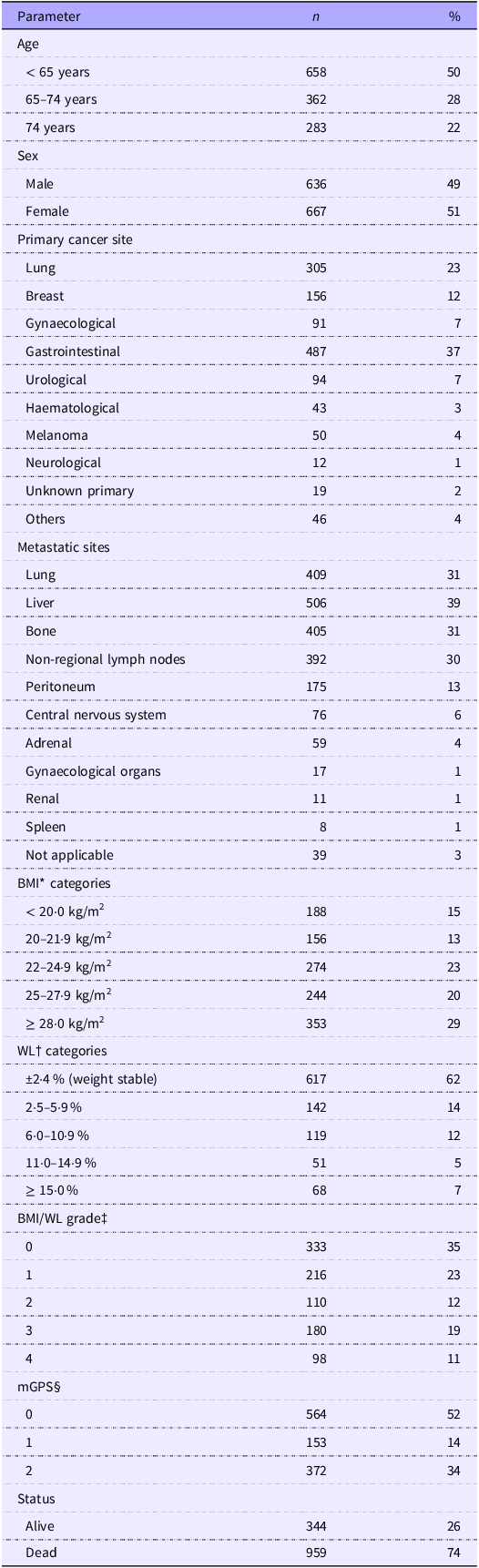
Data were available on 1303 patients in the combined European and Brazilian cohorts. The patient’s clinicopathological characteristics are shown in Table 1. The median age was 64·75 years (interquartile range (IQR) 55·54–72·70), and 667 patients were female (51 %). The majority of patients had either gastrointestinal (37 %, n 487) or lung (23 %, n 305) tumours as a primary cancer site. The liver was the most common metastatic site (39 %, n 506), followed by lung (31 %, n 409) and bone (31 %, n 405). The majority of patients had either a BMI ≥ 28 kg/m2 (29 %, n 353) or a BMI of 22–24·9 kg/m2 (22 %, n 274). Of the patients, 62 % had weight stable, 35 % had BMI/WL grade, 0·52 % had mGPS 0 and 34 % had mGPS 2. At the time of cessation of data collection, 344 patients were alive (26 %), and 959 (74 %) had died. The median survival was 6·6 months (IQR 3·0–14·6).
Clinicopathological characteristics of patients with advanced cancer – combined European and Brazilian cohort (n 1303) (Numbers and percentages)

mGPS, modified Glasgow Prognostic Score; WL, weight loss.
* BMI available on 1215 patients.
† WL available on 997 patients.
‡ BMI/WL grade available on 937 patients. BMI/WL grades calculated based on Martin et al. (Reference Martin, Senesse and Gioulbasanis8).
§ mGPS available on 1089 patients.
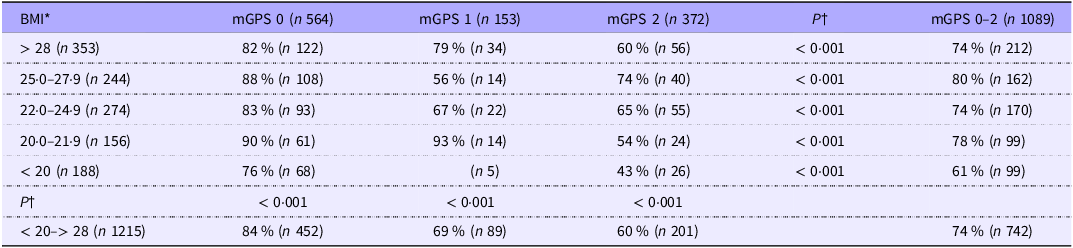
In Table 2, the 3-month survival rates were compared based on mGPS and BMI classifications. Regarding BMI, regardless of mGPS, the 3-month survival rates were similar and ranged from 78 % (BMI 20–21·9) to 61 % (BMI < 20). Considering the mGPS alone, the 3-month survival rate ranges from 84 % (mGPS 0) to 60 % (mGPS 2). Considering the combination of these two parameters, the 3-month survival rates range from 93 % (mGPS 1 and BMI 20–21·9) to 43 % (mGPS 2 and BMI < 20). Notably, the 3-month survival rate in the worst prognosis subgroup (BMI < 20) is 76 % when mGPS is 0 and 43 % when mGPS is 2.
The relationship between BMI and the mGPS and the survival rate at 3 months in patients with advanced cancer – European cohort and Brazilian cohort (n 1·303)

mGPS, modified Glasgow Prognostic Score.
Note: Survival rate (s e)% at 3 months, not calculated if n < 10.
* BMI grouping based on Martin et al. (Reference Martin, Senesse and Gioulbasanis8).
† P value from χ 2 analysis.
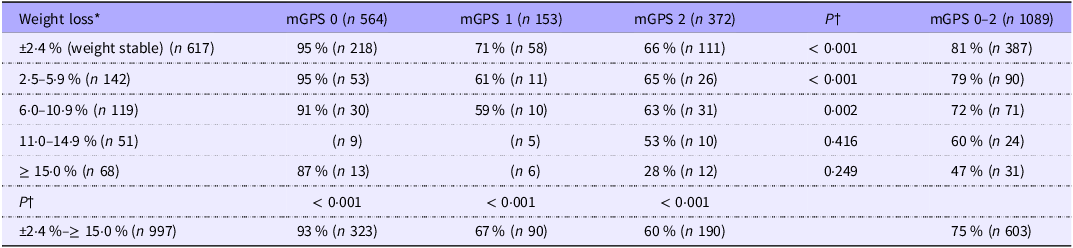
In Table 3, the 3-month survival rate is described based on mGPS and WL classifications. Regarding the WL categories, the 3-month survival rates decreased as WL increased, ranging from 47 % in cases of WL ≥ 15·0 % to 81 % when weight was considered stable (±2·4 %). When considering mGPS alone, the 3-month survival rate was higher when mGPS was 0 (93 %), compared with mGPS 1 (67 %) and 2 (60 %). Considering the combination of these two parameters, the 3-month survival rate ranges from 95 % (weight stable and mGPS 0) to 28 % (WL ≥ 15·0 % and mGPS 2). So, integrating the two prognostic tools enhances the precision of prognosis prediction, particularly in cases of stable WL, where the mGPS categories distinguished patients with 3-month survival rates of 95 % (mGPS 0), 71 % (mGPS 1) and 66 % (mGPS 2). Specifically, in the subgroup with the poorest prognosis (WL ≥ 15·0 %), the 3-month survival rate is 87 % when the mGPS is 0 and drops to 28 % when the mGPS is 2.
The relationship between weight lost (WL) and the mGPS and the survival rate at 3 months in patients with advanced cancer – European cohort and Brazilian cohort (n 1·303)

mGPS, modified Glasgow Prognostic Score.
Note: Survival rate (s e)% at 3 months, not calculated if n < 10.
* WL grouping based on Martin et al. (Reference Martin, Senesse and Gioulbasanis8).
† P value from χ2 analysis.
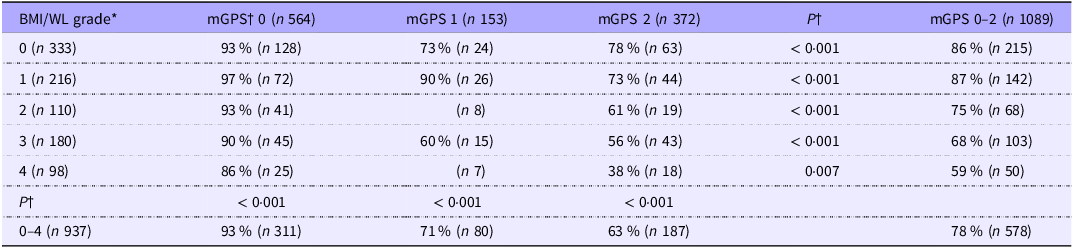
The 3-month survival rates were also compared based on mGPS and BMI/WL grade (Table 4). Individually, the higher the BMI/WL grade, the worse the prognosis; with 3-month survival rates of 86 and 87 % for BMI/WL grades 0 and 1, respectively, and 59 % for BMI/WL grade 4. When considering mGPS alone, the 3-month survival rate was higher with an mGPS of 0 (93 %) compared with mGPS 1 (71 %) and mGPS 2 (63 %). Combining the two prognostic tools enhances the accuracy of prognosis differentiation. In all evaluated categories, the combination of the two prognostic tools effectively distinguished patients with different outcomes. Notably, in patients with BMI/WL grade 4, the 3-month survival rates were 86 and 38 % when mGPS was 0 and 2, respectively.
The relationship between BMI/WL grade and the mGPS and the survival rate at 3 months in patients with advanced cancer – combined European and Brazilian cohort (n 1·303)

mGPS, modified Glasgow Prognostic Score; WL, weight loss.
Note: Survival rate (s e)% at 3 months, not calculated if n < 10.
* BMI/WL grades calculated based on Martin et al. (Reference Martin, Senesse and Gioulbasanis8).
† P value from χ 2 analysis.
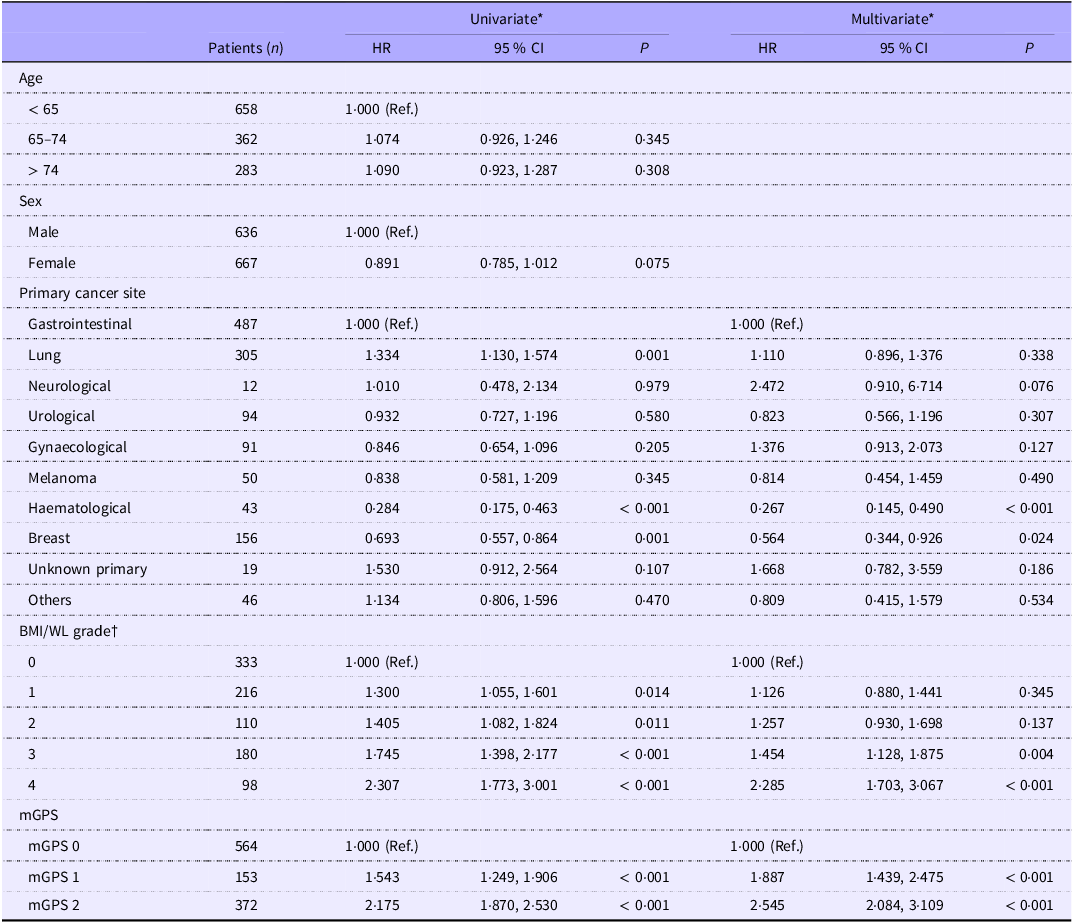
The relationship between objective clinicopathological factors and survival in patients with advanced cancer is shown in Table 5. On univariate survival analysis, lung, haematological and breast as primary cancer sites (HR 1·334 and P = 0·001, HR 0·284 and P < 0·001, HR 0·693 and P = 0·001, respectively), mGPS (HR 1·543–2·175, all P < 0·001) and BMI/WL grade 1, 2, 3 and 4 (HR 1·300 and P = 0·014, HR 1·405 and P = 0·011, HR 1·745 and P < 0·001, HR 2·307 and P < 0·001, respectively) were significantly associated with survival. Age and sex were not associated with survival. On multivariate survival analysis, the most highly predictive factors were BMI/WL grade 3 (HR 1·454, P = 0·004), BMI/WL grade 4 (HR 2·285, P < 0·001) and mGPS (HR 1·887–2·545, all P < 0·001).
The relationship between objective clinicopathological factors and survival in patients with advanced cancer – combined European and Brazilian cohort (n 1·303) (Hazard ratios and 95 % confidence intervals)

mGPS, modified Glasgow Prognostic Score; WL, weight lost.
* HR expressed as per 10 unit change.
† BMI/WL grades calculated based on Martin et al. (Reference Martin, Senesse and Gioulbasanis8).
Discussion
The results of the present study show that BMI, WL and the mGPS, which are phenotypic and aetiologic criteria proposed by GLIM, were significantly and independently associated with survival in patients with advanced cancer (European and Brazilian cohorts combined). Furthermore, when these phenotypic and aetiologic criteria were combined, they provided an enhanced prediction of survival.
The results of the present study are consistent with the findings of Martin and co-workers, who demonstrated that BMI and WL predicted survival independently of conventional prognostic factors. When used in combination with a BMI/WL grading system, it provided a severity grade related to the risk of shortened survival(Reference Martin, Senesse and Gioulbasanis8). Indeed, a prospective study with patients with advanced cancer showed that BMI/WL grade remained independently associated with overall survival. Additionally, in patients with a BMI/WL grade 0/1, both performance status and mGPS also remained independently associated with overall survival(Reference Martin, Senesse and Gioulbasanis8). In this study, the mGPS predicted survival in patients for whom the GLIM criteria were considered normal. These results have several implications, particularly that the systemic inflammatory response precedes the development of malnutrition and should form the basis of the application of GLIM criteria in clinical practice. A recent review highlighted that systemic inflammation has progressively moved to the forefront of the definition and diagnosis of cancer cachexia. The authors consider cancer cachexia as primarily a systemic inflammatory response syndrome, and in this way, there are a number of potential implications for daily clinical practice(Reference McGovern, Dolan and Skipworth15). Furthermore, a recent article comparing prognostic factors in patients with advanced cancer found that a high-performance status score and mGPS were consistently associated with poorer survival(Reference Rocha, Dolan and Paiva16).
Furthermore, contemporary evidence suggests that systemic inflammation is a determinant of body composition, symptom burden, physical function and outcomes in patients with advanced cancer(Reference Martin, Muscaritoli and Bourdel-Marchasson9,Reference Laird, Kaasa and McMillan10,Reference von Elm, Altman and Egger13,Reference Laird, McMillan and Fayers17,Reference Dolan, Almasaudi and Dieu18) . A phase III trial with advanced gastric and esophagogastric junction cancer patients showed that the mGPS was correlated with sarcopenia and dominated the prognostic role of baseline body composition parameters in these patients. The authors support a model where tumour-mediated inflammatory response, as measured by mGPS, represents a well-validated strong negative prognostic factor, which is related to sarcopenia. However, a direct causal path from sarcopenia to survival is lacking(Reference Hacker, Hasenclever and Baber19). Considering that patients with advanced cancer who are systemically inflamed but with no evidence of WL are pre-cachexic(Reference MacDonald, Easson and Mazurak20), cancer cachexia may be considered a disease-related inflammation with malnutrition. For instance, Wallengren and co-workers reported that patients with advanced cancer and CRP levels greater than 10 mg/l exhibited lower muscle mass at baseline and longitudinally(Reference Wallengren, Iresjo and Lundholm21). In addition, Malietzis et al. reported that, in patients with operable colorectal cancer, a neutrophil lymphocyte ratio greater than 3 was associated with lower muscle mass(Reference Malietzis, Currie and Johns22). Another study with 650 operable colorectal cancer patients showed that sarcopenia (Skeletal Muscle Index) and myosteatosis (Skeletal Muscle Density) were associated with the presence of a systemic inflammatory response (in particular, the mGPS) and had independent prognostic value(Reference Dolan, Almasaudi and Dieu18). Given the above, the assessment of systemic inflammation, in addition to nutritional status, should be considered as an essential component of the routine clinical and nutritional evaluation. In this context and based on the results of our study, it is suggested that the tool used to assess systemic inflammation in GLIM would be the mGPS.
Relevant studies and systematic reviews with meta-analyses on GLIM criteria and prognosis in cancer patients have been published and highlight the relevance of the applicability of GLIM in cancer patients and the differences in the dataset. Zhang and co-workers conducted a retrospective cohort analysis with almost 1500 cancer patients and reported that the GLIM criteria can be used in elderly cancer patients not only to assess malnutrition but also to predict survival outcomes(Reference Zhang, Tang and Zhang23). A systematic review of twenty-one cohort studies published after 2018 showed that GLIM-defined malnutrition was consistently predictive of worse clinical outcomes in cancer patients. Notably, the predictive capacity of GLIM for survival was not affected by different measures of muscle mass reduction. However, variation in the assessment of aetiologic criteria has resulted in variation in the predictive ability of the GLIM diagnosis for survival(Reference Brown, Loeliger and Stewart24). Matsui and co-authors conducted a systematic review and random-effects meta-analysis studies that included cancer patients receiving any type of treatment, with nutritional status assessed using GLIM criteria. The study highlighted that GLIM-defined malnutrition may worsen overall survival and increase the risk of postoperative complications in patients with cancer undergoing treatment(Reference Matsui, Rifu and Watanabe25).
The present study had limitations that should be considered. Given its cross-sectional design, heterogenous population and observational nature, it is subject to sample bias. However, a large cohort of well-characterised patients was examined, and the prognostic value of GLIM criteria was consistent across tumour types. The prognostic roles of BMI, WL and BMI/WL were evaluated alongside mGPS. Our findings indicate that mGPS improves prognostic prediction when used in conjunction with WL measures. One limitation of the study is that the accuracy of these measures was not compared directly. Nevertheless, we believe that BMI/WL should be used in combination with mGPS, particularly because these variables were significant in the multivariate survival analysis.
In summary, a high BMI/WL grade and a high mGPS, as outlined in the BMI/WL grade/mGPS framework, were consistently associated with poorer survival outcomes of patients with advanced cancer in the combined prospective European and Brazilian combined cohort. This framework can be readily incorporated into routine patient assessments due to its simplicity and clinical utility.
Acknowledgements
This study received financial support from Medical Research Scotland, Conselho Nacional de Desenvolvimento Científico e Tecnológico, Fundação de Amparo à Pesquisa do Estado de Minas Gerais (FAPEMIG, grant no.: APQ-01961-23) and Coordenação de Aperfeiçoamento de Pessoal de Nível Superior (CAPES grant no.: 88881.624514/2021-01). The funders had no role in the study design, data collection and analysis, decision to publish or preparation of the manuscript.
Conceptualisation, design and methodology (B. M. M. R., R. D. D., C. E. P., J. M., Y. C. P. M., B. J. L., D. C. M.), data curation (B. M. M. R., R. D. D., C. E. P., J. M., B. S. R. P., D. D. P., Y. C. P. M., B. J. L., D. C. M.), formal analysis (B. M. M. R., R. D. D., C. E. P., J. M., Y. C. P. M., B. J. L., D. C. M.), funding acquisition (B. M. M. R., R. D. D., C. E. P., Y. C. P. M., B. J. L., D. C. M.), project administration (B. M. M. R., R. D. D., C. E. P., Y. C. P. M., B. J. L., D. C. M.), supervision (R. D. D., C. E. P.,Y. C. P. M., B. J. L., D. C. M.), writing – original draft (B. M. M. R., C. E. P.,Y. C. P. M., B. J. L., D. C. M.) and review and editing (B. M. M. R., R. D. D., C. E. P., J. M., B. S. R. P., D. D. P., Y. C. P. M., B. J. L., D. C. M.).
The authors declare no potential conflicts of interest.
All patients provided written informed consent. The study complied with the Declaration of Helsinki and was approved by the Human Research Ethics Committee (West of Scotland Ethics Committee UK: 18/WS/0001 (18/01/2018), Cork Research Ethics Committee Ireland: ECM 4 (g) (03/03/2015) and Ethics Committee of the Barretos Cancer Hospital (HCB433/2011 and HCB783/2014)).
The datasets that formed the basis of this article are contained in the University of Glasgow’s MVLS institute (Scotland) and Barretos Cancer Hospital (Brazil). They contain patient-sensitive information and therefore cannot be made available on a public repository.