




Introduction
Postprandial hypotension (PPH) is a common condition in the older adult population (Jansen et al., Reference Jansen, Connelly, Kelley-Gagnon, Parker and Lipsitz1995); in fact, it has been shown to affect approximately one-quarter of older adults that have a past history of falls (Puisieux et al., Reference Puisieux, Bulckaen, Fauchais, Drumez, Salomez-Granier and Dewailly2000). PPH, which is defined as a decline in systolic blood pressure (SBP) of at least 20 mm of Hg (or to less than 90 mm of Hg) during a meal test (Puisieux et al., Reference Puisieux, Bulckaen, Fauchais, Drumez, Salomez-Granier and Dewailly2000), is a poorly understood condition that often results in falls. PPH has been shown to be clearly linked to higher mortality (Fisher et al., Reference Fisher, Davis, Srikusalanukul and Budge2005) and morbidity, likely due to fall-related injuries (Aronow & Ahn, Reference Aronow and Ahn1997; Jansen & Lipsitz, Reference Jansen and Lipsitz1995). Outside of the use of dietary modifications, there is no currently recommended pharmacological treatment for this condition, although some have studied the use of acarbose, an alpha-glucosidase inhibitor, as a potential therapy.
Although not very well studied as a treatment for PPH, acarbose slows gastric emptying (Gentilcore et al., Reference Gentilcore, Bryant, Wishart, Morris, Horowitz and Jones2005), which might attenuate PPH by activation of the gastrovascular reflex (van Orshoven et al., Reference van Orshoven, Oey, van Schelven, Roelofs, Jansen and Akkermans2004). It also has been shown to slow the hypotensive response to duodenal sucrose administration (Gentilcore et al., Reference Gentilcore, Bryant, Wishart, Morris, Horowitz and Jones2005). Previous case reports (Sasaki et al., Reference Sasaki, Goda, Nagata, Kitaoka, Ohsawa and Hanafusa2001), meal test studies (Madden et al., Reference Madden, Harris and Meneilly2015; Qiao et al., Reference Qiao, Li, Li, Qian, Chen, Wei, Jin and Wang2016; Zhang & Guo, Reference Zhang and Guo2017), and systematic reviews (Wang et al., Reference Wang, Zhao, Zhan, Wang, Liu, Zhou and Xu2021) of acarbose have only exclusively studied older adult volunteers with diabetes. No investigations have been performed on a general older adult population that do not necessarily have diabetes, indicating that the effectiveness of acarbose in the general older adult population needs to be established before this medication can be more widely prescribed for PPH.
The objective of our study was to examine, using a randomized, placebo-controlled design, the impact of acarbose on the average change in SBP (PPHmean), the maximal decline in SBP (PPHmax), and the number of PPH events (PPHnum) during a meal test in older adults recruited from geriatrics clinics. We hypothesized that acarbose would attenuate the postprandial hypotensive response in a general population of older adults that did not necessarily have diabetes.
Materials and methods
Subjects
Every participant was required to be at least 65 years old, and they were all recruited sequentially from Geriatric Medicine clinics situated within the Vancouver Coastal Health Authority. All subjects were required to have a normal physical exam, a normal creatinine, and a normal hematocrit. Subjects were excluded if they had a history of stroke, coronary artery disease, uncontrolled hypertension, smoking (in the last 5 years), or chronic respiratory disease. Due to both the uncertainty of the mechanisms that underlie PPH and the fact that subjects with orthostatic hypotension often take medications that obscure meal test responses, subjects with orthostatic hypotension were excluded. Subjects that were currently taking an alpha-glucosidase inhibitor or carbohydrate-splitting enzymes (such as amylase) were also excluded. Each subject was screened for orthostatic hypotension by a series of three orthostatic manoeuvres, which consisted of changing position from lying to standing for 1 minute, and each manoeuvre was separated by a 5-minute rest period. Orthostatic hypotension was defined as a drop in systolic blood pressure greater than 20 mm Hg or a drop in diastolic blood pressure greater than 10 mm Hg during one of these manoeuvres (Ziegler et al., Reference Ziegler, Laux, Dannehl, Spuler, Muhlen, Mayer and Gries1992).
Upon recruitment, each subject received a subject number from the biostatistician, who provided a coded treatment assignment to the laboratory coordinator. The laboratory coordinator, the subject, and the primary investigator were all blinded. Randomization was off-site to maintain allocation concealment.
Ethical approval
All participants provided their informed consent to participate in the study in written form, and the study protocol was approved by the University of British Columbia’s Committee for the Protection of Human Subjects. The purpose of the study and all adverse effects of acarbose were explained to the subjects prior to recruitment.
Meal testing protocol
Meal test
All subjects arrived to the laboratory in a fasted state, and all subjects rested in a supine position for 30 minutes prior to the start of the meal test to reach steady state. All sessions took place between 7 AM and noon to avoid bias due to circadian rhythms, and each meal test lasted 90 minutes. For the prior 24 hours, subjects were instructed to not consume alcohol or caffeine and to refrain from performing vigorous exercise. Subjects held all antihypertensives the morning of the meal test. The study room was quiet and always at a constant temperature (25 ± 1 C). Subjects were given a placebo or acarbose 50 mg immediately prior to the administration of the standardized meal; the placebo was identical in appearance to acarbose. The standardized meal consisted of a 1050 kJ standardized meal substitute (38 g carbohydrates, 7.8 g fat, 9.4 g protein, and 3.4 g fibre) and was refrigerated (3.0 ± 0.5 degrees Centigrade). The carbohydrate sources in the meal substitute consist of corn syrup solids, sucrose, maltodextrin, and modified corn starch.
Data collection and processing
Continuous beat-by-beat measures of blood pressure were collected at baseline (for 20 minutes) and for 90 minutes after the ingestion of the standardized meal. Each subject rested comfortably in the seated position during the meal test. All blood pressure signals were digitized for later analysis by sampling at 1000 Hz (PowerLab, AD Instruments, Colorado Springs, USA).
A Finometer (Finapres Medical Systems BV, The Netherlands) was used to monitor blood pressure. Finometer uses a finger cuff equipped with infrared plethysmography to measure beat-by-beat blood pressure noninvasively. The infrared plethysmography technique is well established as a noninvasive measure of beat-to-beat blood pressure (Imholz et al., Reference Imholz, Wieling, van Montfrans and Wesseling1998) and has been validated in previous work against intra-arterial blood pressure monitoring in older adults (Rongen et al., Reference Rongen, Bos, Lenders, van Montfrans, van Lier, van Goudoever, Wesseling and Thien1995). Return-to-flow calibration with an arm cuff as well as waveform filtering and level correction allows the Finometer to reconstruct brachial artery pressures from the measured plethysmography data (Bos et al., Reference Bos, van Goudoever, van Montfrans, van den Meiracker and Wesseling1996; Guelen et al., Reference Guelen, Westerhof, Van Der Sar, Van Montfrans, Kiemeneij, Wesseling and Bos2003). Beat-to-beat measures of systolic (SBP), mean (MBP), and diastolic (DBP) blood pressure were obtained using the provided commercial software (Beatscope, Finapres Medical Systems BV, The Netherlands). Blood pressure measures were averaged for each 5-minute data window.
The maximum SBP decrease (PPHmax) was calculated for each 5-minute data window and averaged, as well as the mean SBP decrease (PPHmean). A PPH event was defined as a 5–minute data window where SBP declined by at least 20 mm of Hg (or to less than 90 mm of Hg) during the meal test (Puisieux et al., Reference Puisieux, Bulckaen, Fauchais, Drumez, Salomez-Granier and Dewailly2000). The data were all examined manually to exclude artifacts and were analyzed post-collection in a blinded fashion.
Statistical methods
We based our responses on three outcome variables: PPHmean, PPHmax, and PPHnum. Decreases in SBP (both PPHmax and PPHmean) were chosen as our primary outcomes since these are used in the diagnostic criteria for PPH. In our initial models, the predictive variables included group (placebo versus acarbose), age, sex, and the presence of type 2 diabetes. Scatterplots were used to visually inspect for outliers, while density plots helped identify any data skewness. Any predictors that showed skewness were subjected to logarithmic transformations (base ten) before both univariate and multivariate analyses (Crawley, Reference Crawley2011). A priori power analysis was conducted to determine the required sample size for a multiple regression analysis with four predictors, assuming a medium effect size (Cohen’s f 2 = 0.15), an alpha level of 0.05, and a power of 0.80, which indicated that a minimum of 39 participants would be required to detect a statistically significant effect (Crawley, Reference Crawley2011).
Variance inflation factors (VIF) were checked in each initial model to ensure there were no issues with multicollinearity (Crawley, Reference Crawley2011). After the initial model development, we simplified the model using a tiered strategy and a stepwise method. Subsequent regression models were developed by excluding the least significant predictor that had a p-value above 0.10. After the exclusion of each predictor, we calculated the Akaike’s Information Criterion (AIC) until the lowest AIC was reached (Crawley, Reference Crawley2011). We examined tolerance values and VIF for multicollinearity, ensuring the multivariate regression’s assumptions were met.
We reviewed plots of residuals and a QQ plot in our final minimum effective model. The R core software package version 4.2.2 was utilized for all statistical analyses (R Core Team, 2021), with a significance level set at p < 0.05 (Crawley, Reference Crawley2011). All data analyses were performed blindly, and results were expressed in the mean ± standard error format. Differences in PPHnum, PPHmean, and PPHmax between the acarbose and placebo groups were determined using a two-tailed independent samples t-test (Student’s t-test) (Crawley, Reference Crawley2011).
Declaration of sources of funding
This work was supported by the Allan M. McGavin Foundation and the Heart and Stroke Foundation of Canada [grant number H13-01316]. The funding agencies had no role in the design, execution, analysis, and interpretation of the data.
Results
Subject characteristics
Subjects were approached sequentially from geriatric medicine clinics at an academic centre (Vancouver General Hospital, Vancouver, Canada), and 43 of these subjects both met our screening criteria and consented to enroll in the study. There was one withdrawal from the study (placebo group). None of the subjects experienced syncope or presyncopal symptoms during the meal test (Table 1).
Subject characteristics

Means are presented with standard errors. SBP = systolic blood pressure; MAP = mean arterial pressure; DBP = diastolic blood pressure; ACEI = angiotensin converting enzyme inhibitors; ARB = angiotensin receptor blocker; BB = beta-blocker; CCB = calcium channel blocker; *p-value <0.05.
Univariate analysis
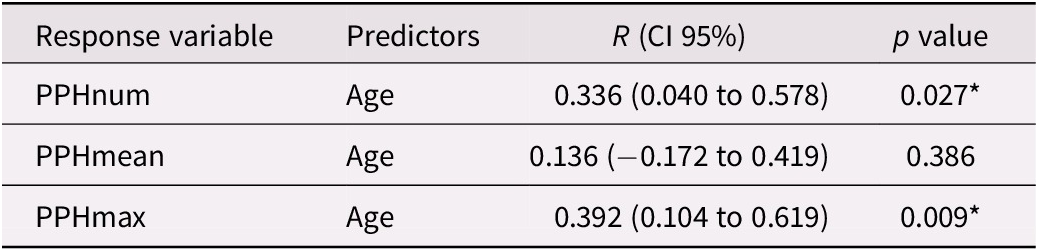
After inspection of density plots, no transformation was required due to the appearance of skewing. In our initial univariable analysis, only PPHnum (p = 0.027) and PPHmax (p = 0.009) showed a significant association with age (Table 2).
Univariate regression analysis (n = 43)

Abbreviations: PPHnum = number of PPH events observed; PPHmean = average decrease in systolic blood pressure; PPHmax = average maximal change in systolic blood pressure; R = Pearson Correlation Coefficient; CI = 95% confidence interval; *P-value <0.05.
Multivariate analysis – number of PPH events (PPHnum)
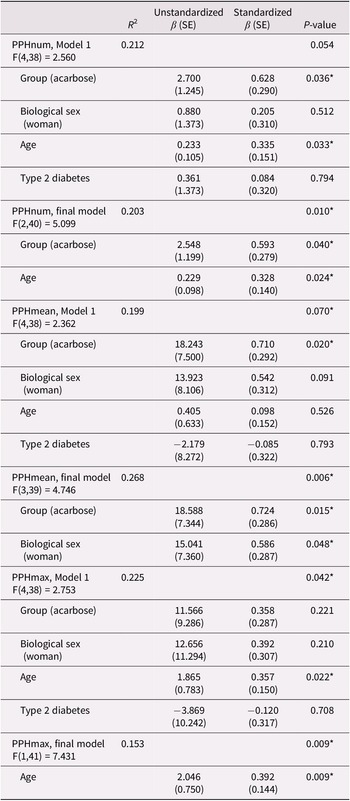
The continuous predictor variable (age) and the logistic predictor variables (group, biological sex, and the presence of type 2 diabetes) were entered into a multivariate regression model that initially explained 21% of the variance in PPHnum. VIF were checked in the initial model; the highest VIF was 1.25 (T2DM), indicating that there were no issues with multicollinearity. As shown in Table 3, our most parsimonious model demonstrated a significant association between PPHnum with group (p = 0.040) and age (p = 0.024). As seen in Figure 1, the acarbose group (4.14 ± 1.11) had more PPH events (p = 0.045) than the placebo group (1.52 ± 0.56).
Stepwise multivariate regression analysis (n = 43)

Abbreviations: PPH num = number of PPH events observed; PPHmean = average decrease in SBP observed; PPHmax = average maximal change in blood pressure; R2 = coefficient of determination; SE = standard error; β = beta-coefficient.
Postprandial systolic blood pressure (SBP) response: The acarbose group demonstrated an attenuation of the mean postprandial hypotensive (PPH) response, but no attenuation of the maximal PPH SBP or the number of PPH episodes detected.

Multivariate analysis – average decrease in SBP (PPHmean)
The continuous predictor variable (age) and the logistic predictor variables (group, biological sex, and the presence of type 2 diabetes) were entered into a multivariate regression model that initially explained 20% of the variance in PPHmean. VIF were checked in the initial model; the highest VIF was 1.25 (T2DM), indicating that there were no issues with multicollinearity. As shown in Table 3, our most parsimonious model demonstrated a significant association between PPHmean with group (p = 0.015) and biological sex (p = 0.048). As seen in Figure 1, the placebo group (−13.8 ± 4.8 mm of Hg) showed an average decrease in SBP (p = 0.038) that was not seen in the acarbose group (2.3 ± 5.7 mm of Hg).
Multivariate analysis – maximal decrease in SBP (PPHmax)
Our initial model initially explained 23% of the variance in PPHmax. VIF were checked in the initial model; the highest VIF was 1.25 (T2DM) indicating that there were no issues with multicollinearity. As shown in Table 3, our most parsimonious model showed an association with age only (p = 0.009*). There was no significant difference in PPHmax (p = 0.312) between the maximal drop in SBP between the placebo (−20.6 ± 6.6 mm of Hg) and the acarbose (−30.7 ± 7.3 mm of Hg) groups (Figure 1).
Secondary haemodynamic measures
During the meal test, there was no difference in the average mean arterial pressure (MAP; acarbose 91.4 ± 6.7, placebo 96.1 ± 7.0, p = 0.630), diastolic blood pressure (DBP; acarbose 88.9 ± 7.0, placebo 100.2 ± 4.7, p = 0.191), or heart rate (HR; acarbose 69.3 ± 2.5, placebo 71.7 ± 2.0, p = 0.454).
Discussion
Principal findings
Although acarbose attenuated the mean decrease in SBP during the meal test, it did not reduce the actual number of PPH events or the maximal decline in SBP (Figure 1).
Previous work
The use of acarbose as a method of attenuating the PPH response has not been well studied and examined subjects that differed from the current study. Initial reports in the literature consisted mainly of case reports in a patient with type 1 (Maule et al., Reference Maule, Tredici, Dematteis, Matteoda and Chiandussi2004) and type 2 diabetes (Sasaki et al., Reference Sasaki, Goda, Nagata, Kitaoka, Ohsawa and Hanafusa2001). A meta-analysis, done in 2021, showed an attenuation of the SBP response by 9 mm of Hg; however, this was based on four randomized controlled trials with a total enrollment of 202 participants with impaired glucose metabolism. In this meta-analysis, once you exclude the duplicate study (a master’s thesis) (Zhang, Reference Zhang2014) and the study that examined a natural health alternative to acarbose (Peng et al., Reference Peng, Jiang, Chen, Lin and Ding2018) the two remaining studies consist of only 81 subjects, all of whom had a diagnosis of type 2 diabetes (Qiao et al., Reference Qiao, Li, Li, Qian, Chen, Wei, Jin and Wang2016; Zhang & Guo, Reference Zhang and Guo2017). A randomized cross-over study published in 2015 by our laboratory also showed an attenuation of the PPH response but also only recruited older adults with type 2 diabetes (Madden et al., Reference Madden, Harris and Meneilly2015). Previous work showing benefits in subjects without diabetes has been confined to the setting of autonomic failure (Shibao et al., Reference Shibao, Gamboa, Diedrich, Dossett, Choi, Farley and Biaggioni2007) and a small (n = 8) group of normal older adults undergoing supraphysiologic intraduodenal sucrose infusions (Gentilcore et al., Reference Gentilcore, Doran, Meyer, Horowitz and Jones2006). To our knowledge, this study is the first to study a general clinic population of older adults.
Potential mechanisms
Given that the underlying mechanisms behind PPH are uncertain (Fukushima et al., Reference Fukushima, Asahina, Fujinuma, Yamanaka, Katagiri, Mori and Kuwabara2012), any discussion of explanatory mechanisms underlying the effects of acarbose on the postprandial hemodynamic response are necessarily theoretical. Dietary carbohydrate intake has been shown to be the main nutritional precipitant of PPH (Jansen et al., Reference Jansen, Peeters, Van Lier and Hoefnagels1990; O’Donovan et al., Reference O’Donovan, Feinle, Tonkin, Horowitz and Jones2002). Stimulation of specialized carbohydrate receptors in the duodenum has been postulated as a potential initiator of postprandial mesenteric vasodilatation (El Ouazzani & Mei, Reference El Ouazzani and Mei1981; Feinle, Reference Feinle1998). Since acarbose acts by creating a breakdown of disaccharides to monosaccharides at the brush border of the intestine, the consequent reduction in duodenal carbohydrate receptor stimulation could explain the attenuation in the postprandial hypotensive response during the acarbose session.
In addition to preventing the start of PPH in the duodenum, acarbose might also be acting at several postulated ‘downstream’ stages of the response. Previous investigations have postulated a postprandial reduction in arterial baroreflex sensitivity (Madden et al., Reference Madden, Feldman and Meneilly2021), an impairment in compensatory efferent sympathetic outflow (Lipsitz et al., Reference Lipsitz, Pluchino, Wei, Minaker and Rowe1986), and an alteration in the postprandial incretin response (Barragan et al., Reference Barragan, Rodriguez and Blazquez1994) as potential mediators of this condition. Alterations in the postprandial incretin response with acarbose is another possible mechanism, given the fact that acarbose has been shown to increase the postprandial secretion of glucagon-like peptide-1 (GLP-1) (Gentilcore et al., Reference Gentilcore, Bryant, Wishart, Morris, Horowitz and Jones2005). Administration of intravenous GLP-1 has been shown to attenuate the hypotensive response to oral (Trahair et al., Reference Trahair, Horowitz, Stevens, Feinle-Bisset, Standfield, Piscitelli, Rayner, Deane and Jones2015) and intraduodenal (Trahair et al., Reference Trahair, Horowitz, Hausken, Feinle-Bisset, Rayner and Jones2014) glucose in previous studies, suggesting that GLP-1 receptor agonists might also be another potential treatment for this condition (Jones et al., Reference Jones, Rigda, Buttfield, Hatzinikolas, Pham, Marathe, Wu, Lange, Trahair, Rayner and Horowitz2019).
It is unlikely that acarbose had any effect on the arterial baroreflex response (which operates to increase blood pressure mainly through short-term chronotropic vagal withdrawal) due to the fact that the postprandial heart rate response was similar in both the acarbose and placebo sessions. Given that PPH is a multifactorial condition, this lack of effect on the arterial baroreflex response might be a potential explanation for the observed lack of attenuation of PPHmax and PPHnum in the acarbose group.
Clinical implications
It is well established that not only is the presence of PPH an independent predictor of mortality in older adults but also there is a dose–response relationship between the size of the postprandial drop in SBP and the mortality risk (Fisher et al., Reference Fisher, Davis, Srikusalanukul and Budge2005). To the best of our knowledge, we are the first to demonstrate that the mean postprandial hypotensive response can be attenuated by acarbose in a general older adult population. It is troubling, however, that it did not improve the maximal decline in SBP or the number of PPH events observed (Figure 1). There is an analogous phenomenon in the field of orthostatic hypotension–inital orthostatic hypotension, a ‘forgotten’ and often undetected condition where blood pressure drops within 15 seconds of standing (Wieling et al., Reference Wieling, Krediet, van Dijk, Linzer and Tschakovsky2007). A recent meta-analysis showed that it is also associated with presyncopal symptoms (Christopoulos et al., Reference Christopoulos, Tran, Hillebrand, Lange, Iseli, Meskers and Maier2021). Although acarbose might be a useful agent to add to fall prevention programs to help with the currently intractable contribution of PPH (Weatherall, Reference Weatherall2004), further work needs to be done to determine the relative contribution of better average SBP versus sudden drops in SBP (PPH events) to both patient symptoms and fall risk, as opposed to meal tests done in the laboratory.
Limitations and future research
Although acarbose attenuated the mean decline in blood pressure after a standardized meal, our study was not designed to demonstrate either a reduction in falls or mortality in this vulnerable population. Our subject pool was quite heterogeneous and modest in size. Our subjects were only studied once (rather than in a longitudinal placebo-controlled design), and the test meal did not have a high caloric content. In addition, our results occurred in an artificial laboratory setting, and caution must be exerted in extrapolating these results to a clinical setting. Although we have theorized some explanations for the attenuation of PPH with acarbose, further work needs to be done to explain underlying mechanisms.
Conclusions
Acarbose attenuated the mean decrease in SBP during the meal test but did not reduce the actual number of PPH events recorded or the maximum PPH event in a general population of older adults. This suggests much further work needs to be done before acarbose can be used to treat PPH in the broader older adult population.
Data availability statement
All data that support the findings of this study are available from the authors upon reasonable request.
Author contribution
K.M.M.: protocol design, data collection, data analysis, writing of manuscript, editing of manuscript, and study funding; B.F.: database management; G.S.M.: protocol design, editing of manuscript, and study funding.
Financial support
This study was funded by the Allan M. McGavin Foundation and the Heart and Stroke Foundation of Canada (Grant No. H13–01316).
Competing interests
The authors declare that there are no competing interests.



 Open access

