




Tege nupi narai ikau? (Do you have dreams?)
“Tege nupi narai ikau?,” which translates to “Do you have dreams?,” is a question I often encounter when I visit villages in Central Kalimantan. The word nupi translates simply as “dream.” However, in Dayak Ngaju culture, nupi is not only used to describe dreams as the state of the sleeping mind, but also as a medium by which non-human places, entities, and spirits communicate with humans. In every village I visited, there were always some local shrines marked with a yellow fabric, which are considered sacred places for the local community. The construction of shrines with yellow fabrics in specific locations is the result of people receiving messages through dreams from nonhuman entities in those places.
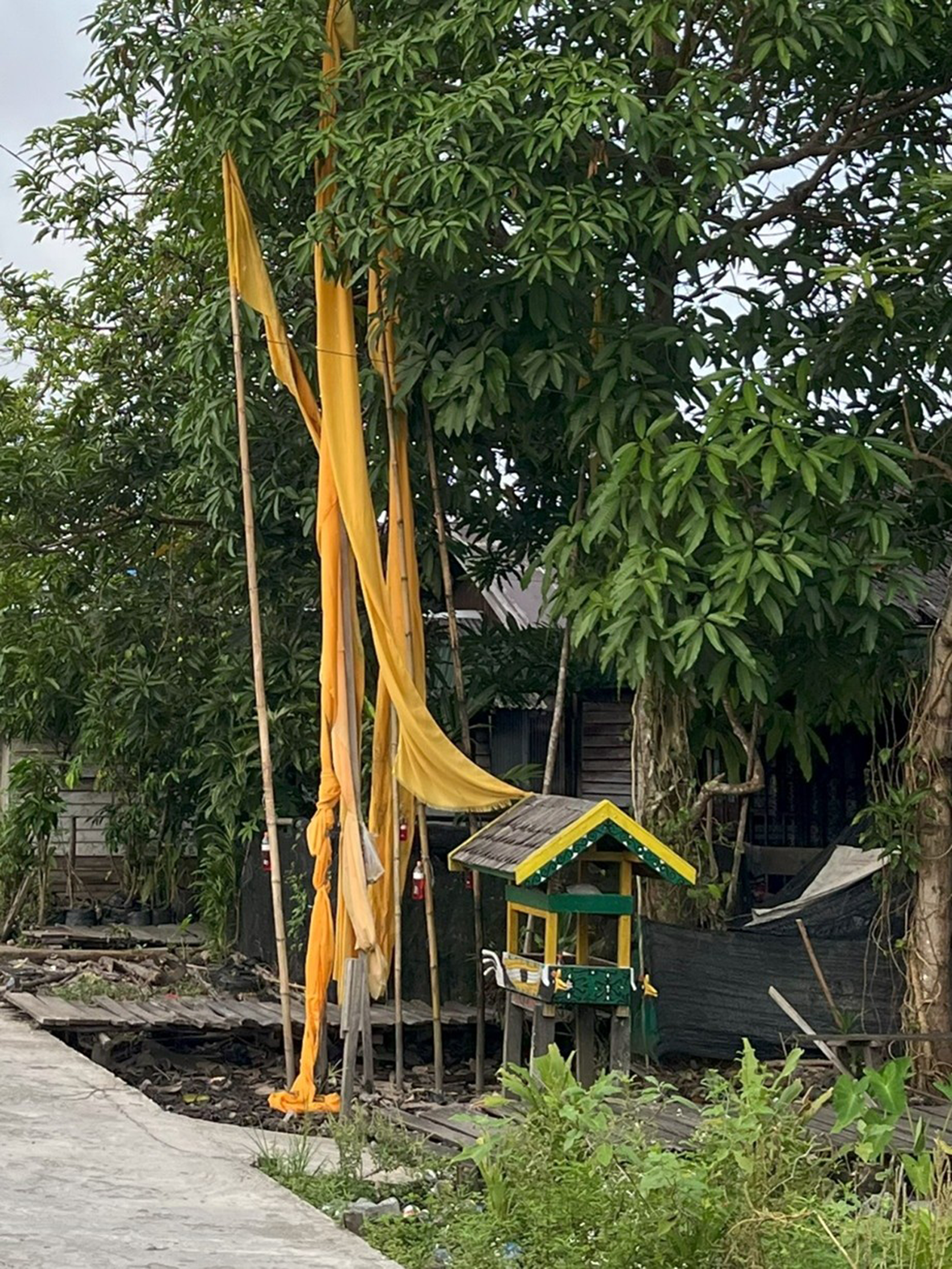
In Central Kalimantan, the presence of a local shrine enveloped in yellow fabric marks a highly revered site deeply connected to ancestral veneration, local spirits, and significant naturalcultural elements such as trees, hills, and burial sites (Figure 1). The use of yellow fabric signifies the shrine’s spiritual and ceremonial significance, as this colour is often associated with sacred authority within Kalimantan’s cultural context. These shrines frequently house offerings, including glutinous rice, black native chickens, coffee or other items considered particularly favoured by spirits inhabiting the area. Visitors to these sacred spaces are encouraged to engage in respectful behaviour, which includes maintaining politeness, using appropriate language, and refraining from removing any of the cloth or offerings. Furthermore, it is essential to observe local customs when greeting or honouring the spirits, thereby fostering a deeper understanding and appreciation for the way the Dayak Ngaju people understand the human and non-human worlds.
Yellow fabric signifying animistic significance of place at a local shrine in Mantangai Hulu Village, Central Kalimantan.
Living with Dayak Ngaju communities for extended periods of time taught me that animism is not only a part of the community’s past, but also something deeply rooted in the current lives of the Dayak Ngaju people. Initially, I thought I was coming to these villages solely to research the local language related to ecology and how the community lives and manages tropical peatlands. Nevertheless, as I became immersed in everyday life with the local community, I found that the local language, culture, and ecology were intimately connected with animistic practices and beliefs.
Like many other Indigenous communities, the Dayak Ngaju people view the forest as a place that is inhabited, sentient, relational and sacred. They always hold rituals and make offerings before carrying out activities in the forest, such as clearing land for agriculture, collecting forest products such as wood, and hunting animals such as wild boar and deer. An example: when they want to clear land in an area that has never been touched before, a ritual is held. After the ritual is completed, they wait for three days. According to the Dayak Ngaju, just as when we move to a new place or a new house, the spirits also need time to move to a new area. There are consequences if the ritual or offering is not performed. Many stories from these villages describe metaphysical occurrences, such as the sound of plates shattering immediately after cutting down a tree, and shortly thereafter, the logger falls ill with an unexplained medical condition that must be treated by a traditional healer, when the proper ritual was not completed.
Situating places and perspectives
This paper brings together a multidisciplinary group of authors to explore the entanglement of animist practices with Dayak Ngaju language in the regeneration of tropical peatland forests in Central Kalimantan, Indonesia. Our opening story and epigraph offer an immersive introduction to this entanglement, where distinctions between dream and reality, nature and culture, human and nonhuman, body and spirit become porous, sticky and difficult to separate out. Each of us comes to this work from different histories and geographies of practice and thought, differences and connections which extend across continents, disciplinary genealogies and cultural affiliations. The paper is led by first author Corry Antang who is a member of the Dayak Ngaju community of First Peoples. It is written in collaboration with her PhD supervisors David Rousell, Samantha Grover and Lily van Eeden who are migrant and settler scholars based in Naarm (Melbourne), Australia. As a supervisory community of practice, we approach co-authorship as a collaborative inquiry and co-mentorship process that generates new insights by building learning relationships across intercultural and place-based perspectives. This ethic of collaboration and co-learning is inspired by our different journeys and angles of arrival into critical forest studies as a transdisciplinary field (see, for instance, Grover, Reference Grover2017; Rousell & Tran, Reference Rousell and Tran2024; van Eeden et al., Reference van Eeden, Bekessy, Smith, Gregg, Hatty, Kaufman, Kusmanoff, Lauren, Lee, Lentini, Renowden, Selinske, Squires and Hames2025), as well as recent work on cooperative, regenerative and reciprocal ways of working across Indigenous and place-based knowledges (Bawaka Country, Reference Wright, Suchet-Pearson, Lloyd, Burarrwanga, Ganambarr and Sweeney2016; Poelina et al., Reference Poelina, Wooltorton, Blaise, Aniere, Horwitz, White and Muecke2022). In light of this, we purposefully alternate between singular and plural, first-person and third-person voices in this article. This variation in voice aims to bring different tonalities and inflections to the stories we share, honouring direct, place-based experience alongside differing histories of learning and engagement with the theories, cultures and environments invoked and elaborated throughout.
The stories shared throughout the paper are derived from Corry’s extended ecolinguistic fieldwork within three Dayak Ngaju villages in Central Kalimantan. The Ngaju people are one of the Indigenous Dayak groups in Central Kalimantan, Indonesia, traditionally inhabiting the riverine areas mostly along the Kahayan and Kapuas rivers. They speak Ngaju language, part of the Austronesian language family, and maintain a rich cultural heritage centred on Kaharingan, their Indigenous faith that derives from the ancient Dayak language, specifically the word “haring,” meaning “life” or “living.” Traditionally, they practised swidden (shifting) agriculture, fishing, and forest gathering within the vast peatswamp and lowland forests that support their livelihoods. The community still holds the hukum adat (customary law) that governs custodianship of lands, resolves disputes, regulates marriage and inheritance and preserves the community’s identity and culture. Today, the Ngaju people face challenges from peatland degradation, deforestation and land conversion yet continue to play a vital role in community-based forest conservation and peatland restoration efforts across Central Kalimantan.
The paper brings stories from Corry’s fieldwork in Dayak Ngaju communities and surrounding peatland regions into conversation with studies and theorisations of “new animisms” and associated pedagogies in environmental education (see Merewether et al., Reference Merewether, Blaise and Giamminuti2025; Rousell, Reference Rousell2023). This work builds on David’s (Author 2) collaborative study of “new animist” pedagogies and ritual practices with colleagues and communities in Brazil, Trinidad and Indonesia (Rousell et al., Reference Rousell, Ryan, Bauer-Nilsen and Lai2022). This theoretical framing acts as a bridge between the specificities of Dayak Ngaju animism and other animist philosophies around the world, including Indigenous as well as place-based understandings of forest sentience as relational pedagogies for addressing contemporary crises without collapsing or negating their differences. This rapprochement of new animist philosophy into an Indigenous (auto) ethnographic methodology is an emergent approach currently unfolding in and through Corry’s PhD study. This approach builds on and extends our different scholarly practices as a supervisory team, situating Dayak Ngaju language within an animistic reality inclusive of nonhuman creatures, objects and spiritual beings that exert their own agency within forest lifeworlds and regenerative practices. Stories from Corry’s extended fieldwork elaborate how Dayak Ngaju relational ontology and ecological language contain the very knowledges and practices needed to sustain and regenerate the peatland forests of Central Kalimantan through time. However, this work also exposes how the political ecology of Central Kalimantan is shifting rapidly due to governmental and multinational corporate interests endemic to the current climate and biodiversity crises. By storying fieldwork events in Dayak Ngaju villages through a new animist approach, Corry’s research teaches us how Indigenous language revitalisation is crucial to forest regeneration and conservation within a highly precarious political atmosphere agitated by a complex array of cultural, governmental, corporate and nonhuman actorsFootnote 1 .
It is important to acknowledge that this work is not possible without a supervisory team which supports and nurtures Indigenous-led research. Our aim, throughout this paper, is to assure that the Dayak Ngaju community voice remains at the centre of this work, with Corry recognised as the cultural authority and knowledge holder who conveys the animistic and ecolinguistic wisdom of her community. Supervisors act as cultural, academic and scientific allies in this work, supporting Indigenous ways of knowing and ensuring animistic perspectives are recognised and valued even when they contradict the very logics of the institutions we are working within.
My supervisory team provides academic and practical support through a relational approach to learning. My primary supervisor, Sam, is a soil scientist who is also a researcher of tropical peatlands in Central Kalimantan. She provides important insights into peatland degradation and restoration, based on her long-term commitment to the region and understanding of local conditions. My co-supervisors, David and Lily, help me connect the stories of the Dayak Ngaju and Indigenous perspectives with broader discussions on environmental education. We create a learning environment based on care and reciprocity, where knowledge flows among my supervisors, I, also the tropical peatlands ecosystem. This collaboration allows me to integrate ecolinguistic methods with environmental science and philosophy, ensuring my research respects Dayak Ngaju cultural values while engaging in global conversations. In my perspective, our teamwork reflects a “new animism,” recognising both humans and non-humans as educational partners in this research journey.
(Corry)
Co-creating mentorship structures to directly support Corry’s leadership of this paper as an Indigenous PhD student is also an important part of this story. As co-authors comprising an intercultural PhD supervision team and community of practice, our process of co-authoring this paper represents its own contribution to urgent questions relating to supervision and mentorship of Indigenous PhD candidates within the hierarchical structures of the settler colonial academy (Arnold et al., Reference Arnold, Atchison and McKnight2021; Cavanagh et al., Reference Cavanagh, Hammersley and Adams2022; Kidman et al., Reference Kidman, Manathunga and Cornforth2017; Moodie et al., Reference Moodie, Ewen, McLeod and Platania-Phung2018)Footnote 2 . Ultimately, the paper not only offers steps towards culturally safe and responsible practices for intercultural studies within animist forest communities, it also gestures towards ways of being and becoming animist researchers within the settler colonial academy.
New animisms in a pluriverse of relations
The revitalisation of animist ontologies has emerged as a central theme in recent turns towards ontological pluralism in environmental education and is also now forming a significant stream of work within the allied field of critical forest studies. This work is forging new connections between place-based and Indigenous understandings of animism and, in particular, the relationships between studies of nonhuman sentience and childhood across a range of cultural and geographical contexts (Merewether, Reference Merewether2019; Reference Merewether2023; Rousell, Reference Rousell2023). Historically, the term animism was coined by Western anthropologists in the early 20th century to describe Indigenous worldviews that attribute personhood, subjectivity, voice and agency to nonhuman beings, spirits and naturalistic phenomena (Bird-David, Reference Bird-David1999; Descola, Reference Descola2024; Harvey, Reference Harvey2005). While early interpretations categorised animism as primitive, archaic or superstitious, scholars such as Blaser and de la Cadena (Reference Blaser and de La Cadena2018), Deborah Bird Rose (Reference Rose2013), Marilyn Strathern (Reference Strathern1992), Elizabeth Povinelli (Reference Povinelli2016), Eduardo Kohn (Reference Kohn2013) and Eduardo Viveiros de Castro (Reference Viveiros de Castro1992) have highlighted animist ontologies as sophisticated systems of worldmaking, semiosis and identity-formation.
What have been called the “new animisms” refer to contemporary efforts to recontextualise the role of animist ontologies within urgent planetary crises, including climate change (Bawaka Country, Reference Country, Wright, Suchet-Pearson, Lloyd, Burarrwanga, Ganambarr, Ganambarr-Stubbs and Maymuru2020), species extinction (Tallbear, Reference TallBear2017) and the rise of emerging technologies such as artificial intelligence (Lewis et al., Reference Lewis, Arista, Pechawis and Kite2018). Disrupting western views of animism as an archaic relic of the past, these frameworks position animist cosmologies as situated, critical, kinship-based responses to the polycrises of the present (Watts, Reference Watts2013). Much of this work has been driven by Indigenous-led scholarship. Examples include explorations of incorporating artificial intelligences into Indigenous kinship systems (Lewis et al., Reference Lewis, Abdilla, Arista, Baker, Benesiinaabandan, Brown and Whaanga2020), the spiritual implications of reviving extinct species through cryogenics (Tallbear, Reference TallBear2017), communications with trees and forests as ancestors (Arnold et al., Reference Arnold, Atchison and McKnight2021) and the cultivation of nuanced understandings and responses to climate change through deep listening and communication with Country (Bawaka Country, 2020). In a similar way that new materialisms have revitalised materialist traditions in Western thought by bridging metaphysics back into science and politics (Coole & Frost, Reference Coole and Frost2010), the new animisms provide opportunities to critically re-read place-based and Indigenous cosmologies through the complex and entangled planetary crises of the present.
To date, much of the research associated with the new animisms has arisen from Latin America where there is now a substantive body of work on the cosmological, political, social and ecological implications of animist ontologies within forest communities (cf Escobar, Reference Escobar2018; Kohn, Reference Kohn2013; Vivieros de Castro, Reference De Castro2005). More recent engagements with animist philosophies in Southeast Asia are now forging new lines of inquiry which both disrupt and extend earlier work in Latin America. This work has moved decisively beyond earlier depictions of “belief systems” into reframing animism as a dynamic field of relational ontologies embedded in environmental politics and everyday life practices. Århem’s contributions (Reference Århem2015) and Descola’s comparative typologies (Reference Descola2024) provide influential analytic scaffolds – linking Southeast Asian animism to Amerindian perspectivism and varieties of nonhuman interiority or “ensoulment” – while Forth (Reference Forth2018) and Kaartinen (Reference Kaartinen2015) illuminate how “life” and the boundaries of humanity are enacted in eastern Indonesia. Building on these studies, Haug (Reference Haug2023), Herrmans (Reference Herrmans2020), Najib (Reference Najib2020) and Prastio et al., (Reference Prastio, Santoso, Roekhan, Maulidina, Numertayasa and Suardana2023) foreground the entanglement of forest spirits, conservation regimes and extractive economies within the political ecology of the Indonesian archipelago, complicating assumptions of ontological stability according to traditional belief systems. Duile (Reference Duile2023) and Kleinod et al., (Reference Kleinod, Duile and Antweiler2022) extend this analysis through a political ecology of animism, tracing how Indigenous actors mobilise cosmological vocabularies in resistance to deforestation and state territorialisation, while Coggins et al. (Reference Coggins, Århem, Boedhihartono, Phan, Le and Wardani2022) demonstrate how sacred-forest ethics underpin locally grounded conservation initiatives.
While these recent texts demonstrate a certain enthusiasm for studies of Southeast Asian animist philosophies, they also invite critical reflection on the epistemic politics of studying Indigenous lifeworlds in the Indonesian context. The continued dominance of Global North scholars in these recent studies risks reproducing a cultural politics and analytics of asymmetry (Escobar, Reference Escobar2018), whereby place-based Indonesian concepts and practices are mediated through Euro-Western linguistic categories such as “ontology,” “perspectivism” and “animism” as externally imposed categories. Ethical and methodological rigour requires sustained collaboration with Indonesian researchers and community members, as well as attentiveness to how language, conservation markets and academic fieldwork shape the representation of “spirits” and “forests” through the interpretation of “data.” Our research contributes to this work through co-authored scholarship and modes of inquiry that invite Indigenous perspectives and linguistic categories to guide theoretical framing, positioning animism not merely as ethnographic data but as an ecolinguistic factor in language practices, knowledge production, interpretation and worldmaking.
Ecolinguistics and the new animisms in social research methods
As a field of study that examines human–nature relationships through an understanding of languages, ecolinguistics has emerged as a critical body of scholarship which is actively contributing to animistic understandings of ecological worldmaking (Stibbe, Reference Stibbe2020). Norwegian American linguist Einar Haugen made a notable contribution to the establishment of ecolinguistics in the 1970s with the introduction of “language ecology” as an analytic framework for studying the interplay of language and environment (Fill, Reference Fill and Muhlhausler2006; Haugen, Reference Haugen2001). Since then, the field of ecolinguistics has grown and expanded in interdisciplinary and applied directions, bringing into play a range of different disciplines and fields such as applied linguistics, anthropology, ecological philosophy and eco-cultural studies. Contemporary ecolinguistics has matured into a crucial interdisciplinary field that effectively combines insights from multiple disciplines to analyse the dynamic relationship between language, culture and environment. While grounded in applied linguistics, this field goes beyond traditional sociolinguistics, rigorously examining how discourse shapes and reflects ecological realities, which significantly influences public perception and environmental policies (Fill, Reference Fill and Muhlhausler2006). Anthropological insights powerfully illustrate how Indigenous and local languages carry and transmit vital ecological knowledge, providing essential perspectives on regenerative practices and worldviews (Ingold, Reference Ingold2021; Maffi, Reference Maffi2005). Moreover, ecological philosophy, particularly deep ecology, process philosophy and systems thinking, further enriches ecolinguistics by offering robust theoretical frameworks that enhance our understanding of the interconnectedness of language, thought and the biosphere (Stibbe, Reference Stibbe2020).
Eco-cultural studies also play a pivotal role by dissecting the narratives, metaphors and ideologies that shape environmental discourse, revealing how prevailing linguistic structures can either champion or obstruct ecological sustainability and regeneration (Harré, Reference Harré, Peter and Jens1999). As the field has progressed, it has seamlessly integrated critical discourse analysis, cognitive linguistics and semiotics, firmly establishing itself as an essential domain for tackling pressing issues such as climate change, biodiversity loss and environmental justice through the power of language (Alexander & Stibbe, Reference Alexander and Stibbe2014). Ecolinguistics offers a framework for understanding how discourse impacts ecological connectivity, particularly using ecological metaphors, narrative structures and lexical choices (Poole, Reference Poole2025; Steffensen, Reference Steffensen2025). These features are highly relevant when combined with animism, which is conceptualised as a relational ontology that emphasises the intersubjective connectivity and transmission of sentience between humans and the nonhuman world (Forbes, Reference Forbes2023; Kohn, Reference Kohn2013).
In the cultural and ecological context of the Dayak Ngaju in Central Kalimantan, a recently published ethnographic study charts the existence of the Pukung Pahewan zoning system, which divides peatland areas into sacred, agricultural and settlement zones, implying spiritual and traditional ecological boundaries in land-use practices (Bulkani et al., Reference Bulkani and Darlan2019; Sumarni et al., Reference Sumarni, Ery Wijaya and Meilasari Sugiana2023). Furthermore, studies on agroforestry within the Dayak Ngaju community emphasise how traditional agroforestry practices and shifting cultivation cycles combine ethnobotanical knowledge, ceremonial protocols, environmental language and soil quality indicators to maintain peatland hydrology and livelihoods (Silvianingsih et al., Reference Silvianingsih, Hairiah, Suprayogo and Van Noordwijk2020). In this sense, ecolinguistics and animism in peatland restoration emphasise the importance of place-based language systems that describe peatland as ancestral heritage and living, relational assemblages, supported by community governance systems and ecological wisdom embedded in practice. This bridging of ecolinguistics into new animist philosophies suggests that any land-based restoration initiatives must respect the entanglement of ecological, cultural, linguistic and spiritual dimensions of place.
Attending to this nexus of ecolinguistics and new animisms also has profound implications for the conceptualisation and practice of social research in and with Indigenous and place-based communities. Our work here is particularly influenced by education scholar and applied linguist Maggie MacLure (Reference MacLure2013; Reference MacLure2021), whose recent writing on “inquiry as divination” brings animist cosmologies into critical confluence with postfoundational methods of qualitative research. MacLure (Reference MacLure2021) uses the concept of divination to describe postfoundational inquiry as a search for “strange relations between the one and the many, in the shifting totality of the cosmos,” suggesting that this search obligates researchers to “entertain relations that are always to some extent inhuman” (p. 502). She cautions against the tendency to appropriate Indigenous ontologies to serve these purposes (however well intentioned) in Western scholarship, advocating instead for a divinatory methodology that assembles “its own pragmatic arts and fashion[s] its own situated practices—ways of thinking and of reading the world that are grounded in the problems addressed by those involved” (p. 504).
In our case, “those involved” include the Dayak Ngaju communities and their land-based relationships; Corry as both researcher and member of those communities; David, Sam and Lily as researchers and supervisors working across different cultural and institutional contexts; the guest editors of this special issue and authors who contributed to the peer review process; readers of this special issue and wider communities of practice which extend across critical forest studies, environmental education and many other connected and tangential fields. When considered in this way, it is clearly impossible to transparently account for every possible relation between “those involved” in the doing and interpretation of this research. MacLure’s (Reference MacLure2021) work helps us understand that some form of animistic divination is needed to navigate the “obscure zones” where divergent ontologies, logics and language systems meet, including contact zones between Indigenous and settler colonial ways of knowing and being. By asking us to trust in stories of place-based relationships rather than detached objects of recognition (McKittrick, 2021), the merging of ecolinguistics and animist philosophy invites new methods for tracking the shifting relationships between signs and events, causes and effects, thoughts and actions, dreams and waking life, words and worlds. In the following section, Corry articulates her own journey into the construction of an Indigenous-framed (auto)ethnographic method which generates stories across multiple and often divergent language systems, knowledges and worlds.
Corry’s method: Indigenous-framed (auto) ethnography
As a researcher and member of the Dayak Ngaju community, I am acutely aware of the historical and ongoing extraction of knowledge from my community in and through Western ethnographic research. I am very conscious that ethnography itself has its roots in a European anthropological tradition which has both explicitly and tacitly used research as a tool of colonialism (Hammersley, Reference Hammersley2018; Tuhiwai Smith, Reference Smith2021). Initially, the ethnographic method was developed in the early 20th century by researchers of European descent, where they could spend months, even years, researching and observing non-European people or cultures through European perspectives (Ryan, Reference Ryan2017). My awareness of this history of extraction led me to develop and apply an Indigenous-framed decolonising approach to (auto) ethnographic fieldwork in villages across Central Kalimantan. This approach ensured that I, as a researcher, did not approach the cultural, linguistic and spiritual values of the Dayak Ngaju community as a separate object or subject of research but also helped me to redress the mainstream narrative that often overlooks, marginalises and assimilates the voices and perspectives of Indigenous communities into Western knowledge frameworks (Smith, Reference Smith2021).
Not only did I understand the language and values of the Dayak Ngaju communities living in the villages of Sei Asem, Pilang and Mantangai Hulu, but I also shared the identity of being a Dayak Ngaju person, which gave me a unique opportunity while living within the community. Incorporating autoethnography allowed me to include my personal experiences and insights as a member of the Dayak Ngaju community, making my work more intimate and profound. This method helps me delve into the personal stories of the community and elaborate the broader cultural, social and environmental realities of my community, particularly my community’s relationship with the land and nature, such as tropical peatlands. By sharing stories and reflecting on them (Darnett & Rhodes, Reference Darnett and Rhodes2023; Rangiwai et al., Reference Rangiwai, George-Koteka, Hagai, Hitchens, Marsters and Vaughn2024), I am able to respect the Dayak Ngaju knowledge system and worldview, which sees humans, forests and spirits as interconnected entities (Cambah, Reference Cambah2022; Luardini, Reference Luardini2008; Schiller, Reference Schiller1997).
Using an Indigenous-framed (auto)ethnographic approach allows me to truly engage and connect with people on a meaningful level, enriching my understanding of various stories and community issues. This approach is in line with Indigenous research practices, which view knowledge as interconnected and narratives as a form of theory, allowing for meaningful connection with people (Kovach, Reference Kovach2021; Smith, Reference Smith2021). Although I have a strong background as a member of the Dayak Ngaju community, living alongside community members allowed me to deepen my insights through shared experiences and reciprocal relationships, which Wilson (Reference Wilson2008) describes as relational accountability.
As a Dayak Ngaju individual, I am very grateful for the trust the community has placed in me by sharing their stories and experiences. These narratives are highly personal and rarely shared with outsiders. As Indigenous scholars emphasise, storytelling goes beyond being merely a data collection method; it is an act of respect and a way to co-create meaning (Archibald, Reference Archibald2008; Simpson, Reference Simpson2017). The stories I received were not merely data points collected during field research, they represented life lessons rich with educational, emotional and spiritual meaning – what Archibald (Reference Archibald2008) refers to as “storywork,” reflecting the Dayak Ngaju worldview that links ecological and spiritual wisdom in oral traditions and local customs (Sunariyati et al., Reference Sunariyati, Decenly and Agnestisia2023; Usop, Reference Usop2020).
In addition to interviews elaborating stories related to forests, fire and spirits, I employed language-focused methods such as collecting key Dayak Ngaju terms. These were analysed not only as linguistic data but as ecological practices, since words and narratives actively shape relationships with the peatland. We also incorporated collaborative interpretation sessions with community members to ensure meanings were understood within local cosmologies rather than imposed from outside. This approach aligns with ecolinguistics, new animisms and Indigenous methodologies by treating language as a living practice that guides ecological governance and regeneration.
The story of Bue Buhai
This is the story from Sei Asem Village, where the local community had a hut, or in local language it’s called pasah, believed to be inhabited by the spirit of a Dayak Ngaju community elder, often referred to as Bue Buhai. Bue literally means “grandfather.” In Dayak Ngaju culture, the word bue is often used to address elderly men, whether they are family members or not, or even young boys or men, where we have a certain level of kinship that requires us to address them as bue. Several local Dayak Ngaju people living in Sei Asem told me that they are direct descendants of Bue Buhai and have personally met Bue Buhai, whom they refer to as a supernatural being who can appear in human form. One community member told me that it is common for people to come to Bue Buhai’s shrine and make wishes to him. Even though this community member is a practising Catholic, he said that asking Bue Buhai for help is acceptable because they are considered God’s intermediaries to assist humankind.
Jite nah kilau Hatalla kea. Hapenda pang bara Hatalla. Cuman iye tau kea. Jatun je jahat kare narai.
“He is also the same as God. He is lower than God. But he also has abilities. He is not evil.”
When asking for a wish from the spirit believed to be Bue Buhai, once the wish is granted, the person who made the wish must pay offerings; otherwise, there will be consequences. He then added that once he made a wish to Bue Buhai. When his wish was granted, he was a day late in delivering the offerings to the pasah. What happened then was that he suddenly experienced an unexplained illness for a week. Shortly after he visited the Bue Buhai shrine to give offerings, the illness vanished immediately.
Batekang hetuh kuh bu. Mata kuh bahandang. Melai hetuh batekang. Kameangkuh tawangkuh.
“It was stiff here, ma’am (while holding his face). My eyes were red. It was stiff here. I sensed it and I understood.”
Iye te dia sampai pire detik, amu anu, tuh aku bue kuangkuh, datu aku maagah hajatkuh kuangkuh, janji kuh kuangkuh.
“Yes, it didn’t take more than a few seconds (after handing over the offering, the illness immediately disappeared). It’s me, Bue, I said. Datu (great-grandfather), I brought the offerings, I said. It’s my vow, I said.”
A local farmer with stories from the forest
Community members in three villages shared stories that places such as land, rivers and forests have guardians. There are guardians of the land, rivers and forests, whose existence is respected by the local communities. Before engaging in farming activities or gathering forest products, community members perform rituals and make offerings as a form of seeking permission from the guardians of these places to work and harvest natural products.
While I was in Pilang village, an elder local farmer who had a lifetime of experience working in the forest told me about the ritual when doing land clearing in an area that has never been touched before. After the ritual is completed, farmers must wait for three days before they can work in that area. According to him, just as when we move to a new place or a new house, the spirits also need time to move to a new area.
Awi aku te lah bu puji bihin lah. Dia manggarap hong hetuh, melai sila hela kanih. Melai batang danum melai kanih. Jadi tege eka pahewan. Kilau kuan oloh nah eka taluh, eka uluh gaib kau nah. Eka huma seruk ae jikau. Palus ikau manenga bagian jikau he. Mamindah ewen, nenga Ganti rugi te he.
“In the past, I used to work over there, on that side of the river. There was a pahewan (sacred place). People said it was a place for invisible creatures, a place for supernatural beings. That is where they reside. We also gave them a share, as compensation.”
Setelah itah manenga bagian kilau kare jagau bahandang, anu hete nenga penginae, katelu andau te pali te dia tau itah kahete maneweng ae. Menunggu ewen pindah, mamindah kare ramu. Awi anu nah kau bu, dia iye itah kalunen bewei, ewen te nah tau kare bamobil sama kare truck ih benda taluh hapa bara hete.
“After we gave them the red rooster, they were given food, and for three days, we were forbidden from going there and chopping down the trees. We waited for them to move and relocate their belongings. You see, ma’am, it’s not just us humans, they also have cars, as well as the trucks they use there.”
He also said that once, when he was doing the land clearing for farming, he was cutting a huge tree using a chainsaw STIHL 70 in the pahewan which means a place where supernatural beings reside. At that time, the spirits at the location prevented him to do that until he talked to the spirits.
Jadi kuangkuh hamauh, ela ketun manderuh, kuangkuh mawi ewen, awi taluh hetuh tuh nah kuangkuh eka kuh malan. Seka matei kea eka ketun bakehu awi apui tuh kuangkuh, awi kayu je huma ketun tuh nah. Awi bakupak, matei. Lasut apui te kan. Ela ketun anu, palihang ih kuang kuh kayu tuh. Imbah aku hamauh kute, balalu balihang ih iye.
“So, I said, please do not interrupt me, I told them, because this is the place where I farm. After all, your place has already been burned down, since this tree is your home. It’s chipped, dead. It’s been burned by the fire. Please do not do that, just knock this tree down. After I said that, the tree immediately fell down.”
Sangiang, calling the spirits to heal the sick
One of the people I interviewed in Mantangai Hulu village was a traditional healer who performs Sangiang, a ritual for calling upon ancestral spirits to help treat various illnesses. He acts as a medium for the spirit that heals patients. He recounted that initially he refused to accept this hereditary ability, but it caused him to lose his sanity until he finally accepted this “special gift” and gradually regained the ability to carry out his daily activities normally.
Je aku tuh huran kuam tau je basangiang nah kuam kahandak kuh? Kahandak oloh gaib. Mander kuh ih akam, aku tuh lepah ngisah kuh ih akam. Mangat ikau gulung dinun gawim kau. Dia hureh je aku. Puji matei suri ije minggu je aku tuh nah. He auh. Awi haranan aku dia mengaku ih. Dia mengaku kare gawi kuh je Sangiang nah. Kuan arwah Bapa kuh ikau kua tau Sangiang, tau badewa. Kuan arwah Bapa. He. Amun ikau kira kalutuh. Sampet layau, gila tangah due nyelu. Katahin kuh gila. Dia aku, pa Sangiang. Dia aku badewa. Dia belai kuh kuangkuh. Waktu aku tabela. Ikau ih mengaku, kua. Asal ikau mengaku ih. Aku dia mengaku. Dan due ih isek kuh dengam, en ikau Sangiang kah en ikau gila? Uras dia ih, kuangkuh. Ganan jite nah aku barusak huran. He. Balalu jikau nah hong kueh eka ku munduk pitip-patap turun baramana, kesurupan kua basa, mun basa anu, kute nah, kasarungan kuan itah. Umba katahi nah sadang kasakian nyelu, biti maringkung kuman dia belai, iye ngaku. Ganan je mengaku jikau na ih je mawi. Balalu tau. Huang hete nah aku je nupi. Te je imbit oloh ngaju ngawa, kapenda danum imbit oloh.
“You think I can perform Sangiang according to my own will? It is the will of supernatural beings. Let me tell you, I will tell you everything. So that you can quickly get what you need for your work. I’m not joking. I was apparently dead for a week. That’s the story. Because I didn’t acknowledge it. I didn’t want to acknowledge my ability to perform Sangiang. My late father said that I had the ability to perform Sangiang, to summon spirits. That’s what my late father said. Well, something like that. I lost my way and went insane for a year and a half. During that time, I was insane. I didn’t want to perform Sangiang, father. I didn’t want to perform badewa (medication ceremony). I didn’t want to, I said. I was young at the time. My father said, just acknowledge it. Just acknowledge it. I didn’t want to acknowledge it. And (my father) said, I have two questions for you: do you want to do Sangiang or do you want to go insane? I do not want either, I said. That’s why I was so messed up back then. Well. That’s where it started. Wherever I was, I would suddenly be possessed, we called it, you know, kasarungan. After a long time, quite few years, my body grew thinner, I lost my appetite, and finally I acknowledged it. After acknowledging it, then it happened. There I had a dream. I was taken by (supernatural beings) here and there. They also took me underwater.”
A particularly notable aspect of our conversation was the moment when the traditional healer conveyed to me that the spirits who live alongside us are also concerned about climate change and the destruction of forests, and they are concerned for us because we as humans directly feel the impact, while they live in a different dimension and do not physically feel the impact.
Memang… memang puna tege. Iyoh, sakit je kua, ketun oloh kalunen esu, kua. Iyoh, tapi je ikei mangat ikei buhau tindar awi alam ikei beken dengan ketun. Mangat je ewen, itah je kakapehe. Cuma iye nah dia bahanyi mamander je sekian nyelo narai macam. Baya iye te, ketun kalunen ih kareh je mahancur ae.
“Indeed… they (the spirits) did say something. Yes, it is difficult, they said, (life) for you, the grandchildren of humans, they said. As for us (the spirits), we can easily leave and move away because our realm is different from yours. They (the spirits) are just fine; it is us (the humans) who are struggling. However, they did not dare to say how many years this would last, afraid of being considered liars. They only said that it is humans who will destroy (nature).”
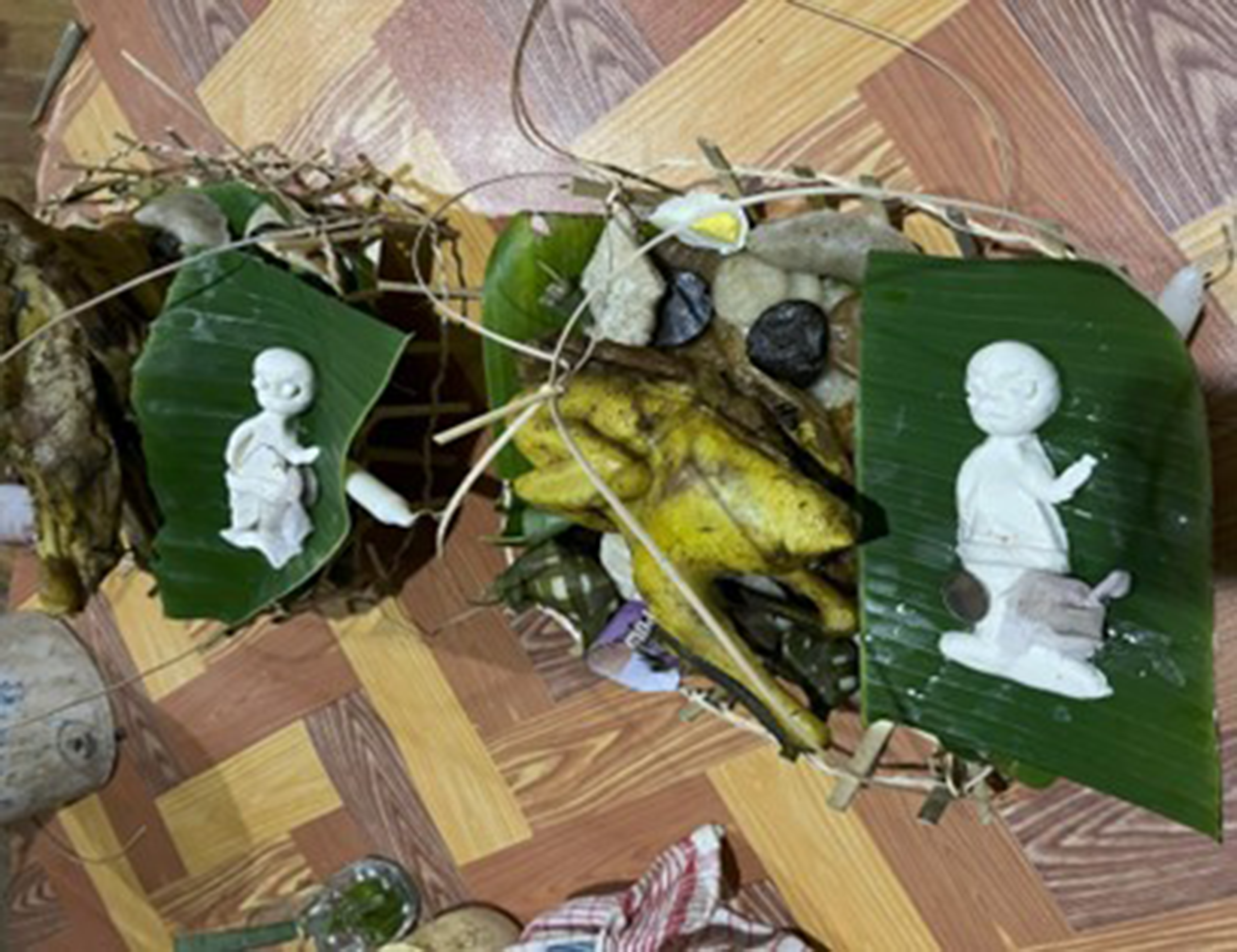
While I was in this village, I also gained permission from the traditional healer and the patient to witness the traditional healing practice, which involves the spirit of an old woman said to originate from the Kahayan region, as the healer. This is due to the existence of certain illnesses that cannot be detected by modern medical methods and are also believed to occur unnaturally. At that time, I also witnessed the spirit summoning process and the treatment process from the beginning to the end. There were some offerings given to the dark spirit that was the source of the patient’s illness so that it would leave the patient’s body, such as a black native free range chicken, several kinds of traditional cakes made from rice flour, boiled eggs and two small statues made from rice flour, which were believed to provide an avenue for the dark spirit to move from the patient’s body into the statues (Figure 2).
The offerings for performing a traditional healing ritual.
Pedagogical reflections
In Central Kalimantan, dreams are the language through which the forest speaks. This language of dreams is interwoven with the spoken language of the Dayak Ngaju community. The Dayak Ngaju language contains within it the knowledge of how to listen carefully and respond appropriately to the forest as it speaks through the language of dreams.
As we looked back on the process during the field work and the collaborative writing process, we came to realise that this study was as important for the regeneration of the community as it was for the regeneration of the tropical peatswamp forest. While in the villages of Sei Asem, Pilang and Mantangai Hulu, Corry’s presence as a researcher and member of the Dayak Ngaju community carried a responsibility to carefully honour the Indigenous knowledge and animism embraced by the Dayak Ngaju people. This responsibility also applies to us as co-authors, whose position as a collective of Indigenous and non-Indigenous researchers requires us to listen carefully, be humble and commit to honouring Indigenous communities in our research. The reflections shared in this paper arise from this relational connection, where research on ecolinguistics is inseparable from education and where learning is a mutual process between human and nonhuman beings.
One of the significant reflections in this paper involves the role of language as more than simply a descriptive instrument. In the context of the Dayak Ngaju worldview, words are not only the bearers of information but also a vital force that maintains the connections between humans, spirits and nature. As we listened to stories about shrines wrapped in yellow fabrics, rituals before the clearing of forests and dreams as messages from nonhuman beings, we began to appreciate ecolinguistics not only as an analytical framework but also as a pedagogy of harmonisation. Language here teaches us how to inhabit the obscure zones where many worlds coexist – some visible, others invisible.
Another reflection highlights the dynamic between the Indigenous animistic ontology of the Dayak Ngaju people and the political ecology of the area, which is impacted by government policies and corporate interests. Peatland restoration initiatives are often presented in technological and positivist scientific terms that disregard local cosmologies. However, as shown by these stories from the field, it is precisely the animistic protocols in rituals and spiritual respect that provide inspiration and foundations for truly regenerative ecological forest management. For us as researchers and educators, this raises the question: how can environmental education provide space for animistic worldviews without exploiting or simplifying them? This reflection reinforces our commitment to placing the Indigenous knowledge not as a sideline but as the foundation for the future of ecological education (Poelina et al., Reference Poelina, Wooltorton, Blaise, Aniere, Horwitz, White and Muecke2022; Reference Poelina, Perdrisat, Wooltorton and Mulligan2023; Wooltorton et al., Reference Wooltorton, Blaise, Poelina and Guimond2025) and the emerging field of critical forest studies (Rousell et al., Reference Rousell, Boadu, Hussey-Smith, Kelly, Mayes, Moss and McCandless2025).
Indigenous PhDs and the new animisms in the academy
These pedagogical reflections apply equally to the question of Indigenous doctoral supervision and relationships of mentorship and knowledge exchange, which we raised earlier in this article. In our work as a supervision team and as co-authors, the ethics of supervision and co-writing are inseparable from relationships embedded in the fieldwork, stories, communities and places we inhabit and contribute to. Co-creating this work together has highlighted the evolution of an unfolding approach to Indigenous PhD supervision that is carefully crafted to honour the multiple knowledges and needs of Corry as an Indigenous person, an academic and a PhD scholar. This approach recognises the knowledge that Corry brings to the work as an Indigenous person, in addition and prior to the learning that she is undertaking during the PhD process. As three supervisors and one PhD student who are each coming from quite different disciplines and cultural backgrounds, the collaborative nature of this writing process itself has educational value. Writing from different backgrounds – Corry as an Indonesian and a native Dayak Ngaju and others as settler and migrant Australians – forces us to negotiate the obscure zones and boundaries of our own understanding of animistic forest relationships in Dayak Ngaju culture. These differences resulted in productive friction, reminding us that critical forest studies are not something already harmonious, but rather a coexistence negotiated through contradictory encounters. We are also continually called to reflect on whether and how our own research practices are colonising. Our writing process became an experiment in collective learning, where disagreement, curiosity and vulnerability open new possibilities for thinking through critical forest studies in a new way.
We collectively acknowledge that Corry bears the burden of multiple translations: from Dayak Ngaju to Indonesian to English, as well as from daily life oral stories caught in the forest and village homes to the academic story format of international journal publications that we share in written form across the world. As a supervisory team, we bear the responsibility of finding new ways to work together to create new paths between the worlds of Indigenous and Western academic knowledge systems. These burdens we bear together joyfully, supported by the nonhuman beings of our local and adopted regenerating forests.
Conclusion
In conclusion, we reflect on the potential of this work for shaping the future. The regeneration of Kalimantan’s tropical peatswamp forests cannot be reduced to ecological metrics alone; it also requires the regeneration of language, stories and spiritual practices that connect people with this ecosystem. Teaching and learning from the Dayak Ngaju language is a practice of regenerative pedagogy – one that counters the extractive logic of capitalism and colonialism, while also affirming the future viability of animism. As such, our reflection highlights the inseparability of ecolinguistics, animism and education in critical forest studies and calls for environmental educators to approach forests not as a resource to be managed or even an ecosystem to be understood but as teachers, kinsfolk and worlds that exist on their own terms, in their own places.
This work demonstrates unequivocably that animism has a fundamental role in the Dayak Ngaju ecolinguistics and in the political ecology of Central Kalimantan. The Dayak Ngaju language, spoken by local communities, especially in traditional communities where people still have close contact with forests, embodies animistic values in many words used to describe their daily activities, particularly related to agriculture, harvesting timber and non-timber forest products, cultural and religious practices. The Dayak Ngaju language integrates animistic concepts that recognise spiritual entities in the surrounding environment, with naming practices and linguistic expressions that affirm a relationship of mutual respect between humans, nature and the deities or spirits that inhabit the landscape. Animistic protocols, such as rituals and spiritual permissions, serve to maintain harmony between humans and nonhumans and as a way for the communities to preserve ecosystems for future generations, which is contrary to the extraction of nature by predatory capitalism, a dominant paradigm in this and many other countries.
The revitalisation of Dayak Ngaju ecological and animistic language and traditional knowledge is an expression of political resistance. Renewal and more widespread appreciation of animistic worldviews can support the preservation of ecology. Use of animistic terminology in the Dayak Ngaju language maintains cultural identity and practical ecological knowledge essential for the regeneration of tropical peatswamp forests in Central Kalimantan. This integration demonstrates how the spiritual power of animism, which exists in the past, present and future, expressed through linguistic practices, forms a comprehensive political ecology that challenges established colonial and neocolonial environmental governance systems, while offering governments and NGOs a more regenerative approach, that respects local communities and local wisdom, to address contemporary environmental challenges in the vulnerable peatland ecosystems of Central Kalimantan.
Finally, our paper highlights how Dayak Ngaju language does more than describe forest ecosystems – it actively regenerates forests through relational practices of naming, storytelling and dreaming. This demonstrates the necessity of approaching environmental education through animist worldviews as pedagogical kaleidoscopes that can expand how all people learn to think, speak and act with forests relationally.
Acknowledgements
We wish to acknowledge the Bunnarung and Woi Wurrung language groups of the Eastern Kulin Nation and the Dayak Ngaju people of Central Kalimantan as the Traditional Owners and Cultural Custodians of the lands, air and waters on which this research takes place. We also wish to acknowledge the collaborative peer reviewers and Guest Editor Mark Harvey for insightful comments on earlier versions of this work and, in particular, for bringing attention to the complexities of Indigenous PhD supervision within the settler colonial academy.
Ethical statement
This research is approved by RMIT Human Research Ethics Committee (Project Number: 27654), Indonesian National Research and Innovation Agency (No: 051/ KE.01/SK/01/2025) and Regional Development Planning Agency of the Central Kalimantan Provincial Government (No: 072/098/2/I/Bapprida).
Financial support
This research was funded by Bappedalitbang Central Kalimantan Province (No: 050/203/Bid.I/Bapplitbang & No: 0088/UN24.13/KS/2024) and RMIT University (STEM College HDR Funds).
Competing interests
The author(s) would like to disclose that Associate Professor David Rousell is an Associate Editor of The Australian Journal of Environmental Education (AJEE). In accordance with AJEE protocols, Dr. Rousell was not involved in the editorial process or decision making regarding this manuscript.
Author Biographies
Corry Antang is a member of the Dayak Ngaju community of First Peoples of Central Kalimantan, recently doing a PhD at RMIT University in Naarm (Melbourne), Australia. She was born and raised in Banjarmasin, an urban area in South Kalimantan, away from the forest landscapes that have shaped the lives and cosmologies of many in her community. This distance has influenced how she relates to Dayak Ngaju animist worldview, not through daily ritual or forest-based practice but through stories, language and cultural memory carried by family and community. While she may not have grown up practising forest-based rituals directly, she understands the forest as a space of life, meaning and ancestral presence through the teachings and oral histories shared with her. For her, language plays a key role in this connection. The Dayak Ngaju language is a vessel for her to remember, relate to and resist. Her engagement with critical forest studies emerges from her hope to bridge Dayak Ngaju Indigenous knowledge and academic critique, while also confronting the complexities of being shaped by both her Indigenous identity and urban, modern life. She writes from a place of partial connection and partial distance, acknowledging both the limits and responsibilities of her position.
David Rousell (he/him) is an elective migrant living and working on the unceded lands of the Wurundjeri people of the Eastern Kulin Nation in the city of Naarm (Melbourne), Australia. He grew up on the East Coast of Turtle Island (North America) and is of Jewish and mixed European ancestry. Previously, he has lived on unceded Peramangk, Kaurna and Bundjalung Country in Australia, Ngati Hau lands in Aotearoa New Zealand and the Peaks district near the city of Manchester, UK. While David was raised in a secular household, since childhood he has experienced an animistic connection to place across the many different geographies he has passed through and inhabited. This connection to animism has often manifested as a deeply felt sense that the world is both sentient and alive in ways that are not reducible to physical causality. This animistic sense of worldly sentience and aliveness has become a central aspect of his research in recent years, including establishing the Critical Forest Studies Collaboratory for the cultivation and exchange of knowledge relating to interspecies learning within forest ecologies. A specific focus of this research has included the development of pedagogies which acknowledge and support the deep connections between childhood and animism across different cultural and geographical contexts.
Samantha Grover’s Anglo-Celtic ancestors tended soil and souls in Ireland and came to Australia in the 1800s to grow potatoes and the Anglican parish. She lives and works on unceded Wurrundjeri lands, within the same catchment as she grew up in, bounded by the Birrarung, Merri-Merri and Darebin waterways. Environmental activism guided her relationship to place during her teenage years and early twenties, taking responsibility for local environments and protesting about global issues. She learnt to listen closely to the earth as a soil scientist in her twenties and thirties, spending many solitary hours in observation and contemplation. In her fourth decade, she was invited to the peatlands of the Dayak Ngaju, upon the strength of relationship with Australian peatland soils. The power of these seemingly impenetrable tropical peatswamp forests and the strength of the relationship between the Dayak Ngaju people and their forests became immediately obvious. The yellow silk markers called quietly until Corry and her paths crossed. The earth as one animate being and/or comprised of many animate beings embodied in land, water and sky are ideas that Sam has encountered and explored in her extra-academic life, through involvement in a local nature-connection community of practice as well as interest in Australian Indigenous knowledge systems. She has honed an aptitude for listening to the earth and draws strength from place-based relationships with her home catchment, as well as familiar plants and soils encountered in work and travels.
Lily van Eeden (she/her) is a non-Indigenous Australian with British settler colonial ancestry on her mother’s side, and her father migrated to Australia from the Netherlands in the 1950s after WWII. She was born, grew up on and has returned to raise her children on Wurundjeri country in south-eastern Australia. She spent her childhood in the dry scrubby forests of the foothills north-east of Melbourne, which led her to pursue studies in ecological sciences. Her Western-style training in natural sciences informs how she perceives of and understands the nonhuman environment. Early in her career, she spent time working in North America and China, including living with an ethnic minority community in a nature reserve in central China. These experiences challenged her understanding of human’s relationship with the nonhuman world and helped her understand how culture and worldview shape environmental management and governance. This led her to retrain in human geography and other social sciences to take a more holistic approach to her research on human–nonhuman–nature interactions.


 Open access

