





1 Introduction
One of the central problems in the foundations of mathematics is the apparent well-ordering of natural theories by various measures of proof-theoretic strength, such as consistency strength. Taken in full generality, these orderings are neither linear nor well-founded. Yet, if one restricts one’s attention to sufficiently “natural” theories, neither non-linearity nor ill-foundedness arise.Footnote 1 Of particular interest is the apparent well-ordering of large cardinal axioms. Koellner writes that “large cardinal axioms …lie at the heart of the remarkable empirical fact that natural theories from completely distinct domains can be compared” [Reference Koellner12]. What explains the apparent well-ordering of the natural mathematical theories such as the large cardinal axioms? The non-mathematical quantification over “natural” theories makes it difficult to approach this question mathematically. Though Shelah says that explaining “the phenomena of linearity of consistency strength (and of large cardinal properties)” is a “logical dream,” he writes that “having an answer may well be disputable; it may have no solution or several” [Reference Shelah25, pp. 215–216].
Steel has emphasized that—for natural theories—the consistency strength ordering coincides with the ordering given by the inclusion relation on theorems from various pointclasses. He writes:
If T and U are natural extensions of $\mathsf {ZFC}$
, then
$\mathsf {ZFC}$
, then
 $$ \begin{align*} T \leq_{\mathsf{Con}}U \Leftrightarrow (\Pi^0_1)_T \subseteq (\Pi^0_1)_U \Leftrightarrow (\Pi^0_\omega)_T \subseteq (\Pi^0_\omega)_U. \end{align*} $$
Thus the well-ordering of natural consistency strengths corresponds to a well-ordering by the inclusion of theories of the natural numbers. There is no divergence at the arithmetic level, if one climbs the consistency strength hierarchy in any natural way we know of…. Natural ways of climbing the consistency strength hierarchy do not diverge in their consequences for the reals…. Let $T, U$
be natural theories of consistency strength at least that of “there are infinitely many Woodin cardinals”; then either
$T, U$
be natural theories of consistency strength at least that of “there are infinitely many Woodin cardinals”; then either $(\Pi ^1_\omega )_T\subseteq (\Pi ^1_\omega )_U$
or
$(\Pi ^1_\omega )_T\subseteq (\Pi ^1_\omega )_U$
or $(\Pi ^1_\omega )_U\subseteq (\Pi ^1_\omega )_T$
. (Steel [Reference Steel27, p. 159])
$(\Pi ^1_\omega )_U\subseteq (\Pi ^1_\omega )_T$
. (Steel [Reference Steel27, p. 159])
In previous work of the second-named author [Reference Walsh29], analogues of consistency strength based on $\Pi ^1_1$
-reflection were introduced that genuinely well-order large classes of theories. These are proven to coincide with inclusion relations on theorems from suitably chosen pointclasses. This provides an insight into Steel’s remarks that removes the non-mathematical quantification over “natural” theories. That work took place in the setting of second-order arithmetic, which limits the applicability and generality of those results. The main goal in this article is to explore the proof-theoretic well-ordering phenomenon in set theory, the context wherein large cardinal axioms arise. Hence, we introduce and study proof-theoretic orderings that exhibit genuine linearity and genuine well-foundedness. In particular, we formulate set-theoretic reflection principles, calibrate their strength, and show that they well-order vast swathes of theories.
$\Pi ^1_1$
-reflection were introduced that genuinely well-order large classes of theories. These are proven to coincide with inclusion relations on theorems from suitably chosen pointclasses. This provides an insight into Steel’s remarks that removes the non-mathematical quantification over “natural” theories. That work took place in the setting of second-order arithmetic, which limits the applicability and generality of those results. The main goal in this article is to explore the proof-theoretic well-ordering phenomenon in set theory, the context wherein large cardinal axioms arise. Hence, we introduce and study proof-theoretic orderings that exhibit genuine linearity and genuine well-foundedness. In particular, we formulate set-theoretic reflection principles, calibrate their strength, and show that they well-order vast swathes of theories.
Let’s introduce a few important definitions before continuing.
Definition 1.1. The formula $F^z$
is obtained from F by restricting all unrestricted quantifiers in F to z, i.e., replacing
$F^z$
is obtained from F by restricting all unrestricted quantifiers in F to z, i.e., replacing $\forall x$
by
$\forall x$
by $\forall x\in z$
and
$\forall x\in z$
and $\exists x$
by
$\exists x$
by $\exists x\in z$
.
$\exists x\in z$
.
It follows that $F^z$
is always a
$F^z$
is always a $\Delta _0$
formula.
$\Delta _0$
formula.
We will be particularly interested in formulas whose quantifiers are restricted to $L_\alpha $
. We will be proving general results about such formulas within formal systems. To prove such results,
$L_\alpha $
. We will be proving general results about such formulas within formal systems. To prove such results, $L_\alpha $
must be definable, whence
$L_\alpha $
must be definable, whence $\alpha $
must have a good representation whose properties can be established over a weak set theory like
$\alpha $
must have a good representation whose properties can be established over a weak set theory like $\mathsf {KP}$
. In this article, we adopt the convention that
$\mathsf {KP}$
. In this article, we adopt the convention that ${\boldsymbol {\alpha }}$
is a representation of the ordinal
${\boldsymbol {\alpha }}$
is a representation of the ordinal $\alpha $
satisfying various criteria (see Definition 3.1 and the discussion afterwards for details). Moreover, we work with theories that prove the
$\alpha $
satisfying various criteria (see Definition 3.1 and the discussion afterwards for details). Moreover, we work with theories that prove the $\Sigma $
-recursion principle so that, given a representation
$\Sigma $
-recursion principle so that, given a representation ${\boldsymbol {\alpha }}$
of an ordinal, we may define
${\boldsymbol {\alpha }}$
of an ordinal, we may define $L_{\boldsymbol {\alpha }}$
within the theory.
$L_{\boldsymbol {\alpha }}$
within the theory.
Definition 1.2. The formula G is $\Pi ^{\boldsymbol {\alpha }}_n$
(
$\Pi ^{\boldsymbol {\alpha }}_n$
( $\Sigma ^{\boldsymbol {\alpha }}_n$
) if G has the form
$\Sigma ^{\boldsymbol {\alpha }}_n$
) if G has the form $F^{L_{\boldsymbol {\alpha }}}$
for some
$F^{L_{\boldsymbol {\alpha }}}$
for some $\Pi _n$
(
$\Pi _n$
( $\Sigma _n$
) formula F.
$\Sigma _n$
) formula F.
Finally, in what follows, $\mathsf {KP}_1$
is the fragment of
$\mathsf {KP}_1$
is the fragment of $\mathsf {KP}$
that results from restricting set induction to
$\mathsf {KP}$
that results from restricting set induction to $(\Sigma _1\cup \Pi _1)$
formulas.
$(\Sigma _1\cup \Pi _1)$
formulas.
The reflection principles we will be working with are those defined as follows:
 $$ \begin{align*}\mathsf{RFN}_{\Sigma^{\boldsymbol{\alpha}}_1}(T) := \forall \varphi\in \Delta_0 \Big(\mathsf{Pr}_T\big(\exists x \in L_{\boldsymbol{\alpha}} \; \varphi(x)\big)\to L_{\boldsymbol{\alpha}}\models_{\Sigma_1} \exists x \varphi(x)\Big).\end{align*} $$
Note that this carves out a whole class of reflection principles, one for each ${\boldsymbol {\alpha }}$
. Moreover, note that each of these reflection principles is a formal statement within the language of set theory.
${\boldsymbol {\alpha }}$
. Moreover, note that each of these reflection principles is a formal statement within the language of set theory.
One of our main theorems is that the relation $\{(T,U) \mid U \vdash \mathsf {RFN}_{\Sigma ^{\boldsymbol {\alpha }}_1}(T)\}$
is well-founded when restricted to a broad class of theories.
$\{(T,U) \mid U \vdash \mathsf {RFN}_{\Sigma ^{\boldsymbol {\alpha }}_1}(T)\}$
is well-founded when restricted to a broad class of theories.
Theorem. There is no sequence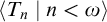 $\langle T_n\mid n<\omega \rangle $
of
$\langle T_n\mid n<\omega \rangle $
of $\Sigma ^{\boldsymbol {\alpha }}_1$
-sound,
$\Sigma ^{\boldsymbol {\alpha }}_1$
-sound, $\Pi ^{\boldsymbol {\alpha }}_1$
-definable extensions of
$\Pi ^{\boldsymbol {\alpha }}_1$
-definable extensions of $\mathsf {KP}_1 + \operatorname {\mathsf {Exists}}({\boldsymbol {\alpha }})$
such that for each n,
$\mathsf {KP}_1 + \operatorname {\mathsf {Exists}}({\boldsymbol {\alpha }})$
such that for each n, $T_n\vdash \mathsf {RFN}_{\Sigma ^{\boldsymbol {\alpha }}_1}(T_{n+1})$
.
$T_n\vdash \mathsf {RFN}_{\Sigma ^{\boldsymbol {\alpha }}_1}(T_{n+1})$
.
On the positive side, note that this theorem delivers as an immediate corollary a version of Gödel’s second incompleteness theorem: No $\Sigma ^{\boldsymbol {\alpha }}_1$
-sound,
$\Sigma ^{\boldsymbol {\alpha }}_1$
-sound, $\Pi ^{\boldsymbol {\alpha }}_1$
-definable extension T of
$\Pi ^{\boldsymbol {\alpha }}_1$
-definable extension T of $\mathsf {KP}_1 + \operatorname {\mathsf {Exists}}({\boldsymbol {\alpha }})$
proves
$\mathsf {KP}_1 + \operatorname {\mathsf {Exists}}({\boldsymbol {\alpha }})$
proves $\mathsf {RFN}_{\Sigma ^{\boldsymbol {\alpha }}_1}(T)$
.Footnote
2
Though
$\mathsf {RFN}_{\Sigma ^{\boldsymbol {\alpha }}_1}(T)$
.Footnote
2
Though $\mathsf {RFN}_{\Sigma ^{\boldsymbol {\alpha }}_1}$
is stronger than consistency,
$\mathsf {RFN}_{\Sigma ^{\boldsymbol {\alpha }}_1}$
is stronger than consistency, $\Pi ^{\boldsymbol {\alpha }}_1$
-definability is a weaker condition than recursive axiomatizability; accordingly, this result is neither stronger nor weaker than Gödel’s theorem but incomparable with it.
$\Pi ^{\boldsymbol {\alpha }}_1$
-definability is a weaker condition than recursive axiomatizability; accordingly, this result is neither stronger nor weaker than Gödel’s theorem but incomparable with it.
On the negative side, note that this result bears on the well-foundedness of proof-theoretic strength but not on the linearity of proof-theoretic strength. In previous work of the second-named author [Reference Walsh29], a proof-theoretic ordering within second-order arithmetic is introduced that coincides with the well-ordering induced by comparing proof-theoretic ordinals; this ordering is both well-founded and linear. Since $\mathsf {RFN}_{\Sigma ^{\boldsymbol {\alpha }}_1}$
is stronger than the reflection principle considered in that work, proof-theoretic ordinals are not sufficient to calibrate the strength of
$\mathsf {RFN}_{\Sigma ^{\boldsymbol {\alpha }}_1}$
is stronger than the reflection principle considered in that work, proof-theoretic ordinals are not sufficient to calibrate the strength of $\mathsf {RFN}_{\Sigma ^{\boldsymbol {\alpha }}_1}$
.
$\mathsf {RFN}_{\Sigma ^{\boldsymbol {\alpha }}_1}$
.
However, Pohlers has emphasized that the hierarchy of theories given by proof-theoretic ordinals is actually the first in a hierarchy of hierarchies. In particular, the standard ordinal analysis measures the strength of theories with respect to capturing properties of $\omega _1^{\mathsf {CK}}$
. Pohlers introduced the following generalizations of ordinal analysis that measure the strength of a theory with respect to capturing properties of other admissible ordinals.
$\omega _1^{\mathsf {CK}}$
. Pohlers introduced the following generalizations of ordinal analysis that measure the strength of a theory with respect to capturing properties of other admissible ordinals.
Definition 1.3. Let T be a theory containing $\mathsf {KP}_1$
. For a complexity class
$\mathsf {KP}_1$
. For a complexity class $\Gamma $
we define
$\Gamma $
we define
 $$ \begin{align*}|T|_{\Gamma^{\boldsymbol{\alpha}}} := \mathsf{min}\{\beta \mid \text{For all } \varphi\in\Gamma, \text{ if }T\vdash \varphi^{L_{\boldsymbol{\alpha}}} \text{ then } L_\beta \vDash \varphi \}.\end{align*} $$
This notion generalizes the standard notion of ordinal analysis for the following reason. There is a standard translation $\star $
from the language of second-order arithmetic into the language of set theory. For an
$\star $
from the language of second-order arithmetic into the language of set theory. For an $\mathcal {L}_2$
theory T,
$\mathcal {L}_2$
theory T,
 $$ \begin{align*}|T^\star|_{\Sigma_1^{\omega_1^{\mathsf{CK}}}}=|T|_{\mathsf{WF}},\end{align*} $$
where $|T|_{\mathsf {WF}}$
is the standard proof-theoretic ordinal of T, i.e., the supremum of the T-provably well-founded primitive recursive linear orders. For details see [Reference Pohlers19].
$|T|_{\mathsf {WF}}$
is the standard proof-theoretic ordinal of T, i.e., the supremum of the T-provably well-founded primitive recursive linear orders. For details see [Reference Pohlers19].
Though Pohlers introduced this generalization of ordinal analysis [Reference Pohlers19] and developed some applications thereof [Reference Pohlers21], the notion has not been thoroughly studied. Our second main theorem is a demonstration of the robustness of this notion. In particular, we give an abstract characterization of the ${\boldsymbol {\alpha }}$
ordinal analysis partition, which identifies theories that have the same
${\boldsymbol {\alpha }}$
ordinal analysis partition, which identifies theories that have the same $\Sigma ^{\boldsymbol {\alpha }}_1$
ordinal. We demonstrate that the
$\Sigma ^{\boldsymbol {\alpha }}_1$
ordinal. We demonstrate that the ${\boldsymbol {\alpha }}$
ordinal analysis partition is the unique finest partition satisfying certain natural criteria.Footnote
3
${\boldsymbol {\alpha }}$
ordinal analysis partition is the unique finest partition satisfying certain natural criteria.Footnote
3
Our final main theorem connects reflection principles and generalized proof-theoretic ordinals. To establish a full correspondence between reflection principles and generalized proof-theoretic ordinals, we use the notion of provability in the presence of an oracle.
Definition 1.4. We define provability in the presence of an oracle for $\Pi ^{\boldsymbol {\alpha }}_1$
-truths
$\Pi ^{\boldsymbol {\alpha }}_1$
-truths $\vdash ^{\Pi ^{\boldsymbol {\alpha }}_1}$
as follows:
$\vdash ^{\Pi ^{\boldsymbol {\alpha }}_1}$
as follows: $T\vdash ^{\Pi ^{\boldsymbol {\alpha }}_1} \varphi $
if there is a true
$T\vdash ^{\Pi ^{\boldsymbol {\alpha }}_1} \varphi $
if there is a true $\Pi ^{\boldsymbol {\alpha }}_1$
-formula
$\Pi ^{\boldsymbol {\alpha }}_1$
-formula $\psi $
such that
$\psi $
such that $T+\psi \vdash \varphi $
. We define
$T+\psi \vdash \varphi $
. We define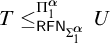 $T\le ^{\Pi ^{\boldsymbol {\alpha }}_1}_{\mathsf {RFN}_{\Sigma ^{\boldsymbol {\alpha }}_1}}U$
if and only if
$T\le ^{\Pi ^{\boldsymbol {\alpha }}_1}_{\mathsf {RFN}_{\Sigma ^{\boldsymbol {\alpha }}_1}}U$
if and only if
 $$ \begin{align*} \mathsf{KP}_1 + \operatorname{\mathsf{Exists}}({\boldsymbol{\alpha}}) \vdash^{\Pi^{\boldsymbol{\alpha}}_1} \mathsf{RFN}_{\Sigma^{\boldsymbol{\alpha}}_1}(U)\to \mathsf{RFN}_{\Sigma^{\boldsymbol{\alpha}}_1}(T). \end{align*} $$
Our final main theorem is as follows.
Theorem. Let T and U be $\Delta ^{\boldsymbol {\alpha }}_1$
-definable
$\Delta ^{\boldsymbol {\alpha }}_1$
-definable $\Sigma ^{\boldsymbol {\alpha }}_1$
-sound extensions of
$\Sigma ^{\boldsymbol {\alpha }}_1$
-sound extensions of $\mathsf {KP}_1 + \mathsf {Exists}({\boldsymbol {\alpha }})$
. Then we have
$\mathsf {KP}_1 + \mathsf {Exists}({\boldsymbol {\alpha }})$
. Then we have
 $$ \begin{align*} |T|_{\Sigma^{\boldsymbol{\alpha}}_1}\le |U|_{\Sigma^{\boldsymbol{\alpha}}_1} \iff T\le^{\Pi^{\boldsymbol{\alpha}}_1}_{\mathsf{RFN}_{\Sigma^{\boldsymbol{\alpha}}_1}}U. \end{align*} $$
Note that this immediately entails that the ordering $<^{\Pi ^{\boldsymbol {\alpha }}_1}_{\mathsf {RFN}_{\Sigma ^{\boldsymbol {\alpha }}_1}}$
induces on
$<^{\Pi ^{\boldsymbol {\alpha }}_1}_{\mathsf {RFN}_{\Sigma ^{\boldsymbol {\alpha }}_1}}$
induces on $\le ^{\Pi ^{\boldsymbol {\alpha }}_1}_{\mathsf {RFN}_{\Sigma ^{\boldsymbol {\alpha }}_1}}$
equivalence classes is a well-ordering. Note, moreover, that the stringent condition of
$\le ^{\Pi ^{\boldsymbol {\alpha }}_1}_{\mathsf {RFN}_{\Sigma ^{\boldsymbol {\alpha }}_1}}$
equivalence classes is a well-ordering. Note, moreover, that the stringent condition of $\Delta ^{\boldsymbol {\alpha }}_1$
-definability is necessary for the theorem; for a counter-example to the corresponding claim for
$\Delta ^{\boldsymbol {\alpha }}_1$
-definability is necessary for the theorem; for a counter-example to the corresponding claim for $\Pi ^{\boldsymbol {\alpha }}_1$
-definability see [Reference Walsh29, Section 3.5].
$\Pi ^{\boldsymbol {\alpha }}_1$
-definability see [Reference Walsh29, Section 3.5].
We prove all of these results assuming that $V=L$
. This excludes the application of these results to theories (for instance) that imply the existence of
$V=L$
. This excludes the application of these results to theories (for instance) that imply the existence of $0^\sharp $
. At the end of the article we discuss further directions. The results proved in this article should generalize to fine structural inner models compatible with
$0^\sharp $
. At the end of the article we discuss further directions. The results proved in this article should generalize to fine structural inner models compatible with $0^\sharp $
and beyond, assuming we limit ourselves to
$0^\sharp $
and beyond, assuming we limit ourselves to ${\boldsymbol {\alpha }}$
ordinal analysis for small enough admissible
${\boldsymbol {\alpha }}$
ordinal analysis for small enough admissible ${\boldsymbol {\alpha }}$
.
${\boldsymbol {\alpha }}$
.
Let us make a few remarks about the techniques deployed in this article. The theorems in this article strengthen various results in [Reference Walsh28, Reference Walsh29]. The main recurring technical tool in that work is the $\Pi ^1_1$
-completeness of well-foundedness, i.e., every
$\Pi ^1_1$
-completeness of well-foundedness, i.e., every $\Pi ^1_1$
statement is
$\Pi ^1_1$
statement is $\mathsf {ACA}_0$
-equivalent to the statement that a particular primitive recursive relation is well-founded. In the present article we do not work with the complexity class
$\mathsf {ACA}_0$
-equivalent to the statement that a particular primitive recursive relation is well-founded. In the present article we do not work with the complexity class $\Pi ^1_1$
, so this completeness theorem does not secure the results we prove. Accordingly, the techniques used in this article are novel and specially designed for the new set-theoretic context.
$\Pi ^1_1$
, so this completeness theorem does not secure the results we prove. Accordingly, the techniques used in this article are novel and specially designed for the new set-theoretic context.
In this article, we do much with $\Sigma _1^{\omega _1^{\mathsf {CK}}}$
-formulas (and with
$\Sigma _1^{\omega _1^{\mathsf {CK}}}$
-formulas (and with $\Sigma _1^{\boldsymbol {\alpha }}$
formulas generally). Following [Reference Sacks24], we may view
$\Sigma _1^{\boldsymbol {\alpha }}$
formulas generally). Following [Reference Sacks24], we may view $\Sigma _1^{\omega _1^{\mathsf {CK}}}$
-definable sets as
$\Sigma _1^{\omega _1^{\mathsf {CK}}}$
-definable sets as $\omega _1^{\mathsf {CK}}$
-recursively enumerable sets. Instead of converting
$\omega _1^{\mathsf {CK}}$
-recursively enumerable sets. Instead of converting $\Pi ^1_1$
statements into well-foundedness claims, one can convert
$\Pi ^1_1$
statements into well-foundedness claims, one can convert $\Sigma _1^{\omega _1^{\mathsf {CK}}}$
-statements into statements about hypercomputations. Such transformations are technically not necessary for our proofs, but we include some discussion of this perspective for conceptual reasons. One of the central activities of traditional ordinal analysis is the classification of recursive functions into transfinite hierarchies and the calibration of the computational strength of theories in terms of such hierarchies. We will see that this tight connection between ordinal analysis and computational strength generalizes into the domain of
$\Sigma _1^{\omega _1^{\mathsf {CK}}}$
-statements into statements about hypercomputations. Such transformations are technically not necessary for our proofs, but we include some discussion of this perspective for conceptual reasons. One of the central activities of traditional ordinal analysis is the classification of recursive functions into transfinite hierarchies and the calibration of the computational strength of theories in terms of such hierarchies. We will see that this tight connection between ordinal analysis and computational strength generalizes into the domain of ${\boldsymbol {\alpha }}$
ordinal analysis. Moreover, this connection can be adumbrated in wholly precise mathematical terms.
${\boldsymbol {\alpha }}$
ordinal analysis. Moreover, this connection can be adumbrated in wholly precise mathematical terms.
Here is our plan for the rest of the article. In Section 2 we review the basics of Kripke–Platek set theory. We cover definitions of the syntactic complexity classes we will work with, as well as their partial truth definitions. Since we are proving very general results in the context of set theory, it is not sufficient to treat primitive recursive well-orders as surrogates for ordinals. Hence in Section 3 we discuss the manner in which we deal with representations of ordinals. In Section 4 we establish the robustness of ${\boldsymbol {\alpha }}$
ordinal analysis by characterizing, in abstract terms, the partition of theories that it carves out. In Section 5 we connect
${\boldsymbol {\alpha }}$
ordinal analysis by characterizing, in abstract terms, the partition of theories that it carves out. In Section 5 we connect ${\boldsymbol {\alpha }}$
ordinal analysis with
${\boldsymbol {\alpha }}$
ordinal analysis with $\alpha $
recursion theory. This discussion lifts the well-known connections between provably total recursive functions and ordinal analysis to the domain of
$\alpha $
recursion theory. This discussion lifts the well-known connections between provably total recursive functions and ordinal analysis to the domain of $\alpha $
-recursion theory. In Section 6 we prove that relative
$\alpha $
-recursion theory. In Section 6 we prove that relative $\mathsf {RFN}_{\Sigma ^{\boldsymbol {\alpha }}_1}$
strength in the presence of appropriate oracles coincides with
$\mathsf {RFN}_{\Sigma ^{\boldsymbol {\alpha }}_1}$
strength in the presence of appropriate oracles coincides with ${\boldsymbol {\alpha }}$
ordinal analysis. In Section 7 we prove that
${\boldsymbol {\alpha }}$
ordinal analysis. In Section 7 we prove that $\mathsf {RFN}_{\Sigma ^{\boldsymbol {\alpha }}_1}$
induces a well-founded relation on a large swathe of theories, even without the presence of oracles. Finally, in Section 8 we discuss the connection of these results with broader set-theoretic themes. In particular, we discuss the connection between our results and the Spector classes introduced by Moschovakis [Reference Moschovakis16]. We also discuss how to generalize our main results to inner models beyond Gödel’s L. In particular, we discuss a generalization of the linearity and well-foundedness phenomena for
$\mathsf {RFN}_{\Sigma ^{\boldsymbol {\alpha }}_1}$
induces a well-founded relation on a large swathe of theories, even without the presence of oracles. Finally, in Section 8 we discuss the connection of these results with broader set-theoretic themes. In particular, we discuss the connection between our results and the Spector classes introduced by Moschovakis [Reference Moschovakis16]. We also discuss how to generalize our main results to inner models beyond Gödel’s L. In particular, we discuss a generalization of the linearity and well-foundedness phenomena for $\Pi ^1_3$
theorems to theories that contain
$\Pi ^1_3$
theorems to theories that contain $\mathsf {ZFC}$
+
$\mathsf {ZFC}$
+ $\boldsymbol {\Delta }^1_2$
determinacy.
$\boldsymbol {\Delta }^1_2$
determinacy.
2 Kripke–Platek set theory
Throughout this article, we will work with the weak set theory $\mathsf {KP}_1$
, Kripke–Platek set theory with the Foundation schema restricted to
$\mathsf {KP}_1$
, Kripke–Platek set theory with the Foundation schema restricted to $\Sigma _1\cup \Pi _1$
-formulas. Working over any weak set theory T comes with an obvious risk: Some claims that seem intuitively obvious may not be T-provable. In this section, we will cover some of the basic facts about
$\Sigma _1\cup \Pi _1$
-formulas. Working over any weak set theory T comes with an obvious risk: Some claims that seem intuitively obvious may not be T-provable. In this section, we will cover some of the basic facts about $\mathsf {KP}_1$
that we will need in the rest of our article.
$\mathsf {KP}_1$
that we will need in the rest of our article.
Definition 2.1. Consider the language $\{\in \}$
. The
$\{\in \}$
. The $\Delta _0$
-formulas are the bounded formulas. That is,
$\Delta _0$
-formulas are the bounded formulas. That is, $\Delta _0$
is the least class of formulas containing atomic formulas that are closed under Booleans and bounded quantification. Following the usual convention,
$\Delta _0$
is the least class of formulas containing atomic formulas that are closed under Booleans and bounded quantification. Following the usual convention, $\Sigma _0=\Pi _0=\Delta _0$
.
$\Sigma _0=\Pi _0=\Delta _0$
.
Now we inductively define $\Sigma _n$
-formulas and
$\Sigma _n$
-formulas and $\Pi _n$
-formulas as follows:
$\Pi _n$
-formulas as follows:
-
• A formula is $\Sigma _{n+1}$
if it is of the form
$\exists x \psi (x,y_1,\ldots y_m)$
for some
$\Pi _{n}$
-formula
$\psi $
.
$\Sigma _{n+1}$
if it is of the form
$\exists x \psi (x,y_1,\ldots y_m)$
for some
$\Pi _{n}$
-formula
$\psi $
. -
• A formula is
$\Pi _{n+1}$
if it is of the form
$\forall x \psi (x,y_1,\ldots y_m)$
for some
$\Sigma _{n}$
-formula
$\psi $
.







If a theory T extending $\mathsf {KP}_1$
proves that
$\mathsf {KP}_1$
proves that $\varphi $
is equivalent both to a
$\varphi $
is equivalent both to a $\Sigma _n$
-formula and to a
$\Sigma _n$
-formula and to a $\Pi _n$
-formula, then we say that
$\Pi _n$
-formula, then we say that $\varphi $
is T-provably
$\varphi $
is T-provably $\Delta _n$
. If the theory T is clear in context, we omit T and simply say that
$\Delta _n$
. If the theory T is clear in context, we omit T and simply say that $\varphi $
is
$\varphi $
is $\Delta _n$
.
$\Delta _n$
. $\mathsf {KP}_1$
is the theory comprising the following axioms:
$\mathsf {KP}_1$
is the theory comprising the following axioms:
-
1. Extensionality, Union, Pairing, and Infinity.
-
2.
$\Delta _0$
-Separation: For every
$\Delta _0$
-formula
$\varphi (x)$
and parameter a, the following is an axiom: That is,
$$ \begin{align*} \exists b \forall x [x\in b\leftrightarrow x\in a\land \varphi(x)]. \end{align*} $$
$\{x\in a\mid \varphi (x)\}$
is a set.
-
3.
$\Sigma _1\cup \Pi _1$
-Foundation in the form of
$\in $
-Induction: For every formula
$\varphi (x)$
, which is either
$\Sigma _1$
or
$\Pi _1$
, the following is an axiom:
$$ \begin{align*} [\forall y\in x \varphi(y)\to \varphi(x)]\to\forall x\varphi(x). \end{align*} $$
-
4.
$\Sigma _1$
-Collection: For every
$\Sigma _1$
-formula
$\varphi (x,y)$
and parameter a the following is an axiom:
$$ \begin{align*} \forall x\in a \exists y\varphi(x,y)\to \exists b\forall x\in a\exists y\in b\varphi(x,y). \end{align*} $$





Remark 2.2. Let us briefly discuss the proof-theoretic strength of $\mathsf {KP}_1$
. Let
$\mathsf {KP}_1$
. Let $\mathsf {KP}_0$
be Kripke–Platek set theory with Infinity, but with the Foundation schema restricted to
$\mathsf {KP}_0$
be Kripke–Platek set theory with Infinity, but with the Foundation schema restricted to $\Delta _0$
-formulas. For a theory
$\Delta _0$
-formulas. For a theory $T\subseteq \mathsf {ZFC}$
in the language of set theory having a model of the form
$T\subseteq \mathsf {ZFC}$
in the language of set theory having a model of the form $L_\alpha $
, let
$L_\alpha $
, let $|T|_{\Gamma }$
be the least ordinal
$|T|_{\Gamma }$
be the least ordinal $\alpha $
such that
$\alpha $
such that $L_\alpha $
satisfies every
$L_\alpha $
satisfies every $\Gamma $
-consequence of T. Cantini [Reference Cantini6] proved that
$\Gamma $
-consequence of T. Cantini [Reference Cantini6] proved that $|\mathsf {KP}_0 + \Sigma _1\text {-Foundation}|_{\Sigma _{1}} = \varphi \omega 0$
. By [Reference Rathjen22, Theorem 2.1], we have
$|\mathsf {KP}_0 + \Sigma _1\text {-Foundation}|_{\Sigma _{1}} = \varphi \omega 0$
. By [Reference Rathjen22, Theorem 2.1], we have
 $$ \begin{align*} |\mathsf{KP}_0 + \Sigma_1\text{-Foundation}|_{\Sigma_1} = |\mathsf{KP}_0 + \Sigma_1\text{-Foundation}|_{\Pi_2}. \end{align*} $$
Also, Rathjen [Reference Rathjen23, Theorem 1.4] proved that $\mathsf {KP}_0 + \Sigma _1\text {-Foundation}$
and
$\mathsf {KP}_0 + \Sigma _1\text {-Foundation}$
and $\mathsf {KP}_1$
prove the same
$\mathsf {KP}_1$
prove the same $\Pi _2$
-consequences. This shows
$\Pi _2$
-consequences. This shows $|\mathsf {KP}_1|_{\Pi _2} =\varphi \omega 0$
. Rathjen [Reference Rathjen22, Remark 2.2] suggested as a rule of thumb that if
$|\mathsf {KP}_1|_{\Pi _2} =\varphi \omega 0$
. Rathjen [Reference Rathjen22, Remark 2.2] suggested as a rule of thumb that if $\alpha =\omega ^\alpha $
and
$\alpha =\omega ^\alpha $
and $\mathsf {KP}_0\subseteq T\subseteq \mathsf {KP}$
, then we usually have
$\mathsf {KP}_0\subseteq T\subseteq \mathsf {KP}$
, then we usually have
 $$ \begin{align*} |T|_{\Pi_2} = \alpha \implies |T|_{\Pi^1_1} = \varphi \alpha 0. \end{align*} $$
Accordingly, a plausible guess is that $|\mathsf {KP}_1|_{\Pi ^1_1}=\varphi (\varphi \omega 0)0$
should hold. This suggests that the proof-theoretic strength of
$|\mathsf {KP}_1|_{\Pi ^1_1}=\varphi (\varphi \omega 0)0$
should hold. This suggests that the proof-theoretic strength of $\mathsf {KP}_1$
is quite weak.
$\mathsf {KP}_1$
is quite weak.
Throughout this article, it is very important to track the complexity of formulas. Let us start with the calculations of the complexity of simple formulas.
Lemma 2.3. Each of the following formulas is equivalent to a $\Delta _0$
-formula:
$\Delta _0$
-formula:
-
1.
$z=\{x,y\}$
. -
2.
$\{x,y\}\in z$
. -
3.
$z=\langle x,y\rangle $
, where
$\langle x,y\rangle = \{\{x\},\{x,y\}\}$
is a Kuratowski ordered pair. -
4.
$z = \bigcup x$
. -
5.
$z = x\cup y$
. -
6.
$z = \varnothing $
. -
7. x is a transitive set.
-
8. x is an ordinal.





Proof. We can see that the following equivalences hold:
-
1.
$z = \{x,y\} \iff (x\in z \land y\in z) \land \forall w\in z(w=x\lor w=y)$
. -
2.
$\{x,y\}\in z \iff \exists w\in z (w = \{x,y\})$
. -
3.
$z = \langle x,y\rangle \iff (\{x\}\in z\land \{x,y\}\in z)\land \forall w\in z (w = \{x\} \lor w = \{x,y\})$
. -
4.
$z=\bigcup x \iff [\forall w\in z\exists y\in x (w\in y)] \land [\forall y\in x\forall w\in y (w\in z)]$
. -
5.
$z=x\cup y \iff [\forall w\in x(w\in z)\land \forall w\in y(w\in z)] \land [\forall w\in z(z\in x \lor z\in y)]$
. -
6.
$z=\varnothing \iff \forall w\in z (w\neq w)$
. -
7.
$x \text {is transitive} \iff \forall y\in x \; \forall z\in y \; (z\in x)$
. -
8.
$x \text {is an ordinal} \iff x \text {is transitive} \land \forall y\in x \; (y \text {is transitive})$
.








The last equivalence requires clarification: The classical definition of $\alpha $
being an ordinal is that
$\alpha $
being an ordinal is that $\alpha $
is transitive and
$\alpha $
is transitive and $(\alpha ,\in )$
is well-ordered in the sense that
$(\alpha ,\in )$
is well-ordered in the sense that $(\alpha ,\in )$
is linear and for every non-empty
$(\alpha ,\in )$
is linear and for every non-empty $y\subseteq \alpha $
, y has an
$y\subseteq \alpha $
, y has an $\in $
-minimal element. Unfortunately, the classical definition is
$\in $
-minimal element. Unfortunately, the classical definition is $\Pi _1$
. However, we can prove that
$\Pi _1$
. However, we can prove that $\alpha $
is an ordinal if and only if
$\alpha $
is an ordinal if and only if $\alpha $
is a transitive set of transitive sets. The reader can see that the proof of Lemmas 6.3 and 6.4 of [Reference Jeon11] works over
$\alpha $
is a transitive set of transitive sets. The reader can see that the proof of Lemmas 6.3 and 6.4 of [Reference Jeon11] works over $\mathsf {KP}_1$
, and it shows that
$\mathsf {KP}_1$
, and it shows that $(\alpha ,\in )$
is well-ordered if and only if
$(\alpha ,\in )$
is well-ordered if and only if $\alpha $
is a transitive set of transitive sets.
$\alpha $
is a transitive set of transitive sets.
We will make use of many more $\Delta _0$
notions. Instead of identifying them here, we will identify them as we go. We will only ever claim that a notion is
$\Delta _0$
notions. Instead of identifying them here, we will identify them as we go. We will only ever claim that a notion is $\Delta _0$
without proof if we trust that the reader can easily verify the claim by hand.
$\Delta _0$
without proof if we trust that the reader can easily verify the claim by hand.
Lemma 2.4. $\mathsf {KP}_1$
proves the adequacy of the Kuratowski definition of ordered pairs in the following sense: If
$\mathsf {KP}_1$
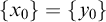
proves the adequacy of the Kuratowski definition of ordered pairs in the following sense: If $\langle x_0,x_1\rangle = \langle y_0,y_1\rangle $
, then
$\langle x_0,x_1\rangle = \langle y_0,y_1\rangle $
, then $x_0=y_0$
and
$x_0=y_0$
and $x_1=y_1$
.
$x_1=y_1$
.
Proof. Suppose that $\langle x_0,x_1\rangle = \langle y_0,y_1\rangle $
, that is,
$\langle x_0,x_1\rangle = \langle y_0,y_1\rangle $
, that is,
 $$ \begin{align*} \{\{x_0\},\{x_0,x_1\}\} = \{\{y_0\},\{y_0,y_1\}\}. \end{align*} $$
Then we have $\{x_0\}=\{y_0\}\lor \{x_0\}=\{y_0,y_1\}$
. Similarly, we have
$\{x_0\}=\{y_0\}\lor \{x_0\}=\{y_0,y_1\}$
. Similarly, we have $\{x_0,x_1\}=\{y_0\}\lor \{x_0,x_1\}=\{y_0,y_1\}$
. Based on this, let us divide the cases:
$\{x_0,x_1\}=\{y_0\}\lor \{x_0,x_1\}=\{y_0,y_1\}$
. Based on this, let us divide the cases:
-
• If
$\{x_0\} = \{y_0,y_1\}$
, then
$x_0=y_0=y_1$
. Thus we get
$\{x_0,x_1\}=\{y_0\}$
, so
$x_1=y_0$
. In sum,
$x_0=x_1=y_0=y_1$
. -
• If
$\{x_0,x_1\}=\{y_0\}$
, then by an argument similar to the previous one, we have
$x_0=x_1=y_0=y_1$
. -
• Now consider the case
$\{x_0\}=\{y_0\}$
and
$\{x_0,x_1\}=\{y_0,y_1\}$
. Then we have
$x_0=y_0$
, so
$\{x_0,x_1\}=\{x_0,y_1\}$
. Hence
$x_1\in \{x_0,y_1\}$
, so either
$x_1=x_0$
or
$x_1=y_1$
. But if
$x_1=x_0$
, then from
$y_1\in \{x_0,x_1\}$
we get
$x_1=y_1$
.















Remark 2.5. The proof for the above lemmas does not use $\Sigma _1$
-Collection.
$\Sigma _1$
-Collection.
Our definitions of $\Sigma _n$
and
$\Sigma _n$
and $\Pi _n$
formulas are quite restrictive. They apply only to formulas in prenex normal form with alternating unbounded formulas. However, it turns out that we can normalize (i.e., transform in
$\Pi _n$
formulas are quite restrictive. They apply only to formulas in prenex normal form with alternating unbounded formulas. However, it turns out that we can normalize (i.e., transform in $\mathsf {KP}_1$
) formulas in other forms into
$\mathsf {KP}_1$
) formulas in other forms into $\Sigma _n$
or
$\Sigma _n$
or $\Pi _n$
-formulas. Influenced by [Reference Friedman, Li and Wong7] and
$\Pi _n$
-formulas. Influenced by [Reference Friedman, Li and Wong7] and $\mathcal {E}_n$
- and
$\mathcal {E}_n$
- and $\mathcal {U}_n$
-hierarchies in [Reference Jeon11], let us define the following.
$\mathcal {U}_n$
-hierarchies in [Reference Jeon11], let us define the following.
Definition 2.6. Define $\underline {\Sigma }_n$
and
$\underline {\Sigma }_n$
and $\underline {\Pi }_n$
recursively as follows:
$\underline {\Pi }_n$
recursively as follows:
-
•
$\underline {\Sigma }_0=\underline {\Pi }_0$
is the set of all bounded formulas. -
•
$\underline {\Sigma }_{n+1}$
is the least class containing
$\underline {\Pi }_n$
that is closed under
$\land $
,
$\lor $
, bounded quantification, and unbounded
$\exists $
. -
•
$\underline {\Pi }_{n+1}$
is the least class containing
$\underline {\Sigma }_n$
that is closed under
$\land $
,
$\lor $
, bounded quantification, and unbounded
$\forall $
.


 $\underline {\Sigma }_1$
-formulas are also known as
$\underline {\Sigma }_1$
-formulas are also known as $\Sigma $
-formulas. Unlike the usual
$\Sigma $
-formulas. Unlike the usual $\Sigma _n$
or
$\Sigma _n$
or $\Pi _n$
formulas, every formula is either one of
$\Pi _n$
formulas, every formula is either one of $\underline {\Sigma }_n$
or
$\underline {\Sigma }_n$
or $\underline {\Pi }_n$
for some n.
$\underline {\Pi }_n$
for some n.
Definition 2.7. A $\underline {\Sigma }_n$
or
$\underline {\Sigma }_n$
or $\underline {\Pi }_n$
formula is normalizable if it is equivalent to a
$\underline {\Pi }_n$
formula is normalizable if it is equivalent to a $\Sigma _n$
or a
$\Sigma _n$
or a $\Pi _n$
formula, respectively.
$\Pi _n$
formula, respectively. $\mathsf {KP}_1$
proves that
$\mathsf {KP}_1$
proves that $\underline {\Sigma }_1$
-formulas are normalizable. In general, we can see that the following holds, and we present its proof for the reader’s convenience.
$\underline {\Sigma }_1$
-formulas are normalizable. In general, we can see that the following holds, and we present its proof for the reader’s convenience.
Lemma 2.8 (Propositions 2.3 and 2.4 of [Reference Friedman, Li and Wong7]) $\mathsf {KP}_1$
proves the following: Suppose that
$\mathsf {KP}_1$
proves the following: Suppose that $\varphi $
and
$\varphi $
and $\psi $
are normalizable formulas of the same complexity.
$\psi $
are normalizable formulas of the same complexity.
-
1. If
$\varphi $
is
$\Sigma _n$
, then
$\exists x\varphi $
and
$\exists x\in a \; \varphi $
are also normalizable. Similarly, if
$\varphi $
is
$\Pi _n$
, then
$\forall x\varphi $
and
$\forall x\in a \; \varphi $
are also normalizable. -
2.
$\lnot \varphi $
,
$\varphi \land \psi $
, and
$\varphi \lor \psi $
are normalizable. -
3. Assuming
$\Sigma _n$
-Collection, if
$\varphi $
is a
$\Sigma _m$
-formula for
$m\le n$
, then
$\forall x\in a \; \varphi $
is normalizable. Similarly, if
$\varphi $
is
$\Pi _n$
and
$m\le n$
, then
$\exists x\in a \; \varphi $
is normalizable.


The following lemma has a central role in our proof.
Lemma 2.9. Working over $\mathsf {KP}_1$
, let
$\mathsf {KP}_1$
, let $\varphi (x_0,x_1,v_0,v_1,\ldots , v_{n-1},\vec {z})$
be a
$\varphi (x_0,x_1,v_0,v_1,\ldots , v_{n-1},\vec {z})$
be a $\Delta _0$
formula. If we set
$\Delta _0$
formula. If we set
 $$ \begin{align*} &\varphi'(x,v_0,\ldots, v_{n-1},\vec{z})\equiv \exists u\in x\exists y_0\in u\exists y_1\in u \nonumber\\&\qquad\qquad\qquad\qquad [(x = \langle y_0,y_1\rangle) \land \varphi(y_0,y_1,v_0,v_1,v_0,v_1,\ldots, v_{n-1},\vec{z})], \end{align*} $$
then $\varphi '$
is also
$\varphi '$
is also $\Delta _0$
and we have the following:
$\Delta _0$
and we have the following:
-
(i) For any
$x_0$
and
$x_1$
, if we let
$x=\langle x_0,x_1\rangle $
, then (1)
$$ \begin{align} \forall \vec{z} \forall v_0\forall v_1\dots\forall v_{n-1}\ [\varphi(x_0,x_1,v_0,\ldots,v_{n-1},\vec{z})\leftrightarrow \varphi'(x,v_0,\ldots,v_{n-1},\vec{z})]. \end{align} $$
-
(ii) We have
$$ \begin{align*} &\forall \vec{z} \left[\forall x_0\forall x_1\exists v_0\forall v_1\ldots \mathsf{Q} v_{n-1} \varphi(x_0,x_1,v_0,v_1,\ldots,v_{n-1},\vec{z}) \right.\\ &\qquad\qquad\qquad\qquad\qquad\left. \leftrightarrow \forall x\exists v_0\forall v_1\ldots \mathsf{Q} v_{n-1} \varphi'(x,v_0,v_1,\ldots,v_{n-1},\vec{z})\right]. \end{align*} $$


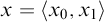


Proof. Let us prove the first claim: Suppose that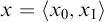 $x=\langle x_0,x_1\rangle $
. By taking
$x=\langle x_0,x_1\rangle $
. By taking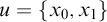 $u=\{x_0,x_1\}$
, we have
$u=\{x_0,x_1\}$
, we have
 $$ \begin{align*} \exists u\in x (x_0,x_1\in u\land x=\langle x_0,x_1\rangle). \end{align*} $$
Thus if $\varphi (x_0,x_1,v_0,\ldots ,v_{n-1})$
holds, then
$\varphi (x_0,x_1,v_0,\ldots ,v_{n-1})$
holds, then $\varphi '(x,v_0,\ldots ,v_{n-1})$
follows.
$\varphi '(x,v_0,\ldots ,v_{n-1})$
follows.
Conversely, suppose that $\varphi '(x,v_0,\ldots ,v_{n-1})$
holds and that for some
$\varphi '(x,v_0,\ldots ,v_{n-1})$
holds and that for some $u\in x$
and some
$u\in x$
and some $y_0,y_1\in u$
:
$y_0,y_1\in u$
:
 $$ \begin{align*} x=\langle y_0,y_1\rangle\land \varphi(y_0,y_1,v_0,\ldots,v_{n-1}). \end{align*} $$
Now let us prove the second claim by induction on n. The left-to-right direction is clear: For given $x_0$
and
$x_0$
and $x_1$
, set
$x_1$
, set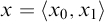 $x=\langle x_0,x_1\rangle $
. For the other direction, suppose that for every x the following holds:
$x=\langle x_0,x_1\rangle $
. For the other direction, suppose that for every x the following holds:
 $$ \begin{align} \exists v_0\forall v_1\ldots \mathsf{Q} v_{n-1} \varphi'(x,v_0,v_1,\ldots,v_{n-1}). \end{align} $$
By taking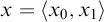 $x=\langle x_0, x_1\rangle $
from (2) and applying (1), we get the following:
$x=\langle x_0, x_1\rangle $
from (2) and applying (1), we get the following:
 $$ \begin{align*} \exists v_0\forall v_1\ldots \mathsf{Q} v_{n-1} \varphi(x_0,x_1,v_0,v_1,\ldots,v_{n-1}).\\[-34pt] \end{align*} $$
Before stating the proof of Lemma 2.8, let us observe that we can find $\varphi '$
from
$\varphi '$
from $\varphi $
that is uniform to
$\varphi $
that is uniform to $\vec {z}$
. That is, the choice of parameters does not affect the new formula obtained by encoding variables into a single one.
$\vec {z}$
. That is, the choice of parameters does not affect the new formula obtained by encoding variables into a single one.
Proof of Lemma 2.8
-
1. Suppose that
$\varphi (x)$
is
$\Sigma _n$
. We first claim that
$\exists x\varphi (x)$
is equivalent to a
$\Sigma _n$
-formula. Suppose that
$\varphi (x)$
is of the form for some
$$ \begin{align*} \exists v_0\forall v_1\ldots\mathsf{Q} v_{n-1} \varphi_0(x,v_0,\ldots,v_{n-1}) \end{align*} $$
$\Delta _0$
-formula
$\varphi _0$
. By Lemma 2.9, we have a
$\Delta _0$
-formula
$\varphi _0'$
satisfying the following: where
$$ \begin{align*} &\forall x\forall v_0\exists v_1\dots \overline{\mathsf{Q}} v_{n-1} \lnot\varphi(x,v_0,v_1,\ldots,v_{n-1}) \\ &\qquad\qquad\qquad\qquad\qquad\qquad\leftrightarrow \forall y\exists v_1\dots \overline{\mathsf{Q}} v_{n-1} \lnot\varphi_0'(y,v_1,\ldots,v_{n-1}), \end{align*} $$
$\overline {\mathsf {Q}}$
is the dual of the quantifier
$\mathsf {Q}$
. By taking the negation, we have
$$ \begin{align*} &\exists x\exists v_0\forall v_1\ldots \mathsf{Q} v_{n-1} \varphi(x,v_0,v_1,\ldots,v_{n-1}) \\ &\qquad\qquad\qquad\qquad\qquad\qquad\leftrightarrow \exists y\forall v_1\ldots \mathsf{Q} v_{n-1} \varphi_0'(y,v_1,\ldots,v_{n-1}). \end{align*} $$
Now let us consider the bounded quantifier case. Formally,
$\exists x\in a\varphi (x)$
is equivalent to
$\exists x (x\in a\land \varphi (x))$
. Under the same assumption on
$\varphi $
and
$\varphi _0$
,
$\exists x (x\in a\land \varphi (x))$
is equivalent to
$$ \begin{align*} \exists x \exists v_0 \forall v_0\ldots\mathsf{Q}v_{n-1} [x\in a\land \varphi_0(x,v_0,\ldots,v_{n-1})]. \end{align*} $$
The formula
$x\in a\land \varphi _0(x,v_0,\ldots ,v_{n-1})$
is
$\Delta _0$
, so by exactly the same argument we did for an unbounded
$\exists $
, we can normalize
$\exists x\in a\varphi (x)$
to a
$\Sigma _n$
-formula. Normalizing
$\forall x\varphi (x)$
or
$\forall x\in a\varphi (x)$
when
$\varphi $
is
$\Pi _n$
is analogous, so we omit the proof. -
2. Suppose that
$\varphi $
and
$\psi $
are
$\Sigma _n$
-formulas. Showing the normalizability of
$\lnot \varphi $
is easy, so let us only consider the normalizability of
$\varphi \land \psi $
. The case for
$\varphi \lor \psi $
is analogous.Suppose that
$\varphi $
and
$\psi $
are
$\Sigma _n$
-formulas. Then we have
$\Delta _0$
-formulas
$\varphi _0$
and
$\psi _0$
such that and
$$ \begin{align*} \varphi(\vec{x}) \equiv \exists u_0 \forall u_1 \ldots \mathsf{Q} u_{n-1} \varphi_0(u_0,u_1,\ldots, u_{n-1},\vec{x}) \end{align*} $$
We may assume that all of
$$ \begin{align*} \psi(\vec{x}) \equiv \exists v_0 \forall v_1 \ldots \mathsf{Q} v_{n-1} \psi_0(v_0,v_1,\ldots, v_{n-1},\vec{x}). \end{align*} $$
$u_i$
and
$v_i$
are different variables by substitution, so by basic predicate logic, the following holds: Now inductively reduce duplicated quantifiers from the inside to the outside by applying the second clause of Lemma 2.9.
$$ \begin{align*} \varphi(\vec{x})\land\psi(\vec{x}) \iff \exists u_0\exists v_0 \forall u_1\forall v_1\ldots \mathsf{Q}u_{n-1}\mathsf{Q}v_{n-1}[\varphi_0\land \psi_0]. \end{align*} $$
To illustrate what is happening, let us consider the case
$n=2$
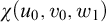
. In this case, we need to normalize the following formula: By Clause 2 of Lemma 2.9, we can find some
$$ \begin{align*} \exists u_0\exists v_0 \forall u_1\forall v_1[\varphi_0(u_0,u_1)\land \psi_0(v_0,v_1)]. \end{align*} $$
$\Delta _0$
-formula
$\chi (u_0,v_0,w_1)$
such that for every
$u_0$
and
$v_0$
, we have Then applying the equivalent form of the second clause of Lemma 2.9, which is for repeating
$$ \begin{align*} \forall u_1\forall v_1[\varphi_0(u_0,u_1)\land \psi_0(v_0,v_1)] \leftrightarrow \forall w_1 \chi(u_0,v_0,w_1). \end{align*} $$
$\exists $
, we can find a
$\Delta _0$
-formula
$\chi '(w_0,w_1)$
, we have
$$ \begin{align*} \exists u_0\exists u_1 \forall w_1 \chi(u_0,v_0,w_1) \leftrightarrow \exists w_0\forall w_1 \chi'(w_0,w_1). \end{align*} $$
-
3. We will prove this claim by induction on n.
$\Sigma _n$
-Collection states the following: For every
$\Sigma _n$
-formula
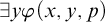
$\varphi (x,y,p)$
, we have for every a and p, Clearly the consequent implies the antecedent, so the equivalence holds. Now assume that
$$ \begin{align*} \forall x\in a \exists y \varphi(x,y,p) \to \exists b \forall x\in a \exists y\in b \varphi(x,y,p). \end{align*} $$
$\varphi $
by a
$\Pi _{n-1}$
-formula. Then
$\exists y\varphi (x,y,p)$
becomes a
$\Sigma _n$
-formula.
Thus, the claim that
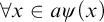
$\forall x\in a\psi (x)$
is equivalent to a
$\Sigma _n$
-formula
$\psi $
reduces to the claim that
$\exists y\in b \chi (y)$
is equivalent to a
$\Pi _{n-1}$
-formula
$\chi $
. However, by the inductive assumption,
$\Sigma _{n-1}$
-Collection shows that
$\exists y\in b \chi (y)$
for a
$\Pi _{n-1}$
-formula
$\chi $
is equivalent to a
$\Pi _{n-1}$
-formula.Reducing
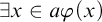
$\exists x\in a\varphi (x)$
for a
$\Pi _n$
-formula
$\varphi $
is analogous, so we omit it.


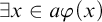








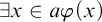


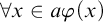









In particular, $\Sigma _n$
-Collection entails that
$\Sigma _n$
-Collection entails that $\underline {\Sigma }_n$
-formulas are provably equivalent to
$\underline {\Sigma }_n$
-formulas are provably equivalent to $\Sigma _n$
-formulas, and
$\Sigma _n$
-formulas, and $\underline {\Pi }_n$
-formulas are provably equivalent to
$\underline {\Pi }_n$
-formulas are provably equivalent to $\Pi _n$
-formulas. In the absence of
$\Pi _n$
-formulas. In the absence of $\Sigma _n$
-Collection, however, we cannot assume that
$\Sigma _n$
-Collection, however, we cannot assume that $\underline {\Sigma }_n$
-formulas are normalizable to
$\underline {\Sigma }_n$
-formulas are normalizable to $\Sigma _n$
-formulas.
$\Sigma _n$
-formulas.
We will frequently define functions and will use them freely in formulas. The reader might find it challenging to analyze the complexity of formulas with newly introduced functions, so we provide a rigorous treatment of the issue.
Definition 2.10. Let $\Gamma $
be a class of formulas over the language of a theory T. Suppose that
$\Gamma $
be a class of formulas over the language of a theory T. Suppose that $\varphi (\vec {x},y)$
is a formula in
$\varphi (\vec {x},y)$
is a formula in $\Gamma $
and assume that T proves
$\Gamma $
and assume that T proves $\forall \vec {x}\exists !y\varphi (\vec {x},y)$
. Then we say that T proves
$\forall \vec {x}\exists !y\varphi (\vec {x},y)$
. Then we say that T proves $\varphi $
defines a function.
$\varphi $
defines a function.
In practice, we write $F(\vec {x})=y$
instead of
$F(\vec {x})=y$
instead of $\varphi (\vec {x},y)$
. We say that F is a
$\varphi (\vec {x},y)$
. We say that F is a $\Gamma $
-definable function if a defining formula
$\Gamma $
-definable function if a defining formula $\varphi $
is in
$\varphi $
is in $\Gamma $
. Also, instead of writing
$\Gamma $
. Also, instead of writing $\exists y \varphi (\vec {x},y)\land \psi (y)$
, we write
$\exists y \varphi (\vec {x},y)\land \psi (y)$
, we write $\psi (F(\vec {x}))$
.
$\psi (F(\vec {x}))$
.
Note that if T proves $\varphi $
defines a function, T proves
$\varphi $
defines a function, T proves $\exists y [\varphi (\vec {x},y)\land \psi (y)]$
is equivalent to
$\exists y [\varphi (\vec {x},y)\land \psi (y)]$
is equivalent to $\forall y [\varphi (\vec {x},y)\to \psi (y)]$
.
$\forall y [\varphi (\vec {x},y)\to \psi (y)]$
.
The following lemma shows composing $\Sigma _1$
-definable function with a
$\Sigma _1$
-definable function with a $\Sigma _1$
-formula does not change the complexity.
$\Sigma _1$
-formula does not change the complexity.
Lemma 2.11. Let F be a $\Sigma _1$
-definable function and
$\Sigma _1$
-definable function and $\psi (x)$
be a
$\psi (x)$
be a $\Sigma _1$
-formula or a
$\Sigma _1$
-formula or a $\Pi _1$
-formula. Then
$\Pi _1$
-formula. Then $\psi (F(x))$
is
$\psi (F(x))$
is $\Sigma _1$
or
$\Sigma _1$
or $\Pi _1,$
respectively.
$\Pi _1,$
respectively.
Proof. Suppose that F is defined by a $\Sigma _1$
-formula
$\Sigma _1$
-formula $\varphi (x,y)$
and
$\varphi (x,y)$
and $\psi $
is
$\psi $
is $\Sigma _1$
.
$\Sigma _1$
. $\psi (F(x))$
is equivalent to
$\psi (F(x))$
is equivalent to $\exists y \varphi (x,y)\land \psi (F(x))$
, which is normalizable to a
$\exists y \varphi (x,y)\land \psi (F(x))$
, which is normalizable to a $\Sigma _1$
-formula by Lemma 2.8. Similarly, if
$\Sigma _1$
-formula by Lemma 2.8. Similarly, if $\psi $
is
$\psi $
is $\Pi _1$
, then
$\Pi _1$
, then $\psi (F(x))$
is equivalent to
$\psi (F(x))$
is equivalent to $\forall y \varphi (x,y)\to \psi (y)$
, which is normalizable by a
$\forall y \varphi (x,y)\to \psi (y)$
, which is normalizable by a $\Pi _1$
-formula.
$\Pi _1$
-formula.
The following facts are standard; proofs are available in [Reference Barwise3].
Lemma 2.12 [Reference Barwise3, Chapter 1, Theorem 4.3] $\mathsf {KP}_1$
proves the
$\mathsf {KP}_1$
proves the $\Sigma $
-Reflection principle. That is, for each
$\Sigma $
-Reflection principle. That is, for each $\Sigma $
-formula
$\Sigma $
-formula $\varphi $
,
$\varphi $
, $\mathsf {KP}_1 \vdash \varphi \leftrightarrow \exists a \varphi ^a$
. Put another way, each
$\mathsf {KP}_1 \vdash \varphi \leftrightarrow \exists a \varphi ^a$
. Put another way, each $\Sigma $
-formula is
$\Sigma $
-formula is $\mathsf {KP}_1$
-provably equivalent to a
$\mathsf {KP}_1$
-provably equivalent to a $\Sigma _1$
-formula.
$\Sigma _1$
-formula.
Lemma 2.13 [Reference Barwise3, Chapter 1, Proposition 6.4]
Working over $\mathsf {KP}_1$
, we have the definition by
$\mathsf {KP}_1$
, we have the definition by $\Sigma $
-Recursion: Let G be an
$\Sigma $
-Recursion: Let G be an $(m+2)$
-ary
$(m+2)$
-ary $\Sigma $
-definable function. Then we can find a
$\Sigma $
-definable function. Then we can find a $\Sigma $
-definable function F such that
$\Sigma $
-definable function F such that
 $$ \begin{align*} F(x_0,\ldots, x_{m-1},y)=G\Big(x_0,\ldots, x_{m-1},y, \big\{\langle z, F(x_0,\ldots, x_{m-1},z)\rangle\mid z \in \mathsf{TC}(y)\big\}\Big), \end{align*} $$
where $\mathsf {TC}(x)$
is the transitive closure of x.
$\mathsf {TC}(x)$
is the transitive closure of x.
Furthermore, the formula $z=F(x_0,\ldots ,x_m,y)$
is
$z=F(x_0,\ldots ,x_m,y)$
is $\Delta _1$
.
$\Delta _1$
.
Proof. We will not prove the $\Sigma $
-Recursion theorem here, and the interested reader may consult [Reference Barwise3].
$\Sigma $
-Recursion theorem here, and the interested reader may consult [Reference Barwise3].
Now let us provide the complexity analysis for $z=F(x_0,\ldots ,x_m,y)$
when F is recursively defined from an
$z=F(x_0,\ldots ,x_m,y)$
when F is recursively defined from an $(m+2)$
-ary
$(m+2)$
-ary $\Sigma $
-definable function G. For notational convenience, let us consider the case
$\Sigma $
-definable function G. For notational convenience, let us consider the case $m=1$
.
$m=1$
.
Observe that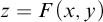 $z=F(x,y)$
is equivalent to
$z=F(x,y)$
is equivalent to
 $$ \begin{align*} &\exists f {\big[}f \text{ is a function of domain } \mathsf{TC}(\{y\}) \\ &\qquad\qquad\qquad\land \forall u\in\mathsf{TC}(\{y\})(f(x,u) = G(x,y,f\upharpoonright \mathsf{TC}(u) ) ){\big]} \land f(x,y)=z. \end{align*} $$
The reader can verify that the formula $y=\mathsf {TC}(x)$
is
$y=\mathsf {TC}(x)$
is $\mathsf {KP}_1$
-provably
$\mathsf {KP}_1$
-provably $\Sigma _1$
(see [Reference Barwise3, Section I.6]), and the statement ‘f is a function of domain a’ is
$\Sigma _1$
(see [Reference Barwise3, Section I.6]), and the statement ‘f is a function of domain a’ is $\Delta _0$
. Also, if f is a function, then
$\Delta _0$
. Also, if f is a function, then $g=f\upharpoonright a$
is also
$g=f\upharpoonright a$
is also $\Delta _0$
since
$\Delta _0$
since
 $$ \begin{align*} g=f\upharpoonright a \iff \forall p\in g(\pi_0(p)\in a\land p\in f) \land \forall p\in f(\pi_0(p)\in a\to p\in g), \end{align*} $$
where $\pi _0(p)$
is a projection function satisfying
$\pi _0(p)$
is a projection function satisfying $\pi _0(\langle u,v\rangle )=u$
, and the reader can see that both
$\pi _0(\langle u,v\rangle )=u$
, and the reader can see that both $\pi _0(p)=u$
and
$\pi _0(p)=u$
and $\pi _0(p)\in a$
are
$\pi _0(p)\in a$
are $\Delta _0$
. Hence by applying Lemma 2.11, we have the following:
$\Delta _0$
. Hence by applying Lemma 2.11, we have the following:
 $$ \begin{align} &\exists f {\Big[}\underbrace{f \text{ is a function of domain} \mathsf{TC}(\{y\})}_{\Delta_{1}} \nonumber\\ &\quad\quad\quad\land \forall \underbrace{u\in\mathsf{TC}(\{y\})}_{\Delta_1}(\underbrace {f(x,u) = G(x,y,f\upharpoonright \mathsf{TC}(u) )}_{\Delta_1} ) {\Big]} \land \underbrace{f(x,y)=z}_{\Delta_{0}}. \end{align} $$
Hence the above formula is $\Sigma _1$
. However, we can see that (3) is equivalent to
$\Sigma _1$
. However, we can see that (3) is equivalent to
 $$ \begin{align*}& \forall f {\big[}f\ \text{is a function of domain} \mathsf{TC}(\{y\}) \\ &\qquad\qquad\qquad\land \forall u\in\mathsf{TC}(\{y\})(f(x,u) = G(x,y,f\upharpoonright \mathsf{TC}(u) ) ){\big]} \to f(x,y)=z, \end{align*} $$
and the reader can verify the above formula is $\Pi _1$
.
$\Pi _1$
.
We will use various types of recursively defined functions, and gauging their complexity is also important. One of the important functions we will use is the function $\alpha \mapsto L_\alpha $
, taking an ordinal
$\alpha \mapsto L_\alpha $
, taking an ordinal $\alpha $
and returning the
$\alpha $
and returning the $\alpha $
th stage of L. By the previous lemma, this function is
$\alpha $
th stage of L. By the previous lemma, this function is $\Delta _1$
definable, and the formula
$\Delta _1$
definable, and the formula $x=L_\alpha $
is equivalent to a
$x=L_\alpha $
is equivalent to a $\Delta _1$
formula.
$\Delta _1$
formula.
Before finishing this section, let us define partial truth predicates. These play a role analogous to the role that finite Turing jumps $0^{(n)}$
of
$0^{(n)}$
of $0$
play in second-order arithmetic. We say that a formula is
$0$
play in second-order arithmetic. We say that a formula is $\Sigma _n$
if it is of the form
$\Sigma _n$
if it is of the form
 $$ \begin{align*}\exists x_0\forall x_1\ldots \mathsf{Q}x_{n-1}\varphi(x_0,\ldots,x_{n-1},\vec{y})\end{align*} $$
for some $\Delta _0$
-formula
$\Delta _0$
-formula $\varphi $
.
$\varphi $
.
Lemma 2.14. $\mathsf {KP}_1$
proves that for every set a and for every code of a
$\mathsf {KP}_1$
proves that for every set a and for every code of a $\Delta _0$
-formula
$\Delta _0$
-formula $\varphi (x)$
, the following are equivalent:
$\varphi (x)$
, the following are equivalent:
-
• There is a transitive set M such that
$a\in M$
and
$M\models \varphi (a)$
. -
• For all transitive M such that
$a\in M$
,
$M\models \varphi (a)$
.


Furthermore, if $\varphi (x)$
is an actual
$\varphi (x)$
is an actual $\Delta _0$
-formula and a is a set,
$\Delta _0$
-formula and a is a set, $\varphi (a)$
holds iff one of the above holds.
$\varphi (a)$
holds iff one of the above holds.
The previous lemma allows us to define $\vDash _{\Sigma _0}$
by a
$\vDash _{\Sigma _0}$
by a $\Delta _1$
-expression.
$\Delta _1$
-expression.
Definition 2.15. Define $\vDash _{\Sigma _0}$
as follows:
$\vDash _{\Sigma _0}$
as follows: $\vDash _{\Sigma _0}\varphi (a)$
holds if there is a transitive set M such that
$\vDash _{\Sigma _0}\varphi (a)$
holds if there is a transitive set M such that $a\in M$
and
$a\in M$
and $M\models \varphi (a)$
.
$M\models \varphi (a)$
.
There is no reason to stop defining the partial truth predicate for more complex formulas.
Definition 2.16. Let us define $\vDash _{\Sigma _n}$
by (meta-)recursion on n as follows: For a
$\vDash _{\Sigma _n}$
by (meta-)recursion on n as follows: For a $\Pi _n$
-formula
$\Pi _n$
-formula $\psi (x,y)$
,
$\psi (x,y)$
, $\vDash _{\Sigma _{n+1}}\exists x\psi (x,y)$
holds iff there is x such that
$\vDash _{\Sigma _{n+1}}\exists x\psi (x,y)$
holds iff there is x such that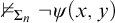 $\nvDash _{\Sigma _n} \lnot \psi (x,y)$
.
$\nvDash _{\Sigma _n} \lnot \psi (x,y)$
.
It is clear that $\vDash _{\Sigma _n}$
is
$\vDash _{\Sigma _n}$
is $\Sigma _n$
-definable for
$\Sigma _n$
-definable for $n\ge 1$
. Furthermore, the above definition works over
$n\ge 1$
. Furthermore, the above definition works over $\mathsf {KP}_1$
with no problem.
$\mathsf {KP}_1$
with no problem. $\vDash _{\Sigma _1}$
behaves like a universal
$\vDash _{\Sigma _1}$
behaves like a universal $\Sigma _1$
-formula, and is not
$\Sigma _1$
-formula, and is not $\Pi _1$
-definable. See Lemma 7.3 for a proof of this fact.
$\Pi _1$
-definable. See Lemma 7.3 for a proof of this fact.
3 Defining ‘reasonably definable ordinals’
In the context of arithmetic, it is typical to use primitive recursive well-orders as surrogates for ordinals. In this article, we will work with set theories and we will deal with ordinals in a more general fashion. For instance, we will be working with ordinals that have no primitive recursive presentations. Nevertheless, we will need to restrict our attention to ordinals that are ‘reasonably definable’. In particular, we will focus on ordinals that are defined by primitive recursive set relations. Inspired by [Reference Rathjen23], which defines a set function as a primitive recursive set function if and only if it is provably $\Sigma _1$
over
$\Sigma _1$
over $\mathsf {KP}_1$
, we introduce the following definition.
$\mathsf {KP}_1$
, we introduce the following definition.
Definition 3.1. A formula $R(x)$
is a representation if
$R(x)$
is a representation if $R(x)$
is a
$R(x)$
is a $\Sigma _1$
-formula such that
$\Sigma _1$
-formula such that $\mathsf {KP}_1$
proves
$\mathsf {KP}_1$
proves
 $$ \begin{align*} \forall x \forall y\ \Big( \big(R(x)\land R(y)\big)\to x=y\Big). \end{align*} $$
An ordinal $\alpha $
is representable if there is a representation
$\alpha $
is representable if there is a representation $R^{\boldsymbol {\alpha }}(x)$
such that
$R^{\boldsymbol {\alpha }}(x)$
such that $R^{\boldsymbol {\alpha }}$
defines
$R^{\boldsymbol {\alpha }}$
defines $\alpha $
over L. We say that
$\alpha $
over L. We say that $\alpha $
is representable via
$\alpha $
is representable via $R^{\boldsymbol {\alpha }}$
.
$R^{\boldsymbol {\alpha }}$
.
For example, $\omega _1^{\mathsf {CK}}$
is representable: It is the least ordinal
$\omega _1^{\mathsf {CK}}$
is representable: It is the least ordinal $\alpha $
such that
$\alpha $
such that $L_\alpha \models \mathsf {KP}$
, and
$L_\alpha \models \mathsf {KP}$
, and $\mathsf {KP}_1$
proves that there is at most one such ordinal (although
$\mathsf {KP}_1$
proves that there is at most one such ordinal (although $\mathsf {KP}_1$
does not prove that there is such an ordinal.) Other examples of representable ordinals are the least gap ordinalFootnote
4
and the least
$\mathsf {KP}_1$
does not prove that there is such an ordinal.) Other examples of representable ordinals are the least gap ordinalFootnote
4
and the least $\alpha $
such that
$\alpha $
such that $L_\alpha \models \mathsf {ZFC}$
.
$L_\alpha \models \mathsf {ZFC}$
.
Remark 3.2. If $R(x)$
is a
$R(x)$
is a $\Sigma _1$
-formula defining an element, then the following
$\Sigma _1$
-formula defining an element, then the following $\Pi _1$
formula also defines the same element:
$\Pi _1$
formula also defines the same element:
 $$ \begin{align} R_*(x) \equiv \forall y \left[ R(y) \to x=y\right]. \end{align} $$
In particular, every representable ordinal is $\mathsf {KP}_1$
-provably
$\mathsf {KP}_1$
-provably $\Delta _1$
-definable.
$\Delta _1$
-definable.
Remark 3.3. We often need to reason about representations of ordinals rather than ordinals themselves. We introduce the following conventions to aid with readability: We use boldfaced lowercase Greek letters ${\boldsymbol {\alpha }}$
,
${\boldsymbol {\alpha }}$
, ${\boldsymbol {\beta }}$
,
${\boldsymbol {\beta }}$
, ${\boldsymbol {\gamma }}$
,
${\boldsymbol {\gamma }}$
, $\dots $
to denote representations for ordinals, and we handle them as actual ordinals. When we handle
$\dots $
to denote representations for ordinals, and we handle them as actual ordinals. When we handle ${\boldsymbol {\alpha }}$
,
${\boldsymbol {\alpha }}$
, ${\boldsymbol {\beta }}$
,
${\boldsymbol {\beta }}$
, ${\boldsymbol {\gamma }}$
,
${\boldsymbol {\gamma }}$
, $\dots $
as formulas, we use the notation
$\dots $
as formulas, we use the notation $R^{\boldsymbol {\alpha }}$
,
$R^{\boldsymbol {\alpha }}$
, $R^{\boldsymbol {\beta }}$
,
$R^{\boldsymbol {\beta }}$
, $\dots $
to avoid confusion.
$\dots $
to avoid confusion.
When we write $\varphi ({\boldsymbol {\alpha }})$
, this is really shorthand for
$\varphi ({\boldsymbol {\alpha }})$
, this is really shorthand for $\forall x \big ( R^{\boldsymbol {\alpha }}(x) \to \varphi (x)\big )$
. Likewise, we write
$\forall x \big ( R^{\boldsymbol {\alpha }}(x) \to \varphi (x)\big )$
. Likewise, we write $\operatorname {\mathsf {Exists}}({\boldsymbol {\alpha }})$
as shorthand for the formula
$\operatorname {\mathsf {Exists}}({\boldsymbol {\alpha }})$
as shorthand for the formula $\exists x R^{\boldsymbol {\alpha }}(x)$
.
$\exists x R^{\boldsymbol {\alpha }}(x)$
.
In fact, $\omega _1^{\mathsf {CK}}$
is not only representable but also admissible.Footnote
5
Even more,
$\omega _1^{\mathsf {CK}}$
is not only representable but also admissible.Footnote
5
Even more, $\mathsf {KP}_1$
proves that it is admissible. The following notion encapsulates this feature of
$\mathsf {KP}_1$
proves that it is admissible. The following notion encapsulates this feature of $\omega _1^{\mathsf {CK}}$
.
$\omega _1^{\mathsf {CK}}$
.
Definition 3.4. We say that a representation ${\boldsymbol {\alpha }}$
is
${\boldsymbol {\alpha }}$
is $\mathsf {KP}_1$
-provably admissible representation if
$\mathsf {KP}_1$
-provably admissible representation if ${\boldsymbol {\alpha }}$
satisfies
${\boldsymbol {\alpha }}$
satisfies
 $$ \begin{align*} \mathsf{KP}_1\vdash \forall \xi [R^{\boldsymbol{\alpha}}(\xi)\to \xi \text{ is admissible}]. \end{align*} $$
The corresponding ordinal $\alpha $
of
$\alpha $
of ${\boldsymbol {\alpha }}$
is called a
${\boldsymbol {\alpha }}$
is called a $\mathsf {KP}_1$
-provably admissible representable ordinal.
$\mathsf {KP}_1$
-provably admissible representable ordinal.
Throughout the rest of this article, we will always assume that ${\boldsymbol {\alpha }}$
is a
${\boldsymbol {\alpha }}$
is a $\mathsf {KP}_1$
-provably admissible representation and that the metatheory satisfies
$\mathsf {KP}_1$
-provably admissible representation and that the metatheory satisfies $\operatorname {\mathsf {Exists}}({\boldsymbol {\alpha }})$
.
$\operatorname {\mathsf {Exists}}({\boldsymbol {\alpha }})$
.
We will introduce an ${\boldsymbol {\alpha }}$
-analogue of the Kleene normal form theorem. Here the existence of a representable ordinal is analogous to the well-foundedness of a given primitive recursive linear order.
${\boldsymbol {\alpha }}$
-analogue of the Kleene normal form theorem. Here the existence of a representable ordinal is analogous to the well-foundedness of a given primitive recursive linear order.
Lemma 3.5. Let $\exists x A(x)$
be a
$\exists x A(x)$
be a $\Sigma _1$
sentence. Then there is a representation
$\Sigma _1$
sentence. Then there is a representation ${\boldsymbol {\gamma }}$
such that
${\boldsymbol {\gamma }}$
such that $\mathsf {KP}_1 + (V=L)$
proves the following:
$\mathsf {KP}_1 + (V=L)$
proves the following:
-
•
$\exists x A(x)\leftrightarrow \operatorname {\mathsf {Exists}}({\boldsymbol {\gamma }}).$
-
•
$\exists x A(x)\to \forall \xi \big (R^{\boldsymbol {\gamma }}(\xi ) \to \exists x\in L_\xi A(x) \big ).$


Proof. Consider $R^\star (\xi )$
given by
$R^\star (\xi )$
given by
 $$ \begin{align*} \xi\ \text{is an ordinal}\land \exists x\in L_\xi A(x)\land \forall \eta<\xi \; \forall x\in L_\eta \lnot A(x). \end{align*} $$
Intuitively, $R^\star (\xi )$
says that
$R^\star (\xi )$
says that $\xi $
is the least ordinal such that
$\xi $
is the least ordinal such that $L_\xi $
captures a witness of
$L_\xi $
captures a witness of $\exists x A(x)$
.
$\exists x A(x)$
.
We need to see that the above formula is $\mathsf {KP}_1$
-provably
$\mathsf {KP}_1$
-provably $\Sigma _1$
. At first glance, the second conjunct may appear
$\Sigma _1$
. At first glance, the second conjunct may appear $\Delta _0$
, but note that the bounded quantifier is bounded in
$\Delta _0$
, but note that the bounded quantifier is bounded in $L_\xi $
, which is defined by
$L_\xi $
, which is defined by $\Sigma $
recursion. That is, the second conjunct contains hidden quantifiers. We can precisely state the second conjunct as follows, which is
$\Sigma $
recursion. That is, the second conjunct contains hidden quantifiers. We can precisely state the second conjunct as follows, which is $\mathsf {KP}_1$
-provably equivalent to
$\mathsf {KP}_1$
-provably equivalent to $\Sigma _1$
:
$\Sigma _1$
:
 $$ \begin{align*} \exists a \left[ a = L_\xi \land \left(\exists x\in a A(x)\right)\right]. \end{align*} $$
The third conjunct of $R^\star (\xi )$
also has the same problem. But the precise statement of the third conjunct is also
$R^\star (\xi )$
also has the same problem. But the precise statement of the third conjunct is also $\mathsf {KP}_1$
-provably equivalent to a
$\mathsf {KP}_1$
-provably equivalent to a $\Sigma _1$
:
$\Sigma _1$
:
 $$ \begin{align*} \forall \eta<\xi \exists a [a=L_\eta \land \forall x\in a \lnot A(x)]. \end{align*} $$
Hence if we let $R^{\boldsymbol {\gamma }}$
obtained from
$R^{\boldsymbol {\gamma }}$
obtained from $R^\star $
by replacing the two conjuncts to their
$R^\star $
by replacing the two conjuncts to their $\Sigma _1$
-equivalent form, respectively, then they satisfy the desired properties.
$\Sigma _1$
-equivalent form, respectively, then they satisfy the desired properties.
By relativizing the above lemma to $L_\alpha $
for an admissible
$L_\alpha $
for an admissible $\alpha $
, we get the following.
$\alpha $
, we get the following.
Corollary 3.6. Let $\exists x A(x)$
be a
$\exists x A(x)$
be a $\Sigma _1$
sentence. Then there is a representation
$\Sigma _1$
sentence. Then there is a representation ${\boldsymbol {\gamma }}$
such that
${\boldsymbol {\gamma }}$
such that $\mathsf {KP}_1$
proves that for every admissible ordinal
$\mathsf {KP}_1$
proves that for every admissible ordinal $\alpha $
, the following holds:
$\alpha $
, the following holds:
-
•
$\exists x\in L_\alpha A(x)\leftrightarrow \operatorname {\mathsf {Exists}}({\boldsymbol {\gamma }})^{L_\alpha }$
. -
•
$\exists x\in L_\alpha A(x)\to \forall \xi \big (R^{\boldsymbol {\gamma }}(\xi ) \to \exists x\in L_\xi A(x) \big )$
.


Furthermore, the choice of ${\boldsymbol {\gamma }}$
only depends on the formula
${\boldsymbol {\gamma }}$
only depends on the formula $\exists x A(x)$
.
$\exists x A(x)$
.
Definition 3.7. We say that T is $\Sigma ^{\boldsymbol {\alpha }}_1$
-sound if for all
$\Sigma ^{\boldsymbol {\alpha }}_1$
-sound if for all $\varphi \in \Sigma _1$
:
$\varphi \in \Sigma _1$
:
 $$ \begin{align*} T\vdash \varphi^{L_{\boldsymbol{\alpha}}} \implies L_{\boldsymbol{\alpha}} \vDash \varphi. \end{align*} $$
Now we introduce a notion that resembles the proof-theoretic ordinal of a theory.
Definition 3.8. Let ${\boldsymbol {\alpha }}$
be
${\boldsymbol {\alpha }}$
be $\mathsf {KP}_1$
-provably admissible representation. Let T be a
$\mathsf {KP}_1$
-provably admissible representation. Let T be a $\Sigma ^{\boldsymbol {\alpha }}_1$
-sound theory extending
$\Sigma ^{\boldsymbol {\alpha }}_1$
-sound theory extending $\mathsf {KP}_1+\operatorname {\mathsf {Exists}}({\boldsymbol {\alpha }})$
Then we define
$\mathsf {KP}_1+\operatorname {\mathsf {Exists}}({\boldsymbol {\alpha }})$
Then we define
 $$ \begin{align*} |T|_{{\boldsymbol{\alpha}}{\text{-}\mathsf{repr}}} := \sup\{\beta\mid \text{for some } {\boldsymbol{\beta}}, \beta \text{ is representable via } {\boldsymbol{\beta}} \text{ and } T\vdash \operatorname{\mathsf{Exists}}({\boldsymbol{\beta}})^{L_{\boldsymbol{\alpha}}}\}. \end{align*} $$
Let us start with this property.
Lemma 3.9. For all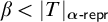 $\beta <|T|_{{\boldsymbol {\alpha }}{\text {-}\mathsf {repr}}}$
, there exists a representable ordinal
$\beta <|T|_{{\boldsymbol {\alpha }}{\text {-}\mathsf {repr}}}$
, there exists a representable ordinal $\gamma $
represented by
$\gamma $
represented by ${\boldsymbol {\gamma }}$
such that
${\boldsymbol {\gamma }}$
such that $\beta <\gamma <|T|_{{\boldsymbol {\alpha }}{\text {-}\mathsf {repr}}}$
and
$\beta <\gamma <|T|_{{\boldsymbol {\alpha }}{\text {-}\mathsf {repr}}}$
and $T\vdash \operatorname {\mathsf {Exists}}({\boldsymbol {\gamma }})^{L_{\boldsymbol {\alpha }}}$
. Especially,
$T\vdash \operatorname {\mathsf {Exists}}({\boldsymbol {\gamma }})^{L_{\boldsymbol {\alpha }}}$
. Especially, $|T|_{{\boldsymbol {\alpha }}{\text {-}\mathsf {repr}}}$
is a limit of representable ordinals.
$|T|_{{\boldsymbol {\alpha }}{\text {-}\mathsf {repr}}}$
is a limit of representable ordinals.
Proof. Suppose that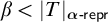 $\beta <|T|_{{\boldsymbol {\alpha }}{\text {-}\mathsf {repr}}}$
, and without loss of generality, assume that
$\beta <|T|_{{\boldsymbol {\alpha }}{\text {-}\mathsf {repr}}}$
, and without loss of generality, assume that $\beta $
is representable by
$\beta $
is representable by ${\boldsymbol {\beta }}$
and
${\boldsymbol {\beta }}$
and $T\vdash \operatorname {\mathsf {Exists}}({\boldsymbol {\beta }})^{L_{\boldsymbol {\alpha }}}$
. Define a new representation
$T\vdash \operatorname {\mathsf {Exists}}({\boldsymbol {\beta }})^{L_{\boldsymbol {\alpha }}}$
. Define a new representation $\boldsymbol {\beta +1}$
by
$\boldsymbol {\beta +1}$
by
 $$ \begin{align*} R^{\boldsymbol{\beta+1}}(\xi) \iff \forall\eta\in\xi [R^{\boldsymbol{\beta}}_*(\eta)\to \xi=\eta\cup\{\eta\}], \end{align*} $$
where $R^{\boldsymbol {\beta }}_*(x)$
is a
$R^{\boldsymbol {\beta }}_*(x)$
is a $\Pi _1$
-formula given from
$\Pi _1$
-formula given from $R^{\boldsymbol {\beta }}$
as presented in (4).
$R^{\boldsymbol {\beta }}$
as presented in (4).
It is clear that $\mathsf {KP}_1$
proves that these two are equivalent, and an ordinal satisfying
$\mathsf {KP}_1$
proves that these two are equivalent, and an ordinal satisfying $R^{\boldsymbol {\beta +1}}(\xi )$
is unique if it exists. Furthermore, T proves
$R^{\boldsymbol {\beta +1}}(\xi )$
is unique if it exists. Furthermore, T proves $\exists \xi R^{\boldsymbol {\beta +1}}_\Sigma (\xi )$
, so
$\exists \xi R^{\boldsymbol {\beta +1}}_\Sigma (\xi )$
, so $\beta +1<|T|_{{\boldsymbol {\alpha }}{\text {-}\mathsf {repr}}}$
. Thus
$\beta +1<|T|_{{\boldsymbol {\alpha }}{\text {-}\mathsf {repr}}}$
. Thus $|T|_{{\boldsymbol {\alpha }}{\text {-}\mathsf {repr}}}$
is a limit of representable ordinals.
$|T|_{{\boldsymbol {\alpha }}{\text {-}\mathsf {repr}}}$
is a limit of representable ordinals.
Remark 3.10. Let us remark that we could prove that $|T|_{{\boldsymbol {\alpha }}{\text {-}\mathsf {repr}}}$
is closed under addition and multiplication, but this would require a more sophisticated argument.
$|T|_{{\boldsymbol {\alpha }}{\text {-}\mathsf {repr}}}$
is closed under addition and multiplication, but this would require a more sophisticated argument.
Finally, it turns out that the new ordinal coincides with a notion that we have already discussed.
Lemma 3.11. Let ${\boldsymbol {\alpha }}$
be a
${\boldsymbol {\alpha }}$
be a $\mathsf {KP}_1$
-provably admissible representation and T be a
$\mathsf {KP}_1$
-provably admissible representation and T be a $\Sigma ^{\boldsymbol {\alpha }}_1$
-sound theory extending
$\Sigma ^{\boldsymbol {\alpha }}_1$
-sound theory extending $\mathsf {KP}_1 + \operatorname {\mathsf {Exists}}({\boldsymbol {\alpha }})$
. Then
$\mathsf {KP}_1 + \operatorname {\mathsf {Exists}}({\boldsymbol {\alpha }})$
. Then $|T|_{{\boldsymbol {\alpha }}{\text {-}\mathsf {repr}}}=|T|_{\Sigma ^{\boldsymbol {\alpha }}_1}$
.
$|T|_{{\boldsymbol {\alpha }}{\text {-}\mathsf {repr}}}=|T|_{\Sigma ^{\boldsymbol {\alpha }}_1}$
.
Proof. We prove $|T|_{{\boldsymbol {\alpha }}{\text {-}\mathsf {repr}}}\le |T|_{\Sigma ^{\boldsymbol {\alpha }}_1}$
first. Suppose that
$|T|_{{\boldsymbol {\alpha }}{\text {-}\mathsf {repr}}}\le |T|_{\Sigma ^{\boldsymbol {\alpha }}_1}$
first. Suppose that $\beta $
is an ordinal and
$\beta $
is an ordinal and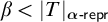 $\beta <|T|_{{\boldsymbol {\alpha }}{\text {-}\mathsf {repr}}}$
. We claim that
$\beta <|T|_{{\boldsymbol {\alpha }}{\text {-}\mathsf {repr}}}$
. We claim that $\beta <|T|_{\Sigma ^{\boldsymbol {\alpha }}_1}$
.
$\beta <|T|_{\Sigma ^{\boldsymbol {\alpha }}_1}$
.
Since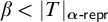 $\beta <|T|_{{\boldsymbol {\alpha }}{\text {-}\mathsf {repr}}}$
, Lemma 3.9 entails that there is a representable
$\beta <|T|_{{\boldsymbol {\alpha }}{\text {-}\mathsf {repr}}}$
, Lemma 3.9 entails that there is a representable $\gamma \in (\beta ,|T|_{{\boldsymbol {\alpha }}{\text {-}\mathsf {repr}}})$
such that T proves
$\gamma \in (\beta ,|T|_{{\boldsymbol {\alpha }}{\text {-}\mathsf {repr}}})$
such that T proves $\operatorname {\mathsf {Exists}}({\boldsymbol {\gamma }})^{L_{\boldsymbol {\alpha }}}$
. Note that
$\operatorname {\mathsf {Exists}}({\boldsymbol {\gamma }})^{L_{\boldsymbol {\alpha }}}$
. Note that $\operatorname {\mathsf {Exists}}({\boldsymbol {\gamma }})^{L_{\boldsymbol {\alpha }}}$
is a
$\operatorname {\mathsf {Exists}}({\boldsymbol {\gamma }})^{L_{\boldsymbol {\alpha }}}$
is a $\Sigma ^{\boldsymbol {\alpha }}_1$
formula, so by the definition of
$\Sigma ^{\boldsymbol {\alpha }}_1$
formula, so by the definition of $|T|_{\Sigma ^{\boldsymbol {\alpha }}_1}$
, we have
$|T|_{\Sigma ^{\boldsymbol {\alpha }}_1}$
, we have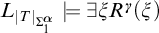 $L_{|T|_{\Sigma ^{\boldsymbol {\alpha }}_1}}\models \exists \xi R^{\boldsymbol {\gamma }}(\xi )$
. That is, we have the following:
$L_{|T|_{\Sigma ^{\boldsymbol {\alpha }}_1}}\models \exists \xi R^{\boldsymbol {\gamma }}(\xi )$
. That is, we have the following:
 $$\begin{align} L \models \exists \xi<|T|_{\Sigma^{\boldsymbol{\alpha}}_1}\ (R^{\boldsymbol{\gamma}}_\Sigma(\xi))^{L_{|T|_{\Sigma^{\boldsymbol{\alpha}}_1}}}. \end{align} $$
By upward absoluteness, (A) implies that there exists $\xi <|T|_{\Sigma ^{\boldsymbol {\alpha }}_1}$
such that
$\xi <|T|_{\Sigma ^{\boldsymbol {\alpha }}_1}$
such that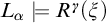 $ L_\alpha \models R^{\boldsymbol {\gamma }}(\xi )$
and so
$ L_\alpha \models R^{\boldsymbol {\gamma }}(\xi )$
and so $\gamma <|T|_{\Sigma ^{\boldsymbol {\alpha }}_1}$
. Hence
$\gamma <|T|_{\Sigma ^{\boldsymbol {\alpha }}_1}$
. Hence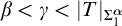 $\beta < \gamma < |T|_{\Sigma _1^{\boldsymbol {\alpha }}}$
.
$\beta < \gamma < |T|_{\Sigma _1^{\boldsymbol {\alpha }}}$
.
Now let us prove $|T|_{\Sigma ^{\boldsymbol {\alpha }}_1}\le |T|_{{\boldsymbol {\alpha }}{\text {-}\mathsf {repr}}}$
. Suppose that
$|T|_{\Sigma ^{\boldsymbol {\alpha }}_1}\le |T|_{{\boldsymbol {\alpha }}{\text {-}\mathsf {repr}}}$
. Suppose that $\gamma < |T|_{\Sigma ^{\boldsymbol {\alpha }}_1}$
. Then there is a
$\gamma < |T|_{\Sigma ^{\boldsymbol {\alpha }}_1}$
. Then there is a $\Delta _0$
-formula
$\Delta _0$
-formula $A(x)$
such that
$A(x)$
such that
 $$ \begin{align*} T\vdash \exists x\in L_{\boldsymbol{\alpha}} A(x) \quad\text{but}\quad L_\gamma\nvDash \exists x A(x). \end{align*} $$
By Lemma 3.5, we can find a representation ${\boldsymbol {\delta }}$
such that
${\boldsymbol {\delta }}$
such that $\mathsf {KP}_1 + (V=L)$
proves the following:
$\mathsf {KP}_1 + (V=L)$
proves the following:
-
(C1)
$\exists x A(x)\leftrightarrow \operatorname {\mathsf {Exists}}({\boldsymbol {\delta }})$
. -
(C2)
$\exists x A(x)\to \exists x\in L_{\boldsymbol {\delta }} A(x)$
.


Then we have $T\vdash \operatorname {\mathsf {Exists}}({\boldsymbol {\delta }})^{L_{\boldsymbol {\alpha }}}$
: Reasoning over T, we have
$T\vdash \operatorname {\mathsf {Exists}}({\boldsymbol {\delta }})^{L_{\boldsymbol {\alpha }}}$
: Reasoning over T, we have $\exists x\in L_{\boldsymbol {\alpha }} A(x)$
by assumption. Since
$\exists x\in L_{\boldsymbol {\alpha }} A(x)$
by assumption. Since $L_{\boldsymbol {\alpha }}$
is a model of
$L_{\boldsymbol {\alpha }}$
is a model of $\mathsf {KP}_1 + (V=L)$
, we have
$\mathsf {KP}_1 + (V=L)$
, we have
 $$ \begin{align*} L_{\boldsymbol{\alpha}} \vDash \exists x A(x)\leftrightarrow \operatorname{\mathsf{Exists}}({\boldsymbol{\delta}}), \end{align*} $$
so we get $\operatorname {\mathsf {Exists}}({\boldsymbol {\delta }})^{L_{\boldsymbol {\alpha }}}$
. Reasoning externally, since T is
$\operatorname {\mathsf {Exists}}({\boldsymbol {\delta }})^{L_{\boldsymbol {\alpha }}}$
. Reasoning externally, since T is $\Sigma _1^{\boldsymbol {\alpha }}$
-sound and
$\Sigma _1^{\boldsymbol {\alpha }}$
-sound and $\operatorname {\mathsf {Exists}}({\boldsymbol {\delta }})^{L_{\boldsymbol {\alpha }}}$
is
$\operatorname {\mathsf {Exists}}({\boldsymbol {\delta }})^{L_{\boldsymbol {\alpha }}}$
is $\Sigma _1^{\boldsymbol {\alpha }}$
, we have that
$\Sigma _1^{\boldsymbol {\alpha }}$
, we have that ${\boldsymbol {\delta }}$
exists over the metatheory. Furthermore, we have
${\boldsymbol {\delta }}$
exists over the metatheory. Furthermore, we have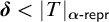 ${\boldsymbol {\delta }} < |T|_{{\boldsymbol {\alpha }}{\text {-}\mathsf {repr}}}$
.
${\boldsymbol {\delta }} < |T|_{{\boldsymbol {\alpha }}{\text {-}\mathsf {repr}}}$
.
Now let us prove $\gamma < {\boldsymbol {\delta }}$
: We know that
$\gamma < {\boldsymbol {\delta }}$
: We know that $\operatorname {\mathsf {Exists}}({\boldsymbol {\delta }})^{L_{\boldsymbol {\alpha }}}$
is true. Since
$\operatorname {\mathsf {Exists}}({\boldsymbol {\delta }})^{L_{\boldsymbol {\alpha }}}$
is true. Since $L_{\boldsymbol {\alpha }}$
is a model of
$L_{\boldsymbol {\alpha }}$
is a model of $\mathsf {KP}_1 + (V=L)$
, we have
$\mathsf {KP}_1 + (V=L)$
, we have
 $$ \begin{align*} L_{\boldsymbol{\alpha}} \vDash \exists x A(x)\to \exists x\in L_{\boldsymbol{\delta}} A(x). \end{align*} $$
This implies that $\exists x\in L_{\boldsymbol {\delta }} A(x)$
is true. If
$\exists x\in L_{\boldsymbol {\delta }} A(x)$
is true. If $\gamma \ge {\boldsymbol {\delta }}$
, then
$\gamma \ge {\boldsymbol {\delta }}$
, then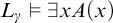 $L_\gamma \vDash \exists x A(x)$
by upward absoluteness, a contradiction. Hence
$L_\gamma \vDash \exists x A(x)$
by upward absoluteness, a contradiction. Hence $\gamma < {\boldsymbol {\delta }}$
.
$\gamma < {\boldsymbol {\delta }}$
.
4 Kreiselian relations
One can interpret ${\boldsymbol {\alpha }}$
ordinal analysis as a means of partitioning theories: Identify two theories if they have the same
${\boldsymbol {\alpha }}$
ordinal analysis as a means of partitioning theories: Identify two theories if they have the same ${\boldsymbol {\alpha }}$
proof-theoretic ordinal. In this section, we demonstrate the robustness of this partition. Indeed, the
${\boldsymbol {\alpha }}$
proof-theoretic ordinal. In this section, we demonstrate the robustness of this partition. Indeed, the ${\boldsymbol {\alpha }}$
ordinal analysis partition is the finest partition satisfying some very natural properties. To explicate these properties, we first introduce some definitions.
${\boldsymbol {\alpha }}$
ordinal analysis partition is the finest partition satisfying some very natural properties. To explicate these properties, we first introduce some definitions.
Definition 4.1. For theories T and U and any syntactic complexity class $\Gamma $
,
$\Gamma $
, $T\subseteq _\Gamma U$
if, for every
$T\subseteq _\Gamma U$
if, for every $\varphi \in \Gamma $
such that
$\varphi \in \Gamma $
such that $T\vdash \varphi $
,
$T\vdash \varphi $
, $U\vdash \varphi $
.
$U\vdash \varphi $
. $T\equiv _\Gamma U$
if both
$T\equiv _\Gamma U$
if both $T\subseteq _\Gamma U$
and
$T\subseteq _\Gamma U$
and $U\subseteq _\Gamma T.$
Definition 4.2. An equivalence relation $\equiv $
on
$\equiv $
on $\Sigma ^{\boldsymbol {\alpha }}_1$
-sound and
$\Sigma ^{\boldsymbol {\alpha }}_1$
-sound and $\Pi ^{\boldsymbol {\alpha }}_1$
-definable extensions of
$\Pi ^{\boldsymbol {\alpha }}_1$
-definable extensions of $\mathsf {KP}_1+\operatorname {\mathsf {Exists}}({\boldsymbol {\alpha }})$
is
$\mathsf {KP}_1+\operatorname {\mathsf {Exists}}({\boldsymbol {\alpha }})$
is ${\boldsymbol {\alpha }}$
-Kreiselian if both:
${\boldsymbol {\alpha }}$
-Kreiselian if both:
-
1.
$T\equiv _{\Sigma ^{\boldsymbol {\alpha }}_1}U$
implies
$T\equiv U$
. -
2.
$T\equiv T+\theta $
for every
$\Pi ^{\boldsymbol {\alpha }}_1$
sentence
$\theta $
.


The motivating example of an ${\boldsymbol {\alpha }}$
-Kreiselian partition is the aforementioned
${\boldsymbol {\alpha }}$
-Kreiselian partition is the aforementioned ${\boldsymbol {\alpha }}$
ordinal analysis partition.
${\boldsymbol {\alpha }}$
ordinal analysis partition.
Definition 4.3. For representable ${\boldsymbol {\alpha }}$
, the
${\boldsymbol {\alpha }}$
, the ${\boldsymbol {\alpha }}$
-ordinal analysis partition is the partition of
${\boldsymbol {\alpha }}$
-ordinal analysis partition is the partition of $\Pi ^{\boldsymbol {\alpha }}_1$
-definable
$\Pi ^{\boldsymbol {\alpha }}_1$
-definable $\Sigma ^{\boldsymbol {\alpha }}_1$
-sound extensions of
$\Sigma ^{\boldsymbol {\alpha }}_1$
-sound extensions of $\mathsf {KP}_1 +\operatorname {\mathsf {Exists}}({\boldsymbol {\alpha }})$
such that the cell of T is
$\mathsf {KP}_1 +\operatorname {\mathsf {Exists}}({\boldsymbol {\alpha }})$
such that the cell of T is $\{ U : |T|_{\Sigma ^{\boldsymbol {\alpha }}_1}=|U|_{\Sigma ^{\boldsymbol {\alpha }}_1} \}$
.
$\{ U : |T|_{\Sigma ^{\boldsymbol {\alpha }}_1}=|U|_{\Sigma ^{\boldsymbol {\alpha }}_1} \}$
.
Proposition 4.4. The ${\boldsymbol {\alpha }}$
-ordinal analysis partition is
${\boldsymbol {\alpha }}$
-ordinal analysis partition is ${\boldsymbol {\alpha }}$
-Kreiselian.
${\boldsymbol {\alpha }}$
-Kreiselian.
Proof. Clearly $T\equiv _{\Sigma ^{\boldsymbol {\alpha }}_1} U$
implies
$T\equiv _{\Sigma ^{\boldsymbol {\alpha }}_1} U$
implies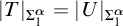 $|T|_{\Sigma ^{\boldsymbol {\alpha }}_1}=|U|_{\Sigma ^{\boldsymbol {\alpha }}_1}$
since
$|T|_{\Sigma ^{\boldsymbol {\alpha }}_1}=|U|_{\Sigma ^{\boldsymbol {\alpha }}_1}$
since $|T|_{\Sigma ^{\boldsymbol {\alpha }}_1}$
is determined by the
$|T|_{\Sigma ^{\boldsymbol {\alpha }}_1}$
is determined by the $\Sigma ^{\boldsymbol {\alpha }}_1$
-consequences of T. The remaining condition follows from [Reference Pohlers19, Theorem 1.2.5].
$\Sigma ^{\boldsymbol {\alpha }}_1$
-consequences of T. The remaining condition follows from [Reference Pohlers19, Theorem 1.2.5].
Proposition 4.4 gives our rationale for calling such relations “ ${\boldsymbol {\alpha }}$
-Kreiselian.” In particular, the following theorem is often attributed to Kreisel: For any recursively axiomatized
${\boldsymbol {\alpha }}$
-Kreiselian.” In particular, the following theorem is often attributed to Kreisel: For any recursively axiomatized $\Pi ^1_1$
-sound extension T of
$\Pi ^1_1$
-sound extension T of $\mathsf {ACA}_0$
and true
$\mathsf {ACA}_0$
and true $\Sigma ^1_1$
sentence
$\Sigma ^1_1$
sentence $\varphi $
, the proof-theoretic ordinal of T is the same as the proof-theoretic ordinal of
$\varphi $
, the proof-theoretic ordinal of T is the same as the proof-theoretic ordinal of $T+\varphi $
. So, roughly, Kreisel proved the special case of Proposition 4.4 where
$T+\varphi $
. So, roughly, Kreisel proved the special case of Proposition 4.4 where ${\boldsymbol {\alpha }}$
is
${\boldsymbol {\alpha }}$
is $\omega _1^{\mathsf {CK}}$
.
$\omega _1^{\mathsf {CK}}$
.
The next theorem says that the ${\boldsymbol {\alpha }}$
-Kreiselian relation induced by
${\boldsymbol {\alpha }}$
-Kreiselian relation induced by $|T|_{\Sigma ^{\boldsymbol {\alpha }}_1}$
is the finest
$|T|_{\Sigma ^{\boldsymbol {\alpha }}_1}$
is the finest ${\boldsymbol {\alpha }}$
-Kreiselian relation.
${\boldsymbol {\alpha }}$
-Kreiselian relation.
Theorem 4.5. Let $\alpha $
be a
$\alpha $
be a $\mathsf {KP}_1$
-provably admissible representation
$\mathsf {KP}_1$
-provably admissible representation ${\boldsymbol {\alpha }}$
and
${\boldsymbol {\alpha }}$
and $\equiv $
be an
$\equiv $
be an $\boldsymbol {\alpha }$
-Kreiselian relation. Let T and U are
$\boldsymbol {\alpha }$
-Kreiselian relation. Let T and U are $\Pi ^{\boldsymbol {\alpha }}_1$
-definable
$\Pi ^{\boldsymbol {\alpha }}_1$
-definable $\Sigma ^{\boldsymbol {\alpha }}_1$
-sound extensions of
$\Sigma ^{\boldsymbol {\alpha }}_1$
-sound extensions of $\mathsf {KP}_1 +\operatorname {\mathsf {Exists}}({\boldsymbol {\alpha }})$
such that
$\mathsf {KP}_1 +\operatorname {\mathsf {Exists}}({\boldsymbol {\alpha }})$
such that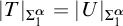 $|T|_{\Sigma ^{\boldsymbol {\alpha }}_1}=|U|_{\Sigma ^{\boldsymbol {\alpha }}_1}$
. Then
$|T|_{\Sigma ^{\boldsymbol {\alpha }}_1}=|U|_{\Sigma ^{\boldsymbol {\alpha }}_1}$
. Then $T\equiv U$
.
$T\equiv U$
.
Proof. Let $A(x)$
be a
$A(x)$
be a $\Delta _0$
-formula and assume that
$\Delta _0$
-formula and assume that $T\vdash \exists x\in L_\alpha A(x)$
. By Corollary 3.6, we can find a representation
$T\vdash \exists x\in L_\alpha A(x)$
. By Corollary 3.6, we can find a representation ${\boldsymbol {\gamma }}$
such that
${\boldsymbol {\gamma }}$
such that
 $$ \begin{align*} \mathsf{KP}_1+\operatorname{\mathsf{Exists}}({\boldsymbol{\alpha}})\vdash \exists x\in L_{\boldsymbol{\alpha}}\ A(x)\leftrightarrow \operatorname{\mathsf{Exists}}({\boldsymbol{\gamma}})^{L_{\boldsymbol{\alpha}}}. \end{align*} $$
Then we have ${\boldsymbol {\gamma }}<|T|_{\Sigma ^{\boldsymbol {\alpha }}_1}=|U|_{\Sigma ^{\boldsymbol {\alpha }}_1}$
, and
${\boldsymbol {\gamma }}<|T|_{\Sigma ^{\boldsymbol {\alpha }}_1}=|U|_{\Sigma ^{\boldsymbol {\alpha }}_1}$
, and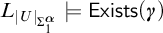 $L_{|U|_{\Sigma ^{\boldsymbol {\alpha }}_1}}\models \operatorname {\mathsf {Exists}}({\boldsymbol {\gamma }})$
. By Lemma 3.9,
$L_{|U|_{\Sigma ^{\boldsymbol {\alpha }}_1}}\models \operatorname {\mathsf {Exists}}({\boldsymbol {\gamma }})$
. By Lemma 3.9, $|U|_{\Sigma ^{\boldsymbol {\alpha }}_1}$
is a limit of representable ordinals that U-provably exist, so we can find some representable ordinal
$|U|_{\Sigma ^{\boldsymbol {\alpha }}_1}$
is a limit of representable ordinals that U-provably exist, so we can find some representable ordinal ${\boldsymbol {\delta }}<|U|_{\Sigma ^{\boldsymbol {\alpha }}_1}$
such that
${\boldsymbol {\delta }}<|U|_{\Sigma ^{\boldsymbol {\alpha }}_1}$
such that ${\boldsymbol {\gamma }}< {\boldsymbol {\delta }}$
,
${\boldsymbol {\gamma }}< {\boldsymbol {\delta }}$
, $U\vdash \operatorname {\mathsf {Exists}}({\boldsymbol {\delta }})^{L_{\boldsymbol {\alpha }}}$
, and
$U\vdash \operatorname {\mathsf {Exists}}({\boldsymbol {\delta }})^{L_{\boldsymbol {\alpha }}}$
, and $L_{\boldsymbol {\delta }}\models \operatorname {\mathsf {Exists}}({\boldsymbol {\gamma }})$
.Footnote
6
$L_{\boldsymbol {\delta }}\models \operatorname {\mathsf {Exists}}({\boldsymbol {\gamma }})$
.Footnote
6
Now consider the sentence $\operatorname {\mathsf {Comp}}({\boldsymbol {\gamma }},{\boldsymbol {\delta }})$
given by
$\operatorname {\mathsf {Comp}}({\boldsymbol {\gamma }},{\boldsymbol {\delta }})$
given by
 $$ \begin{align*} \operatorname{\mathsf{Comp}}({\boldsymbol{\gamma}},{\boldsymbol{\delta}})\equiv \forall\xi[R^{\boldsymbol{\delta}}(\xi)\to L_\xi \models \operatorname{\mathsf{Exists}}({\boldsymbol{\gamma}})]. \end{align*} $$
Roughly, $\operatorname {\mathsf {Comp}}({\boldsymbol {\gamma }},{\boldsymbol {\delta }})$
says that if
$\operatorname {\mathsf {Comp}}({\boldsymbol {\gamma }},{\boldsymbol {\delta }})$
says that if ${\boldsymbol {\delta }}$
exists then
${\boldsymbol {\delta }}$
exists then ${\boldsymbol {\gamma }}$
exists and
${\boldsymbol {\gamma }}$
exists and ${\boldsymbol {\gamma }} < {\boldsymbol {\delta }}$
. So, in some sense,
${\boldsymbol {\gamma }} < {\boldsymbol {\delta }}$
. So, in some sense, $\operatorname {\mathsf {Comp}}({\boldsymbol {\gamma }},{\boldsymbol {\delta }})$
says that
$\operatorname {\mathsf {Comp}}({\boldsymbol {\gamma }},{\boldsymbol {\delta }})$
says that ${\boldsymbol {\gamma }}<{\boldsymbol {\delta }}$
. Also, note that
${\boldsymbol {\gamma }}<{\boldsymbol {\delta }}$
. Also, note that $\operatorname {\mathsf {Comp}}({\boldsymbol {\gamma }},{\boldsymbol {\delta }})$
is a true
$\operatorname {\mathsf {Comp}}({\boldsymbol {\gamma }},{\boldsymbol {\delta }})$
is a true $\Pi ^{\boldsymbol {\alpha }}_1$
-sentence as long as
$\Pi ^{\boldsymbol {\alpha }}_1$
-sentence as long as $\operatorname {\mathsf {Exists}}({\boldsymbol {\gamma }})$
and
$\operatorname {\mathsf {Exists}}({\boldsymbol {\gamma }})$
and $\operatorname {\mathsf {Exists}}({\boldsymbol {\delta }})$
are true and
$\operatorname {\mathsf {Exists}}({\boldsymbol {\delta }})$
are true and ${\boldsymbol {\gamma }}<{\boldsymbol {\delta }}$
.
${\boldsymbol {\gamma }}<{\boldsymbol {\delta }}$
.
Now we can see that U + $\operatorname {\mathsf {Comp}}({\boldsymbol {\gamma }},{\boldsymbol {\delta }})$
proves
$\operatorname {\mathsf {Comp}}({\boldsymbol {\gamma }},{\boldsymbol {\delta }})$
proves $L_{\boldsymbol {\delta }}\models \operatorname {\mathsf {Exists}}({\boldsymbol {\gamma }})^{L_{\boldsymbol {\alpha }}}$
: Working inside U +
$L_{\boldsymbol {\delta }}\models \operatorname {\mathsf {Exists}}({\boldsymbol {\gamma }})^{L_{\boldsymbol {\alpha }}}$
: Working inside U + $\operatorname {\mathsf {Comp}}({\boldsymbol {\gamma }},{\boldsymbol {\delta }})$
, we have
$\operatorname {\mathsf {Comp}}({\boldsymbol {\gamma }},{\boldsymbol {\delta }})$
, we have $\operatorname {\mathsf {Exists}}({\boldsymbol {\delta }})^{L_{\boldsymbol {\alpha }}}$
, which implies
$\operatorname {\mathsf {Exists}}({\boldsymbol {\delta }})^{L_{\boldsymbol {\alpha }}}$
, which implies ${\boldsymbol {\delta }} < {\boldsymbol {\alpha }}$
. Then by
${\boldsymbol {\delta }} < {\boldsymbol {\alpha }}$
. Then by $\operatorname {\mathsf {Comp}}({\boldsymbol {\gamma }},{\boldsymbol {\delta }})$
, we have
$\operatorname {\mathsf {Comp}}({\boldsymbol {\gamma }},{\boldsymbol {\delta }})$
, we have $L_{\boldsymbol {\delta }}\vDash \operatorname {\mathsf {Exists}}({\boldsymbol {\gamma }})$
. Now by upward absoluteness, we have
$L_{\boldsymbol {\delta }}\vDash \operatorname {\mathsf {Exists}}({\boldsymbol {\gamma }})$
. Now by upward absoluteness, we have $L_{\boldsymbol {\alpha }}\vDash \operatorname {\mathsf {Exists}}({\boldsymbol {\gamma }})$
.
$L_{\boldsymbol {\alpha }}\vDash \operatorname {\mathsf {Exists}}({\boldsymbol {\gamma }})$
.
Returning back to reasoning externally, we have $U+\operatorname {\mathsf {Comp}}({\boldsymbol {\gamma }},{\boldsymbol {\delta }})\vdash \operatorname {\mathsf {Exists}}({\boldsymbol {\gamma }})^{L_{\boldsymbol {\alpha }}}$
. Hence
$U+\operatorname {\mathsf {Comp}}({\boldsymbol {\gamma }},{\boldsymbol {\delta }})\vdash \operatorname {\mathsf {Exists}}({\boldsymbol {\gamma }})^{L_{\boldsymbol {\alpha }}}$
. Hence $U+\operatorname {\mathsf {Comp}}({\boldsymbol {\gamma }},{\boldsymbol {\delta }})$
also proves
$U+\operatorname {\mathsf {Comp}}({\boldsymbol {\gamma }},{\boldsymbol {\delta }})$
also proves $\exists x A(x)$
. To rephrase the conclusion, we proved the following:
$\exists x A(x)$
. To rephrase the conclusion, we proved the following:
-
(*) For every
$\Delta _0$
-formula
$A(x)$
, if
$T\vdash \exists x\in L_\alpha A(x)$
, then we can find two representable ordinals
${\boldsymbol {\gamma }}$
and
${\boldsymbol {\delta }}$
such that
$U\vdash \operatorname {\mathsf {Exists}}({\boldsymbol {\delta }})$
and
$U + \operatorname {\mathsf {Comp}}({\boldsymbol {\gamma }},{\boldsymbol {\delta }})\vdash \exists x\in L_{\boldsymbol {\alpha }} A(x)$
.







Define $T_{\Sigma ^{\boldsymbol {\alpha }}_1}$
as the set of
$T_{\Sigma ^{\boldsymbol {\alpha }}_1}$
as the set of $\Sigma ^{\boldsymbol {\alpha }}_1$
theorems of T and
$\Sigma ^{\boldsymbol {\alpha }}_1$
theorems of T and $U_{\Sigma ^{\boldsymbol {\alpha }}_1}$
as the set of
$U_{\Sigma ^{\boldsymbol {\alpha }}_1}$
as the set of $\Sigma ^{\boldsymbol {\alpha }}_1$
theorems of U. Now we define an extension
$\Sigma ^{\boldsymbol {\alpha }}_1$
theorems of U. Now we define an extension $\widehat {U}$
of the theory U. Precisely,
$\widehat {U}$
of the theory U. Precisely, $\varphi \in \widehat {U}$
if and only if one of the following holds:
$\varphi \in \widehat {U}$
if and only if one of the following holds:
-
1.
$\varphi \in U$
. -
2.
$\varphi $
has the form
$\operatorname {\mathsf {Comp}}({\boldsymbol {\gamma }},{\boldsymbol {\delta }})$
, where
${\boldsymbol {\gamma }}$
and
${\boldsymbol {\delta }}$
are representations and
$$ \begin{align*} \exists\psi\in T_{\Sigma^{\boldsymbol{\alpha}}_1} \left[ \mathsf{KP}_1+\operatorname{\mathsf{Exists}}({\boldsymbol{\alpha}}) \vdash \psi\leftrightarrow \operatorname{\mathsf{Exists}}({\boldsymbol{\gamma}}),\, U\vdash \operatorname{\mathsf{Exists}}({\boldsymbol{\delta}}),\, L_{\boldsymbol{\delta}}\models \operatorname{\mathsf{Exists}}({\boldsymbol{\gamma}})\right]. \end{align*} $$
-
3.
$\varphi $
has the form
$\operatorname {\mathsf {Comp}}({\boldsymbol {\gamma }},{\boldsymbol {\delta }})$
, where
${\boldsymbol {\gamma }}$
and
${\boldsymbol {\delta }}$
are representations and
$$ \begin{align*} \exists\psi\in U_{\Sigma^{\boldsymbol{\alpha}}_1} \left[ \mathsf{KP}_1+\operatorname{\mathsf{Exists}}({\boldsymbol{\alpha}}) \vdash \psi\leftrightarrow \operatorname{\mathsf{Exists}}({\boldsymbol{\gamma}}),\, T\vdash \operatorname{\mathsf{Exists}}({\boldsymbol{\delta}}),\, L_{\boldsymbol{\delta}}\models \operatorname{\mathsf{Exists}}({\boldsymbol{\gamma}})\right]. \end{align*} $$


We define $\widehat {T}$
analogously except that we replace clause (1) with
$\widehat {T}$
analogously except that we replace clause (1) with $\varphi \in T$
. By (
$\varphi \in T$
. By ( $\star $
),
$\star $
), $\widehat {T}$
and
$\widehat {T}$
and $\widehat {U}$
prove all of the
$\widehat {U}$
prove all of the $\Sigma ^{\boldsymbol {\alpha }}_1$
-theorems of T and U.
$\Sigma ^{\boldsymbol {\alpha }}_1$
-theorems of T and U.
Furthermore, $\widehat {T}$
and
$\widehat {T}$
and $\widehat {U}$
are also
$\widehat {U}$
are also $\Pi ^{\boldsymbol {\alpha }}_1$
-definable since both of T and U are
$\Pi ^{\boldsymbol {\alpha }}_1$
-definable since both of T and U are $\Pi ^{\boldsymbol {\alpha }}_1$
-definable and “
$\Pi ^{\boldsymbol {\alpha }}_1$
-definable and “ $L_{\boldsymbol {\delta }}\models \operatorname {\mathsf {Exists}}({\boldsymbol {\gamma }})$
” is expressible by the following
$L_{\boldsymbol {\delta }}\models \operatorname {\mathsf {Exists}}({\boldsymbol {\gamma }})$
” is expressible by the following $\Pi ^{\boldsymbol {\alpha }}_1$
formula:
$\Pi ^{\boldsymbol {\alpha }}_1$
formula:
 $$ \begin{align*} \left[\forall \eta\ \left(R^{\boldsymbol{\delta}} (\eta)\to L_\eta\models \operatorname{\mathsf{Exists}}({\boldsymbol{\gamma}})\right)\right]^{L_{\boldsymbol{\alpha}}}. \end{align*} $$
We extended T to $\widehat {T}$
by adding true
$\widehat {T}$
by adding true $\Pi ^{\boldsymbol {\alpha }}_1$
-sentences; hence
$\Pi ^{\boldsymbol {\alpha }}_1$
-sentences; hence $T\equiv \widehat {T}$
by condition 2 from Definition 4.2. Similarly,
$T\equiv \widehat {T}$
by condition 2 from Definition 4.2. Similarly, $U\equiv \widehat {U}$
.
$U\equiv \widehat {U}$
.
Now we claim that $\widehat {T}\equiv _{\Sigma ^{\boldsymbol {\alpha }}_1}\widehat {U}$
, which will finalize our proof since it implies
$\widehat {T}\equiv _{\Sigma ^{\boldsymbol {\alpha }}_1}\widehat {U}$
, which will finalize our proof since it implies $\widehat {T}\equiv \widehat {U}$
, so we have
$\widehat {T}\equiv \widehat {U}$
, so we have $T\equiv \widehat {T} \equiv \widehat {U} \equiv U$
. Indeed, it suffices to show that
$T\equiv \widehat {T} \equiv \widehat {U} \equiv U$
. Indeed, it suffices to show that $\widehat {T}\subseteq _{\Sigma ^{\boldsymbol {\alpha }}_1} \widehat {U}$
since the converse containment is symmetric.
$\widehat {T}\subseteq _{\Sigma ^{\boldsymbol {\alpha }}_1} \widehat {U}$
since the converse containment is symmetric.
Suppose that $\widehat {T}\vdash \theta $
for some
$\widehat {T}\vdash \theta $
for some $\Sigma ^{\boldsymbol {\alpha }}_1$
-sentence
$\Sigma ^{\boldsymbol {\alpha }}_1$
-sentence $\theta $
. Then
$\theta $
. Then $T+\sigma \vdash \theta $
for some true
$T+\sigma \vdash \theta $
for some true $\Pi ^{\boldsymbol {\alpha }}_1$
-sentence
$\Pi ^{\boldsymbol {\alpha }}_1$
-sentence $\sigma $
, which is a conjunction of sentences of the form
$\sigma $
, which is a conjunction of sentences of the form $\operatorname {\mathsf {Comp}}({\boldsymbol {\gamma }},{\boldsymbol {\delta }})$
we added. Thus we have
$\operatorname {\mathsf {Comp}}({\boldsymbol {\gamma }},{\boldsymbol {\delta }})$
we added. Thus we have $T\vdash \sigma \to \theta $
, and
$T\vdash \sigma \to \theta $
, and $\sigma \to \theta $
is
$\sigma \to \theta $
is $\Sigma ^{\boldsymbol {\alpha }}_1$
. However, we defined
$\Sigma ^{\boldsymbol {\alpha }}_1$
. However, we defined $\widehat {U}$
so that it proves all
$\widehat {U}$
so that it proves all $\Sigma ^{\boldsymbol {\alpha }}_1$
-consequences of T, so
$\Sigma ^{\boldsymbol {\alpha }}_1$
-consequences of T, so $\widehat {U}\vdash \sigma \to \theta $
. Since
$\widehat {U}\vdash \sigma \to \theta $
. Since $\sigma \in \widehat {U}$
, we have
$\sigma \in \widehat {U}$
, we have $\widehat {U}\vdash \theta $
.
$\widehat {U}\vdash \theta $
.
What are the ${\boldsymbol {\alpha }}$
-Kreselian equivalence relations, other than the ones induced by generalized ordinal analysis? In the rest of this section, we will give an exact answer to this question. This answer has another benefit. Theorem 4.5 says that the
${\boldsymbol {\alpha }}$
-Kreselian equivalence relations, other than the ones induced by generalized ordinal analysis? In the rest of this section, we will give an exact answer to this question. This answer has another benefit. Theorem 4.5 says that the $\alpha $
-ordinal analysis partition is a maximally fine
$\alpha $
-ordinal analysis partition is a maximally fine $\boldsymbol {\alpha }$
-Kreiselian equivalence relation. But we will show that it is indeed the unique finest
$\boldsymbol {\alpha }$
-Kreiselian equivalence relation. But we will show that it is indeed the unique finest ${\boldsymbol {\alpha }}$
-Kreiselian equivalence relation.
${\boldsymbol {\alpha }}$
-Kreiselian equivalence relation.
Definition 4.6. $\mathsf {Ord}_{\Sigma ^{\boldsymbol {\alpha }}_1}$
is the set
$\mathsf {Ord}_{\Sigma ^{\boldsymbol {\alpha }}_1}$
is the set
 $$ \begin{align*} \big\{ |T|_{\Sigma^{\boldsymbol{\alpha}}_1} : T \text{ is a } \Pi^{\boldsymbol{\alpha}}_1\text{-definable } \Sigma^{\boldsymbol{\alpha}}_1\text{-sound extension of } \textsf{KP}_1 + \textsf{Exists}({\boldsymbol{\alpha}}) \big\}. \end{align*} $$
Remark 4.7. It is not immediately clear how to characterize the possible values of the sets of the form $\mathsf {Ord}_{\Sigma ^{{\boldsymbol {\alpha }}}_1}$
. In fact, it is not even clear how to do so when
$\mathsf {Ord}_{\Sigma ^{{\boldsymbol {\alpha }}}_1}$
. In fact, it is not even clear how to do so when ${\boldsymbol {\alpha }}$
represents
${\boldsymbol {\alpha }}$
represents $\omega _1^{\mathsf {CK}}$
, except that
$\omega _1^{\mathsf {CK}}$
, except that $\mathsf {Ord}_{\Sigma ^{{\boldsymbol {\alpha }}}_1}$
should be a collection of certain ordinals below
$\mathsf {Ord}_{\Sigma ^{{\boldsymbol {\alpha }}}_1}$
should be a collection of certain ordinals below $\omega _1^{\mathsf {CK}}$
. Here is our conjecture for the case when
$\omega _1^{\mathsf {CK}}$
. Here is our conjecture for the case when ${\boldsymbol {\alpha }}$
represents
${\boldsymbol {\alpha }}$
represents $\omega _1^{\mathsf {CK}}$
: Suppose that F is a proof-theoretic dilator of
$\omega _1^{\mathsf {CK}}$
: Suppose that F is a proof-theoretic dilator of $\mathsf {KP}_1$
+ “
$\mathsf {KP}_1$
+ “ $\omega _1^{\mathsf {CK}}$
exists,” and let us define
$\omega _1^{\mathsf {CK}}$
exists,” and let us define $\nu _\alpha $
by
$\nu _\alpha $
by
-
1.
$\nu _0 = F(0) = |\mathsf {KP}_1 + \text {"}\omega _1^{\mathsf {CK}} \text { exists"}|_{\Pi ^1_1}$
, -
2.
$\nu _{\xi +1}$
is an ordinal isomorphic to
$F(\nu _\xi )$
. -
3. If
$\xi $
is a limit,
$\nu _\xi =\sup _{\eta <\xi } \nu _\eta $
.




We conjecture $\mathsf {Ord}_{\Sigma ^{{\boldsymbol {\alpha }}}_1} = \{\nu _\xi \mid \xi <\omega _1^{\mathsf {CK}}\}$
.
$\mathsf {Ord}_{\Sigma ^{{\boldsymbol {\alpha }}}_1} = \{\nu _\xi \mid \xi <\omega _1^{\mathsf {CK}}\}$
.
An analogous fact is Proposition 4.13, which states
 $$ \begin{align*} \{|T|_{\Pi^1_1}\mid T\supseteq \mathsf{ACA}_0 \text{ is } \Pi^1_1\text{-sound}, \Sigma^1_1\text{-definable}\} = \{\varepsilon_\alpha\mid \alpha<\omega_1^{\mathsf{CK}}\}. \end{align*} $$
By a theorem of Aguilera and Pakhomov [Reference Aguilera and Pakhomov1], the proof-theoretic dilator of $\mathsf {ACA}_0$
is the “next epsilon number” dilator,
$\mathsf {ACA}_0$
is the “next epsilon number” dilator, $\varepsilon ^+$
, which takes an ordinal
$\varepsilon ^+$
, which takes an ordinal $\alpha $
and yields a linear order
$\alpha $
and yields a linear order $\varepsilon ^+(\alpha )$
isomorphic to the least epsilon number greater than
$\varepsilon ^+(\alpha )$
isomorphic to the least epsilon number greater than $\alpha $
. Then we can see that
$\alpha $
. Then we can see that
-
1.
$\varepsilon _0 = \varepsilon ^+(0) = |\mathsf {ACA}_0|_{\Pi ^1_1}$
, -
2.
$\varepsilon _{\xi +1}$
is an ordinal isomorphic to
$\varepsilon ^+(\varepsilon _\xi )$
, and -
3. if
$\xi $
is limit,
$\varepsilon _\xi = \sup _{\eta <\xi } \varepsilon _\eta $
.




Definition 4.8. Given a partition $\sim $
of
$\sim $
of $\mathsf {Ord}_{\Sigma ^{\boldsymbol {\alpha }}_1}$
, the
$\mathsf {Ord}_{\Sigma ^{\boldsymbol {\alpha }}_1}$
, the $\sim $
-induced partition
$\sim $
-induced partition $\equiv $
on theories is defined as follows:
$\equiv $
on theories is defined as follows:
 $$ \begin{align*}T\equiv U\text{ if and only if }|T|_{\Sigma^{\boldsymbol{\alpha}}_1}\sim|U|_{\Sigma^{\boldsymbol{\alpha}}_1}.\end{align*} $$
We say that $\equiv $
is
$\equiv $
is $\mathsf {Ord}_{\Sigma ^{\boldsymbol {\alpha }}_1}$
induced if
$\mathsf {Ord}_{\Sigma ^{\boldsymbol {\alpha }}_1}$
induced if $\equiv $
is
$\equiv $
is $\sim $
-induced for some partition
$\sim $
-induced for some partition $\sim $
of
$\sim $
of $\mathsf {Ord}_{\Sigma ^{\boldsymbol {\alpha }}_1}$
.
$\mathsf {Ord}_{\Sigma ^{\boldsymbol {\alpha }}_1}$
.
Remark 4.9. Since every equivalence relation coarsens the identity relation, every $\mathsf {Ord}_{\Sigma ^{\boldsymbol {\alpha }}_1}$
induced relation coarsens the
$\mathsf {Ord}_{\Sigma ^{\boldsymbol {\alpha }}_1}$
induced relation coarsens the ${\boldsymbol {\alpha }}$
-ordinal analysis partition.
${\boldsymbol {\alpha }}$
-ordinal analysis partition.
Theorem 4.10. The ${\boldsymbol {\alpha }}$
-Kreiselian equivalence relations are exactly the
${\boldsymbol {\alpha }}$
-Kreiselian equivalence relations are exactly the $\mathsf {Ord}_{\Sigma ^{\boldsymbol {\alpha }}_1}$
induced partitions.
$\mathsf {Ord}_{\Sigma ^{\boldsymbol {\alpha }}_1}$
induced partitions.
Proof. First, we need to see that every $\mathsf {Ord}_{\Sigma ^{\boldsymbol {\alpha }}_1}$
induced partition is
$\mathsf {Ord}_{\Sigma ^{\boldsymbol {\alpha }}_1}$
induced partition is $\boldsymbol {\alpha }$
-Kreiselian. Let
$\boldsymbol {\alpha }$
-Kreiselian. Let $\equiv $
be
$\equiv $
be $\mathsf {Ord}_{\Sigma ^{\boldsymbol {\alpha }}_1}$
induced.
$\mathsf {Ord}_{\Sigma ^{\boldsymbol {\alpha }}_1}$
induced.
-
1. Suppose that
$T\equiv _{\Sigma ^{\boldsymbol {\alpha }}_1}U$
. Then
$|T|_{\Sigma ^{\boldsymbol {\alpha }}_1}=|U|_{\Sigma ^{\boldsymbol {\alpha }}_1}$
, since the
$\alpha $
-ordinal analysis partition is
$\boldsymbol {\alpha }$
-Kreiselian. Then
$T \equiv U$
since
$\equiv $
coarsens the
$\alpha $
-ordinal analysis partition. -
2. Let
$\varphi $
be true
$\Pi ^{\boldsymbol {\alpha }}_1$
. Then
$|T|_{\Sigma ^{\boldsymbol {\alpha }}_1}=|T+\varphi |_{\Sigma ^{\boldsymbol {\alpha }}_1}$
. Then
$T \equiv T+\varphi $
since
$\equiv $
coarsens the
${\boldsymbol {\alpha }}$
-ordinal analysis partition.

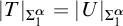





Next we must show that every $\boldsymbol {\alpha }$
-Kreiselian partition is
$\boldsymbol {\alpha }$
-Kreiselian partition is $\mathsf {Ord}_{\Sigma ^{\boldsymbol {\alpha }}_1}$
induced. Let
$\mathsf {Ord}_{\Sigma ^{\boldsymbol {\alpha }}_1}$
induced. Let $\equiv $
be
$\equiv $
be $\boldsymbol {\alpha }$
-Kreiselian. We define a partition
$\boldsymbol {\alpha }$
-Kreiselian. We define a partition $\sim $
on
$\sim $
on $\mathsf {Ord}_{\Sigma ^{\boldsymbol {\alpha }}_1}$
as follows: For
$\mathsf {Ord}_{\Sigma ^{\boldsymbol {\alpha }}_1}$
as follows: For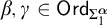 $\beta ,\gamma \in \mathsf {Ord}_{\Sigma ^{\boldsymbol {\alpha }}_1}$
,
$\beta ,\gamma \in \mathsf {Ord}_{\Sigma ^{\boldsymbol {\alpha }}_1}$
, $\beta \sim \gamma $
if and only if, for some
$\beta \sim \gamma $
if and only if, for some $\Pi ^{\boldsymbol {\alpha }}_1$
-definable
$\Pi ^{\boldsymbol {\alpha }}_1$
-definable $\Sigma ^{\boldsymbol {\alpha }}_1$
-sound extensions V and W of
$\Sigma ^{\boldsymbol {\alpha }}_1$
-sound extensions V and W of $\mathsf {KP}_1 +\operatorname {\mathsf {Exists}}({\boldsymbol {\alpha }})$
, the following three claims hold:
$\mathsf {KP}_1 +\operatorname {\mathsf {Exists}}({\boldsymbol {\alpha }})$
, the following three claims hold:
-
1.
$|V|_{\Sigma ^{\boldsymbol {\alpha }}_1}=\beta .$
-
2.
$|W|_{\Sigma ^{\boldsymbol {\alpha }}_1}=\gamma .$
-
3.
$V\equiv W$
.


It is trivial to establish that $\sim $
is an equivalence relation on
$\sim $
is an equivalence relation on $\mathsf {Ord}_{\Sigma ^{\boldsymbol {\alpha }}_1}$
. So we need only see that
$\mathsf {Ord}_{\Sigma ^{\boldsymbol {\alpha }}_1}$
. So we need only see that $\sim $
induces
$\sim $
induces $\equiv $
. To this end, we define
$\equiv $
. To this end, we define
 $$ \begin{align*}T\equiv_\star U := |T|_{\Sigma^{\boldsymbol{\alpha}}_1}\sim |U|_{\Sigma^{\boldsymbol{\alpha}}_1}.\end{align*} $$
Since $\equiv _\star $
just is the
$\equiv _\star $
just is the $\sim $
-induced equivalence relation, it suffices to show that
$\sim $
-induced equivalence relation, it suffices to show that $T\equiv U$
if and only if
$T\equiv U$
if and only if $T\equiv _\star U$
.
$T\equiv _\star U$
.
Suppose that $T\equiv U$
. So by the definition of
$T\equiv U$
. So by the definition of $\sim $
, we have
$\sim $
, we have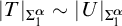 $|T|_{\Sigma ^{\boldsymbol {\alpha }}_1}\sim |U|_{\Sigma ^{\boldsymbol {\alpha }}_1}$
. But then
$|T|_{\Sigma ^{\boldsymbol {\alpha }}_1}\sim |U|_{\Sigma ^{\boldsymbol {\alpha }}_1}$
. But then $T\equiv _\star U$
.
$T\equiv _\star U$
.
Conversely, suppose that $T\equiv _\star U$
, i.e., that
$T\equiv _\star U$
, i.e., that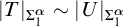 $|T|_{\Sigma ^{\boldsymbol {\alpha }}_1}\sim |U|_{\Sigma ^{\boldsymbol {\alpha }}_1}$
. By definition of
$|T|_{\Sigma ^{\boldsymbol {\alpha }}_1}\sim |U|_{\Sigma ^{\boldsymbol {\alpha }}_1}$
. By definition of $\sim $
, we infer that for some
$\sim $
, we infer that for some $T'$
and
$T'$
and $U'$
:
$U'$
:
-
1.
$|T'|_{\Sigma ^{\boldsymbol {\alpha }}_1}=|T|_{\Sigma ^{\boldsymbol {\alpha }}_1}$
. -
2.
$|U'|_{\Sigma ^{\boldsymbol {\alpha }}_1}=|U|_{\Sigma ^{\boldsymbol {\alpha }}_1}.$
-
3.
$T' \equiv U'$
.
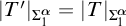


Applying Theorem 4.5 to (1) yields $T\equiv T'$
. Likewise, applying Theorem 4.5 to (2) yields
$T\equiv T'$
. Likewise, applying Theorem 4.5 to (2) yields $U\equiv U'$
.
$U\equiv U'$
.
Combining these observations with (3) yields $T\equiv T' \equiv U' \equiv U$
, whence
$T\equiv T' \equiv U' \equiv U$
, whence $T\equiv U$
.
$T\equiv U$
.
Corollary 4.11. The ${\boldsymbol {\alpha }}$
-ordinal analysis partition properly refines every other
${\boldsymbol {\alpha }}$
-ordinal analysis partition properly refines every other $\boldsymbol {\alpha }$
-Kreiselian partition.
$\boldsymbol {\alpha }$
-Kreiselian partition.
Corollary 4.12. The ${\boldsymbol {\alpha }}$
-ordinal analysis partition is the unique finest
${\boldsymbol {\alpha }}$
-ordinal analysis partition is the unique finest ${\boldsymbol {\alpha }}$
-Kreiselian partition.
${\boldsymbol {\alpha }}$
-Kreiselian partition.
Recall that $\Pi ^1_1$
-statements are precisely
$\Pi ^1_1$
-statements are precisely $\Sigma _1^{\omega _1^{CK}}$
-sentences. So for
$\Sigma _1^{\omega _1^{CK}}$
-sentences. So for $\alpha =\omega _1^{\mathsf {CK}}$
, i.e., the classic ordinal analysis, we can say more. The following theorem is probably “folklore.”
$\alpha =\omega _1^{\mathsf {CK}}$
, i.e., the classic ordinal analysis, we can say more. The following theorem is probably “folklore.”
Proposition 4.13. The proof-theoretic ordinals of the $\Pi ^1_1$
-sound
$\Pi ^1_1$
-sound $\Sigma ^1_1$
-definable extensions of
$\Sigma ^1_1$
-definable extensions of $\mathsf {ACA}_0$
are exactly the recursive
$\mathsf {ACA}_0$
are exactly the recursive $\varepsilon $
-numbers.
$\varepsilon $
-numbers.
Whence it follows that:
Theorem 4.14. The $\omega _1^{\mathsf {CK}}$
-Kreiselian equivalence partitions are exactly those that are induced by partitions of the recursive
$\omega _1^{\mathsf {CK}}$
-Kreiselian equivalence partitions are exactly those that are induced by partitions of the recursive $\varepsilon $
-numbers.Footnote
7
$\varepsilon $
-numbers.Footnote
7
5 A connection with
$\alpha $
-recursion

Another well-established method for measuring the proof-theoretic strength of T is by characterizing the T-provably total recursive functions. This yields a computational perspective on ordinal analysis (see $\Pi ^0_2$
proof-theoretic ordinals in [Reference Beklemishev5]). In this article, we have been investigating “higher” analogues of the usual
$\Pi ^0_2$
proof-theoretic ordinals in [Reference Beklemishev5]). In this article, we have been investigating “higher” analogues of the usual $\Pi ^1_1$
ordinal analysis. Given the connection between ordinal analysis and provably total recursive functions, it is natural to wonder whether there is a significant connection between these higher analogues of ordinal analysis and generalized computability, e.g., the T-provably total
$\Pi ^1_1$
ordinal analysis. Given the connection between ordinal analysis and provably total recursive functions, it is natural to wonder whether there is a significant connection between these higher analogues of ordinal analysis and generalized computability, e.g., the T-provably total $\alpha $
-recursive functions.
$\alpha $
-recursive functions.
There are many ways of defining the notion of an $\alpha $
-recursive functions. For instance, Pohlers defines the
$\alpha $
-recursive functions. For instance, Pohlers defines the $\omega _1^{\mathsf {CK}}$
-recursive functions as functions
$\omega _1^{\mathsf {CK}}$
-recursive functions as functions
 $$ \begin{align*}f\colon L_{\omega_1^{\mathsf{CK}}}\to L_{\omega_1^{\mathsf{CK}}}\end{align*} $$
whose graph is $\Sigma _1^{\omega _1^{\mathsf {CK}}}$
-definable. Using this notion, one can easily establish a connection between
$\Sigma _1^{\omega _1^{\mathsf {CK}}}$
-definable. Using this notion, one can easily establish a connection between $|T|_{\Sigma ^{\boldsymbol {\alpha }}_1}$
and the provably total
$|T|_{\Sigma ^{\boldsymbol {\alpha }}_1}$
and the provably total $\alpha $
-recursive functions of T. However, the definition Pohlers uses emphasizes definability rather than computation. Since our definition of
$\alpha $
-recursive functions of T. However, the definition Pohlers uses emphasizes definability rather than computation. Since our definition of $|T|_{\Sigma ^{\boldsymbol {\alpha }}_1}$
straightforwardly concerns syntactic complexity, it is neither difficult nor enlightening to see its connection with the definability-centric notion Pohlers uses.
$|T|_{\Sigma ^{\boldsymbol {\alpha }}_1}$
straightforwardly concerns syntactic complexity, it is neither difficult nor enlightening to see its connection with the definability-centric notion Pohlers uses.
Perhaps the most famous definition of $\alpha $
-recursion was provided by Sacks in [Reference Sacks24], by using the
$\alpha $
-recursion was provided by Sacks in [Reference Sacks24], by using the $\Sigma _1$
-truth predicate over L. So, again, this is a definability-oriented notion. Although Sacks’ formulation is simple and standard, adapting his formulation to formulate a higher analogue of “gauging the strength of theories via provably total recursive function” is not too enlightening in the present context.
$\Sigma _1$
-truth predicate over L. So, again, this is a definability-oriented notion. Although Sacks’ formulation is simple and standard, adapting his formulation to formulate a higher analogue of “gauging the strength of theories via provably total recursive function” is not too enlightening in the present context.
Hence, in this section, we will focus instead on computation-centric definitions of $\alpha $
-recursion. By connecting these with
$\alpha $
-recursion. By connecting these with $|T|_{\Sigma ^{\boldsymbol {\alpha }}_1}$
, we can develop a computational perspective on higher ordinal analysis. In particular, we will turn our attention to operational formulations of
$|T|_{\Sigma ^{\boldsymbol {\alpha }}_1}$
, we can develop a computational perspective on higher ordinal analysis. In particular, we will turn our attention to operational formulations of $\alpha $
-recursion. Hamkins and Lewis [Reference Hamkins and Lewis9], Koepke [Reference Koepke13], and others have defined Turing-machine-like formulations of ordinal computation. Koepke’s
$\alpha $
-recursion. Hamkins and Lewis [Reference Hamkins and Lewis9], Koepke [Reference Koepke13], and others have defined Turing-machine-like formulations of ordinal computation. Koepke’s $\alpha $
-machine coincides with
$\alpha $
-machine coincides with $\alpha $
-recursion for ordinals [Reference Koepke and Seyfferth14]. Unfortunately, for these operational notions, the only valid inputs to computations are ordinals. By contrast, Sacks’ notion concerns arbitrary sets (in L).
$\alpha $
-recursion for ordinals [Reference Koepke and Seyfferth14]. Unfortunately, for these operational notions, the only valid inputs to computations are ordinals. By contrast, Sacks’ notion concerns arbitrary sets (in L).
Recently, Passmann [Reference Passmann18] introduced a set-friendly operational computability notion—the set register machine— to define his set realizability model. He formulated this model of generalized computation in $\mathsf {ZFC}$
with the powerset axiom. In fact, it is possible to formulate this model of computation over
$\mathsf {ZFC}$
with the powerset axiom. In fact, it is possible to formulate this model of computation over $\mathsf {KP}_1 + (V=L)$
without the powerset axiom. We now provide the definition of set register machine for completeness (following Definitions 3.1 and 3.2 in [Reference Passmann18]).
$\mathsf {KP}_1 + (V=L)$
without the powerset axiom. We now provide the definition of set register machine for completeness (following Definitions 3.1 and 3.2 in [Reference Passmann18]).
Note that in this section, $<_L$
is the standard
$<_L$
is the standard $\Sigma _1$
-definable global well-order over L. Note that this definition works in the setting
$\Sigma _1$
-definable global well-order over L. Note that this definition works in the setting $\mathsf {KP}_1$
.
$\mathsf {KP}_1$
.
Definition 5.1 (
$\mathsf {KP}_1 + (V=L)$
)

A set register program or set register machine (abbreviated SRM) p is a finite sequence of instructions, where an instruction is an instance of one of the following commands (in what follows, $\mathtt {R}_i$
designates the ith bit of content of the ith register).
$\mathtt {R}_i$
designates the ith bit of content of the ith register).
-
1. ‘
$\mathtt {R}_i:=\varnothing $
’ Replace the contents of the ith register with the empty set. -
2. ‘
$\mathtt {ADD}(i,j)$
’ Replace the content of the jth register with
$\mathtt {R}_j\cup \{\mathtt {R}_i\}$
. -
3. ‘
$\mathtt {COPY}(i,j)$
’ Replace the content of the jth register with
$\mathtt {R}_i$
. -
4. ‘
$\mathtt {TAKE}(i,j)$
’ Replace the content of the jth register with the
$<_L$
-least set contained in
$\mathtt {R}_i$
if
$\mathtt {R}_i\neq \varnothing $
. Otherwise, do nothing. -
5. ‘
$\mathtt {REMOVE}(i,j)$
’ Replace the content of the jth register with the set
$\mathtt {R}_i\setminus \{\mathtt {R}_j\}$
. -
6. ‘IF
$\mathtt {R}_i=\varnothing $
THEN GO TO k
’ Check whether
$\mathtt {R}_i=\varnothing $
. If so, move to program line k. If not, move to the next line. -
7. ‘IF
$\mathtt {R}_i\in \mathtt {R}_j$
THEN GO TO k
’ Check whether
$\mathtt {R}_i\in \mathtt {R}_j$
. If so, move to program line k. If not, move to the next line.


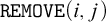


For an SRM p—where $k\in \mathbb {N}$
is the largest register index appearing in p—we say that a sequence
$k\in \mathbb {N}$
is the largest register index appearing in p—we say that a sequence $c=\langle l,r_0,\ldots ,r_k\rangle $
is a configuration if l is a natural number. Intuitively, l is the active program line, and
$c=\langle l,r_0,\ldots ,r_k\rangle $
is a configuration if l is a natural number. Intuitively, l is the active program line, and $r_i$
is the content of the ith register machine. For a configuration c, its successor configuration
$r_i$
is the content of the ith register machine. For a configuration c, its successor configuration $c^+=\langle l^+, r_0^+,\dots , r_k^+\rangle $
is as follows:
$c^+=\langle l^+, r_0^+,\dots , r_k^+\rangle $
is as follows:
-
1. If
$p_l$
is ‘
$\mathtt {R}_i:=\varnothing $
’, then
$r_i^+=\varnothing $
,
$r_j^+=r_j$
for
$j\neq i$
,
$l^+=l+1$
. -
2. If
$p_l$
is ‘
$\mathtt {ADD}(i,j)$
’, then
$r_j^+ = r_j\cup \{r_i\}$
,
$r_m^+=r_m$
if
$m\neq j$
,
$l^+=l+1$
. -
3. If
$p_l$
is ‘
$\mathtt {COPY}(i,j)$
’, then
$r_j^+ = r_i$
,
$r_m^+ = r_m$
if
$m\neq j$
,
$l^+ = l+1$
. -
4. If
$p_l$
is ‘
$\mathtt {TAKE}(i,j)$
’, then
$$ \begin{align*} r_j^+ = \begin{cases} \text{the } <_L\text{-minimal element of } r_i & \text{if } r_i\neq\varnothing, \\ r_j & \text{otherwise}, \end{cases} \end{align*} $$
$r_m^+ = r_m$
if
$m\neq j$
,
$l^+=l+1$
.
-
5. If
$p_l$
is ‘
$\mathtt {REMOVE}(i,j)$
’, then
$r_j^+ = r_j\setminus \{r_i\}$
,
$r_m^+ = r_m$
for
$m\neq j$
,
$l^+ = l+1$
. -
6. If
$p_l$
is ‘IF
$\mathtt {R}_i=\varnothing $
THEN GO TO k
’, then
$r_m^+ = r_m$
for all
$m\le k$
, and
$$ \begin{align*} l^+ = \begin{cases} m & \text{if }r_i=\varnothing, \\ l+1 & \text{otherwise}. \end{cases} \end{align*} $$
-
7. If
$p_l$
is ‘IF
$\mathtt {R}_i\in \mathtt {R}_j$
THEN GO TO k
’, then
$r_m^+ = r_m$
for all
$m\le k$
, and
$$ \begin{align*} l^+ = \begin{cases} m & \text{if }r_i\in r_j, \\ l+1 & \text{otherwise}. \end{cases} \end{align*} $$


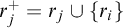


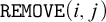
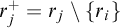


A computation of p with input $x_0,\ldots , x_j$
is a sequence
$x_0,\ldots , x_j$
is a sequence $\langle d_\xi \mid \xi < \alpha +1 \rangle $
with some successor ordinal length consisting of the configurations of p such that
$\langle d_\xi \mid \xi < \alpha +1 \rangle $
with some successor ordinal length consisting of the configurations of p such that
-
1.
$d_0 = \langle 1,x_0,\ldots , x_j,\varnothing ,\dots ,\varnothing \rangle $
. -
2. If
$\beta <\alpha $
, then
$d_{\beta +1}=d_\beta ^+$
. -
3. If
$\beta <\alpha $
is a limit and
$d_\gamma = \langle l_\gamma , r_\gamma ^0,r_\gamma ^1,\ldots , r_\gamma ^{k-1}\rangle $
for
$\gamma <\beta $
, then
$l_\beta = \liminf _{\gamma <\beta }l_\gamma $
,
$r^i_\beta = \liminf _{\gamma <\beta } r^i_\gamma $
for
$i<k$
, and where the limit inferior of sets is computed under the order
$$ \begin{align*} d_\beta = \langle l_\beta,r_\beta^0,r_\beta^1,\ldots, r_\beta^{k-1} \rangle, \end{align*} $$
$<_L$
.Footnote
8
-
4.
$d_\alpha ^+$
is undefined.









It can be verified that most arguments in Section 3 of [Reference Passmann18] are formalizable in $\mathsf {KP}_1 + (V=L)$
as long as the proof does not use the powerset operation. In particular, we can prove the following.
$\mathsf {KP}_1 + (V=L)$
as long as the proof does not use the powerset operation. In particular, we can prove the following.
Lemma 5.2 (
$\mathsf {KP}_1+(V=L)$
, Lemma 3.18 of [Reference Passmann18])

There is an SRM $\mathsf {Tr}_{\Delta _0}$
, which takes a code for a
$\mathsf {Tr}_{\Delta _0}$
, which takes a code for a $\Delta _0$
-formula
$\Delta _0$
-formula $\varphi $
and a parameter a, such that
$\varphi $
and a parameter a, such that $\mathsf {Tr}_{\Delta _0}(\ulcorner \varphi \urcorner ,a)=1$
if
$\mathsf {Tr}_{\Delta _0}(\ulcorner \varphi \urcorner ,a)=1$
if $\vDash _{\Sigma _0}\varphi (a)$
, and
$\vDash _{\Sigma _0}\varphi (a)$
, and $\mathsf {Tr}_{\Delta _0}(\ulcorner \varphi \urcorner ,a)=0$
if
$\mathsf {Tr}_{\Delta _0}(\ulcorner \varphi \urcorner ,a)=0$
if $\vDash _{\Sigma _0}\lnot \varphi (a)$
.
$\vDash _{\Sigma _0}\lnot \varphi (a)$
.
It turns out that the halting problem for Passman’s set register machine is $\Sigma _1$
-complete over L.
$\Sigma _1$
-complete over L.
Lemma 5.3 (
$\mathsf {KP}_1+(V=L)$
)

Let p be an SRM. Then the statement ‘The program p with input x halts’ is $\Sigma _1$
. Conversely, every
$\Sigma _1$
. Conversely, every $\Sigma _1$
formula
$\Sigma _1$
formula $\varphi (x)$
is equivalent to a statement of the form ‘An SRM p with an input x halts.’
$\varphi (x)$
is equivalent to a statement of the form ‘An SRM p with an input x halts.’
Furthermore, the statement ‘The program p with an input x halts’ is equivalent to a statement of the form $\exists d \; \mathtt {T}(p,x,d)$
for some
$\exists d \; \mathtt {T}(p,x,d)$
for some $\mathsf {KP}_1$
-provably
$\mathsf {KP}_1$
-provably $\Delta _1$
formula
$\Delta _1$
formula $\mathtt {T}$
, and satisfies if
$\mathtt {T}$
, and satisfies if $d\in L_\beta $
, then x and the output of p with input x are in
$d\in L_\beta $
, then x and the output of p with input x are in $L_\beta $
.
$L_\beta $
.
Sketch of the proof. Formally, ‘M halts with an input x’ is equivalent to the existence of a computation d of p with input x, and we can see that d being a computation is $\Delta _1$
. If we take
$\Delta _1$
. If we take $\mathtt {T}(p,x,d)$
to be
$\mathtt {T}(p,x,d)$
to be
 $$ \begin{align*} \mathtt{T}(p,x,d):= d\ \text{is a computation of p with input x,} \end{align*} $$
and if $d\in L_\beta $
, then we have that the output of p under x is in
$d\in L_\beta $
, then we have that the output of p under x is in $L_\beta $
since d contains the output of the computation.
$L_\beta $
since d contains the output of the computation.
Conversely, suppose that $\exists y \psi (x,y)$
is a
$\exists y \psi (x,y)$
is a $\Sigma _1$
-formula, where
$\Sigma _1$
-formula, where $\psi $
is a bounded formula. Now consider an SRM p trying to find y such that
$\psi $
is a bounded formula. Now consider an SRM p trying to find y such that $\mathsf {Tr}_{\Delta _0}(\ulcorner \psi \urcorner ,x,y)$
holds via unbounded search. Then ‘p halts with input x’ is equivalent to
$\mathsf {Tr}_{\Delta _0}(\ulcorner \psi \urcorner ,x,y)$
holds via unbounded search. Then ‘p halts with input x’ is equivalent to $\exists y \psi (x,y)$
.
$\exists y \psi (x,y)$
.
Also, we can see that the register machine computable class functions coincide with $\Sigma _1$
-definable class functions.
$\Sigma _1$
-definable class functions.
Lemma 5.4 (
$\mathsf {KP}_1+(V=L)$
)

A class partial function $F\colon L\to L$
is
$F\colon L\to L$
is $\Sigma _1$
-definable (in the sense that
$\Sigma _1$
-definable (in the sense that $x\in \operatorname {dom} F$
and
$x\in \operatorname {dom} F$
and $y=F(x)$
are
$y=F(x)$
are $\Sigma _1$
) if and only if there is an SRM p and a parameter a such that
$\Sigma _1$
) if and only if there is an SRM p and a parameter a such that $x\in \operatorname {dom} F$
iff
$x\in \operatorname {dom} F$
iff $p(x,a)$
halts and
$p(x,a)$
halts and $F(x)=p(x,a)$
for all x in the domain.
$F(x)=p(x,a)$
for all x in the domain.
In fact, we can effectively determine p from the $\Sigma _1$
-definition of F.
$\Sigma _1$
-definition of F.
Sketch of the Proof.
In one direction, suppose that the graph of $F\colon L\to L$
is defined by a formula
$F\colon L\to L$
is defined by a formula $\exists z \varphi _0(x,y,z,a)$
for some
$\exists z \varphi _0(x,y,z,a)$
for some $\Delta _0$
formula
$\Delta _0$
formula $\varphi _0$
and a parameter a. Then consider the following SRM
$\varphi _0$
and a parameter a. Then consider the following SRM $p(x,a)$
: Enumerate all sets under the
$p(x,a)$
: Enumerate all sets under the $<_L$
-order. If the set we enumerate is not an ordered pair, skip this set. If the set we enumerate is of the form
$<_L$
-order. If the set we enumerate is not an ordered pair, skip this set. If the set we enumerate is of the form $\langle y,z\rangle $
, compute
$\langle y,z\rangle $
, compute $\mathrm {Tr}_{\Delta _0}(\ulcorner \varphi _0\urcorner , x,y,z,a)$
. If
$\mathrm {Tr}_{\Delta _0}(\ulcorner \varphi _0\urcorner , x,y,z,a)$
. If $\mathrm {Tr}_{\Delta _0}(\ulcorner \varphi _0\urcorner , x,y,z,a)=1$
,
$\mathrm {Tr}_{\Delta _0}(\ulcorner \varphi _0\urcorner , x,y,z,a)=1$
, $p(x,a)$
returns y. Otherwise, proceed with the computation. Then by definition of p,
$p(x,a)$
returns y. Otherwise, proceed with the computation. Then by definition of p, $p(x,a)$
halts iff
$p(x,a)$
halts iff $x\in \operatorname {dom} F$
, and
$x\in \operatorname {dom} F$
, and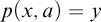 $p(x,a)=y$
iff
$p(x,a)=y$
iff $F(x)=y$
.
$F(x)=y$
.
Conversely, suppose that F is a class function defined by an SRM $p(x,a)$
with parameter a. We can see that there is a
$p(x,a)$
with parameter a. We can see that there is a $\Delta _1$
-definable function
$\Delta _1$
-definable function $\mathtt {U}$
, which reads off a computation d and extracts its output. Then
$\mathtt {U}$
, which reads off a computation d and extracts its output. Then $F(x)=y$
if and only if
$F(x)=y$
if and only if $\exists d\,\mathtt {T}(p,\langle x,a\rangle ,d)\land y=\mathtt {U}(d)$
, which is
$\exists d\,\mathtt {T}(p,\langle x,a\rangle ,d)\land y=\mathtt {U}(d)$
, which is $\Sigma _1$
.
$\Sigma _1$
.
For an admissible $\alpha $
, let us define the
$\alpha $
, let us define the $\alpha $
-set register machine by relativizing its definition over
$\alpha $
-set register machine by relativizing its definition over $L_\alpha $
. By relativizing the above results to an admissible
$L_\alpha $
. By relativizing the above results to an admissible $\alpha $
, we get the following.
$\alpha $
, we get the following.
Corollary 5.5. Let p be an $\alpha $
-SRM. Then the statement ‘The program p with input x halts’ is
$\alpha $
-SRM. Then the statement ‘The program p with input x halts’ is $\Sigma ^\alpha _1$
. Conversely, every
$\Sigma ^\alpha _1$
. Conversely, every $\Sigma _1$
formula
$\Sigma _1$
formula $\varphi (x)$
is equivalent to a statement of the form ‘An
$\varphi (x)$
is equivalent to a statement of the form ‘An $\alpha $
-SRM p with an input x halts.’
$\alpha $
-SRM p with an input x halts.’
Furthermore, the statement ‘The program p with an input x halts’ is equivalent to a statement of the form $\exists d \; \mathtt {T}^\alpha (p,d,x)$
for some
$\exists d \; \mathtt {T}^\alpha (p,d,x)$
for some $\Delta _1^\alpha $
formula
$\Delta _1^\alpha $
formula $\mathtt {T}^\alpha $
, and satisfies if
$\mathtt {T}^\alpha $
, and satisfies if $d\in L_\beta $
for
$d\in L_\beta $
for $\beta <\alpha $
, then x and the output of p with input x are in
$\beta <\alpha $
, then x and the output of p with input x are in $L_\beta $
.
$L_\beta $
.
Corollary 5.6. A partial function $F\colon L_\alpha \to L_\alpha $
is
$F\colon L_\alpha \to L_\alpha $
is $\Sigma _1^\alpha $
-definable if and only if there is an
$\Sigma _1^\alpha $
-definable if and only if there is an $\alpha $
-SRM p such that
$\alpha $
-SRM p such that $F(x)=p(x)$
for all
$F(x)=p(x)$
for all $x\in L_\alpha $
.
$x\in L_\alpha $
.
In fact, we can effectively determine p from the $\Sigma _1^\alpha $
-definition of F, and if F is
$\Sigma _1^\alpha $
-definition of F, and if F is $\Sigma _1^\alpha $
-definable without parameters, then the corresponding p also does not have other parameters.
$\Sigma _1^\alpha $
-definable without parameters, then the corresponding p also does not have other parameters.
That is, every $\Sigma ^\alpha _1$
-set is
$\Sigma ^\alpha _1$
-set is $\alpha $
-register machine computably enumerable, and every
$\alpha $
-register machine computably enumerable, and every $\Sigma ^\alpha _1$
-definable function is computed by an
$\Sigma ^\alpha _1$
-definable function is computed by an $\alpha $
-SRM program.
$\alpha $
-SRM program.
Now we fix a $\mathsf {KP}_1$
-provably admissible representable
$\mathsf {KP}_1$
-provably admissible representable $\alpha $
with a representation
$\alpha $
with a representation ${\boldsymbol {\alpha }}$
.
${\boldsymbol {\alpha }}$
.
Definition 5.7. Let T be a $\Sigma ^{\boldsymbol {\alpha }}_1$
-sound theory extending
$\Sigma ^{\boldsymbol {\alpha }}_1$
-sound theory extending $\mathsf {KP}_1$
+
$\mathsf {KP}_1$
+ $\operatorname {\mathsf {Exists}}({\boldsymbol {\alpha }})$
.
$\operatorname {\mathsf {Exists}}({\boldsymbol {\alpha }})$
.
-
1. Let p be an
${\boldsymbol {\alpha }}$
-SRM. Define
$\mathsf {height}(p)$
as the least ordinal
$\beta <\alpha $
such that for every
$x\in L_\beta $
, if a computation d of p with an input x halts, then
$d\in L_\beta $
. -
2.
$|T|_{{\boldsymbol {\alpha }}\text {-ht}}$
is the supremum of all
$\mathsf {height}(p)$
for an
$\alpha $
-SRM computing a constant function such that T proves p halts. -
3.
$|T|_{{\boldsymbol {\alpha }}\text {-cl}}$
is the least
$\beta $
satisfying
$f[L_\beta ]\subseteq L_\beta $
for all T-provably
${\boldsymbol {\alpha }}$
-recursive f definable without parameters.Equivalently,
$|T|_{{\boldsymbol {\alpha }}\text {-cl}}$
is the least
$\beta $
such that for every
$\alpha $
-SRM p, if T proves p halts for every input
$x\in L_\alpha $
, then the output of p with input in
$L_\beta $
is also in
$L_\beta $
.


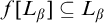


Following the lead of [Reference Pohlers19, Lemma 1.2.3], we get the following.
Proposition 5.8. Let ${\boldsymbol {\alpha }}$
be a representable ordinal that is provably admissible over
${\boldsymbol {\alpha }}$
be a representable ordinal that is provably admissible over $\mathsf {KP}_1$
and let T be a
$\mathsf {KP}_1$
and let T be a $\Sigma ^{\boldsymbol {\alpha }}_1$
-sound theory extending
$\Sigma ^{\boldsymbol {\alpha }}_1$
-sound theory extending $\mathsf {KP}_1 + \operatorname {\mathsf {Exists}}({\boldsymbol {\alpha }})$
. Then
$\mathsf {KP}_1 + \operatorname {\mathsf {Exists}}({\boldsymbol {\alpha }})$
. Then $|T|_{\Sigma ^{\boldsymbol {\alpha }}_1}=|T|_{{\boldsymbol {\alpha }}\text {-}\mathrm {ht}}=|T|_{{\boldsymbol {\alpha }}\text {-{ cl}}}=|T|_{\Pi ^{\boldsymbol {\alpha }}_2}$
.
$|T|_{\Sigma ^{\boldsymbol {\alpha }}_1}=|T|_{{\boldsymbol {\alpha }}\text {-}\mathrm {ht}}=|T|_{{\boldsymbol {\alpha }}\text {-{ cl}}}=|T|_{\Pi ^{\boldsymbol {\alpha }}_2}$
.
Proof. Pohlers [Reference Pohlers19, Lemma 1.2.3] proves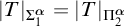 $|T|_{\Sigma ^{\boldsymbol {\alpha }}_1}=|T|_{\Pi ^{\boldsymbol {\alpha }}_2}$
, so let us prove the following:
$|T|_{\Sigma ^{\boldsymbol {\alpha }}_1}=|T|_{\Pi ^{\boldsymbol {\alpha }}_2}$
, so let us prove the following: $|T|_{\Sigma ^{\boldsymbol {\alpha }}_1}\le |T|_{{\boldsymbol {\alpha }}\text {-ht}}$
: To show this, it suffices to show
$|T|_{\Sigma ^{\boldsymbol {\alpha }}_1}\le |T|_{{\boldsymbol {\alpha }}\text {-ht}}$
: To show this, it suffices to show $|T|_{{\boldsymbol {\alpha }}{\text {-}\mathsf {repr}}} \le |T|_{{\boldsymbol {\alpha }}-ht}$
. Let
$|T|_{{\boldsymbol {\alpha }}{\text {-}\mathsf {repr}}} \le |T|_{{\boldsymbol {\alpha }}-ht}$
. Let ${\boldsymbol {\gamma }}$
be a representation such that
${\boldsymbol {\gamma }}$
be a representation such that $T\vdash \exists \operatorname {\mathsf {Exists}}({\boldsymbol {\gamma }})^{L_{\boldsymbol {\alpha }}}$
. By Corollary 5.5, we can construct a following
$T\vdash \exists \operatorname {\mathsf {Exists}}({\boldsymbol {\gamma }})^{L_{\boldsymbol {\alpha }}}$
. By Corollary 5.5, we can construct a following ${\boldsymbol {\alpha }}$
-SRM p: p tries to find an ordinal
${\boldsymbol {\alpha }}$
-SRM p: p tries to find an ordinal $\xi <\alpha $
such that
$\xi <\alpha $
such that $R^{\boldsymbol {\gamma }}(\xi )$
holds, and halts if there is such ordinal and returns that ordinal. We can decide
$R^{\boldsymbol {\gamma }}(\xi )$
holds, and halts if there is such ordinal and returns that ordinal. We can decide $R^{\boldsymbol {\gamma }}(\xi )$
holds within time
$R^{\boldsymbol {\gamma }}(\xi )$
holds within time $<{\boldsymbol {\alpha }}$
by computing
$<{\boldsymbol {\alpha }}$
by computing $R^{\boldsymbol {\gamma }}(\xi )$
and
$R^{\boldsymbol {\gamma }}(\xi )$
and $\lnot R^{\boldsymbol {\gamma }}_*(\xi )$
simultaneously, where
$\lnot R^{\boldsymbol {\gamma }}_*(\xi )$
simultaneously, where $R^{\boldsymbol {\gamma }}_*$
is the
$R^{\boldsymbol {\gamma }}_*$
is the $\Pi _1$
statement for
$\Pi _1$
statement for $R^{\boldsymbol {\gamma }}$
defined in (4). One of them must halt within time
$R^{\boldsymbol {\gamma }}$
defined in (4). One of them must halt within time $<{\boldsymbol {\alpha }}$
, and we can decide the validity of
$<{\boldsymbol {\alpha }}$
, and we can decide the validity of $R^{\boldsymbol {\gamma }}(\xi )$
by using that computational result.
$R^{\boldsymbol {\gamma }}(\xi )$
by using that computational result.
Since T proves $\operatorname {\mathsf {Exists}}({\boldsymbol {\gamma }})^{L_{\boldsymbol {\alpha }}}$
, T proves p halts, and
$\operatorname {\mathsf {Exists}}({\boldsymbol {\gamma }})^{L_{\boldsymbol {\alpha }}}$
, T proves p halts, and $\mathsf {height}(p)=\xi +1$
for the unique
$\mathsf {height}(p)=\xi +1$
for the unique $\xi $
such that
$\xi $
such that $L\models R^{\boldsymbol {\gamma }}(\xi )$
. That is,
$L\models R^{\boldsymbol {\gamma }}(\xi )$
. That is, $\xi <|T|_{{\boldsymbol {\alpha }}\text {-ht}}$
. Then the desired inequality follows from the definition of
$\xi <|T|_{{\boldsymbol {\alpha }}\text {-ht}}$
. Then the desired inequality follows from the definition of $|T|_{{\boldsymbol {\alpha }}{\text {-}\mathsf {repr}}}$
.
$|T|_{{\boldsymbol {\alpha }}{\text {-}\mathsf {repr}}}$
. $|T|_{{\boldsymbol {\alpha }}\text {-ht}}\le |T|_{{\boldsymbol {\alpha }}\text {-cl}}$
: ‘p halts’ for an
$|T|_{{\boldsymbol {\alpha }}\text {-ht}}\le |T|_{{\boldsymbol {\alpha }}\text {-cl}}$
: ‘p halts’ for an ${\boldsymbol {\alpha }}$
-SRM p computing a constant function is a special case of ‘p halts for every input x.’ Thus, every T-provably-halting
${\boldsymbol {\alpha }}$
-SRM p computing a constant function is a special case of ‘p halts for every input x.’ Thus, every T-provably-halting $\alpha $
-SRM that is computing a constant function outputs a value below
$\alpha $
-SRM that is computing a constant function outputs a value below $|T|_{{\boldsymbol {\alpha }}\text {-cl}}$
.
$|T|_{{\boldsymbol {\alpha }}\text {-cl}}$
. $|T|_{{\boldsymbol {\alpha }}\text {-cl}}\le |T|_{\Pi ^{\boldsymbol {\alpha }}_2}$
: By Corollary 5.5, ‘p halts with input x’ is equivalent to
$|T|_{{\boldsymbol {\alpha }}\text {-cl}}\le |T|_{\Pi ^{\boldsymbol {\alpha }}_2}$
: By Corollary 5.5, ‘p halts with input x’ is equivalent to $\exists d\in L_{\boldsymbol {\alpha }} \; \mathtt {T}(p,d,x)$
. Thus the assertion ‘For every
$\exists d\in L_{\boldsymbol {\alpha }} \; \mathtt {T}(p,d,x)$
. Thus the assertion ‘For every $x\in L_{\boldsymbol {\alpha }}$
, p halts with input x’ is
$x\in L_{\boldsymbol {\alpha }}$
, p halts with input x’ is $\Pi ^{\boldsymbol {\alpha }}_2$
. Thus if T proves p halts, then by the definition of
$\Pi ^{\boldsymbol {\alpha }}_2$
. Thus if T proves p halts, then by the definition of $|T|_{\Pi ^{\boldsymbol {\alpha }}_2}$
, then
$|T|_{\Pi ^{\boldsymbol {\alpha }}_2}$
, then $L_{|T|_{\Pi ^{\boldsymbol {\alpha }}_2}}\models \forall x \; \exists d \; \mathtt {T}(p,d,x)$
. By Corollary 5.5 again, we infer that the output of p belongs to
$L_{|T|_{\Pi ^{\boldsymbol {\alpha }}_2}}\models \forall x \; \exists d \; \mathtt {T}(p,d,x)$
. By Corollary 5.5 again, we infer that the output of p belongs to $L_{|T|_{\Pi ^{\boldsymbol {\alpha }}_2}}$
. That is,
$L_{|T|_{\Pi ^{\boldsymbol {\alpha }}_2}}$
. That is, $L_{|T|_{\Pi ^{\boldsymbol {\alpha }}_2}}$
is closed under computation by p.
$L_{|T|_{\Pi ^{\boldsymbol {\alpha }}_2}}$
is closed under computation by p.
Hence we get
 $$ \begin{align*} |T|_{{\boldsymbol{\alpha}}-ht}\le |T|_{{\boldsymbol{\alpha}}-cl}\le |T|_{\Pi^{\boldsymbol{\alpha}}_2}=|T|_{\Sigma^{\boldsymbol{\alpha}}_1}\le|T|_{{\boldsymbol{\alpha}}-ht}.\\[-34pt] \end{align*} $$
6 Comparing the strength of theories
Now let us examine the set-theoretic analogue of the second main theorem in [Reference Walsh29].
Definition 6.1. We define provability in the presence of an oracle for $\Pi ^{\boldsymbol {\alpha }}_1$
-truths
$\Pi ^{\boldsymbol {\alpha }}_1$
-truths $\vdash ^{\Pi ^{\boldsymbol {\alpha }}_1}$
as follows:
$\vdash ^{\Pi ^{\boldsymbol {\alpha }}_1}$
as follows: $T\vdash ^{\Pi ^{\boldsymbol {\alpha }}_1} \varphi $
if there is a true
$T\vdash ^{\Pi ^{\boldsymbol {\alpha }}_1} \varphi $
if there is a true $\Pi ^{\boldsymbol {\alpha }}_1$
-formula
$\Pi ^{\boldsymbol {\alpha }}_1$
-formula $\psi $
such that
$\psi $
such that $T+\psi \vdash \varphi $
. Then we define
$T+\psi \vdash \varphi $
. Then we define
 $$ \begin{align*} T\subseteq^{\Pi^{\boldsymbol{\alpha}}_1}_{\Sigma^{\boldsymbol{\alpha}}_1} U\iff \text{ For all } \varphi\in\Sigma^{\boldsymbol{\alpha}}_1, \text{ if } T\vdash^{\Pi^{\boldsymbol{\alpha}}_1}\varphi, \text{ then } U\vdash^{\Pi^{\boldsymbol{\alpha}}_1}\varphi. \end{align*} $$
Let’s introduce some notation. The reflection principle $\mathsf {RFN}_{\Sigma ^{\boldsymbol {\alpha }}_1}(T)$
is the formula:
$\mathsf {RFN}_{\Sigma ^{\boldsymbol {\alpha }}_1}(T)$
is the formula:
 $$ \begin{align*} \forall \varphi\in \Delta_0 \Big(\mathsf{Pr}_T\big(\exists x \in L_{\boldsymbol{\alpha}} \; \varphi(x)\big)\to L_{\boldsymbol{\alpha}}\models_{\Sigma_1} \exists x \varphi(x)\Big). \end{align*} $$
We define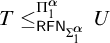 $T\le ^{\Pi ^{\boldsymbol {\alpha }}_1}_{\mathsf {RFN}_{\Sigma ^{\boldsymbol {\alpha }}_1}}U$
if and only if
$T\le ^{\Pi ^{\boldsymbol {\alpha }}_1}_{\mathsf {RFN}_{\Sigma ^{\boldsymbol {\alpha }}_1}}U$
if and only if
 $$ \begin{align*} \mathsf{KP}_1 + \operatorname{\mathsf{Exists}}({\boldsymbol{\alpha}}) \vdash^{\Pi^{\boldsymbol{\alpha}}_1} \mathsf{RFN}_{\Sigma^{\boldsymbol{\alpha}}_1}(U)\to \mathsf{RFN}_{\Sigma^{\boldsymbol{\alpha}}_1}(T). \end{align*} $$
Here is how we can describe $T\vdash ^{\Pi ^{\boldsymbol {\alpha }}_1}\varphi $
, for
$T\vdash ^{\Pi ^{\boldsymbol {\alpha }}_1}\varphi $
, for $\varphi \in \Sigma ^{\boldsymbol {\alpha }}_1$
, from an
$\varphi \in \Sigma ^{\boldsymbol {\alpha }}_1$
, from an ${\boldsymbol {\alpha }}$
-recursion theoretic perspective. For
${\boldsymbol {\alpha }}$
-recursion theoretic perspective. For $\varphi \in \Sigma ^{\boldsymbol {\alpha }}_1$
,
$\varphi \in \Sigma ^{\boldsymbol {\alpha }}_1$
, $T\vdash ^{\Pi ^{\boldsymbol {\alpha }}_1}\varphi $
just in case there exists an
$T\vdash ^{\Pi ^{\boldsymbol {\alpha }}_1}\varphi $
just in case there exists an $\alpha $
-program M such that
$\alpha $
-program M such that $T\vdash ^{\Pi ^{\boldsymbol {\alpha }}_1}$
“M halts.” Accordingly, we may view
$T\vdash ^{\Pi ^{\boldsymbol {\alpha }}_1}$
“M halts.” Accordingly, we may view $\mathsf {RFN}_{\Sigma ^{\boldsymbol {\alpha }}_1}(T)$
as the following claim: Every T-provably halting
$\mathsf {RFN}_{\Sigma ^{\boldsymbol {\alpha }}_1}(T)$
as the following claim: Every T-provably halting ${\boldsymbol {\alpha }}$
-recursive programs actually halts over L.
${\boldsymbol {\alpha }}$
-recursive programs actually halts over L.
Let us start by stating a small lemma that is extracted from the proof of Theorem 4.5. This small lemma will play a pivotal role in the proofs of the main results of this section.
Lemma 6.2 (
$\mathsf {KP}_1 +\operatorname {\mathsf {Exists}}({\boldsymbol {\alpha }})$
)

Let $\gamma $
be an ordinal with representation
$\gamma $
be an ordinal with representation ${\boldsymbol {\gamma }}$
such that
${\boldsymbol {\gamma }}$
such that $\gamma <|T|_{\Sigma ^{\boldsymbol {\alpha }}_1}$
. Then
$\gamma <|T|_{\Sigma ^{\boldsymbol {\alpha }}_1}$
. Then $T\vdash ^{\Pi ^{\boldsymbol {\alpha }}_1}\operatorname {\mathsf {Exists}}({\boldsymbol {\gamma }})^{L_{\boldsymbol {\alpha }}}$
.
$T\vdash ^{\Pi ^{\boldsymbol {\alpha }}_1}\operatorname {\mathsf {Exists}}({\boldsymbol {\gamma }})^{L_{\boldsymbol {\alpha }}}$
.
It is known that adding a true $\Sigma ^1_1$
-sentence to a theory does not alter its
$\Sigma ^1_1$
-sentence to a theory does not alter its $\Pi ^1_1$
-reflection. That is, if
$\Pi ^1_1$
-reflection. That is, if $\theta $
is a true
$\theta $
is a true $\Sigma ^1_1$
sentence and T is a
$\Sigma ^1_1$
sentence and T is a $\Pi ^1_1$
-sound theory, then
$\Pi ^1_1$
-sound theory, then $\mathsf {RFN}_{\Pi ^1_1}(T)$
implies
$\mathsf {RFN}_{\Pi ^1_1}(T)$
implies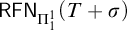 $\mathsf {RFN}_{\Pi ^1_1}(T+\sigma )$
. The following result is a set-theoretic analogue of what we previously stated.
$\mathsf {RFN}_{\Pi ^1_1}(T+\sigma )$
. The following result is a set-theoretic analogue of what we previously stated.
Lemma 6.3. Let $\theta $
be a
$\theta $
be a $\Pi _1$
-sentence such that
$\Pi _1$
-sentence such that $\theta ^{L_\alpha }$
is true, and T be a
$\theta ^{L_\alpha }$
is true, and T be a $\Sigma ^{\boldsymbol {\alpha }}_1$
-sound extension of
$\Sigma ^{\boldsymbol {\alpha }}_1$
-sound extension of $\mathsf {KP}_1 + \operatorname {\mathsf {Exists}}({\boldsymbol {\alpha }})$
. Then we have the following:
$\mathsf {KP}_1 + \operatorname {\mathsf {Exists}}({\boldsymbol {\alpha }})$
. Then we have the following:
 $$ \begin{align*} \mathsf{KP}_1 + \operatorname{\mathsf{Exists}}({\boldsymbol{\alpha}}) \vdash \mathsf{RFN}_{\Sigma^{\boldsymbol{\alpha}}_1}(T) \to \mathsf{RFN}_{\Sigma^{\boldsymbol{\alpha}}_1}(T+\theta). \end{align*} $$
Proof. Let us reason over $\mathsf {KP}_1 + \operatorname {\mathsf {Exists}}({\boldsymbol {\alpha }})$
and suppose that
$\mathsf {KP}_1 + \operatorname {\mathsf {Exists}}({\boldsymbol {\alpha }})$
and suppose that $\mathsf {RFN}_{\Sigma ^{\boldsymbol {\alpha }}_1}(T)$
holds. Now suppose that for a
$\mathsf {RFN}_{\Sigma ^{\boldsymbol {\alpha }}_1}(T)$
holds. Now suppose that for a $\Sigma _1$
-sentence
$\Sigma _1$
-sentence $\sigma $
, we have
$\sigma $
, we have
 $$ \begin{align*} T + \theta^{L_{\boldsymbol{\alpha}}} \vdash \sigma^{L_{\boldsymbol{\alpha}}}. \end{align*} $$
Then $T\vdash (\theta \to \sigma )^{L_{\boldsymbol {\alpha }}}$
, and
$T\vdash (\theta \to \sigma )^{L_{\boldsymbol {\alpha }}}$
, and $\theta \to \sigma $
is
$\theta \to \sigma $
is $\Sigma _1$
. Hence by
$\Sigma _1$
. Hence by $\mathsf {RFN}_{\Sigma ^{\boldsymbol {\alpha }}_1}(T)$
, we get
$\mathsf {RFN}_{\Sigma ^{\boldsymbol {\alpha }}_1}(T)$
, we get $L_\alpha \vDash \theta \to \sigma $
. Since
$L_\alpha \vDash \theta \to \sigma $
. Since $\theta ^{L_\alpha }$
holds, we have
$\theta ^{L_\alpha }$
holds, we have $L_\alpha \vDash \sigma $
.
$L_\alpha \vDash \sigma $
.
Theorem 6.4. Let T and U be $\Pi ^{\boldsymbol {\alpha }}_1$
-definable
$\Pi ^{\boldsymbol {\alpha }}_1$
-definable $\Sigma ^{\boldsymbol {\alpha }}_1$
-sound extensions of
$\Sigma ^{\boldsymbol {\alpha }}_1$
-sound extensions of $\mathsf {KP}_1 +\mathsf {Exists}(\boldsymbol {\alpha })$
, where
$\mathsf {KP}_1 +\mathsf {Exists}(\boldsymbol {\alpha })$
, where ${\boldsymbol {\alpha }}$
is a
${\boldsymbol {\alpha }}$
is a $\mathsf {KP}_1$
-provably admissible representation. Then we have
$\mathsf {KP}_1$
-provably admissible representation. Then we have
 $$ \begin{align*} T\subseteq^{\Pi^{\boldsymbol{\alpha}}_1}_{\Sigma^{\boldsymbol{\alpha}}_1} U \iff |T|_{\Sigma^{\boldsymbol{\alpha}}_1}\le |U|_{\Sigma^{\boldsymbol{\alpha}}_1}. \end{align*} $$
Proof. For the left-to-right, suppose that $T\subseteq ^{\Pi ^{\boldsymbol {\alpha }}_1}_{\Sigma ^{\boldsymbol {\alpha }}_1} U$
. Let
$T\subseteq ^{\Pi ^{\boldsymbol {\alpha }}_1}_{\Sigma ^{\boldsymbol {\alpha }}_1} U$
. Let $\gamma $
be a representable ordinal with a representation
$\gamma $
be a representable ordinal with a representation ${\boldsymbol {\gamma }}$
such that
${\boldsymbol {\gamma }}$
such that $\gamma <|T|_{\Sigma ^{\boldsymbol {\alpha }}_1}$
. Then by Lemma 6.2, we have
$\gamma <|T|_{\Sigma ^{\boldsymbol {\alpha }}_1}$
. Then by Lemma 6.2, we have $T\vdash ^{\Pi ^{\boldsymbol {\alpha }}_1}\operatorname {\mathsf {Exists}}({\boldsymbol {\gamma }})^{L_{\boldsymbol {\alpha }}}$
. Since
$T\vdash ^{\Pi ^{\boldsymbol {\alpha }}_1}\operatorname {\mathsf {Exists}}({\boldsymbol {\gamma }})^{L_{\boldsymbol {\alpha }}}$
. Since $T\subseteq ^{\Pi ^{\boldsymbol {\alpha }}_1}_{\Sigma ^{\boldsymbol {\alpha }}_1} U$
and
$T\subseteq ^{\Pi ^{\boldsymbol {\alpha }}_1}_{\Sigma ^{\boldsymbol {\alpha }}_1} U$
and $\operatorname {\mathsf {Exists}}({\boldsymbol {\gamma }})^{L_{\boldsymbol {\alpha }}}$
is
$\operatorname {\mathsf {Exists}}({\boldsymbol {\gamma }})^{L_{\boldsymbol {\alpha }}}$
is $\Sigma ^{\boldsymbol {\alpha }}_1$
, we have
$\Sigma ^{\boldsymbol {\alpha }}_1$
, we have $U\vdash ^{\Pi ^{\boldsymbol {\alpha }}_1}\operatorname {\mathsf {Exists}}({\boldsymbol {\gamma }})^{L_{\boldsymbol {\alpha }}}$
.
$U\vdash ^{\Pi ^{\boldsymbol {\alpha }}_1}\operatorname {\mathsf {Exists}}({\boldsymbol {\gamma }})^{L_{\boldsymbol {\alpha }}}$
.
Hence we have a $\Pi _1$
-sentence
$\Pi _1$
-sentence $\psi $
such that
$\psi $
such that $L_\alpha \vDash \psi $
and
$L_\alpha \vDash \psi $
and $U\vdash \psi ^{L_{\boldsymbol {\alpha }}}\to \operatorname {\mathsf {Exists}}({\boldsymbol {\gamma }})^{L_{\boldsymbol {\alpha }}}$
. Since the statement
$U\vdash \psi ^{L_{\boldsymbol {\alpha }}}\to \operatorname {\mathsf {Exists}}({\boldsymbol {\gamma }})^{L_{\boldsymbol {\alpha }}}$
. Since the statement $\psi \to \operatorname {\mathsf {Exists}}({\boldsymbol {\gamma }})$
is
$\psi \to \operatorname {\mathsf {Exists}}({\boldsymbol {\gamma }})$
is $\Sigma _1$
, we have
$\Sigma _1$
, we have $L_{|U|_{\Sigma ^{\boldsymbol {\alpha }}_1}}\models \psi \to \operatorname {\mathsf {Exists}}({\boldsymbol {\gamma }})$
. However, since
$L_{|U|_{\Sigma ^{\boldsymbol {\alpha }}_1}}\models \psi \to \operatorname {\mathsf {Exists}}({\boldsymbol {\gamma }})$
. However, since $\psi $
is
$\psi $
is $\Pi _1$
,
$\Pi _1$
, $L_\alpha \models \psi $
implies
$L_\alpha \models \psi $
implies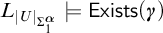 $L_{|U|_{\Sigma ^{\boldsymbol {\alpha }}_1}}\models \operatorname {\mathsf {Exists}}({\boldsymbol {\gamma }})$
. This shows
$L_{|U|_{\Sigma ^{\boldsymbol {\alpha }}_1}}\models \operatorname {\mathsf {Exists}}({\boldsymbol {\gamma }})$
. This shows $\gamma <|U|_{\Sigma ^{\boldsymbol {\alpha }}_1}$
.
$\gamma <|U|_{\Sigma ^{\boldsymbol {\alpha }}_1}$
.
For the right-to-left direction, assume that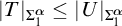 $|T|_{\Sigma ^{\boldsymbol {\alpha }}_1}\le |U|_{\Sigma ^{\boldsymbol {\alpha }}_1}$
and assume that
$|T|_{\Sigma ^{\boldsymbol {\alpha }}_1}\le |U|_{\Sigma ^{\boldsymbol {\alpha }}_1}$
and assume that $T\vdash ^{\Pi ^{\boldsymbol {\alpha }}_1}\varphi ^{L_{\boldsymbol {\alpha }}}$
for a
$T\vdash ^{\Pi ^{\boldsymbol {\alpha }}_1}\varphi ^{L_{\boldsymbol {\alpha }}}$
for a $\Sigma _1$
-formula
$\Sigma _1$
-formula $\varphi $
. Thus we can find a
$\varphi $
. Thus we can find a $\Pi _1$
-formula
$\Pi _1$
-formula $\psi $
such that
$\psi $
such that $L_\alpha \models \psi $
and
$L_\alpha \models \psi $
and $T\vdash (\psi \to \varphi )^{L_{\boldsymbol {\alpha }}}$
. We can see that
$T\vdash (\psi \to \varphi )^{L_{\boldsymbol {\alpha }}}$
. We can see that $\psi \to \varphi $
is
$\psi \to \varphi $
is $\Sigma _1$
, so by Corollary 3.6, we can find a representation
$\Sigma _1$
, so by Corollary 3.6, we can find a representation ${\boldsymbol {\gamma }}$
such that
${\boldsymbol {\gamma }}$
such that
 $$ \begin{align*} \mathsf{KP}_1 \vdash \forall\beta\Big(\beta\ \text{is admissible}\to [(\psi\to\varphi)^{L_\beta} \leftrightarrow \operatorname{\mathsf{Exists}}({\boldsymbol{\gamma}})^{L_\beta}]\Big). \end{align*} $$
Since ${\boldsymbol {\alpha }}$
is
${\boldsymbol {\alpha }}$
is $\mathsf {KP}_1$
-provably admissible, we have
$\mathsf {KP}_1$
-provably admissible, we have
 $$ \begin{align*} \mathsf{KP}_1 + \operatorname{\mathsf{Exists}}({\boldsymbol{\alpha}}) \vdash (\psi\to\varphi)^{L_{\boldsymbol{\alpha}}} \leftrightarrow \operatorname{\mathsf{Exists}}({\boldsymbol{\gamma}})^{L_{\boldsymbol{\alpha}}}. \end{align*} $$
Since T is an extension of $\mathsf {KP}_1 + \operatorname {\mathsf {Exists}}({\boldsymbol {\alpha }})$
, we have
$\mathsf {KP}_1 + \operatorname {\mathsf {Exists}}({\boldsymbol {\alpha }})$
, we have $T\vdash \operatorname {\mathsf {Exists}}({\boldsymbol {\gamma }})^{L_{\boldsymbol {\alpha }}}$
. From this, we get
$T\vdash \operatorname {\mathsf {Exists}}({\boldsymbol {\gamma }})^{L_{\boldsymbol {\alpha }}}$
. From this, we get ${\boldsymbol {\gamma }}<|T|_{\Sigma ^{\boldsymbol {\alpha }}_1}\le |U|_{\Sigma ^{\boldsymbol {\alpha }}_1}$
by Lemma 3.11. Thus by Lemma 6.2,
${\boldsymbol {\gamma }}<|T|_{\Sigma ^{\boldsymbol {\alpha }}_1}\le |U|_{\Sigma ^{\boldsymbol {\alpha }}_1}$
by Lemma 3.11. Thus by Lemma 6.2, $U\vdash ^{\Pi ^{\boldsymbol {\alpha }}_1} \operatorname {\mathsf {Exists}}({\boldsymbol {\gamma }})^{L_{\boldsymbol {\alpha }}}$
, which implies
$U\vdash ^{\Pi ^{\boldsymbol {\alpha }}_1} \operatorname {\mathsf {Exists}}({\boldsymbol {\gamma }})^{L_{\boldsymbol {\alpha }}}$
, which implies $U\vdash ^{\Pi ^{\boldsymbol {\alpha }}_1}(\psi \to \varphi )^{L_{\boldsymbol {\alpha }}}$
. Since
$U\vdash ^{\Pi ^{\boldsymbol {\alpha }}_1}(\psi \to \varphi )^{L_{\boldsymbol {\alpha }}}$
. Since $L_{\boldsymbol {\alpha }}\models \psi $
, we finally have
$L_{\boldsymbol {\alpha }}\models \psi $
, we finally have $U\vdash ^{\Pi ^{\boldsymbol {\alpha }}_1}\varphi ^{L_{\boldsymbol {\alpha }}}$
.
$U\vdash ^{\Pi ^{\boldsymbol {\alpha }}_1}\varphi ^{L_{\boldsymbol {\alpha }}}$
.
Now let us turn our view to the remaining equivalence. Before continuing, let us formulate additional reflection principles.
Definition 6.5.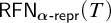 $\mathsf {RFN}_{{\boldsymbol {\alpha }}{\text {-}\mathsf {repr}}}(T)$
is the following principle: For every representation
$\mathsf {RFN}_{{\boldsymbol {\alpha }}{\text {-}\mathsf {repr}}}(T)$
is the following principle: For every representation ${\boldsymbol {\gamma }}$
, if
${\boldsymbol {\gamma }}$
, if $T\vdash \operatorname {\mathsf {Exists}}({\boldsymbol {\gamma }})^{L_{\boldsymbol {\alpha }}}$
, then
$T\vdash \operatorname {\mathsf {Exists}}({\boldsymbol {\gamma }})^{L_{\boldsymbol {\alpha }}}$
, then $L_{\boldsymbol {\alpha }}\models \operatorname {\mathsf {Exists}}({\boldsymbol {\gamma }})$
.
$L_{\boldsymbol {\alpha }}\models \operatorname {\mathsf {Exists}}({\boldsymbol {\gamma }})$
.
Definition 6.6. The principles $\mathsf {RFN}^{\Pi ^{\boldsymbol {\alpha }}_1}_{\Sigma ^{\boldsymbol {\alpha }}_1}(T)$
and
$\mathsf {RFN}^{\Pi ^{\boldsymbol {\alpha }}_1}_{\Sigma ^{\boldsymbol {\alpha }}_1}(T)$
and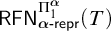 $\mathsf {RFN}^{\Pi ^{\boldsymbol {\alpha }}_1}_{{\boldsymbol {\alpha }}{\text {-}\mathsf {repr}}}(T)$
are obtained from replacing the usual T-provability (
$\mathsf {RFN}^{\Pi ^{\boldsymbol {\alpha }}_1}_{{\boldsymbol {\alpha }}{\text {-}\mathsf {repr}}}(T)$
are obtained from replacing the usual T-provability ( $T\vdash $
) with
$T\vdash $
) with $\Pi ^{\boldsymbol {\alpha }}_1$
-provability (
$\Pi ^{\boldsymbol {\alpha }}_1$
-provability ( $T\vdash ^{\Pi ^{\boldsymbol {\alpha }}_1}$
) in the corresponding reflection principles.
$T\vdash ^{\Pi ^{\boldsymbol {\alpha }}_1}$
) in the corresponding reflection principles.
Definition 6.7. Let T and U be $\Sigma ^{\boldsymbol {\alpha }}_1$
-sound extensions of
$\Sigma ^{\boldsymbol {\alpha }}_1$
-sound extensions of $\mathsf {KP}_1+\operatorname {\mathsf {Exists}}({\boldsymbol {\alpha }})$
. We say that
$\mathsf {KP}_1+\operatorname {\mathsf {Exists}}({\boldsymbol {\alpha }})$
. We say that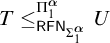 $T\le _{\mathsf {RFN}_{\Sigma ^{\boldsymbol {\alpha }}_1}}^{\Pi ^{\boldsymbol {\alpha }}_1} U$
if the following holds:
$T\le _{\mathsf {RFN}_{\Sigma ^{\boldsymbol {\alpha }}_1}}^{\Pi ^{\boldsymbol {\alpha }}_1} U$
if the following holds:
 $$ \begin{align*} \mathsf{KP}_1 + \operatorname{\mathsf{Exists}}({\boldsymbol{\alpha}}) \vdash^{\Pi^{\boldsymbol{\alpha}}_1} \mathsf{RFN}_{\Sigma^{\boldsymbol{\alpha}}_1}(U)\to\mathsf{RFN}_{\Sigma^{\boldsymbol{\alpha}}_1}(T). \end{align*} $$
Lemma 6.8. Suppose that T is a $\Sigma ^{\boldsymbol {\alpha }}_1$
-sound
$\Sigma ^{\boldsymbol {\alpha }}_1$
-sound $\Delta ^{\boldsymbol {\alpha }}_1$
-definable extension of
$\Delta ^{\boldsymbol {\alpha }}_1$
-definable extension of $\mathsf {KP}_1+\operatorname {\mathsf {Exists}}({\boldsymbol {\alpha }})$
for a
$\mathsf {KP}_1+\operatorname {\mathsf {Exists}}({\boldsymbol {\alpha }})$
for a $\mathsf {KP}_1$
-provably admissible
$\mathsf {KP}_1$
-provably admissible ${\boldsymbol {\alpha }}$
. Then
${\boldsymbol {\alpha }}$
. Then $\mathsf {KP}_1 + \operatorname {\mathsf {Exists}}({\boldsymbol {\alpha }})$
proves all of the following are all equivalent:
$\mathsf {KP}_1 + \operatorname {\mathsf {Exists}}({\boldsymbol {\alpha }})$
proves all of the following are all equivalent:
-
1.
$\mathsf {RFN}_{\Sigma ^{\boldsymbol {\alpha }}_1}(T)$
; -
2.
$\mathsf {RFN}^{\Pi ^{\boldsymbol {\alpha }}_1}_{\Sigma ^{\boldsymbol {\alpha }}_1}(T)$
; -
3.
$\mathsf {RFN}_{{\boldsymbol {\alpha }}{\text {-}\mathsf {repr}}}(T)$
; -
4.
$\mathsf {RFN}^{\Pi ^{\boldsymbol {\alpha }}_1}_{{\boldsymbol {\alpha }}{\text {-}\mathsf {repr}}}(T)$
.


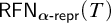
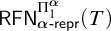
Proof. In this proof, we reason in $\mathsf {KP}_1 + \operatorname {\mathsf {Exists}}({\boldsymbol {\alpha }})$
with no other true
$\mathsf {KP}_1 + \operatorname {\mathsf {Exists}}({\boldsymbol {\alpha }})$
with no other true $\Pi ^{\boldsymbol {\alpha }}_1$
sentences unless specified.
$\Pi ^{\boldsymbol {\alpha }}_1$
sentences unless specified.
(1) $\leftrightarrow $
(2).
$\leftrightarrow $
(2). $\mathsf {RFN}^{\Pi ^{\boldsymbol {\alpha }}_1}_{\Sigma ^{\boldsymbol {\alpha }}_1}(T)\to \mathsf {RFN}_{\Sigma ^{\boldsymbol {\alpha }}_1}(T)$
follows from the trivial fact that
$\mathsf {RFN}^{\Pi ^{\boldsymbol {\alpha }}_1}_{\Sigma ^{\boldsymbol {\alpha }}_1}(T)\to \mathsf {RFN}_{\Sigma ^{\boldsymbol {\alpha }}_1}(T)$
follows from the trivial fact that $T\vdash \varphi $
implies
$T\vdash \varphi $
implies $T\vdash ^{\Pi ^{\boldsymbol {\alpha }}_1}\varphi $
.
$T\vdash ^{\Pi ^{\boldsymbol {\alpha }}_1}\varphi $
.
For the converse, suppose that $T\vdash ^{\Pi ^{\boldsymbol {\alpha }}_1}\varphi ^{L_{\boldsymbol {\alpha }}}$
for some
$T\vdash ^{\Pi ^{\boldsymbol {\alpha }}_1}\varphi ^{L_{\boldsymbol {\alpha }}}$
for some $\Sigma _1$
-statement
$\Sigma _1$
-statement $\varphi $
. Then we have a
$\varphi $
. Then we have a $\Pi _1$
-sentence
$\Pi _1$
-sentence $\psi $
such that
$\psi $
such that $L_\alpha \models \psi $
and
$L_\alpha \models \psi $
and $T\vdash \psi ^{L_{\boldsymbol {\alpha }}}\to \varphi ^{L_{\boldsymbol {\alpha }}}$
. Hence by
$T\vdash \psi ^{L_{\boldsymbol {\alpha }}}\to \varphi ^{L_{\boldsymbol {\alpha }}}$
. Hence by $\mathsf {RFN}_{\Sigma ^{\boldsymbol {\alpha }}_1}(T)$
and from the fact that
$\mathsf {RFN}_{\Sigma ^{\boldsymbol {\alpha }}_1}(T)$
and from the fact that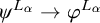 $\psi ^{L_\alpha }\to \varphi ^{L_\alpha }$
is
$\psi ^{L_\alpha }\to \varphi ^{L_\alpha }$
is $\Sigma ^{\boldsymbol {\alpha }}_1$
, we have
$\Sigma ^{\boldsymbol {\alpha }}_1$
, we have $L_\alpha \models \psi \to \varphi $
. But we know that
$L_\alpha \models \psi \to \varphi $
. But we know that $L_\alpha \models \psi $
, so
$L_\alpha \models \psi $
, so $L_\alpha \models \varphi $
. That is,
$L_\alpha \models \varphi $
. That is, $T\vdash ^{\Pi ^{\boldsymbol {\alpha }}_1}\varphi ^{L_{\boldsymbol {\alpha }}}$
implies
$T\vdash ^{\Pi ^{\boldsymbol {\alpha }}_1}\varphi ^{L_{\boldsymbol {\alpha }}}$
implies $L_\alpha \models \varphi $
, which is the very statement of
$L_\alpha \models \varphi $
, which is the very statement of $\mathsf {RFN}^{\Pi ^{\boldsymbol {\alpha }}_1}_{\Sigma ^{\boldsymbol {\alpha }}_1}(T)$
.
$\mathsf {RFN}^{\Pi ^{\boldsymbol {\alpha }}_1}_{\Sigma ^{\boldsymbol {\alpha }}_1}(T)$
.
(3) $\leftrightarrow $
(4).
$\leftrightarrow $
(4). $\mathsf {RFN}^{\Pi ^{\boldsymbol {\alpha }}_1}_{{\boldsymbol {\alpha }}{\text {-}\mathsf {repr}}}(T)\to \mathsf {RFN}_{{\boldsymbol {\alpha }}{\text {-}\mathsf {repr}}}(T)$
is clear as before. To show the converse, suppose that
$\mathsf {RFN}^{\Pi ^{\boldsymbol {\alpha }}_1}_{{\boldsymbol {\alpha }}{\text {-}\mathsf {repr}}}(T)\to \mathsf {RFN}_{{\boldsymbol {\alpha }}{\text {-}\mathsf {repr}}}(T)$
is clear as before. To show the converse, suppose that $T\vdash ^{\Pi ^{\boldsymbol {\alpha }}_1}(\operatorname {\mathsf {Exists}}({\boldsymbol {\gamma }}))^{L_{\boldsymbol {\alpha }}}$
for a representation
$T\vdash ^{\Pi ^{\boldsymbol {\alpha }}_1}(\operatorname {\mathsf {Exists}}({\boldsymbol {\gamma }}))^{L_{\boldsymbol {\alpha }}}$
for a representation ${\boldsymbol {\gamma }}$
. Then we can find a
${\boldsymbol {\gamma }}$
. Then we can find a $\Pi _1$
-sentence
$\Pi _1$
-sentence $\psi $
such that
$\psi $
such that $L_\alpha \models \psi $
and
$L_\alpha \models \psi $
and
 $$ \begin{align} T\vdash \psi^{L_{\boldsymbol{\alpha}}}\to \operatorname{\mathsf{Exists}}({\boldsymbol{\gamma}})^{L_{\boldsymbol{\alpha}}}. \end{align} $$
By Lemma 3.5, we can find a representation ${\boldsymbol {\delta }}$
such that
${\boldsymbol {\delta }}$
such that
 $$ \begin{align} \mathsf{KP}_1 +(V=L) \vdash \operatorname{\mathsf{Exists}}({\boldsymbol{\delta}})\leftrightarrow [\psi\to \operatorname{\mathsf{Exists}}({\boldsymbol{\gamma}})]. \end{align} $$
We know that ${\boldsymbol {\alpha }}$
is a
${\boldsymbol {\alpha }}$
is a $\mathsf {KP}_1$
-provably admissible representation. Which is to say that we know that:
$\mathsf {KP}_1$
-provably admissible representation. Which is to say that we know that:
 $$ \begin{align*} \mathsf{KP}_1 + \operatorname{\mathsf{Exists}}({\boldsymbol{\alpha}}) \vdash[ L_{\boldsymbol{\alpha}}\vDash \mathsf{KP}_1 + (V=L)]. \end{align*} $$
Hence by ( C ), we have
 $$ \begin{align} \mathsf{KP}_1 + \operatorname{\mathsf{Exists}}({\boldsymbol{\alpha}}) \vdash \operatorname{\mathsf{Exists}}({\boldsymbol{\delta}})^{L_{\boldsymbol{\alpha}}}\leftrightarrow [\psi^{L_{\boldsymbol{\alpha}}}\to \operatorname{\mathsf{Exists}}({\boldsymbol{\gamma}})^{L_{\boldsymbol{\alpha}}}]. \end{align} $$
Since T extends $\mathsf {KP}_1 + \operatorname {\mathsf {Exists}}({\boldsymbol {\alpha }})$
, we have
$\mathsf {KP}_1 + \operatorname {\mathsf {Exists}}({\boldsymbol {\alpha }})$
, we have $T\vdash \operatorname {\mathsf {Exists}}({\boldsymbol {\delta }})^{L_\alpha }$
from (
B
) and (
D
). From
$T\vdash \operatorname {\mathsf {Exists}}({\boldsymbol {\delta }})^{L_\alpha }$
from (
B
) and (
D
). From $\mathsf {RFN}_{{\boldsymbol {\alpha }}{\text {-}\mathsf {repr}}}$
, we have
$\mathsf {RFN}_{{\boldsymbol {\alpha }}{\text {-}\mathsf {repr}}}$
, we have $L_\alpha \models \operatorname {\mathsf {Exists}}({\boldsymbol {\delta }})$
, which is equivalent to
$L_\alpha \models \operatorname {\mathsf {Exists}}({\boldsymbol {\delta }})$
, which is equivalent to $L_\alpha \models \psi \to \operatorname {\mathsf {Exists}}({\boldsymbol {\gamma }})$
by (
C
).
$L_\alpha \models \psi \to \operatorname {\mathsf {Exists}}({\boldsymbol {\gamma }})$
by (
C
).
Since $L_\alpha \models \psi $
, we have
$L_\alpha \models \psi $
, we have $L_\alpha \models \operatorname {\mathsf {Exists}}({\boldsymbol {\gamma }})$
. In sum,
$L_\alpha \models \operatorname {\mathsf {Exists}}({\boldsymbol {\gamma }})$
. In sum, $T\vdash ^{\Pi ^{\boldsymbol {\alpha }}_1}(\operatorname {\mathsf {Exists}}({\boldsymbol {\gamma }}))^{L_{\boldsymbol {\alpha }}}$
implies
$T\vdash ^{\Pi ^{\boldsymbol {\alpha }}_1}(\operatorname {\mathsf {Exists}}({\boldsymbol {\gamma }}))^{L_{\boldsymbol {\alpha }}}$
implies $L_\alpha \models \operatorname {\mathsf {Exists}}({\boldsymbol {\gamma }})$
.
$L_\alpha \models \operatorname {\mathsf {Exists}}({\boldsymbol {\gamma }})$
.
(1) $\leftrightarrow $
(3).
$\leftrightarrow $
(3). $\mathsf {RFN}_{\Sigma ^{\boldsymbol {\alpha }}_1}(T)\to \mathsf {RFN}_{{\boldsymbol {\alpha }}{\text {-}\mathsf {repr}}}(T)$
follows from the fact that
$\mathsf {RFN}_{\Sigma ^{\boldsymbol {\alpha }}_1}(T)\to \mathsf {RFN}_{{\boldsymbol {\alpha }}{\text {-}\mathsf {repr}}}(T)$
follows from the fact that $\operatorname {\mathsf {Exists}}({\boldsymbol {\gamma }})$
is a
$\operatorname {\mathsf {Exists}}({\boldsymbol {\gamma }})$
is a $\Sigma _1$
sentence.
$\Sigma _1$
sentence.
Now let us show the converse. For a $\Sigma _1$
-sentence
$\Sigma _1$
-sentence $\varphi $
, we can find a representation
$\varphi $
, we can find a representation ${\boldsymbol {\gamma }}$
such that
${\boldsymbol {\gamma }}$
such that $\varphi ^{L_{\boldsymbol {\alpha }}}\leftrightarrow \operatorname {\mathsf {Exists}}({\boldsymbol {\gamma }})^{L_{\boldsymbol {\alpha }}}$
, which follows from Corollary 3.6 and by repeating the previous arguments.
$\varphi ^{L_{\boldsymbol {\alpha }}}\leftrightarrow \operatorname {\mathsf {Exists}}({\boldsymbol {\gamma }})^{L_{\boldsymbol {\alpha }}}$
, which follows from Corollary 3.6 and by repeating the previous arguments.
Now suppose that $T\vdash \varphi ^{L_{\boldsymbol {\alpha }}}$
, then
$T\vdash \varphi ^{L_{\boldsymbol {\alpha }}}$
, then $T\vdash \operatorname {\mathsf {Exists}}({\boldsymbol {\gamma }})^{L_{\boldsymbol {\alpha }}}$
. We assumed
$T\vdash \operatorname {\mathsf {Exists}}({\boldsymbol {\gamma }})^{L_{\boldsymbol {\alpha }}}$
. We assumed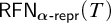 $\mathsf {RFN}_{{\boldsymbol {\alpha }}{\text {-}\mathsf {repr}}}(T)$
, so we infer that
$\mathsf {RFN}_{{\boldsymbol {\alpha }}{\text {-}\mathsf {repr}}}(T)$
, so we infer that $L_{\boldsymbol {\alpha }}\models \operatorname {\mathsf {Exists}}({\boldsymbol {\gamma }})$
. Since
$L_{\boldsymbol {\alpha }}\models \operatorname {\mathsf {Exists}}({\boldsymbol {\gamma }})$
. Since $\varphi ^{L_{\boldsymbol {\alpha }}}\leftrightarrow \operatorname {\mathsf {Exists}}({\boldsymbol {\gamma }})^{L_{\boldsymbol {\alpha }}}$
, we get
$\varphi ^{L_{\boldsymbol {\alpha }}}\leftrightarrow \operatorname {\mathsf {Exists}}({\boldsymbol {\gamma }})^{L_{\boldsymbol {\alpha }}}$
, we get $L_{\boldsymbol {\alpha }}\models \varphi $
.
$L_{\boldsymbol {\alpha }}\models \varphi $
.
The next theorem shows that comparing the $\Sigma ^{\boldsymbol {\alpha }}_1$
-reflection order modulo
$\Sigma ^{\boldsymbol {\alpha }}_1$
-reflection order modulo $\Pi ^{\boldsymbol {\alpha }}_1$
-provability coincides with the ordering induced by comparing
$\Pi ^{\boldsymbol {\alpha }}_1$
-provability coincides with the ordering induced by comparing $\Sigma ^{\boldsymbol {\alpha }}_1$
-proof-theoretic ordinals.
$\Sigma ^{\boldsymbol {\alpha }}_1$
-proof-theoretic ordinals.
Theorem 6.9. Let T and U be $\Delta ^{\boldsymbol {\alpha }}_1$
-definable
$\Delta ^{\boldsymbol {\alpha }}_1$
-definable $\Sigma ^{\boldsymbol {\alpha }}_1$
-sound extensions of
$\Sigma ^{\boldsymbol {\alpha }}_1$
-sound extensions of $\mathsf {KP}_1 + \mathsf {Exists}({\boldsymbol {\alpha }})$
. Then we have
$\mathsf {KP}_1 + \mathsf {Exists}({\boldsymbol {\alpha }})$
. Then we have
 $$ \begin{align} |T|_{\Sigma^{\boldsymbol{\alpha}}_1}\le |U|_{\Sigma^{\boldsymbol{\alpha}}_1} \iff T\le^{\Pi^{\boldsymbol{\alpha}}_1}_{\mathsf{RFN}_{\Sigma^{\boldsymbol{\alpha}}_1}}U. \end{align} $$
Proof. Let us prove the left-to-right implication first. It suffices to show that the following holds:
 $$ \begin{align*} \mathsf{KP}_1 + \operatorname{\mathsf{Exists}}({\boldsymbol{\alpha}}) \vdash^{\Pi^{\boldsymbol{\alpha}}_1} \mathsf{RFN}^{\Pi^{\boldsymbol{\alpha}}_1}_{{\boldsymbol{\alpha}}{\text{-}\mathsf{repr}}}(U)\to \mathsf{RFN}_{{\boldsymbol{\alpha}}{\text{-}\mathsf{repr}}}(T). \end{align*} $$
Then the desired implication follows from Lemma 6.8.
First, let us reason over the metatheory. Suppose that ${\boldsymbol {\gamma }}$
is a representation such that
${\boldsymbol {\gamma }}$
is a representation such that $T\vdash \operatorname {\mathsf {Exists}}({\boldsymbol {\gamma }})^{L_{\boldsymbol {\alpha }}}$
. If
$T\vdash \operatorname {\mathsf {Exists}}({\boldsymbol {\gamma }})^{L_{\boldsymbol {\alpha }}}$
. If ${\boldsymbol {\gamma }}$
is a representation of
${\boldsymbol {\gamma }}$
is a representation of $\gamma $
, then
$\gamma $
, then $\gamma <|T|_{\Sigma ^{\boldsymbol {\alpha }}_1}\le |U|_{\Sigma ^{\boldsymbol {\alpha }}_1}$
. Hence by Lemma 6.2, we have
$\gamma <|T|_{\Sigma ^{\boldsymbol {\alpha }}_1}\le |U|_{\Sigma ^{\boldsymbol {\alpha }}_1}$
. Hence by Lemma 6.2, we have $U\vdash ^{\Pi ^{\boldsymbol {\alpha }}_1}\operatorname {\mathsf {Exists}}({\boldsymbol {\gamma }})^{L_{\boldsymbol {\alpha }}}$
. In short, we have shown that the following sentence is true:
$U\vdash ^{\Pi ^{\boldsymbol {\alpha }}_1}\operatorname {\mathsf {Exists}}({\boldsymbol {\gamma }})^{L_{\boldsymbol {\alpha }}}$
. In short, we have shown that the following sentence is true:
 $$ \begin{align*} \theta :\equiv \forall {\boldsymbol{\gamma}} \Big({\boldsymbol{\gamma}}\ \text{is a representation}\to [\mathsf{Pr}_T(\operatorname{\mathsf{Exists}}({\boldsymbol{\gamma}})^{L_{\boldsymbol{\alpha}}})\to \mathsf{Pr}_U^{\Pi^{\boldsymbol{\alpha}}_1}(\operatorname{\mathsf{Exists}}({\boldsymbol{\gamma}})^{L_{\boldsymbol{\alpha}}})]\Big). \end{align*} $$
Since both T and U are $\Delta ^{\boldsymbol {\alpha }}_1$
-definable,
$\Delta ^{\boldsymbol {\alpha }}_1$
-definable, $\theta $
is a true
$\theta $
is a true $\Pi ^{\boldsymbol {\alpha }}_1$
sentence.Footnote
9
$\Pi ^{\boldsymbol {\alpha }}_1$
sentence.Footnote
9
Now let us reason over $\mathsf {KP}_1 + \operatorname {\mathsf {Exists}}({\boldsymbol {\alpha }}) + \theta $
. If
$\mathsf {KP}_1 + \operatorname {\mathsf {Exists}}({\boldsymbol {\alpha }}) + \theta $
. If ${\boldsymbol {\gamma }}$
is a representation such that
${\boldsymbol {\gamma }}$
is a representation such that $T\vdash \operatorname {\mathsf {Exists}}({\boldsymbol {\gamma }})^{L_{\boldsymbol {\alpha }}}$
, then we have
$T\vdash \operatorname {\mathsf {Exists}}({\boldsymbol {\gamma }})^{L_{\boldsymbol {\alpha }}}$
, then we have $U\vdash ^{\Pi ^{\boldsymbol {\alpha }}_1} \operatorname {\mathsf {Exists}}({\boldsymbol {\gamma }})^{L_{\boldsymbol {\alpha }}}$
. Thus if we have
$U\vdash ^{\Pi ^{\boldsymbol {\alpha }}_1} \operatorname {\mathsf {Exists}}({\boldsymbol {\gamma }})^{L_{\boldsymbol {\alpha }}}$
. Thus if we have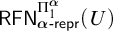 $\mathsf {RFN}^{\Pi ^{\boldsymbol {\alpha }}_1}_{{\boldsymbol {\alpha }}{\text {-}\mathsf {repr}}}(U)$
, then we get
$\mathsf {RFN}^{\Pi ^{\boldsymbol {\alpha }}_1}_{{\boldsymbol {\alpha }}{\text {-}\mathsf {repr}}}(U)$
, then we get $L_\alpha \models \operatorname {\mathsf {Exists}}({\boldsymbol {\gamma }})$
. Hence we get
$L_\alpha \models \operatorname {\mathsf {Exists}}({\boldsymbol {\gamma }})$
. Hence we get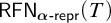 $\mathsf {RFN}_{{\boldsymbol {\alpha }}{\text {-}\mathsf {repr}}}(T)$
.
$\mathsf {RFN}_{{\boldsymbol {\alpha }}{\text {-}\mathsf {repr}}}(T)$
.
To show the right-to-left implication, assume for the sake of contradiction that the implication fails. Thus we have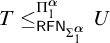 $T\le ^{\Pi ^{\boldsymbol {\alpha }}_1}_{\mathsf {RFN}_{\Sigma ^{\boldsymbol {\alpha }}_1}}U$
but
$T\le ^{\Pi ^{\boldsymbol {\alpha }}_1}_{\mathsf {RFN}_{\Sigma ^{\boldsymbol {\alpha }}_1}}U$
but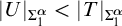 $|U|_{\Sigma ^{\boldsymbol {\alpha }}_1}<|T|_{\Sigma ^{\boldsymbol {\alpha }}_1}$
. Let us fix a representation
$|U|_{\Sigma ^{\boldsymbol {\alpha }}_1}<|T|_{\Sigma ^{\boldsymbol {\alpha }}_1}$
. Let us fix a representation ${\boldsymbol {\gamma }}$
with a value
${\boldsymbol {\gamma }}$
with a value $\gamma $
such that
$\gamma $
such that $T\vdash \operatorname {\mathsf {Exists}}({\boldsymbol {\gamma }})^{L_{\boldsymbol {\alpha }}}$
and
$T\vdash \operatorname {\mathsf {Exists}}({\boldsymbol {\gamma }})^{L_{\boldsymbol {\alpha }}}$
and $|U|_{\Sigma ^{\boldsymbol {\alpha }}_1}<\gamma $
. Now consider the statement F roughly saying ‘Every representation such that U proves its value exists has a value less than
$|U|_{\Sigma ^{\boldsymbol {\alpha }}_1}<\gamma $
. Now consider the statement F roughly saying ‘Every representation such that U proves its value exists has a value less than ${\boldsymbol {\gamma }}$
’:
${\boldsymbol {\gamma }}$
’:
 $$ \begin{align*} F:= \text{For every representation}\ {\boldsymbol{\delta}},\ [[U\vdash \operatorname{\mathsf{Exists}}({\boldsymbol{\delta}})^{L_{\boldsymbol{\alpha}}}]\to L_{\boldsymbol{\gamma}}\models \operatorname{\mathsf{Exists}}({\boldsymbol{\delta}})]. \end{align*} $$
Note that its more formal statement is as follows:
 $$ \begin{align*} \forall \zeta<{\boldsymbol{\alpha}} \forall {\boldsymbol{\delta}} [{\boldsymbol{\delta}}\ \text{is a representation}\land R^{\boldsymbol{\gamma}}(\zeta)\to [[U\vdash \operatorname{\mathsf{Exists}}({\boldsymbol{\delta}})^{L_{\boldsymbol{\alpha}}}]\to L_\zeta\models \operatorname{\mathsf{Exists}}({\boldsymbol{\delta}})]]. \end{align*} $$
Then F is a true $\Pi ^{\boldsymbol {\alpha }}_1$
-statement; indeed, the formula consists of universal quantifiers ranging over a Boolean combination of formulas each of which is at most
$\Pi ^{\boldsymbol {\alpha }}_1$
-statement; indeed, the formula consists of universal quantifiers ranging over a Boolean combination of formulas each of which is at most $\Delta _1^{L_{\boldsymbol {\alpha }}}$
(recall that the U-provability relation is
$\Delta _1^{L_{\boldsymbol {\alpha }}}$
(recall that the U-provability relation is $\Delta _1^{L_{\boldsymbol {\alpha }}}$
by assumption).
$\Delta _1^{L_{\boldsymbol {\alpha }}}$
by assumption).
Since T proves ${\boldsymbol {\gamma }} < {\boldsymbol {\alpha }}$
, we have
${\boldsymbol {\gamma }} < {\boldsymbol {\alpha }}$
, we have $T+F\vdash \mathsf {RFN}_{{\boldsymbol {\alpha }}{\text {-}\mathsf {repr}}}(U)$
. By Lemma 6.3, we get
$T+F\vdash \mathsf {RFN}_{{\boldsymbol {\alpha }}{\text {-}\mathsf {repr}}}(U)$
. By Lemma 6.3, we get
 $$ \begin{align*} \mathsf{KP}_1 + \operatorname{\mathsf{Exists}}({\boldsymbol{\alpha}}) + F \vdash \mathsf{RFN}_{\Sigma^{\boldsymbol{\alpha}}_1}(T) \to \mathsf{RFN}_{\Sigma^{\boldsymbol{\alpha}}_1}(T+F). \end{align*} $$
Combining $T+F\vdash \mathsf {RFN}_{{\boldsymbol {\alpha }}{\text {-}\mathsf {repr}}}(U)$
with Lemma 6.8, we have
$T+F\vdash \mathsf {RFN}_{{\boldsymbol {\alpha }}{\text {-}\mathsf {repr}}}(U)$
with Lemma 6.8, we have
 $$ \begin{align*} \mathsf{KP}_1 + \operatorname{\mathsf{Exists}}({\boldsymbol{\alpha}}) + F \vdash \mathsf{RFN}_{\Sigma^{\boldsymbol{\alpha}}_1}(T) \to \mathsf{RFN}_{\Sigma^{\boldsymbol{\alpha}}_1}(T+\mathsf{RFN}_{\Sigma^{\boldsymbol{\alpha}}_1}(U)). \end{align*} $$
Since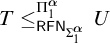 $T\le ^{\Pi ^{\boldsymbol {\alpha }}_1}_{\mathsf {RFN}_{\Sigma ^{\boldsymbol {\alpha }}_1}}U$
, we can find a true
$T\le ^{\Pi ^{\boldsymbol {\alpha }}_1}_{\mathsf {RFN}_{\Sigma ^{\boldsymbol {\alpha }}_1}}U$
, we can find a true $\Pi ^{\boldsymbol {\alpha }}_1$
-sentence G such that
$\Pi ^{\boldsymbol {\alpha }}_1$
-sentence G such that
 $$ \begin{align*} \mathsf{KP}_1 + \operatorname{\mathsf{Exists}}({\boldsymbol{\alpha}}) + G \vdash \mathsf{RFN}_{\Sigma^{\boldsymbol{\alpha}}_1}(U)\to \mathsf{RFN}_{\Sigma^{\boldsymbol{\alpha}}_1}(T). \end{align*} $$
By combining these two, we get
 $$ \begin{align*} \mathsf{KP}_1 + \operatorname{\mathsf{Exists}}({\boldsymbol{\alpha}}) + F + G \vdash \mathsf{RFN}_{\Sigma^{\boldsymbol{\alpha}}_1}(U)\to \mathsf{RFN}_{\Sigma^{\boldsymbol{\alpha}}_1}(T+\mathsf{RFN}_{\Sigma^{\boldsymbol{\alpha}}_1}(U)). \end{align*} $$
Since T contains $\mathsf {KP}_1+\operatorname {\mathsf {Exists}}({\boldsymbol {\alpha }})$
, we get
$\mathsf {KP}_1+\operatorname {\mathsf {Exists}}({\boldsymbol {\alpha }})$
, we get
 $$ \begin{align*} \mathsf{KP}_1 + \operatorname{\mathsf{Exists}}({\boldsymbol{\alpha}}) + F + G + \mathsf{RFN}_{\Sigma^{\boldsymbol{\alpha}}_1}(U) \vdash \mathsf{RFN}_{\Sigma^{\boldsymbol{\alpha}}_1}(\mathsf{KP}_1+ \operatorname{\mathsf{Exists}}({\boldsymbol{\alpha}})+\mathsf{RFN}_{\Sigma^{\boldsymbol{\alpha}}_1}(U)). \end{align*} $$
Let S be the theory on the left-hand side of the above formula. Since F and G are true $\Pi ^{\boldsymbol {\alpha }}_1$
-formulas, we have
$\Pi ^{\boldsymbol {\alpha }}_1$
-formulas, we have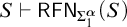 $S\vdash \mathsf {RFN}_{\Sigma ^{\boldsymbol {\alpha }}_1}(S)$
. However, S is axiomatized by sentences valid over L, which means S is sound. A contradiction.
$S\vdash \mathsf {RFN}_{\Sigma ^{\boldsymbol {\alpha }}_1}(S)$
. However, S is axiomatized by sentences valid over L, which means S is sound. A contradiction.
Unlike the proof in [Reference Walsh29], we do not put extra care on proving the left-to-right because $\mathsf {KP}_1$
already proves we can swap an order of a bounded quantifier and an unbounded
$\mathsf {KP}_1$
already proves we can swap an order of a bounded quantifier and an unbounded $\exists $
as long as the resulting formula is still
$\exists $
as long as the resulting formula is still $\Sigma _1$
by Lemma 2.8.
$\Sigma _1$
by Lemma 2.8.
7 Well-foundedness of
$\mathsf {RFN}_{\Sigma ^{\alpha }_1}$
-comparison

Theorem 6.9 demonstrates that $\le ^{\Pi ^{\boldsymbol {\alpha }}_1}_{\mathsf {RFN}_{\Sigma ^{\boldsymbol {\alpha }}_1}}$
is well-ordered. However, the relation
$\le ^{\Pi ^{\boldsymbol {\alpha }}_1}_{\mathsf {RFN}_{\Sigma ^{\boldsymbol {\alpha }}_1}}$
is well-ordered. However, the relation $\le ^{\Pi ^{\boldsymbol {\alpha }}_1}_{\mathsf {RFN}_{\Sigma ^{\boldsymbol {\alpha }}_1}}$
relies on the notion of provability in the presence of a
$\le ^{\Pi ^{\boldsymbol {\alpha }}_1}_{\mathsf {RFN}_{\Sigma ^{\boldsymbol {\alpha }}_1}}$
relies on the notion of provability in the presence of a $\Pi ^{\boldsymbol {\alpha }}_1$
oracle, which is far from the actual provability relation. Can we obtain a similar result for the usual provability relation? It was proven in [Reference Walsh28] that there is no sequence
$\Pi ^{\boldsymbol {\alpha }}_1$
oracle, which is far from the actual provability relation. Can we obtain a similar result for the usual provability relation? It was proven in [Reference Walsh28] that there is no sequence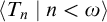 $\langle T_n \mid n<\omega \rangle $
of
$\langle T_n \mid n<\omega \rangle $
of $\Pi ^1_1$
-sound,
$\Pi ^1_1$
-sound, $\Sigma ^1_1$
-definable extensions of
$\Sigma ^1_1$
-definable extensions of $\mathsf {\Sigma ^1_1\text {-}AC_0}$
such that
$\mathsf {\Sigma ^1_1\text {-}AC_0}$
such that $T_n\vdash \mathsf {RFN}_{\Pi ^1_1}(T_{n+1})$
, i.e., the relation
$T_n\vdash \mathsf {RFN}_{\Pi ^1_1}(T_{n+1})$
, i.e., the relation
 $$ \begin{align*} S <_{\mathsf{RFN}_{\Pi^1_1}} T :\equiv T \vdash \mathsf{RFN}_{\Pi^1_1}(S) \end{align*} $$
is well-founded on $\Pi ^1_1$
-sound,
$\Pi ^1_1$
-sound, $\Sigma ^1_1$
-definable extensions of
$\Sigma ^1_1$
-definable extensions of $\mathsf {\Sigma ^1_1\text {-}AC_0}$
.Footnote
10
In this section, we prove its set-theoretic analogue.
$\mathsf {\Sigma ^1_1\text {-}AC_0}$
.Footnote
10
In this section, we prove its set-theoretic analogue.
Theorem 7.1. There is no sequence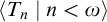 $\langle T_n\mid n<\omega \rangle $
of
$\langle T_n\mid n<\omega \rangle $
of $\Sigma ^{\boldsymbol {\alpha }}_1$
-sound,
$\Sigma ^{\boldsymbol {\alpha }}_1$
-sound, $\Pi ^{\boldsymbol {\alpha }}_1$
-definable extensions of
$\Pi ^{\boldsymbol {\alpha }}_1$
-definable extensions of $\mathsf {KP}_1 + \operatorname {\mathsf {Exists}}({\boldsymbol {\alpha }})$
such that for each n,
$\mathsf {KP}_1 + \operatorname {\mathsf {Exists}}({\boldsymbol {\alpha }})$
such that for each n, $T_n\vdash \mathsf {RFN}_{\Sigma ^{\boldsymbol {\alpha }}_1}(T_{n+1})$
.
$T_n\vdash \mathsf {RFN}_{\Sigma ^{\boldsymbol {\alpha }}_1}(T_{n+1})$
.
Our proof will and must be different from what is presented in [Reference Walsh28]. The main reason is that we are using an $\alpha $
-recursive characteristic function as a set-theoretic analogue of definable well-orders. However, this
$\alpha $
-recursive characteristic function as a set-theoretic analogue of definable well-orders. However, this $\alpha $
-recursive characteristic function is unary, unlike well-orders.
$\alpha $
-recursive characteristic function is unary, unlike well-orders.
The following lemma is a form of diagonal lemma we will use.
Lemma 7.2. Let $\varphi (n,x)$
be a
$\varphi (n,x)$
be a $\Sigma _1$
-formula. Then we can find a
$\Sigma _1$
-formula. Then we can find a $\Sigma _1$
-formula
$\Sigma _1$
-formula $\psi $
such that
$\psi $
such that
 $$ \begin{align*} \mathsf{KP}_1 \vdash \forall x [\psi(x) \leftrightarrow \varphi(\ulcorner \psi\urcorner, x)]. \end{align*} $$
Proof. Consider the following computable function for formulas $\theta $
with two free variables:
$\theta $
with two free variables:
 $$ \begin{align*} d(\ulcorner\theta\urcorner) = \ulcorner\theta(\underline{\ulcorner\theta\urcorner},x)\urcorner. \end{align*} $$
Here $\underline {n}$
means the numeral for n, i.e., the symbol for
$\underline {n}$
means the numeral for n, i.e., the symbol for $1+\cdots + 1$
with n many 1. d is computable, so it is
$1+\cdots + 1$
with n many 1. d is computable, so it is $\Delta _0$
-definable with a parameter
$\Delta _0$
-definable with a parameter $\omega $
over
$\omega $
over $\mathsf {KP}_1$
. Now for a given
$\mathsf {KP}_1$
. Now for a given $\Sigma _1$
-formula
$\Sigma _1$
-formula $\varphi (n,x)$
, let
$\varphi (n,x)$
, let $\varphi '(n,x)$
be a
$\varphi '(n,x)$
be a $\Sigma _1$
-formula that is
$\Sigma _1$
-formula that is $\mathsf {KP}_1$
-provably equivalent to
$\mathsf {KP}_1$
-provably equivalent to
 $$ \begin{align*} \exists m<\omega (d(n)=m \land \varphi(m,x)). \end{align*} $$
Then for every $\Sigma _1$
-formula
$\Sigma _1$
-formula $\theta $
with two variables we have
$\theta $
with two variables we have
 $$ \begin{align*} \mathsf{KP}_1 \vdash \varphi'(\underline{\ulcorner\theta\urcorner},x) \leftrightarrow \varphi(\ulcorner\theta(\underline{\ulcorner\theta\urcorner},x)\urcorner,x). \end{align*} $$
Now take $\theta \equiv \varphi '$
, and let
$\theta \equiv \varphi '$
, and let $\psi (x)\equiv \varphi '(\underline {\ulcorner \varphi '\urcorner },x)$
. Then we get
$\psi (x)\equiv \varphi '(\underline {\ulcorner \varphi '\urcorner },x)$
. Then we get
 $$ \begin{align*} \mathsf{KP}_1 \vdash \psi(x) \leftrightarrow \varphi(\ulcorner\psi\urcorner,x). \end{align*} $$
Since x occurs free, we have the desired result by universal generalization.
First, we will prove a set-theoretic analogue of the $\Sigma ^1_1$
-boundedness lemma.
$\Sigma ^1_1$
-boundedness lemma.
Lemma 7.3 (
$\mathsf {KP}_1 + (V=L)$
)

Suppose that c is a set and let $f\colon c\rightharpoonup \mathsf {Ord}$
be a
$f\colon c\rightharpoonup \mathsf {Ord}$
be a $\Sigma _1$
-definable partial function. Furthermore, assume that for a
$\Sigma _1$
-definable partial function. Furthermore, assume that for a $\Pi _1$
-formula
$\Pi _1$
-formula $\varphi (x)$
,
$\varphi (x)$
, $\operatorname {dom}(f) \supseteq \{x\in c\mid \varphi (x)\}$
. Then the class
$\operatorname {dom}(f) \supseteq \{x\in c\mid \varphi (x)\}$
. Then the class $\{f(x)\mid x\in c\land \varphi (x)\}\subseteq \mathsf {Ord}$
is bounded.
$\{f(x)\mid x\in c\land \varphi (x)\}\subseteq \mathsf {Ord}$
is bounded.
Proof. $\Sigma _1$
truth is
$\Sigma _1$
truth is $\Sigma _1$
-definable over
$\Sigma _1$
-definable over $\mathsf {KP}_1$
as in Definition 2.16. That means that for every
$\mathsf {KP}_1$
as in Definition 2.16. That means that for every $\Sigma _1$
sentence
$\Sigma _1$
sentence $\sigma $
,
$\sigma $
,
 $$ \begin{align} \mathsf{KP}_1\vdash\sigma \leftrightarrow \mathsf{True}_{\Sigma_1}(\ulcorner\sigma\urcorner, 0). \end{align} $$
Now let us reason within $\mathsf {KP}_1 + (V=L)$
: Suppose, toward a contradiction, that the class
$\mathsf {KP}_1 + (V=L)$
: Suppose, toward a contradiction, that the class $\{f(x)\mid x\in c\land \varphi (x)\}$
is cofinal in the class of all ordinals. Now we claim that the partial truth predicate for
$\{f(x)\mid x\in c\land \varphi (x)\}$
is cofinal in the class of all ordinals. Now we claim that the partial truth predicate for $\Sigma _1$
-formulas is
$\Sigma _1$
-formulas is $\Pi _1$
-definable. In fact, we can see that the following equivalence holds for all p and for each
$\Pi _1$
-definable. In fact, we can see that the following equivalence holds for all p and for each $\Sigma _1$
formula
$\Sigma _1$
formula $\psi $
:
$\psi $
:
 $$ \begin{align*} \vDash_{\Sigma_1}\psi(p) \iff \exists x\in c [\varphi(x) \land \forall \xi (f(x)=\xi\to L_{\xi}\models \psi(p))]. \end{align*} $$
The equivalence holds due to the cofinality of the class $\{f(x)\mid x\in c\land \varphi (x)\}$
, and the right-hand formula is
$\{f(x)\mid x\in c\land \varphi (x)\}$
, and the right-hand formula is $\Pi _1$
since the bounded quantifier does not alter the complexity of the formula (due to
$\Pi _1$
since the bounded quantifier does not alter the complexity of the formula (due to $\Sigma _1$
-Collection),
$\Sigma _1$
-Collection), $\varphi (x)$
is
$\varphi (x)$
is $\Pi _1$
, and the formula
$\Pi _1$
, and the formula
 $$ \begin{align*} \forall \xi (f(x)=\xi\to L_{\xi}\models \varphi(p)) \end{align*} $$
is $\Pi _1$
, which follows from the
$\Pi _1$
, which follows from the $\Sigma _1$
-definability of f and the
$\Sigma _1$
-definability of f and the $\Delta _1$
-definability of
$\Delta _1$
-definability of $L_\xi $
.
$L_\xi $
.
So we have concluded that $\vDash _{\Sigma _1}$
is
$\vDash _{\Sigma _1}$
is $\Pi _1$
-definable. That is, there is a
$\Pi _1$
-definable. That is, there is a $\Pi _1$
-formula
$\Pi _1$
-formula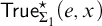 $\mathsf {True}^\star _{\Sigma _1}(e,x)$
such that
$\mathsf {True}^\star _{\Sigma _1}(e,x)$
such that
 $$ \begin{align} \forall \varphi \in \Sigma_1 \forall x \Big( \mathsf{True}^\star_{\Sigma_1}(\varphi,x) \leftrightarrow \mathsf{True}_{\Sigma_1}(\varphi,x) \Big). \end{align} $$
By Lemma 7.2, there is a $\Sigma _1$
-sentence
$\Sigma _1$
-sentence $\lambda $
such that:
$\lambda $
such that:
 $$ \begin{align} \lambda \iff \lnot \mathsf{True}^\star_{\Sigma_1}(\ulcorner\lambda\urcorner, 0). \end{align} $$
 $$\begin{align*} \lambda \iff \neg \mathsf{True}_{\Sigma_1}(\lambda,0). \end{align*}$$
On the other hand, since $\lambda $
is
$\lambda $
is $\Sigma _1$
, (6) entails
$\Sigma _1$
, (6) entails
 $$ \begin{align*} \lambda \iff \mathsf{True}_{\Sigma_1}(\lambda,0). \end{align*} $$
A contradiction. Hence
 $$ \begin{align*}\{f(x)\mid x\in c\land \varphi(x)\}\end{align*} $$
must be bounded.
Remark 7.4. Much care is taken in [Reference Walsh28] to stick closely to Gentzen-style methods and to avoid diagonalization. That paper appeals to $\Sigma ^1_1$
-bounding. However, Beckmann and Pohlers proved
$\Sigma ^1_1$
-bounding. However, Beckmann and Pohlers proved $\Sigma ^1_1$
-bounding via analysis of cut-free derivations [Reference Beckmann and Pohlers4], whence appeals to
$\Sigma ^1_1$
-bounding via analysis of cut-free derivations [Reference Beckmann and Pohlers4], whence appeals to $\Sigma ^1_1$
-bounding can still be considered “diagonalization-free.” This raises a question: Is Lemma 7.3 provable via Gentzen-style methods and without the use of diagonalization?
$\Sigma ^1_1$
-bounding can still be considered “diagonalization-free.” This raises a question: Is Lemma 7.3 provable via Gentzen-style methods and without the use of diagonalization?
By applying the above lemma to $L_\alpha $
, which is a model of
$L_\alpha $
, which is a model of $\mathsf {KP}_1 + (V=L)$
, we get the following.
$\mathsf {KP}_1 + (V=L)$
, we get the following.
Lemma 7.5 (
$\mathsf {KP}_1 + \operatorname {\mathsf {Exists}}({\boldsymbol {\alpha }})$
)

Suppose that $c\in L_\alpha $
and let f be a
$c\in L_\alpha $
and let f be a $\Sigma ^{\boldsymbol {\alpha }}_1$
-definable partial function from c to
$\Sigma ^{\boldsymbol {\alpha }}_1$
-definable partial function from c to $\alpha $
. Furthermore, assume that for a
$\alpha $
. Furthermore, assume that for a $\Pi ^{\boldsymbol {\alpha }}_1$
-formula
$\Pi ^{\boldsymbol {\alpha }}_1$
-formula $\varphi (x)$
, f is defined over
$\varphi (x)$
, f is defined over $b:=\{x\in c\mid \varphi (x)\}$
where b is not necessarily a member of
$b:=\{x\in c\mid \varphi (x)\}$
where b is not necessarily a member of $L_\alpha $
. Then there is
$L_\alpha $
. Then there is $\gamma <\alpha $
such that for every
$\gamma <\alpha $
such that for every $x\in b$
,
$x\in b$
, $f(x)<\gamma $
.
$f(x)<\gamma $
.
Now we prove the set-theoretic analogue of the key lemma (Lemma 3.4 of [Reference Walsh28]).
Lemma 7.6. Let T be a $\Sigma ^{\boldsymbol {\alpha }}_1$
-sound,
$\Sigma ^{\boldsymbol {\alpha }}_1$
-sound, $\Pi ^{\boldsymbol {\alpha }}_1$
-definable extension of
$\Pi ^{\boldsymbol {\alpha }}_1$
-definable extension of $\mathsf {KP}_1 + \operatorname {\mathsf {Exists}}({\boldsymbol {\alpha }})$
. Then we can find a
$\mathsf {KP}_1 + \operatorname {\mathsf {Exists}}({\boldsymbol {\alpha }})$
. Then we can find a $\Sigma _1$
-formula
$\Sigma _1$
-formula $\varphi _T(x)$
such that
$\varphi _T(x)$
such that
 $$ \begin{align*} \mathsf{KP}_1 + \operatorname{\mathsf{Exists}}({\boldsymbol{\alpha}})\vdash \mathsf{RFN}_{\Sigma^{\boldsymbol{\alpha}}_1}(T)\to \exists \xi<{\boldsymbol{\alpha}} \varphi_T^{L_{\boldsymbol{\alpha}}}(\xi), \end{align*} $$
and $|T|_{\Sigma ^{\boldsymbol {\alpha }}_1}$
is the least ordinal
$|T|_{\Sigma ^{\boldsymbol {\alpha }}_1}$
is the least ordinal $\xi $
satisfying
$\xi $
satisfying $\varphi _T^{L_\alpha }(\xi )$
.
$\varphi _T^{L_\alpha }(\xi )$
.
Proof. Let $\theta $
be a
$\theta $
be a $\Pi _1$
formula such that
$\Pi _1$
formula such that $\theta ^{L_{\boldsymbol {\alpha }}}(\ulcorner \psi \urcorner )$
is equivalent to
$\theta ^{L_{\boldsymbol {\alpha }}}(\ulcorner \psi \urcorner )$
is equivalent to $T\vdash \psi $
. Let
$T\vdash \psi $
. Let $\varphi _T(\xi )$
be the assertion ‘Every T-provable
$\varphi _T(\xi )$
be the assertion ‘Every T-provable $\Sigma _1^{\boldsymbol {\alpha }}$
-sentence is valid over
$\Sigma _1^{\boldsymbol {\alpha }}$
-sentence is valid over $L_\xi $
,’ which will have a role of
$L_\xi $
,’ which will have a role of $\prec _T$
in the proof of [Reference Walsh28, Lemma 3.4]:
$\prec _T$
in the proof of [Reference Walsh28, Lemma 3.4]:
 $$ \begin{align*} \varphi_T(\xi):= \forall \sigma\in \Sigma_1 (\theta(\sigma^{L_{\boldsymbol{\alpha}}})\to L_\xi\models \sigma). \end{align*} $$
Since $\theta $
is
$\theta $
is $\Pi _1$
,
$\Pi _1$
, $\varphi _T^{L_{\boldsymbol {\alpha }}}(\xi )$
is
$\varphi _T^{L_{\boldsymbol {\alpha }}}(\xi )$
is $\Sigma ^{\boldsymbol {\alpha }}_1$
. By the definition of
$\Sigma ^{\boldsymbol {\alpha }}_1$
. By the definition of $|T|_{\Sigma ^{\boldsymbol {\alpha }}_1}$
, the least ordinal
$|T|_{\Sigma ^{\boldsymbol {\alpha }}_1}$
, the least ordinal $\xi $
satisfying
$\xi $
satisfying $\varphi _T^{L_{\boldsymbol {\alpha }}}(\xi )$
is
$\varphi _T^{L_{\boldsymbol {\alpha }}}(\xi )$
is $|T|_{\Sigma ^{\boldsymbol {\alpha }}_1}$
.
$|T|_{\Sigma ^{\boldsymbol {\alpha }}_1}$
.
Now working inside $\mathsf {KP}_1 + \operatorname {\mathsf {Exists}}({\boldsymbol {\alpha }})$
, for the sake of contradiction, suppose that
$\mathsf {KP}_1 + \operatorname {\mathsf {Exists}}({\boldsymbol {\alpha }})$
, for the sake of contradiction, suppose that $\mathsf {RFN}_{\Sigma ^{\boldsymbol {\alpha }}_1}(T)$
holds but
$\mathsf {RFN}_{\Sigma ^{\boldsymbol {\alpha }}_1}(T)$
holds but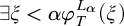 $\exists \xi <\alpha \varphi _T^{L_{\boldsymbol {\alpha }}}(\xi )$
fails. That is, for each
$\exists \xi <\alpha \varphi _T^{L_{\boldsymbol {\alpha }}}(\xi )$
fails. That is, for each $\xi <\alpha $
, we can find a
$\xi <\alpha $
, we can find a $\Sigma _1$
sentence
$\Sigma _1$
sentence $\sigma $
such that
$\sigma $
such that $T\vdash \sigma ^{L_{\boldsymbol {\alpha }}}$
but
$T\vdash \sigma ^{L_{\boldsymbol {\alpha }}}$
but $L_\xi \models \lnot \sigma $
. Now take
$L_\xi \models \lnot \sigma $
. Now take
 $$ \begin{align*} b=\{\sigma\in \Sigma_1\mid T\vdash \sigma^{L_\alpha}\}. \end{align*} $$
b may not be an element of $L_\alpha $
, but it is a subset of the set of
$L_\alpha $
, but it is a subset of the set of $\Sigma _1$
-formulas, and we can view the set of all
$\Sigma _1$
-formulas, and we can view the set of all $\Sigma _1$
-formulas as a recursive subset of
$\Sigma _1$
-formulas as a recursive subset of $\omega $
. That is, b is separated by a
$\omega $
. That is, b is separated by a $\Pi ^{\boldsymbol {\alpha }}_1$
-formula from a set in
$\Pi ^{\boldsymbol {\alpha }}_1$
-formula from a set in $L_\alpha $
. Furthermore, if we take f to be
$L_\alpha $
. Furthermore, if we take f to be
 $$ \begin{align*} f(\sigma) = \text{the least } \xi<\alpha \text{ such that }L_\xi\models \sigma \text{ if it exists,} \end{align*} $$
for a $\Sigma _1$
sentence
$\Sigma _1$
sentence $\sigma $
, then f is a partial
$\sigma $
, then f is a partial $\Sigma ^{\boldsymbol {\alpha }}_1$
function.
$\Sigma ^{\boldsymbol {\alpha }}_1$
function.
By $\mathsf {RFN}_{\Sigma ^{\boldsymbol {\alpha }}_1}$
, we can see that f is defined for all
$\mathsf {RFN}_{\Sigma ^{\boldsymbol {\alpha }}_1}$
, we can see that f is defined for all $\Sigma _1$
-sentence
$\Sigma _1$
-sentence $\sigma \in b$
. However, by our assumption, for every
$\sigma \in b$
. However, by our assumption, for every $\xi <\alpha $
, we can find
$\xi <\alpha $
, we can find $\sigma \in b$
such that
$\sigma \in b$
such that $f(\sigma )>\xi $
. This contradicts Lemma 7.5.
$f(\sigma )>\xi $
. This contradicts Lemma 7.5.
Let us remind the reader that we have argued that T-provability is also $\Pi ^{\boldsymbol {\alpha }}_1$
because definable objects over
$\Pi ^{\boldsymbol {\alpha }}_1$
because definable objects over $\omega $
are
$\omega $
are $\alpha $
-recursive for
$\alpha $
-recursive for $\alpha \ge \omega _1^{\mathsf {CK}}$
. If
$\alpha \ge \omega _1^{\mathsf {CK}}$
. If $\alpha =\omega $
, then the T-provability relation will be
$\alpha =\omega $
, then the T-provability relation will be $\Sigma ^\omega _2$
.
$\Sigma ^\omega _2$
.
Then the proof of Theorem 7.1 follows almost immediately.
Proof of Theorem 7.1
Suppose that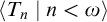 $\langle T_n\mid n<\omega \rangle $
is a sequence of
$\langle T_n\mid n<\omega \rangle $
is a sequence of $\Sigma ^{\boldsymbol {\alpha }}_1$
-sound,
$\Sigma ^{\boldsymbol {\alpha }}_1$
-sound, $\Pi ^{\boldsymbol {\alpha }}_1$
-definable extensions of
$\Pi ^{\boldsymbol {\alpha }}_1$
-definable extensions of $\mathsf {KP}_1 + \operatorname {\mathsf {Exists}}({\boldsymbol {\alpha }})$
such that for each n,
$\mathsf {KP}_1 + \operatorname {\mathsf {Exists}}({\boldsymbol {\alpha }})$
such that for each n, $T_n\vdash \mathsf {RFN}_{\Sigma ^{\boldsymbol {\alpha }}_1}(T_{n+1})$
. By Lemma 7.6 and that
$T_n\vdash \mathsf {RFN}_{\Sigma ^{\boldsymbol {\alpha }}_1}(T_{n+1})$
. By Lemma 7.6 and that $T_n\supseteq \mathsf {KP}_1 + \operatorname {\mathsf {Exists}}({\boldsymbol {\alpha }})$
, we have
$T_n\supseteq \mathsf {KP}_1 + \operatorname {\mathsf {Exists}}({\boldsymbol {\alpha }})$
, we have $\Sigma _1$
formulas
$\Sigma _1$
formulas $\varphi _{T_n}$
such that
$\varphi _{T_n}$
such that
 $$ \begin{align*} T_n\vdash \mathsf{RFN}_{\Sigma^{\boldsymbol{\alpha}}_1}(T_{n+1})\to \exists\xi<{\boldsymbol{\alpha}} \varphi^{L_{\boldsymbol{\alpha}}}_{T_{n+1}}(\xi). \end{align*} $$
Hence $T_n\vdash \exists \xi <{\boldsymbol {\alpha }} \varphi ^{L_{\boldsymbol {\alpha }}}_{T_{n+1}}(\xi )$
. By the definition of
$T_n\vdash \exists \xi <{\boldsymbol {\alpha }} \varphi ^{L_{\boldsymbol {\alpha }}}_{T_{n+1}}(\xi )$
. By the definition of $|T|_{\Sigma ^{\boldsymbol {\alpha }}_1}$
, we have
$|T|_{\Sigma ^{\boldsymbol {\alpha }}_1}$
, we have $L_{|T|_{\Sigma ^{\boldsymbol {\alpha }}_1}}\models \exists \xi \varphi _{T_{n+1}}(\xi )$
.
$L_{|T|_{\Sigma ^{\boldsymbol {\alpha }}_1}}\models \exists \xi \varphi _{T_{n+1}}(\xi )$
.
Since $\varphi _{T_{n+1}}$
is
$\varphi _{T_{n+1}}$
is $\Sigma _1$
,
$\Sigma _1$
, $L_{|T_n|_{\Sigma ^{\boldsymbol {\alpha }}_1}}\models \exists \xi \varphi _{T_{n+1}}(\xi )$
implies
$L_{|T_n|_{\Sigma ^{\boldsymbol {\alpha }}_1}}\models \exists \xi \varphi _{T_{n+1}}(\xi )$
implies $\exists \xi < |T_n|_{\Sigma ^{\boldsymbol {\alpha }}_1}\ L_\alpha \models \varphi _{T_{n+1}}(\xi )$
, which is equivalent to
$\exists \xi < |T_n|_{\Sigma ^{\boldsymbol {\alpha }}_1}\ L_\alpha \models \varphi _{T_{n+1}}(\xi )$
, which is equivalent to
 $$ \begin{align*} \exists \xi<|T_n|_{\Sigma^{\boldsymbol{\alpha}}_1} \varphi_{T_{n+1}}^{L_\alpha}(\xi), \end{align*} $$
so $|T_{n+1}|_{\Sigma ^{\boldsymbol {\alpha }}_1}<|T_n|_{\Sigma ^{\boldsymbol {\alpha }}_1}$
. It holds for all n, so we have an infinite decreasing sequence of ordinals, a contradiction.
$|T_{n+1}|_{\Sigma ^{\boldsymbol {\alpha }}_1}<|T_n|_{\Sigma ^{\boldsymbol {\alpha }}_1}$
. It holds for all n, so we have an infinite decreasing sequence of ordinals, a contradiction.
Remark 7.7. A version of Gödel’s second incompleteness follows as a special case, namely, T cannot prove its own reflection principle $\mathsf {RFN}_{\Sigma _1^{\boldsymbol {\alpha }}}(T)$
assuming that T is a
$\mathsf {RFN}_{\Sigma _1^{\boldsymbol {\alpha }}}(T)$
assuming that T is a $\Sigma ^{\boldsymbol {\alpha }}_1$
-sound
$\Sigma ^{\boldsymbol {\alpha }}_1$
-sound $\Pi ^{\boldsymbol {\alpha }}_1$
-definable extension of
$\Pi ^{\boldsymbol {\alpha }}_1$
-definable extension of $\mathsf {KP}_1 + \operatorname {\mathsf {Exists}}({\boldsymbol {\alpha }})$
. To see that this is an analogue of Gödel’s theorem, note that another way of stating Gödel’s theorem is that T cannot prove its own reflection principle
$\mathsf {KP}_1 + \operatorname {\mathsf {Exists}}({\boldsymbol {\alpha }})$
. To see that this is an analogue of Gödel’s theorem, note that another way of stating Gödel’s theorem is that T cannot prove its own reflection principle $\mathsf {RFN}_{\Pi ^0_1}(T)$
assuming that T is a
$\mathsf {RFN}_{\Pi ^0_1}(T)$
assuming that T is a $\Pi ^0_1$
-sound
$\Pi ^0_1$
-sound $\Sigma ^0_1$
-definable extension of
$\Sigma ^0_1$
-definable extension of $\mathsf {EA}$
(see the discussion in [Reference Walsh28, Section 1]).
$\mathsf {EA}$
(see the discussion in [Reference Walsh28, Section 1]).
8 Higher pointclasses
Throughout this article, we gave various characterizations of generalized ordinal analysis and reflection principles in the context of set theories. There are some points that we have not addressed in detail so far, but that are still worth discussing. First, we will discuss connections between our results and inductive definitions. Then we will discuss how to generalize our results to theories inconsistent with the axiom $V=L$
.
$V=L$
.
8.1 Inductive definitions
In section 5 we proved that $|T|_{\Sigma ^{\boldsymbol {\alpha }}_1}$
gauges the complexity of the T-provably total
$|T|_{\Sigma ^{\boldsymbol {\alpha }}_1}$
gauges the complexity of the T-provably total ${\boldsymbol {\alpha }}$
-recursive function. In this section, we will discuss the connections between
${\boldsymbol {\alpha }}$
-recursive function. In this section, we will discuss the connections between $|T|_{\Sigma ^{\boldsymbol {\alpha }}_1}$
and inductive definitions. The classic theory of inductive definitions yields a “bottom up” perspective on the
$|T|_{\Sigma ^{\boldsymbol {\alpha }}_1}$
and inductive definitions. The classic theory of inductive definitions yields a “bottom up” perspective on the $\Pi ^1_1$
-definable sets. Pohlers has emphasized in various places that iterating inductive definitions yields a very fine-grained stratification of sets of natural numbers into pointclasses. For instance, iterated inductive definitions yield a fine-grained stratification of the
$\Pi ^1_1$
-definable sets. Pohlers has emphasized in various places that iterating inductive definitions yields a very fine-grained stratification of sets of natural numbers into pointclasses. For instance, iterated inductive definitions yield a fine-grained stratification of the $\Delta ^1_2$
sets. In this section we will show that our generalized notions of ordinal analysis provide an alternate perspective on these fine-grained pointclasses.
$\Delta ^1_2$
sets. In this section we will show that our generalized notions of ordinal analysis provide an alternate perspective on these fine-grained pointclasses.
First, let’s briefly introduce inductive definitions.
Let $\mathfrak {M}$
be a structure and
$\mathfrak {M}$
be a structure and $\varphi (n, X)$
be an
$\varphi (n, X)$
be an $\mathfrak {M}$
formula except with a set variable X occurring positively. Then we may view
$\mathfrak {M}$
formula except with a set variable X occurring positively. Then we may view $\varphi $
as a monotone operator
$\varphi $
as a monotone operator
 $$ \begin{align*}\Gamma_\varphi(X)=\{n\mid \mathfrak{M}\models \varphi(n,X)\}.\end{align*} $$
For a class $\boldsymbol {\Delta }$
of formulas, we say that a set
$\boldsymbol {\Delta }$
of formulas, we say that a set $X\subseteq \textsf {domain}(\mathfrak {M})$
is
$X\subseteq \textsf {domain}(\mathfrak {M})$
is $\boldsymbol {\Delta }$
-inductive if X is the least fixed point
$\boldsymbol {\Delta }$
-inductive if X is the least fixed point $I_\varphi $
of an operator
$I_\varphi $
of an operator $\Gamma _\varphi $
for
$\Gamma _\varphi $
for $\varphi \in \boldsymbol {\Delta }$
. In previous work, other logicians have been particularly concerned with the structure
$\varphi \in \boldsymbol {\Delta }$
. In previous work, other logicians have been particularly concerned with the structure $\mathbb {N}$
of natural numbers in an expansion of the language of arithmetic. If
$\mathbb {N}$
of natural numbers in an expansion of the language of arithmetic. If $\boldsymbol {\Delta }$
is the set of all first-order formulas over
$\boldsymbol {\Delta }$
is the set of all first-order formulas over $\mathfrak {M}$
, we call the
$\mathfrak {M}$
, we call the $\boldsymbol {\Delta }$
-Inductive sets the inductive sets.
$\boldsymbol {\Delta }$
-Inductive sets the inductive sets.
We have just defined inductive sets from a top-down point-of-view, but there is also a standard understanding of inductive sets from a bottom-up point-of-view: Let $\varphi (n, X)$
be a first-order formula with X occurring positively, and let
$\varphi (n, X)$
be a first-order formula with X occurring positively, and let $\Gamma _\varphi $
be the corresponding monotone operator. Consider
$\Gamma _\varphi $
be the corresponding monotone operator. Consider $I^\xi _\varphi $
defined recursively by
$I^\xi _\varphi $
defined recursively by $I^\xi _\varphi = \bigcup _{\eta <\xi } \Gamma _\varphi (I^\eta _\varphi )$
. Then there is a least ordinal
$I^\xi _\varphi = \bigcup _{\eta <\xi } \Gamma _\varphi (I^\eta _\varphi )$
. Then there is a least ordinal $\gamma $
such that
$\gamma $
such that $I^\gamma _\varphi =I^{\gamma +1}_\varphi $
, and
$I^\gamma _\varphi =I^{\gamma +1}_\varphi $
, and $I^\gamma _\varphi $
is an inductive set
$I^\gamma _\varphi $
is an inductive set $I_\varphi $
generated by
$I_\varphi $
generated by $\varphi $
. We call
$\varphi $
. We call $\gamma $
the closure ordinal of
$\gamma $
the closure ordinal of $\Gamma _\varphi $
. Also, for
$\Gamma _\varphi $
. Also, for $n\in I_\varphi $
, define the
$n\in I_\varphi $
, define the $\varphi $
-norm by
$\varphi $
-norm by
 $$ \begin{align*} |n|_\varphi = \min \{\xi \mid n\in I^{\xi+1}_\varphi\}. \end{align*} $$
It is well-known (cf. [Reference Moschovakis16]) that the inductive sets over $\mathbb {N}$
are precisely the
$\mathbb {N}$
are precisely the $\Pi ^1_1$
-sets, which are also precisely the
$\Pi ^1_1$
-sets, which are also precisely the $\Sigma _1^{\omega _1^{\mathsf {CK}}}$
-sets. Furthermore,
$\Sigma _1^{\omega _1^{\mathsf {CK}}}$
-sets. Furthermore, $|T|_{\omega _1^{\mathsf {CK}}}$
is the supremum of all
$|T|_{\omega _1^{\mathsf {CK}}}$
is the supremum of all $\varphi $
-norms of n that is T-provably in
$\varphi $
-norms of n that is T-provably in $I_\varphi $
(cf. [Reference Pohlers20, Section 6]):
$I_\varphi $
(cf. [Reference Pohlers20, Section 6]):
 $$ \begin{align*} |T|_{\omega_1^{\mathsf{CK}}} = \sup\{|n|_\varphi \mid \gamma\text{ is a closure ordinal of an arithmetical } \varphi \text{ and }T\vdash n\in I_\varphi\}. \end{align*} $$
We can climb beyond the $\Pi ^1_1$
sets to higher pointclasses by iterating inductive definitions. For instance, if
$\Pi ^1_1$
sets to higher pointclasses by iterating inductive definitions. For instance, if $\boldsymbol {\Delta }$
is the pointclass of all inductive sets, then the
$\boldsymbol {\Delta }$
is the pointclass of all inductive sets, then the $\boldsymbol {\Delta }$
-Inductive sets go beyond the pointlcass of
$\boldsymbol {\Delta }$
-Inductive sets go beyond the pointlcass of $\Pi ^1_1$
sets. Pohlers [Reference Pohlers21] formulated a framework to describe sets defined by iterated inductive definitions by iterating the notion of Spector classes due to Moschovakis [Reference Moschovakis16] (see [Reference Pohlers21, Section 3.3] for Pohlers’ definitions).
$\Pi ^1_1$
sets. Pohlers [Reference Pohlers21] formulated a framework to describe sets defined by iterated inductive definitions by iterating the notion of Spector classes due to Moschovakis [Reference Moschovakis16] (see [Reference Pohlers21, Section 3.3] for Pohlers’ definitions).
Definition 8.1. A Spector class $\mathcal {S}$
over a structure
$\mathcal {S}$
over a structure $\mathfrak {M}=(M,R\in \mathcal {R},f\in \mathcal {F})$
is the collection
$\mathfrak {M}=(M,R\in \mathcal {R},f\in \mathcal {F})$
is the collection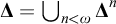 $\boldsymbol {\Delta }=\bigcup _{n<\omega }\boldsymbol {\Delta }^n$
of all relations over M satisfying the following conditions:
$\boldsymbol {\Delta }=\bigcup _{n<\omega }\boldsymbol {\Delta }^n$
of all relations over M satisfying the following conditions:
-
1.
$\boldsymbol {\Delta }$
is closed under Boolean combinations, first-order quantification, and trivial combinatorial substitutions.Footnote
11
-
2.
$\boldsymbol {\Delta }$
is universal: For each n, there is an
$(n+1)$
-ary
$U\in \boldsymbol {\Delta }^{n+1}$
such that for every n-ary
$R\in \boldsymbol {\Delta }^n$
we can find
$e\in M$
such that
$\mathfrak {M}\models \forall \vec {x} [R(\vec {x})\leftrightarrow U(e,\vec {x})]$
. -
3.
$\boldsymbol {\Delta }$
is normed: For every
$R\in \boldsymbol {\Delta }$
there is an ordinal
$\lambda $
and a norm
$\sigma _R\colon R\to \lambda $
. Furthermore, we have stage comparison relations
$<^*_{\sigma _R},\le ^*_{\sigma _R} \in \boldsymbol {\Delta }$
satisfying
$$ \begin{align*} \vec{m} <^*_{\sigma_R} \vec{n} \iff R(\vec{m})\land [R(\vec{n})\to \sigma(\vec{m})< \sigma(\vec{n})], \end{align*} $$
$$ \begin{align*} \vec{m} \le^*_{\sigma_R} \vec{n} \iff R(\vec{m})\land [R(\vec{n})\to \sigma(\vec{m})\le \sigma(\vec{n})]. \end{align*} $$
-
4.
$\mathcal {R\cup F}\subseteq \boldsymbol {\Delta }\cap \check {\boldsymbol {\Delta }}$
, where
$\check {\boldsymbol {\Delta }} = \bigcup \{R\subseteq M^n\mid M^n\setminus R\in \boldsymbol {\Delta }^n\}$
.





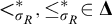




For each structure $\mathfrak {M}$
,
$\mathfrak {M}$
, $\mathbb {SP}(\mathfrak {M})$
is the intersection of all Spector classes over
$\mathbb {SP}(\mathfrak {M})$
is the intersection of all Spector classes over $\mathfrak {M}$
.
$\mathfrak {M}$
.
The class of all inductive sets is an example of a Spector class, and in fact, the least Spector class over $\mathbb {N}$
. In general, for an acceptableFootnote
12
structure
$\mathbb {N}$
. In general, for an acceptableFootnote
12
structure $\mathfrak {M}$
over a finitary language,
$\mathfrak {M}$
over a finitary language, $\mathbb {SP}(\mathfrak {M})$
is precisely the set of all inductive sets over
$\mathbb {SP}(\mathfrak {M})$
is precisely the set of all inductive sets over $\mathfrak {M}$
(Corollary 9A.3 of [Reference Moschovakis16]).
$\mathfrak {M}$
(Corollary 9A.3 of [Reference Moschovakis16]).
Definition 8.2. Let $\mathfrak {M}$
be an acceptable structure. Define
$\mathfrak {M}$
be an acceptable structure. Define
-
•
$\mathbb {SP}_{\mathfrak {M}}^0 = \varnothing $
, -
•
$\mathbb {SP}_{\mathfrak {M}}^{\xi +1} = \mathbb {SP}((\mathfrak {M}; \mathbb {SP}^\xi _{\mathfrak {M}}))$
, and -
•
$\mathbb {SP}^\delta _{\mathfrak {M}}=\bigcup _{\xi <\delta } \mathbb {SP}^\xi _{\mathfrak {M}}$
if
$\delta $
is a limit.



 $\mathbb {SP}^\xi _{\mathbb {N}}$
should give a fine division of pointclasses, which corresponds to pointsets that are many-one reducible to the
$\mathbb {SP}^\xi _{\mathbb {N}}$
should give a fine division of pointclasses, which corresponds to pointsets that are many-one reducible to the $\xi $
th iterate of hyperjumps of 0.
$\xi $
th iterate of hyperjumps of 0. $\mathbb {SP}^1_{\mathbb {N}}$
is precisely the collection of all inductive sets, or equivalently, lightface
$\mathbb {SP}^1_{\mathbb {N}}$
is precisely the collection of all inductive sets, or equivalently, lightface $\Pi ^1_1$
-sets. For a recursive ordinal
$\Pi ^1_1$
-sets. For a recursive ordinal $\xi $
, we may view
$\xi $
, we may view $(\mathbb {N};\mathbb {SP}^\xi _{\mathbb {N}})$
as a finitary structure,Footnote
13
so we may think of elements of
$(\mathbb {N};\mathbb {SP}^\xi _{\mathbb {N}})$
as a finitary structure,Footnote
13
so we may think of elements of $\mathbb {SP}^\xi _{\mathbb {N}}$
as sets given by
$\mathbb {SP}^\xi _{\mathbb {N}}$
as sets given by $<(1+\xi )$
-fold iterated inductive definition.
$<(1+\xi )$
-fold iterated inductive definition.
Since members of $\mathbb {SP}(\mathfrak {M})$
are precisely
$\mathbb {SP}(\mathfrak {M})$
are precisely $\Pi ^1_1$
sets over
$\Pi ^1_1$
sets over $\mathfrak {M}$
(see Chapter 8 of [Reference Moschovakis16]), we can derive the following characterization of members of
$\mathfrak {M}$
(see Chapter 8 of [Reference Moschovakis16]), we can derive the following characterization of members of $\mathbb {SP}^2_{\mathbb {N}}$
.
$\mathbb {SP}^2_{\mathbb {N}}$
.
Lemma 8.3. The collection of all Arithmetical-in-a- $\Pi ^1_1$
-parameter formulas is the least collection of formulas containing
$\Pi ^1_1$
-parameter formulas is the least collection of formulas containing $\Pi ^1_1$
formulas without set free variables and closed under Boolean combinations and number quantification.
$\Pi ^1_1$
formulas without set free variables and closed under Boolean combinations and number quantification.
A formula $\varphi (x,Y)$
is
$\varphi (x,Y)$
is $\Pi ^1_1$
-in-a-
$\Pi ^1_1$
-in-a- $\Pi ^1_1$
-parameter if it has of the form
$\Pi ^1_1$
-parameter if it has of the form $\forall X \varphi (x,X,Y)$
for some arithmetical-in-a-
$\forall X \varphi (x,X,Y)$
for some arithmetical-in-a- $\Pi ^1_1$
-parameter formula
$\Pi ^1_1$
-parameter formula $\varphi (x,X,Y)$
with all free variables displayed.
$\varphi (x,X,Y)$
with all free variables displayed. $\Pi ^1_1(\Pi ^1_1)$
is the collection of all
$\Pi ^1_1(\Pi ^1_1)$
is the collection of all $\Pi ^1_1$
-in-a-
$\Pi ^1_1$
-in-a- $\Pi ^1_1$
-parameter formulas.
$\Pi ^1_1$
-parameter formulas.
For $A\subseteq \mathbb {N}$
,
$A\subseteq \mathbb {N}$
, $A\in \mathbb {SP}^2_{\mathbb {N}}$
if and only if
$A\in \mathbb {SP}^2_{\mathbb {N}}$
if and only if $A=\{n \mid \mathbb {N}\models \varphi (n)\}$
for some
$A=\{n \mid \mathbb {N}\models \varphi (n)\}$
for some $\Pi ^1_1$
-in-a-
$\Pi ^1_1$
-in-a- $\Pi ^1_1$
-parameter formula
$\Pi ^1_1$
-parameter formula $\varphi (x)$
.
$\varphi (x)$
.
By the Barwise–Gandy–Moschovakis theorem (see Chapter 9 of [Reference Moschovakis16]), the members of $\mathbb {SP}^{\mu +1}_{\mathbb {N}}$
are exactly the
$\mathbb {SP}^{\mu +1}_{\mathbb {N}}$
are exactly the $\Sigma _1^{\omega _{\mu +1}^{\mathsf {CK}}}$
-definable subsets of
$\Sigma _1^{\omega _{\mu +1}^{\mathsf {CK}}}$
-definable subsets of $\mathbb {N}$
. Pohlers also defines the following:
$\mathbb {N}$
. Pohlers also defines the following:
 $$ \begin{align*} \kappa^\mu_{\mathbb{N}}(T) := \sup\{\sigma_R(\vec{m})+1\mid R =\{\vec{m}\in \mathbb{N}^n \mid F(\vec{m})\}\in \mathbb{SP}^\mu_{\mathbb{N}},\ T\vdash F(\vec{m})\}. \end{align*} $$
Informally, $\kappa ^\mu _{\mathbb {N}}(T)$
corresponds to the supremum of the closure ordinals of the members of
$\kappa ^\mu _{\mathbb {N}}(T)$
corresponds to the supremum of the closure ordinals of the members of $\mathbb {SP}^\mu _{\mathbb {N}}$
that are provably definable over T.
$\mathbb {SP}^\mu _{\mathbb {N}}$
that are provably definable over T.
If $\omega ^{\mathsf {CK}}_{\mu +1}$
admits a representation, which is always the case for recursive
$\omega ^{\mathsf {CK}}_{\mu +1}$
admits a representation, which is always the case for recursive $\mu $
, then we have
$\mu $
, then we have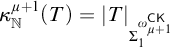 $\kappa _{\mathbb {N}}^{\mu +1}(T) = |T|_{\Sigma _1^{\omega _{\mu +1}^{\mathsf {CK}}}}$
. That is, our results concerning the latter also characterize the closure ordinals of iterated Spector classes. Accordingly, this provides a proof-theoretic analysis of the members of iterated Spector classes, even though iterated Spector classes are semantically defined. For example, by applying the results in Section 6 to
$\kappa _{\mathbb {N}}^{\mu +1}(T) = |T|_{\Sigma _1^{\omega _{\mu +1}^{\mathsf {CK}}}}$
. That is, our results concerning the latter also characterize the closure ordinals of iterated Spector classes. Accordingly, this provides a proof-theoretic analysis of the members of iterated Spector classes, even though iterated Spector classes are semantically defined. For example, by applying the results in Section 6 to $\mu =2$
, we can derive the following.
$\mu =2$
, we can derive the following.
Corollary 8.4. Let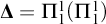 $\boldsymbol {\Delta }=\Pi ^1_1(\Pi ^1_1)$
and T, U be
$\boldsymbol {\Delta }=\Pi ^1_1(\Pi ^1_1)$
and T, U be $\widehat {\boldsymbol {\Delta }}$
-definable
$\widehat {\boldsymbol {\Delta }}$
-definable $\boldsymbol {\Delta }$
-sound extensions of
$\boldsymbol {\Delta }$
-sound extensions of $\mathsf {KP}_1 + \operatorname {\mathsf {Exists}}(\omega _2^{\mathsf {CK}})$
, where
$\mathsf {KP}_1 + \operatorname {\mathsf {Exists}}(\omega _2^{\mathsf {CK}})$
, where $\widehat {\boldsymbol {\Delta }}=\{\lnot \varphi \mid \varphi \in \boldsymbol {\Delta }\}$
. Then
$\widehat {\boldsymbol {\Delta }}=\{\lnot \varphi \mid \varphi \in \boldsymbol {\Delta }\}$
. Then
 $$ \begin{align*} T\subseteq^{\widehat{\boldsymbol{\Delta}}}_{\boldsymbol{\Delta}} U \iff |T|_{\boldsymbol{\Delta}}\le |U|_{\boldsymbol{\Delta}}. \end{align*} $$
8.2 Theories beyond
$V=L$

Theorem 6.9 demonstrates that a broad class of theories is well-ordered by a natural proof-theoretic comparison relation, namely, comparison of $\Sigma ^{\boldsymbol {\alpha }}_1$
theorems modulo a
$\Sigma ^{\boldsymbol {\alpha }}_1$
theorems modulo a $\Pi ^{\boldsymbol {\alpha }}_1$
oracle. This is done by connecting this comparison relation to
$\Pi ^{\boldsymbol {\alpha }}_1$
oracle. This is done by connecting this comparison relation to ${\boldsymbol {\alpha }}$
ordinal analysis. By definition,
${\boldsymbol {\alpha }}$
ordinal analysis. By definition, ${\boldsymbol {\alpha }}$
ordinal analysis measures how closely an axiom system coheres with Gödel’s constructible universe L. Thus, throughout this article, we have assumed that
${\boldsymbol {\alpha }}$
ordinal analysis measures how closely an axiom system coheres with Gödel’s constructible universe L. Thus, throughout this article, we have assumed that $V=L$
. We now turn to generalize Theorem 6.9 to axiomatic systems inconsistent with the assumption
$V=L$
. We now turn to generalize Theorem 6.9 to axiomatic systems inconsistent with the assumption $V=L$
. We are particularly interested in large cardinal axioms and other theories that prove the existence of
$V=L$
. We are particularly interested in large cardinal axioms and other theories that prove the existence of $0^\sharp $
. Though we have assumed
$0^\sharp $
. Though we have assumed $V=L$
throughout our article, the authors believe that very similar arguments should carry over to more complicated fine structural inner models allowing larger large cardinals. The following proposition explains why this should be.
$V=L$
throughout our article, the authors believe that very similar arguments should carry over to more complicated fine structural inner models allowing larger large cardinals. The following proposition explains why this should be.
Proposition 8.5. Let $\alpha $
be an admissible ordinal admitting a
$\alpha $
be an admissible ordinal admitting a $\Sigma _1$
definition
$\Sigma _1$
definition $\varphi (x)$
and a
$\varphi (x)$
and a $\Pi _1$
definition
$\Pi _1$
definition $\psi (x)$
such that
$\psi (x)$
such that $\mathsf {ZFC}^-$
Footnote
14
proves
$\mathsf {ZFC}^-$
Footnote
14
proves $\exists x \varphi (x)$
and
$\exists x \varphi (x)$
and $\varphi (x)\leftrightarrow \psi (x)$
. (In particular this applies in the case
$\varphi (x)\leftrightarrow \psi (x)$
. (In particular this applies in the case $\alpha =\omega _1^{\mathsf {CK}}$
.) If
$\alpha =\omega _1^{\mathsf {CK}}$
.) If $\vec {E}$
is an extender sequence, then
$\vec {E}$
is an extender sequence, then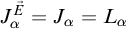 $J^{\vec {E}}_\alpha = J_\alpha = L_\alpha $
.
$J^{\vec {E}}_\alpha = J_\alpha = L_\alpha $
.
Proof. The inner model $J^{\vec {E}}_\alpha $
agrees with
$J^{\vec {E}}_\alpha $
agrees with $J_\alpha $
below the first level
$J_\alpha $
below the first level $\lambda $
such that
$\lambda $
such that $J^{\vec {E}}_\lambda $
recognizes that the
$J^{\vec {E}}_\lambda $
recognizes that the $\lambda $
th extender
$\lambda $
th extender $\vec {E}(\lambda )$
is not empty. Let
$\vec {E}(\lambda )$
is not empty. Let $\kappa $
be its critical point. Then
$\kappa $
be its critical point. Then $J^{\vec {E}}_\lambda $
recognizes that
$J^{\vec {E}}_\lambda $
recognizes that $\kappa $
is a cardinal, so we get
$\kappa $
is a cardinal, so we get $J^{\vec {E}}_\kappa \models \mathsf {ZFC}^-$
, whence
$J^{\vec {E}}_\kappa \models \mathsf {ZFC}^-$
, whence $J^{\vec {E}}_\kappa \models \exists x \varphi (x)$
. But
$J^{\vec {E}}_\kappa \models \exists x \varphi (x)$
. But $\varphi $
is
$\varphi $
is $\Delta _1$
over
$\Delta _1$
over $J^{\vec {E}}_\kappa =J_\kappa $
. By upward absoluteness,
$J^{\vec {E}}_\kappa =J_\kappa $
. By upward absoluteness, $L[\vec {E}]\models \exists x \varphi (x)$
, and since
$L[\vec {E}]\models \exists x \varphi (x)$
, and since $\varphi $
is
$\varphi $
is $\Delta _1$
,
$\Delta _1$
, $\varphi $
defines the same ordinal over L as it does over
$\varphi $
defines the same ordinal over L as it does over $L[\vec {E}]$
. Hence
$L[\vec {E}]$
. Hence $\alpha <\kappa <\lambda $
, and so
$\alpha <\kappa <\lambda $
, and so $J_\alpha =J^{\vec {E}}_\alpha $
.
$J_\alpha =J^{\vec {E}}_\alpha $
. $J_\alpha =L_\alpha $
follows from the admissibility of
$J_\alpha =L_\alpha $
follows from the admissibility of $\alpha $
.
$\alpha $
.
Accordingly, we can replace L in our work from the previous sections with other fine-structural inner models, as long as we work with sufficiently small admissible ordinals. Thus, the well-foundedness and linearity phenomena generalize to theories that are compatible with other fine-structural inner models.
Here is a strong consequence of the above reasoning: All extensions of $\mathsf {KP}_1 + \operatorname {\mathsf {Exists}}(\omega _1^{\mathsf {CK}})$
that are sound to some fine-structural inner model are linearly comparable with respect to
$\mathsf {KP}_1 + \operatorname {\mathsf {Exists}}(\omega _1^{\mathsf {CK}})$
that are sound to some fine-structural inner model are linearly comparable with respect to $\Sigma _1^{\omega _1^{\mathsf {CK}}}$
-reflection strength modulo
$\Sigma _1^{\omega _1^{\mathsf {CK}}}$
-reflection strength modulo $\Pi _1^{\omega _1^{\mathsf {CK}}}$
-provability. Notice that this reasoning invokes the notion of
$\Pi _1^{\omega _1^{\mathsf {CK}}}$
-provability. Notice that this reasoning invokes the notion of $\Pi _1$
truth of formulas with respect to
$\Pi _1$
truth of formulas with respect to $L_{\omega _1^{\mathsf {CK}}}$
, but not with respect to larger structures. Accordingly, one need only concede the determinacy of statements about
$L_{\omega _1^{\mathsf {CK}}}$
, but not with respect to larger structures. Accordingly, one need only concede the determinacy of statements about $L_{\omega _1^{\mathsf {CK}}}$
to recognize the linearity phenomenon, even as it applies to large cardinals and axioms of higher set theory.
$L_{\omega _1^{\mathsf {CK}}}$
to recognize the linearity phenomenon, even as it applies to large cardinals and axioms of higher set theory.
Our results may be adapted to prove a linear comparison result for higher classes of formulas. In an early draft of this article, we conjectured that the linear comparison phenomenon generalizes to $\Pi ^1_3$
for sufficiently strong theories. In private communication, Aguilera has informed us that this is indeed borne out. In particular, assuming
$\Pi ^1_3$
for sufficiently strong theories. In private communication, Aguilera has informed us that this is indeed borne out. In particular, assuming $\mathsf {ZFC}$
+
$\mathsf {ZFC}$
+ $\boldsymbol {\Delta }^1_2$
-determinacy, the recursively axiomatized extensions of
$\boldsymbol {\Delta }^1_2$
-determinacy, the recursively axiomatized extensions of $\mathsf {ZFC}$
+
$\mathsf {ZFC}$
+ $\boldsymbol {\Delta }^1_2$
-determinacy are pre-linearly ordered by the relation
$\boldsymbol {\Delta }^1_2$
-determinacy are pre-linearly ordered by the relation $\subseteq ^{\Sigma ^1_3}_{\Pi ^1_3}$
. To indicate why we conjectured this fact in an early draft of our article, let us recall the following well-known fact in inner model theory.
$\subseteq ^{\Sigma ^1_3}_{\Pi ^1_3}$
. To indicate why we conjectured this fact in an early draft of our article, let us recall the following well-known fact in inner model theory.
Theorem 8.6 (Steel [Reference Steel26, Theorem 4.12])
Let $M_n$
be the least inner model for n Woodin cardinals, and let
$M_n$
be the least inner model for n Woodin cardinals, and let $\delta ^1_n$
be the supremum of all
$\delta ^1_n$
be the supremum of all $\Delta ^1_n$
-definable well-orders over a subset of
$\Delta ^1_n$
-definable well-orders over a subset of $\omega $
. Suppose that
$\omega $
. Suppose that $M_n^\sharp $
exists, then
$M_n^\sharp $
exists, then
-
1. If n is odd, then every
$\Pi ^1_{n+2}$
-formula is equivalent to a
$\Sigma _1^{M_n|\delta ^1_{n+2}}$
-formula. -
2. If n is even, then every
$\Sigma ^1_{n+2}$
-formula is equivalent to a
$\Sigma _1^{M_n|\delta ^1_{n+2}}$
-formula.


Here $M_n|\alpha = (L_\alpha [\vec {E}],\vec {E}|\alpha )$
when
$M_n|\alpha = (L_\alpha [\vec {E}],\vec {E}|\alpha )$
when $M_n=L[\vec {E}]$
. For the case
$M_n=L[\vec {E}]$
. For the case $n=1$
, the presence of
$n=1$
, the presence of $M_1^\sharp $
implies that every
$M_1^\sharp $
implies that every $\Pi ^1_3$
-sentence is equivalent to a
$\Pi ^1_3$
-sentence is equivalent to a $\Sigma _1^{M_1|\delta ^1_3}$
-formula. We conjecture that
$\Sigma _1^{M_1|\delta ^1_3}$
-formula. We conjecture that $\mathsf {ZFC}$
+
$\mathsf {ZFC}$
+ $\boldsymbol {\Delta }^1_2$
-determinacy proves that the following are equivalent for “sufficiently strong” theories
$\boldsymbol {\Delta }^1_2$
-determinacy proves that the following are equivalent for “sufficiently strong” theories $T,U$
that prove the existence of
$T,U$
that prove the existence of $M_1^\sharp $
:
$M_1^\sharp $
:
-
1. Either
$T\subseteq _{\Pi ^1_3}^{\Sigma ^1_3}U$
or
$U\subseteq _{\Pi ^1_3}^{\Sigma ^1_3}T$
. -
2. Either
$T\subseteq _{\Sigma _1^{M_1|\delta ^1_3}}^{\Pi _1^{M_1|\delta ^1_3}}U$
or
$U\subseteq _{\Sigma _1^{M_1|\delta ^1_3}}^{\Pi _1^{M_1|\delta ^1_3}}T$
.


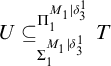
This equivalence should follow from Theorem 8.6. Extensions of our methods should secure the second statement of the equivalence, thereby securing the first.
As a side note, the reader may wonder if the linear comparison phenomenon holds for $\Pi ^1_{n+1}$
-consequences or
$\Pi ^1_{n+1}$
-consequences or $\Sigma ^1_n$
-consequences for
$\Sigma ^1_n$
-consequences for $n\ge 1$
. The following result by Aguilera and Pakhomov provides a negative answer.
$n\ge 1$
. The following result by Aguilera and Pakhomov provides a negative answer.
Theorem 8.7 [Reference Aguilera and Pakhomov2]
Working over $\mathsf {ZFC}$
with
$\mathsf {ZFC}$
with $\omega $
many Woodin cardinals, let
$\omega $
many Woodin cardinals, let $\Gamma $
be either one of
$\Gamma $
be either one of $\Sigma ^1_1$
,
$\Sigma ^1_1$
, $\Pi ^1_2$
,
$\Pi ^1_2$
, $\Sigma ^1_3$
,
$\Sigma ^1_3$
, $\Pi ^1_4$
,
$\Pi ^1_4$
, $\ldots $
, and let
$\ldots $
, and let $\widehat {\Gamma }$
be the set of all negations of formulas in
$\widehat {\Gamma }$
be the set of all negations of formulas in $\Gamma $
.
$\Gamma $
.
Suppose that T is a sound recursively axiomatizable extension of $\mathsf {ACA}_0$
. Then we can find true
$\mathsf {ACA}_0$
. Then we can find true $\Gamma $
-sentences
$\Gamma $
-sentences $\varphi _0$
and
$\varphi _0$
and $\varphi _1$
such that
$\varphi _1$
such that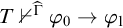 $T\nvdash ^{\widehat {\Gamma }} \varphi _0\to \varphi _1$
and
$T\nvdash ^{\widehat {\Gamma }} \varphi _0\to \varphi _1$
and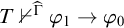 $T\nvdash ^{\widehat {\Gamma }} \varphi _1\to \varphi _0$
.
$T\nvdash ^{\widehat {\Gamma }} \varphi _1\to \varphi _0$
.
Acknowledgments
Thanks to Juan Pablo Aguilera, Wolfram Pohlers, and Shervin Sorouri for helpful discussions.






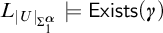
























 Open access

